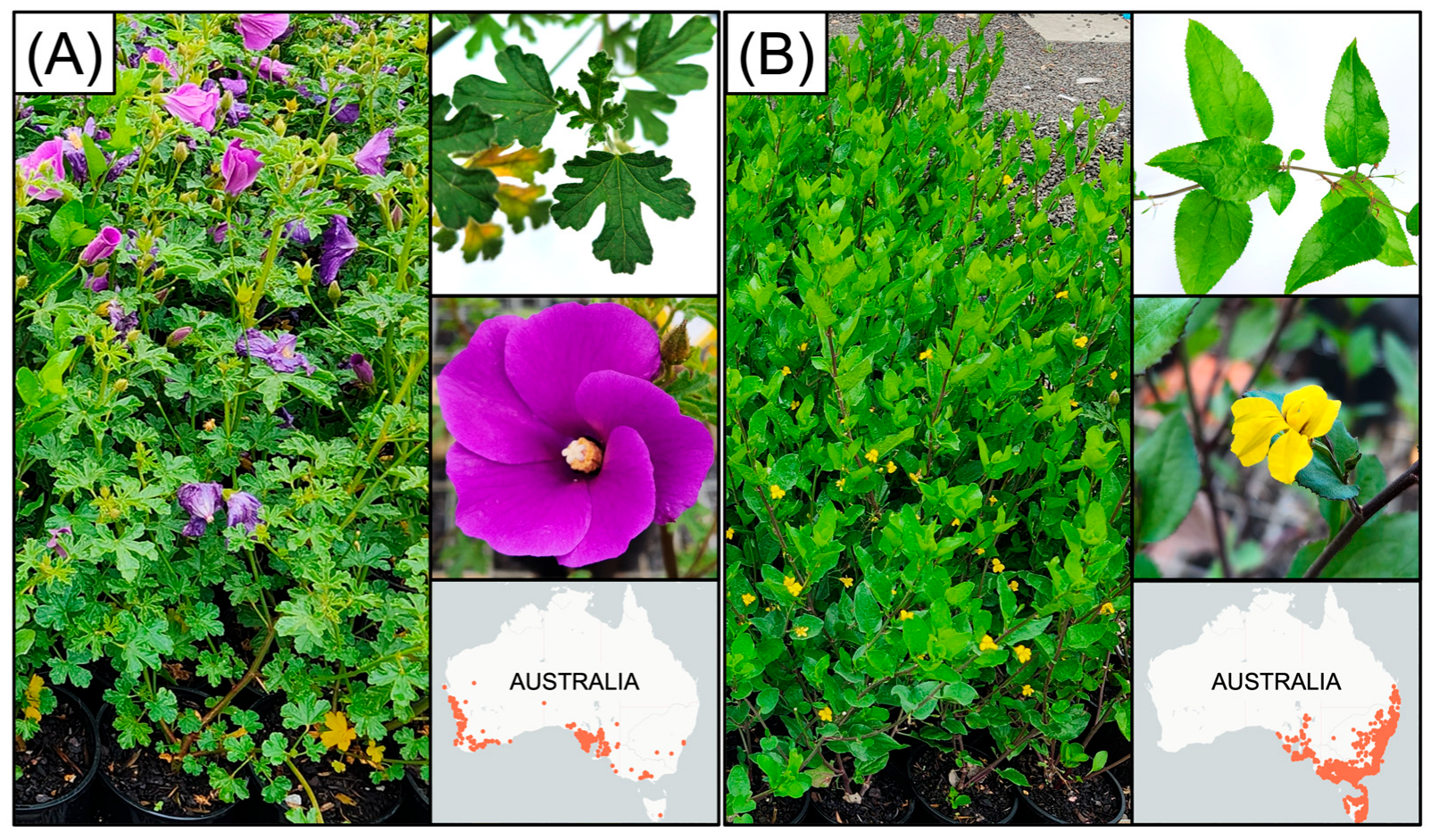

Using Recycled Construction Waste Amended with Pine Bark as a Substrate for Urban Plantings

Abstract
1. Introduction
- Greater rates of pine bark addition to mineral substrates will improve physical and hydrological properties and result in greater plant growth as compared to mixes with lower rates of pine bark addition.
- Greater rates of pine bark addition to alkaline substrates will improve chemical properties and result in greater growth of alkaline-sensitive plant species (G. ovata) than alkaline-tolerant species (A. huegelii).
2. Results
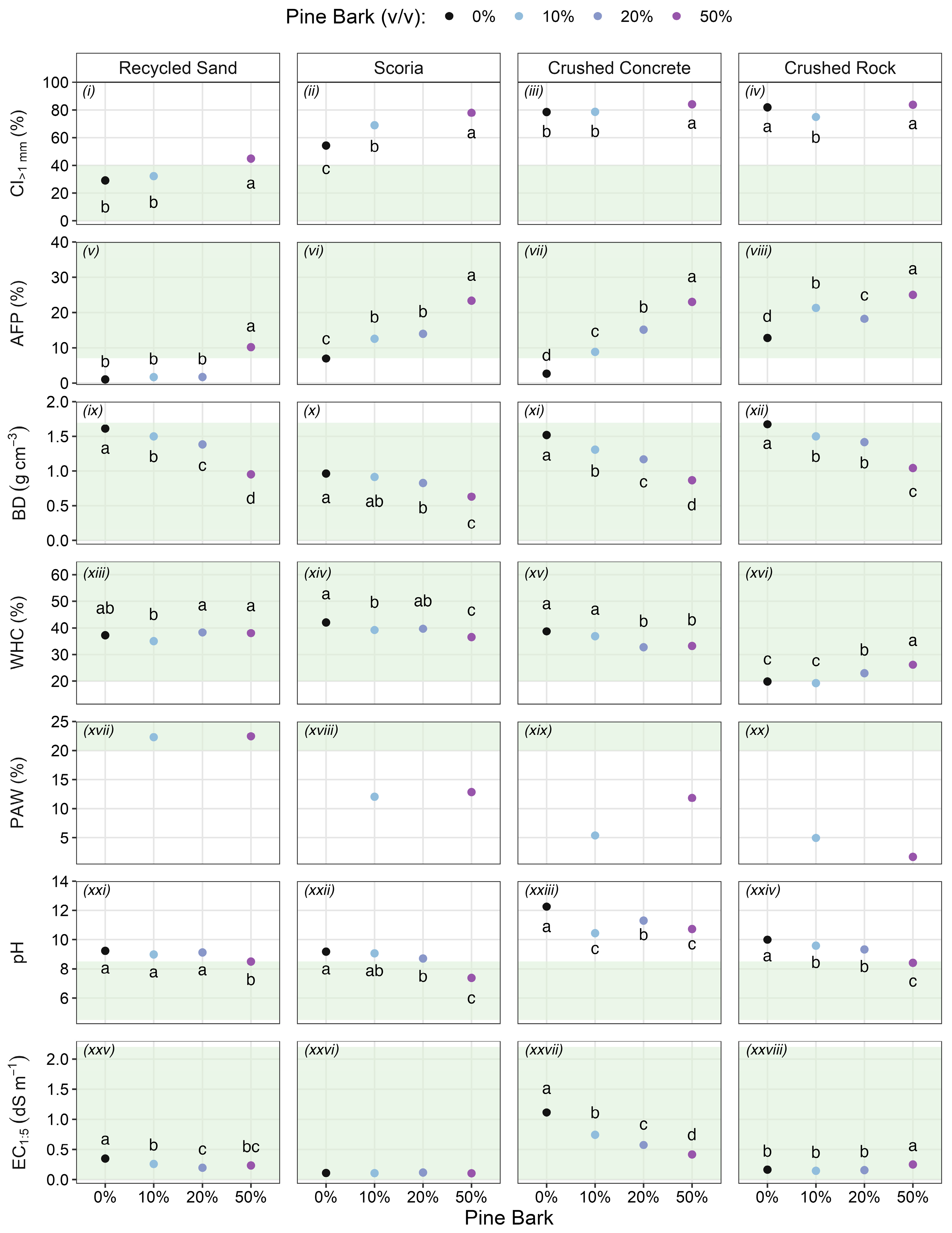
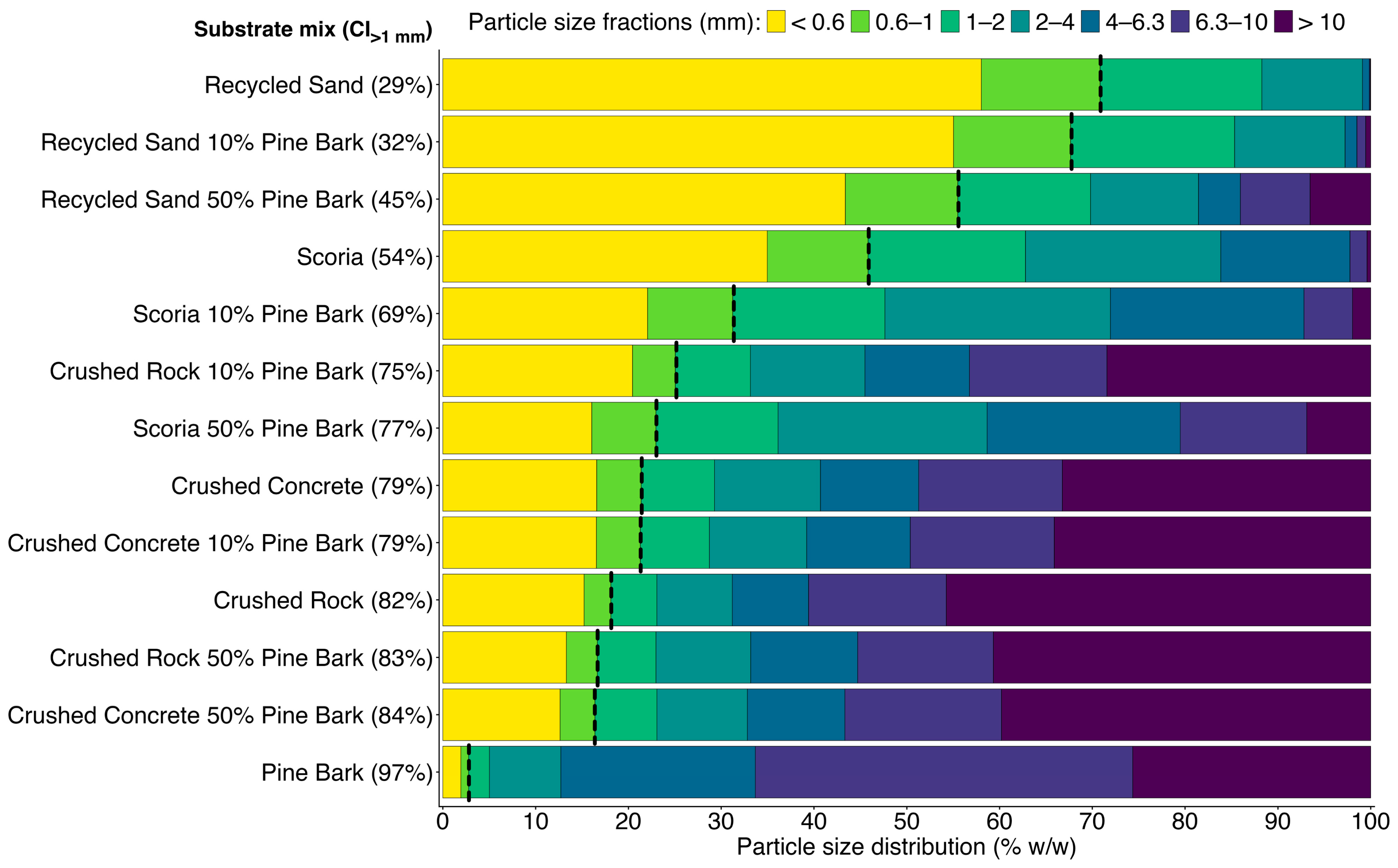
2.1. Effect of Pine Bark Addition on Substrate Properties
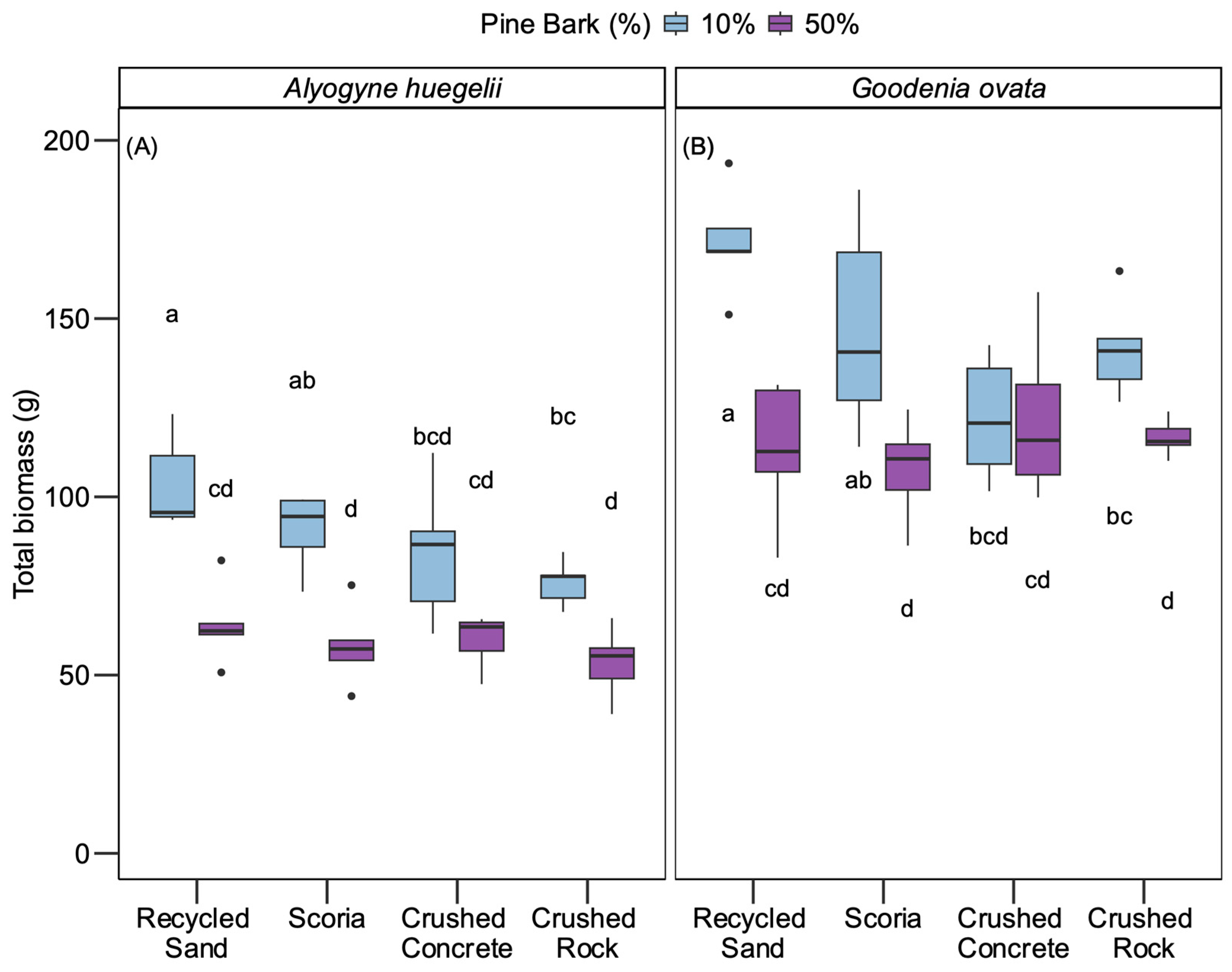
2.2. Plant Biomass and Allocation in the Container Experiment
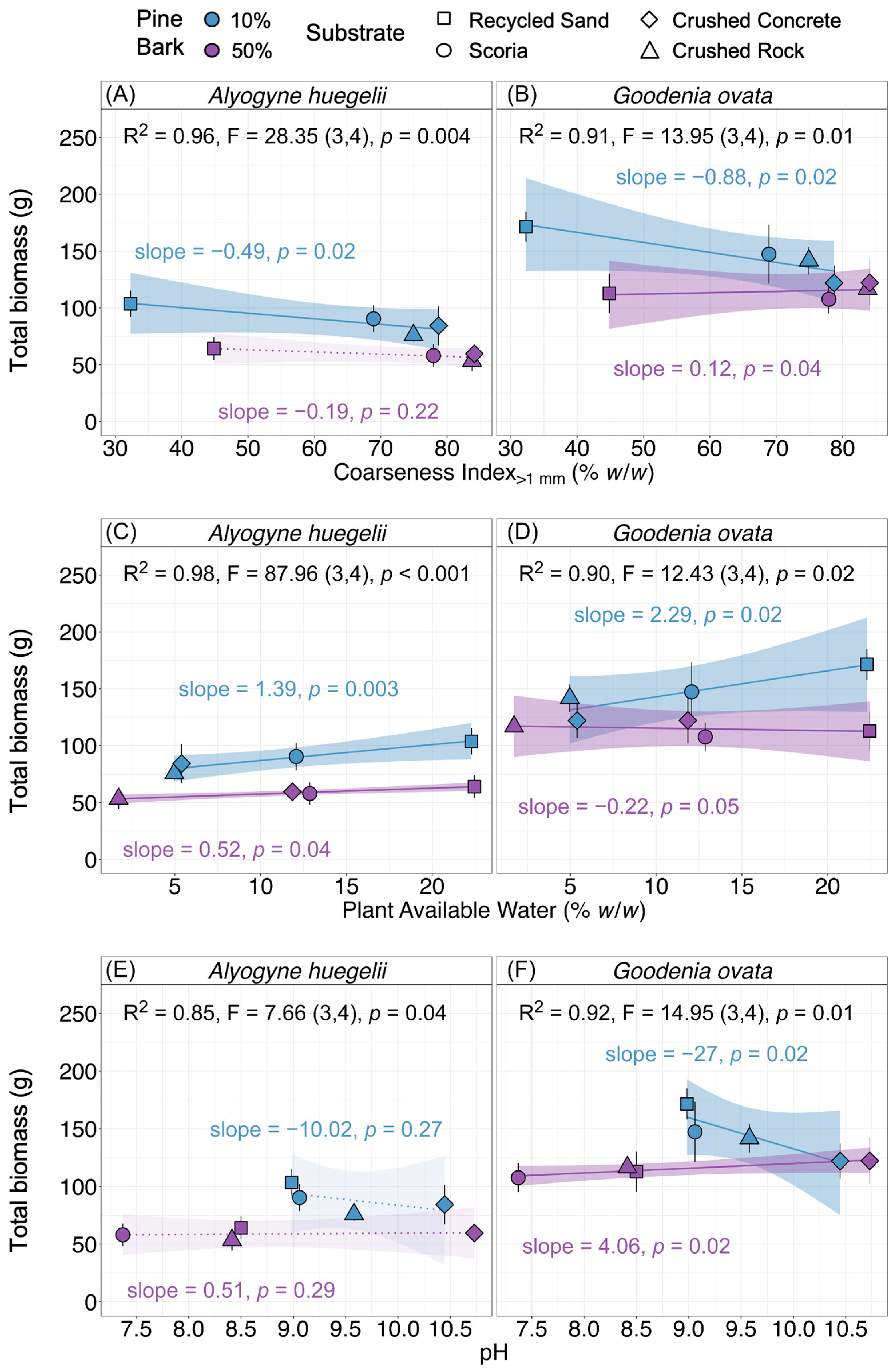
2.3. Relationships Between Substrate Physical and Hydrological Properties and Plant Biomass
2.4. Relationships Between Substrate Chemical Properties and Total Biomass
3. Discussion
3.1. Effect of Pine Bark Addition on Substrate Properties
3.2. Plant Response to Physical and Hydrological Properties Altered by Pine Bark Rate
3.3. Alkaline-Sensitive Plant Response to pH Altered by Coarseness
3.4. Limitations
4. Materials and Methods
4.1. Substrate Components
4.2. Physical and Chemical Properties of Substrate Components and Mixes
4.3. Plant Growth Experiment
4.4. Plant Biomass and Allocation
4.5. Statistical Analyses
5. Conclusions
Supplementary Materials
Author Contributions
Funding
Data Availability Statement
Acknowledgments
Conflicts of Interest
Abbreviations
| AFP | Air-filled porosity |
| AS | Australian standard |
| BD | Dry bulk density |
| CI | Coarseness index |
| EC | Electrical conductivity |
| EPA | Environmental protection agency |
| LMF | Leaf mass fraction |
| PAW | Plant available water |
| RMF | Root mass fraction |
| WHC | Water-holding capacity |
References
- Babington, A.; Hughes, M.; Farrell, C.; Chambers, J.; Standish, R.J. Preference for Multi-Layered, Flowering, Woody Streetscape Plantings in a Mediterranean-Type Climate. Urban For. Urban Green. 2023, 89, 128094. [Google Scholar] [CrossRef]
- Hitchmough, J.; Wagner, M.; Ahmad, H. Extended Flowering and High Weed Resistance within Two Layer Designed Perennial “Prairie-Meadow” Vegetation. Urban For. Urban Green. 2017, 27, 117–126. [Google Scholar] [CrossRef]
- Bretzel, F.; Vannucchi, F.; Pezzarossa, B.; Paraskevopoulou, A.; Romano, D. Establishing Wildflower Meadows in Anthropogenic Landscapes. Front. Hortic. 2024, 2, 428–436. [Google Scholar] [CrossRef]
- Horsfall, K.; Livesley, S.J.; Delpratt, J.; Hirst, M.J.; Williams, N.S.G. Interacting Effects of Sand, Slugs and Jute Drive Community Composition in Direct-seeded Urban Wildflower Meadows. J. Appl. Ecol. 2024, 61, 2762–2773. [Google Scholar] [CrossRef]
- Craul, P.J. Urban Soil: Problems and Promise. Arnoldia 1991, 51, 23–32. [Google Scholar] [CrossRef]
- Fischer, L.K.; von der Lippe, M.; Rillig, M.C.; Kowarik, I. Creating Novel Urban Grasslands by Reintroducing Native Species in Wasteland Vegetation. Biol. Conserv. 2013, 159, 119–126. [Google Scholar] [CrossRef]
- Sloan, J.J.; Ampim, P.A.Y.; Basta, N.T.; Scott, R. Addressing the Need for Soil Blends and Amendments for the Highly Modified Urban Landscape. SSSAJ 2012, 76, 1133–1141. [Google Scholar] [CrossRef]
- Horsfall, K.; Williams, N.S.G.; Michael, R.N.; Livesley, S.J. Rapid Root Development in Clay Subsoils Enhances the Early Growth of Native Grassland Species. Plant Soil 2024, 511, 1151–1172. [Google Scholar] [CrossRef]
- Jim, C.Y. Edaphic Properties and Horticultural Applications of Some Common Growing Media. Commun. Soil Sci. Plant Anal. 1996, 27, 2049–2064. [Google Scholar] [CrossRef]
- Rojas, J.A.; Dhar, A.; Naeth, M.A. Urban Green Spaces Restoration Using Native Forbs, Site Preparation and Soil Amendments—A Case Study. Land 2022, 11, 498. [Google Scholar] [CrossRef]
- Bretzel, F.; Vannucchi, F.; Pini, R.; Scatena, M.; Marradi, A.; Cinelli, F. Use of Coarse Substrate to Increase the Rate of Water Infiltration and the Bearing Capacity in Tree Plantings. Ecol. Eng. 2020, 148, 105798. [Google Scholar] [CrossRef]
- Somerville, P.D.; May, P.B.; Livesley, S.J. Effects of Deep Tillage and Municipal Green Waste Compost Amendments on Soil Properties and Tree Growth in Compacted Urban Soils. J. Environ. Manag. 2018, 227, 365–374. [Google Scholar] [CrossRef]
- Schwartz, S.S.; Smith, B. Restoring Hydrologic Function in Urban Landscapes with Suburban Subsoiling. J. Hydrol. 2016, 543, 770–781. [Google Scholar] [CrossRef]
- Somerville, P.D.; Farrell, C.; May, P.B.; Livesley, S.J. Biochar and Compost Equally Improve Urban Soil Physical and Biological Properties and Tree Growth, with No Added Benefit in Combination. Sci. Total Environ. 2020, 706, 135736. [Google Scholar] [CrossRef]
- Valkó, O.; Kelemen, A.; Kiss, O.; Bátori, Z.; Kiss, R.; Deák, B. Grassland Restoration on Linear Landscape Elements—Comparing the Effects of Topsoil Removal and Topsoil Transfer. BMC Ecol. Evol. 2024, 24, 112. [Google Scholar] [CrossRef]
- Gibson-Roy, P. Australian Grassy Community Restoration: Recognizing What Is Achievable and Charting a Way Forward. Ecol. Manag. Restor. 2022, 23, 10–24. [Google Scholar] [CrossRef]
- Morris, E.C.; Gibson-Roy, P. Comparison of Biomass Removal, Nutrient Manipulation and Native Seed Addition to Restore the Ground Layer of a Degraded Grassy Woodland. Aust. J. Bot. 2017, 66, 1–12. [Google Scholar] [CrossRef]
- Hölzel, N.; Otte, A. Restoration of a Species-rich Flood Meadow by Topsoil Removal and Diaspore Transfer with Plant Material. Appl. Veg. Sci. 2003, 6, 131–140. [Google Scholar] [CrossRef]
- Jaunatre, R.; Buisson, E.; Dutoit, T. Topsoil Removal Improves Various Restoration Treatments of a Mediterranean Steppe (La Crau, Southeast France). Appl. Veg. Sci. 2013, 17, 236–245. [Google Scholar] [CrossRef]
- Resch, M.C.; Schütz, M.; Graf, U.; Wagenaar, R.; van der Putten, W.H.; Risch, A.C. Does Topsoil Removal in Grassland Restoration Benefit Both Soil Nematode and Plant Communities? J. Appl. Ecol. 2019, 56, 1782–1793. [Google Scholar] [CrossRef]
- Buisson, E.; Holl, K.D.; Anderson, S.; Corcket, E.; Hayes, G.F.; Torre, F.; Peteers, A.; Dutoit, T. Effect of Seed Source, Topsoil Removal, and Plant Neighbor Removal on Restoring California Coastal Prairies. Restor. Ecol. 2006, 14, 569–577. [Google Scholar] [CrossRef]
- Hitchmough, J.; Kendle, T.; Paraskevopoulou, A.T. Seedling Emergence, Survival and Initial Growth of Forbs and Grasses Native to Britain and Central/Southern Europe in Low Productivity Urban “Waste” Substrates. Urban Ecosyst. 2001, 5, 285–308. [Google Scholar] [CrossRef]
- Egendorf, S.P.; Cheng, Z.; Deeb, M.; Flores, V.; Paltseva, A.; Walsh, D.; Groffman, P.; Mielke, H.W. Constructed Soils for Mitigating Lead (Pb) Exposure and Promoting Urban Community Gardening: The New York City Clean Soil Bank Pilot Study. Landsc. Urban Plan. 2018, 175, 184–194. [Google Scholar] [CrossRef]
- Hitchmough, J.D.; Kendle, A.D.; Paraskevopoulou, A.T. Emergence, Survival and Initial Growth of North American Prairie Forbs and British Meadow Forbs and Grasses in Low-Productivity Urban “Waste” Soils. J. Hortic. Sci. 2003, 78, 89–99. [Google Scholar] [CrossRef]
- Barrett, G.E.; Alexander, P.D.; Robinson, J.S.; Bragg, N.C. Achieving Environmentally Sustainable Growing Media for Soilless Plant Cultivation Systems—A Review. Sci. Hortic. 2016, 212, 220–234. [Google Scholar] [CrossRef]
- Jim, C.Y. Urban Soil Characteristics and Limitations for Landscape Planting in Hong Kong. Landsc. Urban Plan. 1998, 40, 235–249. [Google Scholar] [CrossRef]
- Séré, G.; Schwartz, C.; Ouvrard, S.; Sauvage, C.; Renat, J.-C.; Morel, J.L. Soil Construction: A Step for Ecological Reclamation of Derelict Lands. J. Soils Sediments 2008, 8, 130–136. [Google Scholar] [CrossRef]
- Abad, M.; Fornes, F.; Carrión, C.; Noguera, V.; Noguera, P.; Maquieira, Á.; Puchades, R. Physical Properties of Various Coconut Coir Dusts Compared to Peat. HortScience 2005, 40, 2138–2144. [Google Scholar] [CrossRef]
- Handreck, K.A.; Black, N.D. Growing Media for Ornamental Plants and Turf, 4th ed.; UNSW Press: Sydney, Australia, 2010; ISBN 978-1-74223-082-5. [Google Scholar]
- Mathers, H.M.; Lowe, S.B.; Scagel, C.; Struve, D.K.; Case, L.T. Abiotic Factors Influencing Root Growth of Woody Nursery Plants in Containers. HortTech 2007, 17, 151–162. [Google Scholar] [CrossRef]
- AS 3743-2003; Australian Standard for Potting Mixes. Standards Australia International: Sydney, Australia, 2003.
- Cao, C.T.N.; Farrell, C.; Kristiansen, P.E.; Rayner, J.P. Biochar Makes Green Roof Substrates Lighter and Improves Water Supply to Plants. Ecol. Eng. 2014, 71, 368–374. [Google Scholar] [CrossRef]
- Conn, R.; Werdin, J.; Rayner, J.P.; Farrell, C. Green Roof Substrate Physical Properties Differ between Standard Laboratory Tests Due to Differences in Compaction. J. Environ. Manag. 2020, 261, 110206. [Google Scholar] [CrossRef] [PubMed]
- Farrell, C.; Cao, C.T.N.; Ang, X.Q.; Rayner, J.P. Use of Water-Retention Additives to Improve Performance of Green Roof Substrates. Acta Hortic. 2016, 1108, 271–278. [Google Scholar] [CrossRef]
- Landscape Development and Landscaping Research Society e.V. (FLL). Guidelines for the Planning, Construction and Maintenance of Green-Roofs; Landscape Development and Landscaping Research Society e.V. (FLL): Bonn, Germany, 2018. [Google Scholar]
- Craul, P.J. The Nature of Urban Soils: Their Problems and Future. Arboric. J. 1994, 18, 275–287. [Google Scholar] [CrossRef]
- Hazelton, P.; Murphy, B. Interpreting Soil Test Results, 3rd ed.; CSIRO Publishing: Clayton South, VIC, Australia, 2016; ISBN 978-1-4863-0396-0. [Google Scholar]
- AS 4419-2018; Australian Standard for Soils for Landscaping and Garden Use. Standards Australia International: Sydney, Australia, 2018.
- Ampim, P.A.Y.; Sloan, J.J.; Cabrera, R.I.; Harp, D.A.; Jaber, F.H. Green Roof Growing Substrates: Types, Ingredients, Composition and Properties. J. Environ. Hortic. 2010, 28, 244–252. [Google Scholar] [CrossRef]
- Kazemi, F.; Mohorko, R. Review on the Roles and Effects of Growing Media on Plant Performance in Green Roofs in World Climates. Urban For. Urban Green. 2017, 23, 13–26. [Google Scholar] [CrossRef]
- United Nations DESA. Transforming Our World: The 2030 Agenda for Sustainable Development; United Nations DESA: New York, NY, USA, 2015. [Google Scholar]
- Jiang, N.; Zou, W.; Lu, Y.; Liao, Z.; Wu, L. Using Recycled Construction Waste Materials with Varying Components and Particle Sizes for Extensive Green Roof Substrates: Assessment of Its Effects on Vegetation Development. Sustainability 2024, 16, 414. [Google Scholar] [CrossRef]
- Kader, S.; Gratchev, I.; Michael, R.N. Recycled Waste Substrates: A Systematic Review. Sci. Total Environ. 2024, 953, 176029. [Google Scholar] [CrossRef]
- Bates, A.J.; Sadler, J.P.; Greswell, R.B.; Mackay, R. Effects of Recycled Aggregate Growth Substrate on Green Roof Vegetation Development: A Six Year Experiment. Landsc. Urban Plan. 2015, 135, 22–31. [Google Scholar] [CrossRef]
- Eksi, M.; Rowe, D.B. Green Roof Substrates: Effect of Recycled Crushed Porcelain and Foamed Glass on Plant Growth and Water Retention. Urban For. Urban Green. 2016, 20, 81–88. [Google Scholar] [CrossRef]
- Graceson, A.; Hare, M.; Hall, N.; Monaghan, J. Use of Inorganic Substrates and Composted Green Waste in Growing Media for Green Roofs. Biosyst. Eng. 2014, 124, 1–7. [Google Scholar] [CrossRef]
- Jauni, M.; Kuoppamäki, K.; Hagner, M.; Prass, M.; Suonio, T.; Fransson, A.-M.; Lehvävirta, S. Alkaline Habitat for Vegetated Roofs? Ecosystem Dynamics in a Vegetated Roof with Crushed Concrete-Based Substrate. Ecol. Eng. 2020, 157, 105970. [Google Scholar] [CrossRef]
- Barredo, O.; Vilela, J.; Garbisu, C.; Besga, G.; Alkorta, I.; Epelde, L. Technosols Made from Urban and Industrial Wastes Are a Good Option for the Reclamation of Abandoned City Plots. Geoderma 2020, 377, 114563. [Google Scholar] [CrossRef]
- Cannavo, P.; Guénon, R.; Galopin, G.; Vidal-Beaudet, L. Technosols Made with Various Urban Wastes Showed Contrasted Performance for Tree Development during a 3-Year Experiment. Environ. Earth Sci. 2018, 77, 650. [Google Scholar] [CrossRef]
- Rokia, S.; Séré, G.; Schwartz, C.; Deeb, M.; Fournier, F.; Nehls, T.; Damas, O.; Vidal-Beaudet, L. Modelling Agronomic Properties of Technosols Constructed with Urban Wastes. Waste Manag. 2014, 34, 2155–2162. [Google Scholar] [CrossRef]
- Weiler, J.; Firpo, B.A.; Schneider, I.A.H. Technosol as an Integrated Management Tool for Turning Urban and Coal Mining Waste into a Resource. Miner. Eng. 2020, 147, 106179. [Google Scholar] [CrossRef]
- Pruvost, C.; Mathieu, J.; Vallet, J.; Dubs, F.; Gigon, A.; Lerch, T.; Blouin, M. Technosols Made of Urban Wastes Are Suitable Habitats for Flora and Soil Macrofauna. Ecol. Eng. 2025, 211, 107457. [Google Scholar] [CrossRef]
- Mikajlo, I.; Pando, A.; Robain, H.; Lerch, T.Z. Reusing Asphalt Millings with Excavated Materials and Compost to Construct Technosols: Effects on Soil Properties and Plant Growth. J. Soils Sediments 2024, 25, 565–577. [Google Scholar] [CrossRef]
- Molineux, C.J.; Fentiman, C.H.; Gange, A.C. Characterising Alternative Recycled Waste Materials for Use as Green Roof Growing Media in the U.K. Ecol. Eng. 2009, 35, 1507–1513. [Google Scholar] [CrossRef]
- Bretzel, F.; Vannucchi, F.; Romano, D.; Malorgio, F.; Benvenuti, S.; Pezzarossa, B. Wildflowers: From Conserving Biodiversity to Urban Greening—A Review. Urban For. Urban Green. 2016, 20, 428–436. [Google Scholar] [CrossRef]
- Graceson, A.; Hare, M.; Monaghan, J.; Hall, N. The Water Retention Capabilities of Growing Media for Green Roofs. Ecol. Eng. 2013, 61, 328–334. [Google Scholar] [CrossRef]
- Gruda, N. Increasing Sustainability of Growing Media Constituents and Stand-Alone Substrates in Soilless Culture Systems. Agronomy 2019, 9, 298. [Google Scholar] [CrossRef]
- Werdin, J.; Conn, R.; Fletcher, T.D.; Rayner, J.P.; Williams, N.S.G.; Farrell, C. Biochar Particle Size and Amendment Rate Are More Important for Water Retention and Weight of Green Roof Substrates than Differences in Feedstock Type. Ecol. Eng. 2021, 171, 106391. [Google Scholar] [CrossRef]
- Duryea, M.L.; English, R.J.; Hermansen, L.A. A Comparison of Landscape Mulches: Chemical, Allelopathic, and Decomposition Properties. J. Arboric. 1999, 25, 88–97. [Google Scholar] [CrossRef]
- Handreck, K.A. Particle Size and the Physical Properties of Growing Media for Containers. Commun. Soil Sci. Plant Anal. 1983, 14, 209–222. [Google Scholar] [CrossRef]
- Altland, J.E.; Locke, J.C.; Krause, C.R. Influence of Pine Bark Particle Size and pH on Cation Exchange Capacity. HortTech 2014, 24, 554–559. [Google Scholar] [CrossRef]
- Farrell, C.; Rayner, J.P.; Bathgate, R. Woody Meadow Guidelines: Naturalistic Plantings of Australian Woody Plants for People and Nature; The University of Melbourne: Richmond, VIC, Australia, 2025. [Google Scholar]
- Botanic Gardens of South Australia. Plant Selector—Alyogyne huegelii. Available online: https://plantselector.botanicgardens.sa.gov.au/Plants/Details/863 (accessed on 16 May 2025).
- Botanic Gardens of South Australia. Plant Selector—Goodenia ovata. Available online: https://plantselector.botanicgardens.sa.gov.au/Plants/Details/565 (accessed on 16 May 2025).
- Nkongolo, N.V.; Caron, J. Bark Particle Sizes and the Modification of the Physical Properties of Peat Substrates. Can. J. Soil Sci. 1999, 79, 111–116. [Google Scholar] [CrossRef]
- Gartner, J.B.; Still, S.M.; Klett, J.E. The Use of Bark Waste as a Substrate in Horticulture. Acta Hortic. 1974, 37, 2003–2012. [Google Scholar] [CrossRef]
- Eksi, M.; Sevgi, O.; Akburak, S.; Yurtseven, H.; Esin, İ. Assessment of Recycled or Locally Available Materials as Green Roof Substrates. Ecol. Eng. 2020, 156, 105966. [Google Scholar] [CrossRef]
- del Pilar León, H.; Martinez, S.; del Mar Delgado, M.; Gabriel, J.L.; Alvarez, S. Plant and Soil Responses to Concrete and Basalt Amendments Under Elevated CO2: Implications for Plant Growth, Enhanced Weathering and Carbon Sequestration. Agriculture 2025, 15, 2435. [Google Scholar] [CrossRef]
- Knapp, W.J.; Tipper, E.T. The Efficacy of Enhancing Carbonate Weathering for Carbon Dioxide Sequestration. Front. Clim. 2022, 4, 928215. [Google Scholar] [CrossRef]
- Sanger, M.; Natarajan, B.M.; Wang, B.; Edil, T.; Ginder-Vogel, M. Recycled Concrete Aggregate in Base Course Applications: Review of Field and Laboratory Investigations of Leachate pH. J. Hazard. Mater. 2020, 385, 121562. [Google Scholar] [CrossRef] [PubMed]
- Burke, T.M.; Kamber, B.S.; Rowlings, D. Microscopic Investigation of Incipient Basalt Breakdown in Soils: Implications for Selecting Products for Enhanced Rock Weathering. Front. Clim. 2025, 7, 1572341. [Google Scholar] [CrossRef]
- Blythe, E.K.; Merhaut, D.J. Grouping and Comparison of Container Substrates Based on Physical Properties Using Exploratory Multivariate Statistical Methods. HortScience 2007, 42, 353–363. [Google Scholar] [CrossRef]
- Nagase, A.; Dunnett, N. The Relationship between Percentage of Organic Matter in Substrate and Plant Growth in Extensive Green Roofs. Landsc. Urban Plan. 2011, 103, 230–236. [Google Scholar] [CrossRef]
- Xue, M.; Farrell, C. Use of Organic Wastes to Create Lightweight Green Roof Substrates with Increased Plant-Available Water. Urban For. Urban Green. 2020, 48, 126569. [Google Scholar] [CrossRef]
- Ekşi, M.; Rowe, D.B. Effect of Substrate Depth and Type on Plant Growth for Extensive Green Roofs in a Mediterranean Climate. J. Green. Build. 2019, 14, 29–44. [Google Scholar] [CrossRef]
- Graceson, A.; Monaghan, J.; Hall, N.; Hare, M. Plant Growth Responses to Different Growing Media for Green Roofs. Ecol. Eng. 2014, 69, 196–200. [Google Scholar] [CrossRef]
- Barzegar, A.R.; Yousefi, A.; Daryashenas, A. The Effect of Addition of Different Amounts and Types of Organic Materials on Soil Physical Properties and Yield of Wheat. Plant Soil 2002, 247, 295–301. [Google Scholar] [CrossRef]
- Abbruzzini, T.F.; Mora, L.; Prado, B. Evaluation of Technosols Constructed with Construction and Excavation Debris for Greenhouse Production of Ornamental Plants. J. Soils Sediments 2021, 22, 745–756. [Google Scholar] [CrossRef]
- Environment Protection Authority Victoria. Waste Disposal Categories—Characteristics and Thresholds; Environment Protection Authority Victoria: Melbourne, Australia, 2021; p. 10.
- Webber, B.; Madgwick, H.A.I. Biomass and Nutrient Content of a 29-Year-Old. N. Z. J. For. Sci. 1983, 13, 222–228. [Google Scholar]
- Nelson, J.T.; Adjuik, T.A.; Moore, E.B.; VanLoocke, A.D.; Ramirez Reyes, A.; McDaniel, M.D. A Simple, Affordable, Do-It-Yourself Method for Measuring Soil Maximum Water Holding Capacity. Commun. Soil Sci. Plant Anal. 2023, 55, 1190–1204. [Google Scholar] [CrossRef]
- Yeates, G.W.; Dando, J.L.; Shepherd, T.G. Pressure Plate Studies to Determine How Moisture Affects Access of Bacterial-feeding Nematodes to Food in Soil. Eur. J. Soil Sci. 2002, 53, 355–365. [Google Scholar] [CrossRef]
- Atlas of Living Australia. Alyogyne huegelii: Lilac Hibiscus. Available online: https://bie.ala.org.au/species/https://id.biodiversity.org.au/node/apni/2908199 (accessed on 14 January 2026).
- Atlas of Living Australia. Goodenia ovata: Hop Goodenia. Available online: https://bie.ala.org.au/species/https://id.biodiversity.org.au/node/apni/2898281 (accessed on 14 January 2026).
- R Core Team. R, Version 4.1.2; A Language and Environment for Statistical Computing; R Foundation for Statistical Computing: Vienna, Austria, 2021. [Google Scholar]
- Fox, J.; Weisberg, S. An R Companion to Applied Regression; Sage: Thousand Oaks, CA, USA, 2019; ISBN 1-5443-3645-4. [Google Scholar]
- Lenth, R.V. Emmeans: Estimated Marginal Means, Aka Least-Squares Means, Version 1.8.5; CRAN: Vienna, Austria, 2023. [Google Scholar]
- Cribari-Neto, F.; Zeileis, A. Beta Regression in R. J. Stat. Softw. 2010, 34, 1–24. [Google Scholar] [CrossRef]
- Revelle, W. psych: Procedures for Psychological, Psychometric, and Personality Research, Version 2.4.3; CRAN: Vienna, Austria, 2024. [Google Scholar]
- Hothorn, T.; Bretz, F.; Westfall, P. Simultaneous Inference in General Parametric Models. Biom. J. 2008, 50, 346–363. [Google Scholar] [CrossRef] [PubMed]
- Wickham, H. ggplot2: Elegant Graphics for Data Analysis; Springer: New York, NY, USA, 2016; ISBN 978-3-319-24277-4. [Google Scholar]



| Property | Unit | Definition | Acceptable Range | References |
|---|---|---|---|---|
| Air-filled porosity (AFP) | % v/v | The percentage of substrate that is composed of air-filled pores | 7–50% depending on plant species | [29,30,31,34,35] |
| Dry bulk density (BD) | g cm−3 | Mass in grams of a dried cubic centimetre of substrate | ≤1.7 g cm−3 | [29,32,36,38] |
| Coarseness index (CI) | % w/w | Summary of particle size distribution: cumulative percentage by weight of particle sizes > 1 mm | <40% | [28] |
| Water-holding capacity (WHC) | % v/v | The total amount of water able to be held by a substrate after gravity drainage (~−10 kPa) | 20–65% | [30,31,32,33,35] |
| Plant available water (PAW) | % w/w | The amount of water available to a plant between field capacity (−10 kPa) and permanent wilting point (−1500 kPa) | >20% depending on plant species water use | [29] |
| pH | unitless | The concentration of hydrogen ions (H+) in a medium. Indicates if the substrate is acidic, neutral, or alkaline | 4.5–8.5 | [29,30,32,36,39] |
| Electrical conductivity (EC) | dS m−1 | The sum of all salt ions in a solution which indicates the salinity of the substrate | ≤2.2 dS m−1 | [29,30,37] |
Disclaimer/Publisher’s Note: The statements, opinions and data contained in all publications are solely those of the individual author(s) and contributor(s) and not of MDPI and/or the editor(s). MDPI and/or the editor(s) disclaim responsibility for any injury to people or property resulting from any ideas, methods, instructions or products referred to in the content. |
© 2026 by the authors. Licensee MDPI, Basel, Switzerland. This article is an open access article distributed under the terms and conditions of the Creative Commons Attribution (CC BY) license.
Share and Cite
Kenefick, C.; Livesley, S.J.; Rayner, J.P.; Farrell, C. Using Recycled Construction Waste Amended with Pine Bark as a Substrate for Urban Plantings. Plants 2026, 15, 403. https://doi.org/10.3390/plants15030403
Kenefick C, Livesley SJ, Rayner JP, Farrell C. Using Recycled Construction Waste Amended with Pine Bark as a Substrate for Urban Plantings. Plants. 2026; 15(3):403. https://doi.org/10.3390/plants15030403
Chicago/Turabian StyleKenefick, Claire, Stephen J. Livesley, John P. Rayner, and Claire Farrell. 2026. "Using Recycled Construction Waste Amended with Pine Bark as a Substrate for Urban Plantings" Plants 15, no. 3: 403. https://doi.org/10.3390/plants15030403
APA StyleKenefick, C., Livesley, S. J., Rayner, J. P., & Farrell, C. (2026). Using Recycled Construction Waste Amended with Pine Bark as a Substrate for Urban Plantings. Plants, 15(3), 403. https://doi.org/10.3390/plants15030403