Article

Characterization of the Maize GASA Gene Family and Their Responses to Low-Phosphorus Stress

by
Chaoye Dao
1,2,†,
Feiyan Li
1,2,†,
Shuang Li
1,2,
Zengqiang Meng
1,2,
Litao Yi
1,2,
Qiuyue Yang
1,2,
Weiwei Huang
3,4,
Xiupeng Mei
1,2,
Jiuguang Wang
1,2,* and
Chaofeng Li
1,2,*
1
Maize Research Institute, Southwest University, Chongqing 400715, China
2
College of Agronomy and Biotechnology, Southwest University, Chongqing 400715, China
3
Co-Innovation Center for Sustainable Forestry in Southern China, Bamboo Research Institute, College of Forestry and Grassland, Nanjing Forestry University, Nanjing 210037, China
4
Department of Geosciences and Natural Resource Management, The University of Copenhagen, Rolighedsvej 23, DK-1958 Frederiksberg, Denmark
*
Authors to whom correspondence should be addressed.
These authors contributed equally to this work.
Plants 2026, 15(2), 309; https://doi.org/10.3390/plants15020309
Submission received: 23 November 2025 / Revised: 15 January 2026 / Accepted: 16 January 2026 / Published: 20 January 2026
(This article belongs to the Section Plant Genetics, Genomics and Biotechnology)

Abstract

Gibberellic Acid-Stimulated Arabidopsis (GASA) proteins are cysteine-rich peptides broadly conserved in plants and implicated in growth regulation, stress adaptation, and hormone signaling. Here, we identified 13 GASA genes in the maize genome, distributed across six chromosomes. Comprehensive analyses of their physicochemical properties, subcellular localization, and structural features classified them into three conserved clades. Promoter cis-element analysis suggested roles in developmental regulation, phytohormone responses, abiotic stress adaptation, and light signaling. Comparative synteny revealed close evolutionary relationships between maize and sugarcane GASA genes, implying divergence from a common ancestor. Transcriptomic and qRT-PCR analyses demonstrated that maize GASA genes exhibit tissue-specific and stress-responsive expression under low-phosphorus condition, with ZmGASA06 showing pronounced responsiveness to low-phosphorus stress. This study provides novel insights into the evolutionary dynamics and potential functional roles of the GASA family in maize, laying a foundation for further functional and molecular breeding studies.

1. Introduction

The Gibberellic Acid-Stimulated Arabidopsis (GASA) gene family constitutes a plant-specific group encoding small cysteine-rich proteins, broadly conserved across gymnosperms, angiosperms, and ferns [1]. Most GASA proteins are secreted to the cell wall and share a conserved structural architecture, including an N-terminal signal peptide, a hydrophilic central region, and a highly conserved cysteine-rich C-terminal domain [2]. The defining feature of the GASA domain is a 12-cysteine motif (XnCX3CX2RCX8CX3CX2CCX2CXCVPXGX2GNX3CPCYX10KCP) [3], which has remained evolutionarily stable. Mutational analyses have shown that disruption of critical cysteine residues abolishes GASA functionality, highlighting the indispensable role of this motif in plant growth and stress adaptation.
Since their first identification in tomato (Solanum lycopersicum) [4], GASA genes have been reported in diverse species such as potato (S. tuberosum) [5], poplar (Populus trichocarpa) [6], and Arabidopsis thaliana [7]. The Arabidopsis genome encodes 14 GASA members (AtGASA1–AtGASA14), several of which (e.g., AtGASA4, AtGASA5, AtGASA6, AtGASA10, AtGASA14) have been functionally characterized. These studies indicate that GASA proteins act at the intersection of hormone signaling, protein–protein interaction, and redox regulation [8,9,10], thereby integrating developmental and environmental cues. Functional diversification within the family is evident. For example, AtGASA4 enhances thermotolerance by restricting ROS accumulation; AtGASA6 promotes early flowering but is repressed by hormones, such as ABA, JA, and SA [7]; AtGASA5 mediates heat sensitivity in a GA-dependent manner; and AtGASA14, with its unique proline-rich N-terminal extension, promotes ABA accumulation when overexpressed [11].
Beyond Arabidopsis, GASA genes have been implicated in growth and morphogenesis, hormone crosstalk, cell proliferation, seed development, and abiotic stress responses in multiple plant species, such as Hordeum vulgare L., tomato, Populus, Nicotiana tabacum, Medicago truncatula, Canavalia rosea, cucumber, and sunflower [4,6,8,10,11,12,13,14,15,16,17]. As downstream targets of DELLA proteins, GASA genes are regulated by gibberellins (GAs), which promote plant growth by inducing DELLA protein degradation and are widely involved in seed germination, organ elongation, trichome development, phase transition, and reproductive growth [18]. Elucidating the structure and function of GASA genes is thus critical for advancing our understanding of GA signaling and its interaction with other hormonal pathways. In addition to GAs, GASA genes also respond to auxin, cytokinins, brassinosteroids, ethylene, ABA [19], JA, and SA [20], underscoring their central role in hormone regulatory networks. For instance, in Prunus mume (Rosaceae), PmGASA1 and PmGASA11 are responsive to exogenous IAA, GA, and ABA [21], while in Brassica rapa (Brassicaceae), BrGASA13 and BrGASA5 harbor drought-inducible cis-elements (e.g., MBS and DRE) in their promoters, contributing to drought tolerance [22]. In addition, GASA genes participate in GA-mediated flowering pathways, influencing flowering time and stability [23], and regulate cell division and elongation to control the morphogenesis and growth of roots, stems, leaves, and fruits [24].
Furthermore, GASA proteins exhibit antimicrobial peptide (AMP)-like activity, contributing to defense against bacterial and fungal pathogens [11]. With growing recognition of cysteine-rich peptides as pivotal regulators in plant biology, GASA proteins are now considered key coordinators of developmental programs and adaptive responses to both biotic and abiotic stresses, and have been identified in both monocot and dicot lineages.
Maize (Zea mays L.), a major cereal crop with high yield potential and wide adaptability, also serves as a model species for genetic and functional research. Despite advances in identifying hormone- and stress-responsive genes in maize, the roles of GASA family members in maize growth, development, and abiotic stress responses remain largely unknown.
Phosphorus is a non-renewable resource, and reducing its input is essential for sustainable agriculture [25]. Therefore, applying low-phosphorus treatment enables the investigation of maize adaptive and regulatory responses to contrasting nutrient availability. In this study, low-phosphorus and treatment was used to identify key GASA genes. This study presents the first comprehensive characterization of the maize GASA gene family, providing insights into their potential functions and evolutionary significance across plant species.

2. Results

2.1. Genome-Wide Identification of the Maize GASA Gene Family

Through BLAST (Version 2.17.0), SMART(Version 10), and InterPro (Version 107.0) analyses, a total of 13 ZmGASA genes were identified in the maize genome and sequentially designated ZmGASA01 to ZmGASA13 according to their chromosomal positions. These genes represent the full complement of the maize GASA gene family.
Predictions of transmembrane domains and their topological structures were performed using bioinformatics platforms. In addition, the physicochemical properties of ZmGASA proteins were analyzed, including amino acid composition, protein length, molecular weight, and isoelectric point (pI). The results are summarized in Table 1. Most family members contain 95–300 amino acids, with molecular weights ranging from 9733.7 to 22,314.63 Da (average: 12,447.25 Da). Among them, ZmGASA09 encodes the longest protein with the highest molecular weight (22,314.63 Da), whereas ZmGASA04 encodes the shortest protein with the lowest molecular weight (9733.7 Da). The coding sequence (CDS) lengths vary between 282 and 600 bp. Subcellular localization prediction indicated that ZmGASA proteins are predominantly localized to the cytoplasm (7 genes) and chloroplasts (6 genes). With the exception of ZmGASA01 and ZmGASA07, which exhibit relatively low pI values, most ZmGASA proteins have isoelectric points between 8 and 10 (average: 8.58), suggesting a predominantly basic nature. Notably, the pronounced differences in amino acid length and molecular weight between ZmGASA04 and ZmGASA09 imply potential structural and functional divergence between these two members.

2.2. Secondary Structure and Tertiary Structure Modeling of Maize GASA Proteins

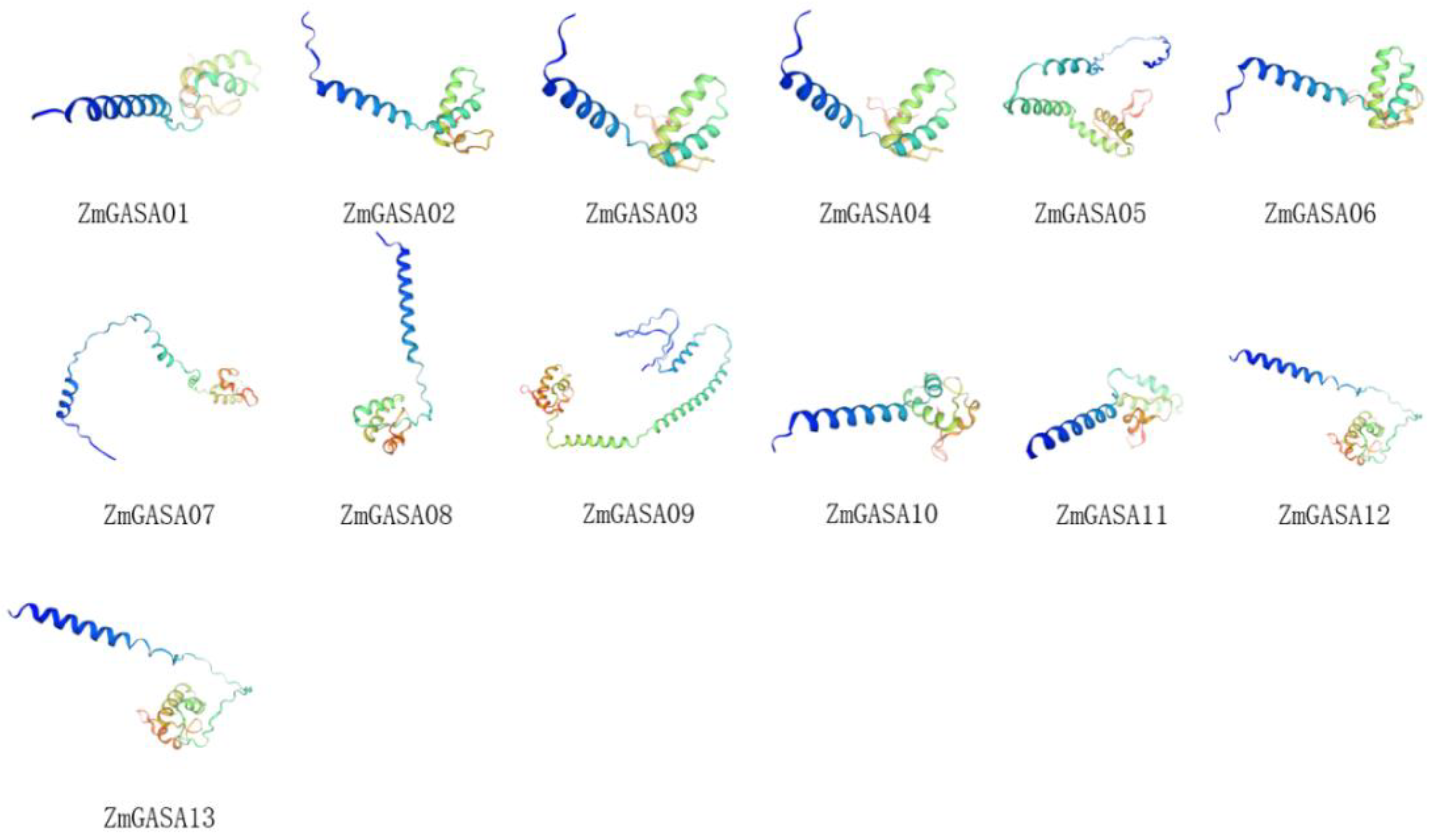
Prediction analysis revealed four secondary structure elements of maize GASA proteins, including α-helices, extended strands, β-turns, and random coils, with their respective numbers and proportions summarized in Table 2. In addition, tertiary structure models of the 13 ZmGASA proteins were generated (Figure 1). The results indicated that α-helices and random coils accounted for the largest proportions of secondary structures. Specifically, the number of α-helices ranged from 19 to 62, with an average proportion of 32.56%, whereas random coils ranged from 39 to 96, with an average proportion of 51.35%. By contrast, extended strands and β-turns were less abundant, each comprising less than 20% of the total. These findings suggest that α-helices and random coils are the predominant structural components of ZmGASA proteins.
Tertiary structure modeling further demonstrated that although the overall conformations of individual proteins differ, they are generally consistent with secondary structure predictions and all contain a conserved helix-turn-helix (HTH) motif. Importantly, members clustered within closer evolutionary relationships (Figure 2 and Figure 3a) exhibited highly similar tertiary structures. For instance, ZmGASA02, ZmGASA03, ZmGASA04, ZmGASA05, and ZmGASA10 shared similar structural features (Figure 1, Figure 2 and Figure 3a), while ZmGASA01, ZmGASA07, ZmGASA08, ZmGASA11, ZmGASA12, and ZmGASA13 also displayed comparable conformations within another branch (Figure 1, Figure 2 and Figure 3a). These results imply that ZmGASA proteins within the same phylogenetic clade may possess analogous structural features and potentially similar biological functions.

2.3. Phylogenetic Analysis of GASA Family Members Across Different Species

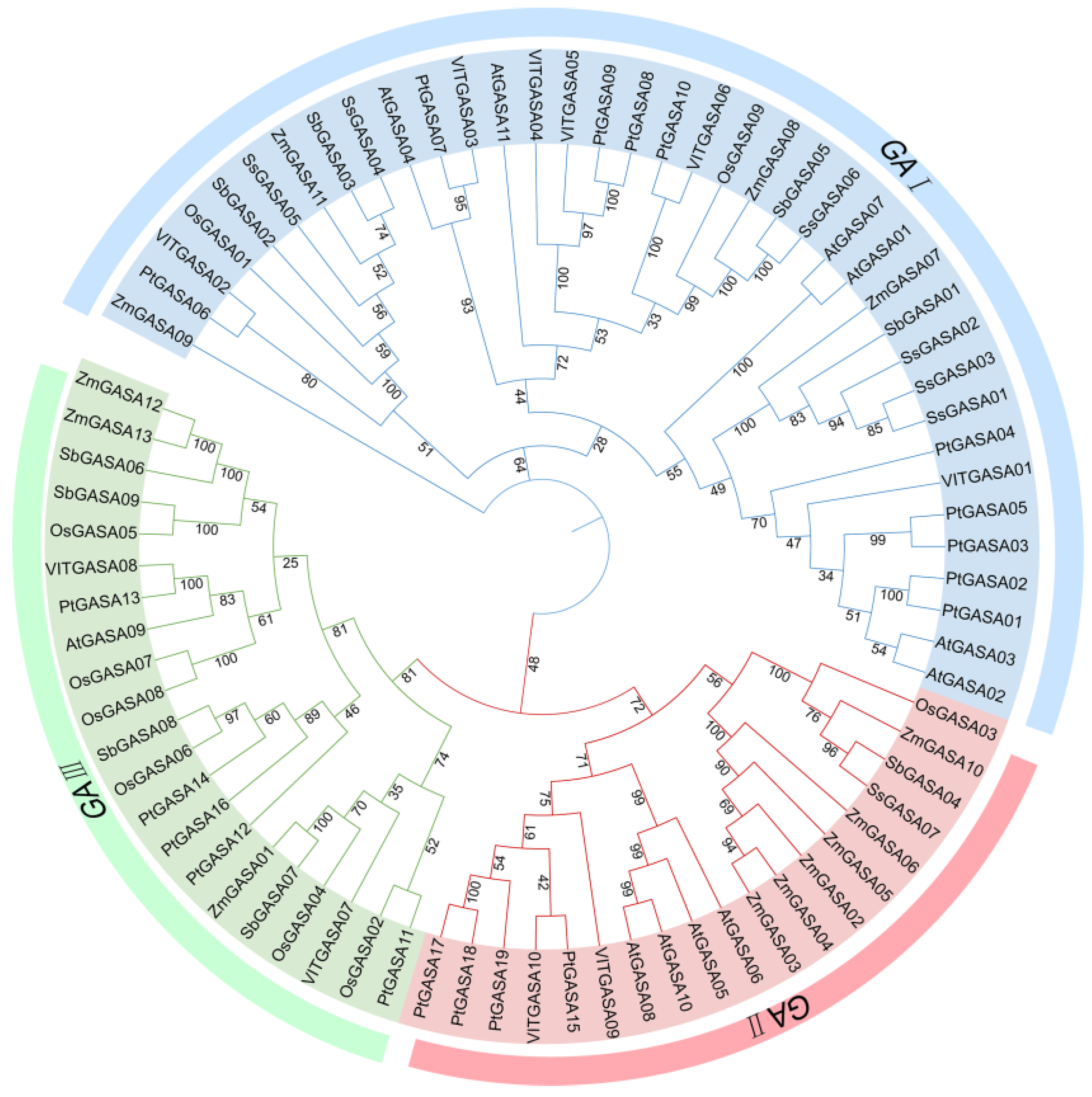
Phylogenetic analysis revealed that GASA genes from seven species can be classified into three subfamilies (GAI, GAII, and GAIII). Members from all seven species were distributed across the three subfamilies. In maize, the GAI subfamily comprises four members (ZmGASA09, ZmGASA11, ZmGASA07, and ZmGASA08), the GAII subfamily includes six members (ZmGASA02, ZmGASA03, ZmGASA04, ZmGASA05, ZmGASA06, and ZmGASA10), and the GAIII subfamily consists of three members (ZmGASA01, ZmGASA12, and ZmGASA13). These findings indicate that the functions of GASA genes are relatively conserved within subfamilies across different species.
Moreover, the phylogenetic distribution of maize GASA family members was found to be highly similar to that of sorghum and sugarcane, suggesting a closer evolutionary relationship among these species and implying a more recent common ancestor.

2.4. Phylogenetic Tree, Conserved Motifs, Conserved Domains, and Gene Structure Analyses of the Maize GASA Gene Family

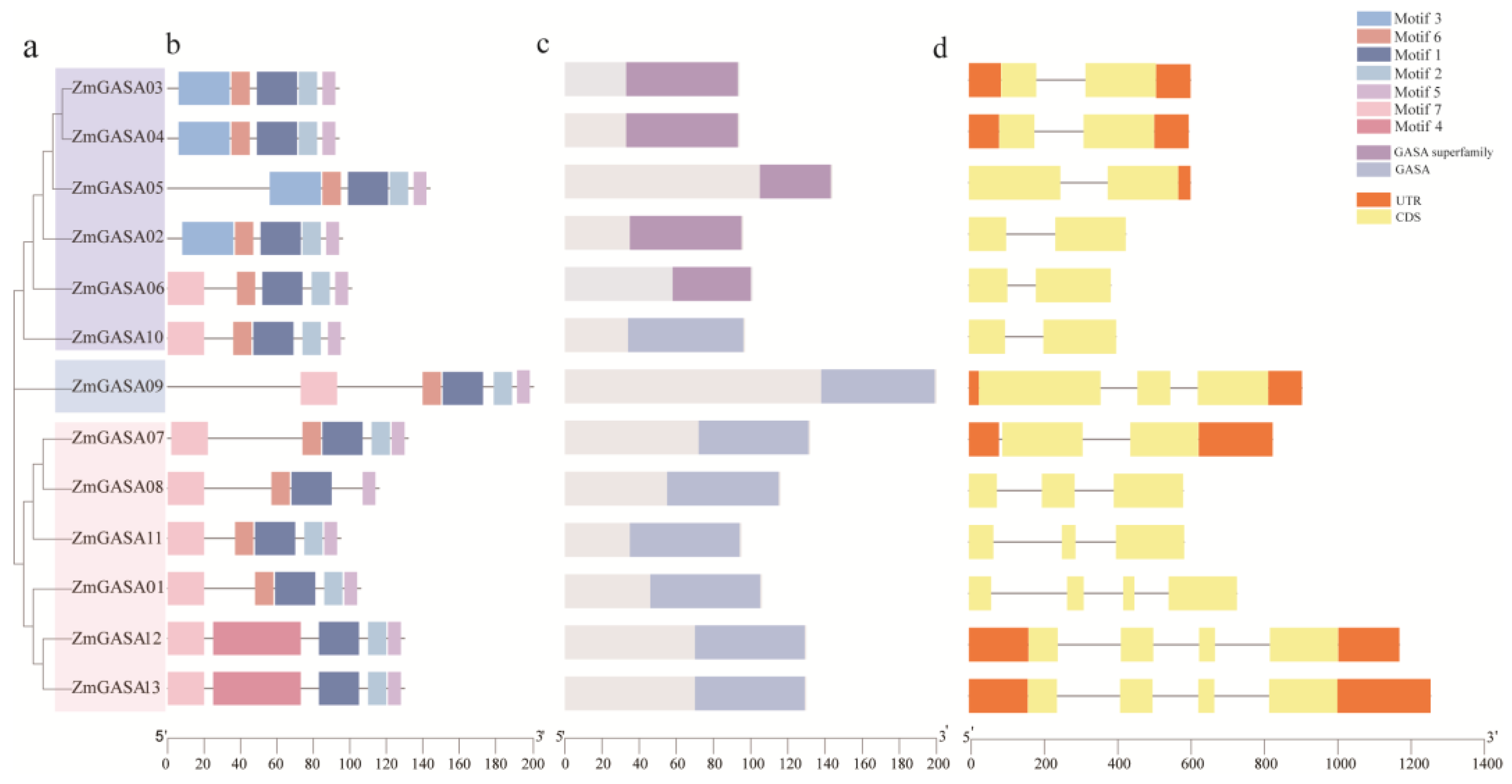
Using MEGA 11 software, a phylogenetic tree of the maize GASA gene family was constructed based on the amino acid sequences encoded by the 13 ZmGASA genes. The results showed that the ZmGASA family members could be classified into three major groups, containing three pairs of paralogous genes, ZmGASA03/ZmGASA04, ZmGASA07/ZmGASA08, and ZmGASA12/ZmGASA13 (Figure 3a), which is largely consistent with the grouping observed in Figure 2.
Conserved motif prediction identified seven motifs (Figure 3b). Among them, Motif 1, Motif 2, and Motif 5 were present in all family members. Motif 3 was uniquely detected in ZmGASA02, ZmGASA03, ZmGASA04, and ZmGASA05, whereas Motif 6 was identified in 11 members, excluding ZmGASA12 and ZmGASA13. Motif 7 was observed in ZmGASA01, ZmGASA06, ZmGASA07, ZmGASA08, ZmGASA09, ZmGASA10, ZmGASA11, ZmGASA12, and ZmGASA13. Notably, Motif 4 was specifically present in ZmGASA12 and ZmGASA13, suggesting that these two genes may play specialized roles within the family (Figure 3b).
To further investigate their potential functions, gene structure analysis was performed (Figure 3d). The results revealed three structural patterns: ZmGASA02, ZmGASA03, ZmGASA04, ZmGASA05, ZmGASA06, ZmGASA07, and ZmGASA10 share a gene structure with two exons and one intron; ZmGASA08, ZmGASA09, and ZmGASA11 have three exons and two introns; ZmGASA01, ZmGASA12, and ZmGASA13 contain four exons and three introns.
The relatively simple exon–intron organization of ZmGASA02, ZmGASA03, ZmGASA04, ZmGASA05, ZmGASA06, ZmGASA07, and ZmGASA10 suggests that these genes may have diverged later during evolution and could be functionally more specialized. In addition, pairs such as ZmGASA03/ZmGASA04 and ZmGASA12/ZmGASA13 exhibited highly similar gene structures and strong homology in the phylogenetic tree, indicating that closely related genes often retain conserved structural features during evolution.
Furthermore, conserved domain analysis (Figure 3c) revealed that all family members contain the characteristic GASA domain (XnCX3CX2RCX8CX3CX2CCX2CXCVPXGX2GNX3CPCYX10KCP). Among them, ZmGASA03, ZmGASA04, ZmGASA05, ZmGASA02, ZmGASA06, and ZmGASA10 harbor the GASA superfamily domain, while ZmGASA10, ZmGASA09, ZmGASA07, ZmGASA08, ZmGASA11, ZmGASA01, ZmGASA12, and ZmGASA13 contain the GASA domain. Comparative analysis further indicated that Motif 1 (PGBIHDCPCYRNMLT), Motif 2 (MAKPPLQTAAIILLVLLAAASCLHTVDAAALGFCWGKCSVRCARATARQA), Motif 5 (PKKRPKCP), and Motif 6 (FLFLAAVAASAAEMIAGSGIGDGEGEELD) constitute the core components of the GASA superfamily domain.

2.5. Cis-Acting Element Analysis of Maize GASA Promoters

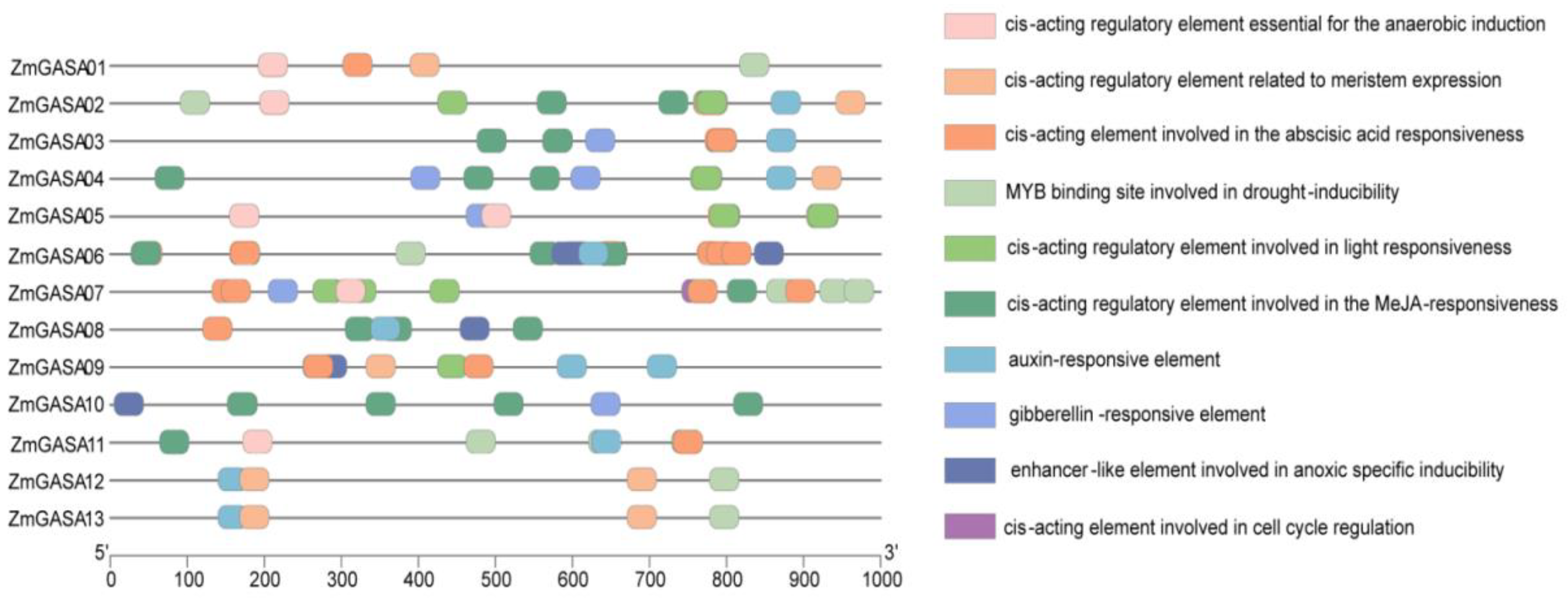
To further investigate the functions and regulatory mechanisms of ZmGASA genes, the promoter regions (2000 bp upstream of the transcription start site) of 13 ZmGASA genes were analyzed. The results revealed that the promoter regions of all ZmGASA genes contain multiple cis-acting elements associated with plant growth and development, hormone responsiveness, stress responses, and light signaling (Figure 4), suggesting that ZmGASA genes play important roles in plant growth, development, and environmental adaptation.
In addition to the core promoter elements TATA-box and CAAT-box, the promoters of ZmGASA genes harbor numerous functional elements, which can be classified into hormone-responsive elements, stress-related elements, light-responsive elements, and growth-related elements. In total, 144 cis-acting elements were identified across the 13 ZmGASA promoters, including 85 hormone-responsive elements: 30 abscisic acid (ABA)-responsive elements, 39 methyl jasmonate (MeJA)-responsive elements, 10 auxin-responsive elements, and 6 gibberellin (GA)-responsive elements. Among them, ABA-responsive elements were enriched in ZmGASA06 and ZmGASA05, while MeJA-responsive elements were particularly abundant in ZmGASA06. Most family members contained auxin- and MeJA-responsive elements.
A total of 19 stress-related elements were identified, including 5 anaerobic induction elements, 9 drought-inducible elements, and 5 anoxic induction enhancers. ZmGASA07 possessed the highest number of drought-inducible elements (3), whereas ZmGASA06 contained a greater number of anoxic induction enhancers. Additionally, 31 light-responsive elements were identified, with relatively higher frequencies in ZmGASA02 and ZmGASA07. With respect to growth-related elements, 9 were detected, including 8 meristem-specific expression elements predominantly found in ZmGASA12 and ZmGASA13. Notably, these two genes also harbored a greater number of auxin-responsive elements, suggesting that ZmGASA12 and ZmGASA13 may be closely involved in the regulation of plant growth and development. Interestingly, only one cell cycle regulatory element was detected, exclusively in the promoter of ZmGASA07, indicating that this gene may play a specialized role within the family.
Taken together, these results demonstrate that auxin-responsive elements and MeJA-responsive elements are widely distributed across the ZmGASA family, while cell cycle regulatory elements, anaerobic response elements, and anoxic response elements are concentrated in a few specific members. This result suggests that the regulatory mechanisms of ZmGASA genes share both common features and member-specific specializations, which underlie their fundamental and specialized biological functions.

2.6. Inter-Species Synteny Analysis of the Maize GASA Gene Family

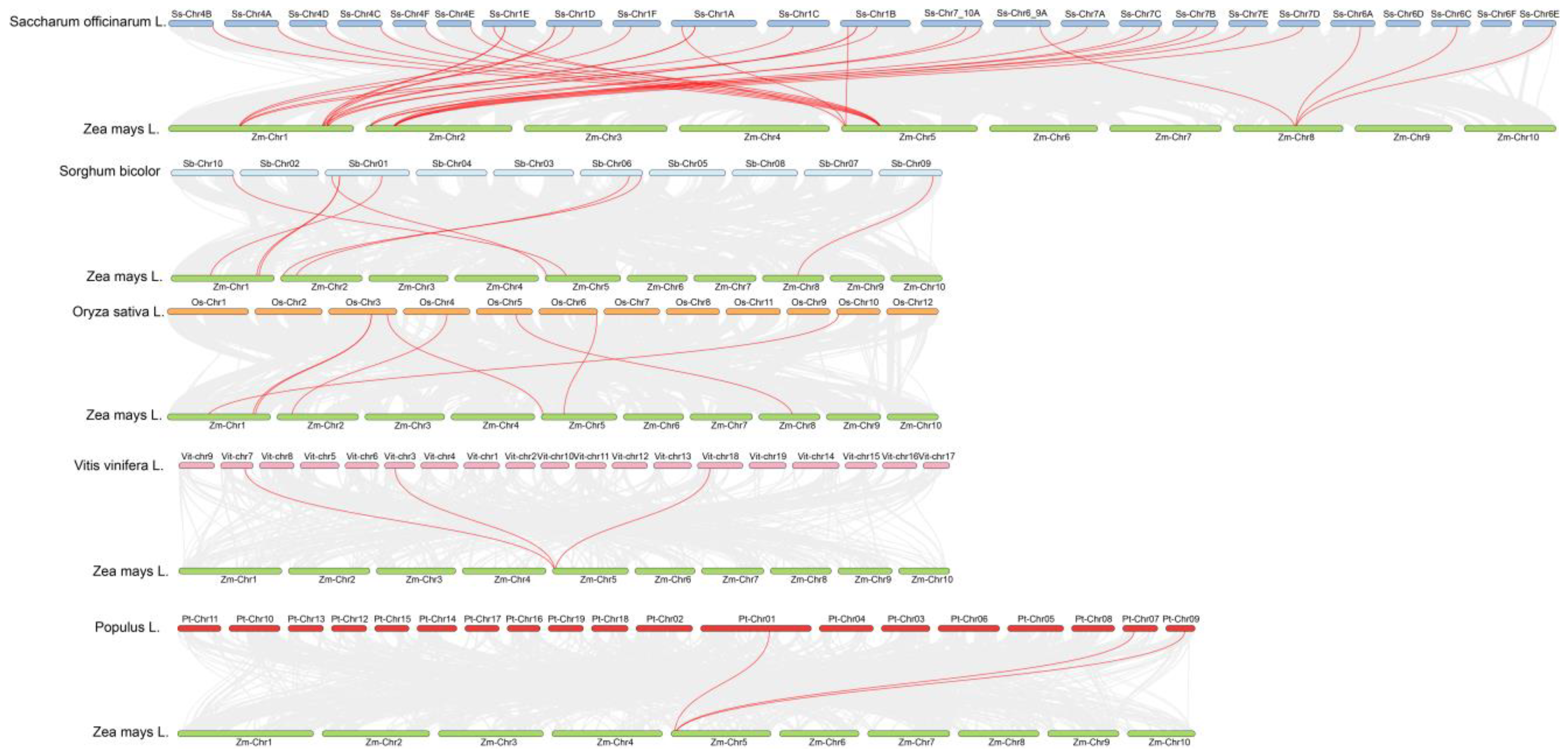
To further elucidate the evolutionary relationships of ZmGASA genes across species, a synteny analysis was performed between maize and rice, sorghum, sugarcane, grape, and poplar (Figure 5). The results revealed that 30 homologous gene pairs were identified between 4 maize chromosomes and 22 sugarcane chromosomes, 8 homologous gene pairs between 4 maize chromosomes and 4 sorghum chromosomes, 3 homologous gene pairs between 1 maize chromosome and 3 grape chromosomes, 7 homologous gene pairs between 4 maize chromosomes and 5 rice chromosomes, and 3 homologous gene pairs between 1 maize chromosome and 3 poplar chromosomes.
Notably, the syntenic relationships were most abundant between maize and sugarcane as well as between maize and sorghum, indicating that the maize GASA genes are more closely related to those in sugarcane and sorghum. These findings suggest that they likely originated from a common ancestral lineage and may have retained conserved functional roles during evolution.

2.7. Expression Profiling of the Maize GASA Gene Family Under Stress Conditions

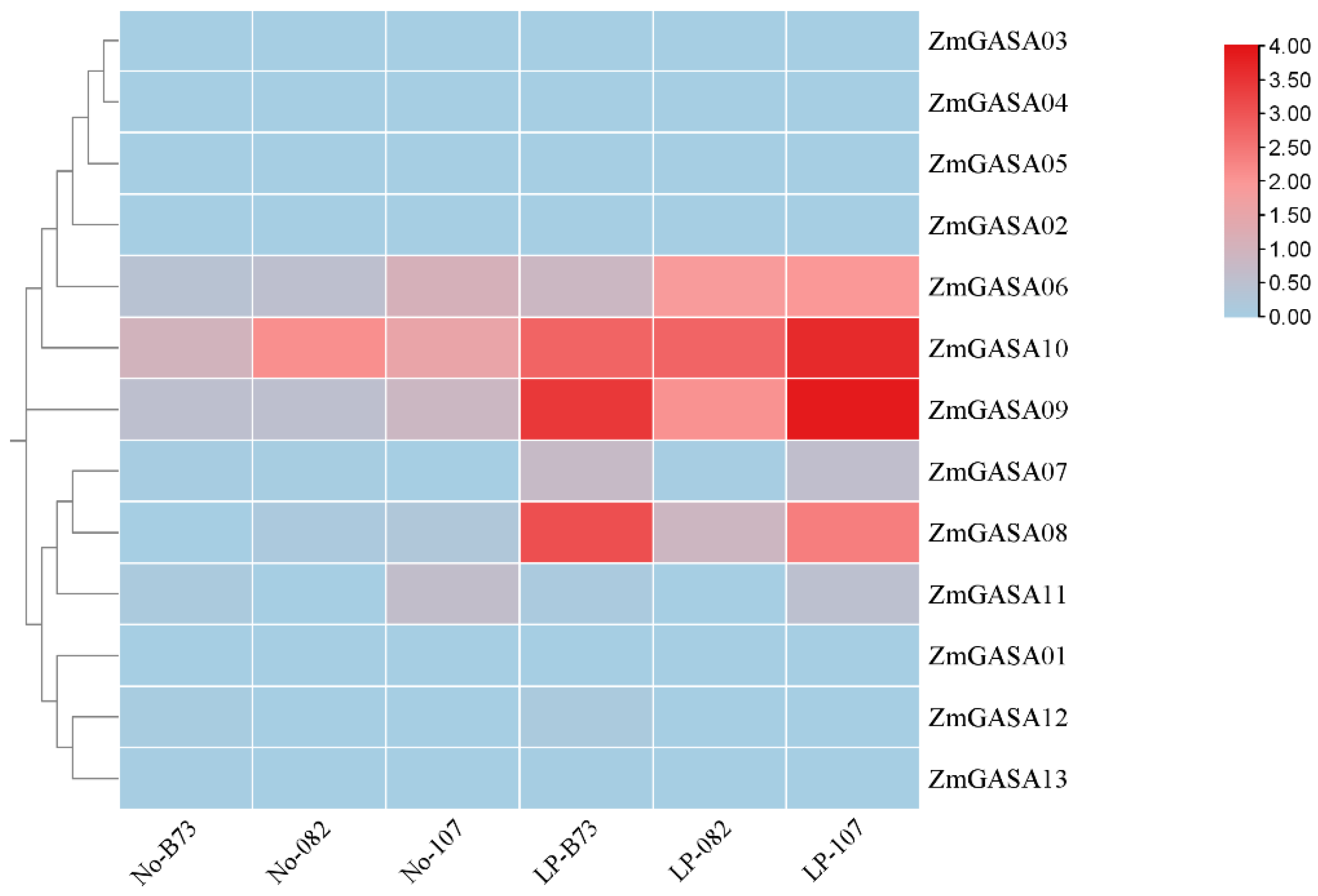
Phosphorus is a non-renewable resource, and reducing phosphorus input while improving phosphorus-use efficiency will be an inevitable strategy in future maize production systems. Therefore, in this study, three maize inbred lines (082, Ye107, and B73) were subjected to low-phosphorus (LP) stress at the three-leaf stage and identified the key GASA genes. After 14 days of treatment, we determined the growth-related physiological parameters of maize seedlings, including plant height, fresh weight, and dry weight. Although distinct growth differences were observed among the three inbred lines, these variations were statistically non-significant and thus not presented in this manuscript. But some GASA genes exhibit substantial differences at the transcriptional levels. The results revealed that most ZmGASA family members exhibited differential transcriptional regulation under both conditions.
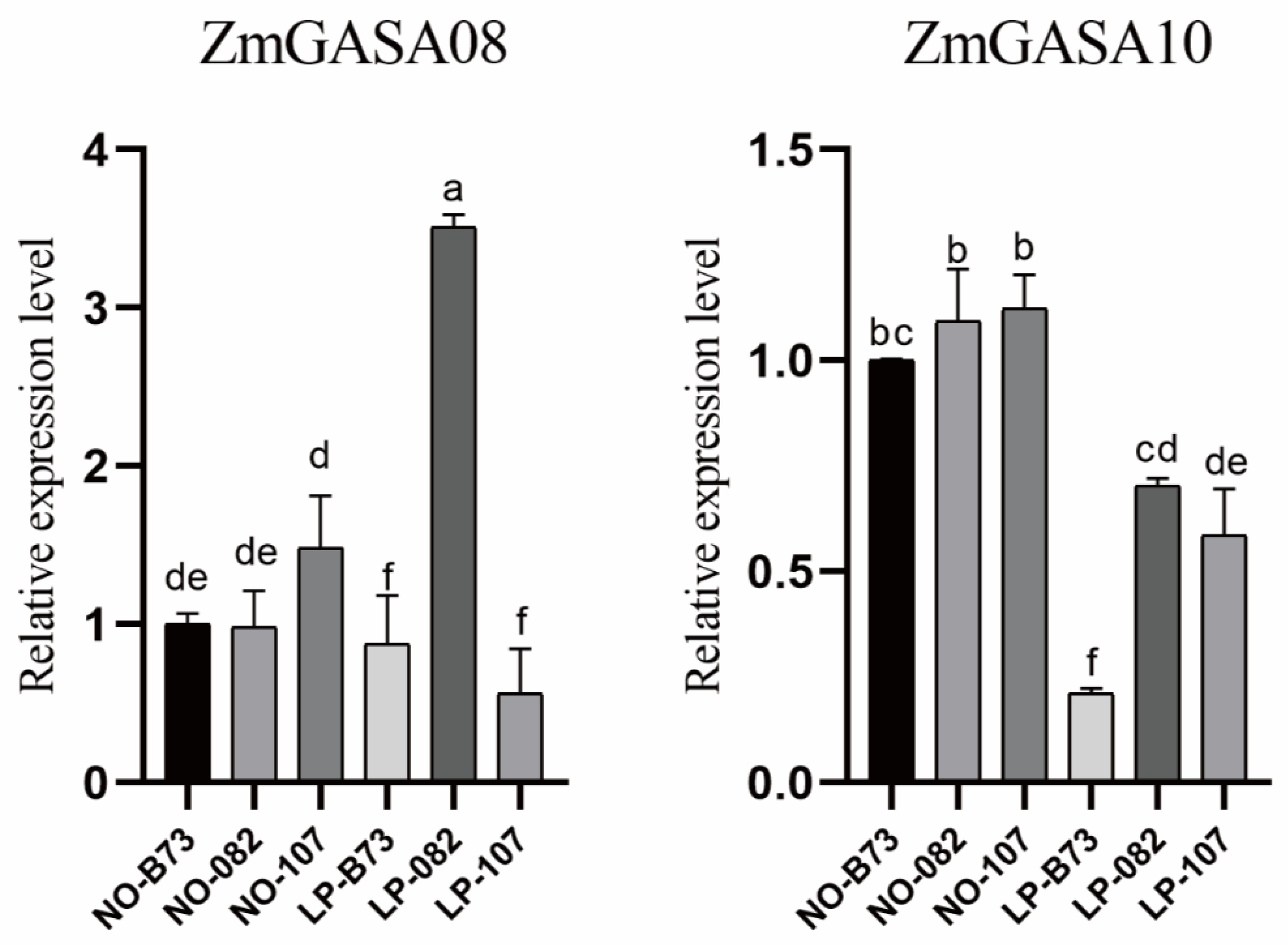
Under LP stress: In inbred line 082, ZmGASA06, ZmGASA08, ZmGASA09, and ZmGASA10 were significantly upregulated, with ZmGASA08 and ZmGASA09 reaching 5.82-fold and 3.77-fold higher expression than controls, respectively; In line Ye107, ZmGASA06, ZmGASA07, ZmGASA08, ZmGASA09, and ZmGASA10 were upregulated, with ZmGASA08 showing the strongest induction (9.49-fold), whereas ZmGASA11 was downregulated; In line B73, ZmGASA06, ZmGASA07, ZmGASA08, ZmGASA09, ZmGASA10, and ZmGASA12 were upregulated, with ZmGASA07 exhibiting a dramatic induction (16.60-fold compared with control) (Figure 6). Taken together, ZmGASA08, ZmGASA09, and ZmGASA10 were consistently induced by LP stress across all three inbred lines, suggesting their critical involvement in maize phosphate-deficiency adaptation.
QRT-PCR assays of ZmGASA08 and ZmGASA10 confirmed that they were strongly induced in lines 082 and Ye107under LP stress, while in line B73, their expression was moderately elevated (Figure 7).
Collectively, these results provide important insights into the functional diversification and regulatory mechanisms of ZmGASA genes in nutrient stress adaptation.

3. Discussion

GASA gene family is widely distributed across plant taxa and encode cysteine-rich peptide (CRP) proteins. These proteins are typically characterized by an N-terminal signal peptide and a conserved C-terminal GASA domain [1]. Members of the GASA gene family have been demonstrated to play essential roles in plant growth and development, responses to biotic and abiotic stresses, and phytohormone signaling pathways [7].
To date, the biological functions and bioinformatic characterization of GASA genes have been extensively studied in horticultural crops and ornamentals, such as tomato [7], Chinese cabbage [7], chrysanthemum [7], rose [7], and crape myrtle [7], whereas reports in cereal crops remain limited. In this study, based on the 14 members of the Arabidopsis GASA gene family [7], 13 GASA genes were identified in maize through genome-wide screening, followed by structural and expression analyses. Notably, certain Arabidopsis GASA homologs were absent in maize, suggesting potential gene loss events in maize or gene acquisition in Arabidopsis during evolution. The identified maize GASA genes were unevenly distributed across six chromosomes, with the majority located on chromosome 1. This distribution pattern differs from Arabidopsis but is consistent with other species such as potato [6], pineapple [24], and poplar [6].
Subcellular localization predictions indicated that most ZmGASA proteins localize to the cytoplasm, while a subset is targeted to chloroplasts. This finding contrasts with poplar GASA proteins, which are localized to the cell wall, nucleus, plasma membrane, and Golgi apparatus [6], implying potential functional divergence. Protein secondary and tertiary structure analyses revealed that ZmGASA proteins share common structural features, including α-helices, extended strands, β-turns, and random coils, with α-helices and random coils being predominant. These findings are consistent with structural predictions for poplar and pineapple GASAs [6,24].
Phylogenetic analysis of seven plant species showed that GASA members clustered into three major groups, with clade GAI containing the largest number of genes. Gene structure analysis revealed that certain members (e.g., ZmGASA02, ZmGASA06, ZmGASA10, ZmGASA08, ZmGASA11, and ZmGASA01) possess relatively simple architectures composed of only two or three coding sequences (CDSs), suggesting their relatively recent origin and functional specialization. Pairs of genes such as ZmGASA03/04 and ZmGASA12/13 exhibited highly similar structures, consistent with their strong homology in phylogenetic trees. Conserved motif analysis further revealed that Motifs 1, 2, and 5 were universally present across all members, likely contributing to core GASA functions, while other motifs (e.g., Motif 3 and Motif 4) were restricted to specific subgroups, implying functional diversification.
Cis-acting regulatory element analysis identified 144 elements across 13 ZmGASA promoters, including those associated with growth and development, phytohormone signaling, stress responses, and light responsiveness. Among these, abscisic acid (ABA)-responsive and methyl jasmonate (MeJA)-responsive elements were the most abundant, suggesting a central role in ABA and MeJA signaling. Interestingly, ZmGASA04 harbored cis-elements responsive to ABA, MeJA, auxin, and gibberellins, indicating a possible hub role in cross-talk between multiple hormone pathways—since the presence of a cis-element does not prove but only shows the possibility. Previous studies in Arabidopsis have shown that AtGASA01 and AtGASA04 participate in hormone signaling [7]. Although GASA genes are generally GA-inducible [7], only ZmGASA03, ZmGASA04, ZmGASA07, and ZmGASA10 contained GA-responsive elements, suggesting that GA regulation in maize might be indirect. Notably, ZmGASA07 contained a unique cell cycle regulatory element, implying a specialized role. Moreover, in agreement with previous studies linking GASAs to reactive oxygen species (ROS) dynamics [11], maize GASAs may contribute to ROS accumulation, promoting cell expansion and enhancing abiotic stress tolerance.
Comparative synteny analysis revealed strong collinearity between maize and sugarcane, with 30 homologous gene pairs identified across four maize and 22 sugarcane chromosomes. This number exceeded syntenic gene pairs between maize and sorghum, grape, rice, or poplar, indicating a closer evolutionary relationship between maize and sugarcane GASAs. This finding suggests that maize and sugarcane GASAs likely evolved from a common ancestor and may retain conserved biological functions.
Maize requires an adequate and balanced supply of mineral nutrients—particularly nitrogen (N), phosphorus (P), and potassium (K)—to sustain optimal growth, development, and high grain yield. Among these macronutrients, phosphorus plays especially critical roles in maize productivity [25,26]. Phosphorus is essential for energy transfer, signal transduction, and membrane synthesis, and it is particularly important for root development, flowering, and grain formation [27,28,29]. Insufficient availability of phosphorus can severely constrain vegetative growth, delay developmental processes, and ultimately reduce grain yield and quality in maize production systems [30]. In this study, to identify the key GASA genes improving maize growth, the expression profiling under nutrient stress showed differential regulation of ZmGASA genes. ZmGASA06 was consistently upregulated in three maize inbred lines under low-phosphorus condition, highlighting its importance in stress adaptation of the particular stresses. Additionally, ZmGASA08, ZmGASA09, and ZmGASA10 were induced by low-phosphorus stress across all three inbred lines.
In summary, this study identified 13 maize GASA genes, classified into three phylogenetic groups, with most members localized on chromosomes 1, 2, 5, and 8. No tandem or segmental duplication events were detected. Synteny analysis revealed closer evolutionary relationships between maize and sugarcane GASA families. Cis-regulatory element profiling suggested roles in hormone and stress signaling, while expression analyses highlighted specific members responsive to nutrient stress. Collectively, these findings provide valuable insights into the evolutionary dynamics and functional roles of ZmGASAs and offer genetic resources for future studies on maize adaptation to abiotic stresses.

4. Materials and Methods

4.1. Genome-Wide Identification of GASA Gene Family Members in Maize

The genomic and coding sequences (CDS) of maize GASA family members (Zm-B73-REFERENCE-NAM-5.0.55) and Arabidopsis thaliana GASA family members (TAIR10) were retrieved from the Phytozome 13 database (https://phytozome-next.jgi.doe.gov, accessed on 14 December 2024). Using the reported Arabidopsis GASA proteins as queries, BLAST searches were performed in Phytozome to identify putative homologs in maize. Candidate sequences with an E-value ≤ 1 × 10⁻⁵ were retained, and redundant sequences were removed. Protein domain confirmation of the candidate members was subsequently conducted using the SMART database [31] (https://smart.embl.de/help/smart_about.shtml, accessed on 1 March 2025) and the InterPro database [32] (https://www.ebi.ac.uk/interpro, accessed on 24 March 2025). Genes encoding proteins with the characteristic GASA domain were designated as bona fide GASA family members.
To further characterize the identified ZmGASA proteins, transmembrane domains and their topological structures were predicted using the TMHMM 2.0 server (https://services.healthtech.dtu.dk/services/TMHMM-2.0, accessed on 17 May 2025). Protein length was also recorded. The theoretical isoelectric point (pI) and molecular weight (MW) of each protein were calculated using the ExPASy server, while subcellular localization was predicted with Wolf PSORT [33] (https://wolfpsort.hgc.jp, accessed on 1 June 2025).

4.2. Prediction of Secondary and Tertiary Structures of Maize GASA Proteins

The amino acid sequences of maize GASA family members were subjected to secondary structure prediction using the SOPMA server (https://npsa-prabi.ibcp.fr/cgi-bin/npsa_automat.pl?page=/NPSA/npsa_sopma.html, accessed on 17 June 2025). Subsequently, three-dimensional structural models of ZmGASA proteins were generated and analyzed using the SWISS-MODEL server [34] (https://www.expasy.org/resources/swiss-model, accessed on 2 July 2025).

4.3. Phylogenetic Analysis of GASA Family Members Across Species

A phylogenetic analysis was performed using MEGA 11 [35] software based on GASA protein sequences from maize (Zea mays L., 13 genes), Arabidopsis thaliana (11 genes), rice (Oryza sativa, 9 genes), sorghum (Sorghum bicolor, 9 genes), sugarcane (Saccharum officinarum, 7 genes), grapevine (Vitis vinifera, 10 genes), and poplar (Populus trichocarpa, 19 genes). The Neighbor-Joining (NJ) method was applied with 1000 bootstrap replicates to construct the phylogenetic tree.

4.4. Phylogenetic Tree Construction, Conserved Motif, Domain, and Gene Structure Analysis of Maize GASA Family Members

The phylogenetic relationships, conserved motifs, domains, and gene structures of ZmGASA family members were analyzed using MEGA 11, the MEME suite [36] (https://meme-suite.org/, accessed on 17 April 2025), InterPro [32], and TBtools 2.136 [37]. A phylogenetic tree was constructed in MEGA 11 based on the amino acid sequences of the 13 ZmGASA proteins using the Neighbor-Joining (NJ) method with 1000 bootstrap replicates. Conserved motifs of the 13 ZmGASA proteins were identified using MEME, while gene structure analysis was performed in TBtools [37]. Conserved domains of ZmGASA proteins were further annotated using the InterPro database. Finally, all datasets were integrated and visualized using TBtools [37] to generate a combined representation of the phylogenetic tree, gene structure, conserved motifs, and domains.

4.5. Cis-Acting Element Analysis of Maize GASA Gene Family Members

The promoter regions (2000 bp upstream of the transcription start site) of the 13 ZmGASA genes were analyzed using the PlantCARE database [38] (https://bioinformatics.psb.ugent.be/webtools/plantcare/html/, accessed on 17 April 2025) to identify putative cis-acting regulatory elements. Functional categorization and statistical analysis of the identified elements were subsequently performed, and the results were visualized using TBtools [37].

4.6. Synteny Analysis of Maize GASA Gene Family Across Species

Rice (O. sativa), sorghum (S. bicolor), sugarcane (S. officinarum), grapevine (V. vinifera), and poplar (P. trichocarpa) were selected for comparative synteny analysis with maize GASA genes. Following BLAST-based sequence alignment, syntenic gene pairs were identified, and the resulting data were visualized using TBtools [37].

4.7. Expression Analysis of Maize GASA Genes Under Stress Conditions

Using three maize inbred lines—B73, 082, and 107—as experimental materials (seeds provided by the Maize Research Institute of Southwest University, China), germination was conducted in a growth chamber at 25 °C via filter paper moistened with demineralized water. When seedlings reached the three-leaf stage, uniformly growing plants were selected, their roots gently rinsed, and then transferred to Hoagland nutrient solution (Coolaber Technology Co., Ltd., Beijing, China). In the preliminary experiments, three-leaf stage seedlings of the inbred line 107 were subjected to treatment with low-phosphorus. Combing with previous studies [39], treatment condition was set as follow: low-phosphorus (5 µM KH2PO4) treatment, while the normal phosphorus was 250 µM. The growth chamber was maintained at a photoperiod of 14 h light/10 h dark, day/night temperatures of 28 °C/24 °C, and 65% relative humidity. After 14 days of treatment, seedlings with consistent phenotypes and uniform growth were selected. For each treatment, four healthy plants were pooled as one biological replicate, with three biological replicates per condition.
Samples were immediately frozen in liquid nitrogen and sent to Biomarker Technologies Co., Ltd. (Beijing, China) for RNA sequencing (RNA-seq) analysis. The expression profiles of GASA family genes were analyzed using the FPKM (Fragments Per Kilobase of transcript per Million mapped reads) values provided by the sequencing company. The raw data were log2 (FPKM + 1)] for data normalization and subsequently visualized as a heatmap via the heatmap function implemented in TBtools [37].
For quantitative real-time PCR (qRT-PCR) analysis, cDNA was synthesized using the Plus All-in-one 1st Strand cDNA Synthesis SuperMix (gDNA Purge, E047-01B; Novoprotein, Shanghai, China), and qRT-PCR was conducted with SYBR qPCR SuperMix Plus. In each reaction, 20 µL PCR reaction system), 10 µL SYBR qPCR SuperMix Plus, 0.5 µL of each forward and reverse primer, 1 µL cDNA, and 8 µL ultra-pure water were used. The initial denaturing conditions was 95 °C for 30 s, followed by 40 cycles at 95 °C for 5 s, and 60 °C for 30 s. A melting curve was run after the PCR cycles, and the time was 95 °C for 15 s, 60 °C for 30 s, and 95 °C for 15 s. ZmActin3 was used as the internal reference gene. Each sample was analyzed in three technical replicates, and relative expression levels were calculated using the 2−ΔΔCt method [40].
To validate these transcriptome results, primer pairs were designed for ZmGASA06, ZmGASA08, ZmGASA09, and ZmGASA10 using SnapGene. However, primers designed in the gene-specific region of ZmGASA06 or ZmGASA09 do not amplify fragments, and primers designed in other regions cannot distinguish between homologous genes. Consequently, only ZmGASA08 and ZmGASA10 had the chance for qRT-PCR validation.
The primer sequences used were as follows: ZmActin3, forward 5′-TCACCCTGTGCTGCTGACCG-3′ (Tm 60 °C, 20 bp), reverse 5′-GAACCGTGTGGCTCACACCA-3′ (Tm 60 °C, 20 bp); ZmGASA08, forward 5′-TCACCACCAGCAACACCAAG-3′ (Tm 60 °C, 20 bp), reverse 5′-GCAGATGTTCTTGCGCGAGT-3′ (Tm 60 °C, 20 bp); ZmGASA10, forward 5′-ATGGCTGGATCAGGGTTCTG-3′ (Tm 60 °C, 20 bp), reverse 5′-TGGTCATGTCGCGGTAGCAT-3′ (Tm 60 °C, 20 bp).

4.8. Statistical Analysis

QRT-PCR data were analyzed using one-way analysis of variance (ANOVA). When significant differences were detected (p < 0.05), pairwise comparisons were conducted using the least significant difference (LSD) test, and the Waller–Duncan post hoc test was additionally applied to validate the robustness of multiple comparisons. All statistical analyses were performed using SPSS version 27.0, with a significance threshold set at p < 0.05. In the bar charts, different lowercase letters (e.g., a, b, c) indicate statistically significant differences among groups (p < 0.05), whereas identical letters denote no significant difference (p > 0.05).

5. Conclusions

In this study, we identified a total of 13 GASA family members in maize and performed a comprehensive genome-wide analysis, including phylogenetic relationship reconstruction, functional categorization, gene structure annotation, and conserved motif characterization. Multiple cis-acting elements associated with hormone responsiveness, stress tolerance, and light signaling suggest that GASA family members are potential involved in regulating plant growth and development. Furthermore, RNA-seq combined with qRT-PCR validation demonstrated that ZmGASA08 and ZmGASA10 were significantly upregulated under low-phosphorus treatment, implicating these two genes in nutrient-responsive pathways—particularly in phosphorus uptake, utilization, and signaling transduction. Overall, our findings lay a solid foundation for future functional characterization of ZmGASA genes and provide valuable insights into their roles in maize development and responses to nutritious cues.

Author Contributions

Conceptualization, C.D. and F.L.; methodology, C.D., F.L. and C.L.; software, C.D., S.L., Z.M. and L.Y.; validation, C.D., C.L. and Q.Y.; formal analysis, F.L., Z.M. and X.M.; resources, C.D., W.H. and C.L.; data curation, F.L., J.W. and C.L.; writing—original draft preparation, C.D. and C.L.; writing—review and editing, C.D., J.W. and C.L.; supervision, F.L. and J.W. All authors have read and agreed to the published version of the manuscript.

Funding

This study was supported by the Special Key Project for Technological Innovation and Application Development in Chongqing (CSTB2022TIAD-KPX0011), National Natural Science Foundation of China (32372040), Graduate Research and Innovation Program of Chongqing (CYS25170), and Innovation and Entrepreneurship Training Program for Undergraduates (X202510635660).

Data Availability Statement

The transcriptomes data of low-phosphorus treatment have been deposited in the Genome Sequence Archive of the BIG Submission Portal, National Genomics Data Center (NGDC, https://ngdc.cncb.ac.cn/) under the Bioproject (PRJCA044786).

Conflicts of Interest

The authors declare no conflicts of interest.

References

  1. Inomata, N. Gibberellin-regulated protein allergy: Clinical features and cross-reactivity. Allergol. Int. 2020, 69, 11–18. [Google Scholar] [CrossRef]
  2. Zhang, S.; Wang, X. One new kind of phytohormonal signaling integrator: Up-and-coming GASA family genes. Plant Signal. Behav. 2017, 12, e1226453. [Google Scholar] [CrossRef]
  3. Herzog, M.; Dorne, A.M.; Grellet, F. GASA, a gibberellin-regulated gene family from Arabidopsis thaliana related to the tomato GAST1 gene. Plant Mol. Biol. 1995, 27, 743–752. [Google Scholar] [CrossRef]
  4. Su, D.; Liu, K.; Yu, Z.; Li, Y.; Zhang, Y.; Zhu, Y.; Wu, Y.; He, H.; Zeng, X.; Chen, H.; et al. Genome-wide characterization of the tomato GASA family identifies SlGASA1 as a repressor of fruit ripening. Hortic. Res. 2022, 10, uhac222. [Google Scholar] [CrossRef]
  5. Oliveira-Lima, M.; Benko-Iseppon, A.M.; Neto, J.R.C.F.; Rodriguez-Decuadro, S.; Kido, E.A.; Crovella, S.; Pandolfi, V. Snakin: Structure, Roles and Applications of a Plant Antimicrobial Peptide. Curr. Protein Pept. Sci. 2017, 18, 368–374. [Google Scholar] [CrossRef] [PubMed]
  6. Han, S.; Jiao, Z.; Niu, M.X.; Yu, X.; Huang, M.; Liu, C.; Wang, H.L.; Zhou, Y.; Mao, W.; Wang, X.; et al. Genome-Wide Comprehensive Analysis of the GASA Gene Family in Populus. Int. J. Mol. Sci. 2021, 22, 12336. [Google Scholar] [CrossRef] [PubMed]
  7. Roxrud, I.; Lid, S.E.; Fletcher, J.C.; Schmidt, E.D.; Opsahl-Sorteberg, H.G. GASA4, one of the 14-member Arabidopsis GASA family of small polypeptides, regulates flowering and seed development. Plant Cell Physiol. 2007, 48, 471–483. [Google Scholar] [CrossRef]
  8. Li, Z.; Gao, J.; Wang, G.; Wang, S.; Chen, K.; Pu, W.; Wang, Y.; Xia, Q.; Fan, X. Genome-Wide Identification and Characterization of GASA Gene Family in Nicotiana tabacum. Front Genet. 2022, 12, 768942. [Google Scholar] [CrossRef]
  9. Rezaee, S.; Ahmadizadeh, M.; Heidari, P. Genome-wide characterization, expression profiling, and post-transcriptional study of GASA gene family. Gene Rep. 2020, 20, 100795. [Google Scholar] [CrossRef]
  10. Nahirñak, V.; Almasia, N.I.; Hopp, H.E.; Vazquez-Rovere, C. Snakin/GASA proteins: Involvement in hormone crosstalk and redox homeostasis. Plant Signal. Behav. 2012, 7, 1004–1008. [Google Scholar] [CrossRef]
  11. Gao, C.; Li, Z.; Zhang, H.; Li, C.; Sun, H.; Li, S.; Ma, N.; Qi, X.; Cui, Y.; Yang, P.; et al. Genome-Wide Identification and Characterization of the GASA Gene Family in Medicago truncatula, and Expression Patterns under Abiotic Stress and Hormone Treatments. Plants 2024, 13, 2364. [Google Scholar] [CrossRef]
  12. Panji, A.; Ismaili, A.; Sohrabi, S.M. Genome-wide identification and expression profiling of snakin/GASA genes under drought stress in barley (Hordeum vulgare L.). 3 Biotech 2023, 13, 126. [Google Scholar] [CrossRef]
  13. Iqbal, A.; Khan, R.S. Snakins: Antimicrobial potential and prospects of genetic engineering for enhanced disease resistance in plants. Mol. Biol. Rep. 2023, 50, 8683–8690. [Google Scholar] [CrossRef]
  14. Bouteraa, M.T.; Ben Romdhane, W.; Baazaoui, N.; Alfaifi, M.Y.; Chouaibi, Y.; Ben Akacha, B.; Ben Hsouna, A.; Kačániová, M.; Ćavar Zeljković, S.; Garzoli, S.; et al. GASA Proteins: Review of Their Functions in Plant Environmental Stress Tolerance. Plants 2023, 12, 2045. [Google Scholar] [CrossRef]
  15. Zhang, M.; Wang, Z.; Jian, S. Genome-wide identification and functional analysis of the GASA gene family responding to multiple stressors in Canavalia rosea. Genes 2022, 13, 1988. [Google Scholar] [CrossRef] [PubMed]
  16. Zhang, K.; Hu, Y.; Yang, D.; Yan, C.; Li, N.; Li, Z.; Njogu, M.K.; Wang, X.; Jia, L. Genome-wide identification of GASA gene family in ten cucurbitaceae species and expression analysis in cucumber. Agronomy 2022, 12, 1978. [Google Scholar] [CrossRef]
  17. Ahmad, M.I.; Tanziela, T.; Ahmad, M.Z.; Jamil, A.; Sayal, O.U.; Ali, A.; Rahman, S.U. Unraveling the contribution of GASA gene family in sunflower under diverse stress conditions. Mol. Biol. Rep. 2025, 52, 958. [Google Scholar] [CrossRef]
  18. Yang, M.; Liu, C.; Zhang, W.; Wu, J.; Zhong, Z.; Yi, W.; Liu, H.; Leng, Y.; Sun, W.; Luan, A.; et al. Genome-Wide Identification and Characterization of Gibberellic Acid-Stimulated Arabidopsis Gene Family in Pineapple (Ananas comosus). Int. J. Mol. Sci. 2023, 24, 17063. [Google Scholar] [CrossRef]
  19. Zhong, C.M.; Wang, X.Q. Research progress of small molecule GASA protein rich in cysteine. Chin. Bull. Bot. 2016, 51, 1–8. (In Chinese) [Google Scholar]
  20. Zhang, S.C.; Wang, X.Q. GASA gene expression in the lower reaches of Arabidopsis DELLA. Chin. Sci. Bull. 2008, 22, 2760–2767. (In Chinese) [Google Scholar]
  21. Zhang, M.; Cheng, W.; Wang, J.; Cheng, T.; Zhang, Q. Genome-Wide Identification, Evolution, and Expression Analysis of GASA Gene Family in Prunus mume. Int. J. Mol. Sci. 2022, 23, 10923. [Google Scholar] [CrossRef]
  22. Sun, B.; Zhao, X.; Gao, J.; Li, J.; Xin, Y.; Zhao, Y.; Liu, Z.; Feng, H.; Tan, C. Genome-wide identification and expression analysis of the GASA gene family in Chinese cabbage (Brassica rapa L. ssp. pekinensis). BMC Genom. 2023, 24, 668. [Google Scholar] [CrossRef] [PubMed]
  23. Zhang, S.; Yang, C.; Peng, J.; Sun, S.; Wang, X. GASA5, a regulator of flowering time and stem growth in Arabidopsis thaliana. Plant Mol Biol. 2009, 69, 745–759. [Google Scholar] [CrossRef] [PubMed]
  24. Ahmad, M.Z.; Sana, A.; Jamil, A.; Nasir, J.A.; Ahmed, S.; Hameed, M.U.; Abdullah. A genome-wide approach to the comprehensive analysis of GASA gene family in Glycine max. Plant Mol. Biol. 2019, 100, 607–620. [Google Scholar] [CrossRef]
  25. Cai, H.; Chu, Q.; Yuan, L.; Liu, J.; Chen, X.; Chen, F.; Mi, G.; Zhang, F. Identification of quantitative trait loci for leaf area and chlorophyll content in maize (Zea mays) under low nitrogen and low phosphorus supply. Mol. Breed. 2012, 30, 251–266. [Google Scholar] [CrossRef]
  26. Torres-Rodríguez, J.V.; Salazar-Vidal, M.N.; Montes, R.A.C.; Massange-Sánchez, J.A.; Gillmor, C.S.; Sawers, R.J.H. Low nitrogen availability inhibits the phosphorus starvation response in maize (Zea mays ssp. mays L.). BMC Plant Biol. 2021, 21, 259. [Google Scholar] [CrossRef]
  27. Wang, Y.; Chen, Y.F.; Wu, W.H. Potassium and phosphorus transport and signaling in plants. J. Integr. Plant Biol. 2021, 63, 34–52. [Google Scholar] [CrossRef]
  28. Prathap, V.; Kumar, A.; Maheshwari, C.; Tyagi, A. Phosphorus homeostasis: Acquisition, sensing, and long-distance signaling in plants. Mol. Biol. Rep. 2022, 49, 8071–8086. [Google Scholar] [CrossRef] [PubMed]
  29. Zhang, Z.; Liao, H.; Lucas, W.J. Molecular mechanisms underlying phosphate sensing, signaling, and adaptation in plants. J. Integr. Plant Biol. 2014, 56, 192–220. [Google Scholar] [CrossRef] [PubMed]
  30. Uhart, S.A.; Andrade, F.H. Nitrogen defeciency in maize: I. Effects on crop growth, development, dry matter partitioning, and kernel set. Crop Sci. 1995, 35, 1376–1383. [Google Scholar] [CrossRef]
  31. Letunic, I.; Khedkar, S.; Bork, P. SMART: Recent updates, new developments and status in 2020. Nucleic Acids Res. 2021, 49, D458–D460. [Google Scholar] [CrossRef] [PubMed]
  32. Blum, M.; Chang, H.-Y.; Chuguransky, S.; Grego, T.; Kandasaamy, S.; Mitchell, A.; Nuka, G.; Paysan-Lafosse, T.; Qureshi, M.; Raj, S.; et al. The InterPro protein families and domains database: 20 years on. Nucleic Acids Res. 2021, 49, D344–D354. [Google Scholar] [CrossRef]
  33. Horton, P.; Park, K.-J.; Obayashi, T.; Fujita, N.; Harada, H.; Adams-Collier, C.J.; Nakai, K. WoLF PSORT: Protein localization predictor. Nucleic Acids Res. 2007, 35, W585–W587. [Google Scholar] [CrossRef]
  34. Waterhouse, A.; Bertoni, M.; Bienert, S.; Studer, G.; Tauriello, G.; Gumienny, R.; Heer, F.T.; De Beer, T.A.P.; Rempfer, C.; Bordoli, L.; et al. SWISS-MODEL: Homology modelling of protein structures and complexes. Nucleic Acids Res. 2018, 46, W296–W303. [Google Scholar] [CrossRef]
  35. Tamura, K.; Stecher, G.; Kumar, S. MEGA11: Molecular evolutionary genetics analysis version 11. Mol. Biol. Evol. 2021, 38, 3022–3027. [Google Scholar] [CrossRef]
  36. Bailey, T.L.; Johnson, J.; Grant, C.E.; Noble, W.S. The MEME suite. Nucleic Acids Res. 2015, 43, W39–W49. [Google Scholar] [CrossRef]
  37. Chen, C.; Wu, Y.; Li, J.; Wang, X.; Zeng, Z.; Xu, J.; Liu, Y.; Feng, J.; Chen, H.; He, Y. TBtools-II: A “one for all, all for one” bioinformatics platform for biological big-data mining. Mol. Plant 2023, 16, 1733–1742. [Google Scholar] [CrossRef] [PubMed]
  38. Lescot, M.; Déhais, P.; Thijs, G.; Marchal, K.; Moreau, Y.; Van de Peer, Y.; Rouzé, P.; Rombauts, S. PlantCARE, a database of plant cis-acting regulatory elements and a portal to tools for in silico analysis of promoter sequences. Nucleic Acids Res. 2002, 30, 325–327. [Google Scholar] [CrossRef] [PubMed]
  39. Li, F.; Li, S.; Yi, L.; Zhao, P.; Ma, C.; Huang, X.; Wang, J.; Liu, C.; Jiao, B.; Mei, X.; et al. Genome-Wide Identification of the YABBY Gene Family in Maize and Its Expression Analysis Under Low Phosphorus and High Nitrogen Stress. Plants 2025, 14, 2763. [Google Scholar] [CrossRef]
  40. Livak, K.J.; Schmittgen, T.D. Analysis of relative gene expression data using real-time quantitative PCR and the 2−ΔΔCT method. Methods 2001, 25, 402–408. [Google Scholar] [CrossRef]
Figure 1. Predicted the tertiary structures of maize ZmGASA proteins. Blue colour represents the N-terminus of the amino acid sequence, and red colour represents the C-terminus of the amino acid sequence. Then, the blue part is an alpha-helix, and the green (light yellow) part is a beta-sheet.
Plants 15 00309 g001
Figure 2. Phylogenetic analysis of GASA family proteins from maize and six other plant species. The outer circle of the phylogenetic tree denotes the subfamily classification of GASA genes, the middle circle shows the corresponding gene names, and the inner circle indicates the specific clades to which each gene belongs. Numbers at the nodes represent bootstrap support values based on 1000 replicates. The species included are Zea mays (Zm), Arabidopsis thaliana (Ath), Oryza sativa (Os), Sorghum bicolor (Sb), Saccharum officinarum (So), Vitis vinifera (Vv), and Populus trichocarpa (Ptr).
Plants 15 00309 g002
Figure 3. Conserved motifs and gene structures of maize GASA family members. (a) Phylogenetic tree of GASA proteins; (b) conserved amino acid motifs identified in GASA proteins; (c) GASA domain architecture; (d) gene structure analysis showing coding sequences (CDSs), introns, and untranslated regions (UTRs).
Plants 15 00309 g003
Figure 4. Cis-acting element analysis of the promoter regions of ZmGASA genes in maize. The right panel displays the types of cis-regulatory elements identified in the promoter regions, while the left panel illustrates their positional distribution along the ZmGASA gene promoters.
Plants 15 00309 g004
Figure 5. Collinearity analysis of GASA gene family among between maize and sugarcane, sorghum, grape, rice and poplar. Gray lines indicate syntenic gene pairs between maize and Saccharum officinarum, (Oryza sativa, Sorghum bicolor, Vitis vinifera, or Populus trichocarpa), while bold red lines represent co-syntenic gene pairs of the GASA gene family between maize and other plant species.
Plants 15 00309 g005
Figure 6. Heatmap showing the expression profiles of maize GASA family genes under low-phosphorus treatment. No indicates maize seedling samples grown under normal nutrient conditions, LP represents seedlings grown under low-phosphorus conditions. Blue, gray, and red boxes indicate low, moderate, and high expression levels, respectively.
Plants 15 00309 g006
Figure 7. Relative expression levels of ZmGASA08 and ZmGASA10 genes with qRT-PCR analysis. No indicates maize seedling samples grown under normal nutrient conditions, LP represents seedlings grown under low-phosphorus conditions. Different letters above the bars indicate statistically significant differences among treatments (p < 0.05), as determined by one-way ANOVA followed by the LSD and Waller–Duncan post hoc tests.
Plants 15 00309 g007
Table 1. Genome-wide identification and basic characteristics of ZmGASA genes.
GeneGene IDChromosome
Location
CDS LengthPIMolecular
Weight (Da)
Subcellular LocalizationAmino Acid Length (aa)Transmembrane DomainTopology of the Transmembrane Domain
ZmGASA01Zm00001eb026020_T001Chr13186.211,392.27Extracellular1061i7-29o
ZmGASA02Zm00001eb050150_T001Chr12888.8410,232.95Chloroplast960Na
ZmGASA03Zm00001eb050160_T001Chr12828.759744.67Chloroplast941o10-32i
ZmGASA04Zm00001eb050170_T001Chr12828.889733.7Chloroplast941o10-32i
ZmGASA05Zm00001eb050180_T001Chr14328.1815,327.2Extracellular1441o61-83i
ZmGASA06Zm00001eb051810_T001Chr13039.0710,594.2Chloroplast1011o10-27i
ZmGASA07Zm00001eb066440_T001Chr23967.9613,380.36Chloroplast1321o10-32i
ZmGASA08Zm00001eb080410_T001Chr23489.1211,904.94Extracellular1161o10-32i
ZmGASA09Zm00001eb228920_T001Chr56008.9322,314.63Chloroplast2001i83-102o
ZmGASA10Zm00001eb214350_T001Chr52918.9110,156.82Extracellular971i7-29o
ZmGASA11Zm00001eb348690_T001Chr82858.499921.59Extracellular950Na
ZmGASA12Zm00001eb405550_T001Chr103909.1413,555.48Extracellular1301i7-29o
ZmGASA13Zm00001eb438860_T001Sca2003909.1413,555.48Extracellular1301i7-29o
Table 2. Prediction of the secondary structure of ZmGASA proteins.
GeneNumber of
α-Helix
Proportion of
α-Helix
Number of Extended StrandProportion of Extended StrandNumber of β-TurnProportion of
β-Turn
Number of Random CoilProportion of Random Coil
ZmGASA011918.10%1413.33%32.86%6965.71%
ZmGASA023334.74%1010.53%88.42%4446.32%
ZmGASA034144.09%44.30%66.45%4245.16%
ZmGASA044245.16%44.30%88.60%3941.94%
ZmGASA056243.36%117.69%64.20%6444.76%
ZmGASA064545.00%22.00%77.00%4646.00%
ZmGASA075038.17%86.11%129.16%6146.56%
ZmGASA082521.74%1613.91%97.83%6556.52%
ZmGASA096030.15%3216.08%115.53%9648.24%
ZmGASA102222.92%1414.58%88.33%5254.17%
ZmGASA112728.72%99.57%44.26%5457.45%
ZmGASA123325.58%107.75%129.30%7457.36%
ZmGASA133325.58%107.75%129.30%7457.36%
Disclaimer/Publisher’s Note: The statements, opinions and data contained in all publications are solely those of the individual author(s) and contributor(s) and not of MDPI and/or the editor(s). MDPI and/or the editor(s) disclaim responsibility for any injury to people or property resulting from any ideas, methods, instructions or products referred to in the content.