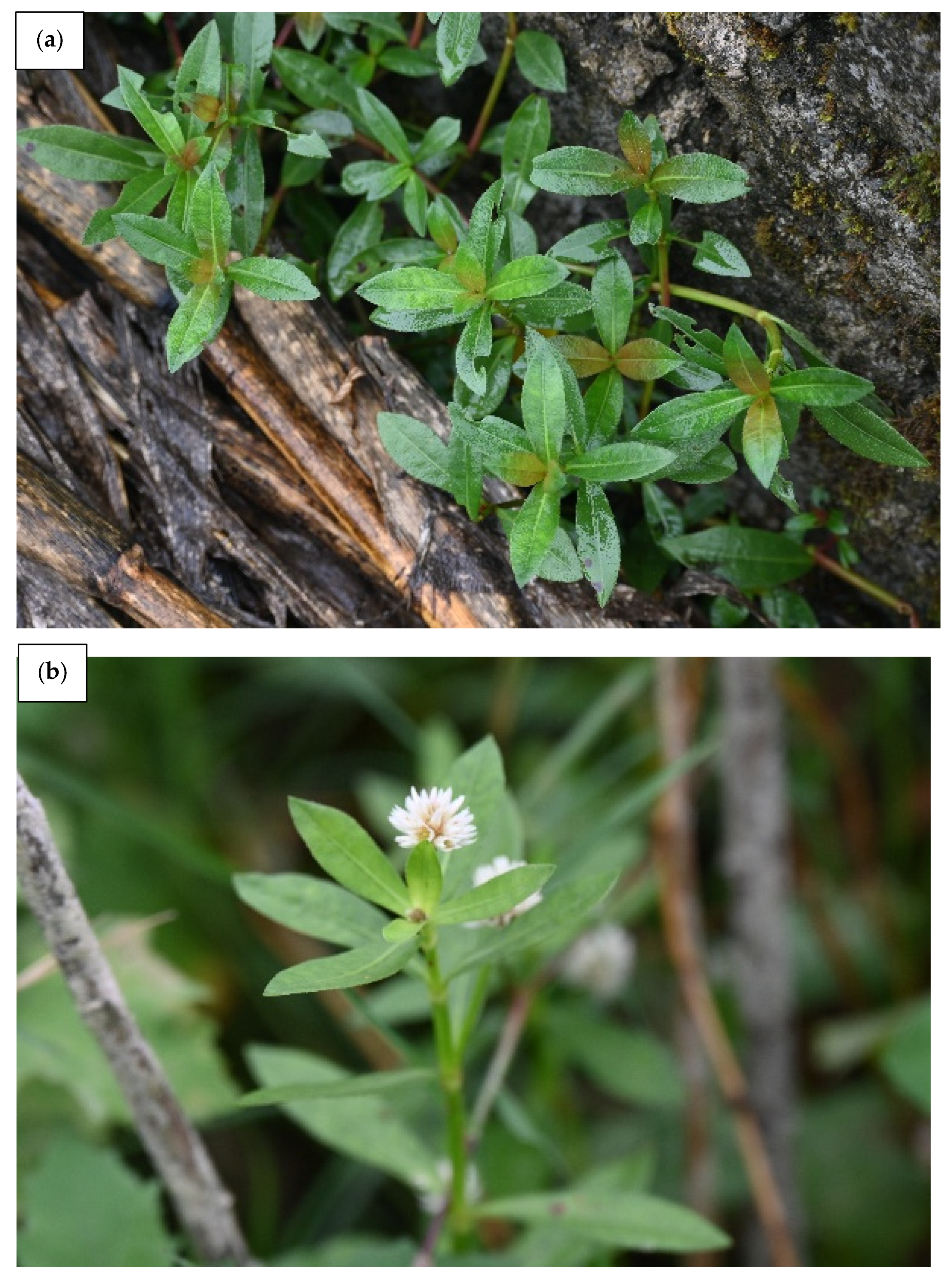
Global Distribution and Dispersal Pathways of Riparian Invasives: Perspectives Using Alligator Weed (Alternanthera philoxeroides (Mart.) Griseb.) as a Model


Abstract
1. Introduction
2. The Potential of A. philoxeroides as a Model
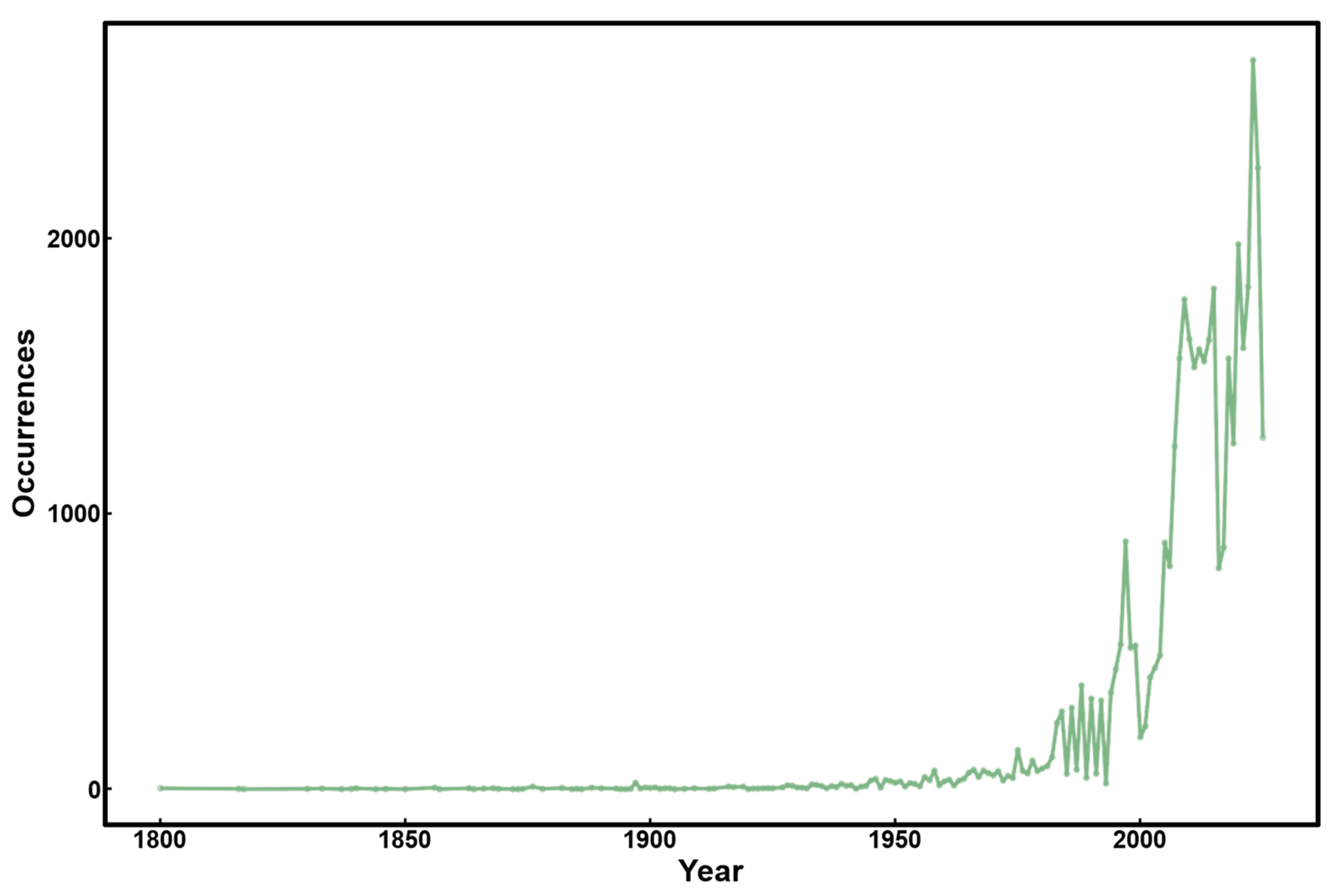
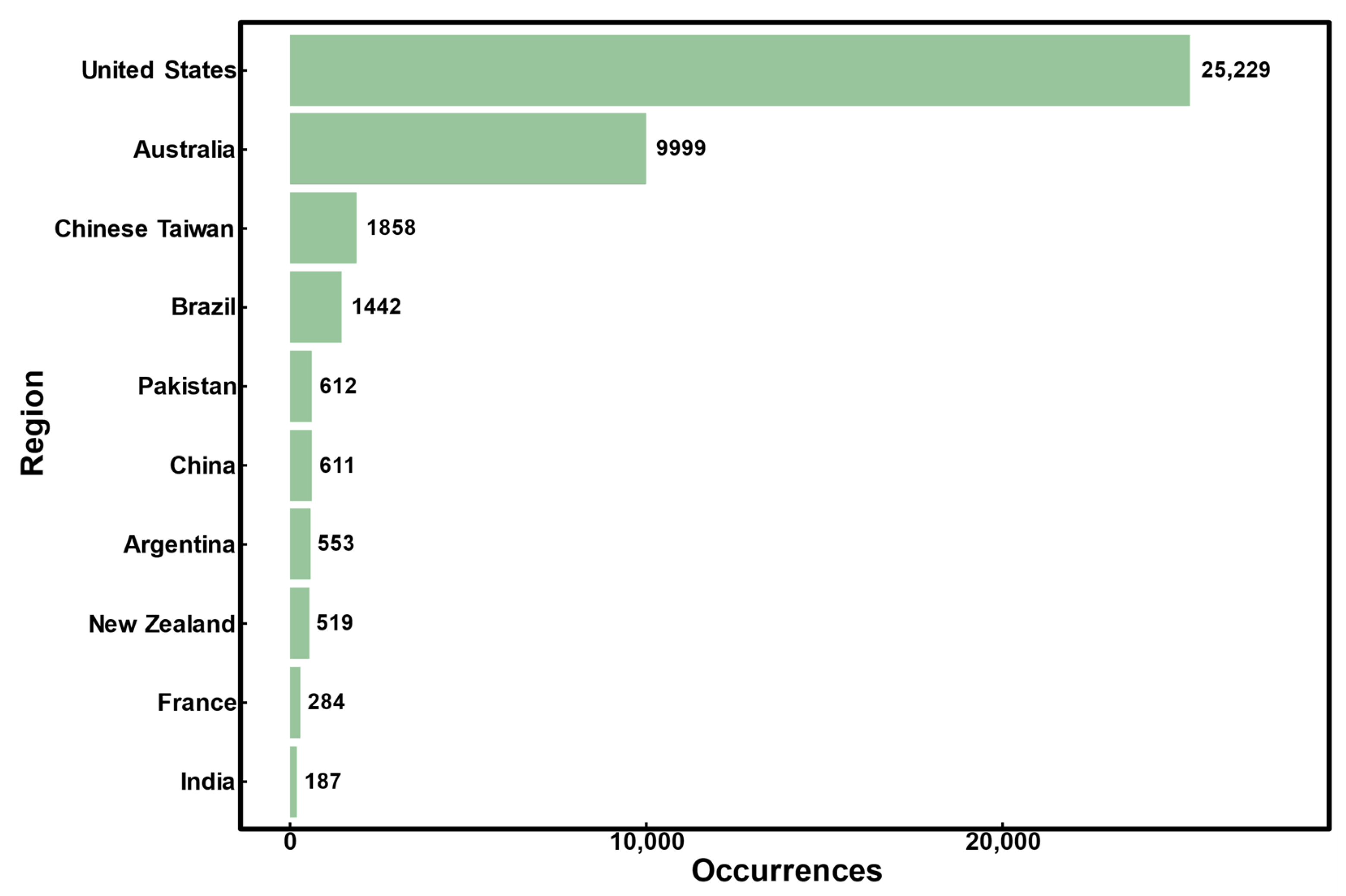
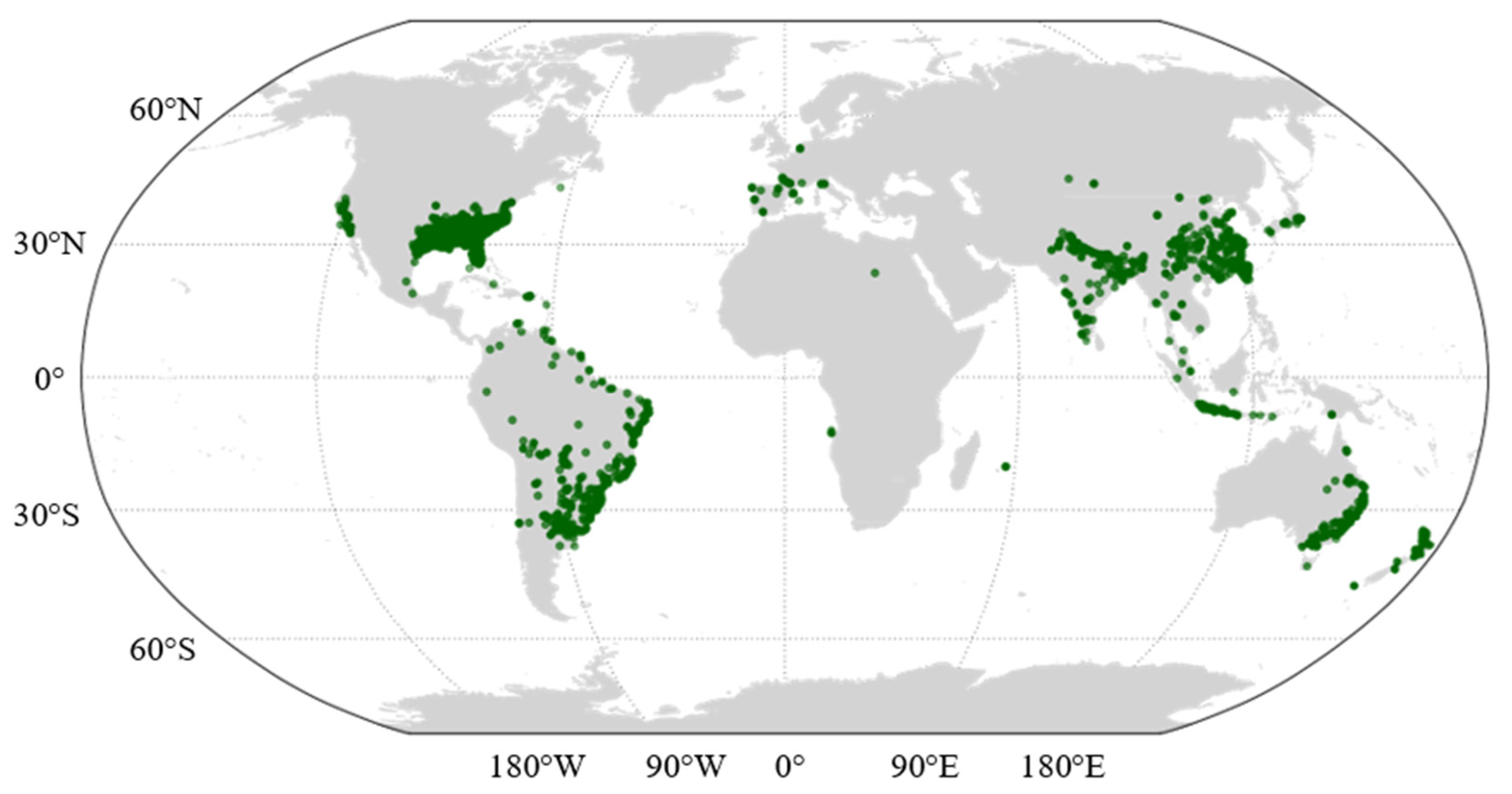
2.1. Long History of Global Invasion Patterns



| Country/Territory | Origin | Distribution | Reported Records | Reference |
|---|---|---|---|---|
| Argentina | Native | Present, widespread | original | [46] |
| Brazil | Native | Present, widespread | original | [46] |
| Mexico | Introduced | Present | 2012 | [49] |
| United States | Introduced | Present, restricted | 1897 | [29,30] |
| France | Introduced | Present | 1971 | [50] |
| Spain | Introduced | Present, restricted | 2015 | [51] |
| Italy | Introduced | Present | 2001 | [36] |
| China | Introduced | Present | 1892 | [52] |
| Chinese Taiwan | Introduced | Present, widespread | 1934 | [53] |
| India | Introduced | Present, widespread | 1965 | [54] |
| Japan | Introduced | Present | 1989 | [55] |
| Pakistan | Introduced | Present | 2014 | [56] |
| Singapore | Introduced | Present | 1953 | [57] |
| Australia | Introduced | Present, widespread | 1946 | [58] |
| New Zealand | Introduced | Present, widespread | 1906 | [59] |
| Environment Type | Suitability | Example Regions | Reference |
|---|---|---|---|
| Temperate regions (optimal 15–30 °C) | More strongly invasive | Southeastern United States, Riverina (Australia) | [42,60] |
| Tropical and subtropical regions | Suitable | Northern Argentina, Southern Brazil | [61] |
| Aquatic systems (rivers, lakes) | Suitable | Mississippi River (USA), Lake Ohakuri (New Zealand) | [61] |
| Terrestrial systems (croplands, riparian zones) | Suitable | Agricultural lands in Eastern China, riparian zones in New South Wales (Australia), Sacramento–San Joaquin Delta (California, USA) | [62,63] |
| Regions with occasional frost | Tolerated/Can survive | Northern China plain, highlands of South Africa | [64,65,66] |
2.2. Broad-Scale Dispersal and Establishment from Propagules to Networks
2.3. Rapid Adaptive Mechanism via Genetics, Epigenetics, and Phenotypic Plasticity
| Species | Traits/Properties | References | ||||
|---|---|---|---|---|---|---|
| Origin and Distribution | Growth Form | Reproduction and Dispersal | Environmental Tolerance | Ecological Impact | ||
| Alternanthera philoxeroides (Mart.) Griseb. | South America; worldwide in subtropical–warm temperate regions | Amphibious, stoloniferous herb | High clonal spread; sexual reproduction rare | Flooding tolerant, moderate drought tolerance; broad expansion under warming | Dense mats reduce native richness; hypoxia under mats | [20,21,99,100] |
| Arundo donax L. | Eurasia | Tall rhizomatous grass | High clonal spread | Medium flood and drought tolerance; warm temperate–subtropical | Forms monospecific stands that drastically alter riparian structure, increase sedimentation, reduce biodiversity, and create fire hazards | [101,102,103] |
| Phragmites australis (Cav.) Trin. ex Steud. | Eurasia | Tall rhizomatous grass | High clonal spread; sexual reproduction rare | Medium–high tolerance; broad temperate | Alters wetland ecosystems, reduces native plants | [104,105,106] |
| Reynoutria japonica Houtt. | East Asia | Rhizomatous forb/shrub | High sexual reproduction; rhizome fragmentation | Medium tolerance; temperate | Alters riparian communities; dense stands | [107,108] |
| Pontederia crassipes (Mart.) Solms | South America | Free-floating rosette | Very high vegetative spread; sexual reproduction high | Obligate aquatic; tropical–subtropical | Blocks light and water flow, outcompetes submerged macrophytes, and causes persistently low dissolved oxygen under dense mats | [40,109,110] |
| Ludwigia hexapetala (Hook. & Arn.) Zardini, Gu & P.H. Raven | South America | Amphibious, creeping mat-forming | High vegetative spread; sexual reproduction moderate | High flood tolerance, low drought tolerance; warm temperate–subtropical | Surface mats reduce native richness; hypoxia | [111] |
| Impatiens glandulifera Royle | Himalayas | Annual forb | High seed production, vegetative growth | Low–medium flood tolerance; cool–temperate | Alters riverbank soils and vegetation | [112,113] |
| Tamarix ramosissima Ledeb. | Eurasia | Deep-rooted shrub/tree | High sexual reproduction | Very high drought tolerance; arid–semiarid riparian | Alters bank structure, evapotranspiration | [114] |
3. Integrative Framework of Riparian Invasives Using A. philoxeroides as a Model
3.1. Distribution Monitoring, Modeling, and Decision Support
3.2. A Paradigm for Global Dispersal Pathways Modeled by A. philoxeroides
4. Bridging Invasion Ecology and Riverscape Management via the Model Species
5. Key Challenges for Future Perspectives
6. Conclusions
Author Contributions
Funding
Data Availability Statement
Acknowledgments
Conflicts of Interest
References
- Hulme, P.E. Trade, Transport and Trouble: Managing Invasive Species Pathways in an Era of Globalization. J. Appl. Ecol. 2009, 46, 10–18. [Google Scholar] [CrossRef]
- Turbelin, A.J.; Cuthbert, R.N.; Essl, F.; Haubrock, P.J.; Ricciardi, A.; Courchamp, F. Biological Invasions Are as Costly as Natural Hazards. Perspect. Ecol. Conserv. 2023, 21, 143–150. [Google Scholar] [CrossRef]
- Convention on Biological Diversity (CBD). Guidance for Interpretation of the CBD Categories on Introduction Pathways (CBD/SBSTTA/22/INF/9), 22 June 2018, Prepared for the Twenty-Second Meeting of the Subsidiary Body on Scientific, Technical and Technological Advice (SBSTTA 22), Montreal, Canada. Available online: https://www.cbd.int/doc/c/9d85/3bc5/d640f059d03acd717602cd76/sbstta-22-inf-09-en.pdf (accessed on 12 November 2025).
- Faulkner, K.T.; Hulme, P.E.; Pagad, S.; Wilson, J.R.U.; Robertson, M.P. Classifying the Introduction Pathways of Alien Species: Are We Moving in the Right Direction? NeoBiota 2020, 62, 143–159. [Google Scholar] [CrossRef]
- Kachigunda, B.; Coupland, G.T.; Mengersen, K.; Perera, D.I.; Van Der Merwe, J.; McKirdy, S. A Systems Approach to Biosecurity Pays off: A Case Study Investigating Introduction Pathways and Interceptions of Non-Indigenous Species at a Biosecurity Border. Biol. Invasions 2023, 25, 2849–2871. [Google Scholar] [CrossRef]
- Barnes, M.A.; Jerde, C.L.; Wittmann, M.E.; Chadderton, W.L.; Ding, J.; Zhang, J.; Purcell, M.; Budhathoki, M.; Lodge, D.M. Geographic Selection Bias of Occurrence Data Influences Transferability of Invasive Hydrilla Verticillata Distribution Models. Ecol. Evol. 2014, 4, 2584–2593. [Google Scholar] [CrossRef] [PubMed]
- Dubos, N.; Préau, C.; Lenormand, M.; Papuga, G.; Montsarrat, S.; Denelle, P.; Louarn, M.L.; Heremans, S.; Roel, M.; Roche, P.; et al. Assessing the Effect of Sample Bias Correction in Species Distribution Models. Ecol. Indic. 2022, 145, 109487. [Google Scholar] [CrossRef]
- Cassini, M.H. A Review of the Critics of Invasion Biology. Biol. Rev. 2020, 95, 1467–1478. [Google Scholar] [CrossRef] [PubMed]
- Sirén, J.; Somervuo, P.; Ovaskainen, O. Agent-Based versus Correlative Models of Species Distributions: Evaluation of Predictive Performance with Real and Simulated Data. Methods Ecol. Evol. 2025, 16, 1295–1307. [Google Scholar] [CrossRef]
- Bradley, B.A.; Blumenthal, D.M.; Wilcove, D.S.; Ziska, L.H. Predicting Plant Invasions in an Era of Global Change. Trends Ecol. Evol. 2010, 25, 310–318. [Google Scholar] [CrossRef] [PubMed]
- Gunasekera, L.; Bonilla, J. Alligatorweed: Tasty vegetable in Australian backyards? J. Aquat. Plant Manag. 2001, 39, 17–20. [Google Scholar]
- Tanveer, A.; Khaliq, A.; Siddiqui, M.H. A review on genus Alternanthera weeds implications. Pak. J. Weed Sci. Res. 2013, 19, 53–58. [Google Scholar]
- Xu, C.-Y.; Schooler, S.S.; Van Klinken, R.D. Effects of Clonal Integration and Light Availability on the Growth and Physiology of Two Invasive Herbs. J. Ecol. 2010, 98, 833–844. [Google Scholar] [CrossRef]
- Zhang, H.; Liu, F.; Wang, R.; Liu, J. Roles of Clonal Integration in Both Heterogeneous and Homogeneous Habitats. Front. Plant Sci. 2016, 7, 551. [Google Scholar] [CrossRef] [PubMed]
- Williams, D.; Harms, N.; Knight, I.; Grewell, B.; Futrell, C.; Pratt, P. High Genetic Diversity in the Clonal Aquatic Weed, Alternanthera philoxeroides in the United States. Invasive Plant Sci. Manag. 2020, 13, 217–225. [Google Scholar] [CrossRef]
- Wang, N.; Yu, F.-H.; Li, P.-X.; He, W.-M.; Liu, F.-H.; Liu, J.-M.; Dong, M. Clonal Integration Affects Growth, Photosynthetic Efficiency and Biomass Allocation, but Not the Competitive Ability, of the Alien Invasive Alternanthera philoxeroides under Severe Stress. Ann. Bot. 2008, 101, 671–678. [Google Scholar] [CrossRef]
- Zhu, Z.; Zhou, C.; Yang, J. Molecular Phenotypes Associated with Anomalous Stamen Development in Alternanthera philoxeroides. Front. Plant Sci. 2015, 6, 242. [Google Scholar] [CrossRef] [PubMed]
- Qi, S.; Rutherford, S.; He, F.; Dong, B.-C.; Zhu, B.; Dai, Z.; Fu, W.; Mao, H.; Du, D. Opposing Effects of Plant Growth Regulators via Clonal Integration on Apical and Basal Performance in Alligator Weed. J. Plant Ecol. 2022, 15, 650–662. [Google Scholar] [CrossRef]
- Hussner, A.; Stiers, I.; Verhofstad, M.J.J.M.; Bakker, E.S.; Grutters, B.M.C.; Haury, J.; van Valkenburg, J.L.C.H.; Brundu, G.; Newman, J.; Clayton, J.S.; et al. Management and Control Methods of Invasive Alien Freshwater Aquatic Plants: A Review. Aquat. Bot. 2017, 136, 112–137. [Google Scholar] [CrossRef]
- Geng, Y.-P.; Pan, X.-Y.; Xu, C.-Y.; Zhang, W.-J.; Li, B.; Chen, J.-K.; Lu, B.-R.; Song, Z.-P. Phenotypic Plasticity Rather than Locally Adapted Ecotypes Allows the Invasive Alligator Weed to Colonize a Wide Range of Habitats. Biol. Invasions 2007, 9, 245–256. [Google Scholar] [CrossRef]
- Zhang, Z.; Liu, J.; Wang, L.-C.; Wang, Y.; Deng, L.-L. Impact of the Invasive Plant Alternanthera philoxeroides (Mart.) Griseb on Soil Meso- and Microfaunal Community. Appl. Ecol. Environ. Res. 2020, 18, 3073–3085. [Google Scholar] [CrossRef]
- Masoodi, A.; Khan, F. Invasion of Alligator Weed (Alternanthera philoxeroides) in Wular Lake, Kashmir, India. Aquat. Invasions 2012, 7, 143–146. [Google Scholar] [CrossRef]
- Wang, J.; Hu, D.; Shi, X.; Luo, J.; Ren, G.; Dai, Z.; Qi, S.; Du, D. Different Responses of Invasive Weed Alternanthera philoxeroides and Oryza Sativa to Plant Growth Regulators. Life 2022, 12, 1069. [Google Scholar] [CrossRef]
- Wang, Y.; Li, C.; Zhao, Y.; Liu, X.; Wang, Y.; Liu, J. Effects of Herb Alternanthera philoxeroides Invasion on Soil Organic Matter Varied with Flooding Conditions in Wetlands. Plant Soil 2025, 513, 1861–1873. [Google Scholar] [CrossRef]
- Sheffield, K.J.; Clements, D.; Clune, D.J.; Constantine, A.; Dugdale, T.M. Detection of Aquatic Alligator Weed (Alternanthera philoxeroides) from Aerial Imagery Using Random Forest Classification. Remote Sens. 2022, 14, 2674. [Google Scholar] [CrossRef]
- Nagarajan, R.P.; Bedwell, M.; Holmes, A.E.; Sanches, T.; Acuña, S.; Baerwald, M.; Barnes, M.A.; Blankenship, S.; Connon, R.E.; Deiner, K.; et al. Environmental DNA Methods for Ecological Monitoring and Biodiversity Assessment in Estuaries. Estuaries Coasts 2022, 45, 2254–2273. [Google Scholar] [CrossRef]
- Teeter, A.M.; Johnson, B.H.; Berger, C.; Stelling, G.; Scheffner, N.W.; Garcia, M.H.; Parchure, T.M. Hydrodynamic and Sediment Transport Modeling with Emphasis on Shallow-Water, Vegetated Areas (Lakes, Reservoirs, Estuaries and Lagoons). Hydrobiologia 2001, 444, 1–23. [Google Scholar] [CrossRef]
- U.S. Fish and Wildlife Service. Alligator Weed (Alternanthera philoxeroides) Ecological Risk Screening Summary. U.S. Fish and Wildlife Service, 2018. Available online: https://www.fws.gov/sites/default/files/documents/2025-01/ecological-risk-screening-summary-alligator-weed.pdf (accessed on 12 November 2025).
- Zeigler, C.F. Biological control of alligatorweed with Agasicles n. sp. In Florida. Water Hyacinth Control J. 1967, 6, 31–34. [Google Scholar]
- Kay, S.H.; Haller, W.T. Evidence for the existence of distinct Alligatorweed biotypes. J. Aquat. Plant Manag. 1982, 20, 37–41. [Google Scholar]
- EPPO. Pest Risk Analysis for Alternanthera philoxeroides; EPPO: Paris, France, 2015. [Google Scholar]
- Lu, X.; Siemann, E.; Shao, X.; Wei, H.; Ding, J. Climate warming affects biological invasions by shifting interactions of plants and herbivores. Glob. Change Biol. 2013, 19, 2339–2347. [Google Scholar] [CrossRef]
- Wu, H.; Carrillo, J.; Ding, J. Invasion by Alligator Weed, Alternanthera philoxeroides, Is Associated with Decreased Species Diversity across the Latitudinal Gradient in China. J. Plant Ecol. 2016, 9, 311–319. [Google Scholar] [CrossRef]
- Parliament of Australia. Appendix 9—The List of Weeds of National Significance. Available online: https://www.aph.gov.au/Parliamentary_Business/Committees/Senate/Environment_and_Communications/Completed_inquiries/2004-07/nationalparks/report/e09 (accessed on 11 November 2025).
- Sherpa, S.; Després, L. The Evolutionary Dynamics of Biological Invasions: A Multi-approach Perspective. Evol. Appl. 2021, 14, 1463–1484. [Google Scholar] [CrossRef]
- Garbari, F.; Pedulla, M.L. Alternanthera philoxeroides (Mart.) Griseb. (Amaranthaceae), a new species for the exotic flora of Italy. Webbia 2001, 56, 139–143. [Google Scholar] [CrossRef]
- Fried, G.; Magoga, E.; Terrin, E. L’herbe a Alligator. Available online: http://www.gt-ibma.eu/a-surveiller-de-pres (accessed on 19 February 2015).
- Pan, X.-Y.; Geng, Y.-P.; Sosa, A.; Zhang, W.-J.; Li, B.; Chen, J.-K. Invasive Alternanthera philoxeroides: Biology, Ecology and Management. J. Syst. Evol. 2007, 45, 884. [Google Scholar] [CrossRef]
- Schmid, S.A.; Turnage, G.; Ervin, G.N. Rare Production of Seeds by Invasive Alternanthera philoxeroides (Alligator Weed) in North America Observed in Terrestrial Populations. Wetlands 2023, 43, 12. [Google Scholar] [CrossRef]
- Villamagna, A.M.; Murphy, B.R. Ecological and Socio-economic Impacts of Invasive Water Hyacinth (Eichhornia crassipes): A Review. Freshw. Biol. 2010, 55, 282–298. [Google Scholar] [CrossRef]
- Keane, R.M.; Crawley, M.J. Exotic Plant Invasions and the Enemy Release Hypothesis. Trends Ecol. Evol. 2002, 17, 164–170. [Google Scholar] [CrossRef]
- Shen, J.; Shen, M.; Wang, X.; Lu, Y. Effect of environmental factors on shoot emergence and vegetative growth of alligator weed (Alternanthera philoxeroides). Weed Sci. 2005, 53, 471–478. [Google Scholar] [CrossRef]
- Van Oosterhout, E. Alligator Weed Control Manual; New South Wales Department of Primary Industries: Orange, Australia, 2007. [Google Scholar]
- Bassett, I.E.; Beggs, J.R.; Paynter, Q. Decomposition dynamics of invasive alligator weed compared with native sedges in a Northland lake. N. Z. J. Ecol. 2010, 34, 324–331. [Google Scholar]
- Bassett, I.E.; Paynter, Q.; Hankin, R.; Beggs, J.R. Characterising alligator weed (Alternanthera philoxeroides; Amaranthaceae) invasion at a northern New Zealand lake. N. Z. J. Ecol. 2012, 36, 216–222. [Google Scholar]
- EPPO. Alternanthera philoxeroides (Alligator Weed)—Datasheet. EPPO Global Database. Available online: https://gd.eppo.int/taxon/ALRPH (accessed on 12 November 2025).
- Global Invasive Species Database. Alternanthera philoxeroides (Mart.) Griseb. Available online: https://www.iucngisd.org/gisd/search.php (accessed on 12 November 2025).
- GBIF. GBIF Occurrence Download. Available online: https://www.gbif.org/occurrence/download/0028479-251025141854904 (accessed on 12 November 2025).
- Mora-Olivo, A.; Sánchez-del Pino, I. Primer registro de la maleza acuática Alternanthera philoxeroides (Amaranthaceae) para México. Bot. Sci. 2014, 92, 189–192. [Google Scholar] [CrossRef][Green Version]
- Dupont, P. Alternanthera philoxeroides, Amaranthacée sud-américaine non encore signalée en Europe, naturalisée dans le Lot-et-Garonne. Bull. Soc. Bot. Cent.-Ouest 1984, 15, 3–5. [Google Scholar]
- Portela, R.; Vicente, J.R.; Roiloa, S.R.; Cabral, J.A. A dynamic model-based framework to test the effectiveness of biocontrol targeting a new plant invader– the case of Alternanthera philoxeroides in the Iberian Peninsula. J. Environ. Manag. 2020, 270, 110349. [Google Scholar] [CrossRef]
- An, S.; Li, H.; Guan, B.; Zhou, C.; Wang, Z.; Deng, Z.; Zhi, Y.; Liu, Y.; Xu, C.; Fang, S.; et al. China’s Natural Wetlands: Past Problems, Current Status, and Future Challenges. AMBIO J. Hum. Environ. 2007, 36, 335–342. [Google Scholar] [CrossRef]
- Wu, S.-H.; Hsieh, C.-F.; Rejmánek, M. Catalogue of the Naturalized Flora of Taiwan. Taiwania 2004, 49, 16–31. [Google Scholar]
- Maheshwari, J.K. Alligator Weed in Indian Lakes. Nature 1965, 206, 1270. [Google Scholar] [CrossRef]
- National Institute for Environmental Studies (NIES). Invasive Alien Species Database: Alternanthera philoxeroides. Available online: https://www.nies.go.jp/biodiversity/invasive/DB/detail/81140e.html (accessed on 12 November 2025).
- Rashid, M.; Sultan, A. Contribution to Flora of Pakistan: Three New Records for Amaranthaceae and Fabaceae Including a New Generic Record. Pak. J. Bot 2023, 55, 583–586. [Google Scholar] [CrossRef] [PubMed]
- Sinclair, J. Additions to the flora of Singapore and new localities in Singapore for some plant thought to be extinct. Gard. Bull. 1953, 14, 30–39. [Google Scholar]
- Commonwealth of Australia. Weeds of National Significance: Alligator Weed (Alternanthera philoxeroides) Control Manual; Department of Agriculture, Fisheries and Forestry: Canberra, Australia, 2000. [Google Scholar]
- Landcare Research. Weeds of Agriculture—Alligator Weed. Te Ara—Encyclopaedia of New Zealand. Available online: https://teara.govt.nz/en/weeds-of-agriculture/media (accessed on 12 November 2025).
- Julien, M.H.; Skarratt, B.; Maywald, G.F. Potential geographical distribution of alligator weed and its biological control by Agasicles hygrophila. J. Aquat. Plant Manag. 1995, 33, 55–60. [Google Scholar]
- Julien, M.H.; Stanley, J.N. The management of alligator weed, a challenge for the new millennium. In Proceedings of the 10th Biennial Noxious Weeds Conference, Ballina, Australia, 20–22 July 1999; pp. 2–13. [Google Scholar]
- Masoodi, A.; Sengupta, A.; Khan, F.A.; Sharma, G.P. Predicting the spread of alligator weed (Alternanthera philoxeroides) in Wular lake, India: A mathematical approach. Ecol. Model. 2013, 263, 119–125. [Google Scholar] [CrossRef]
- California Invasive Plant Council (Cal-IPC). Alternanthera philoxeroides (Alligatorweed) Profile. California Invasive Plant Council. 2026. Available online: https://www.cal-ipc.org/plants/profile/alternanthera-philoxeroides-profile/ (accessed on 12 November 2025).
- Coulson, J.R. Biological Control of Alligatorweed, 1959–1972: A Review and Evaluation (No. 1547); Department of Agriculture, Agricultural Research Service: Washington, DC, USA, 1977. [Google Scholar]
- Ma, R.Y.; Wang, R. Effect of morphological and physiological vaiations in the ecotypes of alligator weed, Alternanthera philoxeroides on the pupation rate of its biocontrol agent Agasicles hygrophila. J. Zhiwu Plant Ecol. 2004, 28, 2430. [Google Scholar]
- Clements, D.; Dugdale, T.M.; Hunt, T.D. Growth of aquatic alligator weed (Alternanthera philoxeroides) over 5 years in south-East Australia. Aquat. Invasions 2011, 6, 77–82. [Google Scholar] [CrossRef]
- Martin, A.C. Weeds; Golden Press: New York, NY, USA, 1972. [Google Scholar]
- Julien, M.H.; Bourne, A.S.; Low, V.H.K. Growth of the weed Alternanthera philoxeroides (Martius) Grisebach (alligator weed) in aquatic and terrestrial habitats in Australia. Plant Prot. Q. 1992, 7, 102–108. [Google Scholar]
- Dugdale, T.M.; Clements, D.; Hunt, T.D.; Butler, K.L. Alligatorweed produces viable stem fragments in response to herbicide treatment. J. Aquat. Plant Manag. 2010, 48, 84–91. [Google Scholar]
- Zhao, Z.; Zhang, L.; Yuan, L.; Bouma, T.J. Saltmarsh Seeds in Motion: The Relative Importance of Dispersal Units and Abiotic Conditions. Mar. Ecol. Prog. Ser. 2021, 678, 63–79. [Google Scholar] [CrossRef]
- Clements, D.; Dugdale, T.M.; Butler, K.L.; Hunt, T.D. Management of aquatic alligator weed (Alternanthera philoxeroides) in an early stage of invasion. Manag. Biol. Invasions 2014, 5, 327–339. [Google Scholar] [CrossRef][Green Version]
- Gurnell, A.; Thompson, K.; Goodson, J.; Moggridge, H. Propagule deposition along river margins: Linking hydrology and ecology. J. Ecol. 2008, 96, 553–565. [Google Scholar] [CrossRef]
- Gömöryová, E.; Hrivnák, R.; Galvánek, D.; Kochjarová, J.; Skokanová, K.; Slezák, M.; Svitková, I.; Šingliarová, B.; Španiel, S.; Gömöry, D. Spatial Patterns and Effects of Invasive Plants on Soil Microbial Activity and Diversity along River Corridors. Plant Soil 2025, 510, 841–855. [Google Scholar] [CrossRef]
- Gettys, L.A.; Haller, W.T.; Petty, D.G. (Eds.) Biology and Control of Aquatic Plants: A Best Management Practices Handbook, 4th ed.; Aquatic Ecosystem Restoration Foundation: Marietta, GA, USA, 2021. [Google Scholar]
- Kelting, D.L. Upper Saranac Lake Aquatic Invasive Species Prevention Plan; Report No. PSCAWI 2015-02; Paul Smith’s College Adirondack Watershed Institute: Paul Smiths, NY, USA, 2015; 95p. [Google Scholar]
- Liu, W.; Deng, R.-F.; Liu, W.-P.; Wang, Z.-M.; Ye, W.-H.; Wang, L.-Y.; Cao, H.-L.; Shen, H. Phenotypic Differentiation Is Associated with Gender Plasticity and Its Responsive Delay to Environmental Changes in Alternanthera philoxeroides—Phenotypic Differentiation in Alligator Weed. PLoS ONE 2011, 6, e27238. [Google Scholar] [CrossRef]
- Liu, Z.; Ge, X.; Fu, Z.; Liu, J. Alternanthera philoxeroides invasion affects the soil seed bank of reed community. Environ. Exp. Bot. 2020, 180, 104196. [Google Scholar] [CrossRef]
- Burgin, S. Indirect Consequences of Recreational Fishing in Freshwater Ecosystems: An Exploration from an Australian Perspective. Sustainability 2017, 9, 280. [Google Scholar] [CrossRef]
- Montagnani, C.; Gentili, R.; Brundu, G.; Caronni, S.; Citterio, S. Accidental Introduction and Spread of Top Invasive Alien Plants in the European Union through Human-Mediated Agricultural Pathways: What Should We Expect? Agronomy 2022, 12, 423. [Google Scholar] [CrossRef]
- European Union. EU AIS (2020) Invasive Alien Species of Union Concern: Alternanthera philoxeroides. Available online: https://especes-exotiques-envahissantes.fr/wp-content/uploads/2024/06/KH-04-20-414-EN-N.pdf (accessed on 12 November 2025).
- Matthews, S. South America Invaded: The Growing Danger of Invasive Alien Species; Global Invasive Species Programme: Cape Town, South Africa, 2005. [Google Scholar]
- Shen, R.L.; Guan, B.H.; Cai, Y.; An, S.Q.; Jiang, J.H.; Dong, L. High sediment phosphorus concentration enhanced invasiveness of Alternanthera philoxeroides. Chin. J. Plant Ecol. 2007, 31, 665–672. [Google Scholar]
- Luo, L.; Kong, X.; Gao, Z.; Zheng, Y.; Yang, Y.; Li, X.; Yang, D.; Geng, Y.; Yang, Y. Comparative Transcriptome Analysis Reveals Ecological Adaption of Cold Tolerance in Northward Invasion of Alternanthera philoxeroides. BMC Genom. 2020, 21, 532. [Google Scholar] [CrossRef]
- Lv, T.; He, Q.; Hong, Y.; Liu, C.; Yu, D. Effects of Water Quality Adjusted by Submerged Macrophytes on the Richness of the Epiphytic Algal Community. Front. Plant Sci. 2019, 9, 1980. [Google Scholar] [CrossRef]
- Harms, N.E.; Knight, I.A.; DeRossette, A.B.; Williams, D.A. Intraspecific Trait Plasticity to N and P of the Wetland Invader, Alternanthera philoxeroides under Flooded Conditions. Ecol. Evol. 2023, 13, e9966. [Google Scholar] [CrossRef] [PubMed]
- Huang, Z.; Guo, W.; Tang, J.; Li, X. Effects of Clonal Integration on the Invasive Weed Alternanthera philoxeroides and Its Native Congener Varied with Plant–Herbivore Coevolutionary History: Implications for Management. BioControl 2025, 70, 417–432. [Google Scholar] [CrossRef]
- Zhang, B.; Shen, L.; Pan, Z.; Pan, C.; Zeng, G. Effects of Arbuscular Mycorrhizal Fungi and Soil Substrate on Invasive Plant Alternanthera philoxeroides. Sci. Rep. 2025, 15, 21461. [Google Scholar] [CrossRef]
- Wang, B.; Li, W.; Wang, J. Genetic Diversity of Alternanthera philoxeroides in China. Aquat. Bot. 2005, 81, 277–283. [Google Scholar] [CrossRef]
- Geng, Y.; van Klinken, R.D.; Sosa, A.; Li, B.; Chen, J.; Xu, C.-Y. The Relative Importance of Genetic Diversity and Phenotypic Plasticity in Determining Invasion Success of a Clonal Weed in the USA and China. Front. Plant Sci. 2016, 7, 213. [Google Scholar] [CrossRef]
- Hanski, I. Metapopulation dynamics. Nature 1998, 396, 41–49. [Google Scholar] [CrossRef]
- Shi, W.; Hu, X.; Chen, X.; Ou, X.; Yang, J.; Geng, Y. Increased Population Epigenetic Diversity of the Clonal Invasive Species Alternanthera philoxeroides in Response to Salinity Stress. Genes Genet. Syst. 2019, 93, 259–269. [Google Scholar] [CrossRef]
- Shi, W.; Chen, X.; Gao, L.; Xu, C.-Y.; Ou, X.; Bossdorf, O.; Yang, J.; Geng, Y. Transient Stability of Epigenetic Population Differentiation in a Clonal Invader. Front. Plant Sci. 2019, 9, 1851. [Google Scholar] [CrossRef] [PubMed]
- Gao, L.; Geng, Y.; Li, B.; Chen, J.; Yang, J. Genome-Wide DNA Methylation Alterations of Alternanthera philoxeroides in Natural and Manipulated Habitats: Implications for Epigenetic Regulation of Rapid Responses to Environmental Fluctuation and Phenotypic Variation. Plant Cell Environ. 2010, 33, 1820–1827. [Google Scholar] [CrossRef] [PubMed]
- Park, J.; Lim, C.J.; Shen, M.; Park, H.J.; Cha, J.-Y.; Iniesto, E.; Rubio, V.; Mengiste, T.; Zhu, J.-K.; Bressan, R.A.; et al. Epigenetic Switch from Repressive to Permissive Chromatin in Response to Cold Stress. Proc. Natl. Acad. Sci. USA 2018, 115, E5400–E5409. [Google Scholar] [CrossRef]
- Mounger, J.; Ainouche, M.L.; Bossdorf, O.; Cavé-Radet, A.; Li, B.; Parepa, M.; Salmon, A.; Yang, J.; Richards, C.L. Epigenetics and the Success of Invasive Plants. Philos. Trans. R. Soc. B 2021, 376, 20200117. [Google Scholar] [CrossRef] [PubMed]
- Portela, R.; Dong, B.-C.; Yu, F.-H.; Barreiro, R.; Roiloa, S.R.; Matos, A.D.M.S. Trans-Generational Effects in the Clonal Invader Alternanthera philoxeroides. J. Plant Ecol. 2020, 13, 122. [Google Scholar] [CrossRef]
- Mehmood, A.; Tanveer, A.; Nadeem, M.A.; Zahir, Z.A. Comparative Allelopathic Potential of Metabolites of Two Alternanthera Species against Germination and Seedling Growth of Rice. Planta Daninha 2014, 32, 1–10. [Google Scholar] [CrossRef]
- Dong, B.-C.; Meng, J.; Yu, F.-H. Effects of Parental Light Environment on Growth and Morphological Responses of Clonal Offspring. Plant Biol. 2019, 21, 1083–1089. [Google Scholar] [CrossRef]
- You, W.; Li, N.; Zhang, J.; Song, A.; Du, D. The Plant Invader Alternanthera philoxeroides Benefits from Clonal Integration More than Its Native Co-Genus in Response to Patch Contrast. Plants 2023, 12, 2371. [Google Scholar] [CrossRef]
- Dai, L.; Tanaka, S.; Kimura, M.; Oshima, Y.; Xu, Y.; Nishikawa, H. Impact of Nutrients on Reproduction from Fragments of Invasive Alien Species Alternanthera philoxeroides. J. Wat. Environ. Tech. 2024, 22, 92–99. [Google Scholar] [CrossRef]
- Perdue, R.E., Jr. Arundo Donax: Source of Musical Reeds and Industrial Cellulose. Econ. Bot. 1958, 12, 368–404. [Google Scholar] [CrossRef]
- Boland, J.M. The Importance of Layering in the Rapid Spread of Arundo Donax (Giant Reed). Madrono 2006, 53, 303–312. [Google Scholar] [CrossRef]
- Quinn, L.D.; Holt, J.S. Ecological Correlates of Invasion by Arundo Donax in Three Southern California Riparian Habitats. Biol. Invasions 2008, 10, 591–601. [Google Scholar] [CrossRef]
- Saltonstall, K.; Lambert, A.; Meyerson, L.A. Genetics and Reproduction of Common (Phragmites australis) and Giant Reed (Arundo donax). Invas. Plant Sci. Manag. 2010, 3, 495–505. [Google Scholar] [CrossRef]
- Hazelton, E.L.G.; Mozdzer, T.J.; Burdick, D.M.; Kettenring, K.M.; Whigham, D.F. Phragmites australis Management in the United States: 40 Years of Methods and Outcomes. AoB Plants 2014, 6, plu001. [Google Scholar] [CrossRef]
- Meyerson, L.A.; Cronin, J.T.; Pyšek, P. Phragmites Australis as a Model Organism for Studying Plant Invasions. Biol. Invasions 2016, 18, 2421–2431. [Google Scholar] [CrossRef]
- Bailey, J.P.; Conolly, A.P. Prize-Winners to Pariahs—A History of Japanese Knotweed s.l. (Polygonaceae) in the British Isles. Available online: https://archive.bsbi.org.uk/Wats23p93.pdf (accessed on 17 November 2025).
- Drazan, D.; Smith, A.G.; Anderson, N.O.; Becker, R.; Clark, M. History of Knotweed (Fallopia spp.) Invasiveness. Weed Sci. 2021, 69, 617–623. [Google Scholar] [CrossRef]
- Jafari, N. Ecological and Socio-Economic Utilization of Water Hyacinth (Eichhornia crassipes Mart Solms). J. Appl. Sci. Environ. Manag. 2010, 14. [Google Scholar] [CrossRef]
- Thamaga, K.H.; Dube, T. Understanding Seasonal Dynamics of Invasive Water Hyacinth (Eichhornia crassipes) in the Greater Letaba River System Using Sentinel-2 Satellite Data. GIScience Remote Sens. 2019, 56, 1355–1377. [Google Scholar] [CrossRef]
- Thouvenot, L.; Haury, J.; Thiébaut, G. Seasonal Plasticity of Ludwigia grandiflora under Light and Water Depth Gradients: An Outdoor Mesocosm Experiment. Flora-Morphol. Distrib. Funct. Ecol. Plants 2013, 208, 430–437. [Google Scholar] [CrossRef]
- Coakley, S.; Petti, C. Impacts of the Invasive Impatiens Glandulifera: Lessons Learned from One of Europe’s Top Invasive Species. Biology 2021, 10, 619. [Google Scholar] [CrossRef]
- Schmitz, D.; Girardi, J.; Ullrich, E.; Muñoz-Sepulveda, K.; Bundschuh, M.; Riess, K.; Schirmel, J. Fallopia Japonica and Impatiens Glandulifera Are Colonized by Species-Poor Root-Associated Fungal Communities but Have Minor Impacts on Soil Properties in Riparian Habitats. Biol. Invasions 2023, 25, 2199–2218. [Google Scholar] [CrossRef]
- Di Tomaso, J.M. Impact, Biology, and Ecology of Saltcedar (Tamarix spp.) in the Southwestern United States. Weed Technol. 1998, 12, 326–336. [Google Scholar] [CrossRef]
- Villa, P.; Pinardi, M.; Bolpagni, R.; Gillier, J.-M.; Zinke, P.; Nedelcuţ, F.; Bresciani, M. Assessing Macrophyte Seasonal Dynamics Using Dense Time Series of Medium Resolution Satellite Data. Remote Sens. Environ. 2018, 216, 230–244. [Google Scholar] [CrossRef]
- Hestir, E.L.; Brando, V.E.; Bresciani, M.; Giardino, C.; Matta, E.; Villa, P.; Dekker, A.G. Measuring Freshwater Aquatic Ecosystems: The Need for a Hyperspectral Global Mapping Satellite Mission. Remote Sens. Environ. 2015, 167, 181–195. [Google Scholar] [CrossRef]
- Tsyganskaya, V.; Martinis, S.; Marzahn, P.; Ludwig, R. Detection of Temporary Flooded Vegetation Using Sentinel-1 Time Series Data. Remote Sens. 2018, 10, 1286. [Google Scholar] [CrossRef]
- Cunliffe, A.M.; Anderson, K.; Boschetti, F.; Brazier, R.E.; Graham, H.A.; Myers-Smith, I.H.; Astor, T.; Boer, M.M.; Calvo, L.G.; Clark, P.E. Global application of an unoccupied aerial vehicle photogrammetry protocol for predicting aboveground biomass in non-forest ecosystems. Remote Sens. Ecol. Conserv. 2022, 8, 57–71. [Google Scholar] [CrossRef]
- Gantz, C.A.; Renshaw, M.A.; Erickson, D.; Lodge, D.M.; Egan, S.P. Environmental DNA Detection of Aquatic Invasive Plants in Lab Mesocosm and Natural Field Conditions. Biol. Invasions 2018, 20, 2535–2552. [Google Scholar] [CrossRef]
- Baker, E.; Drury, J.P.; Judge, J.; Roy, D.B.; Smith, G.C.; Stephens, P.A. The Verification of Ecological Citizen Science Data: Current Approaches and Future Possibilities. Citiz. Sci. Theory Pract. 2021, 6, 12. [Google Scholar] [CrossRef]
- Diviacco, P.; Nadali, A.; Iurcev, M.; Carbajales, R.; Busato, A.; Pavan, A.; Burca, M.; Grio, L.; Nolich, M.; Molinaro, A.; et al. MaDCrow, a Citizen Science Infrastructure to Monitor Water Quality in the Gulf of Trieste (North Adriatic Sea). Front. Mar. Sci. 2021, 8, 619898. [Google Scholar] [CrossRef]
- González-Moreno, P.; Anđelković, A.A.; Adriaens, T.; Botella, C.; Demetriou, J.; Bastos, R.; Bertolino, S.; López-Cañizares, C.; Essl, F.; Fišer, Ž.; et al. Citizen Science Platforms Can Effectively Support Early Detection of Invasive Alien Species According to Species Traits. People Nat. 2025, 7, 278–294. [Google Scholar] [CrossRef]
- Elith, J. Predicting Distributions of Invasive Species. In Invasive Species: Risk Assessment and Management; Cambridge University Press: Cambridge, UK, 2017. [Google Scholar]
- Jarnevich, C.S.; Young, N.E.; Talbert, M.; Talbert, C. Forecasting an Invasive Species’ Distribution with Global Distribution Data, Local Data, and Physiological Information. Ecosphere 2018, 9, e02279. [Google Scholar] [CrossRef]
- Sittaro, F.; Hutengs, C.; Vohland, M. Which Factors Determine the Invasion of Plant Species? Machine Learning Based Habitat Modelling Integrating Environmental Factors and Climate Scenarios. Int. J. Appl. Earth Obs. Geoinf. 2023, 116, 103158. [Google Scholar] [CrossRef]
- Yu, G.-L. Effects of Waterlogging on Intraspecific Interactions of the Clonal Herb Alternanthera philoxeroides. Chin. J. Plant Ecol. 2011, 35, 973. [Google Scholar] [CrossRef]
- Jing, S.; Ren, X.; Lin, F.; Niu, H.; Ayi, Q.; Wan, B.; Zeng, B.; Zhang, X. Water Depth-Dependent Stem Elongation of Completely Submerged Alternanthera philoxeroides Is Mediated by Intra-Internodal Growth Variations. Front. Plant Sci. 2024, 15, 1323547. [Google Scholar] [CrossRef]
- Nishimoto, M.; Miyashita, T.; Yokomizo, H.; Matsuda, H.; Imazu, T.; Takahashi, H.; Hasegawa, M.; Fukasawa, K. Spatial Optimization of Invasive Species Control Informed by Management Practices. Ecol. Appl. 2021, 31, e02261. [Google Scholar] [CrossRef] [PubMed]
- Pascual, A.; Giardina, C.P.; Povak, N.A.; Hessburg, P.F.; Heider, C.; Salminen, E.; Asner, G.P. Optimizing Invasive Species Management Using Mathematical Programming to Support Stewardship of Water and Carbon-Based Ecosystem Services. J. Environ. Manag. 2022, 301, 113803. [Google Scholar] [CrossRef] [PubMed]
- Zipp, K.Y.; Wu, Y.; Wu, K.; Zikatanov, L.T. Optimal Spatial-Dynamic Management to Minimize the Damages Caused by Aquatic Invasive Species. Lett. Spat. Resour. Sci. 2018, 12, 199–213. [Google Scholar] [CrossRef]
- De Maio, N.; Wu, C.-H.; O’Reilly, K.M.; Wilson, D. New Routes to Phylogeography: A Bayesian Structured Coalescent Approximation. PLoS Genet. 2015, 11, e1005421. [Google Scholar] [CrossRef]
- Kinsley, A.C.; Rossi, G.; Silk, M.J.; VanderWaal, K. Multilayer and Multiplex Networks: An Introduction to Their Use in Veterinary Epidemiology. Front. Vet. Sci. 2020, 7, 596. [Google Scholar] [CrossRef]
- Eriksson, A.; Edler, D.; Rojas, A.; De Domenico, M.; Rosvall, M. How Choosing Random-Walk Model and Network Representation Matters for Flow-Based Community Detection in Hypergraphs. Commun. Phys. 2021, 4, 133. [Google Scholar] [CrossRef]
- Cattaneo, M.D.; Escanciano, J.C. (Eds.) Regression Discontinuity Designs: Theory and Applications, 1st ed.; Advances in econometrics; Emerald Publishing: Leeds, UK, 2017. [Google Scholar]
- Peng, X.; Li, H.; Yang, Y.; Zhi, H.; Li, C.; Guo, J. Vegetative Propagation Capacity of Invasive Alligator Weed through Small Stolon Fragments under Different Treatments. Sci. Rep. 2017, 7, 43826. [Google Scholar] [CrossRef]
- Wong, F.; Collins, J.J. Evidence That Coronavirus Superspreading Is Fat-Tailed. Proc. Natl. Acad. Sci. USA 2020, 117, 29416–29418. [Google Scholar] [CrossRef] [PubMed]
- Lima, L.L.; Atman, A.P.F. Impact of Mobility Restriction in COVID-19 Superspreading Events Using Agent-Based Model. PLoS ONE 2021, 16, e0248708. [Google Scholar] [CrossRef]
- Daouia, A.; Stupfler, G.; Usseglio-Carleve, A. Extreme Value Modelling of SARS-CoV-2 Community Transmission Using Discrete Generalized Pareto Distributions. R. Soc. Open Sci. 2023, 10, 220977. [Google Scholar] [CrossRef] [PubMed]
- Khare, S.; Latifi, H.; Rossi, S.; Ghosh, S.K. Fractional Cover Mapping of Invasive Plant Species by Combining Very High-Resolution Stereo and Multi-Sensor Multispectral Imageries. Forests 2019, 10, 540. [Google Scholar] [CrossRef]
- Sepulveda, A.J.; Hoegh, A.; Gage, J.A.; Caldwell Eldridge, S.L.; Birch, J.M.; Stratton, C.; Hutchins, P.R.; Barnhart, E.P. Integrating Environmental DNA Results with Diverse Data Sets to Improve Biosurveillance of River Health. Front. Ecol. Evol. 2021, 9, 620715. [Google Scholar] [CrossRef]
- Kinsley, A.C.; Kao, S.-Y.Z.; Enns, E.A.; Escobar, L.E.; Qiao, H.; Snellgrove, N.; Muellner, U.; Muellner, P.; Muthukrishnan, R.; Craft, M.E.; et al. Modeling the Risk of Aquatic Species Invasion Spread through Boater Movements and River Connections. Conserv. Biol. 2024, 38, e14260. [Google Scholar] [CrossRef]
- Ruiz-Perez, D.; Lugo-Martinez, J.; Bourguignon, N.; Lerner, B.; Bar-Joseph, Z.; Narasimhan, G. Dynamic Bayesian Networks for Integrating Multi-Omics Time-Series Microbiome Data. Msystems 2021, 6, e01105-20. [Google Scholar] [CrossRef]
- Mishra, A.K.; Sudalaimuthuasari, N.; Hazzouri, K.M.; Saeed, E.E.; Shah, I.; Amiri, K.M.A. Tapping into Plant–Microbiome Interactions through the Lens of Multi-Omics Techniques. Cells 2022, 11, 3254. [Google Scholar] [CrossRef]
- Afridi, M.S.; Fakhar, A.; Kumar, A.; Ali, S.; Medeiros, F.H.V.; Muneer, M.A.; Ali, H.; Saleem, M. Harnessing Microbial Multitrophic Interactions for Rhizosphere Microbiome Engineering. Microbiol. Res. 2022, 265, 127199. [Google Scholar] [CrossRef]
- Park, I.; Seo, Y.-S.; Mannaa, M. Recruitment of the Rhizo-Microbiome Army: Assembly Determinants and Engineering of the Rhizosphere Microbiome as a Key to Unlocking Plant Potential. Front. Microbiol. 2023, 14, 1163832. [Google Scholar] [CrossRef] [PubMed]
- Chetty, A.; Blekhman, R. Multi-Omic Approaches for Host-Microbiome Data Integration. Gut Microbes 2024, 16, 2297860. [Google Scholar] [CrossRef]
- Nakayama, K.; Shintani, T.; Komai, K.; Nakagawa, Y.; Tsai, J.W.; Sasaki, D.; Tada, K.; Moki, H.; Kuwae, T.; Watanabe, K.; et al. Integration of Submerged Aquatic Vegetation Motion within Hydrodynamic Models. Water Resour. Res. 2020, 56, e2020WR027369. [Google Scholar] [CrossRef]
- Hyseni, C.; Heino, J.; Bini, L.M.; Bjelke, U.; Johansson, F. The Importance of Blue and Green Landscape Connectivity for Biodiversity in Urban Ponds. Basic Appl. Ecol. 2021, 57, 129–145. [Google Scholar] [CrossRef]
- Sanz-Ramos, M.; López-Gómez, D.; Bladé, E.; Dehghan-Souraki, D. A CUDA Fortran GPU-Parallelised Hydrodynamic Tool for High-Resolution and Long-Term Eco-Hydraulic Modelling. Environ. Model. Softw. 2023, 161, 105628. [Google Scholar] [CrossRef]
- Daniels, J.A.; Kerr, J.R.; Kemp, P.S. River Infrastructure and the Spread of Freshwater Invasive Species: Inferences from an Experimentally-parameterised Individual-based Model. J. Appl. Ecol. 2023, 60, 999–1009. [Google Scholar] [CrossRef]
- Donati, G.F.A.; Van Den Brandeler, F.; Fischer, M.; Molné, F.; Schenk, N.; Grünholz, M.; Bolliger, J. Biodiversity Conservation in Human-dominated Landscapes: Toward Collaborative Management of Blue–Green Systems. Conserv. Lett. 2025, 18, e13079. [Google Scholar]
- Huang, J.; Wang, W.; Hietala, R.; Wu, S.; Ma, M. Hydrological Variation between Dam-Induced Different Backwaters Intensifies Dispersal Limitation among Riparian Plant Communities. Hydrobiologia 2025, 852, 1–17. [Google Scholar] [CrossRef]
- Wang, Y.; Liu, Y.; Ma, M.; Ding, Z.; Wu, S.; Jia, W.; Chen, Q.; Yi, X.; Zhang, J.; Li, X.; et al. Dam-Induced Difference of Invasive Plant Species Distribution along the Riparian Habitats. Sci. Total Environ. 2022, 808, 152103. [Google Scholar]
- Verschuur, J.; Koks, E.E.; Hall, J.W. Systemic Risks from Climate-Related Disruptions at Ports. Nat. Clim. Chang. 2023, 13, 804–806. [Google Scholar] [CrossRef]
- Qu, S.; She, Y.; Zhou, Q.; Verschuur, J.; Zhao, L.T.; Liu, H.; Xu, M.; Wei, Y.M. Modeling the dynamic impacts of maritime network blockage on global supply chains. Innovation 2024, 5, 100653. [Google Scholar] [CrossRef]
- Li, R.; Ranipeta, A.; Wilshire, J.; Malczyk, J.; Duong, M.; Guralnick, R.; Wilson, A.; Jetz, W. A Cloud-Based Toolbox for the Versatile Environmental Annotation of Biodiversity Data. PLoS Biol. 2021, 19, e3001460. [Google Scholar] [CrossRef]
- Mousavi-Derazmahalleh, M.; Stott, A.; Lines, R.; Peverley, G.; Nester, G.; Simpson, T.; Zawierta, M.; De La Pierre, M.; Bunce, M.; Christophersen, C.T. eDNAFlow, an Automated, Reproducible and Scalable Workflow for Analysis of Environmental DNA Sequences Exploiting Nextflow and Singularity. Mol. Ecol. Resour. 2021, 21, 1697–1704. [Google Scholar] [CrossRef] [PubMed]
- Pilosof, S.; Porter, M.A.; Pascual, M.; Kéfi, S. The Multilayer Nature of Ecological Networks. Nat. Ecol. Evol. 2017, 1, 0101. [Google Scholar] [CrossRef] [PubMed]
- Tang, Z.; Parajuli, A.; Chen, C.J.; Hu, Y.; Revolinski, S.; Medina, C.A.; Lin, S.; Zhang, Z.; Yu, L.-X. Validation of UAV-Based Alfalfa Biomass Predictability Using Photogrammetry with Fully Automatic Plot Segmentation. Sci. Rep. 2021, 11, 3336. [Google Scholar] [CrossRef]
- Zualkernan, I.; Abuhani, D.A.; Hussain, M.H.; Khan, J.; ElMohandes, M. Machine Learning for Precision Agriculture Using Imagery from Unmanned Aerial Vehicles (UAVs): A Survey. Drones 2023, 7, 382. [Google Scholar] [CrossRef]
- Dong, H.; Shen, J.; Yu, Z.; Lu, X.; Liu, F.; Kong, W. Low-Cost Plant-Protection Unmanned Ground Vehicle System for Variable Weeding Using Machine Vision. Sensors 2024, 24, 1287. [Google Scholar] [CrossRef]
- Di Gennaro, S.F.; Nati, C.; Dainelli, R.; Pastonchi, L.; Berton, A.; Toscano, P.; Matese, A. An Automatic UAV Based Segmentation Approach for Pruning Biomass Estimation in Irregularly Spaced Chestnut Orchards. Forests 2020, 11, 308. [Google Scholar] [CrossRef]
- Fujitani, M.; McFall, A.; Randler, C.; Arlinghaus, R. Participatory Adaptive Management Leads to Environmental Learning Outcomes Extending beyond the Sphere of Science. Sci. Adv. 2017, 3, e1602516. [Google Scholar] [CrossRef]
- Berkes, F. Environmental Governance for the Anthropocene? Social-Ecological Systems, Resilience, and Collaborative Learning. Sustainability 2017, 9, 1232. [Google Scholar] [CrossRef]
- Ezzine-de-Blas, D.; Corbera, E.; Lapeyre, R. Payments for Environmental Services and Motivation Crowding: Towards a Conceptual Framework. Ecol. Econ. 2019, 156, 434–443. [Google Scholar] [CrossRef]
- Challies, E.; Newig, J.; Kochskämper, E.; Jager, N.W. Governance Change and Governance Learning in Europe: Stakeholder Participation in Environmental Policy Implementation. Policy Soc. 2017, 36, 288–303. [Google Scholar] [CrossRef]
- MacKenzie, D.I.; Nichols, J.D.; Lachman, G.B.; Droege, S.; Royle, J.A.; Langtimm, C.A. Estimating site occupancy rates when detection probabilities are less than one. Ecology 2002, 83, 2248–2255. [Google Scholar] [CrossRef]
- Ficetola, G.F.; Miaud, C.; Pompanon, F.; Taberlet, P. Species Detection Using Environmental DNA from Water Samples. Biol. Lett. 2008, 4, 423–425. [Google Scholar] [CrossRef]
- Williams, J.W.; Jackson, S.T. Novel Climates, No-Analog Communities, and Ecological Surprises. Front. Ecol. Environ. 2007, 5, 475–482. [Google Scholar] [CrossRef]
- Scheffer, M.; Bascompte, J.; Brock, W.A.; Brovkin, V.; Carpenter, S.R.; Dakos, V.; Held, H.; van Nes, E.H.; Rietkerk, M.; Sugihara, G. Early-Warning Signals for Critical Transitions. Nature 2009, 461, 53–59. [Google Scholar] [CrossRef]
- Gama, J.; Žliobaitė, I.; Bifet, A.; Pechenizkiy, M.; Bouchachia, A. A Survey on Concept Drift Adaptation. ACM Comput. Surv. 2014, 46, 1–37. [Google Scholar] [CrossRef]
- Gomulkiewicz, R.; Holt, R.D. When Does Evolution by Natural Selection Prevent Extinction? Evolution 1995, 49, 201–207. [Google Scholar] [CrossRef]
- Estoup, A.; Guillemaud, T. Reconstructing Routes of Invasion Using Genetic Data: Why, How and so What? Mol. Ecol. 2010, 19, 4113–4130. [Google Scholar] [CrossRef]


Disclaimer/Publisher’s Note: The statements, opinions and data contained in all publications are solely those of the individual author(s) and contributor(s) and not of MDPI and/or the editor(s). MDPI and/or the editor(s) disclaim responsibility for any injury to people or property resulting from any ideas, methods, instructions or products referred to in the content. |
© 2026 by the authors. Licensee MDPI, Basel, Switzerland. This article is an open access article distributed under the terms and conditions of the Creative Commons Attribution (CC BY) license.
Share and Cite
Tian, J.; Huang, J.; Luo, Y.; Ma, M.; Wang, W. Global Distribution and Dispersal Pathways of Riparian Invasives: Perspectives Using Alligator Weed (Alternanthera philoxeroides (Mart.) Griseb.) as a Model. Plants 2026, 15, 251. https://doi.org/10.3390/plants15020251
Tian J, Huang J, Luo Y, Ma M, Wang W. Global Distribution and Dispersal Pathways of Riparian Invasives: Perspectives Using Alligator Weed (Alternanthera philoxeroides (Mart.) Griseb.) as a Model. Plants. 2026; 15(2):251. https://doi.org/10.3390/plants15020251
Chicago/Turabian StyleTian, Jia, Jinxia Huang, Yifei Luo, Maohua Ma, and Wanyu Wang. 2026. "Global Distribution and Dispersal Pathways of Riparian Invasives: Perspectives Using Alligator Weed (Alternanthera philoxeroides (Mart.) Griseb.) as a Model" Plants 15, no. 2: 251. https://doi.org/10.3390/plants15020251
APA StyleTian, J., Huang, J., Luo, Y., Ma, M., & Wang, W. (2026). Global Distribution and Dispersal Pathways of Riparian Invasives: Perspectives Using Alligator Weed (Alternanthera philoxeroides (Mart.) Griseb.) as a Model. Plants, 15(2), 251. https://doi.org/10.3390/plants15020251