Article

Agronomic Performance and Dual Resistance Evaluation to Powdery Mildew and Stripe Rust in 660 Wheat Germplasm Lines

1
Wheat Research Institute, College of Life Sciences and Agri-Forestry, Southwest University of Science and Technology, Mianyang 621010, China
2
National Key Laboratory of Green Pesticide, Key Laboratory of Green Pesticide and Agricultural Bioengineering, Ministry of Education, Center for R&D of Fine Chemicals, Guizhou University, Guiyang 550025, China
3
Institute of Plant Sciences, University of Sindh, Jamshoro 76080, Pakistan
4
Crop Germplasm Innovation and Genetic Improvement Key Laboratory of Sichuan Province, Mianyang Institute of Agricultural Science, Mianyang 621023, China
*
Authors to whom correspondence should be addressed.
These authors contributed equally to this work.
Plants 2026, 15(18), 2859; https://doi.org/10.3390/plants15182859 (registering DOI)

Submission received: 26 July 2026 / Revised: 4 September 2026 / Accepted: 14 September 2026 / Published: 18 September 2026

Abstract

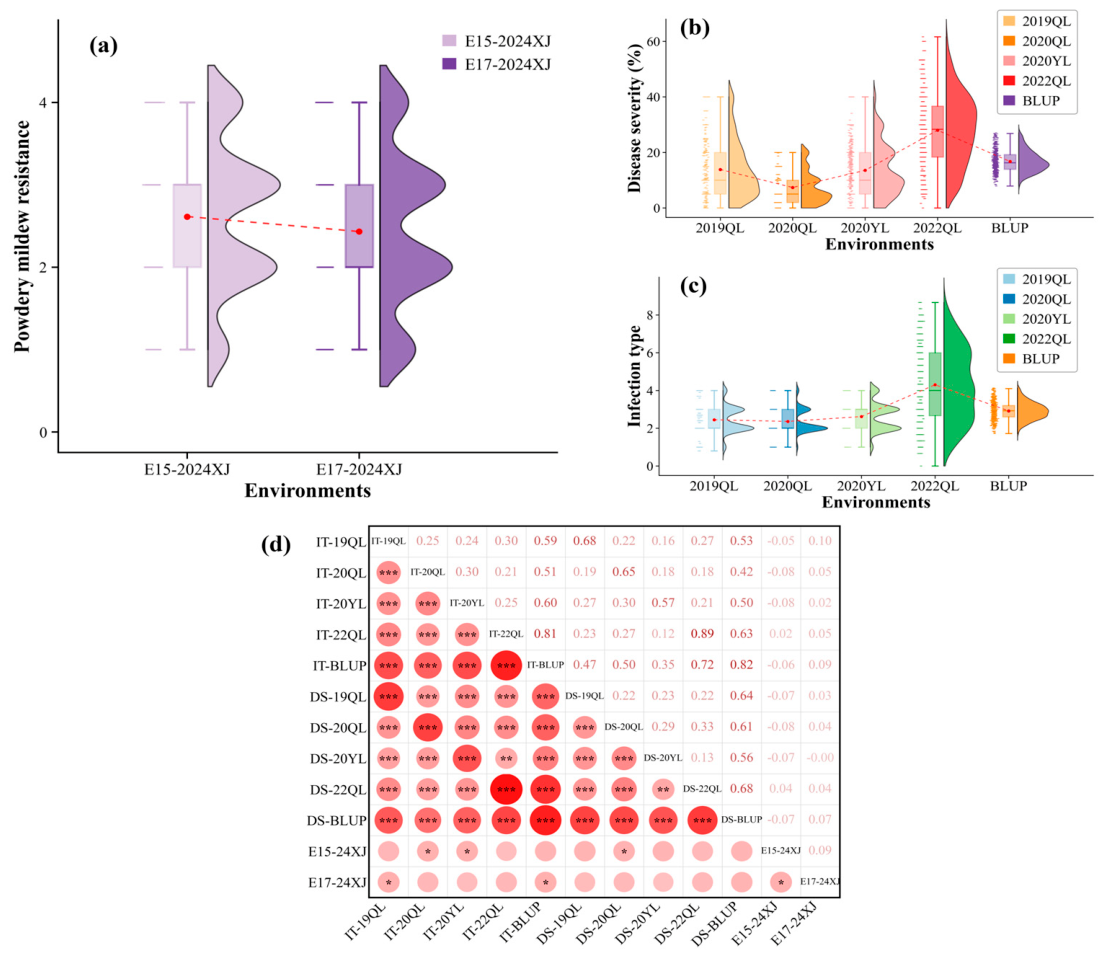
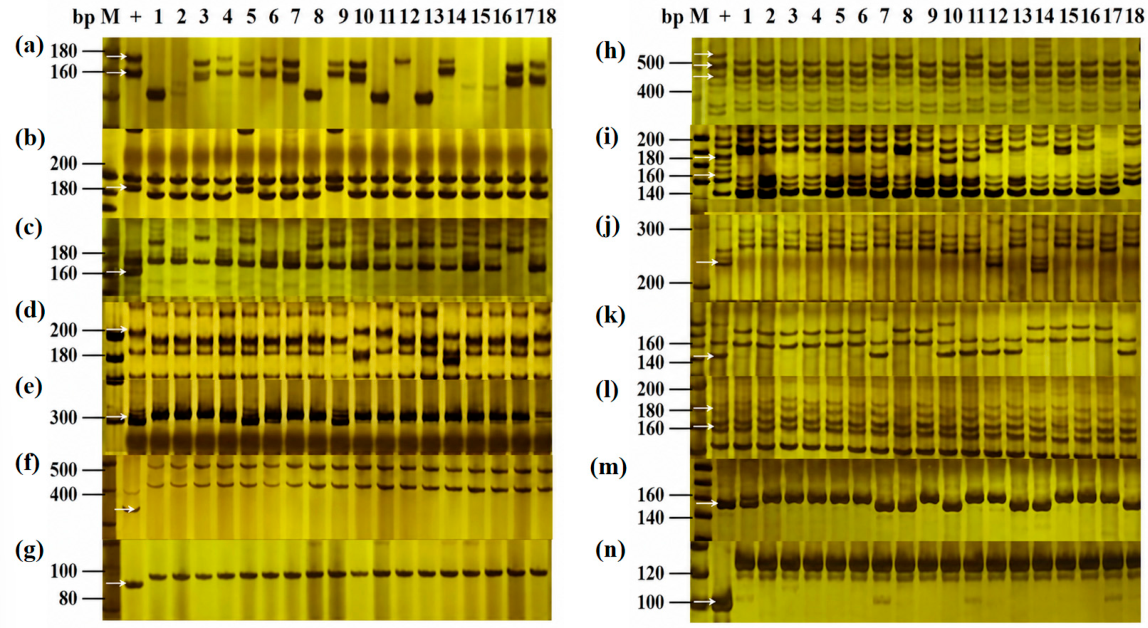
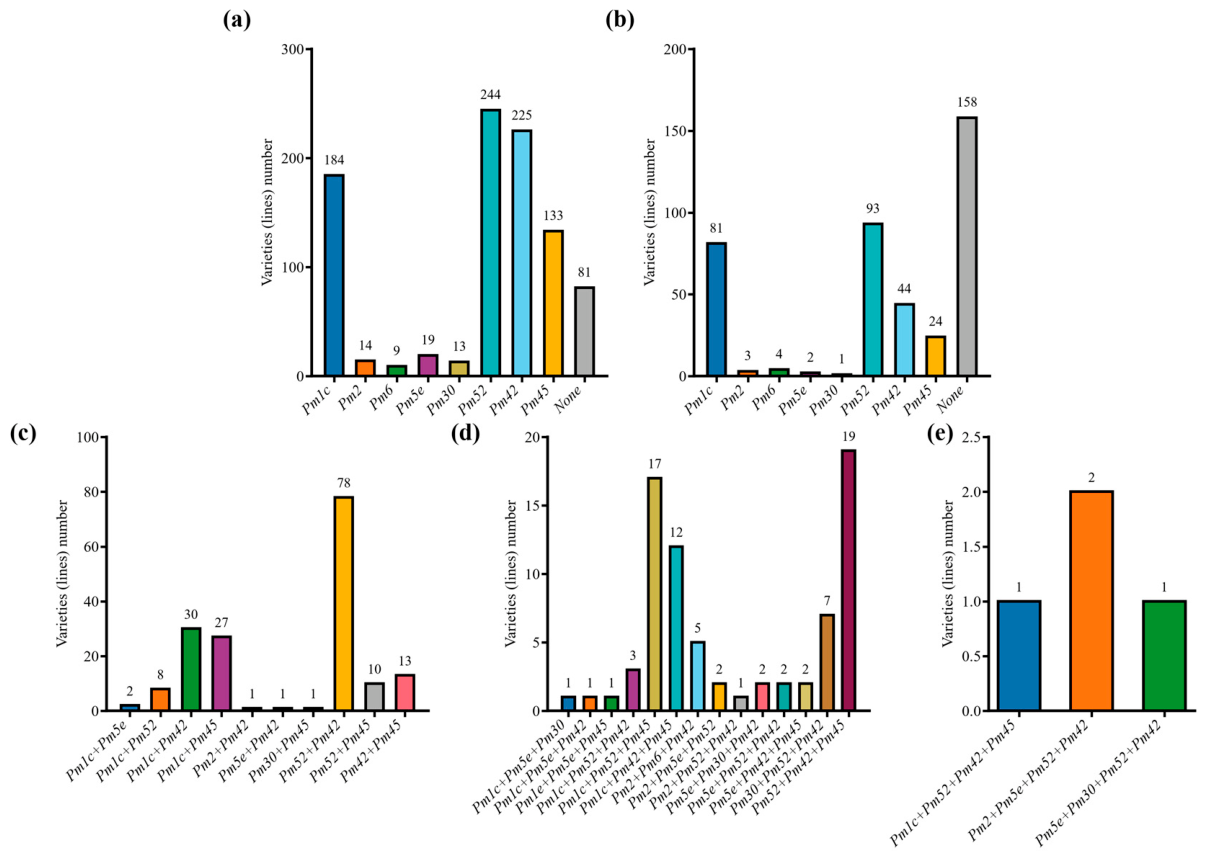
Wheat powdery mildew (Blumeria graminis f. sp. tritici, Bgt) and stripe rust (Puccinia striiformis f. sp. tritici, Pst) are two foliar diseases that threaten global wheat production. The development of germplasms with resistance to both diseases and acceptable agronomic performance is a priority for improving wheat. A total of 660 wheat lines derived from crosses between elite commercial cultivars and resistant donors were evaluated for agronomic traits across five field environments (2019–2024), seedling resistance to Bgt races E15 and E17, and field resistance to stripe rust and were genotyped using markers linked to 14 known Pm loci. Resistance to Bgt was race dependent: only 22 lines (3.3%) exhibited high resistance to both E15 and E17, with infection types (ITs) ≤ 1 on the 0–4 powdery mildew scale, and resistance to the two races was weakly correlated, indicating race-specific variation. Stripe rust resistance was strongly environment dependent: the proportion of immune to highly resistant reactions (stripe rust IT ≤ 3 on the 0–9 scale) ranged from 94.4% (622/659) in 2020QL to 33.1% (218/659) in the highest-pressure environment (2022QL). At the line level, 382 of 659 lines (58.0%) had a mean stripe rust IT ≤ 3 across environments and were classified as immune or highly resistant. Marker analysis detected at least one marker allele linked to known Pm loci in 502 lines (76.1%), involving eight Pm-linked loci (Pm1c, Pm2, Pm5e, Pm6, Pm30, Pm42, Pm45 and Pm52). Because these markers indicate the presence of linked or associated loci rather than direct functional validation, the detected loci are referred to here as marker-detected Pm-linked loci. Notably, resistance to Bgt was not simply proportional to the number of marker-detected Pm-linked loci. Lines carrying three marker-detected Pm-linked loci showed significantly lower infection types to E17 than lines carrying two or fewer loci (p < 0.05), whereas four-locus lines did not show additional resistance. This result suggests a possible combination-associated pattern rather than a strictly number-dependent relationship; however, this interpretation should be considered cautiously because marker-count and marker-combination classes differed in sample size. The MBH1 marker, which is linked to Pm21 and PmV, was not detected in the overall group, suggesting that the identified resistant lines represent valuable resources without the MBH1-tagged Pm21/PmV background. Nineteen selected lines that combined high resistance to both stripe rust and powdery mildew with acceptable agronomic performance were identified. Among these, SWUST-675, SWUST-716, and SWUST-718 represent promising germplasms for disease-resistance breeding in wheat, particularly as lines with strong dual-disease resistance and without the MBH1-tagged Pm21/PmV background.
Keywords: wheat powdery mildew; stripe rust; resistance genes; wheat germplasm resources wheat powdery mildew; stripe rust; resistance genes; wheat germplasm resources