A Highly Efficient In Vitro Regeneration System for Pearl Millet (Pennisetum glaucum) Variety “Shandaweel-1” Using Immature Inflorescences


Abstract
1. Introduction
2. Results
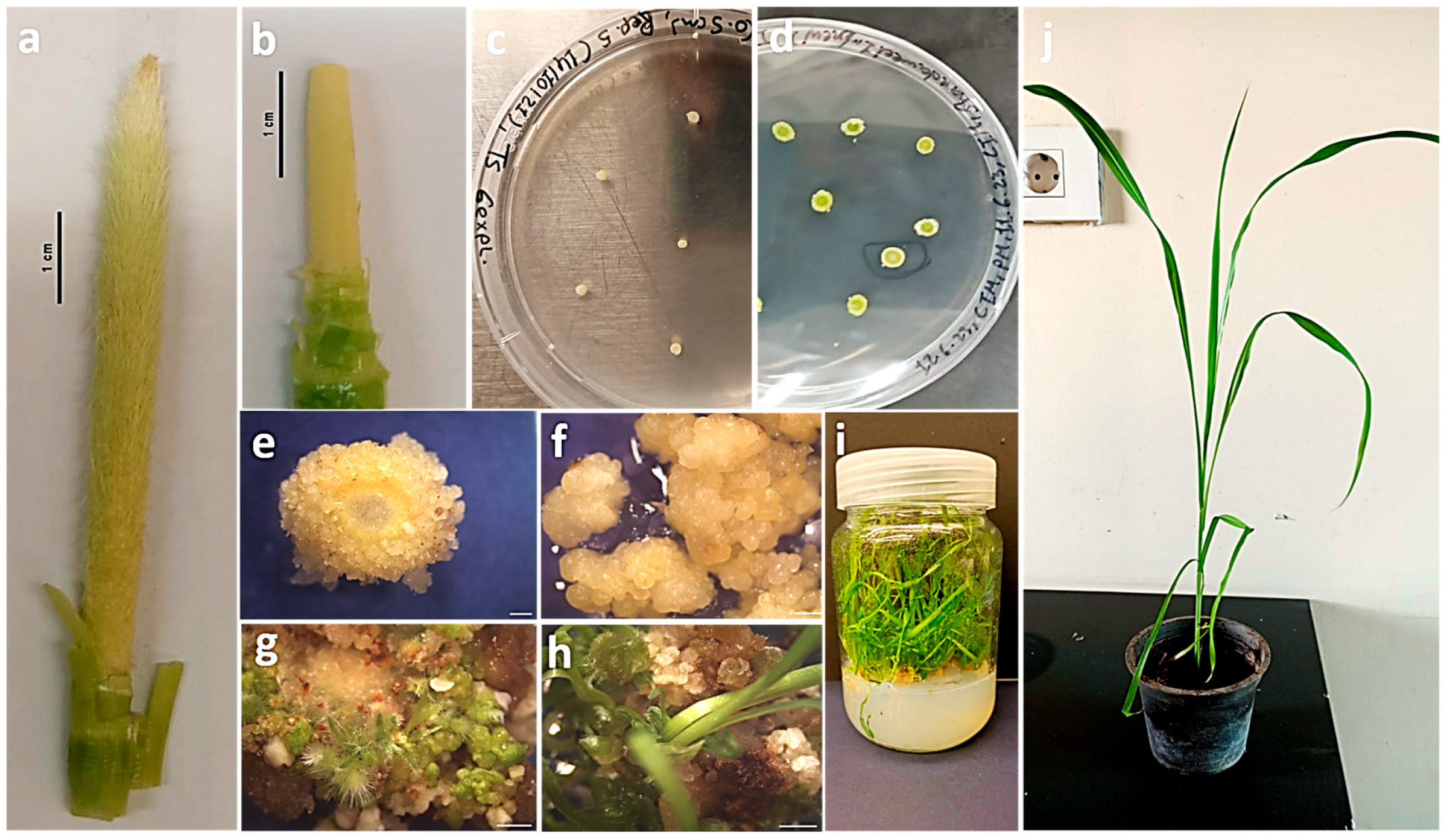
2.1. Overview of the In Vitro Regeneration System of Shandaweel-1 from Immature Inflorescences
2.2. Effect of Culture Media on Callus Quality
2.3. Effect of Culture Media on Vitrification Rates
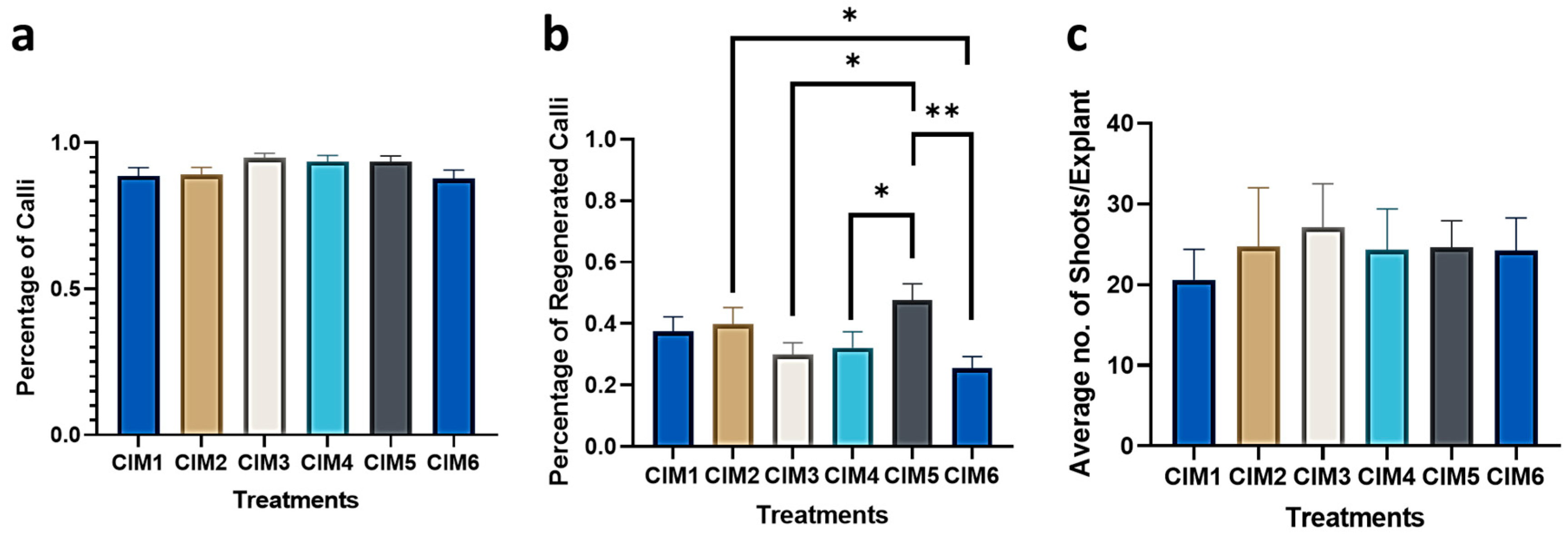
2.4. Effect of Culture Media on Callogenesis and Regeneration Efficiency
3. Discussion
4. Materials and Methods
5. Conclusions
Author Contributions
Funding
Data Availability Statement
Acknowledgments
Conflicts of Interest
Abbreviations
| FAO | Food and Agriculture Organization |
| SDGs | Sustainable Development Goals |
| CIM | Callus Induction Media |
| SIM | Shoot Induction Media |
| SEM | Shoot Elongation Media |
| MS | Murashige and Skoog |
| 2,4-D | 2,4-dichlorophenoxyacetic acid |
| BAP | 6-benzylaminopurine |
| NAA | 1-Naphthaleneacetic acid |
| CuSO4 | Copper Sulfate |
| AgNO3 | Silver Nitrate |
| STS | Silver Thio Sulfate |
| ANOVA | Analysis of Variance |
| LSD | Fisher’s Least Significant Difference |
| ROS | Reactive Oxygen Species |
| BBM | BABY BOOM |
| WUS | WUSCHEL |
| LEC1/2 | LEAFY COTELYDON 1/2 |
References
- Pattanashetti, S.K.; Upadhyaya, H.D.; Dwivedi, S.L.; Vetriventhan, M.; Reddy, K.N. Pearl Millet. In Genetic and Genomic Resources for Grain Cereals Improvement, 1st ed.; Singh, M., Upadhyaya, H.D., Eds.; Academic Press (Elsevier): London, UK, 2016; Volume 1, pp. 253–289. [Google Scholar]
- Adegbola, R.Q.; Otitodun, G.O.; Medinat, O. Fact about Pearl Millet (Pennisetum glaucum (L.): A Review. Iconic Res. Eng. J. 2023, 6, 605–615. [Google Scholar]
- Millet Production by Country. Available online: https://worldpopulationreview.com/country-rankings/millet-production-by-country (accessed on 19 May 2026).
- Sanjana Reddy, P.; Satyavathi, C.T.; Khandelwal, V.; Patil, H.T.; Gupta, P.C.; Sharma, L.D.; Mungra, K.D.; Singh, S.P.; Narasimhulu, R.; Bhadarge, H.H.; et al. Performance and Stability of Pearl Millet Varieties for Grain Yield and Micronutrients in Arid and Semi-Arid Regions of India. Front. Plant Sci. 2021, 12, 670201. [Google Scholar] [CrossRef] [PubMed]
- Satyavathi, C.T.; Ambawat, S.; Thirunavukkarasu, N.; Khandelwal, V.; Reddy, S.; Narala, A. Global Production, Status, and Utilization Pattern of Pearl Millet, 1st ed.; Perumal, R., Prasad, V., Tara, S., Govindaraj, M., Tenkouano, A., Eds.; John Wiley & Sons, Inc.: Hoboken, NJ, USA, 2024. [Google Scholar]
- Indian Institute of Millets Research (IIMR). Millets Newsletter No. 238. Available online: https://www.millets.res.in/hap/sep18.pdf (accessed on 19 May 2026).
- Home|International Year of Millets 2023|Food and Agriculture Organization of the United Nations. Available online: https://www.fao.org/millets-2023/en (accessed on 19 May 2026).
- Kheya, S.A.; Talukder, S.K.; Datta, P.; Yeasmin, S.; Rashid, M.H.; Hasan, A.K.; Anwar, M.P.; Islam, A.K.M.A.; Islam, A.K.M.M. Millets: The Future Crops for the Tropics—Status, Challenges and Future Prospects. Heliyon 2023, 9, e09331. [Google Scholar] [CrossRef] [PubMed]
- Patni, D.; Agrawal, M. Wonder Millet—Pearl Millet, Nutrient Composition and Potential Health Benefits—A Review. Int. J. Innov. Res. Rev. 2017, 5, 6–14. [Google Scholar]
- Saini, S.; Saxena, S.; Samtiya, M.; Puniya, M.; Dhewa, T. Potential of Underutilized Millets as Nutri-Cereal: An Overview. J. Food Sci. Technol. 2021, 58, 4465. [Google Scholar] [CrossRef] [PubMed]
- Mohanan, M.M.; Vijayakumar, A.; Bang-Berthelsen, C.H.; Mudnakudu-Nagaraju, K.K.; Shetty, R. Millets: Journey from an Ancient Crop to Sustainable and Healthy Food. Foods 2025, 14, 1733. [Google Scholar] [CrossRef] [PubMed]
- Karthik, T.R.; Sudha, B.; Simhi Samyukta, S.M.; Dinesh Kumar, R.; Vinodhini, S.M.; Pavithra, G. Pearl Millet (Pennisetum glaucum): A Climate Resilient and Nutritionally Significant Crop for Global Food Security. Int. J. Environ. Clim. Change 2024, 14, 381–393. [Google Scholar] [CrossRef]
- Antony Ceasar, S.; Maharajan, T. The Role of Millets in Attaining United Nation’s Sustainable Developmental Goals. Plants People Planet 2022, 4, 345–349. [Google Scholar] [CrossRef]
- Pei, J.J.; Umapathy, V.R.; Vengadassalapathy, S.; Hussain, S.F.J.; Rajagopal, P.; Jayaraman, S.; Veeraraghavan, V.P.; Palanisamy, C.P.; Gopinath, K. A Review of the Potential Consequences of Pearl Millet (Pennisetum glaucum) for Diabetes Mellitus and Other Biomedical Applications. Nutrients 2022, 14, 2932. [Google Scholar] [CrossRef] [PubMed]
- Yadav, O.; Upadhyaya, H.; Reddy, K.N.; Jukanti, A.K.; Pandey, S.; Tyagi, R. Genetic Resources of Pearl Millet: Status and Utilization. Indian J. Plant Genet. Resour. 2017, 30, 31–47. [Google Scholar] [CrossRef]
- Salama, H.S.A.; Shaalan, A.M.; Nasser, M.E.A.; Salama, H.S.A.; Shaalan, A.M.; Nasser, M.E.A. Forage Performance of Pearl Millet (Pennisetum glaucum [L.] R. Br.) in Arid Regions: Yield and Quality Assessment of New Genotypes on Different Sowing Dates. Chil. J. Agric. Res. 2020, 80, 572–584. [Google Scholar] [CrossRef]
- El-Itriby, H.A.; Assem, S.K.; Hussein, E.H.A.; Abdel-Galil, F.M.; Madkour, M.A. Regeneration and Transformation of Egyptian Maize Inbred Lines via Immature Embryo Culture and a Biolistic Particle Delivery System. In Vitro Cell. Dev. Biol.–Plant 2003, 39, 524–531. [Google Scholar] [CrossRef]
- Khaled, A.G.A.; Hamam, K.A.; Motawea, M.H.; El-Sherbeny, G.A.R. Genetic Studies on Tissue Culture Response and Some Agronomical Traits in Egyptian Bread Wheat. J. Genet. Eng. Biotechnol. 2013, 11, 79–86. [Google Scholar] [CrossRef]
- Amer, A.; Mohamed, G.; Hussein, M.; Sedik, M.; Aly, U. Effect of Some of the Natural Organic Sources on Rice Tissue Culture. Egypt. Pharm. J. 2017, 16, 152. [Google Scholar] [CrossRef] [PubMed]
- Mohamed, A.K.; Badr, A.A.; Fouad, W.M. Mapping Egypt’s Trends and Opportunities in GM Crop Research: A Scoping Review. In Vitro Cell. Dev. Biol.–Plant, 2026; in press.
- Rasco-Gaunt, S.; Barcelo, P. Plant Cell Culture Protocols, 1st ed.; Hall, R.D., Ed.; Methods in Molecular Biology; Humana Press: Totowana, NJ, USA, 1999; Volume 111, pp. 71-81. [Google Scholar] [CrossRef] [PubMed]
- Lambé, P.; Mutambel, H.S.N.; Deltour, R.; Dinant, M. Somatic Embryogenesis in Pearl Millet (Pennisetum glaucum): Strategies to Reduce Genotype Limitation and to Maintain Long-Term Totipotency. Plant Cell Tissue Organ Cult. 1998, 55, 23–29. [Google Scholar] [CrossRef]
- Pinard, F.; Chandrapalaia, C. Pearl Millet Regeneration from Immature Inflorescences: Influence of Explant Age, In Vitro Growth Conditions and Plant Genotype on the Regeneration Potential. In Millet in Africa: Genetic and Agro-Physiological Diversity: Potential and Constraints for Improvement and Cultivation, 1st ed.; Serge, H., Ed.; IRD Éditions: Bondy, France, 1993; Volume 1, pp. 95–106. [Google Scholar]
- Vasil, V.; Vasil, I.K. Characterization of an Embryogenic Cell Suspension Culture Derived from Cultured Inflorescences of Pennisetum americanum (Pearl Millet, Gramineae). Am. J. Bot. 1982, 69, 1441–1449. [Google Scholar] [CrossRef]
- Jha, P.; Yadav, C.B.; Anjaiah, V.; Bhat, V. In Vitro Plant Regeneration through Somatic Embryogenesis and Direct Shoot Organogenesis in Pennisetum glaucum (L.) R. Br. In Vitro Cell. Dev. Biol.–Plant 2009, 45, 145–154. [Google Scholar] [CrossRef]
- Mythili, P.K.; Satyavathi, V.; Pavankumar, G.; Rao, M.V.S.; Manga, V. Genetic Analysis of Short Term Callus Culture and Morphogenesis in Pearl Millet, Pennisetum glaucum. Plant Cell Tissue Organ Cult. 1997, 50, 171–178. [Google Scholar] [CrossRef]
- Plus, J.; George, L.; Eapen, S.; Rao, P.S. Enhanced Plant Regeneration in Pearl Millet (Pennisetum americanum) by Ethylene Inhibitors and Cefotaxime. Plant Cell Tissue Organ Cult. 1993, 32, 91–96. [Google Scholar] [CrossRef]
- Santha, B.; Seetharama, N. Somatic Embryogenesis in Pearl Millet (Pennisetum glaucum (L) R.Br.) Using Light and Electron Microscopy. J. Agric. Vet. Sci. 2013, 5, 1–9. [Google Scholar] [CrossRef]
- Satyavathi, V.; Rao, M.V.S.; Manga, V.; Chittibabu, M. Genetics of Some in Vitro Characters in Pearl Millet. Euphytica 2006, 148, 243–249. [Google Scholar] [CrossRef]
- Abushal, L.T.; Assem, S.K.; Fouad, W.M. Development of an Efficient Indirect Somatic Embryogenesis and Shoot Regeneration System for Sweet Sorghum Cultivars Using Immature Inflorescence. In Vitro Cell. Dev. Biol.–Plant 2025, 61, 618–630. [Google Scholar] [CrossRef]
- Rout, J.R.; Lucas, W.J. Characterization and Manipulation of Embryogenic Response from In-Vitro-Cultured Immature Inflorescences of Rice (Oryza sativa L.). Planta 1996, 198, 127–138. [Google Scholar] [CrossRef]
- Pareddy, D.R.; Petolino, J.F. Somatic Embryogenesis and Plant Regeneration from Immature Inflorescences of Several Elite Inbreds of Maize. Plant Sci. 1990, 67, 211–219. [Google Scholar] [CrossRef]
- Sharma, V.K.; Rao, A.; Varshney, A.; Kothari, S.L. Comparison of Developmental Stages of Inflorescence for High Frequency Plant Regeneration in Triticum aestivum L. and T. durum Desf. Plant Cell Rep. 1995, 15, 227–231. [Google Scholar] [CrossRef] [PubMed]
- Kumar, V.; Parvatam, G.; Aswathanarayana Ravishankar, G. AgNO3—A Potential Regulator of Ethylene Activity and Plant Growth Modulator. Electron. J. Biotechnol. 2009, 12, 717–3458. [Google Scholar] [CrossRef]
- Oldach, K.H.; Morgenstern, A.; Rother, S.; Girgi, M.; O’Kennedy, M.; Lörz, H. Efficient in Vitro Plant Regeneration from Immature Zygotic Embryos of Pearl Millet [Pennisetum glaucum (L.) R. Br.] and Sorghum bicolor (L.) Moench. Plant Cell Rep. 2001, 20, 416–421. [Google Scholar] [CrossRef] [PubMed]
- Hassan, M.F.; Islam, S.M.S. Effect of Silver Nitrate and Growth Regulators to Enhance Anther Culture Response in Wheat (Triticum aestivum L.). Heliyon 2021, 7, e07075. [Google Scholar] [CrossRef] [PubMed]
- Wu, L.M.; Wei, Y.M.; Zheng, Y.L. Effects of Silver Nitrate on the Tissue Culture of Immature Wheat Embryos. Russ. J. Plant Physiol. 2006, 53, 530–534. [Google Scholar] [CrossRef]
- Haque, M.; Siddique, A.B.; Islam, S.M.S. Effect of Silver Nitrate and Amino Acids on High Frequency Plants Regeneration in Barley (Hordeum vulgare L.). Plant Tissue Cult. Biotechnol. 2015, 25, 37–50. [Google Scholar] [CrossRef]
- Pawar, B.D.; Markad, N.R.; Wagh, R.S.; Neumann, M.; Kale, A.A.; Chimote, V.P. Proline and Silver Nitrate Promotes Multiple Shoot Induction from Mature Embryo and Shoot Tip Explants of Sorghum. Sugar Tech 2023, 25, 1187–1195. [Google Scholar] [CrossRef]
- O’kennedy, M.M.; Smith, G.; Botha, F.C. Improved Regeneration Efficiency of a Pearl Millet (Pennisetum glaucum [L.] R.Br.) Breeding Line. S. Afr. J. Bot. 2004, 70, 502–508. [Google Scholar] [CrossRef]
- Muguerza, M.B.; Gondo, T.; Ishigaki, G.; Shimamoto, Y.; Umami, N.; Nitthaisong, P.; Rahman, M.M.; Akashi, R. Tissue Culture and Somatic Embryogenesis in Warm-Season Grasses—Current Status and Its Applications: A Review. Plants 2022, 11, 1263. [Google Scholar] [CrossRef] [PubMed]
- Phillips, G.C.; Garda, M. Plant Tissue Culture Media and Practices: An Overview. In Vitro Cell. Dev. Biol.–Plant 2019, 55, 242–257. [Google Scholar] [CrossRef]
- Pasternak, T.P.; Steinmacher, D. Plant Growth Regulation in Cell and Tissue Culture In Vitro. Plants 2024, 13, 327. [Google Scholar] [CrossRef] [PubMed]
- Hayat, S.; Hayat, Q.; Alyemeni, M.N.; Wani, A.S.; Pichtel, J.; Ahmad, A. Role of Proline under Changing Environments: A Review. Plant Signal. Behav. 2012, 7, 1456. [Google Scholar] [CrossRef] [PubMed]
- Hosseinifard, M.; Stefaniak, S.; Javid, M.G.; Soltani, E.; Wojtyla, Ł.; Garnczarska, M. Contribution of Exogenous Proline to Abiotic Stresses Tolerance in Plants: A Review. Int. J. Mol. Sci. 2022, 23, 5186. [Google Scholar] [CrossRef] [PubMed]
- Lardos, M.; Marmagne, A.; Bonadé Bottino, N.; Caris, Q.; Béal, B.; Chardon, F.; Masclaux-Daubresse, C. Discovery of the Biostimulant Effect of Asparagine and Glutamine on Plant Growth in Arabidopsis thaliana. Front. Plant Sci. 2023, 14, 1281495. [Google Scholar] [CrossRef] [PubMed]
- Hare, P.D.; Cress, W.A.; Van Staden, J. The Effects of Exogenous Proline and Proline Analogues on in Vitro Shoot Organogenesis in Arabidopsis. Plant Growth Regul. 2001, 34, 203–207. [Google Scholar] [CrossRef]
- Meena, M.; Divyanshu, K.; Kumar, S.; Swapnil, P.; Zehra, A.; Shukla, V.; Yadav, M.; Upadhyay, R.S. Regulation of L-Proline Biosynthesis, Signal Transduction, Transport, Accumulation and Its Vital Role in Plants during Variable Environmental Conditions. Heliyon 2019, 5, e02952. [Google Scholar] [CrossRef] [PubMed]
- Kishor, P.B.K.; Hima Kumari, P.; Sunita, M.S.L.; Sreenivasulu, N. Role of Proline in Cell Wall Synthesis and Plant Development and Its Implications in Plant Ontogeny. Front. Plant Sci. 2015, 6, 544. [Google Scholar] [CrossRef] [PubMed]
- Gaufichon, L.; Rothstein, S.J.; Suzuki, A. Asparagine Metabolic Pathways in Arabidopsis. Plant Cell Physiol. 2016, 57, 675–689. [Google Scholar] [CrossRef] [PubMed]
- Balaji, M.; Anjaneyulu, E.; Hemalatha, S.; Raj, S.B. Callus Induction and Plant Regeneration in Finger Millet (Eleusine coracana L.). Libyan Agric. Res. Cent. J. Int. 2011, 2, 57–61. [Google Scholar]
- Tiecoura, K.; Ledoux, L.; Dinant, M. Plant Regeneration Through Tissue Culture of Pear Millet (Pennisetum glaucum (L) R.). Agron. Afr. 2009, 15, 105–121. [Google Scholar] [CrossRef]
- Sarker, K.K.; Kabir, A.; Sharmin, S.; Nasir, Z.; Alam, M. Improved Somatic Embryogenesis Using L-Asparagine in Wheat (Triticum aestivum L.). Sjemenarstvo 2007, 24, 187–196. [Google Scholar]
- Yemets, A.I.; Bayer, G.Y.; Blume, Y.B. An Effective Procedure for In Vitro Culture of Eleusine coracana (L.) and Its Application. Int. Sch. Res. Not. 2013, 2013, 853121. [Google Scholar] [CrossRef]
- Purnhauser, L.; Gyulai, G. Effect of Copper on Shoot and Root Regeneration in Wheat, Triticale, Rape and Tobacco Tissue Cultures. Plant Cell Tissue Organ Cult. 1993, 35, 131–139. [Google Scholar] [CrossRef]
- Sahrawat, A.K.; Chand, S. Stimulatory Effect of Copper on Plant Regeneration in Indica Rice (Oryza sativa L.). J. Plant Physiol. 1999, 154, 517–522. [Google Scholar] [CrossRef]
- Makowska, K.; Oleszczuk, S.; Zimny, J. The Effect of Copper on Plant Regeneration in Barley Microspore Culture. Czech J. Genet. Plant Breed. 2017, 53, 17–22. [Google Scholar] [CrossRef]
- Nirwan, R.S.; Kothari, S.L. High Copper Levels Improve Callus Induction and Plant Regeneration in Sorghum bicolor (L.) Moench. In Vitro Cell. Dev. Biol.–Plant 2003, 39, 161–164. [Google Scholar] [CrossRef]
- Long, Y.; Yang, Y.; Pan, G.; Shen, Y. New Insights Into Tissue Culture Plant-Regeneration Mechanisms. Front. Plant Sci. 2022, 13, 926752. [Google Scholar] [CrossRef] [PubMed]
- Garcia, C.; Furtado de Almeida, A.A.; Costa, M.; Britto, D.; Valle, R.; Royaert, S.; Marelli, J.P. Abnormalities in Somatic Embryogenesis Caused by 2,4-D: An Overview. Plant Cell Tissue Organ Cult. 2019, 137, 193–212. [Google Scholar] [CrossRef]
- Gaikwad, A.R.; Dobariya, K.L. The Role of Genotype, Explant, and Culture Medium on Callus Induction in Pearl Millet (Pennisetum glaucum (L.) R. BR.). J. Soils Crops 2006, 16, 76–83. [Google Scholar]
- Varalaxmi, Y.; Vijayalakshmi, A.; Ravi Kumar, K.; Vijayalakshmi, T.; Maheswari, M. Efficient Plant Regeneration from Shoot Apices of Pearl Millet (Pennisetum americanum (L.) Leeke). Plant Tissue Cult. Biotechnol. 2010, 20, 47–53. [Google Scholar] [CrossRef]
- Thejaswini, P.H. Assessment of Agronomic and Morphological Characters of Somaclonal Variation in Regenerated Pearl Millet Plants. Int. J. Pure Appl. Biosci. 2018, 6, 1721–1727. [Google Scholar] [CrossRef]
- Binte Mostafiz, S.; Wagiran, A. Efficient Callus Induction and Regeneration in Selected Indica Rice. Agronomy 2018, 8, 77. [Google Scholar] [CrossRef]
- Imran Malik, S.; Rashid, H.; Yasmin, T.; Mahmood Minhas, N. Effect of 2,4-Dichlorophenoxyacetic Acid on Callus Induction from Mature Wheat (Triticum aestivum L.) Seeds. J. Agric. Biotechnol. 2004, 6, 156–159. [Google Scholar] [CrossRef]
- Mythili, P.K.; Rao, M.V.S.; Manga, V. Cytology of Explants, Calli and Regenerants in Five Inbred Lines of Pearl Millet, Pennisetum glaucum (L.) R. Br. Cytologia 1995, 60, 23–29. [Google Scholar] [CrossRef]
- Subba Rao, M.V.; Nitzsche, W. Genotypic Differences in Callus Growth and Organogenesis of Eight Pearl Millet Lines. Euphytica 1984, 33, 923–928. [Google Scholar] [CrossRef]
- Kalamani, A.; Ramasamy, N.M. In Vitro Response of Genotypes in Pearl Millet. Indian J. Genet. Plant Breed. 1998, 58, 153–158. [Google Scholar]
- Devi, P.; Zhong, H.; Sticklen, M.B. In Vitro Morphogenesis of Pearl Millet [Pennisetum glaucum (L.) R.Br.]: Efficient Production of Multiple Shoots and Inflorescences from Shoot Apices. Plant Cell Rep. 2000, 19, 546–550. [Google Scholar] [CrossRef] [PubMed]
- Swedlund, B.; Vasil, I.K. Cytogenetic Characterization of Embryogenic Callus and Regenerated Plants of Pennisetum americanum (L.) K. Schum. Theor. Appl. Genet. 1985, 69, 575–581. [Google Scholar] [CrossRef] [PubMed]
- Mehraj, H.; Maruyama, T.; Tsuruta, M.; Ueno, S. Developmental Regulatory Genes: Key Switches in the Developmental Events of Plant Tissue Culture. Curr. Plant Biol. 2025, 44, 100550. [Google Scholar] [CrossRef]
- Ali, M.; Wang, Z.; Guo, Q.; Wang, Y.; Cai, Y.; Du, J.; Pi, E.; Ding, P.; Shen, J. Mapping Plant Cell-Type-Specific Responses to Environmental Stresses. Trends Plant Sci. 2026; in press.
- LAS EZ Imaging software for Windows OS for "EZ" documentation and annotation. Available online: https://www.leica-microsystems.com/products/microscope-software/p/leica-las-ez/ (accessed on 4 July 2026).
- GraphPad Prism 10 User Guide—Analyzing Data with Prism. Available online: https://www.graphpad.com/guides/prism/latest/user-guide/using_analyzing_data.htm (accessed on 1 January 2025).
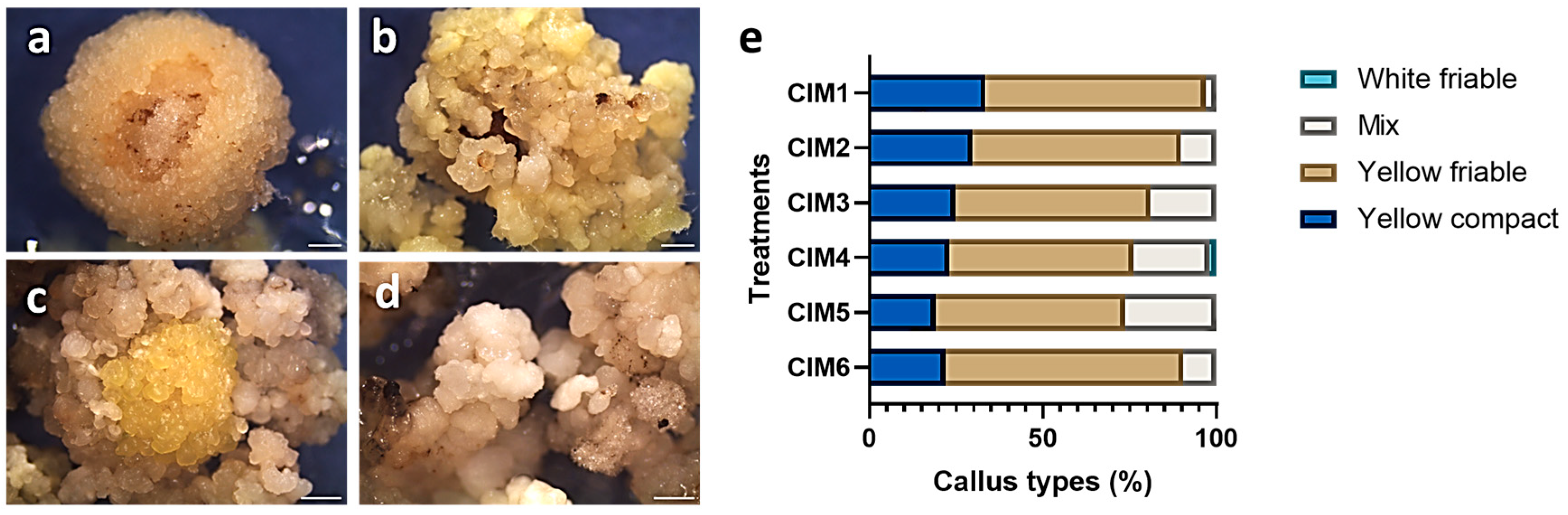
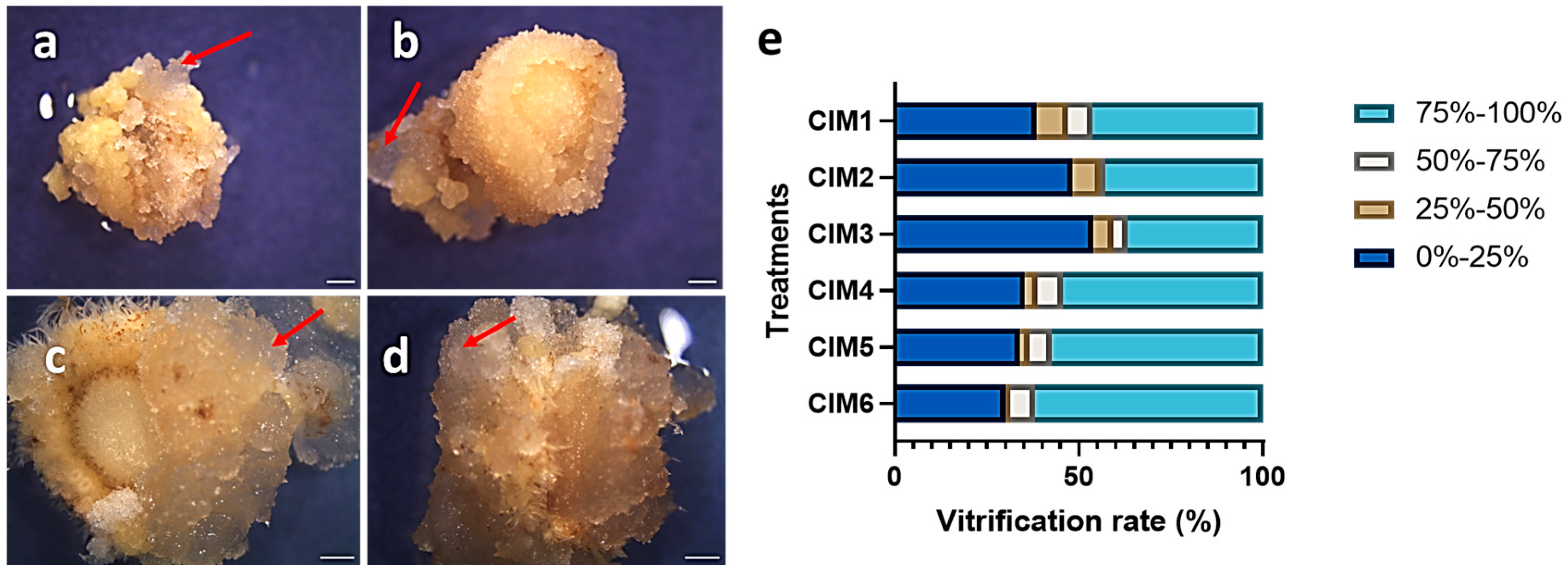


| Treatment | Predominant Callus Type | Predominant Vitrification Range | Callus Induction (%) | Regeneration Frequency (%) | Mean Number of Shoots per Regenerated Explant |
|---|---|---|---|---|---|
| CIM1 | Yellow friable (63.50%) | 75–100% vitrification (46.25%) | 88.0 | 37.50 abc | 20 |
| CIM2 | Yellow friable (60.02%) | 0–25% vitrification (48.36%) | 89.0 | 39.80 ab | 24 |
| CIM3 | Yellow friable (53.00%) | 0–25% vitrification (54.00%) | 95.0 | 29.80 bc | 27 |
| CIM4 | Yellow friable (53.00%) | 75–100% vitrification (54.32%) | 93.0 | 32.00 bc | 24 |
| CIM5 | Yellow friable (54.45%) | 75–100% vitrification (57.29%) | 93.0 | 47.60 a | 24 |
| CIM6 | Yellow friable (68.54%) | 75–100% vitrification (61.81%) | 87.0 | 25.00 c | 24 |
| CIM1 | CIM2 | CIM3 | CIM4 | CIM5 | CIM6 | SIM | SEM | |
|---|---|---|---|---|---|---|---|---|
| MS Basal Salts | 4.33 g | 4.33 g | 4.33 g | 4.33 g | 4.33 g | 4.33 g | 4.33 g | 2.165 g |
| Sucrose | 30.0 g | 30.0 g | 30.0 g | 30.0 g | 30.0 g | 30.0 g | 30.0 g | 30.0 g |
| l-Proline | 1.0 g | 1.0 g | - | 1.0 g | 1.0 g | 1.0 g | 1.0 g | - |
| l-Asparagine | 1.0 g | 1.0 g | - | 1.0 g | 1.0 g | 1.0 g | 1.0 g | - |
| Casein Hydrolysate | - | - | 1.0 g | - | - | - | 0.5 g | - |
| Agar | 8.0 g | 8.0 g | 8.0 g | 8.0 g | 8.0 g | 8.0 g | 8.0 g | 8.0 g |
| MS Vitamins | 100.0 mg | 100.0 mg | 100.0 mg | 100.0 mg | 100.0 mg | 100.0 mg | 100.0 mg | 100.0 mg |
| * CuSO4 | 0.32 mg | 0.32 mg | 0.32 mg | 0.32 mg | 0.32 mg | 0.32 mg | 0.32 mg | 0.32 mg |
| AgNO3 | - | 10.0 mg | 10.0 mg | 10.0 mg | 10.0 mg | 10.0 mg | 10.0 mg | - |
| 2,4-D | 2.0 mg | 2.0 mg | 2.0 mg | 2.0 mg | 1.0 mg | 3.0 mg | - | - |
| BAP | 0.5 mg | 0.5 mg | 0.5 mg | - | 0.5 mg | 0.5 mg | 1.5 mg | - |
| NAA | 0.2 mg | - |
Disclaimer/Publisher’s Note: The statements, opinions and data contained in all publications are solely those of the individual author(s) and contributor(s) and not of MDPI and/or the editor(s). MDPI and/or the editor(s) disclaim responsibility for any injury to people or property resulting from any ideas, methods, instructions or products referred to in the content. |
© 2026 by the authors. Licensee MDPI, Basel, Switzerland. This article is an open access article distributed under the terms and conditions of the Creative Commons Attribution (CC BY) license.
Share and Cite
Mohamed, A.K.; Fahmy, A.H.; Fouad, W.M. A Highly Efficient In Vitro Regeneration System for Pearl Millet (Pennisetum glaucum) Variety “Shandaweel-1” Using Immature Inflorescences. Plants 2026, 15, 2126. https://doi.org/10.3390/plants15142126
Mohamed AK, Fahmy AH, Fouad WM. A Highly Efficient In Vitro Regeneration System for Pearl Millet (Pennisetum glaucum) Variety “Shandaweel-1” Using Immature Inflorescences. Plants. 2026; 15(14):2126. https://doi.org/10.3390/plants15142126
Chicago/Turabian StyleMohamed, Amira K., Ashraf H. Fahmy, and Walid M. Fouad. 2026. "A Highly Efficient In Vitro Regeneration System for Pearl Millet (Pennisetum glaucum) Variety “Shandaweel-1” Using Immature Inflorescences" Plants 15, no. 14: 2126. https://doi.org/10.3390/plants15142126
APA StyleMohamed, A. K., Fahmy, A. H., & Fouad, W. M. (2026). A Highly Efficient In Vitro Regeneration System for Pearl Millet (Pennisetum glaucum) Variety “Shandaweel-1” Using Immature Inflorescences. Plants, 15(14), 2126. https://doi.org/10.3390/plants15142126