Article

A WOX5/7–SCRReciprocal Feedback Loop in Middle Cell Layer Drives Callus Proliferation

1
State Key Laboratory of Hybrid Rice, Institute for Advanced Studies, Wuhan University, Wuhan 430072, China
2
Xiaogan Academy of Agricultural Sciences, Xiaogan 432100, China
3
Guangxi Salt-Alkali Tolerant Food Crop Seed Engineering Research Center, College of Agricultural Engineering, Guangxi Vocational University of Agriculture, Nanning 530007, China
*
Authors to whom correspondence should be addressed.
Plants 2026, 15(2), 210; https://doi.org/10.3390/plants15020210
Submission received: 17 November 2025 / Revised: 4 January 2026 / Accepted: 6 January 2026 / Published: 9 January 2026

Abstract

In plant tissue culture, the middle cell layer of the callus is crucial for establishing pluripotency and serves as the foundation for subsequent organ regeneration. Although several root apical stem cell regulators have been implicated in maintaining callus pluripotency, how they functionally coordinate to control the formation and proliferation of the middle callus layer remains unclear. Here, we identify a reciprocal transcriptional activation between the root stem cell regulators WOX5/7 and SCR in the middle callus layer of Arabidopsis. We further show that WOX5/7 and SCR form protein complexes that mutually enhance their transcriptional activities. Transcriptomic analysis reveals that WOX5/7 and SCR co-regulate a subset of cell cycle-related genes, explaining the reduced mitotic activity observed in the callus of wox5 wox7 double mutants and scr mutants. Together, these findings support a model in which WOX5/7 and SCR establish a reciprocal positive feedback loop in the middle cell layer that drives the robust callus proliferation by promoting cell cycle progression.

1. Introduction

In classic plant in vitro culture systems, callus tissue is induced from explants—such as roots, hypocotyls, and cotyledons—by culturing on callus induction medium (CIM) with an appropriate ratio of auxins and cytokinins [1]. Originally regarded as a disorganized cell mass, the callus is now recognized as a heterogeneous tissue. Its development follows a pattern similar to that of lateral root primordia, originating from pericycle or pericycle-like cells adjacent to xylem poles [2,3]. However, unlike the stereotypic development of lateral roots, callus ontogeny exhibits greater complexity and randomness [4].
Recent advances in single-cell transcriptomics have revealed that the early callus can be systematically partitioned into three distinct layers perpendicular to the explant’s vascular axis: the outer, middle, and inner layers [5,6]. The outer layer expresses epidermal-related genes, while the inner layer is marked by vascular and provascular gene expression. The middle layer is characterized by the enrichment of quiescent center (QC)-like identity genes, and lineage tracing has confirmed that regenerated organs originate specifically from this middle domain [5,7]. Thus, the establishment and proliferative activity of the middle layer are critical for the success of de novo organogenesis.
Several transcription factors play important roles in maintaining the identity of the QC in the root and the middle cell layer in the callus. Among them, the homeodomain transcription factor WUSCHEL-RELATED HOMEOBOX5 (WOX5), which is specifically expressed in the QC, is an essential regulator of stem cell activity [8,9]. WOX5 inhibits QC division and prevents stem cell differentiation by suppressing D-type CYCLIN (CYCD) genes and CYCLING DOF FACTOR4 (CDF4), respectively [8,10]. The GRAS transcription factor SCARECROW (SCR), which is involved in positioning the root stem cell niche [11,12], activates WOX5 expression by recruiting the epigenetic co-regulator SEUSS (SEU) to its promoter [13]. Furthermore, SCR can form higher-order complexes with plant-specific teosinte-branched cycloidea PCNA (TCP) transcription factors and AP2-family transcription factors PLETHORAs (PLTs) to guide WOX5 expression, thereby establishing the root stem cell niche [14].
During callus development, the GRAS-family protein SHORT-ROOT (SHR) is expressed in the inner layer and moves into the middle layer, where it interacts with SCR. This complex activates the expression of WOX5 and its closest homolog WOX7 (collectively WOX5/7) [5,15]. WOX5/7 in turn promotes auxin synthesis and modulates cytokinin responses, thereby sustaining pluripotency in the middle layer [5,15]. Mutations in any of these genes cause severe regeneration defects [16]. Although recent work has greatly advanced our understanding of pluripotency establishment in callus, how these key regulators coordinate to control callus growth remains poorly understood.
Previous studies have shown that WOX5/7 maintain callus development by regulating cell cycle genes, underscoring their crucial role in sustaining the division activity of the pluripotent middle cell layer. Here, using a combination of molecular, biochemical, and microscopy approaches, we further investigated the molecular mechanism by which WOX5/7 form a reciprocal regulatory loop with SCR to control cell proliferation during callus formation.

2. Materials and Methods

2.1. Plant Materials

The Arabidopsis thaliana ecotype Col-0 was used as the wild-type control in this study. The following previously described mutants and transgenic lines were utilized: SCRpro:SCR-eGFP [17], WOX5pro:NLS-3×eGFP [15], wox5-1 wox7-1 double mutant [18], and scr-6 [16]. See Table S2 for a list of plant materials used in this study.

2.2. Callus Induction

Arabidopsis seeds were surface-sterilized with 10% sodium hypochlorite and sown on half-strength Murashige and Skoog (1/2 MS) basal medium without sucrose. The plates were incubated at 22 °C in darkness. Five days after germination, 1 cm hypocotyl explants were excised from the seedlings and transferred to callus induction medium (CIM), which consisted of MS basal medium supplemented with vitamins, 2% (w/v) sucrose, 11 μM 2,4-dichlorophenoxyacetic acid (2,4-D), and 0.2 μM kinetin. The pH of the medium was adjusted to 5.7 before solidification with 0.8% (w/v) agar. Cultures were maintained at 22 °C under continuous light, with a light intensity of 100–150 μmol·m−2·s−1 provided by a combination of cool-white fluorescent lamps and incandescent bulbs to deliver a broad spectrum. Relative humidity was controlled at 60–70%.

2.3. Y2H Assay

For the yeast two-hybrid (Y2H) assay, the coding sequences (CDS) of WOX5 and WOX7 were cloned into the pGBKT7 bait vector, while the CDS of SCR and SHR were cloned into the pGADT7 prey vector. The assay was conducted following a previously established method [19]. All experiments were independently replicated at least three times with consistent results. All primer sequences used in this assay are provided in Table S1.

2.4. BiFC Assay

Bimolecular Fluorescence Complementation (BiFC) was employed to validate protein–protein interactions in vivo. The SCR coding sequence was fused to the C-terminal fragment of YFP in the pSPYCE vector, and the coding sequences of WOX5 and WOX7 were separately fused to the N-terminal fragment of YFP in the pSPYNE vector. See Table S2 for a list of constructs used in this study. These constructs were transiently co-expressed in Arabidopsis leaf protoplasts, and the assay was conducted following an established protocol [20]. Each interaction pair was tested in at least three independent experiments.

2.5. EdU Staining and Calcofluor White Staining

The hypocotyl explants cultured on CIM for 7 days were transferred to CIM supplemented with 2.5 mM EdU (UElandy, C6044L), and grown for 4 h. Subsequent EdU detection and cell wall staining were performed following an established protocol [21].

2.6. Microscopy

Confocal microscopy was performed using a Leica SP8 confocal microscope (Leica Microsystems, Wetzlar, Germany). The fluorescent proteins were detected with the following spectral settings: GFP was excited at 488 nm with emission collected between 500 and 540 nm; PI was excited at 554 nm with emission collected between 570 and 620 nm.
To analyze the area of callus, hypocotyl explants grown vertically on CIM were harvested and subjected to clearing as previously described [5]. The callus treated on CIM for 11 days was imaged and quantified on a Leica DM2500 differential interferometric contrast microscope (DIC) using LAS V4.12 software.

2.7. Dual-Luciferase Reporter Assay

Firefly luciferase reporter vectors were constructed by cloning the 3 kb promoters of SCR, WOX5, and WOX7 into the pGreenII 0800-LUC vector. The full-length coding sequences of GUS, WOX5, WOX7, and SCR were cloned into the pGreenII 62-SK vector to generate effectors. See Table S2 for a list of constructs used in this study. For transient expression assays, the reporter and effector plasmids were co-transformed with the p19 silencing suppressor into young leaves of Nicotiana benthamiana via Agrobacterium tumefaciens infiltration. The infiltrated leaves were harvested 48 h post-infiltration. Firefly luciferase (LUC) and Renilla luciferase (REN) activities were measured using a Dual-Luciferase Reporter Assay Kit (Vazyme, DL101-01). The relative LUC activity was represented by the ratio of LUC to REN luminescence.

2.8. Reverse Transcription Quantitative Real-Time PCR

Total RNA was isolated from 5-day-old calli cultured on callus induction medium (CIM) using the FastPure Universal Plant Total RNA Isolation Kit (Vazyme, RC411). First-strand cDNA was synthesized from the extracted RNA using the TransScript Uni All-in-One First-Strand cDNA Synthesis SuperMix for qPCR (TransGen, AU341). Quantitative real-time PCR was then performed with the PerfectStart Green qPCR SuperMix (TransGen, AQ601) on a CFX Real-Time PCR Detection System (Bio-Rad, Hercules, CA, USA). The RT-qPCR thermal cycling protocol was as follows: initial denaturation at 94 °C for 30 s; followed by 40 cycles of denaturation at 94 °C for 5 s, annealing/extension at 60 °C for 30 s; and a final melting curve analysis step (94 °C for 15 s, 60 °C for 1 min, then continuous heating to 94 °C with fluorescence measurement) to verify amplicon specificity. The ACTIN2 gene (AT3G18780) was used as an internal control for normalization. Gene expression levels were calculated using the ΔCT method in Microsoft Excel. All primer sequences used in this assay are provided in Table S1.

2.9. RNA-Seq Analysis

Hypocotyl explants were collected from 5-day-old calli grown on CIM from the Arabidopsis Col-0 wild type, wox5-1 wox7-1 double mutant, and scr-6 mutant. For each genotype, three biological replicates were prepared, with each replicate comprising a pool of 40 explants. Total RNA was extracted using the RNeasy Plant Mini Kit (QIAGEN (Hilden, Germany), #74903), and RNA integrity was assessed using an Agilent 4200 Bioanalyzer (Santa Clara, CA, USA)_. Library construction and sequencing were performed by Berry Genomics (Beijing, China).
Raw sequencing reads were processed using fastp (v0.23.4) for adapter removal and quality filtering with the parameters: -q 20-u 30-n 5-w 8. Clean reads were then aligned to the Arabidopsis thaliana TAIR10 reference genome using STAR (v2.7.3a) in two-pass mode (--twopassMode Basic).
Gene expression quantification was performed using RSEM (v1.3.1) based on the aligned BAM files to obtain raw read counts and fpkm values. Differential expression analysis was conducted in R (v4.2.0) using the DESeq2 package (v1.38.3). Genes with an p-adj ≤ 0.05 and |log2(fold change)| ≥ 1 were considered significantly differentially expressed. Principal component analysis (PCA) and hierarchical clustering were performed on variance-stabilizing transformed (VST) expression values to evaluate sample reproducibility and transcriptome similarity across genotypes.
Gene ontology (GO) enrichment analysis of differentially expressed genes was performed using Metascape (https://metascape.org), a web-based tool for gene annotation and analysis resource [22]. Enrichment results were visualized using dot plots to highlight biological processes associated with differentially expressed genes.

2.10. Statistical Analysis

The callus area was measured using ImageJ 1.54 software, and statistical analysis was performed with GraphPad Prism 9.0. Statistical significance, as indicated in the figure legends, was determined using a Student’s t-test. Significance levels were defined as * p < 0.05, ** p < 0.01, and *** p < 0.001.

3. Results

3.1. Mutual Transcriptional Regulation Between WOX5/7 and SCR

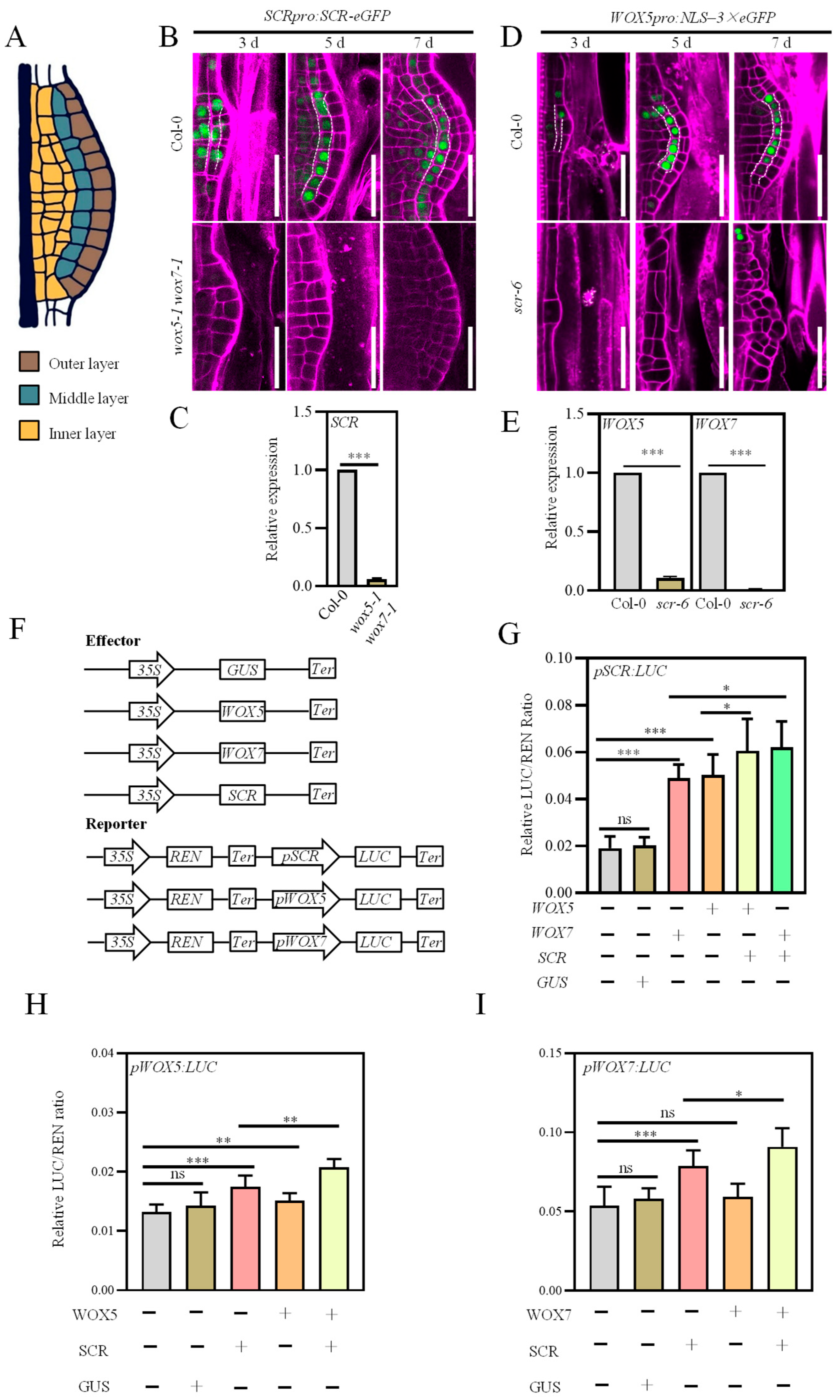
Single-cell transcriptome profiling has categorized callus into three developmental zones: the outer, middle, and inner cell layers (Figure 1A) [5]. Several transcription factors, including WOX5/7 and SCR, have been shown to play essential roles in establishing pluripotency in the middle cell layer [15]. Consistent with previous findings, both wox5-1 wox7-1 and scr-6 mutants displayed delayed development and abnormal cell division patterns during callus formation compared with the wild type (WT) (Figure 1B,D) [15]. However, the scr-6 calli exhibited much more severe defects in cell layering than those of wox5-1 wox7-1 (Figure 1B,D). These observations suggest that WOX5/7 and SCR play similar yet distinct roles in callus formation.
To investigate the molecular relationship between WOX5/7 and SCR, we first examined the spatiotemporal expression of a translational reporter, SCRpro:SCR-eGFP, using confocal microscopy. In WT callus, SCR protein was initially distributed across all cell layers at 3 days after induction and became progressively restricted to the middle cell layer over time (Figure 1B). In contrast, SCR expression was barely detectable in the wox5-1 wox7-1 double mutant (Figure 1B). The observed changes in SCR expression were further confirmed by Reverse Transcription Quantitative Real-Time PCR (RT-qPCR) (Figure 1C). Collectively, these results demonstrate that WOX5/7 are required to maintain SCR expression in the callus.
We next asked whether SCR, in turn, regulates WOX5/7 expression. As previously reported [5,23], the transcriptional reporter WOX5pro:NLS-3×eGFP exhibited an expression pattern similar to that of SCRpro:SCR-eGFP, with enrichment in the middle cell layer during callus development (Figure 1D). However, this expression was markedly reduced in the scr-6 loss-of-function mutant compared to WT (Figure 1D). RT-qPCR analysis further confirmed the downregulation of both WOX5 and WOX7 in scr-6 (Figure 1E), suggesting that SCR positively regulates WOX5/7 expression. These findings are consistent with previous reports indicating that SCR activates WOX5 expression during callus development [15].
To further validate the mutual transcriptional regulation between WOX5/7 and SCR, we conducted transient dual-luciferase assays in Nicotiana benthamiana leaves. Transformation of WOX5 or WOX7 alone significantly activated pSCR:LUC expression, confirming that WOX5/7 transcriptionally activate SCR (Figure 1F,G). Interestingly, co-transformation of SCR with WOX5 or WOX7 further enhanced pSCR:LUC activation beyond the level induced by WOX5 or WOX7 alone (Figure 1F,G), implying an additional regulatory layer beyond direct transcriptional control. Similarly, co-transformation of SCR with WOX5 or WOX7 resulted in stronger activation of pWOX5:LUC or pWOX7:LUC compared to transformation of SCR alone (Figure 1F,H,I). Together, these results support a model of reciprocal transcriptional reinforcement between WOX5/7 and SCR during callus development.

3.2. Physical Interaction of WOX5/7 with SCR

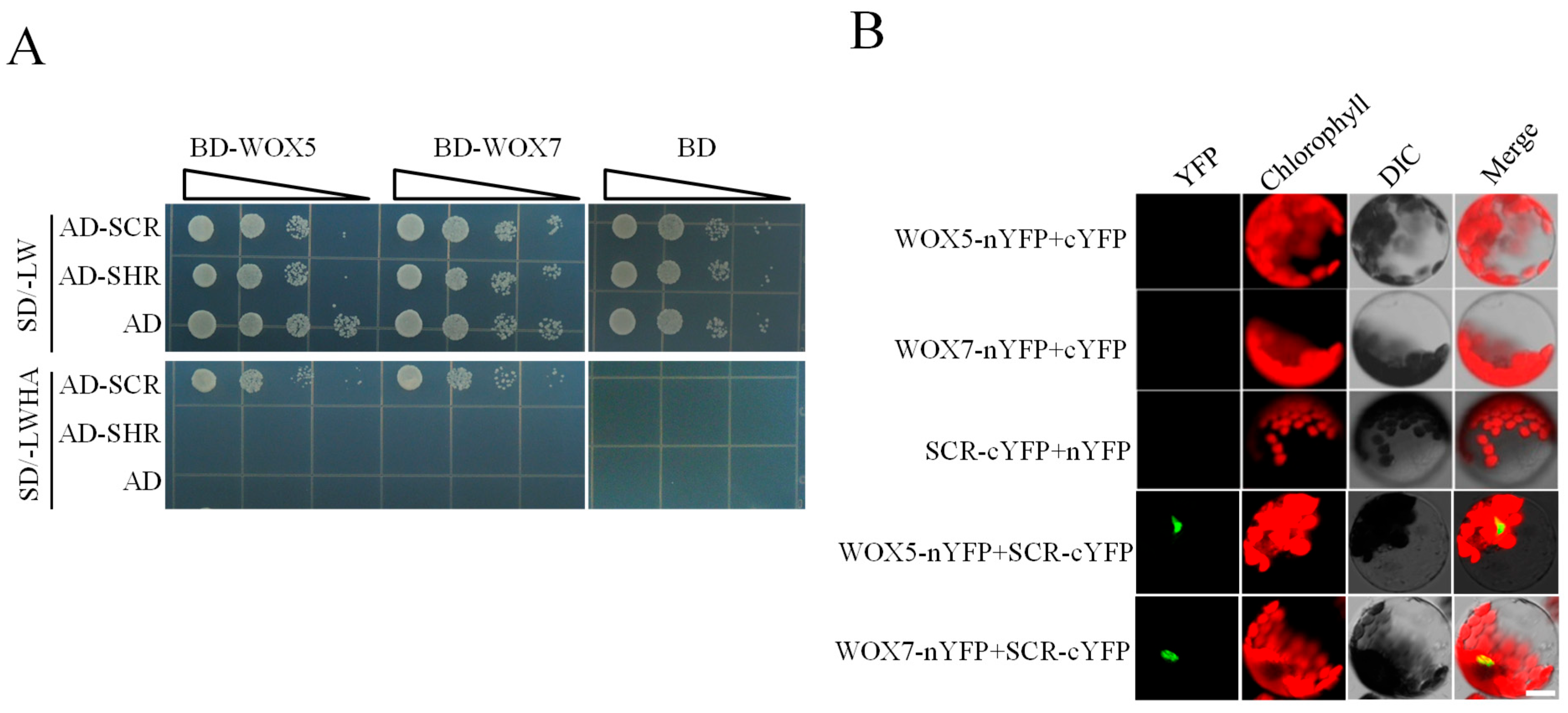
The synergistic effect observed in the transient transcriptional assays prompted us to test for a potential protein–protein interaction between WOX5/7 and SCR. To experimentally test this hypothesis, we employed Yeast Two-Hybrid (Y2H) and Bimolecular Fluorescence Complementation (BiFC) assays. In the Y2H system, co-transformation of WOX5 or WOX7 with SCR supported robust yeast growth on stringent quadruple dropout medium (SD/-Ade/-His/-Leu/-Trp). In contrast, neither WOX5 nor WOX7 interacted with SHORT ROOT (SHR) under the same conditions (Figure 2A). This result indicates a specific protein–protein interaction between WOX5/7 and SCR. To validate this interaction in planta, we conducted BiFC assays in Arabidopsis leaf protoplasts. When SCR-cYFP was co-expressed with WOX5-nYFP or WOX7-nYFP, we observed reconstitution of YFP fluorescence specifically in the nucleus (Figure 2B). No signal was detected in the negative controls. Taken together, these results from two independent methods conclusively demonstrate that both WOX5 and WOX7 can directly interact with SCR in the nucleus.

3.3. WOX5/7 and SCR Co-Regulate a Substantial Number of Cell Cycle Related Genes

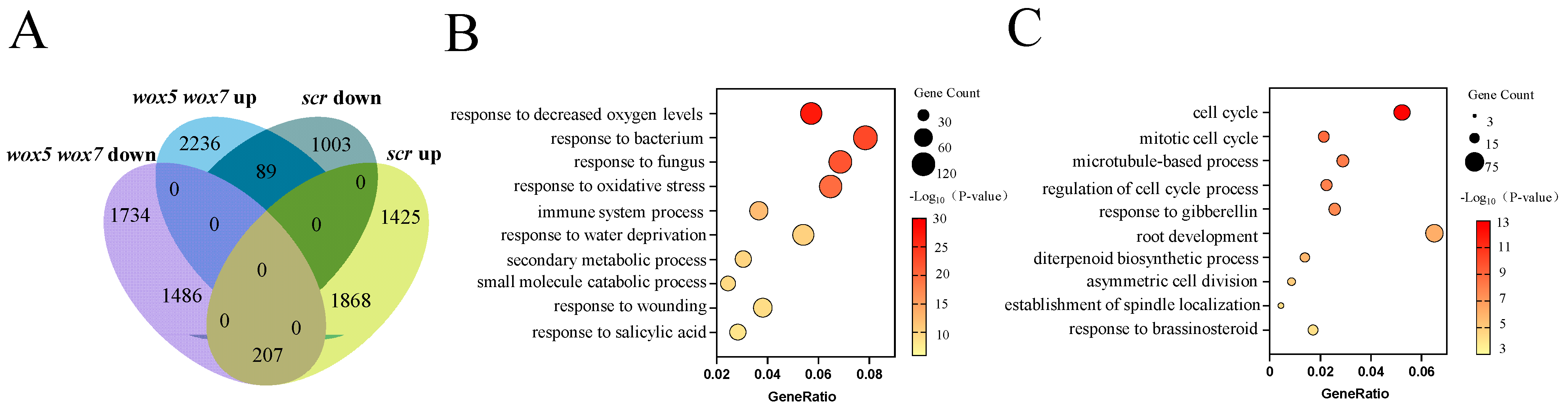
To elucidate the molecular mechanisms governed by the WOX5/7-SCR regulatory circuit, we conducted genome-wide transcriptome analyses of wox5 wox7 and scr mutant callus. In the wox5-1 wox7-1 mutant, 3427 genes were down-regulated and 4193 genes were up-regulated relative to the wild type, whereas the scr-6 mutant exhibited 2578 down-regulated and 3500 up-regulated genes (|log2FC| ≥ 1, adjusted p ≤ 0.05). Among these, 1486 and 1868 differentially expressed genes (DEGs) were commonly down-regulated and up-regulated, respectively, in both mutants (Figure 3A and Table S3). Comparative transcriptomic analysis further revealed a statistically significant overlap of DEGs between wox5-1 wox7-1 and scr-6 (Fisher’s exact test, p < 0.05), indicating shared downstream regulatory pathways affected by both mutations.
Gene Ontology (GO) enrichment analysis showed that the majority of the top 10 enriched terms for the commonly up-regulated genes in wox5-1 wox7-1 and scr-6 mutants were associated with responses to biotic or abiotic stresses (Figure 3B). In line with the established function of WOX5/7 in promoting callus cell division [23], commonly down-regulated genes were significantly enriched in functional categories related to the cell cycle and cell division (Figure 3C). Together, these transcriptomic data provide compelling evidence supporting the model that WOX5/7 and SCR act in the same pathway to coordinately promote callus development.

3.4. The WOX5/7-SCR Module Drives Callus Cell Proliferation

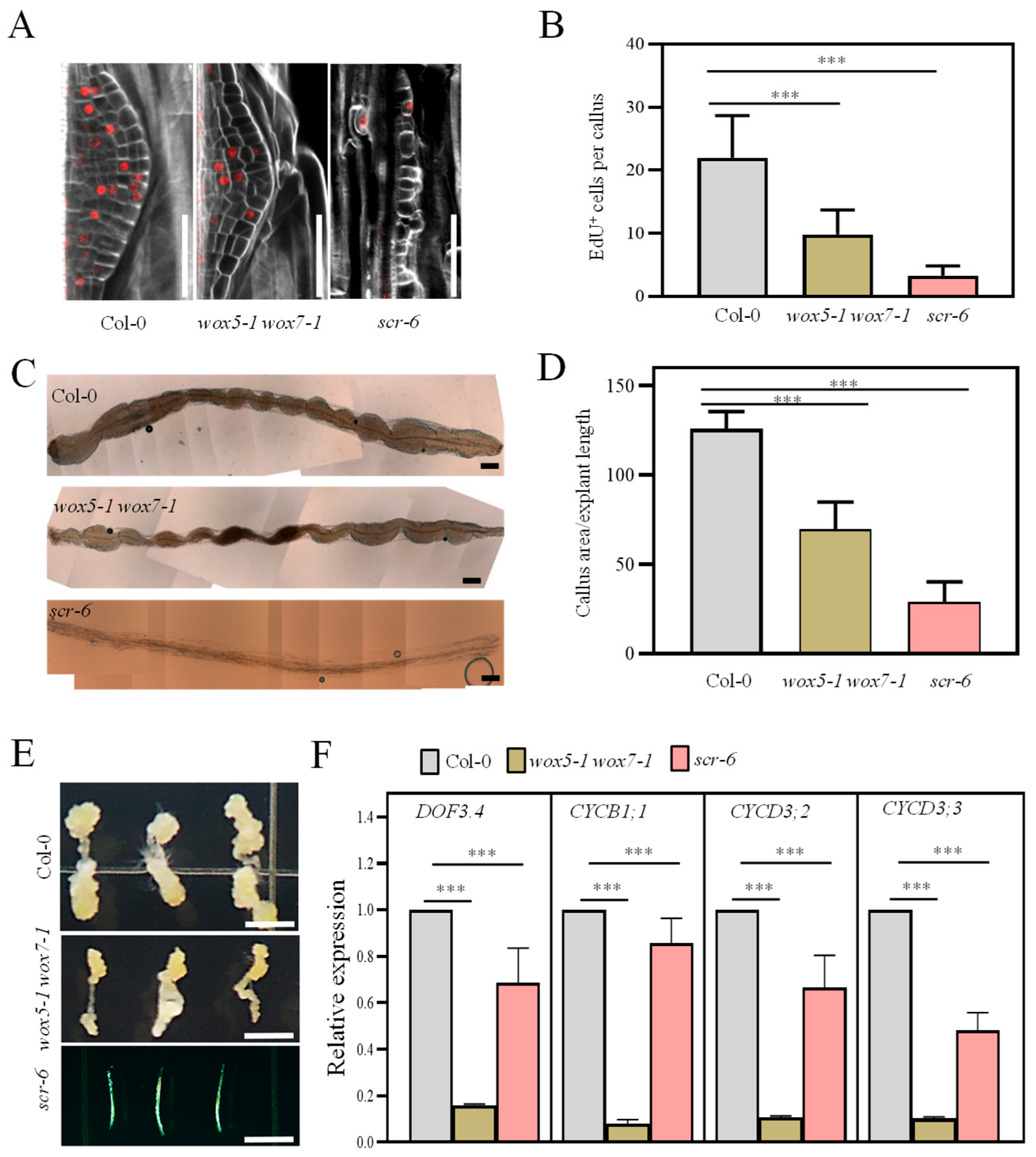
To investigate the biological significance of the co-regulation of cell cycle genes by WOX5/7 and SCR, we analyzed cell cycle progression in their respective loss-of-function mutants. Calli from wox5-1 wox7-1 and scr-6 mutants were pulse-labeled with 5-ethynyl-2′-deoxyuridine (EdU) for five days on CIM. Since EdU is incorporated during DNA synthesis, this assay specifically identifies cells in the S-phase of the cell cycle. We observed a significant reduction in the number of EdU-positive cells in both mutants compared to the WT, indicating impaired S-phase progression (Figure 4A,B). Consistent with this cell cycle defect, both mutants also developed notably smaller calli (Figure 4C–E). In particular, scr-6 produced almost no visible callus after three weeks of culture (Figure 4E).
We have previously shown that WOX5/7 promote cell division by sustaining the expression of cell cycle-related genes, including DOF3.4, CYCB1;1, CYCD3;2, and CYCD3;3 [24]. Here, RT-qPCR analysis revealed that the expression of all four genes was similarly downregulated in scr-6 callus, mirroring the expression pattern in wox5-1 wox7-1 (Figure 4F) [23]. Notably, CYCD3;2 and CYCD3;3 were also significantly downregulated in the transcriptome profiling of both wox5-1 wox7-1 and scr-6 mutants (Table S3).
Taken together, our data demonstrate that SCR functions jointly with WOX5/7 to promote callus proliferation by activating a core set of cell cycle genes.

4. Discussion

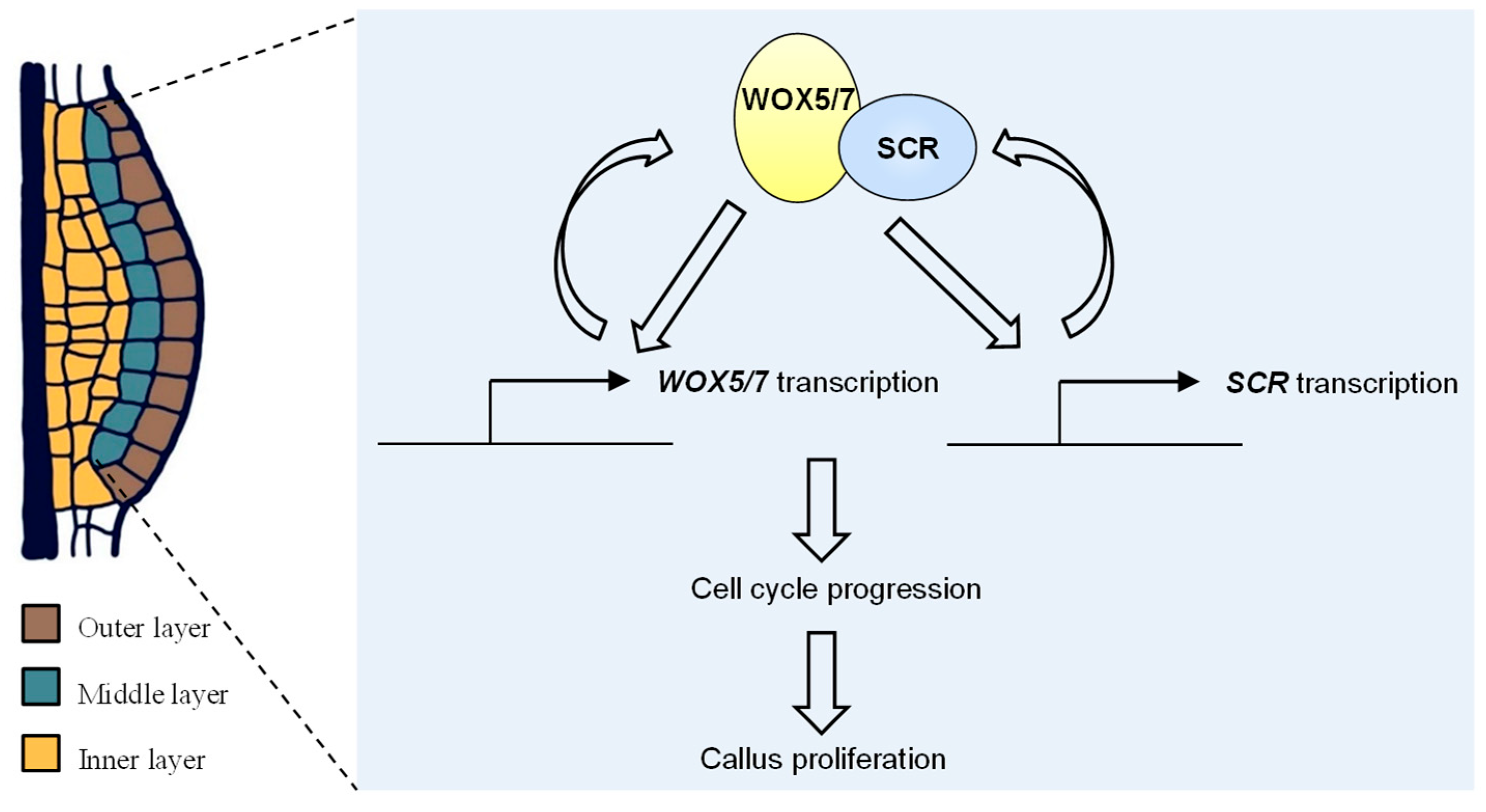
The sustained proliferation of pluripotent cells is crucial for plant regeneration from callus, but its transcriptional control remains poorly understood. Here, we identify a core regulatory module wherein WOX5/7 and SCR mutually activate each other’s expression. Furthermore, their proteins form a complex that reinforces this reciprocal transcription, establishing a positive feedback loop. This loop, in turn, drives callus proliferation by activating cell cycle-related genes (Figure 5).

4.1. A Positive Feedback Loop Stabilizes the Pluripotent Middle Layer

A key finding of our work is the reciprocal transcriptional activation between WOX5/7 and SCR. While the regulation of WOX5 by SCR has been previously suggested [15], our data provide direct genetic and molecular evidence for a fully reciprocal relationship. The loss of SCR abolishes WOX5/7 expression (Figure 1D,E), and conversely, the wox5 wox7 mutations lead to a significant reduction in SCR transcription (Figure 1B,C). This mutual dependency is further amplified at the protein level. The synergistic enhancement of each other’s promoters in transactivation assays (Figure 1F–I), coupled with the direct physical interaction between WOX5/7 and SCR proteins in the nucleus (Figure 2), strongly supports a model where these factors form a protein complex that stabilizes and reinforces their own transcription. This positive feedback loop likely serves as a robust molecular mechanism to maintain the middle callus layer, ensuring a stable source of pluripotent cells for subsequent organ regeneration.

4.2. The Potential of the WOX5/7-SCR Complex in Enhancing Crop Regeneration

In animals, a combination of four transcription factors (Oct4, Sox2, Klf4, and c-Myc) can reprogram differentiated somatic cells into pluripotent stem cells [25]. Among these, Oct4 and Sox2 form a heterodimer that serves as a cornerstone for the gene regulatory network governing pluripotency [26,27]. Analogous to this principle in animals, the overexpression of a fusion protein combining wheat GROWTH-REGULATING FACTOR 4 (GRF4) and its cofactor GRF-INTERACTING FACTOR 1 (GIF1) has been shown to substantially improve regeneration efficiency from callus in wheat [28]. These examples underscore the importance of enhancing protein complex activity to promote pluripotency acquisition and, consequently, regeneration efficiency.
In plants, research has demonstrated that the co-overexpression of WOX5 and SCR significantly enhances shoot-regeneration efficiency in Arabidopsis [16]. Moreover, overexpression of TaWOX5 alone significantly improves regeneration efficiency in wheat [29]. Therefore, by analogy to the successful GRF4-GIF1 fusion strategy and the documented synergy between WOX5 and SCR, we propose that activating a WOX5/7-SCR chimera or co-expressing these genes could be a promising approach to enhance callus pluripotency and regeneration efficiency in crops.

5. Conclusions

Our study elucidates a core transcriptional module wherein a reciprocal WOX5/7-SCR feedback loop, reinforced at both the transcriptional and protein levels, drives callus proliferation by activating cell cycle genes. These findings significantly advance our understanding of the molecular mechanisms governing pluripotent cell growth during callus formation.

Supplementary Materials

The supporting information can be downloaded at: https://www.mdpi.com/article/10.3390/plants15020210/s1.

Author Contributions

Y.Y. and L.P. conceived and designed the experiments. A.P., Y.L., C.H., C.L., H.J. and Y.Y. performed the experiments and analyzed the results. A.P., Y.Y. and L.P. wrote the manuscript. All authors have read and agreed to the published version of the manuscript.

Funding

This work was supported by the China National Key R&D Program (2023YFD2200102).

Data Availability Statement

The raw sequence data reported in this paper have been deposited in the Genome Sequence Archive (Genomics, Proteomics & Bioinformatics 2025) in National Genomics Data Center, China National Center for Bioinformation/Beijing Institute of Genomics, Chinese Academy of Sciences (GSA: CRA035560) that are publicly accessible at https://ngdc.cncb.ac.cn/gsa (accessed on 18 December 2025).

Acknowledgments

We thank Lin Xu and Philip Benfey for kindly providing published plant materials used in this study.

Conflicts of Interest

The authors declare no conflicts of interest.

References

  1. Ikeuchi, M.; Favero, D.S.; Sakamoto, Y.; Iwase, A.; Coleman, D.; Rymen, B.; Sugimoto, K. Molecular Mechanisms of Plant Regeneration. Annu. Rev. Plant Biol. 2019, 70, 377–406. [Google Scholar] [CrossRef]
  2. Sugimoto, K.; Jiao, Y.; Meyerowitz, E.M. Arabidopsis regeneration from multiple tissues occurs via a root development pathway. Dev. Cell 2010, 18, 463–471. [Google Scholar] [CrossRef]
  3. Atta, R.; Laurens, L.; Boucheron-Dubuisson, E.; Guivarc’h, A.; Carnero, E.; Giraudat-Pautot, V.; Rech, P.; Chriqui, D. Pluripotency of Arabidopsis xylem pericycle underlies shoot regeneration from root and hypocotyl explants grown in vitro. Plant J. 2009, 57, 626–644. [Google Scholar] [CrossRef]
  4. Rosspopoff, O.; Chelysheva, L.; Saffar, J.; Lecorgne, L.; Gey, D.; Caillieux, E.; Colot, V.; Roudier, F.; Hilson, P.; Berthomé, R.; et al. Direct conversion of root primordium into shoot meristem relies on timing of stem cell niche development. Development 2017, 144, 1187–1200. [Google Scholar] [CrossRef]
  5. Zhai, N.; Xu, L. Pluripotency acquisition in the middle cell layer of callus is required for organ regeneration. Nat. Plants 2021, 7, 1453–1460. [Google Scholar] [CrossRef]
  6. Yin, R.; Chen, R.; Xia, K.; Xu, X. A single-cell transcriptome atlas reveals the trajectory of early cell fate transition during callus induction in Arabidopsis. Plant Commun. 2024, 5, 100941. [Google Scholar] [CrossRef] [PubMed]
  7. Zhai, N.; Xu, L. CRE/LOX-based analysis of cell lineage during root formation and regeneration in Arabidopsis. Abiotech 2020, 1, 153–156. [Google Scholar] [CrossRef] [PubMed]
  8. Pi, L.; Aichinger, E.; van der Graaff, E.; Llavata-Peris, C.I.; Weijers, D.; Hennig, L.; Groot, E.; Laux, T. Organizer-Derived WOX5 Signal Maintains Root Columella Stem Cells through Chromatin-Mediated Repression of CDF4 Expression. Dev. Cell 2015, 33, 576–588. [Google Scholar] [CrossRef] [PubMed]
  9. Sarkar, A.K.; Luijten, M.; Miyashima, S.; Lenhard, M.; Hashimoto, T.; Nakajima, K.; Scheres, B.; Heidstra, R.; Laux, T. Conserved factors regulate signalling in Arabidopsis thaliana shoot and root stem cell organizers. Nature 2007, 446, 811–814. [Google Scholar] [CrossRef]
  10. Forzani, C.; Aichinger, E.; Sornay, E.; Willemsen, V.; Laux, T.; Dewitte, W.; Murray, J.A. WOX5 suppresses CYCLIN D activity to establish quiescence at the center of the root stem cell niche. Curr. Biol. 2014, 24, 1939–1944. [Google Scholar] [CrossRef]
  11. Di Laurenzio, L.; Wysocka-Diller, J.; Malamy, J.E.; Pysh, L.; Helariutta, Y.; Freshour, G.; Hahn, M.G.; Feldmann, K.A.; Benfey, P.N. The SCARECROW gene regulates an asymmetric cell division that is essential for generating the radial organization of the Arabidopsis root. Cell 1996, 86, 423–433. [Google Scholar] [CrossRef] [PubMed]
  12. Sabatini, S.; Heidstra, R.; Wildwater, M.; Scheres, B. SCARECROW is involved in positioning the stem cell niche in the Arabidopsis root meristem. Genes Dev. 2003, 17, 354–358. [Google Scholar] [CrossRef]
  13. Zhai, H.; Zhang, X.; You, Y.; Lin, L.; Zhou, W.; Li, C. SEUSS integrates transcriptional and epigenetic control of root stem cell organizer specification. EMBO J. 2020, 39, e105047. [Google Scholar] [CrossRef] [PubMed]
  14. Shimotohno, A.; Heidstra, R.; Blilou, I.; Scheres, B. Root stem cell niche organizer specification by molecular convergence of PLETHORA and SCARECROW transcription factor modules. Genes. Dev. 2018, 32, 1085–1100. [Google Scholar] [CrossRef] [PubMed]
  15. Zhai, N.; Pan, X.; Zeng, M.; Xu, L. Developmental trajectory of pluripotent stem cell establishment in Arabidopsis callus guided by a quiescent center-related gene network. Development 2023, 150, dev200879. [Google Scholar] [CrossRef]
  16. Kim, J.Y.; Yang, W.; Forner, J.; Lohmann, J.U.; Noh, B.; Noh, Y.S. Epigenetic reprogramming by histone acetyltransferase HAG1/AtGCN5 is required for pluripotency acquisition in Arabidopsis. EMBO J. 2018, 37, e98726. [Google Scholar] [CrossRef]
  17. Gallagher, K.L.; Paquette, A.J.; Nakajima, K.; Benfey, P.N. Mechanisms regulating SHORT-ROOT intercellular movement. Curr. Biol. 2004, 14, 1847–1851. [Google Scholar] [CrossRef]
  18. Hu, X.; Xu, L. Transcription Factors WOX11/12 Directly Activate WOX5/7 to Promote Root Primordia Initiation and Organogenesis. Plant Physiol. 2016, 172, 2363–2373. [Google Scholar] [CrossRef]
  19. Zhang, C.; Yang, Y.; Yu, Z.; Wang, J.; Huang, R.; Zhan, Q.; Li, S.; Lai, J.; Zhang, S.; Yang, C. SUMO E3 ligase AtMMS21-dependent SUMOylation of AUXIN/INDOLE-3-ACETIC ACID 17 regulates auxin signaling. Plant Physiol. 2023, 191, 1871–1883. [Google Scholar] [CrossRef]
  20. Walter, M.; Chaban, C.; Schütze, K.; Batistic, O.; Weckermann, K.; Näke, C.; Blazevic, D.; Grefen, C.; Schumacher, K.; Oecking, C.; et al. Visualization of protein interactions in living plant cells using bimolecular fluorescence complementation. Plant J. 2004, 40, 428–438. [Google Scholar] [CrossRef]
  21. Cai, X.; Zhang, H.; Mu, C.; Chen, Y.; He, C.; Liu, M.; Laux, T.; Pi, L. A mobile miR160-triggered transcriptional axis controls root stem cell niche maintenance and regeneration in Arabidopsis. Dev. Cell 2025, 60, 459–471.e455. [Google Scholar] [CrossRef] [PubMed]
  22. Zhou, Y.; Zhou, B.; Pache, L.; Chang, M.; Khodabakhshi, A.H.; Tanaseichuk, O.; Benner, C.; Chanda, S.K. Metascape provides a biologist-oriented resource for the analysis of systems-level datasets. Nat. Commun. 2019, 10, 1523. [Google Scholar] [CrossRef]
  23. Yang, Y.; Liu, C.; Yu, Y.; Ran, G.; Zhai, N.; Pi, L. WUSCHEL RELATED HOMEOBOX5 and 7 maintain callus development by promoting cell division in Arabidopsis. Plant Sci. 2024, 346, 112133. [Google Scholar] [CrossRef] [PubMed]
  24. Bisht, A.; Eekhout, T.; Canher, B.; Lu, R.; Vercauteren, I.; De Jaeger, G.; Heyman, J.; De Veylder, L. PAT1-type GRAS-domain proteins control regeneration by activating DOF3.4 to drive cell proliferation in Arabidopsis roots. Plant Cell 2023, 35, 1513–1531. [Google Scholar] [CrossRef]
  25. Welstead, G.G.; Brambrink, T.; Jaenisch, R. Generating iPS cells from MEFS through forced expression of Sox-2, Oct-4, c-Myc, and Klf4. J. Vis. Exp. 2008, 14, 734. [Google Scholar] [CrossRef]
  26. Rizzino, A.; Wuebben, E.L. Sox2/Oct4: A delicately balanced partnership in pluripotent stem cells and embryogenesis. Biochim. Biophys. Acta 2016, 1859, 780–791. [Google Scholar] [CrossRef]
  27. Rizzino, A. Concise review: The Sox2-Oct4 connection: Critical players in a much larger interdependent network integrated at multiple levels. Stem Cells 2013, 31, 1033–1039. [Google Scholar] [CrossRef] [PubMed]
  28. Debernardi, J.M.; Tricoli, D.M.; Ercoli, M.F.; Hayta, S.; Ronald, P.; Palatnik, J.F.; Dubcovsky, J. A GRF-GIF chimeric protein improves the regeneration efficiency of transgenic plants. Nat. Biotechnol. 2020, 38, 1274–1279. [Google Scholar] [CrossRef]
  29. Wang, K.; Shi, L.; Liang, X.; Zhao, P.; Wang, W.; Liu, J.; Chang, Y.; Hiei, Y.; Yanagihara, C.; Du, L.; et al. The gene TaWOX5 overcomes genotype dependency in wheat genetic transformation. Nat. Plants 2022, 8, 110–117. [Google Scholar] [CrossRef]
Figure 1. Mutual transcriptional regulation between WOX5/7 and SCR in callus formation. (A) Schematic representation of an early callus. Gray, blue and yellow areas denote the outer, middle and inner layers, respectively. (B) Representative confocal images of SCRpro:SCR-eGFP expression in 3- to 7-day-old calli from Col-0 and wox5-1 wox7-1 mutants. Green, green florescent protein (GFP); Magenta, propidium iodide (PI). White dashed lines outline the middle cell layer. Scale bar, 50 µm. (C) RT-qPCR analysis of SCR expression in 5-day-old calli of Col-0 and wox5-1 wox7-1 mutants. Data are mean ± SE (n = 4). *** p < 0.001 by two-sided Student’s t-test. (D) Representative confocal images of WOX5pro:NLS–3×eGFP expression in 3- to 7-day-old calli from Col-0 and scr-6 mutants. White dashed lines outline the middle cell layer. Scale bar, 50 µm. (E) RT-qPCR analysis of WOX5 and WOX7 expression in 5-day-old calli of Col-0 and scr-6 mutants. (F) Schematic of the effector and reporter constructs used for transient expression assays in (GI). 35S, constitutive cauliflower Mosaic virus (CaMV) 35S promoter. Ter, 35S terminator. (GI) Transient dual-luciferase assays in N. benthamiana leaves co-transformed with the effector and reporter constructs as indicated. Results are presented as the ratio of LUC (firefly luciferase) to REN (renilla luciferase) activity. Data are mean ± SE (n = 3). * p < 0.05, ** p < 0.01, *** p < 0.001, ns (not significant) by two-sided Student’s t-test.
Plants 15 00210 g001
Figure 2. Physical interaction between WOX5/7 and SCR. (A) Y2H assay demonstrating the interaction between WOX5/7 and SCR. Yeast cells expressing the indicated fusion proteins were serially diluted and spotted onto synthetic defined (SD) medium lacking Leu and Trp (–LW) or SD medium lacking Leu, Trp, His, and Ade (–LWHA). AD, activation domain; BD, DNA-binding domain. (B) BiFC assay confirming the formation of the WOX5/7–SCR complex in Arabidopsis leaf protoplasts. Green, complemented YFP signal; Red, chlorophyll autofluorescence; DIC, differential interference contrast. Experiments were independently repeated three times with similar results. Scale bar: 10 μm.
Plants 15 00210 g002
Figure 3. Comparative transcriptomic analysis of scr and wox5 wox7 mutants. (A) Venn diagram illustrating the overlap between differentially expressed genes (DEGs) in scr-6 and wox5-1 wox7-1 mutants compared to Col-0 wild type (|log2FC| ≥ 1, adjusted p ≤ 0.05). Up, upregulated DEGs; down, downregulated DEGs. (B) Top 10 Gene Ontology (GO) terms for biological processes enriched among the commonly up-regulated DEGs in both mutants. (C) Top 10 GO terms for biological processes enriched among the commonly down-regulated DEGs in both mutants.
Plants 15 00210 g003
Figure 4. The WOX5/7-SCR Module promotes callus cell proliferation. (A) Representative confocal images of 7-day-old calli grown on CIM, stained with EdU to label proliferating cells. Note that due to its limited absorption efficiency, EdU labeling was primarily confined to the callus near the hypocotyl incision. (B) Quantification of EdU-positive cells from (A). Data are presented as mean ± SE (n = 15 calli per genotype). (C) Representative microscopy images showing the overall morphology of hypocotyl explants of the indicated genotypes cultured on CIM for 11 days. (D) Quantification of callus area from (C). Data are presented as mean ± SE (n > 15 explants per genotype). (E) Representative stereomicroscope images of calli from the indicated genotypes after three weeks of culture on CIM (n > 15 explants per genotype). Note the scarce callus formation on explant hypocotyls. (F) RT-qPCR analysis of the relative transcript levels of cell cycle-related genes DOF3.4, CYCB1;1, CYCD3;2 and CYCD3;3 in 5-day-old calli of the indicated genotypes. Data are presented as mean ± SE (n = 3 biological replicates). *** p < 0.001, ns (not significant) by two-sided Student’s t-test. Scale bars: 50 μm in (A), 600 μm in (C) and 0.5 cm in (E).
Plants 15 00210 g004
Figure 5. A working model for the coordination of WOX5/7 and SCR in callus formation. The transcription factors WOX5/7 (yellow ellipse) and SCR (blue ellipse) form a transcriptional complex in the middle cell layer of callus. This complex cooperatively and efficiently activates its own expression, forming a positive feedback loop that drives callus proliferation.
Plants 15 00210 g005
Disclaimer/Publisher’s Note: The statements, opinions and data contained in all publications are solely those of the individual author(s) and contributor(s) and not of MDPI and/or the editor(s). MDPI and/or the editor(s) disclaim responsibility for any injury to people or property resulting from any ideas, methods, instructions or products referred to in the content.