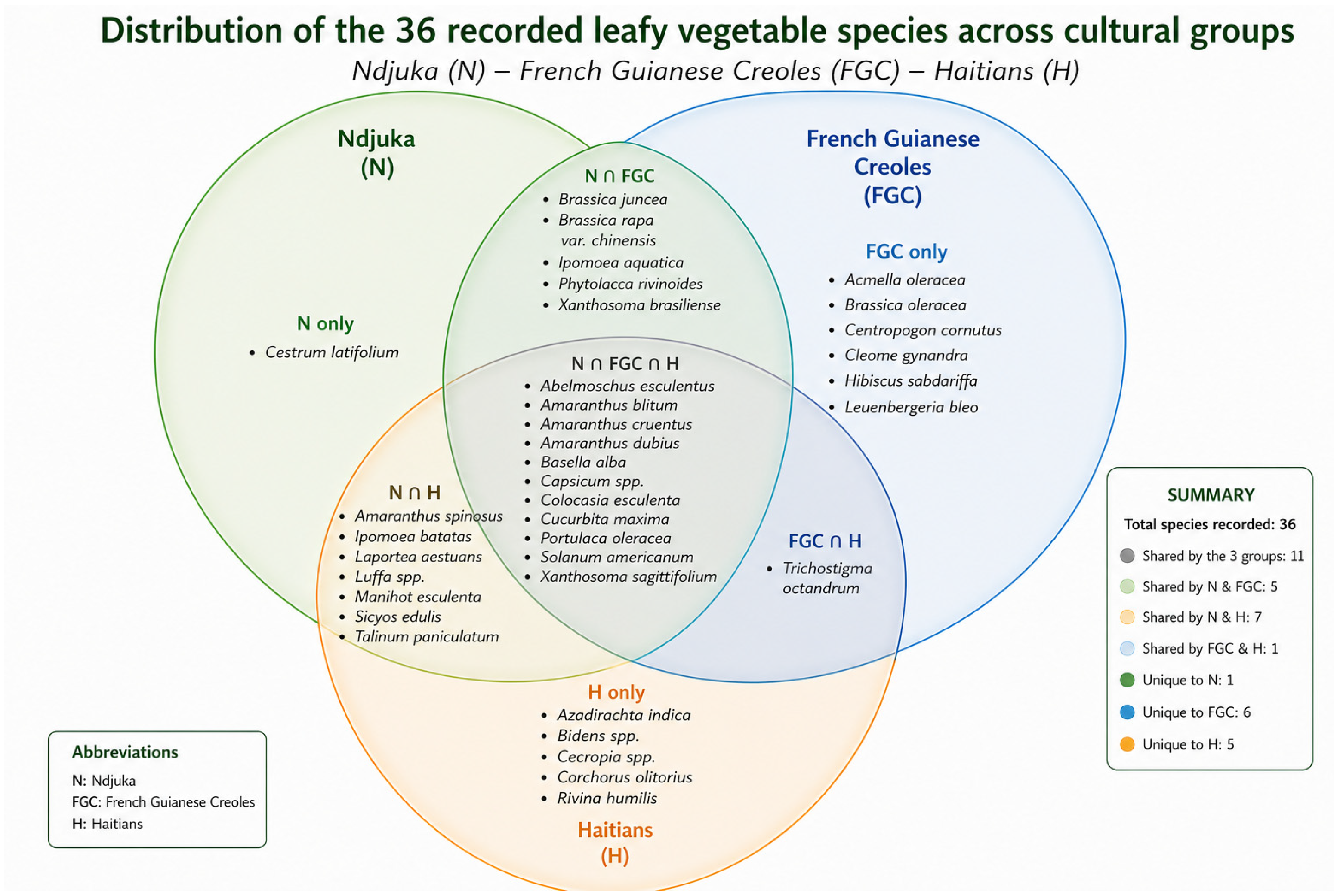
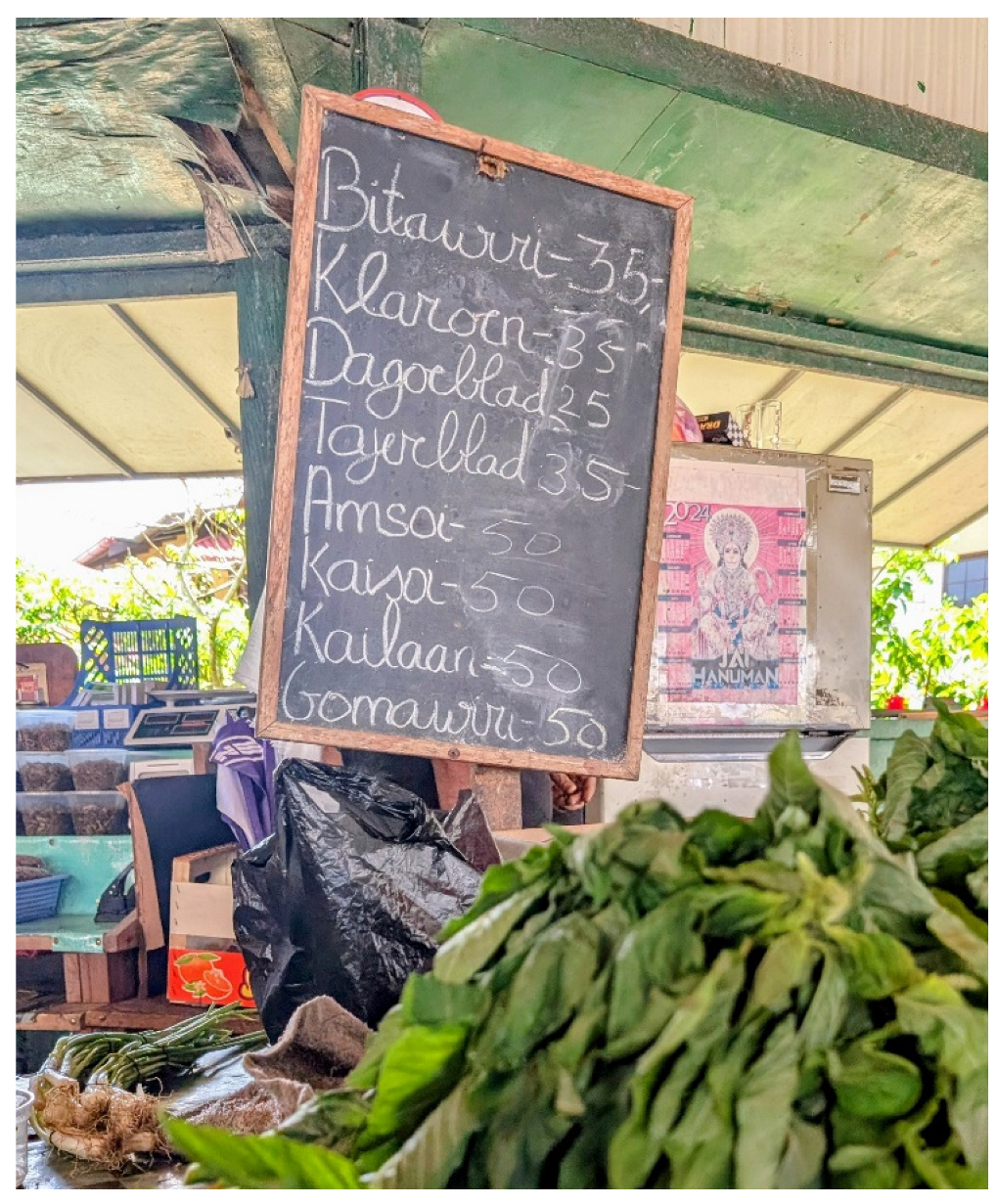
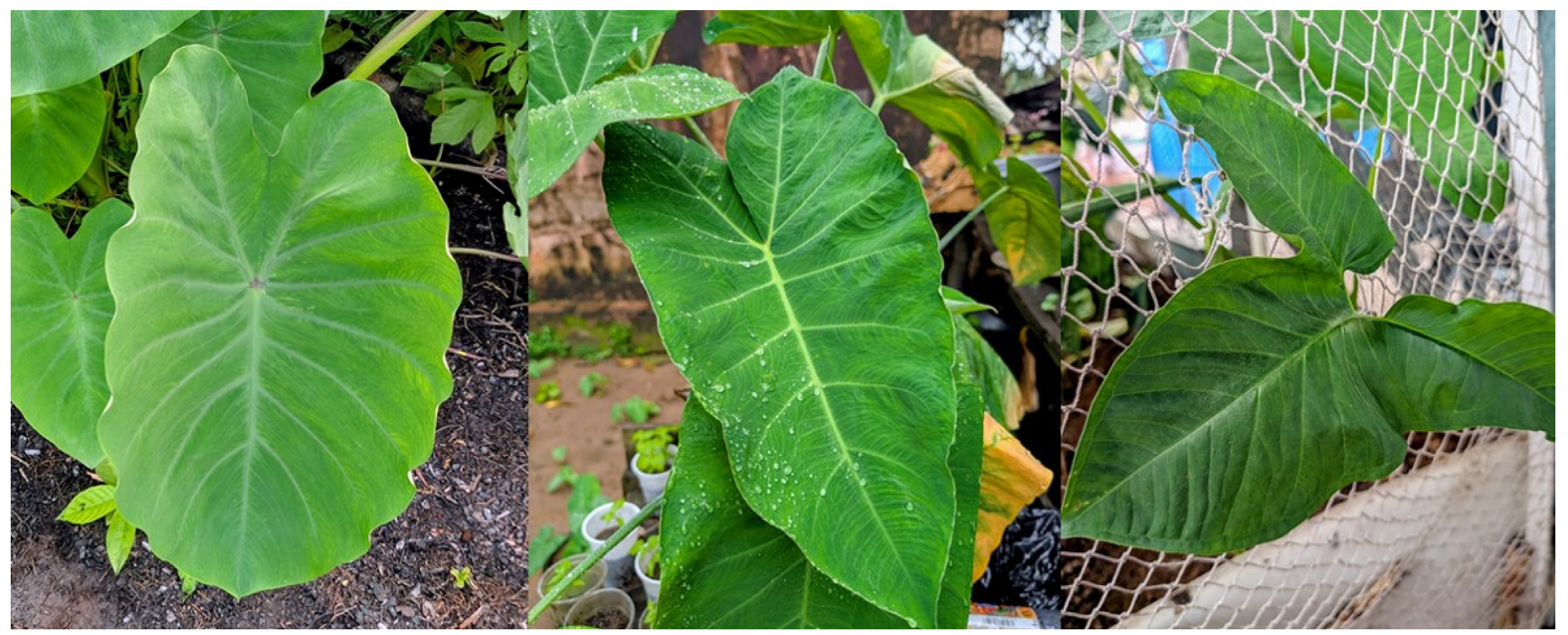
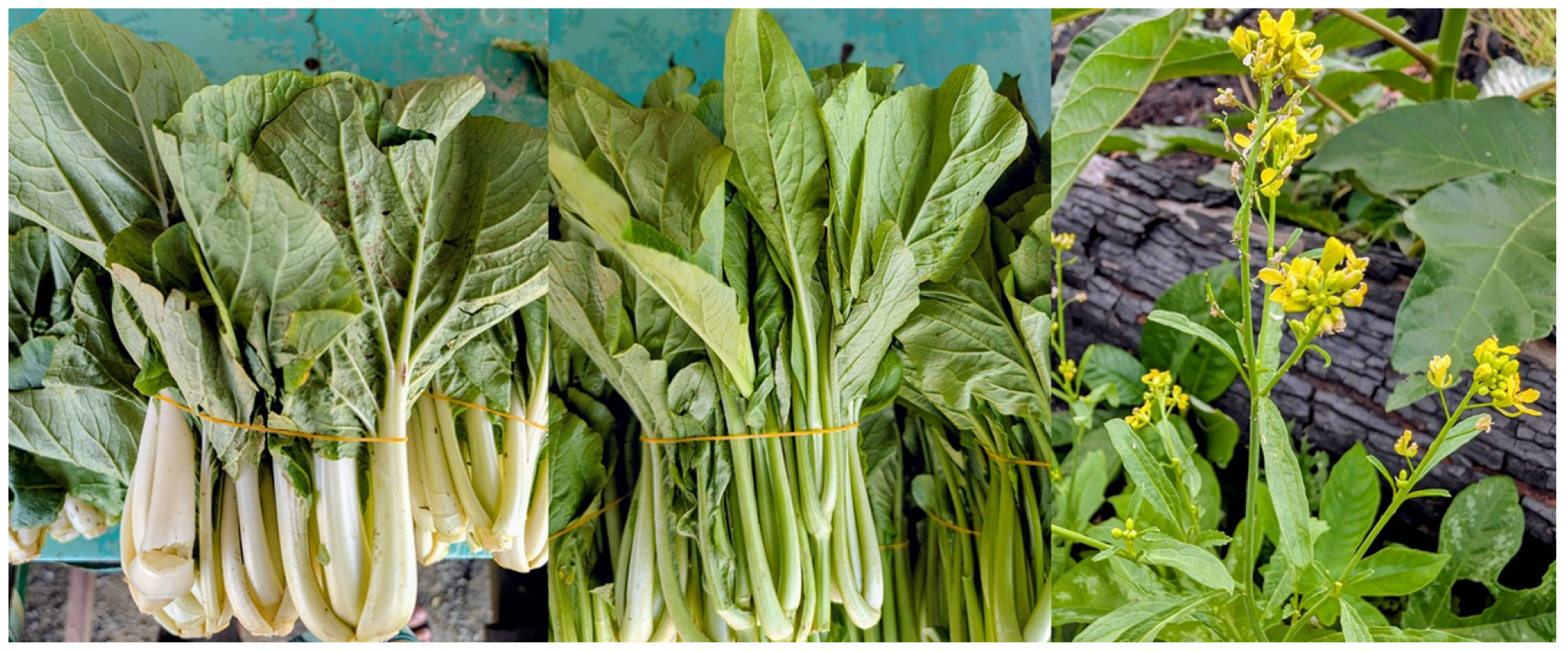
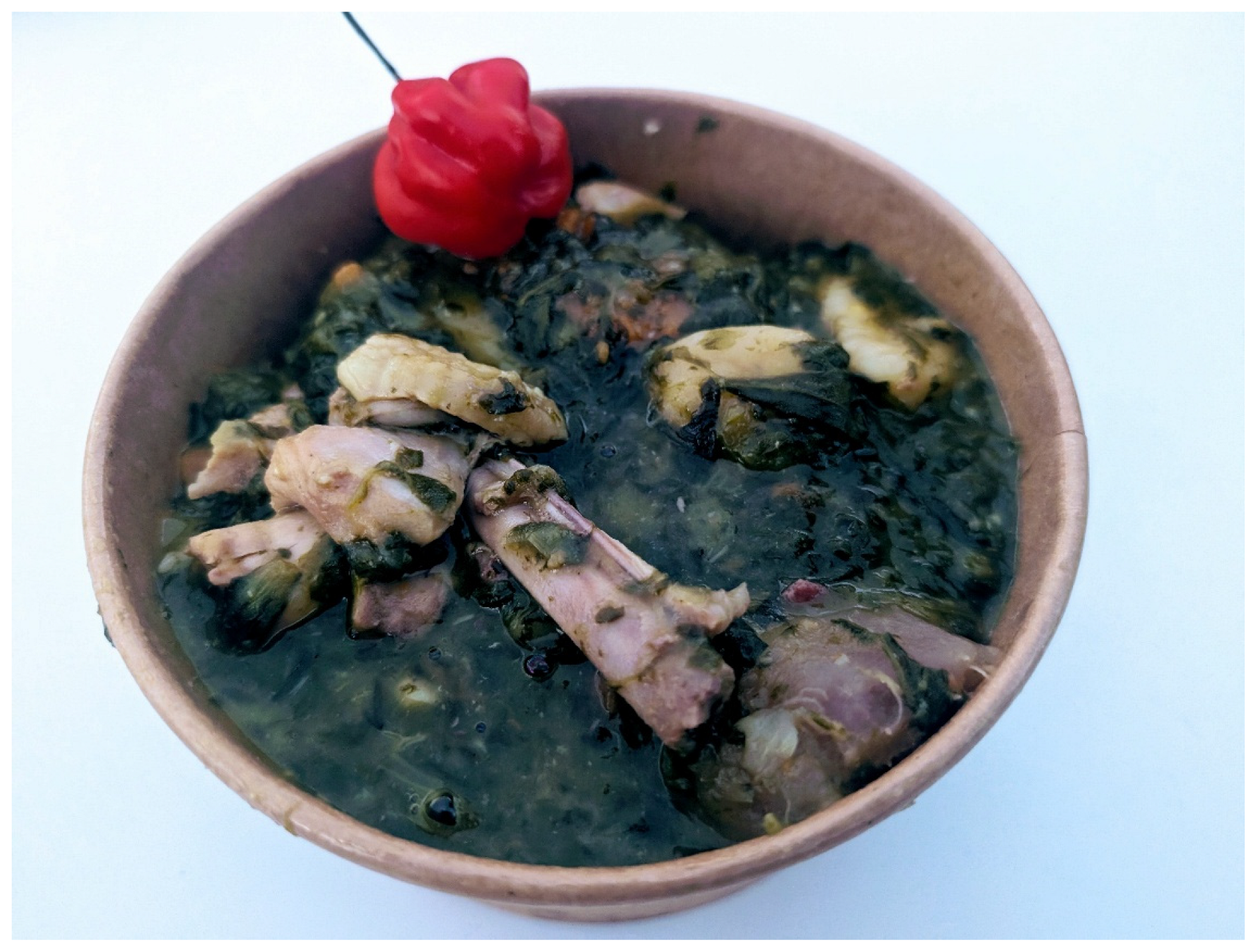
The Consumption of Edible Leaves by Afro-Descendants in French Guiana and Suriname: An Overview of a Constantly Evolving Ethno-Culinary Practice
 , ,
, ,
Abstract
1. Introduction
2. Results
2.1. Ethnobotanical Results
2.2. Species Mentioned During the Survey
2.2.1. Amaranthaceae
2.2.2. Araceae
2.2.3. Asteraceae
2.2.4. Baselaceae
2.2.5. Brassicaceae
2.2.6. Cactaceae
2.2.7. Campanulaceae
“Anvan, asou bitasyon, nou té ka servi sa bokou. Nou té ka mété’l annan kalalou a, annan bouyon wara a…Men moun aprézan pa konnet sa.” [In the countryside, this leaf (C. cornatus) was used a lot. It was added to kalalou and bouyon wara (Creole dishes)…But people nowadays don’t know about it anymore.]”French Guianese woman, 83 old years, living in Cayenne.
2.2.8. Cleomaceae
2.2.9. Convolvulaceae
2.2.10. Cucurbitaceae
2.2.11. Euphorbiaceae
2.2.12. Malvaceae
2.2.13. Meliaceae
2.2.14. Moringaceae
2.2.15. Petiveriaceae
2.2.16. Phytolaccaceae
2.2.17. Portulacaceae
2.2.18. Solanaceae
2.2.19. Talinaceae
2.2.20. Urticaceae
3. Discussion
3.1. Strong Cultural Preferences
3.2. Multiple Heritages, Highlighted by Vernacular Names
3.3. Evolving Culinary Habits
“Anvan nou té ka mété bokou radyé annan nou manjé. Bichoyak, zèb anmè, mouzanbé… Tou sa a bagaj ki disparèt jòdi jou. Jenn yan pa konnet sa zerb ya ankò… [We used to add lots of herbs to our dishes. Bichoyak (P. rivinoides), zeb anmè (S. americanum), mouzambé (C. gynandra)… All of these herbs have disappeared today. Young people no longer recognize these herbs.]”French Guianese woman living in Matoury.
“We made an excellent calalou with “chou caraïbes” leaves, small spiny cucumbers from the savannahs, sweet spinach, and young pumpkin shoots, okra cones, kaia mouzambai foliage [Cleome gynandra?], nightshade, purslane, melon buds, oxalis [Oxalys barrelieri?], roselle, small valeriane with red flowers and silver undersides, commonly known as patagon [Boerhavia sp.?], tomatoes, tender potato leaves, and chili peppers.” (Translation by the authors of the following original quotation: “On compose un excellent calalou (mets créole) avec les feuilles du Chou Caraïbes, le petit concombre épineux des savanes, les épinards doux et les jeunes pousses de giromon, les cônes du gombo, le feuillage du kaia mouzambai, la morelle, le pourpier, les bourgeons de melon, l’oxalide, l’oseille de Guinée, la petite valériane à fleurs rouges et à feuilles argentées en dessous, vulgairement appelée patagon; les tomates, feuilles tendres de patates et les pimens”.)
3.4. Risk Perception and Colonial Legacies
4. Materials and Methods
4.1. Ethnographic Background
4.2. Interviews
4.3. Limitations of the Study
4.4. Plant Identification
5. Conclusions
Author Contributions
Funding
Institutional Review Board Statement
Informed Consent Statement
Data Availability Statement
Acknowledgments
Conflicts of Interest
References
- Achigan-Dako, E.G.; Pasquini, M.W.; Assogba Komlan, F.; N’danikou, S.; Yédomonhan, H.; Dansi, A.; Ambrose-Oji, B. Traditional Vegetables in Benin; Institut National des Recherches Agricoles du Bénin: Cotonou, Benin, 2010.
- Shackleton, C.M.; Pasquini, M.W.; Drescher, A.W. African Indigenous Vegetables in Urban Agriculture; Routledge: London, UK, 2009. [Google Scholar]
- Traoré, K.; Parkouda, C.; Savadogo, A.; Ba/Hama, F.; Kamga, R.; Traoré, Y. Effect of processing methods on the nutritional content of three traditional vegetable leaves: Amaranth, black nightshade and jute mallow. Food Sci. Nutr. 2017, 5, 1139–1144. [Google Scholar] [CrossRef] [PubMed]
- Walker, S.S. African Roots/American Cultures: Africa in the Creation of the Americas; Rowman & Littlefield: Lanham, MD, USA, 2001. [Google Scholar]
- Charpentier, M.; Odonne, G.; Schaal, B. Scents in the social life of non-human and human primates. In Chemical Ecology; Bagnères, A., Hossaert-McKey, M., Eds.; Wiley: Hoboken, NJ, USA, 2016; pp. 47–70. [Google Scholar] [CrossRef]
- Van Andel, T.; Mitchell, S.; Volpato, G.; Vandebroek, I.; Swier, J.; Ruysschaert, S.; Jiménez, C.A.R.; Raes, N. In search of the perfect aphrodisiac: Parallel use of bitter tonics in West Africa and the Caribbean. J. Ethnopharmacol. 2012, 143, 840–850. [Google Scholar] [CrossRef] [PubMed]
- Macia, E.; Tibère, L.; Ka, A.; Seksik, P.; Faye, B.; Boëtsch, G.; Duboz, P. L’alimentation des Peuls du Sénégal. Comparaison entre contextes rural et urbain autour d’éléments emblématiques. Anthropol. Food 2021. [Google Scholar] [CrossRef]
- Toury, J.; Lunven, P.; Giorgi, R. Aliments de cueillette et de complément au Sénégal et zone sahélienne. Plant Foods Hum. Nutr. 1961, 8, 139–156. [Google Scholar] [CrossRef]
- Katz, E.; López, C.L.; Fleury, M.; Miller, R.P.; Payê, V.; Dias, T.; Silva, F.; Oliveira, Z.; Moreira, E. No greens in the forest? Note on the limited consumption of greens in the Amazon. Acta Soc. Bot. Pol. 2012, 81, 283–293. [Google Scholar] [CrossRef]
- Vandebroek, I.; Voeks, R. The gradual loss of African indigenous vegetables in tropical America: A review. Econ. Bot. 2018, 72, 543–571. [Google Scholar] [CrossRef]
- Etkin, N.L. Edible Medicines: An Ethnopharmacology of Food; University of Arizona Press: Tucson, AZ, USA, 2008. [Google Scholar]
- Tareau, M.A. Pharmacopées Métissées en Guyane. Une Phytothérapie en Mouvement; Orphie: Saint-Denis, France, 2026; 384p. [Google Scholar]
- Porcher, V.; Burgos, A.; Dounias, E.; Bonis-Profumo, G.; Césard, N.; Champion, L.; Cormier-Salem, M.-C.; Cubry, P.; Darias, M.J.; Dourian, T.; et al. Policy Brief—Unlocking the Values of Unseen Food Species: A Cautious Approach. 2025. Available online: https://hal.science/hal-05317303/ (accessed on 29 October 2025).
- FAO; IFAD; UNICEF; WFP; WHO. The State of Food Security and Nutrition in the World 2020: Transforming Food Systems for Affordable Healthy Diets; FAO: Rome, Italy, 2020. [Google Scholar] [CrossRef]
- Bokelmann, W.; Huyskens-Keil, S.; Ferenczi, Z.; Stöber, S. The role of indigenous vegetables to improve food and nutrition security: Experiences from the project HORTINLEA in Kenya (2014–2018). Front. Sustain. Food Syst. 2022, 6, 806420. [Google Scholar] [CrossRef]
- Ngidi, M.S.C.; Zulu, S.S.; Ojo, T.O.; Hlatshwayo, S.I. Effect of consumers’ acceptance of indigenous leafy vegetables and their contribution to household food security. Sustainability 2023, 15, 4755. [Google Scholar] [CrossRef] [PubMed]
- Fleury, M. Plantes Alimentaires de Cueillette Chez les Boni de Guyane Française. Ph.D. Thesis, Université Pierre et Marie Curie (Paris VI), Paris, France, 1986. [Google Scholar]
- Bilby, K.; Delpech, B.; Fleury, M.; Vernon, D. L’Alimentation des Noirs Marrons du Maroni: Vocabulaire, Pratiques, Représentations; ORSTOM: Cayenne, French Guiana, 1989; 393p.
- Kinupp, V.F.; Lorenzi, H. Unconventional Food Plants (PANC) in Brazil: Identification Guide, Nutritional Aspects and Illustrated Recipes; Instituto Plantarum: São Paulo, Brazil, 2014. [Google Scholar]
- Kinupp, V.F.; Lorenzi, H. Plantes Alimentaires non Conventionnelles (PANC) au Brésil. Guide d’Identification, Aspects Nutritionnels et Recettes Illustrées; Instituto Plantarum de Estudos de Flora: Nova Odessa, Brazil, 2024. [Google Scholar]
- Stallknecht, G.F.; Schulz-Schaeffer, J.R. Amaranth rediscovered. In New Crops; Janick, J., Simon, J.E., Eds.; Wiley: New York, NY, USA, 1993; pp. 211–218. [Google Scholar]
- POWO. Plants of the World Online. Facilitated by the Royal Botanic Gardens, Kew. 2026. Available online: https://powo.science.kew.org/ (accessed on 27 April 2026).
- Maundu, P.; Achigan-Dako, E.; Morimoto, Y. Biodiversity of African vegetables. In African Indigenous Vegetables in Urban Agriculture; Shackleton, C.M., Pasquini, M.W., Drescher, A.W., Eds.; Routledge: London, UK, 2009; pp. 65–104. [Google Scholar]
- Higman, B.W. Jamaican versions of callaloo. Callaloo 2007, 30, 351–368. [Google Scholar] [CrossRef]
- Savage, G.P.; Dubois, M. The effect of soaking and cooking on the oxalate content of taro leaves. Int. J. Food Sci. Nutr. 2006, 57, 376–381. [Google Scholar] [CrossRef] [PubMed]
- Barabé, D.; Gibernau, M. Aracées de Guyane Française: Biologie et Systématique; Publications scientifiques du Muséum: Paris, France; IRD: Marseille, France, 2015; 349p. [Google Scholar]
- GBIF Secretariat. GBIF Backbone Taxonomy. Checklist Dataset. 2023. Available online: https://www.gbif.org/ (accessed on 5 April 2024).
- Waugh, F.W. Iroquis Foods and Food Preparation. Geological Survey Memoir 86 (No° 12, Anthropological Series); Government Printing Bureau: Ottawa, ON, Canada, 1916; 235p.
- Yanovsky, E. Food Plants of the North American Indians; United States Department of Agriculture: Washington, DC, USA, 1936.
- Barrett, O.W. Tanier, the oldest crop. Plant World 1904, 7, 248–250. [Google Scholar]
- Barrett, O.W. Promising Root Crops for the South: Yautias, Taros, and Dasheens; U.S. Government Printing Office: Washington, DC, USA, 1910.
- Breton, R.; Paisa, M.B.; Bernabé, J. Dictionnaire Caraïbe-Français; Karthala: Paris, France, 1999. [Google Scholar]
- de Préfontaine, J.A.B. Maison Rustique, à l’Usage des Habitans de la Partie de la France Équinoxiale, Connue sous le Nom de Cayenne; Chez Cl.J.B. Bauche: Paris, France, 1763; 211p. [Google Scholar] [CrossRef]
- Descourtilz, M.É. Flore Pittoresque et Médicale des Antilles, ou Histoire Naturelle des Plantes Usuelles des Colonies Françaises, Anglaises, Espagnoles et Portugaises, Tome 8; Crosnier, Chappron, Pichard, Veuve Renard, Levrault, and Malepeyre: Paris, France, 1829; 400p. [Google Scholar]
- CNAC. Guyane—Patrimoine Culinaire; Albin Michel: Paris, France, 1999; 405p. [Google Scholar]
- Haudricourt, A.G. Les Colocasiées alimentaires (Taros et Yautias). J. Agric. Tradit. Bot. Appl. 1941, 21, 40–65. [Google Scholar] [CrossRef]
- Sepúlveda-Nieto, M.D.P.; Bonifacio-Anacleto, F.; Faleiros de Figueiredo, C.; de Moraes-Filho, R.M.; Alzate-Marin, A.L. Accessible morphological and genetic markers for identification of taioba and taro, two forgotten human foods. Horticulturae 2017, 3, 49. [Google Scholar] [CrossRef]
- Fang, Q.; Matthews, P.J.; Grimaldi, I.M.; de Jong, H.; van de Belt, J.; Schranz, M.E.; van Andel, T. The invisible tropical tuber crop: Edible aroids (Araceae) sold as “tajer” in the Netherlands. Econ. Bot. 2025, 79, 44–64. [Google Scholar] [CrossRef]
- Nicolas, J.P. Plantes Médicinales du Nord de Madagascar: Ethnobotanique Antakarana et Informations Scientifiques; Jardins du Monde: Brasparts, France, 2012; 296p. [Google Scholar]
- Chauvet, M. Note about the history of brèdes. Petits Propos Culin. 1998, 59, 41–43. [Google Scholar] [CrossRef]
- Rapinski, M.; Elmira, C.; Belin, M.; Legros, E.; Pages, F.; Lopez, P.J.; Raymond, R. Dataset on Foods Consumed in 2023 in Guadeloupe Declared During 24-h Recall Surveys Conducted by OHM Littoral Caraibe (Project “Food System Under Influence” SASI); NAKALA: Paris, France, 2024. [Google Scholar] [CrossRef]
- De-Lannoy, G. Leaf Vegetables; Directorate General for International Co-operation: Brussels, Belgium, 2001.
- Abukutsa-Onyango, M. The Diversity of Cultivated African Leafy Vegetables in Three Communities in Western Kenya. Ph.D. Thesis, University of Toronto, Toronto, ON, Canada, 2007. [Google Scholar]
- Hoff, M.; Cremers, G. Le jardin guyanais. Inventaire des plantes cultivées et des adventices des jardins de Guyane française. J. Bot. 2005, 29, 3–40. [Google Scholar] [CrossRef]
- Chauvet, M. Encyclopédie des Plantes Alimentaires; Belin: Paris, France, 2018. [Google Scholar]
- Byars, D. Traditional African American foods and African Americans. Agric. Hum. Values 1996, 13, 74–78. [Google Scholar] [CrossRef]
- Yang, Y.; Buys, D.R.; Judd, S.E.; Gower, B.A.; Locher, J.L. Favorite foods of older adults living in the Black Belt Region of the United States: Influences of ethnicity, gender, and education. Appetite 2013, 63, 18–23. [Google Scholar] [CrossRef] [PubMed]
- Mashamaite, C.V.; Manyevere, A.; Chakauya, E. Cleome gynandra: A wonder climate-smart plant for nutritional security for millions in semi-arid areas. Front. Plant Sci. 2022, 13, 1003080. [Google Scholar] [CrossRef] [PubMed]
- van Andel, T.; Maas, P.; Dobreff, J. Ethnobotanical notes from Daniel Rolander’s Diarium Surinamicum (1754–1756): Are these plants still used in Suriname today? Taxon 2012, 61, 852–863. [Google Scholar] [CrossRef]
- Bereau, D.; Planquette, P.; Bereau, M. Traitement artisanal du manioc en Guyane. Cah. d’Outre-Mer 1991, 44, 281–288. [Google Scholar] [CrossRef]
- Gély, A. La Polyculture Vivrière en Guyane Française. Ph.D. Thesis, Université Paul Sabatier de Toulouse, Toulouse, France, 1983. [Google Scholar]
- Jolivet, M.-J. La Question Créole. Essai de Sociologie sur la Guyane Française; Éditions de l’ORSTOM: Paris, France, 1982; 503p.
- Rapinski, M.; Cuerrier, A.; Davy, D. Adaptations in the transformation of cassava (Manihot esculenta Crantz; Euphorbiaceae) for consumption in the dietary management of diabetes: The case of Palikur, or Parikwene people, from French Guiana. Front. Nutr. 2023, 10, 1061611. [Google Scholar] [CrossRef] [PubMed]
- Roethof-Riebeek, A.; Kinking, D. Kwaka. Le couac. Une Histoire Bilingue Nenge(e)/Français; Rectorat de la Guyane, DAC et IRD: Cayenne, French Guiana, 2013; 14p. [Google Scholar]
- Rapinski, M. Du Goût du Temps Aux Raisons du Corps: Transformer le Manioc et Faire du «Couac» Chez les Parikweneh en Guyane. Tech. Cult. 2026; accepted.
- Latif, S.; Müller, J. Potential of cassava leaves in human nutrition: A review. Trends Food Sci. Technol. 2015, 44, 147–158. [Google Scholar] [CrossRef]
- Ufuan Achidi, A.; Ajayi, O.A.; Bokanga, M.; Maziya-Dixon, B. The use of cassava leaves as food in Africa. Ecol. Food Nutr. 2005, 44, 423–435. [Google Scholar] [CrossRef]
- Rapinski, M.; Kang, H.; Duboz, P. Dataset on Foods Consumed in 2023 in the Senegalese Ferlo Declared During 24-h Recall Surveys Conducted by OHMi-Tessekere (Project “Food System Under Influence” SASI); NAKALA: Paris, France, 2024. [Google Scholar] [CrossRef]
- Ka, A.; Leport, J. Le ceebu jën. Anthropol. Food 2023, 17. [Google Scholar] [CrossRef]
- Tareau, M.A.; Cuerrier, A.; Parent, A.A.; Dejouhanet, L.; Palisse, M.; Odonne, G. Divergence and convergence in traditional plant-based medicinal practices of Haitian migrants in Montreal, Miami and Cayenne. Hum. Ecol. 2022, 50, 331–346. [Google Scholar] [CrossRef]
- Fondio, L.; Grubben, G.J.H. Corchorus olitorius L. In PROTA4U; Brink, M., Achigan-Dako, E.G., Eds.; PROTA: Wageningen, The Netherlands, 2011; Available online: https://www.prota4u.org/database/ (accessed on 15 July 2018).
- de Tussac, F.R. Flore des Antilles, ou, Histoire Générale Botanique, Rurale et Économique des Végétaux Indigènes des Antilles et des Exotiques qu’on est Parvenu à Naturaliser, Tome 1; Chez l’auteur and F. Schoell: Paris, France, 1808; 198p. [Google Scholar]
- Longuefosse, J.L. Plantes Médicinales Caribéennes; Orphie: Saint-Denis, France, 2007; Volume 2. [Google Scholar]
- Silva, L.H.P.; Costa, F.N.; Murta, N.M.G. “Não é mato à toa”: Cultura alimentar e plantas espontâneas no Vale do Jequitinhonha, MG/Brasil. Ambient. Soc. 2021, 24, e00031. [Google Scholar] [CrossRef]
- Yang, R.Y.; Ojiewo, C. African nightshades and African eggplants: Taxonomy, crop management, utilization, and phytonutrients. In African Natural Plant Products Volume II: Discoveries and Challenges in Chemistry, Health, and Nutrition; Juliani, H.R., Simon, J.E., Ho, C.T., Eds.; American Chemical Society: Washington, DC, USA, 2013; pp. 137–165. [Google Scholar] [CrossRef]
- Tareau, M.A. Les Pharmacopées Métissées de Guyane: Ethnobotanique d’une Phytothérapie en Mouvement. Ph.D. Thesis, Université de Guyane, Cayenne, French Guiana, 2019. Available online: https://theses.hal.science/tel-02926473/ (accessed on 23 January 2025).
- Cho, S.Y.; Kim, H.W.; Lee, M.K.; Kim, H.J.; Kim, J.B.; Choe, J.S.; Lee, Y.-M.; Jang, H.-H. Antioxidant and anti-inflammatory activities in relation to the flavonoids composition of pepper (Capsicum annuum L.). Antioxidants 2020, 9, 986. [Google Scholar] [CrossRef] [PubMed]
- Kim, W.R.; Kim, E.O.; Kang, K.; Oidovsambuu, S.; Jung, S.H.; Kim, B.S.; Nho, C.W.; Um, B.-H. Antioxidant activity of phenolics in leaves of three red pepper (Capsicum annuum) cultivars. J. Agric. Food Chem. 2014, 62, 850–859. [Google Scholar] [CrossRef] [PubMed]
- Kim, J.; Ahn, J.; Lee, S.; Moon, B.; Ha, T.; Kim, S. Phytochemicals and antioxidant activity of fruits and leaves of paprika (Capsicum annuum L., var. Special) cultivated in Korea. J. Food Sci. 2011, 76, C193–C198. [Google Scholar] [CrossRef] [PubMed]
- Amaechi, N.C.; Udeogu, E.; Okoronkwo, C.U.; Irondi, C.P. Nutritional and phytochemical profiles of common pepper (Capsicum spp.) foliage consumed as leafy vegetables in Southeast Nigeria. Food Res. 2021, 5, 136–144. [Google Scholar] [CrossRef] [PubMed]
- Mintz, S.W.; Price, R. The birth of African-American culture. In African-American Religion; Routledge: London, UK, 2013; pp. 38–53. [Google Scholar]
- Tareau, M.A.; Shepard, G.H., Jr. The interculturization of ethnobotanical practices in French Guiana: Towards a new understanding of medical pluralism. Suds 2023, 288, 145–173. [Google Scholar] [CrossRef]
- Greene, A.M. Plant Relations and Circulations in the Hmong Diaspora. Ph.D. Thesis, Université de Guyane, Cayenne, French Guiana, 2024. Available online: https://theses.hal.science/tel-05128371/ (accessed on 27 April 2026).
- van Andel, T.R.; van ’T Klooster, C.I.E.A.; Quiroz, D.; Towns, A.M.; Ruysschaert, S.; van den Berg, M. Local plant names reveal that enslaved Africans recognized substantial parts of the New World flora. Proc. Natl. Acad. Sci. USA 2014, 111, E5346–E5353. [Google Scholar] [CrossRef] [PubMed]
- van Averbeke, W.; Jansen van Rensburg, W.S.; Slabbert, M.M.; Chabalala, M.P.; Faber, M.; van Jaarsveld, P.; van Heerden, I.; Wenhold, F.; Oelofse, A. African leafy vegetables. In Nutritional Value and Water Use of African Leafy Vegetables for Improved Livelihoods; Oelofse, A., van Averbeke, W., Eds.; WRC Report No. TT 535/12; Water Research Commission: Gezina, South Africa, 2012; pp. 39–67. [Google Scholar]
- Sander, L.; Vandebroek, I. Small-scale farmers as stewards of useful plant diversity: A case study in Portland Parish, Jamaica. Econ. Bot. 2016, 70, 303–319. [Google Scholar] [CrossRef]
- Voeks, R. Carurú: The enigmatic origin of a signature Afro-Brazilian dish. In Conexão Botânica: Arte e Religiosidade: Anais do 2o Colóquio de Botânica Cultural da UEFS; Costa Neto, E.M., Ed.; Editora Zarte: Feira de Santana, Brazil, 2025; pp. 169–186. [Google Scholar]
- Carney, J.A.; Rosomoff, R.N. In the Shadow of Slavery: Africa’s Botanical Legacy in the Atlantic World; University of California Press: Berkeley, CA, USA, 2009. [Google Scholar]
- CNAC. Martinique: Produits du Terroir et Recettes Traditionnelles; Albin Michel: Paris, France, 1997; 319p. [Google Scholar]
- Esquivel, M.; Hammer, K. The Cuban homegarden “conuco”: A perspective environment for evolution and in situ conservation of plant genetic resources. Genet. Resour. Crop Evol. 1992, 39, 9–22. [Google Scholar] [CrossRef]
- Hamilton, R.G.; Hamilton, C.Y. Caruru and calulu, etymologically and sociogastronomically. Callaloo 2007, 30, 338–342. [Google Scholar] [CrossRef]
- Jourdain, É. Le Vocabulaire du Parler Créole de la Martinique. Ph.D. Thesis, Faculté des Lettres, Université de Paris, Paris, France, 1956. [Google Scholar]
- Chastanet, M. Couscous “à la sahélienne” (Sénégal, Mali, Mauritanie). In Couscous, Boulgour et Polenta. Transformer et Consommer les Céréales dans le Monde; Franconie, H., Chastanet, M., Sigaut, F., Eds.; Karthala: Paris, France, 2010; pp. 149–187. [Google Scholar]
- Ka, A. Manger à Widou Thiengoly (Nord-Sénégal): De l’Abondance Remémorée à la Dépendance au Marché. Ph.D. Thesis, Université Cheikh Anta Diop de Dakar, Dakar, Senegal, 2016. [Google Scholar]
- Malzy, P. Quelques plantes du Nord Cameroun et leurs utilisations (suite et fin). J. Agric. Tradit. Bot. Appl. 1954, 1, 317–332. [Google Scholar] [CrossRef]
- Adam, J.G. Itinéraires botaniques en Afrique occidentale. Flore et végétation d’hiver de la Mauritanie occidentale. Les pâturages. Inventaire des plantes signalées en Mauritanie (suite et fin). Rev. Bot. Appl. d’Agric. Trop. 1962, 9, 297–416. [Google Scholar] [CrossRef]
- Chevalier, A. Les productions végétales du Sahara et de ses confins Nord et Sud. Passé-présent-avenir. J. Agric. Tradit. Bot. Appl. 1932, 12, 669–924. [Google Scholar] [CrossRef]
- Fank-de-Carvalho, S.M.; Báo, S.N.; Marchioretto, M.S. Amaranthaceae as a Bioindicator of Neotropical savannah diversity. In Biodiversity Enrichment in a Diverse World; Lameed, G.A., Ed.; InTech: Incheon, Republic of Korea, 2012; pp. 235–262. [Google Scholar] [CrossRef]
- National Research Council. 1 Amaranth. In Lost Crops of Africa: Volume II: Vegetables; National Academies Press: Washington, DC, USA, 2006; pp. 34–51. [Google Scholar] [CrossRef] [PubMed]
- Sagot. Légumes et cultures potagères de la Guyane française. J. Soc. Cent. Hortic. Fr. 1873, 19, 692–720. [Google Scholar]
- Greene, A.M. Planting seeds in a new land: Agricultural development and the formation of a Hmong diaspora in the Guianas since 1977. New West Indian Guide/Nieuwe West-Indische Gids 2024, 98, 40–58. [Google Scholar] [CrossRef]
- Pieroni, A.; Vandebroek, I. (Eds.) Traveling Cultures and Plants: The Ethnobiology and Ethnopharmacy of Migrations; Berghahn Books: New York, NY, USA, 2007. [Google Scholar] [CrossRef]
- Arimond, M.; Wiesmann, D.; Becquey, E.; Carriquiry, A.; Daniels, M.C.; Deitchler, M.; Fanou-Fogny, N.; Joseph, M.L.; Kennedy, G.; Martin-Prevel, Y.; et al. Simple food group diversity indicators predict micronutrient adequacy of women’s diets in 5 diverse, resource-poor settings. J. Nutr. 2010, 140, 2059S–2069S. [Google Scholar] [CrossRef] [PubMed]
- Mirmiran, P.; Azadbakht, L.; Azizi, F. Dietary diversity within food groups: An indicator of specific nutrient adequacy in Tehranian women. J. Am. Coll. Nutr. 2006, 25, 354–361. [Google Scholar] [CrossRef] [PubMed]
- Mirmiran, P.; Azadbakht, L.; Esmaillzadeh, A.; Azizi, F. Dietary diversity score in adolescents—A good indicator of the nutritional adequacy of diets: Tehran lipid and glucose study. Asia Pac. J. Clin. Nutr. 2004, 13, 56–60. [Google Scholar] [PubMed]
- Steyn, N.; Nel, J.; Nantel, G.; Kennedy, G.; Labadarios, D. Food variety and dietary diversity scores in children: Are they good indicators of dietary adequacy? Public Health Nutr. 2006, 9, 644–650. [Google Scholar] [CrossRef] [PubMed]
- Verger, E.O.; Le Port, A.; Borderon, A.; Bourbon, G.; Moursi, M.; Savy, M.; Mariotti, F.; Martin-Prevel, Y. Dietary diversity indicators and their associations with dietary adequacy and health outcomes: A systematic scoping review. Adv. Nutr. 2021, 12, 1659–1672. [Google Scholar] [CrossRef] [PubMed]
- Kennedy, G.L.; Pedro, M.R.; Seghieri, C.; Nantel, G.; Brouwer, I. Dietary Diversity Score Is a Useful Indicator of Micronutrient Intake in Non-Breast-Feeding Filipino Children. J. Nutr. 2007, 137, 472–477. [Google Scholar] [CrossRef] [PubMed]
- An, R.; Xiang, X.; Liu, J.; Guan, C. Diet and self-rated health among oldest-old Chinese. Arch. Gerontol. Geriatr. 2018, 76, 125–132. [Google Scholar] [CrossRef] [PubMed]
- Collins, C.E.; Young, A.F.; Hodge, A. Diet Quality Is Associated with Higher Nutrient Intake and Self-Rated Health in Mid-Aged Women. J. Am. Coll. Nutr. 2008, 27, 146–157. [Google Scholar] [CrossRef] [PubMed]
- Rapinski, M.; Raymond, R.; Davy, D.; Bedell, J.P.; Ka, A.; Lubszynski, J.; Lopez, P.J.; Da Silva, E.F.; El Deghel, N.; Macia, E.; et al. Associations between dietary diversity and self-rated health in a transverse study of four local food systems (French Guiana, Guadeloupe, Portugal and Senegal). BMC Public Health 2025, 25, 823. [Google Scholar] [CrossRef] [PubMed]
- Karnopp, K.V.; Peranzoni, V.C.; Golle, D.P.; Camargo, M.A.S. Plantas alimentícias não convencionais: Usos e saberes dos idosos. Rev. Interdiscip. Ensino Pesqui. Ext. 2021, 9, 423–431. [Google Scholar] [CrossRef]
- Sangat, S.S.; Rosero, M.; Olsson, E.; Nowakowski, A.J.; Drescher-Lehman, J.; Roehrdanz, P.R.; Noon, M.L.; McManus, N.; Perz, S.G.; Angel, M.; et al. Afro-descendant lands in South America contribute to biodiversity conservation and climate change mitigation. Commun. Earth Environ. 2025, 6, 458. [Google Scholar] [CrossRef]
- Stehl, J.; Vonderschmidt, A.; Vollmer, S.; Alexander, P.; Jaacks, L.M. Gap between national food production and food-based dietary guidance highlights lack of national self-sufficiency. Nat. Food 2025, 6, 571–576. [Google Scholar] [CrossRef] [PubMed]
- Nielsen, S.E.; Anthoni, U.; Christophersen, C.; Cornett, C. Triterpenoid saponins from Phytolacca rivinoides and Phytolacca bogotensis. Phytochemistry 1995, 39, 625–630. [Google Scholar] [CrossRef] [PubMed]
- Grabowska, K.; Pecio, Ł.; Galanty, A.; Żmudzki, P.; Oleszek, W.; Podolak, I. Serjanic acid glycosides from Chenopodium hybridum L. with good cytotoxicity and selectivity profile against several panels of human cancer cell lines. Molecules 2021, 26, 4915. [Google Scholar] [CrossRef] [PubMed]
- Choe, S.; Jeong, S.; Jang, M.; Yeom, H.; Moon, S.; Kang, M.; Yang, W.; Kim, S. Identification of phytolaccosides in biological samples from pokeweed intoxication patients using liquid chromatography-tandem mass spectrometry. J. Chromatogr. B 2020, 1149, 122123. [Google Scholar] [CrossRef] [PubMed]
- Woolum, J.A.; Akpunonu, P.; Johnson, M.; Webb, A.N. Human exposures to Phytolacca americana in Kentucky. Toxicon 2022, 220, 106962. [Google Scholar] [CrossRef] [PubMed]
- Jain, R.; Sharma, A.; Gupta, S.; Sarethy, I.P.; Gabrani, R. Solanum nigrum: Current perspectives on therapeutic properties. Altern. Med. Rev. 2011, 16, 78–85. [Google Scholar] [PubMed]
- Chen, X.; Dai, X.; Liu, Y.; Yang, Y.; Yuan, L.; He, X.; Gong, G. Solanum nigrum Linn.: An insight into current research on traditional uses, phytochemistry, and pharmacology. Front. Pharmacol. 2022, 13, 918071. [Google Scholar] [CrossRef] [PubMed]
- Mohy-ud-Din, A.; Khan, Z.-D.; Ahmad, M.; Kashmiri, M.A. Chemotaxonomic value of alkaloids in Solanum nigrum complex. Pak. J. Bot. 2010, 42, 653–660. [Google Scholar]
- Yuan, B.; Lyu, W.; Dinssa, F.; Hoffman, D.; Simon, J.E.; Wu, Q. African nightshades: Recent advances on the phytochemistry, nutrition, and toxicity. In African Natural Plant Products, Volume III: Discoveries and Innovations in Chemistry, Bioactivity, and Applications; Juliani, H.R., Simon, J.E., Ho, C.T., Eds.; American Chemical Society: Washington, DC, USA, 2020; pp. 103–137. [Google Scholar] [CrossRef]
- Al Chami, L.; Méndez, R.; Chataing, B.; O’Callaghan, J.; Usubillaga, A.; LaCruz, L. Toxicological effects of α-solamargine in experimental animals. Phytother. Res. 2003, 17, 254–258. [Google Scholar] [CrossRef] [PubMed]
- Yuan, B.; Byrnes, D.; Giurleo, D.; Villani, T.; Simon, J.E.; Wu, Q. Rapid screening of toxic glycoalkaloids and micronutrients in edible nightshades (Solanum spp.). J. Food Drug Anal. 2018, 26, 751–760. [Google Scholar] [CrossRef] [PubMed]
- Poczai, P.; Hyvönen, J. On the origin of Solanum nigrum: Can networks help? Mol. Biol. Rep. 2011, 38, 1171–1185. [Google Scholar] [CrossRef] [PubMed]
- Dong, Y.; Hao, L.; Fang, K.; Han, X.; Yu, H.; Zhang, J.; Cai, L.-J.; Fan, T.; Zhang, W.-D.; Pang, K.; et al. A network pharmacology perspective for deciphering potential mechanisms of action of Solanum nigrum L. in bladder cancer. BMC Complement. Med. Ther. 2021, 21, 45. [Google Scholar] [CrossRef] [PubMed]
- Sangija, F.; Martin, H.; Matemu, A. African nightshades (Solanum nigrum complex): The potential contribution to human nutrition and livelihoods in sub-Saharan Africa. Compr. Rev. Food Sci. Food Saf. 2021, 20, 3284–3318. [Google Scholar] [CrossRef] [PubMed]
- Särkinen, T.; Poczai, P.; Barboza, G.E.; Van Der Weerden, G.M.; Baden, M.; Knapp, S. A revision of the Old World black nightshades (Morelloid clade of Solanum L., Solanaceae). PhytoKeys 2018, 106, 1–223. [Google Scholar] [CrossRef] [PubMed]
- Léglise, I.; Migge, B. (Eds.) Pratiques et Représentations Linguistiques en Guyane: Regards Croisés; IRD Éditions: Paris, France, 2007. [Google Scholar]
- Granger, S. As migrações de haitianos na Guiana Francesa: Novas dinâmicas. Temáticas 2017, 25, 49–62. [Google Scholar] [CrossRef]
- Handerson, J. Diaspora. As Dinâmicas da Mobilidade Haitiana no Brasil, no Suriname e na Guiana Francesa. Ph.D. Thesis, Universidade Federal do Rio de Janeiro, Rio de Janeiro, Brazil, 2015. [Google Scholar]
- World Bank. Population, Total—Suriname. Available online: https://data.worldbank.org/indicator/SP.POP.TOTL?locations=SR (accessed on 27 April 2026).
- Lebeau, J.P.; Aubin-Auger, I.; Cadwallader, J.S.; Gilles de la Londe, J.; Lustman, M.; Mercier, A.; Peltier, A. Initiation à la Recherche Qualitative en Santé: Le Guide Pour Réussir sa Thèse ou son Mémoire; Global Média Santé: Saint-Cloud, France, 2021. [Google Scholar]
- Vogl, C.R.; Vogl-Lukasser, B.; Puri, R.K. Tools and methods for data collection in ethnobotanical studies of homegardens. Field Methods 2004, 16, 285–306. [Google Scholar] [CrossRef]
- Greene, A.M.; Teixidor-Toneu, I.; Odonne, G. To pick or not to pick: Photographic voucher specimens as an alternative method to botanical collecting in ethnobotany. J. Ethnobiol. 2023, 43, 44–56. [Google Scholar] [CrossRef]
- Boyle, B.; Hopkins, N.; Lu, Z.; Garay, J.A.R.; Mozzherin, D.; Rees, T.; Matasci, N.; Narro, M.L.; Piel, W.H.; McKay, S.J.; et al. The taxonomic name resolution service: An online tool for automated standardization of plant names. BMC Bioinform. 2013, 14, 16. [Google Scholar] [CrossRef] [PubMed]
- Boyle, B.L.; Matasci, N.; Mozzherin, D.; Rees, T.; Barbosa, G.C.; Kumar Sajja, R.; Enquist, B.J. Taxonomic Name Resolution Service, version 5.1; Botanical Information and Ecology Network: Santa Barbara, CA, USA, 2021.
- Gargominy, O. TAXREF, Version 18. Checklist Dataset. UAR PatriNat (OFB-MNHN-CNRS-IRD): Paris, France, 2025. [CrossRef]
- Gargominy, O.; Tercerie, S.; Régnier, C.; Ramage, T.; Dupont, P.; Daszkiewicz, P.; Poncet, L. TAXREF, Référentiel Taxono-Mique pour la France: Méthodologie, mise en Oeuvre et Diffusion. Rapport PatriNat (OFB-CNRS-MNHN); Muséum National d’Histoire Naturelle: Paris, France, 2025; 47p. [Google Scholar]
- Munasinghe, V.P. Callaloo or Tossed Salad? East Indians and the Cultural Politics of Identity in Trinidad; Cornell University Press: Ithaca, NY, USA, 2018. [Google Scholar]
- International Society of Ethnobiology. International Society of Ethnobiology Code of Ethics (with 2008 Additions). 2006. Available online: http://ethnobiology.net/code-of-ethics/ (accessed on 12 May 2024).



| Family Species | Vernacular Names | Source | Status 1 | Range 2 | Sold in Markets | Country |
|---|---|---|---|---|---|---|
| Amaranthaceae | ||||||
| Amaranthus blitum L. | ti zepina (peyi) (FGC, HC), kalalu, mboya (NT), klaroen (SRT) | W | I | SA | Yes | FG; SR |
| Amaranthus dubius Mart. ex Thell. | zepina (peyi), zergon (FGC, HC), kalalu (NT), klaroen (SRT) | W/C | I* | TA | Yes | FG; SR |
| Amaranthus cruentus L. | zepina (peyi) (FGC, HC), kalalu (NT), klaroen (SRT) | W/C | I | CA | Yes | FG; SR |
| Amaranthus spinosus L. | zepina kochon (FGC, HC) | W | I | TA | No | FG |
| Araceae | ||||||
| Colocasia esculenta (L.) Schott | fey dachin (FGC), fey mazonbel (HC), tajer blad (SRT), sineisi taya uwii (NT) | C | I | SEA | Yes | FG; SR |
| Xanthosoma brasiliense (Desf.) Engl. | buter blad (SRT), zerbaj (FGC) | C | NI | TA | Yes | FG; SR |
| Xanthosoma sagittifolium (L.) Schott | fey tayov, djoubéka (FGC), fey malanga (HC), taya uwii (NT), tajer blad (SRT) | C | I | TA | Yes | FG; SR |
| Asteraceae | ||||||
| Acmella oleracea (L.) R.K.Jansen | flèr maldan, kréson Parà (FGC), jambu (BR) | C | I | SA | Yes | FG |
| Bidens spp. | zedjwi dyab (HC) | W/C | N | Cosm. | No | FG |
| Baselaceae | ||||||
| Basella alba L. (syn: Basella rubra L.) | zepina (FGC, HC), spenasi (NT, SRT) | C | I | SEA | Yes | FG; SR |
| Brassicaceae | ||||||
| Brassica juncea (L.) Czern. | amsoi, chap soi, fey chou chinwa (FGC, SRT, NT) | C | I | CEuA | Yes | FG; SR |
| Brassica rapa var. chinensis (L.) Kitam. | pakchoi, bok choi, fey chou chinwa (FGC, SRT, NT) | C | I | A, M | Yes | FG; SR |
| Brassica oleracea L. | fey chou (FGC), kale (BR) | C | I | E | Yes | FG |
| Cactaceae | ||||||
| Leuenbergeria bleo (Kunth) Lodé. | fey pereskya (FGC) | C | I | TA | No | FG |
| Campanulaceae | ||||||
| Centropogon cornutus (L.) Druce | radyé pété (FGC) | W | N | TA | No | FG |
| Cleomaceae | ||||||
| Cleome gynandra L. | mouzambé (FGC) | W | I | A, IS | No | FG |
| Convolvulaceae | ||||||
| Ipomoea aquatica Forssk. | lizron dlo (FGC), dagoe blad (SRT) | C | I | A, SEA | Yes | FG; SR |
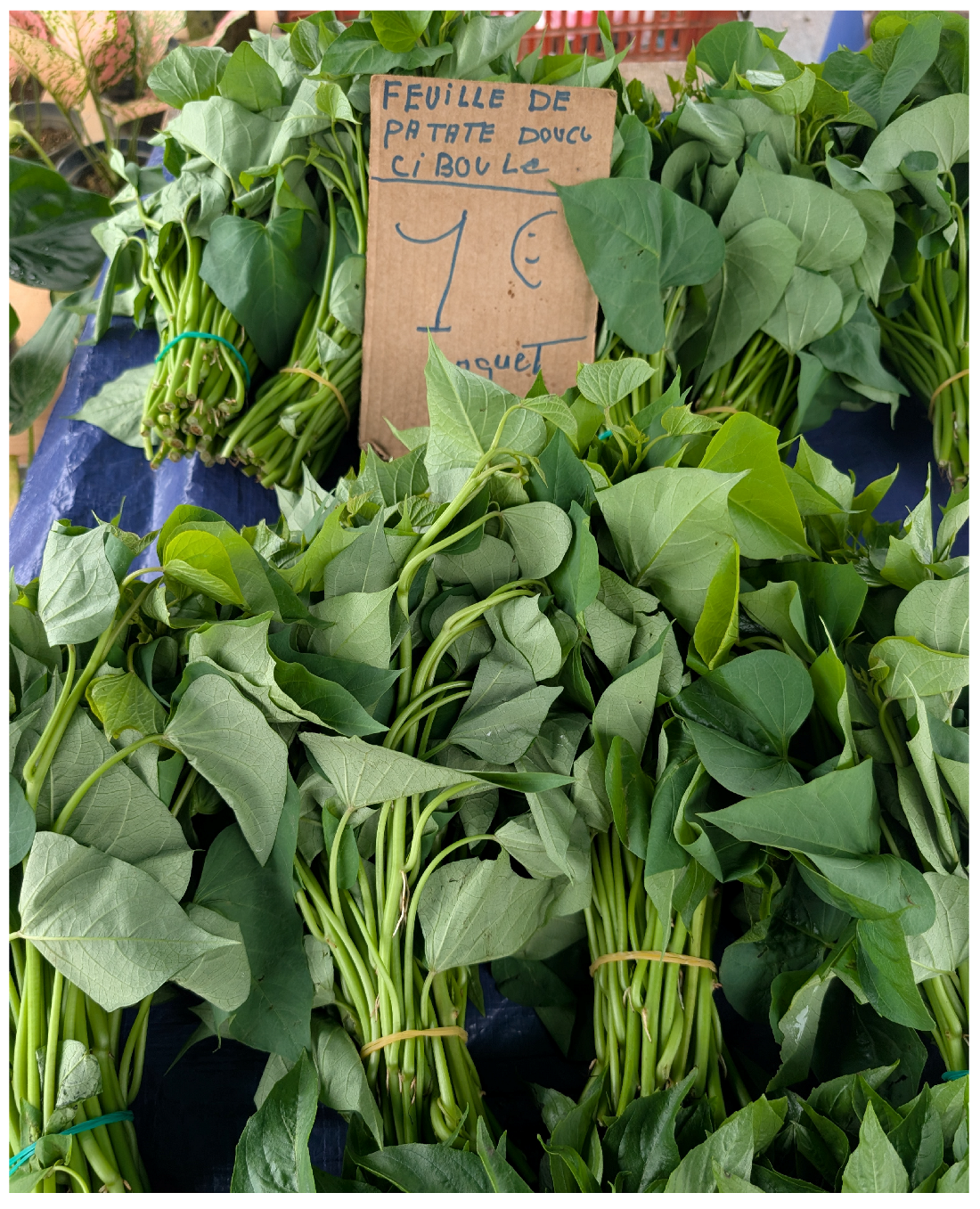
| Ipomoea batatas (L.) Lam. | fey patat (FGC, HC) | C | I | TA | Yes | FG |
| Cucurbitaceae | ||||||
| Cucurbita maxima Duchesne | fey jomou (FGC, HC), pampun uwii (NT) | C | NI | SA | No | FG; SR |
| Luffa spp. | fey konkonm tòrchon (FGC, HC) | C | N | Cosm. | No | FG |
| Sicyos edulis Jacq. | fey kristofin (FGC), fey chayòt (HC) | C | I | CA | No | FG |
| Euphorbiaceae | ||||||
| Manihot esculenta Crantz | maniva (BR), fey mannyòk (FGC, HC) | C | N | SA | Yes | FG |
| Malvaceae | ||||||
| Abelmoschus esculentus (L.) Moench | fey kalou (FGC), fey kalalou (HC), okoo uwii (NT) | C | I | IS | No | FG; SR |
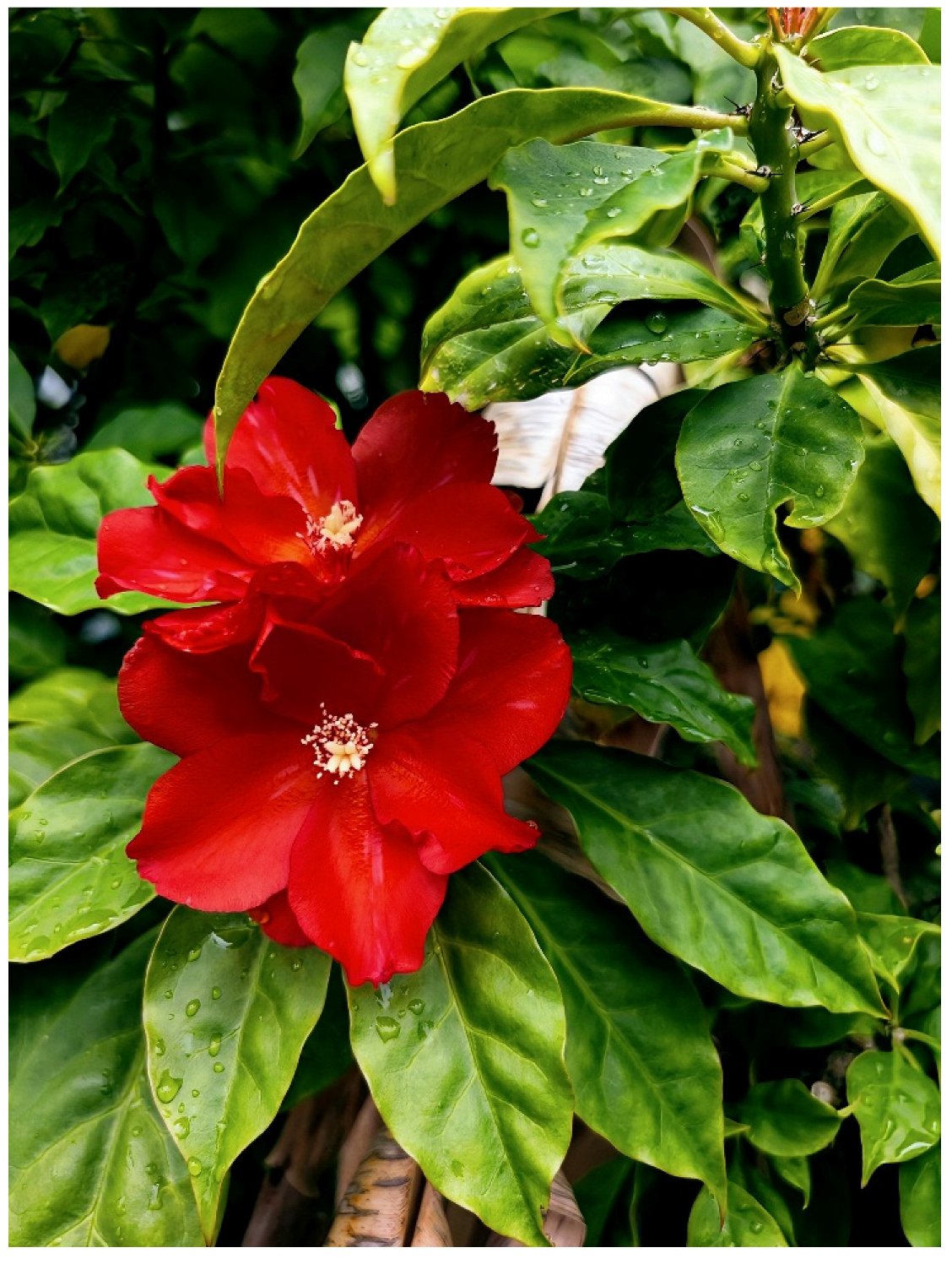
| Hibiscus sabdariffa L. | fey lozey (peyi) (FGC) | C | I | A | Yes | FG |
| Corchorus olitorius L. | lalo (HC) | C | I | A, IS | Yes | FG |
| Meliaceae | ||||||
| Azadirachta indica A.Juss. | fey lila, lila peyi (HC) | C | I | SEA | No | FG |
| Moringaceae | ||||||
| Moringa oleifera Lam. | morenga (FGC), benzoliv (HC) | C | I | IS | No | FG |
| Petiveriaceae | ||||||
| Trichostigma octandrum (L.) H.Walter | lyann pannyé (HC), zépina ayisyen (FGC) | W/C | N | TA | Yes | FG |
| Rivina humilis L. | panzou, lanman layé (HC) | C | I* | TA | Yes | FG |
| Phytolaccaceae | ||||||
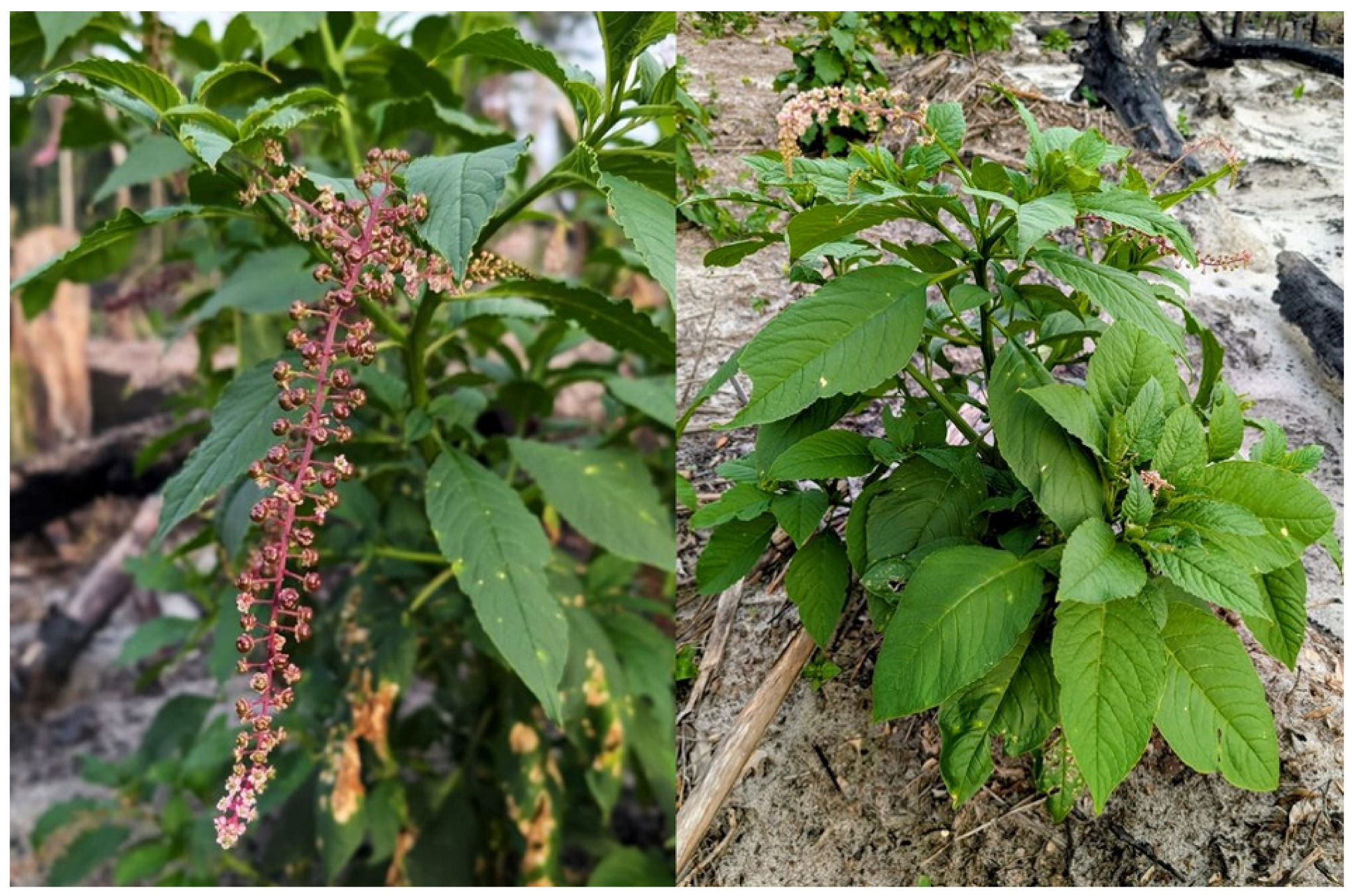
| Phytolacca rivinoides Kunth & C.D. Bouché | bichoyak (FGC), makoko (NT) | W | N | TA | No | FG; SR |
| Portulacaceae | ||||||
| Portulaca oleracea L. | ti koupyé (FGC, HC), poseen (NT) | W/C | I | A, EuA | Yes | FG |
| Solanaceae | ||||||
| Capsicum spp. | fey piman (FGC, HC), pepee (NT) | C | I* | TA | No | FG; SR |
| Cestrum latifolium Lam. | bita uwii (NT), bita wiri (SRT) | W/C | N | TA | Yes | FG; SR |
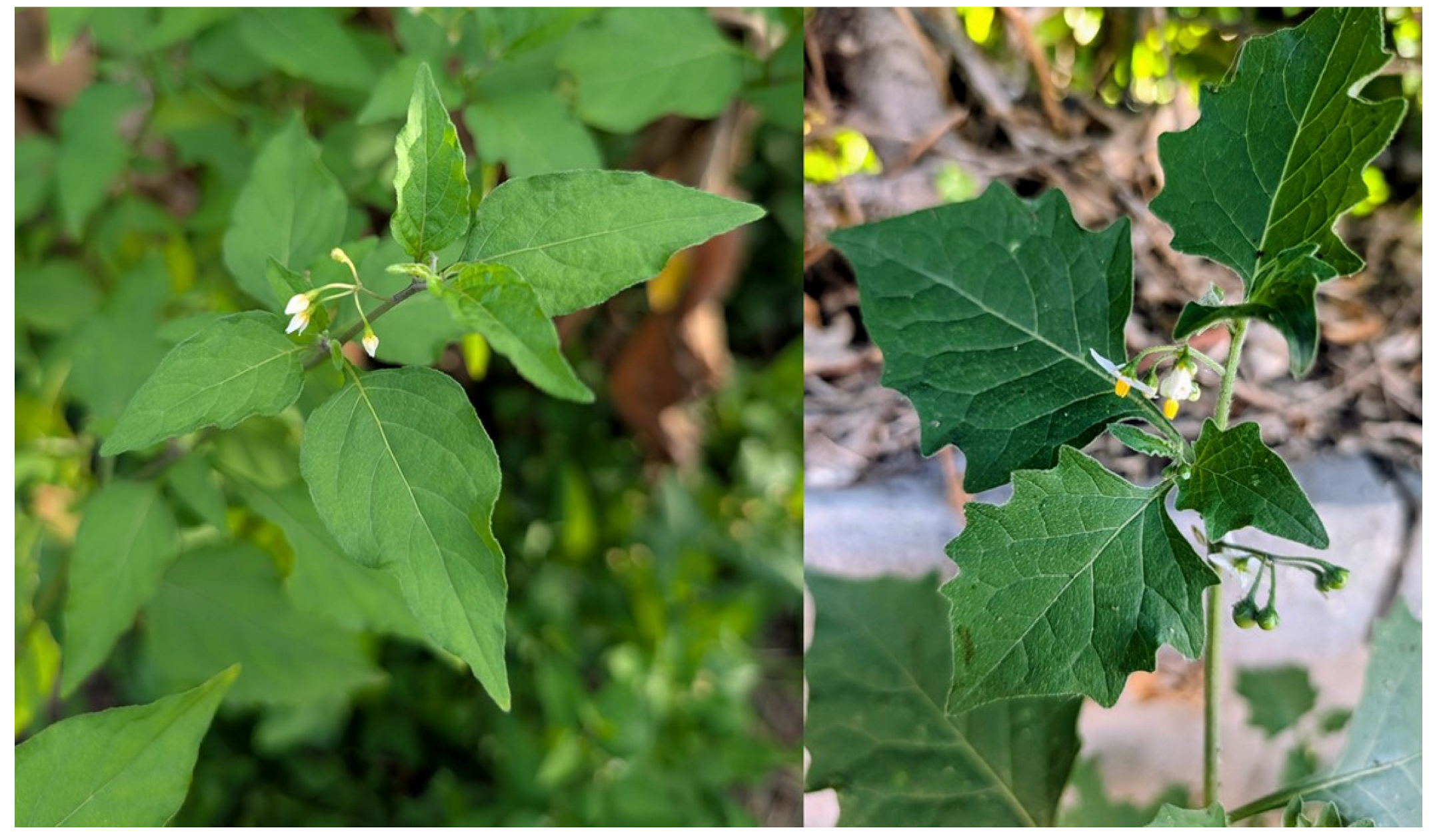
| Solanum americanum Mill. | agouman, alaman (FGC), angoma uwii (NT), lanman (HC), goma wiri (SRT) | W/C | I* | Am | Yes | FG; SR |
| Talinaceae | ||||||
| Talinum paniculatum (Jacq.) Gaertn. | gran pourpyé (FGC, HC) | W/C | N | TA | Yes | FG |
| Urticaceae | ||||||
| Laportea aestuans (L.) Chew | zouti (FGC, HC) | W | N | TA, A, IS | No | FG |
| Cecropia spp. | fèy tronpèt (HC) | W | N | TA | No | FG |
| Cultural Groups | Number of Interviewees | Sex Ratio 1 | Locations | Languages |
|---|---|---|---|---|
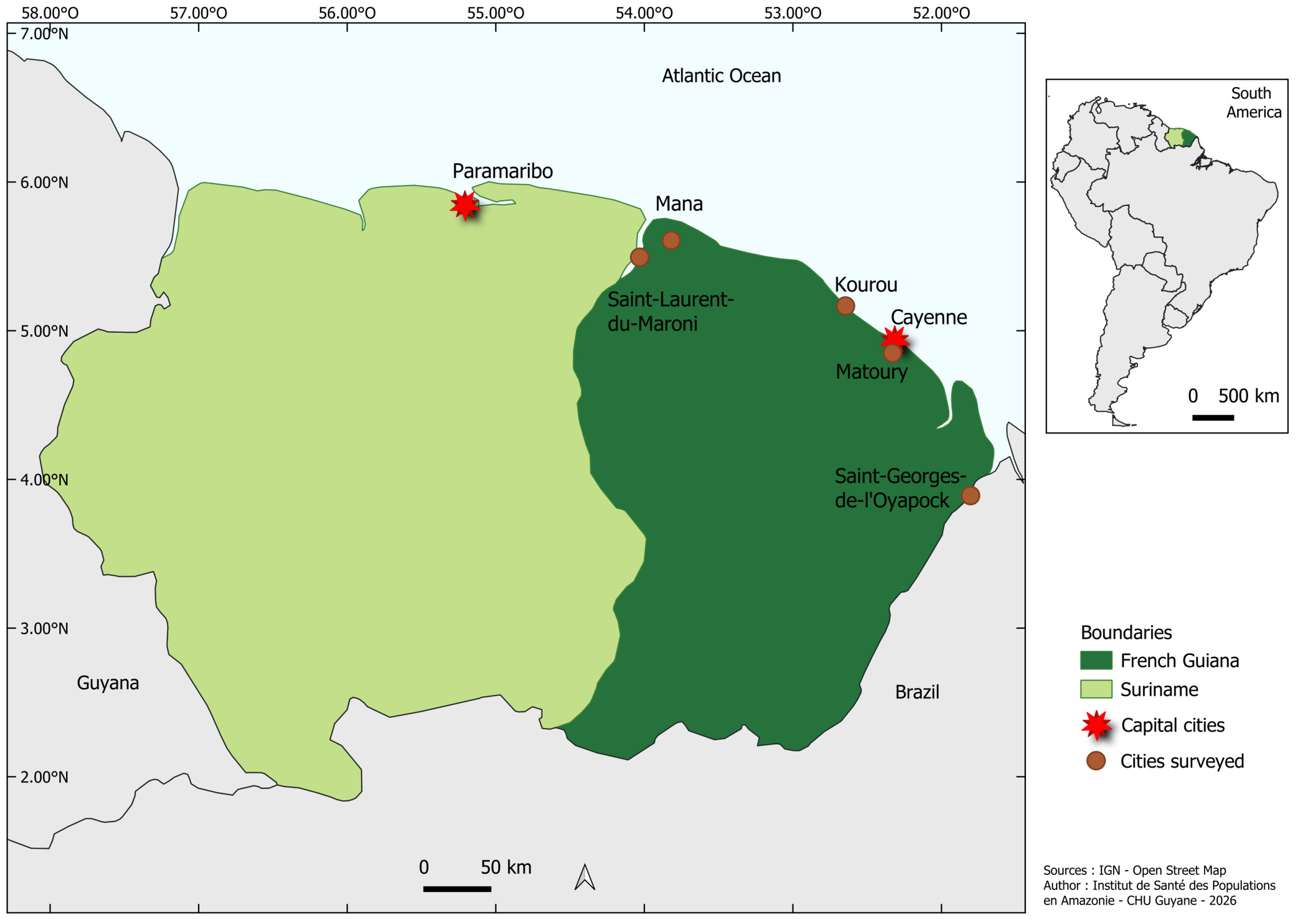
| Ndjuka | 9 | F: 6; M: 3 | Mana, Paramaribo, Saint-Laurent-du-Maroni | Nengee Tongo, Sranan Tongo |
| French Guianese Creoles | 9 | F: 7; M: 2 | Cayenne, Kourou, Matoury, Saint-Georges-de-l’Oyapock | French Guianese Creole, French |
| Haitian Creoles | 6 | F: 3; M: 3 | Cayenne, Kourou, Matoury, Saint-Laurent-du-Maroni | Haitian Creole, French |
| Surinamese Creole | 2 | F: 1; M: 1 | Paramaribo | Sranan Tongo |
Disclaimer/Publisher’s Note: The statements, opinions and data contained in all publications are solely those of the individual author(s) and contributor(s) and not of MDPI and/or the editor(s). MDPI and/or the editor(s) disclaim responsibility for any injury to people or property resulting from any ideas, methods, instructions or products referred to in the content. |
© 2026 by the authors. Licensee MDPI, Basel, Switzerland. This article is an open access article distributed under the terms and conditions of the Creative Commons Attribution (CC BY) license.
Share and Cite
Tareau, M.-A.; Greene, A.M.; Ansoe-Tareau, C.; Pinas, N.; Rapinski, M. The Consumption of Edible Leaves by Afro-Descendants in French Guiana and Suriname: An Overview of a Constantly Evolving Ethno-Culinary Practice. Plants 2026, 15, 2096. https://doi.org/10.3390/plants15132096
Tareau M-A, Greene AM, Ansoe-Tareau C, Pinas N, Rapinski M. The Consumption of Edible Leaves by Afro-Descendants in French Guiana and Suriname: An Overview of a Constantly Evolving Ethno-Culinary Practice. Plants. 2026; 15(13):2096. https://doi.org/10.3390/plants15132096
Chicago/Turabian StyleTareau, Marc-Alexandre, Alexander M. Greene, Clarisse Ansoe-Tareau, Nicholaas Pinas, and Michael Rapinski. 2026. "The Consumption of Edible Leaves by Afro-Descendants in French Guiana and Suriname: An Overview of a Constantly Evolving Ethno-Culinary Practice" Plants 15, no. 13: 2096. https://doi.org/10.3390/plants15132096
APA StyleTareau, M.-A., Greene, A. M., Ansoe-Tareau, C., Pinas, N., & Rapinski, M. (2026). The Consumption of Edible Leaves by Afro-Descendants in French Guiana and Suriname: An Overview of a Constantly Evolving Ethno-Culinary Practice. Plants, 15(13), 2096. https://doi.org/10.3390/plants15132096