Environmental Drivers of Weed Floristic Diversity in Two Contrasting Sugarcane Agroecosystems

 ,
, 
Abstract
1. Introduction
2. Materials and Methods
2.1. Study Area
2.2. Vegetation Sampling and Species Identification
2.3. Soil Sampling and Analyses
2.4. Light Intensity Measurement Under the Sugarcane Canopy
2.5. Composition of Weed Communities
3. Results
3.1. Floristic Diversity and Taxonomic Structure
3.2. Life Form Structure of Sugarcane Weed Flora
3.3. Phytogeographical Affinities and Geographic Distribution of Weeds
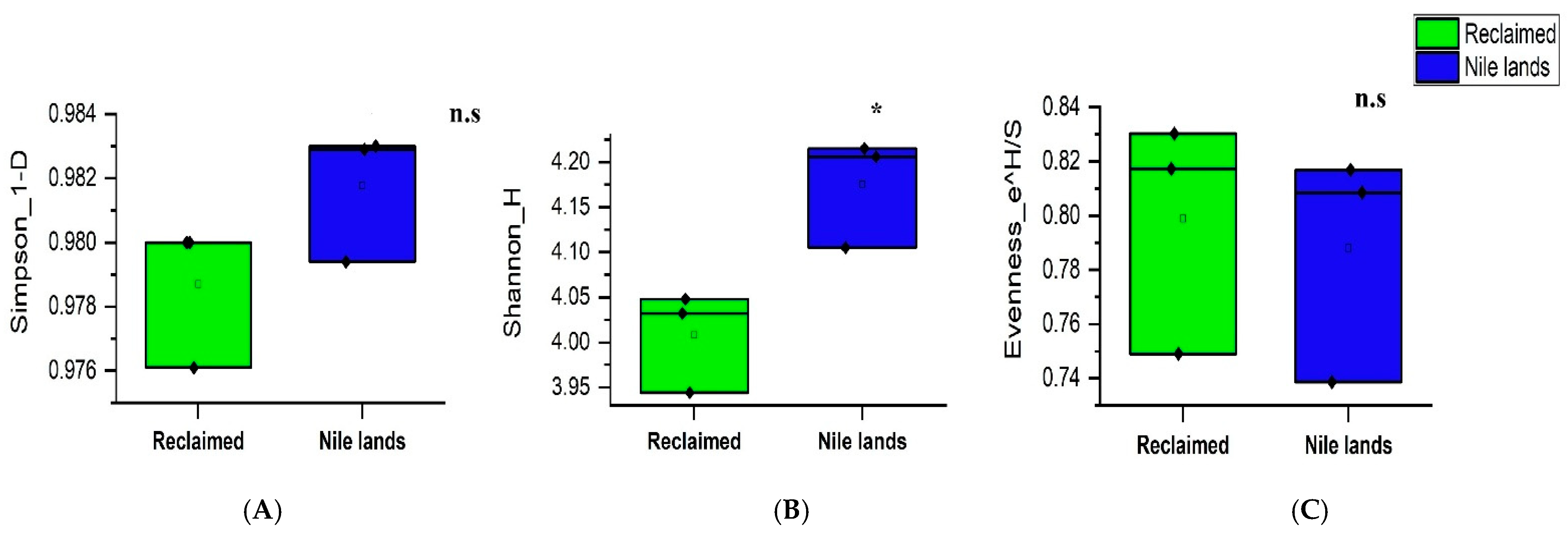
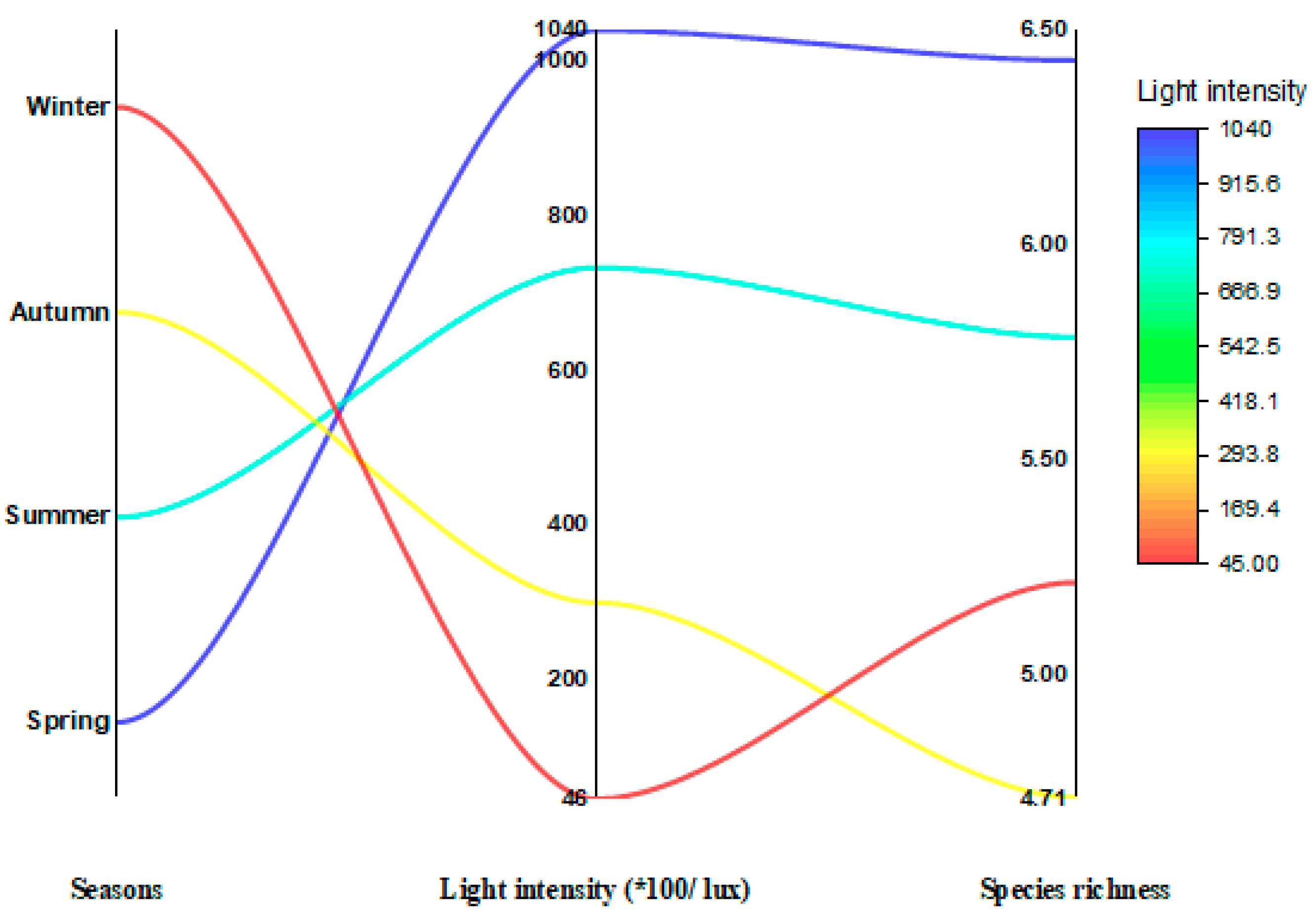
3.4. Spatial and Seasonal Patterns of Weed Diversity
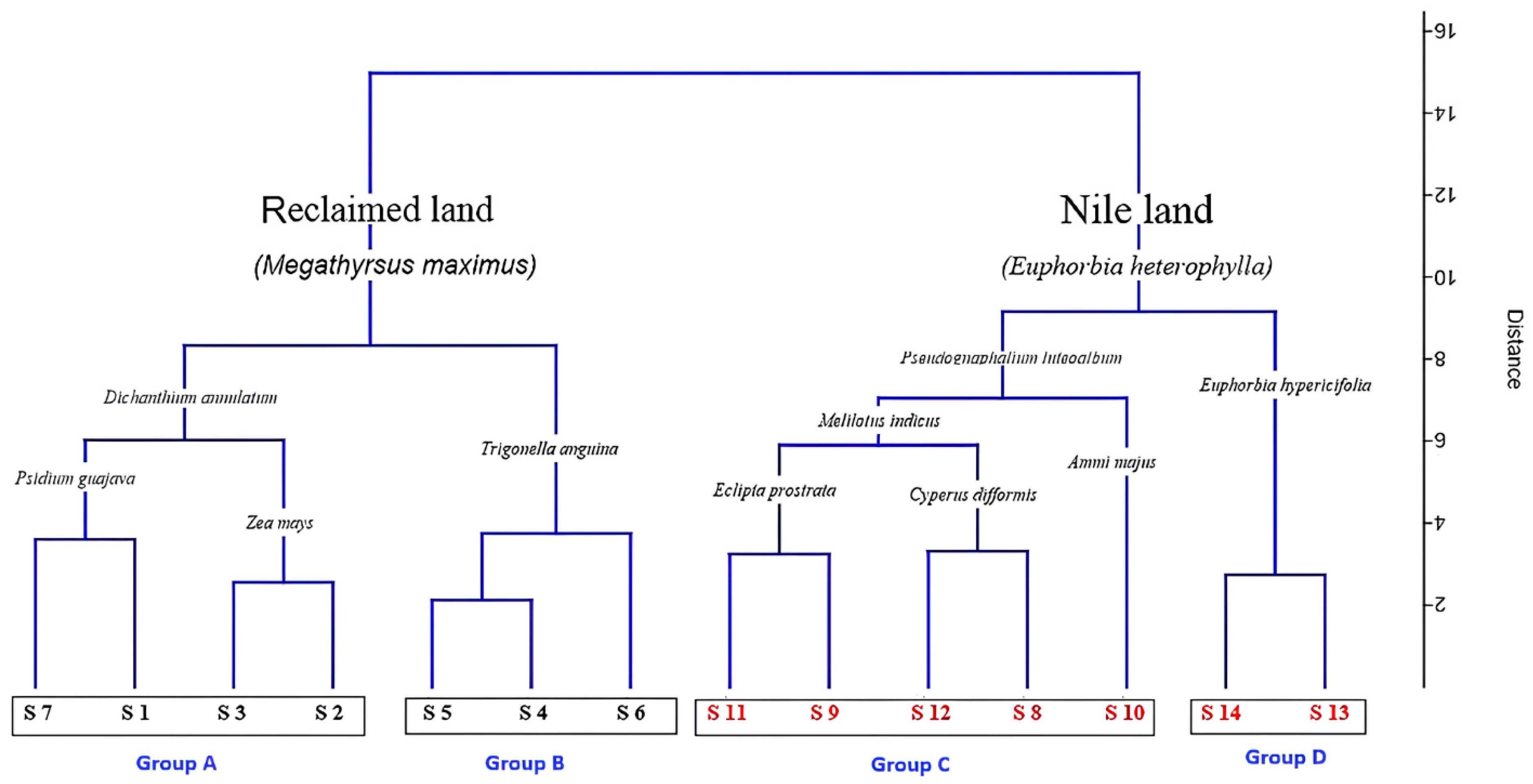
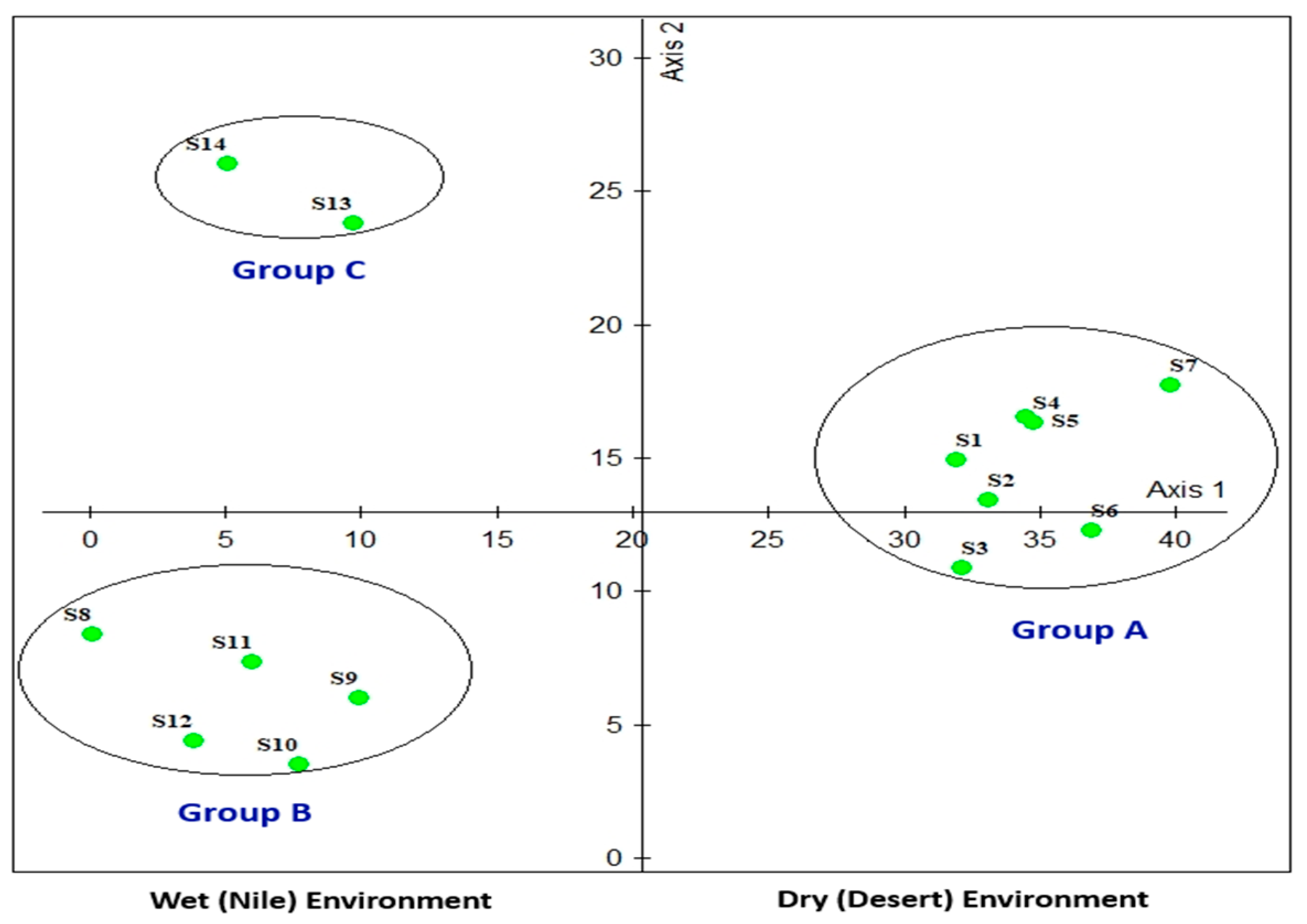
3.5. Weed Community Composition and Structure
3.6. Edaphic Drivers of Weed Community Differentiation
4. Discussion
4.1. Characteristics and Ecological Strategies of Sugarcane Weed Communities
4.2. Biogeographic Origin and Floristic Affiliations
4.3. Drivers of Spatial and Seasonal Variation in Weed Diversity
4.4. Phytosociological Community Assembly and Edaphic Drivers
5. Conclusions
Supplementary Materials
Author Contributions
Funding
Data Availability Statement
Acknowledgments
Conflicts of Interest
Abbreviations
| CCA | Canonical Correspondence Analysis |
| DCA | Detrended Correspondence Analysis |
| TWINSPAN | Two-way indicator species analysis |
Appendix A

| Family | Taxa | Life Span | Life Form | Chorotype | Frequency |
|---|---|---|---|---|---|
| Aizoaceae | Trianthema portulacastrum L. | Annual | Therophyte | PAN | 92.86 |
| Amaranthaceae | Amaranthus graecizans L. subsp. graecizans | Annual | Therophyte | PAL | 7.14 |
| Amaranthus retroflexus L. | Annual | Therophyte | NEO | 35.71 | |
| Amaranthus viridis L. | Annual | Therophyte | NEO | 92.86 | |
| Caroxylon imbricatum (Forssk.) Moq. | Perennial | Chamaephyte | IT + ME + SS + SZ | 50.00 | |
| Bassia muricata (L.) Asch. | Annual | Therophyte | IT + ME + SS + SZ | 42.86 | |
| Beta vulgaris subsp. vulgaris | Annual | Therophyte | ES + IT + ME + SS + SZ | 7.14 | |
| Chenopodium album L. | Annual | Therophyte | COSM | 64.29 | |
| Chenopodiastrum murale (L.) S.Fuentes, Uotila & Borsch | Annual | Therophyte | ES + IT + ME + SS + SZ | 64.29 | |
| Amaryllidaceae | Allium cepa L. | Perennial | Geophyte | IT | 7.14 |
| Anacardiaceae | Mangifera indica L. | Perennial | Phanerophyte | SJ | 7.14 |
| Apiaceae | Ammi majus L. | Annual | Therophyte | ES + IT + ME + SS + SZ | 14.29 |
| Apocynaceae | Calotropis procera (Aiton) W.T.Aiton | Perennial | Phanerophyte | IT + ME + SJ + SS | 35.71 |
| Oxystelma esculentum (L.f.) Sm. | Perennial | Hemicryptophyte | PAN | 7.14 | |
| Cynanchum acutum L. | Perennial | Chamaephyte | ES + IT + ME + SJ + SS | 100 | |
| Leptadenia arborea (Forssk.) Schweinf. | Perennial | Phanerophyte | SS + SZ | 7.14 | |
| Arecaceae | Phoenix dactylifera L. | Perennial | Phanerophyte | IT + SS + SZ | 78.57 |
| Asteraceae | Bidens pilosa L. | Annual | Therophyte | NEO | 64.29 |
| Eclipta prostrata (L.) L. | Annual | Therophyte | NEO | 21.43 | |
| Erigeron bonariensis L. | Annual | Therophyte | NEO | 78.57 | |
| Lactuca serriola L. | Annual | Therophyte | ES + IT + ME + SS + SZ | 42.86 | |
| Launaea mucronata subsp. cassiniana (Jaub. & Spach) N.Kilian | Perennial | Hemicryptophyte | IT + ME + SS + SZ | 14.29 | |
| Launaea nudicaulis (L.) Hook.f. | Perennial | Hemicryptophyte | IT + ME + SS + SZ | 21.43 | |
| Pluchea dioscoridis (L.) DC. | Perennial | Phanerophyte | SS + SZ | 64.29 | |
| Sonchus oleraceus L. | Annual | Therophyte | ES + IT + ME + SS + SZ | 92.86 | |
| Symphyotrichum squamatum (Spreng.) G.L.Nesom | Perennial | Chamaephyte | NEO | 21.43 | |
| Urospermum picroides (L.) Scop. ex F.W.Schmidt | Annual | Therophyte | IT + ME + SS + SZ | 7.14 | |
| Pseudognaphalium luteoalbum (L.) Hilliard & B.L.Burtt | Annual | Therophyte | COSM | 35.71 | |
| Xanthium strumarium L. | Annual | Therophyte | PAL | 28.57 | |
| Brassicaceae | Brassica rapa L. | Annual | Therophyte | IT + ME + SS + SZ | 42.86 |
| Eruca sativa Mill. | Annual | Therophyte | IT + ME + SJ + SS | 28.57 | |
| Raphanus raphanistrum subsp. sativus (L.) Schmalh. | Annual | Therophyte | ME | 7.14 | |
| Caricaceae | Carica papaya L. | Perennial | Phanerophyte | NEO | 7.14 |
| Convolvulaceae | Convolvulus arvensis L. | Perennial | Hemicryptophyte | PAL | 71.43 |
| Ipomoea carnea Jacq. | Perennial | Phanerophyte | NEO | 14.29 | |
| Ipomoea eriocarpa R.Br. | Annual | Therophyte | PAN | 14.29 | |
| Ipomoea cairica (L.) Sweet | Perennial | Geophyte | PAL | 92.86 | |
| Ipomoea triloba L. | Annual | Therophyte | NEO | 71.43 | |
| Combretaceae | Conocarpus erectus L. | Perennial | Phanerophyte | PAN | 21.43 |
| Cucurbitaceae | Citrullus lanatus (Thunb.) Matsum. & Nakai | Annual | Therophyte | ME + SS + SZ | 14.29 |
| Cucumis melo L. | Annual | Therophyte | PAL | 35.71 | |
| Cucumis sativus L. | Annual | Therophyte | SJ | 28.57 | |
| Cyperaceae | Cyperus difformis L. | Annual | Therophyte | COSM | 14.29 |
| Cyperus rotundus L. | Perennial | Geophyte | COSM | 92.86 | |
| Ebenaceae | Diospyros kaki Thunb. | Perennial | Phanerophyte | SJ | 7.14 |
| Euphorbiaceae | Euphorbia heterophylla L. | Annual | Therophyte | NEO | 50.00 |
| Euphorbia hirta L. | Annual | Therophyte | NEO | 35.71 | |
| Euphorbia hypericifolia L. | Annual | Therophyte | NEO | 14.29 | |
| Euphorbia indica Lam. | Annual | Therophyte | IT + ME + SJ | 7.14 | |
| Euphorbia maculata L. | Annual | Therophyte | NEO | 14.29 | |
| Euphorbia nutans Lag. | Annual | Therophyte | NEO | 14.29 | |
| Euphorbia peplus L. | Annual | Therophyte | ES + IT + ME + SS + SZ | 21.43 | |
| Euphorbia prostrata Aiton | Annual | Therophyte | NEO | 7.14 | |
| Euphorbia serpens Kunth | Annual | Therophyte | NEO | 14.29 | |
| Ricinus communis L. | Perennial | Phanerophyte | SZ | 28.57 | |
| Fabaceae | Vachellia nilotica (L.) P.J.H.Hurter & Mabb. | Perennial | Phanerophyte | IT + SS + SZ | 28.57 |
| Alhagi graecorum Boiss. | Perennial | Chamaephyte | IT + ME + SS + SZ | 28.57 | |
| Lotus arabicus Sol. ex L. | Annual | Therophyte | SS + SZ | 7.14 | |
| Medicago sativa L. | Perennial | Hemicryptophyte | ES + IT + ME + SS | 21.43 | |
| Melilotus indicus (L.) All. | Annual | Therophyte | COSM | 78.57 | |
| Leucaena leucocephala (Lam.) de Wit | Perennial | Phanerophyte | NEO | 7.14 | |
| Trigonella anguina Delile | Annual | Therophyte | IT + ME + SS + SZ | 35.71 | |
| Trifolium alexandrinum L. | Annual | Therophyte | IT + ME + SS | 35.71 | |
| Trifolium resupinatum L. | Annual | Therophyte | IT + ME + SS | 7.14 | |
| Sesbania sesban (L.) Merr. | Perennial | Phanerophyte | PAN | 71.43 | |
| Vicia faba L. | Annual | Therophyte | ME | 7.14 | |
| Malvaceae | Abelmoschus esculentus (L.) Moench | Annual | Therophyte | SJ + SZ | 7.14 |
| Corchorus olitorius L. | Annual | Therophyte | PAL | 92.86 | |
| Hibiscus tridactylites Lindl. | Annual | Therophyte | PAL + AUS | 57.14 | |
| Malva parviflora L. | Annual | Therophyte | IT + ME + SS + SZ | 64.29 | |
| Sida alba L. | Annual | Hemicryptophyte | SS + SZ | 85.71 | |
| Myrtaceae | Eucalyptus camaldulensis Dehnh. | Perennial | Phanerophyte | AUS | 42.86 |
| Psidium guajava L. | Perennial | Phanerophyte | NEO | 14.29 | |
| Oleaceae | Olea europaea L. | Perennial | Phanerophyte | CAP + GC + ME + IT + SS + SZ | 28.57 |
| Oxalidaceae | Oxalis corniculata L. | Annual | Therophyte | SJ + SS + SZ | 21.43 |
| Pedaliaceae | Sesamum indicum L. | Annual | Therophyte | SJ + SZ | 14.29 |
| Plantaginaceae | Plantago major L. | Perennial | Hemicryptophyte | COSM | 28.57 |
| Poaceae | Avena fatua L. | Annual | Therophyte | COSM | 21.43 |
| Cenchrus echinatus L. | Annual | Therophyte | NEO | 7.14 | |
| Cynodon dactylon (L.) Pers. | Perennial | Geophyte | COSM | 100 | |
| Dactyloctenium aegyptium (L.) Willd. | Annual | Therophyte | PAL | 50.00 | |
| Desmostachya bipinnata (L.) Stapf | Perennial | Geophyte | PAL | 28.57 | |
| Dichanthium annulatum (Forssk.) Stapf | Perennial | Geophyte | PAL | 42.86 | |
| Digitaria sanguinalis (L.) Scop. | Annual | Therophyte | COSM | 7.14 | |
| Echinochloa colona (L.) Link | Annual | Therophyte | PAL | 100 | |
| Imperata cylindrica (L.) Raeusch. | Perennial | Geophyte | CAP + GC + ME + IT + SS + SZ | 42.86 | |
| Megathyrsus maximus (Jacq.) B.K.Simon & S.W.L.Jacobs | Perennial | Geophyte | PAL | 50.00 | |
| Phragmites australis (Cav.) Trin. ex Steud. | Perennial | Geophyte-Helophyte | COSM | 85.71 | |
| Polypogon monspeliensis (L.) Desf. | Annual | Therophyte | IT + ME + SJ + SS + SZ | 7.14 | |
| Setaria verticillata (L.) P.Beauv. | Annual | Therophyte | COSM | 78.57 | |
| Triticum aestivum L. | Annual | Therophyte | IT + ME + SS + SZ | 35.71 | |
| Urochloa ramosa (L.) T.Q.Nguyen | Annual | Therophyte | PAL | 14.29 | |
| Urochloa reptans (L.) Stapf | Annual | Therophyte | PAN | 64.29 | |
| Sorghum bicolor (L.) Moench | Annual | Therophyte | PAL | 7.14 | |
| Sorghum virgatum (Hack.) Stapf | Annual | Therophyte | IT + ME + SA + SZ | 7.14 | |
| Zea mays L. | Annual | Therophyte | NEO | 28.57 | |
| Polygonaceae | Rumex dentatus L. | Annual | Therophyte | ES + IT + ME + SJ + SS | 28.57 |
| Rumex spinosus L. | Annual | Therophyte | IT + ME + SA + SZ | 28.57 | |
| Portulacaceae | Portulaca oleracea L. | Annual | Therophyte | ES + IT + ME + SS + SZ | 92.86 |
| Rhamnaceae | Ziziphus spina-christi (L.) Desf. | Perennial | Phanerophyte | IT + ME + SS + SZ | 85.71 |
| Rutaceae | Casimiroa edulis La Llave | Perennial | Phanerophyte | NEO | 7.14 |
| Citrus × limon (L.) Osbeck | Perennial | Phanerophyte | PAN | 7.14 | |
| Salicaceae | Salix mucronata Thunb. | Perennial | Phanerophyte | CAP + GC + ME + IT + SS + SZ | 14.29 |
| Solanaceae | Solanum lycopersicum L. | Annual | Therophyte | NEO | 14.29 |
| Solanum nigrum L. | Annual | Therophyte | COSM | 100 | |
| Physalis angulata L. | Annual | Therophyte | NEO | 28.57 | |
| Withania somnifera (L.) Dunal | Perennial | Chamaephyte | IT + ME + SJ + SS + SZ | 7.14 | |
| Tamaricaceae | Tamarix nilotica (Ehrenb.) Bunge | Perennial | Phanerophyte | IT + ME + SS + SZ | 50.00 |
| Typhaceae | Typha domingensis Pers. | Perennial | Helophyte | COSM | 7.14 |
| Zygophyllaceae | Tribulus terrestris L. | Annual | Therophyte | ES + IT + ME + SJ + SS + SZ | 14.29 |
References
- El-Khalifa, Z.S.; Zahran, H. Forecasting of Cultivated Area in Egyptian Lands Using a Time Series Model for Sustainable Development. Open J. Appl. Sci. 2022, 12, 865–876. [Google Scholar] [CrossRef]
- Salama, F.; Abd El-Ghani, M.; El-Tayeh, N.; Amro, A.; Abdrabbu, H. Weed Flora of Common Crops in Desert Reclaimed Arable Lands of Southern Egypt. Taeckholmia 2016, 36, 58–76. [Google Scholar] [CrossRef]
- Cabrera, D.C.; Chaila, S.; Sobrero, M.T.; Varela, A.E. Phytosociological Survey of Sugarcane Crop Weeds in Different Agroecological Areas in TucumÁn Province, Argentina. Planta Daninha 2019, 37, e019179380. [Google Scholar] [CrossRef]
- Mehareb, E.M.; El-Shafai, A.M.A.; Fouz, F.M.A. History and Current Status of Sugarcane Breeding in Egypt. Sugar Tech 2022, 24, 267–271. [Google Scholar] [CrossRef]
- Abdel Daiem, M.M.; Hatata, A.; El-Gohary, E.H.; Abd-Elhamid, H.F.; Said, N. Application of an Artificial Neural Network for the Improvement of Agricultural Drainage Water Quality Using a Submerged Biofilter. Environ. Sci. Pollut. Res. 2021, 28, 5854–5866. [Google Scholar] [CrossRef] [PubMed]
- El-Rawy, M.; Abdalla, F.; El Alfy, M.; El-Rawy, M.; Abdalla, F.; El Alfy, M.; Abdalla, F. Water Resources in Egypt. In The Geology of Egypt; Springer: Berlin/Heidelberg, Germany, 2019; pp. 687–711. [Google Scholar]
- Farag, A.A.; Abdrabbo, M.A.A.; Taher, M.S.K.; Farag, H.A.; Rasha, M.A.F.; Radwan, H.A. Comparative Study of the Production of Sugar Crops under Limited Water. In Proceedings of the 5th International Conference for Agricultural and Bio-Engineering, Cairo, Egypt, 26–27 September 2017; Volume 26, p. 27. [Google Scholar]
- Mohamed, E.; Belal, A.-A.; Ali, R.R.; Saleh, A.; Hendawy, E.A. Land Degradation. In The Soils of Egypt; Springer International Publishing: Cham, Switzerland, 2019; pp. 69–92. [Google Scholar]
- Firehun, Y.; Tamado, T. Weed Flora in the Rift Valley Sugarcane Plantations of Ethiopia as Influenced by Soil Types and Agronomic Practises. Weed Biol. Manag. 2006, 6, 139–150. [Google Scholar] [CrossRef]
- Gomaa, N.H. Soil Seed Bank in Different Habitats of the Eastern Desert of Egypt. Saudi J. Biol. Sci. 2012, 19, 211–220. [Google Scholar] [CrossRef]
- Rao, A.N.; Singh, R.G.; Mahajan, G.; Wani, S.P. Weed Research Issues, Challenges, and Opportunities in India. Crop Prot. 2020, 134, 104451. [Google Scholar] [CrossRef]
- Ghersa, C.M.; Martínez-Ghersa, M.A.; Suarez, S. Spatial and Temporal Patterns of Weed Invasions: Implications for Weed Management and Crop Yield. In Proceedings of the Second International Weed Control Congress; Department of Weed Control and Pesticide Ecology: Copenhagen, Denmark, 1996; pp. 41–47. [Google Scholar]
- Chen, X.; Tang, J.; Fang, Z.; Shimizu, K. Effects of Weed Communities with Various Species Numbers on Soil Features in a Subtropical Orchard Ecosystem. Agric. Ecosyst. Environ. 2004, 102, 377–388. [Google Scholar] [CrossRef]
- Fried, G.; Petit, S.; Dessaint, F.; Reboud, X. Arable Weed Decline in Northern France: Crop Edges as Refugia for Weed Conservation? Biol. Conserv. 2009, 142, 238–243. [Google Scholar] [CrossRef]
- Shehata, H.S.; Galal, T.M. Factors Affecting the Distribution and Associated Species of Malva Parviflora in the N Ile D Elta, E Gypt. Weed Biol. Manag. 2015, 15, 42–52. [Google Scholar] [CrossRef]
- Gurevitch, J.; Scheiner, S.M.; Fox, G.A. The Ecology of Plants; Sinauer Associates, Inc.: Sunderland, MA, USA, 2002. [Google Scholar]
- Jose, S.; Singh, H.P.; Batish, D.R.; Kohli, R.K. Invasive Plant Ecology; CRC Press: Boca Raton, FL, USA, 2013; Volume 12, p. 302. [Google Scholar]
- Derrouch, D.; Chauvel, B.; Cordeau, S.; Dessaint, F. Functional Shifts in Weed Community Composition Following Adoption of Conservation Agriculture. Weed Res. 2022, 62, 103–112. [Google Scholar] [CrossRef]
- Bittencourt, M.F. Seasonal Growth and Shading Potential of Sugarcane (Saccharum spp. Hybrids) and Shade Response of Perennial Weeds. Master’s Thesis, Louisiana State University and Agricultural & Mechanical College, Baton Rouge, LA, USA, 2009; p. 56. [Google Scholar]
- Lago-Olveira, S.; El-Areed, S.R.M.; Moreira, M.T.; González-García, S. Improving Environmental Sustainability of Agriculture in Egypt through a Life-Cycle Perspective. Sci. Total Environ. 2023, 890, 164335. [Google Scholar] [CrossRef] [PubMed]
- Abu El Enain, S.M.; Abd El-Rasoul, S.M.; Mohamed, M.M. Soil Taxonomy and Evaluation of Some Newly Reclaimed Areas Adjacent to the Nile Delta Rims, Egypt. Fayoum J. Agric. Res. Dev. 2010, 24, 78–88. [Google Scholar] [CrossRef]
- Kamal-Uddin, M.D.; Juraimi, A.S.; Begum, M.; Ismail, M.R.; Rahim, A.A.; Othman, R. Floristic Composition of Weed Community in Turf Grass Area of West Peninsular Malaysia. Int. J. Agric. Biol. 2009, 11, 13–20. [Google Scholar]
- Takim, F.O.; Amodu, A. Quantitative Estimate of Weeds of Sugarcane (Saccharum officinarum L.) Crop in Ilorin, Southern Guinea Savanna of Nigeria. Ethiop. J. Environ. Stud. Manag. 2013, 6, 611–619. [Google Scholar] [CrossRef][Green Version]
- Mueller-Dombois, D.; Ellenberg, H. Aims and Methods of Vegetation Ecology; John Wiley and Sons: New York, NY, USA, 1974; p. 547. [Google Scholar]
- Munsif, F.; Ali, K.; Khalid, S.; Ali, A.; Ali, M.; Ahmad, M.; Ahmad, W.; Ahmad, I.; Basir, A. Influence of Row Spacing on Weed Density, Biomass and Yield of Chip Bud Settling of Sugarcane. Pak. J. Weed Sci. Res. 2015, 21, 23–28. [Google Scholar]
- Täckholm, V. Student’s Flora of Egypt, 2nd ed.; Cairo University: Cairo, Egypt, 1974; p. 649. [Google Scholar]
- Boulos, L. Flora of Egypt, Volume 2: Geraniaceae–Boraginaceae; Al Hadara Publishing: Cairo, Egypt, 2000; p. 352. [Google Scholar]
- Boulos, L. Flora of Egypt, Volume 1: Azollaceae—Oxalidaceae; Al Hadara Publishing: Cairo, Egypt, 1999; p. 419. [Google Scholar]
- Boulos, L. Flora of Egypt, Volume 3: Verbenaceae-Compositae; Al Hadara Publishing: Cairo, Egypt, 2002; p. 373. [Google Scholar]
- Boulos, L. Flora of Egypt, Volume 4: Monocotyledons (Alimataceae-Orchidaceae); Al Hadara Publishing: Cairo, Egypt, 2005; p. 617. [Google Scholar]
- POWO. Plants of the World Online. Available online: http://powo.science.kew.org/ (accessed on 21 January 2026).
- Raunkiaer, C. The Life Forms of Plants and Statistical Plant Geography; Clarendon Press: Oxford, UK, 1934; p. 632. [Google Scholar]
- White, F.; Leonard, J.; Léonard, J. Phytogeographical Links between Africa and Southwest Asia. In Flora et Vegetatio Mundi; Schweizerbart Science Publishers: Stuttgart, Germany, 1991; Volume IX, pp. 229–246. [Google Scholar]
- Kilmer, V.J.; Alexander, L.T. Methods of Making Mechanical Analyses of Soils. Soil Sci. 1949, 68, 15–24. [Google Scholar] [CrossRef]
- Sparks, D.L.; Page, A.L.; PA Helmke, R.H.; Loeppert, P.N.S.; Tabatabai, M.A.; Johnston, C.T.; Sumner, M.E. Methods of Soil Analysis, Part 3: Chemical Methods; Soil Science Society of America: Madison, WI, USA; American Society of Agronomy: Madison, WI, USA, 1996. [Google Scholar]
- Estefan, G.; Sommer, R.; Ryan, J. Methods of Soil, Plant, and Water Analysis: A Manual for the West Asia and North Africa Region; ICARDA: Beirut, Lebanon, 2013; Volume 3, pp. 65–119. [Google Scholar]
- Jackson, M.L. Soil Chemical Analysis; Hall India Private Limited: New Delhi, India, 1967; Volume 498, pp. 151–154. [Google Scholar]
- Inman-Bamber, N.G. Temperature and Seasonal Effects on Canopy Development and Light Interception of Sugarcane. Field Crops Res. 1994, 36, 41–51. [Google Scholar] [CrossRef]
- Hammer, Ø.; Harper, D.A.T. Past: Paleontological Statistics Software Package for Educaton and Data Anlysis. Palaeontol. Electron. 2001, 4, 4. [Google Scholar]
- Hill, M. TWINSPAN—A Fortran Program for Arranging Multivariate Data in an Ordered Two-Way Table by Classification of the Individuals and Attributes; Section of Ecology and Systematics, Cornell University: Ithaca, NY, USA, 1979; pp. 1–15. [Google Scholar]
- Ter Braak, C.J.F. Canonical Correspondence Analysis: A New Eigenvector Technique for Multivariate Direct Gradient Analysis. Ecology 1986, 67, 1167–1179. [Google Scholar] [CrossRef]
- Dale, M.R.T.; Thomas, A.; John, E.A. Environmental Factors Including Management Practices as Correlates of Weed Community Composition in Spring Seeded Crops. Can. J. Bot. 1992, 70, 1931–1939. [Google Scholar] [CrossRef]
- Soares, M.B.B.; Bianco, S.; Finoto, E.L.; Bolonhezi, D.; Albuquerque, J.A.A. Phytosociological Study on the Weed Communities in Green Sugarcane Field Reform Using Conservation Tillage and Oilseed Crops in Succession. Appl. Ecol. Environ. Res. 2017, 15, 417–428. [Google Scholar] [CrossRef]
- Wibowo, D.; Rahardjo, B.T.R.I.; Karindah, S.R.I.; Muhammad, F.N. The Diversity and Abundance of Weeds in Sugarcane (Saccharum officinarum) Plantations and Its Relationships with Hymenoptera Parasitoids Diversity. Biodiversitas 2023, 24, 2342–2349. [Google Scholar] [CrossRef]
- Salama, F.; El-Ghani, M.A.; Gadallah, M.; Naggar, S.E.L.; Amro, A. Characteristics of Desert Vegetation along Four Transects in the Aridenvironment of Southern Egypt. Turk. J. Bot. 2016, 40, 59–73. [Google Scholar] [CrossRef]
- Amer, W.; Soliman, A.; Hassan, W. Floristic Composition of Nile Islands in Middle Egypt with Special Reference to the Species Migration Route. J. Am. Sci. 2015, 11, 14–23. [Google Scholar]
- Al-Sodany, Y.M. Vegetation Analysis of the Northern Part of Nile Delta Region. Master’s Thesis, Faculty of Science, Tanta University, Tanta, Egypt, 1992; p. 122. [Google Scholar]
- Khedr, A.H.A.; Hegazy, A.K. Ecology of the Rampant Weed Nymphaea lotus L. Willdenow in Natural and Ricefield Habitats of the Nile Delta, Egypt. Hydrobiologia 1998, 386, 119–129. [Google Scholar] [CrossRef]
- Sans, F.X.; Masalles, R.M. Phenological Patterns in an Arable Land Weed Community Related to Disturbance. Weed Res. 1995, 35, 321–333. [Google Scholar] [CrossRef]
- Marshall, E.J.P. Distribution Patterns of Plants Associated with Arable Field Edges. J. Appl. Ecol. 1989, 26, 247–257. [Google Scholar] [CrossRef]
- Friedman, J. The Evolution of Annual and Perennial Plant Life Histories: Ecological Correlates and Genetic Mechanisms. Annu. Rev. Ecol. Evol. Syst. 2020, 51, 461–481. [Google Scholar] [CrossRef]
- Khan, U.U.; Anwar, M.; Saqlain, M.; Tufail, N. Ecological Study of Weeds of Sugarcane in District Swabi Khyber Pakhtunkhwa, Pakistan. Pak. J. Weed Sci. Res. 2025, 31, 83–89. [Google Scholar]
- Saeed, M.N.; Soliman, A.; Ahmad, M.S.; Korany, S.M.; Alsherif, E. Weed Diversity in the Reclaimed Lands in Middle Egypt. Biodivers. Data J. 2025, 13, e154016. [Google Scholar] [CrossRef]
- Håkansson, S. Multiplication, Growth and Persistence of Perennial Weeds. In Biology and Ecology of Weeds; Springer: Berlin/Heidelberg, Germany, 1982; pp. 123–135. [Google Scholar]
- Holm, L.G.; Plucknett, D.L.; Pancho, J.V.; Herberger, J.P. The World’s Worst Weeds. Distribution and Biology. Pedobiologia 1977, 18, 296–297. [Google Scholar] [CrossRef]
- Leopardi-Verde, C.L.; Guzmán-González, S.; Carnevali, G.; Duno de Stefano, R.; Tapia-Muñoz, J.L. Weeds of Commercial Crops in Colima, Mexico. Rev. Mex. Biodivers. 2021, 92, 923622. [Google Scholar] [CrossRef]
- Lousada, L.L.; Freitas, S.P.; Marciano, C.R.; Esteves, B.S.; Muniz, R.A.; Siqueira, D.P. Correlation of Soil Properties with Weed Ocurrence in Sugarcane Areas. Planta Daninha 2013, 31, 765–775. [Google Scholar] [CrossRef][Green Version]
- Javed, K.; Muhammad, S.; Khan, Z.; Fatima, S.; Nawaz, H.; Mahrukh, T.K.; Ullah, S. Synecological Analysis of Weeds of Wheat, Rice and Sugar Cane Crops of Tehsil Muridke, District Sheikhupura (Punjab) Pakistan. Pak. J. Weed Sci. Res. 2023, 29, 107–114. [Google Scholar]
- Khalafallah, A.A.; Galal, T.M.; Naim, M.; Soliman, M. Floristic and Vegetation Study on the Main Weed Communities Associated with Wheat (Triticum aestivum L.) Crop. J. Sci. Res. Sci. 2016, 33, 65–83. [Google Scholar] [CrossRef]
- Galal, T.M. Studies on the River Nile Vegetation in El Kahira El Kobra. Master’s Thesis, Faculty of Science, Helwan University, Cairo, Egypt, 2001. [Google Scholar]
- Hassib, M. Distribution of Plant Communities in Egypt. Bull. Fac. Sci. Univ. Fouad 1 1951, 29, 59–261. [Google Scholar]
- Shaltout, K.H.; Al-Sodany, Y.M. Vegetation Analysis of Burullus Wetland: A RAMSAR Site in Egypt. Wetl. Ecol. Manag. 2008, 16, 421–439. [Google Scholar] [CrossRef]
- Abbas, A.M.; Ayed, F.A.A.; Sheded, M.G.; Alrumman, S.A.; Radwan, T.A.A.; Badry, M.O. Vegetation Analysis and Environmental Relationships of Riverain Plants in the Aswan Reservoir, Egypt. Plants 2021, 10, 2712. [Google Scholar] [CrossRef] [PubMed]
- El Hadidi, M. A Historical Flora of Egypt: A Preliminary Survey. In Biological Anthropology and the Study of Ancient Egypt; Davies, W.V., Walker, R., Eds.; British Museum Press: London, UK, 1993; pp. 144–155. [Google Scholar]
- El-Ghani, M.A.; El-Kheir, M.A.; Abdel-Dayem, M.; El-Hamid, M.A. Vegetation Analysis and Soil Characteristics of Five Common Desert Climbing Plants in Egypt. Turk. J. Bot. 2011, 35, 561–580. [Google Scholar] [CrossRef]
- Shaltout, K.H.; El Fahar, R.A. Diversity and Phenology of Weed Communities in the Nile Delta Region. J. Veg. Sci. 1991, 2, 385–390. [Google Scholar] [CrossRef]
- Zohary, M. Geobotanical Foundations of the Middle East; Gustav Fischer Vertlag: Stuttgart, Germany; Swets & Zeitlinger: Amsterdam, The Netherlands, 1973. [Google Scholar]
- El Hadidi, M.N.; Hosny, A.I.; El Husseini, N. Some Aspects of the Biodiversity of the Weed Flora in the Farmlands of Egypt. In Proceedings of the the Biodiversity of African Plants: Proceedings XIVth AETFAT Congress, Wageningen, The Netherlands, 22–27 August 1994; Springer: Berlin/Heidelberg, Germany, 1996; pp. 788–794. [Google Scholar]
- Shaheen, A.M. Weed Diversity of Newly Farmed Land on the Southern Border of Egypt (Eastern and Western Shores of Lake Nasser). Pak. J. Biol. Sci. 2002, 5, 802–806. [Google Scholar] [CrossRef]
- Sheded, M.G.; Hamed, S.T.; Badry, M.O. Vegetation Analysis of Six Riverian Islands in Hyper-Arid Environments at Qena Governorate (Upper Egypt). Acta Bot. Hung. 2014, 56, 409–431. [Google Scholar] [CrossRef]
- Sharashy, O. Application of Shannon and Simpson Diversity Index to Study Plant Biodiversity on Coastal Rocky Ridges Habitats with Reference to Census Data in the Ras El-Hekma and Omayed Area on the Western Coastal Region of Egypt. J. Pure Appl. Sci. 2022, 21, 41–45. [Google Scholar] [CrossRef]
- Nagendra, H. Opposite Trends in Response for the Shannon and Simpson Indices of Landscape Diversity. Appl. Geogr. 2002, 22, 175–186. [Google Scholar] [CrossRef]
- Qian, H.; Ricklefs, R.E. Disentangling the Effects of Geographic Distance and Environmental Dissimilarity on Global Patterns of Species Turnover. Glob. Ecol. Biogeogr. 2012, 21, 341–351. [Google Scholar] [CrossRef]
- Wang, R.; Gamon, J.A.; Cavender-Bares, J.; Townsend, P.A.; Zygielbaum, A.I. The Spatial Sensitivity of the Spectral Diversity-Biodiversity Relationship: An Experimental Test in a Prairie Grassland. Ecol. Appl. 2018, 28, 541–556. [Google Scholar] [CrossRef]
- Morris, E.K.; Caruso, T.; Buscot, F.; Fischer, M.; Hancock, C.; Maier, T.S.; Meiners, T.; Müller, C.; Obermaier, E.; Prati, D.; et al. Choosing and Using Diversity Indices: Insights for Ecological Applications from the German Biodiversity Exploratories. Ecol. Evol. 2014, 4, 3514–3524. [Google Scholar] [CrossRef]
- Dormann, C.F.; Bagnara, M.; Boch, S.; Hinderling, J.; Janeiro-Otero, A.; Schäfer, D.; Schall, P.; Hartig, F. Plant Species Richness Increases with Light Availability, but Not Variability, in Temperate Forests Understorey. BMC Ecol. 2020, 20, 43. [Google Scholar] [CrossRef]
- Jia, X.; Huang, R.; Zhou, Y.; Su, Z. Patterns of Understory Plant Diversity in Response to Transmitted Solar Radiation in a Subtropical Forest. In Proceedings of the 2015 International Symposium on Material, Energy and Environment Engineering; Atlantis Press: Dordrecht, The Netherlands, 2015; pp. 347–350. [Google Scholar]
- Khokhar, K.M.; Mehmood, T.; Shakeel, M. Evaluation of Integrated Weed Management Practices for Chilies in Pakistan. Crop Prot. 2007, 26, 1135–1139. [Google Scholar] [CrossRef]
- Nicholls, C.I.; Altieri, M.A. Plant Biodiversity Enhances Bees and Other Insect Pollinators in Agroecosystems. A Review. Agron. Sustain. Dev. 2013, 33, 257–274. [Google Scholar] [CrossRef]
- van Etten, E.J.B.; Fox, J.E.D. Vegetation–Environment Relationships of the Hamersley Ranges, a Mountainous Desert of North-West Australia. Folia Geobot. 2017, 52, 161–173. [Google Scholar] [CrossRef]
- Hussein, E.A.; Abd El-Ghani, M.M.; Šilc, U.; Shalabi, L.F. Importance of Environmental Factors and Crop Type on Weed Diversity Associated with Cereals in Egypt. Hacquetia 2025, 24, 41–56. [Google Scholar] [CrossRef]
- Leon, R.G.; Agüero, R.; Calderón, D. Diversity and Spatial Heterogeneity of Weed Communities in a Sugarcane Cropping System in the Dry Tropics of Costa Rica. Weed Sci. 2017, 65, 128–140. [Google Scholar] [CrossRef]
- Lepš, J.; Šmilauer, P. Multivariate Analysis of Ecological Data Using CANOCO; Cambridge University Press: Cambridge, UK, 2003. [Google Scholar]
- ter Braak, C.J.F.; Šmilauer, P. Canoco Reference Manual and User’s Guide: Software for Ordination, version 5.0.; Microcomputer Power: Ithaca, NY, USA, 2012; Available online: www.canoco.com (accessed on 14 February 2026).


| Family Name | Number of Species | Percentage of Total Flora (%) |
|---|---|---|
| Aizoaceae | 1 | 0.9 |
| Amaranthaceae | 8 | 7.3 |
| Amaryllidaceae | 1 | 0.9 |
| Anacardiaceae | 1 | 0.9 |
| Apiaceae | 1 | 0.9 |
| Apocynaceae | 4 | 3.6 |
| Arecaceae | 1 | 0.9 |
| Asteraceae | 12 | 10.9 |
| Brassicaceae | 3 | 2.7 |
| Caricaceae | 1 | 0.9 |
| Convolvulaceae | 5 | 4.5 |
| Combretaceae | 1 | 0.9 |
| Cucurbitaceae | 3 | 2.7 |
| Cyperaceae | 2 | 1.8 |
| Ebenaceae | 1 | 0.9 |
| Euphorbiaceae | 10 | 9.1 |
| Fabaceae | 11 | 10.0 |
| Malvaceae | 5 | 4.5 |
| Myrtaceae | 2 | 1.8 |
| Oleaceae | 1 | 0.9 |
| Oxalidaceae | 1 | 0.9 |
| Pedaliaceae | 1 | 0.9 |
| Plantaginaceae | 1 | 0.9 |
| Poaceae | 19 | 17.3 |
| Polygonaceae | 2 | 1.8 |
| Portulacaceae | 1 | 0.9 |
| Rhamnaceae | 1 | 0.9 |
| Rutaceae | 2 | 1.8 |
| Salicaceae | 1 | 0.9 |
| Solanaceae | 4 | 3.6 |
| Tamaricaceae | 1 | 0.9 |
| Typhaceae | 1 | 0.9 |
| Zygophyllaceae | 1 | 0.9 |
| Total | 110 | 100 |
| No. | Floristic Category | Total Area | Geographical Distribution | |
|---|---|---|---|---|
| No. | % | |||
| 1 | PAN | 7 | 6.36 | Worldwide |
| 2 | PAL | 14 | 12.73 | |
| 3 | NEO | 23 | 20.91 | |
| 4 | COSM | 13 | 11.82 | |
| 5 | SJ | 3 | 2.73 | Mono-regional elements |
| 6 | ME | 2 | 1.82 | |
| 7 | AUS | 1 | 0.91 | |
| 8 | IT | 1 | 0.91 | |
| 9 | SZ | 1 | 0.91 | |
| 10 | SS + SZ | 4 | 3.64 | Bi-regional elements |
| 11 | SJ + SZ | 2 | 1.82 | |
| 12 | ME + SS + SZ | 1 | 0.91 | Pluri-regional elements |
| 13 | IT + ME + SJ | 1 | 0.91 | |
| 14 | IT + SS + SZ | 2 | 1.82 | |
| 15 | IT + ME + SS | 2 | 1.82 | |
| 16 | SJ + SS + SZ | 1 | 0.91 | |
| 17 | IT + ME + SS + SZ | 12 | 10.91 | |
| 18 | IT + ME + SJ + SS | 2 | 1.82 | |
| 19 | ES + IT + ME + SS | 1 | 0.91 | |
| 20 | IT + ME + SA + SZ | 2 | 1.82 | |
| 21 | ES + IT + ME + SS + SZ | 7 | 6.36 | |
| 22 | ES + IT + ME + SJ + SS | 2 | 1.82 | |
| 23 | ES + IT + ME + SJ + SS + SZ | 1 | 0.91 | |
| 24 | CAP + GC + ME + IT + SS + SZ | 3 | 2.73 | |
| 25 | IT + ME + SJ + SS + SZ | 2 | 1.82 | |
| Total | 110 | 100 | ||
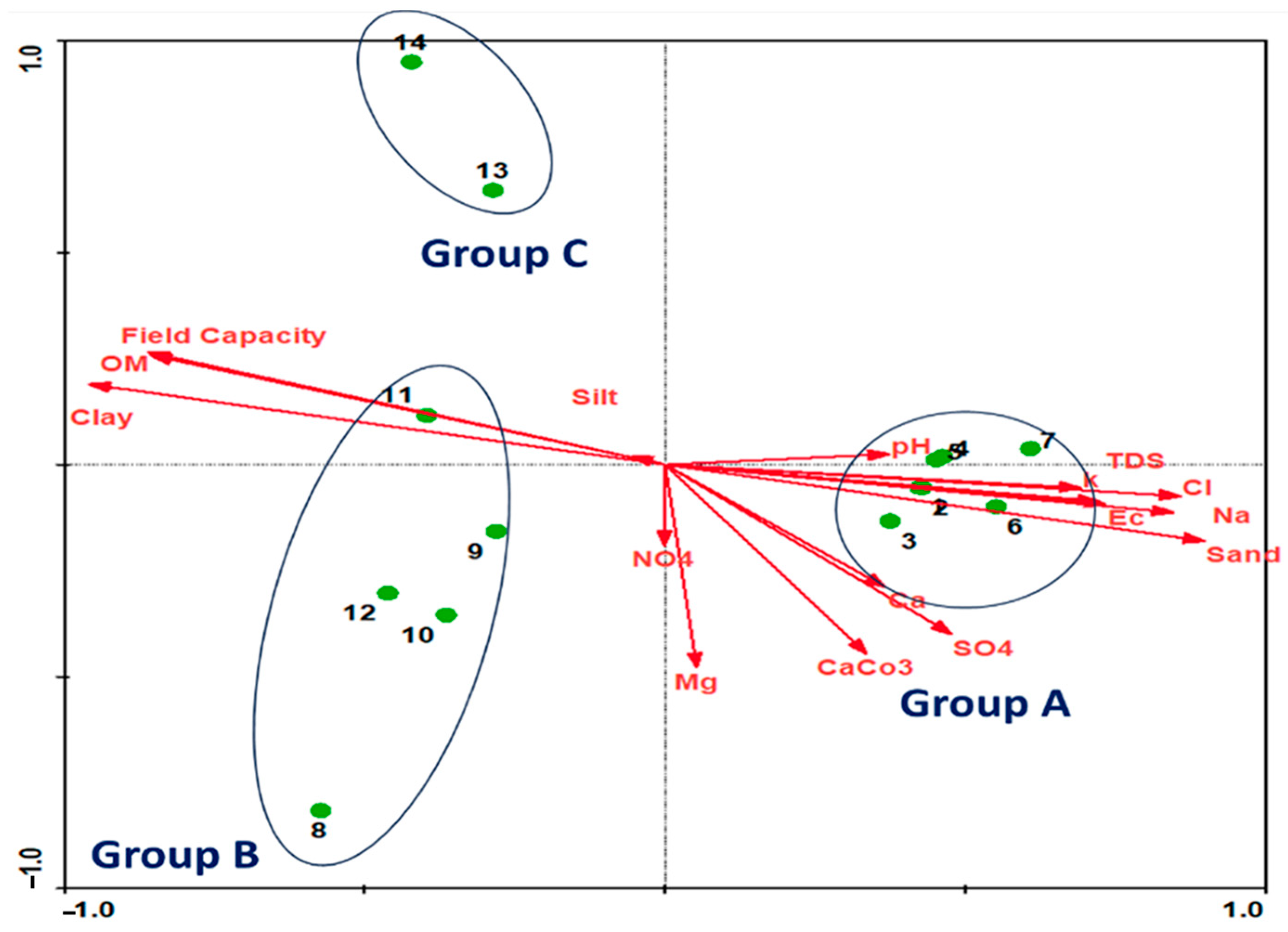
| Group A | Group B | Group C | |
|---|---|---|---|
| Cl− (mg/g) | 3.99 ± 1.83 a | 0.46 ± 0.05 b | 0.38 ± 0.04 b |
| SO42− (mg/g) | 1.01 ± 0.25 a | 0.88 ± 0.14 a | 0.57 ± 0.12 b |
| NO3− (mg/g) | 0.05 ± 0.05 a | 0.07 ± 0.08 a | 0.01 ± 0.00 a |
| CaCO3 (mg/g) | 8.86 ± 0.36 a | 8.37 ± 2.44 a | 6.44 ± 0.06 b |
| K+ (mg/g) | 0.45 ± 0.38 a | 0.05 ± 0.03 b | 0.01 ± 0.00 b |
| Na+ (mg/g) | 1.21 ± 0.58 a | 0.11 b | 0.18 ± 0.01 b |
| Ca2+ (mg/g) | 1.33 ± 1.25 a | 0.68 ± 0.53 a | 0.40 ± 0.04 a |
| Mg2+ (mg/g) | 0.23 ± 0.15 a | 0.20 ± 0.20 a | 0.13 ± 0.01 a |
| pH | 7.89 ± 0.10 a | 7.80 ± 0.31 ab | 7.64 ± 0.09 b |
| TDS (g/L) | 1.69 ± 1.20 a | 0.30 ± 0.09 b | 0.21 ± 0.00 b |
| EC (mS/cm) | 2.60 ± 1.79 a | 0.50 ± 0.14 b | 0.33 ± 0.01 b |
| Organic matter % | 4.56 ± 2.60 a | 12.98 ± 1.07 b | 13.80 ± 0.57 b |
| Field Capacity % | 9.49 ± 6.40 a | 29.17 ± 2.19 b | 31.90 ± 2.11 b |
| Clay % | 5.13 ± 3.68 a | 54.46 ± 3.56 b | 69.10 ± 0.57 c |
| Silt % | 15.10 ± 3.02 a | 18.76 ± 12.58 a | 18.10 ± 5.80 a |
| Sand % | 79.77 ± 5.30 a | 26.78 ± 10.80 b | 12.80 ± 5.23 c |
Disclaimer/Publisher’s Note: The statements, opinions and data contained in all publications are solely those of the individual author(s) and contributor(s) and not of MDPI and/or the editor(s). MDPI and/or the editor(s) disclaim responsibility for any injury to people or property resulting from any ideas, methods, instructions or products referred to in the content. |
© 2026 by the authors. Licensee MDPI, Basel, Switzerland. This article is an open access article distributed under the terms and conditions of the Creative Commons Attribution (CC BY) license.
Share and Cite
Mousa, M.A.; Osman, A.K.; Alzain, M.N.; Basal, O.; Kamel, M.; Hammad, S.A.; Loutfy, N.; Badry, M.O. Environmental Drivers of Weed Floristic Diversity in Two Contrasting Sugarcane Agroecosystems. Plants 2026, 15, 1825. https://doi.org/10.3390/plants15121825
Mousa MA, Osman AK, Alzain MN, Basal O, Kamel M, Hammad SA, Loutfy N, Badry MO. Environmental Drivers of Weed Floristic Diversity in Two Contrasting Sugarcane Agroecosystems. Plants. 2026; 15(12):1825. https://doi.org/10.3390/plants15121825
Chicago/Turabian StyleMousa, Mohamed Abdelazeem, Ahmed K. Osman, Mashail N. Alzain, Oqba Basal, Mohamed Kamel, Sabah A. Hammad, Naglaa Loutfy, and Mohamed O. Badry. 2026. "Environmental Drivers of Weed Floristic Diversity in Two Contrasting Sugarcane Agroecosystems" Plants 15, no. 12: 1825. https://doi.org/10.3390/plants15121825
APA StyleMousa, M. A., Osman, A. K., Alzain, M. N., Basal, O., Kamel, M., Hammad, S. A., Loutfy, N., & Badry, M. O. (2026). Environmental Drivers of Weed Floristic Diversity in Two Contrasting Sugarcane Agroecosystems. Plants, 15(12), 1825. https://doi.org/10.3390/plants15121825