Article

Activation of Multidimensional Defenses in Camptotheca acuminata Seedlings Against Spodoptera frugiperda Larvae

1
School of Biological Engineering, Dalian Polytechnic University, Dalian 116034, China
2
College of Horticulture and Forestry, Tarim University, Alar 843300, China
3
College of Bioscience and Biotechnology, Shenyang Agricultural University, Shenyang 110866, China
*
Authors to whom correspondence should be addressed.
These authors contributed equally to this work.
Plants 2026, 15(12), 1796; https://doi.org/10.3390/plants15121796
Submission received: 28 March 2026 / Revised: 26 May 2026 / Accepted: 3 June 2026 / Published: 11 June 2026
(This article belongs to the Section Plant Protection and Biotic Interactions)

Abstract

Camptotheca acuminata, the primary botanical source of camptothecin (CPT), employs this monoterpenoid indole alkaloid as a key chemical defense against herbivores in addition to its established clinical pharmaceutical importance. Given that Spodoptera frugiperda infestations pose a severe threat to C. acuminata seedlings, we examined integrated, multi-layered defense mechanisms that combine physical barriers with chemical toxins to bolster plant resistance. Physiological analyses revealed that herbivory induces antioxidant enzymes such as superoxide dismutase (SOD) and catalase (CAT), alongside broader metabolic reprogramming. These responses are orchestrated by differential activation of jasmonic acid (JA) and salicylic acid (SA) signaling pathways, which together drive complex defense mobilization, including a marked increase in trichome density. Concurrently, insect herbivory activates the MYB-bHLH-WD40 (MBW) transcriptional complex to promote trichome development while upregulating core CPT biosynthetic genes. In particular, two cytochrome P450 genes, Ca32236 and CaCYP81BQ18, mediate the accumulation of 10-hydroxycamptothecin (10-HCPT), a derivative that is sparingly soluble in water, which enables alkaloid transport and sequestration to specialized storage sites, including trichomes. Collectively, these stress-responsive strategies confer potent insecticidal activity against S. frugiperda and provide valuable insights for improving protection in C. acuminata seedling plantations.

1. Introduction

Since the transition of their ancestors from aquatic to terrestrial habitats, plants have continuously co-evolved with a diverse array of herbivorous threats. To cope with their sessile lifestyle and the absence of an adaptive immune system, plants have evolved sophisticated, multi-layered defense mechanisms capable of detecting and counteracting these biotic stresses [1,2]. Herbivory is perceived through both mechanical stimuli, such as biting and piercing, and chemical cues released by herbivore-derived compounds, including oral secretions, regurgitants, frass, and oviposition fluids [3]. These perception events initiate complex signaling cascades that coordinate direct and indirect defense strategies. Direct defenses comprise physical barriers (e.g., spines, trichomes, and cuticular wax) as well as chemical toxins derived from non-volatile specialized metabolites, whereas indirect defenses are primarily mediated by volatile organic compounds that recruit natural enemies of herbivores [4,5,6]. Fundamentally, the execution of these defense strategies is underpinned by a range of physiological and molecular adjustments, including stomatal regulation, reactive oxygen species (ROS) bursts, antioxidant enzyme activation, lipid peroxidation, and large-scale transcriptional reprogramming [7,8].
Spodoptera frugiperda is a highly polyphagous pest that feeds on more than 350 plant species spanning 76 families, inflicting severe damage on over 80 economically important crops, including maize, rice, and soybean, and causing substantial economic losses [9,10]. These impacts are further exacerbated by the insect’s remarkable metabolic adaptability, broad resistance to multiple insecticides, and tolerance to Bt toxins [11,12,13,14], all of which severely complicate control strategies. Upon feeding, larvae release oral secretions containing fatty acid-amino acid conjugates (FACs). Plant perception of these FACs rapidly activates jasmonic acid (JA)-associated pathways and induces the accumulation of defense-related secondary metabolites, including benzoxazinoids, terpenoids, and proteinase inhibitors [4,15,16]. These induced metabolites constitute the primary defense response triggered by FACs. However, insect-derived salivary enzymes (e.g., SfruACY) degrade FACs and attenuate this defense induction, thereby enhancing larval performance on host plants [17].
Plant secondary metabolites constitute core elements of chemical defense systems, equipping plants with robust capabilities that counter biotic stresses. Among these metabolites, camptothecin (CPT), a monoterpenoid indole alkaloid (MIA), serves as a primary defensive compound within evolutionarily conserved pathways across diverse plant taxa, including Camptotheca (Nyssaceae), Nothapodytes (Icacinaceae), and Ophiorrhiza (Rubiaceae) [18,19,20]. CPT and its structural analogs occur in 43 species spanning eight orders [20], including the medicinal tree Camptotheca acuminata and the herb Ophiorrhiza pumila. Notably, C. acuminata is a deciduous tree species endemic to southern China and is widely cultivated as an ornamental and medicinal plant [21]. Beyond serving as the primary natural source of camptothecin (CPT), which is the precursor of the anticancer drugs irinotecan and topotecan, C. acuminata also plays important economic and ecological roles in industrial oil production, papermaking, furniture manufacturing, and environmental remediation [22]. S frugiperda, a highly polyphagous pest native to the Americas, invaded China in 2018. The absence of natural enemies and favorable climatic conditions have facilitated its rapid spread across major agricultural regions [23]. Although maize is its primary host, the pest’s broad host range poses a potential threat to young C. acuminata seedlings even with their CPT-related chemical defenses. This risk warrants further monitoring.
Despite the well-established role of CPT in plant defense, the underlying metabolic basis of CPT-mediated protective responses remains poorly understood. In C. acuminata, CPT biosynthesis commences with the condensation of tryptamine and secologanin to yield the key precursor strictosidinic acid [24]. However, the downstream steps in the CPT biosynthetic pathway remain incompletely characterized [20,25]. Following its synthesis, CPT is hydroxylated to 10-hydroxycamptothecin (10-HCPT) by cytochrome P450 enzymes (CYP450s) [26]. Due to its increased water solubility, 10-HCPT contributes to the systemic distribution of chemical defenses, and may fulfill distinct defensive functions. Nevertheless, the regulatory mechanisms controlling the conversion of CPT to 10-HCPT by CYP450s remain unclear. This knowledge gap is further compounded by the high degree of tissue specificity in alkaloid accumulation.
In C. acuminata, CPT concentrations in young leaves are five to six times higher than in mature tissues [27], while seedlings display peak production levels relative to later developmental stages. This spatiotemporal distribution pattern indicates an adaptive strategy for safeguarding vulnerable tissues, such as young leaves and seedlings, against herbivory. At the cellular level, glandular trichomes and specialized idioblasts serve as the primary storage sites for CPT [28,29,30], with trichome density exhibiting a positive correlation with CPT concentration [29]. Such associations suggest that physical barriers and chemical defenses may be co-regulated through a common transcriptional network in response to herbivore stress. Consequently, deciphering the regulatory networks that control CPT biosynthesis and their integration with physical barriers like glandular trichomes is crucial for understanding how plants optimize defensive resource allocation under herbivore pressure.
To address these knowledge gaps, the present study investigates the responses of C. acuminata seedlings to S. frugiperda larvae, with a focus on elucidating the regulatory networks governing CPT biosynthesis, its hydroxylation to 10-HCPT, and its coordination with physical defenses such as trichomes. By integrating physiological response, transcriptional analysis, and metabolite profiling, we aim to elucidate signaling pathways (e.g., JA and SA) that modulate plant defense to herbivore stresses in C. acuminata. These insights will not only enhance our understanding of plant–herbivore interactions in C. acuminata but also provide a foundation for developing sustainable pest management strategies and optimizing CPT production for pharmaceutical applications.

2. Results

2.1. Physiological and Defensive Responses to S. frugiperda Herbivory

To evaluate the physiological responses of C. acuminata to insect herbivory, we subjected plants to two damage levels (Figure 1A). Leaf area loss reached approximately 25% after about 12 h of feeding and 50% after about 24 h, the points at which samples were collected (Figure 1A,B). In parallel, mechanical wounding with a hole puncher was conducted to distinguish insect-specific signaling from mere physical injury. Antioxidant enzyme activities, including superoxide dismutase (SOD), Catalase (CAT), and peroxidase (POD), were subsequently measured using NBT reduction, H2O2 decomposition, and guaiacol oxidation assays, respectively, as markers of systemic defense activation. Under insect herbivory, SOD activity increased significantly, reaching 1.3-fold and 1.2-fold of control (untreated control plants caged without intervention) levels at the 25% and 50% damage stages, respectively (Figure 1C). CAT activity exhibited a more substantial elevation, rising to 4.0-fold and 5.2-fold of control under the corresponding damage levels (Figure 1D). Conversely, POD activity displayed distinct patterns. At 25% leaf area loss, POD activity differed significantly among these treatments, whereas at 50% leaf area loss, mechanically wounded plants exhibited significantly higher POD activity than herbivore-treated and control plants (Figure 1E). These observations suggest that insect-specific elicitors, likely derived from oral secretions, regulate POD activity, with pronounced suppression emerging under heightened feeding intensity.
Malondialdehyde (MDA), a key marker of lipid peroxidation and oxidative membrane injury during biotic stress, accumulated progressively with increasing leaf damage in both treatments, with no significant differences detected between insect herbivory and mechanical wounding (Figure 1F). This outcome suggests that the degree of oxidative lipid peroxidation depends mainly on the severity of physical tissue disruption rather than on amplification by insect-specific elicitors. Furthermore, soluble sugar content exhibited distinct treatment-dependent patterns (Figure 1G). Soluble sugar accumulation was significantly higher under herbivory than under mechanical wounding at both the 25% and 50% damage levels. Relative to the control, herbivory consistently induced a significant increase in soluble sugar across both damage levels. Conversely, mechanical wounding failed to induce such an accumulation, with no significant increase observed at the 50% damage level. Meanwhile, chlorophyll content remained stable at 25% damage but decreased significantly at 50% damage under both treatments (Figure 1H). Notably, at the 50% damage level, the reduction in chlorophyll was significantly more severe under herbivory than under mechanical wounding. Together, these results reveal that herbivory by S. frugiperda induces a range of physiological responses in C. acuminata seedlings, including shifts in antioxidant capacity and targeted metabolic reprogramming.

2.2. Activation of Hormonal Signaling and Trichome-Mediated Physical Defense

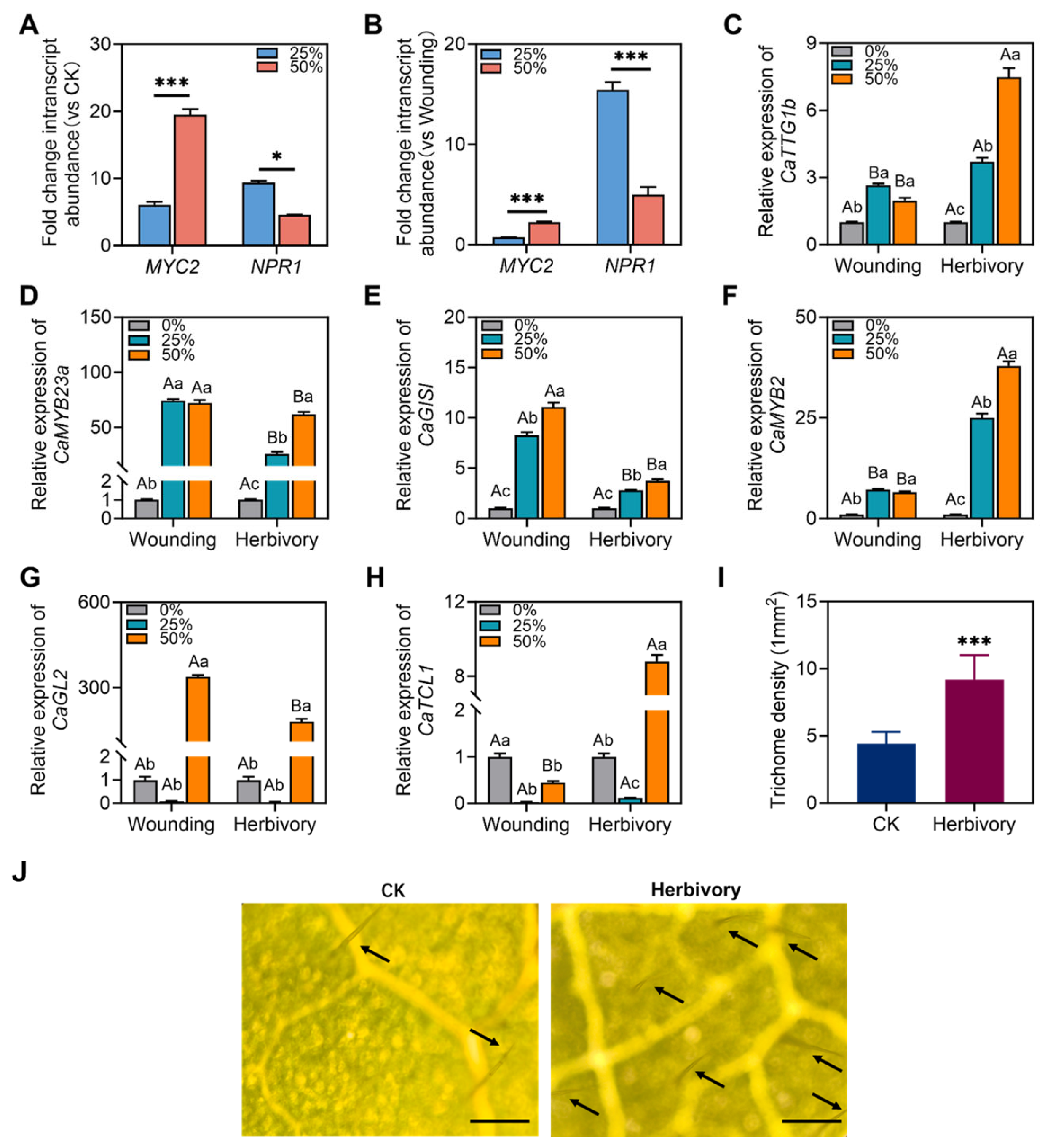
To assess the early activation of defense signaling, we analyzed the expression of JA and SA marker genes. Real-time qPCR revealed that CaMYC2, a core JA signaling component, increased progressively with damage severity, reaching 6.0-fold at 25% damage and 19.5-fold at 50% damage. In contrast, the expression of the SA marker CaNPR1 was highest with 25% damage (9.4-fold increase), whereas it was lower (4.6-fold) in the 50% damage group (Figure 2A). Comparable expression patterns were observed in comparisons relative to the mechanical wounding treatment (Figure 2B). These results indicate that both JA and SA signaling pathways are engaged in the response to herbivory but exhibit distinct temporal dynamics as feeding intensity increases.
Given that JA signaling is known to regulate trichome initiation [31,32], we next examined whether the observed hormonal activation coincided with the induction of trichome-mediated physical defenses. The expression of CaTTG1b and CaMYB23a, which encode core components of the MYB-bHLH-WD40 (MBW) transcriptional complex that regulates trichome development and defense responses, was significantly upregulated under insect herbivory (Figure 2C,D). Notably, CaMYB23a (encoding an R2R3-MYB transcription factor that determines target gene specificity within the MBW complex) showed a 61.6-fold increase at the 50% damage stage. Additional positive regulators, including CaGIS1 (encoding a putative HD-ZIP transcription factor involved in trichome initiation) (Figure 2E) and CaMYB2 (encoding a positive regulator of trichome elongation) (Figure 2F), were also coordinately induced, leading to substantial upregulation of the master regulator of trichome development, CaGL2 (Figure 2G), which directs trichome cell fate and differentiation. Conversely, the repressor CaTCL1 showed reduced expression at the 25% damage level but was upregulated 8.1-fold at the 50% damage level (Figure 2H). Microscopic observations confirmed that these molecular alterations were accompanied by a substantial increase in trichome density in newly developed leaves two weeks post-treatment (Figure 2I,J), thereby implying a potential association between JA-mediated signaling and the bolstering of both physical and chemical defenses against herbivory.

2.3. Induction of CPT and 10 HCPT Biosynthesis and the Synthesis Transport Storage Model

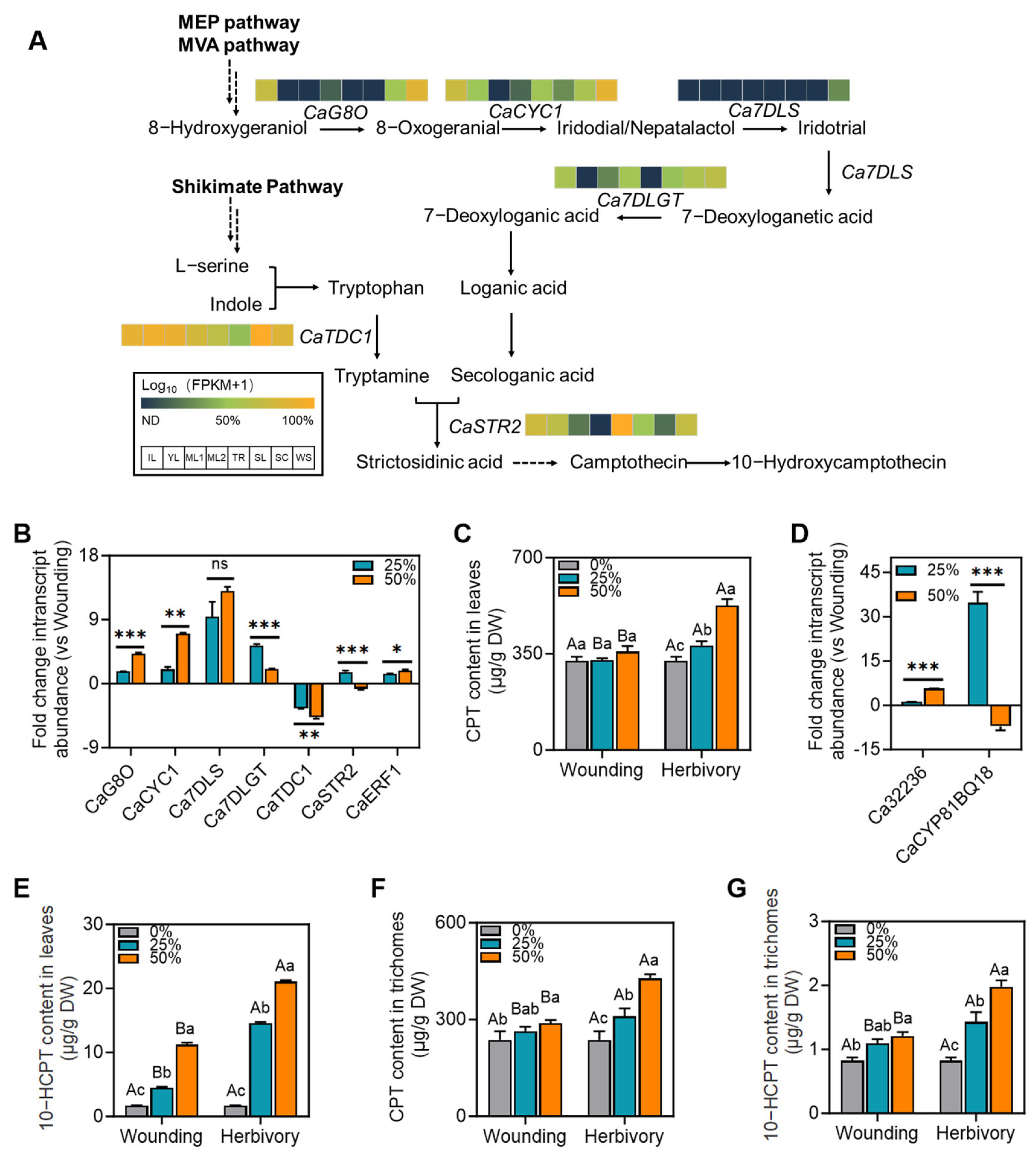
To investigate whether herbivory influences camptothecin biosynthesis at the transcriptional level, we examined the expression patterns of key genes involved in the CPT biosynthetic pathway (Figure 3A,B). Relative to mechanical wounding, insect herbivory triggered significant upregulation of several key genes in the CPT biosynthetic pathway (Figure 3B). At the 25% leaf area loss stage, CaCYC1, Ca7DLS, and Ca7DLGT, as well as the transcription factor CaERF1 [33], were displayed fold inductions of 2.0, 9.4, 5.4, and 1.4, respectively. At the 50% damage stage, CaCYC1 and CaG8O showed further significant increases to 7.0- and 4.2-fold, respectively, whereas Ca7DLS remained highly induced without a significant difference between the two damage levels (Figure 3B). Consistent with the observed transcriptional changes, herbivory induced a marked increase in total leaf CPT content, from 324.7 µg/g to 526.1 µg/g, while mechanical wounding elicited no significant change in accumulation (Figure 3C). A larval survival bioassay showed that S. frugiperda larvae continuously confined on C. acuminata leaves did not survive beyond 24 h, demonstrating that the plant’s strong defense capacity against this herbivory. Given the limited aqueous solubility of CPT and its proposed translocation to trichomes for storage [30,34], we investigated whether herbivory enhances the biosynthesis of 10-HCPT, a more soluble derivative. Two cytochrome P450 genes, Ca32236 and CaCYP81BQ18, which mediate CPT hydroxylation, were significantly upregulated in response to insect herbivory compared with mechanical wounding, exhibiting distinct temporal expression patterns. CaCYP81BQ18 expression peaked at the 25% damage stage with a 34.8-fold increase, whereas Ca32236 reached a 5.6-fold increase at the 50% damage stage (Figure 3D), suggesting an herbivory-induced enhancement in the transcriptional capacity for CPT-to-10-HCPT conversion during feeding. Concurrently, compared with mechanical wounding, 10-HCPT accumulation in leaves increased by 3.3-fold and 1.9-fold at the 25% and 50% damage stages, respectively (Figure 3E), with these relative increases exceeding those observed for CPT (Figure 3B). HPLC analysis further revealed that CPT content in isolated trichomes rose from 236.8 µg/g to 427.8 µg/g under herbivory (Figure 3F), and 10-HCPT was significantly enriched in trichomes compared with whole leaf (Figure 3G). Pearson correlation analysis demonstrated a linear relationship between trichome density and the concentrations of both CPT and 10-HCPT (Figure S1).
Gene expression analysis based on the publicly available transcriptomic dataset (NCBI BioProject PRJNA174448) indicated that genes involved in CPT biosynthesis were predominantly expressed in young leaves and remained barely detectable in trichomes (Figure 3A) [24,34,35], implying that trichomes lack the enzymatic machinery for autonomous CPT biosynthesis despite their high alkaloid content. These findings collectively support a defense model in which CPT and 10-HCPT are synthesized in leaf tissues and subsequently accumulated in trichomes, representing an integration of chemical and physical defenses to form an effective barrier against herbivory.

3. Discussion

Consistent with the pivotal role of oral secretions in triggering plant immunity, our investigation demonstrates that S. frugiperda herbivory elicits a distinct suite of physiological adjustments in C. acuminata. These responses differ markedly from those induced solely by mechanical wounding. Herbivory activated the antioxidant enzymes SOD and CAT more robustly than mechanical damage did, suggesting that insect-specific elicitors amplify the antioxidant response, thus counteracting herbivory-induced oxidative stress. Conversely, POD activity remained elevated following mechanical damage but was suppressed under severe herbivory. This divergent response may reflect the action of salivary effectors that specifically target POD, a phenomenon reported in other plant–insect systems [36]. MDA content increased proportionally to leaf area loss irrespective of treatment, indicating that lipid peroxidation in this system primarily stems from physical tissue disruption rather than insect-specific elicitation. Furthermore, soluble sugars significantly increased only under herbivory at the 50 percent damage level, implying active induction by salivary effectors at higher feeding intensities.
These physiological changes are underpinned by the activation of hormonal signaling pathways. Plants differentiate mechanical wounding from insect herbivory through the recognition of herbivore-associated molecular patterns present in oral secretions [37,38]. Damage-associated molecular patterns, such as extracellular ATP and oligogalacturonides, also contribute to JA and SA signaling via specific receptors [28,39,40,41]. In C. acuminata, herbivory, but not mechanical wounding alone, induced both the JA and SA pathways, each exhibiting distinct alterations across damage stages (based on independent plant samples). Expression of the JA-responsive regulator CaMYC2 was positively associated with increasing leaf damage levels, whereas the SA pathway regulator CaNPR1 showed the highest expression at the 25% leaf damage level and lower expression at the 50% damage level, although it remained elevated relative to the control. This differential response pattern between JA- and SA-associated regulators is consistent with the canonical JA–SA antagonism model [42,43] under continuous herbivory. The dependence of hormonal activation on oral secretions indicates that components within insect saliva, rather than physical injury, drive the observed signaling changes.
Trichomes function as both mechanical and chemical barriers, constituting a primary line of plant defense against herbivores. They store defensive compounds that are liberated upon disruption during herbivore feeding or movement on leaf surfaces [44]. In tomato plants, these structures perceive mechanical stimuli through calcium wave mediated communication, which subsequently activates JA signaling and terpene biosynthesis [45]. This process underscores the fundamental importance of trichome development in establishing both physical and chemical defenses, thereby enabling plants to effectively resist biotic stresses. The MBW transcriptional complex is a well-established central regulator of trichome initiation and development. Within this framework, GLABRA2 acts as a crucial downstream determinant of trichome cell fate [46,47], emphasizing the significance of this regulatory network in mediating plant responses to biotic stresses. In C. acuminata, herbivory strongly upregulated the expression of the MBW complex components CaTTG1b and CaMYB23a, as well as the trichome master regulator CaGL2. This upregulation indicates that JA signaling activates trichome development through evolutionarily conserved transcriptional modules. The negative regulator CaTCL1, a homolog of the Arabidopsis trichome repressor TRY [48], exhibited a biphasic expression pattern. It was suppressed at 25 percent leaf damage and then induced 8.1-fold at 50 percent damage level. This pattern suggests a feedback mechanism that fine tunes physical defense allocation in response to escalating damage levels.
Concurrently, herbivory upregulated CPT biosynthetic genes, leading to enhanced accumulation of CPT and its hydroxylated derivative 10-HCPT. JA signaling is known to regulate the biosynthesis of diverse secondary metabolites, including terpenoids, alkaloids, and glucosinolates, by activating downstream transcription factors of the ERF and MYC families [49,50]. Notably, trichome development and alkaloid biosynthesis were closely associated in C. acuminata. Trichome density correlated positively with CPT and 10-HCPT contents, and young leaves exhibited higher trichome density and alkaloid levels than mature tissues [29]. This spatial coincidence suggests that physical and chemical defenses are coregulated and colocalized to maximize defensive efficacy. Importantly, these findings indicate that mechanical wounding alone cannot fully reproduce the multidimensional defense responses triggered by insect herbivory, thereby highlighting the critical role of herbivore-specific signals, such as oral secretions, in specifically activating the C. acuminata defense system.
A larval survival bioassay showed that S. frugiperda larvae continuously confined on C. acuminata leaves did not survive beyond 24 h, demonstrating that the plant’s strong defense capacity against this herbivory. Gene expression analysis based on publicly available transcriptomic data analysis revealed that 280 genes involved in CPT biosynthesis, particularly those within the iridoid pathway, are expressed predominantly in leaf internal tissues rather than in trichomes. This expression pattern is consistent with findings in other alkaloid accumulating plants, such as Nicotiana benthamiana and Catharanthus roseus, where secondary metabolites are synthesized in leaf internal tissues and subsequently transported to surface structures for storage [51,52]. Such spatial separation of synthesis and storage is thought to serve two adaptive functions by preventing autotoxicity in metabolically active leaf cells while simultaneously positioning chemical defenses at the plant–insect interface, where trichomes function as both physical barriers and concentrated toxin reservoirs.
The hydroxylation of CPT to 10-HCPT represents a critical metabolic node that determines the balance between two defensive alkaloids with distinct physicochemical properties. Our study reveals that S. frugiperda herbivory differentially regulates two cytochrome P450 enzymes involved in this reaction, uncovering a temporal optimization strategy in which different enzymes dominate at successive stages of the defense response. This metabolic shift is consistent with the distinct physicochemical properties of the two compounds, as 10-HCPT exhibits relatively higher water solubility than the nearly insoluble CPT, thereby facilitating cell-to-cell transport and accumulation in epidermal structures such as trichomes. Such spatial separation of synthesis and storage reflects a common principle in plant secondary metabolism that minimizes autotoxicity while positioning defenses at the plant–insect interface. Specifically in C. acuminata, the expression of these cytochrome P450 genes is induced exclusively by herbivory rather than wounding alone, indicating that salivary effectors instead of physical injury drive the metabolic shift.
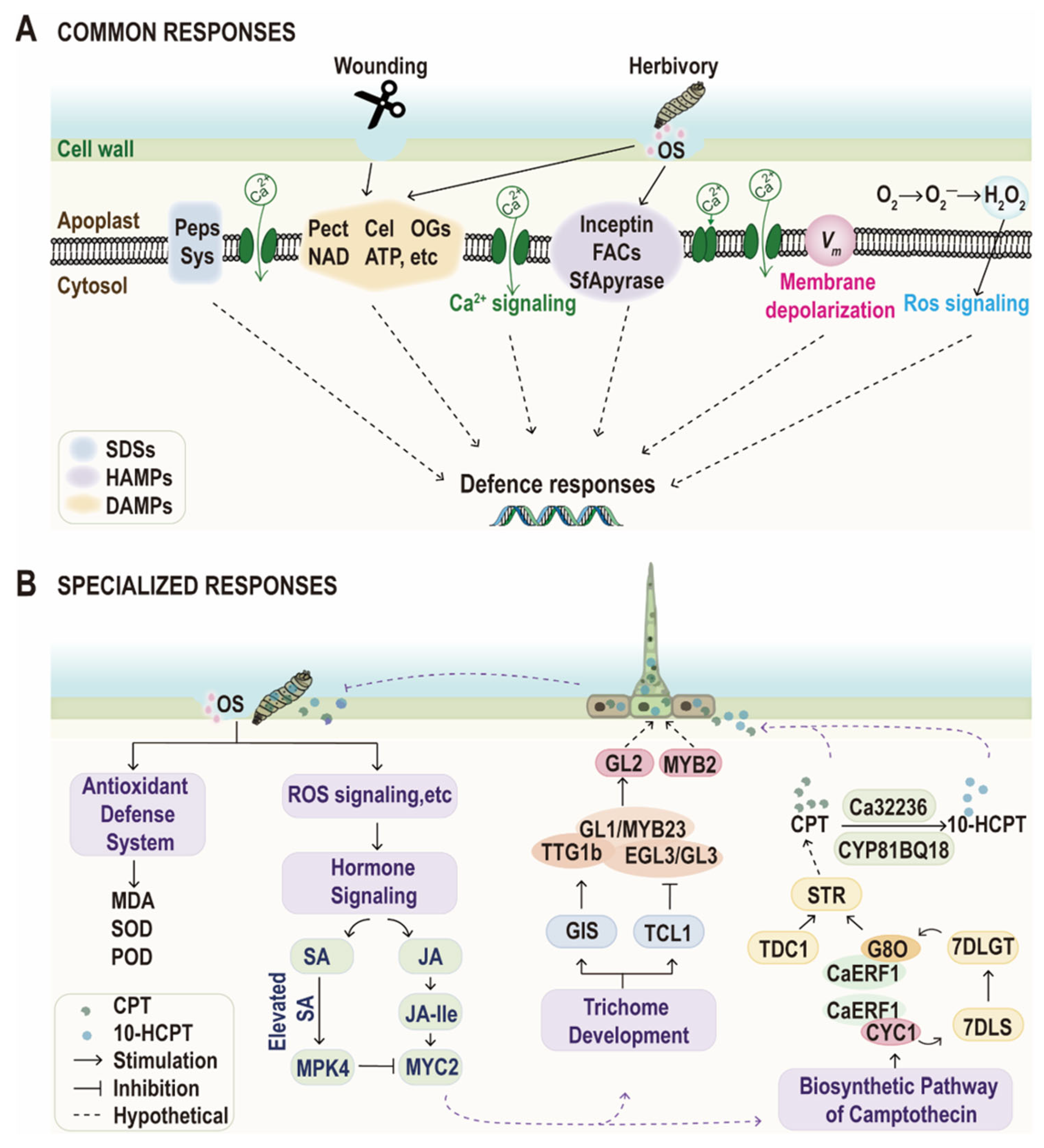
As a potent DNA topoisomerase I inhibitor, CPT exhibits significant cytotoxicity that provides plants with a robust defense against diverse biotic threats. Despite its structural complexity and high biosynthetic cost, the convergent evolution of CPT across 43 plant species in eight distantly related families, including Nyssaceae and Rubiaceae, underscores its indispensable role in broad spectrum defense. In response to herbivory, plants typically initiate a suite of conserved physiological adjustments, such as modulating the activities of SOD, CAT, and POD, while altering MDA levels to mitigate oxidative stress (Figure 4A). Beyond these generalized responses, certain species have evolved specialized defense strategies. C. acuminata, a prominent producer of CPT, exemplifies this specialization (Figure 4B). While activating common stress responses, it simultaneously coordinates multiple defensive dimensions, including CPT biosynthesis, trichome development, and the metabolic conversion of CPT to 10-HCPT, to enhance resistance.
By characterizing the multidimensional defense system comprising both physical and chemical barriers in C. acuminata during herbivory by S. frugiperda, this study demonstrates how plants integrate conserved and specialized mechanisms to achieve highly efficient protection against biotic stress. These findings provide a comprehensive framework for understanding the evolutionary and physiological strategies that enable plants to optimize their survival in hostile environments.

4. Materials and Methods

4.1. Plant Materials and Growth Conditions

Uniform six-month-old C. acuminata seedlings approximately 30 cm in height and bearing eights leaves were cultivated in nutrient soil (Shanghai Qinli Network Technology Co., Ltd., Shanghai, China) within a growth chamber. Prior to the experiments, the growth conditions were maintained at 25 °C with a relative humidity of 60% under a 16-h photoperiod.

4.2. Insect Rearing, Plant Treatments, and Sample Collection

A laboratory population of S. frugiperda was established from individuals collected in cornfields in Conghua District, Guangzhou, Guangdong, China, and maintained on a laboratory-prepared artificial diet for over 15 generations in an incubator at 25 ± 1 °C, 70 ± 5% relative humidity, and a 12 h photoperiod. For herbivory treatment, two fourth-instar larvae were confined to the two upper fully expanded leaves of each seedling which typically possessed eight true leaves at this developmental stage using a mesh cage. Mechanical wounding was applied to the corresponding leaves of separate plants using a sterile punch to simulate physical damage. To ensure consistent environmental conditions, both the mechanically wounded and untreated control plants were enclosed in identical mesh cages.
To conduct subsequent physiological, biochemical, and gene expression analyses, leaves were collected when the damaged area reached approximately 25% (12 h) and 50% (24 h) of the total leaf area. For each treatment at each damage stage, 30 independent plants were divided into three groups of 10. The leaves within each group were then pooled to constitute a single biological replicate, yielding three independent replicates per condition. All samples were immediately flash-frozen in liquid nitrogen and stored at −80 °C.
Photographs of treated leaves were taken prior to sampling, and total leaf area as well as damaged area were measured by tracing leaf margins using ImageJ 1.44p software. The percentage of leaf damage was calculated as (damaged area/total leaf area) × 100%. For trichome observation, newly emerged leaves from treated plants were collected, mounted on slides, and imaged using an IX73 inverted microscope (Olympus Corporation, Tokyo, Japan).
To evaluate larval survival in vivo C. acuminata, fourth-instar S. frugiperda larvae were continuously confined on intact seedling leaves under the same environmental conditions described above. Larval survival was monitored over a 24 h period, and mortality was recorded when larvae showed no movement upon gentle stimulation with a soft brush.

4.3. RNA Isolation and Real-Time qPCR

To assess the expression levels of CPT biosynthetic and trichome development-related genes in C. acuminata, total RNA was extracted from each treatment using TRIzol reagent (Sangon Biotech (Shanghai, China) Co., Ltd.) according to the manufacturer’s instructions. The isolated RNA was reverse-transcribed into cDNA using a commercial reverse transcription kit (Takara Bio, Dalian, China). Subsequent real-time qPCR was conducted on a LightCycler® 480 II system (Roche Diagnostics, Basel, Switzerland) in a 20-µL reaction volume. Each reaction mixture contained SYBR Green Supermix (TransGen Biotech, Beijing, China), 0.2 µM of each specific primer (Table S1), and a cDNA template equivalent to 5 ng of total RNA. The thermal cycling parameters included an initial denaturation at 95 °C for 1 min, followed by 40 cycles of 95 °C for 20 s, 50 °C for 15 s, and 72 °C for 15 s. Relative gene expression was calculated from the cycle threshold (Ct) values using the 2−ΔΔCt method.

4.4. Determination of Chlorophyll Contents, Antioxidant Enzyme Activities, and Malondialdehyde (MDA) Contents

C. acuminata leaves were harvested and gently rinsed with deionized water to remove dust. For determining antioxidant enzyme activities in the collected samples, 1 g of fresh leaves were ground in 10 mL of 50 mM potassium phosphate buffer (1 mM EDTA, 5% polyvinylpolypyrrolidone, 2 mM phenylmethylsulphonyl fluoride, and 0.5% triton X-100), and then kept at 4 °C for 10 min. The supernatants were obtained by centrifugation and used for measuring the activities of superoxide dismutase (SOD), catalase (CAT), and peroxidase (POD) by standard procedures [53,54].
MDA contents in C. acuminata leaves were detected according to the method developed previously [55]. Then, 0.5 g of fresh leaves of each treatment was crushed with 100 mM phosphate buffer, and the extract was collected by centrifugation. Trichloroacetic acid (TCA) and thiobarbituric acid (TBA) were then added with a final concentration of 5% to the extract. After incubation at 100 °C for 10 min, the supernatants were obtained by centrifugation and used to measure their absorbance values at 532 nm by an EnSight™ multimode plate reader (PerkinElmer, Waltham, MA, USA) to determine MDA contents.
Soluble sugar content was quantified using the anthrone colorimetric method [56]. Contents of chlorophyll in C. acuminata leaves were measured using the method developed previously [57].

4.5. Sample Preparation and HPLC Quantification of CPT and 10-HCPT in Leaves and Trichomes

Samples were prepared according to a previously reported method [26]. Briefly, C. acuminata leaves were dried at 45 °C for 48 h. Then, 0.2 g of each sample was extracted with 1.0 mL of methanol for 10 min. The extract was centrifuged at 12,000 rpm for 10 min, and the supernatant was filtered through a 0.22 μm filter. For trichome isolation, leaves were briefly immersed in liquid nitrogen for approximately 30 s while being held with forceps. Trichomes on the leaf surface were then rapidly detached using a brush and collected into a precooled beaker for subsequent analysis. The isolated trichomes were then extracted with 5 mL of methanol, centrifuged, and filtered similarly for HPLC analysis. The contents of CPT and 10-HCPT were determined using an Agilent 1260 series HPLC system (Agilent Technologies, Santa Clara, CA, USA) equipped with a C18 column (250 mm × 4.6 mm, 5 μm). The column temperature was maintained at 30 °C, and the injection volume was 10 μL. Separation was achieved by gradient elution with a mobile phase consisting of (A) acetonitrile and (B) water at a flow rate of 1.0 mL/min. The gradient program was as follows: 0–12 min, 20–26% A; 12–20 min, 26–40% A; 20–25 min, 40–20% A; 25–30 min, 20% A (isocratic). Commercially available CPT and 10-HCPT (Sigma-Aldrich, St. Louis, MO, USA) were used as reference standards to establish calibration curves (Figure S2).

4.6. Statistical Analysis

Data are presented as mean ± standard deviation (SD). Statistical analyses were performed using SPSS 20.0 (IBM, Armonk, NY, USA). Prior to analysis, normality and homogeneity of variances were assessed using the Shapiro–Wilk and Levene’s tests, respectively. When necessary, data were transformed or analyzed using appropriate non-parametric methods. For study assessing the interaction between damage types and severities, differences among treatments were analyzed using two-way analysis of variance (ANOVA). Damage type (mechanical wounding and herbivory) and damage level (0%, 25%, and 50% leaf area loss) were treated as fixed factors, and the full model included the interaction term. Following significant ANOVA results, post hoc multiple comparisons were performed using Tukey–Kramer tests (p < 0.05), with statistical significance denoted by different letters. For independent two-group comparisons, pairwise differences were analyzed separately using Student’s t-tests, with significance indicated by asterisks (* p < 0.05, ** p < 0.01, *** p < 0.001). All statistical analyses were based on three independent biological replicates (n = 3), each consisting of pooled tissue samples collected from 10 independently treated plants.

5. Conclusions

Plants have evolved complex multidimensional defense systems to withstand external stresses, thereby ensuring their survival and sustained growth under adverse conditions. CPT is a specialized alkaloid with documented defensive and pharmaceutical activities and has been identified in 43 species across eight plant families. The present study examined the defense responses of the CPT-producing plant C. acuminata to herbivory by S. frugiperda larvae. The results demonstrated that larval herbivory modified the activities of SOD, CAT, and POD while elevating MDA content as part of the oxidative stress response. In addition, the infestation triggered CPT biosynthesis alongside trichome development, thereby establishing both chemical and physical barriers to biotic stress. Larval feeding stress further promoted the bioconversion of CPT to 10-HCPT, with the resultant increase in water solubility from hydroxylation potentially facilitating the systemic redistribution of these defensive compounds within the plant.

Supplementary Materials

The following supporting information can be downloaded at: https://www.mdpi.com/article/10.3390/plants15121796/s1, Table S1. Primers used in this study. Figure S1. Trichome density correlates with CPT content in C. acuminata young leaves. (A) Trichome density at different leaf developmental stages. (B) Linear relationship between trichome index and CPT content of young leaves of C. acuminata. (C) Linear relationship between trichome index and 10-HCPT content of young leaves of C. acuminata. Figure S2. The HPLC chromatograms of CPT and 10-HCPT.

Author Contributions

Conceptualization, W.M. and F.Y.; methodology, W.M. and C.C.; validation, W.M., C.C. and J.C.; formal analysis, W.M. and Y.W.; investigation, W.M. and X.G.; resources, C.C.; writing—original draft preparation, W.M. and X.G.; writing—review and editing, W.M. and F.Y.; supervision, X.G. and F.Y.; project administration, F.Y.; funding acquisition, C.C. and X.G. All authors have read and agreed to the published version of the manuscript.

Funding

This research was funded by the President’s Fund of Tarim University (TDZKBS202609), the National Natural Science Foundation of China (No. 32102493), the Scientific Research Fund of Liaoning Provincial Education Department (LJ212410152001), Open Fund of Shanghai Key Laboratory of Plant Functional Genomics and Resources (PFGR202602), and 2025 Liaoning Provincial Enterprise Science and Technology Commissioner Project.

Data Availability Statement

The original contributions presented in this study are included in the article. Further inquiries can be directed to the corresponding author.

Acknowledgments

We thank all the lab members for their helpful suggestions. The authors have reviewed and edited the output and take full responsibility for the content of this publication.

Conflicts of Interest

The authors declare that they have no known competing financial interests or personal relationships that could have appeared to influence the work reported in this paper.

References

  1. Zhu, L.; Yang, H.; Li, P.; Dong, L.; Zhao, S.; Lv, H.; Crickmore, N.; Zhou, X.; Zhang, Y.; Guo, Z. Plant strategies against herbivorous insects. J. Integr. Plant Biol. 2026, 1–23. [Google Scholar] [CrossRef]
  2. Fernandes, L.B.; Ghag, S.B. Molecular insights into the jasmonate signaling and associated defense responses against wilt caused by Fusarium oxysporum. Plant Physiol. Biochem. 2022, 174, 22–34. [Google Scholar] [CrossRef]
  3. Chen, S.; Jing, S.; Ye, M.; Feng, Y.; Xu, Y.; Lin, N.; Kuai, P.; Turlings, T.C.J.; Lou, Y. A phytocytokine and its derived peptides in the frass of an insect elicit rice defenses. J. Integr. Plant Biol. 2025, 67, 2118–2134. [Google Scholar] [CrossRef]
  4. Erb, M.; Reymond, P. Molecular interactions between plants and insect herbivores. Annu. Rev. Plant Biol. 2019, 70, 527–557. [Google Scholar] [CrossRef]
  5. Gandhi, A.; Kariyat, R.; Harikishore, A.; Ayati, M.; Bhunia, A.; Sahoo, N. Deciphering the role of ion channels in early defense signaling against herbivorous insects. Cells 2021, 10, 2219. [Google Scholar] [CrossRef]
  6. Zhou, H.; Hua, J.; Zhang, J.; Luo, S. Negative interactions balance growth and defense in plants confronted with herbivores or pathogens. J. Agric. Food Chem. 2022, 70, 12723–12732. [Google Scholar] [CrossRef] [PubMed]
  7. Ali, M.; Kaderbek, T.; Khan, M.A.; Skalicky, M.; Brestic, M.; Elsabagh, M.; El Sabagh, A. Biosynthesis and multifaceted roles of reactive species in plant defense mechanisms during environmental cues. Plant Stress 2025, 18, 101102. [Google Scholar] [CrossRef]
  8. Garcia, A.; Santamaria, M.E.; Diaz, I.; Martinez, M. Disentangling transcriptional responses in plant defense against arthropod herbivores. Sci. Rep. 2021, 11, 12996. [Google Scholar] [CrossRef] [PubMed]
  9. Shu, B.; Yang, X.; Dai, J.; Yu, H.; Yu, J.; Li, X.; Zhang, J.; Lin, J. Effects of camptothecin on histological structures and gene expression profiles of fat bodies in Spodoptera frugiperda. Ecotoxicol. Environ. Saf. 2021, 228, 112968. [Google Scholar] [CrossRef]
  10. Zhang, H.; Xian, X.; Yang, N.; Zhang, Y.; Li, H.; Wan, F.; Liu, W. Insights from the biogeographic approach for biocontrol of invasive alien pests: Estimating the ecological niche overlap of three egg parasitoids against Spodoptera frugiperda in China. Sci. Total Environ. 2023, 862, 160785. [Google Scholar]
  11. Chu, B.; Ge, S.; He, W.; Sun, X.; Ma, J.; Yang, X.; Lv, C.; Xu, P.; Zhao, X.; Wu, K. Gut symbiotic bacteria enhance reproduction in Spodoptera frugiperda (JE Smith) by regulating juvenile hormone III and 20-hydroxyecdysone pathways. Microbiome 2025, 13, 132. [Google Scholar] [CrossRef] [PubMed]
  12. Peng, H.; Zhang, Z.; Kang, X.; Zhang, Y.; Zhang, H.; Wang, Y.; Yang, H.; Ju, F. Unveiling gut microbiota and metabolic functions contributed to polyvinyl chloride degradation in Spodoptera frugiperda larvae. J. Hazard. Mater. 2025, 492, 138209. [Google Scholar] [CrossRef]
  13. Salamat, R.; Saddiq, B.; Afzal, M.B.S.; Banazeer, A.; Serrão, J.E.; Akram, M.I.; Shad, S.A.; Sial, A.A. Resistance of Spodoptera frugiperda (Lepidoptera: Noctuidae) to the diamides chlorantraniliprole and flubendiamide: Resistance development, heritability, inheritance and implications for management. J. Econ. Entomol. 2025, 118, 3157–3172. [Google Scholar] [CrossRef] [PubMed]
  14. Stirle, J.L.; Matias, J.E.F.; Mendes, G.R.; Moscardini, V.F.; Maia, J.B.; Michaud, J.P.; Gontijo, P.C. Differential susceptibility of Spodoptera frugiperda (Lepidoptera: Noctuidae) to single versus pyramided Bt traits in Brazilian soybean: What doesn’t kill you makes you stronger? Pest Manag. Sci. 2024, 80, 6535–6544. [Google Scholar] [CrossRef]
  15. Li, B.; Luo, M.; Liu, X.; Shi, W.; Qi, J.; Zhou, S.; Wang, G. The Spodoptera frugiperda L-aminoacylase degrades fatty acid-amino acid conjugates and promotes larvae growth on Zea mays. Commun. Biol. 2025, 8, 641. [Google Scholar] [CrossRef] [PubMed]
  16. Yao, Y.; Lin, H.T.; Chen, Y.H.; Chen, L.L.; Zhang, H.L.; Fu, H.Y.; Zhan, H.X.; Wang, J.D. Salivary protein Sfapyrase of Spodoptera frugiperda stimulates plant defence response. Plant Cell Environ. 2025, 48, 406–420. [Google Scholar] [CrossRef]
  17. Cai, X.Y.; Tang, H.T.; Wang, Y.Z.; Haq, I.U.; Wang, J.D.; Hou, Y.M. Salivary effector SfPDI modulates plant defense responses to enhance foraging efficiency of Spodoptera frugiperda. Int. J. Biol. Macromol. 2025, 308, 142548. [Google Scholar] [CrossRef]
  18. Lorence, A.; Nessler, C.L. Camptothecin, over four decades of surprising findings. Phytochemistry 2004, 65, 2735–2749. [Google Scholar] [CrossRef]
  19. Kang, M.; Fu, R.; Zhang, P.; Lou, S.; Yang, X.; Chen, Y.; Ma, T.; Liu, J. A chromosome-level Camptotheca acuminata genome assembly provides insights into the evolutionary origin of camptothecin biosynthesis. Nat. Commun. 2021, 12, 3531. [Google Scholar] [CrossRef]
  20. Pu, X.; Zhang, C.R.; Zhu, L.; Li, Q.L.; Huang, Q.M.; Zhang, L.; Luo, Y.G. Possible clues for camptothecin biosynthesis from the metabolites in camptothecin-producing plants. Fitoterapia 2019, 134, 113–128. [Google Scholar] [CrossRef]
  21. Nacheva, L.; Dimitrova, N.; Ivanova, V.; Cao, F.; Zhu, Z. Micropropagation of Camptotheca acuminata Decne (Nyssaceae)—Endangered Ornamental and Medicinal Tree. Acta Univ. Agric. Silvic. Mendel. Brun. 2020, 68, 679–686. [Google Scholar] [CrossRef]
  22. Fan, X.; Lin, X.; Ruan, Q.; Wang, J.; Yang, Y.; Sheng, M.; Zhou, W.; Hao, X. Research progress on the biosynthesis and metabolic engineering of the anti-cancer drug camptothecin in Camptotheca acuminata. Ind. Crops Prod. 2022, 186, 115270. [Google Scholar] [CrossRef]
  23. Zhou, Y.; Zhang, H.W.; Wu, Q.L.; Wu, K.M. Spread of invasive migratory pest Spodoptera frugiperda and management practices throughout China. J. Integr. Agric. 2021, 20, 637–645. [Google Scholar] [CrossRef]
  24. Sadre, R.; Magallanes-Lundback, M.; Pradhan, S.; Salim, V.; Mesberg, A.; Jones, A.D.; DellaPenna, D. Metabolite diversity in alkaloid biosynthesis: A multilane (diastereomer) highway for camptothecin synthesis in Camptotheca acuminata. Plant Cell 2016, 28, 1926–1944. [Google Scholar] [CrossRef] [PubMed]
  25. Pu, X.; Lin, X.Y.; He, J.W.; Ai, Z.H.; He, X.X.; Tong, S.Y.; Liu, L.F.; Huang, Q.M. Multiomics-guided mining and characterization of epoxide hydrolase involved in camptothecin biosynthesis from Camptotheca acuminata. Bioorg. Chem. 2024, 153, 107980. [Google Scholar] [CrossRef] [PubMed]
  26. Pu, X.; Lei, M.; Zhang, J.H.; He, J.W.; Ai, Z.H.; He, X.X.; Tong, S.Y.; Wu, W. Hydroxylase-oriented mining and functional characterization of camptothecin 10-hydroxylase from Camptotheca acuminata Decne. Ind. Crops Prod. 2024, 222, 119469. [Google Scholar] [CrossRef]
  27. Vincent, R.M.; Lopez-Meyer, M.; McKnight, T.D.; Nessler, C.L. Sustained harvest of camptothecin from the leaves of Camptotheca acuminata. J. Nat. Prod. 1997, 60, 618–619. [Google Scholar] [CrossRef]
  28. Tripathi, D.; Zhang, T.; Koo, A.J.; Stacey, G.; Tanaka, K. Extracellular ATP acts on jasmonate signaling to reinforce plant defense. Plant Physiol. 2018, 176, 511–523. [Google Scholar] [CrossRef]
  29. Liu, W.Z. Secretory structures and their relationship to accumulation of camptothecin in Camptotheca acuminata (Nyssaceae). Acta Bot. Sin. 2004, 46, 1242–1248. [Google Scholar]
  30. Pasqua, G.; Monacelli, B.; Valletta, A. Cellular localisation of the anti-cancer drug camptothecin in Camptotheca acuminata Decne (Nyssaceae). Eur. J. Histochem. 2004, 48, 321–328. [Google Scholar]
  31. Qi, T.; Huang, H.; Wu, D.; Yan, J.; Qi, Y.; Song, S.; Xie, D. Arabidopsis DELLA and JAZ proteins bind the WD-repeat/bHLH/MYB complex to modulate gibberellin and jasmonate signaling synergy. Plant Cell 2014, 26, 1118–1133. [Google Scholar] [PubMed]
  32. Yoshida, Y.; Sano, R.; Wada, T.; Takabayashi, J.; Okada, K. Jasmonic acid control of GLABRA3 links inducible defense and trichome patterning in Arabidopsis. Development 2009, 136, 1039–1048. [Google Scholar] [CrossRef]
  33. Wang, Y.; Wang, Y.; Pan, A.; Miao, Q.; Han, Y.; Liu, Z.; Yu, F. CaERF1-mediated ABA signal positively regulates camptothecin biosynthesis by activating the iridoid pathway in Camptotheca acuminata. Int. J. Biol. Macromol. 2024, 261, 129560. [Google Scholar] [CrossRef]
  34. Sun, Y.; Luo, H.; Li, Y.; Sun, C.; Song, J.; Niu, Y.; Zhu, Y.; Dong, L.; Lv, A.; Tramontano, E.; et al. Pyrosequencing of the Camptotheca acuminata transcriptome reveals putative genes involved in camptothecin biosynthesis and transport. BMC Genom. 2011, 12, 533. [Google Scholar] [CrossRef] [PubMed]
  35. Li, S.; Yi, Y.; Wang, Y.; Zhang, Z.; Beasley, R.S. Camptothecin accumulation and variations in Camptotheca. Planta Med. 2002, 68, 1010–1016. [Google Scholar] [PubMed]
  36. Acevedo, F.E.; Peiffer, M.; Tan, C.W.; Stanley, B.A.; Stanley, A.; Wang, J.; Luthe, D.S.; Felton, G.W. Fall armyworm-associated gut bacteria modulate plant defense responses. Mol. Plant-Microbe Interact. 2017, 30, 127–137. [Google Scholar]
  37. Stahl, E.; Hilfiker, O.; Reymond, P. Plant–arthropod interactions: Who is the winner? Plant J. 2018, 93, 703–728. [Google Scholar]
  38. Acevedo, F.E.; Rivera-Vega, L.J.; Chung, S.H.; Ray, S.; Felton, G.W. Cues from chewing insects—The intersection of DAMPs, HAMPs, MAMPs and effectors. Curr. Opin. Plant Biol. 2015, 26, 80–86. [Google Scholar] [CrossRef]
  39. Gramegna, G.; Modesti, V.; Savatin, D.V.; Sicilia, F.; Cervone, F.; De Lorenzo, G. GRP-3 and KAPP, encoding interactors of WAK1, negatively affect defense responses induced by oligogalacturonides and local response to wounding. J. Exp. Bot. 2016, 67, 1715–1729. [Google Scholar]
  40. Ferrari, S.; Savatin, D.V.; Sicilia, F.; Gramegna, G.; Cervone, F.; De Lorenzo, G. Oligogalacturonides: Plant damage-associated molecular patterns and regulators of growth and development. Front. Plant Sci. 2013, 4, 49. [Google Scholar] [CrossRef]
  41. Choi, J.; Tanaka, K.; Cao, Y.; Qi, Y.; Qiu, J.; Liang, Y.; Lee, S.Y.; Stacey, G. Identification of a plant receptor for extracellular ATP. Science 2014, 343, 290–294. [Google Scholar] [CrossRef]
  42. Tsuda, K.; Sato, M.; Stoddard, T.; Glazebrook, J.; Katagiri, F. Network properties of robust immunity in plants. PLoS Genet. 2009, 5, e1000772. [Google Scholar]
  43. Pieterse, C.M.J.; Van der Does, D.; Zamioudis, C.; Leon-Reyes, A.; Van Wees, S.C.M. Hormonal modulation of plant immunity. Annu. Rev. Cell Dev. Biol. 2012, 28, 489–521. [Google Scholar] [CrossRef]
  44. Popowski, J.; Warma, L.; Abarca Cifuentes, A.; Bleeker, P.; Jalaal, M. Glandular trichome rupture in tomato plants is an ultra-fast and sensitive defense mechanism against insects. J. Exp. Bot. 2025, 76, 6508–6519. [Google Scholar] [CrossRef] [PubMed]
  45. Sun, C.; Wei, J.; Gu, X.; Wu, M.; Li, M.; Liu, Y.; Yang, Y.; Wu, S. Different multicellular trichome types coordinate herbivore mechanosensing and defense in tomato. Plant Cell 2024, 36, 4952–4969. [Google Scholar] [CrossRef]
  46. Ramsay, N.A.; Glover, B.J. MYB–bHLH–WD40 protein complex and the evolution of cellular diversity. Trends Plant Sci. 2005, 10, 63–70. [Google Scholar] [PubMed]
  47. Chen, S.; Wang, S. GLABRA2, a common regulator for epidermal cell fate determination and anthocyanin biosynthesis in Arabidopsis. Int. J. Mol. Sci. 2019, 20, 4997. [Google Scholar] [CrossRef] [PubMed]
  48. Schellmann, S.; Schnittger, A.; Kirik, V.; Wada, T.; Okada, K.; Beermann, A.; Thumfahrt, J.; Hülskamp, M. TRIPTYCHON and CAPRICE mediate lateral inhibition during trichome and root hair patterning in Arabidopsis. EMBO J. 2002, 21, 5036–5046. [Google Scholar] [CrossRef]
  49. Wasternack, C.; Strnad, M. Jasmonates are signals in the biosynthesis of secondary metabolites—Pathways, transcription factors and applied aspects—A brief review. New Biotechnol. 2019, 48, 1–11. [Google Scholar] [CrossRef]
  50. Zhou, M.; Memelink, J. Jasmonate-responsive transcription factors regulating plant secondary metabolism. Biotechnol. Adv. 2016, 34, 441–449. [Google Scholar] [CrossRef]
  51. Zador, E.; Jones, D. The biosynthesis of a novel nicotine alkaloid in the trichomes of Nicotiana stocktonii. Plant Physiol. 1986, 82, 479–484. [Google Scholar] [CrossRef]
  52. St-Pierre, B.; Vazquez-Flota, F.A.; De Luca, V. Multicellular compartmentation of Catharanthus roseus alkaloid biosynthesis predicts intercellular translocation of a pathway intermediate. Plant Cell 1999, 11, 887–900. [Google Scholar] [CrossRef]
  53. Beauchamp, C.; Fridovich, I. Superoxide dismutase: Improved assays and an assay applicable to acrylamide gels. Anal. Biochem. 1971, 44, 276–287. [Google Scholar] [CrossRef]
  54. Kar, M.; Mishra, D. Catalase, peroxidase, and polyphenoloxidase activities during rice leaf senescence. Plant Physiol. 1976, 57, 315–319. [Google Scholar] [CrossRef]
  55. Suda, I.; Furuta, S.; Nishiba, Y. Fluorometric determination of a 1,3-diethyl-2-thiobarbituric acid–malondialdehyde adduct as an index of lipid peroxidation in plant materials. Biosci. Biotechnol. Biochem. 1994, 58, 14–17. [Google Scholar] [CrossRef]
  56. Hong, Y.; Yuan, S.; Sun, L.; Wang, X.; Hong, Y. Cytidinediphosphate-diacylglycerol synthase 5 is required for phospholipid homeostasis and is negatively involved in hyperosmotic stress tolerance. Plant J. 2018, 94, 1038–1050. [Google Scholar] [CrossRef]
  57. Arnon, D.I. Copper enzymes in isolated chloroplasts: Polyphenoloxidase in Beta vulgaris. Plant Physiol. 1949, 24, 1–15. [Google Scholar] [CrossRef]
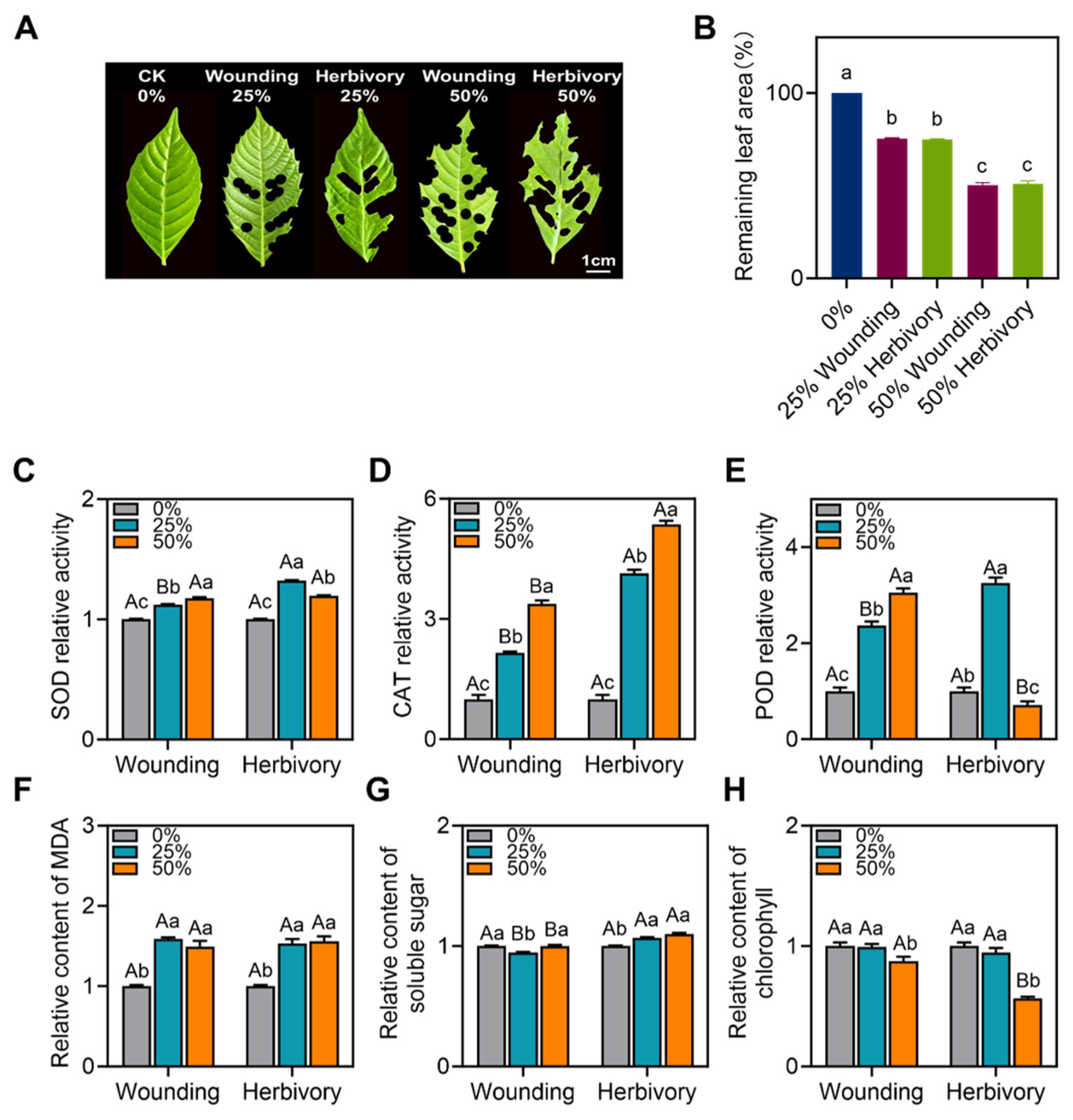
Figure 1. S. frugiperda herbivory-induced physiological changes in C. acuminata seedling leaves. (A) Representative leaves under untreated control plants caged without intervention (CK), mechanical wounding, and herbivory treatments (25% and 50% leaf area damage). Bar = 1 cm. (B) Damaged area was calculated using ImageJ 1.44p. (C) Superoxide dismutase (SOD) activity. (D) Catalase (CAT) activity. (E) Peroxidase (POD) activity. (F) Malondialdehyde (MDA) content. (G) Soluble sugar content. (H) Chlorophyll content. Data were analyzed using two-way ANOVA followed by Tukey’s multiple comparisons test (p < 0.05). Different lowercase letters indicate significant differences among damage levels within the same treatment group, whereas different uppercase letters indicate significant differences between treatment types at the same damage level. Data are presented as mean ± SD (n = 3 independent biological replicates, each consisting of pooled samples from 10 plants).
Plants 15 01796 g001
Figure 2. S. frugiperda herbivory activates hormone signaling and promotes trichome development in C. acuminata. (A,B) Relative expression of the JA pathway key regulator MYC2 and the SA pathway response gene NPR1. (CH) Relative expression levels of trichome-associated regulatory genes. (I) Trichome density on the leaves of the CK and herbivory plants. (J) Representative microscopic images of newly formed trichomes on leaves under control (CK) and herbivory treatments. Black arrows indicate trichomes. Bar = 0.1 mm. Data for (CH) were analyzed using two-way ANOVA followed by Tukey’s multiple comparisons test (p < 0.05). Different lowercase letters indicate significant differences among damage levels within the same treatment group, whereas different uppercase letters indicate significant differences between treatment types at the same damage level. For (A,B), pairwise comparisons between the 25% and 50% damage levels within individual genes were evaluated using Student’s t-test. The comparison between CK and herbivory in (I) was also evaluated using Student’s t-test. Statistical significance is indicated by asterisks (* p < 0.05, *** p < 0.001). Data are presented as mean ± SD (n = 3 independent biological replicates, each consisting of pooled samples from 10 plants).
Plants 15 01796 g002
Figure 3. S. frugiperda enhances CPT and 10-HCPT biosynthesis in C. acuminata. (A) Complete map of CPT biosynthetic pathway and expression of pathway enzyme genes in different tissues of C. acuminata. Tissue abbreviations: IL, immature leaf; YL, young leaf; TR, trichome; SL, seedling leaf; SC, seedling cotyledons; WS, whole seedling; ML1, mature leaf (rep1); ML2, mature leaf (rep2). GenBank accession numbers: CaG8O, GACF01095885; CaCYC1, KU842378; Ca7DLS, GACF01109828; Ca7DLGT, GACF01100860; CaTDC1, AAB39708; CaSTR2, JF508375. Solid arrows indicate confirmed steps, single dashed arrows indicate uncharacterized steps, and double dashed arrows indicate omitted intermediate steps. (B) Relative expression levels of key CPT biosynthetic enzyme genes and the transcription factor CaERF1. (C) CPT accumulation in leaves. (D) Relative expression levels of CYP450s. (E) 10-HCPT accumulation in leaves. (F) CPT accumulation in trichomes. (G) 10-HCPT accumulation in trichomes. Data were analyzed using two-way ANOVA followed by Tukey’s multiple comparisons test (p < 0.05). Different lowercase letters indicate significant differences among damage levels within the same treatment group, whereas different uppercase letters indicate significant differences between treatment types at the same damage level. For (B,D), pairwise comparisons between the 25% and 50% damage levels within individual genes were evaluated using Student’s t-test, and statistical significance is indicated by asterisks (* p < 0.05, ** p < 0.01, *** p < 0.001, ns, not significant). Data are presented as mean ± SD (n = 3 independent biological replicates, each consisting of pooled samples from 10 plants).
Plants 15 01796 g003
Figure 4. Proposed model of stress responses in C. acuminata. (A) Common defense activation pathway triggered by mechanical wounding and insect herbivory. (B) Specialized defense mechanism specifically induced by insect herbivory in C. acuminata. Solid arrows denote experimentally confirmed causal relationships or direct molecular interactions. Dashed arrows indicate putative or hypothesized promoting effects that require further validation. Horizontal arrows represent inhibitory or suppressive regulatory interactions. Abbreviations: Peps, peptides 1–6; Sys, systemin; Cel, cellulose; OG, oligogalacturonide; NAD, nicotinamide adenine dinucleotide; ATP, adenosine 5′-triphosphate; FAC, fatty acid–amino acid conjugate; HAMP, herbivore-associated molecular pattern; DAMP, damage-associated molecular pattern; SDS, secondary danger signal.
Plants 15 01796 g004
Disclaimer/Publisher’s Note: The statements, opinions and data contained in all publications are solely those of the individual author(s) and contributor(s) and not of MDPI and/or the editor(s). MDPI and/or the editor(s) disclaim responsibility for any injury to people or property resulting from any ideas, methods, instructions or products referred to in the content.