Article

BnaA01.BRC1 Negatively Regulates Branch Number and Responds to Gibberellin Signaling in Brassica napus

1
College of Agronomy and Biotechnology, Southwest University, Chongqing 400715, China
2
Hybrid Rapeseed Research Center of Shaanxi Province, Yangling 712100, China
3
Integrative Science Center of Germplasm Creation in Western China (Chongqing) Science City, Chongqing 401329, China
*
Author to whom correspondence should be addressed.
These authors contributed equally to this work.
Plants 2026, 15(12), 1795; https://doi.org/10.3390/plants15121795
Submission received: 6 May 2026 / Revised: 3 June 2026 / Accepted: 8 June 2026 / Published: 10 June 2026
(This article belongs to the Section Plant Genetics, Genomics and Biotechnology)

Abstract

Plant architecture optimization is central to high-yield crop breeding. The number of branches in Brassica napus (B. napus) determines canopy structure, light use efficiency, and yield. The transcription factor BRANCHED1 (BRC1) integrates multiple signals to negatively regulate branching. This study characterized five BnaBRC1 homologs in B. napus via bioinformatics, expression profiling, and CRISPR/Cas9 editing. All BnaBRC1s contain a conserved TCP domain, and their promoters are enriched with light-responsive and hormone-responsive cis-acting elements. BnaA01.BRC1 is highly expressed in leaves, stem nodes, roots, and siliques, and its transcription is coordinately regulated by low light, sucrose, and exogenous cytokinin, and gibberellin (GA) signals. Functional analysis showed that overexpression of BnaA01.BRC1 suppressed branching, whereas CRISPR/Cas9-mediated knockout of BnaBRC1 substantially increased branch number. In basal axillary buds, high BnaBRC1 expression was accompanied by upregulation of GA-inactivating GIBBERELLIN 2 OXIDASEs and the GA signaling negative regulator SPINDLY, and no direct interaction was detected between BnaA01.BRC1 and DELLA proteins, suggesting indirect regulation of branching via GA homeostasis. Collectively, this study demonstrates the pivotal role of BnaA01.BRC1 in branching regulation and provides a genetic resource and theoretical basis for plant architecture optimization and multi-branch germplasm innovation in B. napus.

1. Introduction

Ideal plant architecture serves as the core strategy and pivotal genetic foundation for high-yield crop breeding [1]. By optimizing plant spatial configuration and coordinating critical physiological processes including photosynthesis, nutrient partitioning, lodging resistance, high-density planting adaptability, and regulating carbon consumption from ineffective axillary branches, the crop harvest index can be effectively maximized [2,3,4,5,6,7]. Brassica napus (B. napus), the world’s second largest oilseed crop, shows close intrinsic links between branching traits and overall plant architecture. Branch number, combined with agronomic traits such as plant stature, branch angle and branch node height, determines population canopy structure, photosynthetic light utilization efficiency and final B. napus yield formation, relying on synergistic interaction and phenotypic trade-off effects among diverse traits [8,9]. Moreover, increasing branch number in B. napus improves both edible stem yield and biomass simultaneously, which is important for utilizing B. napus as a vegetable, forage, and green manure. Therefore, elucidating the molecular regulation of branching in B. napus holds substantial theoretical and practical value.
In Arabidopsis thaliana (A. thaliana), branch formation in plants is a complex developmental process. Its initiation and progression are coordinately regulated by a genetic network involving internal hormones, nutrients, and external environmental signals [10]. In tomato, brassinosteroids (BRs) are key signals that release apical dominance and antagonistically regulate lateral branching with auxin (IAA) [11]. BRs integrate multiple phytohormones, including IAA, strigolactones (SLs), gibberellin (GA), cytokinin (CK), and sugar signals. The BRs signaling transcription factor BRASSINAZOLE RESISTANT represses the plant specific TCP factor BRANCHED 1/TEOSINTE BRANCHED 1 (BRC1/TB1), thereby relieving BRC1 mediated inhibition of axillary bud formation [11]. In Arabidopsis, SLs regulate branching by inhibiting trehalose 6 phosphate signaling, an effect also dependent on BRC1 [12]. CK promotes branching by activating WUSCHEL2 to repress BRC1 expression, antagonizing SLs [13,14]. Furthermore, in tomato, light-induced LONG HYPOCOTYL 5 regulates tomato lateral branch development by suppressing BRC1 transcription in axillary buds and activating BRs biosynthesis in lateral buds [15].
BRC1 is the core negative regulator of branch number [16,17]. Most of the known regulatory mechanisms of BRC1 have been elucidated in Arabidopsis. In Arabidopsis, FAR-RED ELONGATED HYPOCOTYLS 3 and FATTY ACID REDUCTASE 1 directly interact with SQUAMOSA PROMOTER BINDING PROTEIN-LIKE 9 (SPL9) and SPL15 and inhibit SPL9/15-mediated activation of BRC1 expression, whereas three D53-like SUPPRESSOR OF MORE AXILLARY GROWTH2-LIKE proteins SMXLs (SMXL6/7/8) directly interact with SPL9/SPL15 and suppress the transactivation activity of SPL9/15 on BRC1, thereby promoting axillary bud growth and branching [18]. In rapeseed, WRKY DNA-BINDING PROTEIN 28 targets and represses BRC1, reducing abscisic acid accumulation in leaf axils and thereby relieving bud dormancy, which leads to excessive bud outgrowth [19]. In Arabidopsis, BRC1 directly interacts with TCP INTERACTOR CONTAINING EAR MOTIF PROTEIN 1 to suppress its own activity, and they coregulate multiple branching-related genes such as HOMEOBOX PROTEIN (HB21), HB40, and HB53 [20]. In rapeseed brc1 mutants, expression of Bna.HBs and downstream NINE-CIS-EPOXYCAROTENOID DIOXYGENASE 3s are significantly reduced in axillary buds [9]. Furthermore, in tomato, BRC1 reduces CK and GA accumulation by transcriptionally regulating LONELY GUY 4, CYTOKININ OXIDASE 7, GIBBERELLIN 2 OXIDASE 4 (GA2OX4), and GA2OX5, thereby inhibiting bud growth in tomato [15]. In Arabidopsis, BRC1 and KAURENE SYNTHASE 1, KAURENE OXIDASE, KAURENOIC ACID OXIDASE, GIBBERELLIN 20 OXIDASE 1 (GA20OX1) form a positive feedback loop through the DELLA-SPL9 module, which plays a crucial role in balancing the regulation of plant height and branch number [21]. Thus, BRC1 serves as a key hub in the complex network regulating lateral branch development.
Five BnaBRC1 homologs in the B. napus genome play redundant roles in branch development [19]. BnaBRC1 expression is significantly upregulated in middle and lower axillary buds, BnaA01.BRC1 (BnaA01g26700D) shows the highest transcriptional abundance [22]. Accordingly, BnaA01.BRC1 acts as a pivotal regulator mediating branch morphogenesis in B. napus. Knockout of BRC1 via CRISPR/Cas9 gene editing can directionally create novel multi-branched B. napus germplasm [9]. Although BRC1 has been extensively studied in A. thaliana, its functional mechanisms and regulatory networks in response to hormones, external environmental signals, and sugars in polyploid B. napus remain unclear. Further research on BRC1 regulatory pathway will enrich the molecular theory of plant architecture, improve the comprehensive utilization value of B. napus through plant type optimization, and provide references for architecture improvement in other Brassica crops. To elucidate BnaBRC1 function, this study performed bioinformatics analysis, expression profiling, and functional characterization, and preliminarily explored its regulatory role in branch development, thereby offering potential strategies and theoretical support for ideotype breeding in B. napus.

2. Results

2.1. Bioinformatic Characterization and Phylogenetic Analysis of BnaBRC1

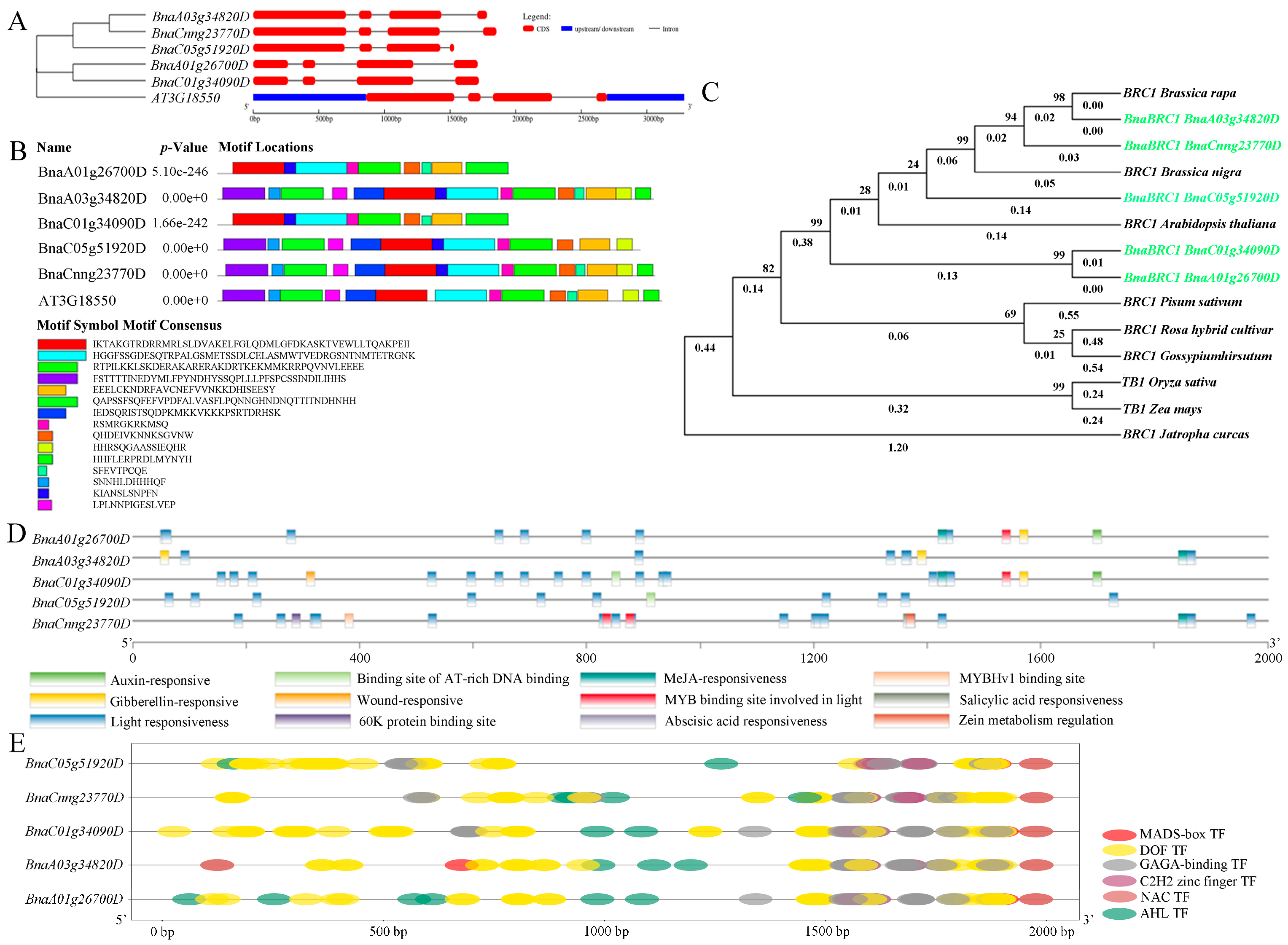
To elucidate the structural composition, evolutionary conservation, and upstream regulatory mechanisms of the BnaBRC1s genes in B. napus, a multidimensional bioinformatics analysis was performed in this study. Gene structure analysis revealed that all BnaBRC1s contain four exons and three introns, exhibiting a highly conserved organization pattern with AtBRC1 and the BnaBRC1s lack UTRs (Figure 1A). Protein domain analysis showed that all BnBRC1s possess a conserved TCP domain (Figure 1B). Phylogenetic analysis indicated that BnaBRC1s are closely related to BRC1 homologs from A. thaliana, Brassica nigra (B. nigra), and Brassica rapa (B. rapa) (Figure 1C). Promoter hormone/stress-responsive elements prediction revealed that the promoter regions of BnaBRC1s are enriched in light-responsive elements and various hormone-responsive elements, including IAA, GA, and jasmonates (JAs) response elements (Figure 1D). In addition, multiple cis-acting elements associated with abiotic stress responses are also distributed in these promoters (Figure 1D). Motif enrichment and prediction analyses revealed the distribution of specific transcription factor binding sites (TFBSs) in the BnaBRC1 promoters, including binding sites for transcription factors from the MADS-box, DOF, GAGA-binding, C2H2 zinc finger, NAC, and AHL families (Figure 1E). Taken together, these results indicate that BRC1 is relatively conserved throughout evolution and may be broadly involved in hormone signaling, plant growth and development, and abiotic stress response networks, with potential regulation by multiple transcription factors.

2.2. Histochemical GUS Staining and Spatiotemporal Expression Pattern of BnaA01.BRC1

GUS histochemical staining was performed to clarify the spatiotemporal expression pattern of BnaA01.BRC1, thereby systematically characterizing the organ-specific expression profile of this gene. The staining results revealed that BnaA01.BRC1 was expressed at all developmental stages, and no GUS signal was detected in WT seedlings (Figure S1A). High expression levels were detected in leaves, roots, shoots, and leaf bases, with strong signals also observed at stem nodes, whereas no expression was observed in hypocotyls. Additionally, expression was also detectable in petals and siliques (Figure S1B–G).

2.3. Core Functional Region Identification of BnaA01.BRC1 Promoter

To further identify the core cis-acting elements of the BnaA01.BRC1 promoter, we performed a series of 5′ deletion analysis on its promoter sequence (Figure S2A,B). GUS staining results showed that the signal weakened when the promoter was truncated to the −731 bp fragment (Figure S2B). Cis-acting element prediction revealed that the deleted region from −731 bp to −501 bp contains cis-acting elements responsive to light and multiple phytohormones, including GA, IAA, and JA (Figure S2C), which is consistent with the known feature that BRC1 responds to various hormone signals. Notably, GUS staining became very weak after truncation to −501 bp. Therefore, we propose that the region from −731 bp to −501 bp is the essential core domain required for maintaining the basal activity of the BnaA01.BRC1 promoter.

2.4. Cis-Responsive Patterns of BnaA01.BRC1 Under Diverse Exogenous Signal Treatments

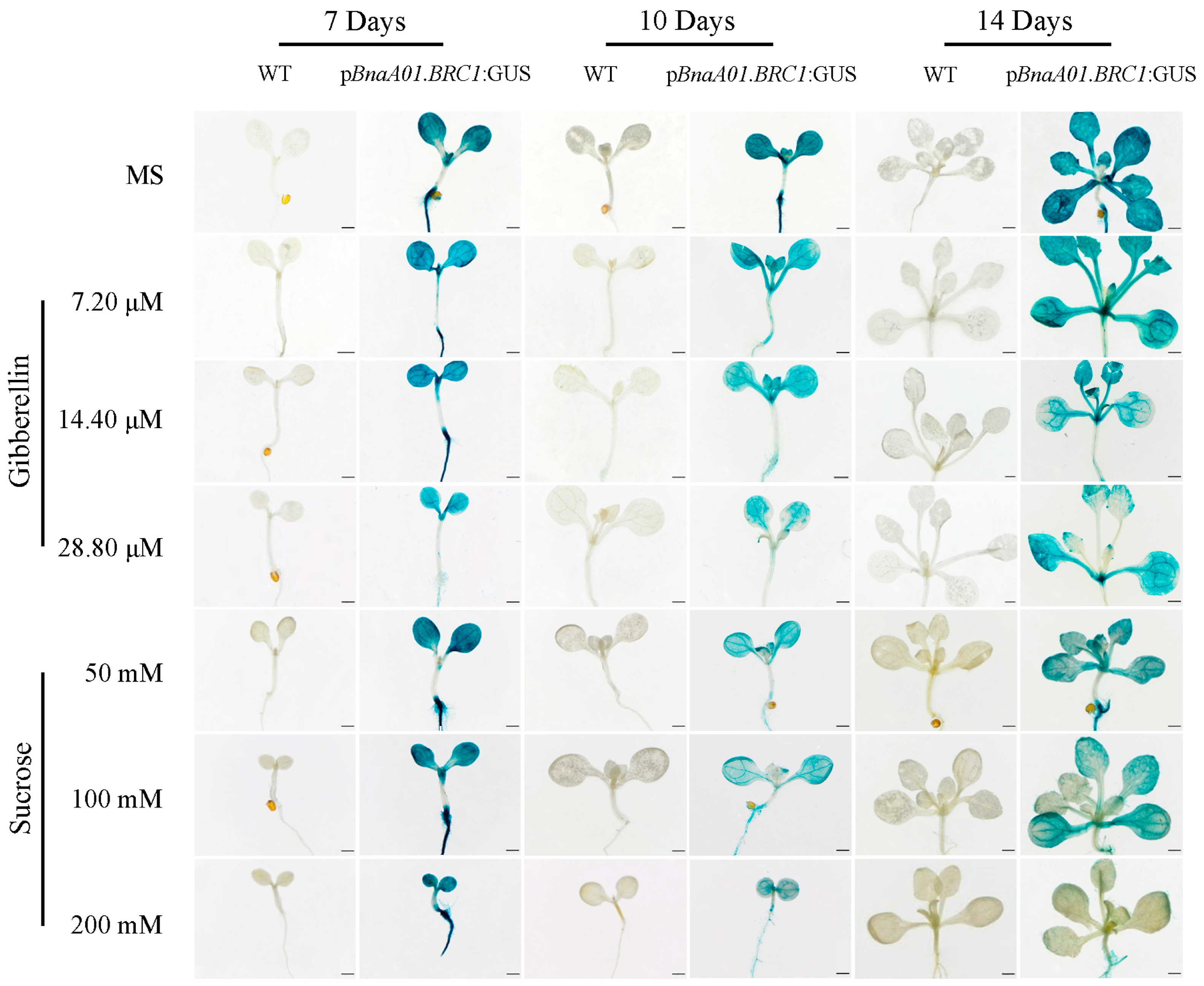
To systematically characterize the response patterns of the BnaA01.BRC1 promoter to various exogenous environmental and hormonal signals, based on the predicted cis-acting elements within its key regions, pBnaA01.BRC1::GUS transgenic plants were subjected to low-light treatment as well as graded concentrations of IAA, 6-benzylaminopurine (6-BA), GA, and sucrose, respectively. Low-light stress markedly induced hypocotyl elongation in seedlings, and this phenotype progressively intensified with prolonged treatment. Compared with normal light conditions, low-light treatment significantly expanded the GUS staining range and enhanced the staining intensity (Figures S3 and S5). Accordingly, it is proposed that BnaA01.BRC1 responds to low-light signals by enhancing its own promoter transcriptional activity, thereby upregulating BnaA01.BRC1 expression. Unlike low light, IAA treatment showed no obvious enhancement of GUS staining intensity under the tested concentrations, and no dose-dependent effect was observed (Figure S4). In contrast, 6-BA, GA, and sucrose all suppressed GUS signals in a concentration-dependent manner, with reduced staining area and weakened intensity as the concentration increased (Figure 2 and Figures S4 and S5). Collectively, these results demonstrate that BnaA01.BRC1 broadly responds to light, multiple phytohormones, and sugar signals, thereby coordinately regulating gene expression and shoot branching development.

2.5. Subcellular Localization Analysis of BnaA01.BRC1

Secondary structure analysis of BnaA01.BRC1 revealed that the protein predominantly adopts an α-helical conformation (Figure S6A). The predicted tertiary structure model further indicated that the three-dimensional folding of BnaA01.BRC1 is conserved and stable, with the spatial conformation of its core TCP functional domain being highly conserved (Figure S6B). Subcellular localization assays using A. thaliana protoplasts showed that the green fluorescence signal of the BnaA01.BRC1-GFP fusion protein completely overlapped with that of the nuclear marker, confirming that BnaA01.BRC1 is specifically localized to the nucleus, which is consistent with the subcellular distribution feature of a transcription factor (Figure S6C).

2.6. Functional Genetic Analysis of BnaA01.BRC1 Mediating Plant Branch Development

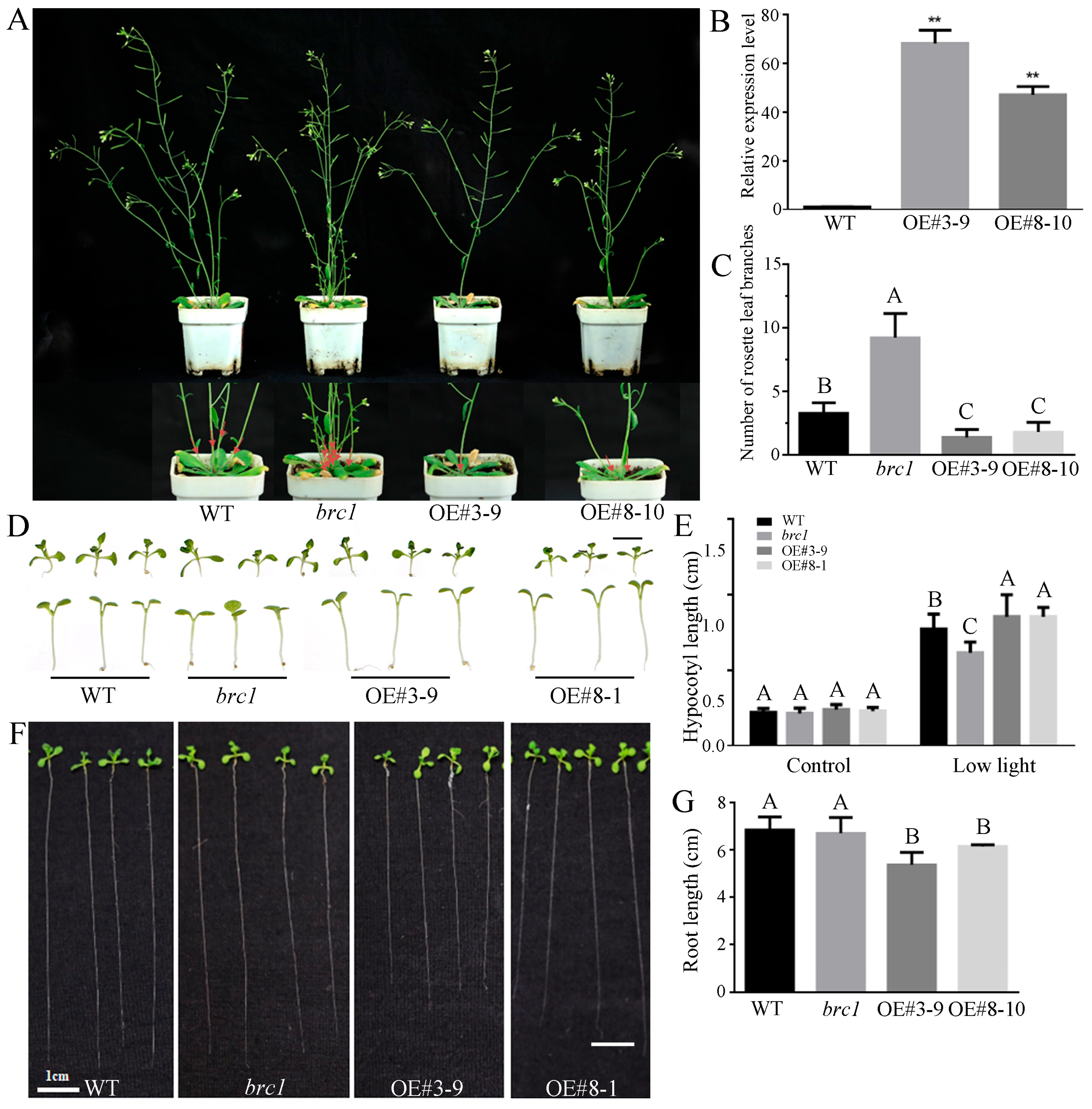
BnaA01.BRC1 was heterologously expressed in A. thaliana to determine its role in branch formation. At full-bloom stage, the rosette branch numbers were counted in WT, brc1, and BnaA01.BRC1 heterologous overexpression lines (OE#3-9 and OE#8-10). The results showed that, compared with WT, overexpression lines exhibited significantly fewer rosette branches, whereas the brc1 displayed significantly more rosette branches (Figure 3A). RT-qPCR analysis revealed that the expression levels of BnaA01.BRC1 in the OE#3-9 and OE#8-10 lines were 68-fold and 47-fold higher than that in WT, respectively (Figure 3B). The rosette branch number statistics further indicated that brc1 had significantly more branches than WT, while both OE#3-9 and OE#8-10 had significantly fewer branches than WT (Figure 3C). These phenotypic observations were highly consistent with the reported function of AtBRC1 in negatively regulating lateral branching in A. thaliana, confirming that BnaA01.BRC1 shares a conserved branch-suppressing function with its A. thaliana homolog. Since BnaA01.BRC1 senses light signal changes (Figures S3 and S5), heterologous BnaA01.BRC1 overexpression lines and brc1 were subjected to low-light treatment. The results showed that under low-light conditions, the overexpression lines exhibited markedly elongated hypocotyls, whereas brc1 showed the opposite trend (Figure 3D,E). These lines of evidence suggest that elevated BnaA01.BRC1 expression promotes stem organ elongation under low light, thereby affecting overall plant growth. Root length measurements revealed that BnaA01.BRC1 heterologous overexpression lines had significantly shorter roots than both WT and brc1 (Figure 3F,G), indicating that BnaA01.BRC1 overexpression may inhibit root development.
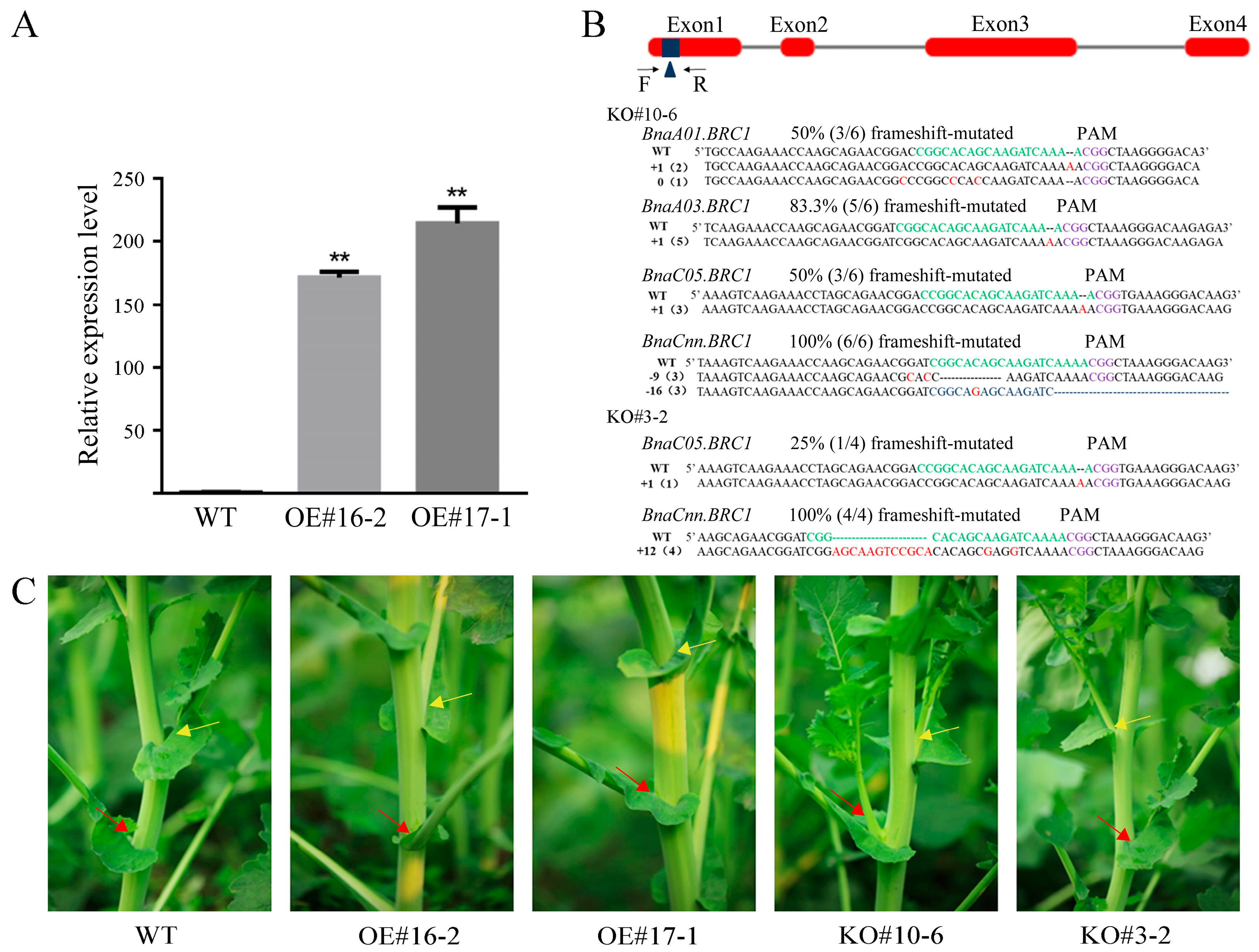
Transgenic lines overexpressing BnaA01.BRC1 and CRISPR/Cas9-based knockout plants were generated for phenotypic observation (Figure 4A,B). Phenotypic analysis at the initial flowering stage revealed that axillary buds at the middle and lower positions developed normally into branches in WT. In the overexpression lines, most axillary buds at the middle and lower positions failed to develop into branches, whereas in the knockout plants, axillary buds at the corresponding positions developed normally into branches (Figure 4C). These results indicate that high expression of BnaBRC1 is a critical factor inhibiting axillary bud outgrowth into branches at the middle and lower positions in B. napus.

2.7. Molecular Mechanism of BnaA01.BRC1 Involved in the GA Signaling Pathway

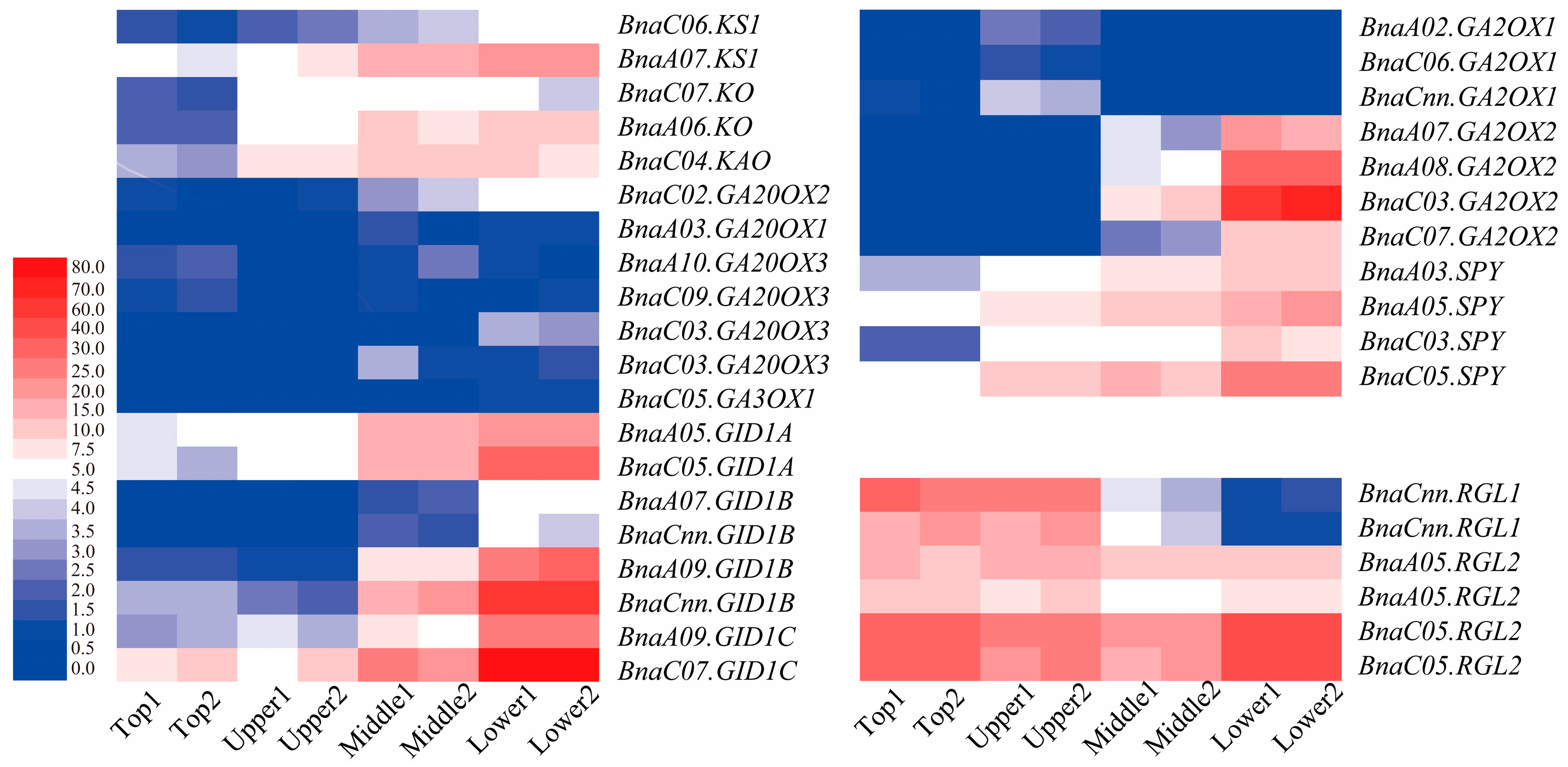
The expression level of BnaBRC1 in B. napus axillary buds increases as bud position descends, with the highest expression observed in the lowest axillary buds, reaching up to a hundred-fold difference [22]. Using previously obtained transcriptome data from axillary buds at different positions in B. napus, genes involved in the GA signaling pathway were analyzed [22]. The results showed that multiple genes participating in GA biosynthesis, including GA20OX and GIBBERELLIN 3 OXIDASE (GA3OX), as well as several homologs of GIBBERELLIN INSENSITIVE DWARF1 (GID) involved in GA signal transduction, exhibited the same expression trend: lower bud positions were associated with higher expression levels (Figure 5). Interestingly, GA2OX1 and GA2OX2, which are involved in GA inactivation, and SPINDLY (SPY), a negative regulator of GA signaling, also displayed a similar expression pattern (Figure 5). In contrast, genes encoding DELLA proteins, the core repressors of the GA signaling pathway, such as RGA-LIKE 1 (RGL1) and RGL2, exhibited the opposite expression pattern (Figure 5).
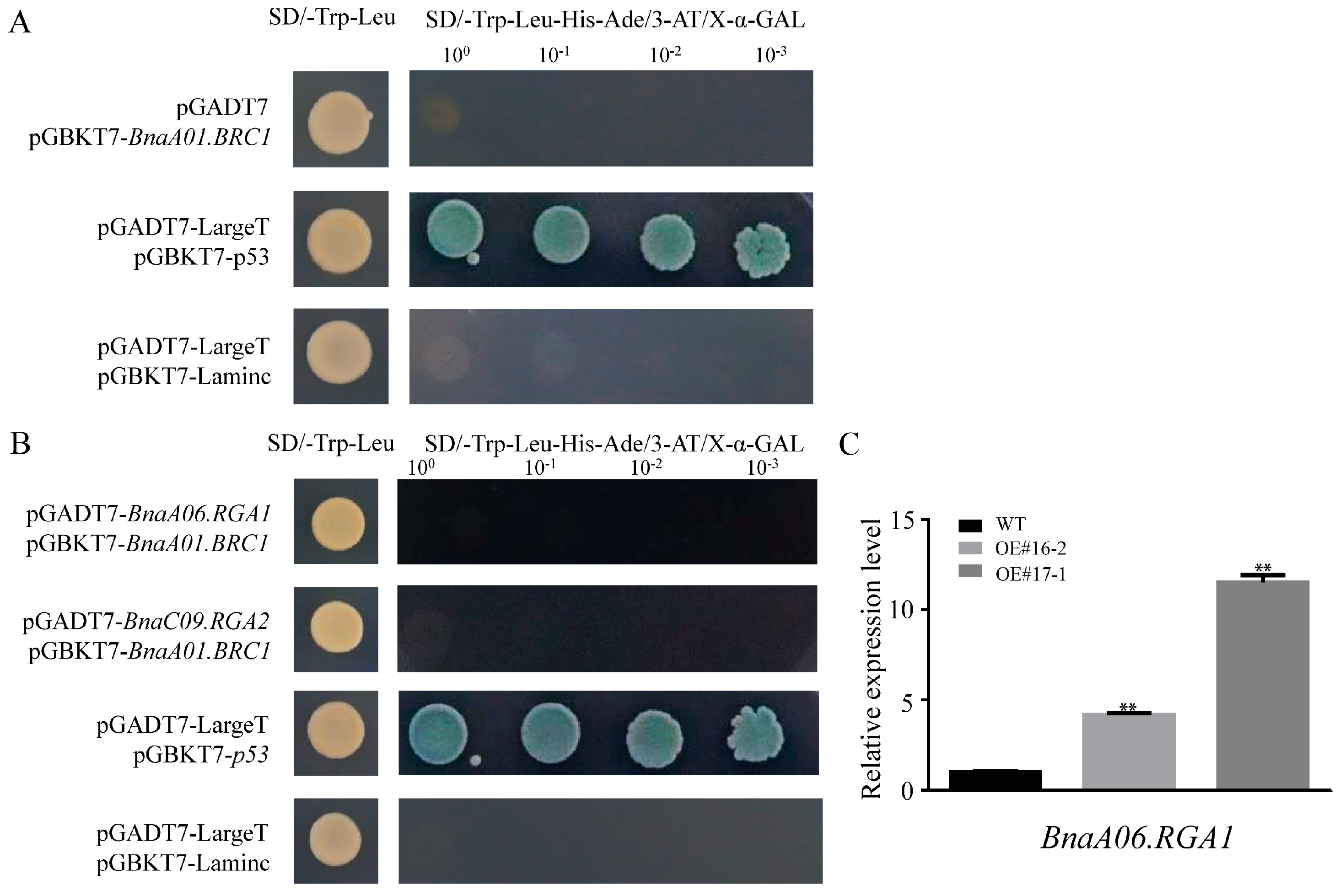
Transcriptional activation activity assays revealed that BnaA01.BRC1 had no autoactivation activity (Figure 6A). Given that the core region of the BnaA01.BRC1 promoter contains GA responsive cis-acting elements and that this gene is transcriptionally responsive to exogenous GA, yeast two-hybridization assays were further performed to test the interactions of the BnaA01.BRC1 protein with the DELLA family proteins REPRESSOR OF GA (BnaA06.RGA1) and RESTORATION ON GROWTH ON AMMONIA 2 (BnaC09.RGA2), respectively. The pairwise yeast two-hybrid assays (Y2H) confirmed that BnaA01.BRC1 does not directly interact with BnaA06.RGA1 or BnaC09.RGA2 (Figure 6B). In BnaA01.BRC1 overexpression lines, BnaA06.RGA1 transcript levels were significantly elevated (Figure 6C). These results indicate that BnaA01.BRC1 acts indirectly in the GA signaling pathway, likely through modulation of GA homeostasis or downstream transcriptional cascades, leading to spatiotemporal regulation of DELLA family gene expression and consequently affecting axillary bud branching in B. napus.

3. Discussion

In past decades, the regulatory mechanisms of plant architecture have been systematically elucidated [23,24,25,26]. Branch number, a key determinant of plant morphology and yield, has received increasing attention [27,28]. The development of axillary buds into branches involves multiple layers of regulation [29,30]. Studies in multiple species have shown that BRC1 precisely controls branch number by inhibiting axillary bud outgrowth [9,31,32,33]. In this study, transgenic and CRISPR/Cas9 technologies were used to generate BnaA01.BRC1 overexpression and knockout lines. Phenotypic analysis revealed that BnaA01.BRC1 overexpression suppressed branch growth, whereas knockout significantly increased branch number (Figure 3 and Figure 4). These results indicate that BnBRC1 negatively regulates branching in rapeseed, consistent with the functions of AtBRC1 and OsTB1 in suppressing branching/tillering, suggesting a highly conserved role among them [34,35]. Therefore, targeted manipulation of BRC1 via gene editing can generate multi-branch rapeseed germplasm, optimize plant architecture, and enhance its multiple utilities for vegetable, forage, and green manure purposes.
BRC1 is a central integrator of hormonal, nutritional, and environmental signals regulating lateral branch development across multiple species [36,37]. BnaA01.BRC1 in rapeseed responds to IAA, CK, GA, sucrose, and light signals (Figure 2 and Figures S3–S5). Light not only drives photosynthesis to supply sucrose but also acts as a signal for photomorphogenesis [38]. In the phytochrome A signaling pathway, FHY3/FAR1 interacts with SPL9/15 and suppress their transcriptional activation of BRC1, thereby promoting branching [18]. In this study, BnaA01.BRC1 responds to low light by enhancing its own promoter transcriptional activity (Figures S3 and S5). Low light inhibits branching and upregulates BRC1 expression [39,40]. During the shade avoidance response, plants elevate leaves, elongate stems, and suppress branching to capture more light, accompanied by increased BRC1 expression [34]. Under low light, BnaA01.BRC1 overexpressing A. thaliana seedlings exhibited longer hypocotyls than the WT, whereas brc1 mutants showed shorter hypocotyls (Figure 3). Elevated TB1 expression is known to inhibit internode elongation [41]. These results indicate that BnaA01.BRC1 responds to changes in light intensity, promotes stem elongation, and inhibits axillary bud outgrowth, thereby participating in light-dependent regulation of axillary branching and plant architecture. Furthermore, BRC1 serves as a key node integrating sugar and hormonal signals to regulate branching [12]. Exogenous sucrose treatment suppressed BnaA01.BRC1 expression, suggesting that BnaA01.BRC1 may regulate branching in rapeseed by responding to sugar signals.
IAA regulates BRC1 expression in axillary buds by antagonizing CK and SL [11,42,43]. High CK levels promote bud activation by downregulating BRC1 [12]. In this study, CK suppressed BnaA01.BRC1 promoter activity in a dose-dependent manner, whereas IAA treatment did not cause a significant change under the tested concentrations, possibly due to insufficient IAA concentration (Figures S4 and S5). It is speculated that CK regulates bud activity and promote branching in rapeseed via BRC1 downregulation. In addition to CK, GA also participates in BRC1 regulation [15,44,45]. Exogenous GA treatment suppressed BnaA01.BRC1 promoter-driven GUS signals, indicating GA-mediated repression of this gene (Figure 2 and Figure S5). Low GA content is required for axillary bud formation in A. thaliana, and ectopic GA20OX2 expression in leaf axils elevates GA levels and inhibits axillary meristem initiation [46]. GA2OX1 and GA2OX2 are key enzymes that inactivate GA, whereas SPY negatively regulates GA responses [47,48]. In basal axillary buds of rapeseed with high BnaBRC1 expression, GA2OX1, GA2OX2 and SPY were significantly upregulated (Figure 5). This may lead to reduced local GA activity and attenuated downstream signaling in basal buds. GA20OX and GA3OX are key genes involved in GA synthesis, whereas GID is a key gene involved in GA signaling [49,50]. GA20OX, GA3OX, and GID were also upregulated, suggesting a higher potential for GA signaling output in basal buds (Figure 5). Collectively, the transcriptional regulation of GA signaling exhibits strong spatial specificity in rapeseed axillary buds. The coordinated upregulation of both promoting and repressing modules indicates that basal axillary buds are not in a simple on or off state but rather in a highly sensitive and finely tuned standby or homeostatic state. It is proposed that basal buds establish a robust GA signaling system while simultaneously deploying GA2OX and SPY as “brakes” to prevent premature or excessive bud outgrowth, thereby maintaining a dormant state with low activity and high potential.
DELLA proteins are core repressors of GA signaling [51]. RGL1 and RGL2, which encode DELLA proteins, are partially redundant but distinct negative regulators of GA responses [52,53]. RGL2 and RGL1 exhibited a decreasing gradient from upper to lower axillary buds in rapeseed. This suggests that low DELLA levels may be a key molecular event for releasing basal bud dormancy, but whether a bud eventually sprouts depends on the net balance of promoting and repressing factors within the GA signaling network and their integration with other hormonal signals. Yeast two-hybrid assays showed no direct interaction of BnaA01.BRC1 with DELLA proteins BnaA06.RGA1 and BnaC09.RGA2, and BnaA06.RGA1 was upregulated in BnaA01.BRC1 overexpressing plants (Figure 6). BRC1 has been shown to reduce GA accumulation by upregulating GA2OX4 and GA2OX5, thereby inhibiting bud outgrowth [15,36]. It is therefore speculated that BnaA01.BRC1 in rapeseed reduces GA content and inhibits bud development by upregulating GA2OXs, while also directly or indirectly increasing BnaA06.RGA1 expression to promote DELLA accumulation and further lower GA levels. DELLA proteins interact with SPL9 and modulate its DNA-binding affinity, forming a DELLA-SPL9-LAS-GA2OX4 feedback module that establishes a low GA microenvironment in leaf axils to precisely control axillary bud formation in A. thaliana [46]. Whether the upregulated BnaA06.RGA1 in BnaA01.BRC1 overexpressing plants participates in axillary bud formation via this module or through crosstalk with other hormones requires further investigation.

4. Materials and Methods

4.1. Plant Materials and Growth Conditions

The transgenic lines of A. thaliana (Col-0) and B. napus used in this study were in the Col-0 and J9709 genetic backgrounds, respectively. The A. thaliana brc1 (SALK_091920) was obtained from AraShare (Airuosha Biotech, Fuzhou, China). N. benthamiana was used for subcellular localization of BnaA01.BRC1. Transgenic B. napus plants were grown in the transgenic plant greenhouse of Southwest University, with field management following standard agricultural practices. Transgenic B. napus materials for successive generation advancement and phenotypic analysis were cultivated in an artificial climate chamber under the following conditions: a light intensity of 15,000 lx, relative humidity of 70–80%, and a photoperiod of 14 h light (24 °C)/10 h dark (22 °C) per cycle. N. benthamiana and A. thaliana were also grown in an artificial climate chamber under the following conditions: a light intensity of 15,000 lx, relative humidity of 75%, and a photoperiod of 16 h light (22 °C)/8 h dark (20 °C).

4.2. Bioinformatic Characterization of BnaBRC1

The full-length gene sequences, 2000-bp promoter sequences, and protein sequences of all BnaBRC1 homologous genes were downloaded from the BnPIR: Brassica napus pan-genome information resource (http://cbi.hzau.edu.cn/bnapus/) (accessed on 28 November 2025), and the full-length gene sequence and protein sequence of AtBRC1 gene were downloaded from TAIR (https://www.arabidopsis.org/) (accessed on 28 November 2025). The online tool GSDS 2.0 (http://gsds.gao-lab.org/) (accessed on 2 December 2025) was used to visualize the gene structure. Motif prediction analysis of BnaBRC1 and AtBRC1 was performed using NCBI Conserved Domains (https://www.ncbi.nlm.nih.gov/Structure/cdd/wrpsb.cgi) (accessed on 5 December 2025), and the sequence motifs were visualized using MEME (https://meme-suite.org/meme/) (accessed on 6 December 2025). Promoter cis-acting element prediction was performed using PlantCare (http://bioinformatics.psb.ugent.be/webtools/plantcare/html/) (accessed on 28 November 2025), and the identified hormone- and stress-responsive elements were visualized using TBtools (https://github.com/CJ-Chen/TBtools/releases) (accessed on 28 November 2025). For modern TFBS motif analysis, the MEME Suite tools were employed. Specifically, Analysis of Motif Enrichment (https://meme-suite.org/meme/tools/ame) (accessed on 28 May 2026)was used for motif enrichment analysis against the JASPAR CORE (2026) non-redundant plant motif database, using the total odds score method and the ranksum test. TFBSs were predicted using Find Individual Motif Occurences (https://meme-suite.org/meme/tools/fimo) (accessed on 28 May 2026). The distribution of predicted TFBSs (q-value < 0.05) was visualized using ggplot2 in R. Protein sequences of BRC1/TB1 from B. rapa, B. nigra, A. thaliana, Pisum sativum, Rosa hybrid cultivar, Gossypium hirsutum, Oryza sativa, Zea mays, and Jatropha curcas were batch-downloaded from the National Center for Biotechnology Information (https://www.ncbi.nlm.nih.gov/) (accessed on 11 December 2025). Sequence alignment was performed using MEGA7.0, and a phylogenetic tree was subsequently constructed. Transmembrane domain prediction of the BnaA01.BRC1 protein sequence was conducted using TMHMM-2.0 (https://services.healthtech.dtu.dk/services/TMHMM-2.0/) (accessed on 12 December 2025). Tertiary structure prediction of the protein was performed using the SWISS-MODEL server (https://swissmodel.expasy.org/) (accessed on 13 December 2025), and the optimal model was selected based on the prediction results.

4.3. Plasmid Construction, A. thaliana and B. napus Transformation

To generate BnaA01.BRC1 overexpression transgenic plants, the full-length CDS of BnaA01.BRC1 (excluding the stop codon) was amplified and cloned into the expression vector via the BamHI and HindIII sites, yielding the p35S::BnaA01.BRC1-DsRed construct. For CRISPR/Cas9-based knockout, a 19 bp gRNA (5′-CCGGCACAGCAAGATCAAAA-3′) targeting the five homologous BnaBRC1 genes was designed and inserted into the p2×35S-dpCas9-atU6-Grna-35S-Hy vector. Subsequently, the resulting recombinant plasmids were introduced into Agrobacterium tumefaciens and transformed into A. thaliana and B. napus (cultivar J9709) via the Agrobacterium-mediated method. The transgenic plants were verified by PCR, and the expression level of BnaA01.BRC1 in the overexpression lines was further confirmed by RT-qPCR. For the knockout lines, genomic DNA was extracted and the targeted region was amplified with primers flanking the gRNA cleavage site; the PCR products were then sequenced to confirm successful editing. All primers used for constructing the fusion expression vectors are listed in Supplementary Table S1.

4.4. Histochemical GUS Staining

To generate the pBnaA01.BRC1::GUS reporter construct, the 1500 bp promoter fragment of BnaA01.BRC1 was amplified from genomic DNA of the cultivar Zhongshuang 11 (ZS11) and inserted into the binary vector pCAMBIA1305.1 via HindIII and NcoI restriction sites (Supplementary Table S1). A series of 5′ truncated promoter fragments (1411, 1231, 1001, 731, 501, 371, 111, and 1411 306 bp) were generated in parallel to determine the core promoter region and introduced into the same vector to produce the corresponding pBnaA01.BRC1::GUS fusion constructs (Supplementary Table S1). All resultant plasmids were introduced into Agrobacterium tumefaciens strain GV3101. The recombinant pBnaA01.BRC1::GUS (full-length promoter) was then transformed into A. thaliana by the floral dip method. For the obtained positive transgenic lines, T3 progeny plants were used for histochemical GUS staining according to the instructions of the GUS Staining Kit (Coolaber, Beijing, China). Samples were incubated at 37 °C in the dark for 16 h. Stained tissues were photographed using a Nikon SMZ1500 stereomicroscope (Nikon, Tokyo, Japan). The truncated promoter constructs were separately delivered into N. benthamiana leaves via Agrobacterium mediated infiltration, followed by GUS analysis under the same staining protocol.

4.5. Different Exogenous Hormones, Sucrose, and Low-Light Treatments

Treatment media were prepared using MS medium supplemented with IAA (1.14, 2.85, 5.70 μM), 6-BA (4.44, 8.88, 22.2 μM), GA3 (7.20, 14.4, 28.8 μM), and sucrose (50, 100, 200 mM) under normal light conditions. Meanwhile, MS medium was placed under low-light conditions (light intensity < 80 lx). The pBnaA01.BRC1::GUS seedlings were grown under each of the above conditions, and at 7, 10, and 14 days of age, GUS staining was performed on the seedlings using the same method, followed by observation under a stereomicroscope with consistent illumination and exposure settings. Each treatment was repeated three times, with no less than 5 plants in each group. For quantitative analysis of GUS staining intensity, the acquired images were processed using ImageJ (v1.54p, National Institutes of Health, Bethesda, MA, USA). Briefly, each image was split into its RGB channels, and only the blue channel was retained to specifically represent the GUS signal. The Mean Gray Value calculated as RawIntDen/Area was measured for the entire region of each seedling. For each treatment group, data from at least 5 biological replicates were collected, and the experiment was repeated three times. Statistical significance between each treatment and the control was evaluated using Student’s t-test.

4.6. Subcellular Localization Analysis

To create a C-terminal fusion of BnaA01.BRC1 with GFP, the full-length cDNA of BnaA01.BRC1 was amplified from ZS11 (Supplementary Table S1). The resulting fragment was cloned into the SpeI and BamHI enzyme sites of pAN580 vector. The plasmids pAN580 (empty control) and pAN580-BnaA01.BRC1-GFP were transformed into GV3101. The recombinant plasmid was transiently expressed in A. thaliana protoplasts using polyethylene glycol-mediated transformation, and BnaA01.BRC1 subcellular localization analysis was performed by laser confocal microscopy.

4.7. Phenotypic Analysis

Following the aforementioned experimental procedures, WT, brc1 and heterologous BnaA01.BRC1-overexpressing transgenic A. thaliana lines were treated under low-light conditions for 14 days, and their hypocotyl lengths were subsequently subjected to statistical analysis. The identical plant seedlings were cultivated on MS medium under normal growing conditions for 12 days, and their root lengths were subsequently subjected to statistical analysis. At the full flowering stage, the branch numbers of the same plants were observed and counted. At least 20 plants per genotype were used for statistical analysis. All data are presented as mean ± standard error (SE). One-way analysis of variance (ANOVA) followed by Tukey’s multiple comparisons test was performed to evaluate the statistical significance of differences among genotypes. Different capital letters in the figures indicate significant differences at p < 0.05. At the initial flowering stage, branch development was observed in transgenic B. napus plants overexpressing BnaA01.BRC1 and BnaBRC1 knockout lines, using J9709 as a control.

4.8. Yeast Two-Hybrid

For Y2H assays, the coding sequence of BnaA01.BRC1 was amplified and ligated into the bait vector pGBKT7 using the NcoI and BamHI sites. The prey vectors pGADT7 carrying the full-length CDSs of BnaA06.RGA1 or BnaC09.RGA2 were constructed via EcoRI and BamHI cloning, respectively. All primers used for vector construction are listed in Supplementary Table S1. The resulting bait and prey plasmids were co-transformed into yeast strain Y2HGold using the Yeastmaker™ Yeast Transformation System 2 (Clontech, Mountain View, CA, USA) following the manufacturer’s protocol. Transformants were plated on SD/-Trp/-Leu for selection, and pairwise interactions were assessed on SD/-Trp/-Leu/-His/-Ade medium.

4.9. RNA Extraction, cDNA Synthesis and Quantitative RT-PCR

Total RNA was isolated from 4-week-old seedlings with the EZ-10 DNAaway RNA Mini-Prep Kit (Sangon Biotech, Shanghai, China) following the manufacturer’s protocol. First-strand cDNA was reverse-transcribed from the RNA using the PrimeScript™ RT reagent kit with gDNA Eraser (TaKaRa, Kusatsu, Japan), and quantitative real-time PCR (RT-qPCR) was carried out with TB Green® Premix Ex Taq™ II (Takara) on a CFX96 Real-Time PCR Detection System. All primers are listed in Supplementary Table S1. Each sample had three independent biological replicates, and PCR amplifications were run according to the kit manufacturer’s instructions. Bna.Actin7 and AtActin2 served as internal controls for B. napus and A. thaliana, respectively. Relative transcript levels were calculated using the 2−ΔΔCT method [54].

4.10. Transcriptome Analysis

Transcriptome data of B. napus axillary buds were retrieved from our published study [22]. Briefly, sample collection, total RNA isolation, cDNA library preparation, RNA-seq and bioinformatics analysis were performed as described previously. The original raw transcriptome data are available at the Sequence Read Archive of the National Center for Biotechnology Information (PRJNA523473).

Supplementary Materials

The following supporting information can be downloaded at: https://www.mdpi.com/article/10.3390/plants15121795/s1, Figure S1. Spatiotemporal expression pattern of BnaA01.BRC1 revealed by GUS staining. (A) GUS staining in wild-type (negative control) and pBnaA01.BRC1:GUS transgenic Arabidopsis seedlings at different developmental stages (7, 10, 14 and 21 days after germination, from left to right); (B–G) Tissue-specific expression of BnaA01.BRC1 in rosette leaves, axillary buds, axillary branches, apical buds, siliques and roots of 35-day-old pBnaA01.BRC1:GUS Arabidopsis plants. Bar = 1000 μm. Figure S2. Core functional region identification of BnaA01.BRC1 promoter by 5′ deletion analysis. (A) Electrophoretic detection of serially truncated BnaA01.BRC1 promoter fragments; (B) GUS staining of each truncation; (C) Predicted cis-acting elements in the −731 to −1 bp region. Figure S3. Low light treatment induces BnaA01.BRC1 promoter activity and promotes hypocotyl elongation (Bar = 1000 μm). Figure S4. Exogenous IAA and 6-BA regulate BnaA01.BRC1 promoter activity in a dose-dependent manner (Bar = 1000 μm). Figure S5. Quantitative analysis of GUS staining intensity in pBnaA01.BRC1:GUS transgenic seedlings (**, p < 0.01; *, p < 0.05; ns, not significant). Figure S6. Protein structure and subcellular localization of BnaA01.BRC1. (A) Predicted secondary structure; (B) Predicted tertiary structure with conserved TCP domain. The core TCP functional domain is highlighted in red in the model; (C) Subcellular localization showing nuclear enrichment in Arabidopsis protoplasts (Bar = 10 μm). Table S1. Primers used in this study.

Author Contributions

Methodology, L.L. (Lujia Liu), L.R., X.W., B.Z. and W.T.; formal analysis, L.L. (Lujia Liu), L.R. and Z.L.; data curation, L.L. (Lujia Liu), L.R., X.W. and B.Z.; writing—original draft, L.L. (Lujia Liu) and L.R.; writing—review and editing, L.X., L.L. (Liezhao Liu), L.Z. and C.Q.; supervision, L.X.; project administration, L.X.; funding acquisition, L.X. and L.L. (Liezhao Liu) All authors have read and agreed to the published version of the manuscript.

Funding

This research was funded by the earmarked fund for CARS-12, Shanxi Laboratory for Arid Agriculture Project (2024ZY-JCYJ-02-42), Shanxi Provincial Youth Science Fund Project (2025JC-YBQN-318), Yangling Demonstration Zone Science and Technology Plan Project (2025CXZX-03), National Training Program of Innovation and Entrepreneurship for Undergraduates (202510635053).

Data Availability Statement

The data presented in this study are available in the article and Supplementary Materials. The promoter sequences and protein sequences of BnaBRC1 homologs can be accessed from the BnPIR database (http://cbi.hzau.edu.cn/bnapus/).

Conflicts of Interest

The authors declare no conflicts of interest.

References

  1. Jafari, F.; Wang, B.; Wang, H.; Zou, J. Breeding maize of ideal plant architecture for high-density planting tolerance through modulating shade avoidance response and beyond. J. Integr. Plant Biol. 2024, 66, 849–864. [Google Scholar] [CrossRef] [PubMed]
  2. Liu, P.; Yin, B.Z.; Liu, X.J.; Gu, L.M.; Guo, J.K.; Yang, M.M.; Zhen, W.C. Optimizing plant spatial competition can change phytohormone content and promote tillering, thereby improving wheat yield. Front. Plant Sci. 2023, 14, 1147711. [Google Scholar] [CrossRef]
  3. Dun, E.A.; Ferguson, B.J.; Beveridge, C.A. Apical dominance and shoot branching. Divergent opinions or divergent mchanisms? Plant Physiol. 2006, 142, 812–819. [Google Scholar] [CrossRef]
  4. Duvick, D.N. The contribution of breeding to yield advances in maize (Zea mays L.). Adv. Agron. 2005, 86, 83–145. [Google Scholar]
  5. Pierik, R.; Fankhauser, C.; Strader, L.C.; Sinha, N. Architecture and plasticity: Optimizing plant performance in dynamic environments. Plant Physiol. 2021, 187, 1029–1032. [Google Scholar] [CrossRef]
  6. Long, S.P.; Zhu, X.G.; Naidu, S.L.; Ort, D.R. Can improvement in photosynthesis increase crop yields? Plant Cell Environ. 2006, 29, 315–330. [Google Scholar] [CrossRef]
  7. Chen, Y.Y.; Wutanbieke, H.; Zhong, D.D.; Chen, J.; Huo, Z.; Dong, H.G. Spatial patterns and key driving factors of wheat harvest index under irrigation and rainfed conditions in arid regions. Front. Plant Sci. 2025, 16, 1614204. [Google Scholar] [CrossRef] [PubMed]
  8. Sarlikioti, V.; de Visser, P.H.B.; Buck-Sorlin, G.H.; Marcelis, L.F.M. How plant architecture affects light absorption and photosynthesis in tomato: Towards an ideotype for plant architecture using a functional-structural plant model. Ann. Bot. 2011, 108, 1065–1073. [Google Scholar] [CrossRef]
  9. Zhang, X.; Feng, B.; Wang, Y.; Mu, T.; Zheng, M.; Gao, C.; Zhang, B.; Li, Y.; Zhang, H.; Yuan, W.; et al. Targeted disruption of five Bna.BRC1 homologs in rapeseed generates a highly branched germplasm for its multifunctional utilization. Plant Commun. 2025, 6, 101319. [Google Scholar] [CrossRef] [PubMed]
  10. Hu, J.; Ji, Y.Y.; Hu, X.T.; Sun, S.Y.; Wang, X.L. BES1 functions as the co-regulator of D53-like SMXLs to inhibit BRC1 expression in strigolactone-regulated shoot branching in Arabidopsis. Plant Commun. 2020, 1, 100014. [Google Scholar] [CrossRef]
  11. Xia, X.J.; Dong, H.; Yin, Y.L.; Song, X.W.; Gu, X.H.; Sang, K.Q.; Zhou, J.; Shi, K.; Zhou, Y.H.; Foyer, C.H.; et al. Brassinosteroid signaling integrates multiple pathways to release apical dominance in tomato. Proc. Natl. Acad. Sci. USA 2021, 118, e2004384118. [Google Scholar] [CrossRef] [PubMed]
  12. Fichtner, F.; Humphreys, J.L.; Barbier, F.F.; Feil, R.; Westhoff, P.; Moseler, A.; Lunn, J.E.; Smith, S.M.; Beveridge, C.A. Strigolactone signalling inhibits trehalose 6-phosphate signalling independently of BRC1 to suppress shoot branching. New Phytol. 2024, 244, 900–913. [Google Scholar] [CrossRef] [PubMed]
  13. Del Rosario Cardenas-Aquino, M.; Sarria-Guzman, Y.; Martinez-Antonio, A. Review: Isoprenoid and aromatic cytokinins in shoot branching. Plant Sci. 2022, 319, 111240. [Google Scholar] [CrossRef]
  14. Li, G.; Tan, M.; Ma, J.; Cheng, F.; Li, K.; Liu, X.; Zhao, C.; Zhang, D.; Xing, L.; Ren, X.; et al. Molecular mechanism of MdWUS2-MdTCP12 interaction in mediating cytokinin signaling to control axillary bud outgrowth. J. Exp. Bot. 2021, 72, 4822–4838. [Google Scholar] [CrossRef]
  15. Dong, H.; Wang, J.C.; Song, X.W.; Hu, C.Y.; Zhu, C.A.; Sun, T.; Zhou, Z.W.; Hu, Z.J.; Xia, X.J.; Zhou, J.; et al. HY5 functions as a systemic signal by integrating BRC1-dependent hormone signaling in tomato bud outgrowth. Proc. Natl. Acad. Sci. USA 2023, 120, e2301879120. [Google Scholar] [CrossRef]
  16. Wang, M.; Le Moigne, M.A.; Bertheloot, J.; Crespel, L.; Perez-Garcia, M.D.; Oge, L.; Demotes-Mainard, S.; Hamama, L.; Daviere, J.M.; Sakr, S. BRANCHED1: A key hub of shoot branching. Front. Plant Sci. 2019, 10, 76. [Google Scholar] [CrossRef]
  17. Aguilar-Martínez, J.A.; Poza-Carrión, C.; Cubas, P. Arabidopsis BRANCHED1 acts as an integrator of branching signals within axillary buds. Plant Cell 2007, 19, 458–472. [Google Scholar] [CrossRef]
  18. Xie, Y.; Liu, Y.; Ma, M.; Zhou, Q.; Zhao, Y.; Zhao, B.; Wang, B.; Wei, H.; Wang, H. Arabidopsis FHY3 and FAR1 integrate light and strigolactone signaling to regulate branching. Nat. Commun. 2020, 11, 1955. [Google Scholar] [CrossRef] [PubMed]
  19. Zhang, K.; Zhang, J.; Cui, C.; Chai, L.; Zheng, B.; Jiang, L.; Li, H. The WRKY28-BRC1 transcription factor module controls shoot branching in Brassica napus. Plants 2025, 14, 486. [Google Scholar] [CrossRef]
  20. Yang, Y.; Nicolas, M.; Zhang, J.; Yu, H.; Guo, D.; Yuan, R.; Zhang, T.; Yang, J.; Cubas, P.; Qin, G. The TIE1 transcriptional repressor controls shoot branching by directly repressing BRANCHED1 in Arabidopsis. PLoS Genet. 2018, 14, e1007296. [Google Scholar] [CrossRef]
  21. Zhang, H.; Liu, M.; Lou, S.L.; Han, Y.; Liu, B.; Yang, S.Y.; Feng, X.Q.; Feng, L.D.; Lin, H.; Zheng, Y.D.; et al. Allelic variations and interactive feedback in major regulators of plant architecture confer high-altitude adaptation in Arabidopsis thaliana. New Phytol. 2025, 248, 2964–2980. [Google Scholar] [CrossRef]
  22. Li, Z.; Ding, Y.; Xie, L.; Jian, H.; Gao, Y.; Yin, J.; Li, J.; Liu, L. Regulation by sugar and hormone signaling of the growth of Brassica napus L. axillary buds at the transcriptome level. Plant Growth Regul. 2020, 90, 571–584. [Google Scholar] [CrossRef]
  23. Sheng, H.; Zhang, H.; Deng, H.; Zhang, Z.; Qiu, F.; Yang, F. Maize COMPACT PLANT 3 regulates plant architecture and facilitates high-density planting. Plant Cell 2025, 37, koaf029. [Google Scholar] [CrossRef]
  24. Nyamaharo, K.C.; Huang, Y.S.; Yang, Q.; Zheng, H.L.; Vitalis, N.E.; Wang, D.J.; Guo, W.L.; Ke, L.P.; Yu, D.L.; Sun, Y.Q. The R2R3 MYB GhMYB308 is a key regulator in lignin biosynthesis and modulates cotton plant architecture and fiber. Ind. Crops Prod. 2025, 232, 121233. [Google Scholar] [CrossRef]
  25. Sandhu, N.; Aggarwal, H.; Kumar, A.; Augustine, G.; Vishnoi, R.; Pandey, A.K.; Chauhan, H.; Chhuneja, P. Regulating plant architecture to enhance the future of cereal crop production. Physiol. Plant. 2025, 177, e70367. [Google Scholar] [CrossRef]
  26. Duan, H.Y.; Li, J.X.; Xue, Z.J.; Yang, L.; Sun, Y.; Ju, X.L.; Zhang, J.H.; Xu, G.Q.; Xiong, X.H.; Sun, L.; et al. Genetic dissection of internode length confers improvement for ideal plant architecture in maize. Plant J. 2025, 121, e17245. [Google Scholar] [CrossRef]
  27. Dai, D.Q.; Huang, L.; Zhang, X.Y.; Zhang, S.Q.; Yuan, Y.T.; Wu, G.F.; Hou, Y.C.; Yuan, X.X.; Chen, X.; Xue, C.C. Identification of a branch number locus in soybean using BSA-Seq and GWAS approaches. Int. J. Mol. Sci. 2024, 25, 873. [Google Scholar] [CrossRef]
  28. Zhao, D.; Zheng, H.W.; Li, J.J.; Wan, M.Y.; Shu, K.; Wang, W.H.; Hu, X.Y.; Hu, Y.; Qiu, L.J.; Wang, X.B. Natural variation in the promoter of GmSPL9d affects branch number in soybean. Int. J. Mol. Sci. 2024, 25, 5991. [Google Scholar] [CrossRef] [PubMed]
  29. Wang, B.; Smith, S.M.; Li, J.Y. Genetic regulation of shoot architecture. Annu. Rev. Plant Biol. 2018, 69, 437–468. [Google Scholar] [CrossRef] [PubMed]
  30. Liu, X.F.; Chen, J.C.; Zhang, X.L. Genetic regulation of shoot architecture in cucumber. Hortic. Res. 2021, 8, 143. [Google Scholar] [CrossRef] [PubMed]
  31. Seale, M.; Bennett, T.; Leyser, O. BRC1 expression regulates bud activation potential but is not necessary or sufficient for bud growth inhibition in Arabidopsis. Development 2017, 144, 1661–1673. [Google Scholar] [PubMed]
  32. Liu, Y.; Liu, Z.; Li, C.; Li, M.; She, D.; Zhang, J.; Ren, H.; Zhong, X.; Huang, Y.; Huang, Y.; et al. The CsphyB-CsPIF4-CsBRC1 module regulates ABA biosynthesis and axillary bud outgrowth in cucumber. J. Integr. Plant Biol. 2025, 67, 2561–2577. [Google Scholar] [CrossRef]
  33. Hatinoglu, G.; van der Wal, F.; Angenent, G.C.; de Maagd, R.A.; Immink, R.G.H. Conserved regions upstream of BRC1B regulate bud dormancy in tomato. Front. Plant Sci. 2025, 16, 1702139. [Google Scholar] [CrossRef]
  34. González-Grandío, E.; Poza-Carrión, C.; Sorzano, C.O.; Cubas, P. BRANCHED1 promotes axillary bud dormancy in response to shade in Arabidopsis. Plant Cell 2013, 25, 834–850. [Google Scholar] [CrossRef]
  35. Miao, R.; Wang, X.; Feng, M.; Cheng, Z.; Shao, J.; Zhou, C.; Qian, J.; Luo, Y.; Luo, W.; Luo, S.; et al. The F-box protein RCN127 enhances rice tillering and grain yield by mediating the degradation of OsTB1 and OsTCP19. Plant Biotechnol. J. 2025, 23, 3638–3649. [Google Scholar] [CrossRef]
  36. van Es, S.W.; Muñoz-Gasca, A.; Romero-Campero, F.J.; González-Grandío, E.; de los Reyes, P.; Tarancón, C.; van Dijk, A.D.J.; van Esse, W.; Pascual-García, A.; Angenent, G.C.; et al. A gene regulatory network critical for axillary bud dormancy directly controlled by Arabidopsis BRANCHED1. New Phytol. 2024, 241, 1193–1209. [Google Scholar] [CrossRef]
  37. Rameau, C.; Bertheloot, J.; Leduc, N.; Andrieu, B.; Foucher, F.; Sakr, S. Multiple pathways regulate shoot branching. Front. Plant Sci. 2015, 5, 741. [Google Scholar] [CrossRef] [PubMed]
  38. Su, H.W.; Abernathy, S.D.; White, R.H.; Finlayson, S.A. Photosynthetic photon flux density and phytochrome B interact to regulate branching in Arabidopsis. Plant Cell Environ. 2011, 34, 1986–1998. [Google Scholar] [CrossRef] [PubMed]
  39. Roman, H.; Girault, T.; Barbier, F.; Péron, T.; Brouard, N.; Pěnčík, A.; Novák, O.; Vian, A.; Sakr, S.; Lothier, J.; et al. Cytokinins are initial targets of light in the control of bud outgrowth. Plant Physiol. 2016, 172, 489–509. [Google Scholar] [CrossRef]
  40. Zhu, C.A.; Thomas, H.R.; Kang, H.J.; Xia, X.J.; Zhou, Y.H. Light regulation of shoot architecture in horticultural crops. Hortic. Plant J. 2025, 11, 1727–1743. [Google Scholar] [CrossRef]
  41. Dixon, L.E.; Pasquariello, M.; Boden, S.A. TEOSINTE BRANCHED1 regulates height and stem internode length in bread wheat. J. Exp. Bot. 2020, 71, 4742–4750. [Google Scholar] [CrossRef]
  42. Zha, M.; Imran, M.; Wang, Y.; Xu, J.; Ding, Y.; Wang, S.H. Transcriptome analysis revealed the interaction among strigolactones, auxin, and cytokinin in controlling the shoot branching of rice. Plant Cell Rep. 2019, 38, 279–293. [Google Scholar] [CrossRef]
  43. Chen, X.J.; Xia, X.J.; Guo, X.; Zhou, Y.H.; Shi, K.; Zhou, J.; Yu, J.Q. Apoplastic H2O2 plays a critical role in axillary bud outgrowth by altering auxin and cytokinin homeostasis in tomato plants. New Phytol. 2016, 211, 1266–1278. [Google Scholar] [CrossRef]
  44. Lantzouni, O.; Klermund, C.; Schwechheimer, C. Largely additive effects of gibberellin and strigolactone on gene expression in seedlings. Plant J. 2017, 92, 924–938. [Google Scholar] [CrossRef] [PubMed]
  45. Sun, Q.; Xie, Y.; Li, H.; Liu, J.; Geng, R.; Wang, P.; Chu, Z.; Chang, Y.; Li, G.; Zhang, X.; et al. Cotton GhBRC1 regulates branching, flowering, and growth by integrating multiple hormone pathways. Crop J. 2022, 10, 75–87. [Google Scholar] [CrossRef]
  46. Zhang, Q.Q.; Wang, J.G.; Wang, L.Y.; Wang, J.F.; Wang, Q.; Yu, P.; Bai, M.Y.; Fan, M. Gibberellin repression of axillary bud formation in Arabidopsis by modulation of DELLA-SPL9 complex activity. J. Integr. Plant Biol. 2020, 62, 421–432. [Google Scholar] [CrossRef] [PubMed]
  47. Silverstone, A.L.; Tseng, T.S.; Swain, S.M.; Dill, A.; Jeong, S.Y.; Olszewski, N.E.; Sun, T.P. Functional analysis of SPINDLY in gibberellin signaling in Arabidopsis. Plant Physiol. 2007, 143, 987–1000. [Google Scholar] [CrossRef]
  48. Kubalová, M.; Griffiths, J.; Müller, K.; Levenets, L.; Tylová, E.; Tarkowská, D.; Jones, A.M.; Fendrych, M. Gibberellin-deactivating GA2OX enzymes act as a hub for auxin-gibberellin cross talk in Arabidopsis thaliana root growth regulation. Proc. Natl. Acad. Sci. USA 2025, 122, e2425574122. [Google Scholar] [CrossRef]
  49. Hedden, P. The current status of research on gibberellin biosynthesis. Plant Cell Physiol. 2020, 61, 1832–1849. [Google Scholar] [CrossRef]
  50. Griffiths, J.; Murase, K.; Rieu, I.; Zentella, R.; Zhang, Z.L.; Powers, S.J.; Gong, F.; Phillips, A.L.; Hedden, P.; Sun, T.P.; et al. Genetic characterization and functional analysis of the GID1 gibberellin receptors in Arabidopsis. Plant Cell 2006, 18, 3399–3414. [Google Scholar] [CrossRef]
  51. Van de Velde, K.; Ruelens, P.; Geuten, K.; Rohde, A.; Van Der Straeten, D. Exploiting DELLA signaling in cereals. Trends Plant Sci. 2017, 22, 880–893. [Google Scholar] [CrossRef] [PubMed]
  52. Wen, C.K.; Chang, C. Arabidopsis RGL1 encodes a negative regulator of gibberellin responses. Plant Cell 2002, 14, 87–100. [Google Scholar] [CrossRef]
  53. Lee, S.; Cheng, H.; King, K.E.; Wang, W.; He, Y.; Hussain, A.; Lo, J.; Harberd, N.P.; Peng, J. Gibberellin regulates Arabidopsis seed germination via RGL2, a GAI/RGA-like gene whose expression is up-regulated following imbibition. Genes Dev. 2002, 16, 646–658. [Google Scholar] [CrossRef] [PubMed]
  54. Livak, K.J.; Schmittgen, T.D. Analysis of relative gene expression data using real-time quantitative PCR and the 2−ΔΔCT method. Methods 2001, 25, 402–408. [Google Scholar] [CrossRef] [PubMed]
Figure 1. Bioinformatic characterization of BnaBRC1s in Brassica napus. (A) Gene structure of BnaBRC1s and AtBRC1. (B) Conserved TCP domain in BnaBRC1 proteins. (C) Phylogenetic relationship of BRC1 homologs across plant species. The green color indicates BnaBRC1s. (D) Predicted cis-acting elements in BnaBRC1 promoters. (E) Transcription factor binding site (TFBS) prediction in BnaBRC1 promoters.
Plants 15 01795 g001
Figure 2. Exogenous GA3 and sucrose suppress BnaA01.BRC1 promoter activity (Bar = 1000 μm).
Plants 15 01795 g002
Figure 3. Heterologous overexpression of BnaA01.BRC1 in Arabidopsis thaliana affects branching, hypocotyl elongation, and root growth. (A) Rosette branch phenotype. (B) Relative expression of BnaA01.BRC1 in overexpression lines (** p ≤ 0.01). (C) Statistical analysis of rosette branch number. (D) Hypocotyl phenotype under low light (Bar = 2000 μm). (E) Hypocotyl length quantification. (F) Root growth phenotype (Bar = 1 cm). (G) Root length quantification. All data are presented as mean ± SE (n ≥ 20 plants per genotype). Different capital letters indicate significant differences among groups (p < 0.05).
Plants 15 01795 g003
Figure 4. Overexpression and CRISPR/Cas9 knockout of BnaBRC1 alter branch number in Brassica napus. (A) Relative expression of BnaA01.BRC1 in overexpression lines (** p ≤ 0.01). (B) Editing results of BnaBRC1 knockout lines. Green font indicates the CRISPR/Cas9 knockout target site, purple font indicates the protospacer adjacent motif (PAM) structure, and red font indicates the edited sequence. (C) Development of middle and lower axillary buds in BnaA01.BRC1 overexpression lines and BnaBRC1 knockout lines at initial flowering stage. Yellow arrows indicate middle axillary buds, and red arrows indicate lower axillary buds.
Plants 15 01795 g004
Figure 5. Expression patterns of GA signaling-related genes in axillary buds of Brassica napus.
Plants 15 01795 g005
Figure 6. BnaA01.BRC1 does not directly interact with DELLA proteins but upregulates BnaA06.RGA1 expression. (A) Transcriptional activation activity assay. (B) Yeast two-hybrid assays showing no interaction with BnaA06.RGA1 or BnaC09.RGA2. (C) Relative expression of BnaA06.RGA1 in overexpression lines. (** p ≤ 0.01).
Plants 15 01795 g006
Disclaimer/Publisher’s Note: The statements, opinions and data contained in all publications are solely those of the individual author(s) and contributor(s) and not of MDPI and/or the editor(s). MDPI and/or the editor(s) disclaim responsibility for any injury to people or property resulting from any ideas, methods, instructions or products referred to in the content.