Morphological and Chemical Characterization of a Novel Wild Tea Plant Resource with Naturally Low Caffeine and High Theobromine from Guangxi Province, China

Abstract
1. Introduction
2. Materials and Methods
2.1. Plant Materials
2.2. Chemicals
2.3. Morphological Characteristics Analysis
2.4. Non-Volatile Metabolomics Analysis
2.5. Absolute Quantification of Catechins, Alkaloids, and Gallic Acid
2.6. Volatile Component Analysis
2.7. Data Analysis
3. Results
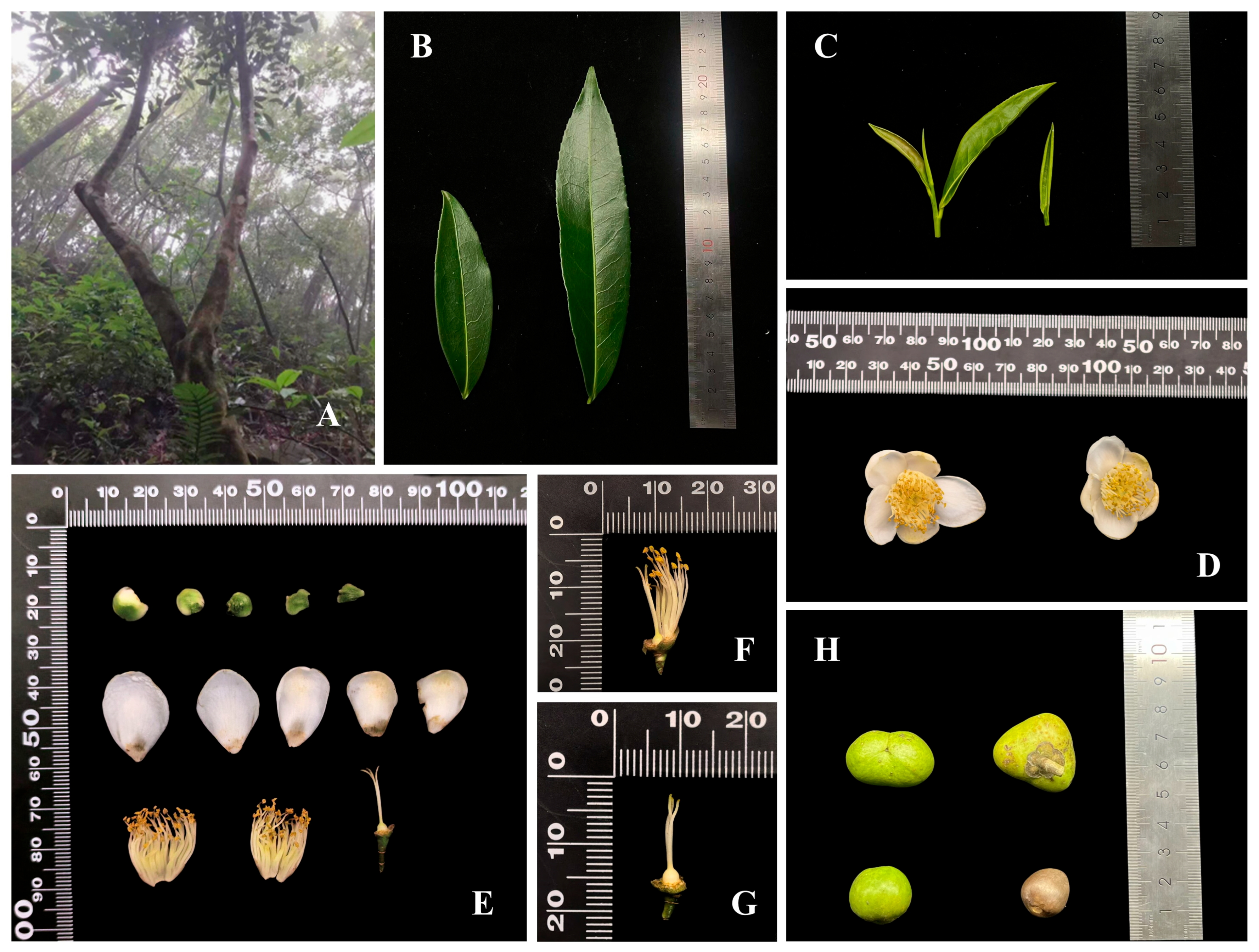
3.1. Morphological Characteristics of ZYC
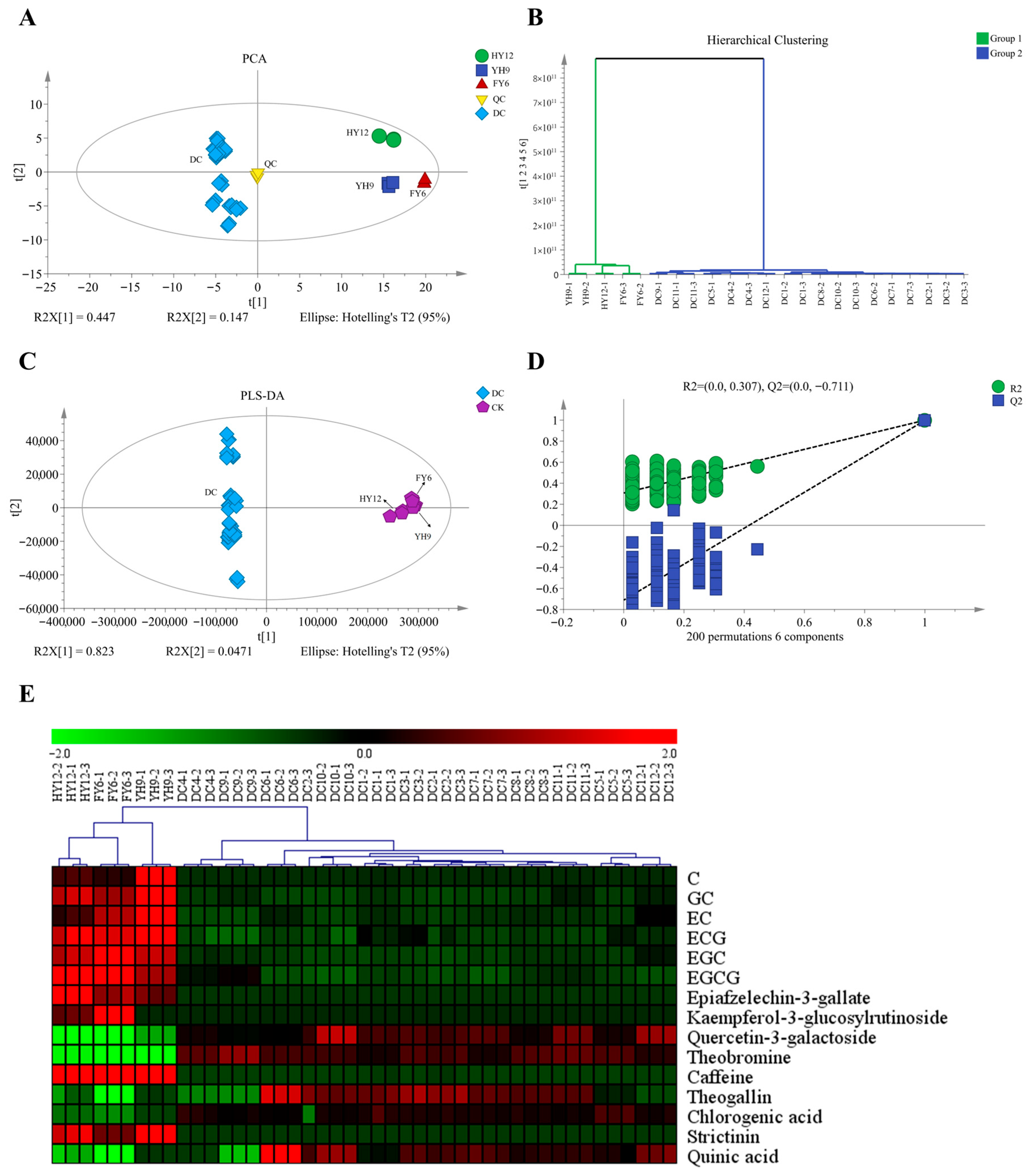
3.2. Differential Analysis of Non-Volatile Metabolites Between ZYC Individual Plants and CK Cultivars
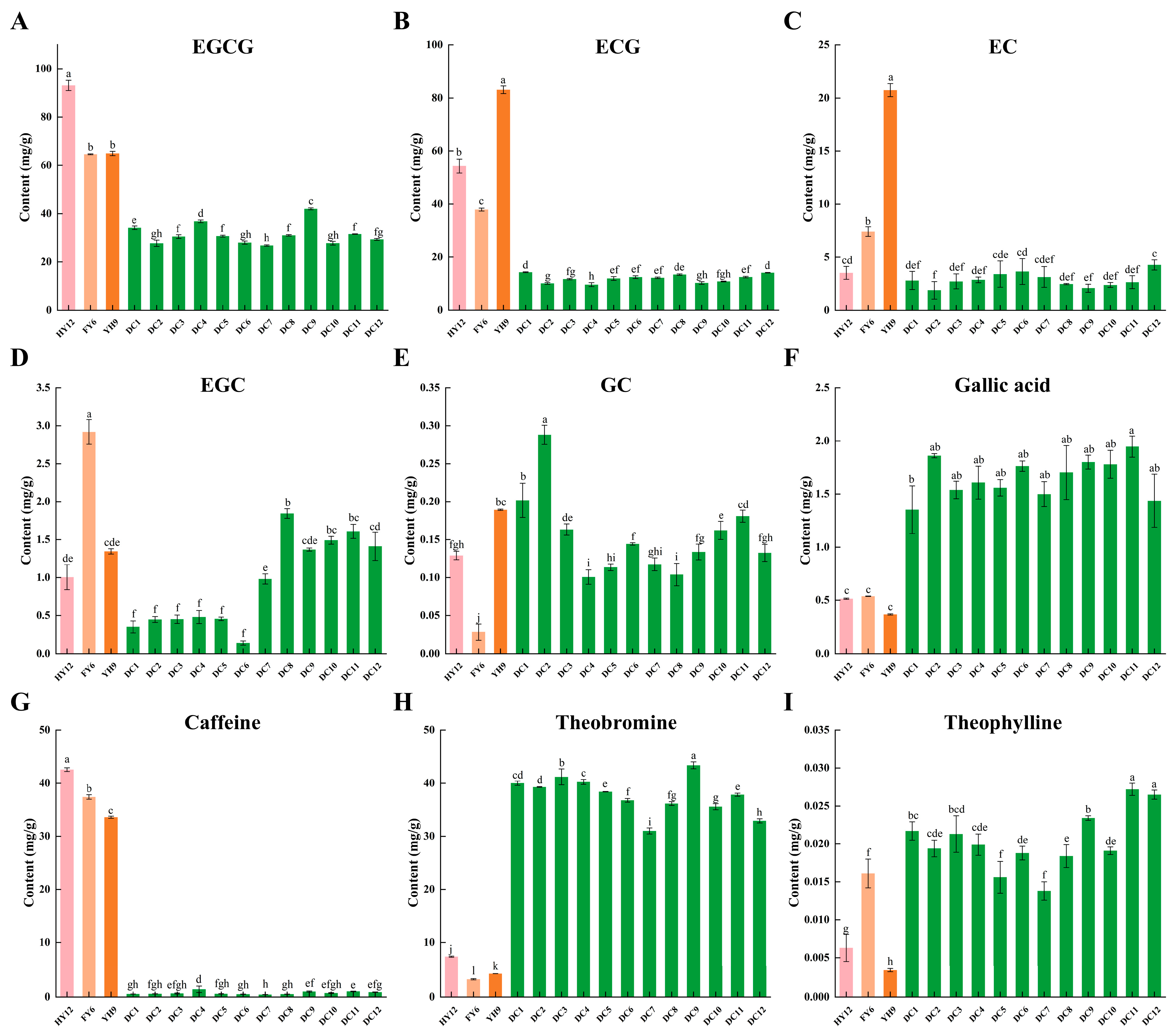
3.3. Comparison of Major Chemical Components Between ZYC Individual Plants and CK Cultivars
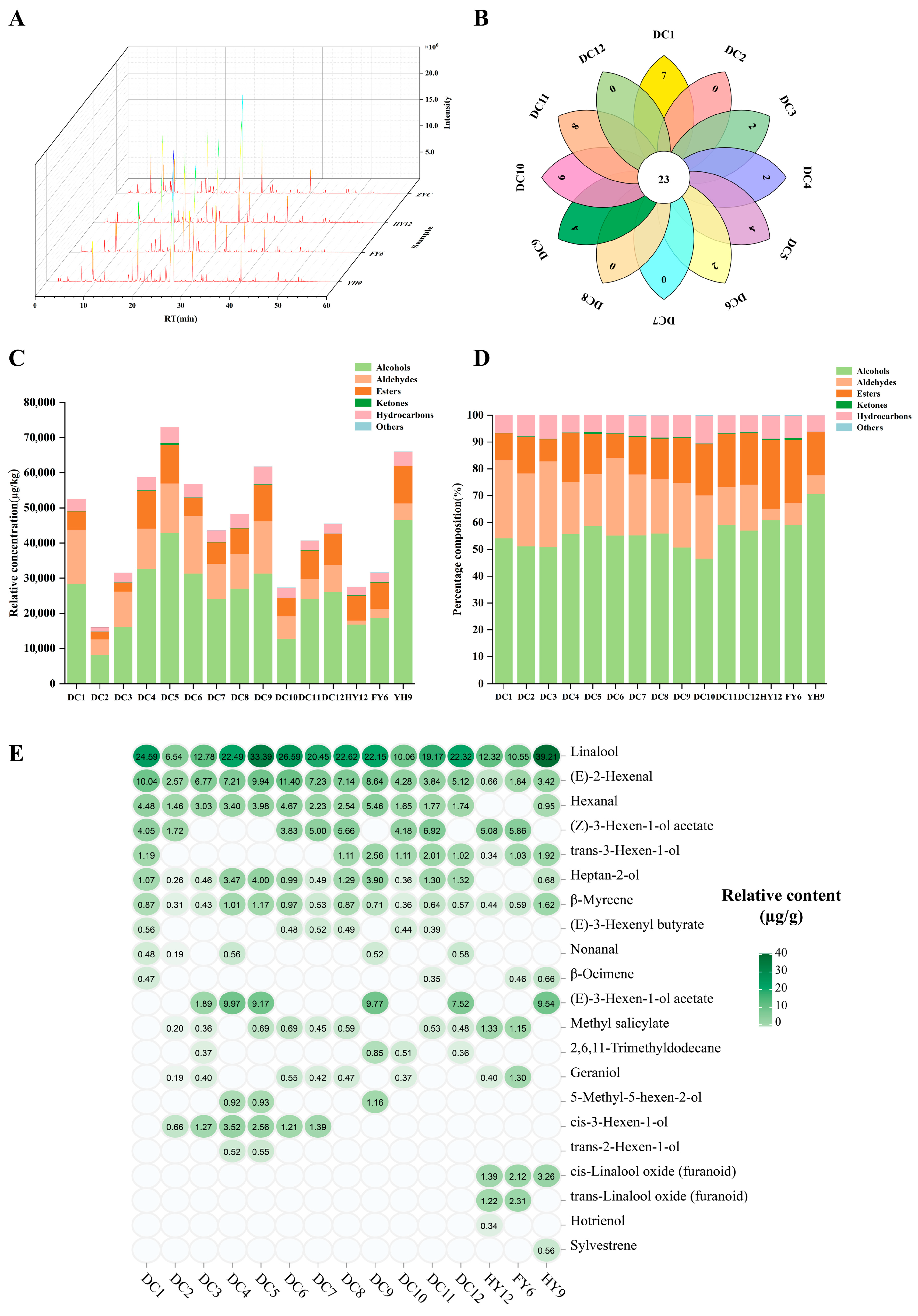
3.4. Identification of Volatile Components
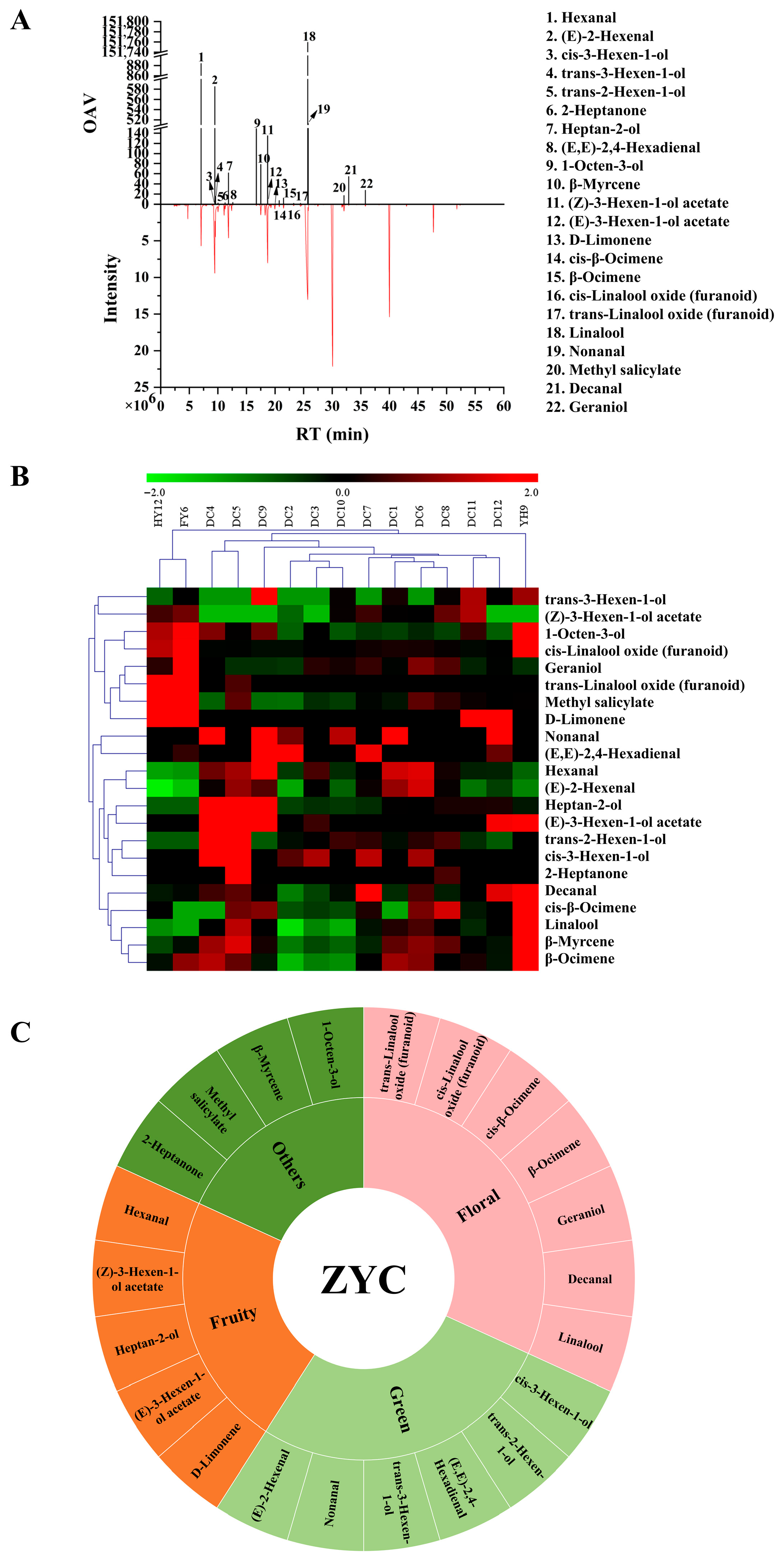
3.5. Odor Activity Values (OAVs) Analysis
3.6. Key Aroma Compounds in ZYC
4. Discussion
5. Conclusions
Supplementary Materials
Author Contributions
Funding
Data Availability Statement
Acknowledgments
Conflicts of Interest
References
- Tang, G.; Meng, X.; Gan, R.; Zhao, C.; Liu, Q.; Feng, Y.; Li, S.; Wei, X.; Atanasov, A.G.; Corke, H.; et al. Health functions and related molecular mechanisms of tea components: An update review. Int. J. Mol. Sci. 2019, 20, 6196. [Google Scholar] [CrossRef]
- Jin, J.; Ma, J.; Ma, C.; Yao, M.; Chen, L. Determination of catechin content in representative Chinese tea germplasms. J. Agric. Food Chem. 2014, 62, 9436–9441. [Google Scholar] [CrossRef]
- Yong, L.; Song, Y.; Xiao, X.; Sui, H.; Xu, H.; Tan, R.; Yang, X.; Song, J.; Li, J.; Wei, S. Quantitative probabilistic assessment of caffeine intake from tea in Chinese adult consumers based on nationwide caffeine content determination and tea consumption survey. Food Chem. Toxicol. 2022, 165, 113102. [Google Scholar] [CrossRef] [PubMed]
- Zhang, H.D. Thea: A section of beveragial tea-trees of the genus Camellia. Acta Sci. Nat. Univ. Sunyatseni 1981, 20, 87–99. [Google Scholar]
- Zhang, H.D. A Taxonomy of the Genus Camellia; The Editorial Staff of the Journal of Sun Yatsen University: Guangzhou, China, 1981; pp. 108–128. [Google Scholar]
- Zhang, H.D. A revision on the tea resource plants. Acta Sci. Nat. Univ. Sunyatseni 1984, 23, 1–12. [Google Scholar]
- Zhang, H.D. Flora Reipublicae Popularis Sinicae; Science Press: Beijing, China, 1998. [Google Scholar]
- Wei, C.; Yang, H.; Wang, S.; Zhao, J.; Liu, C.; Gao, L.; Xia, E.; Lu, Y.; Tai, Y.; She, G.; et al. Draft genome sequence of Camellia sinensis var. sinensis provides insights into the evolution of the tea genome and tea quality. Proc. Natl. Acad. Sci. USA 2018, 115, e4151–e4158. [Google Scholar] [CrossRef]
- Jin, J.; Dai, W.; Zhang, C.; Lin, Z.; Chen, L. Genetic, morphological, and chemical discrepancies between Camellia sinensis (L.) O. Kuntze and its close relatives. J. Food Compos. Anal. 2022, 108, 104417. [Google Scholar] [CrossRef]
- Tao, L.; Zhu, J.; Hu, J.; Xu, Q.; Wu, J.; Chen, C.; Li, Y.; Li, F.; Chen, H.; Huang, S.; et al. Pangenome analyses of tea plants reveal structural variations driving gene expression alterations and agronomic trait diversification. Nat. Commun. 2025, 17, 372. [Google Scholar] [CrossRef]
- Guo, R.; Xia, X.; Chen, J.; An, Y.; Mi, X.; Li, R.; Zhang, C.; Chen, M.; Wei, C.; Liu, S. Genetic relationship analysis and molecular fingerprint identification of the tea germplasms from Guangxi Province, China. Breed. Sci. 2021, 71, 584–593. [Google Scholar] [CrossRef]
- Chen, L.; Yang, Y.; Yu, F. Descriptors and Data Standard for Tea Germplasm (Camellia spp.); China Agriculture Press: Beijing, China, 2005. [Google Scholar]
- Chen, D.; Sun, Z.; Gao, J.; Peng, J.; Wang, Z.; Zhao, Y.; Lin, Z.; Dai, W. Metabolomics combined with proteomics provides a novel interpretation of the compound differences among Chinese tea cultivars (Camellia sinensis var. sinensis) with different manufacturing suitabilities. Food Chem. 2022, 377, 131976. [Google Scholar] [CrossRef]
- Dai, W.; Lou, N.; Xie, D.; Hu, Z.; Song, H.; Lu, M.; Shang, D.; Wu, W.; Peng, J.; Yin, P.; et al. N-ethyl-2-pyrrolidinone-substituted flavan-3-ols with anti-inflammatory activity in lipopolysaccharide-stimulated macrophages are storage-related marker compounds for green tea. J. Agric. Food Chem. 2020, 68, 12164–12172. [Google Scholar] [CrossRef]
- Zhao, M.; Li, T.; Yang, F.; Cui, X.Y.; Zou, T.T.; Song, H.L.; Liu, Y. Characterization of key aroma-active compounds in Hanyuan Zanthoxylum bungeanum by GC-O-MS and switchable GC × GC-O-MS. Food Chem. 2022, 385, 132659. [Google Scholar] [CrossRef]
- Schirack, A.V.; Drake, M.A.; Sanders, T.H.; Sandeep, K.P. Characterization of aroma-active compounds in microwave blanched peanuts. J. Food Sci. 2006, 71, C513–C520. [Google Scholar] [CrossRef]
- Pino, J.A.; Mesa, J. Contribution of volatile compounds to mango (Mangifera indica L.) aroma. Flavour Fragr. J. 2006, 21, 207–213. [Google Scholar] [CrossRef]
- Ottinger, H.; Bareth, A.; Hofmann, T. Characterization of natural “cooling” compounds formed from glucose and L-proline in dark malt by application of taste dilution analysis. J. Agric. Food Chem. 2001, 49, 1336–1344. [Google Scholar] [CrossRef]
- Jaeger, S.R.; McRae, J.F.; Salzman, Y.; Williams, L.; Newcomb, R.D. A preliminary investigation into a genetic basis for cis-3-hexen-1-ol odour perception: A genome-wide association approach. Food Qual. Prefer. 2010, 21, 121–131. [Google Scholar] [CrossRef]
- Guo, X.; Schwab, W.; Ho, C.-T.; Song, C.; Wan, X. Characterization of the aroma profiles of oolong tea made from three tea cultivars by both GC–MS and GC-IMS. Food Chem. 2022, 376, 131933. [Google Scholar] [CrossRef] [PubMed]
- Giri, A.; Osako, K.; Ohshima, T. Identification and characterisation of headspace volatiles of fish miso, a Japanese fish meat based fermented paste, with special emphasis on effect of fish species and meat washing. Food Chem. 2010, 120, 621–631. [Google Scholar] [CrossRef]
- Czerny, M.; Christlbauer, M.; Christlbauer, M.; Fischer, A.; Granvogl, M.; Hammer, M.; Hartl, C.; Hernandez, N.M.; Schieberle, P. Re-investigation on odour thresholds of key food aroma compounds and development of an aroma language based on odour qualities of defined aqueous odorant solutions. Eur. Food Res. Technol. 2008, 228, 265–273. [Google Scholar] [CrossRef]
- Boonbumrung, S.; Tamura, H.; Mookdasanit, J.; Nakamoto, H.; Ishihara, M.; Yoshizawa, T.; Varanyanond, W. Characteristic aroma components of the volatile oil of yellow Keaw mango fruits determined by limited odor unit method. Food Sci. Technol. Res. 2001, 7, 200–206. [Google Scholar] [CrossRef]
- Averbeck, M.; Schieberle, P. Influence of different storage conditions on changes in the key aroma compounds of orange juice reconstituted from concentrate. Eur. Food Res. Technol. 2011, 232, 129–142. [Google Scholar] [CrossRef]
- Zhang, Y.; Pan, H.; Wu, Q.; Zha, Y.; Su, J.; Li, F.; Tong, W.; Zhang, L.; Xia, E. Natural variation in promoters of F3′5′H and ANS correlates with catechins diversification in Thea species of genus Camellia. Plant J. 2025, 121, e70108. [Google Scholar] [CrossRef] [PubMed]
- Zhu, Y.; Li, W.; Zhang, Y.; Yan, H.; Guo, L.; Zhang, Y.; Lv, H.; Zhou, L.; Lin, Z.; Wu, W.; et al. Insight into volatile metabolites and key odorants in black teas processed from Jianghua Kucha tea germplasm (Camellia sinensis var. assamica cv. Jianghua). Food Chem. 2025, 464, 141794. [Google Scholar] [CrossRef]
- Jin, J.; Jiang, C.; Yao, M.; Chen, L. Baiyacha, a wild tea plant naturally occurring high contents of theacrine and 3″-methyl-epigallocatechin gallate from Fujian, China. Sci. Rep. 2020, 10, 9715. [Google Scholar] [CrossRef]
- Wang, P.; Yu, F. The geographic distribution, diversity and utilization of wild tea camellias in China. J. Tea Sci. 2002, 22, 105–108+134. [Google Scholar] [CrossRef]
- Chen, T.; Wu, H.; Luo, J.; Ge, Z.; Zuo, H.; Wang, X.; Yang, X.; Li, S.; Liao, Y.; Meng, J.; et al. Phytochemical characterization of low-caffeine and high-theobromine wild tea Camellia yungkiangensis var. yuanbaoshanica reveal its special compositions. Food Chem. 2025, 496, 146685. [Google Scholar] [CrossRef] [PubMed]
- Chen, T.; Ge, Z.; Yang, X.; Wang, X.; Zuo, H.; Liao, Y.; Chen, Z.; Zhang, Z.; Chen, M.; Zhao, J.; et al. Characterization of a new Camellia plant resource with low caffeine and high theobromine for production of a novel natural low-caffeine tea. Food Chem. X 2024, 23, 101586. [Google Scholar] [CrossRef]
- Wu, H.; Chen, Y.; Cui, Y.; Ren, Q.; Ge, Z.; Wang, X.; Yang, X.; Meng, J.; Chen, M.; Liao, Y.; et al. Metabolomics and bioactivity of low-caffeine, high-theobromine, and high-polyphenol Camellia yungkianensis (RJC) tea. LWT 2025, 227, 117954. [Google Scholar] [CrossRef]
- Teng, J.; Yan, C.; Zeng, W.; Zhang, Y.; Zeng, Z.; Huang, Y. Purification and characterization of theobromine synthase in a Theobromine-Enriched wild tea plant (Camellia gymnogyna Chang) from Dayao Mountain, China. Food Chem. 2020, 311, 125875. [Google Scholar] [CrossRef]
- Teng, J.; Zeng, Z.; Huang, Y. Composition characteristics of purine alkaloids and biochemical components of Camellia gymnogyna. Guihaia 2018, 38, 568–576. [Google Scholar] [CrossRef]
- Yao, H.; Gu, Y.; Zhu, D.; Tang, D.; Chen, W.; Chen, Y.; Zhang, J.; Tan, L. Biosynthesis and application of catechins and their derivatives in Camellia sinensis. Food Sci. Nutr. 2025, 13, e71277. [Google Scholar] [CrossRef]
- Yao, S.; Liu, Y.; Zhuang, J.; Zhao, Y.; Dai, X.; Jiang, C.; Wang, Z.; Jiang, X.; Zhang, S.; Qian, Y.; et al. Insights into acylation mechanisms: Co-expression of serine carboxypeptidase-like acyltransferases and their non-catalytic companion paralogs. Plant J. 2022, 111, 117–133. [Google Scholar] [CrossRef]
- Chen, L.; Zhou, Z.-X.; Yang, Y.-J. Genetic improvement and breeding of tea plant (Camellia sinensis) in China: From individual selection to hybridization and molecular breeding. Euphytica 2007, 154, 239–248. [Google Scholar] [CrossRef]
- Shen, Z.; Feng, Y.; Möller, M.; Burgess, K.S.; Qin, H.; Yang, J.; Mo, Z.; Li, H.; Li, D.; Gao, L. Genomic DNA barcodes provide novel insights into species delimitation in the complex Camellia sect. Thea (Theaceae). BMC Plant Biol. 2025, 25, 570. [Google Scholar] [CrossRef]
- Jiang, S.; Chen, F.; Qin, P.; Xie, H.; Peng, G.; Li, Y.; Guo, X. The specific DNA barcodes based on chloroplast genes for species identification of Theaceae plants. Physiol. Mol. Biol. Plants 2022, 28, 837–848. [Google Scholar] [CrossRef]
- Zhang, H.D.; Ye, C.X.; Zhang, R.M.; Ma, Y.D.; Zeng, P. A discovery of new tea resource—Cocoa tea tree containing theobromine from China. Acta Sci. Nat. Univ. Sunyatseni 1988, 3, 131–133. [Google Scholar]
- Zhang, S.; Jin, J.; Chen, J.; Ercisli, S.; Chen, L. Purine alkaloids in tea plants: Component, biosynthetic mechanism and genetic variation. Beverage Plant Res. 2022, 2, 3. [Google Scholar] [CrossRef]
- Teraoka, J.T.; Tang, J.J.; Noubiap, J.J.; Dewland, T.A.; Marcus, G.M. Abstract 17154: Arrhythmias associated with acute caffeine toxicity. Circulation 2023, 148, A17154. [Google Scholar] [CrossRef]
- Gao, X.; Lin, X.; Ho, C.-T.; Zhang, Y.; Li, B.; Chen, Z. Chemical composition and anti-inflammatory activity of water extract from black cocoa tea (Camellia ptilophylla). Food Res. Int. 2022, 161, 111831. [Google Scholar] [CrossRef] [PubMed]
- Gao, X.; Lin, X.; Li, X.; Zhang, Y.; Chen, Z.; Li, B. Cellular antioxidant, methylglyoxal trapping, and anti-inflammatory activities of cocoa tea (Camellia ptilophylla Chang). Food Funct. 2017, 8, 2836–2846. [Google Scholar] [CrossRef]
- Zhou, L.; Lu, S.; Gao, X.; Chen, Z.; Zhang, Y.; Zhong, W.; Zhu, F.; Li, B.; Lin, X. Antioxidant and anticancer mechanisms of unique polyphenols in Camellia ptilophylla: Focus on gallocatechin-3,5-di-O-gallate and 1,2,4,6-tetra-O-galloyl-β-D-glucopyranose. Molecules 2025, 30, 1919. [Google Scholar] [CrossRef]
- Li, K.; Liu, C.; Shiu, H.; Wong, H.; Siu, W.; Zhang, C.; Han, X.; Ye, C.; Leung, P.; Ko, C. Cocoa tea (Camellia ptilophylla) water extract inhibits adipocyte differentiation in mouse 3T3-L1 preadipocytes. Sci. Rep. 2016, 6, 20172. [Google Scholar] [CrossRef] [PubMed]
- Jin, J.; Chai, Y.; Liu, Y.; Zhang, J.; Yao, M.; Chen, L. Hongyacha, a naturally caffeine-free tea plant from Fujian, China. J. Agric. Food Chem. 2018, 66, 11311–11319. [Google Scholar] [CrossRef] [PubMed]
- Zhang, M.; Zhang, H.; Jia, L.; Zhang, Y.; Qin, R.; Xu, S.; Mei, Y. Health benefits and mechanisms of theobromine. J. Funct. Foods 2024, 115, 106126. [Google Scholar] [CrossRef]
- Jang, M.H.; Mukherjee, S.; Choi, M.J.; Kang, N.H.; Pham, H.G.; Yun, J.W. Theobromine alleviates diet-induced obesity in mice via phosphodiesterase-4 inhibition. Eur. J. Nutr. 2020, 59, 3503–3516. [Google Scholar] [CrossRef]
- Camps-Bossacoma, M.; Garcia-Aloy, M.; Saldaña-Ruiz, S.; Cambras, T.; González-Domínguez, R.; Franch, À.; Pérez-Cano, F.J.; Andres-Lacueva, C.; Castell, M. Role of theobromine in cocoa’s metabolic properties in healthy rats. J. Agric. Food Chem. 2019, 67, 3605–3614. [Google Scholar] [CrossRef]
- Bhat, J.A.; Gupta, S.; Kumar, M. Neuroprotective effects of theobromine in transient global cerebral ischemia-reperfusion rat model. Biochem. Biophys. Res. Commun. 2021, 571, 74–80. [Google Scholar] [CrossRef]
- Fuggetta, M.P.; Zonfrillo, M.; Villivà, C.; Bonmassar, E.; Ravagnan, G. Inflammatory microenvironment and adipogenic differentiation in obesity: The inhibitory effect of theobromine in a model of human obesity in vitro. Mediat. Inflamm. 2019, 2019, 1515621. [Google Scholar] [CrossRef]
- Islam, R.; Matsuzaki, K.; Sumiyoshi, E.; Hossain, M.E.; Hashimoto, M.; Katakura, M.; Sugimoto, N.; Shido, O. Theobromine improves working memory by activating the CaMKII/CREB/BDNF pathway in rats. Nutrients 2019, 11, 888. [Google Scholar] [CrossRef]
- Bhat, J.A.; Kumar, M. Neuroprotective effects of theobromine in permanent bilateral common carotid artery occlusion rat model of cerebral hypoperfusion. Metab. Brain Dis. 2022, 37, 1787–1801. [Google Scholar] [CrossRef]
- Baggott, M.J.; Childs, E.; Hart, A.B.; de Bruin, E.; Palmer, A.A.; Wilkinson, J.E.; de Wit, H. Psychopharmacology of theobromine in healthy volunteers. Psychopharmacology 2013, 228, 109–118. [Google Scholar] [CrossRef]
- Jiang, Y.; Pei, J.; Zheng, Y.; Miao, Y.; Duan, B.; Huang, L. Gallic acid: A potential anti-cancer agent. Chin. J. Integr. Med. 2021, 28, 661–671. [Google Scholar] [CrossRef]
- Kardaş, S.; Çınaroğlu, O.S.; Bora, E.S.; Erbaş, O. Gallic acid protects from sepsis-induced acute lung injury. Curr. Issues Mol. Biol. 2023, 46, 1–10. [Google Scholar] [CrossRef] [PubMed]
- Choińska, R.; Dąbrowska, K.; Świsłocka, R.; Lewandowski, W.; Świergiel, A.H. Antimicrobial properties of mandelic acid, gallic acid and their derivatives. Mini-Rev. Med. Chem. 2021, 21, 2544–2550. [Google Scholar] [CrossRef]
- Bhuia, M.S.; Rahaman, M.M.; Islam, T.; Bappi, M.H.; Sikder, M.I.; Hossain, K.N.; Akter, F.; Al Shamsh Prottay, A.; Rokonuzzman, M.; Gürer, E.S.; et al. Neurobiological effects of gallic acid: Current perspectives. Chin. Med. 2023, 18, 27. [Google Scholar] [CrossRef] [PubMed]
- Zalewska, K.; Kulawik, M.; Gierszewska, J.; Gramala, Z.; Kalus, O.; Karpiński, M.; Maćkowiak, J.; Staniewski, A.; Szymańska, Z.; Zalewska, B.; et al. Chlorogenic acid’s role in metabolic health: Mechanisms and therapeutic potential. Nutrients 2025, 17, 3303. [Google Scholar] [CrossRef]
- Miao, M.; Xiang, L. Pharmacological action and potential targets of chlorogenic acid. Adv. Pharmacol. 2020, 87, 71–88. [Google Scholar] [CrossRef]
- Li, L.; Lei, X.; Chen, L.; Ma, Y.; Luo, J.; Liu, X.; Xu, X.; Zhou, G.; Feng, X. Protective mechanism of quercetin compounds against acrylamide-induced hepatotoxicity. Food Sci. Hum. Wellness 2024, 13, 225–240. [Google Scholar] [CrossRef]
- Zhou, F.; Ke, J.P.; Jiang, Z.D.; Wen, M.C.; Zhang, L. Research progress on tea taste composition. Chin. Tea Process. 2023, 4, 15–21. [Google Scholar] [CrossRef]
- Chen, L.; Ma, J.; Niu, L.; Feng, Y.; Fang, Z.; Zhang, S.; Shan, X.; Zhang, Q.; Zhou, Q.; Jiang, Y.; et al. Lipid profiles and metabolic characteristics of Chinese tea cultivars (Camellia sinensis) with different manufacturing suitabilities by comparative lipidomics using UHPLC-Q-Exactive mass spectrometry. Food Chem. 2025, 488, 144882. [Google Scholar] [CrossRef] [PubMed]
- Peng, L.; Wang, X.; Shi, X.; Li, C.; Ye, C.; Song, X. Characterization of the constituents and antioxidative activity of cocoa tea (Camellia ptilophylla). Food Chem. 2011, 129, 1475–1482. [Google Scholar] [CrossRef]
- Zhai, X.; Zhang, L.; Granvogl, M.; Ho, C.T.; Wan, X. Flavor of tea (Camellia sinensis): A review on odorants and analytical techniques. Compr. Rev. Food Sci. Food Saf. 2022, 21, 3867–3909. [Google Scholar] [CrossRef] [PubMed]
- Kang, S.; Yan, H.; Zhu, Y.; Liu, X.; Lv, H.; Zhang, Y.; Dai, W.; Guo, L.; Tan, J.; Peng, Q.; et al. Identification and quantification of key odorants in the world’s four most famous black teas. Food Res. Int. 2019, 121, 73–83. [Google Scholar] [CrossRef]
- Wang, H.; Bi, H.; Wang, J.; Li, M.; Yao, X.; Zhang, X.; Rigling, M.; Wang, N.; Wan, X.; Zhang, Y.; et al. Key odorants of ‘Keemun Aroma’ and their changes during the preliminary processing of Keemun BLack Tea (Camellia sinensis). J. Food Compos. Anal. 2024, 132, 106254. [Google Scholar] [CrossRef]
- Wang, L.; Xie, J.; Miao, Y.; Wang, Q.; Hu, J.; Jiang, Y.; Wang, J.; Tong, H.; Yuan, H.; Yang, Y. Exploration of the effects of geographical regions on the volatile and non-volatile metabolites of black tea utilizing multiple intelligent sensory technologies and untargeted metabolomics analysis. Food Chem. X 2024, 23, 101634. [Google Scholar] [CrossRef] [PubMed]
- Wei, F.; Luo, L.; Sun, F.; Zhang, B.; Yang, J.; Liu, Y.; Zeng, L. Flavor characteristic and characterization of key sweet aroma compounds in Camellia nanchuanica black tea. Food Res. Int. 2025, 209, 116179. [Google Scholar] [CrossRef]
- Liang, Y.; Wang, Z.; Zhang, L.; Dai, H.; Wu, W.; Zheng, Z.; Lin, F.; Xu, J.; Huang, Y.; Sun, W. Characterization of volatile compounds and identification of key aroma compounds in different aroma types of Rougui Wuyi rock tea. Food Chem. 2024, 455, 139931. [Google Scholar] [CrossRef] [PubMed]
- Liu, C.; Li, J.; Wang, M.; Jian, G.; Zhu, C.; Li, H.; Jia, Y.; Tang, J.; Zeng, L. (R)-Linalool is a key indicator of aroma quality levels of a distinctive black tea (Camellia sinensis var. Yinghong No. 9). Ind. Crops Prod. 2025, 225, 120506. [Google Scholar] [CrossRef]



| NO | Compounds | Category | RI 1 | Odor Description 2 | Threshold (μg/L) | OAV | ||||||||||||||
|---|---|---|---|---|---|---|---|---|---|---|---|---|---|---|---|---|---|---|---|---|
| DC1 | DC2 | DC3 | DC4 | DC5 | DC6 | DC7 | DC8 | DC9 | DC10 | DC 11 | DC 12 | HY 12 | FY6 | YH9 | ||||||
| 1 | 3-Methylbutanal | Aldehydes | 656 | Chocolate, Peach, Fatty | 1.1 | ND | ND | 14.30 | ND | ND | 26.31 | ND | ND | ND | ND | ND | ND | ND | ND | ND |
| 2 | Hexanal | Aldehydes | 793 | Apple, Fat, Fresh, Green, Oil | 4.5 | 995.65 | 325.20 | 674.20 | 756.48 | 883.94 | 1037.54 | 495.22 | 563.48 | 1213.38 | 366.51 | 394.37 | 386.78 | 42.61 | 76.14 | 211.89 |
| 3 | (E)-2-Hexenal | Aldehydes | 844 | Green, Banana, Fatty, Cheesy | 17 | 590.73 | 151.29 | 398.18 | 423.98 | 584.86 | 670.44 | 425.38 | 419.72 | 508.50 | 251.65 | 225.65 | 301.00 | 38.94 | 108.15 | 201.00 |
| 4 | cis-3-Hexen-1-ol | Alcohols | 848 | Grass, Green Fruit, Green Leaf, Herb, Unripe Banana | 1900 | ND | 0.35 | 0.67 | 1.85 | 1.35 | 0.64 | 0.73 | ND | ND | ND | ND | ND | ND | ND | ND |
| 5 | trans-3-Hexen-1-ol | Alcohols | 849 | Grass, Green Fruit, Green Leaf, Herb, Unripe Banana | 70 | 16.97 | ND | ND | ND | ND | ND | ND | 15.92 | 36.59 | 15.80 | 28.74 | 14.51 | 4.83 | 14.69 | 27.46 |
| 6 | trans-2-Hexen-1-ol | Alcohols | 857 | Fresh, Green Leaf, Fruity, Unripe Banana | 231.9 | 0.42 | 0.41 | 0.60 | 2.24 | 2.39 | 0.76 | 0.78 | 0.93 | ND | 0.86 | 0.26 | ND | ND | ND | 0.53 |
| 7 | 2-Heptanone | Ketones | 883 | Blue Cheese, Fruit, Green, Nut, Spice | 140 | ND | ND | ND | ND | 3.00 | ND | ND | 0.40 | ND | ND | ND | ND | ND | ND | ND |
| 8 | Heptan-2-ol | Alcohols | 894 | Citrus, Earth, Fried, Mushroom, Oil | 65.235 | 16.44 | 4.04 | 7.11 | 53.13 | 61.34 | 15.18 | 7.44 | 19.72 | 59.79 | 5.53 | 19.91 | 20.16 | ND | ND | 10.49 |
| 9 | Heptanal | Aldehydes | 897 | Citrus, Fat, Green, Nut | 2.8 | ND | ND | ND | ND | ND | ND | ND | ND | ND | ND | ND | ND | 13.12 | 22.50 | ND |
| 10 | (E,E)-2,4-Hexadienal | Aldehydes | 904 | Green, Sweet, Fruity, Waxy, Fatty | 10 | ND | 5.92 | ND | ND | ND | ND | 2.92 | ND | 3.61 | ND | ND | 1.27 | ND | 0.67 | ND |
| 11 | (E)-2-Heptenal | Aldehydes | 968 | Almond, Fat, Fruit | 1.1 | ND | ND | ND | ND | ND | ND | ND | ND | ND | ND | ND | ND | ND | 7.19 | ND |
| 12 | 1-Octen-3-ol | Alcohols | 972 | Cucumber, Earth, Fat, Floral, Mushroom | 1 | 63.62 | 28.30 | 137.71 | 262.94 | 148.88 | 90.42 | 74.92 | 61.59 | 246.69 | 38.66 | 194.71 | 30.42 | 306.95 | 384.11 | 510.21 |
| 13 | 6-Methyl-5-hepten-2-one | Ketones | 980 | Citrus, Mushroom, Pepper, Rubber, Strawberry | 68 | 1.05 | 0.34 | 0.54 | 1.19 | 1.21 | 1.09 | 0.66 | 0.82 | 1.12 | 0.44 | 1.15 | 1.55 | 0.53 | 0.88 | 0.72 |
| 14 | β-Myrcene | Hydrocarbons | 984 | Balsamic, Fruit, Geranium, Herb, Must | 15 | 58.23 | 20.34 | 29.00 | 67.52 | 78.02 | 64.66 | 35.22 | 58.14 | 47.48 | 24.15 | 42.71 | 38.33 | 29.25 | 39.21 | 107.97 |
| 15 | (Z)-3-Hexen-1-ol acetate | Esters | 1002 | Banana, Candy, Floral, Green | 31 | 130.78 | 55.52 | ND | ND | ND | 123.56 | 161.14 | 182.56 | ND | 134.82 | 223.26 | ND | 163.80 | 188.89 | ND |
| 16 | (E)-3-Hexen-1-ol acetate | Esters | 1005 | Fruit | 870 | ND | ND | 2.17 | 11.46 | 10.54 | ND | ND | ND | 11.23 | ND | ND | 8.65 | ND | ND | 10.97 |
| 17 | p-Cymene | Hydrocarbons | 1015 | Citrus, Fresh, Solvent | 5.01 | 15.95 | 3.86 | 6.30 | 9.47 | 11.14 | 12.53 | ND | 8.27 | ND | 3.63 | 6.09 | ND | 5.34 | ND | 11.83 |
| 18 | o-Cymene | Hydrocarbons | 1017 | Aromatic | 11.4 | ND | ND | ND | ND | ND | ND | 4.21 | ND | ND | ND | ND | 2.25 | ND | ND | ND |
| 19 | D-Limonene | Hydrocarbons | 1021 | Citrus, Mint, Lemon, Orange-like, Green | 200 | ND | ND | ND | ND | ND | ND | ND | ND | ND | ND | 1.13 | 1.02 | 1.16 | 0.89 | ND |
| 20 | 2,2,6-Trimethylcyclohexanone | Ketones | 1026 | Floral | 0.1 | 145.35 | ND | ND | 186.97 | 128.17 | 163.58 | 161.13 | 88.15 | 216.89 | 129.44 | 186.21 | 101.21 | ND | ND | ND |
| 21 | cis-β-Ocimene | Hydrocarbons | 1029 | Floral | 34 | ND | 2.34 | 2.91 | ND | 7.26 | 7.45 | 5.45 | 9.69 | 7.75 | 2.51 | 3.81 | 4.59 | 4.58 | ND | 11.37 |
| 22 | β-Ocimene | Hydrocarbons | 1030 | Floral | 34 | 13.92 | 2.92 | 4.89 | 14.59 | 12.27 | 13.18 | 9.21 | 9.24 | 8.30 | 4.35 | 10.22 | 8.37 | 8.49 | 13.44 | 19.45 |
| 23 | γ-Terpinene | Hydrocarbons | 1050 | Bitter, Citrus | 55 | ND | ND | ND | ND | ND | ND | ND | ND | ND | ND | ND | ND | ND | ND | 1.76 |
| 24 | cis-Linalool oxide (furanoid) | Alcohols | 1064 | Floral | 100 | 4.50 | 1.15 | 2.47 | 1.62 | 1.74 | 4.40 | 3.99 | 3.47 | 1.11 | 2.22 | 1.27 | 2.09 | 13.91 | 21.15 | 32.59 |
| 25 | trans-Linalool oxide (furanoid) | Alcohols | 1082 | Floral | 190 | ND | ND | ND | ND | 1.85 | ND | ND | ND | ND | ND | ND | ND | 6.44 | 12.13 | ND |
| 26 | Linalool | Alcohols | 1099 | Floral, Lavender, Lemon, Rose | 0.22 | 111,784.98 | 29,741.11 | 58,102.16 | 102,224.44 | 151,759.17 | 120,854.00 | 92,967.18 | 102,838.62 | 100,670.89 | 45,714.19 | 87,141.12 | 101,449.29 | 55,988.81 | 47,934.13 | 178,206.55 |
| 27 | Nonanal | Aldehydes | 1099 | Green, Grassy, Cucumber, Melon | 1.1 | 435.52 | 176.02 | ND | 512.40 | ND | ND | ND | ND | 474.16 | 271.56 | ND | 523.32 | ND | ND | ND |
| 28 | Hotrienol | Alcohols | 1101 | Floral, Fresh, Fruity | 110 | ND | ND | ND | ND | ND | ND | ND | ND | ND | ND | ND | ND | 3.07 | ND | ND |
| 29 | trans-2-Nonenal | Aldehydes | 1169 | Paper | 0.19 | ND | ND | ND | ND | ND | ND | 77.59 | ND | ND | ND | ND | 109.16 | ND | ND | ND |
| 30 | Naphthalene | Hydrocarbons | 1174 | Pungent, Dry, Tarry | 6 | ND | 0.54 | 1.13 | ND | ND | 1.64 | 1.21 | 0.91 | ND | 0.84 | 2.83 | 0.78 | ND | ND | ND |
| 31 | Methyl salicylate | Esters | 1186 | Almond, Caramel, Peppermint, Sharp | 40 | 10.37 | 5.05 | 8.96 | 5.84 | 17.21 | 17.19 | 11.23 | 14.80 | 5.16 | 8.03 | 13.21 | 12.03 | 33.13 | 28.77 | 12.65 |
| 32 | Decanal | Aldehydes | 1198 | Floral, Fried, Orange Peel, Penetrating, Tallow | 3 | 27.02 | 10.32 | 22.13 | 49.73 | 54.34 | 51.24 | 108.06 | 29.71 | 39.37 | 32.80 | 37.10 | 78.96 | 30.91 | 33.70 | 94.83 |
| 33 | β-Cyclocitral | Aldehydes | 1212 | Herbal, Rose, Sweet, Fruity | 3 | 7.02 | 3.89 | 4.40 | 11.73 | 9.84 | 10.21 | 10.78 | 7.84 | 7.91 | 9.42 | 7.57 | 7.38 | ND | 8.84 | ND |
| 34 | Geraniol | Alcohols | 1249 | Floral, Sweet, Rose, Fresh, Fruity | 7.5 | 38.64 | 25.93 | 53.26 | 41.91 | 27.43 | 73.18 | 56.22 | 62.68 | 27.46 | 49.48 | 30.62 | 39.20 | 53.63 | 173.39 | 27.62 |
| 35 | Tridecane | Hydrocarbons | 1294 | Alkane | 42 | 0.82 | 0.42 | 1.43 | 1.42 | 1.78 | 0.92 | 1.53 | 1.83 | 3.40 | 1.66 | 1.10 | 1.43 | 0.91 | 0.96 | ND |
| 36 | Undecanal | Aldehydes | 1300 | Waxy, Floral, Citrus, Green, Fatty, Fresh | 12.5 | ND | ND | ND | 0.73 | 0.89 | 0.74 | 1.52 | ND | ND | 0.61 | 0.88 | 1.67 | 0.60 | 0.37 | 1.57 |
| 37 | Dodecanal | Aldehydes | 1403 | Citrus, Fat, Lily | 0.29 | ND | ND | ND | ND | ND | ND | ND | ND | ND | 16.19 | 12.68 | 38.13 | ND | ND | ND |
| 38 | trans-β-Ionone | Ketones | 1478 | Floral, Violet | 0.007 | ND | 538.19 | 1547.45 | 2250.74 | ND | 1312.62 | 1290.62 | 1208.81 | ND | 1760.39 | 816.77 | 1337.88 | ND | ND | 1047.64 |
| 39 | 2,2,4-Trimethyl-1,3-pentanediol diisobutyrate | Esters | 1591 | - | 14 | 1.14 | 0.64 | ND | 1.53 | 1.13 | 1.00 | ND | 2.34 | ND | ND | 0.91 | 0.90 | 1.97 | 1.72 | 1.19 |
Disclaimer/Publisher’s Note: The statements, opinions and data contained in all publications are solely those of the individual author(s) and contributor(s) and not of MDPI and/or the editor(s). MDPI and/or the editor(s) disclaim responsibility for any injury to people or property resulting from any ideas, methods, instructions or products referred to in the content. |
© 2026 by the authors. Licensee MDPI, Basel, Switzerland. This article is an open access article distributed under the terms and conditions of the Creative Commons Attribution (CC BY) license.
Share and Cite
Ma, Q.; Yan, Z.; Yang, X.; Hou, A.; Liu, Z.; Gan, S.; Yang, Y.; Chen, Y.; Qiu, R.; Wu, W. Morphological and Chemical Characterization of a Novel Wild Tea Plant Resource with Naturally Low Caffeine and High Theobromine from Guangxi Province, China. Plants 2026, 15, 1642. https://doi.org/10.3390/plants15111642
Ma Q, Yan Z, Yang X, Hou A, Liu Z, Gan S, Yang Y, Chen Y, Qiu R, Wu W. Morphological and Chemical Characterization of a Novel Wild Tea Plant Resource with Naturally Low Caffeine and High Theobromine from Guangxi Province, China. Plants. 2026; 15(11):1642. https://doi.org/10.3390/plants15111642
Chicago/Turabian StyleMa, Qianting, Zhongjun Yan, Xiaolu Yang, Aixiang Hou, Zhen Liu, Shuang Gan, Yihuan Yang, Yaojin Chen, Ruijin Qiu, and Wenliang Wu. 2026. "Morphological and Chemical Characterization of a Novel Wild Tea Plant Resource with Naturally Low Caffeine and High Theobromine from Guangxi Province, China" Plants 15, no. 11: 1642. https://doi.org/10.3390/plants15111642
APA StyleMa, Q., Yan, Z., Yang, X., Hou, A., Liu, Z., Gan, S., Yang, Y., Chen, Y., Qiu, R., & Wu, W. (2026). Morphological and Chemical Characterization of a Novel Wild Tea Plant Resource with Naturally Low Caffeine and High Theobromine from Guangxi Province, China. Plants, 15(11), 1642. https://doi.org/10.3390/plants15111642