1. Introduction
Fresh fruits suffer postharvest losses of up to 50%, mainly due to moisture loss, decay, mechanical damage, aging, issues exacerbated by inadequate cold chain infrastructure in many regions [
1]. The global fruit industry is under increasing pressure to balance quality preservation, consumer safety, and environmental sustainability across postharvest supply chains. Fresh fruits, being physiologically active and highly perishable, are highly vulnerable during handling, storage, and transportation.
Packaging plays a key and dynamic role in postharvest handling of fruit and other horticultural produce [
2,
3,
4,
5,
6]. Its function include protecting fruit from mechanical damage during handling and bulk transport [
2,
7,
8,
9,
10,
11,
12], reducing moisture loss [
13,
14,
15], preventing contamination and helping to modify the gas composition around the produce [
16]. Packaging also improves the marketability of fruit at the retail level. A variety of materials and designs are used, depending on the fruit type, storage needs, distribution logistics, and marketing conditions [
17].
Traditionally, petroleum-based plastic packaging has been the dominant choice due to its excellent barrier properties, low cost, and scalability [
18]. However, growing environmental concerns over plastic waste, along with regulatory changes and consumer demand for eco-conscious options, have spurred interest in eco-friendly alternatives [
18,
19]. Among these, edible coatings, which are thin, consumable films applied directly onto fruit surface, have emerged as a promising class of bio-based solution [
20]. Composed of natural polymers such as polysaccharides, proteins, and lipids, these coatings can serve as semi-permeable barriers to moisture, gases, and solutes, thereby modulating respiration rates, reducing water loss, and extending shelf life [
1]. Edible coatings can function not only as physical barriers but also as delivery systems for functional agents such as antimicrobials, antioxidants, and ripening inhibitors, thereby enhancing their protective efficacy [
20,
21,
22]. When enriched with bioactive compounds such as plant-derived essential oils, these systems exhibit enhanced preservation [
23,
24].
Despite this potential, the application of edible coatings in the fresh fruit industry faces multiple critical challenges. Firstly, material compatibility is a major concern; the effectiveness of a coating depends on its interaction with the fruit’s surface morphology, wax layer, and respiration physiology, and these properties vary widely between species and even cultivars [
25]. Secondly, coating functionality is limited by trade-offs among water barrier properties, gas permeability, and mechanical strength.
Another persistent issue affecting widespread use of edible coating is application scalability. While many edible coatings demonstrate efficacy under laboratory conditions, transitioning these systems to industrial-scale operations remains difficult due to challenges in uniform application, drying, and adhesion under variable humidity and temperature [
26]. Moreover, regulatory ambiguity and lack of standardized approval procedures for edible coating formulations, particularly for coatings that include bioactive compounds, further hinder commercial adoption in global markets [
27,
28]. Additionally, low consumer acceptance poses a barrier, especially where coatings alter surface appearance, mechanical and surface properties, or perceived naturalness.
Furthermore, there is increasing evidence supporting the importance of developing holistic postharvest strategies. These strategies should integrate edible coatings with complementary cold chain postharvest technologies to fully enhance their potential. For instance, Valdés et al. [
29] highlighted the synergy between edible coatings and controlled atmosphere (CA) storage, showing their combined effect in reducing respiration rate and microbial spoilage in strawberries. In this regard, the compatibility of coatings with packaging formats that maintain humidity, gas balance, and physical protection is vital to avoid coating degradation, cracking, or inefficacy. The integration of such coatings into a smart packaging context, which may involve simplified indicators or passive sensors for ripening and freshness, can bridge functionality with sustainability, supporting both quality maintenance and reduced plastic reliance [
30].
Although the literature covers a wide range of biopolymer-based coating materials and application techniques, research remains fragmented. Most studies focus on short-term physicochemical changes, overlooking long-term interactions between coating composition, fruit metabolism, and storage environment. Furthermore, comparative evaluations across fruit types, coating systems, and storage scenarios are limited, and comprehensive lifecycle or techno-economic assessments are rare. Given the breadth of the edible coatings literature and the diversity of fruit systems, this review does not attempt to exhaustively catalog all coating materials or application outcomes reported to date. Instead, it adopts a selective and analytical approach, focusing on representative studies that illustrate key functional mechanisms, optimization trade-offs, and implementation challenges relevant to fresh fruit preservation. Depth is therefore emphasized in areas where coating performance intersects most strongly with fruit physiology, storage environment, and supply-chain integration, while peripheral or highly specialized topics are referenced more concisely. This scoped approach is intended to provide clarity, coherence, and critical insight, rather than a purely descriptive compilation of studies.
This article is presented as a narrative review, synthesizing recent and authoritative primary studies to provide an integrative overview of edible coatings for fresh fruit preservation, rather than as a systematic literature review.
2. Edible Coating Materials
Table 1 summarizes the edible coating materials consistently supported by current postharvest literature, focusing on their moisture resistance, gas permeability, and demonstrated performance on specific fruits. In the context of fresh-fruit preservation, edible coating materials can be broadly categorized into four major classes: polysaccharide-based, protein-based, lipid-based, and composite or nanostructured systems [
1,
23,
24,
25]. Polysaccharides—including pectin, alginate, and chitosan—represent the most extensively studied and widely applied class for whole fruits due to their inherent gas permeability, biocompatibility, and compatibility with fruit respiration. However, their hydrophilic nature limits moisture barrier performance when used as standalone coatings, particularly under high-humidity storage conditions. Protein- and lipid-based materials have also been explored as edible coatings, but their application in fresh fruits is more constrained. Protein-based coatings offer good film-forming ability and mechanical strength but are highly sensitive to moisture plasticization, while lipid-based coatings provide excellent moisture resistance at the expense of restricted gas exchange, which can induce anaerobic metabolism if not carefully controlled. These material-specific limitations have driven the development of composite and nanostructured systems that combine complementary functionalities.
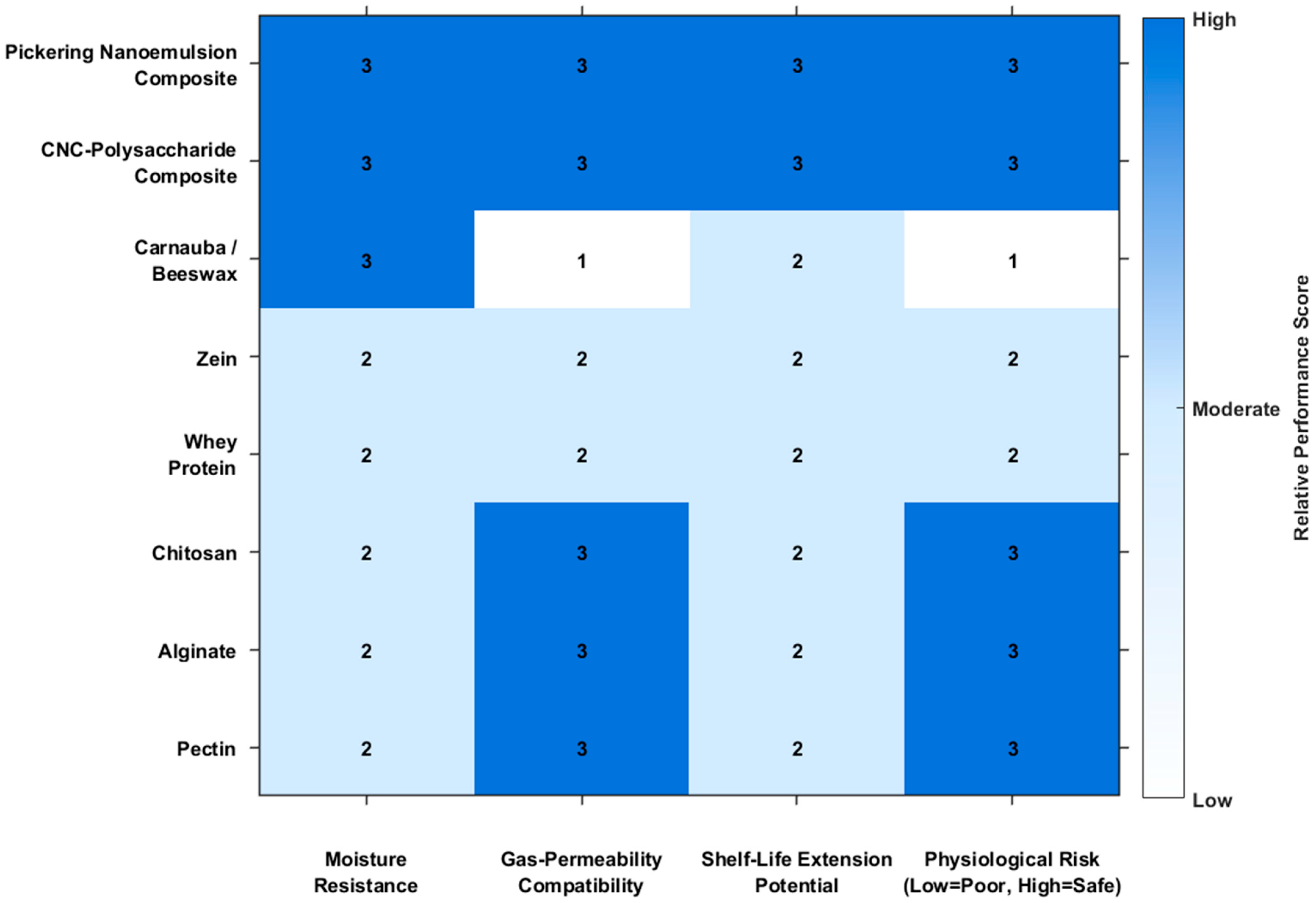
A semi-quantitative heatmap (
Figure 1) was developed to enable structured comparison of representative edible-coating systems across four functional dimensions: moisture resistance, gas-permeability compatibility, shelf-life extension potential, and physiological risk (horizontal axis). Each coating material or composite system (vertical axis) was assigned an ordinal score (1 = low, 2 = moderate, 3 = high) based on consistent experimental trends reported for water-vapor barrier performance, respiratory gas transport, storage-life outcomes, and physiological safety under typical postharvest conditions.
Single-component polysaccharide and protein coatings generally exhibit moderate moisture resistance and favorable gas-exchange compatibility, supporting low physiological risk but achieving only limited shelf-life extension unless formulation is optimized. In contrast, lipid-based coatings (e.g., carnauba/beeswax) score highly in moisture resistance but rank lower in gas-permeability compatibility and physiological safety, reflecting the documented tendency of dense wax layers to restrict O
2 diffusion, elevate internal CO
2 levels, and induce anaerobic metabolism and off-flavor development when coating thickness or loading is excessive [
31]. Composite and nanostructured systems demonstrate more balanced performance across all four dimensions; for example, CNC-reinforced polysaccharide coating enhances moisture resistance and shelf-life extension while maintaining adequate gas permeability and physiological safety, consistent with the tortuous-diffusion effects reported by Pirozzi et al. [
32]. Similarly, Pickering-nanoemulsion-based pectin coatings improve mechanical robustness and moisture-barrier efficiency without compromising respiratory compatibility or physiological stability [
33]. This unified assessment framework highlights the inherent trade-offs associated with single-component systems and the balanced performance achieved by composite and nanostructured coatings. Together, these representations emphasize that coating effectiveness cannot be assessed on the basis of barrier properties alone but must be evaluated in relation to fruit-specific physiological requirements, including respiration rate, transpiration demand, and storage environment. Pirozzi et al. [
32] reported that incorporating nanocellulose into edible-coating matrices enhances barrier properties and structural integrity, leading to improved firmness and reduced dehydration during storage. However, specific water-vapor transmission rate (WVTR) measurements were not provided. Similarly, de Oliveira Filho et al. [
33] found that embedding Pickering nanoemulsions into pectin-based matrices increased mechanical strength and improved moisture barrier performance. González-Cuello et al. [
34] developed a multi-component coating system combining bacterial cellulose, chitosan, and gellan gum, achieving up to 15 days of strawberry (
Fragaria ×
ananassa) shelf-life extension while preserving antioxidant content and reducing enzymatic deterioration. In contrast, traditional polysaccharide coatings—such as pectin, alginate, and chitosan—offer only moderate moisture resistance due to their hydrophilic nature. These materials maintain appropriate gas permeability but struggle to limit water loss effectively. As noted by Liyanapathiranage et al. [
35] and Miteluț et al. [
36], pectin coatings can reduce weight loss in strawberries but still allow significant moisture permeation compared to nanostructured or composite formulations. Wigati et al. [
37] report that cellulose nanocrystals (CNC) incorporation enhances barrier density without compromising oxygen and carbon-dioxide diffusion. These improved moisture barriers translate into better firmness retention and reduced dehydration, especially in high-respiration fruits such as strawberries, raspberries, cherries, peaches, and nectarines.
In addition to the primary biopolymer matrices, minor formulation additives such as plasticizers and surfactants play a decisive role in determining coating processability and physical performance. Plasticizers, including glycerol and sorbitol, are routinely incorporated into polysaccharide- and protein-based coatings to reduce brittleness and enhance flexibility; however, their concentration strongly influences water vapor permeability and mechanical stability due to increased polymer chain mobility [
32,
38]. Likewise, surfactants and emulsifiers are often required to improve the dispersion of hydrophobic components within aqueous coating formulations and to enhance wettability and adhesion on fruit surfaces, thereby promoting more uniform coating depositions during dipping or spraying [
32]. These formulation-level modifications significantly affect coating microstructure and transport behavior and must therefore be considered integral to edible coating design rather than auxiliary adjustments.
The importance of tailoring edible-coating formulations to the physiological characteristics of individual fruits is clearly demonstrated across recent studies. Sun et al. [
39] showed that modifying a pectin matrix with trans-cinnamaldehyde effectively addressed the rapid moisture loss and browning typical of rambutan, illustrating how additive selection must respond to a fruit’s specific deterioration pathways. Likewise, the performance of alginate coatings on fresh-cut papaya, as reported by Tabassum and Khan [
40], reflects the coating’s compatibility with the high-respiration, enzyme-active nature of cut tissues—providing adequate gas exchange yet only moderate moisture protection. Chitosan-based coatings exhibit similar fruit-dependent behavior: while they support aerobic respiration across strawberries, apples (
Malus domestica), and bananas (
Musa spp.), they offer only limited resistance to the higher transpiration demands of these fruits [
41,
42]. Together, these findings underscore that no single polymer system performs optimally across all commodities; instead, coating composition, additives, and barrier properties must be strategically aligned with each fruit’s unique transpiration rate, respiration profile, and susceptibility to quality loss.
Table 1.
Summary of moisture-resistant edible coating materials tested in the fresh fruit industry, including their moisture barrier capacity, gas permeability behavior, and performance on fruit, as reported in recent studies.
Table 1.
Summary of moisture-resistant edible coating materials tested in the fresh fruit industry, including their moisture barrier capacity, gas permeability behavior, and performance on fruit, as reported in recent studies.
| Material/Composite | Moisture Resistance | Gas Permeability | Performance on Fruit | Corrected Citations |
|---|
| Polysaccharides (pure) | | | | |
| Pectin (pure) | Moderate (limited by hydrophilicity) | Allows O2/CO2 exchange | Reduced weight loss in strawberries | [35,36] |
| Alginate (pure) | Moderate (hydrophilic nature) | Allows O2/CO2 exchange | Used widely; variable performance | [40] |
| Chitosan (pure) | Moderate (hydrophilic nature) | Allows O2/CO2 exchange | Applied across various fruits | [41,42] |
| Protein-based coatings | | | | |
| Whey protein films | Low–moderate (highly sensitive to humidity and plasticizer content) | Low O2 permeability (good oxygen barrier; CO2 permeability not reported) | Good film-forming ability and mechanical integrity; moisture-barrier performance strongly formulation- and humidity-dependent | [38] |
| Zein-based coatings | Moderate (hydrophobic protein domains) | Reduced O2 permeability | Improved surface protection and firmness-retention potential; excessive coating thickness may restrict gas exchange | [43,44] |
| Lipid-based coatings | | | | |
| Carnauba/Beeswax | High (hydrophobic wax layer strongly limits transpiration) | Low O2 permeability (coating thickness and formulation dependent) | Effective transpiration control and surface protection; excessive coating loadings may restrict gas exchange and promote anaerobic metabolism | [31] |
| Composite & nanostructured systems | | | | |
| CNC-enhanced polysaccharides | Significantly improved (tortuous diffusion path) | Maintains O2/CO2 diffusion | Preserved firmness and reduced water loss in strawberries | [36,37,45] |
| Pectin + trans-cinnamaldehyde | High moisture retention | Maintains gas exchange | Reduced weight loss; quality retained in rambutan | [39] |
| Pickering nanoemulsions in pectin | Improved barrier and mechanical properties | Controlled permeability | Enhanced coating strength and moisture barrier | [33] |
| Bacterial cellulose + chitosan + gellan gum | High moisture retention (extended storage) | Allows respiration over 15 days | Extended shelf life and quality in strawberries | [34] |
Beyond qualitative classification of coating materials, recent studies increasingly emphasize the need to quantify transport properties to enable rational coating design. Moisture-loss control is governed not only by polymer hydrophilicity but by coating thickness, microstructural tortuosity, and polymer–plasticizer interactions, which collectively determine effective water-vapor permeability (WVP) and diffusivity [
36,
38]. In protein-based systems, these trade-offs are particularly evident: plasticized whey-protein films exhibit good film-forming ability and mechanical integrity but remain highly sensitive to ambient humidity and plasticizer content, resulting in formulation-dependent moisture-barrier performance despite their low oxygen permeability [
38]. Similarly, zein-based coatings, owing to their hydrophobic protein domains, reduce oxygen permeability and provide effective surface protection, yet excessive coating thickness can restrict gas exchange and pose risks of localized anaerobiosis if not carefully controlled [
43,
44].
Incorporation of nanocellulose or cellulose nanocrystals further enhances barrier performance by introducing a tortuous diffusion pathway that reduces effective vapor flux without proportionally restricting oxygen diffusion, a balance critical for maintaining aerobic respiration in climacteric fruits [
37,
38]. Composite systems that combine polysaccharides with lipophilic phases or nanoemulsions likewise modify the continuous-phase morphology, leading to non-linear reductions in WVP that cannot be predicted from bulk polymer properties alone [
33,
36]. In contrast, lipid-based coatings such as carnauba or beeswax form highly hydrophobic surface layers that strongly suppress transpiration but also exhibit low oxygen permeability; their performance is therefore strongly dependent on coating load and formulation, with excessive application potentially restricting gas exchange and promoting anaerobic metabolism [
31].
From a physiological standpoint, excessive restriction of gas exchange has been linked to internal anaerobiosis, ethanol accumulation, and off-flavor development, particularly in high-respiration fruits such as strawberries and fresh-cut produce [
40,
41]. Collectively, these findings underscore that coating effectiveness must be evaluated as a coupled transport–physiology problem rather than as an isolated material property, highlighting the importance of integrating quantitative barrier metrics with fruit respiration characteristics when assessing edible coating performance.
4. Strategies for Optimizing Edible Coatings in Fresh Fruit Preservation
4.1. Material Selection and Formulation
Application strategies for edible coatings play a critical role in determining coating uniformity, adhesion, functional performance, and industrial feasibility. In fresh-fruit postharvest systems, application methods must accommodate high product throughput, variable fruit geometry and surface properties, and compatibility with existing packing-line operations. Consequently, the effectiveness of a coating formulation cannot be evaluated independently of its application strategy, as process-related factors such as residence time, shear forces, drying kinetics, and coating thickness strongly influence barrier properties and functional outcomes. This subsection focuses on application approaches most relevant to fresh-fruit handling, with emphasis on their practical advantages, limitations, and scalability.
Table 6 provides a structured synthesis of optimization strategies for edible coatings, linking material selection, formulation, application methods, and analytical evaluation with functional performance and industrial relevance. From a postharvest systems perspective, the practical adoption of edible coatings is constrained by factors such as packing-line speed, fruit-to-fruit variability in size and surface morphology, drying time limitations, and compatibility with existing cold-chain operations. While laboratory-scale studies often demonstrate promising functional performance, scaling these approaches requires careful consideration of coating uniformity, process control, and throughput efficiency. As summarized in
Table 6, optimization strategies must therefore balance material functionality with application feasibility to ensure that coating technologies can be realistically integrated into commercial fresh-fruit handling systems. The functional performance of edible coatings, including barrier efficiency, antimicrobial activity, and sensory neutrality, is largely dictated by the type and combination of materials used. Edible coatings are constructed primarily from biopolymer materials such as polysaccharides (alginate, chitosan, pectin, cellulose derivatives), proteins (zein, gelatin), and lipid-based components (beeswax, carnauba wax). These materials form the structural matrix of coatings and films, enabling them to act as moisture and gas barriers while providing functional sites for antimicrobial or antioxidant incorporation. Their widespread use in fruit and vegetable preservation is well reflected in studies such as [
27,
28], which collectively highlight their versatility and compatibility with fresh-fruit surfaces.
To enhance functional performance, bioactive additives—including essential oils, metal nanoparticles such as ZnO or Ag, and plant extracts—are often incorporated into these biopolymer matrices. These compounds are valued for their antimicrobial and antioxidant properties, enabling extended shelf life and reduced microbial spoilage. Representative examples include silver-nanoparticle composites, Spirulina-enriched coatings, and essential-oil–reinforced chitosan films, as demonstrated in [
46,
58,
62]. For example, chitosan coatings enriched with clove essential oil have been shown to significantly suppress microbial proliferation and delay quality deterioration in minimally processed strawberries, highlighting the synergistic antimicrobial action of chitosan and phenolic EO constituents such as eugenol [
74]. The preparation of these coatings relies on robust formulation methods, including solution casting, homogenization of emulsions, nanoparticle dispersion, and ultrasonication. These processes are critical for achieving stable, homogeneous coating systems, ensuring proper distribution of active compounds within the matrix. Once formulated, edible coatings are commonly applied to produce via dipping, spraying, or brushing. These simple, scalable techniques enable uniform deposition across variable fruit surfaces and can be integrated into commercial processing operations. Their practical relevance is evident in recent experimental applications. Memete et al. [
71] demonstrated that dipping-based application of polysaccharide coatings on fresh black mulberry fruit (
Morus nigra) resulted in uniform surface coverage, significantly delaying softening and decay during cold storage. In a related context, Sarengaowa et al. [
58] applied chitosan–cinnamon oil coatings to fresh-cut potatoes via controlled immersion, showing that coating uniformity was critical for achieving consistent antimicrobial efficacy and moisture control across cut surfaces. Similarly, Mohammadi et al. [
46] employed standardized dipping and spraying protocols for xanthan gum–based composite coatings on Mexican lime, where controlled application ensured reproducible coating thickness and contributed to reduced weight loss, delayed enzymatic browning, and improved antioxidant retention. Collectively, these studies illustrate how application method and process control directly influence coating performance and reproducibility under practical postharvest conditions.
Evaluating coating performance often begins with moisture barrier analysis, typically through water vapor permeability (WVP) or WVTR measurements. These analyses quantify the coating’s ability to reduce moisture loss and thus prevent textural degradation in produce. The significance of WVP in edible film optimization is highlighted in studies such as [
32,
44], where nanocellulose- and chitosan-based films demonstrate measurable improvements in barrier properties. Gas exchange behavior is equally critical. Gas permeability analysis, including O
2/CO
2 transmission or headspace measurements, ensures that coatings do not impede normal respiration to the point of inducing anaerobiosis or off flavors. Reviews and experimental studies such as [
16,
72] provide methodological frameworks for understanding these gas-exchange dynamics within coated or MAP-treated fresh fruits.
Mechanical performance is assessed through tensile strength, elongation, and modulus testing, which determines a film’s durability, flexibility, and suitability for handling. Mechanical characterization is especially important for films that must withstand stacking, abrasion, or packaging stress. Such analyses are prominently discussed in [
32,
48], demonstrating how structural modifications influence mechanical integrity. The antimicrobial effectiveness of coatings is verified through microbiological assays such as zone-of-inhibition testing, microbial counts, or in situ challenge studies. These tests confirm the coating’s ability to suppress spoilage organisms or pathogens, as documented in [
56,
58], where nano-enhanced or essential-oil-enriched coatings effectively reduced microbial loads during storage. Coating evaluation also involves nutritional and chemical analyses, typically using spectrophotometry or HPLC to quantify vitamin C, phenolics, and antioxidant capacity. These methods help assess how coatings preserve nutritional quality over time. For example, Refs. [
62,
69] provide detailed insight into antioxidant retention and biochemical stability in coated apples and citrus.
Sensory evaluation—via consumer or trained panels—plays a crucial role in determining a coating’s acceptability. These assessments identify potential defects such as waxiness, off-flavors, or undesirable textures. Sensory methodologies and outcomes are thoroughly described in [
68,
69], which show how coatings influence appearance, aroma, flavor, and overall consumer preference. Finally, advanced analytical techniques such as SEM, FTIR, XRD, and DSC/TGA provide deep insight into microstructure, chemical interactions, crystallinity, and thermal stability. These tools support the development of improved formulations and structure–property relationships. Key examples include nanocellulose-reinforced and essential-oil composite films studied in [
32,
37,
48], demonstrating how these techniques drive innovation in edible-coating materials science.
Overall, effective implementation of edible coatings in fresh-fruit supply chains depends not only on formulation design but also on selecting application strategies that balance coating performance, process efficiency, and commercial practicality.
4.2. Coating Application Techniques
The method used to apply edible coatings to fruit and vegetable surfaces significantly influences the coating’s uniformity, functional performance, and industrial applicability. These application techniques determine the coating’s barrier properties, adhesion, and consistency, which in turn affect its effectiveness in preserving fresh fruits throughout the supply chain. Common methods include dipping, spraying, brushing, and layer-by-layer (LbL) deposition, while emerging innovations such as electrostatic spraying and ultrasonic atomization show promise for scalable precision.
4.2.1. Dipping
Dipping remains the most prevalent in laboratory settings due to its simplicity and full-surface coverage. It typically involves immersing the produce in a 1–3% (
w/
v) coating solution for 1–5 min, followed by drying at 20–30 °C for 30–60 min [
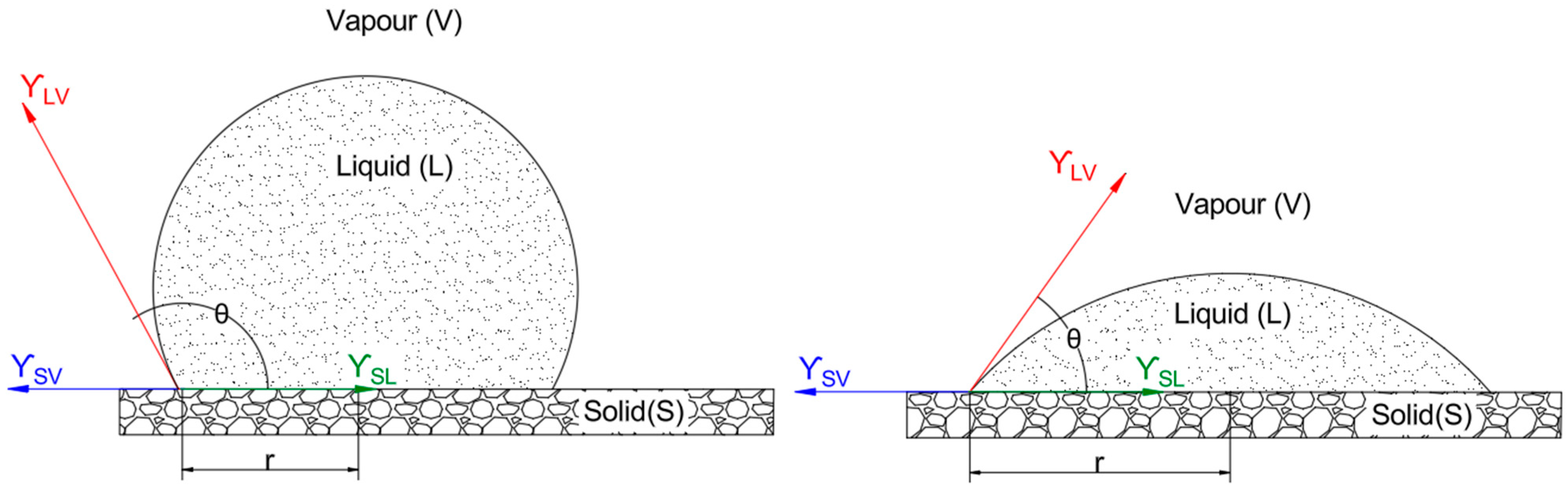
46]. Dipping achieves coating thicknesses of 10–100 µm, influenced by solution viscosity and immersion time. The process is underpinned by wetting dynamics described by Young’s equation:
The interfacial interactions involved are illustrated in
Figure 2, which shows a liquid droplet on a solid surface in equilibrium with the vapor phase, including the relevant surface tensions (γ
SV, γ
SL, γ
LV) and contact angle (θ) as defined by Equation (1) θ, measured through the liquid, represents the angle at which the liquid-vapor interface meets the solid surface, indicating the degree of wetting where θ < 90° suggests good wetting (hydrophilic behavior), while θ > 90° indicates poor wetting (hydrophobic behavior). The interfacial tension between the solid and vapor phases, γ
SV, reflects the surface energy of the solid in the absence of the liquid, while γ
SL, the interfacial tension between the solid and liquid phases, depends on interactions such as hydrogen bonding or van der Waals forces between the coating solution and the fruit cuticle. Lastly, γ
LV, the interfacial tension between the liquid and vapor phases, is equivalent to the surface tension of the coating solution, typically ranging from 30 to 70 mN/m for aqueous polysaccharide solutions.
4.2.2. Spraying
Spraying is widely regarded as the most scalable edible-coating application method for fresh fruit because it enables continuous operation, reduced solution consumption, and controllable coat mass per unit area. In contrast to dipping, spray coating minimizes cross-contamination risk and avoids dilution/drag-out losses, while allowing coating thickness to be tuned via nozzle type, atomization pressure, flow rate, droplet size distribution, and spray time. Comparative evidence indicates that coating method measurably affects uniformity and final barrier function; for example, studies directly comparing dipping and spraying on fresh-cut fruit show method-dependent differences in nutritional retention and surface coverage, attributable to differences in deposited solids and drying dynamics [
75]. Recent work comparing dip, brush, spray, and electrostatic spray further demonstrates that the application route can be as influential as formulation choice in determining coating quality and preservation outcomes [
76]. These results support the need to treat “application method” as a first-order design factor alongside polymer class and additives.
4.2.3. Electrostatic Spraying
Electrostatic spraying improves deposition efficiency by electrically charging droplets so they are attracted to the grounded produce surface, increasing wrap-around coverage and reducing overspray losses. This approach is particularly attractive for industrial lines where coating solution cost and wastewater handling are constraints, and where uniform deposition on complex surfaces is difficult with conventional sprays. Prototype/engineering studies for fruit coating systems report improved transfer efficiency and more complete surface coverage versus uncharged spray under comparable operating conditions [
77]. In preservation-oriented comparisons, electrostatic spray performance has been shown to be comparable to (or better than) conventional spray for key quality outcomes, while using thinner coatings and shorter drying times [
76]. Collectively, these studies position electrostatic spraying as a promising scale-up option, but they also highlight the need for commodity-specific optimization of charge-to-mass ratio, nozzle–fruit distance, line speed, and grounding strategy.
4.2.4. Ultrasonic Coating
Ultrasonic coating uses high-frequency vibration to generate fine droplets with a narrow size distribution, enabling highly uniform thin films at relatively low flow rates and reduced clogging risk for certain biopolymer solutions. This is particularly relevant when nanocellulose, emulsions, or bioactive-loaded formulations are used, where shear history and droplet size can influence phase separation and final microstructure. A recent primary study designing and optimizing an ultrasonic coating system for fresh fruit demonstrated that process parameters (e.g., flow rate, power, exposure time) significantly affected coating uniformity and shelf-life outcomes, supporting ultrasonic atomization as a precision deposition route rather than merely an alternative spray head [
78]. For high-value fruits or active coatings where dose control matters, ultrasonic deposition offers a practical pathway to reduce variability and improve reproducibility relative to conventional spray.
4.2.5. Fluidized-Bed Coating
Fluidized-bed coating is used extensively in food/pharma for coating particulates because it provides intense convective drying and uniform exposure of moving particles to atomized coating droplets. While it is less suited to intact fresh fruit, it is directly relevant for small fruit products (e.g., raisins/dried berries) and coated inclusions, and it provides a useful process analog for continuous coating–drying lines. Primary postharvest-oriented studies on dried fruit demonstrate that edible coatings can be applied to raisins to improve texture/appearance and slow quality loss during storage, highlighting the practical relevance of controlled deposition and drying in particulate products [
79]. In the context of fresh-fruit coatings, fluidized-bed concepts are valuable for understanding how air temperature, humidity, droplet flux, and residence time govern film formation, tackiness, agglomeration risk, and final barrier properties—factors that also constrain industrial spray lines for fresh produce.
4.2.6. Panning Coating
Panning is a high-throughput deposition method in which products tumble in a rotating pan while coating solution is sprayed or metered, followed by forced-air drying. Although most commonly associated with confectionery and nuts, it is conceptually relevant for round/small produce items and for coated inclusions, because it couples mechanical mixing with staged application–drying cycles, enabling thicker multi-pass layers than single-pass spraying. In the edible-coating context, panning is therefore best viewed as a scale-up platform for batch coating of spherical items, where film build-up, tack control, and drying rate must be managed to avoid sticking and non-uniform thickness.
4.2.7. Three-Dimensional Printing and Patterned Deposition
Three-dimensional printing is not yet a mainstream postharvest coating method for intact fruit; however, it is increasingly explored for structured edible layers and customized edible “skins” in fruit-based products. Primary studies show that fruit-based matrices can be printed into stable edible structures with measurable retention of bioactives/antioxidant properties under controlled printing conditions [
80]. From an edible-coating perspective, the relevance of 3-D printing lies in precision patterning (localized barrier placement), multi-material deposition, and the ability to engineer thickness gradients—capabilities that could inform future high-value coating applications where conventional dipping/spraying cannot easily control spatial functionality.
4.2.8. Brushing
Brushing is employed experimentally or for irregular surfaces, applying coatings using manual or mechanical brushes, typically producing coating thicknesses in the order of 20–60 µm, with surface-dependent variability that can exceed 20% depending on formulation and handling [
75,
76,
77]. The method relies on frictional force and manual precision, lacking scalability for industrial use. Its theoretical foundation is based on contact mechanics, where coating distribution depends on brush pressure, bristle texture, and solution rheology, particularly viscosity and shear-thinning properties [
49]. Due to its dependence on operator technique, this method can lead to inconsistency, especially for produce with complex geometries like strawberries or mulberries [
34]. Brushing is generally reserved for small-scale applications or laboratory settings where other techniques are not feasible.
Although simple and low-cost, the technique is less efficient, showing lower repeatability and throughput compared to dipping or spraying. Bharti et al. [
49] observed greater variability in coating thickness and phenolic compound retention for brushed samples of mangoes compared to sprayed samples. These findings underline that while brushing may serve niche applications, it is not ideal for large-scale operations where uniformity and throughput are critical.
Furthermore, surface energy of the fruit, coupled with contact angle behavior, influences coating spread and adhesion during brushing. As with other methods, brushing is sensitive to environmental factors such as temperature and humidity, which alter coating viscosity and drying rate. Brushing is thus best viewed as a supplementary or pilot-stage method, useful for experimental formulations but suboptimal for postharvest logistics on a commercial scale.
4.2.9. Layer-by-Layer (LbL)
LbL deposition involves sequential application of oppositely charged biopolymer layers (e.g., cationic chitosan and anionic alginate) via dipping or spraying, enabling controlled multilayer architectures at the micro- to submicron scale [
71]. The technique exploits electrostatic interactions and hydrogen bonding between oppositely charged layers, allowing tailored functionality and enhanced barrier performance. Memete et al. [
71] showed that sequential application of lipid- and gelatin-based layers (LbL coating) on mulberries significantly enhanced phenolic stability and slowed physicochemical quality degradation during refrigerated storage relative to single-layer treatments.
LbL systems offer advantages in controlled release of bioactives and multilayered protection against moisture and gas exchange. Bharti et al. [
49] also highlighted the potential of multilayer systems in starch-based matrices for improving antimicrobial efficacy, showing over 90% inhibition against Gram-positive bacteria after during storage. However, the process is inherently time-intensive and requires precise control of solution chemistry and processing conditions, which limits throughput and increases operational complexity relative to single-step coating methods. The LbL process benefits from optimization of interlayer adhesion, pH control, and ionic strength of the coating solutions to avoid delamination. Temperature and humidity also affect layer stability during storage, particularly in coatings incorporating thermosensitive ingredients. Despite its labor-intensiveness, LbL is highly promising for research and premium applications where multifunctionality and precision are prioritized over scale.
4.3. Analytical and Evaluation Methods
Thorough evaluation of edible coatings involves a range of physical, chemical, microbiological, and sensory tests. These assessments are necessary to determine barrier properties, nutritional retention, microbial inhibition, structural integrity, and consumer acceptability.
4.3.1. Barrier Properties
The water vapor transmission rate (WVTR) is a fundamental metric for moisture control in edible coatings and packaging films. It is commonly measured using gravimetric cup methods, such as the Desiccant and Water Methods, under standardized conditions defined by ASTM E96/E96M-23. These tests quantify vapor flux by monitoring weight changes in coated samples under controlled temperature and humidity. In a study by Pizato et al. [
74], strawberries coated with 2% chitosan enriched with 1.5% clove essential oil exhibited significantly reduced weight loss, 13.51% compared to 24.19% in uncoated controls, over 12 days of refrigerated storage. This reduction in moisture loss was attributed to the coating’s semi-permeable barrier properties, which effectively modulated WVTR while preserving texture and color. Gas permeability, particularly for oxygen (O
2) and carbon dioxide (CO
2), is equally critical for assessing the impact of coatings on fruit respiration and anaerobic risks. As reviewed by Sánchez-Tamayo et al. [
73], gas permeability in edible films is typically measured using manometric, gravimetric, or continuous-flow techniques, many of which are adapted from ASTM standards. These methods involve placing the film between two compartments, one exposed to the test gas and the other connected to a detector and quantifying the transmission rate under controlled conditions. The review emphasizes that permeability results are highly sensitive to film preconditioning, test setup, and environmental parameters, underscoring the need for standardized protocols when evaluating barrier performance in postharvest applications.
4.3.2. Mechanical Behavior
Mechanical behavior is an essential but often underinterpreted dimension of edible-coating performance. Although coatings applied on fruit surfaces typically form thin layers in the 5–20 µm range, mechanical characterization is almost universally conducted on free-standing cast films—usually 50–200 µm thick—which serve as model systems for assessing the intrinsic strength and flexibility of coating formulations. While these films differ in thickness from applied coatings, their tensile properties provide meaningful insight into how biopolymer networks respond to deformation, bending, and surface stress encountered during handling, transport, and storage.
Across literature, tensile strength (TS) and elongation at break (EAB) remain the most consistently reported parameters.
Table 7 summarizes the mechanical properties that are currently available from the studies reviewed here, highlighting both the strengths of existing characterization efforts and the persistent gaps—particularly the near-total absence of stiffness data—within edible-coating research. Starch–carrageenan composite films, for example, display moderate tensile strength (≈15 MPa) and relatively high elongation (≈28%), reflecting a balanced, ductile structure suitable for flexible coatings [
48]. Chitosan-based systems reinforced with bacterial nanocellulose show substantially higher tensile strength, reaching more than 40 MPa at optimal filler loading—accompanied by reduced elongation, indicating a transition toward greater rigidity and reduced ductility [
32]. Cellulose–chitosan blends exhibit tensile strengths in the 12–14 MPa range, illustrating the diversity of mechanical responses achievable through biopolymer blending [
30]. These patterns emphasize how formulation strategies, such as introducing nanofillers or combining polysaccharides, directly shape the mechanical robustness and flexibility of edible films.
In contrast to TS and EAB, Young’s modulus—central to quantifying stiffness and deformation resistance—remains largely absent from edible-coating research. Among the studies surveyed, none reported absolute modulus values, and only a single review summarized modulus changes in relative terms (e.g., an ≈87% increase with cellulose nanocrystal addition) without providing corresponding baseline values [
45]. This omission limits the development of structure–property models and hinders comparison across formulations, even though stiffness plays a crucial role in determining whether coatings crack, resist bending, or maintain integrity on curved, expanding, or mechanically stressed produce surfaces. As edible coatings evolve toward more engineered, multifunctional systems, routine reporting of Young’s modules would significantly enhance analytical and optimization capabilities.
Most mechanical tests follow ASTM D882, which standardizes specimen dimensions and tensile loading procedures for thin films, enabling reproducible reporting of TS and EAB. Nevertheless, relying solely on these two parameters underrepresents the mechanical complexity of edible coatings and constrains our ability to predict real-world performance. Integrating modulus measurement and, where possible, complementary techniques such as nanoindentation or flexural analysis would provide a more complete mechanical profile of coating materials.
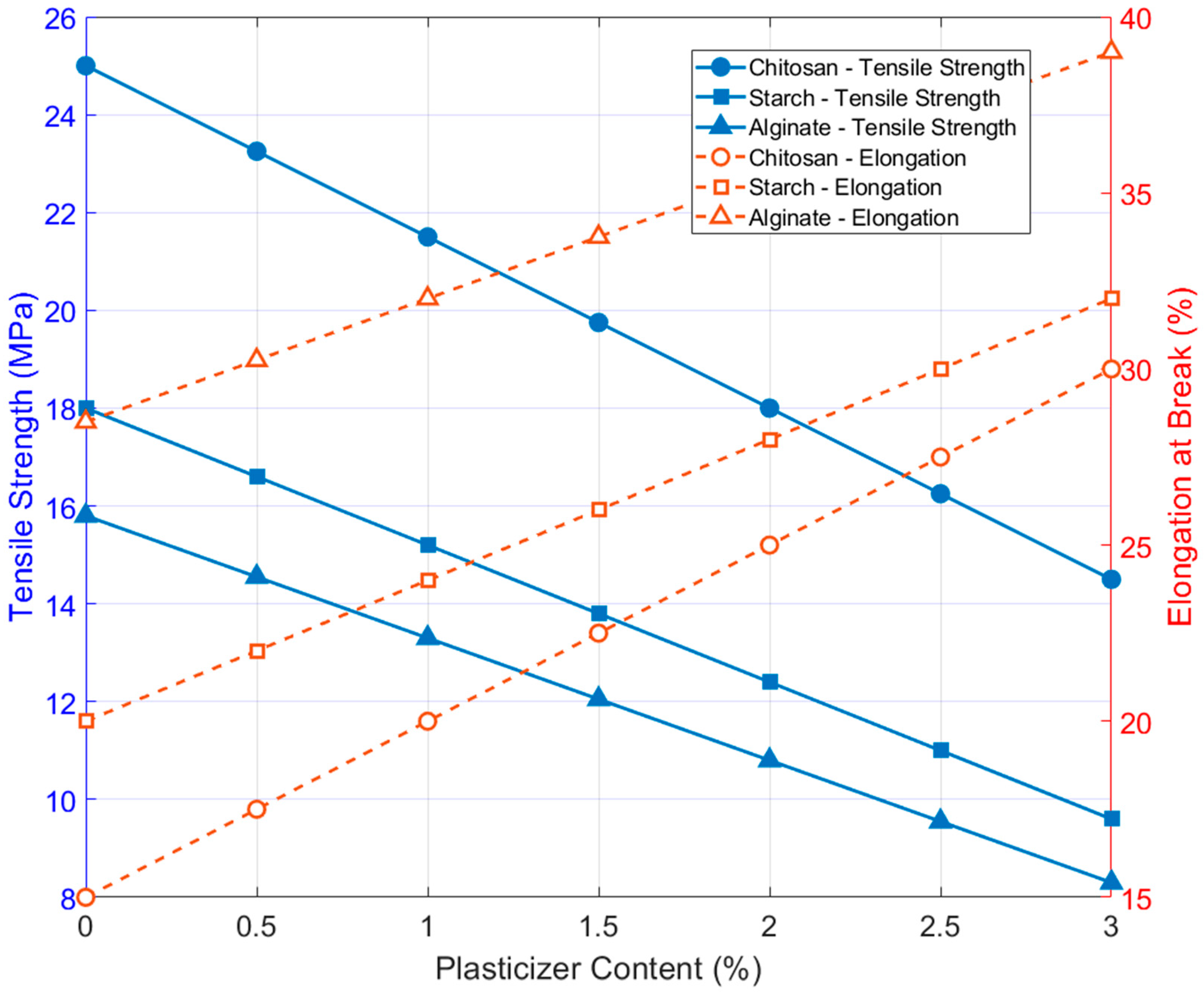
Figure 3 illustrates the mechanical trade-offs observed in chitosan-, CNC-reinforced-, and alginate-based edible coatings as plasticizer content increases. All systems show a consistent pattern: tensile strength declines while elongation at break rises. CNC-reinforced films retain higher tensile strength at comparable plasticizer levels, highlighting the structural benefits of nanocrystal incorporation. These trends, drawn from studies using ASTM D882 protocols [
32,
40,
46], underscore the need to balance rigidity and flexibility when designing coatings for produce with varying mechanical sensitivities.
The durability of produce coatings is influenced by their composition, including the type of biopolymer, plasticizers, and additives used. For instance, Tabassum & Khan [
40] demonstrated that incorporating glycerol as a plasticizer in alginate-based coatings increased elongation at break by 30% compared to non-plasticized films, though it slightly reduced tensile strength. This trade-off is critical, as overly rigid coatings may crack under stress, while excessively flexible coatings may fail to provide adequate protection. Coatings with high tensile strength and moderate elongation at break are ideal for produce like apples or tomatoes, which are prone to mechanical damage during bulk handling. Conversely, softer fruits like berries may require coatings with higher flexibility to accommodate surface deformation. Additionally, environmental factors such as humidity and temperature during storage and transport can affect coating performance. Liyanapathiranage et al. [
35]) found that edible coatings maintained higher Young’s modulus values (up to 1.2 GPa) under low-humidity conditions, ensuring better resistance to deformation during long-distance shipping.
4.3.3. Microbiological Efficacy
Microbiological efficacy is a critical factor in evaluating the performance of edible coatings enriched with antimicrobial agents, especially for extending the shelf life and ensuring the safety of perishable produce. Zone-of-inhibition assays are widely used to measure the antimicrobial activity of coatings by observing the clear zones around coated samples where microbial growth is inhibited. Bharti et al. [
49] employed the disk diffusion method (Microan+51) to assess the efficacy of caraway EO-incorporated starch films, reporting significant inhibition zones against
B. cereus and
S. aureus with zones increasing with higher EO concentrations (e.g., up to 16 mm for
B. cereus at 3% EO). Total plate counts quantify viable microbial loads, offering a direct measure of reduction over time, while challenge studies simulate real-world contamination, providing robust efficacy data. Bizymis et al. [
62] achieved a 99% reduction in
E. coli within 24 h using silver nanoparticles, complementing Bharti et al.’s findings on Gram-positive bacteria sensitivity. The antimicrobial performance of coatings depends on the type, concentration, and compatibility of the antimicrobial agent with the coating matrix. Bharti et al. [
49] found that caraway EO, rich in cicerain (55.74%) and carvone (8.36%), exhibited greater efficacy against gram-positive bacteria (
B. cereus and
S. aureus) due to their thinner cell walls, which are more susceptible to phytochemicals, compared to the intrinsic tolerance of Gram-negative bacteria (
E. coli and
P. aeruginosa). This aligns with Bharti et al. [
49] who tested levels of 0.5%, 1%, 2%, and 3% (TC1 to TC4), with higher concentrations showing enhanced inhibition (
p < 0.01). Environmental factors like temperature and humidity further influence efficacy. For instance, Congying et al. [
48] observed reduced performance of ZnO nanoparticle coatings at higher temperatures Bharti et al. [
49] reported zone-of-inhibition assay results demonstrating clear antimicrobial activity of caraway essential oil (EO)-incorporated starch-based films against Bacillus cereus, Escherichia coli, Pseudomonas aeruginosa, and Staphylococcus aureus. The study highlighted that gram-positive bacteria exhibited larger inhibition zones as EO concentration increased. For comparison, Bizymis et al. [
62] also presented similar findings when evaluating the efficacy of silver nanoparticles.
4.3.4. Nutritional and Biochemical Analysis
Nutritional and biochemical analysis techniques are critical for assessing the preservative efficacy of edible coatings applied to perishable produce. These methods quantify antioxidant capacity, vitamin and phenolic content, and visual quality attributes, furnishing insight into how coatings mitigate oxidative degradation and nutrient loss during storage. Widely used assays include DPPH and FRAP for antioxidant evaluation, HPLC for micronutrient profiling, and colorimetric methods for monitoring browning and pigment degradation. The DPPH (2,2-diphenyl-1-picrylhydrazyl) and FRAP (Ferric Reducing Antioxidant Power) assays are prominent techniques used to measure the antioxidant potential of edible coatings. DPPH evaluates the ability of a sample to scavenge free radicals by observing the decrease in absorbance at 517 nm, while FRAP assesses reducing power through colorimetric change at 593 nm. For example, Bharti et al. [
49] used the DPPH assay to demonstrate that starch-based films enriched with caraway essential oil-maintained antioxidant activity in coated fruit.
High-Performance Liquid Chromatography (HPLC) provides precise quantification of sensitive nutrients such as vitamin C and phenolic compounds. HPLC analyses often use a C18 column and UV detection to identify and quantify key bioactive molecules in fruit samples. Mohammadi et al. [
46] used HPLC to show how chitosan coatings helped retain vitamin C content under cold storage conditions.
Colorimetric tests are also widely applied to monitor enzymatic browning and pigment degradation. Absorbance at 420 nm is typically used for browning index, while chlorophyll and anthocyanin retention are evaluated via spectrophotometric measurements at wavelengths such as 645 nm and 663 nm. Sun et al. [
46] employed such techniques to examine pigment retention in tomato samples coated with chitosan–thyme oil films.
Analytical results are influenced not only by the coating composition but also by sample preparation, solvent selection, and storage conditions. Bharti et al. [
49] extracted phenolic compounds using methanol and noted how higher concentrations of essential oil led to greater inhibition of browning. The barrier properties of the coating, such as thickness and oxygen permeability, also affect the preservation of labile nutrients. Mohammadi et al. [
46] highlighted improved vitamin retention in thicker chitosan layers. Environmental parameters during storage further impact outcomes. Congying et al. [
48] demonstrated that ZnO-enhanced starch coatings preserved anthocyanins better at 4 °C compared to ambient conditions, emphasizing the need to pair biochemical tests with storage simulations.
Standardized protocols enhance reproducibility and facilitate cross-study comparisons. AOAC and ISO guidelines often inform method selection. For instance, absorbance-based readings for browning or pigment retention follow standardized wavelength references, and chromatographic methods adhere to validated column and mobile phase parameters. Bharti et al. [
49], Mohammadi et al. [
46], and Sun et al. [
50] all followed such protocols, ensuring scientific rigor.
4.3.5. Sensory Evaluation
Sensory evaluation plays a pivotal role in determining consumer acceptance of coated fresh fruits, focusing on attributes such as appearance, taste, aroma, texture, and overall preference. This evaluation relies on structured methodologies to provide objective insights into how coatings influence sensory quality. Trained sensory panels and consumer groups are commonly employed, utilizing tools like hedonic scales and descriptive analysis to systematically assess these attributes. The process involves controlled settings to ensure consistency, with methodologies often aligned with international standards such as those from the International Organization for Standardization (ISO).
Hedonic scales, typically ranging from 1 (dislike extremely) to 9 (like extremely), allow panelists to rate overall liking and individual attributes like taste or appearance. Descriptive analysis, a more detailed technique, involves trained panelists who identify and quantify specific sensory characteristics, such as firmness, aroma intensity, or visual clarity, using standardized lexicons. Memete et al. [
71] utilized both approaches, conducting evaluations over 8 days of refrigerated storage to track changes in sensory properties of coated black mulberries.
The choice of sensory evaluation method depends on the study’s objectives and the coating’s properties. Hedonic scales are ideal for consumer acceptance studies, capturing broad preferences, while descriptive analysis suits detailed profiling of sensory changes over time or across formulations. Environmental factors, such as storage conditions (e.g., refrigerated at 4 °C in Memete et al. [
71], and the coating’s thickness or composition influence the sensory attributes assessed, necessitating adjustments in methodology. Sensory evaluation should adhere to standardized guidelines, such as ISO 8589 [
81] for panel selection and training, and ISO 4121 [
82] for sensory analysis methods. These standards dictate the design of evaluation sessions, including sample preparation (e.g., cutting uniform pieces of coated produce) and presentation order to avoid carryover effects. Memete et al. [
71] likely followed similar protocols, ensuring that assessments of gelatin, oil, and wax coatings were conducted consistently across the 8-day period. Data analysis often incorporates software like FIZZ (Biosystèmes, Dijon, France) or Compusense (Compusense Inc., Guelph, ON, Canada) to manage scores and perform statistical tests, ensuring compliance with rigorous scientific practices.
4.3.6. Advanced Structural Analysis
Techniques like scanning electron microscopy (SEM) provide insight into surface uniformity and porosity; FTIR spectroscopy identifies chemical bonding and interactions; and differential scanning calorimetry (DSC) assesses thermal stability. These methods enhance understanding of structure–function relationships and support the design of more stable and functional coating systems [
46]. Despite the broad toolkit available, a key research gap remains in standardizing analytical protocols across studies to enable direct comparison of results. Moreover, real-world validation of coating performance under commercial cold chain logistics is still insufficient, and more studies are needed to evaluate behavior under fluctuating temperature and humidity conditions.
Scanning electron microscopy (SEM) is employed to examine the surface morphology, uniformity, and porosity of coatings at a microscopic level. Samples are typically prepared by freeze-drying or gold sputtering to enhance conductivity, followed by imaging under high vacuum at magnifications ranging from 100× to 10,000×. FTIR spectroscopy analyzes chemical bonding and intermolecular interactions by measuring the absorption of infrared light, with spectra recorded over a range of 400–4000 cm
−1 using attenuated total reflectance (ATR) mode. Differential scanning calorimetry (DSC) evaluates thermal stability and phase transitions by heating samples (e.g., 0–200 °C) at a controlled rate (e.g., 10 °C/min), detecting endothermic or exothermic changes. Mohammadi et al. [
46] utilized these techniques to characterize coating structures, providing a foundation for optimizing design parameters.
The choice of structural analysis method depends on the coating’s composition and the property of interest. SEM is ideal for visualizing physical structure, requiring careful sample preparation to avoid artifacts. FTIR suits the study of chemical compatibility, particularly for coatings with polysaccharides or lipids, while DSC is essential for thermal-sensitive materials like protein-based films. Sample size, moisture content, and instrument calibration influence results, necessitating standardized preparation protocols. Environmental conditions during analysis, such as temperature and humidity, also affect outcomes, highlighting the need for controlled settings. Structural analysis follows guidelines from organizations like the International Union of Pure and Applied Chemistry (IUPAC) and ASTM International. SEM protocols specify sample mounting and vacuum levels, while FTIR adheres to standards for spectral resolution (e.g., 4 cm
−1) and scan numbers (e.g., 32 scans). DSC testing aligns with ISO 11357, detailing heating rates and sample pans. Mohammadi et al. [
46] likely adhered to these standards, though variations in protocols across studies complicate comparisons. Efforts to harmonize methodologies, such as adopting universal sample preparation or data reporting formats, are underway but not yet fully realized.
Taken together, the practical implementation of edible coatings in fresh-fruit systems is constrained by a set of interdependent material, mechanical, and process-related trade-offs. Enhancing coating strength or barrier performance through polymer reinforcement or filler incorporation often leads to increased stiffness and reduced extensibility, which can elevate the risk of cracking, delamination, or failure under handling and transport stresses. Conversely, highly flexible coatings may lack sufficient mechanical integrity to withstand abrasion, compression, or repeated contact during postharvest operations. As illustrated in
Table 8, reported tensile strength, elongation behavior, and Young’s modulus (or stiffness trends where absolute values are unavailable) reveal non-linear responses to formulation changes, indicating narrow optimization windows rather than monotonic performance gains. These mechanical constraints are further compounded by application-related stresses, variability in fruit surface morphology, and scalability requirements within commercial packing lines. Collectively, these factors underscore the need to evaluate edible coatings as integrated material–process systems, where formulation design, application method, and mechanical robustness must be optimized concurrently to achieve reliable performance under real postharvest conditions.
6. Conclusions
Edible coatings, especially those derived from natural biopolymers, present a promising advancement in sustainable postharvest packaging for fresh fruits. Their functional versatility, including moisture and gas barrier properties, microbial inhibition, and sensory quality preservation, positions them as viable alternatives to synthetic packaging materials in fresh fruit supply chains. However, their effective implementation demands a detailed understanding of material properties, formulation strategies, application methods, and performance evaluation protocols.
This review has highlighted significant progress in the development and application of polysaccharide-, protein-, and lipid-based coatings, yet notable gaps remain in aligning coating performance with the physiological and logistical requirements of commercial postharvest systems. Key factors such as mechanical integrity, water vapor permeability, and gas transmission characteristics of biopolymer films directly impact a coating’s ability to function as viable packaging substitutes. Standard testing methods, such as ASTM D882 (for mechanical properties) and ASTM E96/E96M (for WVP), remain crucial for characterizing these materials. However, performance is often limited by the plasticizing effect of moisture in hydrophilic matrices, which reduces barrier integrity. This challenge underscores the need for targeted research into barrier enhancement techniques, such as nanostructuring, hydrophobic modification, or multilayer designs.
Importantly, edible coatings not only serve as passive barriers but can actively modulate the fruit’s internal atmosphere, potentially replicating or enhancing the microenvironmental benefits of modified atmosphere packaging. Yet, the interplay between coating properties and fruit physiology remains insufficiently explored, particularly under commercial handling conditions. Future studies must bridge this gap by integrating advanced material characterization with physiological monitoring and shelf-life assessments under real-world scenarios. Future research should therefore focus on integrating quantitative transport and mechanical characterization with fruit physiological responses under commercial postharvest conditions. In addition, greater emphasis is needed on scalable application technologies and standardized evaluation protocols, alongside lifecycle and regulatory considerations, to support industry adoption.
In conclusion, optimizing edible coatings for fresh fruits preservation requires a holistic approach that balances material innovation, application scalability, and postharvest efficacy. Advancing this field will depend on interdisciplinary collaboration across food science, material engineering, and postharvest technology, supported by standardized evaluation protocols and regulatory clarity. With such efforts, edible coating could transition from niche innovation to mainstream application in sustainable fresh fruits logistics.




 ,
, 
_Ambaw.png)