A Palynological Atlas of the Amazon canga Vegetation
 , , , and
Abstract
1. Introduction
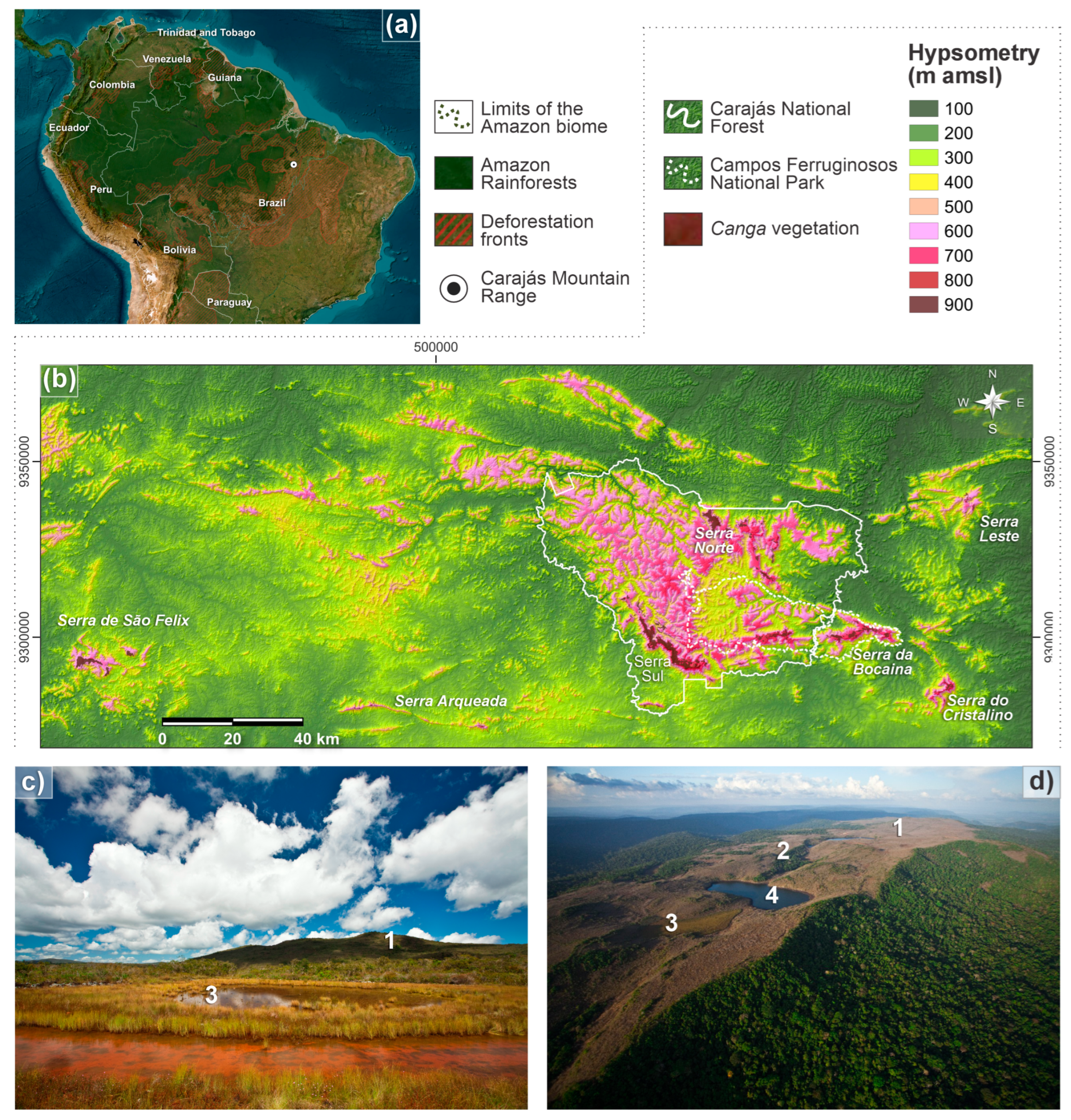
Study Area
2. Materials and Methods
3. Results
Description of Spores and Pollen
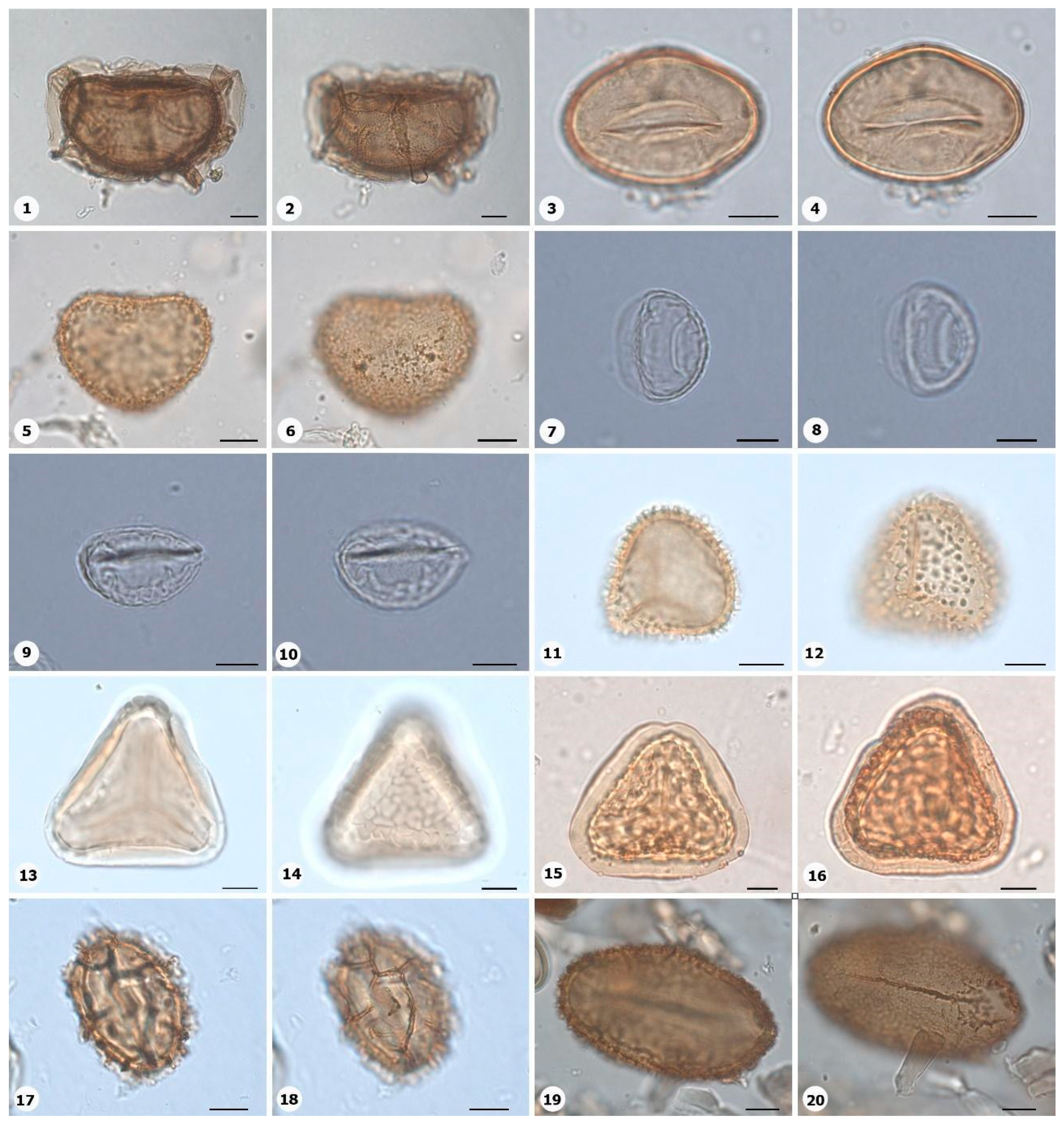
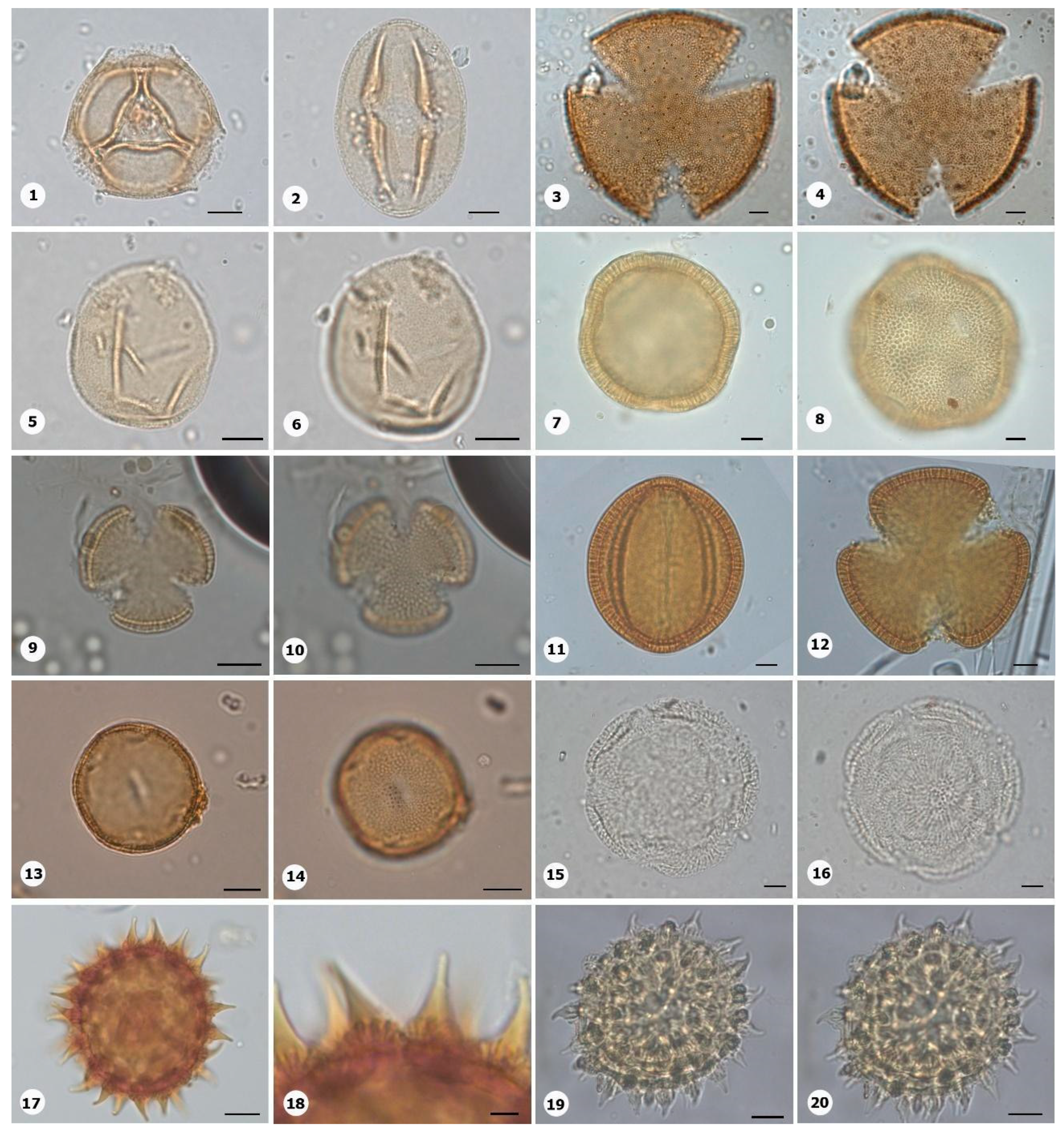
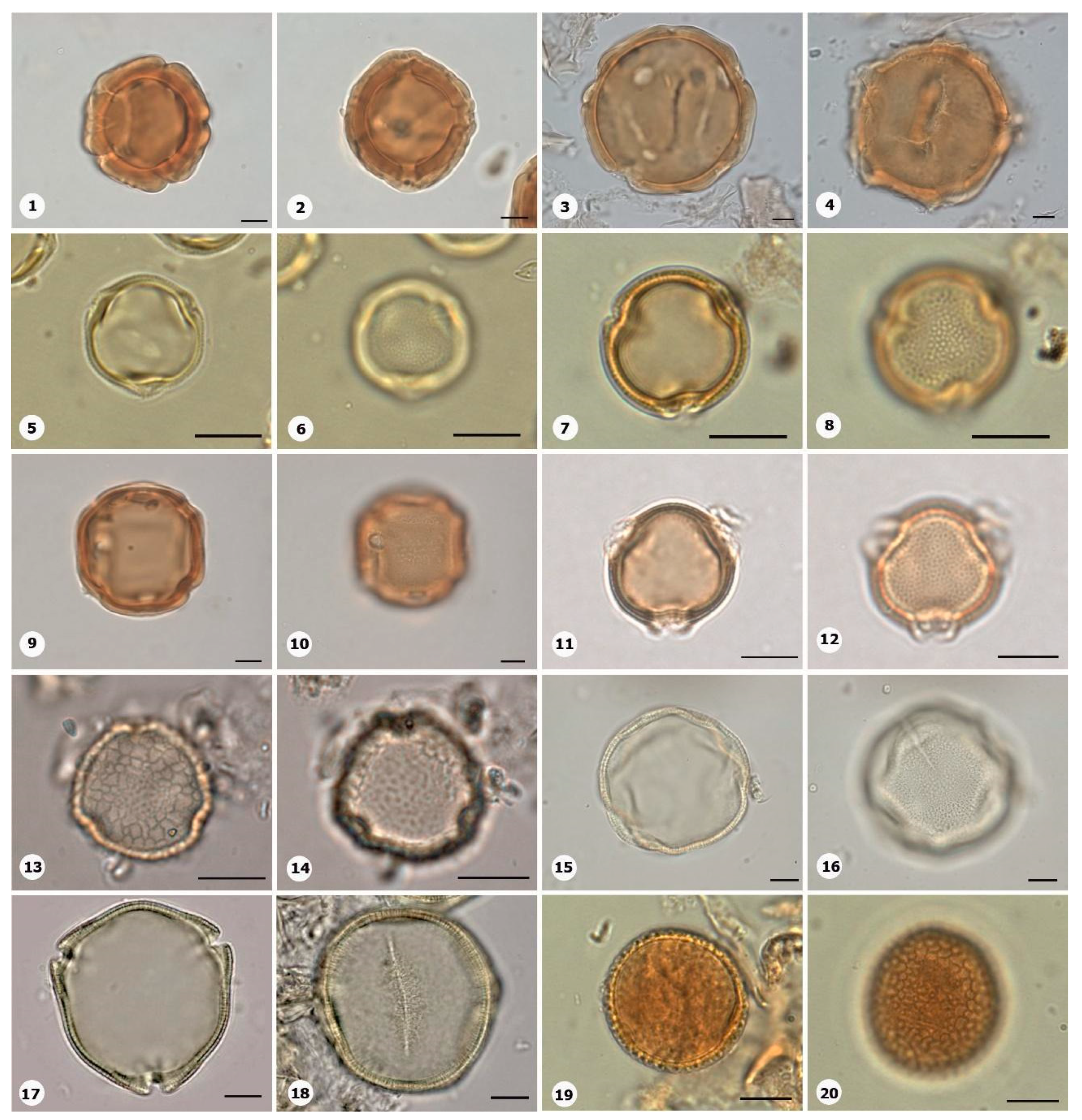
- FERNS AND LYCOPHYTESOrder: Polypodiales LinkFamily: Aspleniaceae NewmanHerbarium number: HCJS 1548Description: Spores single, shape with rounded ends; laesura straight, margo narrow; sclerine ~3 µm thick, exospore distinct, ornamentation with thin and irregular undulating membrane, resembling a hamulate pattern.
- Life form: Herb.
- Geoenvironment: Forested slopes and caves over plinthosols and ferralsols.
- Order: Polypodiales LinkFamily: Blechnaceae NewmanHerbarium number: HCJS 4365Description: Spores single, shape with rounded ends; laesura straight, margo 2–3 µm thick, protruding.Life form: Herb.Geoenvironment: Forested slopes and caves over plinthosols and ferralsols.
- Family: Dennstaedtiaceae LotsyHerbarium number: BHCB 601Description: Spores single, shape with rounded ends; laesura indistinct; exospore 1.5–2.4 thick.Life form: Herb.Geoenvironment: Upland anthropic areas.
- Order: Isoëtales C.AgardhFamily: Isoëtaceae Rchb.f.Herbarium number: HCJS 6277Description: Spores single, shape with pointed ends; laesura straight, without prominent invagination; perispore microechinate in proximal view and microechinate to tuberculate in distal view.Life form: Herb.Geoenvironment: Doliniform lakes; Amendoim Lake, S11D, active lakeHerbarium number: HCJS 5433Description: Spores single, shape with pointed ends; laesura straight, without prominent invagination; perispore laevigate in proximal view and microechinate to tuberculate in distal view.Life form: HerbGeoenvironment: Poorly drained depressions and levels over plinthosols and histosols.
- Order: Polypodiales LinkFamily: Pteridaceae E.D.M.Kirchn.Herbarium number: HCJS 1465Description: Spores single, shape with rounded corners; curvature absent, margo indistinct, commissure straight; endospore 1 µm thick; exospore 1 µm thick, echinae 1–2 µm height.Life form: Herb.Geoenvironment: Forested slopes and caves over plinthosols and ferralsols.Herbarium number: HCJS 1007Description: Spores single, shape with rounded corners; curvature absent, commissure curved, margo ~3 µm thick, very distinct; endospore 1 µm thick, exospore 1 µm thick, cingulated, cingulum about 4–5 µm thick and likely varying in thickness until radial area.Life form: Herb.Geoenvironment: Forested slopes and caves over plinthosols and ferralsols.Herbarium number: HCJS 1559Description: Spores single, shape with rounded corners; margo indistinct, commissure straight; endospore indistinct, exospore 1 µm thick, cingulated, cingulum about 5 µm thick and not varying in thickness.Life form: Herb.Geoenvironment: Forested slopes and caves over plinthosols and ferralsols.
- Family: Thelypteridaceae Pic.Serm.Herbarium number: HCJS 4775Description: Spores single, shape with rounded ends; laesura straight to curved, margo indistinct; sclerine ~2–3 µm thick, exospore distinct.Life form: Herb.Geoenvironment: Forested slopes and caves over plinthosols and ferralsols.Herbarium number: HCJS 3009Description: Spores single, shape with rounded ends; laesura straight to curved, margo indistinct; exospore 2 µm thick.Life form: Herb.Geoenvironment: Poorly drained depressions and levels over plinthosols and histosols.
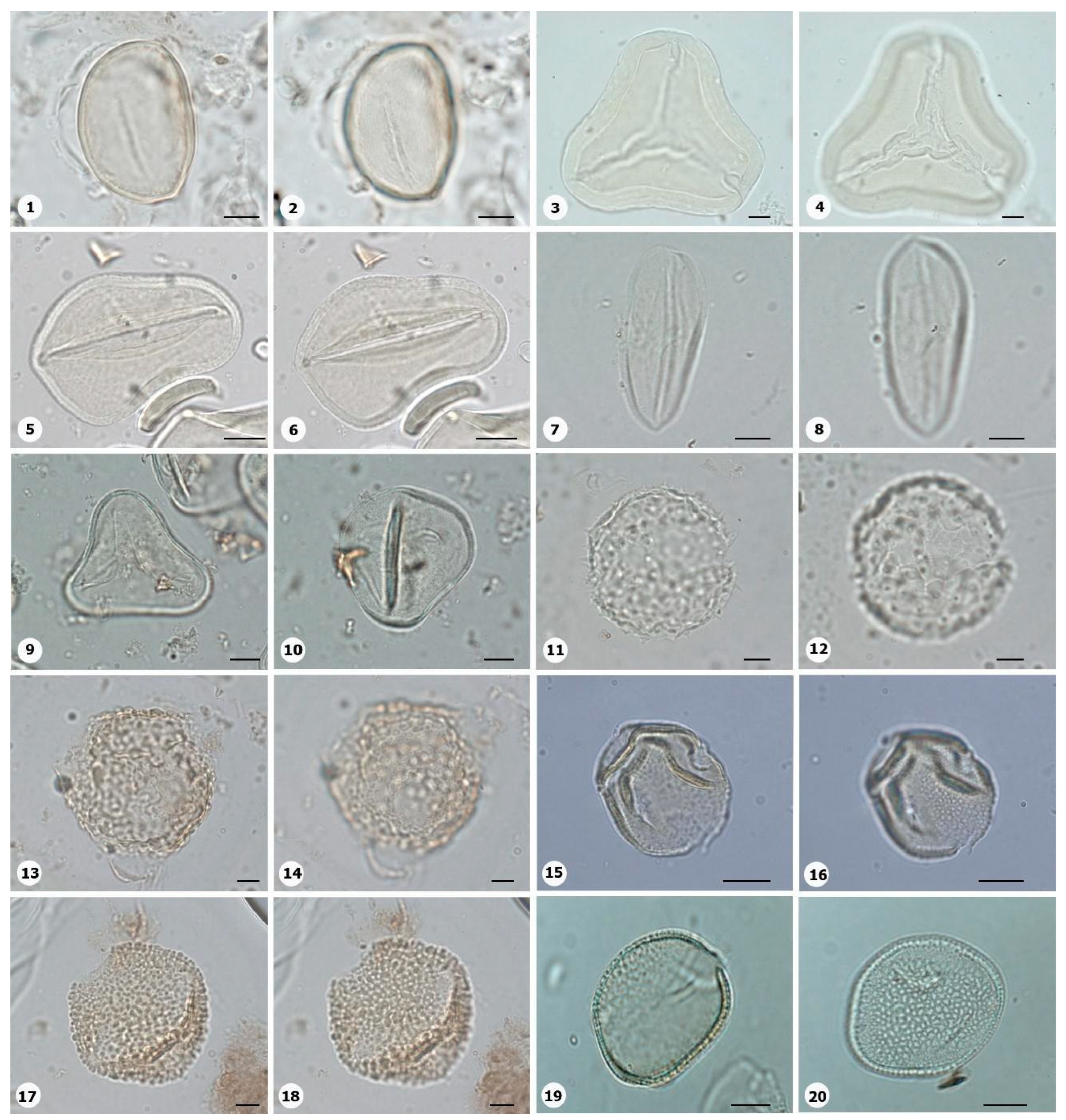
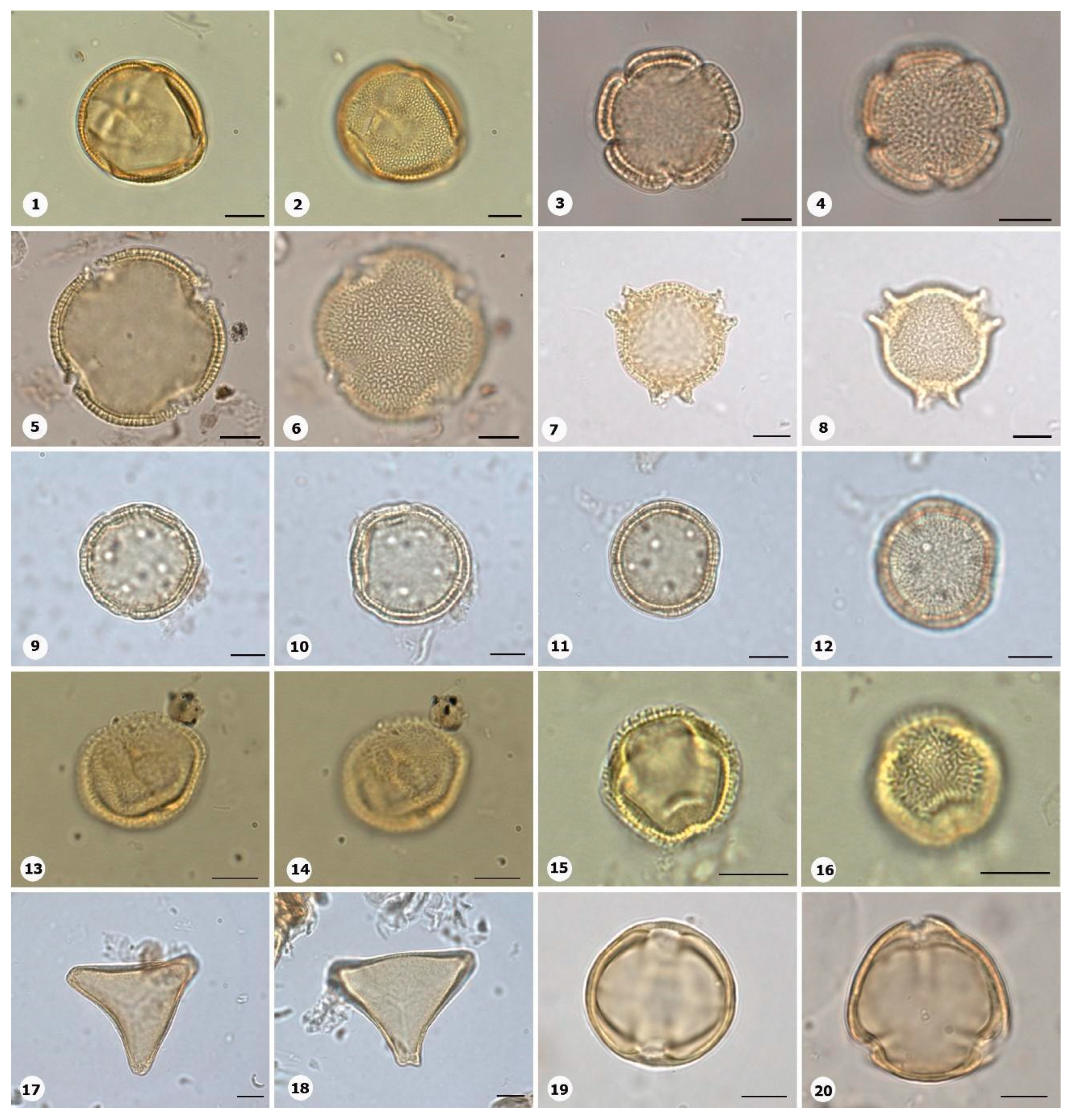
- MONOCOTSOrder: Alismatales R. Br. ex Bercht. and J. PreslFamily: Araceae Juss.Herbarium number: MG 214008Description: Monads, large, sulci marginate; amb elliptical; exine 1.2 µm thick, tectate.Life form: Herb.Geoenvironment: Forested slopes and caves over plinthosols and ferralsols.
- Order: Arecales BromheadFamily: Arecaceae Bercht. and J.Presl.Herbarium number: HCJS 0646Description: Monad, large; sulci marginate; amb triangular–obtuse–concave; exine 7.3 µm thick, tectate.Life form: Palm.
- Geoenvironment: Forested slopes and caves over plinthosols and ferralsols.Herbarium number: HCJS 0383Description: Monad, large; sulci marginate; amb elliptical; exine 2.6 µm thick, tectate.Life form: Palm.Geoenvironment: Forested slopes and caves over plinthosols and ferralsols.Herbarium number: HCJS 0272Description: Monad, large; sulci with a slight margo; amb elliptical with acute ends; exine 1 µm thick, tecta indistinct.Life form: Palm.Geoenvironment: Poorly drained depressions and levels over plinthosols and histosols, doliniform lakes with organic mud sediment at the bottom.Herbarium number: HCJS 0370Description: Monad, medium; sulci with a slight margo; amb triangular–obtuse–concave; exine 2–2.3 µm thick, tectate.Life form: Palm.Geoenvironment: Forested slopes and caves over plinthosols and ferralsols.Herbarium number: HCJS 1433Description: Monad, apolar; circular; exine 3.5–5 µm thick, tectate.Life form: Palm.Geoenvironment: Forested slopes and caves over plinthosols and ferralsols.
- Order: Poales SmallFamily: Bromeliaceae Juss.Herbarium number: HCJS 1335Description: Monad, large; large pores 7–8 µm diameter; circular; exine 2.5 µm thick.Life form: Herb.Geoenvironment: Forested slopes and caves over plinthosols and ferralsols, slopes with canga vegetation over plinthosols.Herbarium number: MG 214066Description: Monad, medium; spheroidal; tectate, columellate, exine 1.2 µm thick, heterobrochate reticulate.Life form: Herb.Geoenvironment: Forested slopes and caves over plinthosols and ferralsols, slopes with canga vegetation over plinthosols.Herbarium number: HCJS 1410Description: Monad, large; exine 4.2 µm thick, tectate, heterobrochate reticulate.Life form: Herb.Geoenvironment: Forested slopes and caves over plinthosols and ferralsols.Herbarium number: MG 222350; HCJS 1040Description: Monad, medium; margo indistinct; amb elliptical; exine 1.6 µm thick, tectate, heterobrochate reticulate.Life form: Herb.Geoenvironment: Slopes with canga vegetation over plinthosols.
- Herbarium number: MG 222323Description: Monad, medium; margo indistinct; amb elliptical; exine 1 µm thick, tectate, heterobrochate reticulate.Life form: Herb.Geoenvironment: Slopes with canga vegetation over plinthosols.
- Order: Zingiberales GrisebachFamily: Costaceae NakaiHerbarium number: INPA 257238, 109585Description: Monad, very large; exine 4–5 µm thick, tectate.Life form: Herb.Geoenvironment: Forested slopes and caves over plinthosols and ferralsols, slopes with canga vegetation over plinthosols.Herbarium number: INPA 98074, 53463Description: Monad, very large; pores slightly annulate; spheroidal; exine 5–6 µm thick, tectate.Life form: Herb.Geoenvironment: Forested slopes and caves over plinthosols and ferralsols, slopes with canga vegetation over plinthosols.Herbarium number: INPA 163081, 262903Description: Monad, gigantic; exine 5 µm thick, tectate.Life form: Herb.Geoenvironment: Forested slopes and caves over plinthosols and ferralsols, slopes with canga vegetation over plinthosols.
- Order: Poales SmallFamily: Cyperaceae Juss.Herbarium number: BHCB 115277Description: Monad, medium; exine 1 µm thick, tectate.Life form: Herb.Geoenvironment: Forested slopes and caves over plinthosols and ferralsols, poorly drained depressions and levels over plinthosols and histosols.Herbarium number: BHCB 137680Description: Monad, medium; presence of pseudoapertures; exine 1.5 µm thick, tectate.Life form: Herb.Geoenvironment: Slopes with canga vegetation over plinthosols, forested slopes and caves over plinthosols and ferralsols, poorly drained depressions and levels over plinthosols and histosols.Herbarium number: BHCB 115278Description: Monad, medium; presence of pseudoapertures; exine 1.5 µm thick, tectate.Life form: Herb.Geoenvironment: Slopes with canga vegetation over plinthosols, forested slopes and caves over plinthosols and ferralsols, poorly drained depressions and levels over plinthosols and histosols.Herbarium number: BHCB 139491, MG 214017Description: Monad, medium; presence of pseudoapertures; proximal pole slightly smaller than distal pole; exine 1.3 µm thick, tectate.Life form: Herb.Geoenvironment: Poorly drained depressions and levels over plinthosols and histosols, forested slopes and caves over plinthosols and ferralsols, slopes with canga vegetation over plinthosols, doliniform lakes with organic mud sediments at the bottom.Herbarium number: BHCB 137669Description: Monad, medium; proximal pole slightly smaller than distal pole; exine 1.3 µm thick, tectate.Life form: Herb.Geoenvironment: Forested slopes and caves over plinthosols and ferralsols, slopes with canga vegetation over plinthosols.Herbarium number: MG 214013Description: Monad, small; proximal pole slightly smaller than distal pole; exine 0.5–0.6 µm thick, tectate.Life form: Herb.Geoenvironment: Slopes with canga vegetation over plinthosols.
- Herbarium number: BHCB 142679Description: Monad, small; proximal pole smaller than distal pole; exine 0.8–0.9 µm thick, tectate.Life form: Herb.Geoenvironment: Slopes with canga vegetation over plinthosols.Herbarium number: MG 214003Description: Monad, medium, heteropolar; inaperturate; elliptical, proximal pole smaller than distal pole; exine 0.8 µm thick, tectate, ornamentation microreticulate.Life form: Herb.Geoenvironment: Slopes with canga vegetation over plinthosols.Herbarium number: BHCB 130685, MG 213983, 222341Description: Monad, medium; proximal pole slightly smaller than distal pole; exine 1.5 µm thick, tectate, ornamentation with coarse muri.Life form: Herb.Geoenvironment: Slopes with canga vegetation over plinthosols, forested slopes and caves over plinthosols and ferralsols, poorly drained depressions and levels over plinthosols and histosols.Herbarium number: BHCB 115300Description: Monad, medium; proximal pole slightly smaller than distal pole; exine 1 µm thick, tectate.Life form: Herb.Geoenvironment: Forested slopes and caves over plinthosols and ferralsols, poorly drained depressions and levels over plinthosols and histosols.Herbarium number: HCJS 0732, HCJS 0791Description: Monad, medium; exine 1–1.2 µm thick, tectate.Life form: Herb.Geoenvironment: Slopes with canga vegetation over plinthosols, poorly drained depressions and levels over plinthosols and histosols.
- Herbarium number: BHCB 137678, BHCB 155861Description: Monad, medium; exine 1 µm thick, tectate.Life form: Herb.Geoenvironment: Forested slopes and caves over plinthosols and ferralsols, poorly drained depressions and levels over plinthosols and histosols.Herbarium number: MG 214081Description: Monad, medium; exine 1–1.2 µm thick, tectate.Life form: Herb.Geoenvironment: Slopes with canga vegetation over plinthosols, poorly drained depressions and levels over plinthosols and histosols.Herbarium number: BHCB 158212Description: Monad, medium; exine 1 µm thick, tectate.Life form: Herb.Geoenvironment: Slopes with canga vegetation over plinthosols, poorly drained depressions and levels over plinthosols and histosols.
- Order: Dioscoreales R.Br.Family: Dioscoreaceae (R. Br.)Herbarium number: HCJS 0806Description: Monad, medium; exine 0.6 µm thick, tectate.Life form: Liana.Geoenvironment: Forested slopes and caves over plinthosols and ferralsols, slopes with canga vegetation over plinthosols.Herbarium number: HCJS 0482Description: Monad, large; exine 1.8–2 µm thick, tectate.Life form: Liana.Geoenvironment: Slopes with canga vegetation over plinthosols.
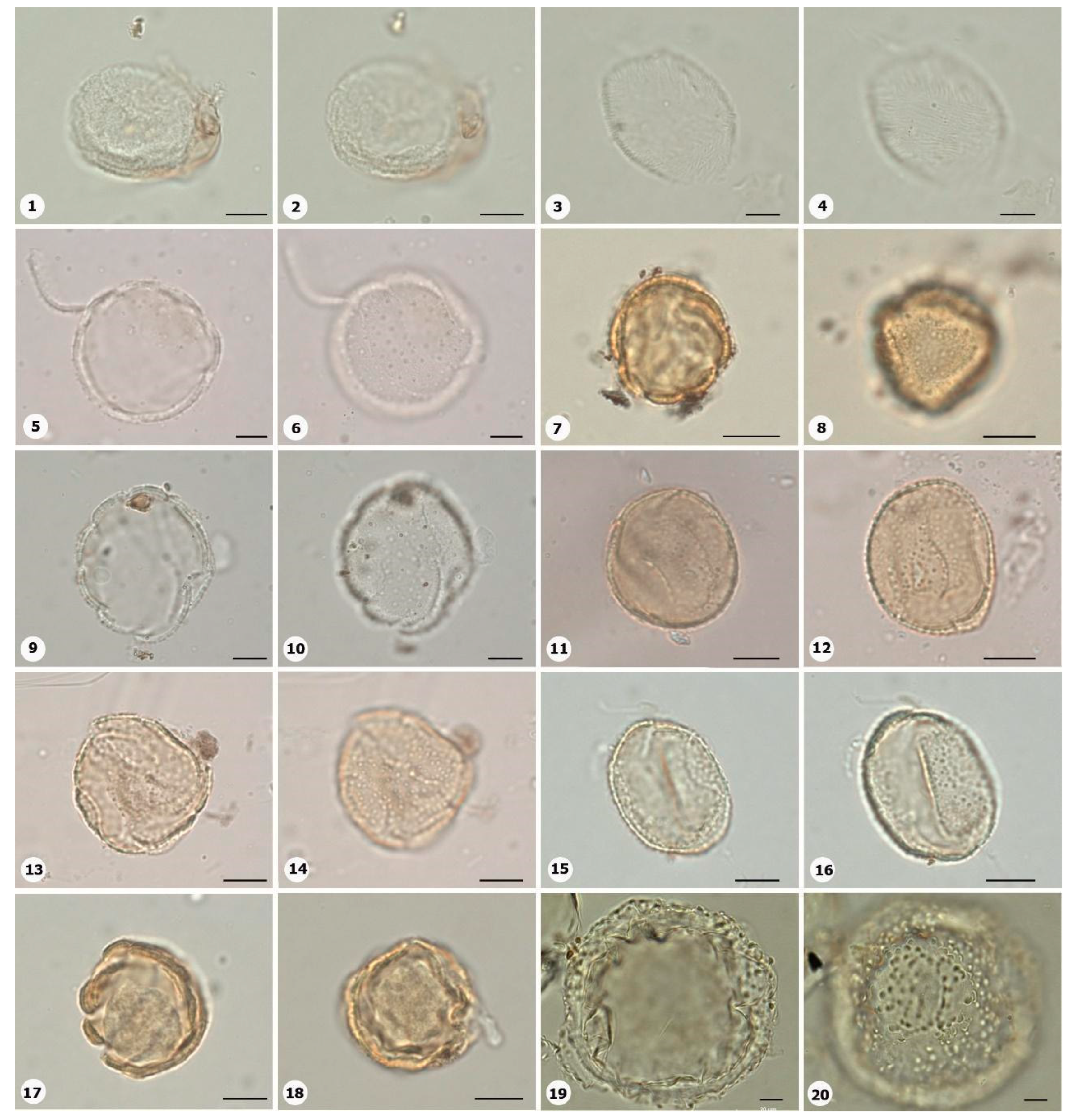
- Order: Poales SmallFamily: Eriocaulaceae MartinovHerbarium number: HCJS 1578Description: Monad, medium; spiral apertures in a crosshatch pattern, with 2–3 apertures; exine 1.8–2 µm thick, tectate.Life form: Herb.Geoenvironment: Poorly drained depressions and levels over plinthosols and histosols.Herbarium number: MG 214910Description: Monad, small; spiral apertures in a crosshatch pattern, with 2–3 apertures; exine 1.2–1.3 µm thick, tectate.Life form: Herb.Geoenvironment: Poorly drained depressions and levels over plinthosols and histosols.Herbarium number: MG 85842Description: Monad, small; spiral apertures in a crosshatch pattern, with 2–3 apertures; exine 1.7–1.8 µm thick, tectate.Life form: Herb.Geoenvironment: Poorly drained depressions and levels over plinthosols and histosols.Herbarium number: HCJS 0541, MG 223908Description: Monad, small; spiral apertures with apertures tracing various designs (many arrangements); spheroidal; exine 1 µm thick, tectate.Life form: Herb.Geoenvironment: Forested slopes and caves over plinthosols and ferralsols, poorly drained depressions and levels over plinthosols and histosols.Herbarium number: MG 214016Description: Monad, small; spiral apertures with apertures tracing various designs (many arrangements); exine 1 µm thick, tectate.Life form: Herb.Geoenvironment: Poorly drained depressions and levels over plinthosols and histosols.Herbarium number: MG 117013Description: Monad, small; spiral apertures with apertures tracing various designs (many arrangements); exine 1 µm thick, tectate.Life form: HerbGeoenvironment: Poorly drained depressions and levels over plinthosols and histosols.Collection number: ITV 1774Description: Monad, small; spiral apertures with apertures tracing various designs (many arrangements); exine 1.2–1.3 µm thick, tectate.Life form: Herb.Geoenvironment: Forested slopes and caves over plinthosols and ferralsols, poorly drained depressions and levels over plinthosols and histosols.
- Order: Zingiberales GrisebachFamily: Heliconiaceae NakaiHerbarium number: MG 251426Description: Monad, large; exine 6.5–7 µm thick, nexine significantly thicker than endexine, tectate.Life form: Herb.Geoenvironment: Forested slopes and caves over plinthosols and ferralsols.
- Order: Poales SmallFamily: Mayacaceae KunthHerbarium number: MG 222303Description: Monad, medium; exine 1.5–1.6 µm thick, tectate.Life form: Herb.Geoenvironment: Poorly drained depressions and levels over plinthosols and histosols, doliniform lakes with organic mud sediment at the bottom.Family: Poaceae BarnhartHerbarium number: MG 116782Description: Monad, medium; pores annulate; exine 1.1–2 µm thick, tectate.Life form: Herb.Geoenvironment: Forested slopes and caves over plinthosols and ferralsols, slopes with canga vegetation over plinthosols.Herbarium number: BHCB 155944Description: Monad, medium; pores annulate; exine 0.7–0.8 µm thick, tectate.Life form: Herb.Geoenvironment: Slopes with canga vegetation over plinthosols.Herbarium number: MG 99379Description: Monad, medium; pores annulate; exine 0.9–1.5 µm thick, tectate.Life form: Herb.Geoenvironment: Slopes with canga vegetation over plinthosols.Herbarium number: MG 147039Description: Monad, medium; pores annulate; exine 0.8–1.3 µm thick, tectate.Life form: Herb.Geoenvironment: Slopes with canga vegetation over plinthosols.
- Herbarium number: MG 213985Description: Monad, medium; pores annulate; exine 1.5 µm thick, tectate.Life form: Herb.Geoenvironment: Slopes with canga vegetation over plinthosols.Herbarium number: HCJS 1740Description: Monad, medium; pores annulate; exine 1.3–1.5 µm thick, tectate.Life form: Herb.Geoenvironment: Forested slopes and caves over plinthosols and ferralsols.Herbarium number: MG 214084Description: Monad, medium; pores annulate; exine 1.3–1.5 µm thick, tectate.Life form: Herb.Geoenvironment: Forested slopes and caves over plinthosols and ferralsols, slopes with canga vegetation over plinthosols.Herbarium number: MG 222316Description: Monad, medium; pores annulate; exine 1 µm thick, tectate.Life form: Herb.Geoenvironment: Slopes with canga vegetation over plinthosols, poorly drained depressions and levels over plinthosols and histosols.Herbarium number: MG 105630Description: Monad, medium; pores annulate; exine 0.9–1.4 µm thick, tectate.Life form: Herb.Geoenvironment: Slopes with canga vegetation over plinthosols, forested slopes and caves over plinthosols and ferralsols, poorly drained depressions and levels over plinthosols and histosols.
- Herbarium number: MG 67183Description: Monad, medium; pores annulate; exine 0.8–1 µm thick, tectate.Life form: Herb.Geoenvironment: Slopes with canga vegetation over plinthosols.Herbarium number: BHCB 139242Description: Monad, medium; pores annulate; exine 1–1.4 µm thick, tectate.Life form: Herb.Geoenvironment: Poorly drained depressions and levels over plinthosols and histosols.Herbarium number: MG 208828Description: Monad, large; pores annulate but some grains are indistinct; exine 2–2.8 µm thick, tectate.Life form: Herb.Geoenvironment: Slopes with canga vegetation over plinthosols.Herbarium number: MG 214010Description: Monad, medium; pores annulate; exine 1.5–3 µm thick, tectate.Life form: Herb.Geoenvironment: Slopes with canga vegetation over plinthosols.Herbarium number: MG 67531Description: Monad, medium; pores annulate; exine 0.9–1.7–3 µm thick, tectate.Life form: Herb.Geoenvironment: Poorly drained depressions and levels over plinthosols and histosols.
- Herbarium number: MG 135244Description: Monad, medium; pores annulate; exine 1.3–3.4 µm thick, tectate.Life form: Herb.Geoenvironment: Poorly drained depressions and levels over plinthosols and histosols.Herbarium number: MG 213981Description: Monad, medium; pores annulate; exine 1.1–1.8 µm thick, tectate.Life form: Herb.Geoenvironment: Forested slopes and caves over plinthosols and ferralsols.Herbarium number: MG 213975Description: Monad, medium; pores with operculum, annulate; exine 1.1–1.7 µm thick, tectate.Life form: Herb.Geoenvironment: Slopes with canga vegetation over plinthosols, poorly drained depressions and levels over plinthosols and histosols.Herbarium number: MG 215537Description: Monad, medium; pores annulate; exine 1–1.5 µm thick, tectate.Life form: Herb.Geoenvironment: Poorly drained depressions and levels over plinthosols and histosols.Herbarium number: MG 213989Description: Monad, medium; pores annulate; exine 1–1.5 µm thick, tectate.Life form: Herb.Geoenvironment: Slopes with canga vegetation over plinthosols, poorly drained depressions and levels over plinthosols and histosols.
- Order: Liliales PerlebFamily: Velloziaceae J.AgardhCollection code: ITV 2114Description: Tetragonal tetrad, large; exine 2.5–3 µm.Life form: Shrub and herb.Geoenvironment: Slopes with canga vegetation over plinthosols.Collection code: ITV 2115Description: Tetragonal tetrad, large; exine 2–2.5 µm, reticulate with lumina of 4–5 µm width.Life form: Shrub and herb.Geoenvironment: Slopes with canga vegetation over plinthosols.
- Order: Poales SmallFamily: Xyridaceae C.AgardhHerbarium number: MG 213994Description: Monads, large; exine 3 µm thick, tectate.Life form: Herb.Geoenvironment: Poorly drained depressions and levels over plinthosols and histosols, doliniform lakes with organic mud sediments at the bottom.Herbarium number: MG 214073Description: Monads, medium; exine 1–2 µm thick, tectate.Life form: Herb.Geoenvironment: Poorly drained depressions and levels over plinthosols and histosols, doliniform lakes with organic mud sediments at the bottom.
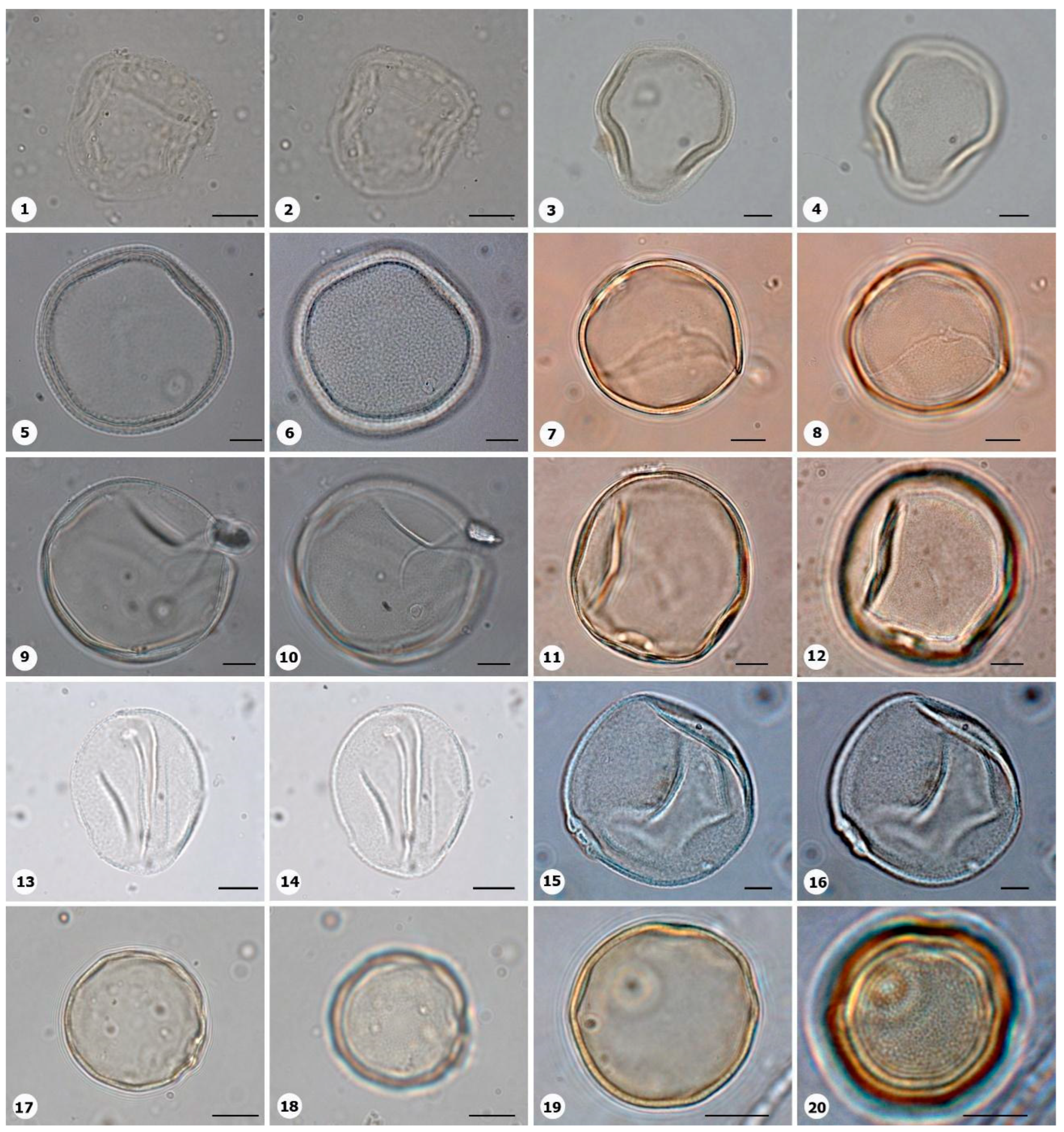
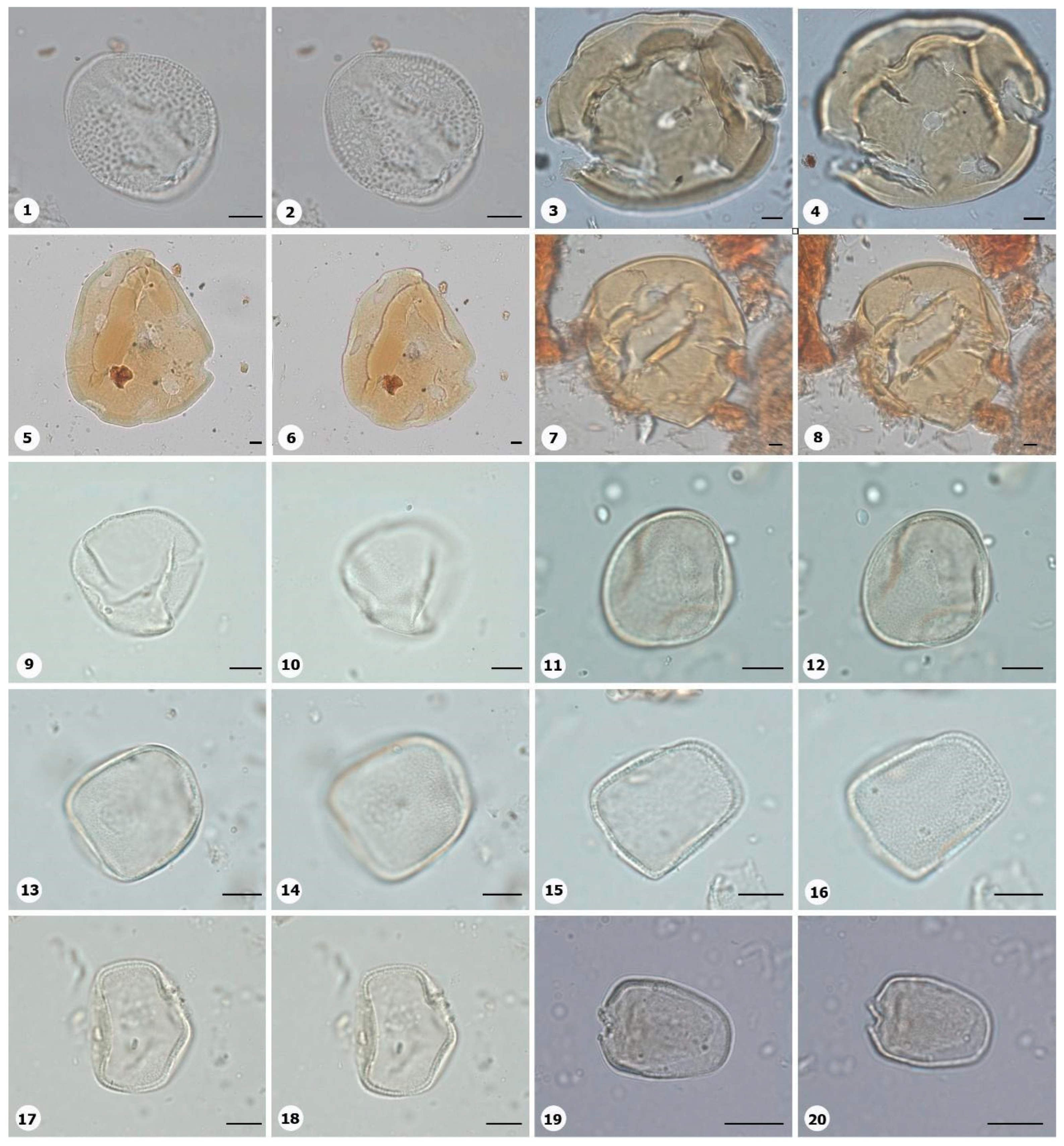
- EUDICOTS AND MAGNOLIIDSOrder: Lamiales BromheadFamily: Acanthaceae Juss.Herbarium number: HCJS 0728Description: Monads, large; brevicolpi; amb elliptical; exine 2–3 µm thick.Life form: Shrub and herb.Geoenvironment: Forested slopes and caves over plinthosols and ferralsols, slopes with canga vegetation over plinthosols.
- Order: Sapindales Juss. ex Bercht. and J. PreslFamily: Anacardiaceae R.Br.Herbarium number: MG 112455Description: Monads, large; amb triangular–obtuse–convex; exine 5–5.6 µm thick, densely columellate, tectate.Life form: Tree.Geoenvironment: Forested slopes and caves over plinthosols and ferralsols, slopes with canga vegetation over plinthosols.
- Order: Magnoliales BromheadFamily: Annonaceae Juss.Herbarium number: HCJS 1436Description: Monads, large; sulci with a prominent zonasulcus; amb elliptical; exine 1–1.5 µm thick.Life form: Tree.Geoenvironment: Forested slopes and caves over plinthosols and ferralsols, slopes with canga vegetation over plinthosols.Herbarium number: MG 59152Description: Monads, medium; pore costate, pore diameter 5 µm; amb circular; exine 2–3 µm thick.Life form: Tree and shrub.Geoenvironment: Forested slopes and caves over plinthosols and ferralsols, slopes with canga vegetation over plinthosols.
- Order: Gentianales Juss. ex Bercht. & J.PreslFamily: Apocynaceae Juss.Herbarium number: MG 222310Description: Monads, very large; 4–5 pores with annuli; amb circular; exine 1.4–2 µm thick, ornamentation psilate and microreticulate near apertural region.Life form: Liana.Geoenvironment: Forested slopes and caves over plinthosols and ferralsols, slopes with canga vegetation over plinthosols.Herbarium number: MG 57360Description: Monads, medium; five pores with prominent annuli; amb circular; exine 2–3 µm thick, tectate.Life form: Liana.Geoenvironment: Poorly drained depressions and levels over plinthosols and histosols.
- Order: Asterales LinkFamily: Asteraceae Bercht. and J.PreslHerbarium number: MG 37869Description: Monad, small; brevicolpi; amb circular; exine 3–4 µm thick, densely columellate.Life form: Herb.Geoenvironment: Forested slopes and caves over plinthosols and ferralsols.Herbarium number: MG 222326Description: Monad, small; brevicolpi; amb circular; exine 3 µm thick, columellate.Life form: Herb.Geoenvironment: Slopes with canga vegetation over plinthosols.Herbarium number: MG 213971Description: Monad, medium; brevicolpi; amb circular; exine 3–3.5 µm thick, columellate.Life form: HerbGeoenvironment: Forested slopes and caves over plinthosols and ferralsols, poorly drained depressions and levels over plinthosols and histosols, doliniform lakes with organic mud sediment at the bottom.Herbarium number: MG 213957Description: Monad, medium; brevicolpi, echinolophate; amb circular; exine 4–6 µm thick, columellate.Life form: Subshrub.Geoenvironment: Slopes with canga vegetation over plinthosols, forested slopes and caves over plinthosols and ferralsols, poorly drained depressions and levels over plinthosols and histosols.Herbarium number: MG 213951Description: Monad, small; brevicolpi; amb circular; exine 3–4 µm thick, columellate.Life form: Herb.Geoenvironment: Forested slopes and caves over plinthosols and ferralsols, slopes with canga vegetation over plinthosols.Herbarium number: MG 222330Description: Monad, medium; brevicolpi, elongated pores; amb circular; exine 2 µm thick, indistinct tectum.Life form: Herb.Geoenvironment: Slopes with canga vegetation over plinthosols, forested slopes and caves over plinthosols and ferralsols, poorly drained depressions and levels over plinthosols and histosols.
- Order: Cucurbitales Juss. ex Bercht. & J.PreslFamily: Begoniaceae C.AgardhHerbarium number: MG 213986Description: Monad, small; amb circular; exine 0.5–1 µm thick, tectate.Life form: Subshrub.Geoenvironment: Slopes with canga vegetation over plinthosols.
- Order: Lamiales BromheadFamily: Bignoniaceae Juss.Collector number: Carreira et al. 3429Description: Monad, very large; eight colpi; amb circular; exine 7–7.5 µm thick, tectate.Life form: Shrub.Geoenvironment: Forested slopes and caves over plinthosols and ferralsols, slopes with canga vegetation over plinthosols.Herbarium number: MG 69537Description: Monad, large; long colpi and pores, costate; amb circular; exine 1–2 µm thick, semitectate, columellate, homobrochate reticulate.Life form: Tree.Geoenvironment: Forested slopes and caves over plinthosols and ferralsols.Herbarium number: MG 72382Description: Monad, medium to large; pores costate; amb circular; exine 1.5–2 µm thick.Life form: Tree.Geoenvironment: Forested slopes and caves over plinthosols and ferralsols.
- Order: Malvales Juss.Family: Bixaceae KunthHerbarium number: MG 116597Description: Monad, large; amb triangular–obtuse–convex; exine 1.5–2 µm thick, tectate, perforate forming equatorial lobes.Life form: Tree.Geoenvironment: Forested slopes and caves over plinthosols and ferralsols.
- Order: Caryophyllales Juss. ex Bercht. and J. PreslFamily: Cactaceae Juss.Herbarium number: HCJS 4810Description: Monad, very large; long colpi; amb circular; exine 2–2.2 µm thick, tectate.Life form: Tree and shrub.Geoenvironment: Slopes with canga vegetation over plinthosols.
- Order: Malpighiales Juss. ex Bercht. and J. PreslFamily: Clusiaceae Lindl.Herbarium number: MG 213956Description: Monad, medium; amb circular; exine 1–1.5 µm thick, tectate.Life form: Tree and shrub.Geoenvironment: Forested slopes and caves over plinthosols and ferralsols, slopes with canga vegetation over plinthosols.
- Order: Solanales Juss. ex Bercht. and J. PreslFamily: Convolvulaceae Juss.Herbarium number: MG 222367Description: Monad, large; brevicolpi; exine 7–8 µm thick, tectate.Life form: Liana.Geoenvironment: Forested slopes and caves over plinthosols and ferralsols, slopes with canga vegetation over plinthosols.
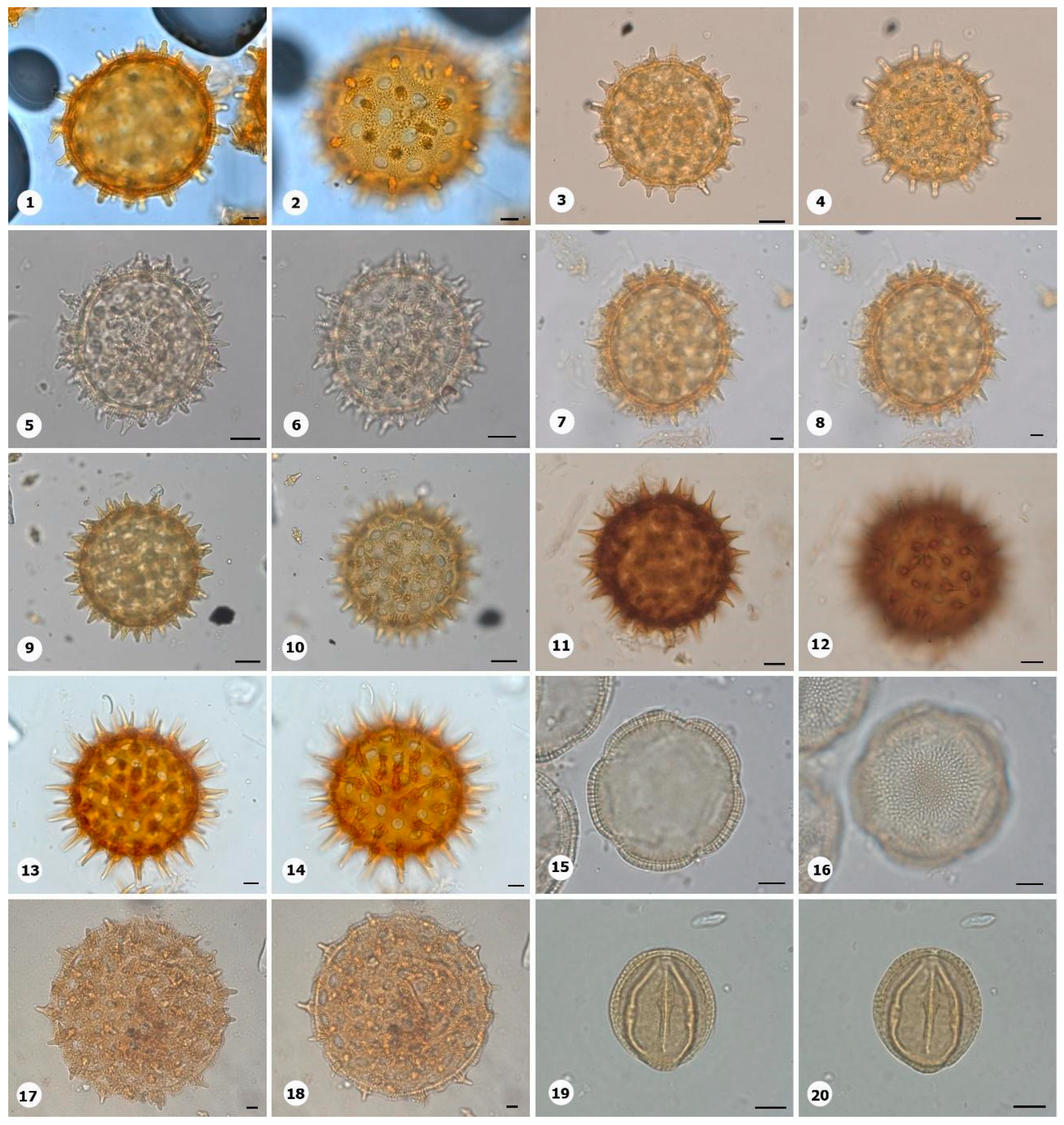
- Herbarium number: MG 215432Description: Monad, medium; amb circular; exine 2–3 µm thick, tectate.Life form: Shrub, subshrub, herb.Geoenvironment: Forested slopes and caves over plinthosols and ferralsols, slopes with canga vegetation over plinthosols.Herbarium number: MG 215937Description: Monad, large; long colpi; amb circular; exine 4–5 µm thick, tectate.Life form: Liana.Geoenvironment: Forested slopes and caves over plinthosols and ferralsols, slopes with canga vegetation over plinthosols.Herbarium number: MG 215006Description: Monad, medium; brevicolpi; exine 1–2 µm thick, tectate.Life form: Herb.Geoenvironment: Forested slopes and caves over plinthosols and ferralsols, slopes with canga vegetation over plinthosols.Herbarium number: MG 214054Description: Monad, large; five brevicolpi; amb circular; exine 4–5 µm thick, tectate.Life form: Shrub, subshrub, herb.Geoenvironment: Forested slopes and caves over plinthosols and ferralsols, slopes with canga vegetation over plinthosols.Herbarium number: MG 226331Description: Monad, large; large pores; exine 6 µm thick, granules are secondary in the ornamentation, conical echinae.Life form: Liana.Geoenvironment: Forested slopes and caves over plinthosols and ferralsols, slopes with canga vegetation over plinthosols.Herbarium number: MG 214004Description: Monad, large; large pores; exine 6.5–8 µm thick, granules are secondary in the ornamentation, conical echinae.Life form: Liana.Geoenvironment: Forested slopes and caves over plinthosols and ferralsols, slopes with canga vegetation over plinthosols.
- Herbarium number: MG 215128Description: Monad, large to very large; large pores; exine 4–7 µm thick, granules are secondary in the ornamentation, bulbous echinae (type 3).Life form: Liana.Geoenvironment: Slopes with canga vegetation over plinthosols, forested slopes and caves over plinthosols and ferralsols, poorly drained depressions and levels over plinthosols and histosols.Herbarium number: MG 223638Description: Monad, large; large pores; exine 6 µm thick, granules are secondary in the ornamentation, bulbous echinae (type 2).Life form: Liana.Geoenvironment: Forested slopes and caves over plinthosols and ferralsols, slopes with canga vegetation over plinthosols.
- Herbarium number: MG 213191Description: Monad, large to very large; large pores; exine 8–9 µm thick, granules are secondary in the ornamentation, bulbous echinae (type 2).Life form: Liana.Geoenvironment: Forested slopes and caves over plinthosols and ferralsols, slopes with canga vegetation over plinthosols.Herbarium number: MG 227195Description: Monad, very large; large pores; exine 7–8 µm thick, granules are secondary in the ornamentation, bulbous echinae (type 1).Life form: Liana.Geoenvironment: Forested slopes and caves over plinthosols and ferralsols, slopes with canga vegetation over plinthosols.Herbarium number: MG 227199Description: Monad, very large; large pores; exine 7–9 µm thick, granules are secondary in the ornamentation, bulbous echinae (type 2).Life form: Liana.Geoenvironment: Forested slopes and caves over plinthosols and ferralsols, slopes with canga vegetation over plinthosols.Herbarium number: MG 222344Description: Monad, large to very large; large pores; exine 8–9 µm thick, conical echinae.Life form: Liana.Geoenvironment: Forested slopes and caves over plinthosols and ferralsols, slopes with canga vegetation over plinthosols.Herbarium number: MG 165270Description: Monad, large to very large; large pores; exine 7–8 µm thick, columellate near echinae region, conical echinae.Life form: Herb and liana.Geoenvironment: Forested slopes and caves over plinthosols and ferralsols, slopes with canga vegetation over plinthosols.Herbarium number: MG 223119Description: Monad, large; 4–5 colporus, brevicolpi; spheroidal; exine 4–5 µm thick, columellate, tectate.Life form: Liana.Geoenvironment: Forested slopes and caves over plinthosols and ferralsols, slopes with canga vegetation over plinthosols.Herbarium number: MG 165294Description: Monad, large to very large; large pores; exine 7–8 µm thick, columellate near echinae region, bulbous echinae (Type 2).Life form: Liana.Geoenvironment: Forested slopes and caves over plinthosols and ferralsols, slopes with canga vegetation over plinthosols.
- Order: Malpighiales Juss. ex Bercht. & J. PreslFamily: Erythroxylaceae KunthHerbarium number: MG 22354Description: Monad, medium; pores costate; amb circular; exine 2–3 µm thick, columellate, semitectate, heterobrochate reticulate, larger lumina in the apocolpium region.Life form: Shrub.Geoenvironment: Slopes with canga vegetation over plinthosols, poorly drained depressions and levels over plinthosols and histosols.
- Herbarium number: MG 112462Description: Monad, large; amb circular; exine 3–4 µm thick, columellate, tectate, columellate, heterobrochate reticulate.Life form: Tree and shrub.Geoenvironment: Slopes with canga vegetation over plinthosols, poorly drained depressions and levels over plinthosols and histosols.
- Family: Euphorbiaceae Juss.Herbarium number: MG 86323Description: Monad, medium; amb circular; exine 1.5–2 µm thick, tectate.Life form: Tree.Geoenvironment: Slopes with canga vegetation over plinthosols, poorly drained depressions and levels over plinthosols and histosols.Herbarium number: MG 131797Description: Monad, medium; operculate pores; amb triangular–obtuse–convex to straight; exine 2–2.6 µm thick, tectate.Life form: Tree and shrub.Geoenvironment: Forested slopes and caves over plinthosols and ferralsols.Herbarium number: MG 213977Description: Monad, large; exine 4 µm thick, columellate, capitate columellae, croton pattern.Life form: Shrub and herb.Geoenvironment: Forested slopes and caves over plinthosols and ferralsols, slopes with canga vegetation over plinthosols.Herbarium number: MG 59033Description: Monad, large; lalongate endoaperture; amb triangular–obtuse–convex; exine 3–4 µm thick, columellate, tectate.Life form: Tree and shrub.Geoenvironment: Forested slopes and caves over plinthosols and ferralsols, slopes with canga vegetation over plinthosols.
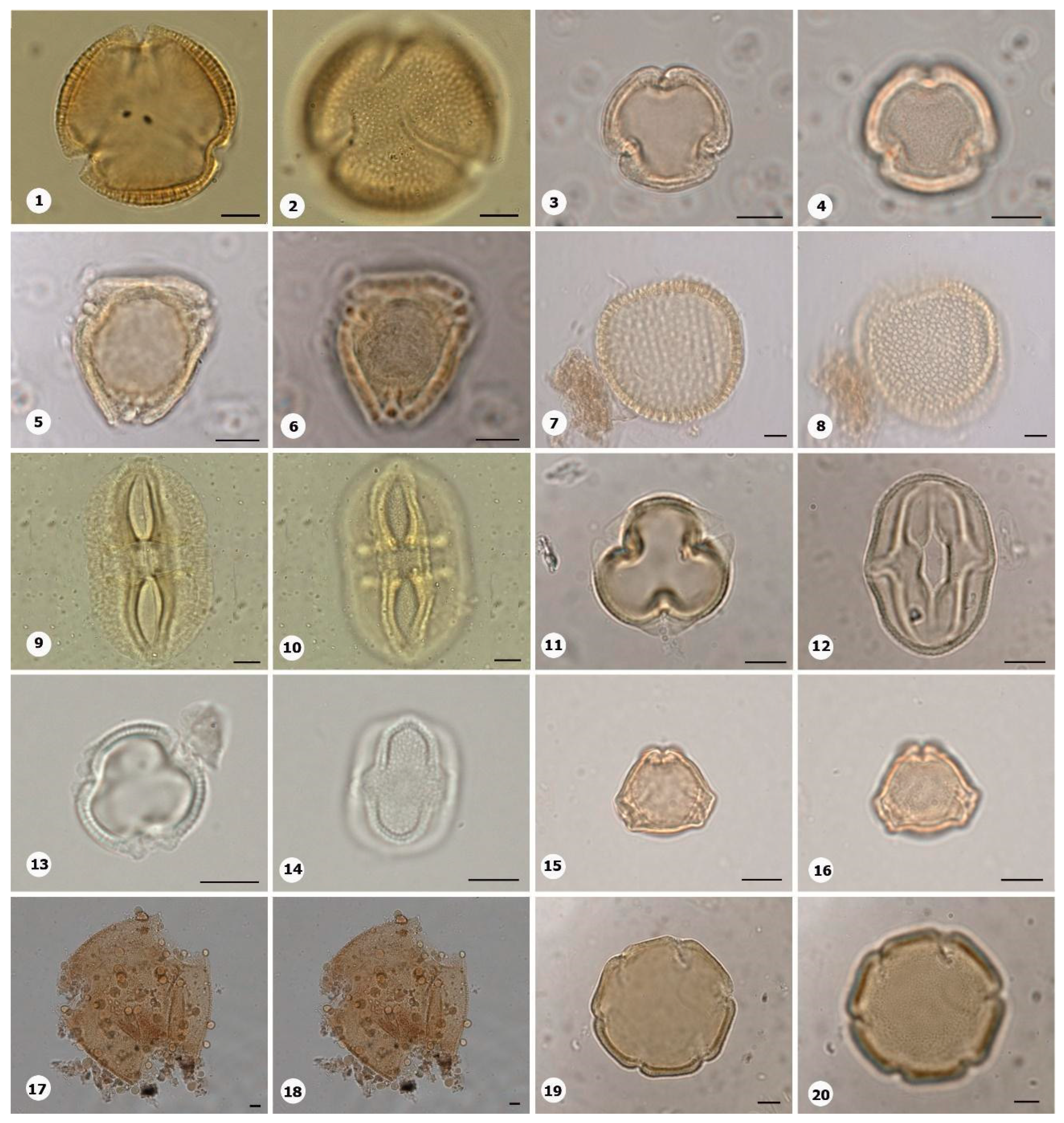
- Order: Fabales BromheadFamily: Fabaceae Juss.Herbarium number: MG 222313Description: Monad, medium; lalongate endoaperture; amb circular; exine 1.5–2 µm thick, columellate.Life form: Liana.Geoenvironment: Forested slopes and caves over plinthosols and ferralsols, slopes with canga vegetation over plinthosols.Herbarium number: MG 222328Description: Monad, small; colpi with margo; amb circular, subprolate; exine 1 µm thick, columellate, tectate, heterobrochate reticulate.Life form: Subshrub.Geoenvironment: Slopes with canga vegetation over plinthosols, poorly drained depressions and levels over plinthosols and histosols.Herbarium number: IAN 195824Description: Monad, small; pores annulate; amb triangular–obtuse–convex; exine 1 µm thick, tectate.Life form: Tree.Geoenvironment: Forested slopes and caves over plinthosols and ferralsols.Herbarium number: INPA 139259Description: Monad, very large; long colpi, large pores; amb triangular–obtuse–convex; exine 7–8 µm thick, columellate.Life form: Tree and shrub.Geoenvironment: Poorly drained depressions and levels over plinthosols and histosols, forested slopes and caves over plinthosols and ferralsols, slopes with canga vegetation over plinthosols, doliniform lakes with organic mud sediments at the bottom.Herbarium number: MG 214006Description: Monad, large; six colpi, brevicolpate; amb hexangular; exine 2–3 µm thick, tectate.Life form: Liana.Geoenvironment: Slopes with canga vegetation over plinthosols, forested slopes and caves over plinthosols and ferralsols, poorly drained depressions and levels over plinthosols and histosols.
- Herbarium number: MG 36728Description: Monad, large; amb triangular–obtuse–convex; exine 1.5–2 µm thick, tectate, heterobrochate reticulate.Life form: Shrub and subshrub.Geoenvironment: Slopes with canga vegetation over plinthosols, forested slopes and caves over plinthosols and ferralsols, poorly drained depressions and levels over plinthosols and histosols.Herbarium number: MG 214058Description: Monad, large; pores costate; amb triangular–obtuse–convex; exine 2–2.5 µm thick, tectate.Life form: Shrub and subshrub.Geoenvironment: Slopes with canga vegetation over plinthosols.Herbarium number: MG 213980Description: Monad, large; pores costate; amb triangular–obtuse–convex; exine 3 µm thick, tectate.Life form: Shrub and subshrub.Geoenvironment: Slopes with canga vegetation over plinthosols, forested slopes and caves over plinthosols and ferralsols, poorly drained depressions and levels over plinthosols and histosols.Herbarium number: MG 214055Description: Monad, large; lalongate endoaperture; amb triangular–obtuse–convex; exine 2–2.5 µm thick, tectate.Life form: Shrub and subshrub.Geoenvironment: Slopes with canga vegetation over plinthosols, forested slopes and caves over plinthosols and ferralsols, poorly drained depressions and levels over plinthosols and histosols.
- Herbarium number: IAN 195827Description: Monad, large; five colpi; amb circular; exine 1.5–2 µm thick, tectate.Life form: Tree.Geoenvironment: Slopes with canga vegetation over plinthosols.Herbarium number: MG 116170Description: Monad, medium; amb triangular–obtuse–straight; exine 1–1.5 µm thick, tectate.Life form: Tree and shrub.Geoenvironment: Forested slopes and caves over plinthosols and ferralsols, slopes with canga vegetation over plinthosols.Herbarium number: MG 222334Description: Monad, large; pores costate; amb triangular–obtuse–convex; exine 1.5–2 µm thick, columellate.Life form: Subshrub.Geoenvironment: Slopes with canga vegetation over plinthosols.Herbarium number: MG 214377Description: Monad, large; amb triangular–obtuse–straight; exine 5 µm thick, tectate, predominantly reticulate in the apocolpial field.Life form: Liana.Geoenvironment: Slopes with canga vegetation over plinthosols, forested slopes and caves over plinthosols and ferralsols, poorly drained depressions and levels over plinthosols and histosols.Herbarium number: MG 213961Description: Monad, large; amb triangular–obtuse–straight; exine 4 µm thick, tectate.Life form: Liana.Geoenvironment: Slopes with canga vegetation over plinthosols.Herbarium number: MG 33470Description: Monad, large, isopolar; colpi marginate; amb triangular–obtuse–convex; exine 2.5 µm thick, columellate.Life form: Tree.Geoenvironment: Forested slopes and caves over plinthosols and ferralsols.
- Herbarium number: MG 213962Description: Tetragonal tetrad, small; tetrad calymmate; exine 0.6–0.7 µm thick.Life form: Tree and shrub.Geoenvironment: Slopes with canga vegetation over plinthosols, forested slopes and caves over plinthosols and ferralsols, poorly drained depressions and levels over plinthosols and histosols.Herbarium number: MG 222306Description: Tetrahedral tetrad, very small; tetrad calymmate; exine 0.5–0.8 µm thick.Life form: Shrub and herb.Geoenvironment: Poorly drained depressions and levels over plinthosols and histosols, forested slopes and caves over plinthosols and ferralsols, slopes with canga vegetation over plinthosols, doliniform lakes with organic mud sediments at the bottom.Herbarium number: MG 213978Description: Tetragonal tetrad, very small; tetrad calymmate; exine 0.5 µm thick.Life form: Shrub and herb.Geoenvironment: Slopes with canga vegetation over plinthosols, forested slopes and caves over plinthosols and ferralsols, poorly drained depressions and levels over plinthosols and histosols.
- Herbarium number: MG 213987Description: Tetragonal tetrad, small, apolar; tetrad calymmate; exine 1 µm thick.Life form: Shrub and subshrub.Geoenvironment: Slopes with canga vegetation over plinthosols, forested slopes and caves over plinthosols and ferralsols, poorly drained depressions and levels over plinthosols and histosols.Herbarium number: MG 22307Description: Tetragonal tetrad, small; tetrad calymmate; exine 0.5–1 µm thick.Life form: Shrub and subshrub.Geoenvironment: Slopes with canga vegetation over plinthosols, forested slopes and caves over plinthosols and ferralsols, poorly drained depressions and levels over plinthosols and histosols.Herbarium number: MG 198053Description: Tetragonal tetrad, very small; tetrad calymmate; exine 0.5 µm thick.Life form: Subshrub.Geoenvironment: Slopes with canga vegetation over plinthosols, forested slopes and caves over plinthosols and ferralsols, poorly drained depressions and levels over plinthosols and histosols.Herbarium number: MG 112372Description: Polyads, very large; polyads calymmate with > 20 united grains; exine 3.5–5 µm thick.Life form: Tree.Geoenvironment: Poorly drained depressions and levels over plinthosols and histosols, forested slopes and caves over plinthosols and ferralsols, slopes with canga vegetation over plinthosols, doliniform lakes with organic mud sediments at the bottom.Herbarium number: MG 99510Description: Monad, large; long colpi, marginate, pores large; amb triangular–obtuse–straight; exine 3 µm thick.Life form: Liana.Geoenvironment: Slopes with canga vegetation over plinthosols, forested slopes and caves over plinthosols and ferralsols, poorly drained depressions and levels over plinthosols and histosols.Herbarium number: MG 213963Description: Monad, medium; colpi marginate; amb triangular–obtuse–convex; exine 1.5–2 µm thick.Life form: Shrub and subshrub.Geoenvironment: Slopes with canga vegetation over plinthosols, forested slopes and caves over plinthosols and ferralsols, poorly drained depressions and levels over plinthosols and histosols.Herbarium number: MG 30663Description: Monad, medium; colpi marginate; amb circular; exine 2–2.5 µm thick, heterobrochate reticulate.Life form: Tree and shrub.Geoenvironment: Forested slopes and caves over plinthosols and ferralsols.
- Herbarium number: MG 3175Description: Monad, medium; pores costate; amb triangular–obtuse–convex; exine 2–2.5 µm thick.Life form: Tree and shrub.Geoenvironment: Forested slopes and caves over plinthosols and ferralsols, slopes with canga vegetation over plinthosols.Herbarium number: IAN 195829Description: Monad, medium; brevicolpi; circular; exine 2–2.5 µm thick.Life form: Tree.Geoenvironment: Exotic species, forested slopes and caves over plinthosols and ferralsols, slopes with canga vegetation over plinthosols.Herbarium number: MG 147939Description: Polyads, medium; polyads calymmate with 16 united grains; exine 1–1.5 µm thick.Life form: Tree.Geoenvironment: Forested slopes and caves over plinthosols and ferralsols.Herbarium number: MG 120653Description: Monad, large; amb elliptical; exine 2–2.5 µm thick, columellate.Life form: Subshrub.Geoenvironment: Slopes with canga vegetation over plinthosols.Herbarium number: MG 59069Description: Monad, medium; colpi slightly marginate; amb circular; exine 2–2.5 µm thick, columellate.Life form: Tree.Geoenvironment: Forested slopes and caves over plinthosols and ferralsols, slopes with canga vegetation over plinthosols.
- Order: Gentianales Juss. ex Bercht. & J.PreslFamily: Gentianaceae Juss.Herbarium number: MG 214028Description: Tetrahedral tetrad, large; colpi marginate, calymmate; triangular in lateral view; 4–5 µm thick, tectate, columellate.Life form: Tree.Geoenvironment: Slopes with canga vegetation over plinthosols.Herbarium number: MG 214028Description: Tetrahedral tetrad, large; colpi marginate, calymmate; triangular in lateral view; 5–6 µm thick, tectate, columellate, curvimurate.Life form: Herb.Geoenvironment: Slopes with canga vegetation over plinthosols, poorly drained depressions and levels over plinthosols and histosols.
- Order: Malpighiales Juss. ex Bercht. & J.PreslFamily: Hypericaceae Juss.Herbarium number: MG 87024Description: Monad, medium to large; colpi marginate; amb circular; exine 1–1.5 µm thick, tectate, columellate, heterobrochate reticulate, microreticulate near margines.Life form: Tree.Geoenvironment: Forested slopes and caves over plinthosols and ferralsols.Order: Lamiales BromheadFamily: Lamiaceae Lindl.Herbarium number: MG 87024Description: Monad, medium; six long colpi; amb circular; exine 2.5–3 µm thick, tectate, columellate heterobrochate reticulate.Life form: Herb.Geoenvironment: Poorly drained depressions and levels over plinthosols and histosols.Herbarium number: MG 120793Description: Monad, medium; six long colpi; amb circular; exine 2.5–3 µm thick, tectate, columellate, heterobrochate reticulate.Life form: Herb.Geoenvironment: Forested slopes and caves over plinthosols and ferralsols.
- Order: Ericales Mart.Family: Lecythidaceae A.Juss.Herbarium number: MG 60382Description: Monad, medium; amb triangular–obtuse–convex; exine 2 µm thick, tectate, columellate.Life form: Tree.Geoenvironment: Forested slopes and caves over plinthosols and ferralsols.
- Order: Lamiales BromheadFamily: Lentibulariaceae RichHerbarium number: MG 222342Description: Monad, small, isopolar; 8–9 colporus; amb circular; exine 1 µm thick, tectate.Life form: Herb.Geoenvironment: Poorly drained depressions and levels over plinthosols and histosols, doliniform lakes with organic mud sediment at the bottom.Herbarium number: MG 213996Description: Monad, small; 9–10 colpi; amb circular; exine 0.5–0.7 µm thick, tectate.Life form: Herb.Geoenvironment: Poorly drained depressions and levels over plinthosols and histosols, doliniform lakes with organic mud sediment at the bottom.Herbarium number: MG 214072Description: Monad, medium; 13–15 colporus; amb circular; exine 1.5–2 µm thick, tectate.Life form: Herb.Geoenvironment: Poorly drained depressions and levels over plinthosols and histosols, doliniform lakes with organic mud sediment at the bottom.
- Order: Myrtales Juss. ex Bercht. & J.PreslFamily: Lythraceae J.St.-Hil.Herbarium number: MG 213965Description: Monad, medium; short colpi, protruding pores; amb triangular–obtuse–straight; exine 1–3 µm thick, thickening in the region between the endoapertures, tectate.Life form: Shrub and subshrub.Geoenvironment: Slopes with canga vegetation over plinthosols, poorly drained depressions and levels over plinthosols and histosols.
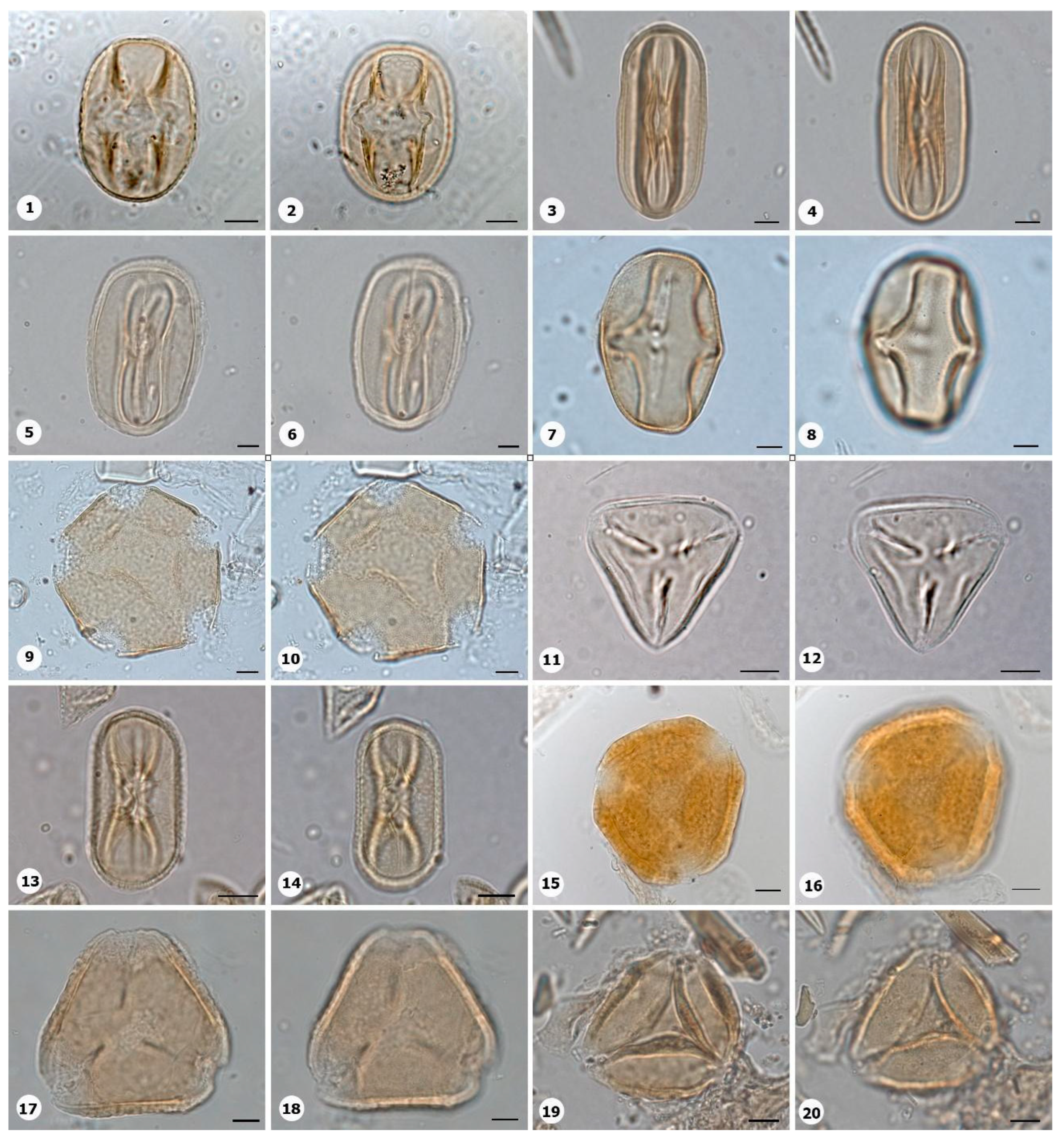
- Herbarium number: MG 222339Description: Monad, medium; short colpi, protruding and large pores with 4–5 µm diameter; amb triangular–obtuse–straight; exine 1–3 µm thick, thickening in the region between the endoapertures, tectate.Life form: Shrub and subshrub.Geoenvironment: Slopes with canga vegetation over plinthosols, forested slopes and caves over plinthosols and ferralsols, poorly drained depressions and levels over plinthosols and histosols.Herbarium number: MG 214023Description: Monad, medium; short colpi, protruding pores; amb triangular–obtuse–straight; exine 1–3 µm thick, thickening in the region between the endoapertures, tectate.Life form: Shrub, subshrub, herb.Geoenvironment: Slopes with canga vegetation over plinthosols, forested slopes and caves over plinthosols and ferralsols, poorly drained depressions and levels over plinthosols and histosols.Herbarium number: MG 214065Description: Monad, small; colpi marginate; amb triangular–obtuse–convex; exine 1–3 µm thick.Life form: Shrub, subshrub, herb.Geoenvironment: Slopes with canga vegetation over plinthosols, forested slopes and caves over plinthosols and ferralsols, poorly drained depressions and levels over plinthosols and histosols.Herbarium number: MG 213967Description: Monad, medium; brevicolpi, protruding pores; amb triangular–obtuse–concave; exine 1–2 µm thick, tectate.Life form: Shrub, subshrub, herb.Geoenvironment: Slopes with canga vegetation over plinthosols, forested slopes and caves over plinthosols and ferralsols, poorly drained depressions and levels over plinthosols and histosols.
- Order: Malpighiales Juss. ex Bercht. & J.PreslFamily: Malpighiaceae Juss.Herbarium number: MG 213959Description: Monad, large; large pores, pseudocolpate; exine 3–4 µm thick, tectate.Life form: Shrub, subshrub, liana.Geoenvironment: Slopes with canga vegetation over plinthosols.
- Herbarium number: MG 222352Description: Monad, large; large pores, pseudocolpate; exine 8–9 µm thick, tectate.Life form: Shrub and subshrub.Geoenvironment: Forested slopes and caves over plinthosols and ferralsols, slopes with canga vegetation over plinthosols.Herbarium number: MG 214076
- Description: Monad, large; large pores, pseudocolpate; exine 5–6 µm thick, tectate.Life form: Shrub, subshrub, liana.Geoenvironment: Forested slopes and caves over plinthosols and ferralsols, slopes with canga vegetation over plinthosols.Herbarium number: MG 125695Description: Monad, small; protruding pores, brevicolpi; amb circular; exine 1 µm thick, tectate, columellate.Life form: Tree and shrub.Geoenvironment: Poorly drained depressions and levels over plinthosols and histosols.Herbarium number: IAN 195825Description: Monad, small; protruding pores, brevicolpi; amb circular; exine 1 µm thick, tectate, columellate.Life form: Tree.Geoenvironment: Slopes with canga vegetation over plinthosols.Herbarium number: MG 85808Description: Monad, large; pantoporate, large pores, pseudocolpate; exine 5–6 µm thick, tectate.Life form: Liana.Geoenvironment: Forested slopes and caves over plinthosols and ferralsols, slopes with canga vegetation over plinthosols.Herbarium number: MG 30032Description: Monad, small; protruding pores, brevicolpi; amb circular; exine 1.5–1.7 µm thick, tectate, columellate.Life form: Tree.Geoenvironment: Forested slopes and caves over plinthosols and ferralsols.
- Order: Malvales Juss.Family: Malvaceae Juss.Herbarium number: MG 30109Description: Monad, small; amb circular; exine 1.5 µm thick, tectate, heterobrochate reticulate.Life form: Tree.Geoenvironment: Slopes with canga vegetation over plinthosols.Herbarium number: MG 222336Description: Monad, large; brevicolpi, lalongate endoaperture; amb circular; exine 2–3 µm thick, tectate, columellate.Life form: Tree and shrub.Geoenvironment: Poorly drained depressions and levels over plinthosols and histosols.Herbarium number: HCJS 023Description: Monad, medium to large; brevicolpi, protruding pores; amb triangular–obtuse–convex; exine 2–3 µm thick, tectate, columellate, reticulate near the apertural region.Life form: Tree and shrub.Geoenvironment: Poorly drained depressions and levels over plinthosols and histosols.Herbarium number: IAN 195841Description: Monad, small to medium; brevicolpi, lalongate endoaperture; amb circular; exine 1–1.5 µm thick, tectate, columellate, heterobrochate reticulate.Life form: Tree.Geoenvironment: Forested slopes and caves over plinthosols and ferralsols.
- Order: Ericales Bercht. & J.PreslFamily: Marcgraviaceae Bercht. & J.PreslHerbarium number: MG 123123Description: Monad, medium; brevicolpi; amb circular; exine 3.5–4 µm thick, tectate, columellate.Life form: Liana.Geoenvironment: Slopes with canga vegetation over plinthosols.
- Order: Myrtales Juss. ex Bercht. & J.PreslFamily: Melastomataceae Juss.Herbarium number: MG 214002Description: Monad, medium; pseudocolpi, lalongate endoaperture; amb circular; exine 2 µm thick, tectate.Life form: Tree and shrub.Geoenvironment: Forested slopes and caves over plinthosols and ferralsols, slopes with canga vegetation over plinthosols.Herbarium number: MG 214035Description: Monad, small; pores slightly costate, three pseudocolpi; amb circular; exine 1–1.5 µm thick, tectate.Life form: Tree.Geoenvironment: Forested slopes and caves over plinthosols and ferralsols, slopes with canga vegetation over plinthosols.
- Order: Sapindales Juss. ex Bercht. & J.PreslFamily: Meliaceae Juss.Herbarium number: MG 77934Description: Monad, large; four brevicolpi, marginate; amb circular; exine 2–4 µm thick, tectate, columellate.Life form: Tree.Geoenvironment: Managed species, forested slopes and caves over plinthosols and ferralsols.
- Order: Asterales LinkFamily: Menyanthaceae Dumort.Species: Nymphoides humboldtiana (Kunth) Kuntze (Figure 19: 9–10)Herbarium number: MG 214022Description: Monad, small; large colpi, marginate; amb triangular–obtuse–straight; exine 2 µm thick, tectate, columellate.Life form: Herb.Geoenvironment: Doliniform lakes with organic mud sediments at the bottom.
- Order: Magnoliales BromheadFamily: Myristicaceae R.Br.Herbarium number: IAN 146780Description: Monad, medium; large colpi, marginate; amb triangular–obtuse–straight; exine 1.5–2 µm thick, tectate, columellate, heterobrochate reticulate.Life form: Tree.Geoenvironment: Forested slopes and caves over plinthosols and ferralsols.
- Order: Myrtales Juss. ex Bercht. & J. PreslFamily: Myrtaceae Juss.Herbarium number: MG 112463Description: Monad, small; three colpi; amb triangular–obtuse–convex; exine 1 µm thick, tectate.Life form: Tree and shrub.Geoenvironment: Forested slopes and caves over plinthosols and ferralsols, slopes with canga vegetation over plinthosols.Herbarium number: MG 174698Description: Monad, small to medium; 3–4 colpi; amb triangular–obtuse–concave to quadrangular; exine 1 µm thick, tectate.Life form: Tree and shrub.Geoenvironment: Forested slopes and caves over plinthosols and ferralsols, slopes with canga vegetation over plinthosols.Herbarium number: MG 112459Description: Monad, small; three colpi; amb triangular–obtuse–straight; exine 1.5–2 µm thick, tectate.Life form: Tree and shrub.Geoenvironment: Slopes with canga vegetation over plinthosols, forested slopes and caves over plinthosols and ferralsols, poorly drained depressions and levels over plinthosols and histosols.
- Family: Passifloraceae Juss. ex RousselHerbarium number: MG 216102Description: Monad, large; 3-mesocolpi fused in pairs; amb circular; exine 9–10 µm thick, tectate, columellate, curvimurate, sometimes bacula are observed.Life form: Liana.Geoenvironment: Forested slopes and caves over plinthosols and ferralsols, slopes with canga vegetation over plinthosols.
- Herbarium number: MG 216123Description: Monad, large; 3-mesocolpi fused in pairs; amb circular; exine 8–9 µm thick, tectate, columellate, curvimurate, sometimes bacula are observed.Life form: Liana.Geoenvironment: Forested slopes and caves over plinthosols and ferralsols, slopes with canga vegetation over plinthosols.
- Family: Phyllanthaceae MartinovHerbarium number: MG 216123Description: Monad, medium; pores costate, marginate; amb elliptical; exine 1 µm thick, tectate, columellate, heterobrochate reticulate.Life form: Shrub and herb.Geoenvironment: Poorly drained depressions and levels over plinthosols and histosols.
- Order: Fabales BromheadFamily: Polygalaceae Hoffmanns. & LinkHerbarium number: MG 222363Description: Monad, large to very large; 12 colporus, zonorate; amb elliptical; exine 4–5 µm thick, tectate.Life form: Subshrub.Geoenvironment: Slopes with canga vegetation over plinthosols, poorly drained depressions and levels over plinthosols and histosols.
- Herbarium number: MG 222364Description: Monad, medium; 12 colporus, zonorate; amb elliptical; exine 2–3 µm thick, tectate.Life form: Liana.Geoenvironment: Slopes with canga vegetation over plinthosols, poorly drained depressions and levels over plinthosols and histosols.Herbarium number: MG 222337Description: Monad, large; 12 colporus, zonorate; amb elliptical; exine 3–4 µm thick, tectate.Life form: Herb.Geoenvironment: Slopes with canga vegetation over plinthosols, poorly drained depressions and levels over plinthosols and histosols.
- Order: Gentianales Juss. ex Bercht. & J. PreslFamily: Rubiaceae Juss.Herbarium number: MG 115799Description: Monad, medium; exine 3–3.5 µm thick, tectate, columellate.Life form: Subshrub.Geoenvironment: Slopes with canga vegetation over plinthosols, poorly drained depressions and levels over plinthosols and histosols.Herbarium number: MG 222332Description: Monad, medium; exine 2–3 µm thick, tectate, columellate.Life form: Subshrub.Geoenvironment: Poorly drained depressions and levels over plinthosols and histosols, forested slopes and caves over plinthosols and ferralsols, slopes with canga vegetation over plinthosols, doliniform lakes with organic mud sediments at the bottom.Herbarium number: MG 115799Description: Monad, large; exine 4 µm thick, tectate, columellate.Life form: Shrub and herb.Geoenvironment: Poorly drained depressions and levels over plinthosols and histosols.Herbarium number: MG 214083Description: Monad, small; exine 2–2.5 µm thick, tectate, columellate.Life form: Shrub and herb.Geoenvironment: Slopes with canga vegetation over plinthosols, forested slopes and caves over plinthosols and ferralsols, poorly drained depressions and levels over plinthosols and histosols.Herbarium number: MG 213972Description: Monad, medium; 5–7 brevicolpi; exine 2 µm thick, tectate, columellate.Life form: Herb.Geoenvironment: Slopes with canga vegetation over plinthosols, poorly drained depressions and levels over plinthosols and histosols.
- Herbarium number: IAN 195851Description: Monad, medium; lalongate endoaperture, colpi slightly marginate; amb circular; exine 2 µm thick, tectate, columellate, heterobrochate reticulate.Life form: Shrub.Geoenvironment: Anthropic areas.Herbarium number: MG 208513Description: Monad, small; five brevicolpi; amb circular; exine 2–3 µm thick, tectate, columellate.Life form: Herb.Geoenvironment: Slopes with canga vegetation over plinthosols, doliniform lakes with organic mud sediments at the bottom.
- Herbarium number: MG 222331Description: Monad, medium; 4–5 brevicolpi; amb circular; exine 3 µm thick, tectate, columellate.Life form: Herb.Geoenvironment: Slopes with canga vegetation over plinthosols, poorly drained depressions and levels over plinthosols and histosols.Collection number: ITV 2116Description: Monad, medium; brevicolpi, protruding large pores; amb circular; exine 3 µm thick, tectate, columellate.Life form: Herb.Geoenvironment: Slopes with canga vegetation over plinthosols, poorly drained depressions and levels over plinthosols and histosols.Herbarium number: MG 214024Description: Monad, medium; exine 2.5–3 µm thick, tectate, columellate.Life form: Shrub, subshrub, herb.Geoenvironment: Doliniform lakes with organic mud sediments at the bottom.Herbarium number: MG 222338Description: Monad, medium; exine 2.5 µm thick, tectate, columellate.Life form: Shrub, subshrub, herb.Geoenvironment: Slopes with canga vegetation over plinthosols.
- Order: Sapindales Juss. ex Bercht. & J. PreslFamily: Rutaceae Juss.Herbarium number: MG 37903Description: Monad, medium; amb elliptical; exine 2 µm thick, columellate, heterobrochate reticulate, sometimes curvimurate.Life form: Tree.Geoenvironment: Forested slopes and caves over plinthosols and ferralsols.Herbarium number: MG 222372Description: Monad, medium; pores costate; amb elliptical; exine 2 µm thick, columellate, heterobrochate reticulate.Life form: Tree.Geoenvironment: Forested slopes and caves over plinthosols and ferralsols.
- Family: Sapindaceae Juss.Herbarium number: MG 214067Description: Monad, medium; longicolpi, likely lolongate; amb triangular–acute–straight to concave; exine 1.5 µm thick, thickening towards the apertural region, tectate, columellate.Life form: Liana.Geoenvironment: Forested slopes and caves over plinthosols and ferralsols.
- Order: Solanales Juss. ex Bercht. & J. PreslFamily: Solanaceae Adans.Herbarium number: MG 115832Description: Monad, medium; colpi marginate, slightly protruding pores costate; amb circular; exine 2 µm thick, tectate.Life form: Tree and shrub.Geoenvironment: Forested slopes and caves over plinthosols and ferralsols, slopes with canga vegetation over plinthosols.
- Order: Ericales Bercht. & J. PreslFamily: Styracaceae DC. & Spreng.Herbarium number: MG 213964Description: Monad, large; large pores; amb triangular–obtuse–straight to convex; exine 3.5–4 µm thick, tectate, columellate.Life form: Tree and shrub.Geoenvironment: Forested slopes and caves over plinthosols and ferralsols, slopes with canga vegetation over plinthosols.
- Order: MalpighialesFamily: Turneraceae Kunth ex DC.Herbarium number: MG 222359Description: Monad, very large; brevicolpi, large elliptical pores; amb elliptical; exine 4.5–5 µm thick, thickening towards the distal face, tectate, columellate, microreticulate in distal face, regularly microechinate.Life form: Shrub.Geoenvironment: Forested slopes and caves over plinthosols and ferralsols, slopes with canga vegetation over plinthosols.
- Order: Lamiales BromheadFamily: Verbenaceae J.St.-Hil.Herbarium number: MG 222359Description: Monad, medium; six colpi; amb circular; exine 3.5 µm thick, tectate, columellate, heterobrochate reticulate, sometimes curvimurate.Life form: Shrub, subshrub, herb.Geoenvironment: Forested slopes and caves over plinthosols and ferralsols, slopes with canga vegetation over plinthosols.Herbarium number: MG 213955Description: Monad, medium; brevicolpi, marginate, lalongate; amb triangular–obtuse–straight to convex; exine 2–2.5 µm thick, tectate.Life form: Shrub.Geoenvironment: Slopes with canga vegetation over plinthosols.
- Order: Vitales Juss. ex Bercht. & J. PreslFamily: Vitaceae Juss.Herbarium number: MG 214070Description: Monad, large; lalongate endoaperture, large pores costate; amb elliptical; exine 2.3–3.5 µm thick, tectate, columellate.Life form: Shrub and liana.Geoenvironment: Slopes with canga vegetation over plinthosols, forested slopes and caves over plinthosols and ferralsols, poorly drained depressions and levels over plinthosols and histosols.
- Order: Myrtales Juss. ex Bercht. & J. PreslFamily: Vochysiaceae A.St.-Hil.Collection number: ITV 2253Description: Monad, small; colpi slightly marginate; amb circular; exine 1 µm thick.Life form: Tree and shrub.Geoenvironment: Forested slopes and caves over plinthosols and ferralsols, slopes with canga vegetation over plinthosols.
4. Discussion
5. Conclusions
Supplementary Materials
Author Contributions
Funding
Data Availability Statement
Acknowledgments
Conflicts of Interest
References
- Gentry, A.H. Tree Species richness of upper Amazonian forests. Proc. Natl. Acad. Sci. USA 1988, 85, 156–159. [Google Scholar] [CrossRef] [PubMed]
- Cardoso, D.; Sarkinen, T.; Alexander, S.; Amorim, A.M.; Bittrich, V.; Celis, M.; Daly, D.C.; Fiaschi, P.; Funk, V.A.; Giacomin, L.L.; et al. Amazon plant diversity revealed by a taxonomically verified species list. Proc. Natl. Acad. Sci. USA 2017, 114, 10695–10700. [Google Scholar] [CrossRef] [PubMed]
- ter Steege, H.; Pitman, N.C.A.; do Amaral, I.L.; Coelho, L.d.S.; Matos, F.D.d.A.; Filho, D.d.A.L.; Salomão, R.P.; Wittmann, F.; Castilho, C.V.; Guevara, J.E.; et al. Mapping density, diversity and species-richness of the Amazon tree flora. Commun. Biol. 2023, 6, 1130. [Google Scholar] [CrossRef] [PubMed]
- Giulietti, A.M.; Giannini, T.C.; Mota, N.F.O.; Watanabe, M.T.C.; Viana, P.L.; Pastore, M.; Silva, U.C.S.; Siqueira, M.F.; Pirani, J.R.; Lima, H.C.; et al. Edaphic endemism in the Amazon: Vascular plants of the canga of Carajás, Brazil. Bot. Rev. 2019, 85, 357–383. [Google Scholar] [CrossRef]
- Darbyshire, I.; Anderson, S.; Asatryan, A.; Byfield, A.; Cheek, M.; Clubbe, C.; Ghrabi, Z.; Harris, T.; Heatubun, C.D.; Kalema, J.; et al. Important plant areas: Revised selection criteria for a global approach to plant conservation. Biodivers. Conserv. 2017, 26, 1767–1800. [Google Scholar] [CrossRef]
- Soh, M.C.K.; Mitchell, N.J.; Ridley, A.R.; Butler, C.W.; Puan, C.L.; Peh, K. Impacts of habitat degradation on tropical montane biodiversity and ecosystem services: A systematic map for identifying future research priorities. Front. For. Glob. Change 2019, 2, 83. [Google Scholar] [CrossRef]
- Merckx, V.S.F.T.; Hendriks, K.P.; Beentjes, K.K.; Mennes, C.B.; Becking, L.E.; Peijnenburg, K.T.C.A.; Afendy, A.; Arumugam, N.; de Boer, H.; Biun, A.; et al. Evolution of endemism on a young tropical mountain. Nature 2015, 524, 347–350. [Google Scholar] [CrossRef]
- Eken, G.; Bennun, L.; Brooks, T.M.; Darwall, W.; Fishpool, L.D.C.; Foster, M.; Knox, D.; Langhammer, P.; Matiku, P.; Radford, E.; et al. Key biodiversity areas as site conservation targets. BioScience 2004, 54, 1110–1118. [Google Scholar] [CrossRef]
- Kasecker, T.P.; Silva, J.M.C.; Rapini, A.; Barroso, M.; Giulietti, A.M.; Andrade, M.J.G.; Queiroz, L.P. Áreas-chave para espécies raras de fanerógamas. In Plantas Raras do Brasil; Giulietti, A.M., Rapini, A., Andrade, M.J.G., Queiroz, L.P., Silva, J.M.C., Eds.; Conservation International: Belo Horizonte, MG, Brasil, 2009; pp. 433–472. [Google Scholar]
- Tolbert, G.E.; Tremaine, J.W.; Melcher, G.C.; Gomes, C.B. The recently discovered Serra dos Carajás iron deposit, northern Brazil. Econ. Geol. 1971, 66, 985–994. [Google Scholar] [CrossRef]
- Schaefer, C.E.; Cândido, H.G.; Corrêa, G.R.; Nunes, J.A.; Arruda, D.M. Soils associated with rupestrian grasslands. In Ecology and Conservation of Mountain-Top Grasslands in Brazil; Fernandes, G.W., Ed.; Springer International: Cham, Switzerland, 2016; pp. 55–68. [Google Scholar]
- Schaefer, C.E.; Lima Neto, E.; Corrêa, G.R.; Simas, F.N.B.; Campos, J.F.; Mendonça, B.A.F.; Nunes, J.A. Geoambientes, solos e estoques de carbono na Serra Sul de Carajás, Pará, Brasil. Bol. Mus. Para. Emílio Goeldi. Cienc. Nat. 2016, 11, 85–101. [Google Scholar] [CrossRef]
- Souza-Filho, P.W.M.; Souza, E.B.; Silva Júnior, R.O.; Nascimento, W.R.; Versiani, B.R.M.; Guimarães, J.T.F.; Dall’Agnol, R.; Siqueira, J.O. Four decades of land-cover, land-use and hydroclimatology changes in the Itacaiúnas River watershed, southeastern Amazon. J. Environ. Manag. 2016, 167, 175–184. [Google Scholar] [CrossRef] [PubMed]
- Gibson, N.; Coates, D.; Thiele, K. Taxonomic research and the conservation status of flora in the Yilgarn Banded Iron Formation ranges. Nutysia 2007, 17, 1–12. [Google Scholar] [CrossRef]
- Nunes, J.A.; Schaefer, C.E.G.R.; Ferreira Júnior, W.G.; Neri, A.V.; Correa, G.R.; Enright, N.J. Soil-vegetation relationships on a banded ironstone ‘island’, Carajás Plateau, Brazilian Eastern Amazonia. An. Acad. Bras. Cienc. 2015, 87, 2097–2110. [Google Scholar] [CrossRef]
- Viana, P.L.; Mota, N.F.O.; Gil, A.S.B.; Salino, A.; Zappi, D.C.; Harley, R.M.; Ilkiu-Borges, A.L.; Secco, R.d.S.; Almeida, T.E.; Watanabe, M.T.C.; et al. Flora of the cangas of the Serra dos Carajás, Pará, Brazil: History, study area and methodology. Rodriguésia 2016, 67, 1107–1124. [Google Scholar] [CrossRef]
- Mota, N.F.O.; Watanabe, M.T.C.; Zappi, D.C.; Hiura, A.L.; Pallos, J.; Viveiros, R.; Giulietti, A.M.; Viana, P.L. Amazon canga: The unique vegetation of Carajás revealed by the list of seed plants. Rodriguésia 2018, 69, 1435–1487. [Google Scholar] [CrossRef]
- Gibson, N.; Yates, C.J.; Dillon, R. Plant communities of the ironstone ranges of Southwestern Australia: Hotspots for plant diversity and mineral deposits. Biodivers. Conserv. 2010, 19, 3951–3962. [Google Scholar] [CrossRef]
- Jacobi, C.M.; do Carmo, F.F.; Vincent, R.C.; Stehmann, J.R. Plant communities on ironstone outcrops: A diverse and endangered Brazilian ecosystem. Biodivers. Conserv. 2007, 16, 2185–2200. [Google Scholar] [CrossRef]
- Zappi, D.C.; Moro, M.F.; Meagher, T.R.; Nic Lughadha, E. Plant Biodiversity Drivers in Brazilian Campos Rupestres: Insights from Phylogenetic Structure. Front. Plant Sci. 2017, 8, 2141. [Google Scholar] [CrossRef]
- Romeiro, L.A.; da Silva, E.F.; Vasconcelos, L.V.; Lopes, K.S.; Carreira, L.M.M.; Guimarães, J.T.F. Pollen Morphology of Convolvulaceae from Southeastern Amazonian Cangas and Its Relevance for Interaction Networks and Paleoenvironmental Studies. Plants 2023, 12, 2256. [Google Scholar] [CrossRef]
- Guimarães, J.T.F.; Carreira, L.M.M.; Alves, R.; Souza-Filho, P.W.M.; Giannini, T.C.; Macambira, H.J.; da Silva, E.F.; Dias, A.C.R.; da Silva, C.B.; Romeiro, L.d.A.; et al. Pollen morphology of the Poaceae: Implications of the palynological and paleoecological records of the southeastern Amazon in Brazil. Palynology 2017, 42, 311–323. [Google Scholar] [CrossRef]
- Guimarães, J.T.F.; Costa, L.; Zappi, D.C.; Batista Junior, W.F.; Lopes, K.S.; Alves, R.C.O.; Romeiro, L.A.; Silva, E.F.; Carreira, L.M.M.; Rodrigues, T.M.; et al. Foraging preferences of the native stingless bee Melipona seminigra pernigra (Apidae: Meliponini) in campo rupestre on canga of Serra dos Carajás, southeastern Amazonia. Biota Neotrop. 2021, 21, e20201004. [Google Scholar] [CrossRef]
- Romeiro, L.A.; Borges, R.C.; da Silva, E.F.; Guimarães, J.T.F.; Giannini, T.C. Assessing entomological collection data to build pollen interaction networks in the tropical Amazon forest. Arthropod-Plant Interact. 2023, 17, 313–325. [Google Scholar] [CrossRef]
- Guimarães, J.T.F.; Rodrigues, T.M.; Reis, L.S.; de Figueiredo, M.M.J.C.; da Silva, D.F.; Alves, R.; Giannini, T.C.; Carreira, L.M.M.; Dias, A.C.R.; da Silva, E.F.; et al. Modern pollen rain as a background for palaeoenvironmental studies in the Serra dos Carajás, southeastern Amazonia. Holocene 2017, 27, 1055–1066. [Google Scholar] [CrossRef]
- Guimarães, J.T.F.; Sahoo, P.K.; Figueiredo, M.M.J.C.; Lopes, K.D.A.S.; Gastauer, M.; Ramos, S.J.; Caldeira, C.F.; Souza-Filho, P.W.M.; Reis, L.S.; Da Silva, M.S.; et al. Lake sedimentary processes and vegetation changes over the last 45k cal a BP in the uplands of southeastern Amazonia. J. Quat. Sci. 2021, 36, 255–272. [Google Scholar] [CrossRef]
- Reis, L.S.; Guimarães, J.T.F.; Souza-Filho, P.W.M.; Sahoo, P.K.; Figueiredo, M.M.J.C.; Souza, E.B.; Giannini, T.C. Environmental and vegetation changes in southeastern Amazonia during the late Pleistocene and Holocene. Quat. Int. 2017, 449, 83–105. [Google Scholar] [CrossRef]
- Reis, L.S.; Bouloubassi, I.; Mendez-Millan, M.; Guimarães, J.T.F.; Romeiro, L.D.A.; Sahoo, P.K.; Pessenda, L.C.R. Hydroclimate and vegetation changes in southeastern Amazonia over the past ~25,000 years. Quat. Sci. Rev. 2022, 284, 107466. [Google Scholar] [CrossRef]
- Da Silva, E.F.; Lopes, K.S.; Alves, R.; Carreira, L.M.M.; da Silva, D.F.; Romeiro, L.A.; Júnior, W.F.B.; Rodrigues, T.M.; Secco, R.S.; Guimarães, J.T.F. Late Quaternary hydroclimate and vegetation changes in an upland lake in southeastern Amazonia. An. Acad. Bras. Cienc. 2023, 95, e20230173. [Google Scholar] [CrossRef]
- Lopes, K.S.; Reis, L.S.; Sahoo, P.K.; Gastauer, M.; Silva Júnior, R.O.; Melo, A.M.Q.; Leite, A.S.; Salomão, G.N.; Romeiro, L.A.; Rodrigues, T.M.; et al. Historical vegetation shifts in southeastern Amazonia: Unraveling ecotone dynamics in the Carajás region over the last ∼14,000 cal yr BP. Quat. Sci. Adv. 2024, 16, 100245. [Google Scholar] [CrossRef]
- Reis, L.S.; Guimarães, J.T.F.; Yao, Q.; de Sá, C.Y.G.; De Oliveira, P.E. Modern pollen spectra from bat guano deposits in southeastern Amazonia. Rev. Palaeobot. Palynol. 2023, 318, 104983. [Google Scholar] [CrossRef]
- Reis, L.S.; de Sá, C.Y.G.; Guimarães, J.T.F.; Yao, Q.; De Oliveira, P.E. Pollen atlas from bat guano deposits in southeastern Amazonia. Palynology 2024, 49, 1–27. [Google Scholar] [CrossRef]
- Tavares, F.M.; Trouw, R.A.J.; Silva, C.M.G.; Justo, A.P.; Oliveira, J.K.M.O. The multistage tectonic evolution of the northeastern Carajás Province, Amazonian Craton, Brazil: Revealing complex structural patterns. J. S. Am. Earth Sci. 2018, 88, 238–252. [Google Scholar] [CrossRef]
- Vasconcelos, P.M.; Becker, T.A.; Renne, P.R.; Brimhall, G.H. Direct dating of weathering phenomena by K-Ar and 40Ar/39Ar analysis of supergene-Mn oxides. Geochim. Cosmochim. Acta 1994, 58, 1635–1665. [Google Scholar] [CrossRef]
- Maurity, C.W.; Kotschoubey, B. Evolução recente da cobertura de alteração no Platô N1- Serra dos Carajás-PA. Degradação, pseudocarstificação, espeleotemas. Bol. Mus. Paraense Emílio Goeldi, Sér. Ciênc. Terra 1995, 7, 331–362. [Google Scholar]
- WWF. World Wide Fund for Nature—Global Deforestation Fronts, Drivers and Responses in a Changing World. WWF GLOBIL World Wide Fund for Nature. 2021. Available online: https://globil-panda.opendata.arcgis.com/datasets/46b29ddaf2a54730844000ce8c431f83/about (accessed on 27 November 2023).
- Souza-Filho, P.W.M.; Giannini, T.C.; Jaffé, R.; Giulietti, A.M.; Santos, D.C.; Nascimento, W.R., Jr.; Guimarães, J.T.F.; Costa, M.F.; Imperatriz-Fonseca, V.L.; Siqueira, J.O. Mapping and quantification of ferruginous outcrop savannas in the Brazilian Amazon: A challenge for biodiversity conservation. PLoS ONE 2019, 14, e0211095. [Google Scholar] [CrossRef]
- Lopes, M.N.G.; Souza, E.B.; Ferreira, D.B.D.S. Climatologia regional da precipitação no estado do Pará. Rev. Bras. Climatol. 2013, 12, 84–102. [Google Scholar] [CrossRef]
- Silva Júnior, R.O.; De Souza, E.B.; Tavares, A.L.; Mota, J.A.; Ferreira, D.B.; Souza-Filho, P.W.; Da Rocha, E.J. Three decades of reference evapotranspiration estimates for a tropical watershed in the eastern Amazon. An. Acad. Bras. Ciências 2017, 89, 1985–2002. [Google Scholar] [CrossRef] [PubMed]
- Erdtman, G. The acetolysis method—A revised description. Sven. Bot. Tidskr. 1960, 54, 561–564. [Google Scholar]
- Kaiser, E. Verfahren zur Herstellung einer tadellosen Glyceringelatine. Bot. Zentralb. 1880, 180, 25–26. [Google Scholar]
- Punt, W.; Hoen, P.P.; Blackmore, S.; Nilsson, S.; Le Thomas, A. Glossary of pollen and spore terminology. Rev. Palaeobot. Palynol. 2007, 143, 1–81. [Google Scholar] [CrossRef]
- PPG I. A community-derived classification for extant lycophytes and ferns. J. Syst. Evol. 2016, 54, 563–603. [Google Scholar] [CrossRef]
- APG IV. An update of the Angiosperm Phylogeny Group classification for the orders and families of flowering plants: APG IV. Bot. J. Linn. Soc. 2016, 181, 1–20. [Google Scholar] [CrossRef]
- Reflora. Plantas do Brasil: Resgate Histórico e Herbário Virtual para o Conhecimento e ConsHerbção da Flora Brasileira [WWW Document]. 2024. Available online: https://reflora.jbrj.gov.br/reflora/herbarioVirtual/ (accessed on 8 September 2024).
- Giannini, T.C.; Acosta, A.L.; Costa, W.F.; Miranda, L.; Pinto, C.E.; Watanabe, M.T.C.; Zappi, D.C.; Giulietti, A.M.; Imperatriz-Fonseca, V.L. Flora of Ferruginous Outcrops Under Climate Change: A Study in the Cangas of Carajás (Eastern Amazon). Front. Plant Sci. 2021, 12, 699034. [Google Scholar] [CrossRef]
- Levis, C.; Costa, R.F.C.; Bongers, F.; Peña-Claros, M.; Clement, C.R.; Junqueira, A.B. Persistent effects of pre-Columbian plant domestication on Amazonian forest composition. Science 2017, 355, 925–931. [Google Scholar] [CrossRef] [PubMed]
- Santos, R.S.; Coelho-Ferreira, M.; Lima, P.G.C.; Magalhães, M.P. Useful plants and their relation to archaeological sites in the Serra de Carajás, Brazil. An. Acad. Bras. Cienc. 2019, 91, e20170909. [Google Scholar] [CrossRef] [PubMed]
- Blüthgen, N.; Klein, A.-M. Functional complementarity and specialisation: The role of biodiversity in plant–pollinator interactions. Basic Appl. Ecol. 2011, 12, 282–291. [Google Scholar] [CrossRef]
- Giannini, T.C.; Giulietti, A.M.; Harley, R.M.; Viana, P.L.; Jaffé, R.; Alves, R.; Pinto, C.E.; Mota, N.F.; Caldeira, C.F.; Imperatriz-Fonseca, V.L. Selecting plant species for practical restoration of degraded lands using a multiple-trait approach. Austral Ecol. 2016, 42, 510–521. [Google Scholar] [CrossRef]


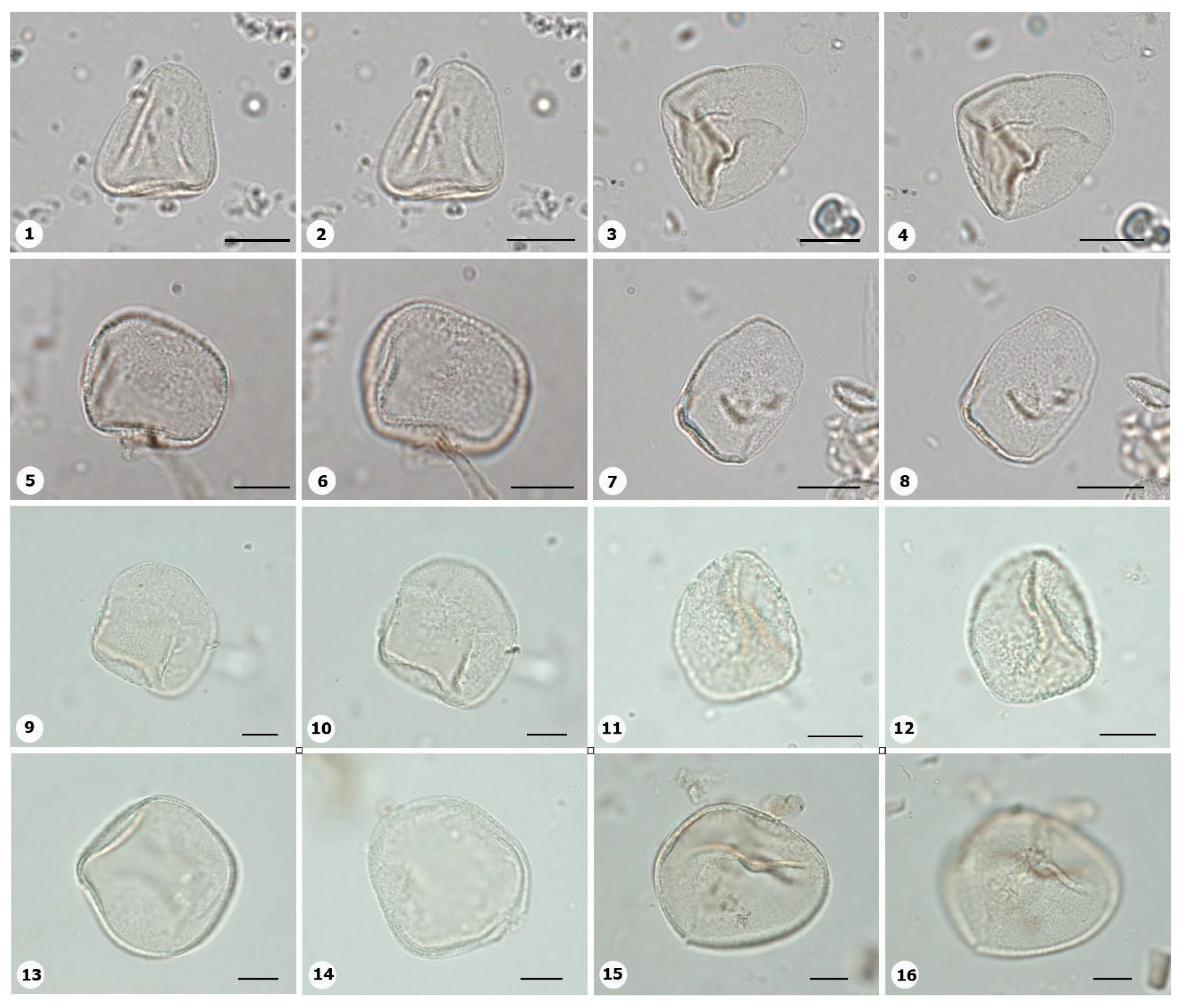

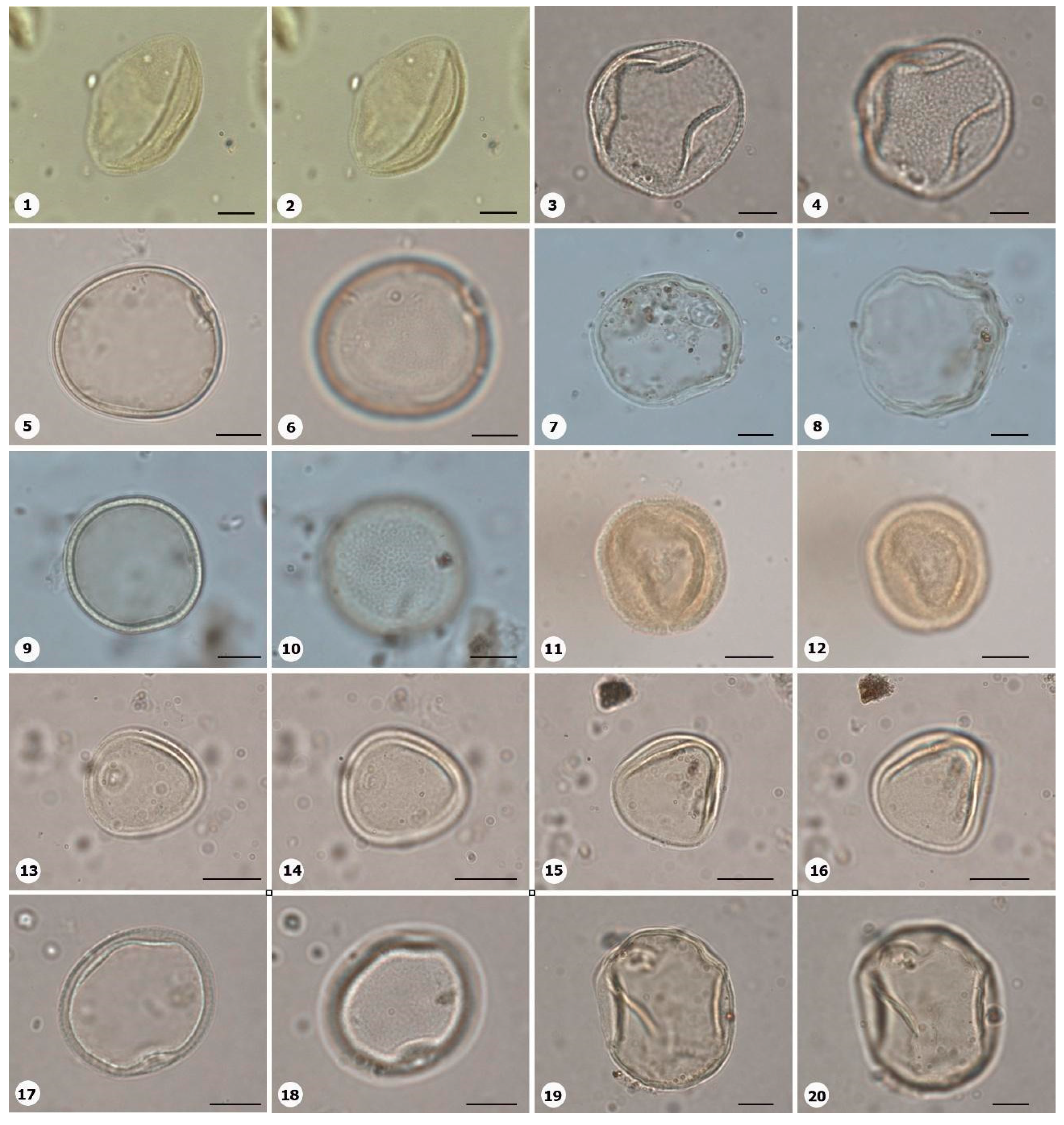

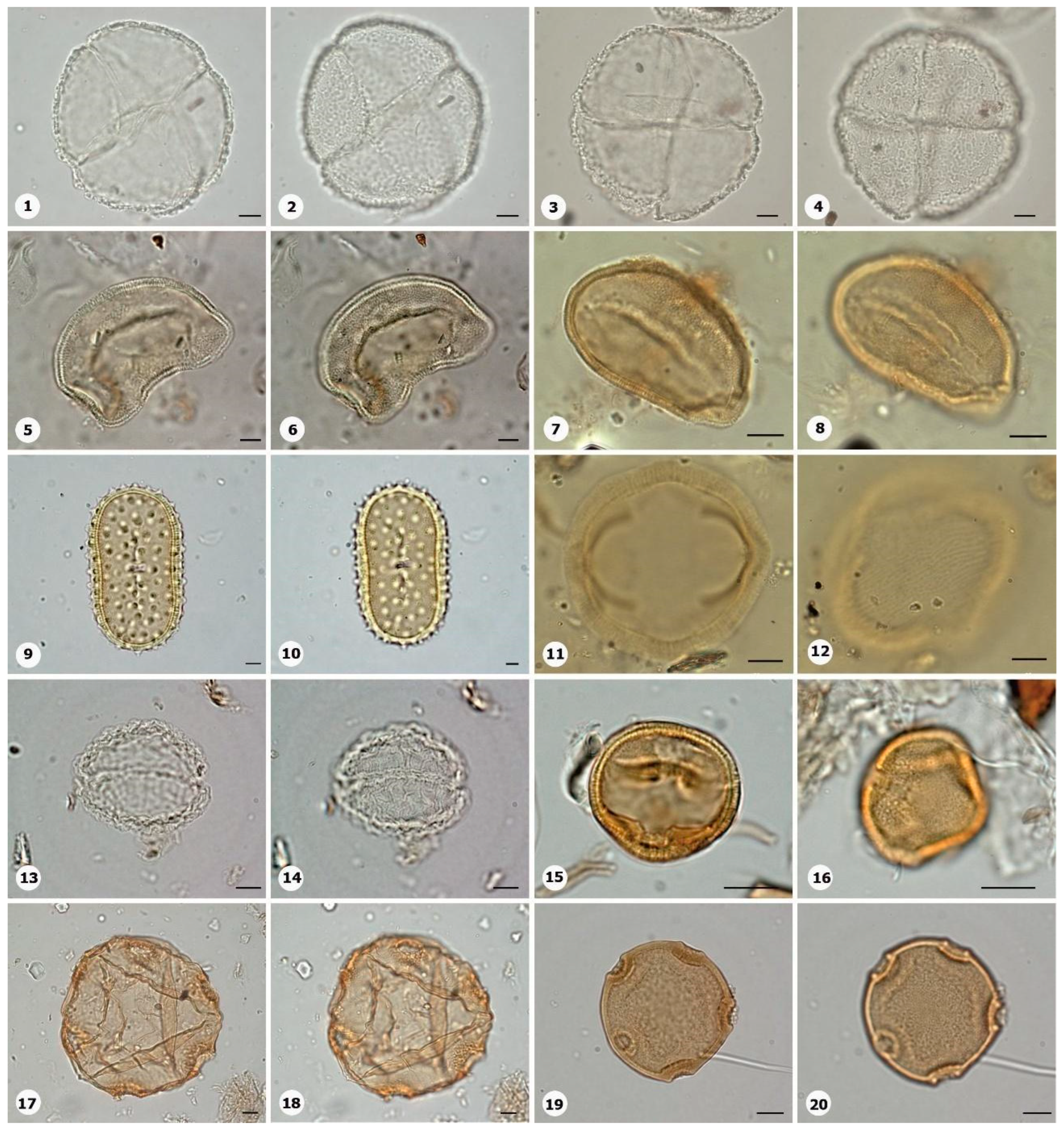
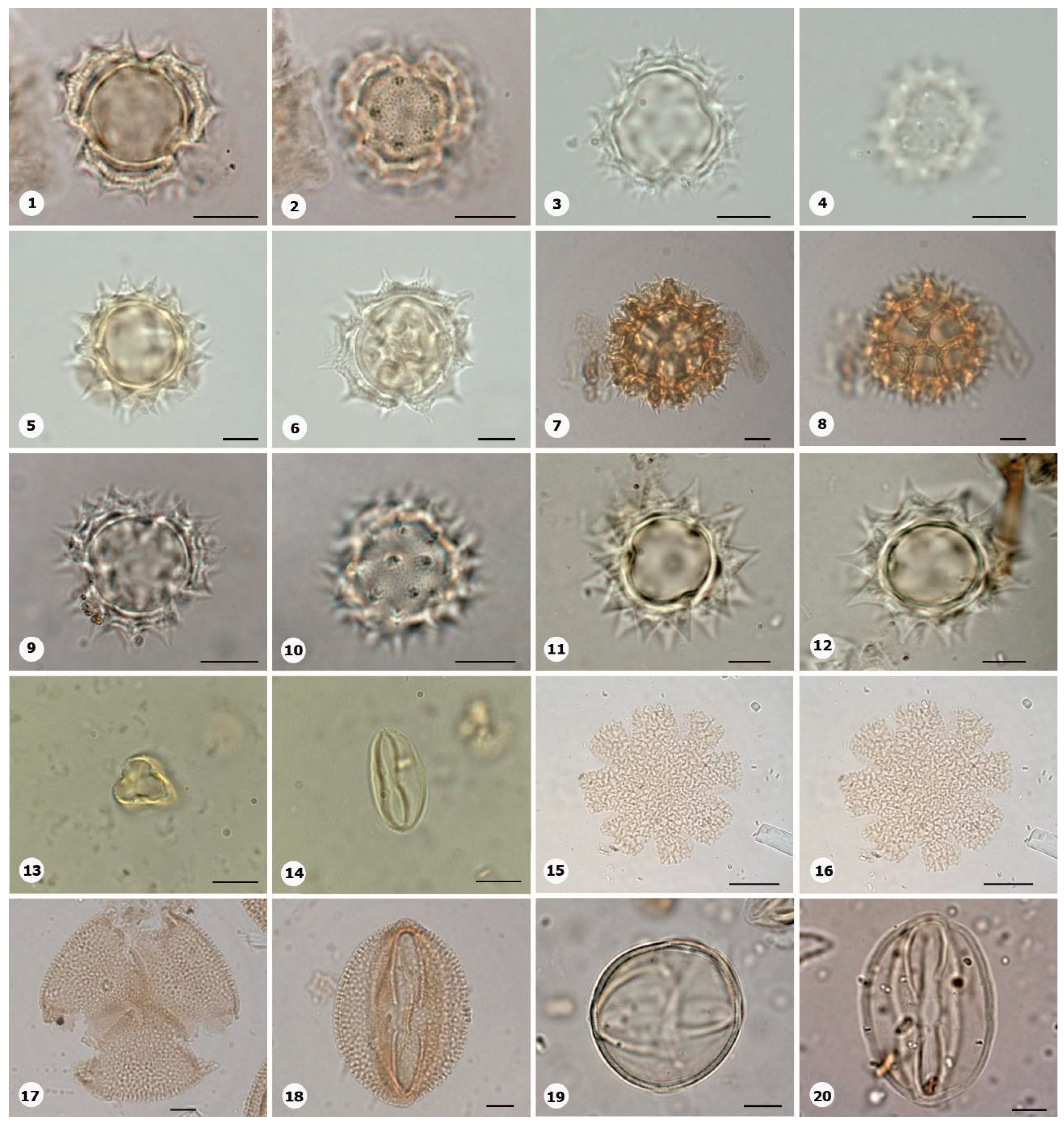


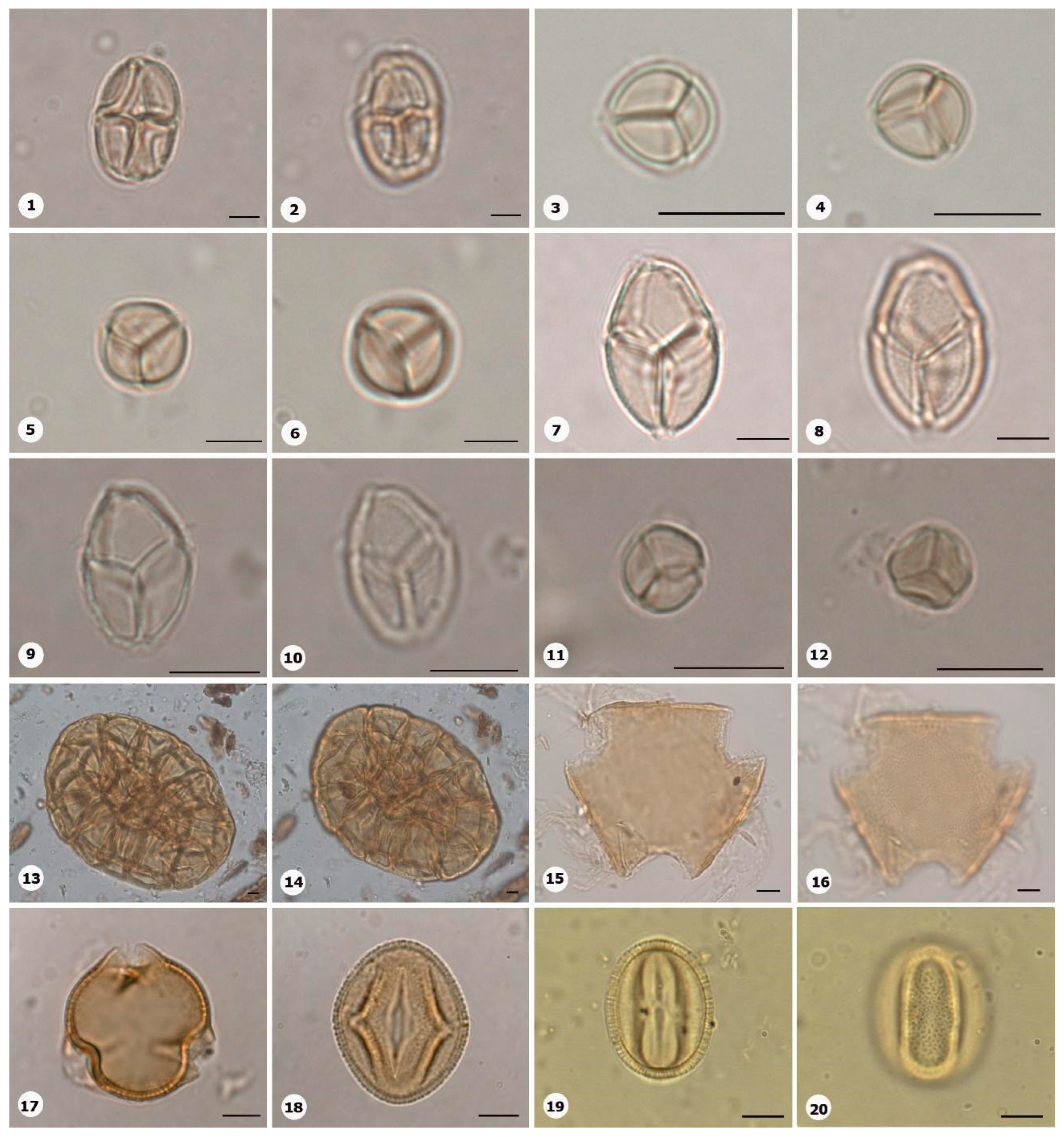
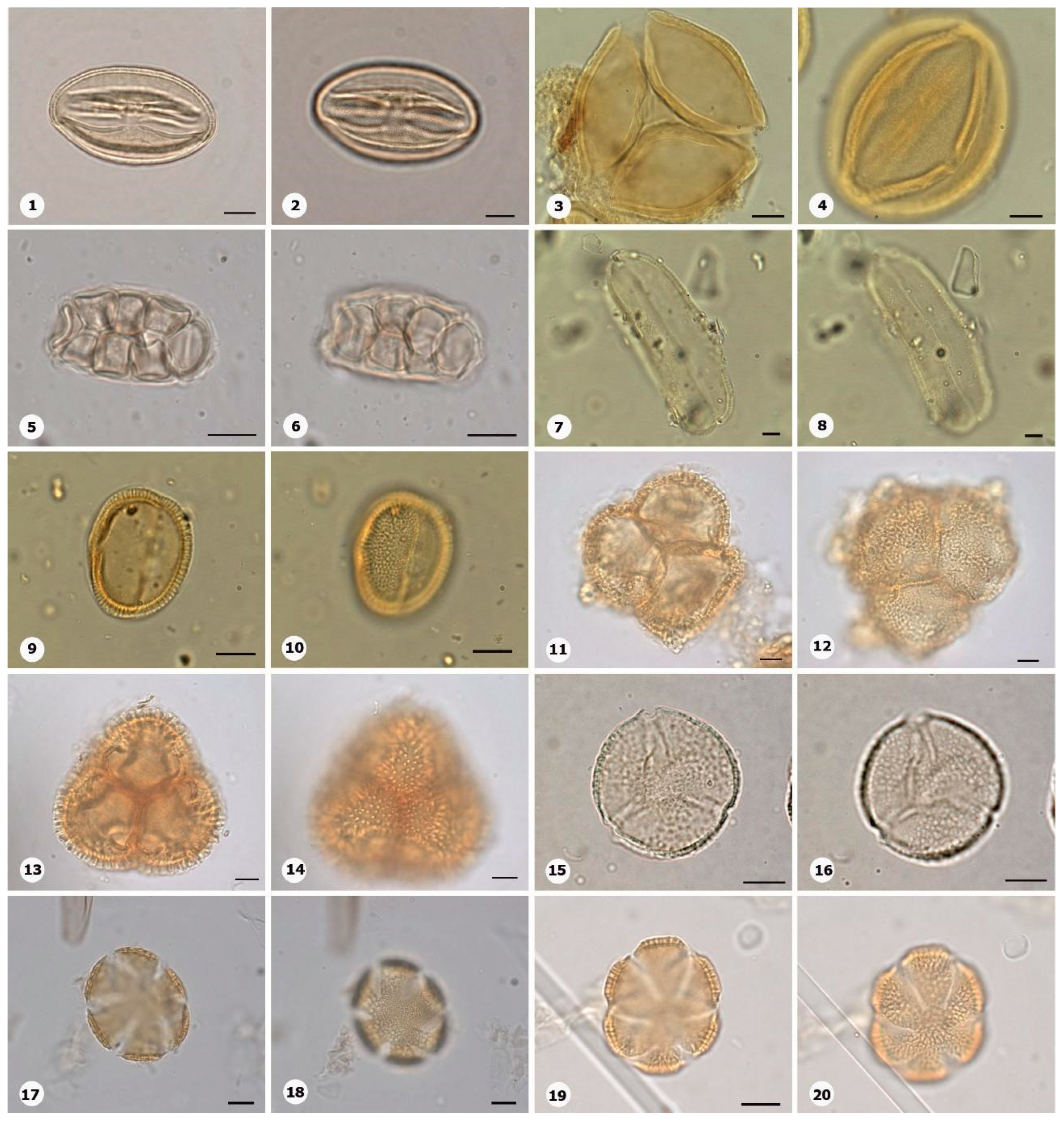
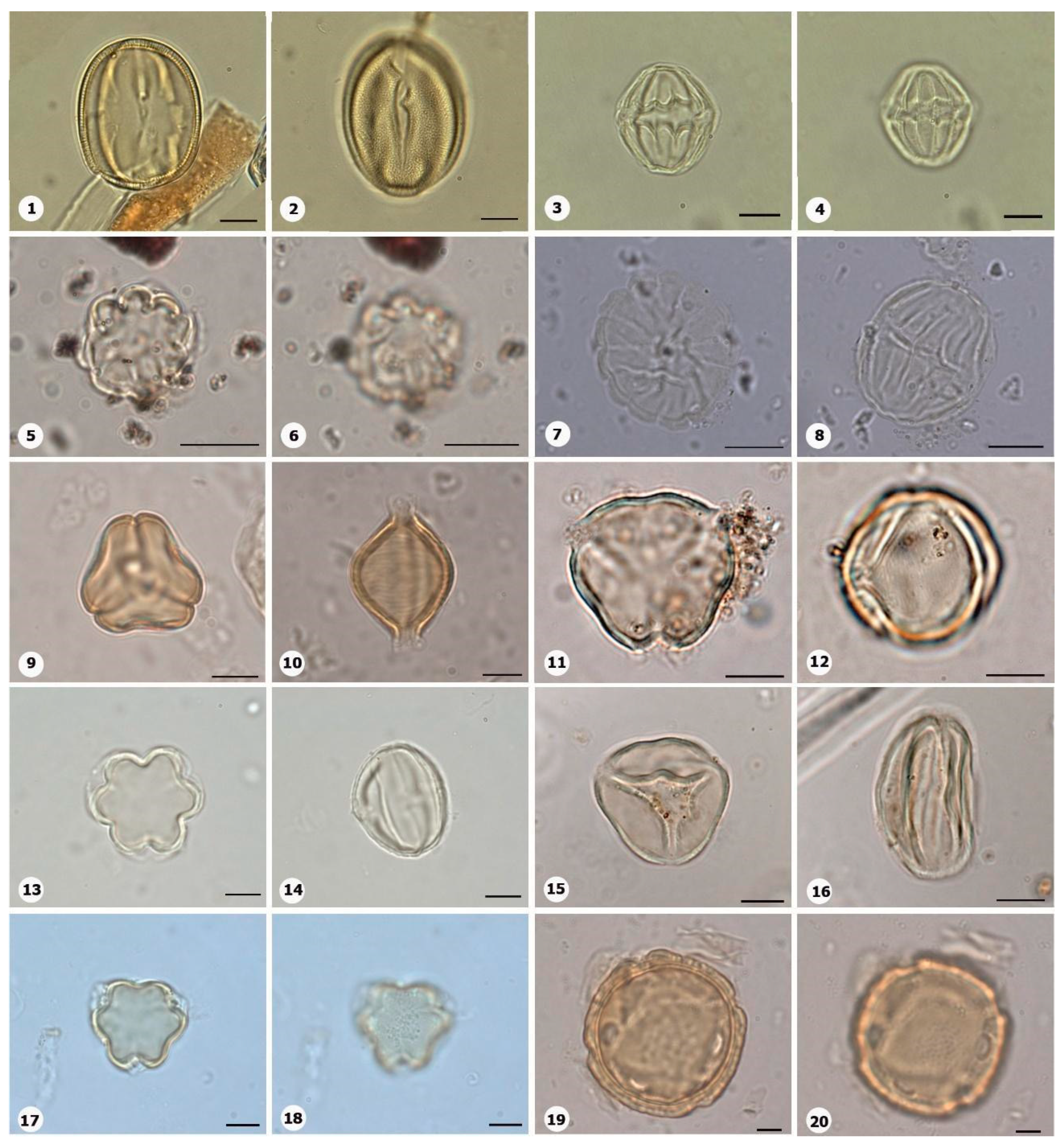

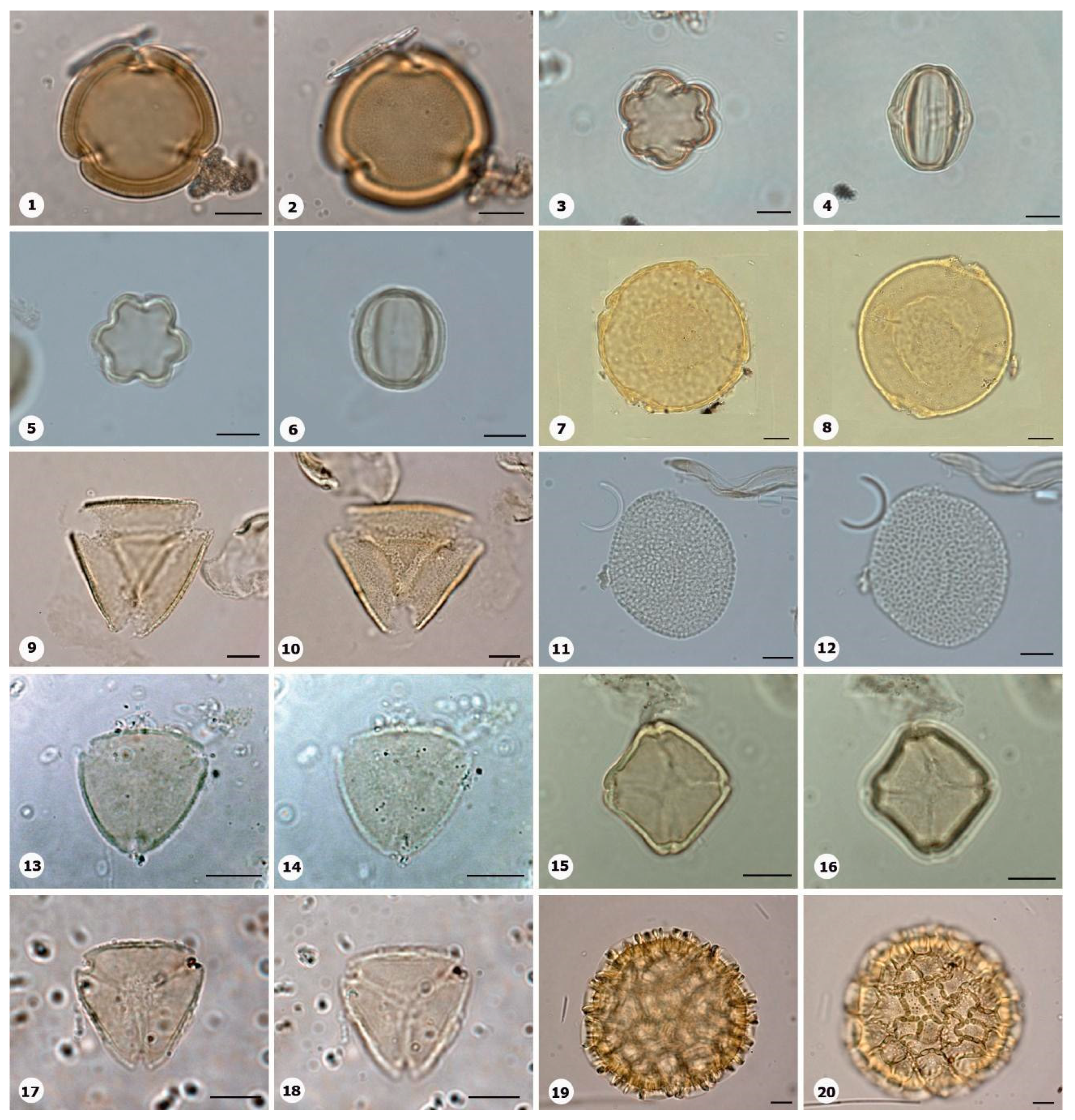
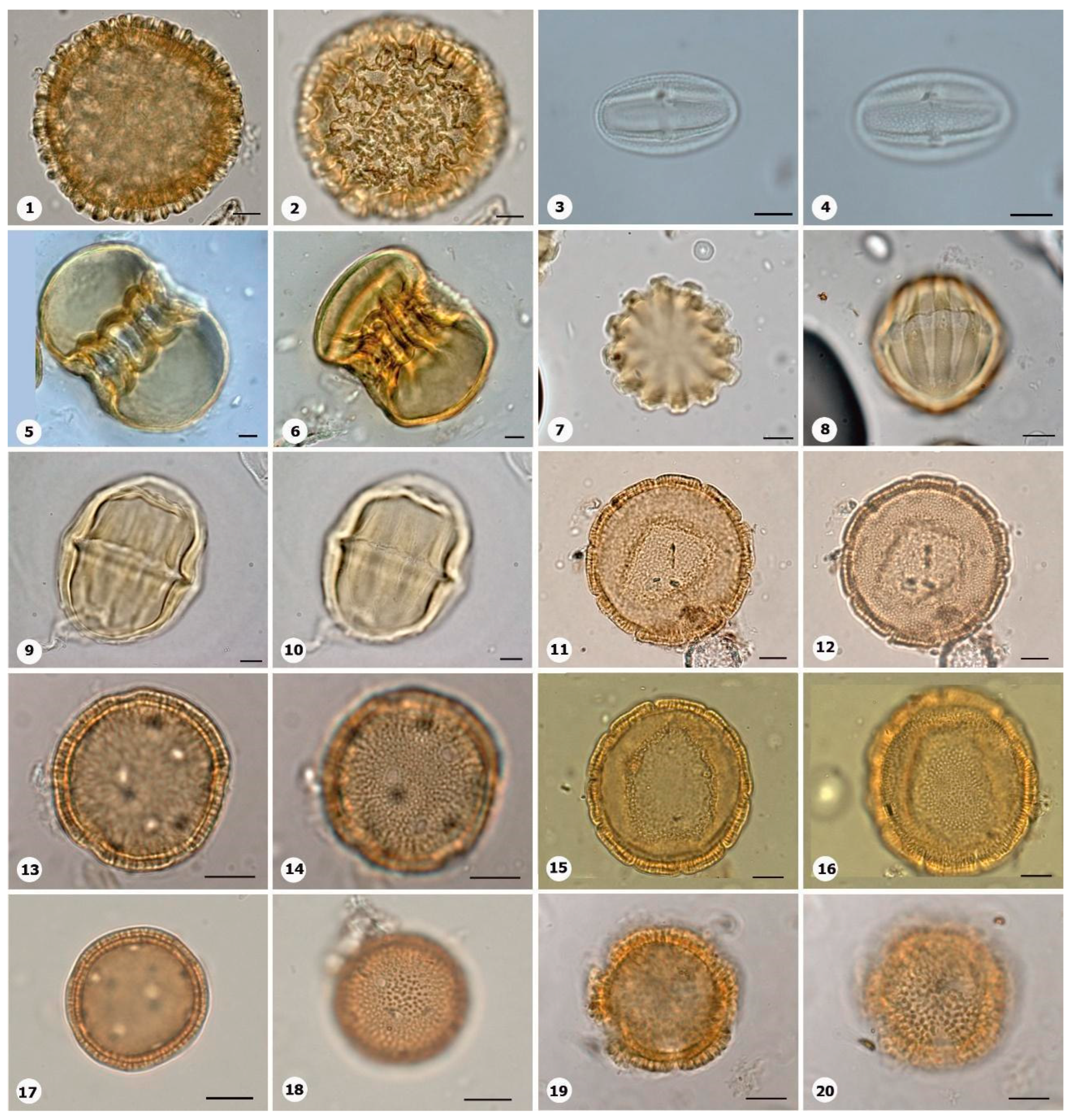

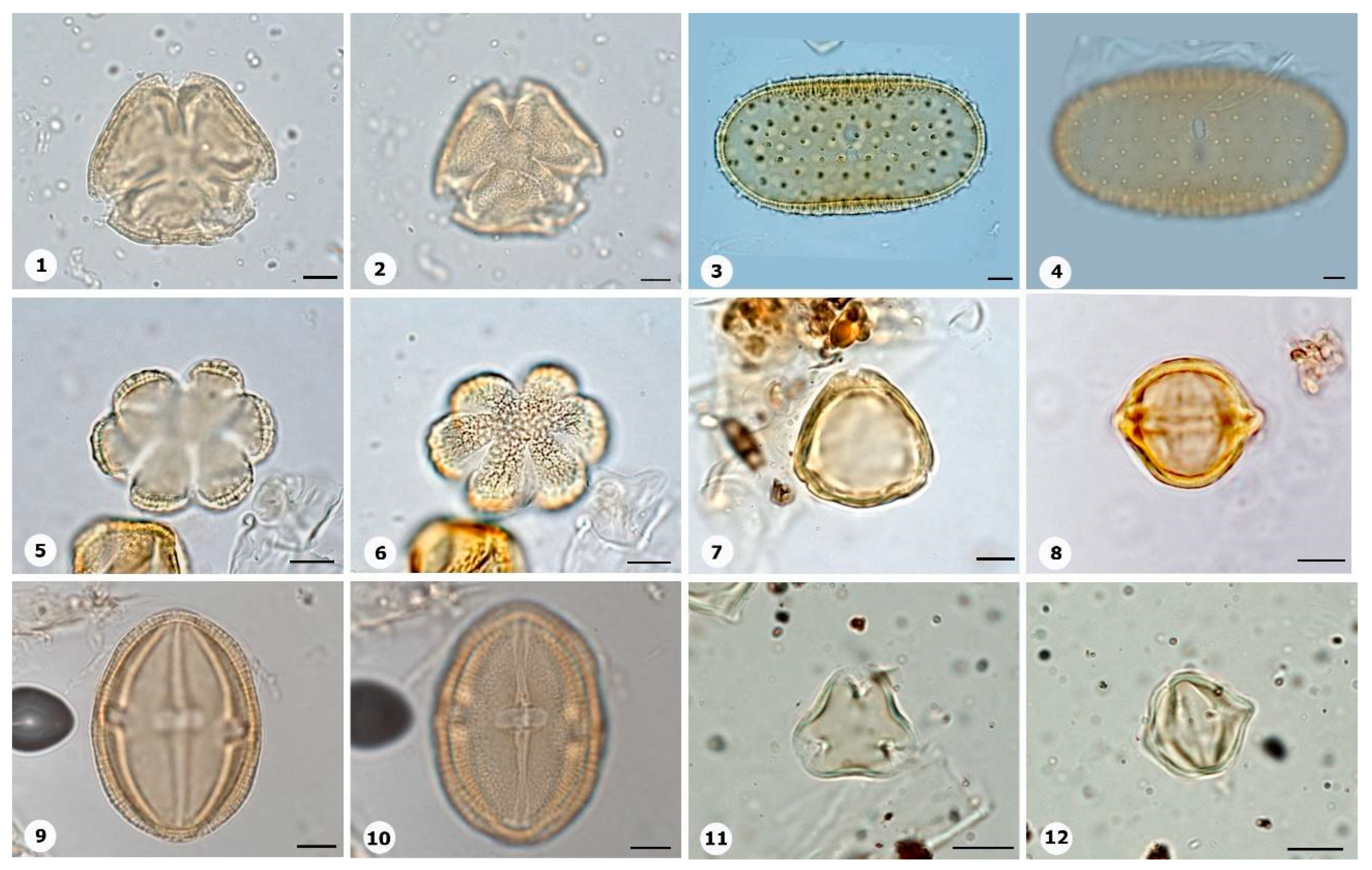

| Species | Symmetry | Shape | Aperture Type | Ornamentation | Equatorial Diameter (E) | Polar Diameter (P) | Diameter (D) |
|---|---|---|---|---|---|---|---|
| Ferns and Lycophytes | |||||||
| Family: Aspleniaceae Newman | |||||||
| Asplenium serratum L. | bilateral | elliptical | monolete | laevigate to scabrate | 50.6–56 µm | 29–39 µm | |
| Family: Blechnaceae Newman | |||||||
| Blechnum polypodioides Raddi | bilateral | elliptical | monolete | laevigate to microreticulate | 36–47.6 µm | 28–34 µm | |
| Family: Dennstaedtiaceae Lotsyaz | |||||||
| Pteridium esculentum (G. Forst.) Cockayne | heteropolar | elliptical | monolete | densely rugulate | 34–41 µm | 30.4–35 µm | |
| Family: Isoëtaceae Rchb.f. | |||||||
| Isoëtes cangae J.B.S.Pereira, Salino and Stützel | heteropolar | elliptical | monolete | microechinate | 30–34 µm | 23–29 µm | |
| Isoëtes serracarajensis J.B.S.Pereira, Salino and Stützel | heteropolar | elliptical | monolete | laevigate and microechinate to tuberculate | 30–37 µm | 25–30 µm | |
| Family: Pteridaceae E.D.M.Kirchn. | |||||||
| Hemionitis palmata L. | radial | triangular–obtuse–convex | trilete | densely echinate | 27–31 µm | 30–35.4 µm | |
| Pteris denticulata Sw. | radial | Triangular–obtuse–straight | densely hamulate | 28–35 µm | 45–53 µm | ||
| Pteris pungens Willd. | radial | Triangular–obtuse–straight | verrucate to hamulate | 50–53 µm | 40–47 µm | ||
| Family: Thelypteridaceae Pic.Serm. | |||||||
| Christella hispidula (Decne.) Holttum | bilateral | elliptical | monolete | laevigate to hamulate | 35–39.2 µm | 24–26.2 µm | |
| Cyclosorus interruptus (Willd.) H. Ito | bilateral | elliptical | monolete | densely hamulate–baculate | 54–65 µm | 36–37.3 µm | |
| Monocots | |||||||
| Family: Araceae Juss. | |||||||
| Philodendron wullschlaegelii Schott | heteropolar | oblate | monocolpate | striate | 48–57 µm | 37–41.5 µm | |
| Family: Arecaceae Bercht. and J.Presl. | |||||||
| Acrocomia aculeata (Jacq.) Lodd. ex Mart. | heteropolar | oblate spheroidal | trichotomosulcate | microreticulate | 83–92 µm | 79–89 µm | |
| Attalea maripa (Aubl.) Mart | heteropolar | prolate to perprolate | monosulcate | microreticulate | 26.7–30.8 µm | 44–51 µm | |
| Euterpe oleraceae Mart. | heteropolar | perprolate | monosulcate | microreticulate | 24–27 µm | 55–60 µm | |
| Oenocarpus distichus Mart. | heteropolar | perprolate | trichotomosulcate | microreticulate | 24–31 µm | 47–55 µm | |
| Socratea exorrhiza (Mart.) H.Wendl. | apolar | prolate | monosulcate | scabrate to echinate | 52–60 µm | ||
| Family: Bromeliaceae Juss. | |||||||
| Aechmea bromeliifolia (Rudge) Baker | heteropolar | oblate spheroidal | di(tri)porate | reticulate to rugulate | 65 µm | 63.5 µm | |
| Aechmea castelnavii Baker | apolar | spheroidal | inaperturate | heterobrochate reticulate | 27–34 µm | ||
| Aechmea mertensii (G.Mey.) Schult. and Schult.f. | apolar | spheroidal | inaperturate | heterobrochate reticulate | 55–50 µm | ||
| Dyckia duckei L.B.Sm. | heteropolar | subprolate to prolate | monosulcate | heterobrochate reticulate | 19–26 µm | 41–46 µm | |
| Pitcairnia lanuginosa Ruiz and Pav. | heteropolar | prolate spheroidal | monosulcate | heterobrochate reticulate | 41.3–48 µm | 49–52 µm | |
| Family: Costaceae Nakai | |||||||
| Chamaecostus acualis (S.Moore) T.André and C.D.Specht | isopolar | spheroidal | pantoporate | psilate to punctate | 139–142 µm | ||
| Chamaecostus lanceolatus (Petersen) C.D.Specht and D.W.Stey | isopolar | spheroidal | pantoporate | psilate to punctate | 119–125 µm | ||
| Costus scaber Ruiz and Pav. | isopolar | spheroidal | pantoporate | psilate to punctate | 204–212 µm | ||
| Family: Cyperaceae Juss. | |||||||
| Bulbostylis paraensis C.B.Clarke | heteropolar | spheroidal | inaperturate | microreticulate | 39–42 µm | ||
| Cyperus aggregatus (Willd.) Endl. | heteropolar | spheroidal | inaperturate | microreticulate | 31–33 µm | ||
| Cyperus amabilis Vahl | heteropolar | spheroidal | inaperturate | microreticulate | 30–34 µm | ||
| Cyperus haspan L. | heteropolar | elliptical | inaperturate | microreticulate | 25–29 µm | ||
| Cyperus laxus Lam. | heteropolar | elliptical | inaperturate | microreticulate | 29–23 µm | ||
| Cyperus sphacelatus Rottb. | heteropolar | elliptical | inaperturate | microreticulate | 16–21 µm | ||
| Cyperus surinamensis Rottb. | heteropolar | elliptical | inaperturate | microreticulate | 18–21 µm | ||
| Eleocharis flavescens (Poir.) Urb. | heteropolar | elliptical | inaperturate | microreticulate | 21–27 µm | ||
| Rhynchospora barbata (Vahl) Kunth | heteropolar | elliptical | inaperturate | microreticulate | 25–30 µm | ||
| Rhynchospora corymbosa (L.) Britton | heteropolar | elliptical | inaperturate | microreticulate | 17–23 µm | ||
| Rhynchospora seccoi C.S. Nunes, P.J.S. Silva Filho, and A. Gil | heteropolar | spheroidal | inaperturate | microreticulate | 27–32 µm | ||
| Rhynchospora tenuis Link | heteropolar | spheroidal | inaperturate | microreticulate | 22–29 µm | ||
| Scleria cyperina Willd. ex Kunth | heteropolar | spheroidal | inaperturate | microreticulate | 34–38 µm | ||
| Scleria verticillata Muhl. ex Willd | heteropolar | spheroidal | inaperturate | microreticulate | 31–33 µm | ||
| Family: Dioscoreaceae (R. Br.) | |||||||
| Dioscorea glandulosa (Klotzsch ex Griseb.) Kunth | apolar | spheroidal | inaperturate | microreticulate | 29–31 µm | ||
| Dioscorea pohlii Griseb. | elliptical | inaperturate | striate | 38–52 µm | |||
| Family: Eriocaulaceae Martinov | |||||||
| Eriocaulon aff. setaceum L. | apolar | spheroidal | spiraperturate | microechinate and microreticulate | 42–47 µm | ||
| Eriocaulon setaceum L. | apolar | spheroidal | spiraperturate | microechinate and microreticulate | 22–25 µm | ||
| Paepalanthus aff. fasciculatus (Rottb.) Kunth | apolar | spheroidal | spiraperturate | microechinate and microreticulate | 41–44 µm | ||
| Syngonanthus caulescens (Poir.) Ruhland | apolar | spheroidal | spiraperturate | microechinate and microreticulate | 26–31 µm | ||
| Syngonanthus discretifolius (Moldenke) M.T.C.Watan. | apolar | spheroidal | spiraperturate | microechinate and microreticulate | 29–34 µm | ||
| Syngonanthus heteropeplus (Koern.) Ruhland | apolar | spheroidal | spiraperturate | microechinate and microreticulate | 26–34 µm | ||
| Syngonanthus sp. 1 | apolar | spheroidal | spiraperturate | microechinate and microreticulate | 26–30 µm | ||
| Family: Heliconiaceae Nakai | |||||||
| Heliconia adeliana Emygdio and E.Santos | apolar | spheroidal | inaperturate | punctate | 70–73 µm | ||
| Family: Mayacaceae Kunth | |||||||
| Mayaca fluviatilis Aubl. | heteropolar | elliptical | inaperturate | microreticulate | 20–31 µm | ||
| Family: Poaceae Barnhart | |||||||
| Axonopus capillaris (Lam.) Chase | apolar | spheroidal | monoporate | microreticulate–microrugulate | 27–26 µm | ||
| Axonopus carajasensis Bastos | apolar | spheroidal | monoporate | microreticulate | 31–34 µm | ||
| Axonopus longispicus (Döll) Kuhlm | apolar | spheroidal | monoporate | microreticulate | 30–36 µm | ||
| Eragrostis maypurensis (Kunth) Steud | apolar | spheroidal | monoporate | microreticulate | 20–31 µm | ||
| Eragrostis rufescens Schrad. ex Schult | apolar | spheroidal | monoporate | microreticulate | 32–39 µm | ||
| Hildaea breviscrobs (Döll) C.Silva and R.P. Oliveira | apolar | spheroidal | monoporate | microreticulate | 20–23 µm | ||
| Ichnanthus calvescens (Nees ex Trin.) Döll | apolar | spheroidal | monoporate | microreticulate | 34–42 µm | ||
| Isachne polygonoides (Lam.) Döll | apolar | spheroidal | monoporate | microreticulate | 21–28 µm | ||
| Mesosetum cayennense Steud. | apolar | spheroidal | monoporate | microreticulate | 32–41 µm | ||
| Mnesithea aurita (Steud.) de Koning and Sosef | apolar | spheroidal | monoporate | microreticulate | 32–36 µm | ||
| Otachyrium versicolor (Döll) Henrard | apolar | spheroidal | monoporate | microreticulate | 31–41 µm | ||
| Paspalum carajasense S.Denham | apolar | spheroidal | monoporate | microreticulate | 51–61 µm | ||
| Paspalum carinatum Humb. and Bonpl. ex Flüggé | apolar | spheroidal | monoporate | microreticulate | 42–63 µm | ||
| Paspalum virgatum L. | apolar | spheroidal | monoporate | microreticulate | 42–58 µm | ||
| Rhytachne gonzalezii Davidse | apolar | spheroidal | monoporate | microreticulate | 48–65 µm | ||
| Sporobolus multiramosus Longhi-Wagner and Boechat | apolar | spheroidal | monoporate | microreticulate–reticulate | 31–35 µm | ||
| Trichanthecium parvifolium (Lam.) Zuloaga and Morrone | apolar | spheroidal | monoporate | microreticulate–reticulate | 34–40 µm | ||
| Trichanthecium polycomum (Trin.) Zuloaga and Morrone | apolar | spheroidal | monoporate | microreticulate–reticulate | 29–37 µm | ||
| Trichanthecium sp. 1 | apolar | spheroidal | monoporate | microreticulate | 29–32 µm | ||
| Family: Velloziaceae J.Agardh | |||||||
| Vellozia sp. 1 | apolar | spheroidal | inaperturate | reticulate | 80–85 µm | ||
| Vellozia sp. 2 | apolar | spheroidal | inaperturate | reticulate | 62–70 µm | ||
| Family: Xyridaceae C.Agardh | |||||||
| Xyris brachysepala Kral. | heteropolar | elliptical | inaperturate | reticulate | 34–62 µm | ||
| Xyris macrocephala Vahl | heteropolar | elliptical | inaperturate | microreticulate | 35–48 µm | ||
| EUDICOTS AND MAGNOLIIDS | |||||||
| Family: Acanthaceae Juss. | |||||||
| Justicia birae A.S.Reis, F.A.Silva, A.Gil, and Kameyama | isopolar | prolate | dicolporate | echinate and microreticulate | 58–60 µm. | 98–105 µm | |
| Family: Anacardiaceae R.Br. | |||||||
| Anacardium occidentale L. | isopolar | prolate/oblate spheroidal | tricolporate | striate–reticulate | 44–55 µm | 50–59 µm | |
| Family: Annonaceae Juss. | |||||||
| Onychopetalum amazonicum R.E.Fr. | isopolar | subprolate | zonasulcate | rugulate | 52.8–57.6 µm | 42.8–49 µm | |
| Xylopia aromatica (Lam.) Mart. | isopolar | prolate spheroidal | tricolporate | reticulate | 27–29 µm | 28–30 µm | |
| Family: Apocynaceae Juss. | |||||||
| Mandevilla hirsuta (A.Rich.) K.Schum. | isopolar | prolate spheroidal | pantoporate | psilate and microreticulate | 100–110 µm | ||
| Mandevilla tenuifolia (J.C.Mikan) Woodson | isopolar | prolate spheroidal | pantoporate | reticulate | 34–48 µm | ||
| Family: Asteraceae Bercht. and J.Presl | |||||||
| Cavalcantia glomerata (G.M.Barroso and R.M.King) R.M.King, and H.Rob. | isopolar | prolate spheroidal | tricolporate | echinate and punctate | 20–25 µm | 22–25 µm | |
| Emilia sp. 1 | isopolar | prolate spheroidal | tricolporate | echinate and punctate | 23–24 µm | 24–25 µm | |
| Ichthyothere terminalis (Spreng.) S.F.Blake | isopolar | prolate spheroidal | tricolporate | echinate and punctate | 32–33 µm | 31–38 µm | |
| Lepidaploa paraensis (H.Rob.) H.Rob | isopolar | oblate spheroidal | tricolporate | echinate | 40–55 µm | 40–54 µm | |
| Monogereion carajensis G.M.Barroso and R.M.King | isopolar | oblate spheroidal | tricolporate | echinate | 20–27 µm | 20–28 µm | |
| Riencourtia pedunculosa (Rich.) Pruski | isopolar | subprolate | tricolporate | echinate | 28–30 µm | 31–33 µm | |
| Family: Begoniaceae C.Agardh | |||||||
| Begonia guaduensis Kunth | isopolar | prolate | tricolporate | psilate and slightly striate | 11–12 µm | 20–24.4 µm | |
| Family: Bignoniaceae Juss. | |||||||
| Anemopaegma carajasense A.H. Gentry ex Firetti-Leggieri | isopolar | circular | stephanocolpate | heterobrochate reticulate | 110–124 µm | ||
| Handroanthus serratifolius (Vahl) S.Grose | isopolar | subprolate | tricolporate | homobrochate reticulate | 52–70 µm | 70–80 µm | |
| Jacaranda copaia (Aubl.) D.Don | isopolar | prolate | tricolporate | microreticulate | 33–55 µm | 50–58 µm | |
| Family: Bixaceae Kunth | |||||||
| Bixa orellana L. | isopolar | subprolate | tricolporate | microreticulate | 41–63 µm | 54–65 µm | |
| Family: Cactaceae Juss. | |||||||
| Cereus hexagonus (L.) Mill. | isopolar | oblate spheroidal | tricolpate | reticulate, echinate e microequinate | 110–115 µm | 98–105 µm | |
| Family: Clusiaceae Lindl. | |||||||
| Clusia nemorosa G.Mey. | isopolar | prolate spheroidal | tricolporate | microreticulate | 29.4–38 µm | 34.3–42.4 µm | |
| Family: Convolvulaceae Juss. | |||||||
| Aniseia cernua Moric. | apolar | spheroidal | pantocolpate | microreticulate and microequinate | 76–83 µm | ||
| Cuscuta insquamata Yunck. | isopolar | subprolate | tricolpate | microreticulate and microequinate | 18–39 µm | 25–48 µm | |
| Distimake macrocalyx (Ruiz and Pav.) A.R. Simões and Staples | isopolar | subprolate | tricolpate | microreticulate and microgranulate | 72–83 µm | 69–86.6 µm | |
| Evolvulus filipes Mart. | apolar | spheroidal | pantocolpate | microreticulate | 28–32 µm | ||
| Evolvulus sp. 1 | isopolar | prolate spheroidal | pantocolpate | microreticulate | 69–92 µm | 71–93 µm | |
| Ipomoea asplundii O’Donell | apolar | spheroidal | pantoporate | echinate and microreticulate | 78–82 µm | ||
| Ipomoea carajasensis D.F. Austin | apolar | spheroidal | pantoporate | echinate and microreticulate | 80–90 µm | ||
| Ipomoea cavalcantei D.F. Austin | apolar | spheroidal | pantoporate | echinate and microreticulate | 84–155 µm | ||
| Ipomoea cavalcantei x marabaensis | apolar | spheroidal | pantoporate | echinate and microreticulate | 85–87 µm | ||
| Ipomoea decora Meisn. | apolar | spheroidal | pantoporate | echinate and microreticulate | 94–103 µm | ||
| Ipomoea goyazensis Gardner | apolar | spheroidal | pantoporate | echinate and microreticulate | 118–125 µm | ||
| Ipomoea marabaensis D.F.Austin and Secco | apolar | spheroidal | pantoporate | echinate and microreticulate | 120–145 µm | ||
| Ipomoea procumbens Mart. ex Choisy | apolar | spheroidal | pantoporate | echinate and microreticulate | 113–117 µm | ||
| Ipomoea setifera Poir. | apolar | spheroidal | pantoporate | echinate and microreticulate | 98–102 µm | ||
| Jacquemontia tamnifolia (L.) Griseb. | apolar | spheroidal | pantocolporate | microechinate and microreticulate | 60–65 µm | ||
| Turbina cordata (Choisy) D.F.Austin and Staples | apolar | spheroidal | pantoporate | echinate and microreticulate | 156–160 µm | ||
| Family: Erythroxylaceae Kunth | |||||||
| Erythroxylum carajasense Plowman | isopolar | prolate spheroidal | tricolporate | heterobrochate reticulate | 29 µm | 33 µm | |
| Erythroxylum nelson-rosae Plowman | isopolar | prolate spheroidal | tricolporate | heterobrochate reticulate | 45–52 µm | 56–60 µm | |
| Family: Euphorbiaceae Juss. | |||||||
| Alchornea discolor Poepp. | isopolar | prolate spheroidal to subprolate | tricolporate | microreticulate | 24–25 µm | 26–28 µm | |
| Aparisthmium cordatum (A.Juss.) Baill. | isopolar | subspheroidal | tricolporate | rugulate–punctate | 32–39 µm | 25–30 µm | |
| Astraea lobata (L.) Klotzsch | isopolar | spheroidal | inaperturate | croton pattern | 59–63 µm | ||
| Sapium glandulosum (L.) Morong | isopolar | prolate | tricolporate | reticulate | 40–45 µm | 60–68 µm | |
| Family: Fabaceae Juss. | |||||||
| Abrus fruticulosus Wight and Arn. | isopolar | prolate | tricolporate | psilate to punctate | 39–45.8 µm | 31–32 µm | |
| Aeschynomene rudis Benth. | isopolar | subprolate | tricolporate | heterobrochate microreticulate | 20.1–22 µm | 23.5–29 µm | |
| Andira inermis (W.Wright) DC. | isopolar | prolate spheroidal | tricolporate | microreticulate | 20–22.6 µm | 21–26.3 µm | |
| Bauhinia pulchella Benth. | isopolar | oblate | tricolporate | microreticulate | 130–165 µm | 60–70 µm | |
| Centrosema carajasense Cavalcante | isopolar | oblate | stephanocolpate | microreticulate | 56–59 µm | 28–33.2 µm | |
| Cerradicola elliptica (Desv) L.P.Queiroz | isopolar | subprolate | tricolporate | heterobrochate reticulate | 43–44 µm | 53–54 µm | |
| Chamaecrista desvauxii (Collad.) Killip | isopolar | perprolate | tricolporate | psilate | 34–41.3 µm | 69.1–79.4 µm | |
| Chamaecrista flexuosa (L.) Greene | isopolar | prolate | tricolporate | microreticulate | 50 µm | 84–85 µm | |
| Chamaecrista sp. 1 | isopolar | prolate | tricolporate | microreticulate | 45.7–56.6 µm | 80–90 µm | |
| Clitoria fairchildiana R.A.Howard | isopolar | oblate | pantocolpate | microreticulate and punctate | 72–77 µm | 39–45 µm | |
| Copaifera martii Hayne | isopolar | subprolate | tricolporate | psilate and scabrate | 30–40 µm | 20–30 µm | |
| Crotalaria maypurensis Kunth | isopolar | prolate | tricolporate | microreticulate | 22–28 µm | 36–45 µm | |
| Dioclea apurensis Kunth | isopolar | oblate | parasyncolporate | rugulate to reticulate | 75–80 µm | 40 µm | |
| Dioclea virgata (Rich.) Amshoff | isopolar | peroblate | tricolporate | reticulate | 82.3–94.8 µm | 39.5–47 µm | |
| Dipteryx odorata (Aubl.) Forsyth F. | isopolar | subspheroidal | parasyncolporate | microreticulate | 40–54 µm | 46–60 µm | |
| Mimosa acutistipula var. ferrea Barneby | apolar | elliptical | tetrad calymmate | microreticulate and psilate | 10–14 µm | ||
| Mimosa aff. skinneri Benth. | apolar | spheroidal | tetrad calymmate | psilate | 7–9 µm | ||
| Mimosa carajarum (Barneby) T.P.Mendes and M.J.Silva | apolar | spheroidal | tetrad calymmate | psilate | 7–8 µm | ||
| Mimosa somnians var. viscida (Willd.) Barneby | apolar | elliptical | tetrad calymmate | microreticulate | 13–20 µm | ||
| Mimosa xanthocentra Mart. | apolar | elliptical | tetrad calymmate | microreticulate | 18–20 µm | ||
| Mimosa xanthocentra var. mansii (Mart.) Barneby | apolar | spheroidal | tetrad calymmate | psilate | 7–8 µm | ||
| Parkia platycephala Benth. | apolar | elliptical | polyads calymmate | psilate to scabrate | 160–185 µm | ||
| Periandra coccinea (Schrad.) Benth. | isopolar | subprolate | tricolporate | punctate | 53–53 µm | 62–64 µm | |
| Periandra mediterranea (Vell.) Taub. | isopolar | prolate | tricolporate | microreticulate | 34–39 µm | 36–44 µm | |
| Schizolobium parahyba var. amazonicum (Huber ex Ducke) Barneby | isopolar | prolate spheroidal | tricolporate | heterobrochate reticulate | 29.8–36.1 µm | 37–43.5 µm | |
| Senna multijuga (Rich.) H.S.Irwin and Barneby | isopolar | prolate | tricolporate | microreticulate | 30–48 µm | 50–58 µm | |
| Senna siamea (Lam.) H.S.Irwin and Barneby | apolar | prolate spheroidal | tricolporate | rugulate and reticulate | 49–50 µm | ||
| Stryphnodendron pulcherrimum (Willd.) Hochr. | apolar | elliptical | polyads calymmate | psilate to scabrate | 25–32 µm | ||
| Stylosanthes humilis Kunth | isopolar | prolate | tricolporate | microreticulate | 41–50.7 µm | 62–69 µm | |
| Tachigali vulgaris L.G.Silva and H.C.Lima | isopolar | prolate | tricolporate | microreticulate | 22–25 µm | 30–35 µm | |
| Family: Gentianaceae Juss. | |||||||
| Chelonanthus purpurascens (Aubl.) Struwe et al. | apolar | triangular | 3-hemicolporate | reticulate | 70–80 µm | ||
| Schultesia benthamiana Klotzsch ex Griseb | apolar | triangular | 3-hemicolporate | reticulate | 80–92 µm | ||
| Family: Hypericaceae Juss. | |||||||
| Vismia cayennensis (Jacq.) Pers. | isopolar | prolate | parasyncolporate | heterobrochate reticulate | 30–38 µm | 40–52 µm | |
| Family: Lamiaceae Lindl. | |||||||
| Hyptis atrorubens Poit. | isopolar | oblate | stephanocolpate | heterobrochate reticulate | 30–40 µm | 15–20 µm | |
| Hyptis parkeri Benth. | isopolar | oblate | stephanocolpate | heterobrochate reticulate | 35–45 µm | 20–25 µm | |
| Family: Lecythidaceae A.Juss. | |||||||
| Bertholletia excelsa Bonpl. | isopolar | subprolate | tricolporate | microreticulate | 29–32.8 µm | 42–50 µm | |
| Family: Lentibulariaceae Rich | |||||||
| Utricularia pusilla Vahl | isopolar | subprolate | stephanocolporate | psilate to scabrate | 15–17 µm | 18–23 µm | |
| Utricularia sp. 1 | isopolar | subprolate | stephanocolporate | psilate to scabrate | 10.9–13.4 µm | 15–17.5 µm | |
| Utricularia sp. 2 | isopolar | prolate spheroidal | stephanocolporate | microreticulate | 23–27 µm | 26–30 µm | |
| Family: Lythraceae J.St.-Hil. | |||||||
| Cuphea annulata Koehne | isopolar | oblate | syncolporate | striate | 33.8–37.2 µm | 22–17.4 µm | |
| Cuphea carajasensis Lourteig | isopolar | oblate | syncolporate | striate | 26–29 µm | 16–20 µm | |
| Cuphea sp. 1 | isopolar | oblate | syncolporate | striate | 33–37.6 µm | 23.3–29.9 µm | |
| Cuphea sp. 2 | isopolar | subprolate | parasyncolporate | psilate | 17–21 µm | 22–24 µm | |
| Cuphea sp. 3 | isopolar | oblate | tricolporate | microreticulate | 21–24.7 µm | 18–21 µm | |
| Family: Malpighiaceae Juss. | |||||||
| Banisteriopsis appressa (B.Gates) R.F.Almeida and M.Pell. | apolar | quadrangular | pantoporate | microreticulate | 43–54 µm | ||
| Banisteriopsis malifolia (Nees and Mart.) B.Gates | apolar | spheroidal to quadrangular | pantoporate | microreticulate | 50–55 µm | ||
| Banisteriopsis sp. 1 | apolar | spheroidal to hexangular | pantoporate | microreticulate | 60–70 µm | ||
| Byrsonima chrysophylla Kunth | isopolar | spheroidal | tricolporate | microreticulate | 19–21 µm | 20–23 µm | |
| Byrsonima spicata (Cav.) DC. | isopolar | spheroidal | tricolporate | microreticulate | 14.2–14.9 µm | 15.8–14.2 µm | |
| Diplopterys pubipetala (A.Juss.) W.R.Anderson and C.C.Davis | apolar | spheroidal to quadrangular | pantoporate | microreticulate | 50–60 µm | ||
| Spachea lactescens (Ducke) R.F.Almeida and M.Pell. | isopolar | prolate spheroidal | tricolporate | microreticulate | 22–25 µm | 22–26 µm | |
| Family: Malvaceae Juss. | |||||||
| Guazuma ulmifolia Lam. | isopolar | prolate spheroidal | tricolporate | heterobrochate reticulate | 22–23 µm | 22–24 µm | |
| Melochia arenosa Benth. | isopolar | prolate spheroidal | tricolporate | microreticulate | 53–54.7 μm | 54.4–57 μm | |
| Melochia spicata (L.) Fryxell | isopolar | oblate spheroidal | tricolporate | microreticulate | 45–52 μm | 45–48 μm | |
| Theobroma grandiflorum (Willd. ex Spreng.) K.Schum. | isopolar | prolate spheroidal | tricolporate | heterobrochate reticulate | 22–30 μm | 24–32 μm | |
| Family: Marcgraviaceae Bercht. and J.Presl | |||||||
| Norantea guianensis Aubl. | isopolar | oblate spheroidal to prolate | tricolporate | microreticulate to scabrate | 27–37 μm | 26–36 μm | |
| Family: Melastomataceae Juss. | |||||||
| Miconia chamissois Naudin | isopolar | subprolate to prolate | tricolporate | psilate | 28–32 µm | 36–40 µm | |
| Pleroma stenocarpum (Schrank et Mart. ex DC.) Triana | isopolar | subprolate | tricolporate | psilate | 17–20 µm | 20–24 µm | |
| Family: Meliaceae Juss. | |||||||
| Carapa guianensis Aubl. | isopolar | oblate spheroidal | pantocolporate | microreticulate | 52–61 µm | 50–60 µm | |
| Family: Menyanthaceae Dumort. | |||||||
| Nymphoides humboldtiana (Kunth) Kuntze | isopolar | oblate | parasyncolporate | microreticulate | 42–55 µm | 30–35 µm | |
| Family Myristicaceae R.Br. | |||||||
| Virola michelii Heckel | heteropolar | oblate to suboblate | monocolpate | heterobrochate reticulate | 30–44 µm | 25–28 µm | |
| Family: Myrtaceae Juss. | |||||||
| Eugenia flavescens DC. | isopolar | oblate | syncolporate | microreticulate | 18–22 µm | 12–14 µm | |
| Eugenia punicifolia (Kunth) DC. | isopolar | oblate | parasyncolporate | microreticulate to scabrate | 24–28 µm | 15–18 µm | |
| Myrcia multiflora (Lam.) DC. | isopolar | oblate | syncolporate | microreticulate to scabrate | 20–25 µm | 15–18 µm | |
| Family: Passifloraceae Juss. ex Roussel | |||||||
| Passiflora glandulosa Cav. | isopolar | prolate spheroidal | 3-mesocolpi fused in pairs | reticulate | 88–92 µm | 90–94 µm | |
| Passiflora tholozanii Sacco | isopolar | prolate spheroidal | 3-mesocolpi fused in pairs | reticulate | 68–80 µm | 70–82 µm | |
| Family: Phyllanthaceae Martinov | |||||||
| Phyllanthus hyssopifolioides Kunth | isopolar | perprolate | tricolporate | heterobrochate reticulate | 15–17 µm | 38–42 µm | |
| Family: Polygalaceae Hoffmanns. and Link | |||||||
| Caamembeca spectabilis (DC.) J.F.B.Pastore | isopolar | prolate | stephanocolporate | microreticulate to perforate | 69–70 µm | 100–110 µm | |
| Securidaca diversifolia (L.) S.F.Blake | isopolar | prolate | stephanocolporate | microreticulate to perforate | 30–35 µm | 40–46 µm | |
| Senega adenophora (DC.) J.F.B.Pastore | isopolar | prolate | stephanocolporate | microreticulate | 75–80 µm | 40–46 µm | |
| Family: Rubiaceae Juss. | |||||||
| Borreria alata (Aubl.) DC. | apolar | spheroidal | pantoporate | puntate with microechinae | 35–40 µm | ||
| Borreria elaiosulcata E.L.Cabral and L.M.Miguel | apolar | spheroidal | pantoporate | puntate with microechinae | 33–40 µm | ||
| Borreria latifolia (Aubl.) K.Schum | apolar | spheroidal | pantoporate | puntate with microechinae | 50–60 µm | ||
| Borreria paraensis E.L.Cabral and Bacigalupo | apolar | spheroidal | pantoporate | puntate with microechinae | 20–24 µm | ||
| Carajasia cangae R.M.Salas, E.L.Cabral and Dessein | apolar | spheroidal | stephanocolporate | microreticulate | 25–30 µm | ||
| Ixora coccinea L. | isopolar | prolate spheroidal | tricolporate | heterobrochate reticulate | 35–40 µm | 35–40 µm | |
| Mitracarpus carajasensis E.L.Cabral, Sobrado, and E.B.Souza | isopolar | prolate spheroidal | pantocolpate | puntate with microechinae | 20–24 µm | 20–24 µm | |
| Perama carajensis J.H.Kirkbr. | isopolar | prolate spheroidal | pantocolporate | microreticulate | 44–50 µm | 44–50 µm | |
| Perama sp. 1 | isopolar | prolate spheroidal | tricolporate | rugulate | 30–33 µm | 30–33 µm | |
| Spermacoce sp. 1 | apolar | spheroidal | pantoporate | microreticulate | 30–35 µm | ||
| Spermacoce sp. 2 | apolar | spheroidal | pantoporate | microreticulate | 27–30 µm | ||
| Family: Rutaceae Juss. | |||||||
| Pilocarpus microphyllus Stapf ex Wardlew. | isopolar | prolate | tricolporate | heterobrochate reticulate | 20–26 µm | 25–34 µm | |
| Zanthoxylum gardneri Engl. | isopolar | prolate spheroidal | tricolporate | heterobrochate reticulate | 16–17 µm | 20–24 µm | |
| Family: Sapindaceae Juss. | |||||||
| Serjania caracasana (Jacq.) Willd. | heteropolar | oblate | syncolporate | microreticulate | 47–53 µm | 35–38 µm | |
| Family: Solanaceae Adans. | |||||||
| Solanum crinitum Lam. | isopolar | prolate | tricolporate | microreticulate | 32–34 µm | 32–35 µm | |
| Family: Styracaceae DC. and Spreng. | |||||||
| Styrax ferrugineus Nees and Mart | isopolar | prolate spheroidal | tricolporate | microreticulate | 46–54 µm | 48–56 µm | |
| Family: Turneraceae Kunth ex DC. | |||||||
| Turnera glaziovii Urb. | isopolar | prolate | dicolporate | microreticulate | 55–58 µm | 105–110 µm | |
| Family: Verbenaceae J.St.-Hil. | |||||||
| Lantana sp. 1 | isopolar | spheroidal | stephanocolpate | heterobrochate reticulate | 38–42 µm | 38–42 µm | |
| Lippia grata Schauer | isopolar | prolate spheroidal | tricolporate | microreticulate | 25–30 µm | 30–34 µm | |
| Family: Vitaceae Juss. | |||||||
| Cissus erosa Rich. | isopolar | prolate | tricolporate | microreticulate | 35–44 µm | 55–64 µm | |
| Family: Vochysiaceae A.St.-Hil. | |||||||
| Callisthene microphylla Warm. | isopolar | prolate | tricolporate | psilate | 18–20 | 18–20 µm | |
Disclaimer/Publisher’s Note: The statements, opinions and data contained in all publications are solely those of the individual author(s) and contributor(s) and not of MDPI and/or the editor(s). MDPI and/or the editor(s) disclaim responsibility for any injury to people or property resulting from any ideas, methods, instructions or products referred to in the content. |
© 2025 by the authors. Licensee MDPI, Basel, Switzerland. This article is an open access article distributed under the terms and conditions of the Creative Commons Attribution (CC BY) license (https://creativecommons.org/licenses/by/4.0/).
Share and Cite
Romeiro, L.d.A.; da Silva, E.F.; Reis, L.S.; Carreira, L.M.M.; Rodrigues, T.M.; da Silva, D.F.; Giannini, T.C.; Gastauer, M.; e Souza-Filho, P.W.M.; Tyski, L.; et al. A Palynological Atlas of the Amazon canga Vegetation. Plants 2025, 14, 1319. https://doi.org/10.3390/plants14091319
Romeiro LdA, da Silva EF, Reis LS, Carreira LMM, Rodrigues TM, da Silva DF, Giannini TC, Gastauer M, e Souza-Filho PWM, Tyski L, et al. A Palynological Atlas of the Amazon canga Vegetation. Plants. 2025; 14(9):1319. https://doi.org/10.3390/plants14091319
Chicago/Turabian StyleRomeiro, Luiza de Araújo, Edilson Freitas da Silva, Luiza Santos Reis, Léa Maria Medeiros Carreira, Tarcísio Magevski Rodrigues, Delmo Fonseca da Silva, Tereza Cristina Giannini, Markus Gastauer, Pedro Walfir Martins e Souza-Filho, Lourival Tyski, and et al. 2025. "A Palynological Atlas of the Amazon canga Vegetation" Plants 14, no. 9: 1319. https://doi.org/10.3390/plants14091319
APA StyleRomeiro, L. d. A., da Silva, E. F., Reis, L. S., Carreira, L. M. M., Rodrigues, T. M., da Silva, D. F., Giannini, T. C., Gastauer, M., e Souza-Filho, P. W. M., Tyski, L., & Guimarães, J. T. F. (2025). A Palynological Atlas of the Amazon canga Vegetation. Plants, 14(9), 1319. https://doi.org/10.3390/plants14091319