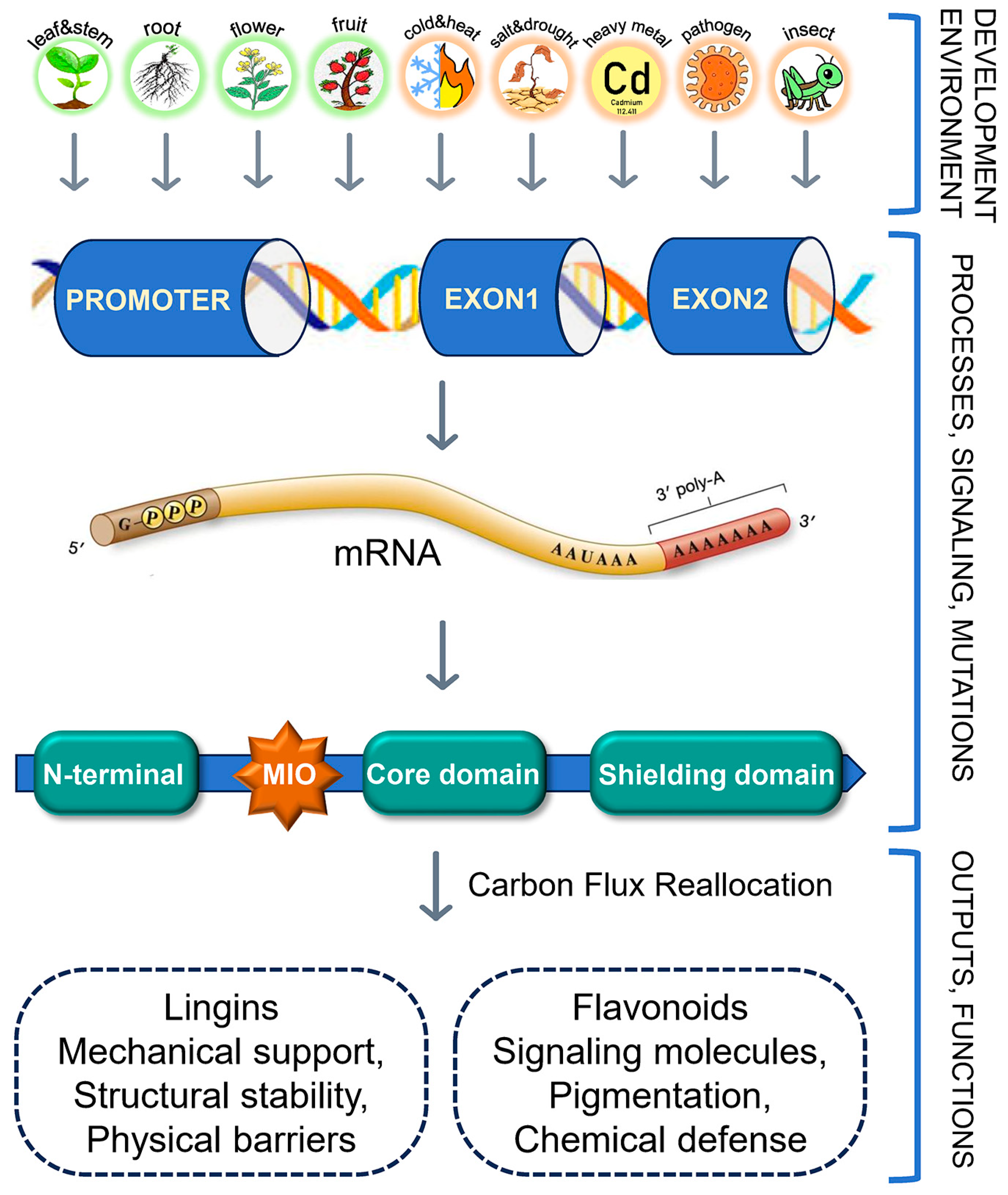
Phenylalanine Ammonia-Lyase: A Core Regulator of Plant Carbon Metabolic Flux Redistribution—From Molecular Mechanisms and Growth Modulation to Stress Adaptability

 ,
,
Abstract
1. Introduction
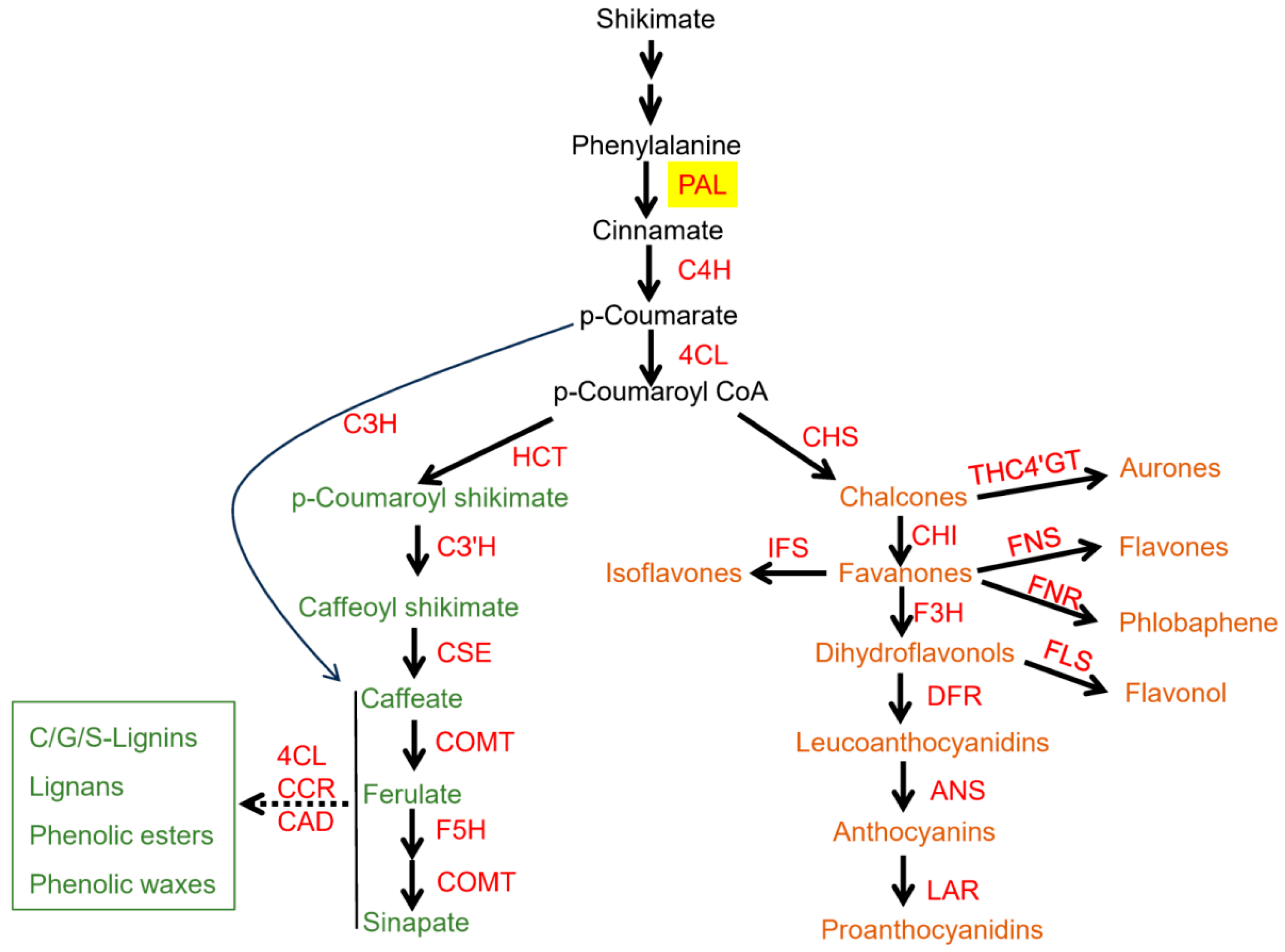
1.1. PAL in Plant Carbon Metabolism Networks
1.2. Core Roles of PAL in Carbon Flux Reallocation
2. Structural and Evolutionary Foundations of PAL-Mediated Carbon Flux Regulation
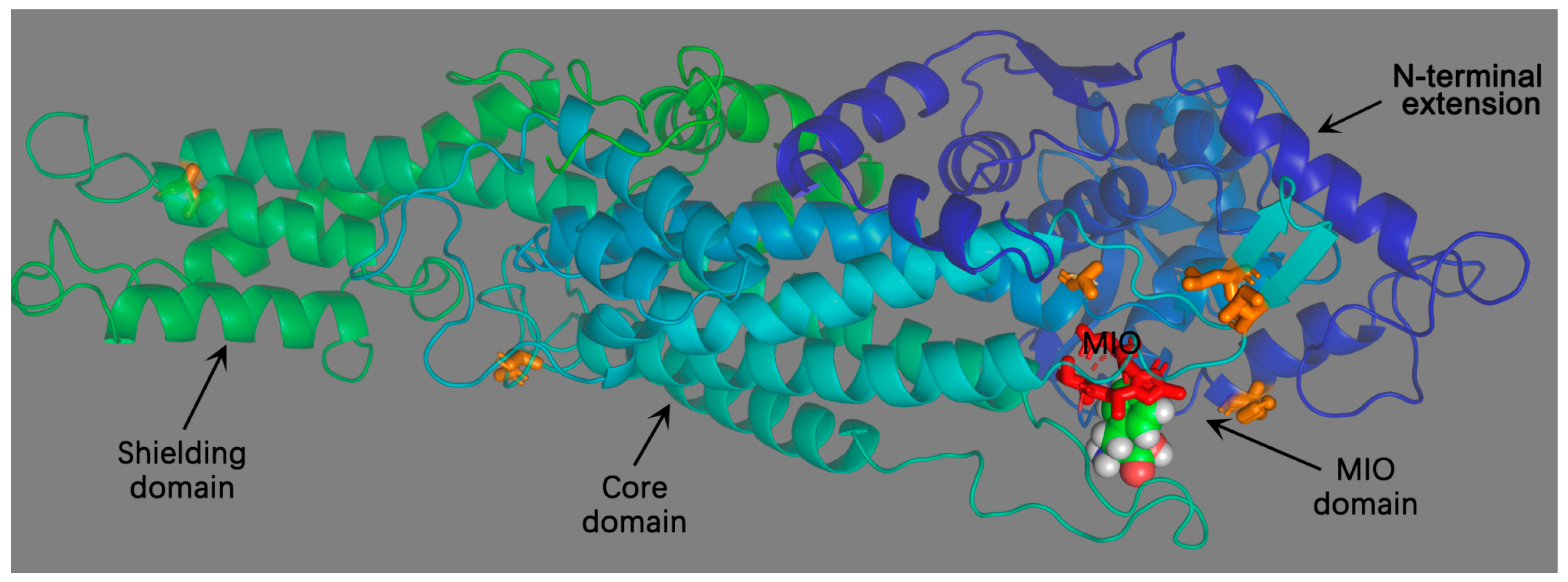
2.1. Structural Basis of PAL Catalysis and Species-Specific Functional Adaptation
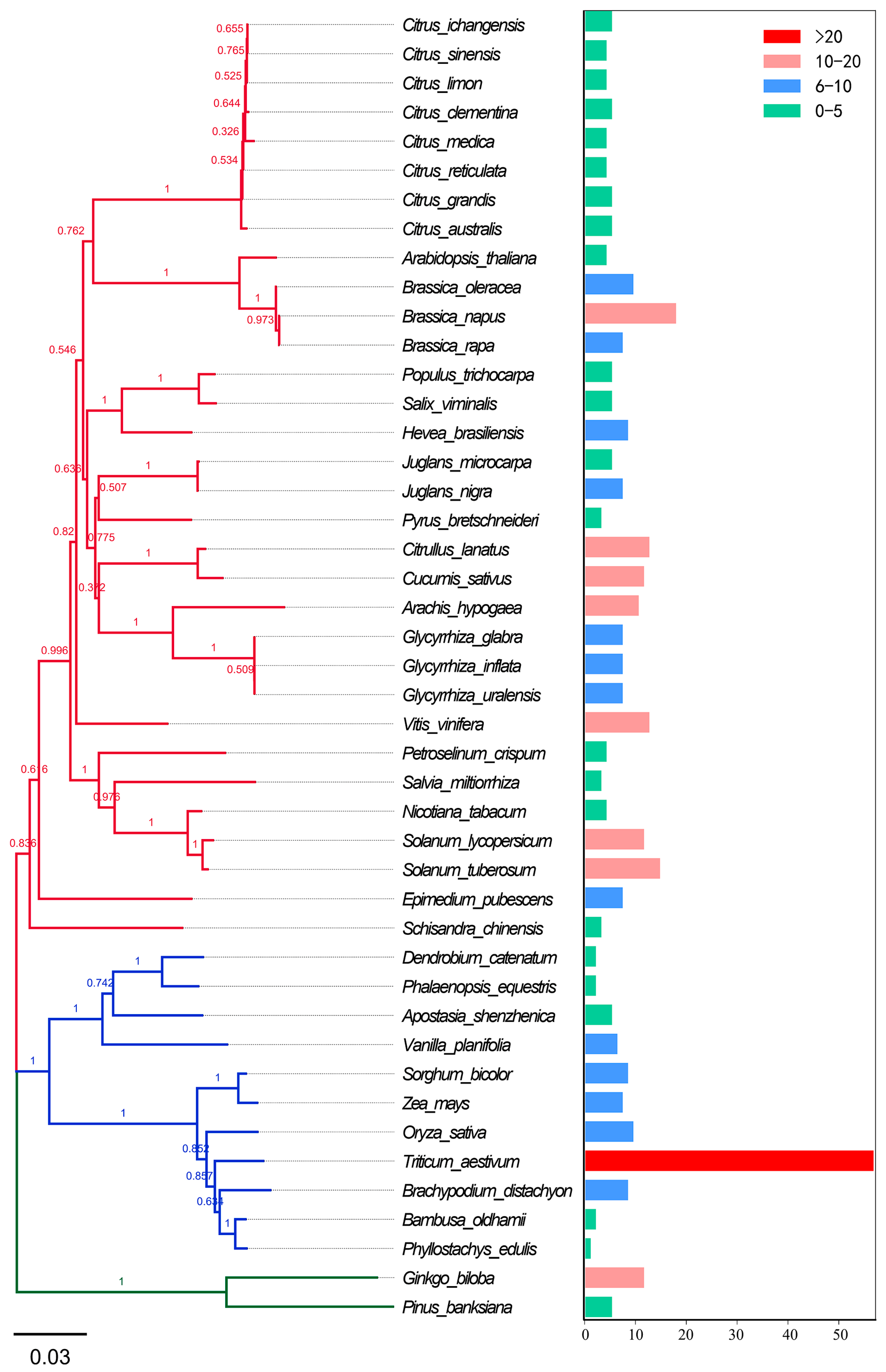
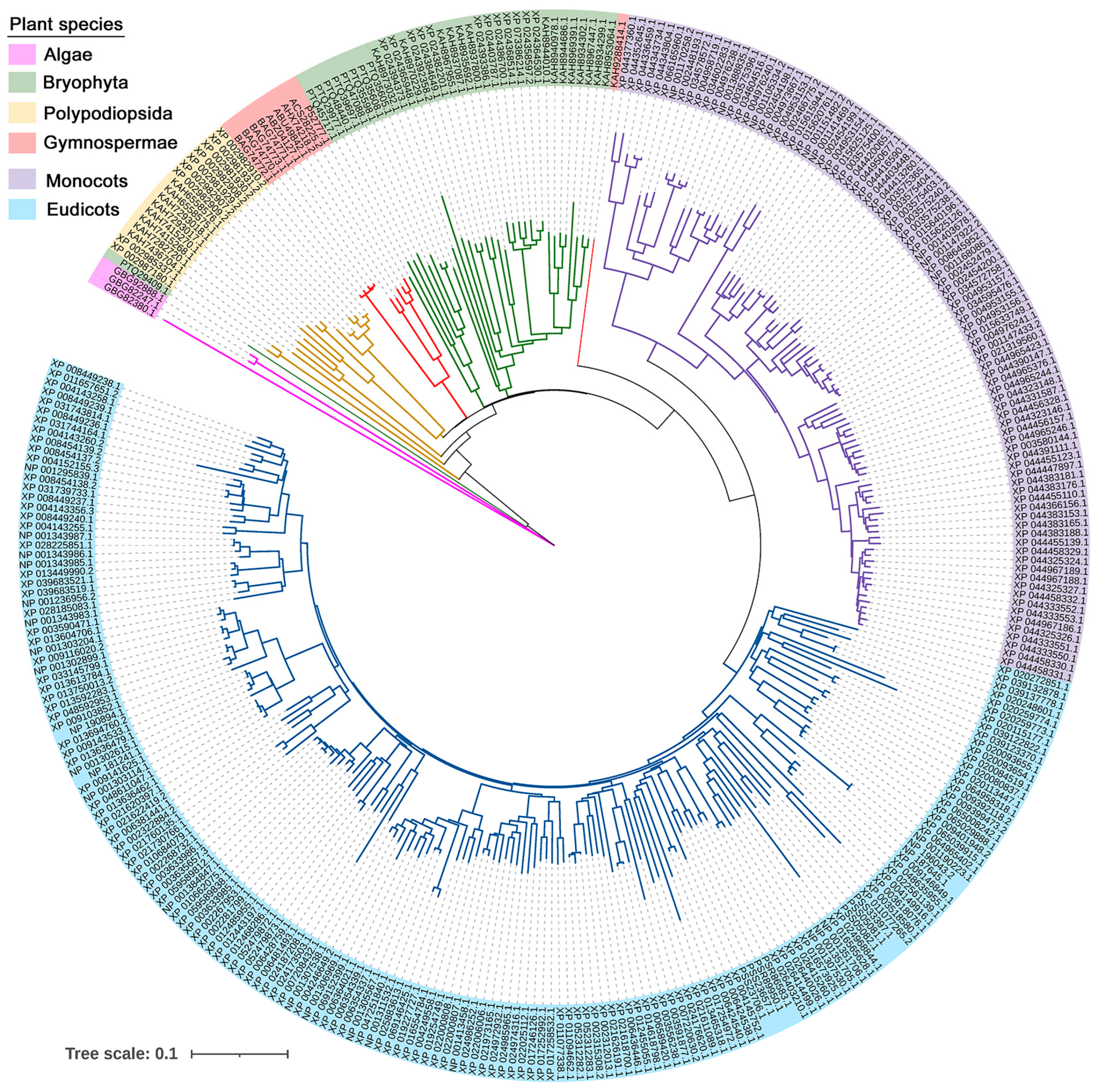
2.2. Evolutionary Expansion and Structural Diversification of the PAL Gene Family
3. Regulation of Plant Growth and Development by PAL-Mediated Carbon Flux Reallocation
3.1. Association Between Carbon Flux Reallocation and Plant Organ Development & Lifecycle-Wide Dynamic Regulation
3.2. Synergistic Regulation of PAL and Other Pathways: Carbon–Nitrogen Balance
4. PAL-Mediated Carbon Flux Reallocation and Plant Stress Adaptation
4.1. PAL-Mediated Carbon Flux Regulation and Responses to Abiotic Stress
4.2. PAL-Mediated Carbon Flux and Defense Responses to Biotic Stress
4.3. Regulatory Network of PAL and Phytohormones Under Combined Stresses
5. Summary and Perspectives
Supplementary Materials
Author Contributions
Funding
Data Availability Statement
Acknowledgments
Conflicts of Interest
Abbreviations
| 3-PGA | 3-phosphoglycerate |
| 4CL | 4-coumarate-CoA ligase |
| ABA | abscisic acid |
| C4H | cinnamate 4-hydroxylase |
| CBSMs | carbon-based secondary metabolites |
| CCR | cinnamoyl-CoA reductase |
| kcat | turnover number |
| Km | Michaelis constant |
| MDA | malondialdehyde |
| MIO | 4-methylidene-imidazole-5-one |
| PAL | phenylalanine ammonia-lyase |
| RNAi | RNA interference |
| ROS | reactive oxygen species |
| SA | salicylic acid |
| TCA | tricarboxylic acid |
| WGD | whole-genome duplication |
References
- Zhang, X.; Liu, C.-J. Multifaceted Regulations of Gateway Enzyme Phenylalanine Ammonia-Lyase in the Biosynthesis of Phenylpropanoids. Mol. Plant 2015, 8, 17–27. [Google Scholar] [CrossRef]
- Augustine, L.; Varghese, L.; Kappachery, S.; Ramaswami, V.M.; Surendrababu, S.P.; Sakuntala, M.; Thomas, G. Comparative Analyses Reveal a Phenylalanine Ammonia Lyase Dependent and Salicylic Acid Mediated Host Resistance in Zingiber Zerumbet against the Necrotrophic Soft Rot Pathogen Pythium Myriotylum. Plant Sci. 2024, 340, 111972. [Google Scholar] [CrossRef] [PubMed]
- Sun, H.; Li, H.; Huang, M.; Gao, Z. Expression and Function Analysis of Phenylalanine Ammonia-lyase Genes Involved in Bamboo Lignin Biosynthesis. Physiol. Plant. 2024, 176, e14444. [Google Scholar] [CrossRef] [PubMed]
- Pedras, M.S.C.; Ahiahonu, P.W.K. Metabolism and Detoxification of Phytoalexins and Analogs by Phytopathogenic Fungi. Phytochemistry 2005, 66, 391–411. [Google Scholar] [CrossRef]
- He, J.; Liu, Y.; Yuan, D.; Duan, M.; Liu, Y.; Shen, Z.; Yang, C.; Qiu, Z.; Liu, D.; Wen, P.; et al. An R2R3 MYB Transcription Factor Confers Brown Planthopper Resistance by Regulating the Phenylalanine Ammonia-Lyase Pathway in Rice. Proc. Natl. Acad. Sci. USA 2020, 117, 271–277. [Google Scholar] [CrossRef] [PubMed]
- Singh, G.; Agrawal, H.; Bednarek, P. Specialized Metabolites as Versatile Tools in Shaping Plant–Microbe Associations. Mol. Plant 2023, 16, 122–144. [Google Scholar] [CrossRef]
- Ritter, H.; Schulz, G.E. Structural Basis for the Entrance into the Phenylpropanoid Metabolism Catalyzed by Phenylalanine Ammonia-Lyase. Plant Cell 2004, 16, 3426–3436. [Google Scholar] [CrossRef]
- Lemoine, R.; Camera, S.L.; Atanassova, R.; Dédaldéchamp, F.; Allario, T.; Pourtau, N.; Bonnemain, J.-L.; Laloi, M.; Coutos-Thévenot, P.; Maurousset, L.; et al. Source-to-Sink Transport of Sugar and Regulation by Environmental Factors. Front. Plant Sci. 2013, 4, 272. [Google Scholar] [CrossRef]
- Cochrane, F.C.; Davin, L.B.; Lewis, N.G. The Arabidopsis Phenylalanine Ammonia Lyase Gene Family: Kinetic Characterization of the Four PAL Isoforms. Phytochemistry 2004, 65, 1557–1564. [Google Scholar] [CrossRef]
- Chen, X.; Jiang, C.; Long, M.; Hu, X.; Xu, S.; Huo, H.; Shi, R.; Xu, Q.; Xie, S.; Li, Z.; et al. Overexpression of the Glycyrrhiza Uralensis Phenylalanine Ammonia-Lyase Gene GuPAL1 Promotes Flavonoid Accumulation in Arabidopsis Thaliana. Int. J. Mol. Sci. 2025, 26, 4073. [Google Scholar] [CrossRef]
- Uy, A.L.T.; Yamamoto, A.; Matsuda, M.; Arae, T.; Hasunuma, T.; Demura, T.; Ohtani, M. The Carbon Flow Shifts from Primary to Secondary Metabolism during Xylem Vessel Cell Differentiation in Arabidopsis thaliana. Plant Cell Physiol. 2023, 64, 1563–1575. [Google Scholar] [CrossRef] [PubMed]
- Abdel, L.A.; Dawood, M.; Hassanpour, H.; Rezayian, M.; Younes, N.A. Impact of the Static Magnetic Field on Growth, Pigments, Osmolytes, Nitric Oxide, Hydrogen Sulfide, Phenylalanine Ammonia-Lyase Activity, Antioxidant Defense System, and Yield in Lettuce. Biology 2020, 9, 172. [Google Scholar] [CrossRef] [PubMed]
- Chen, D.; Mubeen, B.; Hasnain, A.; Rizwan, M.; Adrees, M.; Naqvi, S.A.H.; Iqbal, S.; Kamran, M.; El-Sabrout, A.M.; Elansary, H.O.; et al. Role of Promising Secondary Metabolites to Confer Resistance against Environmental Stresses in Crop Plants: Current Scenario and Future Perspectives. Front. Plant Sci. 2022, 13, 881032. [Google Scholar] [CrossRef]
- Fan, L.; Shi, G.; Yang, J.; Liu, G.; Niu, Z.; Ye, W.; Wu, S.; Wang, L.; Guan, Q. A Protective Role of Phenylalanine Ammonia-Lyase from Astragalus Membranaceus against Saline-Alkali Stress. Int. J. Mol. Sci. 2022, 23, 15686. [Google Scholar] [CrossRef]
- Solgi, M.; Bagnazari, M.; Mohammadi, M.; Azizi, A. Thymbra Spicata Extract and Arbuscular Mycorrhizae Improved the Morphophysiological Traits, Biochemical Properties, and Essential Oil Content and Composition of Rosemary (Rosmarinus officinalis L.) under Salinity Stress. BMC Plant Biol. 2025, 25, 220. [Google Scholar] [CrossRef]
- Guo, L.; Wang, P.; Jaini, R.; Dudareva, N.; Chapple, C.; Morgan, J.A. Dynamic Modeling of Subcellular Phenylpropanoid Metabolism in Arabidopsis Lignifying Cells. Metab. Eng. 2018, 49, 36–46. [Google Scholar] [CrossRef]
- Gho, Y.S.; Kim, S.J.; Jung, K.H. Phenylalanine Ammonia-Lyase Family Is Closely Associated with Response to Phosphate Deficiency in Rice. Genes. Genom. 2020, 42, 67–76. [Google Scholar] [CrossRef]
- Achnine, L.; Blancaflor, E.B.; Rasmussen, S.; Dixon, R.A. Colocalization of L-Phenylalanine Ammonia-Lyase and Cinnamate 4-Hydroxylase for Metabolic Channeling in Phenylpropanoid Biosynthesis. Plant Cell 2004, 16, 3098–3109. [Google Scholar] [CrossRef]
- Blount, J.W.; Korth, K.L.; Masoud, S.A.; Rasmussen, S.; Lamb, C.; Dixon, R.A. Altering Expression of Cinnamic Acid 4-Hydroxylase in Transgenic Plants Provides Evidence for a Feedback Loop at the Entry Point into the Phenylpropanoid Pathway. Plant Physiol. 2000, 122, 107–116. [Google Scholar] [CrossRef] [PubMed]
- Huang, J.; Zhao, X.; Zhang, Y.; Chen, Y.; Zhang, X.; Yi, Y.; Ju, Z.; Sun, W. Chalcone-Synthase-Encoding RdCHS1 Is Involved in Flavonoid Biosynthesis in Rhododendron Delavayi. Molecules 2024, 29, 1822. [Google Scholar] [CrossRef]
- Reyes, J.A.; Gomez, L.M.; Civello, P.M.; Martinez, G.A. Phenylalanine Ammonia Lyase Is More Relevant than Chalcone Synthase and Chalcone Isomerase in the Biosynthesis of Flavonoids during Postharvest Senescence of Broccoli. J. Food Biochem. 2022, 46, e14054. [Google Scholar] [CrossRef]
- Albert, N.W.; Lafferty, D.J.; Moss, S.M.A.; Davies, K.M. Flavonoids–Flowers, Fruit, Forage and the Future. J. R. Soc. N. Z. 2023, 53, 304–331. [Google Scholar] [CrossRef]
- Joshi, A.; Jeena, G.S.; Shikha; Kumar, R.S.; Pandey, A.; Shukla, R.K. Ocimum Sanctum, OscWRKY1, Regulates Phenylpropanoid Pathway Genes and Promotes Resistance to Pathogen Infection in Arabidopsis. Plant Mol. Biol. 2022, 110, 235–251. [Google Scholar] [CrossRef] [PubMed]
- Liu, B.; Jing, D.; Liu, F.; Ma, H.; Liu, X.; Peng, L. Serendipita Indica Alleviates Drought Stress Responses in Walnut (Juglans Regia L.) Seedlings by Stimulating Osmotic Adjustment and Antioxidant Defense System. Appl. Microbiol. Biotechnol. 2021, 105, 8951–8968. [Google Scholar] [CrossRef]
- Sato, T.; Kiuchi, F.; Sankawa, U. Inhibition of Phenylalanine Ammonia-Lyase by Cinnamic Acid Derivatives and Related Compounds. Phytochemistry 1982, 21, 845–850. [Google Scholar] [CrossRef]
- Wei, J.; Liao, S.; Li, M.; Zhu, B.; Wang, H.; Gu, L.; Yin, H.; Du, X. AetSRG1 Contributes to the Inhibition of Wheat Cd Accumulation by Stabilizing Phenylalanine Ammonia Lyase. J. Hazard. Mater. 2022, 428, 128226. [Google Scholar] [CrossRef]
- Zhang, X.; Gou, M.; Liu, C.-J. Arabidopsis Kelch Repeat F-Box Proteins Regulate Phenylpropanoid Biosynthesis via Controlling the Turnover of Phenylalanine Ammonia-Lyase. Plant Cell 2013, 25, 4994–5010. [Google Scholar] [CrossRef]
- Reddy, J.T.; Korth, K.L.; Wesley, S.V.; Howles, P.A.; Rasmussen, S.; Lamb, C.; Dixon, R.A. Post-Transcriptional Regulation of Phenylalanine Ammonia-Lyase Expression in Tobacco Following Recovery from Gene Silencing. Biol. Chem. 2000, 381, 655–665. [Google Scholar] [CrossRef]
- Liu, W.; Zheng, T.; Yang, Y.; Li, P.; Qiu, L.; Li, L.; Wang, J.; Cheng, T.; Zhang, Q. Meta-Analysis of the Effect of Overexpression of MYB Transcription Factors on the Regulatory Mechanisms of Anthocyanin Biosynthesis. Front. Plant Sci. 2021, 12, 781343. [Google Scholar] [CrossRef] [PubMed]
- Maeda, K.; Kimura, S.; Demura, T.; Takeda, J.; Ozeki, Y. DcMYB1 Acts as a Transcriptional Activator of the Carrot Phenylalanine Ammonia-Lyase Gene (DcPAL1) in Response to Elicitor Treatment, UV-B Irradiation and the Dilution Effect. Plant Mol. Biol. 2005, 59, 739–752. [Google Scholar] [CrossRef] [PubMed]
- Koukol, J.; Conn, E.E. The Metabolism of Aromatic Compounds in Higher Plants. IV. Purification and Properties of the Phenylalanine Deaminase of Hordeum Vulgare. J. Biol. Chem. 1961, 236, 2692–2698. [Google Scholar] [CrossRef]
- Jun, S.Y.; Sattler, S.A.; Cortez, G.S.; Vermerris, W.; Sattler, S.E.; Kang, C. Biochemical and Structural Analysis of Substrate Specificity of a Phenylalanine Ammonia-Lyase. Plant Physiol. 2018, 176, 1452–1468. [Google Scholar] [CrossRef]
- Calabrese, J.C.; Jordan, D.B.; Boodhoo, A.; Sariaslani, S.; Vannelli, T. Crystal Structure of Phenylalanine Ammonia Lyase: Multiple Helix Dipoles Implicated in Catalysis. Biochemistry 2004, 43, 11403–11416. [Google Scholar] [CrossRef]
- Schuster, B.; Retey, J. The Mechanism of Action of Phenylalanine Ammonia-Lyase: The Role of Prosthetic Dehydroalanine. Proc. Natl. Acad. Sci. USA 1995, 92, 8433–8437. [Google Scholar] [CrossRef] [PubMed]
- Schuster, B.; Retey, J. Serine-202 Is the Putative Precursor of the Active Site Dehydroalanine of Phenylalanine Ammonia Lyase. Site-Directed Mutagenesis Studies on the Enzyme from Parsley (Petroselinum crispum L.). FEBS Lett. 1994, 349, 252–254. [Google Scholar] [CrossRef] [PubMed]
- Jaliani, H.Z.; Farajnia, S.; Mohammadi, S.A.; Barzegar, A.; Talebi, S. Engineering and Kinetic Stabilization of the Therapeutic Enzyme Anabeana Variabilis Phenylalanine Ammonia Lyase. Appl. Biochem. Biotechnol. 2013, 171, 1805–1818. [Google Scholar] [CrossRef]
- Zhang, F.; Ren, J.; Zhan, J. Identification and Characterization of an Efficient Phenylalanine Ammonia-Lyase from Photorhabdus Luminescens. Appl. Biochem. Biotechnol. 2021, 193, 1099–1115. [Google Scholar] [CrossRef]
- Pezeshki, S.; Warmbier, I.; Busch, T.; Bauerbach, E.; Szovenyi, P.; Petersen, M. The First Step into Phenolic Metabolism in the Hornwort Anthoceros Agrestis: Molecular and Biochemical Characterization of Two Phenylalanine Ammonia-Lyase Isoforms. Planta 2022, 256, 33. [Google Scholar] [CrossRef] [PubMed]
- Cass, C.L.; Peraldi, A.; Dowd, P.F.; Mottiar, Y.; Santoro, N.; Karlen, S.D.; Bukhman, Y.V.; Foster, C.E.; Thrower, N.; Bruno, L.C.; et al. Effects of PHENYLALANINE AMMONIA LYASE (PAL) Knockdown on Cell Wall Composition, Biomass Digestibility, and Biotic and Abiotic Stress Responses in Brachypodium. J. Exp. Bot. 2015, 66, 4317–4335. [Google Scholar] [CrossRef]
- José, M.T.D.A.F.; Pedrita, A.S.; Emanuella, C.V.P.; Raimundo, G.D.O.J.; Fabrício, S.S.; Jackson, R.G.D.S.A.; Larissa, A.R.; Xirley, P.N.; Edigênia, C.D.C.A. Flavonoids as Photoprotective Agents: A Systematic Review. J. Med. Plants Res. 2016, 10, 848–864. [Google Scholar] [CrossRef]
- Ryan, K.G.; Swinny, E.E.; Markham, K.R.; Winefield, C. Flavonoid Gene Expression and UV Photoprotection in Transgenic and Mutant Petunia Leaves. Phytochemistry 2002, 59, 23–32. [Google Scholar] [CrossRef] [PubMed]
- Holcroft, D.M.; Kader, A.A. Carbon Dioxide–Induced Changes in Color and Anthocyanin Synthesis of Stored Strawberry Fruit. HortScience 1999, 34, 1244–1248. [Google Scholar] [CrossRef]
- Lister, C.E.; Lancaster, J.E.; Walker, J.R.L. Phenylalanine Ammonia-Lyase (PAL) Activity and Its Relationship to Anthocyanin and Flavonoid Levels in New Zealand-Grown Apple Cultivars. J. Am. Soc. Hortic. Sci. 1996, 121, 281–285. [Google Scholar] [CrossRef]
- Medda, S.; Dessena, L.; Mulas, M. Monitoring of the PAL Enzymatic Activity and Polyphenolic Compounds in Leaves and Fruits of Two Myrtle Cultivars during Maturation. Agriculture 2020, 10, 389. [Google Scholar] [CrossRef]
- Nutricati, E.; Sabella, E.; Negro, C.; Min Allah, S.; Luvisi, A.; De Bellis, L.; Accogli, R.A. Anthocyanins and Anthocyanin Biosynthesis Gene Expression in Passiflora Flower Corona Filaments. Plants 2025, 14, 1050. [Google Scholar] [CrossRef] [PubMed]
- Li, C.; Zhang, G.; Cheng, G.; Wang, Q. Phenylalanine Ammonia-Lyase GhPAL9 Confers Resistance to Verticillium Wilt in Cotton. Int. J. Mol. Sci. 2025, 26, 4983. [Google Scholar] [CrossRef]
- Wang, N.; Zhu, Y.; Zhou, Y.; Gao, F.; Cui, S. Transcriptome Analysis Reveals the Crucial Role of Phenylalanine Ammonia-Lyase in Low Temperature Response in Ammopiptanthus Mongolicus. Genes 2024, 15, 1465. [Google Scholar] [CrossRef]
- Arafa, A.M.; Abdel-Ghany, A.E.; El-Dahmy, S.I.; Abdelaziz, S.; El-Ayouty, Y.; El-Sayed, A. Purification and Characterization of Anabaena Flos-Aquae Phenylalanine Ammonia-Lyase as a Novel Approach for Myristicin Biotransformation. J. Microbiol. Biotechnol. 2020, 30, 622–632. [Google Scholar] [CrossRef]
- Albogami, A.; Naguib, D.M. Agricultural Wastes: A New Promising Source for Phenylalanine Ammonia-Lyase as Anticancer Agent. 3 Biotech. 2024, 14, 22. [Google Scholar] [CrossRef]
- Cui, J.D.; Li, L.L.; Bian, H.J. Immobilization of Cross-Linked Phenylalanine Ammonia Lyase Aggregates in Microporous Silica Gel. PLoS ONE 2013, 8, e80581. [Google Scholar] [CrossRef] [PubMed]
- Qin, Y.; Li, Q.; An, Q.; Li, D.; Huang, S.; Zhao, Y.; Chen, W.; Zhou, J.; Liao, H. A Phenylalanine Ammonia Lyase from Fritillaria Unibracteata Promotes Drought Tolerance by Regulating Lignin Biosynthesis and SA Signaling Pathway. Int. J. Biol. Macromol. 2022, 213, 574–588. [Google Scholar] [CrossRef]
- Davies, K.M.; Jibran, R.; Zhou, Y.; Albert, N.W.; Brummell, D.A.; Jordan, B.R.; Bowman, J.L.; Schwinn, K.E. The Evolution of Flavonoid Biosynthesis: A Bryophyte Perspective. Front. Plant Sci. 2020, 11, 7. [Google Scholar] [CrossRef]
- Bagal, U.R.; Leebens-Mack, J.H.; Lorenz, W.W.; Dean, J.F. The Phenylalanine Ammonia Lyase (PAL) Gene Family Shows a Gymnosperm-Specific Lineage. BMC Genom. 2012, 13, S1. [Google Scholar] [CrossRef]
- Xu, C.; Fan, X.; Shen, G.; Guo, B. Genome-Wide Identification of the Phenylalanine Ammonia-Lyase Gene from Epimedium Pubescens Maxim. (Berberidaceae): Novel Insight into the Evolution of the PAL Gene Family. BMC Plant Biol. 2024, 24, 831. [Google Scholar] [CrossRef]
- Zhang, C.; Guo, H.; Li, Z.; Yue, S. Evolution of Phenylalanine Ammonia-Lyase Protein Family from Algae to Angiosperm. Funct. Integr. Genom. 2025, 25, 40. [Google Scholar] [CrossRef] [PubMed]
- Huang, J.; Gu, M.; Lai, Z.; Fan, B.; Shi, K.; Zhou, Y.-H.; Yu, J.-Q.; Chen, Z. Functional Analysis of the Arabidopsis PAL Gene Family in Plant Growth, Development, and Response to Environmental Stress. Plant Physiol. 2010, 153, 1526–1538. [Google Scholar] [CrossRef] [PubMed]
- Felton, G.W.; Korth, K.L.; Bi, J.L.; Wesley, S.V.; Huhman, D.V.; Mathews, M.C.; Murphy, J.B.; Lamb, C.; Dixon, R.A. Inverse Relationship between Systemic Resistance of Plants to Microorganisms and to Insect Herbivory. Curr. Biol. 1999, 9, 317–320. [Google Scholar] [CrossRef]
- Tavernier, V.; Cadiou, S.; Pageau, K.; Laugé, R.; Reisdorf-Cren, M.; Langin, T.; Masclaux-Daubresse, C. The Plant Nitrogen Mobilization Promoted by Colletotrichum Lindemuthianum in Phaseolus Leaves Depends on Fungus Pathogenicity. J. Exp. Bot. 2007, 58, 3351–3360. [Google Scholar] [CrossRef]
- Hsieh, L.S.; Ma, G.J.; Yang, C.C.; Lee, P.D. Cloning, Expression, Site-Directed Mutagenesis and Immunolocalization of Phenylalanine Ammonia-Lyase in Bambusa Oldhamii. Phytochemistry 2010, 71, 1999–2009. [Google Scholar] [CrossRef]
- Hsieh, L.S.; Hsieh, Y.L.; Yeh, C.S.; Cheng, C.Y.; Yang, C.C.; Lee, P.D. Molecular Characterization of a Phenylalanine Ammonia-Lyase Gene (BoPAL1) from Bambusa Oldhamii. Mol. Biol. Rep. 2011, 38, 283–290. [Google Scholar] [CrossRef] [PubMed]
- Chai, P.; Cui, M.; Zhao, Q.; Chen, L.; Guo, T.; Guo, J.; Wu, C.; Du, P.; Liu, H.; Xu, J.; et al. Genome-Wide Characterization of the Phenylalanine Ammonia-Lyase Gene Family and Their Potential Roles in Response to Aspergillus flavus L. Infection in Cultivated Peanut (Arachis hypogaea L.). Genes 2024, 15, 265. [Google Scholar] [CrossRef]
- Karamat, U.; Guo, J.; Jiang, S.; Khan, I.; Lu, M.; Fu, M.; Li, G. Comprehensive, Genome-Wide Identification and Expression Analyses of Phenylalanine Ammonia-Lyase Family under Abiotic Stresses in Brassica Oleracea. Int. J. Mol. Sci. 2024, 25, 10276. [Google Scholar] [CrossRef]
- Liu, J.; Lefevere, H.; Coussement, L.; Delaere, I.; De Meyer, T.; Demeestere, K.; Höfte, M.; Gershenzon, J.; Ullah, C.; Gheysen, G. The Phenylalanine Ammonia-lyase Inhibitor AIP Induces Rice Defence against the Root-knot Nematode Meloidogyne graminicola. Mol. Plant Pathol. 2024, 25, e13424. [Google Scholar] [CrossRef]
- Yang, L.; Li, W.C.; Fu, F.L.; Qu, J.; Sun, F.; Yu, H.; Zhang, J. Characterization of Phenylalanine Ammonia-Lyase Genes Facilitating Flavonoid Biosynthesis from Two Species of Medicinal Plant Anoectochilus. PeerJ 2022, 10, e13614. [Google Scholar] [CrossRef] [PubMed]
- Brown, D.E.; Rashotte, A.M.; Murphy, A.S.; Normanly, J.; Tague, B.W.; Peer, W.A.; Taiz, L.; Muday, G.K. Flavonoids Act as Negative Regulators of Auxin Transport in Vivo in Arabidopsis. Plant Physiol. 2001, 126, 524–535. [Google Scholar] [CrossRef] [PubMed]
- Kurepa, J.; Shull, T.E.; Smalle, J.A. Friends in Arms: Flavonoids and the Auxin/Cytokinin Balance in Terrestrialization. Plants 2023, 12, 517. [Google Scholar] [CrossRef]
- Peer, W.A.; Murphy, A.S. Flavonoids and Auxin Transport: Modulators or Regulators? Trends Plant Sci. 2007, 12, 556–563. [Google Scholar] [CrossRef] [PubMed]
- Feduraev, P.; Riabova, A.; Skrypnik, L.; Pungin, A.; Tokupova, E.; Maslennikov, P.; Chupakhina, G. Assessment of the Role of PAL in Lignin Accumulation in Wheat (Tríticum aestívum L.) at the Early Stage of Ontogenesis. Int. J. Mol. Sci. 2021, 22, 9848. [Google Scholar] [CrossRef]
- Lu, J.; Shi, Y.; Li, W.; Chen, S.; Wang, Y.; He, X.; Yin, X. RcPAL, a Key Gene in Lignin Biosynthesis in Ricinus communis L. BMC Plant Biol. 2019, 19, 181. [Google Scholar] [CrossRef]
- Agati, G.; Brunetti, C.; Di Ferdinando, M.; Ferrini, F.; Pollastri, S.; Tattini, M. Functional Roles of Flavonoids in Photoprotection: New Evidence, Lessons from the Past. Plant Physiol. Biochem. PPB 2013, 72, 35–45. [Google Scholar] [CrossRef]
- An, X.; Li, G.; Chen, A.; Zhao, P.; Ding, Y. Identification and Expression Analysis of PAL Genes Related to Chlorogenic Acid Synthesis in Vaccinium Dunalianum Wight. Front. Plant Sci. 2025, 16, 1544303. [Google Scholar] [CrossRef]
- Gray-Mitsumune, M.; Molitor, E.K.; Cukovic, D.; Carlson, J.E.; Douglas, C.J. Developmentally Regulated Patterns of Expression Directed by Poplar PAL Promoters in Transgenic Tobacco and Poplar. Plant Mol. Biol. 1999, 39, 657–669. [Google Scholar] [CrossRef]
- Xue, J.; Lu, D.; Wang, S.; Lu, Z.; Liu, W.; Wang, X.; Fang, Z.; He, X. Integrated Transcriptomic and Metabolomic Analysis Provides Insight into the Regulation of Leaf Senescence in Rice. Sci. Rep. 2021, 11, 14083. [Google Scholar] [CrossRef]
- Huo, Q.; Chang, F.; Jia, P.; Fu, Z.; Zhao, J.; Gao, Y.; Luan, H.; Wang, Y.; Dong, Q.; Qi, G.; et al. Integrated Transcriptomic and Metabolomic Analysis Reveals Nitrogen-Mediated Delay of Premature Leaf Senescence in Red Raspberry Leaves. Plants 2025, 14, 2388. [Google Scholar] [CrossRef]
- Abid, M.A.; Wei, Y.; Meng, Z.; Wang, Y.; Ye, Y.; Wang, Y.; He, H.; Zhou, Q.; Li, Y.; Wang, P.; et al. Increasing Floral Visitation and Hybrid Seed Production Mediated by Beauty Mark in Gossypium Hirsutum. Plant Biotechnol. J. 2022, 20, 1274–1284. [Google Scholar] [CrossRef] [PubMed]
- Glover, B.J.; Martin, C. Anthocyanins. Curr. Biol. 2012, 22, R147–R150. [Google Scholar] [CrossRef] [PubMed]
- Trunschke, J.; Lunau, K.; Pyke, G.H.; Ren, Z.-X.; Wang, H. Flower Color Evolution and the Evidence of Pollinator-Mediated Selection. Front. Plant Sci. 2021, 12, 617851. [Google Scholar] [CrossRef] [PubMed]
- Mekapogu, M.; Vasamsetti, B.M.K.; Kwon, O.-K.; Ahn, M.-S.; Lim, S.-H.; Jung, J.-A. Anthocyanins in Floral Colors: Biosynthesis and Regulation in Chrysanthemum Flowers. Int. J. Mol. Sci. 2020, 21, 6537. [Google Scholar] [CrossRef]
- Muhlemann, J.K.; Younts, T.L.B.; Muday, G.K. Flavonols Control Pollen Tube Growth and Integrity by Regulating ROS Homeostasis during High-Temperature Stress. Proc. Natl. Acad. Sci. USA 2018, 115, E11188–E11197. [Google Scholar] [CrossRef]
- Ylstra, B.; Touraev, A.; Moreno, R.M.B.; Stöger, E.; van Tunen, A.J.; Vicente, O.; Mol, J.N.M.; Heberle-Bors, E. Flavonols Stimulate Development, Germination, and Tube Growth of Tobacco Pollen 1. Plant Physiol. 1992, 100, 902–907. [Google Scholar] [CrossRef] [PubMed]
- Kishitani, S.; Yomoda, A.; Konno, N.; Tanaka, Y. Involvement of Phenylalanine Ammonia-Lyase in the Development of Pollen in Broccoli (Brassica oleracea L.). Sex. Plant Reprod. 1993, 6, 244–248. [Google Scholar] [CrossRef]
- Diallinas, G.; Kanellis, A.K. A Phenylalanine Ammonia-Lyase Gene from Melon Fruit: CDNA Cloning, Sequence and Expression in Response to Development and Wounding. Plant Mol. Biol. 1994, 26, 473–479. [Google Scholar] [CrossRef]
- Qiao, F.; Zhang, K.; Zhou, L.; Qiu, Q.-S.; Chen, Z.; Lu, Y.; Wang, L.; Geng, G.; Xie, H. Analysis of Flavonoid Metabolism during Fruit Development of Lycium Chinense. J. Plant Physiol. 2022, 279, 153856. [Google Scholar] [CrossRef] [PubMed]
- Mattus-Araya, E.; Guajardo, J.; Herrera, R.; Moya-León, M.A. ABA Speeds up the Progress of Color in Developing F. Chiloensis Fruit through the Activation of PAL, CHS and ANS, Key Genes of the Phenylpropanoid/Flavonoid and Anthocyanin Pathways. Int. J. Mol. Sci. 2022, 23, 3854. [Google Scholar] [CrossRef]
- Kostenyuk, I.A.; Zoń, J.; Burns, J.K. Phenylalanine Ammonia Lyase Gene Expression during Abscission in Citrus. Physiol. Plant. 2002, 116, 106–112. [Google Scholar] [CrossRef]
- Mo, F.; Li, L.; Zhang, C.; Yang, C.; Chen, G.; Niu, Y.; Si, J.; Liu, T.; Sun, X.; Wang, S.; et al. Genome-Wide Analysis and Expression Profiling of the Phenylalanine Ammonia-Lyase Gene Family in Solanum Tuberosum. Int. J. Mol. Sci. 2022, 23, 6833. [Google Scholar] [CrossRef]
- Han, J.; Wang, Z.; Wu, X.; Xia, J.; Wang, L.; Wang, Z.; Zhang, Y. Deciphering High-Temperature-Induced Lignin Biosynthesis in Wheat through Comprehensive Transcriptome Analysis. Plants 2024, 13, 1832. [Google Scholar] [CrossRef]
- Vogt, T. Phenylpropanoid Biosynthesis. Mol. Plant 2010, 3, 2–20. [Google Scholar] [CrossRef]
- Yang, K.; Li, L.; Lou, Y.; Zhu, C.; Li, X.; Gao, Z. A Regulatory Network Driving Shoot Lignification in Rapidly Growing Bamboo. Plant Physiol. 2021, 187, 900–916. [Google Scholar] [CrossRef] [PubMed]
- Grotewold, E. THE GENETICS AND BIOCHEMISTRY OF FLORAL PIGMENTS. Annu. Rev. Plant Biol. 2006, 57, 761–780. [Google Scholar] [CrossRef]
- Fenster, C.B.; Armbruster, W.S.; Wilson, P.; Dudash, M.R.; Thomson, J.D. Pollination Syndromes and Floral Specialization. Annu. Rev. Ecol. Evol. Syst. 2004, 35, 375–403. [Google Scholar] [CrossRef]
- Changwal, C.; Shukla, T.; Hussain, Z.; Singh, N.; Kar, A.; Singh, V.P.; Abdin, M.Z.; Arora, A. Regulation of Postharvest Tomato Fruit Ripening by Endogenous Salicylic Acid. Front. Plant Sci. 2021, 12, 663943. [Google Scholar] [CrossRef] [PubMed]
- Strack, D. 10-Phenolic Metabolism. In Plant Biochemistry; Dey, P.M., Harborne, J.B., Eds.; Academic Press: London, UK, 1997; pp. 387–416. ISBN 978-0-12-214674-9. [Google Scholar]
- Feng, W.; Xue, W.; Zhao, Z.; Wang, H.; Shi, Z.; Wang, W.; Chen, B.; Qiu, P.; Xue, J.; Sun, M. Nitrogen Level Impacts the Dynamic Changes in Nitrogen Metabolism, and Carbohydrate and Anthocyanin Biosynthesis Improves the Kernel Nutritional Quality of Purple Waxy Maize. Plants 2024, 13, 2882. [Google Scholar] [CrossRef] [PubMed]
- Ibrahim, M.H.; Jaafar, H.Z.E.; Rahmat, A.; Rahman, Z.A. Effects of Nitrogen Fertilization on Synthesis of Primary and Secondary Metabolites in Three Varieties of Kacip Fatimah (Labisia Pumila Blume). Int. J. Mol. Sci. 2011, 12, 5238–5254. [Google Scholar] [CrossRef] [PubMed]
- Trush, K.; Gavurová, M.; Monje-Rueda, M.D.; Kolarčik, V.; Bačovčinová, M.; Betti, M.; Paľove-Balang, P. Low Nitrogen Status Affects Isoflavonoid Production and Flavonol Decoration in Lotus Corniculatus. Plant Stress. 2024, 11, 100336. [Google Scholar] [CrossRef]
- Bassi, D.; Menossi, M.; Mattiello, L. Nitrogen Supply Influences Photosynthesis Establishment along the Sugarcane Leaf. Sci. Rep. 2018, 8, 2327. [Google Scholar] [CrossRef]
- Kováčik, J.; Klejdus, B.; Bačkor, M.; Repčák, M. Phenylalanine Ammonia-Lyase Activity and Phenolic Compounds Accumulation in Nitrogen-Deficient Matricaria chamomilla Leaf Rosettes. Plant Sci. 2007, 172, 393–399. [Google Scholar] [CrossRef]
- Samuels, L.; Kunst, L.; Jetter, R. Sealing Plant Surfaces: Cuticular Wax Formation by Epidermal Cells. Annu. Rev. Plant Biol. 2008, 59, 683–707. [Google Scholar] [CrossRef]
- Sun, Y.; Hou, M.; Mur, L.A.J.; Yang, Y.; Zhang, T.; Xu, X.; Huang, S.; Tong, H. Nitrogen Drives Plant Growth to the Detriment of Leaf Sugar and Steviol Glycosides Metabolisms in Stevia (Stevia rebaudiana Bertoni). Plant Physiol. Biochem. 2019, 141, 240–249. [Google Scholar] [CrossRef]
- Thapa, S.; Prasanna, R.; Ramakrishnan, B.; Sheoran, N.; Kumar, A.; Velmourougane, K.; Kumar, A. Interactive Effects of Magnaporthe Inoculation and Nitrogen Doses on the Plant Enzyme Machinery and Phyllosphere Microbiome of Resistant and Susceptible Rice Cultivars. Arch. Microbiol. 2018, 200, 1287–1305. [Google Scholar] [CrossRef]
- De Long, J.R.; Sundqvist, M.K.; Gundale, M.J.; Giesler, R.; Wardle, D.A. Effects of Elevation and Nitrogen and Phosphorus Fertilization on Plant Defence Compounds in Subarctic Tundra Heath Vegetation. Funct. Ecol. 2016, 30, 314–325. [Google Scholar] [CrossRef]
- Dormann, C.F. Consequences of Manipulations in Carbon and Nitrogen Supply for Concentration of Anti-Herbivore Defence Compounds in Salix Polaris. Écoscience 2003, 10, 312–318. [Google Scholar] [CrossRef]
- Khanna, A.Q.; Borowicz, V.A.; Jones, M.A. Effects of Nitrogen Fertilizer and Defoliation on Growth, Foliar Nitrogen, and Foliar Coumestrol Concentrations of Soybean. Trans. Ill. State Acad. Sci. 1999, 92, 167–179. [Google Scholar]
- Tomova, L.; Braun, S.; Flückiger, W. The Effect of Nitrogen Fertilization on Fungistatic Phenolic Compounds in Roots of Beech (Fagus sylvatica) and Norway Spruce (Picea abies). For. Pathol. 2005, 35, 262–276. [Google Scholar] [CrossRef]
- Bhaskar, C.V.; Rao, G.R.; Reddy, K.B. Effect of Nitrogen and Potassium Nutrition on Sheath Rot Incidence and Phenol Content in Rice (Oryza sativa L.). Indian. J. Plant Physiol. 2001, 6, 254–257. [Google Scholar]
- Keller, M.; Rogiers, S.Y.; Schultz, H.R. Nitrogen and Ultraviolet Radiation Modify Grapevines’ Susceptibility to Powdery Mildew. Vitis 2003, 42, 87–94. [Google Scholar]
- Leser, C.; Treutter, D. Effects of Nitrogen Supply on Growth, Contents of Phenolic Compounds and Pathogen (Scab) Resistance of Apple Trees. Physiol. Plant. 2005, 123, 49–56. [Google Scholar] [CrossRef]
- Mittelstrass, K.; Treutter, D.; Plessl, M.; Heller, W.; Elstner, E.F.; Heiser, I. Modification of Primary and Secondary Metabolism of Potato Plants by Nitrogen Application Differentially Affects Resistance to Phytophthora infestans and Alternaria solani. Plant Biol. Stuttg. Ger. 2006, 8, 653–661. [Google Scholar] [CrossRef] [PubMed]
- Gu, J.; Sohail, H.; Qiu, L.; Chen, C.; Yue, H.; Li, Z.; Yang, X.; Zhang, L. Genome-Wide Characterization and Expression Analysis of CsPALs in Cucumber (Cucumis sativus L.) Reveal Their Potential Roles in Abiotic Stress and Aphid Stress Tolerance. Plants 2024, 13, 2537. [Google Scholar] [CrossRef]
- Jia, C.; Guo, B.; Wang, B.; Li, X.; Yang, T.; Li, N.; Wang, J.; Yu, Q. Integrated Metabolomic and Transcriptomic Analysis Reveals the Role of Phenylpropanoid Biosynthesis Pathway in Tomato Roots during Salt Stress. Front. Plant Sci. 2022, 13, 1023696. [Google Scholar] [CrossRef]
- Yeshi, K.; Crayn, D.; Ritmejerytė, E.; Wangchuk, P. Plant Secondary Metabolites Produced in Response to Abiotic Stresses Has Potential Application in Pharmaceutical Product Development. Molecules 2022, 27, 313. [Google Scholar] [CrossRef]
- Zhu, J.-K. Abiotic Stress Signaling and Responses in Plants. Cell 2016, 167, 313–324. [Google Scholar] [CrossRef] [PubMed]
- Hürkan, Y.K.; Hürkan, K. Chapter 12 - Regulation of Enzymatic Antioxidants and Stress-Related Gene Expression in Plant System. In Role of Antioxidants in Mitigating Plant Stress; Husen, A., Ed.; Plant Biology, sustainability and climate change; Academic Press: Cambridge, MA, USA, 2025; pp. 229–242. ISBN 978-0-443-26799-4. [Google Scholar]
- Mishra, N.; Jiang, C.; Chen, L.; Paul, A.; Chatterjee, A.; Shen, G. Achieving Abiotic Stress Tolerance in Plants through Antioxidative Defense Mechanisms. Front. Plant Sci. 2023, 14, 1110622. [Google Scholar] [CrossRef] [PubMed]
- Sachdev, S.; Ansari, S.A.; Ansari, M.I.; Fujita, M.; Hasanuzzaman, M. Abiotic Stress and Reactive Oxygen Species: Generation, Signaling, and Defense Mechanisms. Antioxidants 2021, 10, 277. [Google Scholar] [CrossRef] [PubMed]
- Zhang, J.; Cheng, K.; Liu, X.; Dai, Z.; Zheng, L.; Wang, Y. Exogenous Abscisic Acid and Sodium Nitroprusside Regulate Flavonoid Biosynthesis and Photosynthesis of Nitraria Tangutorum Bobr in Alkali Stress. Front. Plant Sci. 2023, 14, 1118984. [Google Scholar] [CrossRef]
- Zhang, Y.; Xu, J.; Li, R.; Ge, Y.; Li, Y.; Li, R. Plants’ Response to Abiotic Stress: Mechanisms and Strategies. Int. J. Mol. Sci. 2023, 24, 10915. [Google Scholar] [CrossRef]
- Balasubramaniam, T.; Shen, G.; Esmaeili, N.; Zhang, H. Plants’ Response Mechanisms to Salinity Stress. Plants 2023, 12, 2253. [Google Scholar] [CrossRef]
- Ramakrishna, A.; Ravishankar, G.A. Influence of Abiotic Stress Signals on Secondary Metabolites in Plants. Plant Signal. Behav. 2011, 6, 1720–1731. [Google Scholar] [CrossRef]
- Shomali, A.; Das, S.; Arif, N.; Sarraf, M.; Zahra, N.; Yadav, V.; Aliniaeifard, S.; Chauhan, D.K.; Hasanuzzaman, M. Diverse Physiological Roles of Flavonoids in Plant Environmental Stress Responses and Tolerance. Plants 2022, 11, 3158. [Google Scholar] [CrossRef]
- Zhao, S.; Zhang, Q.; Liu, M.; Zhou, H.; Ma, C.; Wang, P. Regulation of Plant Responses to Salt Stress. Int. J. Mol. Sci. 2021, 22, 4609. [Google Scholar] [CrossRef]
- Gai, Z.; Wang, Y.; Ding, Y.; Qian, W.; Qiu, C.; Xie, H.; Sun, L.; Jiang, Z.; Ma, Q.; Wang, L.; et al. Exogenous Abscisic Acid Induces the Lipid and Flavonoid Metabolism of Tea Plants under Drought Stress. Sci. Rep. 2020, 10, 12275. [Google Scholar] [CrossRef]
- Rezayian, M.; Niknam, V.; Ebrahimzadeh, H. Differential Responses of Phenolic Compounds of Brassica Napus under Drought Stress. Iran. J. Plant Physiol. 2018, 8, 2417–2425. [Google Scholar]
- Sharma, A.; Shahzad, B.; Rehman, A.; Bhardwaj, R.; Landi, M.; Zheng, B. Response of Phenylpropanoid Pathway and the Role of Polyphenols in Plants under Abiotic Stress. Molecules 2019, 24, 2452. [Google Scholar] [CrossRef]
- Gao, G.; Lv, Z.; Zhang, G.; Li, J.; Zhang, J.; He, C. An ABA–Flavonoid Relationship Contributes to the Differences in Drought Resistance between Different Sea Buckthorn Subspecies. Tree Physiol. 2021, 41, 744–755. [Google Scholar] [CrossRef] [PubMed]
- Hu, H.; Fei, X.; He, B.; Luo, Y.; Qi, Y.; Wei, A. Integrated Analysis of Metabolome and Transcriptome Data for Uncovering Flavonoid Components of Zanthoxylum Bungeanum Maxim. Leaves Under Drought Stress. Front. Nutr. 2022, 8, 801244. [Google Scholar] [CrossRef] [PubMed]
- Yu, W.; Liu, H.; Luo, J.; Zhang, S.; Xiang, P.; Wang, W.; Cai, J.; Lu, Z.; Zhou, Z.; Hu, J.; et al. Partial Root-Zone Simulated Drought Induces Greater Flavonoid Accumulation than Full Root-Zone Simulated Water Deficiency in the Leaves of Ginkgo biloba. Environ. Exp. Bot. 2022, 201, 104998. [Google Scholar] [CrossRef]
- Bigham Soostani, S.; Ranjbar, M.; Memarian, A.; Mohammadi, M.; Yaghini, Z. Regulation of APX, SOD, and PAL Genes by Chitosan under Salt Stress in Rapeseed (Brassica napus L.). BMC Plant Biol. 2025, 25, 824. [Google Scholar] [CrossRef]
- Swetha, R.; Sridhanya, V.M.; Varanavasiappan, S.; Kumar, K.K.; Kokiladevi, E.; Ravichandran, V.; Ramalingam, J.; Sudhakar, D.; Arul, L. Root Apoplastic Barrier Mechanism: An Adaptive Strategy to Protect against Salt Stress. Mol. Biol. Rep. 2025, 52, 56. [Google Scholar] [CrossRef]
- Yang, J.; Zhang, Y.; Jia, J.; Wang, C.; Fu, Y. Flavonoid-Lignin Crosstalk: Engineering Metabolic Flux for Optimised Plant Growth and Stress Resilience. Plant Cell Environ. 2025, 48, 8141–8160. [Google Scholar] [CrossRef]
- Djanaguiraman, M.; Boyle, D.L.; Welti, R.; Jagadish, S.V.K.; Prasad, P.V.V. Decreased Photosynthetic Rate under High Temperature in Wheat Is Due to Lipid Desaturation, Oxidation, Acylation, and Damage of Organelles. BMC Plant Biol. 2018, 18, 55. [Google Scholar] [CrossRef]
- Xu, C.; Wang, Y.; Yang, H.; Tang, Y.; Liu, B.; Hu, X.; Hu, Z. Cold Acclimation Alleviates Photosynthetic Inhibition and Oxidative Damage Induced by Cold Stress in Citrus Seedlings. Plant Signal. Behav. 2023, 18, 2285169. [Google Scholar] [CrossRef] [PubMed]
- Zhou, L.; Ullah, F.; Zou, J.; Zeng, X. Molecular and Physiological Responses of Plants That Enhance Cold Tolerance. Int. J. Mol. Sci. 2025, 26, 1157. [Google Scholar] [CrossRef]
- Amjad, M.; Wang, Y.; Han, S.; Haider, M.Z.; Sami, A.; Batool, A.; Shafiq, M.; Ali, Q.; Dong, J.; Sabir, I.A.; et al. Genome Wide Identification of Phenylalanine Ammonia-Lyase (PAL) Gene Family in Cucumis Sativus (Cucumber) against Abiotic Stress. BMC Genom. Data 2024, 25, 76. [Google Scholar] [CrossRef]
- Cao, Q.; Yuan, X.; Zhang, C.; Deng, X.; Jiang, Y.; Wang, B. An Opinion on the Roles of Phenylalanine Ammonia-Lyase in the Browning of Fresh-Cut Fruit and Vegetables. Front. Nutr. 2025, 12, 1561620. [Google Scholar] [CrossRef]
- Wang, B.; Wu, C.; Wang, G.; He, J.; Zhu, S. Transcriptomic Analysis Reveals a Role of Phenylpropanoid Pathway in the Enhancement of Chilling Tolerance by Pre-Storage Cold Acclimation in Cucumber Fruit. Sci. Hortic. 2021, 288, 110282. [Google Scholar] [CrossRef]
- dos Santos, A.B.; Bottcher, A.; Vicentini, R.; Sampaio Mayer, J.L.; Kiyota, E.; Landell, M.A.G.; Creste, S.; Mazzafera, P. Lignin Biosynthesis in Sugarcane Is Affected by Low Temperature. Environ. Exp. Bot. 2015, 120, 31–42. [Google Scholar] [CrossRef]
- Zhao, P.; Yan, X.; Qian, C.; Ma, G.; Fan, X.; Yin, X.; Liao, Y.; Fang, T.; Zhou, S.; Awuku, I.; et al. Flavonoid Synthesis Pathway Response to Low-Temperature Stress in a Desert Medicinal Plant, Agriophyllum Squarrosum (Sandrice). Genes 2024, 15, 1228. [Google Scholar] [CrossRef] [PubMed]
- Hausman, J.F.; Evers, D.; Thiellement, H.; Jouve, L. Compared Responses of Poplar Cuttings and in Vitro Raised Shoots to Short-Term Chilling Treatments. Plant Cell Rep. 2000, 19, 954–960. [Google Scholar] [CrossRef]
- Olenichenko, N.A.; Zagoskina, N.V. Response of Winter Wheat to Cold: Production of Phenolic Compounds and L-Phenylalanine Ammonia Lyase Activity. Appl. Biochem. Microbiol. 2005, 41, 600–603. [Google Scholar] [CrossRef]
- Luo, Z.; Xu, X.; Yan, B. Accumulation of Lignin and Involvement of Enzymes in Bamboo Shoot during Storage. Eur. Food Res. Technol. 2008, 226, 635–640. [Google Scholar] [CrossRef]
- Laoué, J.; Fernandez, C.; Ormeño, E. Plant Flavonoids in Mediterranean Species: A Focus on Flavonols as Protective Metabolites under Climate Stress. Plants 2022, 11, 172. [Google Scholar] [CrossRef]
- Mansinhos, I.; Gonçalves, S.; Rodríguez-Solana, R.; Ordóñez-Díaz, J.L.; Moreno-Rojas, J.M.; Romano, A. Impact of Temperature on Phenolic and Osmolyte Contents in in Vitro Cultures and Micropropagated Plants of Two Mediterranean Plant Species, Lavandula viridis and Thymus lotocephalus. Plants 2022, 11, 3516. [Google Scholar] [CrossRef]
- Pastore, C.; Dal Santo, S.; Zenoni, S.; Movahed, N.; Allegro, G.; Valentini, G.; Filippetti, I.; Tornielli, G.B. Whole Plant Temperature Manipulation Affects Flavonoid Metabolism and the Transcriptome of Grapevine Berries. Front. Plant Sci. 2017, 8, 929. [Google Scholar] [CrossRef] [PubMed]
- Yuan, Y.; Liu, Y.; Luo, Y.; Huang, L.; Chen, S.; Yang, Z.; Qin, S. High Temperature Effects on Flavones Accumulation and Antioxidant System in Scutellaria baicalensis Georgi Cells. Afr. J. Biotechnol. 2011, 10, 5182–5192. [Google Scholar]
- Alahmadi, A.; Dmello, A. Detrimental Effects of Elevated Temperatures on the Structure and Activity of Phenylalanine Ammonia Lyase-Bovine Serum Albumin Mixtures and the Stabilizing Potential of Surfactant and Sugars. AAPS PharmSciTech 2022, 23, 297. [Google Scholar] [CrossRef]
- Hyodo, H.; Kuroda, H.; Yang, S.F. Induction of Phenylalanine Ammonia-Lyase and Increase in Phenolics in Lettuce Leaves in Relation to the Development of Russet Spotting Caused by Ethylene. Plant Physiol. 1978, 62, 31–35. [Google Scholar] [CrossRef]
- Martínez-Téllez, M.A.; Lafuente, M.T. Effect of High Temperature Conditioning on Ethylene, Phenylalanine Ammonia-Lyase, Peroxidase and Polyphenol Oxidase Activities in Flavedo of Chilled ‹fortune› Mandarin Fruit. J. Plant Physiol. 1997, 150, 674–678. [Google Scholar] [CrossRef]
- Sanchez-Ballesta, M.T.; Zacarias, L.; Granell, A.; Lafuente, M.T. Accumulation of PAL Transcript and PAL Activity as Affected by Heat-Conditioning and Low-Temperature Storage and Its Relation to Chilling Sensitivity in Mandarin Fruits. J. Agric. Food Chem. 2000, 48, 2726–2731. [Google Scholar] [CrossRef] [PubMed]
- Wen, P.-F.; Chen, J.-Y.; Wan, S.-B.; Kong, W.-F.; Zhang, P.; Wang, W.; Zhan, J.-C.; Pan, Q.-H.; Huang, W.-D. Salicylic Acid Activates Phenylalanine Ammonia-Lyase in Grape Berry in Response to High Temperature Stress. Plant Growth Regul. 2008, 55, 1–10. [Google Scholar] [CrossRef]
- Jańczak-Pieniążek, M.; Cichoński, J.; Michalik, P.; Chrzanowski, G. Effect of Heavy Metal Stress on Phenolic Compounds Accumulation in Winter Wheat Plants. Molecules 2022, 28, 241. [Google Scholar] [CrossRef]
- Kısa, D.; Elmastaş, M.; Öztürk, L.; Kayır, Ö. Responses of the Phenolic Compounds of Zea Mays under Heavy Metal Stress. Appl. Biol. Chem. 2016, 59, 813–820. [Google Scholar] [CrossRef]
- Mansoor, S.; Ali, A.; Kour, N.; Bornhorst, J.; AlHarbi, K.; Rinklebe, J.; Abd El Moneim, D.; Ahmad, P.; Chung, Y.S. Heavy Metal Induced Oxidative Stress Mitigation and ROS Scavenging in Plants. Plants 2023, 12, 3003. [Google Scholar] [CrossRef] [PubMed]
- Pawlak-Sprada, S.; Arasimowicz-Jelonek, M.; Podgórska, M.; Deckert, J. Activation of Phenylpropanoid Pathway in Legume Plants Exposed to Heavy Metals. Part I. Effects of Cadmium and Lead on Phenylalanine Ammonia-Lyase Gene Expression, Enzyme Activity and Lignin Content. Acta Biochim. Pol. 2011, 58, 211–216. [Google Scholar] [CrossRef]
- Smirnov, O.E.; Kosyan, A.M.; Kosyk, O.I.; Taran, N.Y. Response of Phenolic Metabolism Induced by Aluminium Toxicity in Fagopyrum Esculentum Moench. Plants. Ukr. Biochem. J. 2015, 87, 129–135. [Google Scholar] [CrossRef] [PubMed]
- Kobyletska, M.; Kavulych, Y.; Romanyuk, N.; Korchynska, O.; Terek, O. Exogenous Salicylic Acid Modifies Cell Wall Lignification, Total Phenolic Content, PAL-Activity in Wheat (Triticum aestivum L.) and Buckwheat (Fagopyrum esculentum Moench) Plants under Cadmium Chloride Impact. Biointerface Res. Appl. Chem. 2022, 13, 117. [Google Scholar] [CrossRef]
- Grover, S.; Shinde, S.; Puri, H.; Palmer, N.; Sarath, G.; Sattler, S.E.; Louis, J. Dynamic Regulation of Phenylpropanoid Pathway Metabolites in Modulating Sorghum Defense against Fall Armyworm. Front. Plant Sci. 2022, 13, 1019266. [Google Scholar] [CrossRef]
- Liu, H.; He, Q.; Hu, Y.; Lu, R.; Wu, S.; Feng, C.; Yuan, K.; Wang, Z. Genome-Wide Identification and Expression Profile Analysis of the Phenylalanine Ammonia-Lyase Gene Family in Hevea Brasiliensis. Int. J. Mol. Sci. 2024, 25, 5052. [Google Scholar] [CrossRef] [PubMed]
- Olsen, K.M.; Lea, U.S.; Slimestad, R.; Verheul, M.; Lillo, C. Differential Expression of Four Arabidopsis PAL Genes; PAL1 and PAL2 Have Functional Specialization in Abiotic Environmental-Triggered Flavonoid Synthesis. J. Plant Physiol. 2008, 165, 1491–1499. [Google Scholar] [CrossRef]
- Jeandet, P.; Hébrard, C.; Deville, M.-A.; Cordelier, S.; Dorey, S.; Aziz, A.; Crouzet, J. Deciphering the Role of Phytoalexins in Plant-Microorganism Interactions and Human Health. Molecules 2014, 19, 18033–18056. [Google Scholar] [CrossRef]
- Lee, M.; Jeon, H.S.; Kim, S.H.; Chung, J.H.; Roppolo, D.; Lee, H.; Cho, H.J.; Tobimatsu, Y.; Ralph, J.; Park, O.K. Lignin-based Barrier Restricts Pathogens to the Infection Site and Confers Resistance in Plants. EMBO J. 2019, 38, e101948. [Google Scholar] [CrossRef]
- Li, Z.; Zhang, Y.; Ren, J.; Jia, F.; Zeng, H.; Li, G.; Yang, X. Ethylene-Responsive Factor ERF114 Mediates Fungal Pathogen Effector PevD1-Induced Disease Resistance in Arabidopsis Thaliana. Mol. Plant Pathol. 2022, 23, 819–831. [Google Scholar] [CrossRef] [PubMed]
- Tripathi, D.; Raikhy, G.; Kumar, D. Chemical Elicitors of Systemic Acquired Resistance—Salicylic Acid and Its Functional Analogs. Curr. Plant Biol. 2019, 17, 48–59. [Google Scholar] [CrossRef]
- Ullah, C.; Chen, Y.-H.; Ortega, M.A.; Tsai, C.-J. The Diversity of Salicylic Acid Biosynthesis and Defense Signaling in Plants: Knowledge Gaps and Future Opportunities. Curr. Opin. Plant Biol. 2023, 72, 102349. [Google Scholar] [CrossRef]
- Dong, Q.; Huang, T.; Zhou, C.; Wan, X.; He, X.; Miao, P.; Cheng, H.; Wang, X.; Yu, H.; Hu, M.; et al. Nano-Priming with Selenium Nanoparticles Reprograms Seed Germination, Antioxidant Defense, and Phenylpropanoid Metabolism to Enhance Fusarium Graminearum Resistance in Maize Seedlings. J. Adv. Res. 2025; in press. [Google Scholar] [CrossRef]
- Chen, Y.; Li, F.; Tian, L.; Huang, M.; Deng, R.; Li, X.; Chen, W.; Wu, P.; Li, M.; Jiang, H.; et al. The Phenylalanine Ammonia Lyase Gene LjPAL1 Is Involved in Plant Defense Responses to Pathogens and Plays Diverse Roles in Lotus Japonicus-Rhizobium Symbioses. Mol. Plant Microbe Interact. 2017, 30, 739–753. [Google Scholar] [CrossRef]
- Dixon, R.A.; Achnine, L.; Kota, P.; Liu, C.; Reddy, M.S.S.; Wang, L. The Phenylpropanoid Pathway and Plant Defence—a Genomics Perspective. Mol. Plant Pathol. 2002, 3, 371–390. [Google Scholar] [CrossRef] [PubMed]
- Ramaroson, M.-L.; Koutouan, C.; Helesbeux, J.-J.; Le Clerc, V.; Hamama, L.; Geoffriau, E.; Briard, M. Role of Phenylpropanoids and Flavonoids in Plant Resistance to Pests and Diseases. Molecules 2022, 27, 8371. [Google Scholar] [CrossRef]
- Sun, M.; Li, L.; Wang, C.; Wang, L.; Lu, D.; Shen, D.; Wang, J.; Jiang, C.; Cheng, L.; Pan, X.; et al. Naringenin Confers Defence against Phytophthora nicotianae through Antimicrobial Activity and Induction of Pathogen Resistance in Tobacco. Mol. Plant Pathol. 2022, 23, 1737–1750. [Google Scholar] [CrossRef]
- Del Mondo, A.; Sansone, C.; Brunet, C. Insights into the Biosynthesis Pathway of Phenolic Compounds in Microalgae. Comput. Struct. Biotechnol. J. 2022, 20, 1901–1913. [Google Scholar] [CrossRef]
- Jackrel, S.L.; Wootton, J.T. Cascading Effects of Induced Terrestrial Plant Defences on Aquatic and Terrestrial Ecosystem Function. Proc. R. Soc. B Biol. Sci. 2015, 282, 20142522. [Google Scholar] [CrossRef] [PubMed]
- Kumar, N.; Goel, N. Phenolic Acids: Natural Versatile Molecules with Promising Therapeutic Applications. Biotechnol. Rep. 2019, 24, e00370. [Google Scholar] [CrossRef]
- Schott, J.; Fuchs, B.; Böttcher, C.; Hilker, M. Responses to Larval Herbivory in the Phenylpropanoid Pathway of Ulmus Minor Are Boosted by Prior Insect Egg Deposition. Planta 2022, 255, 16. [Google Scholar] [CrossRef]
- Bhonwong, A.; Stout, M.J.; Attajarusit, J.; Tantasawat, P. Defensive Role of Tomato Polyphenol Oxidases against Cotton Bollworm (Helicoverpa armigera) and Beet armyworm (Spodoptera Exigua). J. Chem. Ecol. 2009, 35, 28–38. [Google Scholar] [CrossRef]
- Duffey, S.S.; Stout, M.J. Antinutritive and Toxic Components of Plant Defense against Insects. Arch. Insect Biochem. Physiol. 1996, 32, 3–37. [Google Scholar] [CrossRef]
- Ruttanaphan, T.; Songoen, W.; Pluempanupat, W.; Bullangpoti, V. Potential Insecticidal Extracts from Artocarpus lacucha against Spodoptera litura (Lepidoptera: Noctuidae) Larvae. J. Econ. Entomol. 2023, 116, 1205–1210. [Google Scholar] [CrossRef]
- Wiwattanawanichakun, P.; Saehlee, S.; Yooboon, T.; Kumrungsee, N.; Nobsathian, S.; Bullangpoti, V. Toxicity of Isolated Phenolic Compounds from Acorus calamus L. to Control Spodoptera Litura (Lepidoptera: Noctuidae) under Laboratory Conditions. Chem. Biol. Technol. Agric. 2022, 9, 10. [Google Scholar] [CrossRef]
- Glinwood, R.T.; Pettersson, J. Change in Response of Rhopalosiphum Padi Spring Migrants to the Repellent Winter Host Component Methyl Salicylate. Entomol. Exp. Appl. 2000, 94, 325–330. [Google Scholar] [CrossRef]
- Hardie, J.; Isaacs, R.; Pickett, J.A.; Wadhams, L.J.; Woodcock, C.M. Methyl Salicylate and (-)-(1R,5S)-Myrtenal Are Plant-Derived Repellents for Black Bean Aphid,Aphis fabae Scop. (Homoptera: Aphididae). J. Chem. Ecol. 1994, 20, 2847–2855. [Google Scholar] [CrossRef]
- Lu, Q.; Bi, S.; Dong, S.; Wang, X.; Guo, F.; Wang, W. ABA Orchestrates Molecular Networks Linking Antioxidant Defense, Sugar Metabolism and Circadian Clock for Combined Stress Tolerance in Quinoa (Chenopodium Quinoa Willd.). Plant Physiol. Biochem. 2025, 229, 110536. [Google Scholar] [CrossRef]
- Song, Z.; Lai, X.; Chen, H.; Wang, L.; Pang, X.; Hao, Y.; Lu, W.; Chen, W.; Zhu, X.; Li, X. Role of MaABI5-like in Abscisic Acid-Induced Cold Tolerance of ‘Fenjiao’ Banana Fruit. Hortic. Res. 2022, 9, uhac130. [Google Scholar] [CrossRef] [PubMed]
- Purohit, S.; Laloraya, M.M.; Bharti, S.; Nozzolillo, C. Effect of Phenolic Compounds on ABA-Induced Changes in K+ Concentration of Guard Cells and in Epidermal Diffusive Resistance. J. Exp. Bot. 1992, 43, 103–110. [Google Scholar] [CrossRef]
- Pociecha, E.; Płażek, A.; Janowiak, F.; Zwierzykowski, Z. ABA Level, Proline and Phenolic Concentration, and PAL Activity Induced during Cold Acclimation in Androgenic Festulolium Forms with Contrasting Resistance to Frost and Pink Snow Mould (Microdochium nivale). Physiol. Mol. Plant Pathol. 2008, 73, 126–132. [Google Scholar] [CrossRef]
- Pandey, P.; Ramegowda, V.; Senthil-Kumar, M. Shared and Unique Responses of Plants to Multiple Individual Stresses and Stress Combinations: Physiological and Molecular Mechanisms. Front. Plant Sci. 2015, 6, 723. [Google Scholar] [CrossRef]
- Gorman, Z.; Liu, H.; Sorg, A.; Grissett, K.S.; Yactayo-Chang, J.P.; Li, Q.; Rivers, A.R.; Basset, G.J.; Rering, C.C.; Beck, J.J.; et al. Flood-Induced Insect Resistance in Maize Involves Flavonoid-Dependent Salicylic Acid Induction. Plant Cell Environ. 2025, 48, 5169–5183. [Google Scholar] [CrossRef]
- Amorim-Silva, V.; Botella, M.A. The Whole Is Not Always the Sum of the Parts: Synergistic Plant Responses to Combined Environmental Stresses. Plant Cell Environ. 2025, 48, 6336–6338. [Google Scholar] [CrossRef]
- Gupta, A.; Hisano, H.; Hojo, Y.; Matsuura, T.; Ikeda, Y.; Mori, I.C.; Senthil-Kumar, M. Global Profiling of Phytohormone Dynamics during Combined Drought and Pathogen Stress in Arabidopsis Thaliana Reveals ABA and JA as Major Regulators. Sci. Rep. 2017, 7, 4017. [Google Scholar] [CrossRef]
- Machado, J.; Fernandes, A.P.G.; Bokor, B.; Vaculík, M.; Kostoláni, D.; Kokavcová, A.; Heuvelink, E.; Vasconcelos, M.W.; Carvalho, S.M.P. Tomato Responses to Nitrogen, Drought and Combined Stresses: Shared and Specific Effects on Vascular Plant Anatomy, Nutrient Partitioning and Amino Acids Profile. Plant Physiol. Biochem. 2025, 221, 109649. [Google Scholar] [CrossRef] [PubMed]
- Pandey, E.; Kumari, R.; Faizan, S.; Pandey, S. Linking the Interaction of Salicylates and Jasmonates for Stress Resilience in Plants. Stress. Biol. 2025, 5, 64. [Google Scholar] [CrossRef] [PubMed]
- Vishwakarma, S.K.; Singh, N.; Kumaria, S. Genome-Wide Identification and Analysis of the PAL Genes from the Orchids Apostasia shenzhenica, Dendrobium catenatum and Phalaenopsis equestris. J. Biomol. Struct. Dyn. 2023, 41, 1295–1308. [Google Scholar] [CrossRef]
- Zhang, H.; Zhang, X.; Zhao, H.; Hu, J.; Wang, Z.; Yang, G.; Zhou, X.; Wan, H. Genome-Wide Identification and Expression Analysis of Phenylalanine Ammonia-Lyase (PAL) Family in Rapeseed (Brassica napus L.). BMC Plant Biol. 2023, 23, 481. [Google Scholar] [CrossRef]
- Dong, C.J.; Shang, Q.M. Genome-Wide Characterization of Phenylalanine Ammonia-Lyase Gene Family in Watermelon (Citrullus lanatus). Planta 2013, 238, 35–49. [Google Scholar] [CrossRef]
- Yin, T.; Xu, R.; Zhu, L.; Yang, X.; Zhang, M.; Li, X.; Zi, Y.; Wen, K.; Zhao, K.; Cai, H.; et al. Comparative Analysis of the PAL Gene Family in Nine Citruses Provides New Insights into the Stress Resistance Mechanism of Citrus Species. BMC Genom. 2024, 25, 1020. [Google Scholar] [CrossRef]
- De Paolis, A.; Pignone, D.; Morgese, A.; Sonnante, G. Characterization and Differential Expression Analysis of Artichoke Phenylalanine Ammonia-Lyase-Coding Sequences. Physiol. Plant 2008, 132, 33–43. [Google Scholar] [CrossRef] [PubMed]
- Shahidi, P.; Bahramnejad, B.; Vafaee, Y.; Dastan, D.; Heidari, P. Isolation and Characterization of Phenylalanine Ammonia Lyase (PAL) Genes in Ferula Pseudalliacea: Insights into the Phenylpropanoid Pathway. Genes 2024, 15, 771. [Google Scholar] [CrossRef]
- Yan, F.; Li, H.; Zhao, P. Genome-Wide Identification and Transcriptional Expression of the PAL Gene Family in Common Walnut (Juglans regia L.). Genes 2019, 10, 46. [Google Scholar] [CrossRef]
- Zhou, H.; Liu, H.; Ma, J.; Yue, M.; Wang, Y.; Zhao, P.; Chen, Z. Genome-Wide Identification, Transcriptome Dynamics, and Expression Regulation of the Key Lignin Biosynthesis Gene Families PAL and CAD in Black Walnut Shell. BMC Plant Biol. 2025, 25, 859. [Google Scholar] [CrossRef]
- Yazaki, K.; Kataoka, M.; Honda, G.; Severin, K.; Heide, L. cDNA Cloning and Gene Expression of Phenylalanine Ammonia-Lyase in Lithospermum Erythrorhizon. Biosci. Biotechnol. Biochem. 1997, 61, 1995–2003. [Google Scholar] [CrossRef] [PubMed]
- Butland, S.L.; Chow, M.L.; Ellis, B.E. A Diverse Family of Phenylalanine Ammonia-Lyase Genes Expressed in Pine Trees and Cell Cultures. Plant Mol. Biol. 1998, 37, 15–24. [Google Scholar] [CrossRef]
- Osakabe, Y.; Osakabe, K.; Kawai, S.; Katayama, Y.; Morohoshi, N. Characterization of the Structure and Determination of mRNA Levels of the Phenylalanine Ammonia-Lyase Gene Family from Populus Kitakamiensis. Plant Mol. Biol. 1995, 28, 1133–1141. [Google Scholar] [CrossRef]
- de Jong, F.; Hanley, S.J.; Beale, M.H.; Karp, A. Characterisation of the Willow Phenylalanine Ammonia-Lyase (PAL) Gene Family Reveals Expression Differences Compared with Poplar. Phytochemistry 2015, 117, 90–97. [Google Scholar] [CrossRef]
- Zhang, F.; Wang, J.; Li, X.; Zhang, J.; Liu, Y.; Chen, Y.; Yu, Q.; Li, N. Genome-Wide Identification and Expression Analyses of Phenylalanine Ammonia-Lyase Gene Family Members from Tomato (Solanum lycopersicum) Reveal Their Role in Root-Knot Nematode Infection. Front. Plant Sci. 2023, 14, 1204990. [Google Scholar] [CrossRef] [PubMed]
- Rasool, F.; Uzair, M.; Naeem, M.K.; Rehman, N.; Afroz, A.; Shah, H.; Khan, M.R. Phenylalanine Ammonia-Lyase (PAL) Genes Family in Wheat (Triticum aestivum L.): Genome-Wide Characterization and Expression Profiling. Agronomy 2021, 11, 2511. [Google Scholar] [CrossRef]
- Zhan, C.; Li, Y.; Li, H.; Wang, M.; Gong, S.; Ma, D.; Li, Y. Phylogenomic Analysis of Phenylalanine Ammonia-Lyase (PAL) Multigene Family and Their Differential Expression Analysis in Wheat (Triticum aestivum L.) Suggested Their Roles during Different Stress Responses. Front. Plant Sci. 2022, 13, 982457. [Google Scholar] [CrossRef]
- Kaur, A.; Sharma, K.; Pawar, S.V.; Sembi, J.K. Genome-Wide Characterization of PAL, C4H, and 4CL Genes Regulating the Phenylpropanoid Pathway in Vanilla Planifolia. Sci. Rep. 2025, 15, 10714. [Google Scholar] [CrossRef] [PubMed]
- Gao, Z.; Wang, H.; Chen, X.; Ding, Q.; Li, E.; Shen, Y.; Jiang, C.; Li, Y.; Zhang, C.; Hou, X. BcVQ11A-BcWRKY23-BcWRKY25 Module Is Involved in Thermotolerance by Regulating Phenylalanine Ammonia-Lyase Activity in Non-Heading Chinese Cabbage. Plant Cell Environ. 2025, 48, 2357–2376. [Google Scholar] [CrossRef]
- Xiang, D.; Tu, H.; Yuan, Y.; Yao, Y.; Liao, W.; Wang, H.; Yan, Y.; Wang, Y.; Chen, Y.; Liu, D.; et al. A Blast-Resistant NLR Gene Confers Drought Resistance by Competitively Interacting with an E3 Ligase to Protect Phenylalanine Ammonia-Lyase in Rice. Adv. Sci. 2025, 12, e02662. [Google Scholar] [CrossRef] [PubMed]
- Kalariya, K.A.; Mevada, R.R.; Das, M. Characterization of Phenylalanine Ammonia Lyase and Revealing Flavonoid Biosynthesis in Gymnema Sylvestre R. Br through Transcriptomic Approach. J. Genet. Eng. Biotechnol. 2024, 22, 100344. [Google Scholar] [CrossRef]
- Wang, W.; Li, T.; Chen, J.; Zhang, X.; Wei, L.; Yao, S.; Zeng, K. A Self-Regulated Transcription Factor CsWRKY33 Enhances Resistance of Citrus Fruit to Penicillium Digitatum. Postharvest Biol. Technol. 2023, 198, 112267. [Google Scholar] [CrossRef]
- Pant, S.R.; Irigoyen, S.; Liu, J.; Bedre, R.; Christensen, S.A.; Schmelz, E.A.; Sedbrook, J.C.; Scholthof, K.; Mandadi, K.K. Brachypodium Phenylalanine Ammonia Lyase (PAL) Promotes Antiviral Defenses against Panicum Mosaic Virus and Its Satellites. mBio 2021, 12, e03518-20. [Google Scholar] [CrossRef]
- Zha, L.; Liu, S.; Liu, J.; Jiang, C.; Yu, S.; Yuan, Y.; Yang, J.; Wang, Y.; Huang, L. DNA Methylation Influences Chlorogenic Acid Biosynthesis in Lonicera Japonica by Mediating LjbZIP8 to Regulate Phenylalanine Ammonia-Lyase 2 Expression. Front. Plant Sci. 2017, 8, 1178. [Google Scholar] [CrossRef]
- Kim, D.S.; Hwang, B.K. An Important Role of the Pepper Phenylalanine Ammonia-Lyase Gene (PAL1) in Salicylic Acid-Dependent Signalling of the Defence Response to Microbial Pathogens. J. Exp. Bot. 2014, 65, 2295–2306. [Google Scholar] [CrossRef]
- Shine, M.B.; Yang, J.W.; El-Habbak, M.; Nagyabhyru, P.; Fu, D.Q.; Navarre, D.; Ghabrial, S.; Kachroo, P.; Kachroo, A. Cooperative Functioning between Phenylalanine Ammonia Lyase and Isochorismate Synthase Activities Contributes to Salicylic Acid Biosynthesis in Soybean. New Phytol. 2016, 212, 627–636. [Google Scholar] [CrossRef] [PubMed]
- Wang, L.; An, C.; Qian, W.; Li, J.; Chen, Z.; Liu, T. Detection of the Putative Cis- Region Involved in the Induction by a Pyricularia Oryzae Elicitor of the Promoter of a Gene Encoding Phenylalanine Ammonia-Lyase in Rice. Plant Cell Rep. 2004, 22, 513–518. [Google Scholar] [CrossRef] [PubMed]
- Bhat, W.W.; Razdan, S.; Rana, S.; Dhar, N.; Wani, T.A.; Qazi, P.; Vishwakarma, R.; Lattoo, S.K. A Phenylalanine Ammonia-Lyase Ortholog (PkPAL1) from Picrorhiza Kurrooa Royle Ex. Benth: Molecular Cloning, Promoter Analysis and Response to Biotic and Abiotic Elicitors. Gene 2014, 547, 245–256. [Google Scholar] [CrossRef]
- Dehghan, S.; Sadeghi, M.; Poppel, A.; Fischer, R.; Lakes-Harlan, R.; Kavousi, H.R.; Vilcinskas, A.; Rahnamaeian, M. Differential Inductions of Phenylalanine Ammonia-Lyase and Chalcone Synthase during Wounding, Salicylic Acid Treatment, and Salinity Stress in Safflower, Carthamus Tinctorius. Biosci. Rep. 2014, 34, 273–282. [Google Scholar] [CrossRef]
- Phimchan, P.; Chanthai, S.; Bosland, P.W.; Techawongstien, S. Enzymatic Changes in Phenylalanine Ammonia-Lyase, Cinnamic-4-Hydroxylase, Capsaicin Synthase, and Peroxidase Activities in Capsicum under Drought Stress. J. Agric. Food Chem. 2014, 62, 7057–7062. [Google Scholar] [CrossRef]
- Gao, Z.M.; Wang, X.C.; Peng, Z.H.; Zheng, B.; Liu, Q. Characterization and Primary Functional Analysis of Phenylalanine Ammonia-Lyase Gene from Phyllostachys Edulis. Plant Cell Rep. 2012, 31, 1345–1356. [Google Scholar] [CrossRef]
- Gao, J.; Zhang, S.; Cai, F.; Zheng, X.; Lin, N.; Qin, X.; Ou, Y.; Gu, X.; Zhu, X.; Xu, Y.; et al. Characterization, and Expression Profile of a Phenylalanine Ammonia Lyase Gene from Jatropha curcas L. Mol. Biol. Rep. 2012, 39, 3443–3452. [Google Scholar] [CrossRef]
- Maroga, G.M.; Soundy, P.; Sivakumar, D. Different Postharvest Responses of Fresh-Cut Sweet Peppers Related to Quality and Antioxidant and Phenylalanine Ammonia Lyase Activities during Exposure to Light-Emitting Diode Treatments. Foods 2019, 8, 359. [Google Scholar] [CrossRef] [PubMed]
- Park, J.H.; Park, N.I.; Xu, H.; Park, S.U. Cloning and Characterization of Phenylalanine Ammonia-Lyase and Cinnamate 4-Hydroxylase and Pyranocoumarin Biosynthesis in Angelica Gigas. J. Nat. Prod. 2010, 73, 1394–1397. [Google Scholar] [CrossRef]
- Guo, J.; Wang, M.H. Characterization of the Phenylalanine Ammonia-Lyase Gene (SlPAL5) from Tomato (Solanum lycopersicum L.). Mol. Biol. Rep. 2009, 36, 1579–1585. [Google Scholar] [CrossRef]
- Osakabe, Y.; Osakabe, K.; Chiang, V.L. Characterization of the Tissue-Specific Expression of Phenylalanine Ammonia-Lyase Gene Promoter from Loblolly Pine (Pinus taeda) in Nicotiana Tabacum. Plant Cell Rep. 2009, 28, 1309–1317. [Google Scholar] [CrossRef]
- Ma, L.Q.; Gao, D.Y.; Wang, Y.N.; Wang, H.H.; Zhang, J.X.; Pang, X.B.; Hu, T.S.; Lu, S.Y.; Li, G.F.; Ye, H.C.; et al. Effects of Overexpression of Endogenous Phenylalanine Ammonia-Lyase (PALrs1) on Accumulation of Salidroside in Rhodiola Sachalinensis. Plant Biol. Stuttg. 2008, 10, 323–333. [Google Scholar] [CrossRef]
- Prats, E.; Martinez, F.; Rojas-Molina, M.M.; Rubiales, D. Differential Effects of Phenylalanine Ammonia Lyase, Cinnamyl Alcohol Dehydrogenase, and Energetic Metabolism Inhibition on Resistance of Appropriate Host and Nonhost Cereal-Rust Interactions. Phytopathology 2007, 97, 1578–1583. [Google Scholar] [CrossRef]
- Dai, L.P.; Xiong, Z.T.; Huang, Y.; Li, M.J. Cadmium-Induced Changes in Pigments, Total Phenolics, and Phenylalanine Ammonia-Lyase Activity in Fronds of Azolla Imbricata. Env. Toxicol. 2006, 21, 505–512. [Google Scholar] [CrossRef]
- Basha, S.A.; Sarma, B.K.; Singh, D.P.; Annapurna, K.; Singh, U.P. Differential Methods of Inoculation of Plant Growth-Promoting Rhizobacteria Induce Synthesis of Phenylalanine Ammonia-Lyase and Phenolic Compounds Differentially in Chickpea. Folia Microbiol. Praha 2006, 51, 463–468. [Google Scholar] [CrossRef]
- Bhowmik, P.K.; Matsui, T. Changes in Phenylalanine Ammonia-Lyase Activity and Gene Expression during Storage of Asparagus Spears. Z. Naturforsch C J. Biosci. 2005, 60, 128–132. [Google Scholar] [CrossRef]
- Lafuente, M.T.; Sala, J.M.; Zacarias, L. Active Oxygen Detoxifying Enzymes and Phenylalanine Ammonia-Lyase in the Ethylene-Induced Chilling Tolerance in Citrus Fruit. J. Agric. Food Chem. 2004, 52, 3606–3611. [Google Scholar] [CrossRef]
- Khan, W.; Prithiviraj, B.; Smith, D.L. Chitosan and Chitin Oligomers Increase Phenylalanine Ammonia-Lyase and Tyrosine Ammonia-Lyase Activities in Soybean Leaves. J. Plant Physiol. 2003, 160, 859–863. [Google Scholar] [CrossRef]
- Chen, M.; McClure, J.W. Altered Lignin Composition in Phenylalanine Ammonia-Lyase-Inhibited Radish Seedlings: Implications for Seed-Derived Sinapoyl Esters as Lignin Precursors. Phytochemistry 2000, 53, 365–370. [Google Scholar] [CrossRef]
- Brincat, M.C.; Gibson, D.M.; Shuler, M.L. Alterations in Taxol Production in Plant Cell Culture via Manipulation of the Phenylalanine Ammonia Lyase Pathway. Biotechnol. Prog. 2002, 18, 1149–1156. [Google Scholar] [CrossRef]


Disclaimer/Publisher’s Note: The statements, opinions and data contained in all publications are solely those of the individual author(s) and contributor(s) and not of MDPI and/or the editor(s). MDPI and/or the editor(s) disclaim responsibility for any injury to people or property resulting from any ideas, methods, instructions or products referred to in the content. |
© 2025 by the authors. Licensee MDPI, Basel, Switzerland. This article is an open access article distributed under the terms and conditions of the Creative Commons Attribution (CC BY) license (https://creativecommons.org/licenses/by/4.0/).
Share and Cite
Wu, X.; Zhu, S.; He, L.; Cheng, G.; Li, T.; Meng, W.; Wen, F. Phenylalanine Ammonia-Lyase: A Core Regulator of Plant Carbon Metabolic Flux Redistribution—From Molecular Mechanisms and Growth Modulation to Stress Adaptability. Plants 2025, 14, 3811. https://doi.org/10.3390/plants14243811
Wu X, Zhu S, He L, Cheng G, Li T, Meng W, Wen F. Phenylalanine Ammonia-Lyase: A Core Regulator of Plant Carbon Metabolic Flux Redistribution—From Molecular Mechanisms and Growth Modulation to Stress Adaptability. Plants. 2025; 14(24):3811. https://doi.org/10.3390/plants14243811
Chicago/Turabian StyleWu, Xiaozhu, Suqing Zhu, Lisi He, Gongmin Cheng, Tongjian Li, Wenying Meng, and Feng Wen. 2025. "Phenylalanine Ammonia-Lyase: A Core Regulator of Plant Carbon Metabolic Flux Redistribution—From Molecular Mechanisms and Growth Modulation to Stress Adaptability" Plants 14, no. 24: 3811. https://doi.org/10.3390/plants14243811
APA StyleWu, X., Zhu, S., He, L., Cheng, G., Li, T., Meng, W., & Wen, F. (2025). Phenylalanine Ammonia-Lyase: A Core Regulator of Plant Carbon Metabolic Flux Redistribution—From Molecular Mechanisms and Growth Modulation to Stress Adaptability. Plants, 14(24), 3811. https://doi.org/10.3390/plants14243811