Article

Diversity and Distribution of Bryophytes Along an Altitudinal Gradient on Flores Island (Azores, Portugal)


by
Rosalina Gabriel
1,*,
Leila Nunes Morgado
1,
Silvia Poponessi
2,
Débora S. G. Henriques
3,
Márcia C. M. Coelho
1,
Gabriela M. Silveira
4 and
Paulo A. V. Borges
1
1
University of the Azores, CE3C—Centre for Ecology, Evolution and Environmental Changes, Azorean Biodiversity Group, CHANGE—Global Change and Sustainability Institute, School of Agricultural and Environmental Sciences, Rua Capitão João d’Ávila, Pico da Urze, 9700-042 Angra do Heroísmo, Portugal
2
Institute for Alpine Environment, Eurac Research, Viale Druso 1, 39100 Bolzano, Italy
3
Banco Genético Vegetal Autóctone, Empresa Municipal Cascais Ambiente, Estrada de Vale de Cavalos, 2645-138 Cascais, Portugal
4
University of the Azores, Gaspar Frutuoso Foundation, Rua Capitão João d’Ávila, Pico da Urze, São Pedro, 9700-042 Angra do Heroísmo, Portugal
*
Author to whom correspondence should be addressed.
Plants 2025, 14(24), 3766; https://doi.org/10.3390/plants14243766
Submission received: 27 October 2025 / Revised: 5 December 2025 / Accepted: 7 December 2025 / Published: 10 December 2025
(This article belongs to the Special Issue Diversity, Distribution and Conservation of Bryophytes)

Abstract

Altitudinal gradients offer powerful natural frameworks to investigate how environmental factors shape biodiversity, especially on young oceanic volcanic islands where short spatial distances encompass sharp climatic transitions. This study documents bryophyte diversity and examines how elevation, substrate, and environmental variables influence the structure of bryophyte communities on Flores Island (Azores). Across five sites and 385 microplots, 89 species from 37 families were recorded, with liverworts predominating (liverwort-to-moss ratio of 1.41). Species richness and abundance followed a unimodal pattern, peaking at mid-elevations (400–600 m a.s.l.), where humid and thermally stable conditions favor the coexistence of lowland and montane taxa. Even modest altitudinal shifts corresponded to pronounced turnover in community composition, revealing strong ecological filtering along the gradient. Substrate type further influenced diversity patterns, with liverworts dominating epiphytic and lignicolous habitats, while mosses were more diverse on terricolous and rupicolous substrates. The presence of several Azorean and Macaronesian endemics, including threatened taxa, highlights the conservation importance of mid-elevation habitats. Overall, these results show that fine-scale altitudinal variation generates substantial ecological differentiation, underscoring the role of montane forests as refugia for hygrophilous and endemic bryophytes and as sensitive indicators of environmental change in island ecosystems.

1. Introduction

Islands represent valuable natural laboratories for advancing the theoretical understanding of ecological processes, due to their geographic isolation and the distinctive composition of their biota [1]. Oceanic islands originate from submarine volcanic activity, predominantly characterized by basaltic substrates and remaining geologically isolated from continental landmasses. Their biotic assemblages were initially established through long-distance dispersal, followed by in situ speciation, which contributed to the development of unique evolutionary trajectories [2]. Generally, oceanic islands have lower species richness per unit area than equivalent continental regions [2] but demonstrate higher levels of endemism [3,4].
Thus, the biogeographical patterns observed on oceanic islands are shaped by a complex interplay of factors operating across multiple spatial and temporal scales, influencing species’ richness, endemism [5,6], and extinction dynamics [7]. Likewise, altitudinal patterns of species richness result from the combined effects of climatic, biological, geographical, and historical factors [8,9] as demonstrated in Macaronesian Islands [10]. Typically, but not always, species richness decreases with increasing altitude, often showing a mid-elevation peak where environmental heterogeneity is greatest [9,11,12]. Hence, altitude is frequently used as a proxy for multiple biotic and abiotic gradients that together shape the composition and structure of ecological communities [13].
Studies on the diversity and distribution of vascular plants and bryophytes along elevation gradients have been conducted in different island ecosystems. For vascular plant species, Tassin and colleagues [14] showed that the species richness of the native woody flora on Réunion Island (Mascarene Archipelago, Indian Ocean) increased up to 700–750 m a.s.l. and declines above 1000 m a.s.l., whereas endemicity increases linearly with altitude. Also, on Réunion Island, Ah-Peng and colleagues [15], analyzed bryophyte diversity along an altitudinal transect (250–850 m a.s.l.) and found that total bryophyte richness (comprising 55 liverworts, one hornwort, and 14 mosses) increased with elevation, with liverwort richness contributing strongly to this pattern. Similarly, an analysis of epiphytic bryophytes along a wider elevation gradient on Réunion (350–2750 m a.s.l.), found a peak in species richness at mid-elevations [11]. On Sicily, a continental island, bryophyte richness also follows a hump-shaped relationship with the elevation, with a peak at 1200–1700 m a.s.l. [16]. Beyond individual island studies, a recent global synthesis by Maul and colleagues [17] showed that liverworts exhibit a consistent mid-elevation richness peak across most mountain ranges worldwide. Relative elevation was identified as the strongest predictor of richness, suggesting that the mixing of low- and high-elevation floras along steep ecological gradients drives this pattern. Climatic variables related to temperature and water availability further explained variation in richness, indicating that low-elevation liverwort communities may be especially susceptible to warming and increasing drought.
In the Azores archipelago, bryophyte diversity along altitudinal gradients was studied in Pico [12,18] and Terceira islands [19,20,21], using protocols comparable to those applied in La Réunion [11,22,23]. On both islands, species’ richness peaks between 600 and 1000 m a.s.l. The patterns observed on Pico and Terceira are broadly similar within their shared elevation range; the main difference is that Pico extends to much higher elevations. Above 1000 m a.s.l., richness on Pico declines sharply toward the summit at 2200 m a.s.l. [12,19], whereas on Terceira, which reaches only 1000 m, richness remains relatively stable up to the island’s highest elevations, with only a slight decline near the top [20,21].
Pico and Terceira are arguably the best-preserved islands of the Azores, a region where most natural vegetation has been altered or degraded due to anthropogenic activities, particularly at low-middle elevations, with native forests experiencing the most significant impact [23,24]. Well-preserved vegetation remnants are found at elevations above 600 m a.s.l., primarily consisting of Juniperus-Ilex forests and Juniperus woodlands [25].
Flores island, a much smaller (143 km2), and isolated island, located in the American tectonic plate, displays a humid oceanic climate characterized by significant orographic precipitation [26], making it an optimal environment for bryophyte diversity [27]. Although not reaching 1000 m a.s.l., the distribution of bryophyte species in Flores Island is distinctive, as studied by the Allorge couple after their visit in 1937 [27]. At the time, the richest strata were associated with forests, which in Flores are found at lower altitudes than is typically found in the archipelago. This is probably due to the highest levels of precipitation, which creates favorable conditions for the establishment of these forests below 700 m a.s.l. [25]. Presently, the island still harbors remnant native forests, which constitute an important habitat for bryophytes, including Macaronesian endemics, which have restricted distributions.
Due to its isolation, well-marked elevational range, and relatively undisturbed habitats, Flores offers a valuable natural laboratory for studying bryophyte diversity and distribution along altitudinal gradients. Despite this potential, no systematic study has yet assessed bryophyte richness in relation to altitude on this island. Understanding how elevation shapes patterns of bryophyte richness is therefore essential for clarifying the ecological mechanisms underlying their diversity and spatial distribution.
The aim of this study is to (1) document bryophyte species richness, composition, and colonization status along an elevation gradient on Flores Island, and (2) evaluate how substrate type contributes to variation in bryophyte diversity and community structure.

2. Results

2.1. Species Inventory and Sampling Completeness

2.1.1. Floristics

Five localities were surveyed along the elevation gradient of Flores Island, distributed between 70 and 800 m a.s.l. (200 m elevation steps). In total, 385 microplots were sampled, resulting in the identification of 37 families (19 Bryophyta and 18 Marchantiophyta), 57 genera (27 Bryophyta and 30 Marchantiophyta), and 89 species (37 Bryophyta and 52 Marchantiophyta) [28,29] (Figure 1). The overall ratio of liverwort-to-moss was 1.41. The Family Lejeuneaceae was the most diverse, with 16 species, followed by families Lophocoleaceae and Fissidentaceae, each represented by six species. Regarding abundance, Lejeuneaceae was also the most abundant family, comprising 316 of the 1345 specimens collected (24%), then followed by Frullaniaceae (n = 201; 15%), Radulaceae (n = 106; 8%), Hypnaceae (n = 78; 6%), and Fissidentaceae (n = 71; 5%), while all remaining families accounted for ≤70 specimens (≤5%). At the generic level, the most representative taxa were Frullania (n = 202; 15%), Lejeunea (n = 130; 10%), Radula (n = 106; 8%), Hypnum (n = 77; 6%), and Fissidens (n = 71; 5%) with all other genera represented by 70 specimens or less (5%). Owing to the scarcity of material, particularly among epiphylls, three specimens could only be assigned to family, and 68 to the genus level.
At the sample level, the ten most frequently recorded species included six liverworts (Frullania acicularis, F. microphylla, Marchesinia mackaii, Lejeunea eckloniana, Radula carringtonii, Drepanolejeunea hamatifolia) and four mosses (Hypnum uncinulatum, Pseudotaxiphyllum laetevirens, Fissidens taxifolius and Echinodium renauldii).
Six liverwort species (Frullania acicularis, F. microphylla, Lejeunea eckloniana, Lejeunea hibernica, L. lamacerina, Saccogyna viticulosa), but no moss species were found in encompassing the whole altitudinal gradient, with Campylopus flexuosus and Hypnum uncinulatum present in four of the five surveyed levels, from 200 to 800 m a.s.l. A higher number of species (17 mosses, 17 liverworts), were only found in one elevation, and about a fifth of the species were only recorded once in the gradient (Nuniques = 18; 13.2%) (e.g., Exsertotheca crispa, Isopterygiopsis pulchella, Tetrastichium virens, Fuscocephaloziopsis lunulifolia).
With respect to substrate, most liverwort species (n = 42; 81%) occurred on trees, whereas fewer than half of the moss species (n = 16; 43%) were found on that substrate.

2.1.2. Colonization Status and Vulnerability

Four Azorean endemic taxa were recorded in the present survey (Table S1): Leptoscyphus porphyrius subsp. azoricus, Fissidens azoricus, Rhynchostegiella azorica, and Echinodium renauldii [30,31]. Among these, F. azoricus is classified as Critically Endangered under the IUCN Red List criteria; the pleurocarpous moss E. renauldii and the foliose liverwort L. porphyrius subsp. azoricus are both considered as Endangered, whereas Rhynchostegiella azorica is listed as Near Threatened [32]. Seven Macaronesian endemic species were also recorded (Table S1). These include the liverwort Calypogeia azorica (Endangered), and two pleurocarpous mosses, Andoa berthelotian and Isothecium prolixum, both assessed as Vulnerable. The remaining four Macaronesian endemics are classified as Near Threatened. In addition, twelve European endemic species were found, with four listed as Near Threatened and eight as Least Concern. The remaining taxa (n = 66) are regarded as native; among these, most (n = 56) are assessed as Least Concern, five as Near Threatened, two as Vulnerable (Cololejeunea azorica, Lejeunea mandonii), and one as Endangered (Cololejeunea sintenisii). Two species have not yet been evaluated. No invasive bryophyte species were recorded on this survey.

2.1.3. Sampling Completeness

Sampling completeness, estimated with the first-order jackknife, reached 83% for the overall bryophyte assemblage, with a higher value for liverworts (88%; 52 species) compared to mosses (77%; 37 species). The lower completeness value obtained for mosses reflects the higher proportion of unique or infrequent species in this group; nevertheless, the estimated coverage is still adequate to provide a reliable basis for further studies of the sampled communities.

2.2. Altitudinal Gradient and Mid-Domain Effect

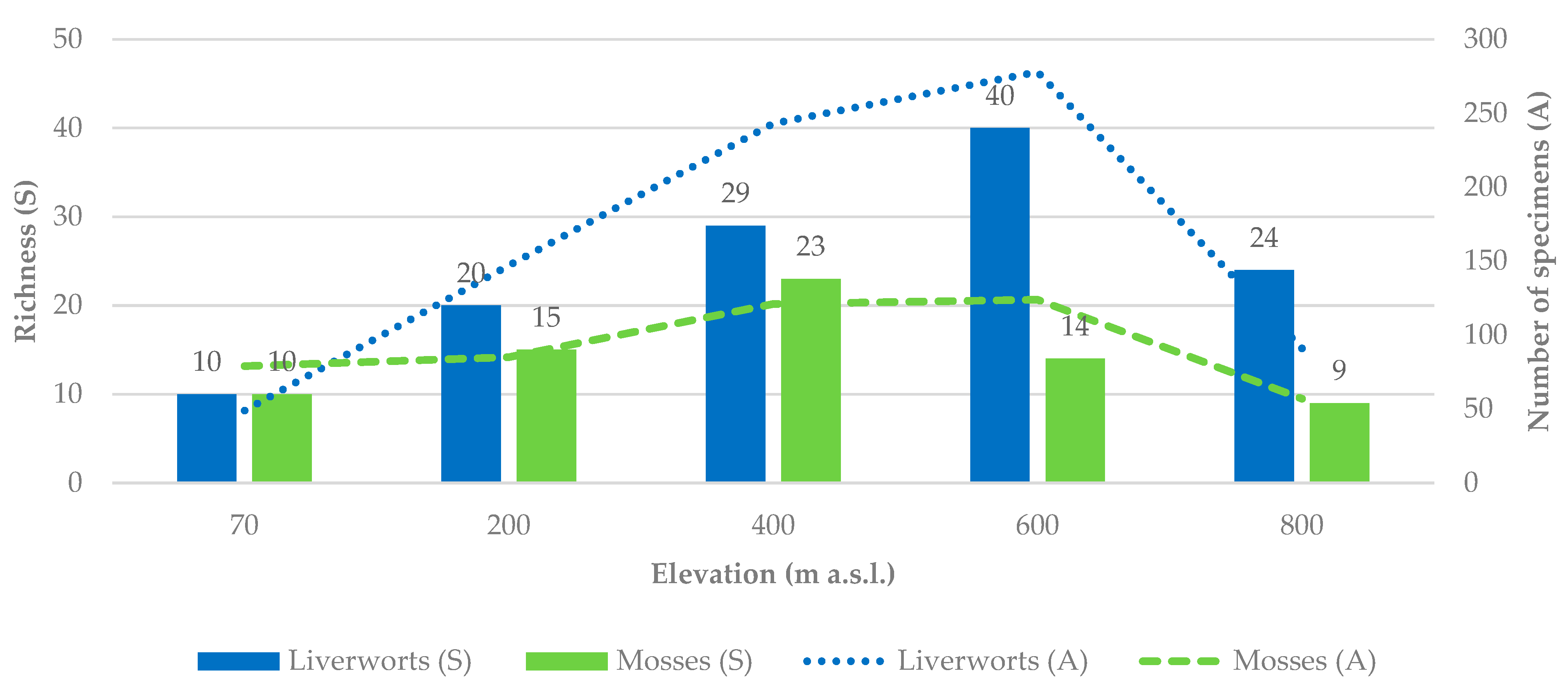
Bryophyte richness (S) increased with altitude up to mid-elevations and declined towards the uppermost site, forming a clear unimodal pattern (Figure 2).
The highest values were recorded at 400 m a.s.l. (S = 52) and 600 m a.s.l. (S = 54), indicating that mid-elevations support both greater abundance and diversity of bryophytes. Similarly, the number of identified specimens increased from the lowest altitude sampled (70 m a.s.l.), reaching a peak at 600 m a.s.l. (n = 402; 31.65%), before declining at 800 m a.s.l. (n = 147; 11.57%). Overall, the sites at mid-elevation accounted for approximately 60% of all recorded specimens and species.
The null model predicted a peak at 400–600 m, consistent with the expectation of the mid-domain effect. Observed richness values were always higher than the simulated mean, falling outside of the 95% confidence intervals. However, the Spearman correlation between observed and predicted richness was strong and significant (ρ = 0.95, p = 0.014), indicating that the overall shape of the richness–elevation relationship closely matched that expected under random geometric constraints.
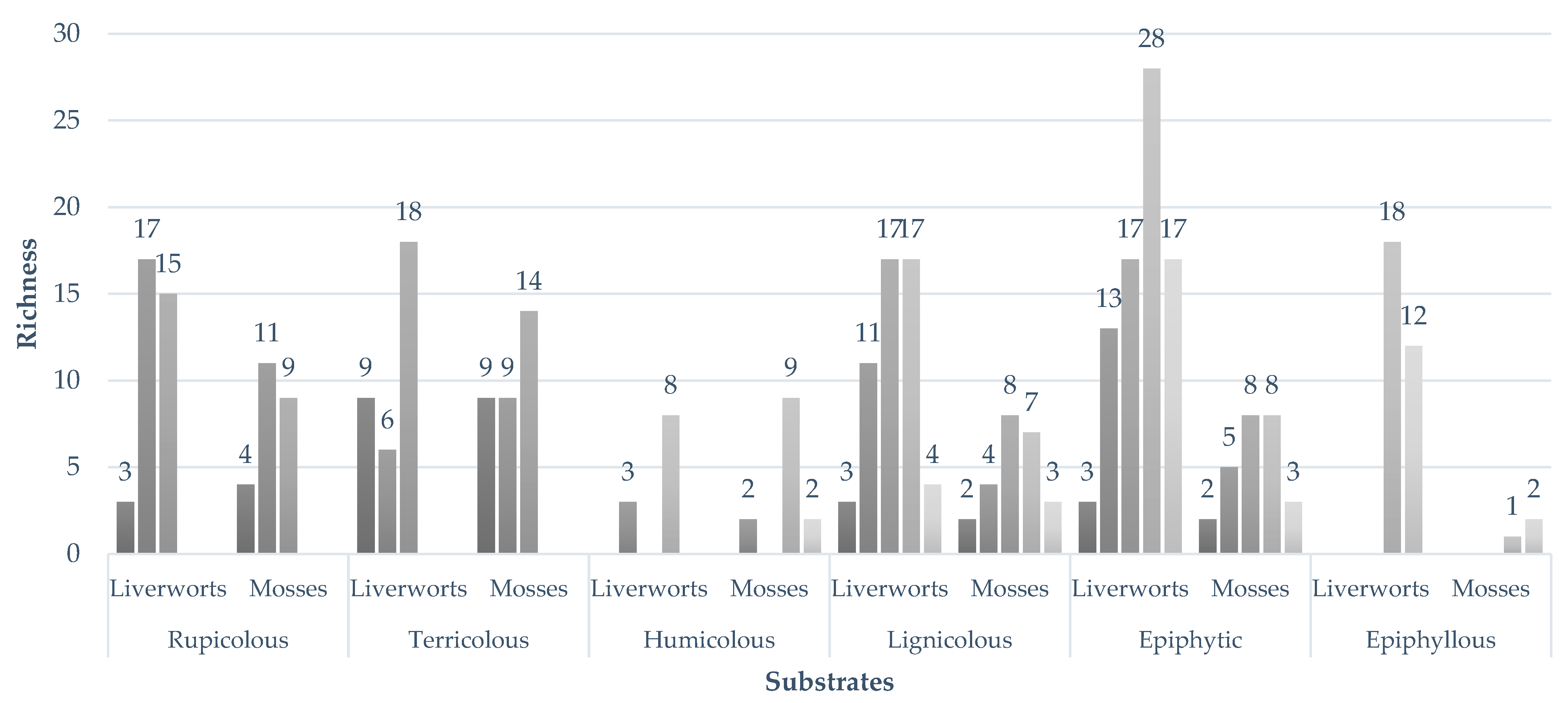
The number of sampled substrates varied across elevations, reflecting differences in substrate availability along the gradient. Nonetheless, all elevational bands included a substantial sampling effort (59–60 samples at the lowest and highest sites and 84–92 at the intermediate elevations) and included both ground-based substrates (e.g., rupicolous, terricolous, humicolous) and plant-based substrates (e.g., lignicolous, epiphytic, and epiphyllous). This ensured consistent representation of the main bryophyte microhabitats at each site and allowed the assessment of how species richness changes with elevation and substrate (Figure 3).
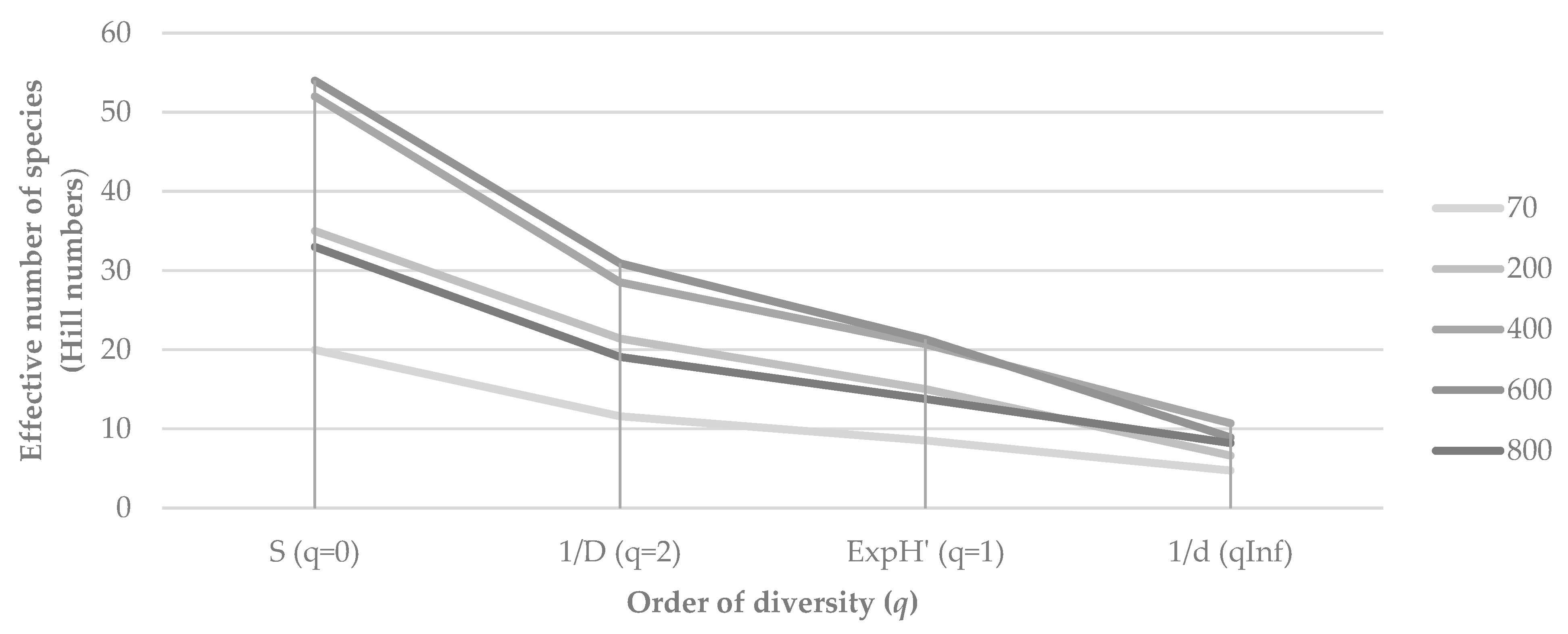
To complement the observed patterns in abundance and species richness, we assessed α-diversity using Hill numbers, which integrate information on both species’ richness and relative abundance on Flores Island (Figure 4). Species richness (q = 0) and effective numbers of common and dominant species (q = 1–2) increased from low elevations (70 m) to mid-elevations (400–600 m), where diversity reached its maximum. At the highest altitude (800 m), all diversity measures declined markedly.
The decreasing difference between H0, H1 and H2 at mid-elevations suggests greater evenness in species abundances, whereas wider gaps at the extremes of the gradient (70 m and 800 m) point to stronger dominance by a few taxa. Overall, the results suggest that bryophyte α-diversity on Flores Island peaks under intermediate environmental conditions.
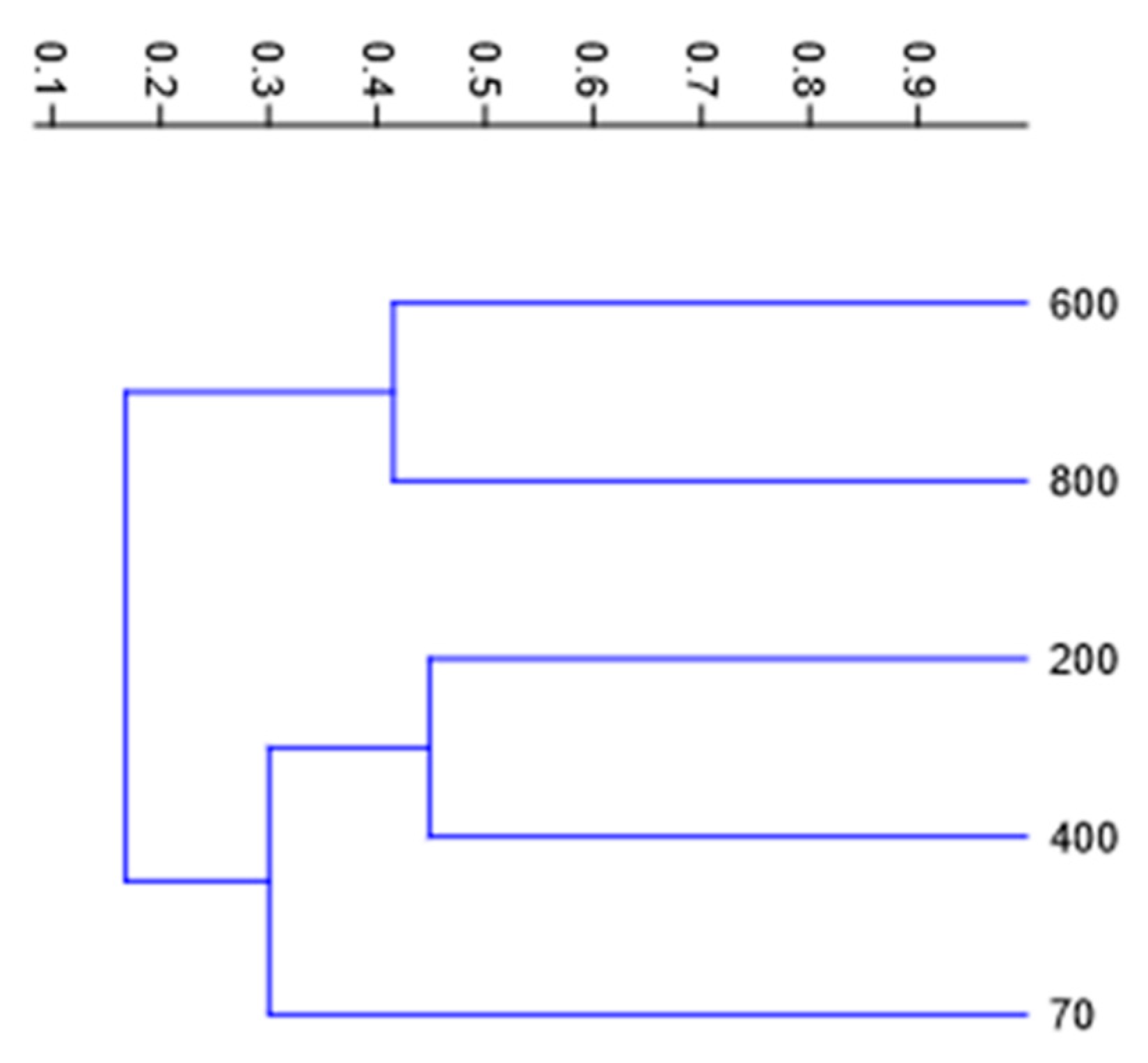
To explore whether these variations in diversity and evenness correspond to differences in community composition along the gradient, we conducted a clustering analysis. The UPGMA dendrogram, based on Bray–Curtis distances, revealed a clear altitudinal structuring of bryophyte assemblages on Flores Island (Figure 5).
Samples from low to mid elevations (70 m, 200 m, and 400 m) clustered together at relatively low dissimilarity values, indicating broadly similar community composition along this altitudinal range. In contrast, the high-elevation sites (600 m and 800 m) formed a separate and internally coherent cluster, reflecting a distinct bryophyte assemblage characteristic of upper montane conditions. The higher Bray–Curtis distances separating the two major clusters suggest a marked compositional shift between mid- and high-elevation communities, likely associated with environmental gradients such as increasing humidity, lower temperatures and greater cloud frequency at higher altitudes.

2.3. Substrate Specificity of Bryophyte Assemblages

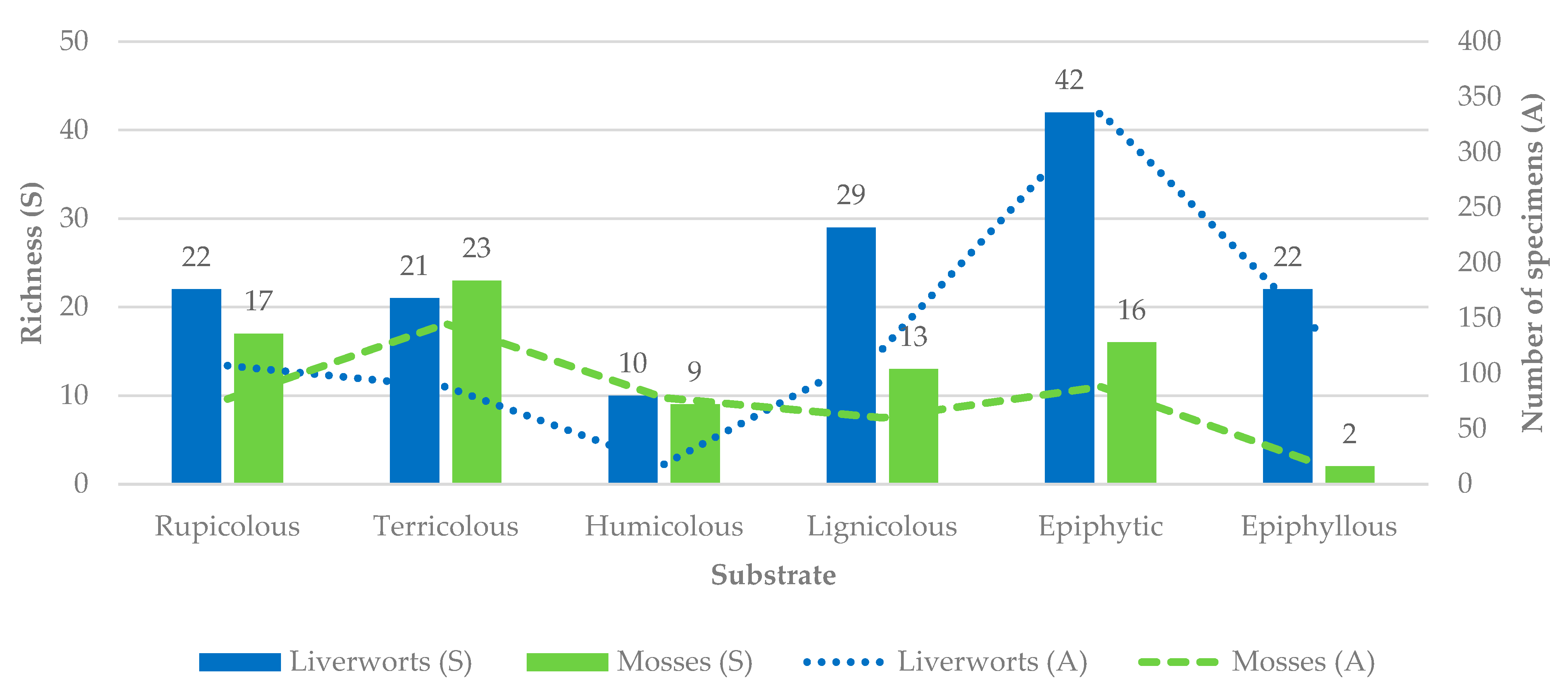
The number of species and specimens varies according to the different substrates sampled. Figure 6 illustrates the variation in species richness of liverworts and mosses across different substrate types on Flores Island. Epiphytic and lignicolous substrates supported the highest numbers of liverwort species (42 and 29, respectively), whereas mosses were most diverse on terricolous (23) and rupicolous (17) substrates. In contrast, epiphyllous and humicolous substrates harbored fewer species of both groups.
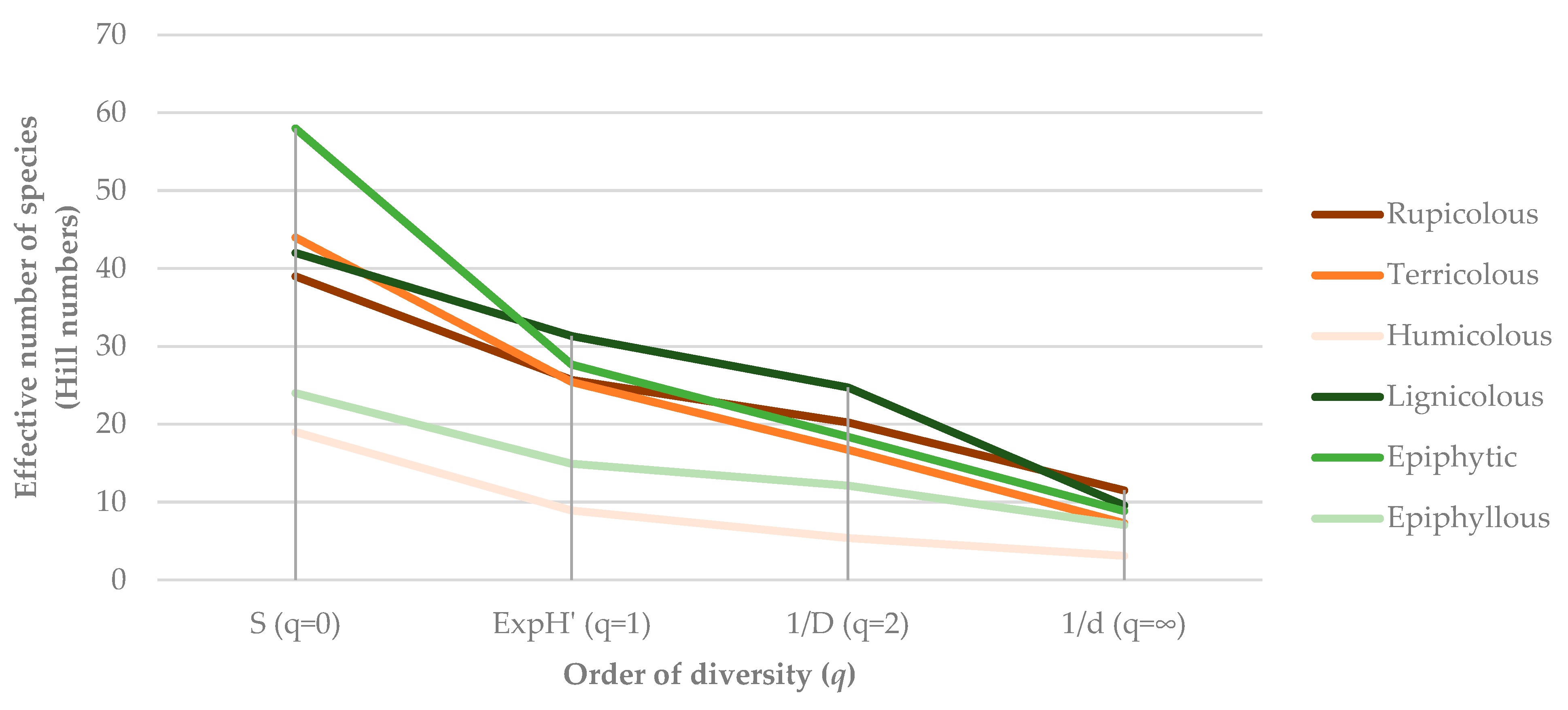
Consistent with the results for species richness and abundance, the analysis of α-diversity based on Hill numbers (H) reveals similar patterns across bryophyte communities (Figure 7). Species richness (q = 0) was highest on epiphytic (58 spp.), terricolous (44 spp.) and rupicolous (39 spp.) substrates, and lowest on humicolous (19 spp.) and epiphyllous (24 spp.) ones. When abundance was incorporated, both the effective number of species (ExpH’, q = 1) and Simpson diversity (q = 2) showed the same general trend: lignicolous and epiphytic communities exhibited the highest diversity and evenness, while humicolous assemblages were clearly less diverse and strongly dominated by a few species, namely Sphagnum palustre.
Differences between H0, H1 and H2 were smallest in lignicolous and epiphytic bryophyte assemblages, indicating relatively even species distributions and balanced dominance structures. In contrast, the wider gaps observed in humicolous and epiphyllous communities reflect stronger dominance by a few taxa and a high proportion of rare species.
Overall, these results show that substrate type exerts a strong influence on bryophyte α-diversity on Flores Island. Lignicolous and epiphytic habitats provide a wide range of microclimatic and structural niches that support diverse and compositionally balanced communities, whereas humicolous and epiphyllous substrates represent more restrictive or transient environments, supporting fewer and more unevenly distributed species.
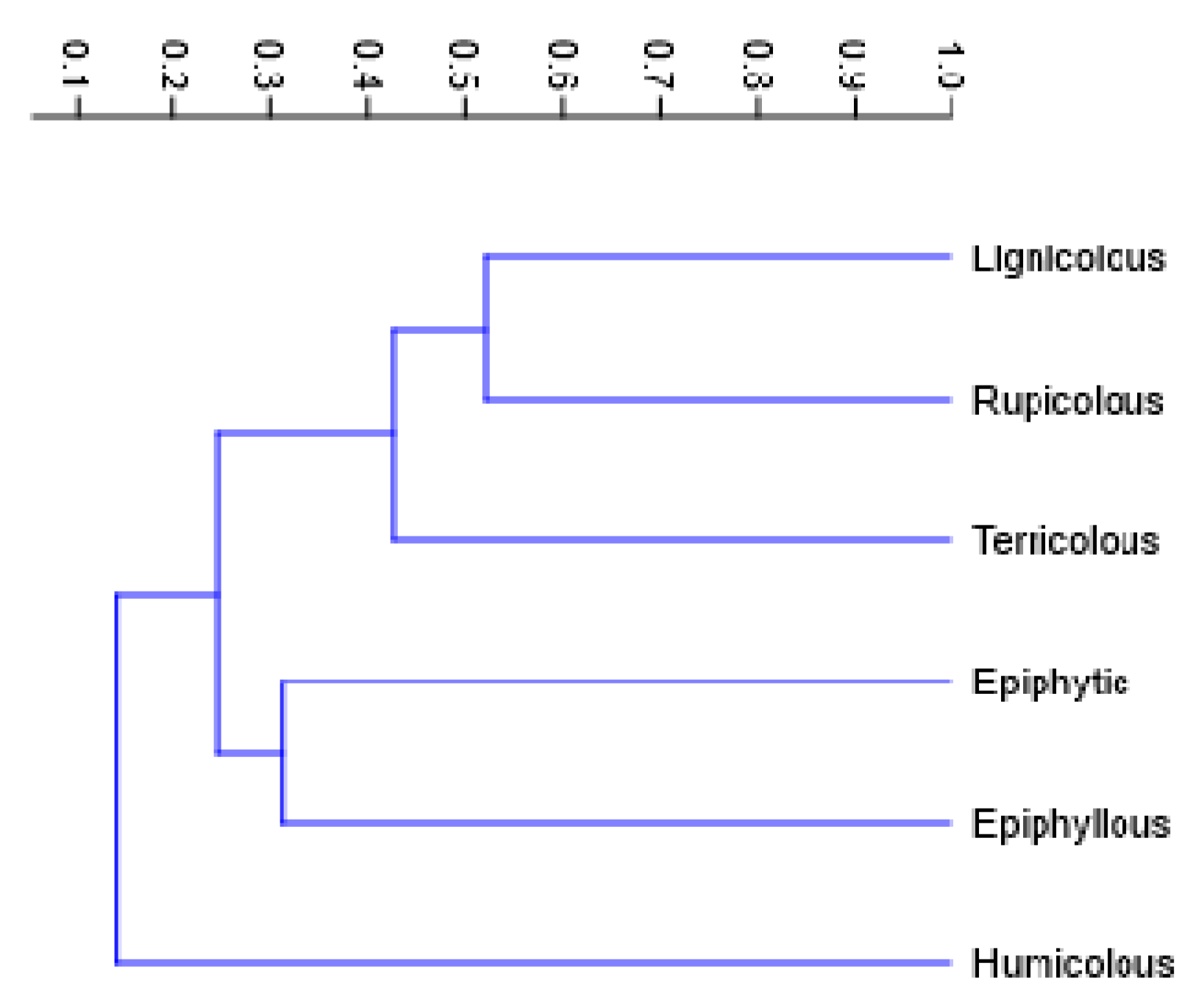
Given the marked variation in species richness and evenness across substrate types, a UPGMA clustering analysis based on Bray–Curtis dissimilarities was conducted to examine the similarity relationships among the bryophyte assemblages (Figure 8).
The dendrogram reveals two major clusters. Lignicolous, rupicolous, and terricolous assemblages, form a cohesive “ground-substrate”, joining at relatively low dissimilarity values (similarity ≈ 0.4–0.5), suggesting that these substrates share a subset of species. Epiphytic and epiphyllous assemblages cluster together at moderate similarity levels (similarity ≈ 0.3–0.4).
In contrast, humicolous communities form a clearly distinct branch, exhibiting low similarity with all other substrate types (≈0.1–0.2). This separation indicates that bryophyte assemblages associated with soil or decaying organic matter are compositionally unique, likely driven by specific microclimatic and nutrient conditions. Overall, the clustering pattern highlights substrate specificity as a key of bryophyte community structure.

3. Discussion

3.1. General Overview and Sampling Completeness

This study provides a structured and up-to-date field survey of bryophytes along an elevational gradient on Flores Island, complementing the pioneering works the Allorge couple and Persson in 1937 [27] and Erik Sjögren in 1993 [33]. It documents 89 species across 37 families and 57 genera, with a sampling completeness of 83%. Although this represents only about one third (33.8%) of the bryophyte flora previously reported for the Island and circa a fifth (18%) of the Azores archipelago bryophyte diversity [30,31], these values are notable given the small spatial extent of our plots and the forest-focused design of the study. As in Pico Island [12], several species were new records for the surveyed sites, especially at lower elevations. Rather than aiming at exhaustive floristic coverage, the goal was to characterize fine-scale ecological patterns, and in this context, the stratified GIMS protocol [34], which incorporates multiple elevation levels and six substrate types, proved effective for capturing a meaningful subset of the island’s regional bryophyte diversity. Species not detected are likely associated with habitats that fall outside the scope of our forest-based sampling (e.g., bogs, stream margins, urban areas, grasslands, or mixed exotic woodlands), suggesting that the true alpha-diversity of Flores may still be under-represented in existing floristic inventories.
The observed ratio of liverworts to mosses (1.41) and the predominance of leafy liverwort families such as Lejeuneaceae, Frullaniaceae, and Radulaceae is characteristic of oceanic, hyper-humid environments [35,36,37] and confirms earlier descriptions of Azorean bryophyte assemblages as highly hygrophilous and dominated by liverworts [12,19,20,21,29,38,39,40,41]. The higher completeness for liverworts (88%) compared to mosses (77%) may reflect the ecological dominance of epiphyllous and epiphytic species on Flores Island. Despite this, the estimated coverage is sufficient to support robust ecological inferences, capturing the main floristic and functional composition of the island’s bryophyte communities.
These results indicate that Flores retains well-preserved humid forest habitats, especially at mid- and upper-elevation zones, and are consistent with patterns observed on other Azorean islands, where montane bryophyte assemblages are dominated by oceanic liverworts and pleurocarpous mosses adapted to shaded, moisture-saturated conditions [12,27,39]. The presence of four Azorean endemic taxa, including the conservation concern species Fissidens azoricus and Echinodium renauldii, further highlights the biogeographical distinctiveness of the bryoflora of Flores and its contribution to the regional pool of Macaronesian endemics, reinforcing the role of natural areas as refugia, areas where species can retreat to, persist under changing environmental conditions and potentially expand from [42]. Previous assessments of climate-related threats to the Macaronesian endemic flora indicate that such refugial areas will become increasingly critical in the coming decades, as projections suggest an average decline of more than 50% in suitable habitat per species [43,44].

3.2. Altitudinal Gradients of Diversity and Compositional Turnover

Along the elevational transect, bryophyte richness and abundance exhibited a unimodal pattern, with a peak at mid-elevations (400–600 m a.s.l.), consistent with the intermediate productivity and environmental heterogeneity hypotheses commonly described for island ecosystems. Because elevation on oceanic islands is bounded by sea level below and the mountain summit above, the ranges of low- and high-elevation taxa necessarily overlap toward the center of the gradient, producing a tendency toward increased richness at mid elevations. This mid-elevation maximum has been documented in other insular and montane ecosystems and is often attributed to the convergence of favorable climatic and structural conditions, including high atmospheric humidity, moderate temperatures, and increased substrate heterogeneity [9,13,15,45,46]. This mechanism is also consistent with the global synthesis of Maul and colleagues [17], who showed that the relative position along the gradient is a strong predictor of liverwort richness, reflecting the admixture of floras and the transition between contrasting environments. At the same time, the consistently higher observed richness relative to geometric predictions indicates that environmental factors, such as substrate diversity, humidity, or microclimatic stability, amplify this mid-elevation peak. Mid-elevations on Flores correspond to persistent cloud cover, characterized by stable humidity, mild temperatures, and heterogeneous substrates, conditions particularly favorable for bryophyte establishment and persistence.
The combined geometric and environmental processes provide a coherent explanation for the observed pattern. In fact, at low elevations (70–200 m), reduced humidity, higher temperatures, and greater exposure to wind and salt spray may limit bryophyte colonization and survival, favoring a smaller subset of stress-tolerant species. On the other hand, at high elevations (800 m), decreasing temperature and reduced substrate diversity, with the ground dominated by Sphagnum palustre, may constrain species establishment, leading to a decline in both richness and evenness. Such a pattern aligns with previous studies from Macaronesia showing similar unimodal responses of bryophyte diversity to elevation [12,47,48].
Community clustering analyses reinforce this interpretation by showing two major assemblage groups: one comprising the low-to-mid elevations (70–400 m) and another representing the upper montane sites (600–800 m). This compositional turnover suggests the existence of distinct bryophyte communities structured primarily by altitudinal microclimates and associated vegetation zones. Such elevational differentiation reflects both environmental filtering and limited dispersal across sharp humidity and temperature gradients typical of oceanic islands.

3.3. Substrate Specificity and Ecological Differentiation

Substrate type proved to be a key determinant of bryophyte assemblage composition and diversity. Epiphytic and lignicolous substrates supported the highest numbers of liverwort species, reflecting the importance of tree bark and decaying wood as stable, moisture-retaining habitats that buffer microclimatic fluctuations. These substrates are characterized by surface roughness, organic matter accumulation, and capillary water retention, conditions that favor species with thin, delicate gametophytes such as members of Lejeuneaceae and Frullaniaceae [49]. By contrast, terricolous substrates harbored the highest proportion of mosses. The lowest total diversity was found in humicolous communities, greatly dominated by Sphagnum palustre and Polytrichum commune, and epiphyllous communities, which represent more transient or environmentally unstable habitats. These results are consistent with those observed in other oceanic and subtropical islands, where substrate heterogeneity has been shown to be a critical driver of bryophyte α-diversity [50,51].
Differences in evenness across substrates, as revealed by Hill numbers, further highlight how substrate-specific microclimates influence community structure. Lignicolous and epiphytic assemblages exhibited relatively even species distributions, while humicolous and epiphyllous habitats were dominated by a few dominant species. This supports the view that habitat heterogeneity and substrate stability underpin both local and regional bryophyte diversity, especially on islands where spatial turnover is constrained by limited area and dispersal barriers.

3.4. Biogeographical and Conservation Implications

Taken together, the patterns observed across elevation and substrate types indicate that diversity on Flores Island, as in other islands and archipelagos [52,53], is structured by the interaction of climatic gradients and microhabitat heterogeneity. The strong correspondence between community composition and elevation suggests that temperature, humidity, and forest structure act as key filters determining species occurrence. However, the influence of substrate type shows that local-scale factors also mediate these effects, reinforcing the importance of fine-scale environmental complexity in sustaining high bryophyte richness on oceanic islands.
The floristic composition of Flores Island also reveals the coexistence of widespread temperate bryophytes including Azorean and Macaronesian endemics, several of which are threatened. The occurrence of Fissidens azoricus, Leptoscyphus porphyrius subsp. azoricus, and Echinodium renauldii, classified as Critically Endangered or Endangered under IUCN criteria [32], emphasizes the conservation importance of maintaining humid montane forest habitats. These environments, concentrated around mid-elevations, coincide with the areas of highest bryophyte richness identified in this study, reinforcing their value as refugial ecosystems under changing climatic regimes.
Given the small area of Flores Island, the strong elevational structuring detected here suggests that even modest shifts in climatic zones may have disproportionate impacts on bryophyte distributions. Species restricted to narrow elevational belts may face habitat contraction or local extinction if suitable microclimates shift upward [43,44] or downwards [44]. Maintaining habitat continuity across the elevational gradient, particularly through the conservation of native forest remnants and the restoration of promising fragments such as the site on 400 m elevation, is therefore crucial to facilitate altitudinal migration and preserve community connectivity.
At a regional scale, the findings contribute to the growing understanding of how island topography, microclimate, and habitat diversity interact to shape bryophyte biogeography in Macaronesia. The predominance of oceanic liverworts and the strong elevational signal suggest that Flores still retains conditions resembling pre-disturbance montane forests. However, anthropogenic alterations, such as the establishment of invasive species, habitat fragmentation and disruption of humidity gradients may hinder the diversity and conservation of bryophytes in the Azores and Macaronesia.

3.5. Limitations and Perspectives

While this study provides robust evidence of the main drivers of bryophyte diversity on Flores, and demonstrates the effectiveness of the GIMS protocol [34], derived from the modified BRYOLAT method [11,22], for surveying bryophyte communities across elevation gradients, future research could benefit from incorporating finer-scale microclimatic measurements (e.g., substrate moisture, canopy cover, irradiance, evapotranspiration) and temporal replication to capture seasonal variability. This would be especially important for taxa identifiable only during a narrow phenological window, such as shuttle species, in the Family Ricciaceae.
Examining additional dimensions of biodiversity, including functional and genetic diversity, would help explain ecosystem functioning, stability, and resilience than species richness alone. Integrating molecular approaches could also improve taxonomic resolution for morphologically cryptic taxa and enable the detection of intraspecific responses to elevation.
Moreover, long-term monitoring along the same altitudinal transect would be essential for assessing the sensitivity of bryophyte communities to ongoing climate change, especially in mid-elevation zones that appear both species-rich and potentially vulnerable. Establishing one or more additional altitudinal transects elsewhere on the island would further increase statistical power and strengthen the generality of elevation-related patterns.

4. Methodology

4.1. Study Area

4.1.1. Azores Archipelago

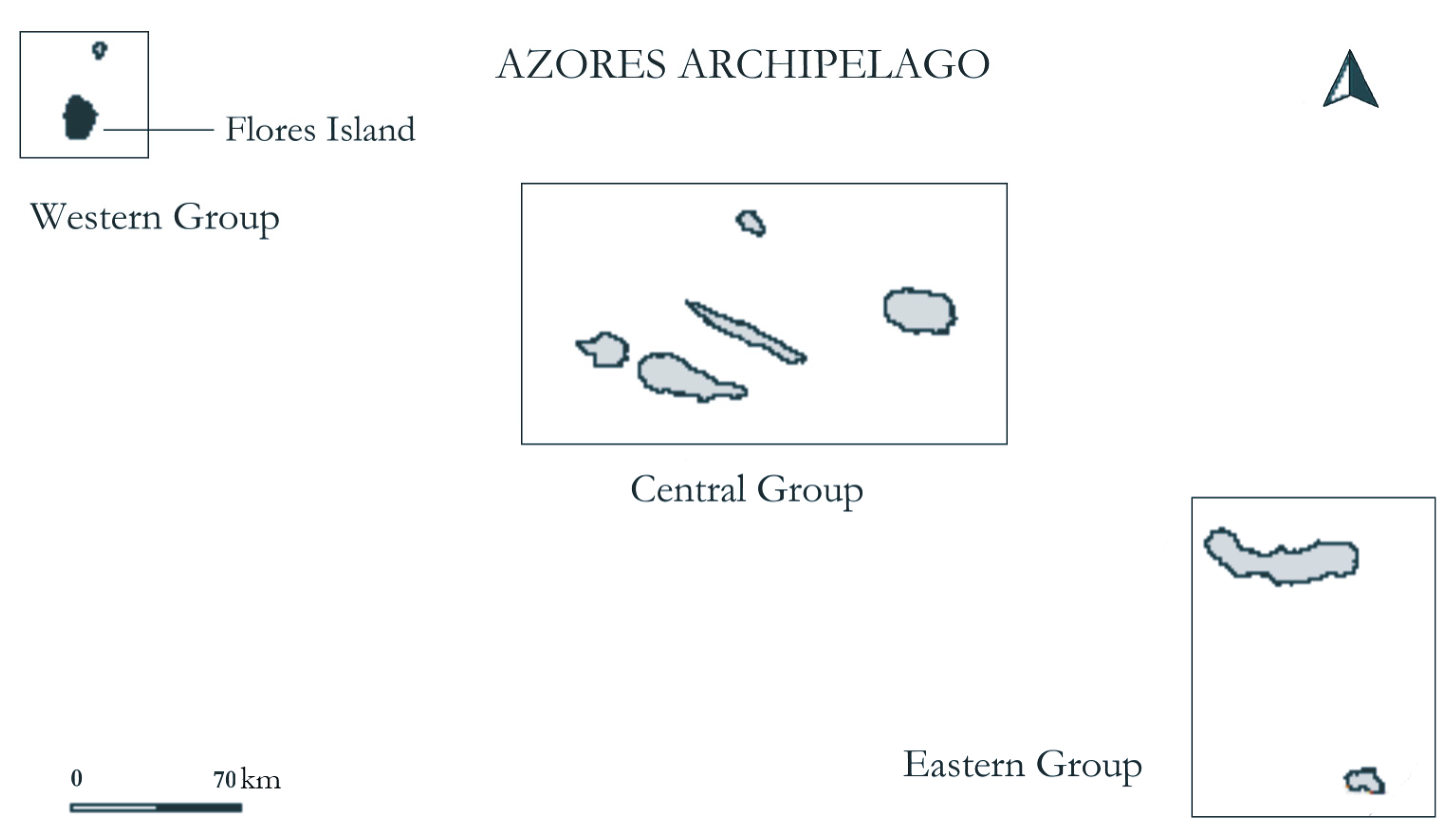
The Azores archipelago consists of nine oceanic islands of volcanic origin, situated in the North Atlantic Ocean, between 36°55′ and 39°43′ N latitude and 25°00′ and 31°17′ W longitude, approximately 1600 km from the western coast of the European continent and nearly 2000 km away from North America [54].
Geographically, the archipelago is divided into three island groups: The Western Group (Flores and Corvo) located on the North American tectonic plate, the Central Group (Pico, Faial, São Jorge, Terceira, and Graciosa), and the Eastern Group (São Miguel and Santa Maria), both located on the Eurasian tectonic plate (Figure 9). The oldest island in the Azores archipelago is Santa Maria, estimated to be 6.01 million years old [55], while the youngest is Pico Island, approximately 0.186 million years old [56].
The Azores archipelago encompasses a total land area of 2323 km2, with Corvo (17 km2) being the smallest island, São Miguel (745 km2) the largest, and Flores Island being the fourth smallest (143.1 km2). Pico Island is the highest (2350 m a.s.l.), and only four other islands reach more than 1000 m a.s.l. (São Miguel, 1105 m a.s.l.; São Jorge, 1053 m a.s.l.; Faial, 1043 m a.s.l.; Terceira, 1021 m a.s.l.), while Flores Island peaks at 915 m a.s.l. in Morro Alto [54].
Due to its geographical location, the Azores exhibit a predominantly maritime climate, characterized by mild temperatures with a narrow thermal amplitude, high relative humidity, and significant precipitation during autumn and winter [57]. The mean annual temperature ranges from 12 °C to 23 °C, while relative humidity remains consistently high across all seasons, exceeding 95% on more than 50 days per year, particularly in March, June, and December; annual precipitation at sea level varies between 1000 mm in the Eastern Group (particularly in Santa Maria Island) and 1600 mm in the western group [58]. Wind and precipitation are the primary climatic factors influencing local vegetation [59]. At high altitudes, wind speeds can exceed 100 km/h, accompanied by temperatures ranging from 0 °C to 5 °C, while precipitation, including horizontal precipitation, plays a crucial role in increasing the water availability in biological systems, promoting the growth of altitudinal vegetation through the Föhn effect [59,60,61].
Biogeographically part of Macaronesia, the Azores archipelago presents high biological and ecological interest in fauna and flora [62], and a remarkable socio-economic and cultural importance [63].

4.1.2. Flores Island

Flores Island is located in the North Atlantic Ocean (between latitudes 36.9° N–39.7° N and longitudes 24.9° W–31.3° W) [54]. The island is thought to be 2.0 to 2.5 million years old [56] and its most recent volcanic activity occurred in the 15th century, already during the period of Portuguese colonization [64]. This volcanic phase was characterized by monogenetic, effusive, and explosive basaltic eruptions, which formed several scoria cones, maars, and tuff rings across the central area of the island [26,65]. The central area currently hosts the largest peat bog in the Region, which plays a vital role in regulating the island’s hydrological balance and contributes significantly to the formation of streams and waterfalls [66].
The Island benefits from a temperate oceanic climate, largely influenced by its development, orientation, and the presence of the Azores anticyclone. Consequently, the island’s landscape displays a variety of green shades, resulting from the high humidity levels and frequent natural landslides, which contribute to floristic and structural diversity, with extensive areas of pastures and woodlands [66,67].
Flores Island is administratively divided into two municipalities: Santa Cruz das Flores in the north and Lajes das Flores in the south. It has a resident population of 3.429 inhabitants, making it the second least populous island in the archipelago, with just 2.57% population of the most populated island São Miguel (~133.390 inhabitants) [68].
In 2009, the island was designated a UNESCO Biosphere Reserve, encompassing not only the entire emerged area of the island but also an adjacent marine zone, covering a total of 58.619 hectares; this mention recognizes the island’s unique landscape, geological, environmental, and cultural values at regional, national, and international levels [65].

4.1.3. Sampling Design and Fieldwork Procedures

The methodology was designed to investigate the diversity and distribution of bryophytes along altitudinal gradients, with the aim of obtaining data on the environmental factors and substrates associated with the bryophyte community and roughly followed the BRYOLAT protocol [11], adapted for the Azores [22], later published as a Global Island Monitoring Scheme—GIMS [53].
The study was conducted between 29 July and 1 August 2013 in the municipality of Santa Cruz das Flores. Sampling sites differed in location, elevation (m a.s.l.), and geographic coordinates (decimal Latitude and Longitude) (Table 1).
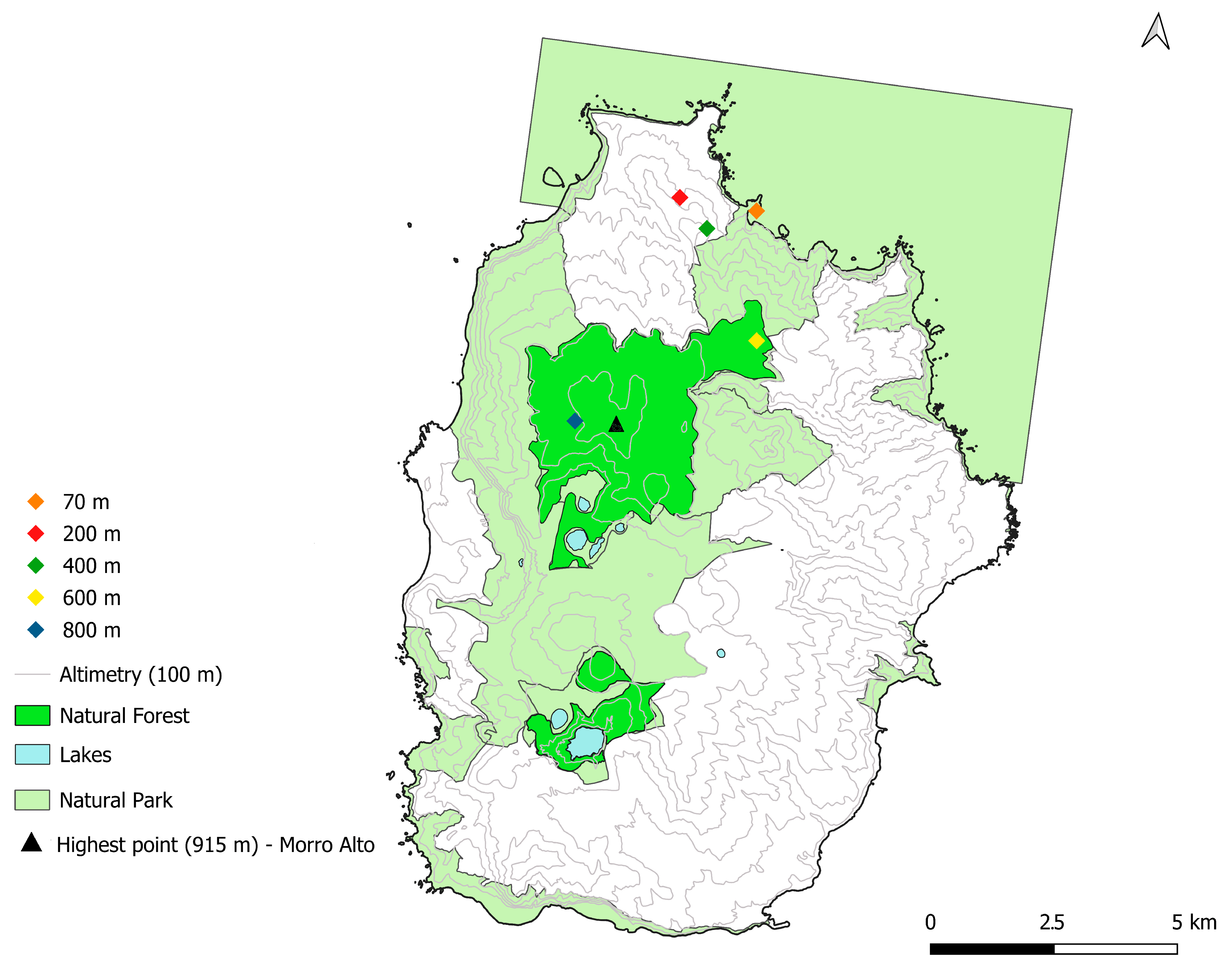
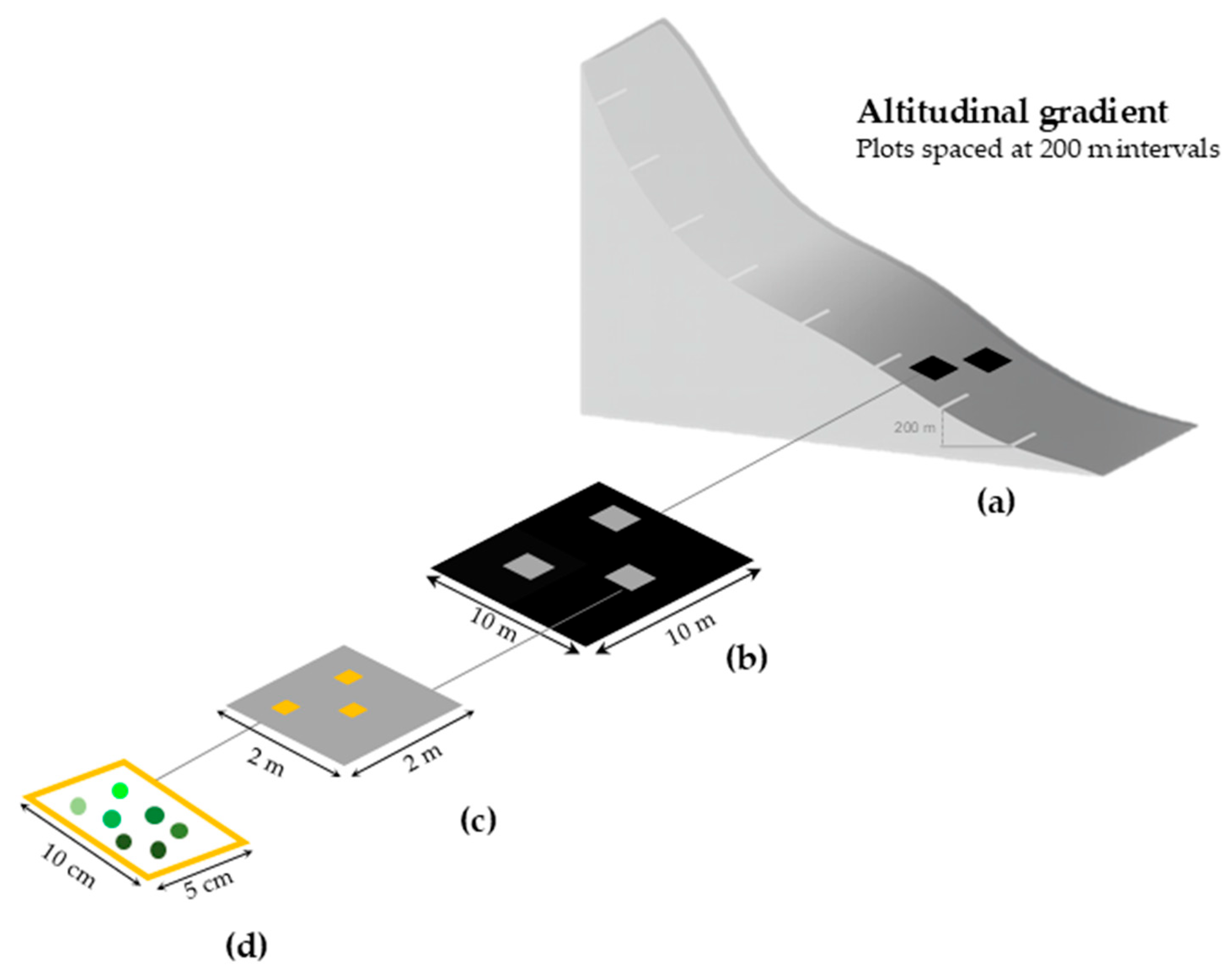
Sampling plots were established in environmentally homogeneous areas that were representative of the best-preserved native vegetation fragments at each selected elevation (70, 200, 400, 600, and 800 m a.s.l.) (Figure 10). Although a linear arrangement of plots would have been preferable, this was not feasible due to constraints related to the spatial distribution of native vegetation and local topography, which in some cases (e.g., 400 m) prevented the safe and practical installation of plots along a straight transect.
Bryophyte specimens were collected by experienced bryologists, with particular care taken to minimize disturbance to the habitat and to avoid excessive removal of material from natural populations.
Bryophytes were sampled along the elevation gradient using the GIMS protocol for bryophytes [53] a modified BRYOLAT standardized method [11,22] in order to include taxonomic information on bryoflora and environmental data. At each site, two plots of 10 m × 10 m were set 10–15 m apart. Each plot was divided into 25 quadrats (2 m × 2 m), from which three were randomly selected for further inspection. Each quadrat was carefully examined to collect three microplots of 50 cm2 (10 cm × 5 cm) for all the substrates colonized by bryophytes: rock, soil, humus, organic matter, tree bark, and leaves/fronds, using the following nomenclatures: Rupicolous (RU); Terricolous (TE); Humicolous (HU); Lignicolous (LI); Epiphytic (T); Epiphyllous (LF). The distinction between terricolous and humicolous substrates was based on the dominant material directly underlying each microplot: terricolous samples showed a visible mineral component, whereas humicolous samples consisted mainly of organic remnants, mostly degraded Sphagnum material, with no apparent mineral structure. On trees, nine microplots were sampled across three height levels, lowest (1–50 cm), medium (51–100 cm), and higher (101–200 cm) levels [11,22,53].
Immediately following collection, microplots were placed in paper bags and stored in a dark, ventilated environment until samples were completely desiccated. After taxonomic identification, specimens were inserted into labeled herbarium envelopes and deposited in the Bryophyte Section of the University of the Azores Herbarium (AZU). The collection is archived under the title: “MOVECLIM—AZORES Project: Bryophytes from Flores Island (2013)”.
The same plots were also surveyed for vascular plants following the GIMS protocol [53]. This procedure involves assessing each 10 m × 10 m, which is subdivided into four 5 m × 5 m subplots. All subplots are inventoried for vascular plant species, and each species is assigned a cover value based on Braun Blanquet Ordinal Transform Value (OTV) [69]. The source of the taxonomic nomenclature follows Silva et al. [70], updated by the Azorean Biodiversity Portal [31].

4.1.4. Fieldwork Locations

This study was conducted across five sites distributed along an elevational gradient on Flores Island (Azores, Portugal), including areas within the Flores Natural Park (Table 1, Figure 11). The sampling transects span from Ponta do Ilhéu at 70 m a.s.l. to Morro Alto at 800 m a.s.l., encompassing elevations of 70, 200, 400, 600, and 800 m a.s.l.
Below is a brief characterization of the vegetation at each bryophyte collection area.
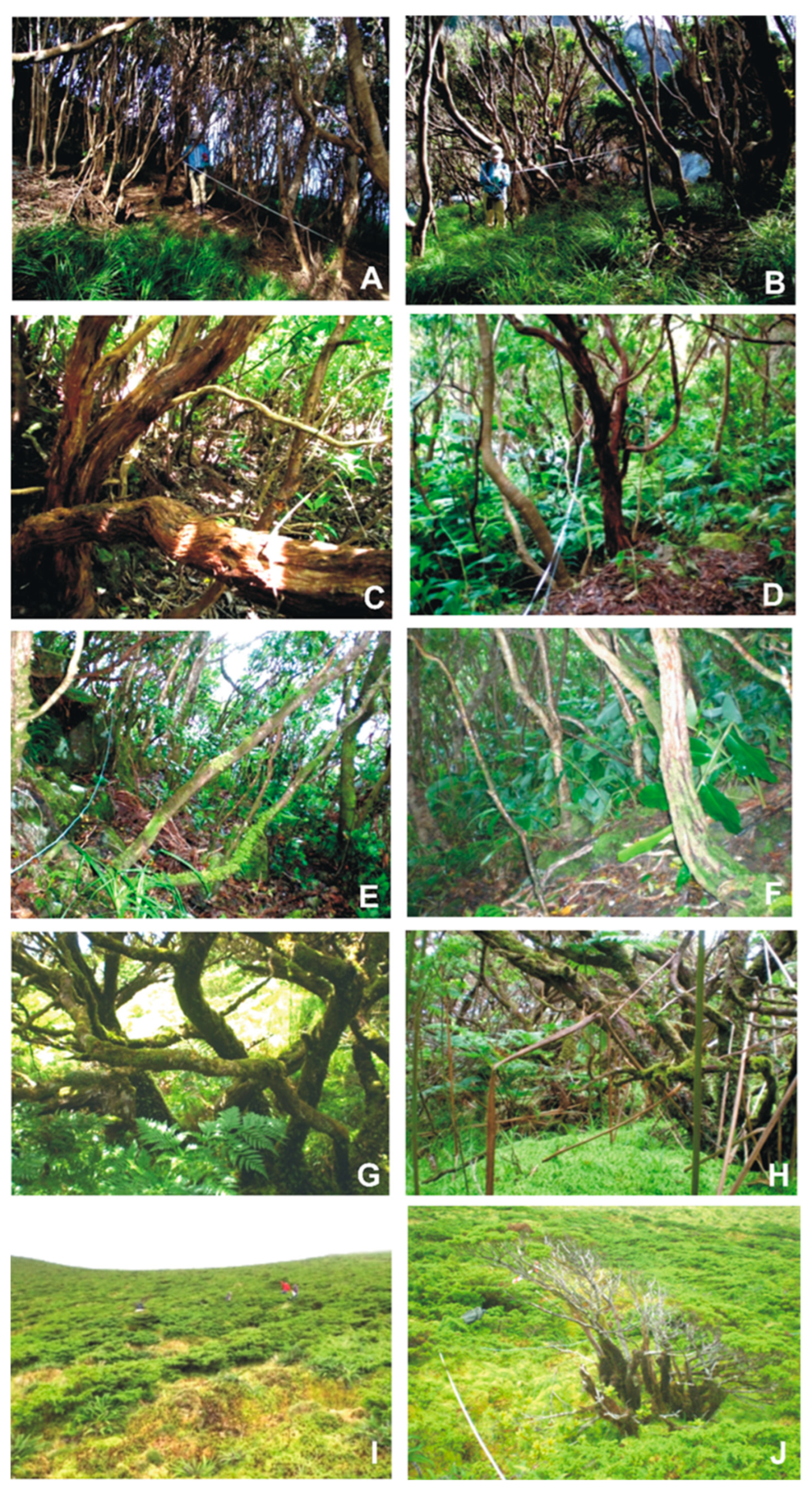
  • Ponta do Ilhéu (70 m a.s.l.)—Vegetation at this lowland site is dominated by Picconia azorica (Tutin) Knobl. (Endemic), Pittosporum undulatum Vent. (Introduced/Invasive species), and Morella faya (Aiton) Wilbur. (Native). The forest canopy reaches an average height of 5.2 m. Bryophyte cover ranges from 5% to 25%, distributed across soil, rocks, and tree trunks (Figure 12A,B);
  • Caminho para Ponta Delgada (200 m a.s.l.)—The forest includes species such as Erica azorica Hochst. ex Seub. (Endemic), Vaccinium cylindraceum Sm. (Endemic), Juniperus brevifolia (Hochst. ex Seub.) Antoine (Endemic), and Morella faya, alongside the invasive Pittosporum undulatum. The canopy reaches up to 5.8 m. Bryophytes are most abundant on rocky surfaces, with approximately 25% cover, and occur less frequently on soil and tree bark (Figure 12C,D);
  • Outeiros (400 m a.s.l.)—This mid-elevation forest exhibits a higher canopy, reaching up to 6.2 m. However, approximately 50% of the vegetation is composed of Pittosporum undulatum, and large individuals of Hedychium gardnerianum Sheppard ex Ker-Gawl. (Introduced/Invasive species) are present. Native species such as Erica azorica, Picconia azorica, Laurus azorica (Seub.) Franco (Endemic), Morella faya, and Vaccinium cylindraceum occur with relative abundances ranging from 15% to 40%. Bryophyte cover is highest on tree trunks (~60%) but is also substantial on the forest floor (~40%) (Figure 12E,F);
  • Ribeira do Cascalho (600 m)—This forested site, known locally as “Zimbral,” is dominated by Juniperus brevifolia, comprising approximately 90% of the canopy, which reaches a height of 3.9 m. Other species, including Vaccinium cylindraceum (30%), Ilex azorica Gand. (Endemic) (25%), Laurus azorica (15%), and Myrsine retusa Aiton (Endemic) (25%), are present at lower frequencies. Bryophyte cover is extensive, reaching approximately 80% on both soil and tree surfaces (Figure 12G,H);
  • Morro Alto (800 m)—Located within a designated Nature Reserve, this site features high-altitude scrubland dominated by Juniperus brevifolia and Calluna vulgaris (L.) Hull (Native), with Struthiopteris spicant (L.) Weis (Native) also abundant. Vascular plants do not exceed 2 m in height. The bryophyte layer covers nearly 100% of the ground surface, predominantly composed of Sphagnum spp. Epiphytic bryophytes are also well represented, with average coverage reaching up to 30% (Figure 12I,J).

4.2. Study Taxa

4.2.1. Bryophytes

Bryophytes are ancestral, small, rootless plants, comprising around 20,000 species worldwide, and include mosses, liverworts, and hornworts [53]. They exhibit diverse life strategies [71,72] that enable them to colonize a wide range of habitats in all terrestrial ecosystems, from coastal zones to forests and urban areas. These sensitive plants are highly dependent on their immediate environment, responding to various changes, including substrate composition and acidity, precipitation, temperature, salinity, and pollution [49].
These plants play crucial roles in ecosystems, such as retaining water and regulating the water cycle [73,74], and often acting as pioneers, creating favorable conditions for the establishment and development of non-pioneer organisms [75]. These groups are found in all terrestrial ecosystems, including coastal zones, natural forests, urban areas, and pastures, among others [76].

4.2.2. Bryophytes in the Azores

The Azores, with approximately 475 taxa (308 mosses, 162 liverworts, and 5 hornworts) [30,31], rank among the three Atlantic archipelagos with the highest bryophyte species richness [77], which is a tribute to the high dispersion ability typical of this group. The Canary Islands, with about 617 taxa (six hornworts, 194 liverworts, and 417 mosses) [78], exhibit the greatest bryophyte diversity, followed by the Madeira archipelago, which contains approximately 546 taxa (six hornworts, 175 liverworts, and 365 mosses) [79]. The rate of endemism is relatively low on bryophytes, but presently seven moss species and three liverwort species are considered Azorean endemics [31,62,80].

4.3. Identification and Categorization of Specimens

4.3.1. Taxonomic Framework

The nomenclature and taxonomy of the bryoflora on Flores Island are based on established taxonomic keys specific to this group of plants. Moss identification was largely based on the floras by Smith [81] and Casas et al. [82], while liverworts were identified using the works of Paton [83], Casas et al., [84], and the identification key developed by Schumacker &Váňa [85] for Europe. Visual guides [74,86,87], as well as online resources from the Azorean Biodiversity Portal [31], the British Bryological Society and the ‘Bildatlas der Moose Deutschlands’ were also consulted. Taxonomic nomenclature follows the framework established by Gabriel and colleagues [30], incorporating updates available through the Azorean Biodiversity Portal [31].

4.3.2. Biogeographic Framework

The identified species have been classified into the following biogeographic categories: Azorean endemics, Macaronesian endemics, European endemics, and Native [30].

4.3.3. Conservation Framework

The conservation status of the different species was assessed according to the categories of the IUCN Red List in Europe [32,88]: Not Evaluated (NE), Data Deficient (DD), Least Concern (LC), Near Threatened (NT), Vulnerable (VU), Endangered (EN), Critically Endangered (CR), Extinct in the Wild (EW), and Extinct (EX).

4.4. Sampling Completeness and Diversity Measurement

First-order Jackknife estimator was used to estimate the completeness of the bryophyte, moss, and liverwort inventories, as it performs well with presence-absence data and is particularly suited for datasets with many rare species [89].
Currently, one of the most accepted approaches for quantifying diversity from species abundance data is the use of effective numbers of species, also known as Hill numbers [90,91,92]. Hill numbers form a unified family of diversity indices that differ only in a single parameter, q, which determines their sensitivity to species relative abundances [90]. When q = 0, all species are weighted equally, regardless of their frequency; as q increases, common species receive progressively more weight, while rare species become less influential [90,91].
This formulation also places traditional indices into the same conceptual framework: species richness corresponds to q = 0; Shannon entropy becomes comparable when exponentiated (q = 1); and Simpson’s index corresponds to the inverse of the concentration index (q = 2). In this way, values are expressed in consistent units (“effective number of species”), which makes comparisons across indices and communities more intuitive [90,91,92].
In practical terms, four orders of Hill numbers were used in this study: (a) species richness (S) (q = 0), the simple count of species at a site; (b) the exponential of Shannon–Wiener entropy (H’) (q = 1) [93]; (c) the inverse of Simpson’s concentration index (D) (q = 2); and (d) the inverse of Berger–Parker’s index (d) (q = ∞), which emphasizes dominance by the most abundant species [94]. Together, these indices integrate complementary aspects of diversity, reflecting richness, rarity, and dominance within the same framework [95,96].
In addition to alpha diversity, beta diversity was also assessed to evaluate the degree of compositional turnover among sites. In this context, the fewer the species shared between communities, the higher the beta diversity [97]. Pairwise similarity coefficients were applied to compare communities in both qualitative and quantitative terms.
Species composition similarity was also investigated using cluster analysis, both for elevation and the substrate. Hierarchical cluster analysis (UPGMA) was made based on species richness across five altitudinal levels and six substrates, using Bray–Curtis dissimilarity. In this method, the sites or substrates are joined based on the average distance between all members in the two groups. Values on the dendrogram scale represent Bray–Curtis dissimilarity (0 = identical composition; 1 = completely dissimilar).
All analyses were made using the free software Past 4.03 [98].

4.5. Altitudinal Gradient and Mid-Domain Effect Analysis

To test whether the altitudinal pattern of bryophyte richness could be explained by a mid-domain effect (MDE), we modeled the expected distribution of species richness using a null model based on random overlap of species’ altitudinal ranges. For each species, the observed minimum and maximum elevations were used to define its range size. We then simulated 10,000 randomizations in which the position of each range was reassigned randomly within the observed altitudinal domain (10–800 m a.s.l.), while keeping its size constant. For each simulation, we calculated species richness at the five sampled elevations (10, 200, 400, 600 and 800 m). The mean and 95% confidence intervals of the simulated richness values were compared with the observed richness. Agreement between the observed and predicted richness patterns was assessed visually and using a Spearman rank correlation test. All analyses were performed in R version 4.5.2 (R Core Team, Vienna, Austria), using the packages dplyr, ggplot2, and tidyverse.

5. Conclusions

This study bridges floristic and ecological approaches, integrating diversity metrics, endemism, and substrate preferences into a unified analysis. It demonstrates that bryophyte diversity on Flores Island is structured primarily by elevation, which integrates key climatic and ecological gradients. Species richness and evenness peak at mid-elevations, where moderate temperatures, high humidity, and structural complexity favor the coexistence of lowland and montane taxa. Substrate type further modulates community composition, reflecting the importance of local-scale habitat heterogeneity. Together, topography, substrate diversity, and vegetation complexity explain the observed distributional patterns and underscore the ecological distinctiveness of Flores’ bryophyte flora, revealing that strong community turnover can occur over remarkably short altitudinal ranges, emphasizing the ecological sensitivity of island bryophyte assemblages.
From a conservation perspective, these findings highlight the need to maintain elevational continuity and microhabitat diversity within the island’s native forests. Mid-elevation woodlands, particularly those retaining structural complexity and frequent cloud immersion, act as refugia for hygrophilous and endemic species. Because bryophyte assemblages respond rapidly to subtle climatic and structural changes, they serve as sensitive indicators of environmental disturbance and forest integrity. These altitudinal trends reflect not only contemporary climatic gradients but also the biogeographical and historical processes shaping bryophyte assemblages across the archipelago.
This integrative framework provides a baseline for future long-term monitoring and comparative studies across Macaronesian islands, providing valuable early-warning signals of climate-driven changes in species distributions and community structure. More broadly, the pronounced ecological differentiation over short spatial distances on Flores underscores both the fragility and the exceptional scientific value of island ecosystems as natural laboratories for understanding biodiversity responses to environmental change.

Supplementary Materials

The following supporting information can be downloaded at: https://www.mdpi.com/article/10.3390/plants14243766/s1, Table S1: Taxonomic classification of the bryoflora of Flores Island (Azores), including Phylum, Class, Order, Family, Scientific Name, Abbreviation (Scientific Name), Colonization Status, and IUCN Status.

Author Contributions

Conceptualization, R.G.; Methodology, R.G.; Investigation, R.G., L.N.M., S.P., D.S.G.H., M.C.M.C., G.M.S. and P.A.V.B.; Field work, D.S.G.H. and M.C.M.C.; Lab work: S.P., L.N.M., R.G. and G.M.S.; Data curation, R.G., L.N.M. and P.A.V.B.; Writing—original draft preparation, L.N.M. and R.G.; Writing—review and editing, R.G., L.N.M., S.P., D.S.G.H., M.C.M.C., G.M.S. and P.A.V.B. Project administration, R.G.; Funding acquisition, R.G. and P.A.V.B. All authors have read and agreed to the published version of the manuscript.

Funding

This study was originally supported by ERA-NET-BIOME MOVECLIM—“Montane vegetation as listening posts for climate change”, grant number M2.1.2/F/04/2011/NET, from the Regional Government of the Azores which also funded M.C. via Fundo Regional para a Ciência e Tecnologia (FRCT), grant number M3.1.2/F/007/2012. The research was also funded by Fundação para a Ciência e Tecnologia (FCT), under grant number UID/00329/2025—Centre for Ecology, Evolution and Environmental Changes (CE3C), and by Project BioMonI, funded by EU BIODIVERSA + through FCT, Bio-divMon/0003/2022. APC were funded by Direção Regional da Ciência, Inovação e Desenvolvimento (DRCID), through the PROSCIENTIA Incentive System, grant number M1.1. A/FUNC.UI&D/021/2025.

Data Availability Statement

The full dataset used in this article, ‘MOVECLIM—AZORES project: Bryophytes from Flores Island (2013)’, is deposited in GBIF [28], a publicly available database. URL: https://doi.org/10.15468/943by2 (accessed on 22 October 2025). Release date: 5 June 2025.

Acknowledgments

We would like to thank: Claudine Ah-Peng for initiating the MOVECLIM project and for reaching out to establish its collaboration in the Azores, which was the foundation of the present study; Fernando Pereira for his help during field work in Flores Island and for providing field images for this article; Margarida Brito de Azevedo for helping in the identification of epiphyllous liverworts; and Cecília Sérgio and Manuela Sim-Sim for helping with the identification of complex specimens. We are also much indebted to three anonymous reviewers, and the editor of this publication, who have contributed with important and interesting suggestions. Thank you, all!

Conflicts of Interest

Author Débora S. G. Henriques was employed by the company Empresa Municipal Cascais Ambiente. The remaining authors declare that the research was conducted in the absence of any commercial or financial relationships that could be construed as a potential conflict of interest.

References

  1. Whittaker, R.J.; Triantis, K.A.; Ladle, R.J. A general dynamic theory of oceanic island biogeography. J. Biogeogr. 2008, 35, 977–994. [Google Scholar] [CrossRef]
  2. Whittaker, R.J.; Fernandez-Palácios, J.M. Island Biogeography: Ecology, Evolution, and Conservation, 2nd ed.; Oxford University Press: Oxford, UK, 2007. [Google Scholar]
  3. Kier, G.; Kreft, H.; Lee, T.M.; Jetz, W.; Ibisch, P.L.; Nowicki, C.; Mutke, J.; Barthlott, W. A global assessment of endemism and species richness across island and mainland regions. Proc. Natl. Acad. Sci. USA 2009, 106, 9322–9327. [Google Scholar] [CrossRef]
  4. Steinbauer, M.J.; Otto, R.; Naranjo-Cigala, A.; Beierkuhnlein, C.; Fernández-Palacios, J.M. Increase of island endemism with altitude—Speciation processes on oceanic islands. Ecography 2012, 35, 23–32. [Google Scholar] [CrossRef]
  5. Levin, S.A. The problem of pattern and scale in ecology: The Robert H. MacArthur Award Lecture. Ecology 1992, 73, 1943–1967. [Google Scholar] [CrossRef]
  6. Sax, D.F.; Gaines, S.D. Species invasions and extinction: The future of native biodiversity on islands. Proc. Natl. Acad. Sci. USA 2008, 105, 11490–11497. [Google Scholar] [CrossRef]
  7. Triantis, K.A.; Guilhaumon, F.; Whittaker, R.J. The island species–area relationship: Biology and statistics. J. Biogeogr. 2012, 39, 215–231. [Google Scholar] [CrossRef]
  8. Lomolino, M.V. Elevation gradients of species-density: Historical and prospective views. Glob. Ecol. Biogeogr. 2001, 10, 3–13. [Google Scholar] [CrossRef]
  9. Rahbek, C. The elevational gradient of species richness: A uniform pattern? Ecography 1995, 18, 200–205. [Google Scholar] [CrossRef]
  10. Aranda, S.C.; Gabriel, R.; Borges, P.A.; Santos, A.M.; de Azevedo, E.B.; Patiño, J.; Lobo, J.M. Geographical, temporal and environmental determinants of bryophyte species richness in the Macaronesian Islands. PLoS ONE 2014, 9, e101786. [Google Scholar] [CrossRef] [PubMed]
  11. Ah-Peng, C.; Wilding, N.; Kluge, J.; Descamps-Julien, B.; Bardat, J.; Chuah-Petiot, M.; Hedderson, T.A. Bryophyte diversity and range size distribution along two altitudinal gradients: Continent vs. island. Acta Oecologica 2012, 42, 58–65. [Google Scholar] [CrossRef]
  12. Coelho, M.C.M.; Gabriel, R.; Hespanhol, H.; Borges, P.A.V.; Ah-Peng, C. Bryophyte diversity along an elevational gradient on Pico Island (Azores, Portugal). Diversity 2021, 13, 162. [Google Scholar] [CrossRef]
  13. Rahbek, C. The role of spatial scale and the perception of large-scale species-richness patterns. Ecol. Lett. 2005, 8, 224–239. [Google Scholar]
  14. Tassin, J.; Derroire, G.; Rivière, J.-N. Gradient altitudinal de la richesse spécifique et de l’endémicité de la flore ligneuse indigène à l’île de La Réunion (archipel des Mascareignes). Acta Bot. Gall. 2004, 151, 181–196. [Google Scholar] [CrossRef]
  15. Ah-Peng, C.; Chuah-Petiot, M.; Descamps-Julien, B.; Bardat, J.; Staménoff, P.; Strasberg, D. Bryophyte diversity and distribution along an altitudinal gradient on a lava flow in La Réunion. Divers. Distrib. 2007, 13, 654–662. [Google Scholar] [CrossRef]
  16. Puglisi, M.; Sciandrello, S. Bryophyte Diversity and Distribution Patterns along Elevation Gradients of the Mount Etna (Sicily), the Highest Active Volcano in Europe. Plants 2023, 12, 2655. [Google Scholar] [CrossRef]
  17. Maul, K.; Wei, Y.M.; Iskandar, E.A.P.; Chantanaorrapint, S.; Ho, B.C.; Quandt, D.; Kessler, M. Liverworts show a globally consistent mid-elevation richness peak. Ecol. Evol. 2023, 13, e9862. [Google Scholar] [CrossRef] [PubMed]
  18. Coelho, M.C.M.; Elias, R.B.; Kluge, J.; Pereira, F.; Henriques, D.S.G.; Aranda, S.C.; Borges, P.A.V.; Ah-Peng, C.; Gabriel, R. Vascular plants on Pico Island transect. Long-term monitoring across elevational gradients (II): Vascular plants on Pico Island (Azores) transect. Arquipelago Life Mar. Sci. 2016, 33, 21–44. [Google Scholar]
  19. Gabriel, R.; Morgado, L.N.; Borges, P.A.V.; Coelho, M.C.M.; Aranda, S.C.; Henriques, D.S.G.; Sérgio, C.; Hespanhol, H.; Pereira, F.; Sim-Sim, M.; et al. The MOVECLIM–AZORES project: Bryophytes from Pico Island along an elevation gradient. Biodivers. Data J. 2024, 12, e117890. [Google Scholar] [CrossRef]
  20. Gabriel, R.; Morgado, L.N.; Henriques, D.; Coelho, M.C.M.; Hernández-Hernández, R.; Borges, P.A.V. The MOVECLIM–AZORES project: Bryophytes from Terceira Island along an elevation gradient. Biodivers. Data J. 2024, 12, e131935. [Google Scholar] [CrossRef]
  21. Henriques, D.S.; Elias, R.B.; Coelho, M.C.; Hernández, R.H.; Pereira, F.; Gabriel, R. Long-term monitoring across elevational gradients (III): Vascular plants on Terceira Island (Azores) transect. Arquipelago Life Mar. Sci. 2017, 34, 1–20. [Google Scholar]
  22. Gabriel, R.; Coelho, M.C.M.; Henriques, D.S.G.; Borges, P.A.V.; Elias, R.B.; Kluge, J.; Ah-Peng, C. Long-term monitoring across elevational gradients to assess ecological hypotheses: A description of standardized sampling methods in oceanic islands and first results. Arquipelago Life Mar. Sci. 2014, 31, 45–67. Available online: https://repositorio.uac.pt/ (accessed on 22 October 2025).
  23. Borges, P.A.V.; Santos, A.M.C.; Elias, R.B.; Gabriel, R. The Azores Archipelago: Biodiversity erosion and conservation biogeography. In Encyclopedia of the World’s Biomes—Earth Systems and Environmental Sciences; Scott, E., Ed.; Elsevier: Amsterdam, The Netherlands, 2019; pp. 1–13. [Google Scholar] [CrossRef]
  24. Norder, S.J.; de Lima, R.F.; de Nascimento, L.; Lim, J.Y.; Fernández-Palacios, J.M.; Romeiras, M.M.; Elias, R.B.; Cabezas, F.J.; Catarino, L.; Ceríaco, L.M.; et al. Global change in microcosms: Environmental and societal predictors of land cover change on the Atlantic Ocean Islands. Anthropocene 2020, 30, 100242. [Google Scholar] [CrossRef]
  25. Elias, R.B.; Gil, A.; Silva, L.; Fernández-Palacios, J.M.; Azevedo, E.B.; Reis, F. Natural zonal vegetation of the Azores Islands: Characterization and potential distribution. Phytocoenologia 2016, 46, 107–123. [Google Scholar] [CrossRef]
  26. Azevedo, J.M.M.; Ferreira, M.R.P. The volcanotectonic evolution of Flores Island, Azores (Portugal). J. Volcanol. Geotherm. Res. 2006, 156, 90–102. [Google Scholar] [CrossRef]
  27. Allorge, P.; Allorge, V. Les étages de végétation muscinale aux îles Açores et leurs éléments. Mém. Soc. Biogéogr. 1946, 8, 369–386. [Google Scholar]
  28. GBIF Occurrence Download. Available online: https://doi.org/10.15468/943by2 (accessed on 22 October 2025).
  29. Gabriel, R.; Morgado, L.N.; Borges, P.A.V.; Poponessi, S.; Henriques, D.S.G.; Coelho, M.C.M.; Silveira, G.M.; Pereira, F. Dataset on bryophyte species distribution across an elevational gradient on Flores Island. Biodivers. Data J. 2025, 13, e165664. [Google Scholar] [CrossRef] [PubMed]
  30. Gabriel, R.; Sjögren, E.; Schumacker, R.; Sérgio, C.; Aranda, S.; Claro, D.; Homem, N.; Martins, B. List of bryophytes (Anthocerotophyta, Marchantiophyta, Bryophyta). In A List of the Terrestrial and Marine Biota from the Azores; Borges, P.A.V., Costa, A., Cunha, R., Gabriel, R., Gonçalves, V., Martins, A.F., Melo, I., Parente, M., Raposeiro, P., Rodrigues, P., Eds.; Princípia: Cascais, Portugal, 2010; pp. 99–115. [Google Scholar]
  31. PBA. Portal da Biodiversidade dos Açores|Azorean Biodiversity Portal. 2025. Available online: https://azoresbioportal.uac.pt (accessed on 22 October 2025).
  32. Hodgetts, N.; Cálix, M.; Englefield, E.; Fettes, N.; Criado, M.G.; Patin, L.; Nieto, A.; Bergamini, A.; Bisang, I.; Baisheva, E.; et al. A Miniature World in Decline: European Red List of Mosses, Liverworts and Hornworts, 1st ed.; IUCN: Brussels, Belgium, 2019; Volume 1, 100p. [Google Scholar] [CrossRef]
  33. Sjögren, E. Bryosociological Investigations on the Islands of Faial, Pico, S. Jorge, Flores. In LIFE Project Report: Inventário e Cartografia da Vegetação e Flora Natural dos Açores (LIFE B4-3200/94/764); Universidade dos Açores: Horta, Portugal; Uppsala, Sweden, 1995. [Google Scholar]
  34. Borges, P.A.V.; Cardoso, P.; Kreft, H.; Whittaker, R.J.; Fattorini, S.; Emerson, B.C.; Gil, A.; Gillespie, R.G.; Matthews, T.J.; Santos, A.M.C.; et al. Global Island Monitoring Scheme (GIMS): A proposal for the long-term coordinated survey and monitoring of native island forest biota. Biodivers. Conserv. 2018, 27, 2567–2586. [Google Scholar] [CrossRef]
  35. Schuster, R.M. Ecology, reproductive biology and dispersal of Hepaticae in the tropics. J. Hattori Bot. Lab. 1988, 64, 237–269. [Google Scholar]
  36. Frahm, J.-P.; Pocs, T.; O’sHea, B.; Koponen, T.; Piippo, S.; Enroth, J.; Rao, P.; Fang, Y.-M. Manual of Tropical Bryology. Bryophyt. Divers. Evol. 2003, 23, 1–200. [Google Scholar] [CrossRef]
  37. Graham, J.G.; Fischer, M.; Pócs, T. Bryoflora and landscapes of the eastern Andes of central Peru: I. Liverworts of the El Sira Communal Reserve. Acta Biol. Plant. Agriensis 2016, 4, 3–60. [Google Scholar] [CrossRef]
  38. Sjögren, E. Epiphyllous bryophytes in the Azores Islands. Arquipel. Life Mar. Sci. 1997, 15, 1–49. [Google Scholar]
  39. Gabriel, R.; Bates, J.W. Bryophyte community composition and habitat specificity in the natural forests of Terceira, Azores. Plant Ecol. 2005, 177, 125–144. [Google Scholar] [CrossRef]
  40. Aranda, S.C.; Gabriel, R.; Borges, P.A.V.; Lobo, J.M. Assessing the completeness of bryophytes inventories: An oceanic island as a case study (Terceira, Azorean archipelago). Biodivers. Conserv. 2010, 19, 2469–2484. [Google Scholar] [CrossRef]
  41. Henriques, D.S.; Borges, P.A.V.; Ah-Peng, C.; Gabriel, R. Mosses and liverworts show contrasting elevational distribution patterns in an oceanic island (Terceira, Azores): The influence of climate and space. J. Bryol. 2016, 38, 183–194. [Google Scholar] [CrossRef]
  42. Keppel, G.; Van Niel, K.P.; Wardell-Johnson, G.W.; Yates, C.J.; Byrne, M.; Mucina, L.; Schut, A.G.T.; Hopper, S.D.; Franklin, S.E. Refugia: Identifying and understanding safe havens for biodiversity under climate change. Glob. Ecol. Biogeogr. 2012, 21, 393–404. [Google Scholar] [CrossRef]
  43. Ferreira, M.T.; Cardoso, P.; Borges, P.A.V.; Gabriel, R.; Azevedo, E.B.; Reis, F.; Araújo, M.B.; Elias, R.B. Effects of climate change on the distribution of indigenous species in oceanic islands (Azores). Clim. Change 2016, 138, 603–615. [Google Scholar] [CrossRef]
  44. Patiño, J.; Mateo, R.; Zanatta, F.; Marquet, A.; Aranda, S.C.; Borges, P.A.V.; Dirkse, G.; Gabriel, R.; Gonzalez-Mancebo, J.M.; Guisan, A.; et al. Climate threat on the Macaronesian endemic bryophyte flora. Sci. Rep. 2016, 6, 29156. [Google Scholar] [CrossRef]
  45. Grytnes, J.-A.; McCain, C.M. Elevational trends in biodiversity. In Encyclopedia of Biodiversity, 2nd ed.; Levin, S.A., Ed.; Academic Press: San Diego, CA, USA, 2013; pp. 149–154. [Google Scholar] [CrossRef]
  46. Sanders, N.J.; Rahbek, C. The patterns and causes of elevational diversity gradients. Ecography 2012, 35, 1–3. [Google Scholar] [CrossRef]
  47. Hernández-Hernández, R.; Borges, P.A.V.; Gabriel, R.; Rigal, F.; Ah-Peng, C.; González-Mancebo, J.M. Scaling α- and β-diversity: Bryophytes along an elevational gradient on a subtropical oceanic island (La Palma, Canary Islands). J. Veg. Sci. 2017, 28, 1209–1219. [Google Scholar] [CrossRef]
  48. Martins, A.; Collart, F.; Sim Sim, M.; Patiño, J. Ecological drivers of taxonomic, functional, and phylogenetic diversity of bryophytes in an oceanic island. Ecol. Evol. 2024, 14, e70023. [Google Scholar] [CrossRef] [PubMed]
  49. Gradstein, S.R.; Griffin, D., III; Morales, M.I.; Nadkarni, N.M. Diversity and habitat differentiation of mosses and liverworts in the cloud forest of Monteverde, Costa Rica. Caldasia 2001, 23, 203–212. [Google Scholar]
  50. Halpern, C.B.; Dovčiak, M.; Urgenson, L.S.; Evans, S.A. Substrates mediate responses of forest bryophytes to a gradient in overstory retention. Can. J. For. Res. 2014, 44, 855–866. [Google Scholar] [CrossRef]
  51. Chen, Y.; Niu, S.; Li, P.; Jia, H.; Wang, H.; Ye, Y.; Yuan, Z. Stand structure and substrate diversity as two major drivers for bryophyte distribution in a temperate montane ecosystem. Front. Plant Sci. 2017, 8, 874. [Google Scholar] [CrossRef]
  52. Weigelt, P.; Jetz, W.; Kreft, H. Bioclimatic and physical characterization of the world’s islands. Proc. Natl. Acad. Sci. USA 2013, 110, 15307–15312. [Google Scholar] [CrossRef] [PubMed]
  53. Rios, E.B.; Sadler, J.; Graham, L.; Matthews, T.J. Species distribution models and island biogeography: Challenges and prospects. Glob. Ecol. Conserv. 2024, 51, e02943. [Google Scholar] [CrossRef]
  54. Forjaz, V.H. Atlas Básico dos Açores; Observatório Vulcanológico e Geotérmico dos Açores (OVGA): Ponta Delgada, Portugal, 2004. [Google Scholar]
  55. Ramalho, R.S.; Helffrich, G.; Madeira, J.; Cosca, M.; Thomas, C.; Quartau, R.; Hipólito, A.; Rovere, A.; Hearty, P.J.; Ávila, S.P. Emergence and evolution of Santa Maria Island (Azores)—The conundrum of uplifted islands revisited. Geol. Soc. Am. Bull. 2017, 129, 372–391. [Google Scholar] [CrossRef]
  56. Costa, A.C.G.; Hildenbrand, A.; Marques, F.O.; Sibrant, A.L.R.; Santos de Campos, A. Catastrophic flank collapses and slumping in Pico Island during the last 130 kyr (Pico-Faial ridge, Azores Triple Junction). J. Volcanol. Geotherm. Res. 2015, 302, 33–46. [Google Scholar] [CrossRef]
  57. Azevedo, E.B.; Pereira, L.S.; Itier, B. Modelling the local climate in island environments: Water balance applications. Agric. Water Manag. 1999, 40, 393–403. [Google Scholar] [CrossRef]
  58. Azevedo, E.B.; Rodrigues, M.C.; Fernandes, J.F. O clima dos Açores. Climatologia: Introdução. In Atlas Básico dos Açores; Forjaz, V.H., Ed.; Observatório Vulcanológico e Geotérmico dos Açores: Ponta Delgada, Portugal, 2004. [Google Scholar]
  59. Dias, E. Vegetação Natural dos Açores: Ecologia e Sintaxonomia das Florestas Naturais. Ph.D. Thesis, Universidade dos Açores, Angra do Heroísmo, Portugal, 1996. [Google Scholar]
  60. Dias, E.; Fontes, J.; Pereira, D.; Mendes, C.; Melo, C. Modelo espacial de avaliação da importância da floresta no ordenamento do território, em função da precipitação oculta. In IV Jornadas Forestales de la Macaronesia; La Palma: Islas Canarias, Spain, 2006. [Google Scholar]
  61. Pereira, D.; Mendes, C.; Dias, E. The potential of peatlands in global climate change mitigation: A case study of Terceira and Flores Islands (Azores, Portugal) hydrologic services. SN Appl. Sci. 2022, 4, 184. [Google Scholar] [CrossRef]
  62. Borges, P.A.V.; Costa, A.; Cunha, R.; Gabriel, R.; Gonçalves, V.; Martins, A.F.; Melo, I.; Parente, M.; Raposeiro, P.; Santos, R.S.; et al. (Eds.) Listagem dos Organismos Terrestres e Marinhos dos Açores/A List of the Terrestrial and Marine Biota from the Azores, bilingual ed.; Princípia: Cascais, Portugal, 2010; 432p, ISBN 9789898131751. [Google Scholar]
  63. Fuentes-Sánchez, A.; Dentinho, T.P.; Arroz, A.M.; Gabriel, R. Urban sustainability: Q-method application to five cities of the Azorean Islands. Rev. Port. Estud. Reg. 2021, 57, 33–56. [Google Scholar]
  64. Chester, D.; Duncan, A.; Coutinho, R.; Wallenstein, N.; Branca, S. Communicating information on eruptions and their impacts from the earliest times until the late twentieth century. In Observing the Volcano World; Springer: Cham, Switzerland, 2017; pp. 419–443. [Google Scholar] [CrossRef]
  65. Andrade, M.; Pimentel, A.; Ramalho, R.; Kutterolf, S.; Hernández, A. The recent volcanism of Flores Island (Azores): Stratigraphy and eruptive history of Funda Volcanic System. J. Volcanol. Geotherm. Res. 2022, 432, 107706. [Google Scholar] [CrossRef]
  66. Hipólito, M. Ilha das Flores: Reservas da Biosfera dos Açores. Available online: https://siaram.azores.gov.pt (accessed on 28 April 2025).
  67. Elias, R.B.; Dias, E. Effects of landslides on the mountain vegetation of Flores Island, Azores. J. Veg. Sci. 2009, 20, 706–717. [Google Scholar] [CrossRef]
  68. SREA. Censos 2021: Principais Resultados Preliminares. Informação Estatística, Estatística dos Açores. 2021. Available online: https://srea.azores.gov.pt (accessed on 29 April 2025).
  69. van der Maarel, E. Transformation of cover-abundance values for appropriate numerical treatment-Alternatives to the proposals by Podani. J. Veg. Sci. 2007, 18, 767–770. [Google Scholar]
  70. Silva, L.; Moura, M.; Schaefer, H.; Rumsey, F.; Dias, E.F. Lista das Plantas Vasculares (Tracheobionta)|List of Vascular Plants (Tracheobionta). In A List of the Terrestrial and Marine Biota from the Azores; Borges, P.A.V., Costa, A., Cunha, R., Gabriel, R., Gonçalves, V., Martins, A.F., Melo, I., Parente, M., Raposeiro, P., Rodrigues, P., Eds.; Princípia: Cascais, Portugal, 2010; pp. 117–146. [Google Scholar]
  71. Grime, J.P.; Rincon, E.R.; Wickerson, B.E. Bryophytes and plant strategy theory. Bot. J. Linn. Soc. 1990, 104, 175–186. [Google Scholar] [CrossRef]
  72. Söderström, L.; During, H.J. Bryophyte rarity viewed from the perspectives of life history strategy and metapopulation dynamics. J. Bryol. 2005, 27, 261–268. [Google Scholar] [CrossRef]
  73. Coelho, M.C.M.; Gabriel, R.; Ah-Peng, C. Characterizing and quantifying water content in 14 species of bryophytes present in Azorean native vegetation. Diversity 2023, 15, 295. [Google Scholar] [CrossRef]
  74. Coelho, M.C.M.; Gabriel, R.; Ah-Peng, C. Seasonal hydration status of common bryophyte species in Azorean native vegetation. Plants 2023, 12, 2931. [Google Scholar] [CrossRef]
  75. Goffinet, B.; Shaw, A.J. (Eds.) Bryophyte Biology, 2nd ed.; Cambridge University Press: Cambridge, UK, 2009; 565p. [Google Scholar] [CrossRef]
  76. Elias, R.B.; Rodrigues, A.F.F.; Gabriel, R. Guia Prático da Flora Nativa dos Açores/Field Guide of Azorean Native Flora; Gabriel, R., Borges, P.A.V., Eds.; Instituto Açoriano de Cultura: Angra do Heroísmo, Portugal, 2022; Volume 1, 519p, ISBN 9789898225740. [Google Scholar]
  77. Costa, D.P.; Sérgio, C. Tropical Atlantic oceanic islands and archipelagos: Physical structures, plant diversity, and affinities of the bryofloras of northern and southern islands. Res. Sq. 2023. preprint. [Google Scholar] [CrossRef]
  78. Hodgetts, N.; Lockhart, N. Checklist and Country Status of European Bryophytes—Update 2020. Irish Wildl. Man. 2020, 123, 1–214. [Google Scholar]
  79. Sérgio, C.; Sim-Sim, M.; Fontinha, S.; Figueira, R. Os briófitos (Bryophyta) dos arquipélagos da Madeira e das Selvagens. In Listagem dos Fungos, Flora e Fauna Terrestres dos Arquipélagos da Madeira e Selvagens Borges; Princípia: Cascais, Portugal, 2008; pp. 123–156. [Google Scholar]
  80. Gabriel, R.; Homem, N.; Couto, A.; Aranda, S.C.; Borges, P.A.V. Azorean bryophytes: A preliminary review of rarity patterns. Açoreana 2011, 7, 149–206. [Google Scholar]
  81. Smith, A.J.E.; Smith, R. The Moss Flora of Britain and Ireland; Cambridge University Press: Cambridge, UK, 2004. [Google Scholar] [CrossRef]
  82. Casas, C.; Brugués, M.; Cros, R.M.; Sérgio, C. Handbook of Mosses of the Iberian Peninsula and the Balearic Islands: Illustrated Keys to Genera and Species; Institut d’Estudis Catalans: Barcelona, Spain, 2006; ISBN 847283865X. [Google Scholar]
  83. Paton, J.A. The Liverwort Flora of the British Isles; Harley Books: Colchester, UK, 1999. [Google Scholar]
  84. Casas, C.; Brugués, M.; Cros, R.M.; Sérgio, C.; Infante, M. Handbook of Liverworts and Hornworts of the Iberian Peninsula and the Balearic Islands: Illustrated Keys to Genera and Species; Institut d’Estudis Catalans: Barcelona, Spain, 2009. [Google Scholar]
  85. Schumacker, R.; Váňa, J. Identification Keys to the Liverworts and Hornworts of Europe and Macaronesia, 2nd ed.; Station Scientifique des Hautes-Fagnes: Waimes, Belgium, 2005. [Google Scholar]
  86. Atherton, I.; Bosanquet, S.; Lawley, M. (Eds.) Mosses and Liverworts of Britain and Ireland: A Field Guide; British Bryological Society: Plymouth, UK, 2010. [Google Scholar]
  87. Lüth, M. Mosses of Europe—A Photographic Flora; Selbstverlag: Freiburg, Germany, 2019. [Google Scholar]
  88. IUCN. The IUCN Red List of Threatened Species, Version 2025-2. 2025. Available online: https://www.iucnredlist.org (accessed on 23 October 2025).
  89. Hortal, J.; Borges, P.A.; Gaspar, C. Evaluating the performance of species richness estimators: Sensitivity to sample grain size. J. Anim. Ecol. 2006, 75, 274–287. [Google Scholar] [CrossRef]
  90. Hill, M.O. Diversity and Evenness: A Unifying Notation and Its Consequences. Ecology 1973, 54, 427–432. [Google Scholar] [CrossRef]
  91. Jost, L. Entropy and diversity. Oikos 2006, 113, 363–376. [Google Scholar] [CrossRef]
  92. Chao, A.; Chiu, C.H.; Jost, L. Unifying species diversity, phylogenetic diversity, functional diversity, and related similarity and differentiation measures through hill numbers. Annu. Rev. Ecol. Evol. Syst. 2014, 45, 297–324. [Google Scholar] [CrossRef]
  93. Krebs, C.J. Ecological Methodology, 2nd ed.; Harper Collins Publishers: New York, NY, USA, 1999. [Google Scholar]
  94. Berger, W.H.; Parker, F.L. Diversity of planktonic foraminifera in deep-sea sediments. Science 1970, 168, 1345–1347. [Google Scholar] [CrossRef] [PubMed]
  95. Magurran, A.E. Measuring Biological Diversity; Blackwell Science Ltd.: Malden, MA, USA, 2004. [Google Scholar]
  96. Jost, L. Partitioning diversity into independent alpha and beta components. Ecology 2007, 88, 2427–2439. [Google Scholar] [CrossRef]
  97. Whittaker, R.J.; Willis, K.J.; Field, R. Scale and species richness: Towards a general, hierarchical theory of species diversity. J. Biogeogr. 2001, 28, 453–470. [Google Scholar] [CrossRef]
  98. Hammer, Ø.; Harper, D.A.T.; Ryan, P.D. Past: Paleontological Statistics software package for education and data analysis. Palaeontol. Electron. 2001, 4, 9. Available online: https://palaeo-electronica.org/2001_1/past/past.pdf (accessed on 23 October 2025).
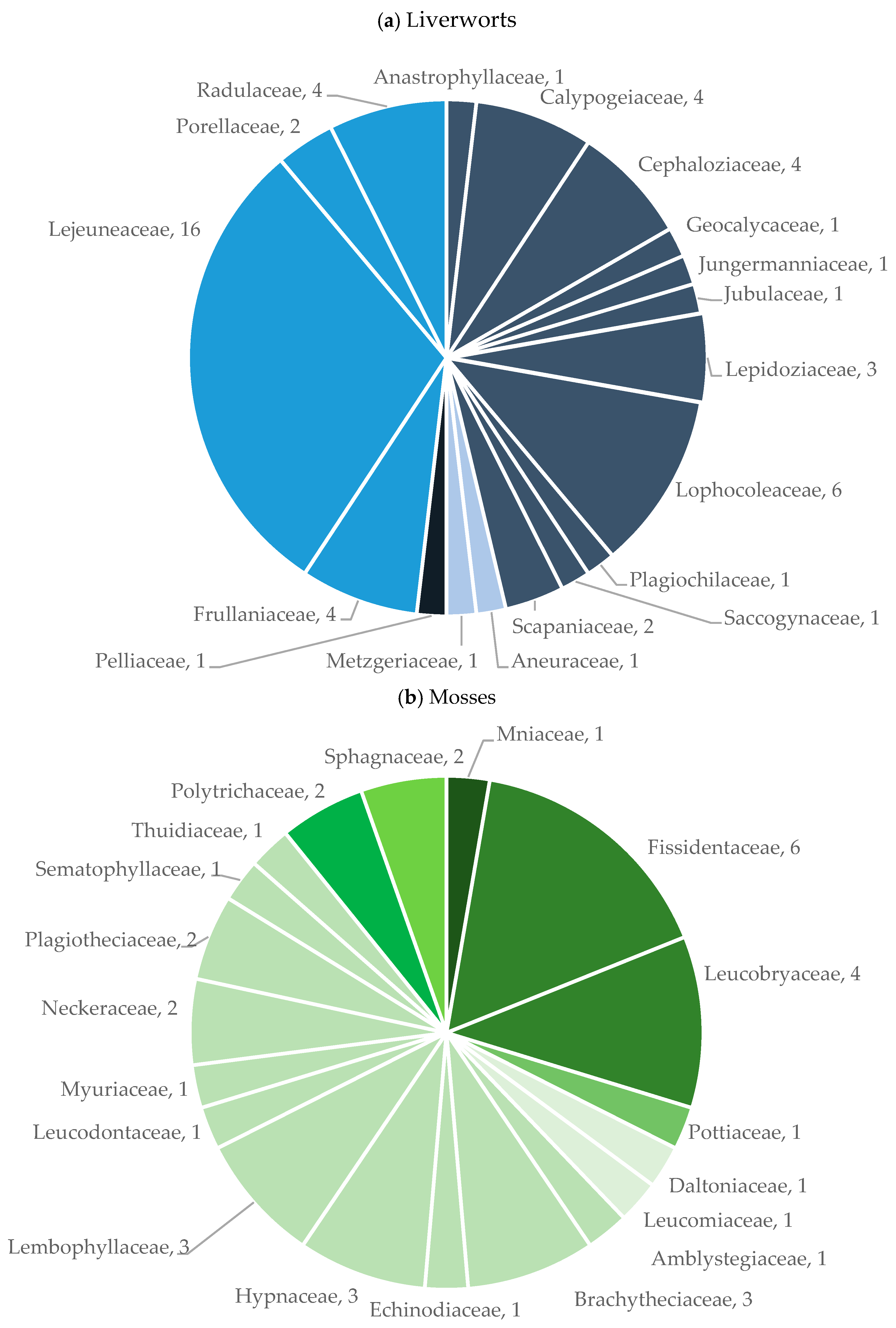
Figure 1. (a) Number of species per family within liverworts. Each slice represents a family, with size proportional to species richness. Colors correspond to the Order of each Family: Jungermanniales, Metzgeriales, Pelliales, and Porellales. (b) Number of species per family within mosses. Each slice represents a family, with size proportional to species richness. Colors indicate the Order of each Family: Bryales, Dicranales, Pottiales, Hookeriales, Hypnales, Polytrichales, and Sphagnales.
Plants 14 03766 g001
Figure 2. Bryophyte (liverworts and mosses) richness and abundance (number of specimens present in 5 cm × 10 cm microplots; see the secondary axis) along Flores Island’s elevational gradient.
Plants 14 03766 g002
Figure 3. Richness of liverworts and mosses recorded across substrates and elevations on Flores Island. Bars show the number of species in each substrate type (rupicolous, terricolous, humicolous, lignicolous, epiphytic and epiphyllous) at the five elevational bands (70, 200, 400, 600 and 800 m a.s.l.) (see also Section 2.3).
Plants 14 03766 g003
Figure 4. Hill diversity profiles of bryophyte communities along an elevational gradient on Flores Island (Azores).
Plants 14 03766 g004
Figure 5. UPGMA dendrogram showing the similarity relationships among bryophyte assemblages sampled at five elevations (70 m, 200 m, 400 m, 600 m, and 800 m) on Flores Island.
Plants 14 03766 g005
Figure 6. Bryophyte (liverworts and mosses) richness and abundance (number of specimens present in 5 cm × 10 cm microplots; see the secondary axis) along six substrates on Flores Island.
Plants 14 03766 g006
Figure 7. Hill diversity profiles of bryophyte communities across substrate types on Flores Island (Azores).
Plants 14 03766 g007
Figure 8. UPGMA dendrogram showing similarity relationships among bryophyte assemblages associated with six substrate types (rupicolous, terricolous, humicolous, lignicolous, epiphytic, and epiphyllous) on Flores Island.
Plants 14 03766 g008
Figure 9. Map of the Azores archipelago, composed of nine volcanic islands in the North Atlantic. The study was conducted on Flores Island, shown in black.
Plants 14 03766 g009
Figure 10. Sampling design used for bryophyte surveys along the altitudinal gradient on Flores Island, following the GIMS protocol based on the BRYOLAT methodology [11,18,21]. (a) Sampling was conducted at 200 m elevation intervals; at each elevation level, two plots (black squares, 10 m × 10 m) were established 10–15 m apart. (b) Each plot was subdivided into 25 quadrats (gray squares, 2 m × 2 m), of which three were randomly selected for sampling. (c,d) Within each selected quadrat, all available microhabitats were examined (e.g., soil, rock, bark, litter, decaying wood), and three microplots (yellow rectangles, 5 cm × 10 cm) were sampled per microhabitat. On trees, nine microplots were sampled across three height levels (1–50 cm, 51–100 cm; 101–200 cm).
Plants 14 03766 g010
Figure 11. Distribution of bryophyte sampling sites across Flores Island (Azores), overlaid on topographic contours (100 m intervals). Sites are colored by locality (70 to 800 m a.s.l.). Areas shaded in light green represent the Flores Natural Park, in green, represent the natural forests, while blue polygons indicate lakes.
Plants 14 03766 g011
Figure 12. Overview of vegetation in the ten sampling plots used for the bryophyte survey on Flores Island, shown in pairs by locality and increasing elevation: (A,B) Ponta do Ilhéu (70 m); (C,D) Caminho para Ponta Delgada (200 m); (E,F) Outeiros (400 m); (G,H) Ribeira do Cascalho (600 m); (I,J) Morro Alto (800 m). Each locality is represented by two adjacent plots (1 and 2).
Plants 14 03766 g012
Table 1. Geographic and topographic characteristics of the ten bryophyte sampling plots established on Flores Island (Azores). Each locality includes two plots, with values of elevation, slope, aspect (exposure), and geographic coordinates. Pairs of plots (P1 and P2) were established within each locality to capture within-site variability. Coordinates are in decimal degrees; exposure is expressed in azimuth degrees (0° = N).
Plot CodeLocalityElevation
(m a.s.l.)
Slope
(Degrees)
Exposure
(Degrees)
Latitude
(Decimal °)
Longitude
(Decimal °)
FLO_0070_P1Ponta do Ilhéu701528039.50633−31.19453
FLO_0070_P2771810739.50622−31.19461
FLO_0200_P1Caminho para Ponta Delgada2493514139.50689−31.21286
FLO_0200_P2266321439.50661−31.21275
FLO_0400_P1Outeiros399408139.50192−31.20558
FLO_0400_P2399415439.50183−31.20558
FLO_0600_P1Ribeira do
Cascalho
64959039.48281−31.19042
FLO_0600_P2648817639.48267−31.19033
FLO_0800_P1Morro Alto8331427839.46319−31.22594
FLO_0800_P28331528339.46325−31.22600
Disclaimer/Publisher’s Note: The statements, opinions and data contained in all publications are solely those of the individual author(s) and contributor(s) and not of MDPI and/or the editor(s). MDPI and/or the editor(s) disclaim responsibility for any injury to people or property resulting from any ideas, methods, instructions or products referred to in the content.