Article

The Effects of Photoperiodic Transcription Factor OsPRR37 on Grain Filling and Starch Synthesis During Rice Caryopsis Development


1
College of Agronomy, Northwest A&F University, Yangling 712100, China
2
College of Bioscience and Biotechnology, Yangzhou University, Yangzhou 225009, China
3
College of Life Sciences, South China Agricultural University, Guangzhou 510642, China
*
Authors to whom correspondence should be addressed.
Plants 2025, 14(23), 3690; https://doi.org/10.3390/plants14233690
Submission received: 3 September 2025 / Revised: 14 November 2025 / Accepted: 21 November 2025 / Published: 4 December 2025
(This article belongs to the Special Issue Molecular Breeding and Germplasm Improvement of Rice—2nd Edition)

Abstract

Grain filling governs grain weight formation in rice, while starch biosynthesis during this process critically determines both grain quality and yield. In this study, we characterized the heading date regulator OsPRR37 on regulating grain development, starch metabolism, and starch physicochemical properties. The osprr37 mutants exhibited undesirable agronomic traits, including reduced plant height, decreased grain thickness, lower 1000-grain weight, and diminished yield. Moreover, mutant endosperm displayed irregular starch packing, aberrant granules morphology, and decreased granule diameter. Impaired grain filling was observed in osprr37 mutants with reduced grain filling rates, which coincided with elevated soluble sugar content and reduced starch accumulation during grain development. Simultaneously, the expression of starch synthesis-related genes (SSRGs) was significantly altered. osprr37 mutants had decreased total starch and amylose content, leading to reduced starch crystallinity, lower structural order degree, and impaired gelatinization properties. Collectively, our results demonstrated that OsPRR37 functions as a key regulator of grain filling and starch biosynthesis, thereby determining starch composition and physicochemical properties that ultimately affect rice quality and yield.

1. Introduction

Rice is a critically important food crop, feeding over 50% of the global population with approximately 155.5 million hectares cultivated [1]. Starch constitutes the primary component of rice grain, representing 80–90% of its dry weight. The starch located in the endosperm consists of amylose and amylopectin, the relative properties of these polymers critically influence both yield and quality [2]. Protein constitutes the second largest component, accounting for 7–10% dry weight in endosperm [3]. Minor constitutes include lipids, amino acids, vitamins, and other compounds [4]. Consequently, comprehensively identifying and harnessing starch biosynthesis regulators represents a critical strategy for developing elite rice varieties with enhanced quality [5].
Rice quality comprises four principal indices: processing quality, appearance quality, eating and cooking quality (ECQ), and nutritional quality [6]. Brown rice rate, head rice rate, and whole head rice rate are key indicators for assessing processing quality [7]. Appearance quality is primarily related to grain morphology and chalkiness. Key morphological parameters include length, width, thickness, and length-to-width ratio. Chalkiness refers to opaque areas in grain, resulting from insufficient grain filling and disorganized starch granule packing [8]. Eating and cooking quality, a paramount aspect of rice quality, is primarily determined by the composition and physicochemical properties of starch. Key ECQ evaluation indicators include amylose content, gel consistency, gelatinization temperature, peak viscosity, and enthalpy [9]. Generally, rice with low amylose content exhibits high gel consistency, low gelatinization temperature, and high peak viscosity, resulting in superior ECQ [6]. Proteins and amino acids serve as key indicators of nutritional quality. Grain storage proteins comprise the albumin, globulin, glutelin, and prolamin, with glutelin representing the predominant storage protein in rice [10].
Rice quality is dictated by starch characteristics, including content, composition, and physicochemical properties. These traits are governed not only by starch biosynthetic enzymes but also by transcription factors that modulate starch pathway gene expression. RSR1, an AP2/EREBF family transcription factor, represses starch biosynthesis genes, with its loss-of-function mutant showing reduced starch content and shifted amylose-to-amylopectin ratio [11]. The NF-Y family is involved in storage substance accumulation and endosperm development in rice. NF-YB1 forms a complex with NF-YC12 and bHLH144 that directly activates Wx expression to modulate amylose content [12]. Furthermore, NF-YB1 directly targets the OsYUC11 promoter, enhancing auxin biosynthesis to regulate grain filling and storage compound accumulation [13]. The NAC transcription factors OsNAC20 and OsNAC26 directly activate starch and storage protein biosynthesis genes, while OsNAC25 forms a positive feedback loop with OsNAC20/OsNAC26 to stabilize starch biosynthesis pathways and maintain normal substance accumulation [14,15]. OsbZIP60 maintains ER homeostasis during endosperm development. Its loss-of-function mutant disrupts proteostasis, triggering OsbZIP50-mediated unfold protein change (UPR) signaling that up-regulates chalkiness-related genes, thereby inducing grain chalkiness [16]. The bHLH transcription factor OsFIF3 represses OsSUT1 and FLO2 expression, elevating grain chalkiness and reducing grain weights [17]. Overexpression of OsTFIIB5 decreased plant height, accelerated flowering time, and increased seed storage protein accumulation while suppressing starch biosynthesis and altering starch composition [18].
The PRR (pseudo-response regulator) family is one of the core components of plant circadian clock, which is widely involved in various physiological process such as plant development, stress response, and grain productivity [19]. Natural variation of TaPRR1 in wheat correlates with yield traits, particularly 1000-grain weight. Specific haplotypes simultaneously increase grain weight, reduce plant height, and accelerate heading [20]. OsPRR37 functions as a photoperiodic flowering repressor under long-day condition, delaying heading and increasing plant height. Concurrently, OsPRR37 modulates panicle differentiation rate to increase spikelet number per panicle, ultimately enhancing grain yield [21,22]. While the PRR family are regulating flowering and yield, their direct roles determining grain quality remain unknown. Therefore, this study aimed to elucidate the role of rice photoperiodic transcription factor OsPRR37 in regulating rice yield and quality through a comprehensive comparison of wild-type and osprr37 mutants, focusing on yield-related traits and starch characteristics. We demonstrated that OsPRR37 functions as a pleiotropic regulator, influencing heading date, grain size, and yield potential, thereby concurrently determining multiple quality traits including processing, appearance, eating and cooking, and nutrition quality, which provide a critical insight for the genetic improvement of rice grain quality and yield.

2. Results

2.1. Effect of OsPRR37 on Agronomic Traits

Under natural long-day conditions in Yangling, both the wild-type and osprr37 mutants failed to head. However, under artificial short-day conditions, the osprr37 mutants headed 5 days earlier than wild-type plants. Then, we investigated mature plant phenotype to assess the effects of OsPRR37 on rice growth and endosperm development (Figure 1). Compared to wild-type plant, plant height in the osprr37 mutants decreased by 11.7%, while flag leaf length increased by 27.8%. However, flag leaf width and panicle neck length showed no significant differences. Yield components were compared between wild-type and the osprr37 to assess the effect of OsPRR37 mutation on agronomic traits. Versus wild-type, panicle length, spikelet number per panicle, number of secondary branches, and grain density increased significantly in the osprr37 by 9.9%, 39.2%, 86.3%, and 31.2%, respectively. Panicle number per plant decreased by 31.2%, effective panicles per plant by 33.3%, and seed setting rate by 27.3%. Effective spikelet number per panicle and number of primary branches were slightly higher in the osprr37 than wild-type (by 1.85% and 6.1%, respectively). Consequently, grain yield per plant in the osprr37 mutants decreased significantly by 16.1% compared to wild-type.

2.2. Effect of OsPRR37 on Seed Morphology

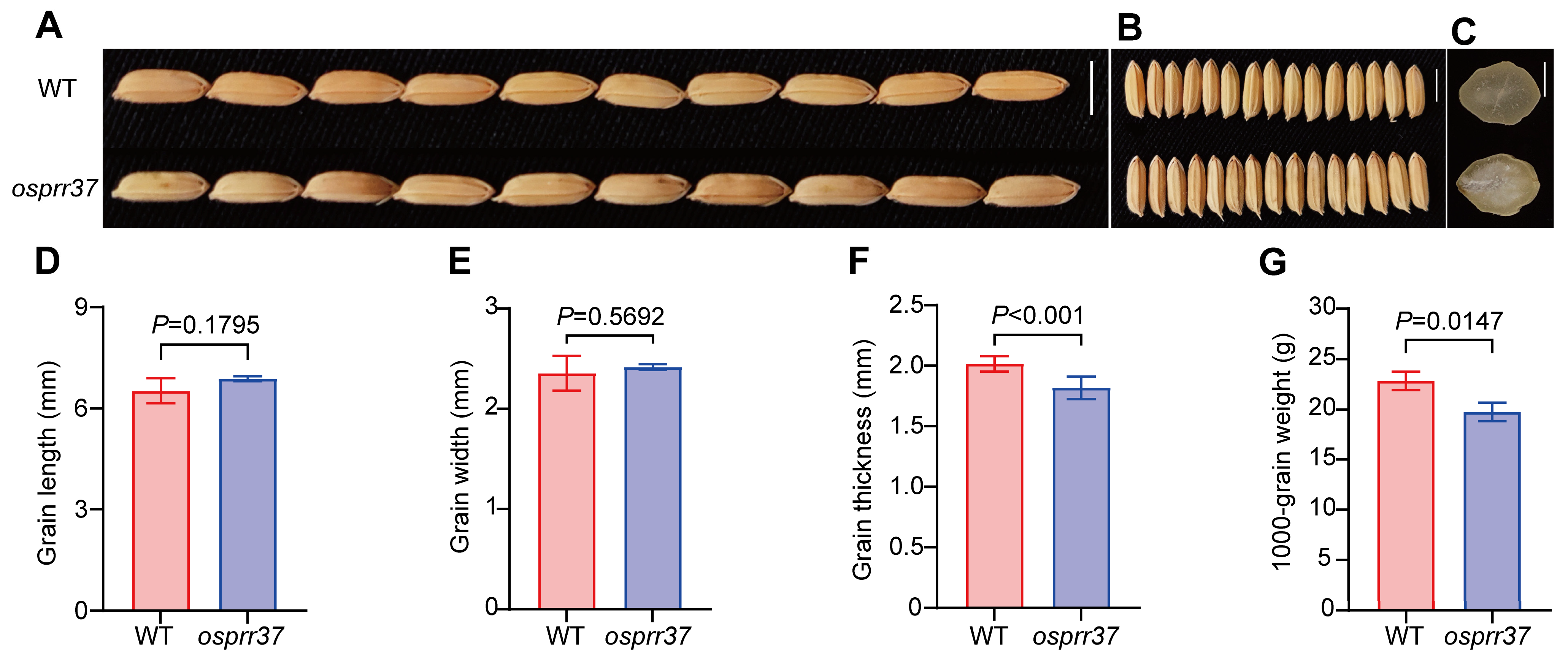
To investigate the grain differences between wild-type and osprr37 mutants, we quantitatively analyzed the grain morphology of brown rice, including grain length, grain width, grain thickness, and grain weight (Figure 2). The results showed that, compared to wild-type, the grains of osprr37 mutants are longer (+5.46%) and wider (+2.68%), but these differences are not significant (p > 0.05). However, the grain thickness decreased significantly by 9.82% in osprr37 mutants (p < 0.01). Transverse sections of osprr37 mutant grains revealed chalky endosperm characterized by distinct opacity. The central endosperm region exhibited pronounced opacity, while the peripheral zone remained translucent, indicating severe chalkiness. This abnormal chalkiness was associated with incomplete grain filling, correlating with a 13.54% reduction in 1000-grain weight (p < 0.01).

2.3. The Rice osprr37 Mutants Display Defects in Grain Filling

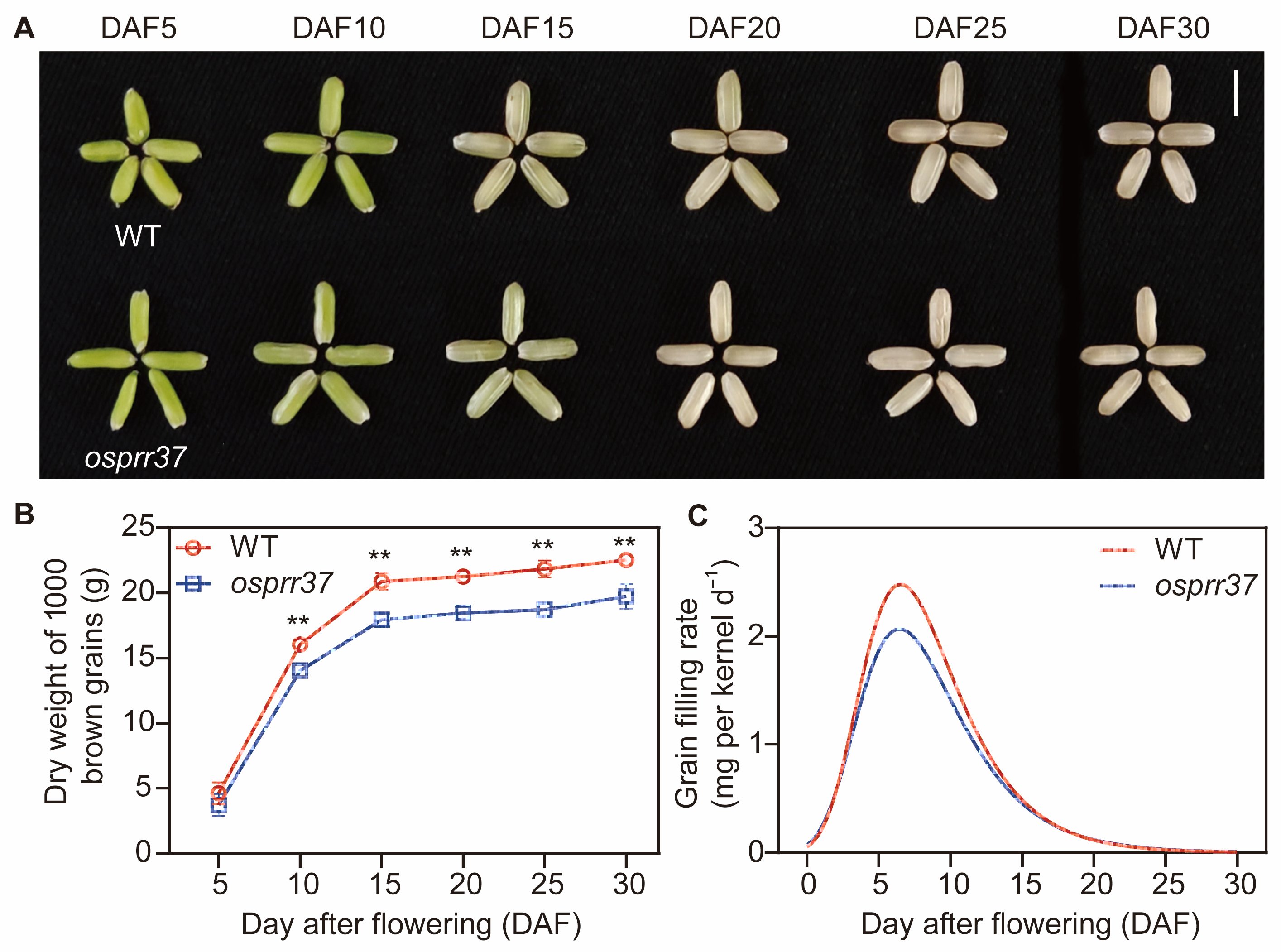
To determine the effect of OsPRR37 on grain development, wild-type and osprr37 mutant plants were sampled at various grain developing stages. Grain dry weight and filling rates were analyzed to access developmental differences (Figure 3). The results showed that endosperm opacity in osprr37 mutants progressively intensified during grain filling (Figure 3A). Figure 3B presents endosperm dry weight dynamic in wild-type and osprr37 mutant grains during grain filling stage. Dry weight accumulation occurred rapidly during early grain filling stage (5–15 DAF, days after flowering), followed by progressively slower accumulation until plateauing at physiological maturity (~30 DAF). Throughout endosperm development, osprr37 mutants accumulated 13.54% less dry weight than wild-type grains.
Analysis of grain filling rates revealed that the osprr37 mutants exhibited consistently lower rates than wild-type during early grain filling stage (2–18.4 DAF) (Figure 3C). From 18.4 DAF onward, grain filling rates in the osprr37 mutants converged with those of wild-type plant. Although both genotypes reached peak filling rates (Gmax) at approximately 6.5 DAF, the mutants maintained significantly reduced average filling rate ( G ¯ ) throughout the grain filling period (17% lower than wild-type) (Table 1). These results indicated that osprr37 mutants reduces early grain filling rates, contributing to the compromised carbon metabolism and decrease in final grain weight observed in mutants.

2.4. Effect of OsPRR37 on Carbohydrate Accumulation

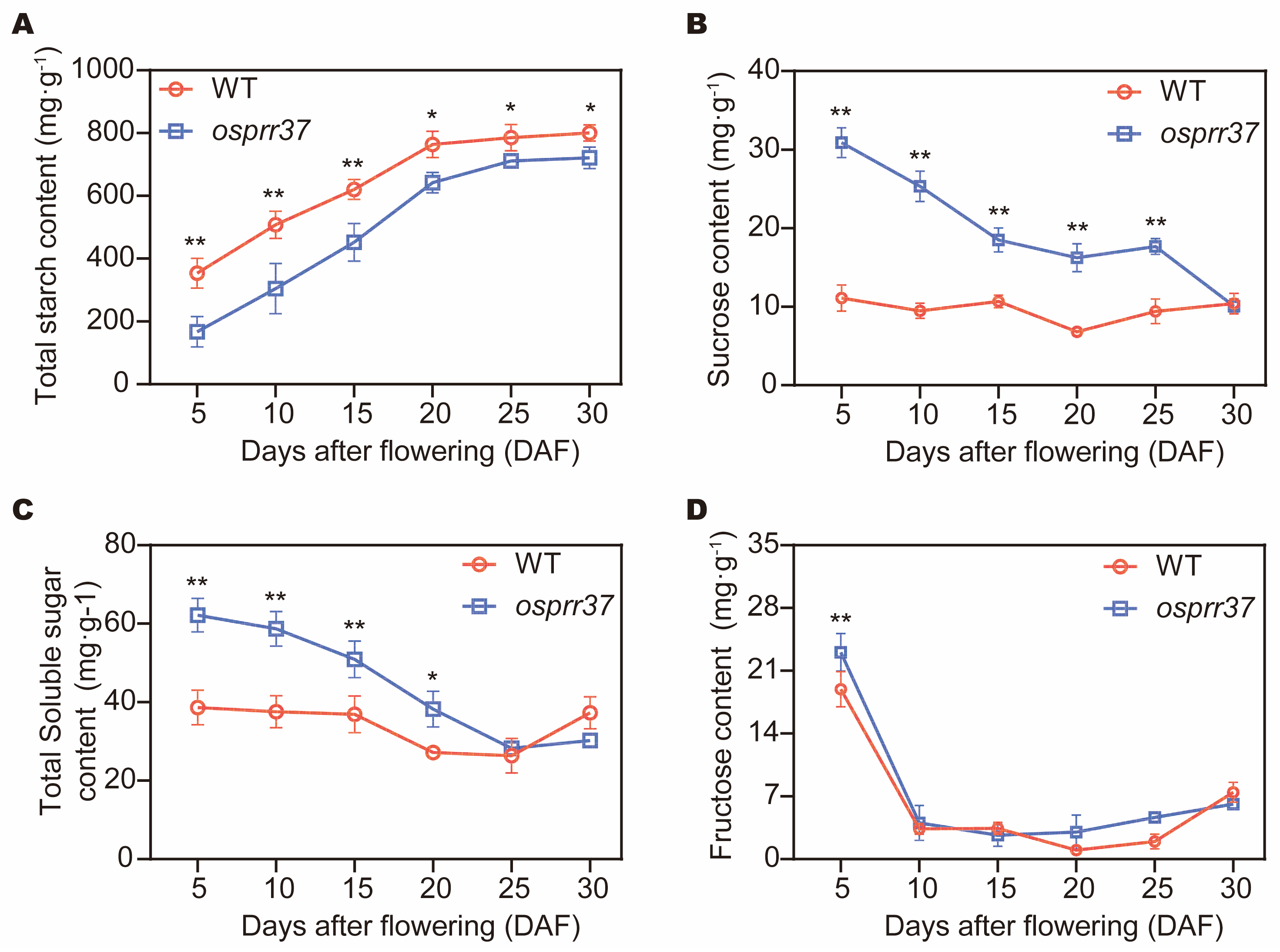
We systematically profiled carbohydrate metabolism in developing rice endosperm by quantifying fructose, sucrose, total soluble sugar, and starch accumulation in wild-type and osprr37 mutants at critical grain filling stages (5, 10, 15, 20, 25, 30 DAF) (Figure 4). Fructose content accumulation peaked during early grain filling (5–10 DAF) before declining rapidly. At 5 DAF, osprr37 mutants exhibited 21.8% higher fructose content than wild-type (p < 0.01), with no significant differences observed during subsequent developmental stages (10–30 DAF) (Figure 4D). Compared with wild-type, the osprr37 mutants accumulated significantly higher total soluble sugar levels during early-to-mid grain filling stages (5–20 DAF), with differences reaching 18–27% (p < 0.05). However, no significant differences were observed at late grain filling stages (25–30 DAF) (Figure 4C). Sucrose dynamics paralleled total soluble sugar patterns, progressively declining throughout grain development. The osprr37 mutants consistently maintained elevated sucrose levels relative to wild-type until 30 DAF, as quantified in Figure 4B. Starch accumulation patterns revealed significant divergence between genotypes (Figure 4A). Wild-type plants reached the accumulation plateau at 20 DAF, with starch accounting for 76.66% of grain dry weight. In contrast, osprr37 mutants exhibit delayed starch accumulation, reaching the plateau at 25 DAF and containing 71.13% starch. These results indicated that impaired sucrose-to-starch conversion in osprr37 elevates soluble sugars content and decreases starch accumulation, directly reducing grain weight.

2.5. The Structure of Starch Compound Granules Is Abnormal in osprr37 Endosperm Cells

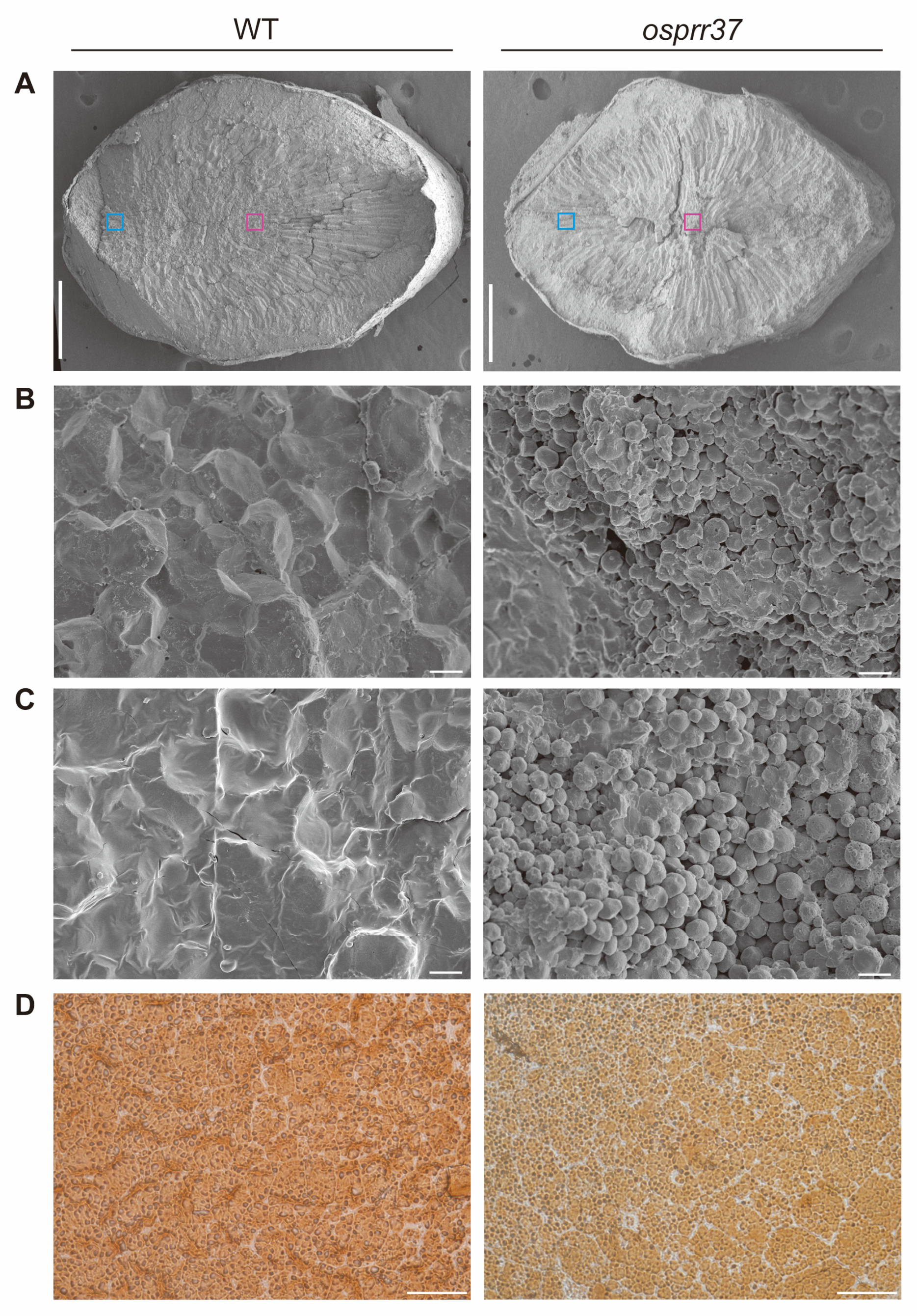
Scanning electron microscopy (SEM) of mature grain cross-sections revealed differences in endosperm architectures (Figure 5A–C). Wild-type endosperm displayed tightly packed starch granules with sharp edges and regular polyhedral structures. In contrast, osprr37 mutant seeds exhibited loosely packed, irregularly spherical granules with extensive intergranular spaces through the central and peripheral regions. These structural irregularities promoted multiple light scattering events, resulting in the opaque phenotype of mutant grains.

2.6. Effect of OsPRR37 on Starch Particle Size

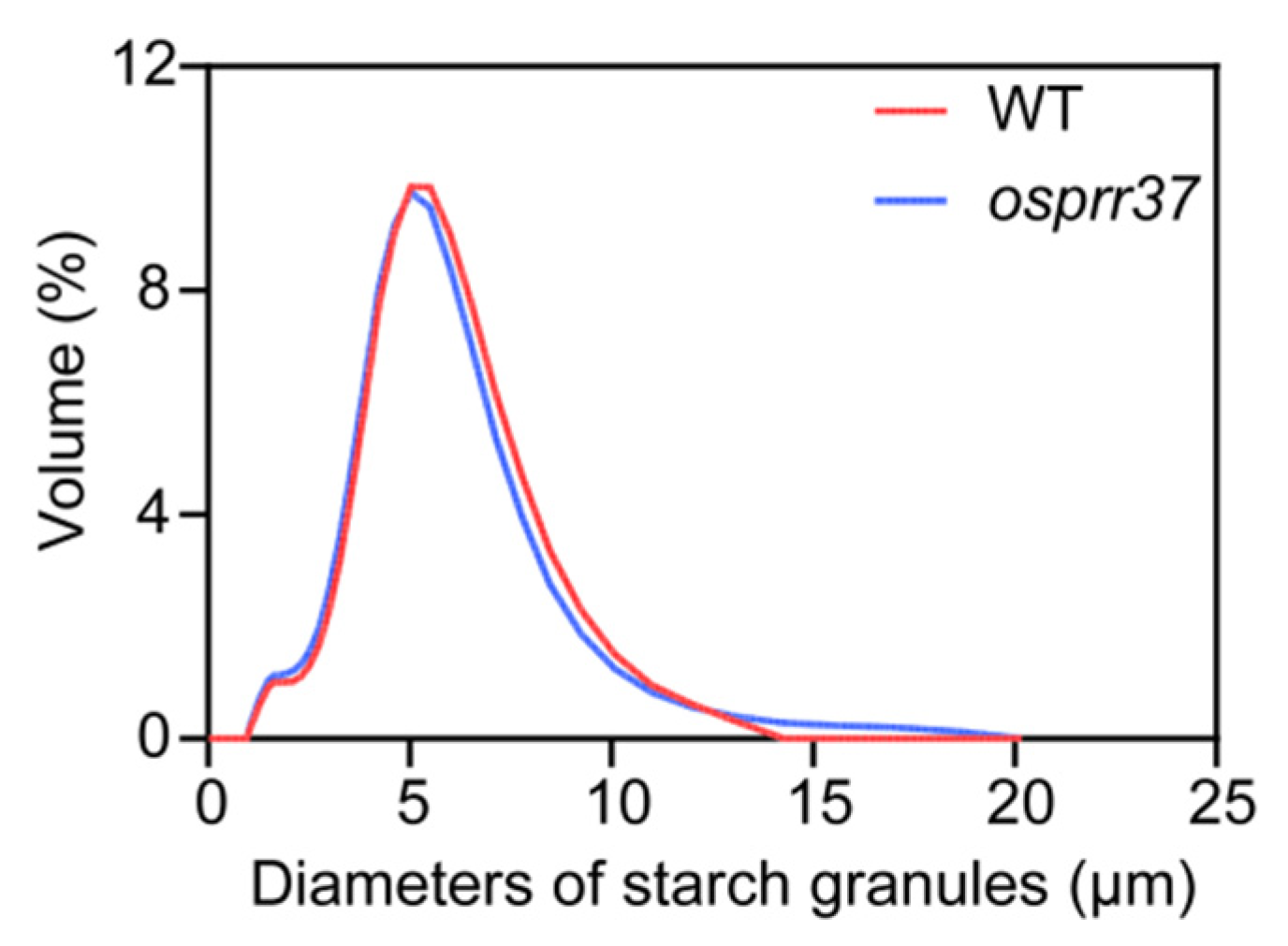
Starch granule fractions were categorized into three size classes: small (≤2 μm), medium (2–5 μm), and large (≥5 μm). Starch granule volume distributions are shown in Figure 6. Both wild-type and osprr37 mutants exhibited unimodal volume distributions, with peak at 5.04 μm. Granule morphology analysis revealed significant alteration in osprr37 (Table 1). Compared to wild-type, osprr37 mutants exhibited 2.87% reduction in mean granule size and 2% decrease in volume-weighted mean diameter (both p < 0.05), while the 2.43% reduction in surface area-weighted mean diameter was non-significant (p > 0.05). Granule size distribution analysis revealed a 4.40% increase in the proportion of small starch granules, the proportion of medium starch granules increased significantly by 7.89% (p < 0.01), while large starch granules decreased significantly by 5.13% (p < 0.05) (Table 2). Overall, the OsPRR37 mutation shifted starch distribution from large to small and medium sizes, generating significantly smaller granules. These findings demonstrated that OsPRR37 mutation alters starch granule morphology.

2.7. Effect of OsPRR37 on Rice Grain Quality

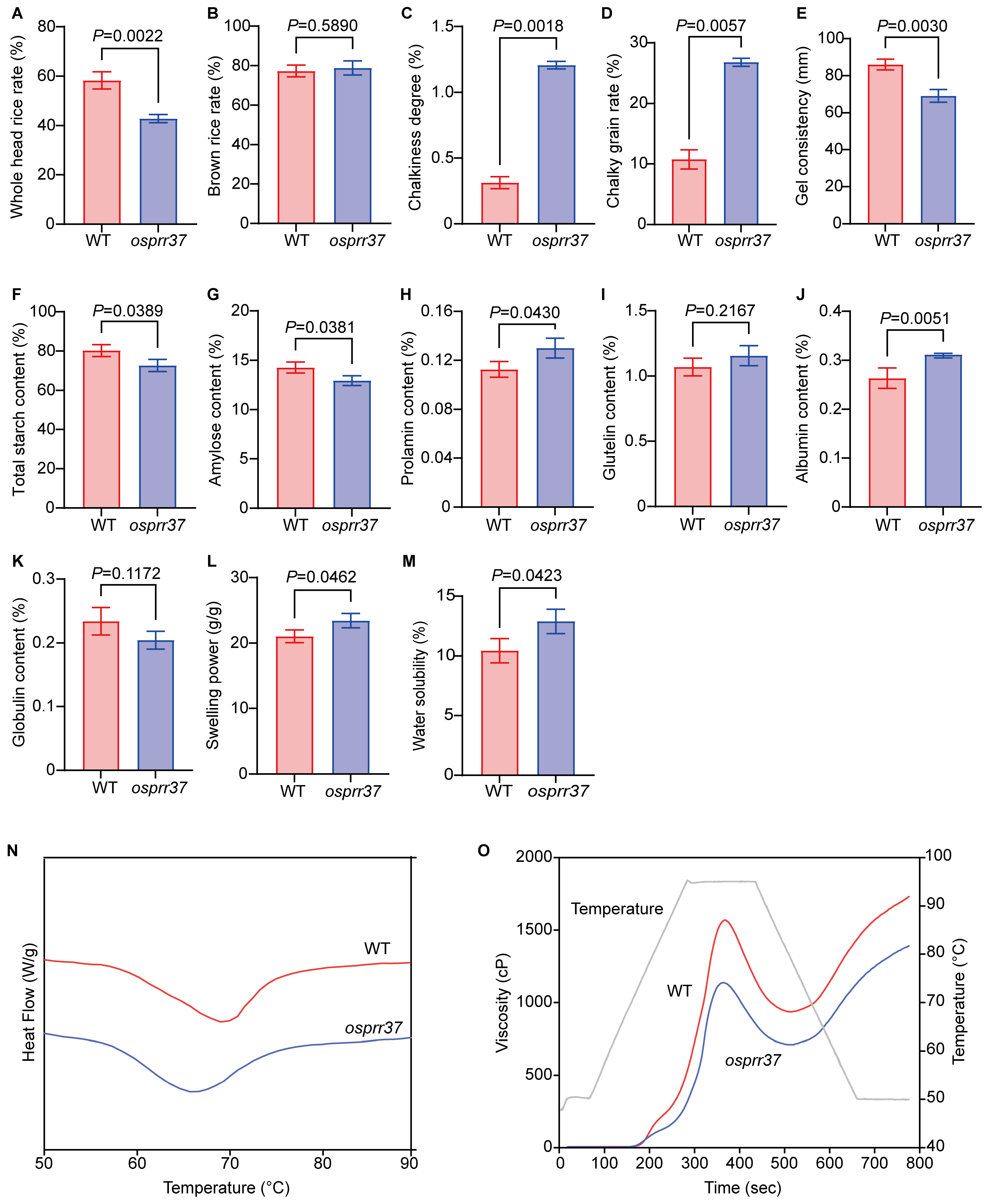
The changes in rice processing and appearance quality were analyzed. Regarding processing quality, osprr37 exhibited a significant 26.49% (p < 0.01) decrease in whole head rice rate compared to wild-type (Figure 7A). However, its brown rice rate increased 2.04% (p > 0.05); this difference was not statistically significant (Figure 7B). For appearance quality, the OsPRR37 mutation increased chalky grain rate by 1.49-fold (p < 0.01) and chalkiness degree by 2.86-fold (p < 0.01) compared to wild-type (Figure 7C,D). In osprr37 mutants, gel consistency decreased by 19.64% (p < 0.01), total starch content by 9.40% (p < 0.05), and amylose content by 9.26% (p < 0.05) compared to wild-type (Figure 7E–G). Rice endosperm contains four nutritional seed storage proteins (SSPs): albumin, glutelin, globulin, and prolamin. Quantitative analysis revealed significant SSP alterations in osprr37 versus wild-type (Figure 7H–K): albumin increased 18.32% (p < 0.05), globulin decreased 12.69% (p > 0.05), glutelin increased 8.04% (p > 0.05), and prolamin increased 15.35% (p < 0.05). The significant albumin and prolamin increases versus non-significant globulin and glutelin changes suggested that OsPRR37 loss-of-function significantly alters seed storage protein composition, with these compositional shifts potentially influencing rice quality traits.
Significant differences in solubility and swelling power were observed between wild-type and osprr37 starches. osprr37 starch exhibited significantly higher solubility and swelling power than wild-type (p < 0.05). At 95 °C, solubility increased from 10.44% to 12.89%, while swelling power rose from 21.03 g/g to 23.45 g/g (Figure 7L,M).
Starch gelatinization properties were analyzed using differential scanning calorimetry (DSC). DSC thermograms revealed similar gelatinization profiles between wild-type and osprr37 mutant starch, though the mutant exhibited a slight reduction in gelatinization entropy (Figure 7N). Thermal characteristics are present in Table 3. Compared to wild-type, osprr37 exhibited reductions in onset (T0), peak (Tp), and terminal (Tc) temperature (1.39%, 2.37%, and 2.43%, respectively) with a 12.89% decrease in gelatinization enthalpy (∆H). ∆H reflected energy consumption during starch granule dissolution, where higher values indicate great energy requirements. The 12.89% reduction in ∆H suggests lower crystalline perfection in mutant starch granules, aligning with observed morphological defects (Figure 5). These findings indicated that osprr37 reduces rice starch gelatinization properties and enhances dissolution susceptibility, potentially due to alteration in granules size, amylose content, and amylopectin structure.
Given the importance of pasting properties in determining rice eating and cooking quality, we analyzed viscosity characteristics using Rapid Visco Analyzer (RVA). While wild-type and osprr37 starch exhibited qualitatively similar temperature-dependent viscosity profiles (Figure 7O), significant qualitatively differences emerged in key parameters (Table 4). Wild-type starch exhibited characteristic viscosity development; viscosity increased with temperature until peak viscosity was attained. During subsequent cooling, viscosity briefly decreased before rapidly increasing to final viscosity. In contrast, osprr37 mutant starch maintained a depressed viscosity profile throughout gelatinization, with peak viscosity occurring significantly earlier. RVA analysis revealed that osprr37 exhibited significant reductions versus wild-type in peak viscosity, trough viscosity, breakdown, final viscosity, setback, and peak time. These parameters significantly decreased by 28.06%, 25.98%, 31.15%, 21.19%, 15.57%, and 2.26%, respectively. In contrast, pasting temperature increased by 21.3% (all p < 0.05). This altered viscosity profile correlates with observed structural defects in compound granules, including reduced granule packing density and increased surface fissures. These results demonstrate that OsPRR37 mutation impairs starch pasting properties and affects rice eating and cooking quality.

2.8. Starch Physicochemical Properties in osprr37 Grain

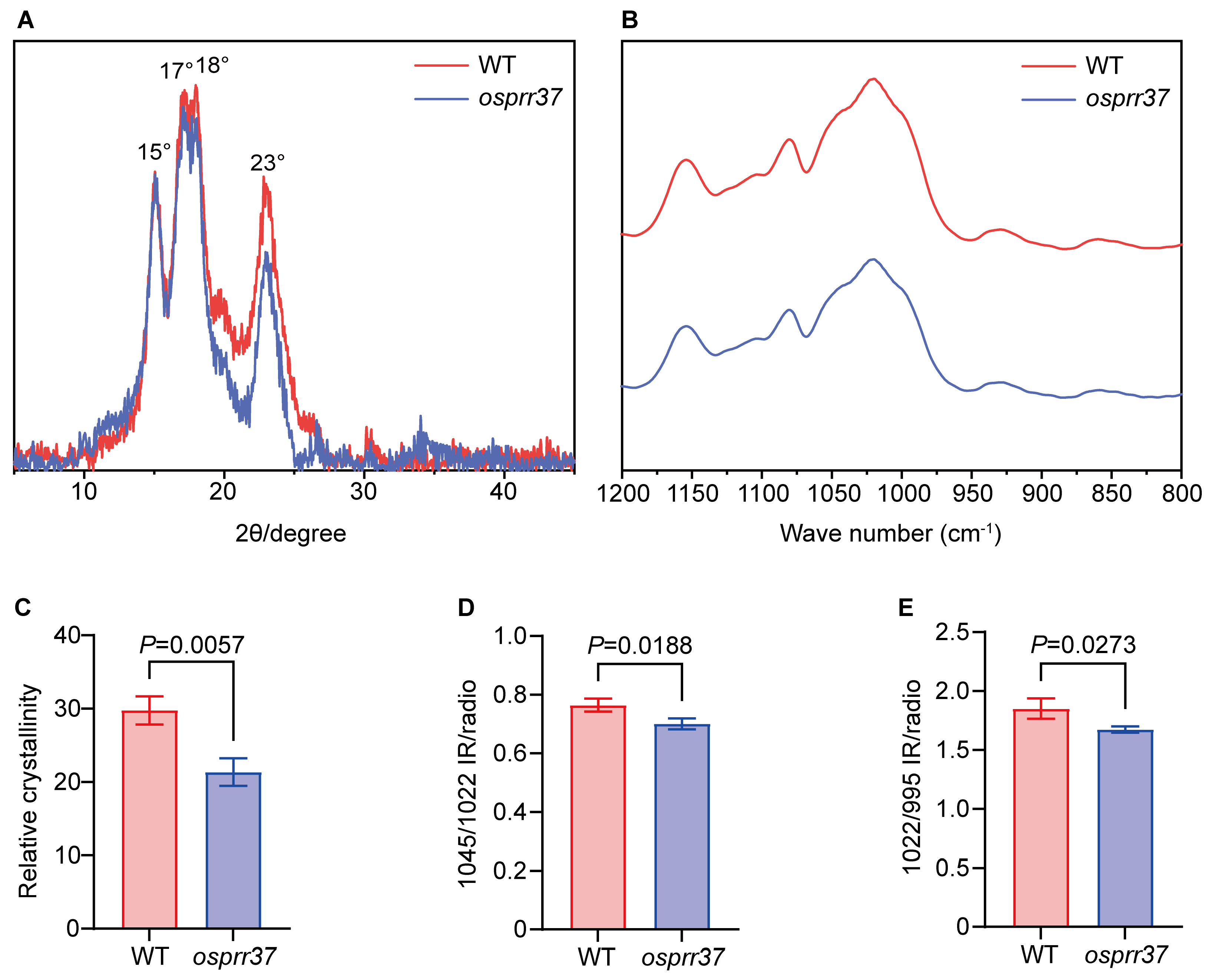
Starch crystallinity was analyzed using X-ray diffraction (XRD). Wild-type and osprr37 starch exhibit similar XRD patterns, showing strong diffraction single peaks at 15°, 17°, 18°, and 23°; this pattern is characteristic A-type starch crystallinity (Figure 8A). The OsPRR37 loss-of-function mutation did not alter characteristic A-type XRD pattern but caused reduced XRD peak intensity and a 28.25% decrease in relative crystallinity versus wild-type (p < 0.05). This result demonstrates that OsPRR37 loss-of-function causes crystalline structure defects that impaired starch functional properties, explaining the mutant’s lower gelatinization enthalpy (12.89% decrease) and peak viscosity (28.06% decrease).
FTIR spectra revealed similar starch absorption profiles in wild-type and osprr37, demonstrating that the OsPRR37 loss-of-function mutation does not alter starch’s basic chemical structure (Figure 8B). However, osprr37 exhibited significant absorbance attenuation across the 800–1200 cm−1 region, with significant spectral deviations at 995, 1022, and 1045 cm−1. Compared to wild-type, the 1045/1022 cm−1 and 1022/998 cm−1 ratio significantly decreased by 8.36% and 9.64% in osprr37, respectively (p < 0.05). Collectively, these results demonstrate that OsPRR37 loss-of-function disrupts double-helical ordering, reduces short-range molecular organization, and induces structural reorganization of amorphous domains and lamellar architecture.

2.9. The Expression Pattern of Starch Synthesis-Related Genes and Enzyme Activities

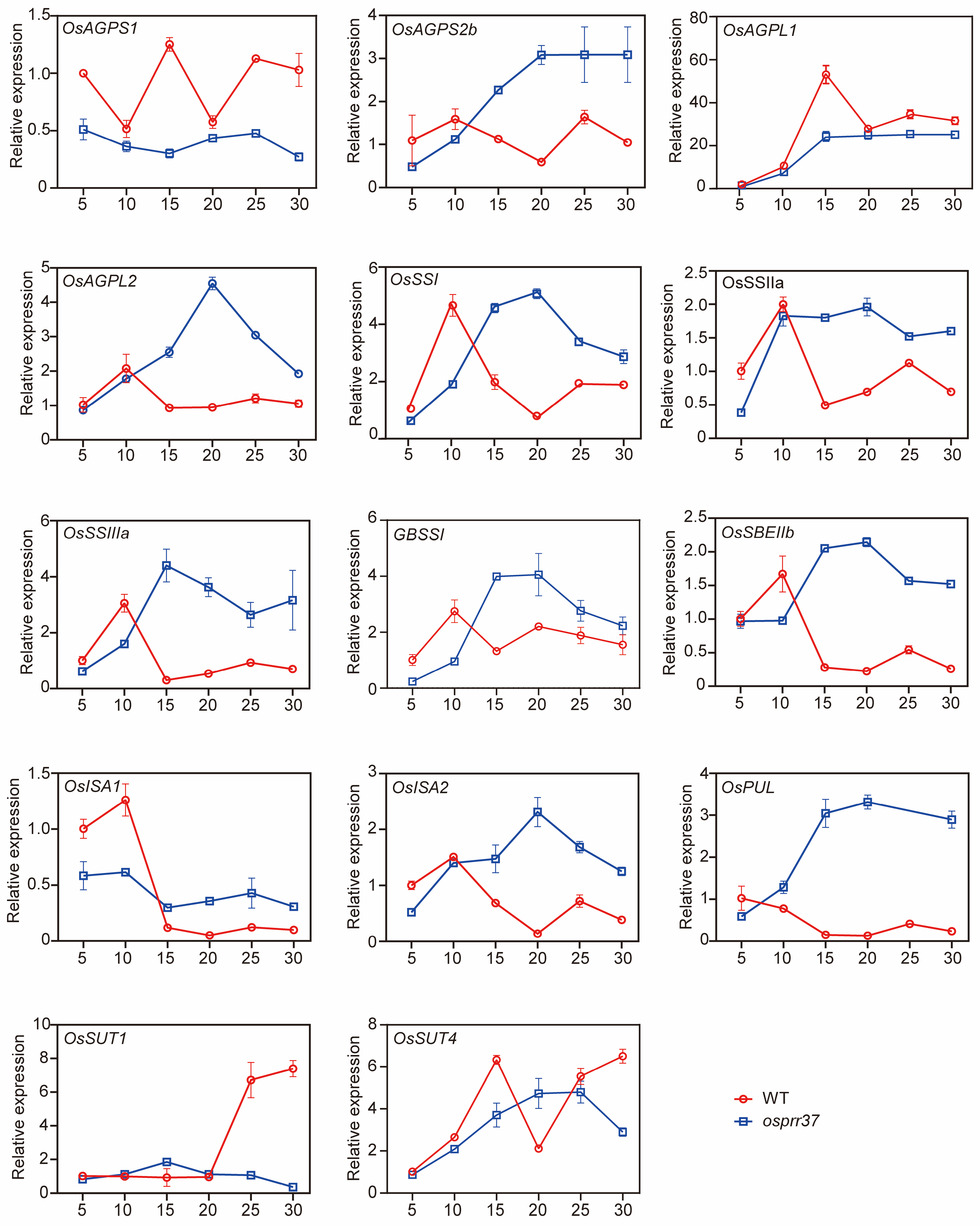
To elucidate the function of OsPRR37 in starch biosynthesis within rice endosperm, we analyzed the expression profiles of starch synthesis-related genes (SSRGs) in wild-type and osprr37 endosperms using qRT-PCR at 5, 10, 15, 20, 25, and 30 DAF (Figure 9). Expression of OsAGPS1 and OsAGPL1, which synthesize the starch precursor ADP-glucose, was consistently lower in osprr37 than in wild-type. OsPUL transcripts were only detectable at low levels in the mutant at 5 DAF and 25 DAF. Moreover, several other starch synthesis genes (OsAGPS2b, OsAGPL2, OsSSI, OsSSIIa, OsSSIIIa, OsGBSSI, OsSBEIIb, OsISA1, and OsISA2) showed elevated expression in osprr37 during mid-to-late developmental stages (15–30 DAF). Sucrose transporter genes were also affected, OsSUT1 expression was reduced throughout development, while OsSUT4 was transiently elevated at 20 DAF but otherwise suppressed.
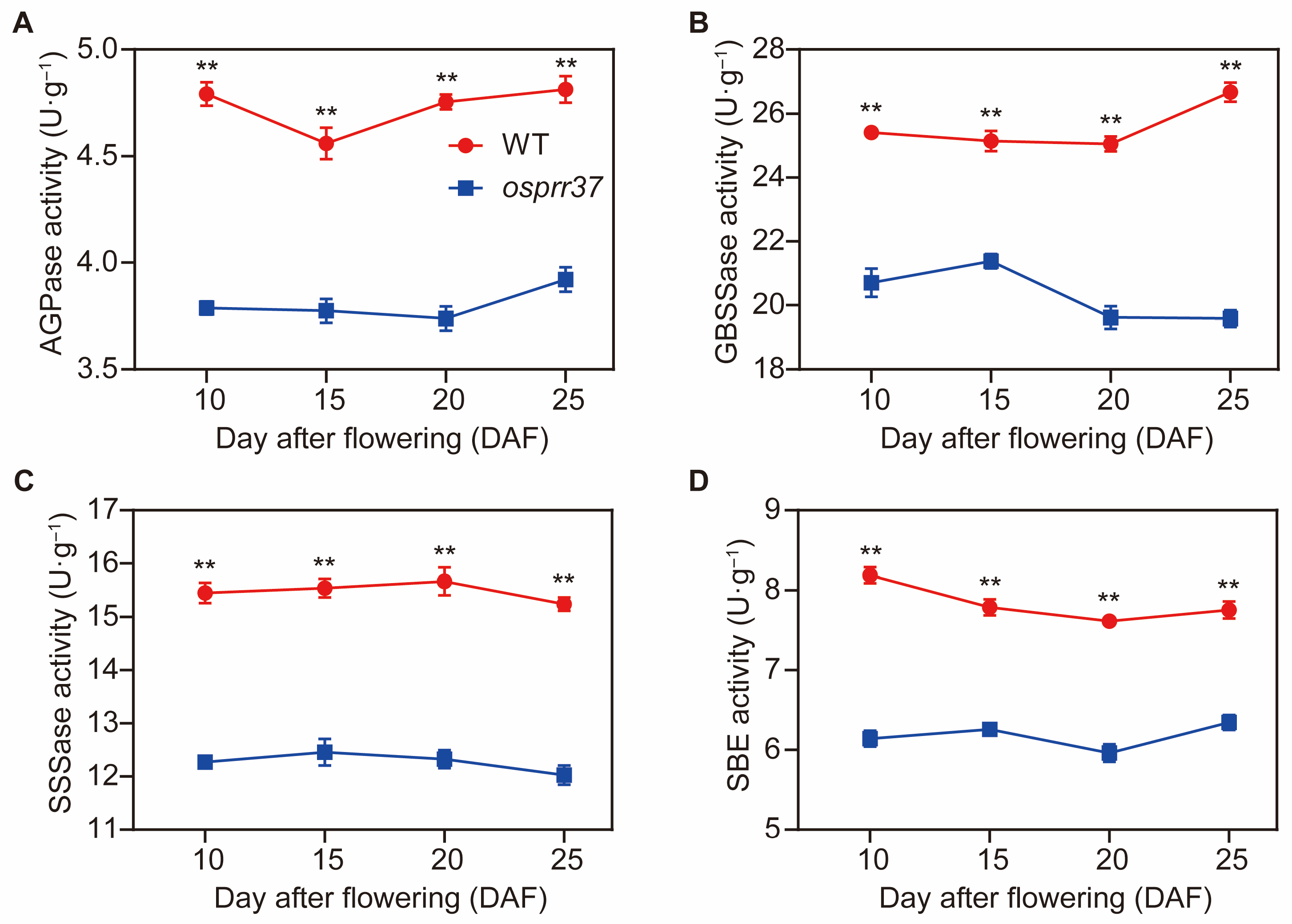
To further verify these differences at the enzyme activity level, we quantified the activities of AGPase, GBSS, SSSase, and SBE in developing grains from 10 to 25 DAF. As presented in Figure 10, although the fluctuation in enzyme activities was minimal during grain filling, osprr37 mutants consistently exhibited significantly reduced activities of four enzymes compared to wild-type. Specifically, throughout the grain filling period, AGPase activity in osprr37 mutants decreased by 17.2–21.4%, GBSS activity decreased by 15–26.6%, SSSase activity decreased by 19.8–21.3%, and SBE activity decreased by 18.2–25%. Collectively, these alterations in both the activities of starch synthesis enzymes and the expression levels of their coding genes disrupt starch metabolism in osprr37 endosperm.

3. Discussion

3.1. OsPRR37 Controls Rice Grain Filling and Starch Biosynthesis During Caryopsis Development

Previous study indicated that grain size is a primary determinant of grain weight, which ultimately determines grain yield [23,24,25,26,27,28]. However, grain filling rate also plays an important role in this process [29]. Grain filling is the progress whereby photosynthetic products from leaves are transported and converted into storage compounds within grains. Its dynamics are thus critical in determining rice quality, including processing, appearance, eating and cooking, and nutritional quality [30,31,32,33]. An impaired grain filling rate results in slower dry matter accumulation and reduced starch content, consequently leading to a decreased head rice rate and increased chalkiness degree [29]. Grain filling rate (average and maximum) showed a significant correlation with grain weight. Based on grain filling parameters, the grain filling period is divided into early, middle, and late stages. In the middle stage, the average grain filling rate peaks, representing the most critical phase for grain dry matter accumulation. While the correlation between grain filling duration and grain weight is generally weak, grain filling rate proves more influential than duration [34,35].
In this study, no significant differences in grain filling duration were observed between the wild-type and osprr37 mutants throughout grain developing stages. However, for the grain filling rate during the middle stage, the maximum and average grain filling rates were significantly reduced in osprr37. This impairment led to slower dry matter accumulation and ultimately reduced grain weight and yield per plant (Figure 1). During grain filling stages, osprr37 grains accumulated significantly higher levels of sucrose, fructose, and total soluble sugar compared to wild-type, while starch content was reduced throughout grain development (Figure 4). Collectively, these results suggested that OsPRR37 mutation impairs starch synthesis and disrupts compound granule formation in endosperm during grain filling stages.
It is well known that starch constitutes the primary component of grain weight. Consequently, grain filling centers on starch synthesis and accumulation [36]. Starch biosynthesis requires multiple enzymes. Key enzymes include ADP-glucose pyrophosphorylase (AGPase), soluble starch synthase (SSSase), starch branching enzyme (SBE), and starch debranching enzyme (DBE) [37]. Enzyme activity and gene expression in the starch biosynthesis pathway significantly regulate grain filling. Their reduction impairs grain filling rates and causes incomplete grain development [29]. Sucrose, synthesized photosynthetically in leaves, serves as the primary precursor for starch biosynthesis. This sucrose is unloaded into endosperm cells via either the symplastic or apoplastic pathway. Sucrose unloading directly influences grain filling rates and starch biosynthesis [29,38]. AGPase catalyzes the rate-limiting step in the starch biosynthesis pathway, producing the essential precursor ADP-glucose (ADPG). Consequently, mutation in AGPase-encoding genes typically disrupts grain filling, causing grain shriveling along with reduced grain weight and starch content [39]. Furthermore, AGPase activity is strongly and positively correlated with grain filling rate, starch accumulation, and final starch content [40]. Granule-bound starch synthase I (GBSSI), encoded by Waxy gene, catalyzes amylose synthesis in the endosperm using ADP-glucose as substrate. The elongation, branching, and structural refinement of amylopectin chains are catalyzed by the coordinated action of soluble starch synthase (SSSase), starch branching enzyme (SBE), and starch debranching enzyme (DBE) [2]. SSSase catalyzes the elongation of α-1,4-glycosidic chains, and its activity level reflects the capacity for starch synthesis from ADPG. SBE introduces branches points by forming α-1,6-linkages and is essential for amylopectin synthesis [41].
Throughout the grain filling period, the osprr37 mutants exhibited a slower grain filling rate and reduced starch accumulation, which corresponded to lower AGPase activity. This reduction in AGPase directly limited the supply of ADPG, the essential substrate for starch synthesis. Additionally, GBSS, SSSase, and SBE, all of which function as key downstream starch synthases, were consistently lower in osprr37 mutants. This coordinated decline in enzyme activity indicated a reduced efficiency in utilizing ADPG for starch chain elongation and branching. Consequently, the overall capacity for starch synthesis was impaired, leading to the alterations in starch composition.
We found that the gene encoding AGPase, OsAGPS1 and OsAGPL1, consistently exhibited low expression levels in osprr37 mutants. In contrast, the transcript levels of OsAGPS2b, OsAGPL2, OsSSI, OsSSIIa, OsSSIIIa, OsGBSSI, OsSBEIIb, OsISA1, and OsISA2 were higher than in wild-type during mid-to-late grain filling stages. This indicated that the loss of OsPRR37 function may trigger a compensatory feedback mechanism that upregulated the expression of these genes. In barley, functional disruption of HvSSIIa led to the compensatory upregulation of other starch synthesis genes, such as HvGBSSI, HvSSI, and HvSBEIIa, to maintain starch synthesis [42]. During the grain filling stage, the endosperm of the osprr37 mutants accumulated high levels of soluble sugars. The sugars function not only as metabolic substrates but also as signaling molecules that regulate the expression of starch biosynthesis genes [43,44]. Consequently, under these high-sugar conditions, the expression of several genes in the starch synthesis pathway was upregulated. The regulatory pattern is consistent with other cereals. In wheat gbssi mutants, sucrose and glucose contents were elevated, and the transcription abundance of SSs, SBEs, and DBEs was increased. Similarly, sbeiia mutants exhibited increased fructose and sucrose levels, along with upregulated expression of GBSSI and ISAII; ISAII participates in amylose synthesis by providing GBSSI with α-glucan chains for elongation [45]. An analogous regulation in transcription levels was also observed in rice gbssi mutants [46]. Despite the compensatory regulation of some starch synthesis genes in the mid-to-late grain filling stages, the dysregulated gene expression in osprr37 mutants not only failed to compensate for the starch deficiency but also delayed starch synthesis initiation and altered starch composition and structure, ultimately reducing grain weight and yield per plant.

3.2. Effects of Assimilate Accumulation on Rice Quality Traits

Starch, protein, and soluble sugars constitute the primary components of endosperm, and their contents and interactions significantly influence rice quality [47,48]. Critically, grain chalkiness stems not only from deficient starch biosynthesis but also from disrupted protein–starch equilibrium during endosperm development [49]. When endosperm development is compromised, elevated protein synthesis causes protein deposition within inter-granules spaces, physically preventing dense packing of starch granules. This spatial competition creates structure voids in the endosperm, resulting in increasing light scattering, thereby causing chalkiness phenotype [50]. In addition, soluble sugars (e.g., sucrose) serve as substrates for starch biosynthesis in grains, and their conversion efficiency directly affects grain filling and starch accumulation [38]. Excess sucrose and fructose during late grain filling promote storage protein accumulation while disrupting starch granule arrangement; this disordered crystalline packing elevate chalkiness, reducing both processing and appearance quality [51,52].
In this study, compared to wild-type, osprr37 mutants exhibited reduced starch synthesis capacity and impaired conversion of sucrose to starch, resulting in elevated sucrose content prior to 30 DAF and higher total soluble sugars from 5–25 DAF, while starch content remained consistently lower throughout the entire grain filling period. The metabolic imbalance in osprr37 suppressed sucrose conversion and starch accumulation, which induced disorder starch granule packing and compromised grain appearance quality. Meanwhile, osprr37 exhibited higher storage protein contents (especially glutelin, prolamin, and albumin) and more abnormal starch granules than wild-type. Excessive protein accumulation in the gaps between starch granules in osprr37 may limit starch granule polymerization and reduce grain compactness, contributing to increased chalkiness and decreased head rice rate.
Starch is water-insoluble, but upon heating, granules swell in the amorphous region and form a viscous paste. This phase transition is gelatinization, with its characteristic onset temperature termed gelatinization temperature [53]. Rice starch gelatinization depends not only on starch composition but also on storage proteins. A protein network structure formed by storage proteins (notably glutelin and prolamin) encapsulates starch granules, physically limiting water access during heating. This impedes granule swelling and amylose leaching, thereby reducing peak viscosity during gelatinization [52,54,55]. Moreover, hydrophobic storage proteins exhibit strong competitive hydration capacity. Elevated protein content reduces free water availability for starch gelatinization and restricts water mobility, thereby increasing the activation energy required for dissolution of internal starch crystallites and significantly impeding gelatinization progress [56,57]. In this study, osprr37 mutants enhanced the accumulation of glutelin, prolamin, and albumin, which formed a protein barrier that impeded starch gelatinization. This led to an increased pasting temperature and a decreased peak viscosity. Collectively, OsPRR37 mutation altered grain composition—reducing starch while elevating soluble sugars and storage proteins—while collectively impairing milling yield, increasing chalkiness, and degrading appearance and eating and cooking quality.
In this study, the increased protein content in osprr37 mutants suggests the improvement in nutritional quality. However, this benefit is offset by reductions in amylose and total starch content, which adversely affect other critical quality traits: processing, appearance, and eating/cooking quality. The decrease in total starch content resulted in powdery and friable grains and increased chalkiness, indicating poor processing and appearance quality. Concurrently, the decrease in amylose content led to undesirable alterations in pasting and gelatinization properties, negatively influencing eating and cooking quality such as rice stickiness, elasticity, and overall palatability. Consequently, despite the nutritional enhancement, the overall grain quality is substantially compromised.
Furthermore, we observed similar phenotypes in other crops as well. The maize Opaque-2 (O2) protein is a key regulator of endosperm development and carbon–nitrogen metabolism, whose loss of function leads to significantly reduced starch content and yield [58,59]. In our study, osprr37 mutants exhibit a parallel phenotype: disrupted starch metabolism, elevated soluble sugars, reduced starch content, increased protein content, and lower yield. These key traits are highly similar to the phenotypes of the maize o2 mutants, suggesting that OsPRR37 may be similar to the O2 protein and play a regulatory role in grain yield and quality formation.

3.3. OsPRR37 Regulates Starch Molecular Architecture and Functional Properties

Starch gelatinization is an irreversible order–disorder transition initiated by moist heat, characterized by granule swelling, crystalline melting, and amylose leaching due to hydrogen dissociation [60]. Differential scanning calorimetry (DSC) characterized starch thermal properties via gelatinization enthalpy (∆H) and transition temperature (To, Tp, Tc). Reduced amylose content typically correlates with decreased stability of the crystalline structure, consequently lowering the temperature required for gelatinization. In contrast, starch with high amylose content requires greater thermal energy to break hydrogen bonds in crystalline regions and exhibits reduced swelling capacity due to limited granule hydration, synergistically elevating gelatinization temperature [61]. Starch granule size further influences gelatinization properties: smaller granules gelatinize at low temperatures due to higher surface area–volume ratios, requiring less thermal energy for phase transition [62]. Gelatinization enthalpy (∆H) quantifies the endothermic disruption of double-helical crystallites. Since ∆H scales with crystallinity, highly crystalline starch requires greater thermal energy input to overcome its structure stability during transition [63,64]. Concurrent reductions in amylose content, gelatinization temperature, relative crystallinity, and gelatinization enthalpy, along with elevated swelling power and water solubility, indicate disrupted double-helical packing in osprr37 starch granules. This structure instability facilitates phase transition at lower thermal energy inputs.
Alterations in starch molecular structure and composition directly determine pasting behavior [65]. OsPRR37 mutation altered starch functional properties; key RVA parameters (peak viscosity, trough viscosity, breakdown, setback, peak time) decreased significantly, whereas gelatinization transition temperature increased, indicating modified hydrothermal stability. Peak viscosity (PV) measures the maximum paste resistance during heating, quantifying starch swelling power achieved through hydration-driven granule expansion prior to rupture [66]. Consistent evidence indicates that large starch granules exhibit greater water absorption capacity due to reduced surface area-to-volume ratios, consequently elevating peak viscosity through enhanced swelling power [67]. Final viscosity (FV) quantifies paste viscosity at 50 °C, serving as a key indicator of retrogradation tendency. High-amylose starch promotes robust inter-chain hydrogen bonding, accelerating amylose recrystallization during cooling. This strengthens gel networks and elevates FV [66]. The significantly lower PV and FV and in osprr37 starch directly stem from its 18.7% amylose reduction and 32% small granule diameter (Figure 6 and Figure 7), collectively accelerating hydration while compromising structural stability during heating.

4. Materials and Methods

4.1. Plant Materials and Growth Condition

Rice materials of wild-type and osprr37 mutants used in this study were provided by Professor Jingxin Guo of South China Agricultural University. Wild-type plants (with Hd1, Ghd7, DTH8, and OsPRR37) were selected from an F5 family from a cross between an indica landrace (accession no. I7) and the indica cultivar Qinghuazhan [68]. Their unpublished study generated osprr37 mutants by creating a mutated osprr37 allele at target site 5′-CTCATCACAACCAAACtCGCcgg-3′ via CRISPR/Cas9-mediated knockout of sequence 5′-CTCATCACAACCAAACCGCcgg-3′ in the first exon of OsPRR37. Rice plants were cultivated in the experimental greenhouse at Northwest A&F University, Yangling, Shaanxi Province, China (34°16′ N, 108°04′ E). From mid-May to October, plants were maintained under artificial short-day conditions (11–11.5 h day-lengths) using daily shading before dusk.

4.2. Determination of Agronomic Traits and Grain Filling Rate

To elucidate the process of rice yield formation, we systematically measured key agronomic traits at maturity, including plant height (PH), panicle length (PL), panicle number per plant (PNP), effective panicles per plant (EPP), spikelet number per panicle (SNPP), effective spikelet number per panicle (ESPP), seed setting rate (SSR), number of primary branches (NPB), number of secondary branches (NSB), flag leaf length (FLL), flag leaf width (FLW), panicle neck length (PNL), grain density (GD), and yield per plant (YPP). The grain morphological traits (grain length, width, thickness, and 1000-g weight) were measured after harvest using a seed test instrument (SC-G, Wanshen, Shenzhen, China). Seeds at different grain filling stages (5, 10, 15, 20, 25, and 30 days after flowering, DAF) were collected, oven-dried at 65 °C to constant weight, dehulled, and weighed. The Richards equation [W = A(1 + Be−kt)−1/N] was fitted to derive grain filling parameters [69].

4.3. Determination of Carbohydrate Content

To elucidate the physicochemical basis of yield and quality formation, we quantified sugar and starch content according to the method of Wang et al. [70]. Harvested grains were dehulled, dried to constant weight, and ground into powder. Next, 0.2 g rice flour was mixed with 10 mL deionized water and incubated at 100 °C for 30 min. After cooling to 25 °C, the mixture was centrifuged at 2000× g for 6 min. The supernatant was collected and adjusted to 40 mL as the extract for soluble sugar quantification. The dried residue was first hydrolyzed with 2 mL deionized water at 100 °C for 30 min, followed by the addition of 2 mL 9.2 M HClO4 for further incubation at 100 °C for 30 min. After cooling to 25 °C, 6 mL deionized water was added and vortex-mixed. Following centrifugation (2000× g, 6 min), the supernatant was retained. The precipitate underwent identical extraction with 4.6 M HClO4. Combined supernatants were volumetrically adjusted to 40 mL as the starch extract. Total soluble sugar content and starch content were quantified by the anthrone method. Sucrose content and fructose content were determined using the resorcinol assay [71].

4.4. Analysis of Starch Physicochemical Properties

To analyze key starch composition and function properties, we measured the amylose content, gel consistency, starch water solubility, and swelling power. Amylose content was quantified using iodine colorimetry [72]. Then, 20 mg rice flour was suspended in 100 μL anhydrous ethanol, homogenized with 1.8 mL 1 M NaOH, and digested at 60 °C for 1 h. After cooling to 25 °C, 100 μL precipitate was mixed with 9 mL deionized water and 200 μL 1 M acetic acid. Following the addition of 200 μL 0.02% I2-KI, samples were measured at 620 nm. Gel consistency was assessed according to the standard tube test method [73]. Next, 100 mg rice flour was mixed with 0.2 mL thymol blue indicator and 2.0 mL 0.2 M KOH. After vortex homogenization, samples were boiled for 8 min, cooled to room temperature, and chilled at 0 °C for 20 min, then gel length was measured immediately using a caliper. Starch solubility and swelling power were determined following Kong et al. [74]. Exactly 150 mg (W0) starch was suspended in 10 mL deionized water and vortex-mixed thoroughly. Samples were incubated at 55 °C, 65 °C, 75 °C, 85 °C, and 95 °C for 30 min with vortex mixing every 2 min. After cooling to 25 °C, centrifugation was performed at 3000× g for 20 min. The supernatant was dried to constant weight (W1). The wet precipitate (W2) was weighed, then dried to constant weight (W3). The swelling power (SP) and water solubility (WS) were calculated as follows: SP (g/g) = W2/W3, WS (%) = (W1/W0) × 100%.

4.5. Determination of Storage Protein Content

To evaluate the nutritional quality, grain storage proteins were extracted and quantified from rice flour according to the method described by Chen et al. [52]. Albumin, globulin, glutelin, and prolamin fractions were sequentially extracted from 1.0 g dehulled rice flour. Each extraction was performed at room temperature with continuous shaking of 2 h, followed by centrifugation at 10,000× g for 5 min to collect the supernatant. This extraction process was repeated twice, and the combined supernatant was diluted to a final volume at 25 mL. For protein quantification, 1 mL aliquots of each extract were mixed with 5 mL Coomasie Brilliant Blue G-250 (Bio-Rad Laboratories, Hercules, CA, USA), and absorbance was measured at 592 nm.

4.6. Analysis of Starch Granule Morphology and Size Distribution

To comprehensively characterize starch granule properties, we employed multiple approaches. Starch granule morphology was analyzed by field-emission scanning electron microscopy (FESEM, S-4800, Hitachi, Tokyo, Japan). Transverse sections of mature seeds were prepared using razor blades. The air-dried sections were mounted on aluminum stubs, gold-sputtered for conductivity, and imaged by FESEM. To examine the development of compound granules, transverse sections of developing endosperm harvested at 10 DAF were used to prepared semithin sections using a microtome (Leica, UC7, Nussolch, Germany). The 1 μm sections were stained with 1% I2-KI and imaged by light microscopy (Leica, MZ10F, Wetzlar, Germany). Starch particle size distribution was determined by laser diffraction particle size analyzer (Mastersizer 2000, Malvern Instruments, Malvern, UK). Then, 10 mg of starch was dispersed in 5 L of deionized water and homogenized by vortex mixing. Measurements were performed immediately to prevent sedimentation.

4.7. Starch Crystallinity Analysis

The crystalline structure and relative crystallinity of starch granules were analyzed using an X-ray diffractometer (XRD, D8 ADVANCE A25, Bruker AXS GmBH, Karlsruhe, Germany) according to the method of Guo et al. [75]. The operating parameters were set as follows: voltage 40 kV, current intensity 100 mA, scanning range 5–40° (2θ), step size 0.02°, and the scanning speed 10°·min−1. The relative crystallinity of starch was calculated using MDI Jade 6.0 software.

4.8. Fourier Transform Infrared Spectrum Analysis

To characterize the molecular order and helical arrangement of starch components at short-range scales through Fourier transform infrared spectrum (FTIR, Bruker Optics, Karlsruhe, Germany), starch samples were thoroughly blended with potassium bromide to make a slice and put into the sample chamber. FTIR spectra were acquired in the scanning wave number region between 4000 and 500 cm−1 at a resolution of 4 cm−1 over 42 scans. Absorbance values of starch at 1045 cm−1, 1022 cm−1, and 995 cm−1 were obtained from the deconvolution infrared spectra, and the variation of starch molecular order was analyzed by calculating the absorbance ratio at 1044/1022 cm−1 and 1022/998 cm−1.

4.9. Thermal Properties Analysis

To characterize the thermal behavior and gelatinization properties of starch, differential scanning calorimetry (DSC) was employed. Accurately weighed 5 mg of starch was placed in a crucible, mixed with 15 μL of deionized water, sealed, and equilibrated at 4 °C for 24 h. During analysis, an empty crucible was used as the reference sample, then the test samples were heated from 30 °C to 100 °C at a rate of 10 °C·min−1, with three independent replicates performed for each sample. The DSC curve was analyzed using the instrument’s own software (TA Universal Analysis Version 4.5, TA instruments, New Castle, DE, USA) to determine thermal characteristic parameters: onset temperature (T0), peak of gelatinization temperature (Tp), conclusion temperature (Tc), and gelatinization enthalpy (∆H).

4.10. Pasting Properties Analysis

The starch pasting properties were investigated using the Rapid Viscosity Analyzer (RVA4500, Perten, Stockholm, Sweden) according to the method of Guo et al. [75]. Rice flour (3 g) was weighed and thoroughly mixed with 25 mL of deionized water in an aluminum barrel. The procedure was as follows: equilibrium at 50 °C for 1 min, heating to 95 °C at a rate of 12 °C·min−1, holding at 95 °C for 2.5 min, cooling to 50 °C at the same rate, and maintaining at 50 °C for 2 min. The following parameters were derived from the pasting curve: peak viscosity (PV), trough viscosity (TV), final viscosity (FV), breakdown (BD), setback (SB), pasting temperature (PT), and pasting time (PeT).

4.11. RNA Extraction and Real-Time PCR Analysis

To analyze the expression profiles of starch synthesis-related genes, total RNA was extracted from rice seeds at various grain filling stages using the RNAprep Pure Plant Kit (DP441). RNA integrity was verified by agarose gel electrophoresis. cDNA synthesis was performed with ToloScript ALL-in-One RT EasyMix (#22107). Quantitative PCR used 2× Universal SYBR qPCR Master Mix (QP101_Ver.1) with OsActin (Os03g071810) as reference, following the manufacture’s protocol. Relative expression was calculated using the 2−ΔΔCT. Primer sequences are listed in Supplementary Material Table S1.

4.12. Enzyme Extract and Activity Assay

To investigate the enzymatic changes in starch synthesis, the activities of key starch biosynthetic enzymes (AGPase, GBSS, SSSase, SBE) were quantified in developing grains. Grains were collected at 10, 15, 20, and 25 DAF. Samples were immediately flash-frozen in liquid nitrogen and stored at −80 °C for subsequent analysis. For enzyme extraction, 1 g grains were homogenized in 9 mL pre-cooled extraction buffer as described by Wang et al. [76]. The homogenate was then centrifuged at 4 °C, 10,000× g for 30 min, and the supernatant was collected for enzyme activity assay. The AGPase, GBSS, SSSase, and SBE activities were measured using enzyme-linked immunosorbent assay kits (Shanghai FANKEL Industrial Co., Ltd., Shanghai, China, No. F7859-B, F50055-B, F7906-B, and F7907-B, respectively) following the manufacturer’s protocols.

4.13. Statistical Analysis

In this study, at least two replicates were performed in each experiment. The data were analyzed by SPSS (version 25.0, Chicago, IL, USA) and presented as mean ± standard (mean ± SD). The significant difference between samples was determined using Student’s t-test; * and ** indicate p < 0.05 and p < 0.01, respectively.

5. Conclusions

This study reveals how the photoperiodic transcription factor OsPRR37 regulates rice grain yield and quality. The osprr37 mutants exhibited significant alteration in agronomic traits compared to wild-type. Plant height, panicles per plant, and seed setting rate were significantly reduced in the mutant. Grain thickness and 1000-grain weight decreased, concomitant with increased chalky grain rate and severe chalkiness phenotype. These defects were associated with impaired grain filling in osprr37 mutants, evidenced by significantly reduced grain filling rates throughout the grain developing period. During the grain filling stage, starch biosynthesis was impaired in osprr37 mutants, resulting in elevated soluble sugar contents, reduced starch accumulation, and dysregulated expression of SSRGs. Microstructural analysis revealed incomplete endosperm filling and aberrant starch granule morphology in osprr37 grains. The osprr37 mutants showed inferior processing and appearance quality, though it accumulated higher storage protein content. OsPRR37 mutation reduced total starch and amylose content, consequently decreasing starch viscosity and gelatinization enthalpy. These changes correlated with reduced starch granule size, decreased crystallinity, and diminished molecular order in endosperm. Although we reveal the role of OsPRR37 in regulating grain yield and quality, the precise molecular mechanisms underlying these effects remain largely elusive. Future research should focus on the following aspects: protein–protein interaction screening using yeast two-hybrid or Co-immunoprecipitation assay could identify functional proteins that bind to OsPRR37 and modulate its expression or activity; high-throughput technologies such as Chip-seq or DAP-seq could be employed to identify its downstream target genes. These approaches will elucidate the molecular mechanisms through which OsPRR37 regulates grain yield and quality.

Supplementary Materials

The following supporting information can be downloaded at: https://www.mdpi.com/article/10.3390/plants14233690/s1. Table S1: Primers used for RT-PCR.

Author Contributions

Conceptualization, H.Z., J.G. and Z.W.; methodology, H.Z., S.T., F.W. and W.Z.; formal analysis, S.T., F.W., J.H., X.R. and J.Z.; writing—original draft preparation, H.Z.; writing—review and editing, J.G. and Z.W. All authors have read and agreed to the published version of the manuscript.

Funding

This work was funded by Guangdong Basic Research Center of Excellence for Precise Breeding of Future Crops Major Project (FCBRCE-202502, FCBRCE-202504).

Data Availability Statement

The original contributions presented in this study are included in the article/Supplementary Material. Further inquiries can be directed to the corresponding author.

Conflicts of Interest

The authors declare no conflicts of interest.

Abbreviations

The following abbreviations are used in this manuscript:
SSRGsstarch synthesis-related genes
PLpanicle length
EPPeffective panicles per plant
PNPpanicle number per plant
SNPPspikelet number per panicle
ESPPeffective spikelet number per panicle
SSRseed setting rate
PHplant height
NPBnumber of primary branches
NSBnumber of secondary branches
FLLflag leaf length
FLWflag leaf width
PNLpanicle neck length
GDgrain density
YPPyield per plant
ECQeating and cooking quality
UPRunfold protein change
pseudo-response regulatorPRR
WTwild-type
SEMscanning electron microscopy
DAFdays after flowering
DSCdifferential scanning calorimetry
SSPsseed storage proteins
RVARapid Visco Analyzer
XRDX-ray diffraction
AGPaseADP-glucose pyrophosphorylase
SSstarch synthase
SBEstarch branching enzyme
DBEstarch debranching enzyme
PVpeak viscosity
FVfinal viscosity

References

  1. Ahmad, M.S.; Wu, B.; Wang, H.; Kang, D. Identification of Drought Tolerance on the Main Agronomic Traits for Rice (Oryza sativa L. ssp. Japonica) Germplasm in China. Agronomy 2021, 11, 1740. [Google Scholar] [CrossRef]
  2. Vandeputte, G.E.; Delcour, J.A. From Sucrose to Starch Granule to Starch Physical Behaviour: A Focus on Rice Starch. Carbohydr. Polym. 2004, 58, 245–266. [Google Scholar] [CrossRef]
  3. Martin, M.; Fitzgerald, M.A. Proteins in Rice Grains Influence Cooking Properties! J. Cereal Sci. 2002, 36, 285–294. [Google Scholar] [CrossRef]
  4. Xu, L.; Wang, F.; Zhang, Z.; Terry, N. Optimization of Polysaccharide Production from Cordyceps Militaris by Solid-State Fermentation on Rice and Its Antioxidant Activities. Foods 2019, 8, 590. [Google Scholar] [CrossRef]
  5. Chen, F.; Lu, Y.; Pan, L.; Fan, X.; Li, Q.; Huang, L.; Zhao, D.; Zhang, C.; Liu, Q. The Underlying Physicochemical Properties and Starch Structures of Indica Rice Grains with Translucent Endosperms under Low-Moisture Conditions. Foods 2022, 11, 1378. [Google Scholar] [CrossRef]
  6. Fitzgerald, M.A.; McCouch, S.R.; Hall, R.D. Not Just a Grain of Rice: The Quest for Quality. Trends Plant Sci. 2009, 14, 133–139. [Google Scholar] [CrossRef]
  7. Lu, X.; Wang, L.; Xiao, Y.; Wang, F.; Zhang, G.; Tang, W.; Deng, H. Grain Quality Characterization of Hybrid Rice Restorer Lines with Resilience to Suboptimal Temperatures during Filling Stage. Foods 2022, 11, 3513. [Google Scholar] [CrossRef]
  8. Zhu, A.; Zhang, Y.; Zhang, Z.; Wang, B.; Xue, P.; Cao, Y.; Chen, Y.; Li, Z.; Liu, Q.; Cheng, S.; et al. Genetic Dissection of qPCG1 for a Quantitative Trait Locus for Percentage of Chalky Grain in Rice (Oryza sativa L.). Front. Plant Sci. 2018, 9, 1173. [Google Scholar] [CrossRef]
  9. Xiao, Y.; Dong, Y.; Zhou, M.; Wang, Y.; Liu, X.; Lu, X.; Zhang, G.; Wang, F.; Tang, W.; Deng, H. Regulation of Rice Grain Quality by Exogenous Kinetin During Grain-Filling Period. Plants 2025, 14, 358. [Google Scholar] [CrossRef] [PubMed]
  10. Yang, Y.; Guo, M.; Sun, S.; Zou, Y.; Yin, S.; Liu, Y.; Tang, S.; Gu, M.; Yang, Z.; Yan, C. Natural Variation of OsGluA2 Is Involved in Grain Protein Content Regulation in Rice. Nat. Commun. 2019, 10, 1949. [Google Scholar] [CrossRef]
  11. Fu, F.-F.; Xue, H.-W. Coexpression Analysis Identifies Rice Starch Regulator1, a Rice AP2/EREBP Family Transcription Factor, as a Novel Rice Starch Biosynthesis Regulator. Plant Physiol. 2010, 154, 927–938. [Google Scholar] [CrossRef]
  12. Bello, B.K.; Hou, Y.; Zhao, J.; Jiao, G.; Wu, Y.; Li, Z.; Wang, Y.; Tong, X.; Wang, W.; Yuan, W.; et al. NF-YB1-YC12-bHLH144 Complex Directly Activates Wx to Regulate Grain Quality in Rice (Oryza sativa L.). Plant Biotechnol. J. 2019, 17, 1222–1235. [Google Scholar] [CrossRef]
  13. Xu, X.; E, Z.; Zhang, D.; Yun, Q.; Zhou, Y.; Niu, B.; Chen, C. OsYUC11-Mediated Auxin Biosynthesis Is Essential for Endosperm Development of Rice. Plant Physiol. 2021, 185, 934–950. [Google Scholar] [CrossRef]
  14. Wang, J.; Chen, Z.; Zhang, Q.; Meng, S.; Wei, C. The NAC Transcription Factors OsNAC20 and OsNAC26 Regulate Starch and Storage Protein Synthesis. Plant Physiol. 2020, 184, 1775–1791. [Google Scholar] [CrossRef]
  15. Wang, J.; Zhang, H.; Wang, Y.; Meng, S.; Liu, Q.; Li, Q.; Zhao, Z.; Liu, Q.; Wei, C. Regulatory Loops between Rice Transcription Factors OsNAC25 and OsNAC20/26 Balance Starch Synthesis. Plant Physiol. 2024, 195, 1365–1381. [Google Scholar] [CrossRef] [PubMed]
  16. Yang, W.; Xu, P.; Zhang, J.; Zhang, S.; Li, Z.; Yang, K.; Chang, X.; Li, Y. OsbZIP60-Mediated Unfolded Protein Response Regulates Grain Chalkiness in Rice. J. Genet. Genom. 2022, 49, 414–426. [Google Scholar] [CrossRef] [PubMed]
  17. Tang, X.; Zhong, W.; Wang, K.; Gong, X.; Xia, Y.; Nong, J.; Xiao, L.; Xia, S. Regulation of Grain Chalkiness and Starch Metabolism by FLO2 Interaction Factor 3, a bHLH Transcription Factor in Oryza sativa. Int. J. Mol. Sci. 2023, 24, 12778. [Google Scholar] [CrossRef] [PubMed]
  18. Sharma, S.; Prusty, A.; Dansana, P.K.; Kapoor, S.; Tyagi, A. Overexpression of the General Transcription Factor OsTFIIB5 Alters Rice Development and Seed Quality. Plant Cell Rep. 2025, 44, 27. [Google Scholar] [CrossRef]
  19. Chen, C.-Q.; Tian, X.-Y.; Li, J.; Bai, S.; Zhang, Z.-Y.; Li, Y.; Cao, H.-R.; Chen, Z.-C. Two Central Circadian Oscillators OsPRR59 and OsPRR95 Modulate Magnesium Homeostasis and Carbon Fixation in Rice. Mol. Plant 2022, 15, 1602–1614. [Google Scholar] [CrossRef] [PubMed]
  20. Sun, H.; Zhang, W.; Wu, Y.; Gao, L.; Cui, F.; Zhao, C.; Guo, Z.; Jia, J. The Circadian Clock Gene, TaPRR1, Is Associated with Yield-Related Traits in Wheat (Triticum aestivum L.). Front. Plant Sci. 2020, 11, 285. [Google Scholar] [CrossRef]
  21. Liu, T.; Liu, H.; Zhang, H.; Xing, Y. Validation and Characterization of Ghd7.1, a Major Quantitative Trait Locus with Pleiotropic Effects on Spikelets per Panicle, Plant Height, and Heading Date in Rice (Oryza sativa L.). J. Integr. Plant Biol. 2013, 55, 917–927. [Google Scholar] [CrossRef]
  22. Yan, W.; Liu, H.; Zhou, X.; Li, Q.; Zhang, J.; Lu, L.; Liu, T.; Liu, H.; Zhang, C.; Zhang, Z.; et al. Natural Variation in Ghd7.1 Plays an Important Role in Grain Yield and Adaptation in Rice. Cell Res. 2013, 23, 969–971. [Google Scholar] [CrossRef]
  23. Fan, C.; Xing, Y.; Mao, H.; Lu, T.; Han, B.; Xu, C.; Li, X.; Zhang, Q. GS3, a Major QTL for Grain Length and Weight and Minor QTL for Grain Width and Thickness in Rice, Encodes a Putative Transmembrane Protein. Theor. Appl. Genet. 2006, 112, 1164–1171. [Google Scholar] [CrossRef]
  24. Li, H.; Wang, Y.; Qiao, W.; Zhu, Z.; Wang, Z.; Tian, Y.; Liu, S.; Wan, J.; Liu, L. Identification of a Novel Locus qGW12/OsPUB23 Regulating Grain Shape and Weight in Rice (Oryza sativa L.). Theor. Appl. Genet. 2024, 137, 267. [Google Scholar] [CrossRef]
  25. Guo, M.; Liu, J.; Hou, L.; Zhao, S.; Zhang, N.; Lu, L.; Zhao, X. The Mitochondria-Localized Protein OsNDB2 Negatively Regulates Grain Size and Weight in Rice. Crop J. 2022, 10, 1819–1824. [Google Scholar] [CrossRef]
  26. Li, R.; Li, Z.; Ye, J.; Yang, Y.; Ye, J.; Xu, S.; Liu, J.; Yuan, X.; Wang, Y.; Zhang, M.; et al. Identification of SMG3, a QTL Coordinately Controls Grain Size, Grain Number per Panicle, and Grain Weight in Rice. Front. Plant Sci. 2022, 13, 880919. [Google Scholar] [CrossRef] [PubMed]
  27. Li, L.; Li, J.; Liu, K.; Jiang, C.; Jin, W.; Ye, J.; Qin, T.; Luo, B.; Chen, Z.; Li, J.; et al. DGW1, Encoding an hnRNP-like RNA Binding Protein, Positively Regulates Grain Size and Weight by Interacting with GW6 mRNA. Plant Biotechnol. J. 2024, 22, 512–526. [Google Scholar] [CrossRef] [PubMed]
  28. Gao, P.; Chen, F.; Liu, H.; Fan, S.; Zeng, J.; Diao, X.; Liu, Y.; Song, W.; Wang, S.; Li, J.; et al. qGW11a/OsCAT8, Encoding an Amino Acid Permease, Negatively Regulates Grain Size and Weight in Rice. Crop J. 2024, 12, 1150–1158. [Google Scholar] [CrossRef]
  29. Wei, X.; Jiao, G.; Lin, H.; Sheng, Z.; Shao, G.; Xie, L.; Tang, S.; Xu, Q.; Hu, P. GRAIN INCOMPLETE FILLING 2 Regulates Grain Filling and Starch Synthesis during Rice Caryopsis Development. J. Integr. Plant Biol. 2017, 59, 134–153. [Google Scholar] [CrossRef]
  30. Fan, X.; Li, Y.; Zhu, Y.; Wang, J.; Zhao, J.; Sun, X.; Pan, Y.; Bian, X.; Zhang, C.; Zhao, D.; et al. Characterization of Physicochemical Qualities and Starch Structures of Two Indica Rice Varieties Tolerant to High Temperature during Grain Filling. J. Cereal Sci. 2020, 93, 102966. [Google Scholar] [CrossRef]
  31. Hu, L.; Tu, B.; Yang, W.; Yuan, H.; Li, J.; Guo, L.; Zheng, L.; Chen, W.; Zhu, X.; Wang, Y.; et al. Mitochondria-Associated Pyruvate Kinase Complexes Regulate Grain Filling in Rice. Plant Physiol. 2020, 183, 1073–1087. [Google Scholar] [CrossRef]
  32. Liu, B.; Meng, S.; Yang, J.; Wu, J.; Peng, Y.; Zhang, J.; Ye, N. Carbohydrate Flow during Grain Filling: Phytohormonal Regulation and Genetic Control in Rice (Oryza sativa). J. Integr. Plant Biol. 2025, 67, 1086–1104. [Google Scholar] [CrossRef]
  33. Jiang, H.; Zhao, Y.; Chen, L.; Wan, X.; Yan, B.; Liu, Y.; Liu, Y.; Zhang, W.; Gao, J. Grain Weight and Taste Quality in Japonica Rice Are Regulated by Starch Synthesis and Grain Filling Under Nitrogen–Phosphorus Interactions. Plants 2025, 14, 432. [Google Scholar] [CrossRef] [PubMed]
  34. Fu, P.; Wang, J.; Zhang, T.; Huang, J.; Peng, S. High Nitrogen Input Causes Poor Grain Filling of Spikelets at the Panicle Base of Super Hybrid Rice. Field Crops Res. 2019, 244, 107635. [Google Scholar] [CrossRef]
  35. Xie, Q.; Mayes, S.; Sparkes, D.L. Carpel Size, Grain Filling, and Morphology Determine Individual Grain Weight in Wheat. J. Exp. Bot. 2015, 66, 6715–6730. [Google Scholar] [CrossRef]
  36. Liu, C.; Zhou, T.; Xue, Z.; Wei, C.; Zhu, K.; Ye, M.; Zhang, W.; Zhang, H.; Liu, L.; Wang, Z.; et al. Combining Controlled-Release and Normal Urea Enhances Rice Grain Quality and Starch Properties by Improving Carbohydrate Supply and Grain Filling. Plants 2025, 14, 107. [Google Scholar] [CrossRef]
  37. Teng, Z.; Zheng, Q.; Liu, B.; Meng, S.; Zhang, J.; Ye, N. Moderate Soil Drying-Induced Alternative Splicing Provides a Potential Novel Approach for the Regulation of Grain Filling in Rice Inferior Spikelets. Int. J. Mol. Sci. 2022, 23, 7770. [Google Scholar] [CrossRef]
  38. Li, G.; Pan, J.; Cui, K.; Yuan, M.; Hu, Q.; Wang, W.; Mohapatra, P.K.; Nie, L.; Huang, J.; Peng, S. Limitation of Unloading in the Developing Grains Is a Possible Cause Responsible for Low Stem Non-Structural Carbohydrate Translocation and Poor Grain Yield Formation in Rice through Verification of Recombinant Inbred Lines. Front. Plant Sci. 2017, 8, 1369. [Google Scholar] [CrossRef] [PubMed]
  39. Lee, S.-K.; Hwang, S.-K.; Han, M.; Eom, J.-S.; Kang, H.-G.; Han, Y.; Choi, S.-B.; Cho, M.-H.; Bhoo, S.H.; An, G.; et al. Identification of the ADP-Glucose Pyrophosphorylase Isoforms Essential for Starch Synthesis in the Leaf and Seed Endosperm of Rice (Oryza sativa L.). Plant Mol. Biol. 2007, 65, 531–546. [Google Scholar] [CrossRef]
  40. Prathap, V.; Tyagi, A. Correlation between Expression and Activity of ADP Glucose Pyrophosphorylase and Starch Synthase and Their Role in Starch Accumulation during Grain Filling under Drought Stress in Rice. Plant Physiol. Biochem. 2020, 157, 239–243. [Google Scholar] [CrossRef] [PubMed]
  41. Szydlowski, N.; Ragel, P.; Hennen-Bierwagen, T.A.; Planchot, V.; Myers, A.M.; Mérida, A.; d’Hulst, C.; Wattebled, F. Integrated Functions among Multiple Starch Synthases Determine Both Amylopectin Chain Length and Branch Linkage Location in Arabidopsis Leaf Starch. J. Exp. Bot. 2011, 62, 4547–4559. [Google Scholar] [CrossRef]
  42. Yang, Q.; Ding, J.; Feng, X.; Zhong, X.; Lan, J.; Tang, H.; Harwood, W.; Li, Z.; Guzmán, C.; Xu, Q.; et al. Editing of the Starch Synthase IIa Gene Led to Transcriptomic and Metabolomic Changes and High Amylose Starch in Barley. Carbohydr. Polym. 2022, 285, 119238. [Google Scholar] [CrossRef] [PubMed]
  43. Huang, H.; Xie, S.; Xiao, Q.; Wei, B.; Zheng, L.; Wang, Y.; Cao, Y.; Zhang, X.; Long, T.; Li, Y.; et al. Sucrose and ABA Regulate Starch Biosynthesis in Maize through a Novel Transcription Factor, ZmEREB156. Sci. Rep. 2016, 6, 27590. [Google Scholar] [CrossRef]
  44. Rook, F.; Corke, F.; Card, R.; Munz, G.A.; Smith, C.; Bevan, M. Impaired Sucrose-Induction Mutants Reveal the Modulation of Sugar-Induced Starch Biosynthetic Gene Expression by Abscisic Acid Signalling. Plant J. Cell Mol. Biol. 2001, 26, 421–433. [Google Scholar] [CrossRef] [PubMed]
  45. Botticella, E.; Sestili, F.; Sparla, F.; Moscatello, S.; Marri, L.; Cuesta-Seijo, J.A.; Falini, G.; Battistelli, A.; Trost, P.; Lafiandra, D. Combining Mutations at Genes Encoding Key Enzymes Involved in Starch Synthesis Affects the Amylose Content, Carbohydrate Allocation and Hardness in the Wheat Grain. Plant Biotechnol. J. 2018, 16, 1723–1734. [Google Scholar] [CrossRef]
  46. Zhang, M.-Z.; Fang, J.-H.; Yan, X.; Liu, J.; Bao, J.-S.; Fransson, G.; Andersson, R.; Jansson, C.; Åman, P.; Sun, C. Molecular Insights into How a Deficiency of Amylose Affects Carbon Allocation—Carbohydrate and Oil Analyses and Gene Expression Profiling in the Seeds of a Rice Waxy Mutant. BMC Plant Biol. 2012, 12, 230. [Google Scholar] [CrossRef]
  47. Bao, J.; Ying, Y.; Zhou, X.; Xu, Y.; Wu, P.; Xu, F.; Pang, Y. Relationships among Starch Biosynthesizing Protein Content, Fine Structure and Functionality in Rice. Carbohydr. Polym. 2020, 237, 116118. [Google Scholar] [CrossRef]
  48. Yu, X.; Yuan, F.; Fu, X.; Zhu, D. Profiling and Relationship of Water-Soluble Sugar and Protein Compositions in Soybean Seeds. Food Chem. 2016, 196, 776–782. [Google Scholar] [CrossRef] [PubMed]
  49. Guo, C.; Zhang, L.; Jiang, P.; Yang, Z.; Chen, Z.; Xu, F.; Guo, X.; Sun, Y.; Ma, J. Grain Chalkiness Is Decreased by Balancing the Synthesis of Protein and Starch in Hybrid Indica Rice Grains under Nitrogen Fertilization. Foods 2024, 13, 855. [Google Scholar] [CrossRef]
  50. Fei, L.; Yang, S.; Ma, A.; Lunzhu, C.; Wang, M.; Wang, G.; Guo, S. Grain Chalkiness Is Reduced by Coordinating the Biosynthesis of Protein and Starch in Fragrant Rice (Oryza sativa L.) Grain under Nitrogen Fertilization. Field Crops Res. 2023, 302, 109098. [Google Scholar] [CrossRef]
  51. Guo, C.; Yuan, X.; Yan, F.; Xiang, K.; Wu, Y.; Zhang, Q.; Wang, Z.; He, L.; Fan, P.; Yang, Z.; et al. Nitrogen Application Rate Affects the Accumulation of Carbohydrates in Functional Leaves and Grains to Improve Grain Filling and Reduce the Occurrence of Chalkiness. Front. Plant Sci. 2022, 13, 921130. [Google Scholar] [CrossRef]
  52. Chen, Z.; Li, P.; Du, Y.; Jiang, Y.; Cai, M.; Cao, C. Dry Cultivation and Cultivar Affect Starch Synthesis and Traits to Define Rice Grain Quality in Various Panicle Parts. Carbohydr. Polym. 2021, 269, 118336. [Google Scholar] [CrossRef]
  53. Guo, J.; Gutierrez, A.; Tan, L.; Kong, L. Inhibitory Effect of Ascorbic Acid on in Vitro Enzymatic Digestion of Raw and Cooked Starches. Front. Nutr. 2021, 8, 758367. [Google Scholar] [CrossRef]
  54. Jekle, M.; Mühlberger, K.; Becker, T. Starch–Gluten Interactions during Gelatinization and Its Functionality in Dough like Model Systems. Food Hydrocoll. 2016, 54, 196–201. [Google Scholar] [CrossRef]
  55. Dhital, S.; Butardo, V.M.; Jobling, S.A.; Gidley, M.J. Rice Starch Granule Amylolysis—Differentiating Effects of Particle Size, Morphology, Thermal Properties and Crystalline Polymorph. Carbohydr. Polym. 2015, 115, 305–316. [Google Scholar] [CrossRef] [PubMed]
  56. Wu, C.; Gong, X.; Zhang, J.; Zhang, C.; Qian, J.-Y.; Zhu, W. Effect of Rice Protein on the Gelatinization and Retrogradation Properties of Rice Starch. Int. J. Biol. Macromol. 2023, 242, 125061. [Google Scholar] [CrossRef] [PubMed]
  57. Zhang, F.; Shen, Q. The Impact of Endogenous Proteins on Hydration, Pasting, Thermal and Rheology Attributes of Foxtail Millet. J. Cereal Sci. 2021, 100, 103255. [Google Scholar] [CrossRef]
  58. Jia, M.; Wu, H.; Clay, K.L.; Jung, R.; Larkins, B.; Gibbon, B.C. Identification and Characterization of Lysine-Rich Proteins and Starch Biosynthesis Genes in the Opaque2 Mutant by Transcriptional and Proteomic Analysis. BMC Plant Biol. 2013, 13, 60. [Google Scholar] [CrossRef]
  59. Sethi, M.; Singh, A.; Kaur, H.; Phagna, R.K.; Rakshit, S.; Chaudhary, D. Expression Profile of Protein Fractions in the Developing Kernel of Normal, Opaque-2 and Quality Protein Maize. Sci. Rep. 2021, 11, 2469. [Google Scholar] [CrossRef]
  60. da Rosa Zavareze, E.; Dias, A.R.G. Impact of Heat-Moisture Treatment and Annealing in Starches: A Review. Carbohydr. Polym. 2011, 83, 317–328. [Google Scholar] [CrossRef]
  61. Singh, N.; Singh, J.; Kaur, L.; Singh Sodhi, N.; Singh Gill, B. Morphological, Thermal and Rheological Properties of Starches from Different Botanical Sources. Food Chem. 2003, 81, 219–231. [Google Scholar] [CrossRef]
  62. da Costa Urtiga, S.C.; Alves, V.M.O.; de Oliveira Melo, C.; de Lima, M.N.; Souza, E.; Cunha, A.P.; Ricardo, N.M.P.S.; Oliveira, E.E.; do Egito, E.S.T. Xylan Microparticles for Controlled Release of Mesalamine: Production and Physicochemical Characterization. Carbohydr. Polym. 2020, 250, 116929. [Google Scholar] [CrossRef] [PubMed]
  63. Shi, M.; Cheng, Y.; Wang, F.; Ji, X.; Liu, Y.; Yan, Y. Rheological Properties of Wheat Flour Modified by Plasma-Activated Water and Heat Moisture Treatment and in Vitro Digestibility of Steamed Bread. Front. Nutr. 2022, 9, 850227. [Google Scholar] [CrossRef] [PubMed]
  64. Wang, J.; Li, Y.; Jin, Z.; Cheng, Y. Physicochemical, Morphological, and Functional Properties of Starches Isolated from Avocado Seeds, a Potential Source for Resistant Starch. Biomolecules 2022, 12, 1121. [Google Scholar] [CrossRef]
  65. Newberry, M.; Zwart, A.B.; Whan, A.; Mieog, J.C.; Sun, M.; Leyne, E.; Pritchard, J.; Daneri-Castro, S.N.; Ibrahim, K.; Diepeveen, D.; et al. Does Late Maturity Alpha-Amylase Impact Wheat Baking Quality? Front. Plant Sci. 2018, 9, 1356. [Google Scholar] [CrossRef]
  66. Limpongsa, E.; Jaipakdee, N. Physical Modification of Thai Rice Starch and Its Application as Orodispersible Film Former. Carbohydr. Polym. 2020, 239, 116206. [Google Scholar] [CrossRef]
  67. Hamza, Z.; El-Hashash, M.; Aly, S.; Hathout, A.; Soto, E.; Sabry, B.; Ostroff, G. Preparation and Characterization of Yeast Cell Wall Beta-Glucan Encapsulated Humic Acid Nanoparticles as an Enhanced Aflatoxin B1 Binder. Carbohydr. Polym. 2019, 203, 185–192. [Google Scholar] [CrossRef]
  68. Zong, W.; Ren, D.; Huang, M.; Sun, K.; Feng, J.; Zhao, J.; Xiao, D.; Xie, W.; Liu, S.; Zhang, H.; et al. Strong Photoperiod Sensitivity Is Controlled by Cooperation and Competition among Hd1, Ghd7 and DTH8 in Rice Heading. New Phytol. 2021, 229, 1635–1649. [Google Scholar] [CrossRef]
  69. Richards, F.J. A Flexible Growth Function for Empirical Use. J. Exp. Bot. 1959, 10, 290–301. [Google Scholar] [CrossRef]
  70. Wang, B.; Ma, M.; Lu, H.; Meng, Q.; Li, G.; Yang, X. Photosynthesis, Sucrose Metabolism, and Starch Accumulation in Two NILs of Winter Wheat. Photosynth. Res. 2015, 126, 363–373. [Google Scholar] [CrossRef]
  71. Yemm, E.W.; Willis, A.J. The Estimation of Carbohydrates in Plant Extracts by Anthrone. Biochem. J. 1954, 57, 508–514. [Google Scholar] [CrossRef]
  72. Juliano, B.O.; Perez, C.M.; Blakeney, A.B.; Castillo, T.; Kongseree, N.; Laignelet, B.; Lapis, E.T.; Murty, V.V.S.; Paule, C.M.; Webb, B.D. International Cooperative Testing on the Amylose Content of Milled Rice. Starch-Stärke 1981, 33, 157–162. [Google Scholar] [CrossRef]
  73. Cagampang, G.B.; Perez, C.M.; Juliano, B.O. A Gel Consistency Test for Eating Quality of Rice. J. Sci. Food Agric. 1973, 24, 1589–1594. [Google Scholar] [CrossRef] [PubMed]
  74. Kong, X.; Zhu, P.; Sui, Z.; Bao, J. Physicochemical Properties of Starches from Diverse Rice Cultivars Varying in Apparent Amylose Content and Gelatinisation Temperature Combinations. Food Chem. 2015, 172, 433–440. [Google Scholar] [CrossRef] [PubMed]
  75. Guo, L.; Wang, Q.; Chen, H.; Wu, D.; Dai, C.; Chen, Y.; Ma, Y.; Wang, Z.; Li, H.; Cao, X.; et al. Moderate Addition of B-Type Starch Granules Improves the Rheological Properties of Wheat Dough. Food Res. Int. 2022, 160, 111748. [Google Scholar] [CrossRef] [PubMed]
  76. Wang, H.; Li, D.; Ma, Q.; Wu, E.; Gao, L.; Yang, P.; Gao, J.; Feng, B. Nitrogen Fertilizer Affects Starch Synthesis to Define Non-Waxy and Waxy Proso Millet Quality. Carbohydr. Polym. 2023, 302, 120423. [Google Scholar] [CrossRef]
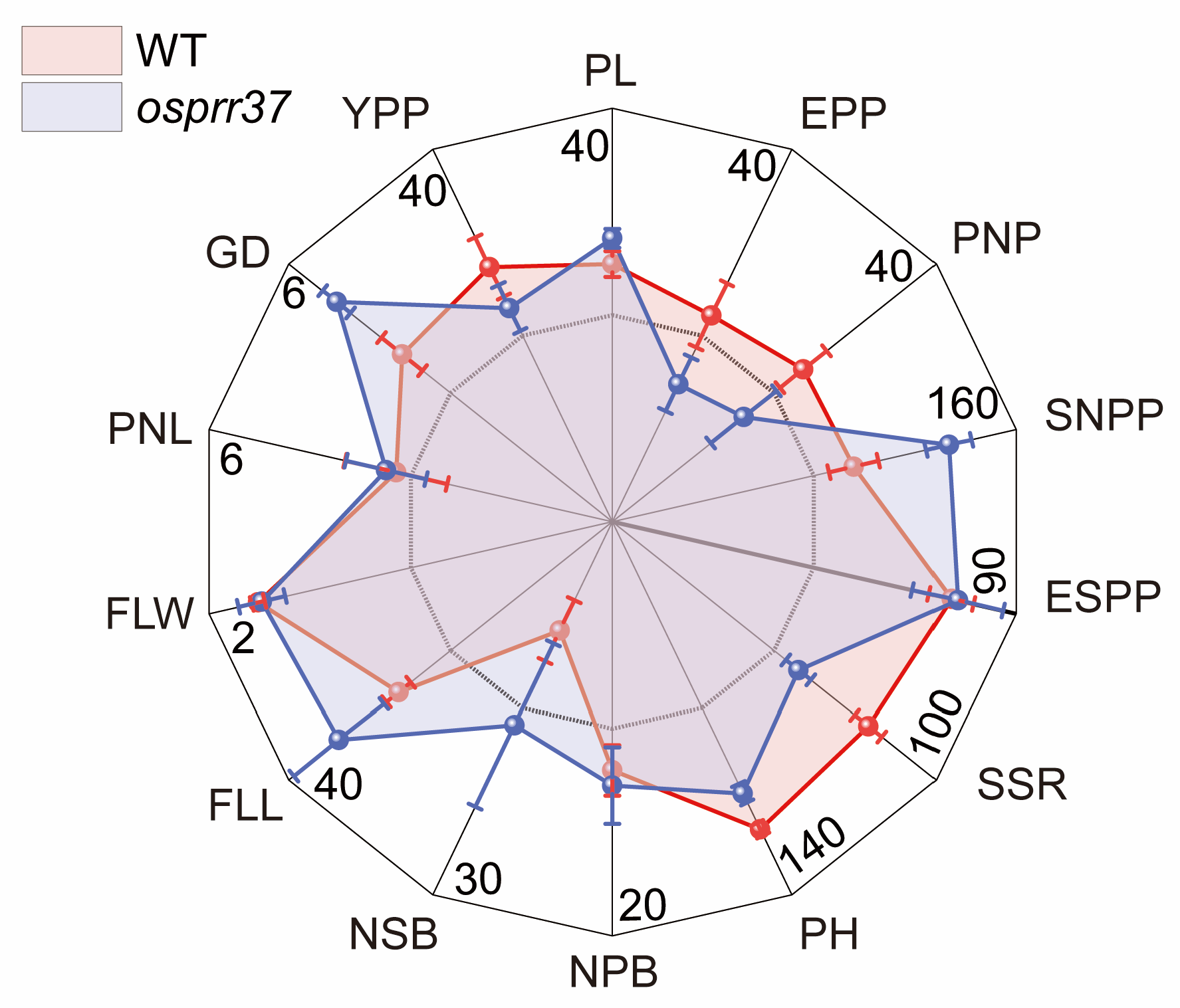
Figure 1. Agronomic characteristic comparison of wild-type (WT) and osprr37 mutants. PL, panicle length; EPP, effective panicles per plant; PNP, panicle number per plant; SNPP, spikelet number per panicle; ESPP, effective spikelet number per panicle; SSR, seed setting rate; PH, plant height; NPB, number of primary branches; NSB, number of secondary branches; FLL, flag leaf length; FLW, flag leaf width; PNL, panicle neck length; GD, grain density; YPP, yield per plant.
Plants 14 03690 g001
Figure 2. Phenotype comparison of wild-type and osprr37 mutant mature grains. (A,B) Phenotype of grains for wild-type and osprr37 mutants. (C) Cross-section of brown rice. (DG) Examination of grain length, grain width, grain thickness, and 1000-grain weight. There were three independent biological replicates. Data indicate means ± SD from at least 3 biological replicates. Student’s t-test was used to generate the p values. Bar = 5 mm in (A). Bar = 4 mm in (B). Bar = 1 mm in (C).
Plants 14 03690 g002
Figure 3. Dynamic changes of grains, endosperm dry weight, and grain filling rate in wild-type and osprr37 mutants. (A) Grain phenotype, (B) endosperm dry weight, and (C) grain filling rate at different days after flowering; Data were analyzed using t-test and presented as means ± SD from 3 biological replicates. ** p < 0.01. Bar = 5 mm in (A).
Plants 14 03690 g003
Figure 4. Dynamic changes of carbohydrate during grain filling process. The content of starch (A), sucrose (B), total soluble sugar (C), and fructose (D) in the grain of wild-type and osprr37 mutants. Data were analyzed using t-test and presented as means ± SD from 3 biological replicates. * p < 0.05, ** p < 0.01.
Plants 14 03690 g004
Figure 5. Starch granule morphology in endosperm cells. (A) SEM images of the transverse sections of mature endosperms from wild-type and osprr37. Bars = 5 mm. (B) SEM images of central region in mature endosperms from wild-type and osprr37. The areas shown in higher magnification are indicated by pink boxes. Bars = 50 μm. (C) SEM images of periphery region in mature endosperms from wild-type and osprr37. The areas shown in higher magnification are indicated by blue boxes. Bars = 50 μm. (D) Semithin sections of wild-type and osprr37 developing endosperms at 10 DAF. Bars = 50 μm. Semithin sections of developing endosperms at 10 DAF were generated to examine the structure of starch compound granules in wild-type and osprr37 (D). Wild-type endosperm cells contained abundant developed polygonal starch granules with uniform size and dense spatial packing. In contrast, osprr37 exhibited incomplete granule filling with prominent endosperm voids and significantly fewer compound starch granules. Mutant endosperm also showed numerous structurally defective compound starch granules that were dispersed, fractured, loosely packed, and weakly strained, distributed among normal granules. These findings demonstrate that OsPRR37 mutation inhibit standard compound starch granule formation.
Plants 14 03690 g005
Figure 6. Distribution of particle size in endosperm starch granules.
Plants 14 03690 g006
Figure 7. Grain quality traits in wild-type and osprr37 mutants. (A,B) Grain processing quality; (C,D) grain appearance quality; (EG) grain eating and cooking; (HK) grain nutritional quality; (L) swelling power; (M) water solubility; (N) starch thermal property; (O) starch RVA pasting curves. Data indicate means ± SD from 3 biological replicates. Student’s t-test was used to generate the p values.
Plants 14 03690 g007
Figure 8. Starch crystal structure of wild-type and osprr37 mutants. (A) XRD spectra analysis of starches; (B) Fourier transform infrared spectroscopy (FTIR) spectra analysis of starches; (C) relative crystallinity; (D) order degree of starch; (E) disorder degree of starch. Data indicate means ± SD from 3 biological replicates. Student’s t-test was used to generate the p values.
Plants 14 03690 g008
Figure 9. Relative expression of starch synthesis-related genes in wild-type and osprr37 mutants at various grain filling stages. OsAGPS1, OsAGPS2b are small subunit genes of ADP-glucose pyrophosphorylase; OsAGPL1, OsAGPL2 are large subunit genes of ADP-glucose pyrophosphorylase; OsSSI, OsSSIIa, OsSSIIIa are starch synthase genes; OsGBSSI, granule-bound starch synthase gene; OsSBEIIb, starch branching enzyme IIb gene; OsISA1, OsISA2 are starch debranching enzyme genes; OsPUL, pullulanase-type of a debranching enzyme gene; OsSUT1, OsSUT4 are sucrose transporter genes. RNA was isolated from developing grains at 5, 10, 15, 20, 25, and 30 DAF. Data indicate means ± SD from 3 biological replicates.
Plants 14 03690 g009
Figure 10. The differences of enzyme activities related to starch synthesis. (A) Activity of AGPase (ADP-glucose pyrophosphorylase), (B) GBSSase (granule-bound starch synthase), (C) SSSase (soluble starch synthase), and (D) SBE (starch branching enzyme) in the wild-type and osprr37 mutants at 10, 15, 20, and 25 DAF. Data indicate means ± SD from 3 biological replicates. ** p < 0.01.
Plants 14 03690 g010
Table 1. Grain filling parameters of grains.
GenotypeTmax·G
(Day)
Gmax
(g·1000 Grains−1·Day)
D
(Day)
G ¯
(g·1000 Grains−1·Day)
A
(g·1000 Grain−1)
WT6.507 ± 0.2042.483 ± 0.111 *13.303 ± 0.4261.498 ± 0.058 *22.834 ± 0.909 *
osprr376.456 ± 0.2382.069 ± 0.11914.324 ± 1.431.244 ± 0.07219.742 ± 0.933
Note: tmax·G, the data of reaching the maximum grain filling rate; Gmax, the maximum grain filling rate; D, active grain filling duration;  G ¯ , average grain filling rate; A, final grain weight. Data were analyzed using t-test and presented as means ± SD from 3 biological replicates. * p < 0.05.
Table 2. Effect of OsPRR37 on the diameter of starch granules.
GenotypeMean Diameter (μm)Distribution of Volume-Weighted Mean Diameter (%)Surface Area-Weighted Mean Diameter D [3,2] (μm)Volume-Weighted Mean Diameter
D [4,3] (μm)
≤2 μm2–5 μm≥5 μm
WT4.87 ± 0.03 *6.13 ± 0.4138.02 ± 0.3055.85 ± 0.71 *4.12 ± 0.055.05 ± 0.02 *
osprr374.73 ± 0.016.40 ± 0.4741.02 ± 0.30 **52.58 ± 0.174.02 ± 0.044.95 ± 0.02
Data indicate means ± SD from 2 biological replicates. Student’s t-test was used to generate the p values; * and ** indicate p < 0.05 and p < 0.01, respectively.
Table 3. Starch DSC characteristic values of wild-type and osprr37 mutants.
GenotypeTo (°C)Tp (°C)Tc (°C)ΔH (J·g−1)
WT58.46 ± 0.3667.62 ± 0.26 *75.66 ± 0.2812.42 ± 0.21 *
osprr3757.65 ± 0.3765.18 ± 1.3773.82 ± 1.5910.82 ± 0.82
Data indicate means ± SD from 3 biological replicates. Student’s t-test was used to generate the p values; * p < 0.05.
Table 4. Starch RVA profile characteristic values of wild-type and osprr37 mutants.
GenotypePeak Viscosity PV (cP)Trough Viscosity TV (cP)Breakdown BD (cP)Final Viscosity FV (cP)Setback SB (cP)Pasting Temperature PT (°C)Peak Time
PeT (min)
WT1587.5 ± 24.7 **947 ± 15.6 **640.5 ± 9.2 **1750.5 ± 27.6 **803.5 ± 12 **76.6 ± 0.16.17 ± 0.05 *
osprr371142 ± 7.1701 ± 12.7441 ± 19.81379.5 ± 17.7678.5 ± 4.992.9 ± 0.1 **6.03 ± 0.05
Data indicate means ± SD from 2 biological replicates. Student’s t-test was used to generate the p values; * and ** indicate p < 0.05 and p < 0.01, respectively.
Disclaimer/Publisher’s Note: The statements, opinions and data contained in all publications are solely those of the individual author(s) and contributor(s) and not of MDPI and/or the editor(s). MDPI and/or the editor(s) disclaim responsibility for any injury to people or property resulting from any ideas, methods, instructions or products referred to in the content.