Article

Essential Oils from Neolamarckia cadamba: Methyl Salicylate-Rich Stem Bark Oil as a Multi-Functional Biopesticide with Insecticidal and Antifungal Efficacy


State Key Laboratory of Green Pesticide, South China Agricultural University, Guangzhou 510642, China
*
Author to whom correspondence should be addressed.
Plants 2025, 14(23), 3633; https://doi.org/10.3390/plants14233633
Submission received: 16 October 2025 / Revised: 14 November 2025 / Accepted: 25 November 2025 / Published: 28 November 2025
(This article belongs to the Section Phytochemistry)

Abstract

The escalating challenges of insecticide resistance and environmental pollution underscore the urgent need for sustainable and multi-functional biopesticides. This study reveals the chemical diversity and potent bioactivity of essential oils (EOs) from Neolamarckia cadamba, highlighting their potential as a valuable source of bioactive agents. Gas chromatography–mass spectrometry analysis revealed a striking contrast between the essential oils: the stem bark EO was dominated by methyl salicylate (MeSA, 97.61%), representing the first report of MeSA as a major constituent in this species, while the leaf oil exhibited a complex profile enriched with diterpenoids (25.09%) and fatty acids (23.21%). Both EOs exhibited significant insecticidal efficacy against Aedes aegypti, demonstrating rapid knockdown with median knockdown times (KT50) of 1.36–1.97 min—surpassing the synthetic dimefluthrin. Additionally, they demonstrated pronounced toxicity, with median lethal concentrations (LC50) of 73.41–75.27 μg/mL and fumigant toxicity values of 0.20–0.22 μL/L. Notably, the major component MeSA in the stem bark EO demonstrated obvious insecticidal potential, exhibiting rapid knockdown activity (KT50 of 2.29 min), fumigant toxicity (LC50 of 1.55 μL/L, 5 h), and poisonous activity (LC50 of 92.67 μg/mL, 24 h). Meanwhile, both the stem bark EO and MeSA exhibited strong antifungal activity against the phytopathogen Rhizoctonia solani, with median effective concentration (EC50) values of 48.70 and 53.91 μg/mL, respectively. This efficacy surpassed that of the commercial fungicide physcion (EC50 of 93.34 μg/mL). Additionally, the EOs demonstrated moderate antioxidant activity in the 2,2-diphenyl-1-picrylhydrazyl (DPPH) radical scavenging assay. Mechanistic investigations revealed that the antifungal action of MeSA involved severe cellular disruption, including ultrastructural damage, membrane peroxidation, and critical metabolic suppression via the inhibition of succinate dehydrogenase activity. Our results clearly established N. cadamba EOs, particularly the MeSA-rich stem bark oil, as potent, plant-based, and multi-target agent with significant potential for integration into sustainable pest and disease management strategies.

1. Introduction

Neolamarckia cadamba (Roxb.) Bosser (syn. Anthocephalus cadamba Miq.), a tropical tree belonging to the Rubiaceae family, is native to southern Asia and southern China [1]. In ethnomedicine, the bark of N. cadamba has traditionally been used to treat inflammation, fever, pruritus, leprosy, dysentery, malaria, and related conditions in China, India, and Southeast Asia [2]. Recognized as a fast-growing “miracle tree”, N. cadamba is a valuable resource for construction, furniture manufacturing, and industrial applications such as fiberboard, plywood, and pulp production [3].
Due to its notable pharmacological potential, the bioactive constituents of N. cadamba have been extensively studied. To date, various compounds, primarily triterpenoid glycosides, alkaloids, and iridoids, have been identified from its roots, stem bark, leaves, and seeds. Nevertheless, the EO derived from this species remains poorly characterized, despite the well-documented broad-spectrum bioactivities associated with plant EOs, including insecticidal, antimicrobial, herbicidal, anti-inflammatory, and parasiticidal effects [4].
Mosquitoes are among the most important vectors of infectious diseases, transmitting yellow fever, malaria, and Zika virus infections [5,6]. The growing challenges of insecticide resistance and environmental concerns underscore the urgency for sustainable alternatives. Botanical insecticides, particularly those derived from EOs, offer several advantages including low environmental persistence, target-specific modes of action, and a reduced risk of resistance development [7]. Similarly, plant fungal pathogens including Rhizoctonia solani Kühn, Colletotrichum gloeosporioides Penz., Fusarium oxysporum f. sp. Cubense (Foc), and Pyricularia grisea Sacc cause devastating agricultural losses worldwide. Although conventional synthetic fungicides are effective, they are increasingly associated with resistance development, ecological harm, and non-target toxicity. Hence, plant-based antimicrobials, especially EOs, are increasingly recognized as eco-friendly alternatives [8].
Based on the traditional use and phytochemical richness of N. cadamba, and inspired particularly by our field observations of its mosquito-free groves, we hypothesized that its EOs possess significant and previously unexplored pesticidal potential.
In this work, the chemical constituents and bioactivities of bark- and leaf-derived EOs from N. cadamba were analyzed. Then, the insecticidal, antifungal, and antibacterial activities were evaluated, and the physiological and biochemical mechanisms of the main active components were further investigated. This investigation highlights the bioactive potential of N. cadamba essential oils, providing evidence for their application in next-generation plant-based pesticides and public health strategies against resistant pathogens and vectors.

2. Materials and Methods

2.1. Plant Material

Fresh stem bark and leaves of N. cadamba (approx. 20 m in height) were collected on the campus of South China Agricultural University (Guangzhou, Guangdong province, China) in December 2019 and the identified voucher specimen was deposited in the State Key Laboratory of Green Pesticides, South China Agricultural University, China.

2.2. Extraction of Essential Oil

Fresh stem bark (130 g) and leaves of N. cadamba (155 g) were separately subjected to hydrodistillation for 4 h using a Clevenger apparatus. The resulting oils were dried over anhydrous sodium sulfate (purity ≥ 99%, Sigma-Aldrich, Darmstadt, Germany). This process yielded 0.7 mL of stem bark EO and 0.15 mL leaf EO, corresponding to yield rates of 0.54% (v/w) and 0.096% (v/w), respectively. The EOs were then stored in sealed, dark glass vials at 4 °C until further analysis [9].

2.3. Analysis of the Essential Oil

Essential oil analysis was performed using an Agilent Technologies 7693A Gas Chromatograph coupled with a 5977B Mass Spectrometer. A DB-5 MS capillary column (40 m × 0.25 mm × 0.25 μm; Agilent Technologies Inc., Santa Clara, CA, USA) was employed for compound separation. Analyses were conducted using helium as the carrier gas at a flow rate of 1.0 mL/min with a split ratio of 15:1. The oven temperature was programmed as follows: initially held at 40 °C, then increased to 150 °C at a rate of 6 °C/min; further raised to 270 °C at 3 °C/min; and finally increased to 300 °C at 10 °C/min, where it was held for 3 min. The injector and detector temperatures were maintained at 325 °C. A mixture of normal alkanes (C7–C30, 1000 μg/mL) and essential oil samples (0.8 μL), dissolved in hexane, were injected for analysis. All samples were filtered through a 0.22 μm organic phase filter (BS-QT-013, Biosharp, Haimen, China) prior to injection. The Mass spectra were acquired by electron ionization (EI) at 70 eV, using a spectral range of 30–550 AMU in full scan mode. The MS transfer line (Agilent Technologies Inc., Santa Clara, CA, USA) was maintained at 250 °C [10].

2.4. Identification of the Essential Oil Chemical Constituents

Essential oil constituents were identified by comparing their mass spectra with entries in the National Institute of Standards and Technology (NIST 17) Mass Spectral Database or with those of authentic reference compounds. Identification was further confirmed by comparing retention indices with values reported in the literature. The relative percentage of each component in the essential oil was calculated by the area normalization method. The retention index was determined by the following equation:
RI = 100n + 100(tx − tn)/(tn+1 − tn)
where tn, tn+1, and tx were net retention times.
Identification of the individual components was performed based on the following criteria: (1) comparison of the mass spectra with those of authentic reference compounds, when available, and with spectral data from the NIST 17 database and the Adams terpene library; and (2) comparison of retention indices (RI), determined on an HP-5 column relative to the retention times of a series of n-alkanes (C7–C30) using linear interpolation, with those of authentic standards or values reported in the literature [10].

2.5. Determination of Larvicidal Activity of the Stem Bark Essential Oil and Its Major Constituent MeSA Against Aedes aegypti

Larvicidal activity against A. aegypti was evaluated using both the EOs and MeSA as test agents. A. aegypti larvae, obtained from the Guangzhou Center for Disease Control and Prevention, were reared in the laboratory for over 10 generations maintained at 26 ± 1 °C, 50 ± 10% relative humidity, and a 16:8 h light-to-dark photoperiod. Early fourth-instar larvae were used for the bioassay. Stock solutions of the test samples were prepared in dimethyl sulfoxide (DMSO, purity ≥ 99%, USP, USA) and subsequently diluted with 0.1% Tween-80 (Sigma-Aldrich, Darmstadt, Germany) in distilled water to obtain a series of final test concentrations: 200, 100, 50, 25, and 12.5 μg/mL. The larvicidal activity of the test samples against A. aegypti larvae was determined using the World Health Organization (WHO) recommended liquid immersion method [11]. The treated beakers were placed in an artificial climate chamber maintained at 26 ± 1 °C, 50 ± 10% relative humidity, and a 16:8 h light-to-dark photoperiod. Larval mortality was recorded at 24 and 48 h after the treatment.
The fumigant activity of the EOs of N. cadamba and MeSA against A. aegypti was determined using a conical flask fumigation method. Twenty 3-day-old healthy female A. aegypti mosquitoes were introduced into a 330 mL conical flask. A filter paper strip (3 × 1 cm) was fixed at one end to an absorbent cotton plug using adhesive tape, ensuring complete adhesion to avoid contact with mosquitoes. A volume of 2 μL of the test sample was then applied to the filter paper strip using a micropipette. The flask was immediately sealed with the cotton plug and plastic wrap. Mosquito knockdown status was recorded every 30 s, with knockdown defined as the inability to maintain an upright position or fly normally [12]. The median knockdown time (KT50) was calculated based on knockdown rates at different time intervals.
The fumigant lethal activity against adult A. aegypti was evaluated using the conical flask fumigation method. N. cadamba essential oils (stem bark and leaf) and MeSA were separately diluted in ethanol (≥99.5%, Sigma-Aldrich, Darmstadt, Germany) to generate specific concentration gradients: 0.0625, 0.125, 0.25, 0.5, and 1 μL/L for the essential oils, and 0.25, 0.5, 1, 2, and 4 μL/L for MeSA. For each replicate, a volume of 2 μL of the diluted solution was applied to a filter paper strip (3 × 1 cm) placed inside a 330 mL conical flask. Twenty 3-day-old healthy A. aegypti mosquitoes were then introduced into the flask, which was immediately sealed with an absorbent cotton plug and parafilm to initiate a 5 h fumigation period. After exposure, all mosquitoes were transferred to a clean recovery flask containing a 5% glucose solution (glucose, purity ≥ 99%, BioFroxx, Einhausen, Germany) and maintained in an artificial climate chamber at 26 ± 1 °C, 50 ± 10% relative humidity, under a 16:8 h (L:D) photoperiod. Mortality was assessed 24 h after the transfer. A mosquito was considered dead if it showed no response when its abdomen was gently stimulated with a brush [13]. A solvent control (2 μL of ethanol) and an untreated blank control were included.

2.6. Determination of Antioxidant Activity

The antioxidant activity was measured following the method described by Abd El-Gawad (2016) [14]. The N. cadamba essential oil was tested for radical scavenging activity, using the stable radical 2,2-diphenyl-1-picrylhydrazyl (DPPH, purity ≥ 98%, Sigma-Aldrich, Darmstadt, Germany). A reaction mixture of 1 mL of a hexane solution of the essential oil with different concentrations and equal volume of the ethanol solution of 0.3 mM DPPH was prepared, mixed well, and incubated in the dark for 15 min at room temperature. Ascorbic acid was used as the reference. The decrease in absorbance at 517 nm was determined using a spectrophotometer (UV-8500PC, Metash, Shanghai, China). The IC50 (the amount of sample necessary to decrease the absorbance of DPPH by 50%) was calculated. The percentage inhibition of the DPPH radical was calculated using the equation:
inhibition (%) =1 − (Absorbance of sample/Absorbance of control) × 100.

2.7. Determination of Antifungal Activity of the Essential Oils and MeSA on Mycelial Growth

The in vitro antifungal activity of the EOs and MeSA on mycelial growth was evaluated against four phytopathogenic fungi R. solani, C. gloeosporioides, F. oxysporum f. sp. cubense, and P. grisea. These fungal isolates were originally obtained from symptomatic rice, pepper, and banana plants at the Teaching and Research Base of South China Agricultural University. Following isolation and identification, the cultures were preserved in the Department of Plant Pathology, South China Agricultural University. Antifungal assays were conducted using a modified method from Kamaruzzaman et al. [15]. Stock solutions of the test samples and the positive control (physcion, purity ≥ 98.0%, Merck, Darmstadt, Germany) were prepared by dissolving 0.1 g of each compound in DMSO and diluting to a final volume of 1 mL, resulting in a concentration of 100,000 μg/mL. Then, 5 mL of potato dextrose agar (PDA) medium was dispensed into 70 mm sterile Petri dishes. After cooling to approximately 40 °C, 25 μL of the stock solution was added to the medium and thoroughly mixed to ensure uniform distribution. This procedure was repeated with appropriate dilutions of the stock solution to obtain the following final concentrations: 120, 60, 30, 15, and 7.5 μg/mL for R. solani; 1000, 500, 250, 125, and 62.5 μg/mL for C. gloeosporioides; 2000, 1000, 500, 250, and 125 μg/mL for both F. oxysporum f. sp. cubense and P. grisea. A solvent control containing 0.5% DMSO (v/v) and a blank control containing 0.5% sterile water (v/v) were included in each experiment. A 6 mm diameter agar plug, taken from the margin of an actively growing fungal culture, was placed in the center of the solidified medium. Plates were sealed and incubated in an artificial climate chamber at 26 ± 1 °C, 50 ± 10% relative humidity, under 16:8 h (L:D) photoperiod until the mycelial growth in the control plates reached approximately 80% of the plate diameter. Mycelial diameter was then measured using the cross method [16].

2.8. Physiological and Biochemical Effects of MeSA on R. solani

2.8.1. Hyphal Morphology of R. solani

The effect of MeSA on R. solani hyphal morphology was assessed in vitro. MeSA was added to PDA medium at concentrations of 0, 12.5, 25, 50, 100, and 200 μg/mL. A 5 mm agar plug from an actively growing R. solani culture was then inoculated at the center of each treatment plate, which was then incubated upside down at 25 °C. The control group was treated with DMSO at the same concentration used in the MeSA treatments. After incubation, hyphae from the surface of the culture medium were carefully scraped, suspended in distilled water on the glass slide, and examined under light microscopy (Leica DMLB2, Leica Microsystems, Wetzlar, Germany) to observe morphological changes induced by different MeSA treatments. Transmission electron microscopy (TEM) analysis was conducted using a FEI Tecnai 12 instrument (FEI Company, Hillsboro, CA, USA) to examine the effect of MeSA at 50 µg/mL on the ultrastructure of R. solani. The TEM samples were processed as described previously by Houot et al. [17].

2.8.2. Weight and Quantity of Sclerotium of R. solani

R. solani cultures were incubated on PDA medium at 25 °C for 10 days in the presence of MeSA at concentrations ranging from 12.5 to 200 μg/mL. Cultures treated with DMSO served as the control. After incubation, sclerotia were carefully harvested from the culture medium, transferred into 2 mL microcentrifuge tubes, and counted. The dry weight of the sclerotia was then determined after drying in an oven (DHG-9240, JingHong, Shanghai, China) at 60 °C until a constant weight was achieved.

2.8.3. Detection of Soluble Protein

Soluble protein content was determined using the Bradford assay, with bovine serum albumin (BSA, purity ≥ 98.0%, Sigma-Aldrich, Darmstadt, Germany) as the standard. A BSA stock solution (1000 μg/mL) was prepared, and serial dilutions were made to obtain BSA standard solutions at concentrations of 0, 125, 250, 375, 500, 625, 750, and 1000 μg/mL. The Coomassie Brilliant Blue G-250 reagent (CBB G-250, purity ≥ 95%, Sigma-Aldrich, Darmstadt, Germany) was prepared by dissolving 0.01 g of CBB G-250 in 5 mL of 95% ethanol, followed by the addition of 10 mL of 80% phosphoric acid. The solution was then diluted to 100 mL with deionized water and filtered. To generate the standard curve, 0.1 mL of each BSA standard solution was mixed with 5 mL of the CBB G-250. After a 5 min incubation, the absorbance was measured at 595 nm using a spectrophotometer. R. solani sclerotia treated with MeSA were cultured at 25 °C for 10 days, with DMSO-treated cultures serving as control. After incubation, 0.2 g of sclerotia was homogenized in 1.5 mL of phosphate buffer (pH 7.4; Sigma-Aldrich, Darmstadt, Germany) using a mortar and pestle under frozen conditions. The homogenate was then transferred to a 10 mL centrifuge tube and centrifuged at 4000 rpm for 10 min. The supernatant was collected for protein quantification. A 0.1 mL aliquot of the supernatant was then mixed with 5 mL of CBB G-250, incubated for 5 min, and the absorbance was measured at 595 nm. Soluble protein concentrations in the samples were then calculated using the BSA standard curve. The soluble protein content was determined using the following formula:
Soluble protein content (mg/g) = soluble protein concentration (μg/mL) × total volume of extract (mL)/(sample volume for analysis (mL) × sample weight (g) × 1000)

2.8.4. Detection of Malondialdehyde (MDA) Content

MDA content, an indicator of lipid peroxidation, was determined using the thiobarbituric acid (TBA) method. R. solani mycelia (0.5 g) treated with MeSA for 10 days were homogenized in 5 mL of 10% trichloroacetic acid (TCA, purity ≥ 99%, Sigma-Aldrich, Darmstadt, Germany) solution using a mortar and pestle. The homogenate was then centrifuged at 4000 g for 15 min. A 2 mL aliquot of the supernatant was mixed with 2 mL of 0.6% TBA solution. The mixture was heated in a water bath at 100 °C for 20 min. After cooling to room temperature, the absorbance was measured at 532, 600, and 450 nm using a spectrophotometer.
MDA concentration: C (mmol/L) = 6.45 × (OD532 − OD600) − 0.56 × OD450
MDA content = MDA concentration (mmol/L) × Total volume of extract (L)/sample (g).

2.8.5. Detection of Cell Membrane Permeability

The effect of MeSA on R. solani cell membrane permeability was assessed by measuring relative electrical conductivity [18]. R. solani was cultured in PDA medium. Five agar plugs of R. solani (untreated with MeSA) were inoculated into 100 mL of PDA medium and incubated on a rotary shaker (THZ-300C, Yiheng, Shanghai, China) at 25 °C and 120 rpm for 24 h. Subsequently, the cultures were treated with different concentrations of MeSA (5 mL per flask) and further incubated for 12 h. Hyphae were then collected by filtration using filter paper, washed, and dried. The dried hyphae were subsequently ground under frozen conditions. The resulting material was then transferred to a 25 mL centrifuge tube, and the volume was adjusted to 20 mL with distilled water. After 20 min’s gentle stirring, the electrical conductivity (R1) of the suspension was measured using a conductivity meter (FE32-Meter, Mettler toledo, Shanghai, China). To determine the total conductivity, the suspension was heated in boiling water for 15 min to disrupt the cells, thereby killing the pathogen. After cooling the suspension to room temperature by placing the tube under running water for 10 min, the electrical conductivity (R2) was measured. Relative conductivity was calculated as the ratio of R1 to R2 (R1/R2) [19].

2.8.6. Succinate Dehydrogenase (SDH) Activity Assay

SDH activity was determined using a commercially available SDH assay kit (MAK561, Sigma-Aldrich, Darmstadt, Germany). Fresh R. solani mycelia (0.1 g) treated with MeSA for 8 days were homogenized in reagent 1 (1 mL) from the assay kit, followed by the addition of 10 μL of reagent 2. Homogenization was performed in an ice bath. The homogenate was then centrifuged at 11,000× g for 15 min at 4 °C. Following centrifugation (TGL-16M, Cence, Changsha, China), the supernatant was collected and kept on ice. Then, for the assay, a reaction mixture was prepared containing 168 μL of Reagent 3, 12 μL of Reagent 5, and 20 μL of the supernatant. Absorbance at 600 nm was measured at 20 s (A1) and 80 s (A2) after initiating the reaction, and the change in absorbance (ΔA = A2 − A1) was calculated.
SDH (U·mg−1) = (ΔA × Vtotal reaction × Vtotal sample × 109)/(ε × d × W × Vsample × T)
Note: Vtotal reaction: 2 × 10⁻⁴ L; ε: the extinction coefficient of 2, 6-dichloroindophenol, 2.1 × 10⁴ L/mol/cm; d: the light diameter of the cuvette, 1 cm; Vtotal sample: 2 × 10⁻⁵ L; W: weight of sample, 0.1 g; T: reaction time, 60 s.

2.9. Statistical Analysis

Data were analyzed using IBM SPSS Statistics, Version 19.0 (International Business Machines Corporation, Armonk, NY, USA). Analysis of variance (ANOVA) was used to determine significant differences among treatments (p < 0.05), followed by Duncan’s multiple range test or Student’s t-test for pairwise comparisons. Median effective concentrations (EC50) and median inhibitory concentrations (IC50), with 95% confidence intervals, were calculated by probit analysis. Each treatment included three replicates. All experiments were repeated at least three times. All quantitative data were presented as the mean ± standard deviation (SD) of at least three independent experiments.

3. Results

3.1. Chemical Components Identified in the Essential Oil of the Stem Barks

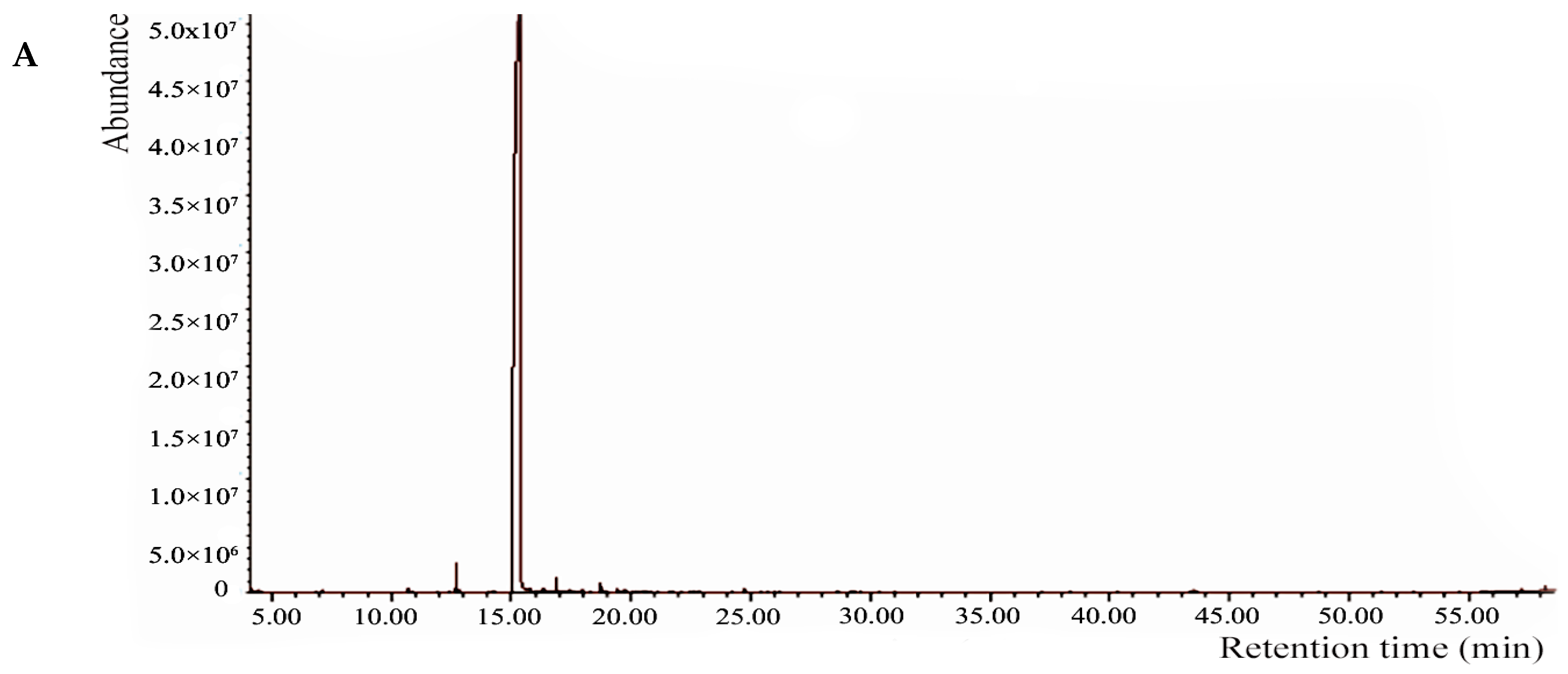
The components of the essential oil of stem bark of N. cadamba are listed in Table 1. The GC-MS chromatogram of the essential oil is shown in Figure 1A. A total of 17 components were identified accounting for 99.73% of the total oil composition. MeSA was the most abundant compound, accounting for 97.61% of the total oil. Minor constituents included linalool (0.58%), ethyl salicylate (0.30%), n-hexadecanoic acid (0.19%), chavibetol (0.19%), and nerolidol (0.12%). All other components were present at levels below 0.10% (Table 1).

3.2. Chemical Components Identified in the Essential Oil of the Leaves

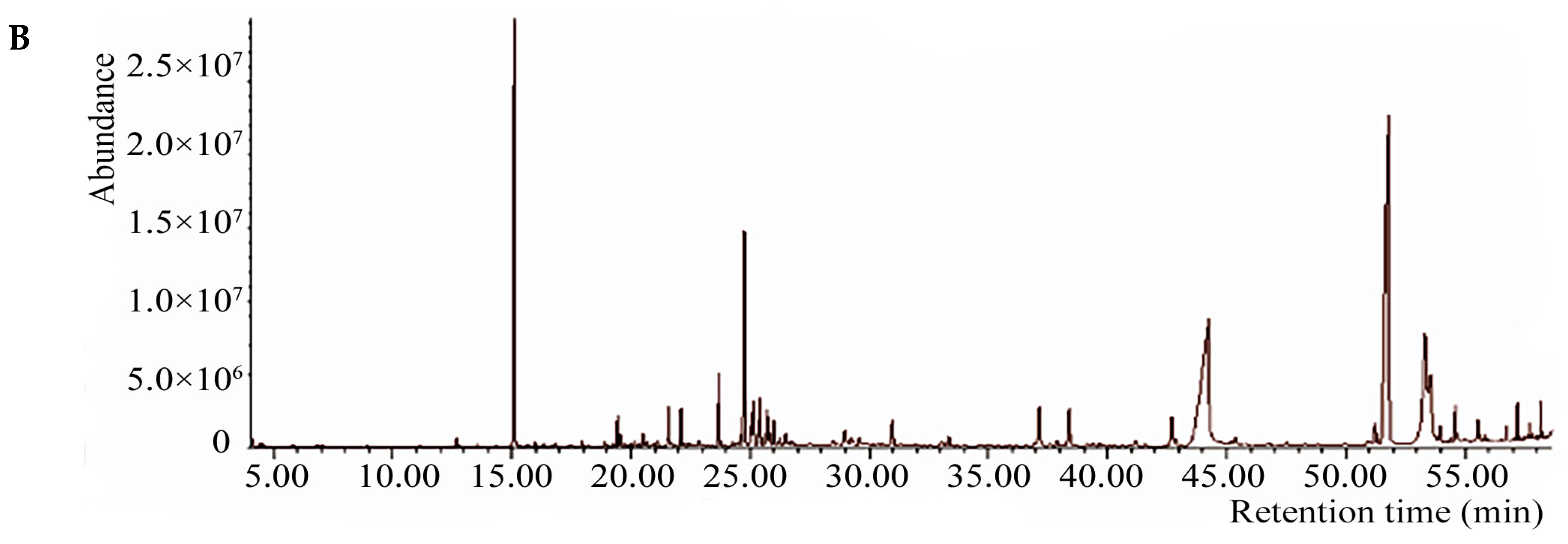
The GC-MS chromatogram (Figure 1B) and detailed composition (Table 2 and Table S1) of N. cadamba leaf essential oil revealed a complex profile of 132 identified constituents, accounting for 93.94% of the total oil. Compared to the stem bark EO, the leaf EO was characterized by a greater diversity of compound classes. The major compound classes identified in the leaf EO included diterpenoids (25.09%), fatty acids (23.21%), esters (18.64%), and sesquiterpenoids (11.33%). Table 2 lists the 18 individual components with relative contents exceeding 0.5%, while the complete list of 132 identified constituents is provided in Table S1.

3.3. Poisonous, Knockdown, and Fumigant Activities of N. cadamba Stem Bark Essential Oil and Its Main Component, MeSA, Against A. aegypti

The poisonous activity of N. cadamba essential oils was evaluated against the 4th instar larvae of A. aegypti (Table 3). The LC50 values (24 h) for the stem bark and leaf essential oils were 75.27 μg/mL and 73.41 μg/mL, respectively. MeSA, the major component of the stem bark oil, also demonstrated poisonous activity, with an LC50 value of 92.67 μg/mL after 24 h.
Knockdown assays demonstrated that the stem bark essential oil, leaf essential oil, and MeSA all possessed significant knockdown activity against the adult female A. aegypti, with KT50 values of 1.97, 1.36, and 2.29 min, respectively. In contrast, the KT50 value for the commercial pyrethroid insecticide dimefluthrin was 2.48 min (Table 3), indicating that both the stem bark and leaf essential oils, as well as MeSA, exhibited faster knockdown activity against the adult female Aedes aegypti.
Furthermore, the stem bark essential oil, leaf essential oil, and MeSA exhibited significant fumigant activity 5 h after treatment, with LC50 values of 0.22, 0.20, and 1.55 μL/L, respectively (Table 3).
Table 1. Chemical components identified in N. cadamba stem bark essential oil by GC-MS.
No.RTCompoundsMolecular FormulaPercentage (%)RIaRIbRIcClassMatch(%)CAS
115.39Methyl salicylateC8H8O397.6112091194 [20]1192Ester98.39119-36-8
212.69LinaloolC10H18O0.5810991097 [20]1099Monoterpene Alcohol99.3978-70-6
316.87Ethyl salicylateC9H10O30.3012721193 [21]1269Ester97.55118-61-6
418.74m-EugenolC10H12O20.1913511370 [22]1375Phenylpropanoid96.73501-19-9
543.55n-Hexadecanoic acidC16H32O20.1919571961 [23]1968Fatty Acids92.661957-10-3
624.73NerolidolC15H26O0.1215572053 [24]1564Sesquiterpene Alcohol97.527212-44-4
716.35GeraniolC10H18O0.0812501254 [20]1255Monoterpene Alcohol96.41106-24-1
810.693-Ethyl-4-methylpentan-1-olC8H18O0.0710191020 [25]1023Alcohol96.9738514-13-5
912.81NonanalC9H18O0.0711041103 [20]1104Aldehyde97.36124-19-6
1014.22(E)-2-NonenalC9H16O0.0711611164 [23]1162Aldehyde95.6618829-56-6
1119.43β-DamascenoneC13H18O0.0713801385 [23]1386Ketone93.9423726-93-4
1219.74β-ElemeneC15H240.0713941391 [26]1391Sesquiterpene Hydrocarbon92.95515-13-9
137.111-HexanolC6H14O0.06864864 [23]868Alcohol95.46111-27-3
1417.42Dihydroedulane IIC13H22O0.0612952089 [27]1318Cyclic Ether89.9141678-32-4
1517.97(E,E)-2,4-DecadienalC10H16O0.0613181315 [28]1317Aldehyde92.5425152-84-5
1629.31N-Hexyl salicylateC13H18O30.0616741683 [29]1683Ester90.366259-76-3
1758.212,2’-Methylenebis (6-tert-
butyl-4-methyl-phenol)
C23H32O20.062398-2414Phenol75.48119-47-1
Total99.73
Note: RT, the retention time; RIa, the Kovats retention index of each component calculated by NIST software (2.3) and ion spectrum of C7-C30 n-alkane mixture; RIb, the retention index in NIST 17 mass spectrometry library; RIc, the retention index in the literature.
Table 2. Major chemical constituents (≥ 0.5% in content) of the essential oil from N. cadamba leaves identified by GC-MS.
No.RTCompoundsMolecular FormulaPercentage (%)RIaRIbRIcClassMatchCAS
151.78PhytolC20H40O23.3221082104 [24]2114Diterpene98.81150-86-7
244.25n-Hexadecanoic acidC16H32O218.4119701961 [23]1968Fatty acid97.661957/10/3
315.10Methyl salicylateC8H8O39.8311971194 [20]1192Ester99.48119-36-8
453.331-HeneicoseneC21H428.1821452096 [28]2089.1Alkene70.901599-68-4
524.77NerolidolC15H26O5.3315592053 [25]1564Sesquiterpene Alcohol98.507212-44-4
653.56Linolenic acidC18H30O24.6121502020 [30]2139Fatty acid93.71463-40-1
723.70(-)-SpathulenolC15H24O1.6115281599 [10]1577Sesquiterpene Alcohol81.7577171-55-2
838.39Benzyl salicylateC14H12O31.4418611790 [31]1869Ester96.70118-58-1
925.15(Z)-3-Hexenyl benzoateC13H16O21.4215692148 [32]1570Ester97.3025152-85-6
1037.14Hexahydrofarnesyl acetoneC18H36O1.4118371848 [33]1844Ketone97.20502-69-2
1125.71(E)-2-Hexenyl benzoateC13H16O21.2715852182 [34]1588Ester82.3076841-70-8
1225.42Benzoic acid, hexyl esterC13H18O21.1915771576 [30]1580Ester98.136789-88-4
1354.60Ethyl linolenateC20H34O21.1621752073 [30]2169Ester88.871191-41-9
1442.70IsophytolC20H40O1.1219421939 [28] 1948Diterpene Alcohol97.22505-32-8
1530.971,2-EpoxyhexadeceneC16H32O0.821712-1708Epoxide89.107320-37-8
1621.58Cabreuva oxide BC15H24O0.7214601458 [21]1465Sesquiterpene Epoxide95.92107602-53-9
1726.00(E)-β-Farnesene epoxideC15H24O0.6415941624 [35]1624Sesquiterpene Epoxide84.6083637-40-5
1853.96Phytol, acetateC22H42O20.5921592215 [33]2168Ester86.2010236-16-5
Total83.04
Note: RT, the retention time; RIa, the Kovats retention index of each component calculated by NIST software (2.3) and ion spectrum of C7-C30 n-alkane mixture; RIb, the retention index in NIST 17 mass spectrometry library; RIc, the retention index in the literature.
Table 3. Poisonous, knockdown, and fumigant activity of N. cadamba stem bark essential oil and its main component, MeSA, against A. aegypti.
ActivityTreatmentTimeRegression Eq.LC50 + (μg/mL)
/KT50 & (min)
Correlation Coefficient (r)95% Confidence
Limit (μg/mL)
Poisonous activity
(LC50)
EO-ST *24 hy = −15.75 + 8.42x75.270.9757.75–100.88
EO-L #24 hy = −7.39 + 3.96x73.410.9764.34–84.35
MeSA24 hy = −9.78 + 5.10x92.670.9860.36–120.03
EO-ST48 hy = 1.35 + 1.99x67.560.9951.87–88.00
EO-L48 hy = 1.93 + 1.71x61.970.9845.35–83.53
MeSA48 hy = −9.78 + 5.10x82.680.9860.36–120.03
Knockdown activity
(KT50)
EO-ST-y = −1.82 + 2.68x1.970.971.66–2.28
EO-L-y = −0.79 + 2.56x1.360.990.99–1.71
MeSA-y = −1.82 + 2.68x2.290.971.66–2.28
dimefluthrin-y = −2.92 + 3.21x2.480.952.19–2.82
Fumigant activity
(LC50)
EO-ST5 hy = 6.36 + 2.07x0.220.990.17–0.28
EO-L5 hy = 6.23 + 1.78x0.200.980.15–0.27
MeSA5 hy = 4.67 + 1.69x1.550.981.14–2.11
Note: *: EO of the stem bark; #: EO of the leaves; +: median lethal concentration; &: median knockdown time.

3.4. Antioxidant Activity

Given their potential as natural alternatives for synthetic antioxidants in food preservation, essential oils have attracted considerable attention. In this study, the antioxidant activity of N. cadamba essential oils was evaluated using the DPPH radical scavenging assay. This assay was based on the reduction in the stable free radical DPPH, which exhibited a deep violet color, to DPPH, a colorless compound, upon reaction with an antioxidant. Free radical scavenging activity was typically expressed either as the percentage of DPPH inhibition or as the concentration of antioxidant required to reduce the DPPH radical concentration by 50% (IC50). A lower IC50 value indicated a higher antioxidant potency. The results showed that the positive control ascorbic acid exhibited the strongest antioxidant activity with an IC50 value of 0.02 mg/mL. In comparison, the IC50 values of the essential oils from N. cadamba stem bark and leaves were 1.23 and 3.29 mg/mL, respectively (Table 4), indicating a moderate capacity to scavenge DPPH radicals.

3.5. Antifungal Activities of N. cadamba Essential Oil and MeSA

The effects of N. cadamba stem bark essential oil on the mycelial growth of R. solani, F. oxysporum, C. gloeosporioides, and P. grisea are summarized in Table 5. The antifungal activity, as estimated by the EC50 values, varied considerably among the fungal species (Figure S1 and Table 5). The lowest EC50 value was observed against R. solani (48.70 μg/mL), indicating the highest antifungal activity, while the highest EC50 value was detected against F. oxysporum (1229.48 μg/mL), indicating the lowest antifungal activity. The antifungal activities of MeSA against these four fungal species were also determined (Table 5). The EC50 values of MeSA against R. solani, F. oxysporum, C. gloeosporioides, and P. grisea were 53.91, 1045.11, 854.17, and 1041.76 μg/mL, respectively. In comparison, the EC50 values of physcion against R. solani was 93.34 μg/mL. These results indicated the essential oil from the stem bark of N. cadamba, and the active ingredient MeSA exhibited notable antifungal activity against R. solani.

3.6. Effect of MeSA on Sclerotium Weight and Quantity of R. solani

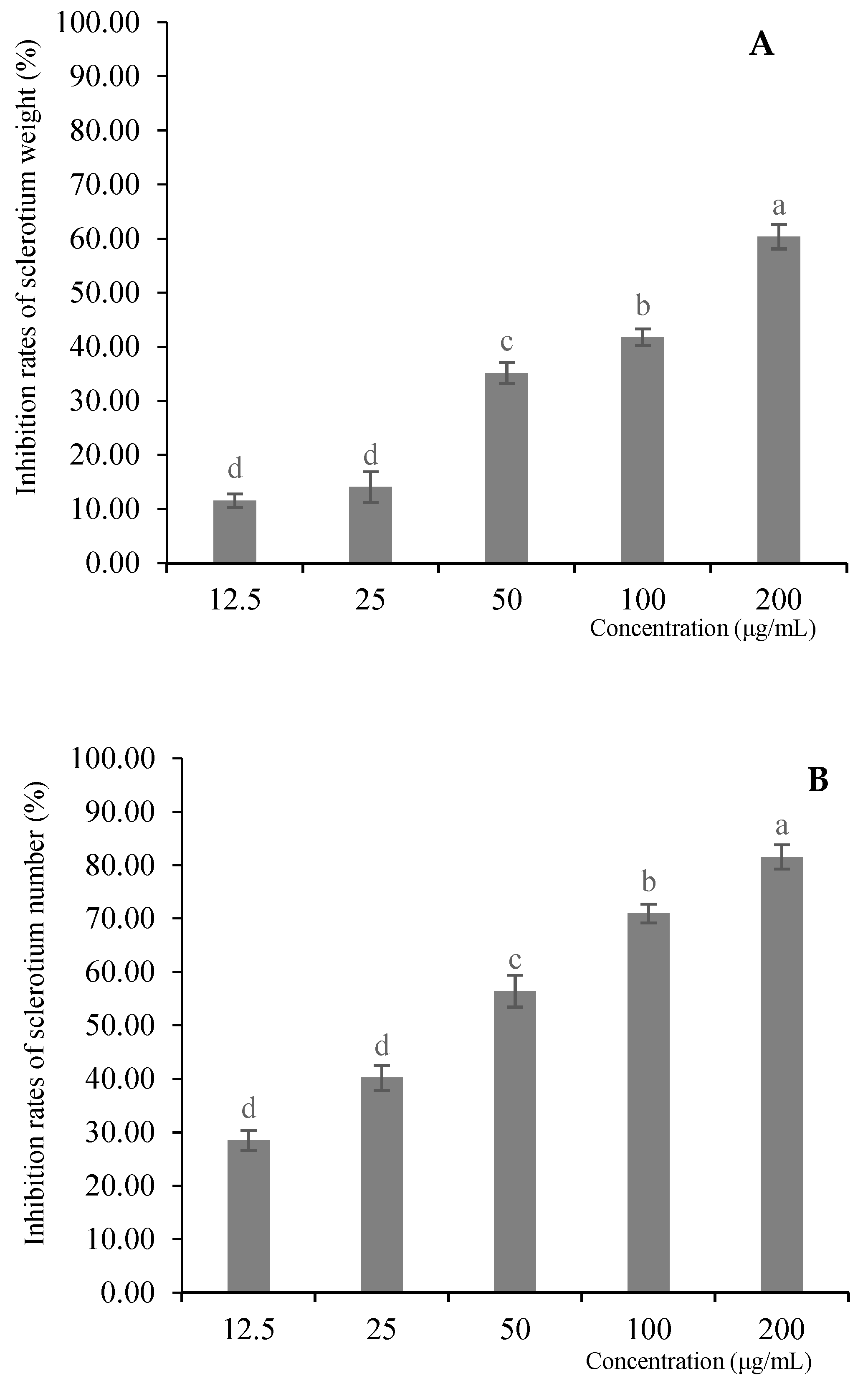
In general, the sclerotium weight was higher in the control group compared to that of the MeSA treated groups. Treatment with MeSA at 200 μg/mL resulted in a 60.33% reduction in sclerotium weight. Similarly, the number of sclerotia formed by R. solani decreased with increasing MeSA concentrations. Specifically, treatment with MeSA at 200 μg/mL and 100 μg/mL resulted in inhibition rates of 81.56% and 70.95%, respectively, in sclerotium number. Treatment with MeSA resulted in a concentration-dependent reduction in both the weight and number of sclerotia produced by R. solani (Figure 2).

3.7. Effect of MeSA on Hyphal Morphology and Ultrastructure of R. solani

3.7.1. Effects of MeSA on Mycelial Morphology and General Ultrastructure of R. solani

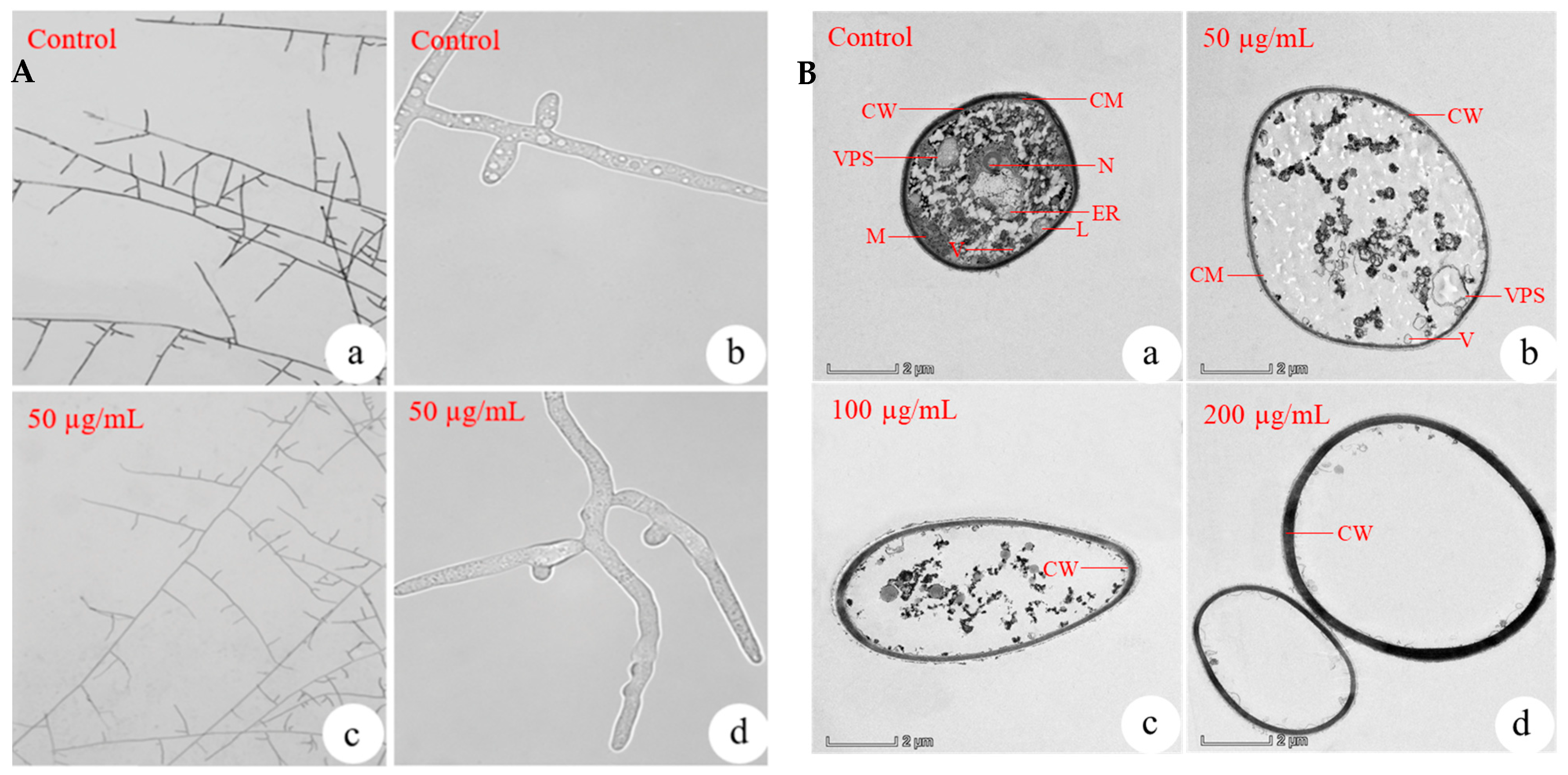
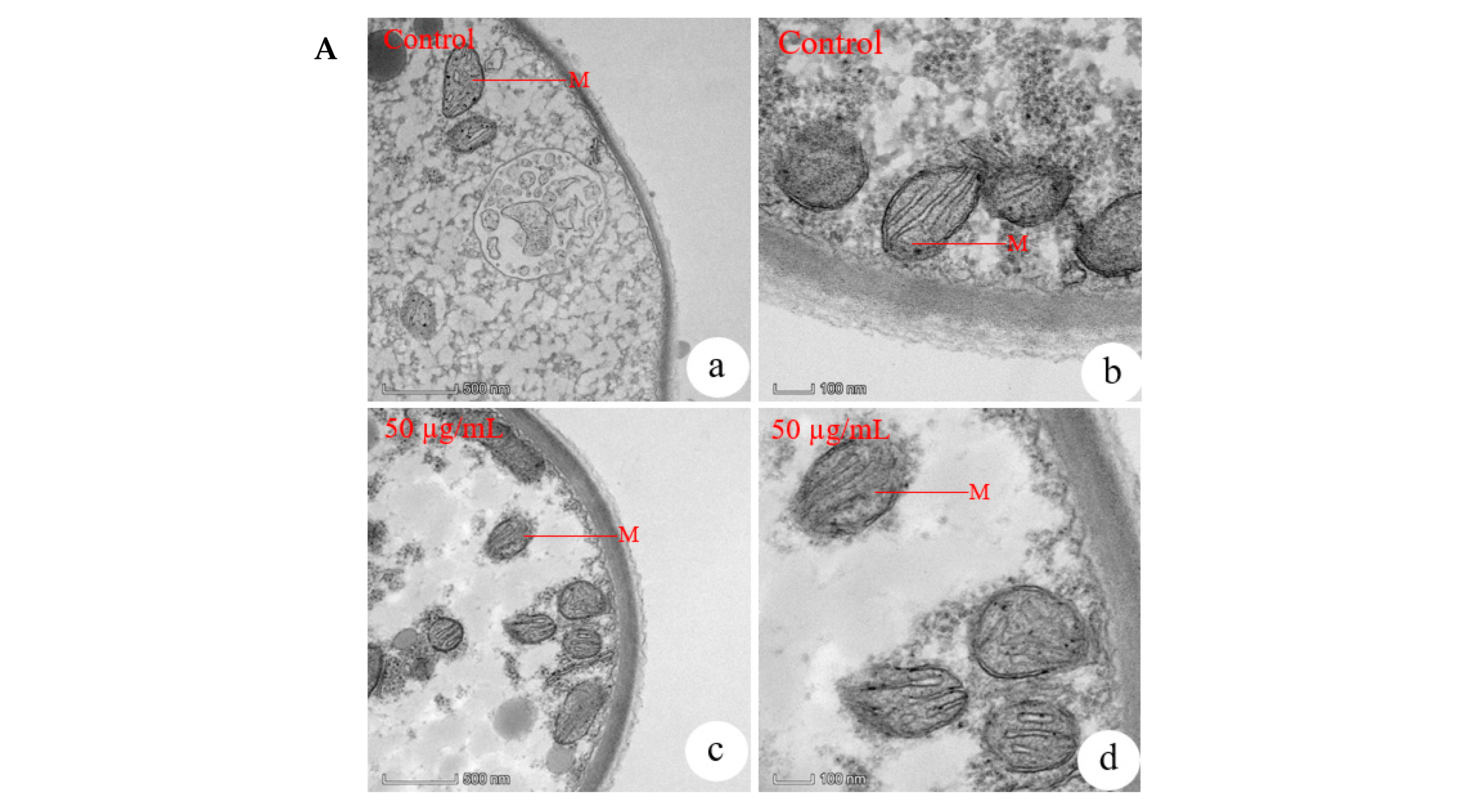
MeSA treatment significantly altered the mycelial morphology of R. solani. Microscopic observation revealed distinct differences between the control and the MeSA-treated hyphae. In the control, the hyphae exhibited smooth surfaces, right-angled branching with prominent barrel-shaped constrictions at the base of each branch (Figure 3A(a,b)).
In contrast, R. solani treated with MeSA displayed abnormal mycelial development, characterized by irregular protrusions (Figure 3A(c,d)). The hyphae appeared collapsed and flaccid, with reduced branching angles and a noticeable loss of rigidity and erectness. Furthermore, MeSA treatment induced a clear dose-dependent response in the ultrastructural alterations of fungal cells. In control cells, typical organelles such as vesicles, mitochondria, endoplasmic reticulum, vesicle-producing systems, and lomasomes were clearly visible, along with intact nuclei, cell membranes, and cell walls (Figure 3B(a)). However, MeSA treatment induced progressive cellular damage with increasing concentrations. At 50 µg/mL, partial cell membrane disruption was observed (Figure 3B(b)). At 100 µg/mL, extensive loss of membrane structure occurred (Figure 3B(c)). At 200 µg/mL, structural integrity of organelles and nuclei progressively diminished, with near-complete organelle degradation and an almost complete absence of the cell membrane (Figure 3B(d)).

3.7.2. Effects of MeSA on Mitochondria, Endoplasmic Reticulum, Vesicle Production System and Vesicles in R. solani

TEM revealed distinct ultrastructural changes in R. solani mitochondria following MeSA treatment. In control cells, both mitochondria (Figure 4A(a,b)) exhibited normal, well-defined morphology. However, exposure to 50 µg/mL MeSA induced progressive organelle damages, including structural disruption and a quantitative reduction in mitochondria (Figure 4A(c,d)). These degenerative effects became more pronounced at 100 µg/mL, where a dramatic decrease in organelle numbers was observed (Figure 3B(c)). At the highest concentration (200 µg/mL, Figure 3B(d)), the structural integrity of key organelles was entirely lost. These dose-dependent ultrastructural alterations demonstrated that MeSA could disrupt cellular organelles in R. solani.
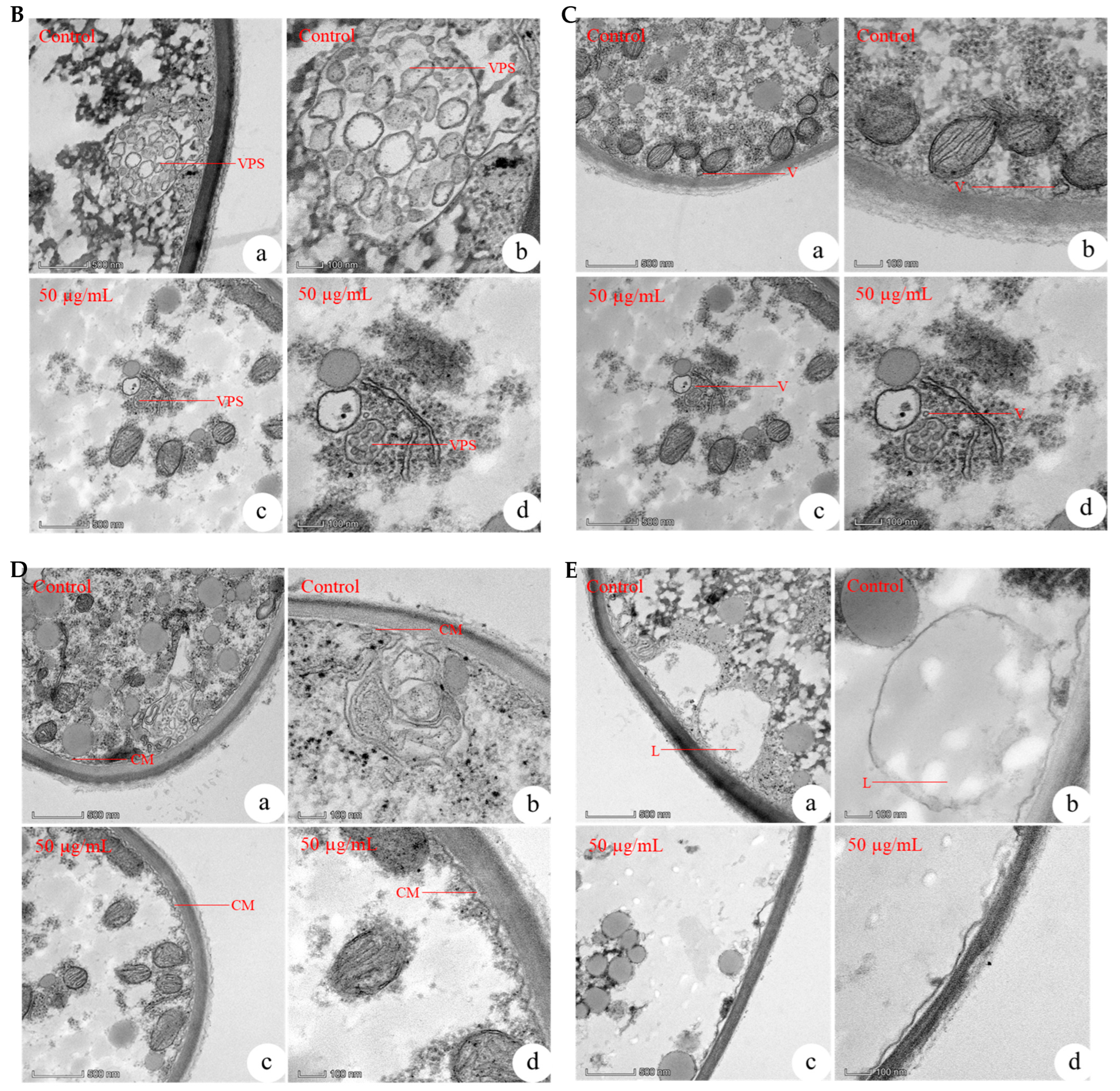
Our ultrastructural analysis also demonstrated significant, dose-dependent disruptions to the vesicle production system (VPS) (Figure 4B(c,d)) and vesicles (Figure 4C(c,d)) in R. solani following MeSA treatment. The vesicular components exhibited progressive structural damage and a quantitative reduction with increasing MeSA concentrations. As it was shown, exposure to 50 µg/mL MeSA resulted in visible structural deterioration and reduced numbers of both the VPS (Figure 4B(c,d)) and vesicles (Figure 4C(c,d)). The damage to the secretory system was particularly severe and initiated at a lower concentration. Complete disintegration of the vesicle production system (VPS) was observed at 100 µg/mL (Figure 3B(c)), and by 200 µg/mL, vesicles were nearly undetectable (Figure 3B(d)).
These findings revealed that MeSA targeted the fungal secretory pathway, with the VPS exhibiting greater sensitivity to the treatment than the vesicles themselves. The sequential disruption of these critical cellular components suggested a specific mode of action for MeSA in impairing fungal transport and secretion mechanisms.
TEM further revealed dose dependent ultrastructural alterations in both the cell membrane and lomasomes of R. solani following MeSA treatment. The cell membrane exhibited progressive damage, with initial alterations observed at 50 µg/mL MeSA (Figure 4D(c,d)) and nearly complete disintegration at 200 µg/mL (Figure 3B(d)). In contrast, lomasomes demonstrated greater sensitivity to MeSA, showing complete disappearance even at the lower concentration of 50 µg/mL (Figure 4E(c,d)). These differential responses suggested that MeSA might affect the cell membrane and lomasomes in different ways.

3.8. Effects of MeSA on Physiological and Biochemical Parameters of R. solani

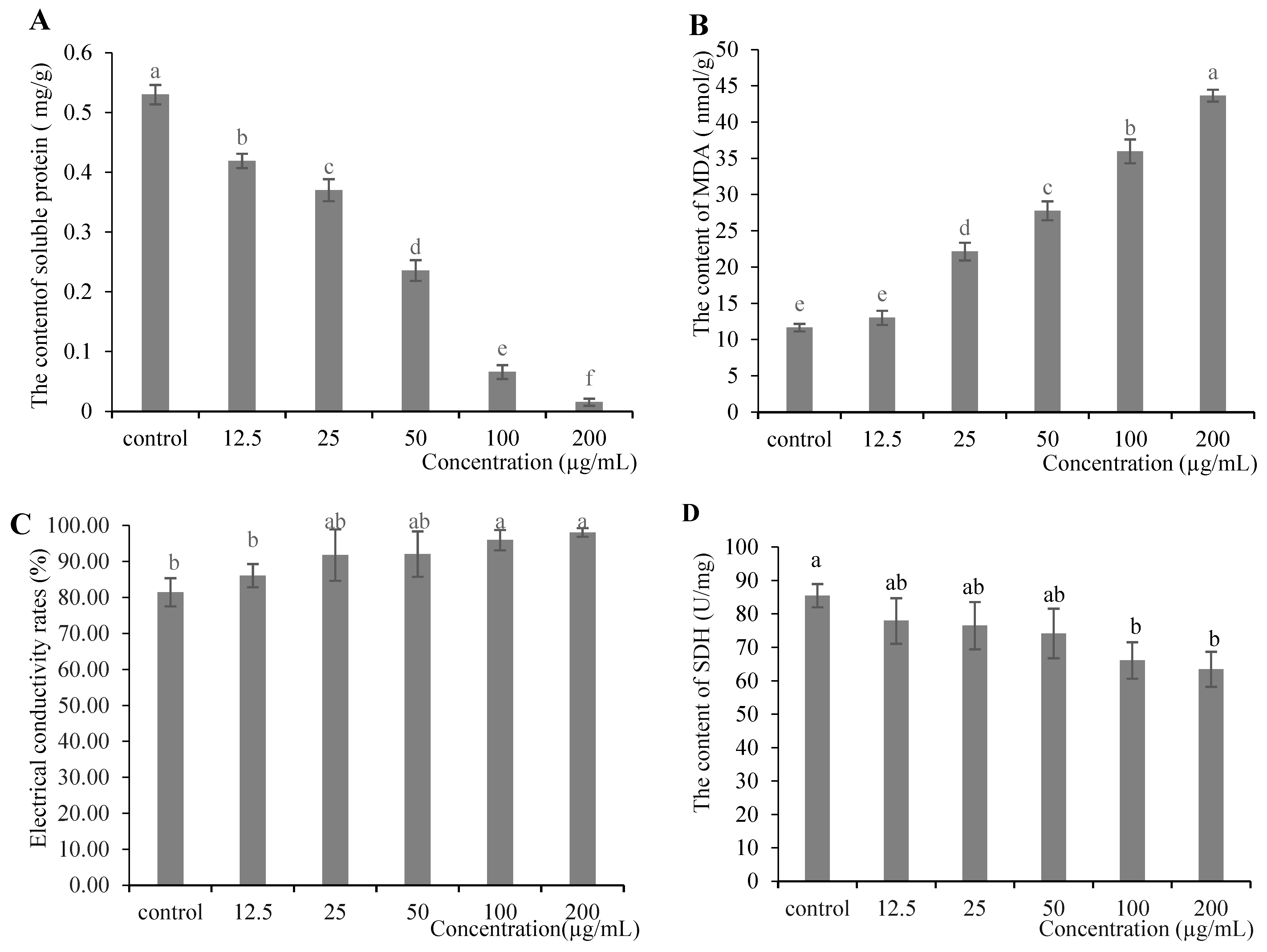
The soluble protein content in R. solani decreased in a dose-dependent manner from 0.53 to 0.015 mg/g as MeSA treatment increased from 0 to 200 µg/mL (p < 0.05). These results indicated that MeSA effectively suppress soluble protein synthesis in the pathogen, thereby inhibiting its growth (Figure 5A).
Lipid peroxidation, measured by MDA content, increased from 13.01 to 43.66 nmol/g in R. solani mycelia with increasing MeSA concentrations. The 200 µg/mL MeSA treatment induced a nearly 4-fold increase in MDA content compared to the control, indicating severe membrane damage, and impaired cellular integrity (Figure 5B).
The electrical conductivity of R. solani cells increased significantly with increasing concentrations of MeSA (p < 0.05). Treatment with 200 µg/mL MeSA resulted in a conductivity rate of 98.07% compared to the control, indicating enhanced electrolyte leakage. These results demonstrated that MeSA disrupted the cell membrane integrity of R. solani, leading to increased permeability and electrolyte efflux (Figure 5C).
SDH activity in R. solani treated with MeSA ranged from 63.49 to 85.46 U/mg. The 200 µg/mL MeSA treatment resulted in a 34.60% reduction in SDH activity compared to other concentrations, demonstrating a significant inhibitory effect (p < 0.05). These findings indicated that MeSA impaired mitochondrial respiration in the pathogen, thereby suppressing its growth (Figure 5D).

4. Discussion

Our study presents a comprehensive analysis of the chemical profiles and bioactivities of EOs extracted from different parts of N. cadamba, revealing their strong potential as multi-functional biopesticides. The GC-MS analysis revealed a striking chemical difference between the stem bark and leaf EOs. Notably, the stem bark EO was characterized by an exceptionally high concentration of methyl salicylate (MeSA, 97.61%), which, to our knowledge, represented the first report identifying MeSA as the dominant constituent in this species.
In contrast, the leaf EO presented a more complex mixture, rich in diterpenoids and fatty acids, consistent with the greater chemical diversity commonly reported for the leaf of plant [36]. It was noteworthy that the chemical profile of our leaf EO also differed from the previously reported result for N. cadamba leave EO using headspace solid-phase microextraction (HS-SPME) [37]. This divergence underscored how analytical methodologies and plant material collectively affected the final chemical profile. Specifically, HS-SPME targeted primarily the headspace volatiles released under specific conditions. Furthermore, the plants used in the previous study were young trees (1.5–2 m in height), in contrast to the mature trees (approx. 20 m in height) employed in our work. It is well-established that secondary metabolite profiles, particularly defense-related compounds, can vary dramatically with plant ontogeny [38,39]. These factors likely accounted for the differences observed even for the same plant organ. In this context, the discovery of the MeSA-dominated stem bark EO of N. cadamba was a novel finding.
Furthermore, both essential oils demonstrated notable insecticidal activity against A. aegypti, particularly through a rapid knockdown effect that exceeded the efficacy of the synthetic dimefluthrin. Our result also showed that MeSA was the main active ingredient in the stem bark EO. This result was consistent with the known bioactivities of MeSA against various insect pests [36]. Furthermore, the presence of linalool, the second most abundant component in the stem bark oil, might contribute to the overall insecticidal effect, as its activity against A. aegypti had been previously documented [40].
Beyond insecticidal activity, a key finding of our work was the pronounced and specific antifungal activity of the stem bark EO and MeSA against R. solani. The EC50 values for both the oil and MeSA were lower than that of the commercial fungicide physcion, highlighting their potential efficacy. While a previous study reported the inhibition of R. solani by MeSA, our research provided deeper mechanistic insights [41]. We found that the antifungal action of MeSA was multifaceted, involving direct cellular damage. Our ultrastructural evidence indicated severe disruption to organelles, including mitochondria and the endoplasmic reticulum, together with the loss of membrane integrity, as confirmed by the increased MDA content and electrolyte leakage. Meanwhile, we also demonstrated the inhibition of SDH activity, suggesting a disruption of the mitochondrial respiratory chain. This combination of membrane damage and suppression of core metabolic energy production likely contributed to the potent antifungal effect observed.
The practical implications of using N. cadamba EOs, particularly the MeSA-rich stem bark oil, extend beyond direct toxicity. MeSA was a recognized plant signal molecule involved in defense responses [42].
Therefore, the application of this EO in an agricultural setting could offer a dual benefit. It could act directly against fungal pathogens and insect pests while also potentially priming plant defense mechanisms, as evidenced by studies where MeSA induced resistance in plants [43,44] and enhanced the biological control activity of natural enemies [45]. These multi-faceted effects represented a distinct advantage of plant-derived EOs compared to conventional, single-site synthetic pesticides, potentially mitigating the risk of resistance development [46].
In summary, our results highlighted N. cadamba EOs, especially the stem bark oil, as a promising source of eco-friendly biopesticidal agents. We identified the previously unreported MeSA-rich stem bark and elucidated a multi-target antifungal mechanism involving cellular ultrastructural disruption, membrane damage, and metabolic inhibition. Coupled with its potent insecticidal activity and the potential to harness plant-induced resistance, N. cadamba stem bark EO and the active ingredient MeSA presented candidates for sustainable crop protection strategies. The fact that N. cadamba is a fast-growing tree [47] further enhanced the feasibility and sustainability of utilizing its stem bark, a by-product of timber production, for this purpose.

5. Conclusions

The essential oils of N. cadamba exhibit both insecticidal and fungicidal activities. Specifically, the essential oil demonstrated poisonous, knockdown, and fumigant effects against A. aegypti, with MeSA identified as the primary active ingredient. Overall, MeSA’s antifungal activity stemmed from its ability to simultaneously target and disrupt multiple cellular components in R. solani. These included degradation of the cell wall and plasma membrane, damage to key organelles such as mitochondria, endoplasmic reticulum (ER), vesicle-producing systems (VPS), vesicles, and lomasomes, as well as interference with essential biochemical processes like protein synthesis and respiration. This multi-target disruption led to catastrophic loss of cellular integrity, impaired fungal growth, and ultimately cell death.

Supplementary Materials

The following supporting information can be downloaded at https://www.mdpi.com/article/10.3390/plants14233633/s1. Table S1. Chemical components identified in N. cadamba leaf essential oil by GC-MS, Figure S1. The antifungal activities of the essential oil of stem bark of N. cadamba, MeSA and physcion. References [48,49,50,51,52,53,54,55,56,57,58,59] are cited in the Supplementary Materials.

Author Contributions

H.Y. and Y.L., GC-MS experiment, literature search, figures, and data analysis; X.L., GC-MS experiment and identification; Q.D., literature search and bioassay; J.Z., data collection and bioassay; J.H., the design of the work, interpretation of data for the work, and writing. All authors have read and agreed to the published version of the manuscript.

Funding

This work was supported by the National Key Research and Development Program of China (Grant No. 2023YFD1700700).

Data Availability Statement

The data are contained within the article.

Acknowledgments

The authors thank Huining Lu and Ling Fang from Instrumental Analysis and Research Center, Sun Yat-Sen University for the help of the analysis of essential oil.

Conflicts of Interest

The authors declare no conflict of interest.

References

  1. Dwiyanti, F.G.; Kamal, I.; Pratama, R.; Syaputra, D.; Rustam, E.; Damayanti, R.U.; Siregar, I.Z.; Sudrajat, D.J. Whole genome sequencing of Neolamarckia macrophylla (Roxb.) Bosser and Neolamarckia cadamba (Roxb.) Bosser from Indonesia: A vital resource for completing chloroplast genomes and mining microsatellite markers. Front. Plant Sci. 2025, 16, 1608577. [Google Scholar] [CrossRef] [PubMed]
  2. Tang, L.H.; Li, K.Y.; Cai, C.Q.; Wu, W.J.; Jian, G.C.; Lei, Z.M.; Peng, C.C.; Long, J.M. Genome-wide identification and expression pattern analysis of the SBP gene family in Neolamarckia cadamba. Genes 2025, 16, 460. [Google Scholar] [CrossRef]
  3. Ghosh, S.; Abdullah, M.F. Extraction of polysaccharide fraction from Cadamba (Neolamarckia cadamba) fruits and evaluation of its in vitro and in vivo antioxidant activities. Int. J. Biol. Macromol. 2024, 279, 135564. [Google Scholar] [CrossRef]
  4. Yuan, H.; Zhao, Y.; Qin, X.; Liu, Y.; Yu, H.; Zhu, P.; Jin, Q. Anti-inflammatory and analgesic activities of Neolamarckia cadamba and its bioactive monoterpenoid indole alkaloids. J. Ethnopharmacol. 2020, 260, 113103. [Google Scholar] [CrossRef]
  5. Carter, T.E. Genomic clues into the spread of deadly mosquitoes. Science 2025, 389, 1188–1189. [Google Scholar] [CrossRef]
  6. Pinto, L. How billions of hacked mosquitoes and a vaccine could beat the deadly dengue virus. Nature 2025, 645, 578–580. [Google Scholar] [CrossRef]
  7. Santos, D.G.; Dias, L.L.; Avellar, G.S.; Simeone, M.L.F.; Parrella, R.A.; Santos, N.M.; Mendes, S.M. Biomass sorghum (Sorghum bicolor) agronomic response to Melanaphis sorghi (Hemiptera: Aphididae) infestation and silicon application. Insects 2025, 16, 566. [Google Scholar] [CrossRef] [PubMed]
  8. Torres Neto, L.; Monteiro, M.L.G.; Machado, M.A.M.; Galvan, D.; Conte Junior, C.A. An optimization of oregano, thyme, and lemongrass essential oil blend to simultaneous inactivation of relevant foodborne pathogens by simplex–centroid mixture design. Antibiotics 2022, 11, 1572. [Google Scholar] [CrossRef] [PubMed]
  9. Ali, A.; Tabanca, N.; Demirci, B.; Blythe, E.K.; Baser, K.H.C.; Khan, I.A. Chemical composition and biological activity of essential oils from four nepeta species and hybrids against Aedes aegypti (L.) (Diptera: Culicidae). Recent Pat. Nat. Prod. 2016, 10, 137–147. [Google Scholar]
  10. Liu, H.; Huang, J.; Yang, S.; Li, J.; Zhou, L. Chemical composition, algicidal, antimicrobial, and antioxidant activities of the essential oils of Taiwania flousiana Gaussen. Molecules 2020, 25, 967. [Google Scholar] [CrossRef]
  11. Li, H.Y. Chemical Composition and Biological Activities of Zanthoxylum dimorphophyllum. Master’s Thesis, China Agricultural University, Beijing, China, 2016. [Google Scholar]
  12. Chen, W.; Wu, H.; Ma, Z.; Feng, J.; Zhang, X. Evaluation of fumigation activity of thirty-six essential oils against Culex pipiens pallens (Diptera: Culicidae). Acta Entomol. Sin. 2018, 61, 86–93. [Google Scholar]
  13. Said-Al Ahl, H.A.; Kačániova, M.; Mahmoud, A.A.; Hikal, W.M.; Čmiková, N.; Szczepanek, M.; Tkachenko, K.G. Phytochemical characterization and biological activities of essential oil from Satureja montana L., a medicinal plant grown under the influence of fertilization and planting dates. Biology 2024, 13, 328. [Google Scholar] [CrossRef]
  14. Abd El-Gawad, A.M. Chemical constituents, antioxidant and potential allelopathic effect of the essential oil from the aerial parts of Cullen plicata. Ind. Crops Prod. 2016, 80, 36–41. [Google Scholar] [CrossRef]
  15. Kamaruzzaman, M.; Islam, M.S.; Mahmud, S.; Polash, S.A.; Sultana, R. In vitro and in silico approach of fungal growth inhibition by Trichoderma asperellum HbGT6-07 derived volatile organic compounds. Arab. J. Chem. 2021, 14, 103290. [Google Scholar] [CrossRef]
  16. Zeng, X.; Zhang, X.; Peng, B.; Xie, B.; Yuan, Y.; Yao, H.; Li, Y. Chitooligosaccharide enhanced the efficacy of Bacillus amyloliquefaciens CAS02 for the control of tobacco black shank. Front. Microbiol. 2023, 14, 1296916. [Google Scholar] [CrossRef]
  17. Houot, V.; Etienne, P.; Petitot, A.; Barbier, S.; Blein, J.; Suty, L. Hydrogen peroxide induces programmed cell death features in cultured tobacco BY-2 cells, in a dose-dependent manner. J. Exp. Bot. 2001, 52, 1721–1730. [Google Scholar] [CrossRef]
  18. Wang, H.; Li, Y.; Yang, Y.; Xu, Y.; Fan, X.; Guo, Z.; Lin, X. Physiological mechanisms and core genes in response to saline-alkali stress in foxtail millet (Setaria italica L.). Biomolecules 2025, 15, 859. [Google Scholar] [CrossRef] [PubMed]
  19. Zhang, S. The Action Mechanism of Prothionazole Against Rice Sheath. Master’s Thesis, Anhui Agricultural University, Hefei, China, 2021. [Google Scholar]
  20. Su, Y.C.; Ho, C.L. Essential oil compositions and antimicrobial activities of various parts of Litsea cubeba from Taiwan. Nat. Prod. Commun. 2016, 11, 515–518. [Google Scholar] [CrossRef] [PubMed]
  21. Chua, L.Y.W.; Chua, B.L.; Figiel, A.; Chong, C.H.; Wojdyło, A.; Szumny, A. Antioxidant activity, and volatile and phytosterol contents of Strobilanthes crispus dehydrated using conventional and vacuum microwave drying methods. Molecules 2019, 24, 1397. [Google Scholar] [CrossRef]
  22. Pandiyan, G.N.; Mathew, N.; Munusamy, S. Larvicidal activity of selected essential oil in synergized combinations against Aedes aegypti. Ecotoxicol. Environ. Saf. 2019, 174, 549–556. [Google Scholar] [CrossRef]
  23. Ciotlaus, I.; Pojar-Fenesan, M.; Balea, A. Analysis of volatile organic compounds from the aerial parts of medicinal plant, Galium verum. Rev. Chim. 2020, 71, 136–144. [Google Scholar] [CrossRef]
  24. Bajer, T.; Janda, V.; Bajerová, P.; Kremr, D.; Eisner, A.; Ventura, K. Chemical composition of essential oils from Plantago lanceolata L. leaves extracted by hydrodistillation. J. Food Sci. Technol. 2016, 53, 1576–1584. [Google Scholar] [CrossRef]
  25. Ili, M.D.; Mareti, M.D.; Zlatkovi, B.K. Chemical composition of volatiles of eight Geranium L. species from Vlasina plateau (South Eastern Serbia). Chem. Biodivers. 2020, 17, e1900544. [Google Scholar] [CrossRef] [PubMed]
  26. Li, B.; Zhang, C.; Peng, L.; Liang, Z.; Yan, X.; Zhu, Y.; Liu, Y. Comparison of essential oil composition and phenolic acid content of selected Salvia species measured by GC-MS and HPLC methods. Ind. Crops Prod. 2015, 69, 329–334. [Google Scholar] [CrossRef]
  27. Singh, N.; Singh, H.P.; Batish, D.R.; Kohli, R.K.; Yadav, S.S. Chemical characterization, phytotoxic, and cytotoxic activities of essential oil of Mentha longifolia. Environ. Sci. Pollut. Res. Int. 2020, 27, 13512–13523. [Google Scholar] [CrossRef]
  28. Medimagh, S.; Daami-Remadi, M.; Jabnoun-Khiareddine, H.; Naffati, M.; Ben Jannet, H.; Hamza, M.A. Chemical composition and in vitro evaluation of antimicrobial and anti-acetylcholinesterase activities of the root oil from Asteriscus maritimus (L.) less growing in Tunisia. J. Essent. Oil Bear. Plants 2013, 16, 443–450. [Google Scholar] [CrossRef]
  29. Al-Yousef, H.M. Essential oil of Coffee arabica L. Husks: A brilliant source of antimicrobial and antioxidant agents. Biomed. Res. 2018, 29, 174–180. [Google Scholar]
  30. Zhao, C.; Li, X.; Liang, Y.; Fang, H.; Huang, L.; Guo, F. Comparative analysis of chemical components of essential oils from different samples of Rhododendron with the help of chemometrics methods. Chemom. Intell. Lab. Syst. 2006, 82, 218–228. [Google Scholar] [CrossRef]
  31. Suleimen, E.M.; Sisengalieva, G.G.; Adilkhanova, A.A.; Dudkin, R.V.; Gorovoi, P.G.; Iskakova, Z.B. Composition and biological activity of essential oil from Artemisia keiskeana. Chem. Nat. Compd. 2019, 55, 154–156. [Google Scholar] [CrossRef]
  32. Karamenderes, C.; Demirci, B.; Baser, K. Composition of essential oils of ten Centaurea L. taxa from Turkey. J. Essent. Oil Res. 2008, 20, 342–349. [Google Scholar] [CrossRef]
  33. Abd-ElGawad, A.M.; Elshamy, A.I.; El-Amier, Y.A.; El Gendy, A.E.-N.G.; Al-Barati, S.A.; Dar, B.A.; Al-Rowaily, S.L.; Assaeed, A.M. Chemical composition variations, allelopathic, and antioxidant activities of Symphyotrichum squamatum (Spreng.) Nesom essential oils growing in heterogeneous habitats. Arab. J. Chem. 2020, 13, 4237–4245. [Google Scholar] [CrossRef]
  34. Agiel, N.; Hanoğlu, D.Y.; Hanoğlu, A.; Baser, K.H.C.; Mericli, F. Volatile oil constituents of Crataegus azarolus L. and Crataegus pallasii Grisb. Recent Nat. Prod. 2019, 13, 405–412. [Google Scholar] [CrossRef]
  35. Najar, B.; Cervelli, C.; Ferri, B.; Cioni, P.L.; Pistelli, L. Essential oils and volatile emission of eight South African species of Helichrysum grown in uniform environmental conditions. S. Afr. J. Bot. 2019, 124, 178–187. [Google Scholar] [CrossRef]
  36. Kambiré, D.A.; Kablan, A.C.L.; Yapi, T.A.; Vincenti, S.; Maury, J.; Baldovini, N.; Tomi, F. Neuropeltis acuminata (P. Beauv.): Investigation of the chemical variability and in vitro anti-inflammatory activity of the leaf essential oil from the Ivorian species. Molecules 2022, 27, 3759. [Google Scholar] [CrossRef] [PubMed]
  37. Wu, S.; Huang, P.; Zhang, C.; Zhou, W.; Chen, X.; Zhang, Q. Novel strategy to understand the aerobic deterioration of corn silage and the influence of Neolamarckia cadamba essential oil by multi-omics analysis. Chem. Eng. J. 2024, 482, 148715. [Google Scholar] [CrossRef]
  38. Barton, K.E.; Boege, K. Future directions in the ontogeny of plant defence: Understanding the evolutionary causes and consequences. Ecol. Lett. 2017, 20, 403–411. [Google Scholar] [CrossRef] [PubMed]
  39. Moore, B.D.; Andrew, R.L.; Külheim, C.; Foley, W.J. Explaining intraspecific diversity in plant secondary metabolites in an ecological context. New Phytol. 2014, 201, 733–750. [Google Scholar] [CrossRef]
  40. Chiluwal, K.; Kim, J.; Bae, S.D.; Park, C.G. Essential oils from selected wooden species and their major components as repellents and oviposition deterrents of Callosobruchus chinensis (L.). J. Asia-Pac. Entomol. 2017, 20, 1447–1453. [Google Scholar] [CrossRef]
  41. Yursida, Y.; Andrew, F.; Agustina, K.; Mareza, E.; Kalsum, U.; Ikhwani, I.; Putra, N.R. Harnessing the power of cinnamon oil: A review of its potential as natural biopesticide and its implications for food security. Heliyon 2025, 2, 11. [Google Scholar] [CrossRef]
  42. Dieryckx, C.; Gaudin, V.; Dupuy, J.W.; Bonneu, M.; Girard, V.; Job, D. Beyond plant defense: Insights on the potential of salicylic and methylsalicylic acid to contain growth of the phytopathogen Botrytis cinerea. Front. Plant Sci. 2015, 6, 859. [Google Scholar] [CrossRef]
  43. Laupheimer, S.; Ghirardo, A.; Kurzweil, L.; Weber, B.; Stark, T.D.; Dawid, C.; Hückelhoven, R. Blumeria hordei affects volatile emission of susceptible and resistant barley plants and modifies the defense response of recipient plants. Physiol. Plant. 2024, 176, e14646. [Google Scholar] [CrossRef] [PubMed]
  44. Gondor, O.K.; Pál, M.; Janda, T.; Szalai, G. The role of methyl salicylate in plant growth under stress conditions. J. Plant Physiol. 2022, 277, 153809. [Google Scholar] [CrossRef]
  45. Bar-Nun, N.; Mayer, A.M. Methyl jasmonate and methyl salicylate, but not cis-jasmone, evoke defenses against infection of Arabidopsis thaliana by Orobanche aegyptiaca. Weed Biol. Manag. 2008, 8, 91–96. [Google Scholar] [CrossRef]
  46. Liu, J.; Sun, L.; Fu, D.; Zhu, J.; Liu, M.; Xiao, F.; Xiao, R. Herbivore-induced rice volatiles attract and affect the predation ability of the wolf spiders, Pirata subpiraticus and Pardosa pseudoannulata. Insects 2022, 13, 90. [Google Scholar] [CrossRef]
  47. Yin, Q.; Qin, W.; Liu, T.; Kang, L. Functional conservation of Neolamarckia cadamba NcIRX9 gene in xylan biosynthesis in Tetraena mongolica Maxim. Chin. J. Nanjing For. Univ. 2019, 43, 129–136. [Google Scholar]
  48. Wanner, J.K.R.; Dai, D.N.; Huong, L.T.; Hung, N.V.; Schmidt, E.; Jirovetz, L. Chemical composition of Vietnamese essential oils of Cinnamomum rigidifolium, Dasymaschalon longiusculum, Fissistigma maclurei and Goniothalamus albiflorus. Nat. Prod. Commun. 2016, 11, 1701–1703. [Google Scholar] [CrossRef]
  49. Avoseh, O.N.; Ogunwande, I.A.; Ojenike, G.O.; Mtunzi, F.M. Volatile composition, toxicity, analgesic, and anti-inflammatory activities of Mucuna pruriens. Nat. Prod. Commun. 2020, 15, 1934578X20932326. [Google Scholar] [CrossRef]
  50. Falcão, S.I.; Freire, C.; Figueiredo, C. The volatile composition of Portuguese propolis towards its origin discrimination. Recent Nat. Prod. 2016, 10, 176–188. [Google Scholar]
  51. Yang, Y.J.; Lin, M.Y.; Feng, S.Y.; Gu, Q.; Chen, Y.C.; Wang, Y.D.; Song, D.F.; Gao, M. Chemical composition, antibacterial activity, and mechanism of action of essential oil from Litsea cubeba against foodborne bacteria. J. Food Process. Preserv. 2020, 44, e14724. [Google Scholar] [CrossRef]
  52. Li, H.; Luo, L.; Ma, M.; Zeng, L. Characterization of volatile compounds and sensory analysis of Jasmine scented black tea produced by different scenting processes: Characterization of volatile compounds. J. Food Sci. 2018, 83, 2718–2732. [Google Scholar] [CrossRef] [PubMed]
  53. Radulović, N.S.; Mladenović, M.Z.; Ristić, M.N.; Dekić, V.S.; Dekić, B.R.; Ristić, N.R. A new longipinane ketone from Achillea abrotanoides (Vis.) Vis.: Chemical transformation of the essential oil enables the identification of a minor constituent. Phytochem. Anal. 2020, 31, 501–515. [Google Scholar] [CrossRef] [PubMed]
  54. Zhao, C.; Li, B.; Liu, D.; Dai, W.; Cao, L.; Zhang, M. Chemical components of the volatile oil from leaves of Cananga odorata and its antioxidant activity. Pak. J. Pharm. Sci. 2019, 32, 165–169. [Google Scholar] [PubMed]
  55. Ashafa, A.O.T.; Pitso, T.R. Effects of microwave drying on the yield and chemical composition of essential oils of Artemisia afra Jacq. Ex willd from the eastern free state South Africa. J. Essent. Oil Bear. Plants 2014, 17, 1087–1093. [Google Scholar] [CrossRef]
  56. Ma, X.; Yang, W.; Marsol-Vall, A. Analysis of flavour compounds and prediction of sensory properties in sea buckthorn (Hippophaee rhamnoides L.) berries. Int. J. Food Sci. Technol. 2020, 55, 1705–1715. [Google Scholar] [CrossRef]
  57. Gasiński, A.; Kawa-Rygielska, J.; Szumny, A.; Czubaszek, A.; Gąsior, J.; Pietrzak, W. Volatile compounds content, physicochemical parameters, and antioxidant activity of beers with addition of mango fruit (Mangifera indica). Molecules 2020, 25, 3033. [Google Scholar] [CrossRef]
  58. Benmeddour, T.; Laouer, H.; Akkal, S.; Flamini, G. Chemical composition and antibacterial activity of essential oil of Launaea lanifera Pau grown in Algerian arid steppes. Asian Pac. J. Trop. Biomed. 2015, 5, 960–964. [Google Scholar] [CrossRef]
  59. Hu, J.; Wang, W.; Dai, J.; Zhu, L. Chemical composition and biological activity against Tribolium castaneum (Coleoptera: Tenebrionidae) of Artemisia brachyloba essential oil. Ind. Crops Prod. 2019, 128, 29–37. [Google Scholar] [CrossRef]
Figure 1. GC-MS chromatograms of essential oils from N. cadamba: (A) Stem bark EO; (B) Leaf EO.
Plants 14 03633 g001aPlants 14 03633 g001b
Figure 2. Inhibition of R. solani sclerotium: (A) weight; (B) number by MeSA. Different letters indicated significant differences (p < 0.05).
Plants 14 03633 g002
Figure 3. MeSA altered the mycelial morphology and general ultrastructure of R. solani. (A) Morphology of hyphae under optical microscope. (a,b) Control hyphae at 5× and 100× magnification, respectively; (c,d) Hyphae treated with 50 μg/mL MeSA at 5× and 100× magnification. (B) General ultrastructure observed by TEM (5300×). (a) Control hyphae; (b) Hyphae treated with 50 μg/mL MeSA; (c,d) Hyphae treated with 100 and 200 μg/mL MeSA, respectively. Abbreviations: CW, cell wall; VPS, vesicle production system; M, mitochondria; CM, cell membrane; N, nucleus; ER, endoplasmic reticulum; L, lomasome; V, vesicle.
Plants 14 03633 g003
Figure 4. MeSA disrupted mitochondrial, vesicle production system (VPS), vesicle ultrastructure, cell membrane, and lomasome ultrastructure in R. solani: (A) Mitochondrial ultrastructure. (a,b) Control mitochondria; (c,d) Mitochondria treated with 50 μg/mL MeSA. (B) Vesicle production system (VPS). (a,b) Control group; (c,d) Treated with 50 µg/mL MeSA. (C) Vesicle ultrastructure. (a,b) Control group; (c,d) Treated with 50 µg/mL MeSA. (D) Cell membrane integrity. (a,b) Control group; (c,d) Treated with 50 µg/mL MeSA. (E) Lomasome ultrastructure. (a,b) Control group; (c,d) Treated with 50 µg/mL MeSA. Magnifications: 22,000× (a,c in all panels) and 57,000× (b,d in all panels). Abbreviations: M, mitochondria; VPS, vesicle production system; V, vesicle; CM, cell membrane; L, lomasome.
Plants 14 03633 g004aPlants 14 03633 g004b
Figure 5. Physiological and biochemical effects of MeSA on R. solani: (A) Soluble protein content; (B) MDA content; (C) Relative conductivity; (D) SDH activity. Control: DMSO treatment. Different letters indicated significant differences (p < 0.05).
Plants 14 03633 g005
Table 4. Antioxidant activity of the EOs of N. cadamba stem barks and the leaves measured by 2,2-diphenyl-1-picrylhydrazyl (DPPH).
TreatmentRegression EquationIC50 * (mg/mL)Correlation
Coefficient (r)
95% Confidence Limit (mg/mL)
Ascorbic acidy = 1.75 + 2.46x0.020.980.016 − 0.026
EO of the stem barksy = 1.25 + 1.21x1.240.970.88 − 1.90
EO of the leavesy = 0.32 + 1.33x3.290.971.89 − 5.73
Note: *: the concentration of antioxidant required to reduce the DPPH radical concentration by 50%.
Table 5. The antifungal activities of the essential oil of stem bark of N. cadamba (EC50).
TreatmentFungusTimeRegression
Equation
EC50 *
(μg/mL)
Correlation
Coefficient(r)
95% Confidence
Limit (μg/mL)
EO of stem barkR. solani1 dy = −6.88 + 4.14x48.700.9442.80–155.87
F. oxysporum4 dy = −7.29 + 2.26x1229.480.96986.53–1650.02
C. gloeosporioides4 dy = −14.27 + 4.81x928.930.98802.46–1124.78
P. grisea7 dy = −7.00 + 2.35x957.790.99773.38–1241.83
MeSAR. solani1 dy = −6.25 + 3.61x53.910.9932.51–115.21
F. oxysporum4 dy = −10.96 + 3.63x1045.110.99902.83–1234.76
C. gloeosporioides4 dy = −13.00 + 4.43x854.170.98736.06–1032.26
P. grisea7 dy = −7.61 + 2.53x1041.760.99825.37–1265.87
Physcion #R. solani1 dy = −5.98 + 3.04x93.340.9784.79–103.55
*: EC50: median effective concentration; #: The EC50 values of physcion against F. oxysporum, C. gloeosporioides and P. grisea were more than 200 μg/mL.
Disclaimer/Publisher’s Note: The statements, opinions and data contained in all publications are solely those of the individual author(s) and contributor(s) and not of MDPI and/or the editor(s). MDPI and/or the editor(s) disclaim responsibility for any injury to people or property resulting from any ideas, methods, instructions or products referred to in the content.