Review

Fissistigma oldhamii (Hemsl.) Merr.: Ethnomedicinal, Phytochemistry, and Pharmacological Aspects


by
Christian Bailly
1,2,3
1
CNRS, Inserm, CHU Lille, UMR9020-U1277-CANTHER—Cancer Heterogeneity Plasticity and Resistance to Therapies, OncoLille Institut, University of Lille, 59000 Lille, France
2
Institute of Pharmaceutical Chemistry Albert Lespagnol (ICPAL), Faculty of Pharmacy, University of Lille, 59006 Lille, France
3
OncoWitan, Scientific Consulting Office, 59290 Lille, France
Plants 2023, 12(24), 4094; https://doi.org/10.3390/plants12244094

Submission received: 16 November 2023 / Revised: 29 November 2023 / Accepted: 4 December 2023 / Published: 7 December 2023

Abstract

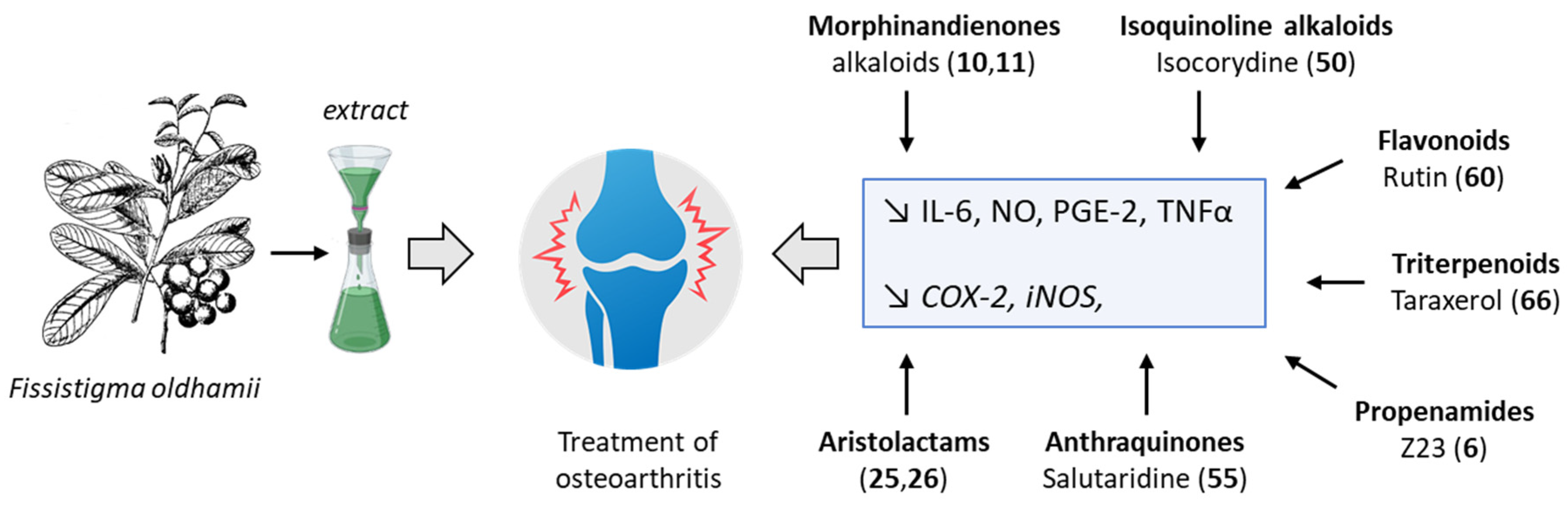
The species Fissistigma oldhamii (Hemsl.) Merr. (Annonaceae) has long been used as a traditional herbal medicine in China to treat diverse human diseases. Decoctions from the roots of the plant (Guā Fù Mù) are used to treat body pain and inflammatory pathologies, such as rheumatic syndromes, sciatica, and osteoarthritis. The phytochemical content of the plant and the associated pharmacological activities have been analyzed. Seventy natural products were identified in the different parts of the plants, namely, the roots, stems, leaves, fruits, and seeds. The compounds comprise many tri- and tetracyclic alkaloids (aporphine-type), anthraquinones, terpenoids, flavonoids, and others. The pharmacological properties of these molecules were analyzed to point out the anti-inflammatory, antioxidant, anticancer, and/or antimicrobial effects, together with the underlying modulated pathways and molecular targets in some cases. The panel of phytoconstituents present in F. oldhamii extracts is large, with the majority of bioactive products identified in the roots and stems. Multiple molecules can contribute to the anti-inflammatory properties of the extracts. Network pharmacology analyses of the phytoconstituents are needed to better delineate the effective components and their targets.
Keywords: anticancer; anti-inflammatory; Fissistigma oldhamii; phytochemicals; traditional medicine anticancer; anti-inflammatory; Fissistigma oldhamii; phytochemicals; traditional medicine