Review

Stress-Induced Volatile Emissions and Signalling in Inter-Plant Communication

1
School of Agriculture, Food and Wine, The University of Adelaide, Glen Osmond, SA 5064, Australia
2
Australian Research Council Training Centre for Innovative Wine Production, Urrbrae, SA 5064, Australia
3
New South Wales Department of Primary Industries, Wollongbar, NSW 2477, Australia
*
Author to whom correspondence should be addressed.
Plants 2022, 11(19), 2566; https://doi.org/10.3390/plants11192566

Submission received: 21 August 2022 / Revised: 12 September 2022 / Accepted: 14 September 2022 / Published: 29 September 2022
(This article belongs to the Special Issue Plant Signaling, Behavior and Communication)

Abstract

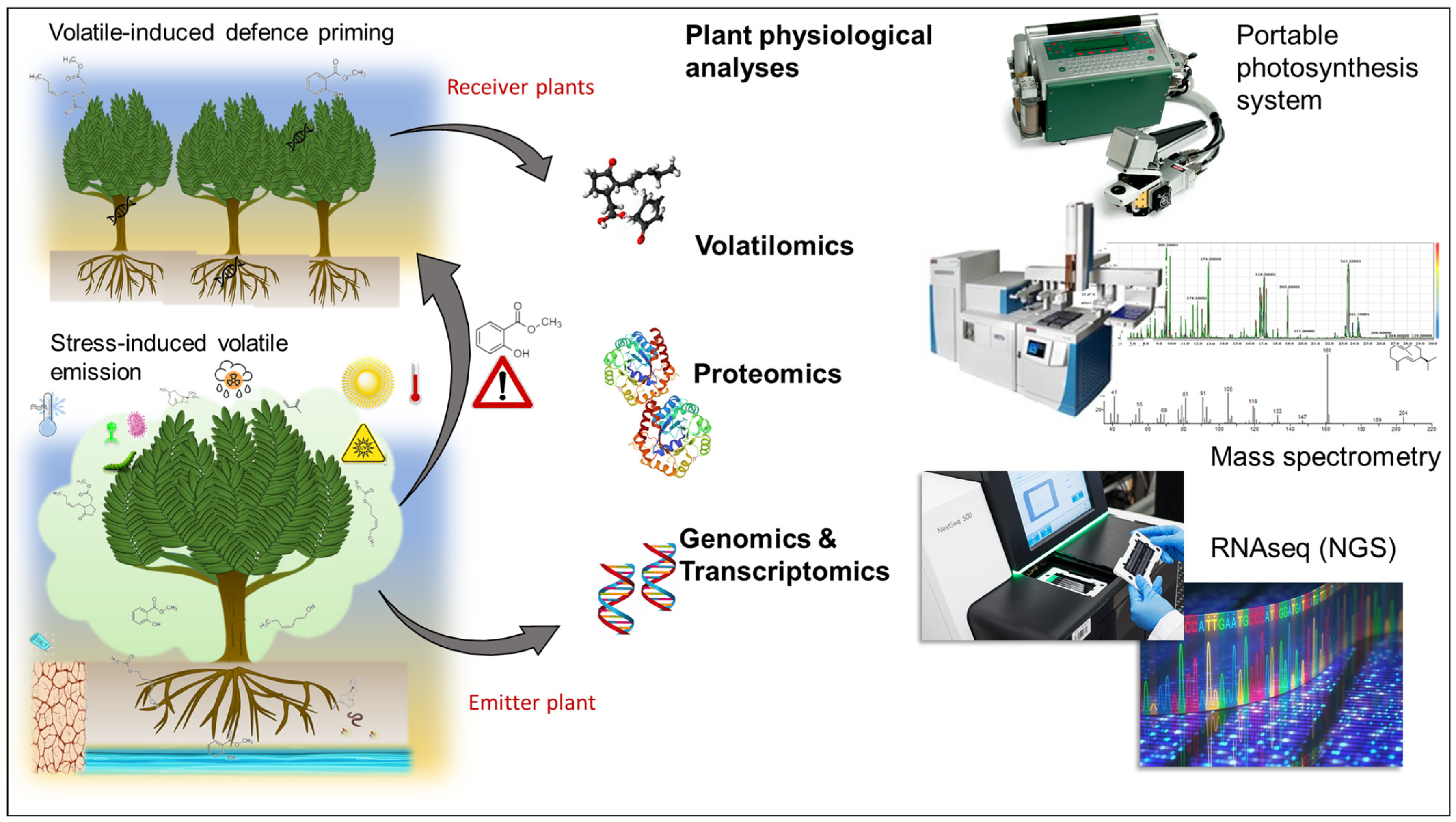
The sessile plant has developed mechanisms to survive the “rough and tumble” of its natural surroundings, aided by its evolved innate immune system. Precise perception and rapid response to stress stimuli confer a fitness edge to the plant against its competitors, guaranteeing greater chances of survival and productivity. Plants can “eavesdrop” on volatile chemical cues from their stressed neighbours and have adapted to use these airborne signals to prepare for impending danger without having to experience the actual stress themselves. The role of volatile organic compounds (VOCs) in plant–plant communication has gained significant attention over the past decade, particularly with regard to the potential of VOCs to prime non-stressed plants for more robust defence responses to future stress challenges. The ecological relevance of such interactions under various environmental stresses has been much debated, and there is a nascent understanding of the mechanisms involved. This review discusses the significance of VOC-mediated inter-plant interactions under both biotic and abiotic stresses and highlights the potential to manipulate outcomes in agricultural systems for sustainable crop protection via enhanced defence. The need to integrate physiological, biochemical, and molecular approaches in understanding the underlying mechanisms and signalling pathways involved in volatile signalling is emphasised.
Keywords: abiotic stress; biotic stress; plant–plant interactions; priming; stress signalling; VOCs; volatile-mediated signalling abiotic stress; biotic stress; plant–plant interactions; priming; stress signalling; VOCs; volatile-mediated signalling