Article

Wheat, Rye, and Barley Genomes Can Associate during Meiosis in Newly Synthesized Trigeneric Hybrids


by
María-Dolores Rey
1,
Carmen Ramírez
2 and
Azahara C. Martín
3,*
1
Agroforestry and Plant Biochemistry, Proteomics and Systems Biology, Department of Biochemistry and Molecular Biology, University of Córdoba, 14014 Córdoba, Spain
2
Institute for Sustainable Agriculture (IAS-CSIC), Department of Plant Genetic Improvement, 14004 Córdoba, Spain
3
Crop Genetics Department, John Innes Centre, Norwich NR4 7UH, UK
*
Author to whom correspondence should be addressed.
Plants 2021, 10(1), 113; https://doi.org/10.3390/plants10010113

Submission received: 12 December 2020 / Revised: 29 December 2020 / Accepted: 5 January 2021 / Published: 7 January 2021
(This article belongs to the Special Issue Stars in Plant Cell Biology)

Abstract

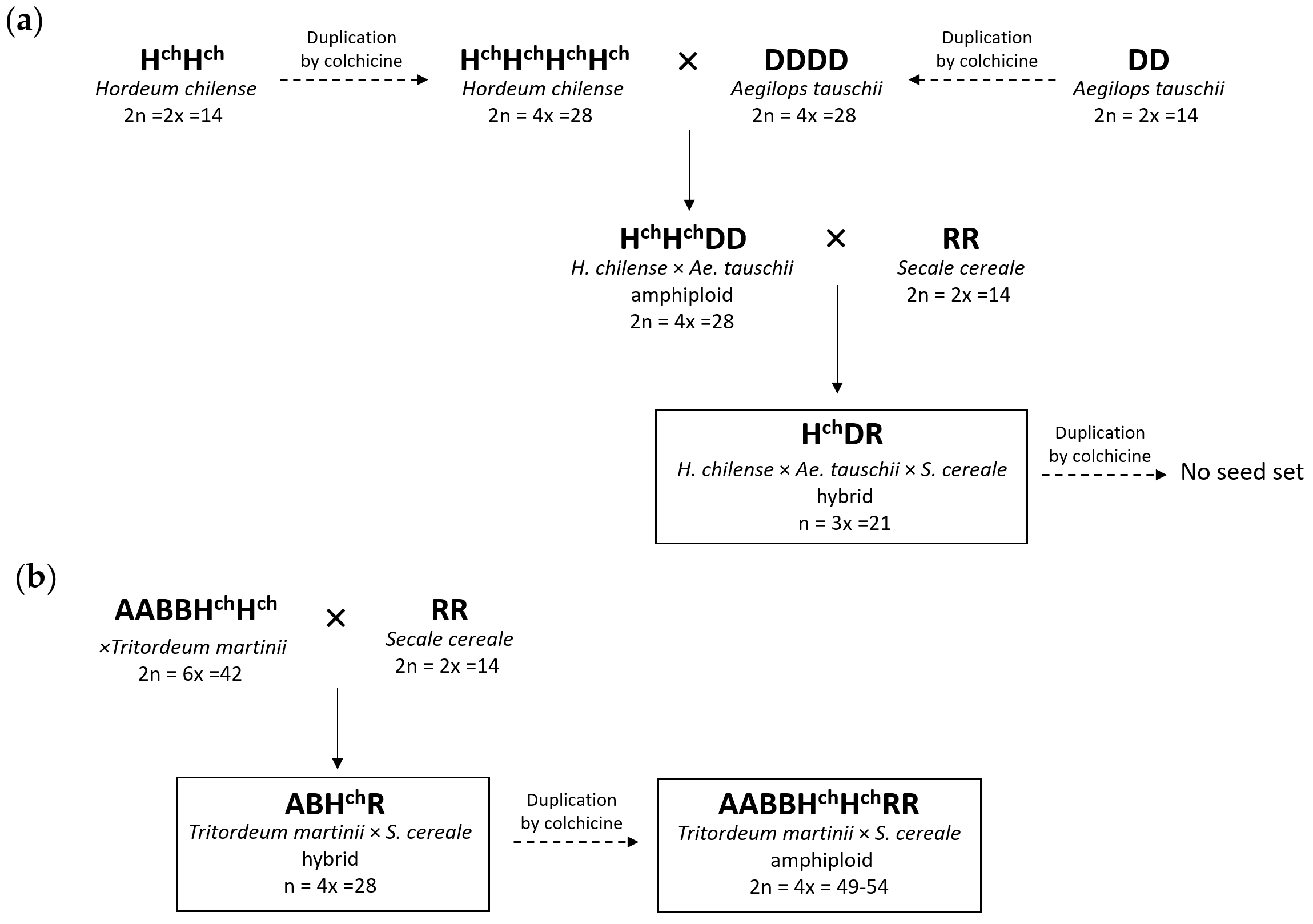
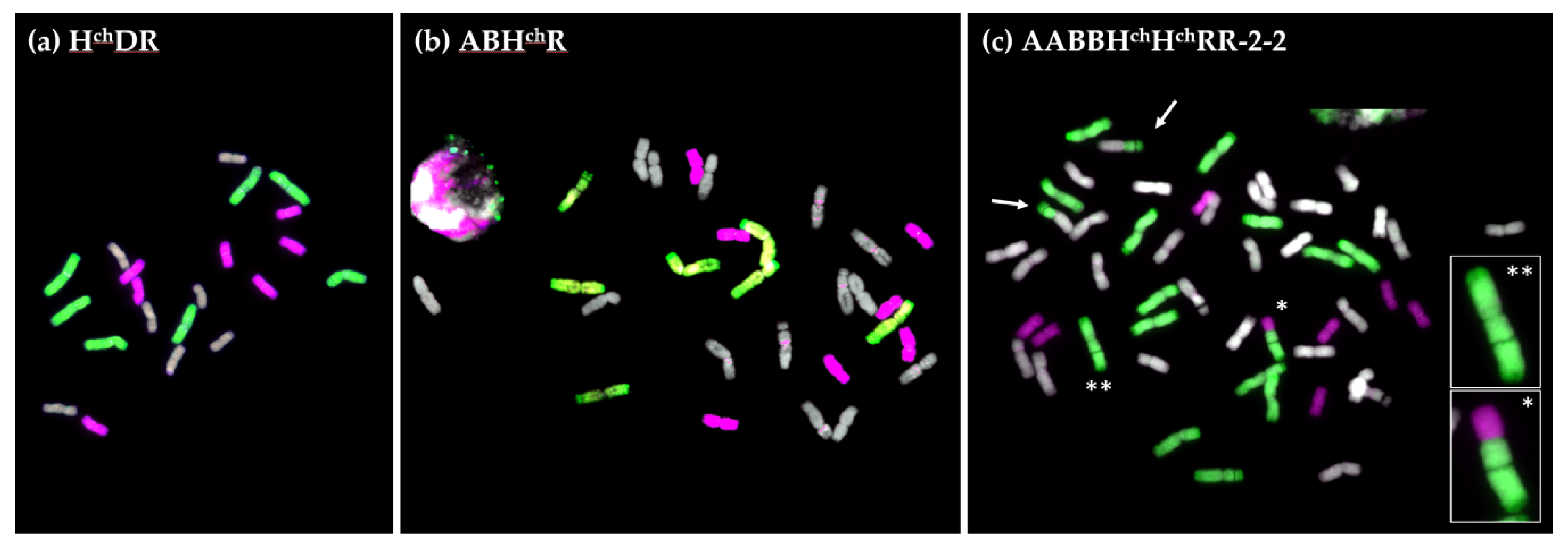
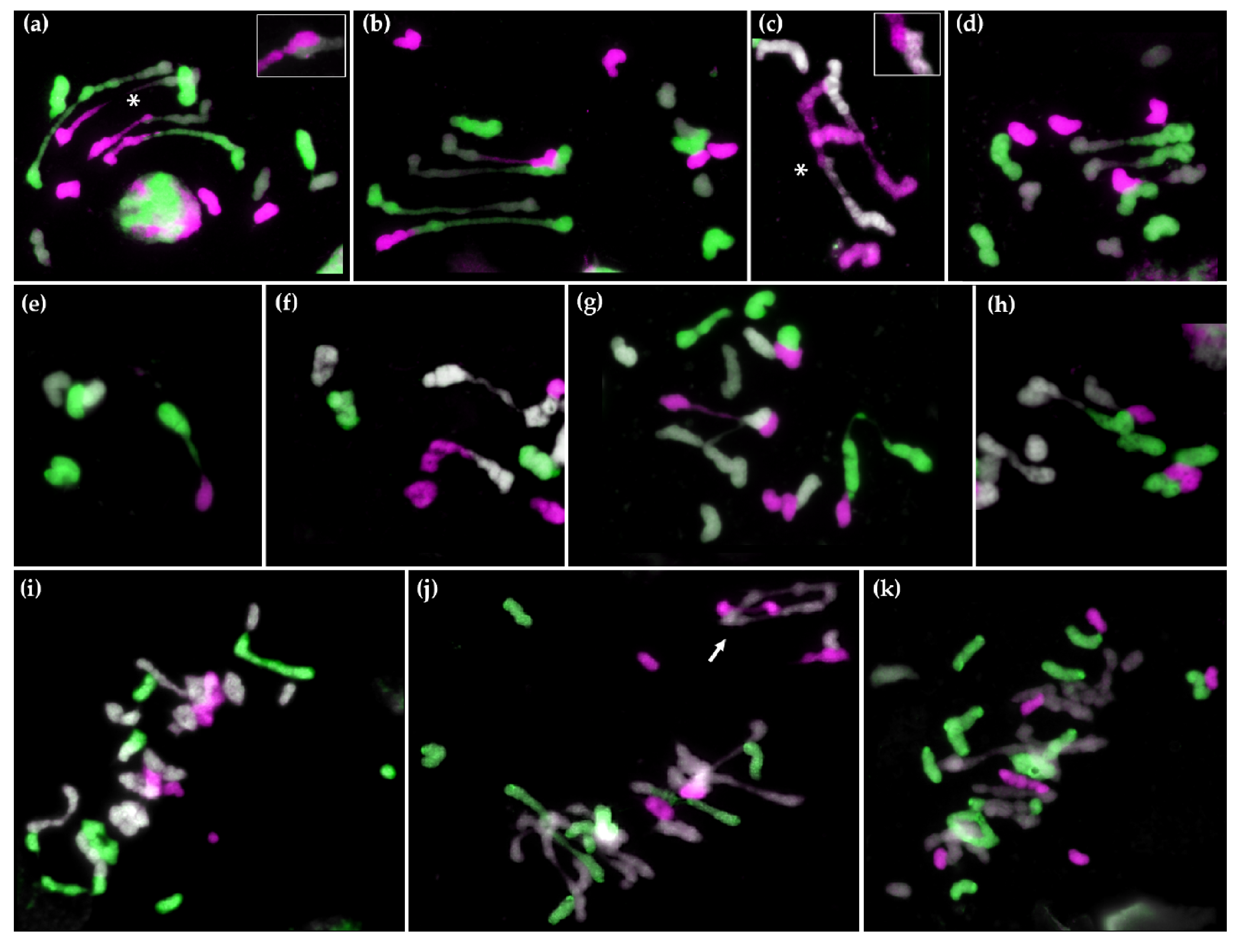
Polyploidization, or whole genome duplication (WGD), has an important role in evolution and speciation. One of the biggest challenges faced by a new polyploid is meiosis, in particular, discriminating between multiple related chromosomes so that only homologs recombine to ensure regular chromosome segregation and fertility. Here, we report the production of two new hybrids formed by the genomes of species from three different genera: a hybrid between Aegilops tauschii (DD), Hordeum chilense (HchHch), and Secale cereale (RR) with the haploid genomic constitution HchDR (n = 7× = 21); and a hybrid between Triticum turgidum spp. durum (AABB), H. chilense, and S. cereale with the constitution ABHchR (n = 7× = 28). We used genomic in situ hybridization and immunolocalization of key meiotic proteins to establish the chromosome composition of the new hybrids and to study their meiotic behavior. Interestingly, there were multiple chromosome associations at metaphase I in both hybrids. A high level of crossover (CO) formation was observed in HchDR, which shows the possibility of meiotic recombination between the different genomes. We succeeded in the duplication of the ABHchR genome, and several amphiploids, AABBHchHchRR, were obtained and characterized. These results indicate that recombination between the genera of three economically important crops is possible.
Keywords: wheat; Hordeum chilense; Triticeae; WGD (whole genome duplication); hybridization; meiosis; recombination; synapsis; GISH wheat; Hordeum chilense; Triticeae; WGD (whole genome duplication); hybridization; meiosis; recombination; synapsis; GISH