
This is an early access version, the complete PDF, HTML, and XML versions will be available soon.
Article

Dynamic Evaluation of Fire Service Accessibility for Fireworks Manufacturers

1
School of Transportation, Changsha University of Science & Technology, Changsha 410114, China
2
Institute of Disaster Prevention Science and Safety Technology, School of Civil Engineering, Central South University, Changsha 410075, China
*
Author to whom correspondence should be addressed.
ISPRS Int. J. Geo-Inf. 2026, 15(9), 378; https://doi.org/10.3390/ijgi15090378
Submission received: 20 June 2026 / Revised: 7 August 2026 / Accepted: 23 August 2026 / Published: 24 August 2026

Abstract

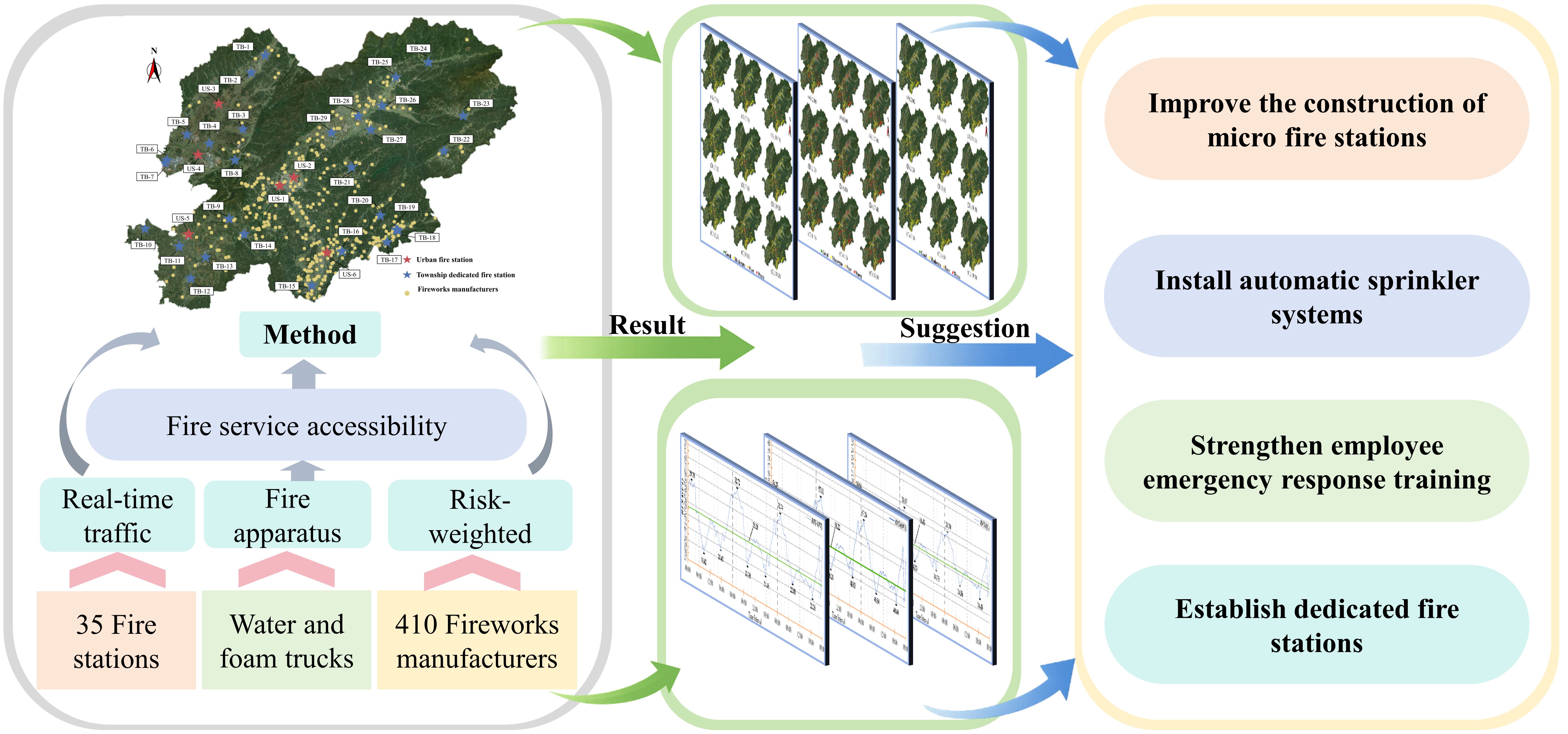
Although fire service accessibility has been extensively studied for urban public facilities such as hospitals and parks, it remains largely unexplored for high-risk industrial facilities such as fireworks manufacturers. In this study, fire risk and transportation network conditions are jointly considered, and a dynamic risk-weighted fire service accessibility evaluation framework is developed. An empirical study was conducted using 35 fire stations and 410 fireworks manufacturers in Liuyang City, China. Fire truck travel times were simulated via online map application programming interfaces (APIs) at 10–30 min intervals over a continuous three-day period, generating 193 evaluation scenarios and 158,260 data samples. The results indicate that the total average travel time of different types of fire trucks to demand points with varying risk levels was found to range from 570.33 to 1362.18 s, and risk-weighted fire service accessibility ranges from 16.84 to 57.26, reflecting a generally poor level of fire service accessibility within the current transport network. To resolve these constraints, it is recommended to optimize the spatial configuration of micro fire stations, promote the collaborative planning of shared enterprise-based fire units, and cross-integrate accessibility metrics into regional industrial land-use planning. These spatial measures are expected to significantly enhance the spatial resilience of transportation systems serving peripheral high-risk industrial clusters.
Keywords: fire service accessibility; fireworks manufacturers; geography; real-time traffic; industrial risk fire service accessibility; fireworks manufacturers; geography; real-time traffic; industrial risk
Graphical Abstract