
Article

Exploring the Nonlinear and Interactive Effects of the Built Environment and Air Pollution on Free-Floating Bike-Sharing Usage

School of Architecture, Southeast University, Si Pailou Campus, Nanjing 210096, China
*
Author to whom correspondence should be addressed.
ISPRS Int. J. Geo-Inf. 2026, 15(5), 225; https://doi.org/10.3390/ijgi15050225
Submission received: 12 February 2026 / Revised: 26 April 2026 / Accepted: 18 May 2026 / Published: 21 May 2026

Abstract

Free-floating bike-sharing (FFBS) systems play a valuable role in alleviating traffic congestion and reducing carbon emissions, making them vital to sustainable urban transportation. Although extensive research has investigated the relationship between the built environment and cycling behavior, the adverse effects of air pollution and its interaction with the built environment remain insufficiently understood. In this study, multisource data from Shenzhen are used, and an XGBoost–SHAP model is employed to comprehensively investigate the nonlinear associations among the FFBS trip volume, built environment, and air pollution while considering the spatial heterogeneity in interaction effects. The results indicate that population density, road density, building density, and PM2.5 are the most influential factors. In addition, significant temporal heterogeneity is observed between weekdays and weekends. The effects of the built environment variables and their interactions are more pronounced on weekdays than on weekends. More importantly, an interaction analysis reveals that the positive influence of compact urban development on cycling is conditional: in high-density areas with elevated pollution exposure, the health risks associated with air pollution can offset or even outweigh the mobility benefits of compactness. Overall, this study identifies the complex, spatially heterogeneous mechanisms through which the built environment and air quality jointly shape FFBS usage. These findings provide important evidence for integrating environmental health considerations into compact city planning and offer practical insights for promoting cycling and sustainable urban mobility in high-density cities.

1. Introduction

Cycling is widely recognized as a sustainable mode of transportation that helps to reduce carbon emissions, alleviate urban traffic congestion, and generate public health benefits. To lower the barriers to bicycle use, bike-sharing systems have emerged as an important solutions for addressing the “last mile” problem; thus, these systems receive strong support from urban governments [1,2]. With the advancement of information technology, fourth-generation bike-sharing systems, which are known as free-floating bike-sharing (FFBS), have emerged. By integrating dockless systems with GPS technology, FFBS allows users to pick up and return bicycles flexibly within designated areas without being restricted to fixed docking stations [3]. Owing to this convenience and efficiency, FFBS has rapidly expanded and gradually replaced docked systems, becoming a preferred mode of short-distance travel for urban residents [4]. Compared with private bicycles and traditional docked public bike systems, FFBS is more flexible and less constrained by docking infrastructure (i.e., fixed bicycle stations), and its usage is more dependent on real-time environmental conditions, which makes cycling behavior more sensitive to urban environmental conditions, particularly the built environment and air pollution. In the context of increasingly available mobility data, bike-sharing datasets have become valuable resources for understanding urban travel patterns, and research on residents’ travel behavior and urban development issues from a bike-sharing perspective has become a growing focus [3].
Given the benefits of FFBS for cities and public health, understanding how the quality of the built environment influences FFBS usage has become a key research concern [5]. Existing studies, which are often framed within the “5D” dimensions of the built environment, have comprehensively demonstrated the positive effects of factors such as development intensity, public transit accessibility, and the floor area ratio on bike-sharing usage [6,7,8]. These findings provide an important foundation for understanding how urban spatial form and infrastructure conditions can promote cycling. In addition, bike-sharing usage is closely related to air quality [9]. A large body of research has documented the adverse health effects of exposure to air pollution [10], which, in turn, influence travel decisions and suppresses the frequency of shared cycling [11]. Scholars have further quantified these effects and reported that increases in the concentrations of particulate matter, ozone, and nitrogen dioxide significantly reduce bike-sharing ridership [5,12,13].
Notably, the influence of air pollution on cycling may vary across different built environment contexts. Jia et al. [14] observed that well-designed green infrastructure can reduce cyclists’ exposure to air pollution, which suggests that the urban form may partly modify the relationship between environmental conditions and cycling behavior. However, studies have largely focused on exposure mitigation or the independent effects of environmental factors, while the potential interaction between air pollution and built environment characteristics in shaping FFBS usage remains insufficiently examined. Moreover, the effects of pollution are not homogeneous across all cyclists. Although air pollution generally has a negative effect on bike-sharing usage, cyclists’ behavioral responses vary significantly depending on the trip purpose and individual characteristics [5].
Overall, although previous studies have examined the influence of air pollution on bike-sharing, most have focused primarily on the direct suppressive effects of the pollution itself [13] and have often relied on linear modeling frameworks [5]. Relatively few studies have investigated the complex, nonlinear effects on cycling behavior or the interaction mechanisms between air pollution and the built environment. To address these research gaps, this study takes Shenzhen as a case city and integrates the built environment and air pollution variables to examine their nonlinear effects on FFBS cycling. Particular attention is given to the interaction effects between air pollution and other influencing factors. Specifically, this study addresses the following key questions:
(1)
Do built environments and air pollution have nonlinear or threshold effects on bike-sharing usage, and do these effects differ between weekdays and weekends?
(2)
How do built environment characteristics interact with air pollution to shape bike-sharing usage patterns?
(3)
Do these nonlinear and interaction effects exhibit spatial heterogeneity across different urban areas?
To answer these questions, this study adopts an XGBoost–SHAP framework to capture the nonlinear relationships and interaction mechanisms among the built environment, air pollution, and cycling behavior. The findings aim to deepen the understanding of how environmental conditions promote or constrain cycling, and to provide strategic insights for sustainable transportation development in high-density cities. Section 2 of the article provides a detailed literature review on the determinants of FFBS usage, identifies the research gaps, and highlights the contributions of this study. Section 3 introduces the study area, datasets, and modeling methodology. Section 4 presents and interprets the modeling results. Section 5 discusses the main findings, offers policy implications for urban planning and sustainable transportation, and outlines the study’s limitations.

2. Literature Review

2.1. Built Environment and Bike-Sharing Behavior

A growing body of literature has explored the factors that influence cycling behavior, with particular attention given to the role of the built environment in determining FFBS usage. One of the most widely adopted frameworks for measuring built environment characteristics is the “5D” principle proposed by Ewing and Cervero [15], which includes density, diversity, design, destination accessibility, and distance to transit. This framework remains a cornerstone in the development of built environment variable systems.
Population density is positively associated with bicycle usage. Studies conducted in seven major metropolitan areas in the United States [16], Canada [17], and Beijing, China [18] have confirmed the positive relationship between population density and cycling behavior. However, some scholars argue that population density is not a universally significant factor [6], potentially because of differences in urban contexts or spatial scales of analysis. Similarly, the relationship between access to public transit and cycling behavior remains mixed. Some studies have identified a complementary effect between FFBS and public transportation, particularly in urban cores and areas of transit-oriented development and employment concentration [19]. Other research has demonstrated a competitive relationship between shared bikes and public transit services [20].
In general, land use variables tend to have a positive influence on cycling behavior. For example, higher densities of restaurants [21], commercial establishments [22], and a greater land use mix [23] are associated with increased FFBS usage. Notably, land use indicators often exhibit temporal variation [7]; for example, the density of offices and enterprises tends to have a stronger positive influence on weekdays [24], whereas a higher proportion of park land contributes to more cycling activity on weekends [25].
With advances in data and technology, scholars have increasingly focused on streetscape features. Studies suggest that the microscale street environment plays a critical role in shaping daily travel behavior [26]. Empirical evidence indicates that streets with higher levels of greenery or greater spatial openness not only help to reduce the risk of bicycle collisions but also enhance the integration of shared bicycle use with metro systems [27,28]. Moreover, streetscape environments may influence cycling behavior by both improving cyclists’ environmental perceptions and moderating the relationships between other environmental factors and cycling behavior.

2.2. Air Pollution and Bike-Sharing Behavior

With rapid urban expansion and rising levels of motorization, air pollution has become a major threat to urban livability and public health [29]. A large body of environmental health research shows that exposure to air pollution increases the risk of respiratory and cardiovascular diseases [30,31]. Globally, outdoor air pollution is responsible for more than 6.5 million deaths each year, and this number continues to increase [32,33]. In terms of behavioral mechanisms, air pollution may reduce travel comfort and heighten perceptions of health risk, thereby triggering avoidance behavior and suppressing cycling activity [12,34]. According to the World Health Organization [35], five major pollutants—namely, particulate matter (PM), carbon monoxide (CO), ozone (O3), nitrogen dioxide (NO2), and sulfur dioxide (SO2)—are considered to pose significant risks to public health. Quantitative studies have shown that for every 10 μg/m3 increase in the PM2.5 concentration, bike-sharing ridership decreases by 2.5% [13]. In addition, gaseous pollutants such as NO2 and SO2 have been shown to negatively affect outdoor activity by reducing travel comfort, thereby discouraging individuals from engaging in cycling under polluted conditions [5,33,36,37]. However, some studies have failed to detect a significant relationship between air quality and cycling, which suggests that the underlying mechanisms remain insufficiently understood [38].
Moreover, several studies have indicated that the relationship between air pollution and cycling may be moderated by other factors. Hong, McArthur, Sim and Kim [13] found that during the COVID-19 pandemic, cyclists were more tolerant of severe air pollution, possibly because of the lack of alternative travel modes that met public health restrictions. Jia, Lu, Zheng, Li, Liu, Peng and He [14], through simulation experiments, showed that choosing wider roads can reduce cyclists’ exposure to pollutants and encourage active travel, such as cycling. Nevertheless, the systematic interaction effects between air pollution and built environment factors remain largely unknown.
The literature has further suggested that the effects of air pollution on cycling behavior are not uniform across populations but may vary according to sociodemographic characteristics and the travel purpose. On the basis of a survey of 307 private bicycle users in Beijing, Zhao et al. [39] observed that those who continued cycling under severe air pollution were more likely to be male, over 30 years old, low-income, or short-distance travelers, whereas women were more likely to switch to other transportation modes. Saberian et al. [40] distinguished between commuting and recreational cycling by time of day and revealed that during air pollution alerts, recreational cycling declined more sharply than work-related trips did. However, these studies are largely based on surveys of private bicycle users with relatively small sample sizes, and large-scale evidence on heterogeneous responses in public bike-sharing systems remains limited.
Accordingly, although existing studies have confirmed a significant association between air pollution and cycling behavior, the complex mechanisms underlying this relationship have not been fully explored. Does air pollution begin to significantly suppress cycling only after a certain threshold is exceeded? If so, what is this concentration threshold? Do the effects of air pollution vary across different travel contexts, such as weekday and weekend cycling? Do built environment characteristics such as density, land use, or the street environment mitigate or amplify the negative impact of air pollution on cycling? These key questions warrant further investigation.

2.3. Nonlinear Correlation Between Urban Characteristics and Cycling Behavior

Numerous studies have employed various modeling approaches to explore the relationships between urban characteristics and cycling behavior. Early research relied primarily on linear regression techniques, such as ordinary least squares (OLS) [41], a negative binomial regression [42], and zero-inflated negative binomial (ZINB) models [43], to identify the factors that influence bike usage. These methods assume a constant linear relationship between variables such as the built environment or weather conditions and cycling behavior [25].
However, in complex urban systems, the mechanisms that impact cycling behavior often do not conform to the assumption of constant slopes. As a result, researchers have increasingly adopted smoothing functions, such as those used in generalized additive models, to flexibly capture the nonlinear relationships between influencing factors and cycling activity [44]. Although these approaches are effective at identifying nonlinear effects, they still focus primarily on additive relationships and have a limited ability to detect the interactions among multiple urban factors.
With the rapid development of artificial intelligence and growing interest in nonlinear effects, machine learning models have become increasingly popular in transportation research [4,23,45]. Compared with traditional linear models and additive models based on smoothing functions, machine learning approaches can capture complex nonlinear relationships and interaction effects among high-dimensional features without the need to predefine functional forms, thereby providing a more flexible and adaptive technical pathway for modeling cycling behavior. Additionally, through a simulation and empirical analysis, Li [46] demonstrated that the spatial effects captured by XGBoost are comparable to those modeled by spatial lag models (SLMs) and multiscale geographically weighted regressions (MGWRs), further encouraging the use of machine learning for spatial data analysis.
To improve the interpretability of these “black-box” models, researchers have introduced SHapley Additive exPlanations (SHAPs), which quantify the contribution of each explanatory variable and reveal their nonlinear effects on the outcome [47]. Most studies typically calculate global SHAP values to rank variable importance [25,27] or use SHAP dependence plots to depict the nonlinear relationships between individual variables and cycling behavior [22,48]. However, these studies have given relatively limited attention to the potential interaction effects among different factors. In particular, when the impact of air pollution on bike-sharing cycling behavior is examined, research often treats air pollution as an independent factor, and there is still a lack of systematic discussion on how its nonlinear effects may be amplified or mitigated through interactions with other variables.
In fact, the SHAP framework can further decompose the total effect into the main effects of individual variables and the interaction effects between variables. The former isolates the independent contribution of a single feature to the model’s prediction by excluding the influence of other variables, whereas the latter reveals the joint influence of two variables on the prediction outcome [47]. Building on this, this study systematically characterizes the complex mechanisms through which the built environment and air pollution jointly influence bike-sharing cycling behavior from three perspectives: total effects, main effects, and interaction effects.

3. Data and Methodology

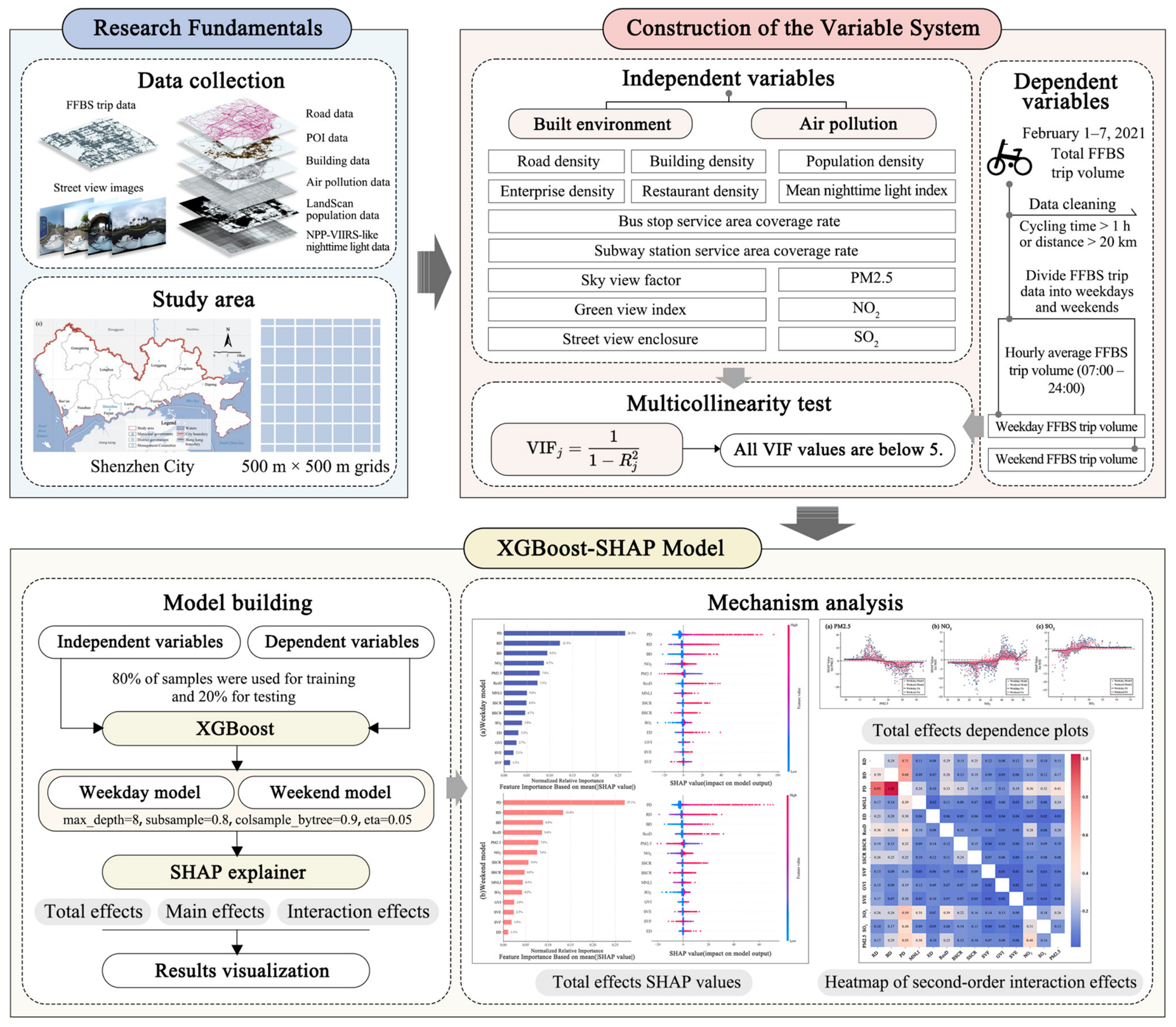
The technical framework is shown in Figure 1. First, a multisource dataset was constructed, including FFBS trip records, road network information, building information, and other relevant urban data. To capture cycling activities and built environment characteristics at a fine spatial scale, the study area was divided into grid cells of 500 m × 500 m, which served as the basic spatial analysis unit. Considering that shared bicycle usage aligns with distinct travel purposes on weekdays and weekends, this study calculated weekday and weekend trip volumes as separate dependent variables to capture the temporal variability in the mechanisms that influence FFBS usage. Next, a comprehensive system of explanatory variables was established, and multicollinearity tests were conducted to ensure model robustness. Finally, both the explanatory and dependent variables were fed into the XGBoost–SHAP model to analyze the nonlinear effects comprehensively, with a particular focus on the interaction mechanisms between air pollution and other influencing factors. Based on the results, policy recommendations are proposed to support urban renewal and the development of sustainable transportation.

3.1. Study Area

This study investigates the factors that affect cycling behavior in Shenzhen, Guangdong Province, China. As a megacity that has experienced rapid urbanization, Shenzhen is characterized by a high-density urban form and strong commuting demand. In addition, unlike northern Chinese cities with higher levels of industrialization, the air pollution in Shenzhen is driven primarily by traffic-related emissions, which makes it a representative case for examining the effects of air pollution on daily travel behavior. Shenzhen introduced FFBS in 2016 and, by 2021, the three major FFBS platforms had 27.7 million registered users and an average of 1.38 million daily rides; this provides rich spatiotemporal data for investigating the mechanisms that influence bike-sharing usage. Therefore, understanding how the built environment and air pollution jointly affect cycling behavior in Shenzhen has important implications for balancing environmental quality and the promotion of active travel in high-density urban areas.
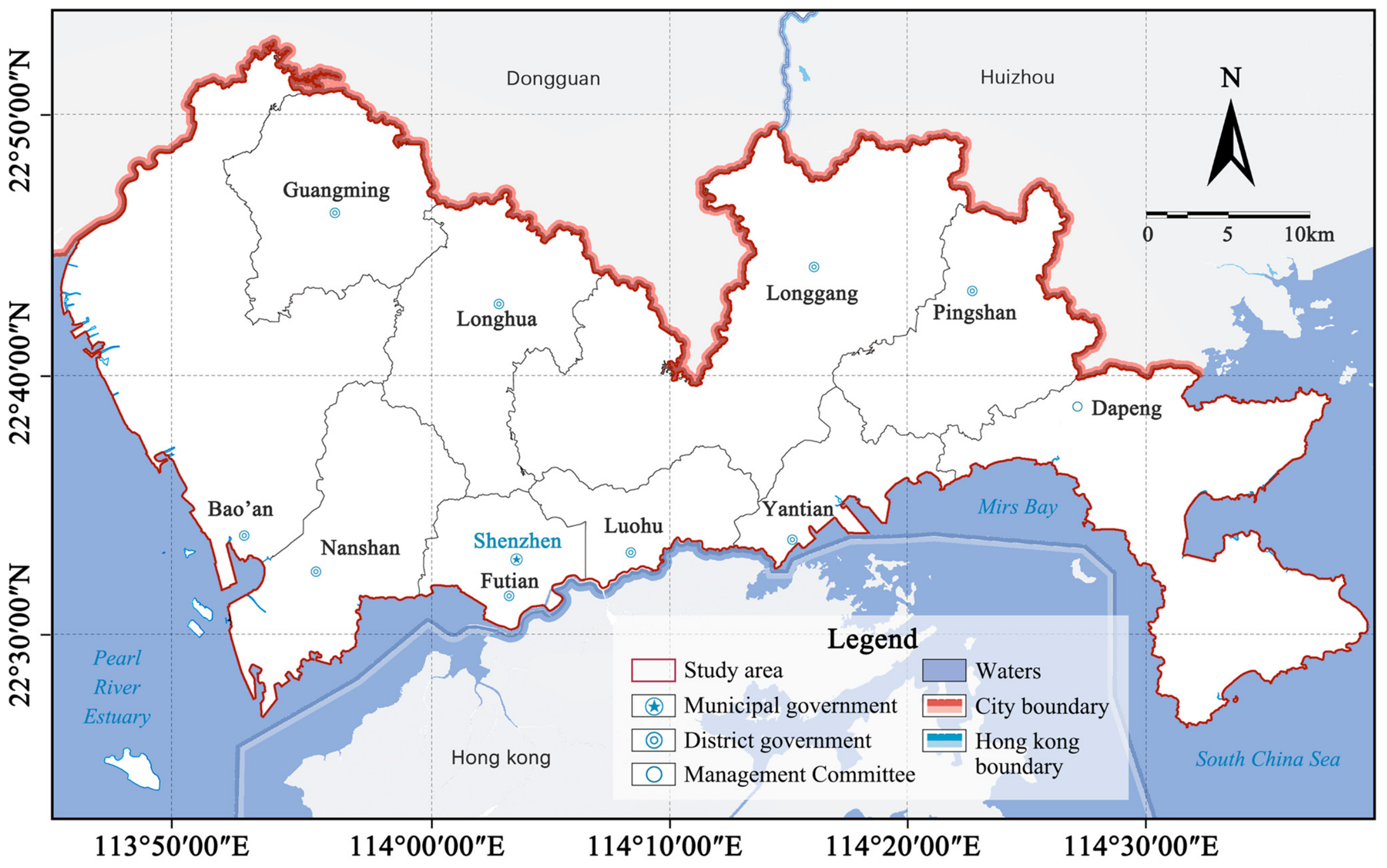
The study area is shown in Figure 2 and includes 10 administrative districts, including Nanshan, Futian, and Luohu. However, small islands on the western side of Shenzhen were excluded because of a lack of available FFBS trip data. Following previous grid-based urban spatial division methods [49], the study area was divided into traffic analysis zones (TAZs) in ArcGIS (version 10.8) with a grid size of 500 m × 500 m, resulting in a total of 8462 valid analytical units.

3.2. Data

3.2.1. FFBS Data

For the dependent variable, FFBS data were obtained from the Shenzhen Government Open Data Platform (https://opendata.sz.gov.cn/ (accessed on 17 October 2024)) for the period from 1 to 7 February 2021. During this period, Shenzhen experienced relatively stable weather conditions, with mild temperatures (approximately 16–26 °C), consistently clear days, and no extreme weather events observed. The dataset includes approximately 8.77 million trip records, which are represented as point features, with information such as an anonymized user ID, start time, end time, trip duration, and trip distance. To ensure data quality, abnormal trips were removed. Abnormal trips were defined as those with a duration exceeding 1 h or a distance of more than 20 km.
To capture the temporal differences in cycling behavior, trip records were grouped by weekday and weekend as a proxy for potential differences in commuting-oriented and leisure-oriented travel patterns [24]. Specifically, cycling data for weekdays and weekends were selected from 07:00 to 24:00, and a standardized hourly trip volume indicator was calculated using Equation (1):
Y d = N d / ( D d × H d ) ,
where Yd represents the average hourly trip volume (trips/hour) for day type d (i.e., weekday or weekend), Nd is the total number of trips for day type d, Hd denotes the number of analysis hours per day (17 h, from 07:00 to 24:00), and Dd indicates the number of days in each day type, with Dweekday = 5 and Dweekend = 2.

3.2.2. Built Environment Data

The data on the built environment used in this study include spatial datasets such as road networks, buildings, points of interest (POIs), and streetscape imagery. Road network and building data were sourced from OpenStreetMap (https://www.openstreetmap.org/ (accessed on 3 December 2024)). POIs, which reflect land use patterns, were obtained from the Baidu Map service platform, and comprised 685,217 points in 2021 across categories such as dining, enterprises, tourist attractions, and commercial facilities. Population density and the mean nightlight index are also important indicators of urban development. Population data were acquired from the 2021 LandScan dataset developed by the U.S. Department of Energy’s Oak Ridge National Laboratory (ORNL) (https://landscan.ornl.gov/ (accessed on 3 December 2024)), and nighttime light data came from the 2021 NPP-VIIRS-like nighttime light dataset [50] accessed via Harvard Dataverse (https://data.harvard.edu/dataverse (accessed on 10 April 2025)).
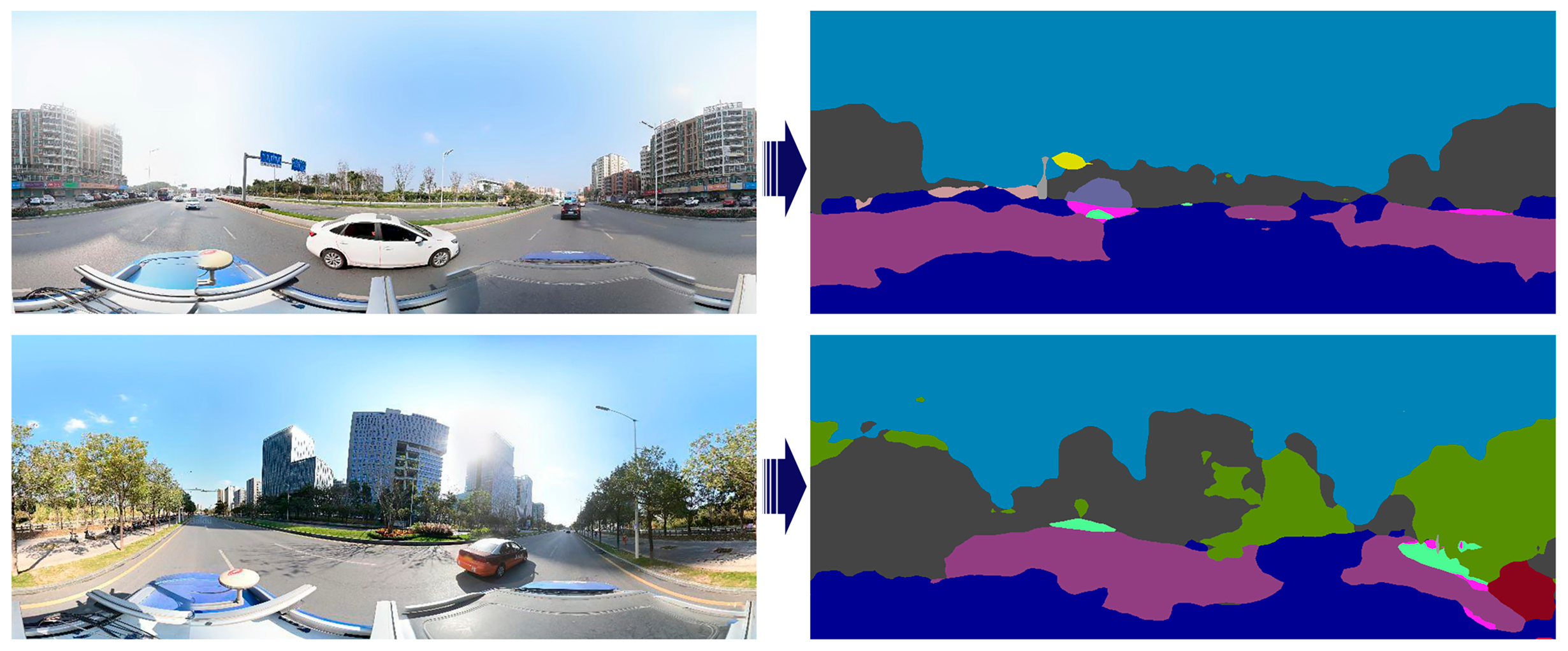
In addition, streetscape imagery was used to assess the visual environment around the FFBS parking points to reflect cyclists’ perceptual experience. These perceptual features are considered important factors that may influence cycling behavior directly, and they moderate the relationship between air pollution exposure and FFBS usage. We collected 153,168 panoramic images that covered four directions (0°, 90°, 180°, and 270°) from Baidu Street View (https://map.baidu.com/ (accessed on 10 December 2024)) for Shenzhen in 2021. With the DeepLabv3+ architecture, the images were segmented into 19 categories on the basis of a pretrained Cityscapes model. Following existing studies [27], we selected the green view index, sky openness, and degree of enclosure as the key streetscape indicators. Figure 3 presents sample results of the streetscape segmentation.

3.2.3. Air Pollution Data

Air pollution data were obtained from the National Earth System Science Data Center (https://www.geodata.cn/main/ (accessed on 31 January 2025)) and comprised daily ground-level concentration raster datasets of PM2.5, NO2, and SO2 for February 2021, with a spatial resolution of 1 km. O3 and CO were not included in the final analysis because their temporal consistency during the study period was not sufficient to support reliable comparisons across spatial units.
The above pollutants are commonly used as representative indicators of urban air quality [12] and are considered to be significantly associated with residents’ active travel behavior. Unlike other environmental factors, air pollution exhibits strong spatial diffusion, resulting in relatively smooth concentration gradients at the urban scale. Therefore, air pollution data with a spatial resolution of 1 km × 1 km were adopted in this study to characterize the pollution levels. To address missing values, empirical Bayesian kriging (EBK) was applied for spatial interpolation. During indicator processing, the air pollution variables were aggregated as average pollution levels over the study period to ensure alignment with cycling usage indicators and other built environment variables.
The model variables were computed using these datasets. Table 1 summarizes the variable categories, descriptions, means, and standard deviations. Variance inflation factor (VIF) tests confirmed that all of the variables had VIF values less than 5 when weekday and weekend trip volumes were used as dependent variables, which indicates that there were no multicollinearity issues.

3.3. Methods

3.3.1. Extreme Gradient Boosting

Extreme gradient boosting (XGBoost) is an improvement of gradient boosting decision trees (GBDTs), an ensemble learning framework known for modeling nonlinear relationships with high robustness to outliers and missing values [51]. Compared with GBDTs, XGBoost incorporates regularization terms and second-order Taylor expansion and supports parallel computation, leading to a faster training speed, greater parameter tuning flexibility, and higher accuracy.
Studies have demonstrated that XGBoost, which performs well in scenarios with complex spatial effects and nonlinearities [46], can serve as an effective alternative to traditional spatial statistical models and has been widely applied in urban studies. Based on these advantages, this study uses XGBoost (version 2.1.3) to explore the mechanisms underlying FFBS trip volumes in Shenzhen.
The relationship between the predicted output and the number of trees in the XGBoost model is given by Equation (2), where Y ^ d denotes the predicted bike trip volume, X = {x1, x2, …, x14} represents the explanatory variables, and F is the space of the regression trees. The model aggregates predictions from K regression trees.
Y ^ d = k = 1 K f k ( X ) ,     f k F ,
The XGBoost objective function includes a loss function and a regularization term, as shown in Equation (3). Here, N is the total number of samples, L indicates the loss function, and Ω ( f k ) signifies the regularization term. Specifically, T k is the number of leaves in the k-th tree, which controls tree complexity by penalizing splits and leaf weight magnitudes to prevent overfitting.
L ( ϕ ) = i = 1 N L ( Y d ( i ) , Y ^ d ( i ) ) + k = 1 K Ω ( f k ) ,

3.3.2. Model Evaluation Parameters

To evaluate the accuracy of the XGBoost model in capturing the relationships between the FFBS trip volume and explanatory variables in Shenzhen, three metrics were used; namely, the coefficient of determination (R2), mean squared error (MSE), and mean absolute error (MAE). A value of R2 closer to 1 indicates a stronger explanatory power of the model. MSE measures the average squared deviation between the predicted and observed values, whereas MAE reflects the average absolute magnitude of the prediction errors. Therefore, smaller values of MSE and MAE indicate better model performance.

3.3.3. SHapley Additive exPlanations

The XGBoost model is often regarded as a “black box” because of the difficulty in interpreting its internal mechanisms and decision-making processes. To address this issue, Lundberg and Lee [52] proposed the SHapley Additive exPlanations (SHAP) method, which is based on cooperative game theory and quantifies each feature’s contribution to model predictions. SHAP decomposes feature contributions into three interpretable components: total effect, interaction effect, and main effect [48].
In previous studies, the SHAP total effect values have been widely used to assess the global importance of features and examine their nonlinear relationships with the dependent variable [53]. The mathematical expression of the SHAP total effect is shown in Equation (4) as follows:
ϕ j t o t a l = S { 1 , 2 , , p } \ { j } | S | ! ( p | S | 1 ) ! / p !   [ v ( S { j } ) v ( S ) ] ,
where ϕ j t o t a l identifies the SHAP value of the total effect of feature j and measures its overall contribution to the prediction. S is a subset of all features excluding feature j, and v(S) refers to the model output (i.e., the expected prediction) based on subset S. p represents the total number of features.
The interaction SHAP value between features i and j is defined in Equation (5) as follows:
ϕ i , j i n t e r a c t i o n = S { 1,2 , , p } \ { i , j } | S | ! ( p | S | 2 ) ! / 2 ( p 1 ) !   i , j ( S ) ,
w h e n   i j ,   a n d   i , j ( S ) = v ( S { i , j } ) v ( S { i } ) v ( S { j } ) + v ( S )
where ϕ i , j i n t e r a c t i o n denotes the second-order interaction SHAP value between features i and j, which quantifies the additional effect that results from their interaction. i , j ( S ) captures the change in model output due to the presence or absence of specific feature combinations and serves as the core element in measuring both the main and interaction effects.

4. Results

4.1. Temporal and Spatial Analysis of FFBS Trip Volumes

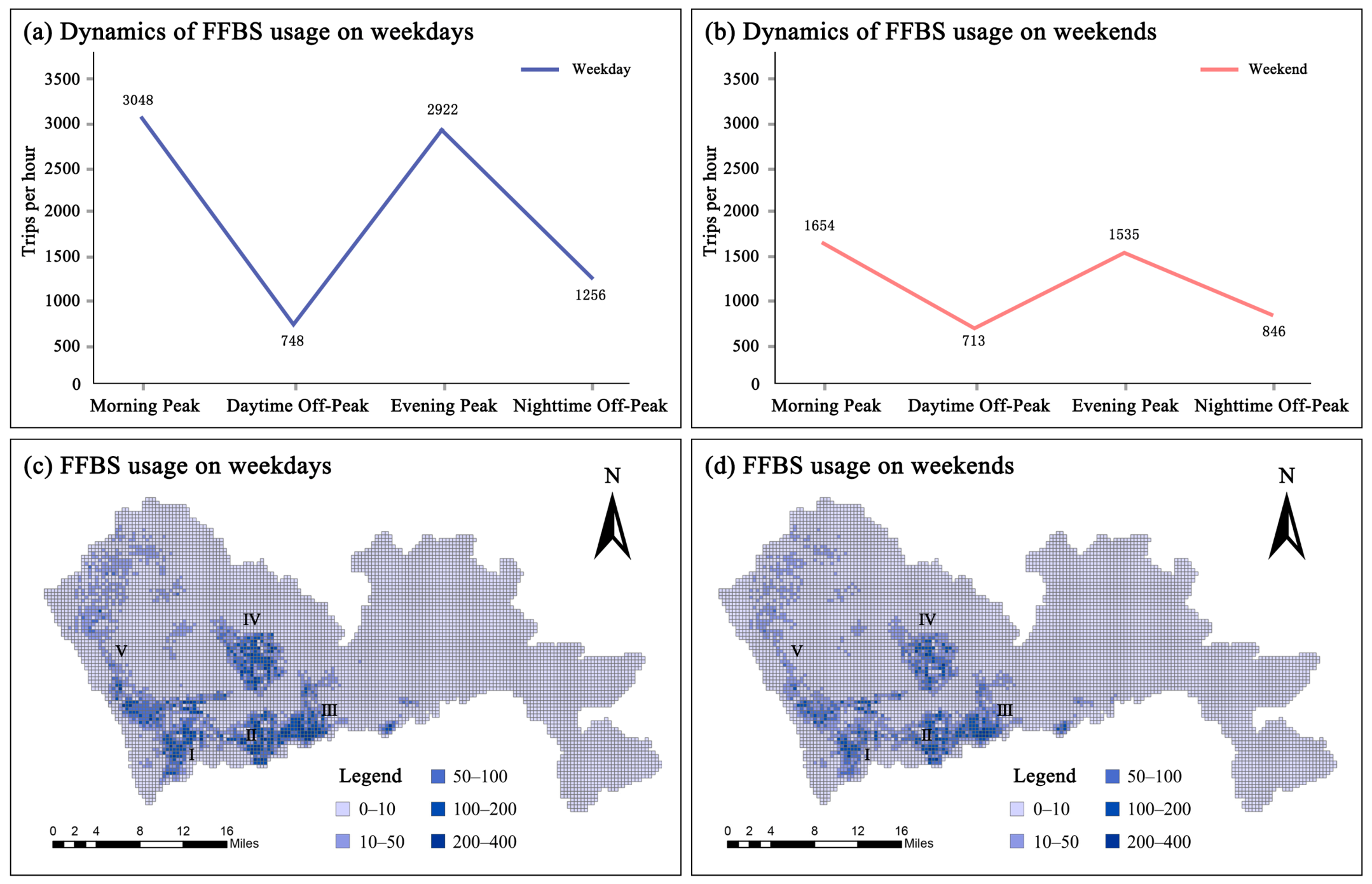
In this study, the spatiotemporal variations in FFBS trip volumes across Shenzhen were investigated (Figure 4). Figure 4a,b present the average hourly bike-sharing flow across four periods for weekdays and weekends: morning peak (7:00–9:00), midday off-peak (9:00–17:00), evening peak (17:00–19:00), and night off-peak (19:00–24:00). It is evident that weekday peak-hour trip volumes are substantially higher than those on weekends, with nearly double the volume, which reflects the rigid commuting demand among urban residents during weekday rush hours. On weekdays, the morning and evening peaks are relatively similar, which contrasts with the findings of previous studies [24]. However, trip volumes during the night off-peak period exceed those during the midday off-peak period, which may be associated with not only extended working hours but also evening leisure and social activities.
Furthermore, Figure 4c,d illustrate the spatial distributions of the average hourly FFBS trip volumes on weekdays and weekends. Higher and more concentrated trip volumes are observed in the city center (Zones I, II and III), Longhua District (Zone IV), and southern Bao’an District (Zone V). Although the distribution patterns of shared bikes on weekdays and weekends are similar, the Longhua and Bao’an districts exhibit slightly lower trip intensities and less cycling coverage on weekends, possibly reflecting more diverse travel patterns during nonworking days.

4.2. Model Comparison

In this study, 80% of the samples were used for training, and 20% were used for testing. Table A1 in the Appendix A details the hyperparameter tuning workflow and corresponding optimal parameters. The predictive performance of several machine learning models—RF (scikit-learn 1.6.1), GBDT (scikit-learn 1.6.1), LightGBM (version 4.5.0), and XGBoost (version 2.1.3)—was evaluated using R2, MSE, and MAE. The comparison results are summarized in Table 2. XGBoost outperforms the RF, GBDT, LightGBM, and OLS (scikit-learn 1.6.1) models in terms of both goodness-of-fit and prediction accuracy. Therefore, XGBoost was selected as the most suitable model for capturing the complex relationships between the built environment variables and cycling behavior in Shenzhen. Additionally, the spatial cross-validation yielded mean R2 values of 0.569 for the weekday model and 0.592 for the weekend model, indicating that the model performance is partly dependent on spatial dependence.

4.3. Total Effects Analysis

4.3.1. Relative Importance of the Independent Variables

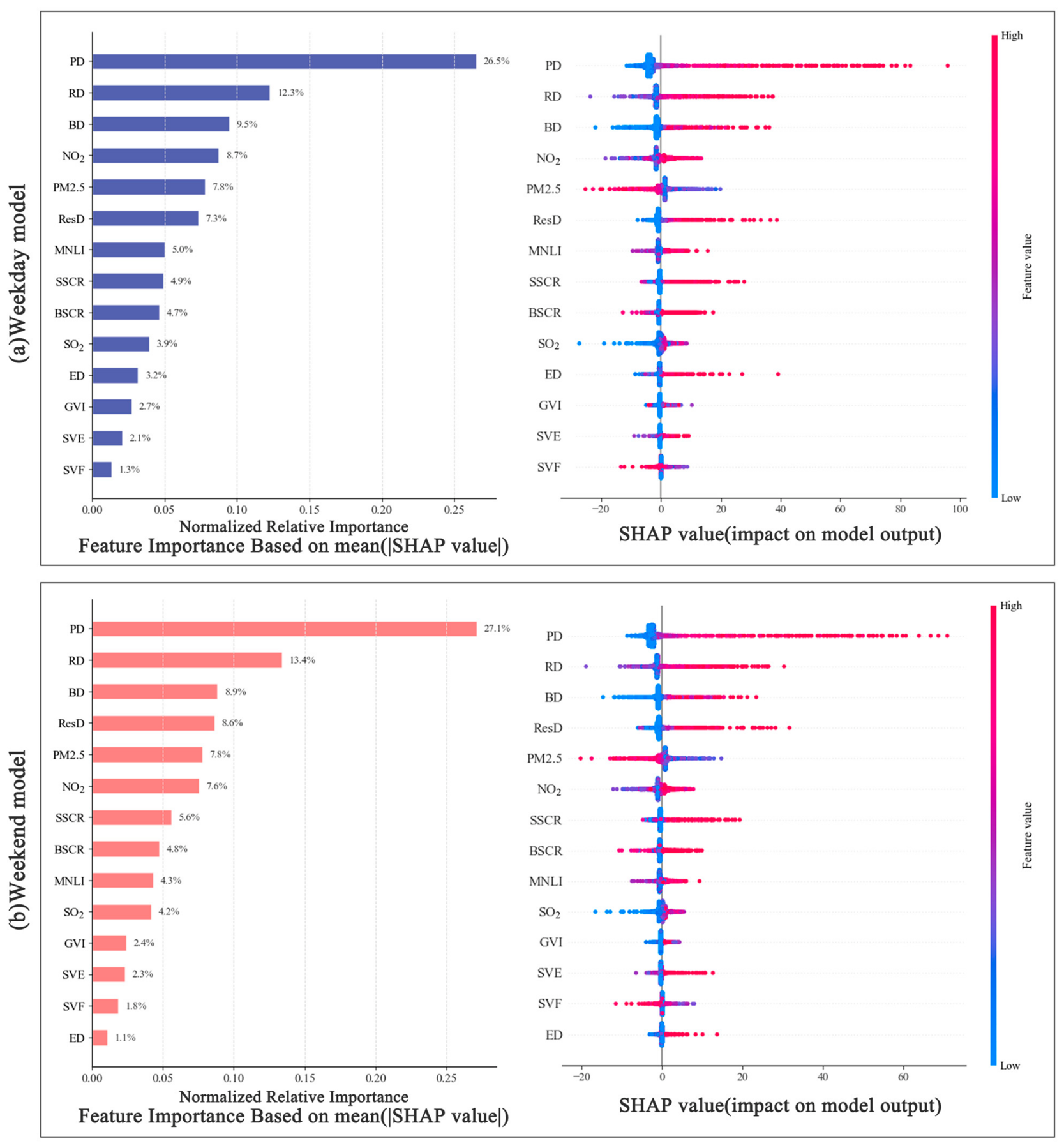
A common approach for interpreting machine learning models is to analyze the relative importance of features and their global SHAP values [54]. Following this approach, Figure 5 presents the relative importance and total SHAP effects of the predictors on FFBS usage.
Clearly, population density (PD), road density (RD), building density (BD) and restaurant density (ResD) consistently have strong positive effects on FFBS usage on both weekdays and weekends. Notably, PD contributes 27.1% to FFBS usage prediction during weekends. This may be related to higher travel demand in densely populated areas, where FFBS usage is more likely to occur as an alternative to congested public transportation. These findings are consistent with those of Sun, Wang and Wu [23].
Air pollution variables collectively contribute approximately 20% to the model’s predictive performance, indicating that air quality plays a nonnegligible role in shaping shared bike usage. Among these variables, the PM2.5 concentration is clearly negatively associated with cycling, with lower cycling volumes observed in areas with higher particulate pollution levels. In contrast, SO2 contributes relatively little to SHAP, which may be related to its limited spatial variability or its collinearity with other pollutants. Notably, NO2 displays a slightly positive association with bike use in the model. This unexpected result does not imply that NO2 promotes cycling; rather, it may reflect the spatial co-location of NO2 concentrations and high-intensity urban activity areas. In such areas, relatively high cycling volumes may persist despite poorer air quality, resulting in a statistically positive association. These findings underscore the need for policymakers to reduce residents’ long-term exposure to air pollutants such as NO2 through targeted interventions [55].

4.3.2. Nonlinear Relationships

Although the SHAP summary plot and relative importance chart effectively illustrate the global influence of each feature, they fail to capture the nonlinear and threshold effects of individual predictors. To address this limitation, this study employed SHAP dependence plots to investigate the detailed influence mechanisms of the key variables.
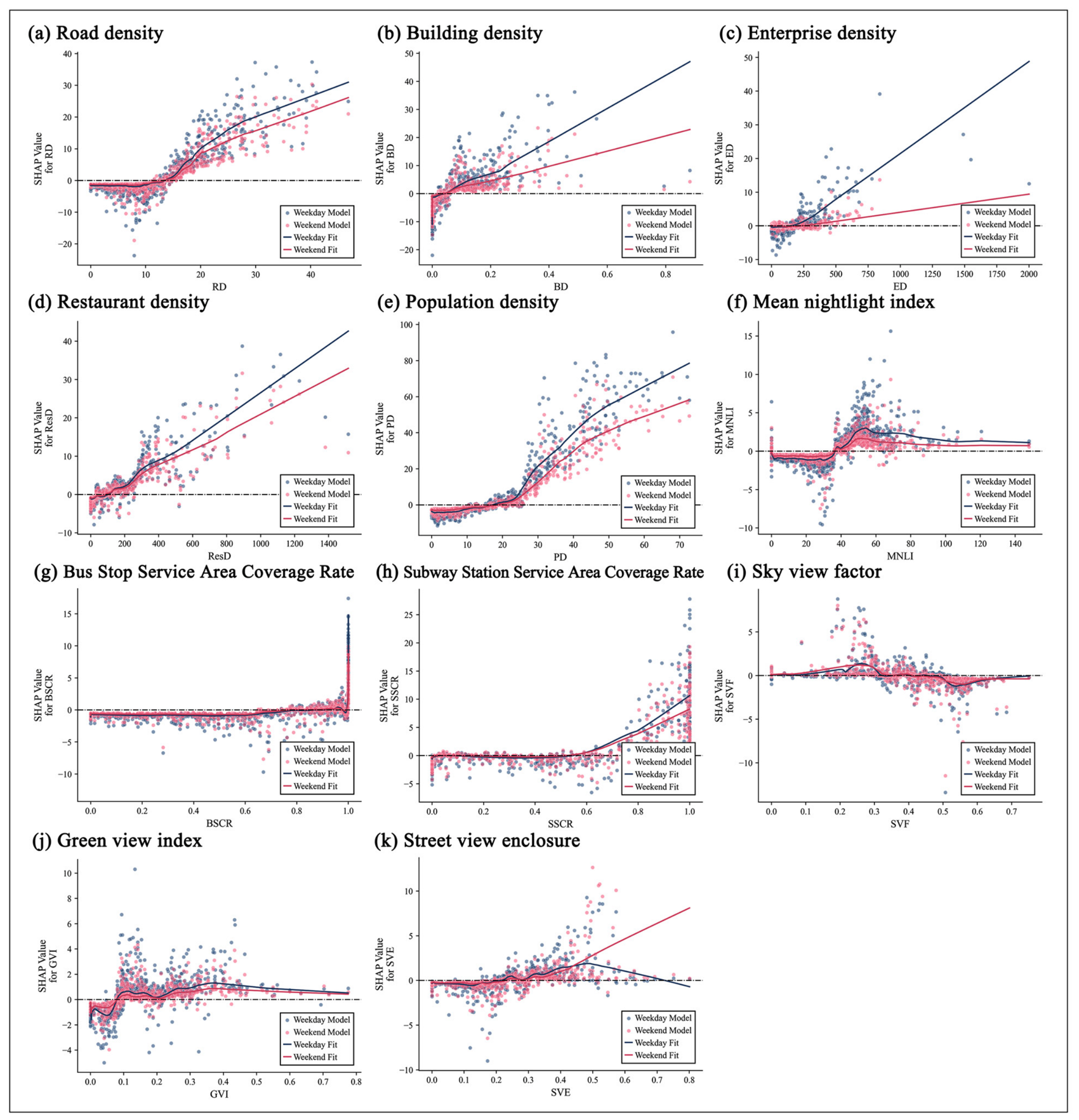
Figure 6 presents the partial dependence plots of the FFBS trip volume as a function of each built-environment factor. Most explanatory variables had positive effects on the FFBS trip volume. When the RD reaches approximately 15 km/km2, its local effect shifts from negative to positive. SHAP values increase markedly when the PD exceeds approximately 25,000 people/km2, which suggests a potential threshold-like pattern beyond which cycling demand intensifies. In contrast, BD and ResD exhibit nearly linear relationships with the FFBS trip volume, with consistently positive slopes. These findings indicate that in areas with dense buildings and dining facilities, residents’ travel demand is relatively concentrated. The influence of the mean nighttime light intensity (MNLI) is complex. When the MNLI exceeds approximately 40 nW/cm2/sr, its contribution becomes positive, which identifies areas with concentrated commercial and residential activities [56]. However, as the MNLI further increases, the positive impact diminishes. These findings demonstrate that cycling activity tends to plateau or decline in extremely high-intensity urban cores, where short-distance walking or stationary activities may also be prevalent.
Streetscape features have significant nonlinear effects on cycling behavior. The sky view factor (SVF) has the strongest positive effect on the FFBS volume within the 0.1–0.3 range but becomes negatively associated beyond 0.5. The green view index (GVI) generally increases usage within the 0.1–0.4 range but reaches a minimum near 0.2. This may be because of the relatively uniform distribution of greenery in the city, leading to unclear trend directions, or because excessive greenery sometimes encroaches on nonmotorized lanes, which reduces residents’ willingness to cycle. Street enclosure also plays a key role. When the street view enclosure (SVE) is less than 0.3, the space is overly open, which may hinder destination-oriented cycling behavior. Conversely, when the SVE exceeds 0.5, excessive enclosure may create a confined environment that discourages social interaction and cycling activities. These findings are broadly consistent with classic street design principles that emphasize the importance of balanced enclosure in shaping human-scale urban spaces [57].
Notably, the temporal differences in these nonlinear relationships vary across the types of environmental variables. For the density-related variables, the response curves become progressively steeper on weekdays than on weekends as the variable values increase. In contrast, weekend cycling may be more flexible and activity-driven, which could partly explain the flatter response curves and weaker associations observed during weekends [25]. In contrast, variables such as MNLI, GVI, SVE, and the subway station service area coverage rate (SSCR) show only modest weekday–weekend differences, with slightly stronger effects observed on weekdays. In comparison, the SVF and bus stop service area coverage rate (BSCR) exhibit little temporal variation. These findings imply that temporal heterogeneity is more pronounced for the variables that reflect urban activity intensity, as their effects appear to be more closely tied to routine weekday travel demand, whereas the streetscape and transit-accessibility variables show comparatively stable associations across different travel contexts.
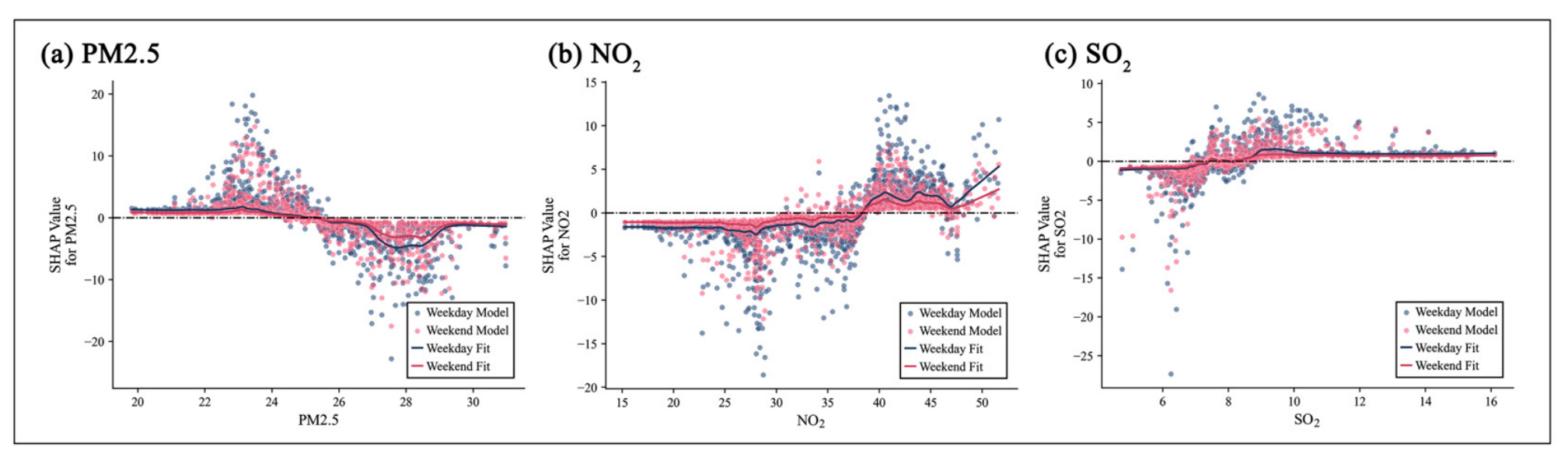
Figure 7 illustrates the effects of air pollution on the FFBS trip volume. The results indicate that the PM2.5 concentration negatively impacts cycling behavior, with the strongest adverse effect observed at approximately 25–30 µg/m3. High PM2.5 levels not only raise health concerns but also reduce street visibility, leading people to prefer enclosed transportation modes over shared bicycles. A comparison of the weekday and weekend models reveals that the negative influence of PM2.5 is more pronounced on weekdays. This stronger weekday association may be related to more structured and time-constrained travel patterns, which may reduce individuals’ flexibility in responding to short-term fluctuations in air pollution levels.
The weak positive associations observed for NO2 and SO2 should not be interpreted as beneficial effects, as they likely reflect the spatial correlation of these pollutants with dense urban activity centers. In these areas, relatively high cycling activity may still be observed under high pollutant concentrations. This pattern highlights the importance of considering cyclists’ exposure in high-activity urban areas.

4.4. Main Effects and Interaction Effects Analysis

4.4.1. Comparative Analysis of the Main Effects and Interaction Effects

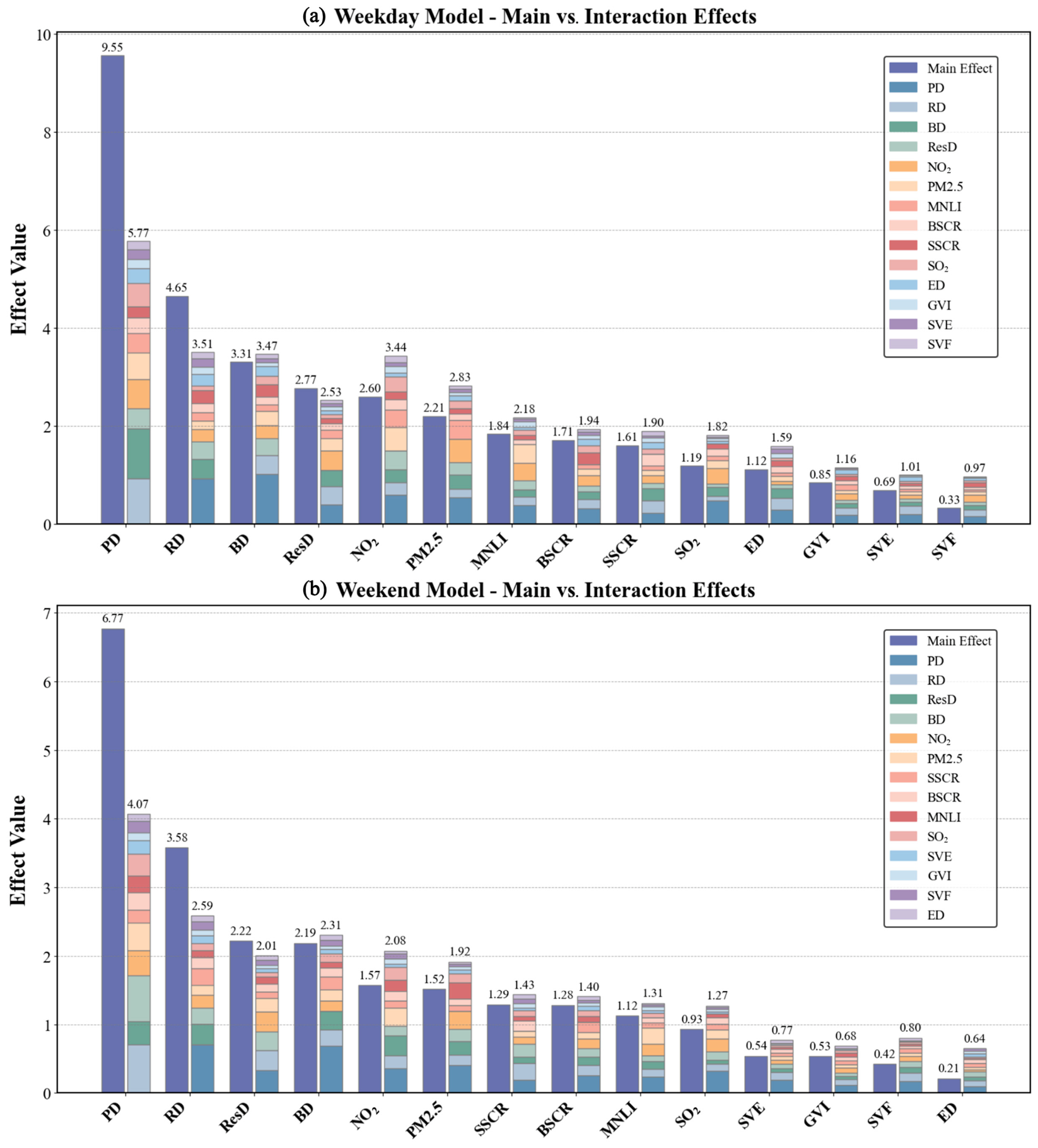
To explore the interactive effects among the features on FFBS trip volumes, the interaction values among the 14 variables are calculated in this section. Figure 8 presents a comparison between the sum of the second-order interaction SHAP values and their main effects for both weekday and weekend periods.
For the dominant features that influence the FFBS trip volume, the main effects clearly exceed the sum of their interaction effects with the other variables. On both weekdays and weekends, PD, RD, and ResD have dominant main effects; particularly PD, which accounts for more than 60% of the total effect. Moreover, the interaction effects between these dominant variables and others are considerable, indicating that they not only have a substantial direct effect on FFBS usage but also modulate the effects of other variables. For the nondominant variables, however, interaction effects play a greater role in the FFBS trip volume, with the ratio of the interaction effect to the main effect being three times greater.

4.4.2. Analysis of the Interaction Effects and Spatial Heterogeneity

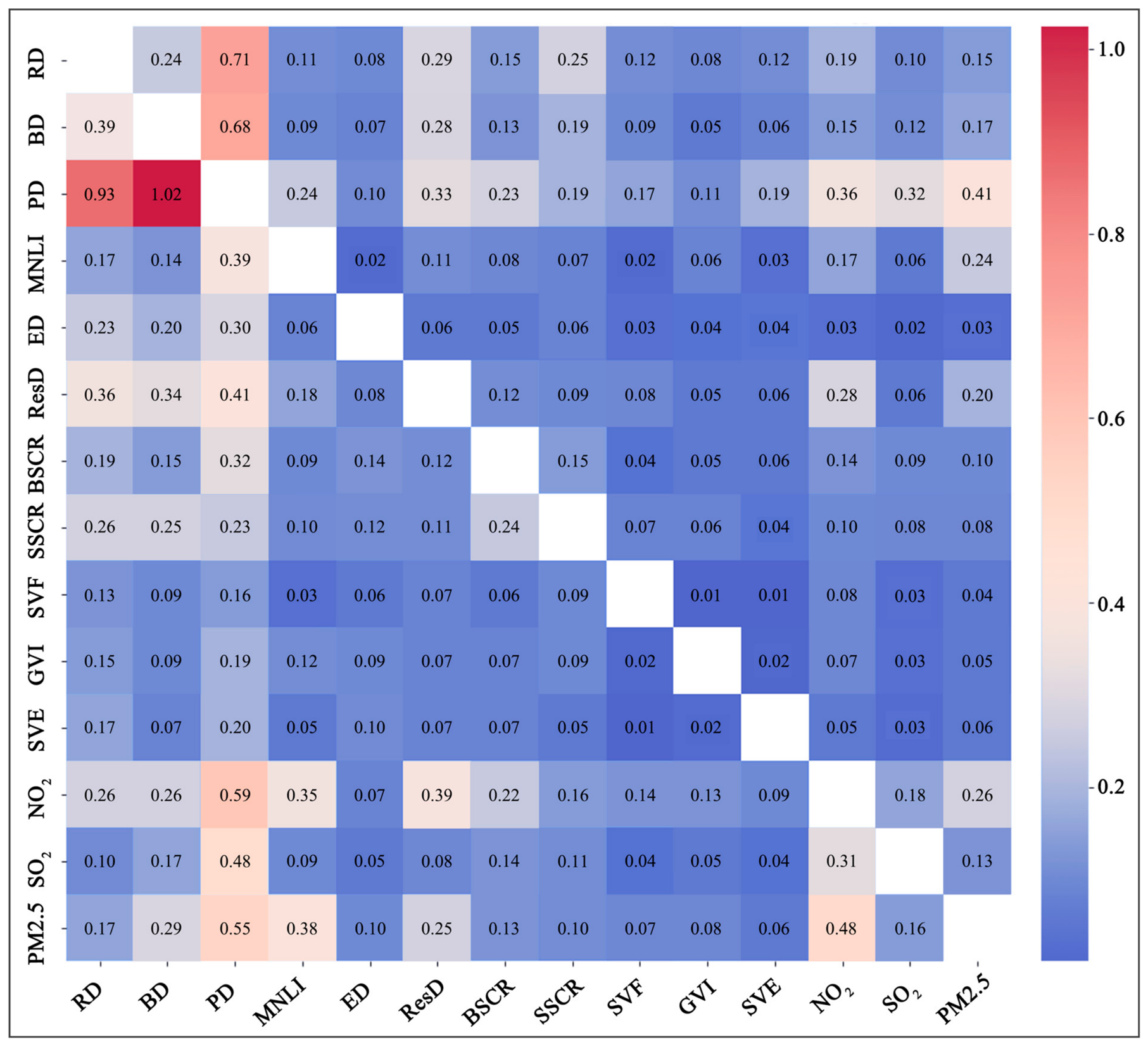
To identify the variable pairs with high interaction values, this study visualizes the interaction effects between each pair of variables during weekday and weekend periods, as shown in Figure 9. The variable pairs with strong interaction effects are concentrated among six variables: RD, BD, PD, and the three air pollution indicators.
During weekdays, RD, BD, and PD exhibit strong interaction effects, reflecting the tight coupling between urban development and population demand. Notably, the interaction effects between the air pollution variables, particularly NO2 and PM2.5, and the density-related variables are substantial. This may be due to the heightened sensitivity to pollution among residents in high-density, high-income urban areas, where the threshold for the negative effects of pollution is lower than that in other regions. With respect to temporal variability, weekend cycling generally involves less emphasis on travel efficiency, which weakens the influence of features such as RD, resulting in weaker interaction effects among the variables during weekends than during weekdays.
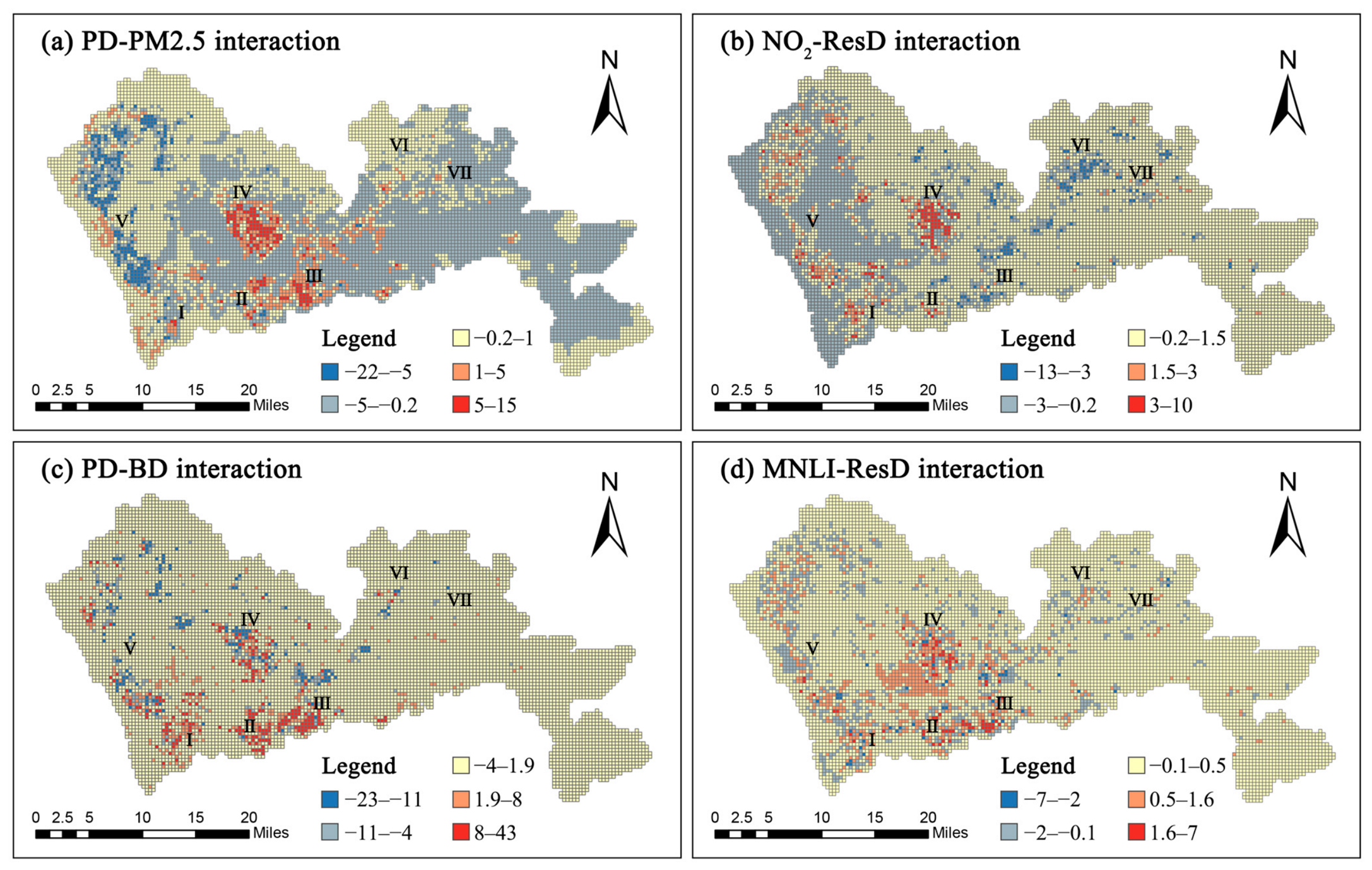
Figure 10 visualizes the second-order interaction SHAP values of the key variable pairs during weekdays, emphasizing the local spatial interaction effects and their synergy with the urban functional structure.
The interaction effect between PD and PM2.5 exhibits significant spatial heterogeneity. In Shenzhen’s central districts (Zones I–III) and Longhua (Zone IV), which represent the city’s commercial core and a mixed-use subcenter, the interaction is positive, whereas in industrial-oriented Bao’an (Zone V), it becomes negative. The core reason for this difference lies in the functional zoning of the areas: the central districts are dominated by high-density commercial and office functions, where travel tends to involve short distances and is thus less affected by pollution. In Bao’an, however, industrial and traffic emissions overlap, which results in relatively high pollution levels that may be associated with reduced cycling activity.
The interaction between the NO2 concentration and ResD is shown in Figure 10b. In areas with high FFBS trip volumes, such as the central districts (Zones I, II and III) and Longhua (Zone IV), the joint increase in these two factors enhances their individual positive effects. This pattern may reflect the spatial overlap between elevated NO2 concentrations and restaurant-dense areas, where short-distance activity demand is relatively concentrated.
The interaction between PD and BD has a strong positive effect in the central districts (Zones I, II and III) but a localized negative effect in northern Bao’an (Zone V). Considering the functional differences among these areas, the positive interaction in the central districts may indicate the role of functional agglomeration in concentrating travel demand [24], whereas in Bao’an, the negative interaction may be related to the negative externalities of high-density urban development, such as congestion and pollution, which may reduce the attractiveness of FFBS use.
The interaction between the MNLI and ResD is shown in Figure 10d, with high interaction values concentrated in the central districts (Zones I, II and III) and Longhua (Zone IV), whereas other districts have interaction values close to zero. This pattern reflects the dominance of commercial, business, and industrial development in these central areas and is consistent with the important role of socioeconomic factors in shaping cycling behavior [58].

5. Discussion and Conclusions

Bicycle riding can reduce urban carbon emissions, stimulate street vitality, and benefit the health of city residents [59]. Therefore, promoting cycling is highly important for sustainable urban development. In this study, interpretable machine learning models were employed to examine the relationships between environmental factors and the FFBS trip volume across weekdays and weekends. The empirical findings provide new insights into how the built environment and air pollution factors affect cycling behavior and inform related policy-making.

5.1. Total Effects of Built Environment and Air Pollution

With respect to the built environment factors, most effects align with expectations and previous studies. In particular, increases in RD, BD, and ResD tend to promote the development of urban bicycle networks and the mixed functional development of cities, thereby stimulating residents’ cycling behavior [7]. PD plays a dominant role in influencing FFBS trip volumes in Shenzhen and partially enhances the contributions of other features. Therefore, bike-sharing providers can flexibly allocate bicycles on the basis of community population size. The mean nightlight index also significantly affects the FFBS trip volume and exhibits clear threshold effects. When the light index reaches 50–60 nW/cm2/sr, the area likely corresponds to a densely populated commercial or residential zone with well-developed nighttime lighting, which jointly promotes cycling through enhanced attractiveness and perceived safety. Thus, urban planners should emphasize the design of nighttime lighting landscapes to increase the proportion of cycling or walking trips and advance sustainable urban mobility. Moreover, the results show a sharp increase in the FFBS trip volume once the service coverage of subway stations reaches 60–100%; this confirms a complementary relationship between bike-sharing and public transit. These findings suggest that expanding the service areas of bus and subway stations can effectively promote the use of integrated bike–transit travel chains [27]. In addition, a comparison of nonlinear effects between weekdays and weekends indicates that cyclists’ responses to urban environmental factors exhibit varied temporal heterogeneity. Specifically, the density-related variables tend to exert more pronounced effects on cycling during weekdays, while weekend cycling is more flexible with relatively weakened responses. Accordingly, weekday bike supply should prioritize high-vitality areas with mixed commercial and residential functions. Weekend cycling remains largely activity-driven, so deployment planning can focus on restaurant-concentrated districts and leisure and entertainment clusters [60]. In contrast, the streetscape and the public transit accessibility indicators remain stable across time, with only marginal discrepancies observed between different periods.
This study also highlights the complex mechanisms of air pollution effects. PM2.5 is among the most influential pollutants that negatively impact FFBS usage, as people consciously avoid cycling during periods of high particulate matter concentration, which is consistent with the findings of Jiang et al. [61] regarding air pollution and park visitation. The strongest adverse effect on cycling occurs when PM2.5 reaches approximately 25–30 µg/m3. However, in traffic-congested or industrial zones such as the Bao’an and Longhua districts, cycling activity remains relatively high despite elevated pollution levels. This does not imply that pollution promotes cycling; rather, it signifies that routine travel demand in these areas may limit individuals’ ability to avoid exposure. This situation calls for stricter policies to limit motor vehicle travel and control industrial emissions. Interestingly, a trade-off exists between pollution exposure and certain travel activities [53]. The results of this study reveal that on weekdays, NO2 is the fourth most important contributor, whereas on weekends, ResD replaces NO2 concentration, indicating that people may prioritize activities such as dining out during weekends, even under relatively high pollution levels.

5.2. Interaction Effects and Spatial Heterogeneity

Beyond identifying individual determinants, this study demonstrates that FFBS usage is shaped by the coupled effects of the built environment and air pollution. From a travel behavior perspective, cycling decisions in urban space are often the result of a trade-off between travel convenience and perceived environmental risk. High-density urban environments generally stimulate cycling demand by shortening travel distances and concentrating activities. For example, clustered cycling activities are common in Shenzhen’s central districts, Bao’an, and Longhua, which reveals the functional intensity and compact urban structure of these areas [24].
However, this positive effect is not unconditional. When environmental stressors such as air pollution intensify, perceived health risks may alter individuals’ mode choice decisions, particularly regarding discretionary or less time-sensitive trips, thereby offsetting or even suppressing the mobility benefits brought by compact development [55,62]. In southern Bao’an, which has recently been incorporated into the Qianhai Cooperation Zone, office and residential development has been rapidly increasing. However, the second-order interaction between PD and PM2.5 has a negative effect on cycling activity. These findings signal that urban compactness and environmental quality must be considered simultaneously, as their interaction partly determines the attractiveness of cycling. In this sense, air pollution does not act solely as a direct predictor of cycling behavior but is associated with systematic variations in how built-environment characteristics are related to cycling activity.

5.3. Limitations and Future Directions

Although this study supplements the literature on the built environment and cycling behavior and provides valuable insights, several limitations remain.
First, this study did not directly observe individual-level sociodemographic attributes (e.g., age, income, and occupation) or trip purpose because of data constraints. Future research could incorporate individual-level data to better capture travel purposes and behavioral heterogeneity.
Second, the data used in this study were collected in 2021 over a relatively short period (7 consecutive days in February), which may not fully capture the seasonal variations in travel behavior, weather conditions, and air pollution levels and may also be affected by subsequent urban renewal and changes in the built environment. Therefore, the findings of this study should be interpreted as context-specific statistical associations rather than as universal causal relationships. Future work may consider incorporating multiseason, long-term, or more recent data to further validate the findings.
Finally, the spatial cross-validation indicated that, while XGBoost captures the overall trends, its cross-regional generalizability remains limited. Future research could adopt local machine learning approaches to better account for spatial heterogeneity.

Author Contributions

Conceptualization, Ziye Liu and Mingxing Hu; methodology, Ziye Liu and Jianyu Li; software, Ziye Liu and Shumin Wang; validation, Ziye Liu, Jianyu Li and Mingxing Hu; formal analysis, Ziye Liu; investigation, Shumin Wang and Jingyue Huang; resources, Mingxing Hu; data curation, Ziye Liu and Mingxing Hu; writing—original draft preparation, Ziye Liu; writing—review and editing, Jianyu Li and Mingxing Hu; visualization, Ziye Liu and Jingyue Huang; supervision, Mingxing Hu; project administration, Ziye Liu and Mingxing Hu. All authors have read and agreed to the published version of the manuscript.

Funding

This research received no external funding.

Data Availability Statement

The raw data that support the conclusions of this article can be made available by the authors upon request.

Conflicts of Interest

The authors declare that they have no conflicts of interest.

Abbreviations

The following abbreviations are used in this manuscript:
FFBSFree-floating bike-sharing
XGBoostExtreme gradient boosting
SHAPSHapley Additive exPlanations
POIsPoints of interest
GBDTsGradient boosting decision trees
R2Coefficient of determination
MSEMean squared error
MAEMean absolute error
RDRoad density
BDBuilding density
EDEnterprise density
ResDRestaurant density
PDPopulation density
MNLIMean nightlight index
BSCRBus stop service area coverage rate
SSCRSubway station service area coverage rate
SVFSky view factor
GVIGreen view index
SVEStreet view enclosure

Appendix A

To optimize the XGBoost model, a grid search was employed. The search ranges and the optimal values for the main hyperparameters are summarized in Table A1. Early stopping (50 rounds) was applied to prevent overfitting, and the model was trained with num_boost_round = 2000 as the upper limit.
Table A1. Hyperparameter tuning of XGBoost.
ParameterSearch RangeOptimal Value
max_depth{4, 6, 8, 10}8
eta{0.01, 0.05, 0.1}0.05
subsample{0.6, 0.8, 1.0}0.8
colsample_bytree{0.6, 0.7, 0.8, 0.9, 1.0}0.9

References

  1. Mueller, N.; Rojas-Rueda, D.; Cole-Hunter, T.; de Nazelle, A.; Dons, E.; Gerike, R.; Götschi, T.; Int Panis, L.; Kahlmeier, S.; Nieuwenhuijsen, M. Health impact assessment of active transportation: A systematic review. Prev. Med. 2015, 76, 103–114. [Google Scholar] [CrossRef]
  2. Maizlish, N.; Linesch, N.J.; Woodcock, J. Health and greenhouse gas mitigation benefits of ambitious expansion of cycling, walking, and transit in California. J. Transp. Health 2017, 6, 490–500. [Google Scholar] [CrossRef] [PubMed]
  3. Vallamsundar, S.; Jaikumar, R.; Venugopal, M. Exploring the Spatial-temporal dynamics of travel patterns and air pollution exposure of E-scooters. J. Transp. Geogr. 2022, 105, 103477. [Google Scholar] [CrossRef]
  4. Zhang, F.; Liu, W. An economic analysis of integrating bike sharing service with metro systems. Transp. Res. Part D Transp. Environ. 2021, 99, 103008. [Google Scholar] [CrossRef]
  5. Liang, Y.; Wang, D.; Yang, H.; Yuan, Q.; Yang, L. Examining the causal effects of air pollution on dockless bike-sharing usage using instrumental variables. Transp. Res. Part D Transp. Environ. 2023, 121, 103808. [Google Scholar] [CrossRef]
  6. Guo, Y.; He, S.Y. Built environment effects on the integration of dockless bike-sharing and the metro. Transp. Res. Part D Transp. Environ. 2020, 83, 102335. [Google Scholar] [CrossRef]
  7. Zhang, Y.; Hu, X.; Wang, H.; An, S. How does the built environment affect the usage efficiency of dockless-shared bicycle? An exploration of time-varying nonlinear relationships. J. Transp. Geogr. 2024, 118, 103908. [Google Scholar] [CrossRef]
  8. Cai, X.; Gu, X.; Silm, S.; Hadachi, A.; Jin, T.; Witlox, F. Differences in bike-sharing usage and its associations with station-surrounding characteristics: A multi-group analysis using machine learning techniques. J. Transp. Geogr. 2025, 125, 104201. [Google Scholar] [CrossRef]
  9. Cheng, Z.; Zhao, L.; Li, H. A Transportation Network Paradox: Consideration of Travel Time and Health Damage due to Pollution. Sustainability 2020, 12, 8107. [Google Scholar] [CrossRef]
  10. Raaschou-Nielsen, O.; Andersen, Z.J.; Beelen, R.; Samoli, E.; Stafoggia, M.; Weinmayr, G.; Hoffmann, B.; Fischer, P.; Nieuwenhuijsen, M.J.; Brunekreef, B.; et al. Air pollution and lung cancer incidence in 17 European cohorts: Prospective analyses from the European Study of Cohorts for Air Pollution Effects (ESCAPE). Lancet Oncol. 2013, 14, 813–822. [Google Scholar] [CrossRef]
  11. Huang, G.; Jiang, Y.; Zhou, W.; Pickett, S.T.A.; Fisher, B. The impact of air pollution on behavior changes and outdoor recreation in Chinese cities. Landsc. Urban Plan. 2023, 234, 104727. [Google Scholar] [CrossRef]
  12. Yoo, E.-H.; Roberts, J.E.; Suh, Y. Delayed effects of air pollution on public bike-sharing system use in Seoul, South Korea: A time series analysis. Soc. Sci. Med. 2024, 352, 117030. [Google Scholar] [CrossRef]
  13. Hong, J.; McArthur, D.P.; Sim, J.; Kim, C.H. Did air pollution continue to affect bike share usage in Seoul during the COVID-19 pandemic? J. Transp. Health 2022, 24, 101342. [Google Scholar] [CrossRef]
  14. Jia, Y.-P.; Lu, K.-F.; Zheng, T.; Li, X.-B.; Liu, X.; Peng, Z.-R.; He, H.-D. Effects of roadside green infrastructure on particle exposure: A focus on cyclists and pedestrians on pathways between urban roads and vegetative barriers. Atmos. Pollut. Res. 2021, 12, 1–12. [Google Scholar] [CrossRef]
  15. Ewing, R.; Cervero, R. Travel and the Built Environment. J. Am. Plan. Assoc. 2010, 76, 265–294. [Google Scholar] [CrossRef]
  16. Nasri, A.; Younes, H.; Zhang, L. Analysis of the effect of multi-level urban form on bikeshare demand: Evidence from seven large metropolitan areas in the United States. J. Transp. Land Use 2020, 13, 389–408. [Google Scholar] [CrossRef]
  17. Faghih-Imani, A.; Eluru, N.; El-Geneidy, A.M.; Rabbat, M.; Haq, U. How land-use and urban form impact bicycle flows: Evidence from the bicycle-sharing system (BIXI) in Montreal. J. Transp. Geogr. 2014, 41, 306–314. [Google Scholar] [CrossRef]
  18. Lin, J.-J.; Zhao, P.; Takada, K.; Li, S.; Yai, T.; Chen, C.-H. Built environment and public bike usage for metro access: A comparison of neighborhoods in Beijing, Taipei, and Tokyo. Transp. Res. Part D Transp. Environ. 2018, 63, 209–221. [Google Scholar] [CrossRef]
  19. Qiu, W.; Chang, H. The interplay between dockless bikeshare and bus for small-size cities in the US: A case study of Ithaca. J. Transp. Geogr. 2021, 96, 103175. [Google Scholar] [CrossRef]
  20. Campbell, K.B.; Brakewood, C. Sharing riders: How bikesharing impacts bus ridership in New York City. Transp. Res. Part A Policy Pract. 2017, 100, 264–282. [Google Scholar] [CrossRef]
  21. Xing, Y.; Wang, K.; Lu, J.J. Exploring travel patterns and trip purposes of dockless bike-sharing by analyzing massive bike-sharing data in Shanghai, China. J. Transp. Geogr. 2020, 87, 102787. [Google Scholar] [CrossRef]
  22. Fu, C.; Huang, Z.; Scheuer, B.; Lin, J.; Zhang, Y. Integration of dockless bike-sharing and metro: Prediction and explanation at origin-destination level. Sustain. Cities Soc. 2023, 99, 104906. [Google Scholar] [CrossRef]
  23. Sun, Y.; Wang, Y.; Wu, H. How does the urban built environment affect dockless bikesharing-metro integration cycling? Analysis from a nonlinear comprehensive perspective. J. Clean. Prod. 2024, 449, 141770. [Google Scholar] [CrossRef]
  24. Zhou, J.; Lai, Y.; Tu, W.; Wu, Y. Exploring the relationship between built environment and spatiotemporal heterogeneity of dockless bike-sharing usage: A case study of Shenzhen, China. Cities 2024, 155, 105504. [Google Scholar] [CrossRef]
  25. Lu, Y.; Zhang, L.; Corcoran, J. How weather and built environment factors influence e-scooter ridership: Understanding non-linear and time varying effects. J. Cycl. Micromobility Res. 2024, 2, 100036. [Google Scholar] [CrossRef]
  26. Song, Q.; Huang, Y.; Li, W.; Chen, F.; Qiu, W. Unraveling the effects of micro-level street environment on dockless bikeshare in Ithaca. Transp. Res. Part D Transp. Environ. 2024, 132, 104256. [Google Scholar] [CrossRef]
  27. Shen, H.; Weng, J.; Lin, P. Exploring the nuanced correlation between built environment and the integrated travel of dockless bike-sharing and metro at origin-route-destination level. Sustain. Cities Soc. 2025, 119, 106090. [Google Scholar] [CrossRef]
  28. Jeon, J.; Woo, A. The effects of built environments on bicycle accidents around bike-sharing program stations using street view images and deep learning techniques: The moderating role of streetscape features. J. Transp. Geogr. 2024, 121, 103992. [Google Scholar] [CrossRef]
  29. Jaczewska, J.; Tarkowski, M.; Puzdrakiewicz, K.; Połom, M. Urban densification and sustainable mobility in a post-socialist city. Reconstruction of the science and business district development in Gdańsk. Cities 2022, 127, 103739. [Google Scholar] [CrossRef]
  30. Xu, H.; Jia, Y.; Sun, Z.; Su, J.; Liu, Q.S.; Zhou, Q.; Jiang, G. Environmental pollution, a hidden culprit for health issues. Eco-Environ. Health 2022, 1, 31–45. [Google Scholar] [CrossRef]
  31. Singh, V.; Meena, K.K.; Agarwal, A. Travellers’ exposure to air pollution: A systematic review and future directions. Urban Clim. 2021, 38, 100901. [Google Scholar] [CrossRef]
  32. Fuller, R.; Landrigan, P.J.; Balakrishnan, K.; Bathan, G.; Bose-O’Reilly, S.; Brauer, M.; Caravanos, J.; Chiles, T.; Cohen, A.; Corra, L.; et al. Pollution and health: A progress update. Lancet Planet. Health 2022, 6, e535–e547. [Google Scholar] [CrossRef]
  33. Meena, K.K.; Goswami, A.K. A review of air pollution exposure impacts on travel behaviour and way forward. Transp. Policy 2024, 154, 48–60. [Google Scholar] [CrossRef]
  34. Tainio, M.; Jovanovic Andersen, Z.; Nieuwenhuijsen, M.J.; Hu, L.; de Nazelle, A.; An, R.; Garcia, L.M.T.; Goenka, S.; Zapata-Diomedi, B.; Bull, F.; et al. Air pollution, physical activity and health: A mapping review of the evidence. Environ. Int. 2021, 147, 105954. [Google Scholar] [CrossRef]
  35. WHO. WHO Global Air Quality Guidelines: Particulate Matter (PM2.5 and PM10), Ozone, Nitrogen Dioxide, Sulfur Dioxide and Carbon Monoxide. Available online: https://www.who.int/zh/news-room/questions-and-answers/item/who-global-air-quality-guidelines (accessed on 20 March 2025).
  36. An, R.; Shen, J.; Ying, B.; Tainio, M.; Andersen, Z.J.; de Nazelle, A. Impact of ambient air pollution on physical activity and sedentary behavior in China: A systematic review. Environ. Res. 2019, 176, 108545. [Google Scholar] [CrossRef] [PubMed]
  37. Yan, L.; Duarte, F.; Wang, D.; Zheng, S.; Ratti, C. Exploring the effect of air pollution on social activity in China using geotagged social media check-in data. Cities 2019, 91, 116–125. [Google Scholar] [CrossRef]
  38. Morton, C. The demand for cycle sharing: Examining the links between weather conditions, air quality levels, and cycling demand for regular and casual users. J. Transp. Geogr. 2020, 88, 102854. [Google Scholar] [CrossRef]
  39. Zhao, P.; Li, S.; Li, P.; Liu, J.; Long, K. How does air pollution influence cycling behaviour? Evidence from Beijing. Transp. Res. Part D Transp. Environ. 2018, 63, 826–838. [Google Scholar] [CrossRef]
  40. Saberian, S.; Heyes, A.; Rivers, N. Alerts work! Air quality warnings and cycling. Resour. Energy Econ. 2017, 49, 165–185. [Google Scholar] [CrossRef]
  41. Li, X.; Du, M.; Yang, J. Factors influencing the access duration of free-floating bike sharing as a feeder mode to the metro in Shenzhen. J. Clean. Prod. 2020, 277, 123273. [Google Scholar] [CrossRef]
  42. Mathew, J.K.; Liu, M.; Bullock, D.M. Impact of Weather on Shared Electric Scooter Utilization. In Proceedings of the 2019 IEEE Intelligent Transportation Systems Conference (ITSC), Auckland, New Zealand, 27–30 October 2019; pp. 4512–4516. [Google Scholar]
  43. Zhao, D.; Ong, G.P.; Wang, W.; Hu, X.J. Effect of built environment on shared bicycle reallocation: A case study on Nanjing, China. Transp. Res. Part A Policy Pract. 2019, 128, 73–88. [Google Scholar] [CrossRef]
  44. Hosseinzadeh, A.; Karimpour, A.; Kluger, R. Factors influencing shared micromobility services: An analysis of e-scooters and bikeshare. Transp. Res. Part D Transp. Environ. 2021, 100, 103047. [Google Scholar] [CrossRef]
  45. Jin, T.; Cheng, L.; Zhang, X.; Cao, J.; Qian, X.; Witlox, F. Nonlinear effects of the built environment on metro-integrated ridesourcing usage. Transp. Res. Part D Transp. Environ. 2022, 110, 103426. [Google Scholar] [CrossRef]
  46. Li, Z. Extracting spatial effects from machine learning model using local interpretation method: An example of SHAP and XGBoost. Comput. Environ. Urban Syst. 2022, 96, 101845. [Google Scholar] [CrossRef]
  47. Lundberg, S.M.; Erion, G.; Chen, H.; DeGrave, A.; Prutkin, J.M.; Nair, B.; Katz, R.; Himmelfarb, J.; Bansal, N.; Lee, S.-I. From local explanations to global understanding with explainable AI for trees. Nat. Mach. Intell. 2020, 2, 56–67. [Google Scholar] [CrossRef] [PubMed]
  48. Gao, M.; Fang, C. Deciphering urban cycling: Analyzing the nonlinear impact of street environments on cycling volume using crowdsourced tracker data and machine learning. J. Transp. Geogr. 2025, 124, 104179. [Google Scholar] [CrossRef]
  49. Song, K.; Diao, M. Nonlinear and Spatially-Varying effects of the built environment on dockless Bike-Sharing usage. Transp. Res. Part D Transp. Environ. 2025, 145, 104807. [Google Scholar] [CrossRef]
  50. Chen, Z.; Yu, B.; Yang, C.; Zhou, Y.; Yao, S.; Qian, X.; Wang, C.; Wu, B.; Wu, J.; Liao, L.; et al. The Global NPP-VIIRS-Like Nighttime Light Data (Version 2) for 1992–2024. Harvard Dataverse, V9. 2020. [CrossRef]
  51. Chen, T.; Guestrin, C. XGBoost. In Proceedings of the 22nd ACM SIGKDD International Conference on Knowledge Discovery and Data Mining, San Francisco, CA, USA, 13–17 August 2016; pp. 785–794. [Google Scholar]
  52. Lundberg, S.M.; Lee, S.I. A unified approach to interpreting model predictions. In Proceedings of the 31st International Conference on Neural Information Processing Systems (NIPS’17), Long Beach, CA, USA, 4–9 December 2017; pp. 4768–4777. [Google Scholar]
  53. Doan, Q.C.; Ma, J.; Chen, S.; Zhang, X. Nonlinear and threshold effects of the built environment, road vehicles and air pollution on urban vitality. Landsc. Urban Plan. 2025, 253, 105204. [Google Scholar] [CrossRef]
  54. Jiang, Y.; Li, T.; Xu, H.; Huang, X.; Li, H.; Wang, Z. Exploring the factors influencing visits to urban parks: A case study of Beijing’s central urban area. Appl. Geogr. 2025, 178, 103613. [Google Scholar] [CrossRef]
  55. Wei, Y.D.; Wu, Y.; Xiao, W.; Garcia, I.; Wen, M. Urban form, air pollution, and walking behavior: A study of Salt Lake County, Utah. J. Transp. Health 2023, 33, 101686. [Google Scholar] [CrossRef]
  56. Shi, G.; Liu, J.; Yang, C.; An, Q.; Tian, Z.; Chen, C.; Zhang, J.; Li, X.; Zhang, Y.; Xu, J. Study on the spatiotemporal evolution of urban spatial structure in Nanjing’s main urban area: A coupling study of POI and nighttime light data. Front. Archit. Res. 2025, 14, 1780–1793. [Google Scholar] [CrossRef]
  57. Ewing, R.; Handy, S. Measuring the Unmeasurable: Urban Design Qualities Related to Walkability. J. Urban Des. 2009, 14, 65–84. [Google Scholar] [CrossRef]
  58. Paydar, M.; Kamani Fard, A. Active travel and socioeconomic segregation in Temuco, Chile: The association of personal factors and perceived built environment. Travel Behav. Soc. 2025, 39, 100980. [Google Scholar] [CrossRef]
  59. Ji, S.; Wang, X.; Lyu, T.; Liu, X.; Wang, Y.; Heinen, E.; Sun, Z. Understanding cycling distance according to the prediction of the XGBoost and the interpretation of SHAP: A non-linear and interaction effect analysis. J. Transp. Geogr. 2022, 103, 103414. [Google Scholar] [CrossRef]
  60. Yin, A.; Chen, X.; Haitao, H.; Morris, A.; Yuan, Q.; Ma, X.; Yang, Z. Shared e-bikes demand in urban mobility: Temporal heterogeneity, driving factors, and strategic implications. Travel Behav. Soc. 2025, 41, 101075. [Google Scholar] [CrossRef]
  61. Jiang, Y.; Huang, G.; Fisher, B. Air quality, human behavior and urban park visit: A case study in Beijing. J. Clean. Prod. 2019, 240, 118000. [Google Scholar] [CrossRef]
  62. Wang, S.; Hu, M.; Li, J.; Liu, G.; Hu, W.; Qi, J.; Huang, J.; Liu, Z.; Wang, H.; Han, B. An interpretable spatially weighted machine learning approach for revealing spatial nonstationarity impacts of the built environment on air pollution. Build. Environ. 2025, 280, 113150. [Google Scholar] [CrossRef]
Figure 1. Research framework.
Ijgi 15 00225 g001
Figure 2. Study area.
Ijgi 15 00225 g002
Figure 3. Street view image segmentation samples. Colors in the output image indicate distinct semantic categories from the segmentation.
Ijgi 15 00225 g003
Figure 4. FFBS usage on weekdays and weekends. (a) Dynamics of FFBS usage on weekdays; (b) Dynamics of FFBS usage on weekends; (c) FFBS usage on weekdays; and (d) FFBS usage on weekends. Zones I–V correspond to: I: Nanshan, II: Futian, III: Luohu; IV: Longhua; V: Bao’an.
Ijgi 15 00225 g004
Figure 5. Total effects SHAP values for weekdays (a) and weekends (b).
Ijgi 15 00225 g005
Figure 6. Partial dependence plots of the FFBS trip volume and built-environment factors.
Ijgi 15 00225 g006
Figure 7. Partial dependence plots of the FFBS trip volume and air pollution factors.
Ijgi 15 00225 g007
Figure 8. Main and interaction effects for weekdays (a) and weekends (b).
Ijgi 15 00225 g008
Figure 9. Heatmap of the second-order interaction effects during weekdays (lower) and weekends (upper).
Ijgi 15 00225 g009
Figure 10. Visualizations of the interaction effects of the partial variable pairs during weekdays. (a) PD-PM2.5; (b) NO2-ResD; (c) PD-BD; and (d) MNLI-ResD. Zones I–VII correspond to: I: Nanshan, II: Futian, III: Luohu; IV: Longhua; V: Bao’an; VI: Longgang; VII: Pingshan.
Ijgi 15 00225 g010
Table 1. Summary statistics for the variables (n = 8462).
DimensionVariablesDescriptionMeanStd. Dev.
Dependent variablesWeekday FFBS trip volumeAverage hourly FFBS trip volume on weekdays (trips/hour)11.35624.786
Weekend FFBS trip volumeAverage hourly FFBS trip volume on weekends (trips/hour)8.00635.174
Built environmentRoad densityTotal road length per square kilometer (km/km2)7.6067.942
Building densityRatio of above-ground building area to land area0.0300.001
Enterprise densityNumber of enterprise POIs per km2 (POIs/km2)55.911106.077
Restaurant densityNumber of restaurant POIs per km2 (POIs/km2)59.504139.085
Population densityPopulation per km2 (thousand POIs/km2)8.27212.976
Mean nightlight indexAverage nightlight intensity (nW/cm2/sr)23.8620.939
Bus stop service area coverage rateCoverage ratio of the 300 m buffer zone around bus stops0.3810.411
Subway station service area coverage rateCoverage ratio of the 500 m buffer zone around subway stations0.1220.275
Sky view factorAverage proportion of sky pixels in street view images0.1890.224
Green view indexAverage proportion of vegetation pixels in street view images0.0770.115
Street view enclosureAverage proportion of building and wall pixels in street view images0.1140.153
Air pollutionPM2.5Average PM2.5 concentration (µg/m3)24.6311.612
NO2Average NO2 concentration (µg/m3)33.5588.343
SO2Average SO2 concentration (µg/m3)7.9182.133
Table 2. Comparison of the model fitting performance.
Dependent VariablesModelR2MSEMAE
Weekday FFBS trip volumeOLS0.545563.53013.1303
RF0.691439.5127.562
GBDT0.725390.4517.634
LightGBM0.768330.2636.629
XGBoost0.797288.5415.652
Weekend FFBS trip volumeOLS0.558271.9999.1424
RF0.721190.5185.131
GBDT0.743175.1965.217
LightGBM0.767158.8064.421
XGBoost0.822121.2773.744
Disclaimer/Publisher’s Note: The statements, opinions and data contained in all publications are solely those of the individual author(s) and contributor(s) and not of MDPI and/or the editor(s). MDPI and/or the editor(s) disclaim responsibility for any injury to people or property resulting from any ideas, methods, instructions or products referred to in the content.