
Nonlinearity and Scale Effects: How the Built Environment Modulates Urban Vitality in Multi-Scale Community Life Circles Across Weekdays and Weekends

Abstract
1. Introduction
2. Materials and Methods
2.1. Study Area
2.2. Classification of CLC and Research Framework
2.3. Date Source
2.3.1. Urban Vitality
2.3.2. Built Environment
2.4. Method
3. Results
3.1. The Spatiotemporal Distribution of Urban Vitality in Multi-Scale CLC
3.2. Relative Influence of Built Environment
3.3. Nonlinear Effects of BE on UV in Multi-Scale CLC
3.3.1. Nonlinear Effects of Density and Diversity on UV in CLC
3.3.2. Nonlinear Effects of Design and Destination Accessibility on UV in CLC
3.3.3. Nonlinear Effects of Distance to Transportation on UV in CLC
3.4. Interactive Effects of BE on UV in CLC
4. Discussion
4.1. Nonlinear Effects of BE on UV Across Multi-Scale CLC at Different Times
4.2. Interactive Effects of BE on UV Across Multi-Scale CLC
4.3. Policy Implications
4.4. Limitations and Future Research
5. Conclusions
- (1)
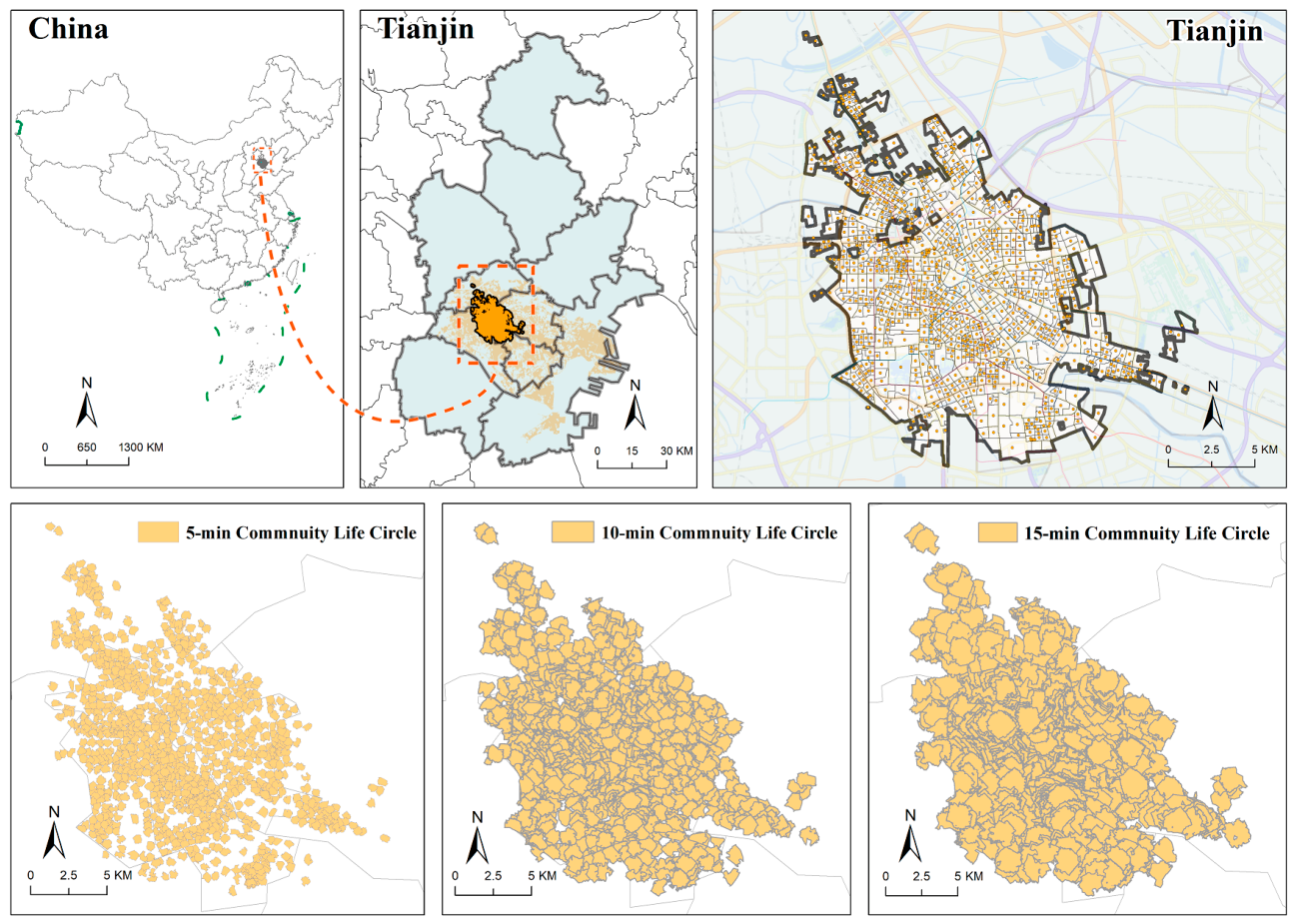
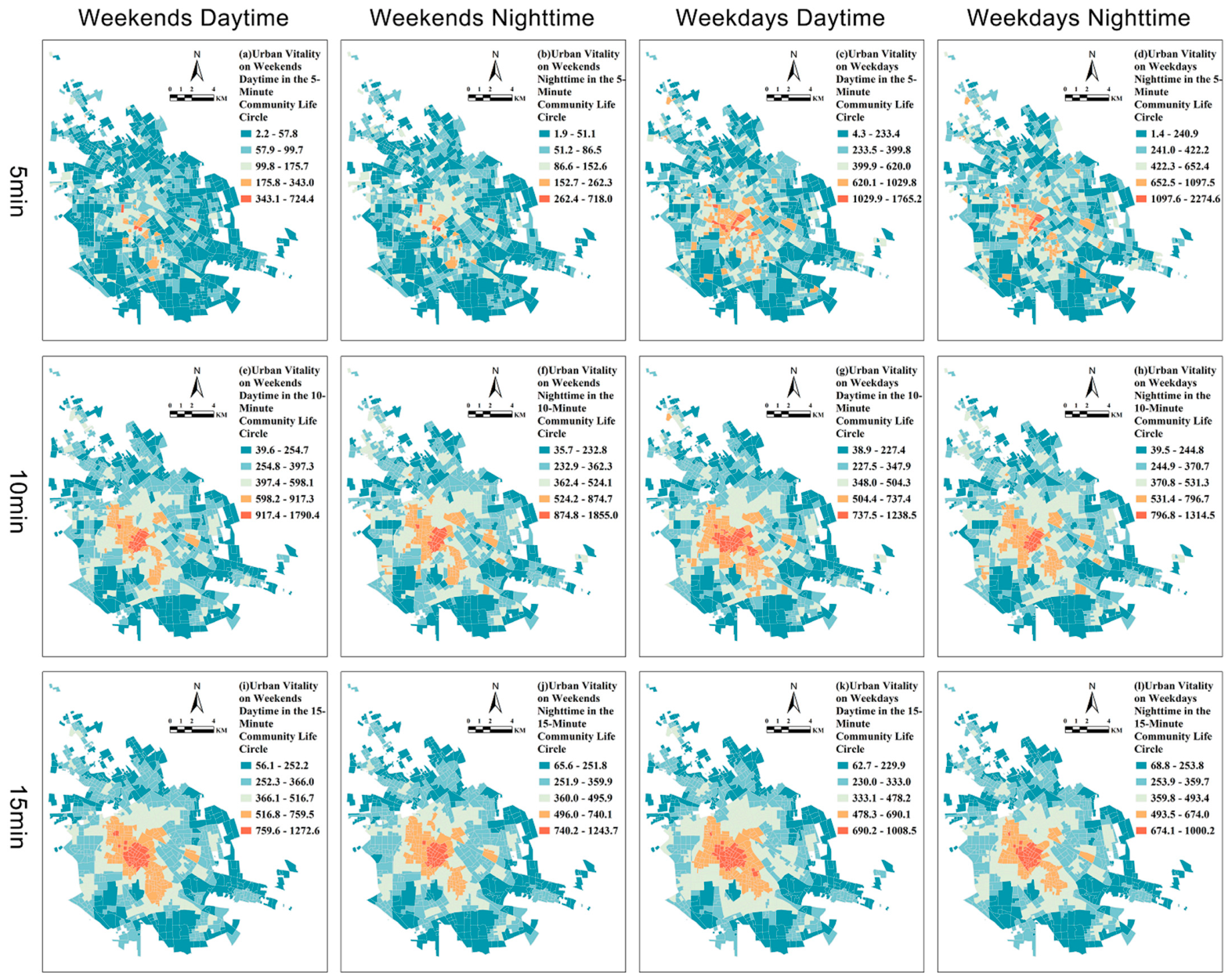
- UV demonstrates pronounced variations across different spatial scales in Tianjin. The 10MCLC exhibits the highest UV, retaining the convenience of the 5MCLC while providing more comprehensive commercial facilities and public spaces, and achieving a balance between convenience and comfort. The 15MCLC exhibits a UV level close to that of the 10MCLC, yet vitality in its marginal areas is insufficient. The 5MCLC exhibits the lowest UV, which is primarily driven by neighborhood-oriented and walkable facilities. The 5MCLC is dominated by regular daily activities, with higher UV on weekdays. The 10MCLC and 15MCLC are more strongly influenced by leisure activities, with more vigorous UV on weekends.
- (2)
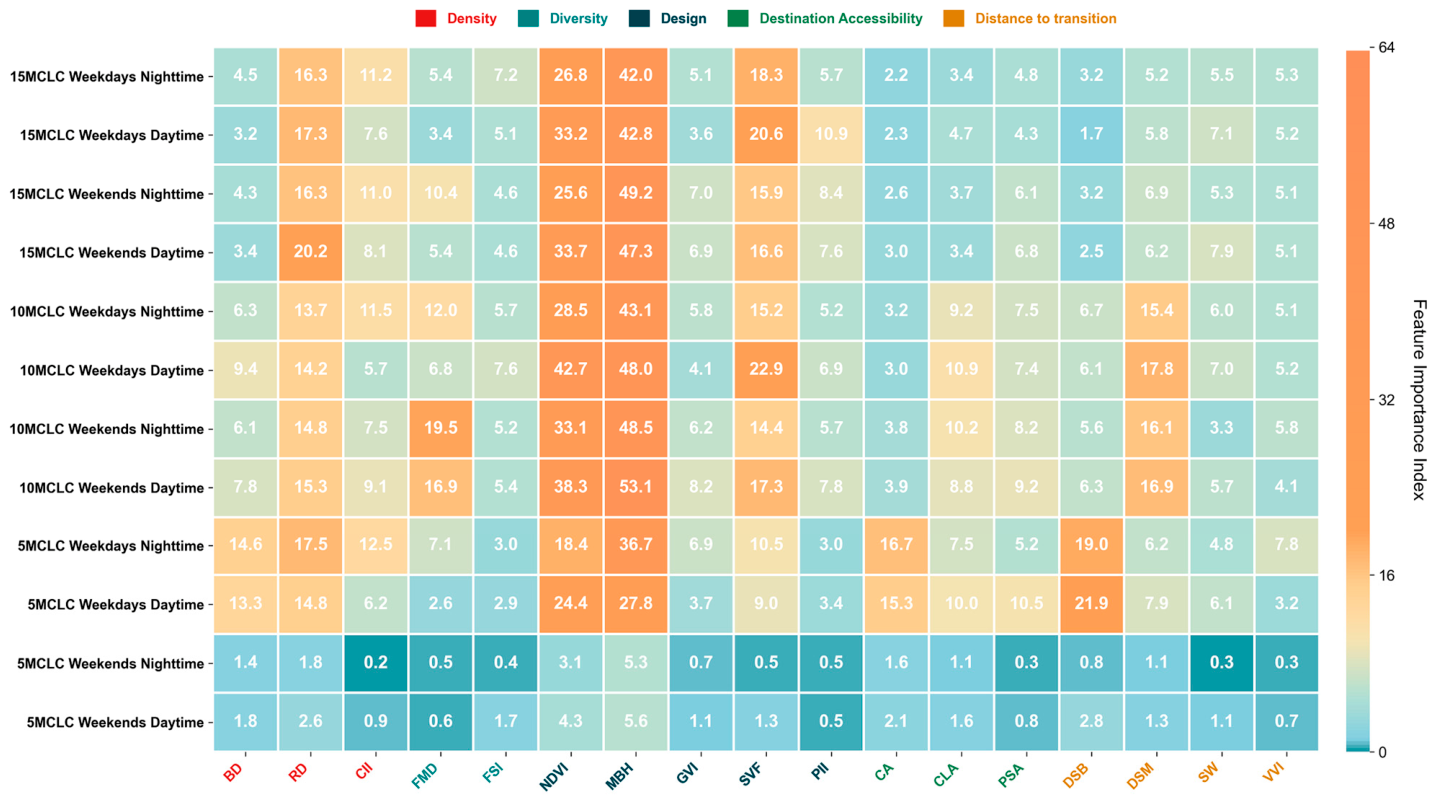
- In the ranking of the relative influence of BE on UV, MBH and NDVI consistently rank at the top. The relative influence rankings of indicators including DSM, DSB, CA, BD, GVI, and SVF vary significantly across different spatiotemporal scenarios. The relative influence of GVI, SVF, and PII increases with the increasing scale. Conversely, the relative influence of CA, DSB, BD, and CLA decreases with the increasing scale. The relative influence of PSA on weekends increases significantly with scale. The relative influence of CII during nighttime is greater than that during daytime. Unlike previous studies, GVI and SVF are negatively associated with UV.
- (3)
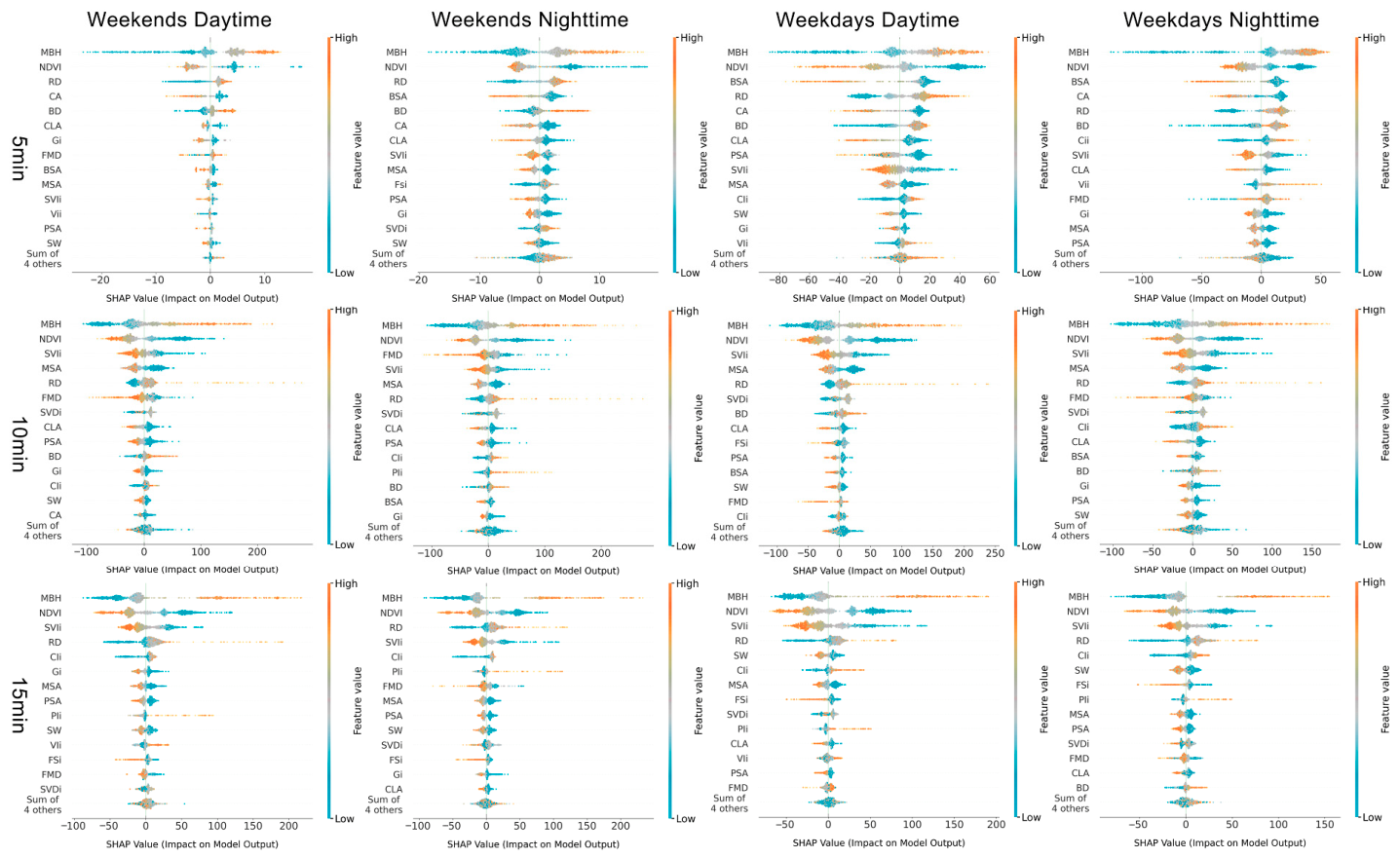
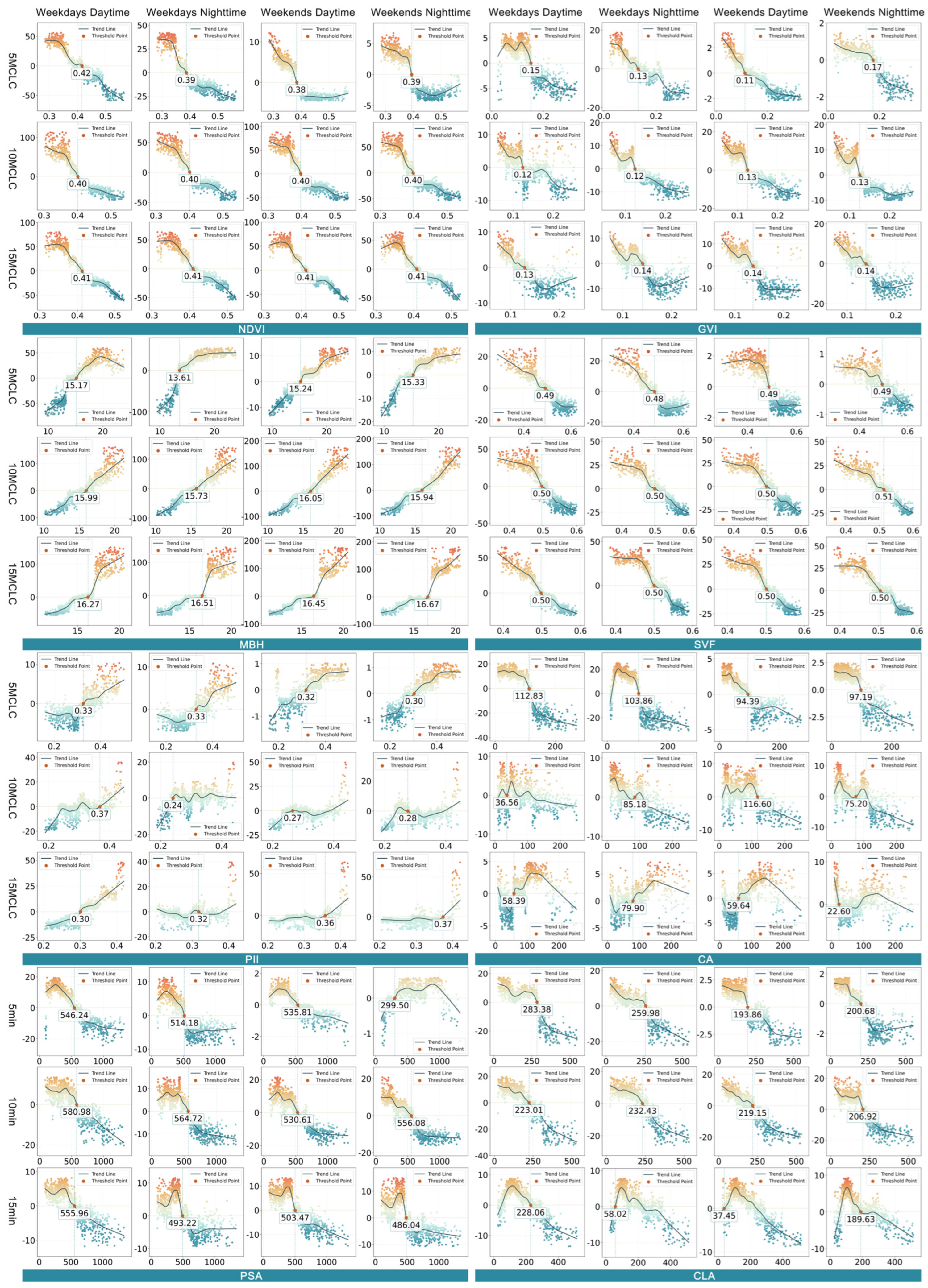
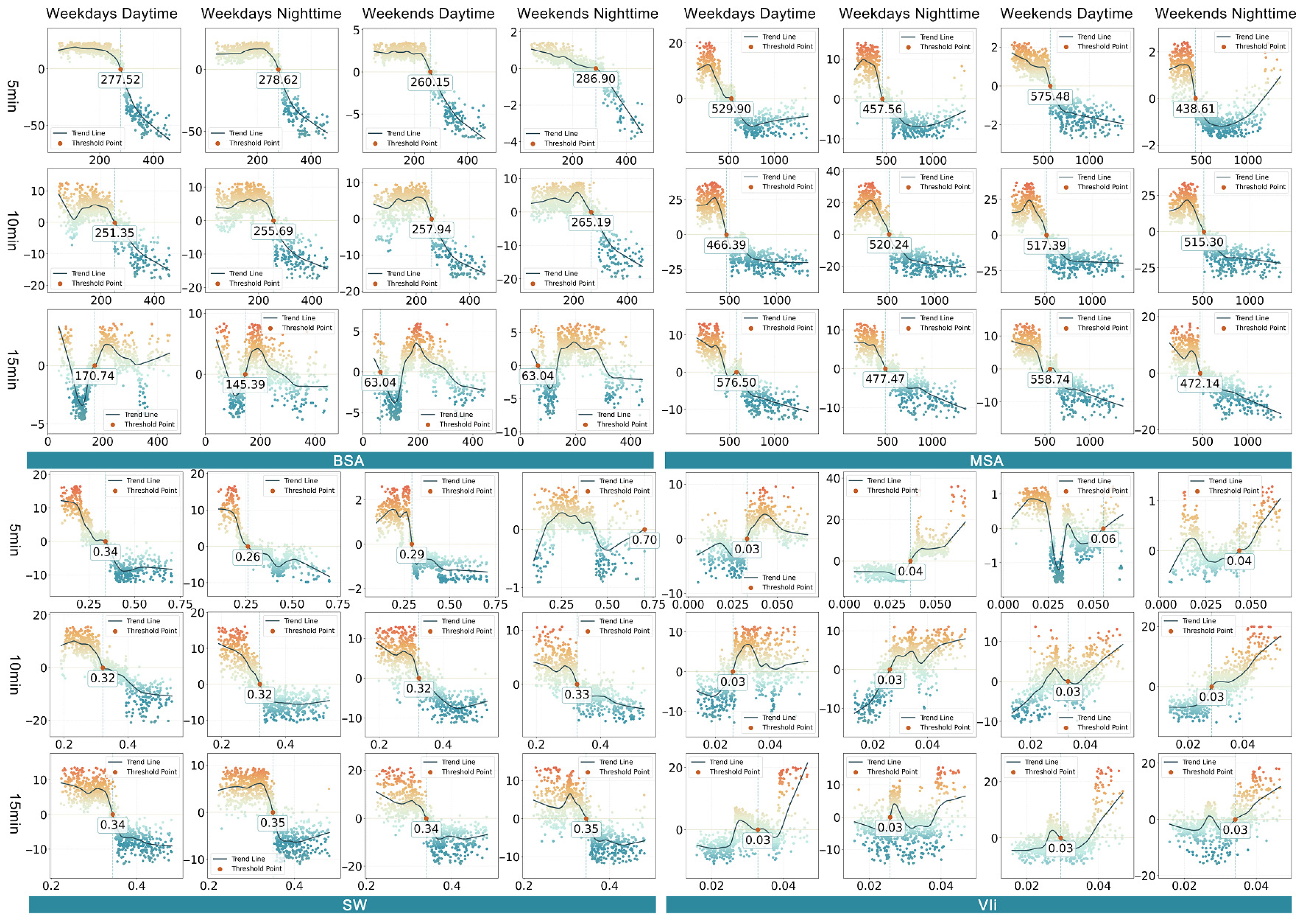
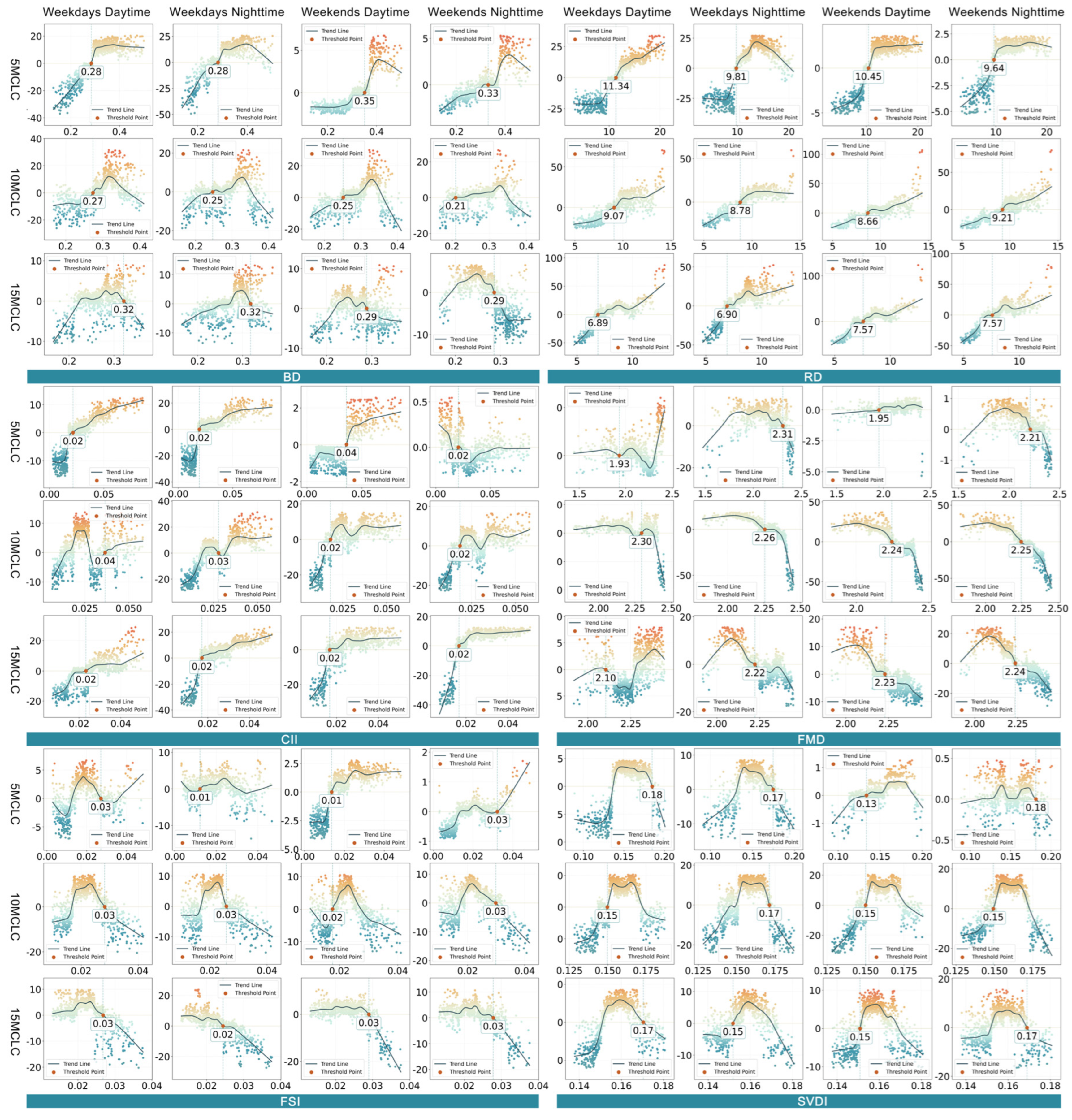
- The effects of BE on UV exhibits nonlinear characteristics, featuring a distinct threshold range that dynamically changes with scale expansion and temporal progression. The nonlinear relationship between BE and UV on weekdays exhibits greater regularity. MBH and NDVI are core indicators that exert effects on UV across all spatiotemporal scenarios. The effects of indicators including BD, RD, MBH, NDVI, CLA, and DSM exhibit strong scale effects and temporal heterogeneity. In terms of scale, as the scale increases, the threshold of RD decreases, while the thresholds of MBH and NDVI increase. Higher BD will exert greater negative effects on UV. In terms of time, the threshold of CLA is higher on weekdays than on weekends, while the threshold of DSM is higher on weekends than on weekdays.
- (4)
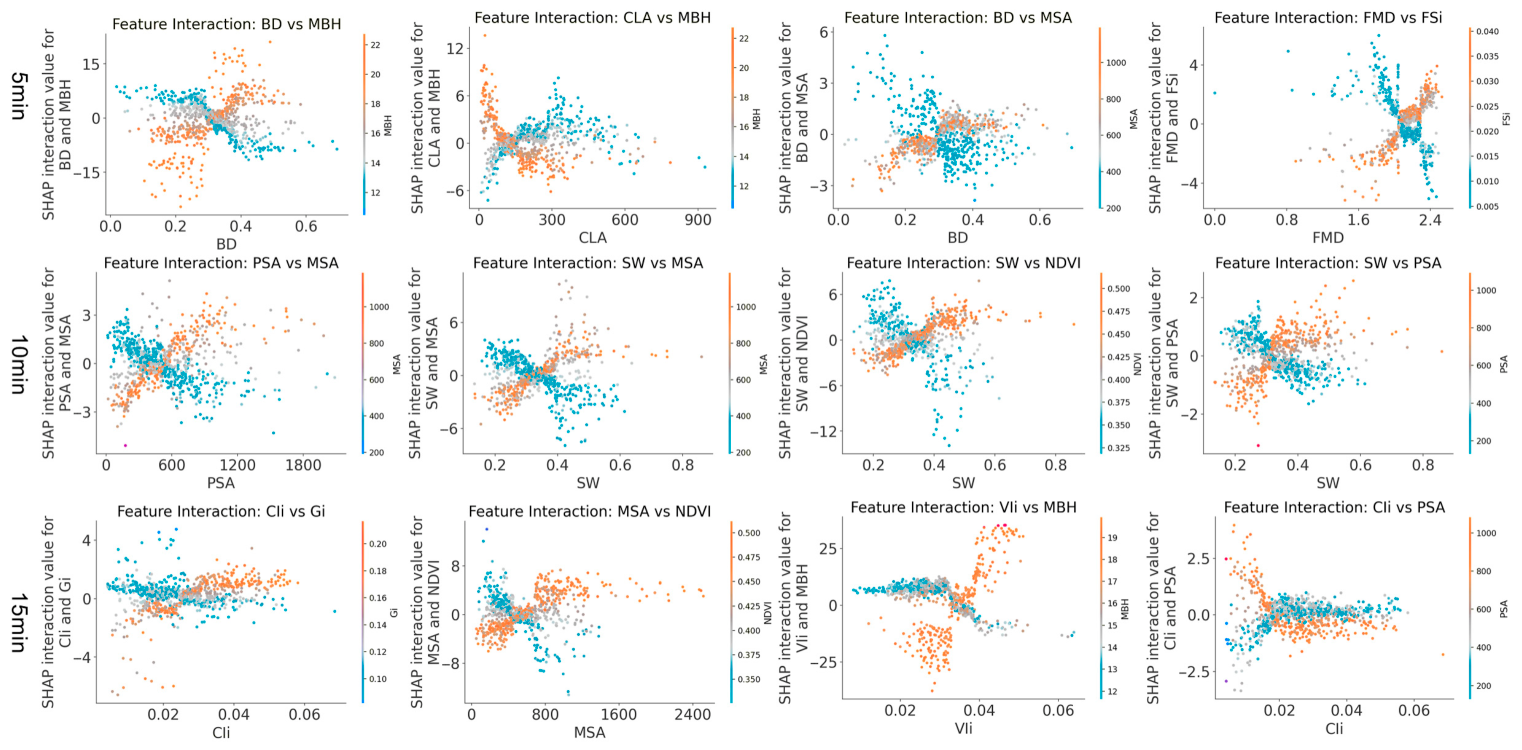
- The interactions between BD and MBH and DSM, between PSA and SW, CII and DSM, and between DSM and SW, NDVI, and other BE indicators are significant. A balance between these BE indicators needs to be achieved through the rational spatial layout and systematic regulation of different BE, in order to effectively enhance UV.
Author Contributions
Funding
Data Availability Statement
Conflicts of Interest
Abbreviations
| BD | Building Density |
| RD | Road Density (km/km2) |
| CII | Crowd Interactivity Index |
| FMD | Functional Mix Degree |
| SVDI | Street Visual Diversity Index |
| FSI | Furniture Support Index |
| NDVI | Normalized Difference Vegetation Index |
| MBH | Mean Building Height (m) |
| GVI | Green View Index |
| SVF | Sky View Factor |
| PII | Place Imageability Index |
| CA | Commercial Accessibility (m) |
| CLA | Cultural and Leisure Accessibility (m) |
| PSA | Park and Square Accessibility (m) |
| DSB | Distance to Bus |
| DSM | Distance to Metro |
| SW | Spatial Walkability |
| VVI | Vehicle Visibility Index |
References
- Wang, X.; Zhang, Y.; Li, C.; Yin, C.; Shao, C. Investigating nonlinear and spatially heterogeneous impacts of the built environment on urban vitality. Sustain. Cities Soc. 2025, 135, 107033. [Google Scholar] [CrossRef] [Scilit]
- Li, X.; Li, Y.; Jia, T.; Zhou, L.; Hijazi, I.H. The six dimensions of built environment on urban vitality: Fusion evidence from multi-source data. Cities 2022, 121, 103482. [Google Scholar] [CrossRef] [Scilit]
- Li, J.; Chen, Y.; Zhao, D.; Zhai, J. The Impact of Built Environment on Mixed Land Use: Evidence from Xi’an. Land 2024, 13, 2214. [Google Scholar] [CrossRef] [Scilit]
- Kohl, H.W.; Craig, C.L.; Lambert, E.V.; Inoue, S.; Alkandari, J.R.; Leetongin, G.; Kahlmeier, S. The pandemic of physical inactivity: Global action for public health. Lancet 2012, 380, 294–305. [Google Scholar] [CrossRef] [Scilit]
- Xia, C.; Yeh, A.G.-O.; Zhang, A. Analyzing spatial relationships between urban land use intensity and urban vitality at street block level: A case study of five Chinese megacities. Landsc. Urban Plan. 2020, 193, 103669. [Google Scholar] [CrossRef] [Scilit]
- Jacobs, J. The Death and Life of Great American Cities; Random House: New York, NY, USA, 1961. [Google Scholar]
- Lynch, K. Good City Form; MIT Press: Cambridge, MA, USA, 1984. [Google Scholar]
- Gehl, J. Life Between Buildings; Island Press: Washington, DC, USA, 2011. [Google Scholar]
- Montgomery, J. Making a city: Urbanity, vitality and urban design. J. Urban Des. 1998, 3, 93–116. [Google Scholar] [CrossRef] [Scilit]
- Sheng, J.; He, Y.; Lu, T.; Wang, F.; Huang, Y.; Leng, B.; Zhang, X.; Chen, Y. Unveiling urban vitality and its interactions in mountainous cities: A human behaviour perspective on community-level dynamics. Cities 2025, 159, 105780. [Google Scholar] [CrossRef] [Scilit]
- Balram, S.; Dragićević, S. Attitudes toward urban green spaces: Integrating questionnaire survey and collaborative GIS techniques to improve attitude measurements. Landsc. Urban Plan. 2005, 71, 147–162. [Google Scholar] [CrossRef]
- Li, Y.; Yabuki, N.; Fukuda, T. Exploring the association between street built environment and street vitality using deep learning methods. Sustain. Cities Soc. 2022, 79, 103656. [Google Scholar] [CrossRef] [Scilit]
- Xie, Q.; Cai, C.; Jiang, Y.; Zhang, H.; Wu, Z.; Xu, J. Investigating the performance of SDGSAT-1/GIU and NPP/VIIRS nighttime light data in representing nighttime vitality and its relationship with the built environment: A comparative study in Shanghai, China. Ecol. Indic. 2024, 160, 111945. [Google Scholar] [CrossRef] [Scilit]
- Pan, H.; Yang, C.; Quan, L.; Liao, L. A New Insight into Understanding Urban Vitality: A Case Study in the Chengdu-Chongqing Area Twin-City Economic Circle, China. Sustainability 2021, 13, 10068. [Google Scholar] [CrossRef] [Scilit]
- Tu, W.; Cao, J.Z.; Yue, Y.; Shaw, S.L.; Zhou, M.; Wang, Z.S.; Chang, X.M.; Xu, Y.; Li, Q.Q. Coupling mobile phone and social media data: A new approach to understanding urban functions and diurnal patterns. Int. J. Geogr. Inf. Sci. 2017, 31, 2331–2358. [Google Scholar] [CrossRef] [Scilit]
- Kim, Y.L. Seoul’s Wi-Fi hotspots: Wi-Fi access points as an indicator of urban vitality. Comput. Environ. Urban Syst. 2018, 72, 13–24. [Google Scholar] [CrossRef] [Scilit]
- Huang, X.; Jiang, P.; Li, M.; Zhao, X. Applicable Framework for Evaluating Urban Vitality with Multiple-Source Data: Empirical Research of the Pearl River Delta Urban Agglomeration Using BPNN. Land 2022, 11, 1901. [Google Scholar] [CrossRef] [Scilit]
- Rui, J.; Li, X. Decoding vibrant neighborhoods: Disparities between formal neighborhoods and urban villages in eye-level perceptions and physical environment. Sustain. Cities Soc. 2024, 101, 105122. [Google Scholar] [CrossRef] [Scilit]
- Jiang, Y.; Sun, Z.; Wei, D.; Zhao, P.; Yang, L.; Lu, Y. Revealing the spatiotemporal pattern of urban vibrancy at the urban agglomeration scale: Evidence from the Pearl River Delta, China. Appl. Geogr. 2025, 181, 103694. [Google Scholar] [CrossRef] [Scilit]
- Cheng, Z.; Li, X.; Zhang, Q. Can new-type urbanization promote the green intensive use of land? J. Environ. Manag. 2023, 342, 118150. [Google Scholar] [CrossRef] [Scilit]
- Liu, P.; Zhu, B. Temporal-spatial evolution of green total factor productivity in China’s coastal cities under carbon emission constraints. Sustain. Cities Soc. 2022, 87, 104231. [Google Scholar] [CrossRef] [Scilit]
- Mouratidis, K.; Poortinga, W. Built environment, urban vitality and social cohesion: Do vibrant neighborhoods foster strong communities? Landsc. Urban Plan. 2020, 204, 103951. [Google Scholar] [CrossRef] [Scilit]
- Asfour, O.S.; Zourob, N. The neighbourhood unit adequacy: An analysis of the case of Gaza, Palestine. Cities 2017, 69, 1–11. [Google Scholar] [CrossRef] [Scilit]
- Moreno, C.; Allam, Z.; Chabaud, D.; Gall, C.; Pratlong, F. Introducing the “15-Minute City”: Sustainability, Resilience and Place Identity in Future Post-Pandemic Cities. Smart Cities 2021, 4, 93–111. [Google Scholar] [CrossRef] [Scilit]
- Teixeira, J.F.; Silva, C.; Seisenberger, S.; Büttner, B.; McCormick, B.; Papa, E.; Cao, M. Classifying 15-minute Cities: A review of worldwide practices. Transp. Res. Part A Policy Pract. 2024, 189, 104234. [Google Scholar] [CrossRef] [Scilit]
- Khavarian-Garmsir, A.R.; Sharifi, A.; Sadeghi, A. The 15-minute city: Urban planning and design efforts toward creating sustainable neighborhoods. Cities 2023, 132, 104101. [Google Scholar] [CrossRef] [Scilit]
- Nica, I.; Delcea, C.; Ionescu, Ș. Urban accessibility and digital transformation: A bibliometric study of the 15-Minute City and smart city technologies. Cities 2026, 171, 106797. [Google Scholar] [CrossRef] [Scilit]
- Liu, W.; Zheng, S.; Hu, X.; Wu, Z.; Chen, S.; Huang, Z.; Zhang, W. Effects of spatial scale on the built environments of community life circles providing health functions and services. Build. Environ. 2022, 223, 109492. [Google Scholar] [CrossRef] [Scilit]
- Song, L.; Kong, X.; Cheng, P. Supply-demand matching assessment of the public service facilities in 15-minute community life circle based on residents’ behaviors. Cities 2024, 144, 104637. [Google Scholar] [CrossRef] [Scilit]
- He, S.; Zhang, Z.; Yu, S.; Xia, C.; Tung, C.-L. Investigating the effects of urban morphology on vitality of community life circles using machine learning and geospatial approaches. Appl. Geogr. 2024, 167, 103287. [Google Scholar] [CrossRef] [Scilit]
- Liu, K.; Zhou, D.; Qi, Y.; Zhang, M.; Ren, Y.; Wei, Y.; Wang, J. Exploring the Complex Effects and Their Spatial Associations of the Built Environment on the Vitality of Community Life Circles Using an eXtreme Gradient Boosting–SHapley Additive exPlanations Approach: A Case Study of Xi’an. Buildings 2025, 15, 1372. [Google Scholar] [CrossRef] [Scilit]
- Liu, D.; Shi, Y. The Influence Mechanism of Urban Spatial Structure on Urban Vitality Based on Geographic Big Data: A Case Study in Downtown Shanghai. Buildings 2022, 12, 569. [Google Scholar] [CrossRef] [Scilit]
- Zhang, A.; Li, W.; Wu, J.; Lin, J.; Chu, J.; Xia, C. How can the urban landscape affect urban vitality at the street block level? A case study of 15 metropolises in China. Environ. Plan. B Urban Anal. City Sci. 2021, 48, 1245–1262. [Google Scholar] [CrossRef] [Scilit]
- Cervero, R.; Kockelman, K. Travel demand and the 3Ds: Density, diversity, and design. Transp. Res. Part D Transp. Environ. 1997, 2, 199–219. [Google Scholar] [CrossRef] [Scilit]
- Chen, J.; Tian, W.; Xu, K.; Pellegrini, P. Testing Small-Scale Vitality Measurement Based on 5D Model Assessment with Multi-Source Data: A Resettlement Community Case in Suzhou. ISPRS Int. J. Geo-Inf. 2022, 11, 626. [Google Scholar] [CrossRef] [Scilit]
- Lai, G.; Shang, Y.; He, B.; Zhao, G.; Yang, M. Revealing Taxi Interaction Network of Urban Functional Area Units in Shenzhen, China. ISPRS Int. J. Geo-Inf. 2022, 11, 377. [Google Scholar] [CrossRef] [Scilit]
- Badrinarayanan, V.; Kendall, A.; Cipolla, R. SegNet: A Deep Convolutional Encoder-Decoder Architecture for Image Segmentation. IEEE Trans. Pattern Anal. Mach. Intell. 2017, 39, 2481–2495. [Google Scholar] [CrossRef] [Scilit]
- Shen, Q.; Zeng, W.; Ye, Y.; Arisona, S.M.; Schubiger, S.; Burkhard, R.; Qu, H. StreetVizor: Visual Exploration of Human-Scale Urban Forms Based on Street Views. IEEE Trans. Vis. Comput. Graph. 2018, 24, 1004–1013. [Google Scholar] [CrossRef] [Scilit]
- Wang, H.; Yang, Y. Neighbourhood walkability: A review and bibliometric analysis. Cities 2019, 93, 43–61. [Google Scholar] [CrossRef] [Scilit]
- Lu, S.; Shi, C.; Yang, X. Impacts of Built Environment on Urban Vitality: Regression Analyses of Beijing and Chengdu, China. Int. J. Environ. Res. Public Health 2019, 16, 4592. [Google Scholar] [CrossRef] [Scilit]
- Fotheringham, A.S.; Yang, W.; Kang, W. Multiscale Geographically Weighted Regression (MGWR). Ann. Am. Assoc. Geogr. 2017, 107, 1247–1265. [Google Scholar] [CrossRef] [Scilit]
- Zhang, W.; Zhao, Y.; Cao, X.; Lu, D.; Chai, Y. Nonlinear effect of accessibility on car ownership in Beijing: Pedestrian-scale neighborhood planning. Transp. Res. Part D Transp. Environ. 2020, 86, 102445. [Google Scholar] [CrossRef] [Scilit]
- Xiao, L.; Lo, S.; Liu, J.; Zhou, J.; Li, Q. Nonlinear and synergistic effects of TOD on urban vibrancy: Applying local explanations for gradient boosting decision tree. Sustain. Cities Soc. 2021, 72, 103063. [Google Scholar] [CrossRef] [Scilit]
- Yang, L.; Ao, Y.; Ke, J.; Lu, Y.; Liang, Y. To walk or not to walk? Examining non-linear effects of streetscape greenery on walking propensity of older adults. J. Transp. Geogr. 2021, 94, 103099. [Google Scholar] [CrossRef] [Scilit]
- Sun, F.; Wang, E. Unveiling the Spatial Heterogeneity of Urban Vitality Using Machine Learning Methods: A Case Study of Tianjin, China. Land 2025, 14, 1316. [Google Scholar] [CrossRef] [Scilit]
- Tian, Y.; Kong, X.; Liu, Y. Combining weighted daily life circles and land suitability for rural settlement reconstruction. Habitat Int. 2018, 76, 1–9. [Google Scholar] [CrossRef] [Scilit]
- Millward, H.; Spinney, J.; Scott, D. Active-transport walking behavior: Destinations, durations, distances. J. Transp. Geogr. 2013, 28, 101–110. [Google Scholar] [CrossRef] [Scilit]
- Fang, L.; Huang, J.L.; Zhang, Z.Y.; Nitivattananon, V. Data-driven framework for delineating urban population dynamic patterns: Case study on Xiamen Island, China. Sustain. Cities Soc. 2020, 62, 102365. [Google Scholar] [CrossRef] [Scilit] [PubMed]
- Lyu, G.; Angkawisittpan, N.; Fu, X.; Sonasang, S. Enhancing urban vitality through big data: A case study of Yinchuan City using GWR and GBDT models. Sci. Rep. 2023. [Google Scholar] [CrossRef] [Scilit]
- Yang, J.; Cao, J.; Zhou, Y. Elaborating non-linear associations and synergies of subway access and land uses with urban vitality in Shenzhen. Transp. Res. Part A Policy Pract. 2021, 144, 74–88. [Google Scholar] [CrossRef] [Scilit]
- Gong, F.-Y.; Yang, Z.; Deng, S. Fine-scale assessment of diurnal heat health risk based on satellite and street view images. Cities 2025, 162, 105963. [Google Scholar] [CrossRef] [Scilit]
- Wu, W.; Tan, W.; Wang, R.; Chen, W.Y. From quantity to quality: Effects of urban greenness on life satisfaction and social inequality. Landsc. Urban Plan. 2023, 238, 104843. [Google Scholar] [CrossRef] [Scilit]
- Lu, Y. The Association of Urban Greenness and Walking Behavior: Using Google Street View and Deep Learning Techniques to Estimate Residents’ Exposure to Urban Greenness. Int. J. Environ. Res. Public Health 2018, 15, 1576. [Google Scholar] [CrossRef] [Scilit]
- Yu, Y.; Jiang, Y.; Qiu, N.; Guo, H.; Han, X.; Guo, Y. Exploring built environment factors on e-bike travel behavior in urban China: A case study of Jinan. Front. Public Health 2022, 10, 1013421. [Google Scholar] [CrossRef] [Scilit]
- Yang, J.; Dong, J.; Xiao, X.; Dai, J.; Wu, C.; Xia, J.; Zhao, G.; Zhao, M.; Li, Z.; Zhang, Y.; et al. Divergent shifts in peak photosynthesis timing of temperate and alpine grasslands in China. Remote Sens. Environ. 2019, 233, 111395. [Google Scholar] [CrossRef] [Scilit]
- Tan, W.; Wei, C.; Lu, Y.; Xue, D. Reconstruction of All-Weather Daytime and Nighttime MODIS Aqua-Terra Land Surface Temperature Products Using an XGBoost Approach. Remote Sens. 2021, 13, 4723. [Google Scholar] [CrossRef] [Scilit]
- Zhang, X.; Yan, C.; Gao, C.; Malin, B.A.; Chen, Y. Predicting Missing Values in Medical Data Via XGBoost Regression. J. Healthc. Inform. Res. 2020, 4, 383–394. [Google Scholar] [CrossRef] [Scilit]
- Ester, M.; Kriegel, H.P.; Xu, X. XGBoost: A scalable tree boosting system. In Proceedings of the 22Nd ACM SIGKDD International Conference on Knowledge Discovery and Data Mining, San Francisco, CA, USA, 13–17 August 2016; Geographical Analysis 2022. p. 785. [Google Scholar]
- Lundberg, S.M.; Lee, S.-I. A unified approach to interpreting model predictions. arXiv 2017, arXiv:1705.07874. [Google Scholar] [CrossRef] [Scilit]
- Lundberg, S.M.; Erion, G.; Chen, H.; DeGrave, A.; Prutkin, J.M.; Nair, B.; Katz, R.; Himmelfarb, J.; Bansal, N.; Lee, S.-I. From local explanations to global understanding with explainable AI for trees. Nat. Mach. Intell. 2020, 2, 56–67. [Google Scholar] [CrossRef] [Scilit] [PubMed]
- Tamim Kashifi, M.; Jamal, A.; Samim Kashefi, M.; Almoshaogeh, M.; Masiur Rahman, S. Predicting the travel mode choice with interpretable machine learning techniques: A comparative study. Travel Behav. Soc. 2022, 29, 279–296. [Google Scholar] [CrossRef] [Scilit]
- Yang, J.; Wang, E. Exploring the Nonlinear Impacts of Built Environment on Urban Vitality from a Spatiotemporal Perspective at the Block Scale in Chongqing. ISPRS Int. J. Geo-Inf. 2025, 14, 225. [Google Scholar] [CrossRef] [Scilit]
- Chen, L.; Zhao, L.Y.; Xiao, Y.; Lu, Y. Investigating the spatiotemporal pattern between the built environment and urban vibrancy using big data in Shenzhen, China. Comput. Environ. Urban Syst. 2022, 95, 101827. [Google Scholar] [CrossRef] [Scilit]
- Lee, S.; Cho, N. Nonlinear and interaction effects of multi-dimensional street-level built environment features on urban vitality in Seoul. Cities 2025, 165, 106145. [Google Scholar] [CrossRef] [Scilit]
- Zhang, Y.; Wang, X.; Ye, Y.; Wang, L.; Zhang, Y.; Qin, W.; Chi, Y.; Liu, G.; Yao, S. Nonlinear relationships and interaction effects of urban built environment on urban vitality based on explainable machine learning. City Environ. Interact. 2025, 28, 100244. [Google Scholar] [CrossRef] [Scilit]
- Yue, Y.; Zhuang, Y.; Yeh, A.G.O.; Xie, J.Y.; Ma, C.L.; Li, Q.Q. Measurements of POI-based mixed use and their relationships with neighbourhood vibrancy. Int. J. Geogr. Inf. Sci. 2017, 31, 658–675. [Google Scholar] [CrossRef] [Scilit]
- Jiang, Y.; Han, Y.; Liu, M.; Ye, Y. Street vitality and built environment features: A data-informed approach from fourteen Chinese cities. Sustain. Cities Soc. 2022, 79, 103724. [Google Scholar] [CrossRef] [Scilit]
- Zhou, H.; Gu, J.; Liu, Y.; Wang, X. The impact of the “skeleton” and “skin” for the streetscape on the walking behavior in 3D vertical cities. Landsc. Urban Plan. 2022, 227, 104543. [Google Scholar] [CrossRef] [Scilit]
- Ming, Y.; Liu, Y.; Li, Y.; Yue, W. Core-periphery disparity in community vitality in Chongqing, China: Nonlinear explanation based on mobile phone data and multi-scale factors. Appl. Geogr. 2024, 164, 103222. [Google Scholar] [CrossRef] [Scilit]
- Qiao, W.; Zheng, H. Predicting urban vitality and pedestrian road safety in urban areas based on machine learning. Cities 2025, 166, 106193. [Google Scholar] [CrossRef] [Scilit]
- Lian, A.; Zhang, Y.; Cai, Y.; Wang, Z.; Sun, X.; Jiao, Y.; Dong, R. Exploring the nonlinear relationship and interaction effects between the built environment and street vitality using machine learning methods. Ecol. Front. 2026, 46, 932–946. [Google Scholar] [CrossRef] [Scilit]
- Chen, Y.; Yu, B.; Shu, B.; Yang, L.; Wang, R. Exploring the spatiotemporal patterns and correlates of urban vitality: Temporal and spatial heterogeneity. Sustain. Cities Soc. 2023, 91, 104440. [Google Scholar] [CrossRef] [Scilit]
- Sung, H.; Lee, S. Residential built environment and walking activity: Empirical evidence of Jane Jacobs’ urban vitality. Transp. Res. Part D Transp. Environ. 2015, 41, 318–329. [Google Scholar] [CrossRef] [Scilit]
- Doan, Q.C.; Ma, J.; Chen, S.; Zhang, X. Nonlinear and threshold effects of the built environment, road vehicles and air pollution on urban vitality. Landsc. Urban Plan. 2025, 253, 105204. [Google Scholar] [CrossRef] [Scilit]
- Lin, J.Y.; Zhuang, Y.Y.; Zhao, Y.; Li, H.; He, X.Y.; Lu, S.Y. Measuring the Non-Linear Relationship between Three-Dimensional Built Environment and Urban Vitality Based on a Random Forest Model. Int. J. Environ. Res. Public Health 2023, 20, 734. [Google Scholar] [CrossRef] [Scilit] [PubMed]





| Dimension | Indicator | Abbr. | Description | Data Source |
|---|---|---|---|---|
| Density | Building Density | BD | Building footprint area/CLC area | Amap |
| Road Density (km/km2) | RD | Total road length inside the CLC (outward-facing roads)/CLC area | OSM data | |
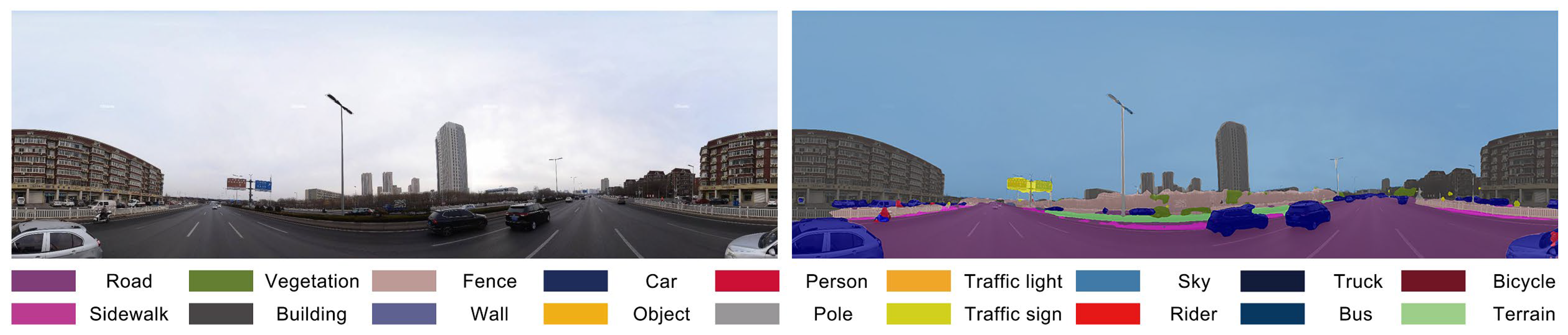
| Crowd Interactivity Index | CII | The density of pedestrians, cyclists and non-motor vehicles on roads CII = VIperson + VIrider + VIbicycle/VIsidewalk + VIroad | Baidu Map | |
| Diversity | Functional Mix Degree | FMD | Diversity index of various POIs within the CLC (calculated using Shannon’s diversity index) | Amap |
| Street Visual Diversity Index | SVDI | The area proportion of roads, sidewalks, fences, poles, street lamps and traffic signs SVDI = VIroad + VIsidewalk + VIfence + VIpole + VIstrlgt + VIstrsig | Baidu Map | |
| Furniture Support Index | FSI | The area proportion of fences, street lamps and traffic signs FSI = VIfence + VIstrlgt + VIstrsig | Baidu Map | |
| Design | Normalized Difference Vegetation Index | NDVI | Average fractional vegetation cover within the CLC | Google Earth Engine |
| Mean Building Height (m) | MBH | Average building height within the CLC | Amap | |
| Green View Index | GVI | Vegetation coverage percentage GVI = VIvegetation | Baidu Map | |
| Sky View Factor | SVF | Sky visibility percentage SVF = VIsky | Baidu Map | |
| Place Imageability Index | PII | The proportion of buildings, vegetation and streets PII = VIbuilding + VIvegetation + VIstrsig | Baidu Map | |
| Destination Accessibility | Commercial Accessibility (m) | CA | Distance from CLC centroid to nearest commercial POI | Amap |
| Cultural and Leisure Accessibility (m) | CLA | Distance from CLC centroid to nearest cultural and leisure POI | Amap | |
| Park and Square Accessibility (m) | PSA | Distance from CLC centroid to nearest park or square | Amap | |
| Distance to Transition | Distance to Bus | DSB | Distance from CLC centroid to nearest bus stops | Amap |
| Distance to Metro | DSM | Distance from CLC centroid to nearest metro station | Amap | |
| Spatial Walkability | SW | The ratio of pedestrian traffic facilities (sidewalks, fences) to roads SW = VIsidewalk + VIfence/VIroad | Baidu Map | |
| Vehicle Visibility Index | VVI | The proportion of vehicle (cars, trucks, trains, buses and motorcycles) pixels in the image VII = VIcar + VItruck + VIbus + VItrain + VImotorcycle | Baidu Map |
| Learning_Rate | Max_Depth | N_Estimators | |
|---|---|---|---|
| 5MCLC Weekdays Daytime, 5MCLC Weekdays Nighttime | 0.05 | 4 | 100 |
| 10MCLC Weekdays Nighttime, 10MCLC Weekends Daytime, 10MCLC Weekends Nighttime, 15MCLC Weekdays Daytime, 15MCLC Weekends Daytime | 0.1 | 4 | 100 |
| 10MCLC Weekdays Daytime, 15MCLC Weekdays Nighttime, 15MCLC Weekends Nighttime | 0.15 | 4 | 100 |
| 5MCLC Weekends Daytime | 0.1 | 3 | 50 |
| 5MCLC Weekends Nighttime | 0.05 | 4 | 50 |
| Training Set R2 | Test Set R2 | Training Set RMSE | Test Set RMSE | Training Set MAE | Test Set MAE | |
|---|---|---|---|---|---|---|
| 5MCLC Weekdays Daytime | 0.7419 | 0.4486 | 83.8733 | 120.6674 | 62.4318 | 95.7779 |
| 5MCLC Weekdays Nighttime | 0.7384 | 0.3461 | 90.9493 | 127.9279 | 69.5706 | 101.8469 |
| 5MCLC Weekends Daytime | 0.5392 | 0.3780 | 19.7715 | 24.2794 | 14.6887 | 19.1400 |
| 5MCLC Weekends Nighttime | 0.4688 | 0.3193 | 20.7130 | 23.0605 | 16.1982 | 18.6505 |
| 10MCLC Weekdays Daytime | 0.9655 | 0.7015 | 33.9461 | 90.1331 | 24.7699 | 69.3337 |
| 10MCLC Weekdays Nighttime | 0.9256 | 0.6741 | 45.6437 | 86.0709 | 33.0154 | 67.6469 |
| 10MCLC Weekends Daytime | 0.9336 | 0.6875 | 52.5466 | 100.8412 | 36.7550 | 77.2685 |
| 10MCLC Weekends Nighttime | 0.9302 | 0.6713 | 50.1545 | 97.9899 | 34.5309 | 73.2271 |
| 15MCLC Weekdays Daytime | 0.9766 | 0.8931 | 25.2570 | 50.4237 | 19.6079 | 40.4872 |
| 15MCLC Weekdays Nighttime | 0.9846 | 0.8527 | 17.9878 | 52.6425 | 13.4789 | 41.2760 |
| 15MCLC Weekends Daytime | 0.9733 | 0.8695 | 28.9087 | 60.1870 | 21.5886 | 47.3241 |
| 15MCLC Weekends Nighttime | 0.9835 | 0.8477 | 20.6979 | 59.7020 | 15.2735 | 46.6706 |
| Scale | Community Life Circle Vitality | |||
|---|---|---|---|---|
| Weekends Daytime | Weekends Nighttime | Weekdays Daytime | Weekdays Nighttime | |
| 5MCLC | 71.03 | 68.89 | 361.84 | 387.58 |
| 10MCLC | 388.06 | 372.42 | 358.86 | 375.43 |
| 15MCLC | 374.38 | 356.34 | 348.28 | 359.8 |
Disclaimer/Publisher’s Note: The statements, opinions and data contained in all publications are solely those of the individual author(s) and contributor(s) and not of MDPI and/or the editor(s). MDPI and/or the editor(s) disclaim responsibility for any injury to people or property resulting from any ideas, methods, instructions or products referred to in the content. |
© 2026 by the authors. Published by MDPI on behalf of the International Society for Photogrammetry and Remote Sensing. Licensee MDPI, Basel, Switzerland. This article is an open access article distributed under the terms and conditions of the Creative Commons Attribution (CC BY) license.
Share and Cite
Fu, R.; Wang, E. Nonlinearity and Scale Effects: How the Built Environment Modulates Urban Vitality in Multi-Scale Community Life Circles Across Weekdays and Weekends. ISPRS Int. J. Geo-Inf. 2026, 15, 190. https://doi.org/10.3390/ijgi15050190
Fu R, Wang E. Nonlinearity and Scale Effects: How the Built Environment Modulates Urban Vitality in Multi-Scale Community Life Circles Across Weekdays and Weekends. ISPRS International Journal of Geo-Information. 2026; 15(5):190. https://doi.org/10.3390/ijgi15050190
Chicago/Turabian StyleFu, Runya, and Enxu Wang. 2026. "Nonlinearity and Scale Effects: How the Built Environment Modulates Urban Vitality in Multi-Scale Community Life Circles Across Weekdays and Weekends" ISPRS International Journal of Geo-Information 15, no. 5: 190. https://doi.org/10.3390/ijgi15050190
APA StyleFu, R., & Wang, E. (2026). Nonlinearity and Scale Effects: How the Built Environment Modulates Urban Vitality in Multi-Scale Community Life Circles Across Weekdays and Weekends. ISPRS International Journal of Geo-Information, 15(5), 190. https://doi.org/10.3390/ijgi15050190