
Article

Multi-Scale Space Syntax Analysis of Hybrid Urban Street Networks for Accessibility and Mobility Efficiency: The Case of Mandalay in Myanmar

1
Department of Human Ecology and Technology, Handong Global University, 558 Handongro, Bukgu, Pohang 37554, Republic of Korea
2
Department of Spatial Environment System Engineering, Handong Global University, 558 Handongro, Bukgu, Pohang 37554, Republic of Korea
*
Author to whom correspondence should be addressed.
ISPRS Int. J. Geo-Inf. 2026, 15(2), 62; https://doi.org/10.3390/ijgi15020062 (registering DOI)
Submission received: 19 November 2025 / Revised: 16 January 2026 / Accepted: 28 January 2026 / Published: 31 January 2026
(This article belongs to the Special Issue Spatial Data Science and Knowledge Discovery)

Abstract

Street layout has a significant effect on accessibility and intelligibility, which ultimately affects navigation and movement efficiency. While previous research has examined planned and unplanned street patterns, most studies focus on single-scale analyses or isolated typologies, limiting understanding of how hybrid networks function across multiple spatial levels. Addressing this gap, this study investigates the effects of hybrid planned and organically evolved street layouts on spatial accessibility in Mandalay, Myanmar. The research employs space syntax analysis to assess the citywide, township-level, and micro-scale networks through measures of angular integration, choice, axial connectivity, and intelligibility. Using the Four-Point Star Model to identify Mandalay’s distinct spatial features, a global accessibility assessment compares it to 50 other cities. The results show that grid-based layouts with central townships exhibit the highest integration and connectivity, while organic and fragmented networks, particularly in Amarapura, reduce spatial coherence and accessibility. Micro-scale analysis indicates that hybrid layouts with cul-de-sacs and distorted grids can improve accessibility when they connect effectively with secondary roads. By analysing street networks across multiple spatial scales, this research presents significant implications for efficient accessibility and transport planning in mixed-pattern cities.

1. Introduction

Street patterns play a fundamental role in shaping urban connectivity, pedestrian movement and overall livability [1,2]. Their arrangement influences how people find their way, how easily they can move through the city, and the spatial legibility of their surroundings [3,4,5,6,7,8,9]. With rapid urbanization around the world, it has become increasingly important to understand how planned and unplanned street networks interact, since this relationship affects both mobility efficiency and long-term sustainability. In many cities, regular grid layouts are known to improve connectivity and create a more predictable urban form, which in turn helps people navigate more easily and supports everyday urban functions [5,10,11,12,13,14,15]. Recent studies demonstrate that spatial properties are scale-dependent, with different network characteristics emerging at city-wide, neighbourhood, and micro-scales [16,17,18,19]. Recent analytical approaches have extended these ideas by integrating configurational and typological analyses within urban morphology, linking spatial form to performance and design outcomes [20,21].
Unplanned and informal street networks tend to create fragmented urban spaces. This fragmentation decreases accessibility, walkability, and economic activity because of irregular connectivity [22,23,24,25,26]. However, the relationship between planned and unplanned patterns is more complex than a simple dichotomy, particularly in cities shaped by multiple planning regimes that have introduced various grid geometries across political periods. Existing research on hybrid cities mainly focuses on colonial–indigenous overlays, where European planning systems introduced grid layouts into pre-existing organic settlements [27,28,29,30]. In contrast, cities where non-colonial and post-independence planning regimes introduced different grid geometries that coexist with organic street patterns across multiple periods and spatial scales remain largely understudied.
Myanmar cities are notably absent from major comparative space syntax studies and global urban classification frameworks, despite their distinctive morphological development [31,32]. Large-scale comparative work such as Sun (2013) demonstrates how global datasets of 50 cities can reveal consistent configurational properties, yet Myanmar and much of Southeast Asia remain underrepresented [33]. In the regional context, studies like Paul (2012) show how space syntax can inform evidence-based urban design in Asian cities, underscoring the importance of expanding such analyses to indigenous Southeast Asian morphologies [34]. Although recent studies suggest that the interaction between grid and irregular street patterns can support urban adaptability, systematic multi-scale analyses of indigenous hybrid grid systems remain limited. Such hybrid morphologies, characterized by multiple grid geometries alongside organic street patterns, may produce different relationships between spatial structure and urban function, highlighting the need for clear morphological analysis as a foundation for future functional studies. Unlike most existing studies that focus on colonial–indigenous overlays or single-period planning systems, this study examines a multi-period indigenous hybrid grid system combined with organic growth patterns across multiple spatial scales using space syntax.
Mandalay, the last royal capital of Myanmar, presents a unique case study for addressing these research gaps because of its multi-period indigenous grid systems with distinct geometries coexisting with extensive organic development. The city’s original square grid was established by King Mindon in the mid-nineteenth century, with a 2400-square-foot perimeter enclosing the royal palace and royal city wall [35]. The outer city was constructed on a grid pattern measuring 525 square feet. [31]. In 1885, during the colonial period, a modern superblock system was introduced into parts of the original grid pattern to enhance transportation efficiency, without altering the underlying grid dimensions. In the 1980s, the Burma Socialist Program Party (BSPP) introduced a new rectangular grid in the southern city extension, characterized by elongated blocks designed to accommodate rapid urbanization and squatter development. During the State Law and Order Restoration Council (SLORC), the grid pattern remained unchanged to develop an industrial development township [31]. Amarapura, the former capital, developed predominantly organic street patterns after the destruction of its original palace grid and was incorporated into Mandalay’s urban area in 2015, introducing extensive organic and distorted grid areas into the formal city structure.
Mandalay’s layering of indigenous grids, modern planned grid extensions, and organic settlements offers a distinctive opportunity to examine how planned and unplanned street networks coexist and influence accessibility and intelligibility across spatial scales. It also provides an opportunity to explore how these spatial systems interact to shape urban mobility, intelligibility, and spatial equity across multiple scales. To capture these dynamics, this study adopts a three-tiered analytical framework that moves from macro to micro scales. At the city-wide level, it examines the global accessibility structure shaped by major arterial streets and overall street network integration. The township scale then allows for comparison between administrative areas that differ in grid geometry, block size, and the extent of organic development. Finally, the 1 km2 micro-neighbourhood scale reveals how local spatial configurations such as cul-de-sacs, distorted grids, or continuous links aggregate to affect neighbourhood-scale intelligibility and walkability. This nested approach helps unpack how accessibility outcomes emerge from the interaction of spatial structures across scales. By clarifying these inter-scale dynamics, the study responds directly to the need for more structured multi-scalar approaches in space syntax and urban morphology research.
Space syntax analysis is commonly employed to investigate the connections among urban street networks, accessibility, and intelligibility. Recent methodological advances in space syntax have expanded its analytical scope through network-based and multi-scalar configurational models [21,36,37,38,39,40]. These developments enable stronger quantitative links between spatial configuration and urban function, supporting the comparative and evidence-based approach adopted in this study. It provides important insights into the ways in which spatial configuration affects movement patterns [10,41,42,43,44,45,46]. Extensive empirical research has demonstrated strong relationships between syntactic measures and observed movement, confirming the effectiveness of space syntax in linking spatial form to movement efficiency [10,47,48]. The methodology enables the analysis of key street network characteristics such as connectivity, integration, and depth, which are essential for understanding urban mobility and accessibility across different urban contexts [1,49,50,51]. Empirical studies further show that different spatial configurations—such as grid and organic street patterns—generate distinct movement behaviors and levels of pedestrian activity, highlighting the importance of spatial structure in shaping urban mobility [30,52]. In addition, space syntax supports the interpretation of the historical evolution of urban spaces, urban morphology and informs planning and design decisions aimed at improving walkability and transportation sustainability [21,53,54,55]. Therefore, this study applies space syntax measures within a multi-scale analytical framework to examine how hybrid street network configurations influence accessibility and intelligibility. Unlike conventional network or GIS-based analyses that primarily measure distance or connectivity, space syntax is specifically designed to examine spatial configuration and intelligibility, making it well suited for analysing hybrid street networks across multiple spatial scales.
Mandalay represents a geographically complex urban morphology, where multiple grid geometries coexist with organic and distorted street patterns. While these forms emerged under different planning conditions, the analysis focuses on their configurational properties rather than historical narration. By comparing Mandalay’s normalized space syntax indicators with those of 50 global cities using the Four-Point Star Model, the study provides a morphological baseline for understanding hybrid street networks. In terms of accessibility improvement, the study identifies structural accessibility patterns and spatial inequalities across scales, thereby supporting more sustainable and inclusive urban and mobility planning in rapidly transforming cities. Despite growing interest in hybrid street networks, existing studies largely focus on colonial–indigenous overlays or single-period planning systems, and often examine spatial effects at only one scale. Systematic multi-scale analyses of indigenous hybrid grid systems in non-Western cities remain limited. This study addresses this gap by examining how multiple indigenous grid geometries and organic street patterns interact across city-wide, township, and micro scales in Mandalay, Myanmar, using space syntax as a configurational analysis framework.

2. Literature Review

2.1. Street Layouts and Spatial Accessibility

Street layouts play a central role in determining how accessible and understandable a city is. Accessibility relates to ease of movement, while intelligibility refers to the ability of individuals to comprehend and navigate urban spaces. Street configurations are important in determining centrality in spatial networks, affecting pedestrian movement, walkability, and urban vitality [56,57,58]. The development of street networks, especially in coastal cities, underscores the importance of allometry in street network syntax and its effects on accessibility, land use, and socio-economic patterns [59,60]. Planned grid layouts have been extensively researched for their role in enhancing accessibility and intelligibility. Boeing contends that grid-based cities improve connectivity where roads intersect at nodes with more four-way junctions and fewer dead-ends, which ultimately enhances the connectivity of the street network [5]. Studies indicate that grid layouts enhance movement efficiency by increasing pedestrian connectivity through organized networks [10,61,62,63]. The planned interventions keep network density constant while reducing orthogonality, which affects accessibility dynamics [64]. Additionally, grid systems characterized by small blocks and numerous through streets typically display high street network connectivity. In contrast, curvilinear street networks featuring large blocks, numerous cul-de-sacs, and wide roads that promote fast traffic tend to have lower connectivity [65].
Organic and unplanned street layouts, commonly found in historical cities and informal settlements, improve localized accessibility but often decrease overall intelligibility. Studies on cities like George Town, Malaysia, indicate that irregular grid integration can improve pedestrian movement, although it might result in reduced vehicular mobility because of fragmented connectivity [66]. With the expansion of cities, there is often a decrease in both intelligibility and accessibility [67]. Comparisons between grid and meandering street patterns indicate that grids enhance connectivity and clarity, whereas organic layouts foster inviting and easily navigable urban environments. These irregular patterns improve historical aesthetics, but they frequently obstruct modern traffic flow and accessibility [68,69,70]. The alleyways in organic network, which are connected to the main roads play an essential role in supporting accessibility [71]. And, grid-like and organic street designs are not intrinsically opposed and can work together to promote urban regeneration [30]. Cul-de-sac designs, which are typically found in suburban areas, reduce through traffic, resulting in quieter and safer environments. However, these patterns result in increased dependence on cars due to limited access to public transportation [72,73]. These layouts facilitate community-building by reducing non-residential traffic; however, their isolated characteristics may limit urban mobility. Combining grid efficiency with organic movement, hybrid patterns produce a balanced method of urban development [74].

2.2. Multi-Scale Spatial Analysis Framework

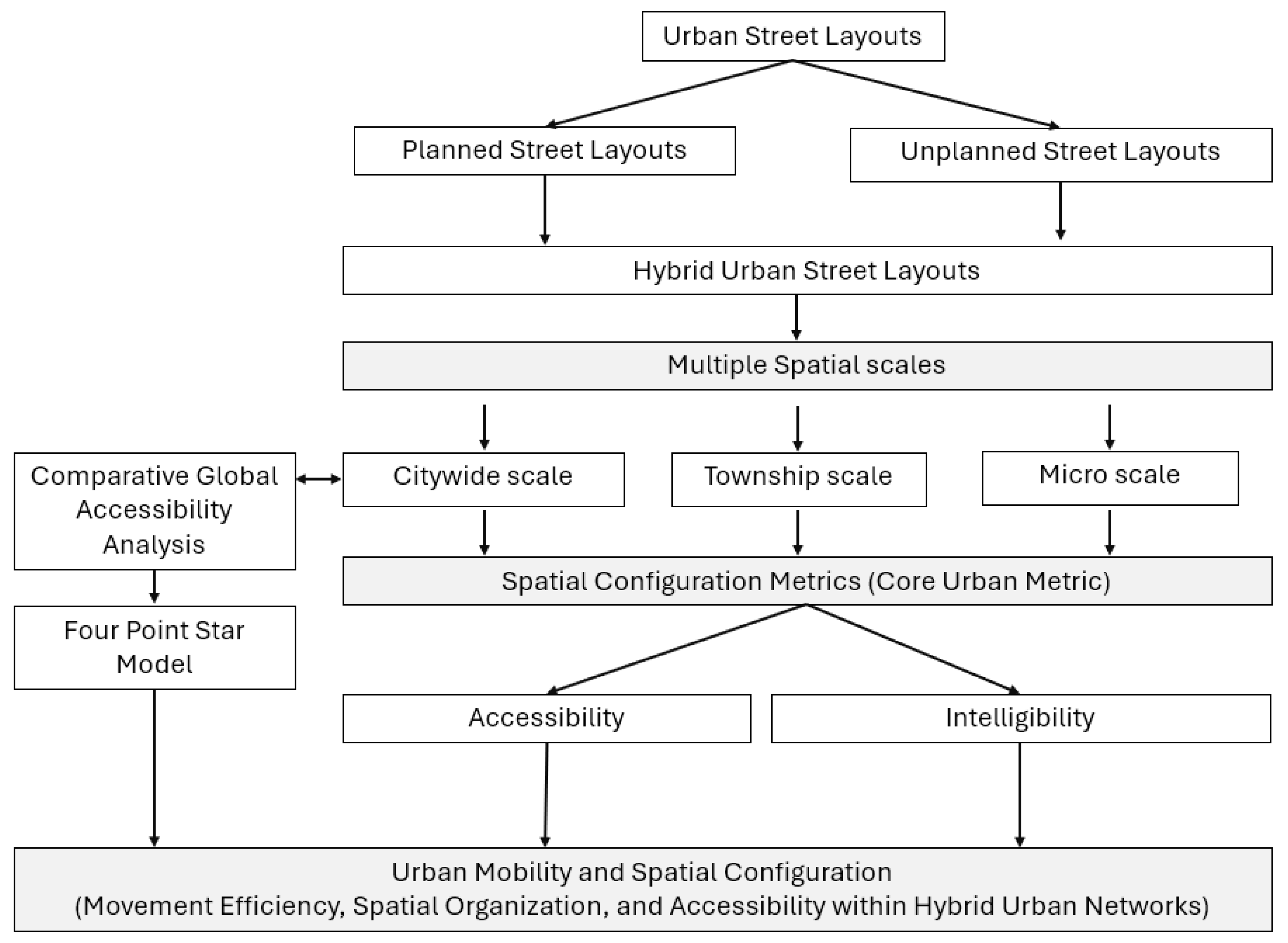
This study examines the effects of planned and unplanned layouts on accessibility and intelligibility at multiple spatial scales in Mandalay. That approach differs from past research looking at historical changes in street networks. Instead, it analyzes the current urban structure after urban growth at various spatial scales to assess if the integration of different street layouts consistently improves movement efficiency. This study’s theoretical framework focuses on how different combinations of street patterns and spatial configuration interact, affecting accessibility and intelligibility at various spatial scales. Within this framework, street patterns serve as independent variables, classified as either planned grids or unplanned layouts. Their impact is mediated by segment angular integration and choice and correlation values between integration and connectivity, which in turn shape accessibility (ease of movement, transport connectivity) and intelligibility (wayfinding, spatial perception). Additionally, a global comparison using the Four-Point Star Model evaluates Mandalay’s spatial accessibility in relation to 50 cities, ranging from strict orthogonal grids to organic networks and varying in size from fewer than 1000 to up to 250,000 segments [37]. This comparative analysis helps identify Mandalay’s unique spatial characteristics, particularly how its hybrid street structure—integrating historic grids with spontaneous growth—affects movement efficiency and urban connectivity. Analysis at different spatial scales reveals different characteristics of movement, from overall city accessibility to township-level street form and local configurational structure. The following diagram illustrates theoretical flowchart of the study (Figure 1). Unlike previous studies that focus on historical change or single-scale analysis, this framework explicitly links street network structure across multiple spatial scales to examine how local configurations relate to broader accessibility patterns.

3. Materials and Methods

3.1. Data Collection and Analytical Models

The study applies the space syntax analysis to multiple spatial scales to evaluate spatial accessibility and intelligibility in Mandalay. Three analytical spatial scales are conducted; the city-wide scale, the township scale and the micro-scale, which is defined as fixed 1 km2 spatial units to enable consistent comparison across different urban layouts. OpenStreetMap (OSM) was used as the source of street network data, which was downloaded in December 2023. Due to limited public access of official street network, land-use, and mobility datasets in Myanmar, OSM provides the most comprehensive and accessible base dataset for spatial network analysis. The OSM street data was imported in Quantum Geographic Information System (QGIS) for systematic data cleaning. Data cleaning included the removal of duplicated road segments, correction of disconnected or fragmented segments, removal of railway lines that function as inter-city transport rather than urban streets, and visual checking of main road structures using the Mandalay city image map produced by the Mandalay City Development Committee (MCDC). These procedures ensured topological continuity and analytical suitability for space syntax analysis.
The cleaned data was then exported to AutoCAD 2021 (DXF format). In AutoCAD, the fully city network, six townships and 25 1 km2 layouts were extracted based on administrative boundaries and typological selection. These DXF files were imported into DepthmapX for spatial analysis, where both segment maps and axial maps were generated as the basis for calculating syntactic measures. The analysis focuses on Integration, Choice, and Intelligibility because these measures capture street network structure and its effects on accessibility and intelligibility across different spatial scales, which are central to the research questions. At the city-wide scale, segment angular integration and angular choice, as proposed by Turner (2001), were applied to examine overall accessibility structure and primary movement corridors [75]. Two radii were applied: global radius (r = n) to capture city-wide movement potential and arterial connectivity, and local radius (r = 3) to represent neighbourhood-scale movement and local accessibility. The combined use of r = n and r = 3 allows differentiation between global foreground networks and local background networks and corresponds directly to the study’s research questions on multi-scale movement structure. The citywide analytical approach, utilizing standardized angular integration and choice measures, offers a transferable method for examining how mixed street geometries influence accessibility and movement potential in diverse global urban contexts. At the township and micro-scale levels, axial intelligibility, integration and connectivity as defined by Hillier and Hanson were calculated using a radius of r = 10 [46]. The radius r = 10 was selected to examine local street detail together with the wider spatial structure and to support comparison of accessibility and intelligibility across townships and 1 km2 layouts. The metrics used for township-level evaluation are broadly applicable, providing a systematic way for planners in other regions to diagnose spatial segregation and fragmentation within distinct administrative or historical districts. Intelligibility was assessed through correlation analysis between integration and connectivity values, allowing evaluation of how well local street connections reflect the overall spatial structure.
To expand the findings globally, the study applies normalized angular integration (NAIN) and choice (NACH) of space syntax to compare Mandalay’s street network with 50 cities dataset [76]. NAIN and NACH were calculated using the same normalization logic and angular segment representation. Both radius n and various local metric radii can be applied depending on the analytical focus. In this study, the analysis focuses on overall city structure and spatial accessibility as structural properties of the street network, rather than on pedestrian- or vehicle-specific movement behaviour. Therefore, typological radii (r = n and r = 3) were selected to represent global and local network characteristics at the city-wide scale, instead of metric radii commonly used for modelling walking or vehicular accessibility. Table 1 presents NACH and NAIN values [37], illustrating how Mandalay’s street network compares to global averages and its unique spatial structure.
Although the original dataset of 50 cities does not report uniform data extraction standards or city boundary sizes for all reference cities, the use of normalized measures enables city comparison despite differences in data sources. Hillier et al. (2012) investigated the 50-city dataset, which includes cities of varying sizes (from less than 1000 to up to 250,000 segments), Mandalay’s network, with 91,167 segments, falls within this range, supporting the validity of the comparison [37]. The reference cities were selected with consideration of geographic diversity, historical and cultural context, and variation in spatial structure [76]. Mandalay has a hybrid urban form shaped by different planning periods, combining planned grid layouts with organic growth. Including Mandalay in the comparison helps show how different grid geometries and organic street patterns affect accessibility. Although there are small differences in data sources and city boundary sizes, Hillier et al. applied the same calculation methods for NAIN and NACH across all 50 cities. Because the Four-Point Star Model and normalized measures (NAIN and NACH) rely on standardized mathematical calculations rather than local qualitative assessments, this comparative framework can be replicated to position other cities within a global morphological baseline. The same methods were applied to Mandalay in this study, allowing a consistent comparison within a global urban context. Table 2 shows the lists of the 50 cities.
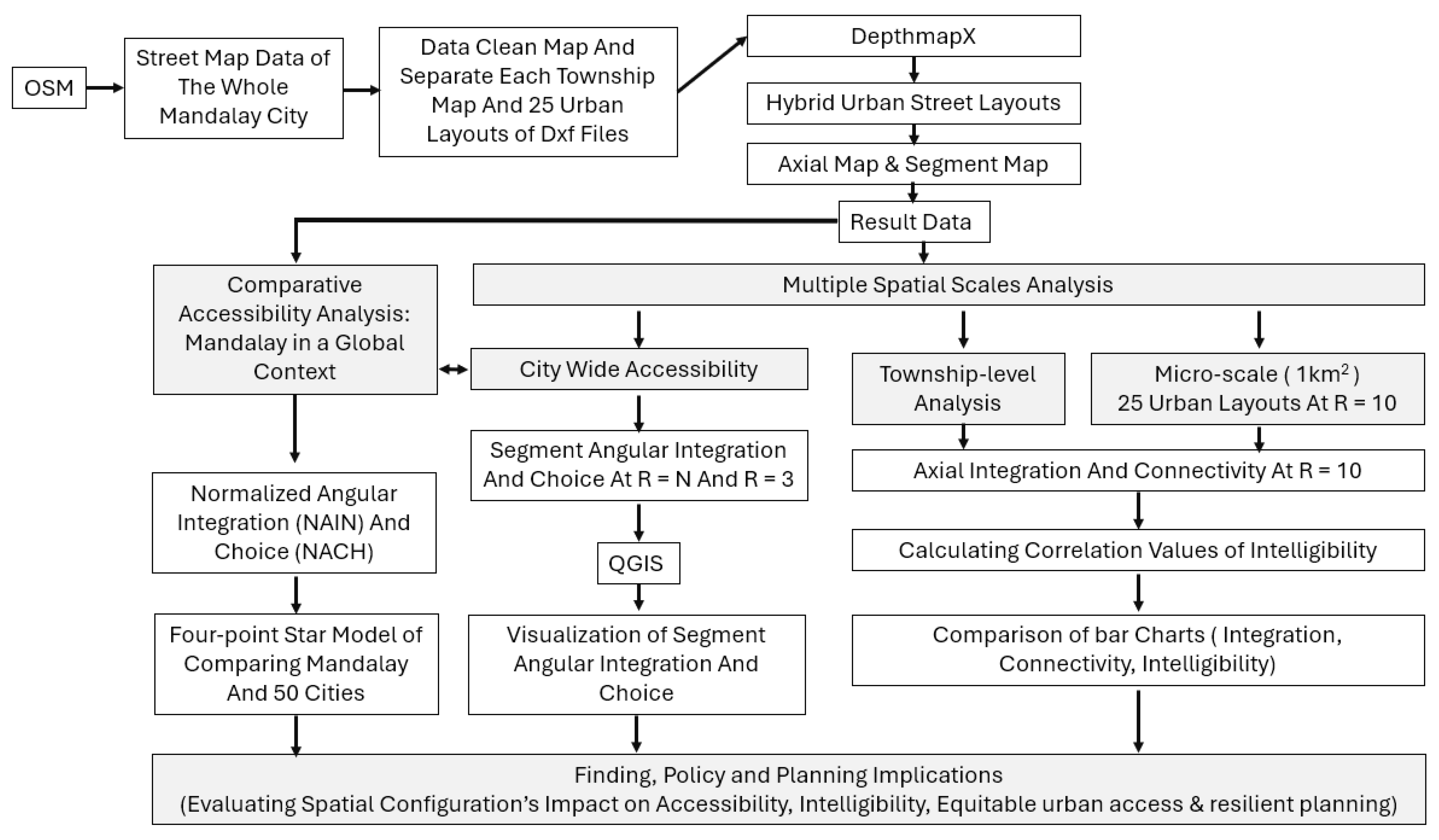
The findings from the space syntax analysis regarding city-wide accessibility are visualized using QGIS-based mapping and data interpretation methods. Integration and choice maps are produced to show accessibility across different spatial layouts. Comparative bar charts are used to present variations in integration, connectivity and intelligibility for different grid geometries and their combination with organic pattern at township level and within the 1 km2 micro-scale areas. The final stage synthesizes these analytical data into findings and policy suggestions and planning implications. As the analysis focuses on spatial configuration, functional attributes such as land use and observed movement patterns are not explicitly examined and are acknowledged as a methodological limitation. The following Figure 2 illustrates the analytical flow model of the research methodology.

3.2. Site Selection

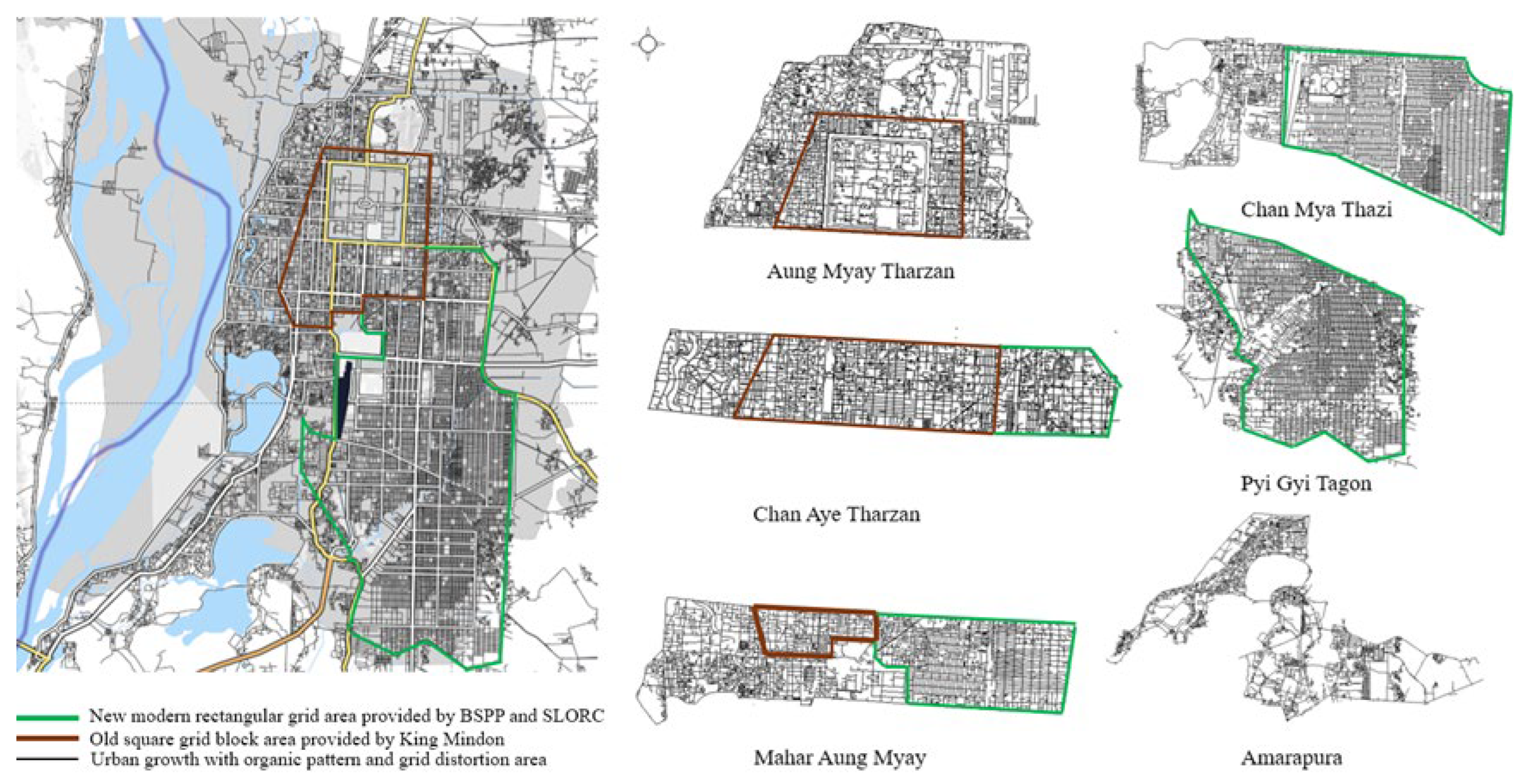
Mandalay City is composed of six townships officially recognized by the Mandalay City Development Committee (MCDC). Figure 3 illustrates the boundaries of all six townships within the whole Mandalay city structure. These six townships collectively represent the full range of main street network types present in Mandalay, including the original royal grid, later planned grid extensions, industrial grid systems, and organically developed street patterns resulting from incremental urban growth (Figure 4). Each township reflects a distinct combination of different grid geometries with unplanned growth street structures. Aung Myay Tharzan combines an orthogonal grid with organic streets, based on King Mindon’s original layout, whereas Chan Aye Tharzan maintains the square grid with minimal organic influence. Mahar Aung Myay integrates square and organic grids, incorporating newer rectangular patterns from the 1980s Burmese socialist relocation program. Chan Mya Thazi follows a similar rectangular grid distinct from King Mindon’s layout. Pyi Gyi Tagon, developed industrially in the 1990s, contrasts industrial grids with residential rectangular grids of Chan Mya Thazi. Amarapura, an ancient capital annexed into Mandalay in 2015, preserves its organic street patterns. As shown in Figure 3, both planned grid systems and subsequent organic transformations are distributed across these townships. Therefore, the inclusion of all six townships ensures comprehensive coverage of Mandalay’s dominant street network morphologies, and no township was excluded due to data availability or quality issues.
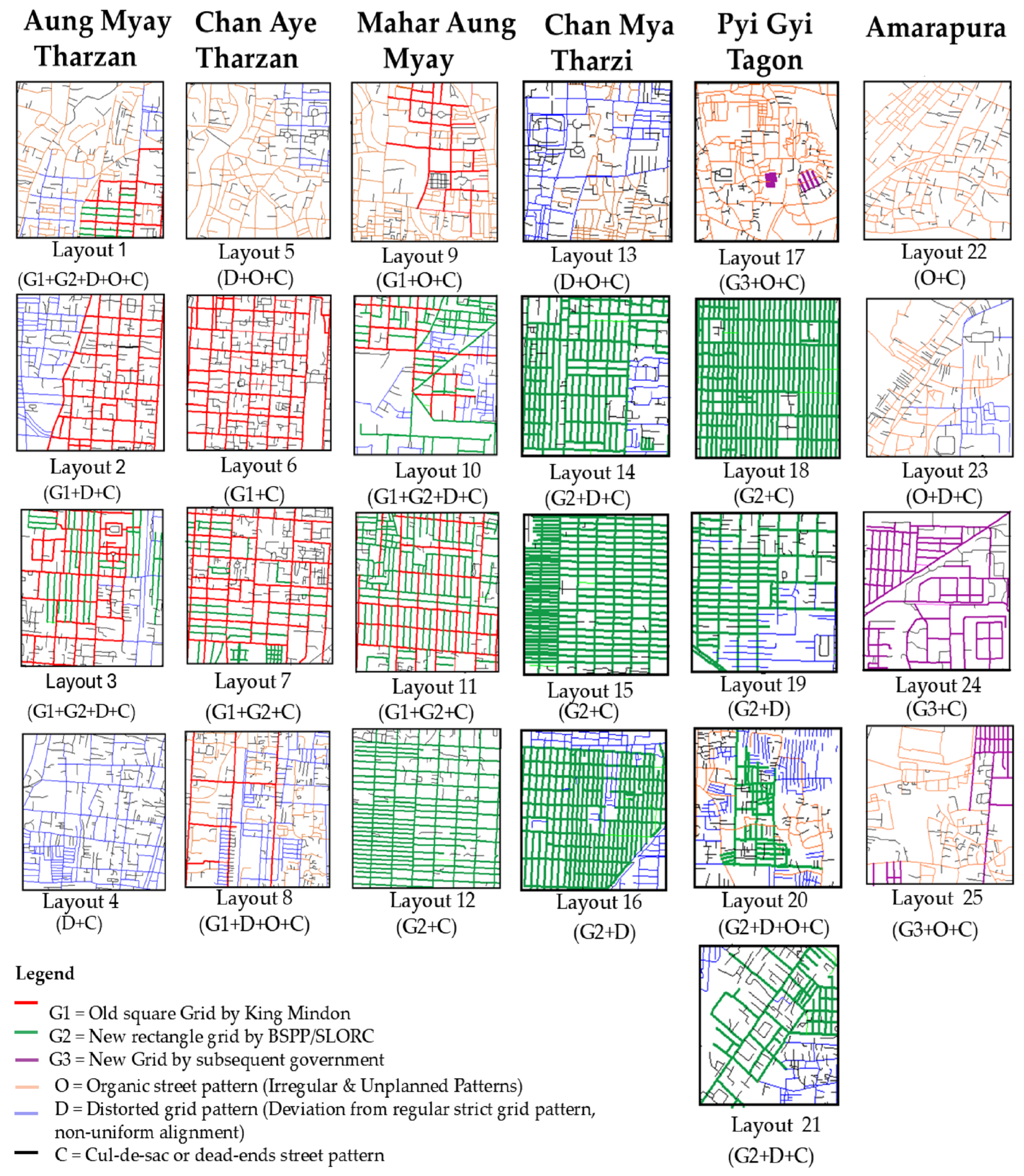
To capture internal morphological variation within each township, 25 one-square-kilometre (1 km2) micro-scale layouts were selected, as shown in Figure 4. The selection followed a purposive, typology-based sampling strategy, rather than systematic grid coverage. Each layout represents a distinct street-pattern typology, including grid-based, organic, and combined (hybrid) forms. These typologies reflect different historical development phases, such as the original royal grid (G1), later rectangular grids introduced during the BSPP/SLORC periods (G2), subsequent government grids (G3), and later urban growth forms including organic streets (O), distorted grids (D), and cul-de-sacs (C). The total of 25 layouts was determined to ensure that all major street-pattern typologies present across the six townships, while also capturing different hybrid morphologies and spatial arrangements, even where similar typology combinations occur. Figure 4 describes the detailed configuration of each 1 km square and its corresponding street pattern typology. Multiple layouts were selected within each township to reflect internal morphological diversity, resulting in different numbers of layouts per township. The methodology for micro-scale layout analysis is designed for replicability, allowing the same space syntax metrics to be applied to representative neighbourhood samples in other hybrid cities to identify localized spatial accessibility challenges.
A 1 km2 spatial unit was chosen because it is sufficiently large to capture meaningful combinations of grid and organic street structures while remaining small enough to clearly distinguish local street-pattern types. The selected layouts correspond to different development periods and street pattern typologies in each township. However, the analysis focuses on spatial configuration rather than functional land use. The selected layouts differ in land use and development period, but this study focuses only on street network structure. These differences are acknowledged as a limitation. Accordingly, the purpose of the micro-scale sampling is to achieve morphological coverage of key street-pattern typologies rather than statistical representativeness based on socio-demographic variables. This sampling framework ensures that the selected layouts adequately reflect Mandalay’s hybrid street network configurations while remaining consistent with the study’s morphological focus.

4. Results

4.1. Citywide Accessibility in Mandalay: Global and Local Movement Patterns

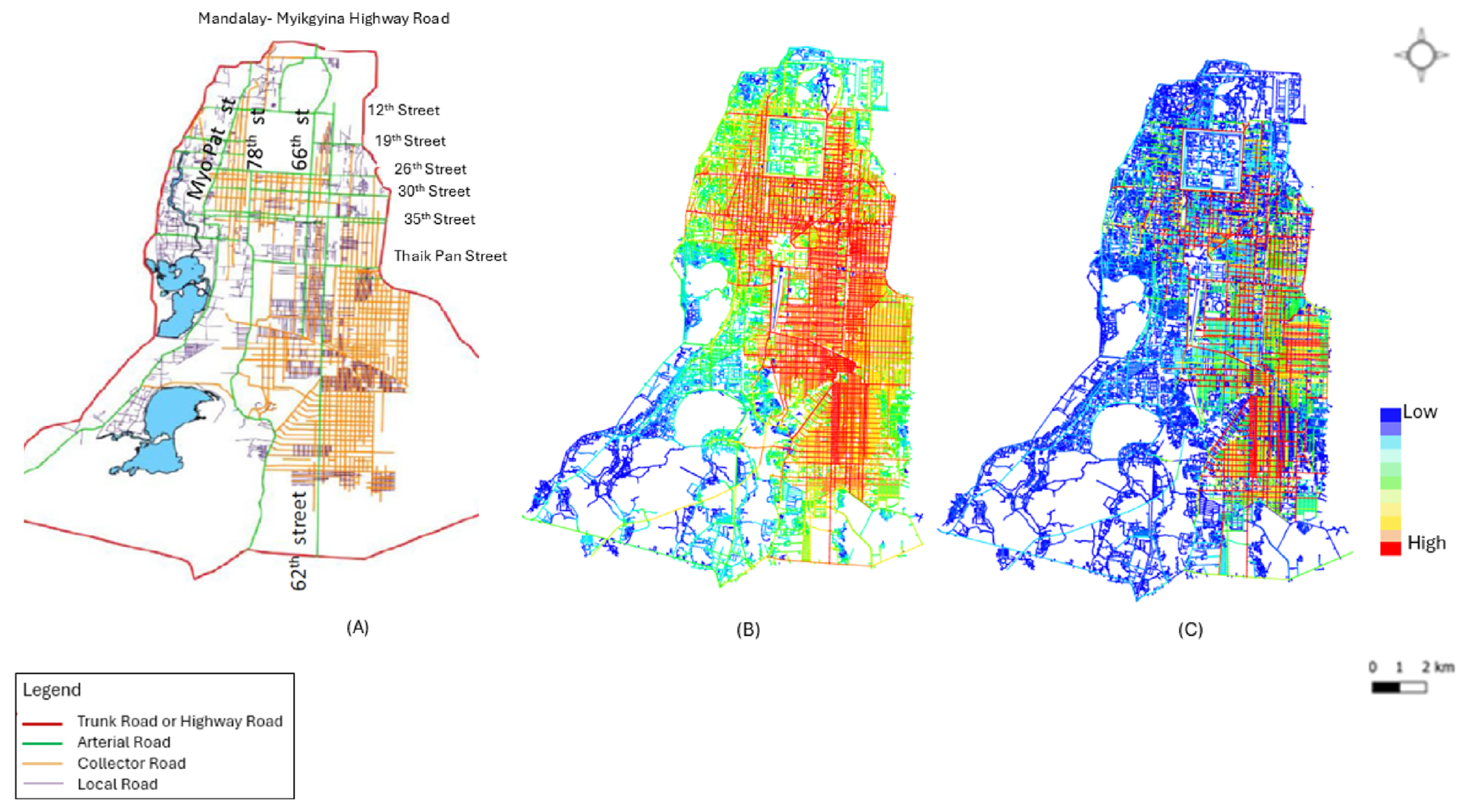
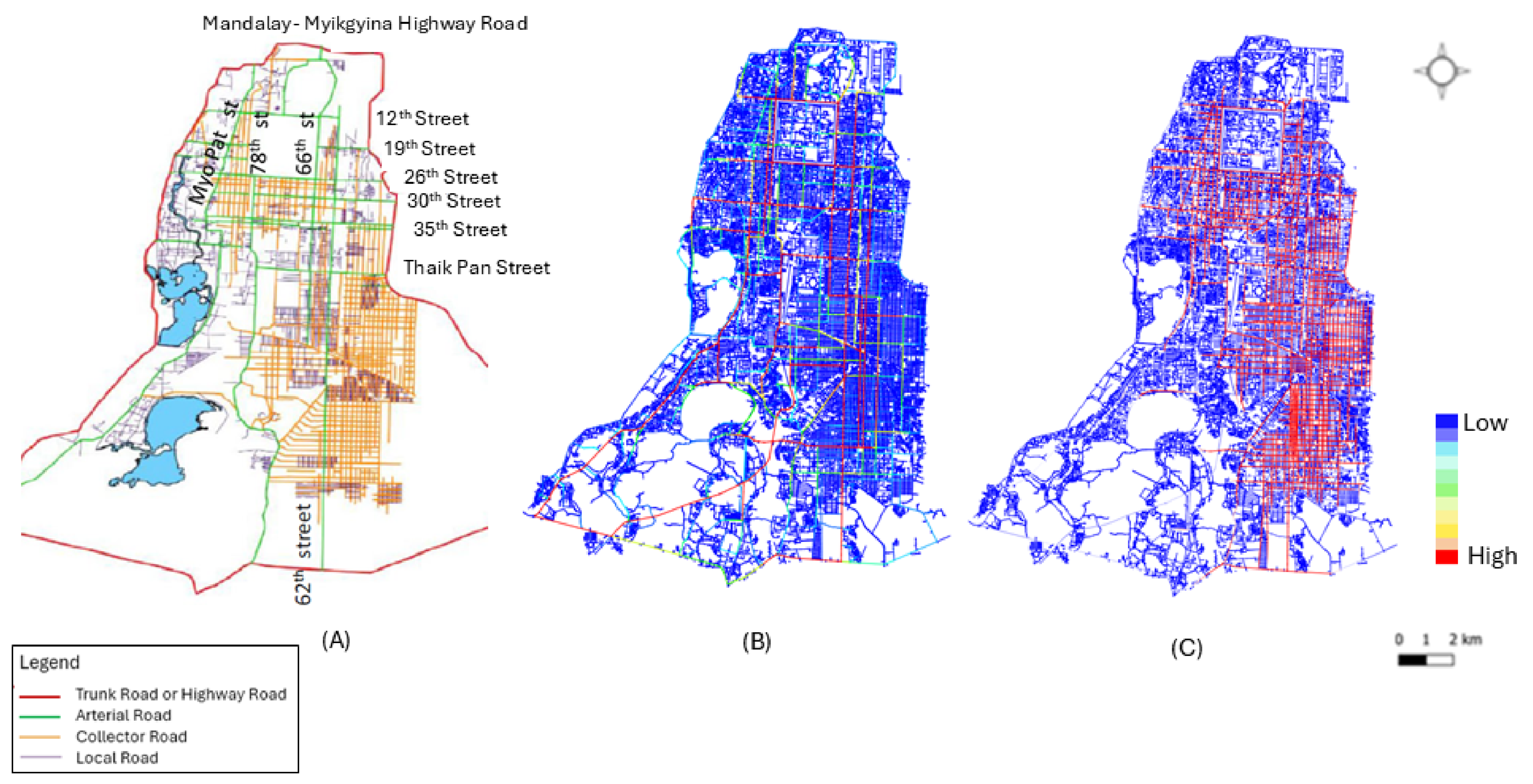
The segment angular integration and choice analysis reveal significant accessibility variations across Mandalay’s urban structure. The values of higher or lower integration and choice are represented by a colour range in the image, with red indicating the highest levels of connectivity and blue the lowest (Figure 5 and Figure 6). Higher integration in grid-based areas in the centre townships (Chan Aye Tharzan, Pyi Gyi Tagon, Chan Mya Tharzi) indicates that regular grid geometries support stronger citywide spatial integration. In contrast, the irregular structures of Amarapura and some parts of Aung Myay Tharzan, in particular, exhibit reduced integration, thereby restricting citywide access (Figure 5 and Figure 6).
At the global integration (r = n), major arterial roads facilitate movement within the city core but do not function as continuous radial or ring structures capable of linking peripheral areas, resulting in constrained citywide accessibility (Figure 5A,B). This spatial pattern suggests that Mandalay’s arterial network lacks hierarchical continuity at the metropolitan scale. Meanwhile, local scale (r = 3) integration highlights strong intra-neighbourhood connectivity in collector roads of grid-based areas, while organic and irregular street patterns in the city’s southern and western disrupt local movement continuity (Figure 5C). At the global level of choice (Figure 6A,B), major arterial roads serve as the primary movement corridors with high choice values, acting as the backbone of Mandalay’s connectivity. However, secondary streets show consistently lower choice values, indicating limited alternative routing options at the citywide scale.
At the local scale (r = 3) (Figure 6C), the distribution of high-choice values changes. In grid-based neighbourhoods, choice values are more evenly distributed, allowing for better lateral movement and local accessibility. In irregularly structured neighbourhoods, most streets have low choice values, which means there are fewer route options and limited connectivity. Mandalay’s urban structure facilitates efficient movement within neighbourhoods and central districts; however, it does not provide strong connectivity throughout the entire city, especially in peripheral areas with irregular street layouts. Overall, the citywide-scale results indicate that Mandalay’s mixed street-pattern geometries support localized movement efficiency but lack strong configurational integration between the city centre and peripheral areas. The same citywide analysis using angular integration and choice measures can be applied to other cities to study how street network form affects accessibility at global and local scales.

4.2. Township-Level Spatial Configuration in Mandalay: Analysing Integration, Connectivity, and Intelligibility

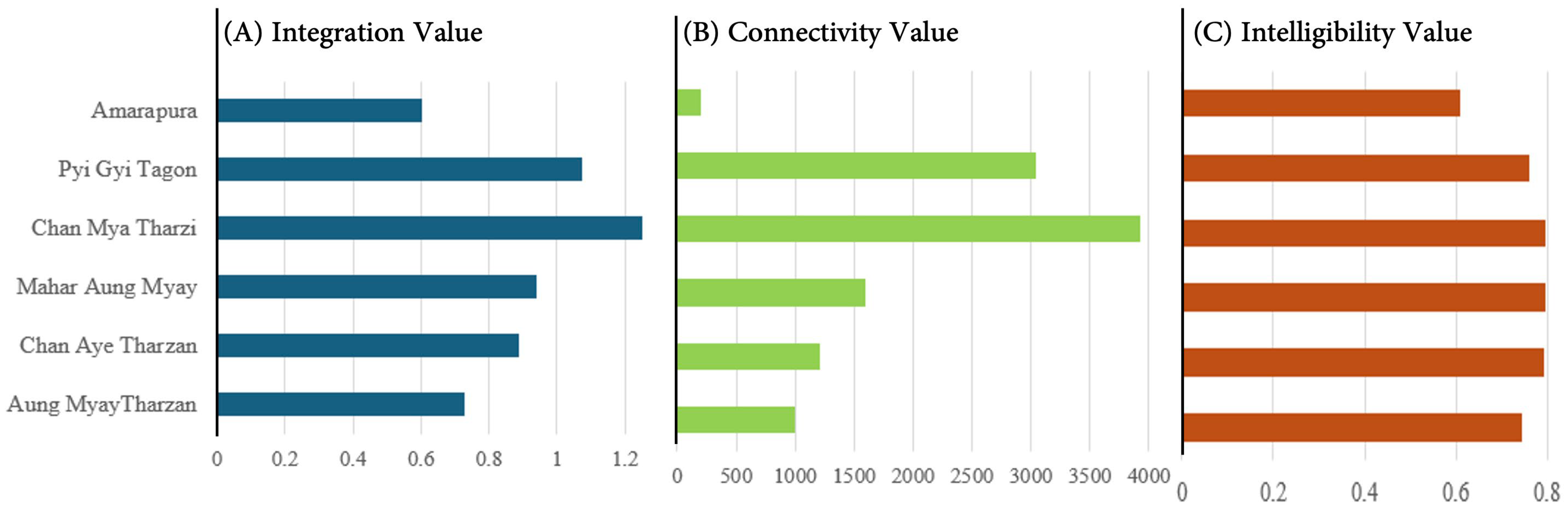
The township-level analysis shows differences in spatial accessibility related to street network form. Figure 7 shows a bar chart comparing integration, connectivity, and intelligibility values across the townships. Chan Mya Thazi Township, dominated by a modern grid with some irregular areas, records the highest integration (1.25) and connectivity (3918.87). Furthermore, Pyi Gyi Tagon demonstrates an integration value of 1.07 and a connectivity of 3039.42, while Mahar Aung Myay shows an integration value of 0.94 and a connectivity of 1586.56. Both areas include a grid-based and mixed layout, contributing to their relatively high levels of integration and connectivity, which improve efficient transportation. Chan Aye Thazan has an integration score of 0.89 and a connectivity of 1205.83, while Aung Myay Thazan has an integration score of 0.73 and a connectivity of 985.54. Both areas, shaped by historic grid layouts, exhibit moderate levels of integration. Amarapura has an organic and dispersed layout, showing the lowest integration (0.6) and connectivity (192.61), confirming that dispersed organic layouts are the most spatially segregated at the township scale.
The intelligibility values indicate that structured grids in Chan Mya Thazi (0.794), Mahar Aung Myay (0.793), and Chan Aye Thazan (0.792) show a stronger relationship between local connectivity and global integration. Meanwhile, Amarapura’s fragmented street network weakens spatial coherence (0.607 intelligibility). Aung Myay Tharzan and Pyi Gyi Tagon show similar intelligibility values (0.743 and 0.758, respectively) (Figure 7). These findings suggest that townships dominated by grid-based urban patterns promote higher accessibility and spatial efficiency, whereas organically developed areas tend to exhibit spatial segregation and lower intelligibility. Grid-based townships record higher integration, connectivity, and intelligibility values. Townships with organic and dispersed street patterns show lower values for these measures and are more fragmented at the township scale. The analytical measures used in this analysis can also be applied to township-level units in other cities to examine differences in accessibility and spatial structure.

4.3. Micro Scale Level: Assessment of 25 Urban Layouts in Six Townships

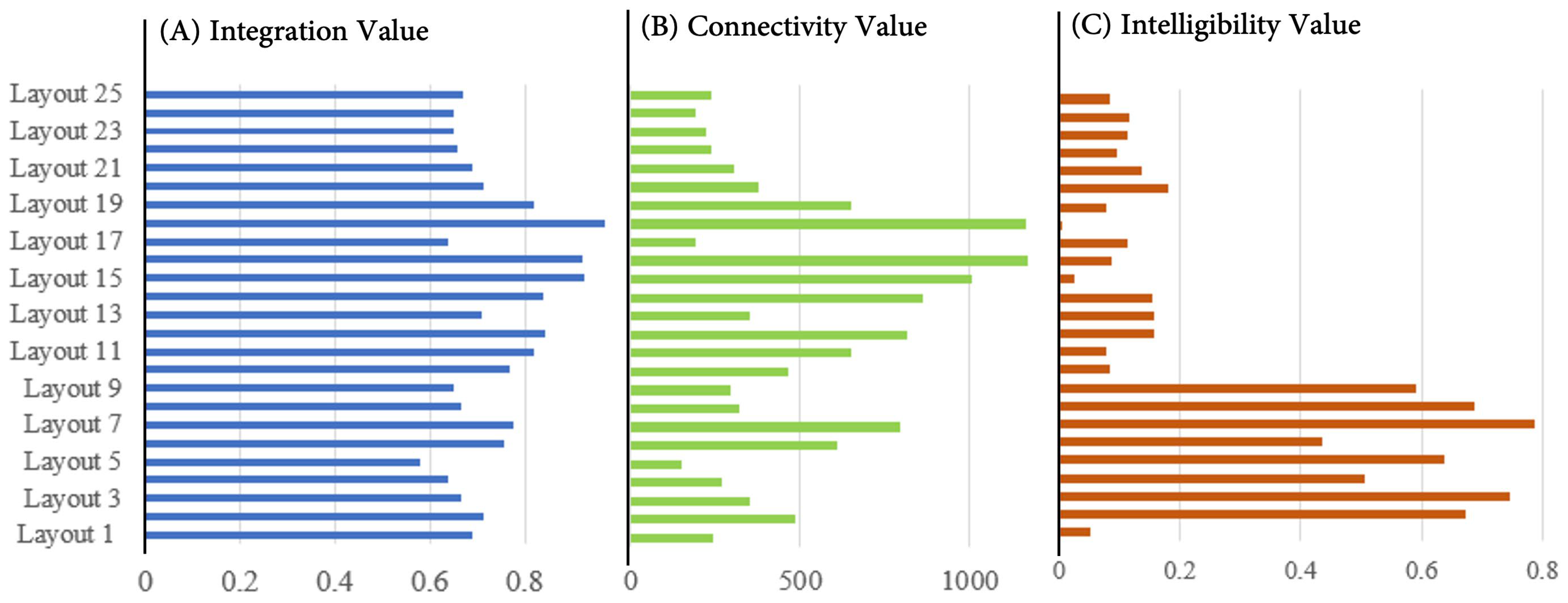
The analysis of 25 urban layouts reveals significant variations in accessibility and intelligibility, particularly at the micro-scale (Figure 8). As seen in Figure 8, layouts that use more organic, unstructured patterns typically have much less integration and connectivity than layouts that rely on systematic grids, such as G1 and G2. As observed in Layouts 14, 15, 16, and 18, hybrid arrangements that combine grid patterns with cul-de-sacs and distorted grids can promote effective mobility as long as secondary thoroughfares are properly integrated into the main network. These layouts demonstrate relatively high integration and connectivity despite the presence of irregular elements. The grid types do not perform the same in terms of accessibility and intelligibility. Layouts that combine G1 (conventional square grids) with other patterns, such as Layouts 2, 3, 5, 7, 8, 9, and 10, typically have higher integration and connectivity values and are also more intelligible than layouts that are primarily G2. However, layouts based mostly on planned grids often do not result in improved accessibility and intelligibility. For instance, Layout 11, which is dominated by G1 and G2 grids, exhibits lower integration, connectivity, and intelligibility than expected. This suggests that a purely structured grid layout alone does not guarantee efficient spatial performance. Furthermore, layouts 12 and 18 use G2 grids with cul-de-sacs and show different spatial patterns. Layout 18 has greater integration and connectivity scores than Layout 12. Layout 18 has a larger street density and a greater number of street connections, which could explain the disparity.
Notably, Layout 18 shows the lowest intelligibility values yet has the highest integration and connection values. This indicates a weak correlation between local connectivity and global integration. This implies that limited links between local movement efficiency and global navigation predictability result from well-connected streets not always being globally integrated. In this layout, high connectivity results from a dense network of short and frequently intersecting street segments, while high integration reflects their central position within the local network. However, because many streets are short and irregular, frequently change direction, and do not follow a clear orthogonal pattern, the network is difficult to read, and the connection between local and citywide structure becomes weak. This pattern is characteristic of G2 grids developed during the BSPP and SLORC periods, which deviate from strict orthogonality and lack long, continuous axial lines. As a result, these grids can achieve high accessibility but lower spatial coherence. In contrast, layouts dominated by G1 square grids, originally established during the King Mindon period, exhibit stronger intelligibility. This is due to the fact that their well-connected secondary streets, longer and straighter axial lines, and strict orthogonality enable local connectivity to more clearly reflect the global spatial structure (e.g., Layouts 2, 3, 7, and 8). Unplanned expansion decreases movement efficiency, as demonstrated by the low integration and connectivity of layouts with organic or fragmented growth (e.g., Layouts 5, 13, 17, 22, 23, and 25). Overall, these micro-scale findings demonstrate that hybrid street networks can enhance accessibility only when organic streets, distorted grids, and cul-de-sacs are structurally integrated into a coherent grid framework. This micro-scale layout analysis can also be applied in other cities using representative neighbourhood samples and the same space syntax measures to examine differences in local spatial accessibility.

4.4. Mandalay’s Spatial Structure in a Global Context: A Comparative Analysis with a 50-Cities Dataset

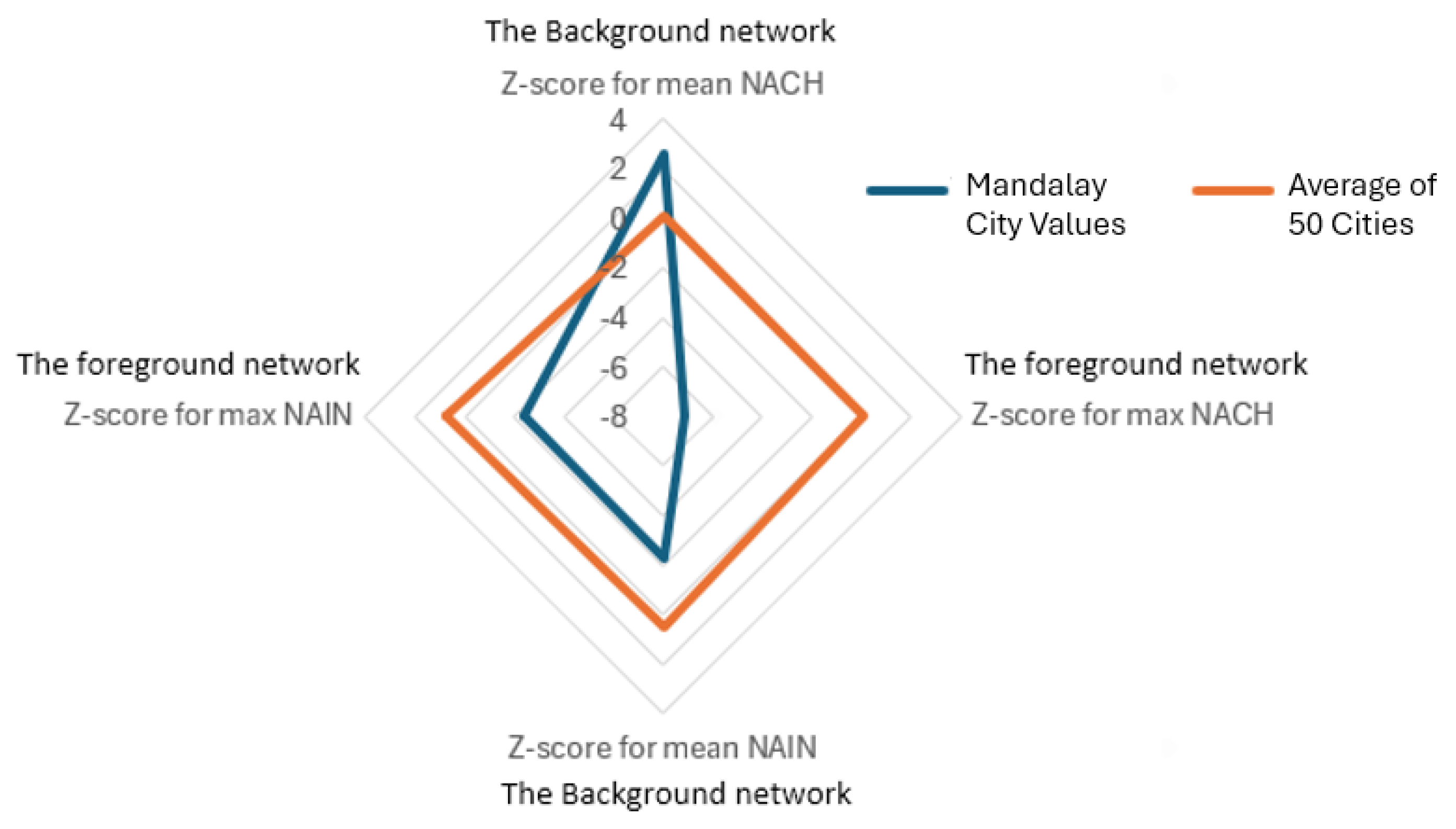
The previous analysis of Mandalay’s 25 urban layouts highlighted how different spatial layouts ranging from planned grids to fragmented organic patterns influence spatial accessibility at a local scale. However, to determine whether these spatial characteristics are unique or align with broader global trends, this section compares Mandalay’s urban structure with a 50-city dataset (Figure 9). This comparison provides insights into whether Mandalay’s accessibility structure follows global patterns seen in other cities or if its mixed grid and organic street pattern create distinct movement characteristics. The following Table 3 shows the mean and maximum values of normalized angular choice (NACH) and normalized angular integration (NAIN) from the six townships of Mandalay City. Figure 9 shows these values using the Four Point Star Model to compare Mandalay with the other cities.
The comparison reveals that Mandalay exhibits higher background network accessibility (mean NACH) than the 50-city average (Table 3 and Figure 9), suggesting that local street connectivity plays a stronger role in everyday movement than in many globally integrated cities. This pattern is consistent with the citywide angular choice maps (Figure 6), which show dense local connectivity within grid-based neighbourhoods but limited continuity at the city scale. Structured grid areas (G1, G2) maintain strong neighbourhood-level accessibility, reinforcing localized movement (Figure 5 and Figure 8). However, Mandalay’s major roads have lower foreground network accessibility (max NAIN) than the global average (Table 3 and Figure 9), indicating that its arterial roads do not function as highly integrated arterial corridors at the citywide scale. This outcome is visually supported by Figure 5 and Figure 6, where high-integration and high-choice segments are concentrated in central grid areas and fail to extend effectively toward peripheral townships. In contrast to cities characterized by radial or concentric road systems, Mandalay lacks a unified arterial hierarchy that proficiently links the peripheral areas to the central urban core. At a local scale (r = 3), accessibility remains strong in grid-based neighbourhoods but diminishes in areas dominated by distorted grids, organic, or cul-de-sacs. This spatial fragmentation explains why Mandalay’s background network performs well in normalized measures while its foreground network remains weak in global integration.
While grid-based areas retain strong local accessibility, the city’s overall structure relies more on background network movement rather than a core-oriented arterial system. Its major roads do not form a well-integrated hierarchy across different spatial scales. Compared to cities with balanced foreground-background relationships, Mandalay lacks a balanced street hierarchy, favours lateral and localized movement rather than citywide accessibility. Overall, the 50-city comparison confirms that Mandalay’s spatial structure differs from global norms. While neighbourhood-level accessibility is relatively strong, fragmented expansion and weak arterial continuity have limited citywide integration. By linking the Four-Point Star Model (Figure 9) with Mandalay’s spatial maps (Figure 5 and Figure 6), this study demonstrates that Mandalay’s global positioning is a direct outcome of its internally fragmented but locally dense street network structure. These results underscore the necessity for the development of strategic frameworks that enhance arterial connectivity whilst safeguarding localized accessibility, especially in peripheral regions. The Four-Point Star Model and the normalized angular measures (NAIN and NACH) use standard calculations, so the same comparison can be carried out in other cities using comparable street network data.

5. Discussion

This study demonstrates that street network morphology strongly shapes accessibility and intelligibility across spatial scales in Mandalay. At the citywide level, the central areas of townships dominated by planned grid structures show higher integration and connectivity while areas characterized by fragmented organic growth remain less navigable. These results confirmed long-established space syntax findings that grid-based layouts support higher levels of spatial accessibility [5,10,63], and demonstrate that this relationship also holds in a non-Western, rapidly transforming urban context. At the township scale, the results shown in Figure 7 indicated that grid-dominated townships such as Chan Aye Tharzan, Mahar Aung Myay, Chan Mya Thazi, and Pyi Gyi Tagon consistently achieve higher integration, connectivity and intelligibility, meaning that local street connections reliably reflect the overall spatial structure. The townships which are more organically developed and less systematic grid structure display lower values across all three measures, confirming that dispersed and uncoordinated growth reduces spatial legibility. This finding aligns with Günaydin & Yücekaya (2020), who observed declining intelligibility and accessibility as cities expand [67], but the Mandalay case further shows that the absence of a clear arterial hierarchy intensifies this effect, particularly in peripheral townships.
At the micro scale, the analysis of 25 urban layouts reveals more nuanced spatial patterns. Rectangular grids (G2) developed during the BSPP and SLORC periods often achieve high integration and connectivity, but lower intelligibility, indicating that well-connected local streets do not necessarily produce a coherent global spatial structure. This occurs because G2 grids, although appearing grid-like, frequently exhibit variations in orthogonality and non-uniform street alignment, which weakens the relationship between local connectivity and overall spatial comprehension. In contrast, layouts where G1 grid main streets form the dominant structure tend to maintain stronger intelligibility, even when combined with organic or cul-de-sac elements, because the strict orthogonality and continuous main axes of G1 grids allow secondary streets to connect more clearly to the overall structure. This finding supports Hachi and Lagesse (2017), who argue that planned interventions can maintain network density while introducing variations in orthogonality, which in turn affect accessibility dynamics [64]. Furthermore, this finding is consistent with Askarizad et al. (2024), who argue that alleyways and cul-de-sacs contribute positively to accessibility only when they are effectively linked to primary streets [71]. This supports the observation that hybrid street layouts function successfully only when irregular components are systematically embedded within a coherent grid structure.
Importantly, the micro-scale analysis helps explain citywide accessibility outcomes. Micro layouts with high local integration but low intelligibility tend to weaken spatial coherence when repeated across larger areas. Townships with many such layouts, like Amarapura, also show weak arterial integration and low global choice values, indicating that local structural weaknesses can accumulate and reduce accessibility at broader scales. In contrast, micro layouts dominated by well-structured G1 grids show higher intelligibility, allowing local connectivity to reflect the wider spatial structure more clearly. When these layouts are consistently embedded within townships, they support stronger township-level accessibility and contribute to improved citywide integration. This suggests a bottom-up relationship where micro-scale configurations influence township structure and, in turn, shape the effectiveness of the city’s arterial network.
Building on these micro-scale findings, the comparative analysis with the 50-city dataset helps to contextualize Mandalay’s spatial structure within broader global patterns. The Four-Point Star Model shows that Mandalay exhibits strong background (local) accessibility but relatively weak foreground (arterial) integration, indicating a movement structure dominated by localized, lateral movement rather than efficient citywide connectivity. This pattern contrasts with cities that possess well-developed radial or ring-road systems, where arterial networks support stronger centre–periphery integration and mobility benefits [77]. In Mandalay, major roads do not form a coherent arterial system capable of connecting peripheral areas with the city centre, which contributes to persistent spatial fragmentation at the citywide level. Furthermore, street layout at the township level plays a key role in linking neighbourhood-scale patterns to overall city accessibility. Townships composed of well-connected and intelligible neighbourhood layouts tend to form stronger local networks that support the city’s main road system. In contrast, townships made up of disconnected neighbourhood layouts often fail to create continuous arterial routes, resulting in weak links within the city-wide network. This highlights the importance of coordinated planning across neighbourhood, township, and city scales.
From a planning perspective, these results indicate that improving accessibility in Mandalay should prioritize better connections between existing grid areas and organically developed neighbourhoods, rather than introducing entirely new grid systems. Townships with fragmented street patterns, such as Aung Myay Tharzan and Amarapura, would particularly benefit from well-connected secondary streets that link local roads to primary collectors and main arterial routes. At the neighbourhood scale, cul-de-sacs and distorted street patterns can contribute to accessibility only when they are clearly connected to the wider street network. Overall, the findings demonstrate that a multi-scale space syntax approach serves as a practical analytical tool for identifying accessibility weaknesses and for supporting more sustainable and inclusive urban mobility planning in cities with hybrid street networks. These insights highlight the value of integrating spatial analysis into urban policy, particularly in rapidly transforming cities like Mandalay.

6. Conclusions

This study employed a multi-scale space syntax framework to analyze the extent to which hybrid street network morphologies affect spatial accessibility and intelligibility in Mandalay. By analysing the whole city at city-wide, township, and micro (1 km2) scales, the research demonstrates that planned grid structures consistently support higher accessibility, while more organic and fragmented growth patterns reduce spatial coherence. Importantly, the results show that high connectivity does not automatically lead to high intelligibility, particularly in later rectangular grid systems characterized by non-uniform orthogonal grids with cul-de-sac. The comparison with a 50-city global dataset further reveals that Mandalay has highly localized movement. It has strong background accessibility but weak arterial integration, struggles with connecting the centre to the periphery effectively. These findings address the research questions by showing how different grid geometries and organic street patterns interact across different spatial scales to shape accessibility outcomes in a hybrid urban system. The study contributes to space syntax research by providing empirical evidence from a non-Western city with multiple coexisting grid forms, refining the common assumption that increased connectivity always improves spatial intelligibility. By positioning Mandalay within a global comparative framework, the study highlights how variations in grid geometry, axial continuity, and arterial hierarchy influence accessibility beyond local contexts. From a practical perspective, the findings offer an analytical foundation for more sustainable and inclusive urban mobility planning in hybrid cities. Rather than introducing new grid systems, accessibility improvement should prioritize strengthening structural connections between existing grids and organically developed areas, especially in townships with fragmented growth such as Aung Myay Tharzan and Amarapura.
This study makes a distinct contribution by shifting the analytical focus from conventional colonial–indigenous overlays to a multi-period indigenous hybrid grid system. By employing a three-tiered analytical framework that integrates citywide, township, and micro (1 km2) scales, the research demonstrates that high levels of local street connectivity do not necessarily correspond to high global spatial intelligibility, particularly within later-period rectangular grid systems characterized by distorted orthogonality and cul-de-sacs. Furthermore, by benchmarking Mandalay against 50 global cities using the Four-Point Star Model, this study identifies a unique spatial structure dominated by dense background networks rather than a coherent, centrally integrated arterial hierarchy. As the first systematic, multi-scale space syntax–based analysis of street-network morphology in a Myanmar city, the research provides a critical theoretical and empirical foundation for understanding and improving accessibility in rapidly evolving hybrid urban environments.
The study’s methodology is limited by the absence of official land-use and observed mobility datasets in Myanmar due to institutional disruptions caused by the military coup, which restricts behavioural validation. Future research should integrate pedestrian and vehicular movement data, where feasible, to further test the relationship between spatial configuration and observed mobility.

Author Contributions

Conceptualization, Thwe Thwe Lay Maw and Ducksu Seo; methodology, Thwe Thwe Lay Maw and Ducksu Seo; formal analysis, Thwe Thwe Lay Maw and Ducksu Seo; investigation, Thwe Thwe Lay Maw and Ducksu Seo; resources, Thwe Thwe Lay Maw and Ducksu Seo; data curation, Thwe Thwe Lay Maw; writing—original draft preparation, Thwe Thwe Lay Maw; writing—review & editing, Thwe Thwe Lay Maw and Ducksu Seo; visualization, Thwe Thwe Lay Maw and Ducksu Seo; supervision, Ducksu Seo. All authors have read and agreed to the published version of the manuscript.

Funding

This research received no external funding.

Data Availability Statement

Data underlying the results presented in this paper are not publicly available at this time but may be obtained from the authors upon request.

Conflicts of Interest

The authors declare no conflicts of interest.

References

  1. Yang, J.; Li, X.; Du, J.; Cheng, C. Exploring the relationship between urban street spatial patterns and street vitality: A case study of Guiyang, China. Int. J. Environ. Res. Public Health 2023, 20, 1646. [Google Scholar] [CrossRef]
  2. Postaria, R. Appraising the influence of street patterns on non-motorized travel behaviour in Ahmedabad City, India. WIT Trans. Built Environ. 2017, 176, 527–538. [Google Scholar] [CrossRef]
  3. Sarhan, A.E.N.; Farghaly, Y.A.; Mamdouh, A.A. The influence of urban fabric typologies on pedestrian wayfinding. J. Al-Azhar Univ. Eng. Sect. 2021, 16, 49–62. [Google Scholar] [CrossRef]
  4. Kang, C.-D. Measuring the effects of street network configurations on walking in Seoul, Korea. Cities 2017, 71, 30–40. [Google Scholar] [CrossRef]
  5. Boeing, G. Urban spatial order: Street network orientation, configuration, and entropy. Appl. Netw. Sci. 2019, 4, 67. [Google Scholar] [CrossRef]
  6. Govind, A.; Poorthuis, A.; Derudder, B. Quantifying the effects of Singapore’s street configurations on people’s activity spaces. Environ. Plan. B Urban Anal. City Sci. 2024, 52, 23998083241272093. [Google Scholar] [CrossRef]
  7. Bielik, M.; König, R.; Schneider, S.; Varoudis, T. Measuring the impact of street network configuration on the accessibility to people and walking attractors. Netw. Spat. Econ. 2018, 18, 657–676. [Google Scholar] [CrossRef]
  8. Askarizad, R.; He, J. Perception of spatial legibility and its association with human mobility patterns: An empirical assessment of the historical districts in rasht, iran. Int. J. Environ. Res. Public Health 2022, 19, 15258. [Google Scholar] [CrossRef]
  9. Askarizad, R.; He, J.; Khotbehsara, E.M. The legibility efficacy of historical neighbourhoods in creating a cognitive map for citizens. Sustainability 2022, 14, 9010. [Google Scholar] [CrossRef]
  10. Hillier, B.; Penn, A.; Hanson, J.; Grajewski, T.; Xu, J. Natural movement: Or, configuration and attraction in urban pedestrian movement. Environ. Plan. B Plan. Des. 1993, 20, 29–66. [Google Scholar] [CrossRef]
  11. Hillier, B. Cities as Movement Economies. Urban Des. Int. 1996, 1, 41–60. [Google Scholar] [CrossRef]
  12. Xiao, Y.; Sarkar, C.; Webster, C.; Chiaradia, A.; Lu, Y. Street network accessibility-based methodology for appraisal of land use master plans: An empirical case study of Wuhan, China. Land Use Policy 2017, 69, 193–203. [Google Scholar] [CrossRef]
  13. Boeing, G. Off the grid… and back again? The recent evolution of American street network planning and design. J. Am. Plan. Assoc. 2021, 87, 123–137. [Google Scholar] [CrossRef]
  14. Kolesnikova, D.A. Grids: Re-considering Infrastructural Politics of Urban Space. J. Front. Stud. 2024, 9, 187–210. [Google Scholar] [CrossRef]
  15. Zhao, X.; Feng, W.; Yang, L.; Tang, J.; Wu, Q. Analysis of Distribution Network Planning Strategy in Urban Centre based on Grid Concept. In Proceedings of the 2022 9th International Forum on Electrical Engineering and Automation (IFEEA), Zhuhai, China, 4–6 November 2022; IEEE: New York, NY, USA, 2022. [Google Scholar]
  16. Chen, S.; Yu, B.; Shi, G.; Cai, Y.; Wang, Y.; He, P. Scale-Dependent Relationships Between Urban Morphology and Noise Perception: A Multi-Scale Spatiotemporal Analysis in New York City. Land 2025, 14, 476. [Google Scholar] [CrossRef]
  17. Bin Asad, K.M.; Yuan, Y. The impact of scale on extracting individual mobility patterns from location-based social media. Sensors 2024, 24, 3796. [Google Scholar] [CrossRef] [PubMed]
  18. Lam, N.S.N. Fractals and scale in environmental assessment and monitoring. In Scale and Geographic Inquiry: Nature, Society, and Method; Wiley: Hoboken, NJ, USA, 2004; pp. 23–40. [Google Scholar]
  19. Mabrouk, M.; Han, H.; Mahran, M.G.N.; Abdrabo, K.I.; Yousry, A. Revisiting urban resilience: A systematic review of multiple-scale urban form indicators in flood resilience assessment. Sustainability 2024, 16, 5076. [Google Scholar] [CrossRef]
  20. Berghauser Pont, M. An analytical approach to urban form. In Teaching Urban Morphology; Springer: Berlin/Heidelberg, Germany, 2018; pp. 101–119. [Google Scholar]
  21. Karimi, K. The configurational structures of social spaces: Space syntax and urban morphology in the context of analytical, evidence-based design. Land 2023, 12, 2084. [Google Scholar] [CrossRef]
  22. Asriana, N.; Koerniawan, M.D.; Tambunan, L.; Paramita, B. The Effects Street-Network Configuration in Modelling Walkability Through Space Syntax. Dimens. (J. Archit. Built Environ.) 2023, 50, 13–20. [Google Scholar] [CrossRef]
  23. Beddiaf, W.; Dib, B. Informal urban development in urban cities. Spatial assessment in the city of Batna, Algeria. Tech. Soc. Sci. J. 2022, 37, 658. [Google Scholar] [CrossRef]
  24. Hanif, A.; Barak, T.; Loodin, N.; Duque, C.; Zakeri, J.A.; Mirzahi, S.; Nadeem, G.F. Physical features of unplanned settlements in Herat City, Afghanistan. Front. Urban Rural Plan. 2024, 2, 18. [Google Scholar] [CrossRef]
  25. Nusaputra, C.P.; Dwisusanto, Y.B. Fragmentation of street space usage in Chinatown Village Semarang, Indonesia. ARTEKS J. Tek. Arsit. 2022, 7, 33–42. [Google Scholar] [CrossRef]
  26. El Barmelgy, M.; Anwer, M.; Eissa, O.M. Upgrading Public Space in Informal Areas Utilizing Ict in Planning Process. In The International Conference on Civil and Architecture Engineering; Military Technical College: Cairo, Egypt, 2024. [Google Scholar]
  27. Zhao, L.; Wong, W.B.; Hanafi, Z.B. The evolution of George Town’s urban morphology in the Straits of Malacca, late 18th century-early 21st century. Front. Archit. Res. 2019, 8, 513–534. [Google Scholar] [CrossRef]
  28. Bigon, L.; Hart, T. Beneath the Cityʼs Grid: Vernacular and (Post) colonial Planning Interactions in Dakar, Senegal. In Gridded Worlds: An Urban Anthology; Springer: Berlin/Heidelberg, Germany, 2018; pp. 177–206. [Google Scholar]
  29. Kolnberger, T. Between planning and spontaneous order: The’equifinal’production of urban space in colonial Phnom Penh (1860s-1930s). Geogr. Z. 2014, 102, 86–105. [Google Scholar] [CrossRef]
  30. Yoo, C.; Lee, S. When organic urban forms and grid systems collide: Application of space syntax for analysing the spatial configuration of Barcelona, Spain. J. Asian Archit. Build. Eng. 2017, 16, 597–604. [Google Scholar] [CrossRef]
  31. Maw, T.T.L.; Seo, D. Historical geographies of grid city development: Mandalay from Burma to Myanmar. J. Hist. Geogr. 2024, 86, 133–148. [Google Scholar] [CrossRef]
  32. Jiang, H.; Zhou, Y. Evolution of the “Golden Royal City”: Analytical study on urban forms of ancient capital cities in Myanmar. Front. Archit. Res. 2023, 12, 714–731. [Google Scholar] [CrossRef]
  33. Sun, X. Comparative Analysis of Urban Morphology: Evaluating Space Syntax and Traditional Morphological Methods. Master’s Thesis, University of Gävle, Gävle, Sweden, 2013. [Google Scholar]
  34. Paul, A. Creating awareness of an evidence-based approach to urban design. J. Environ. Sci. Eng. 2012, 54, 175–180. [Google Scholar]
  35. Tun, D.T. Ne Hle Yazawain [Chronicle from the Field]; Nan Tha Press: Yangon, Myanmar, 1968; Volume 2. [Google Scholar]
  36. Rashid, M. Space syntax: A network-based configurational approach to studying urban morphology. In The Mathematics of Urban Morphology; Springer: Berlin/Heidelberg, Germany, 2019; pp. 199–251. [Google Scholar]
  37. Van Nes, A.; Yamu, C. Introduction to Space Syntax in Urban Studies; Springer Nature: Berlin/Heidelberg, Germany, 2021. [Google Scholar]
  38. Alobaydi, A.F.; Alobaydi, D.; Abdullah, S.F. Exploring the Impact of Streets’ Syntactic Properties on the Urban Functions and Land Use: Insights from Spatial Network Analysis. J. Eng. 2025, 31, 122–141. [Google Scholar] [CrossRef]
  39. Peponis, J. The space syntax of intelligible communities. In Community Wayfinding: Pathways to Understanding; Springer: Berlin/Heidelberg, Germany, 2016; pp. 35–60. [Google Scholar]
  40. Yesil, M.; Karabork, R.N.; Ozkul, V.E.; Guzel, M. Analysing the relationship between spatial configuration and land use of the Ordu city with the space syntax approach. J. Environ. Eng. Landsc. Manag. 2024, 32, 305–316. [Google Scholar] [CrossRef]
  41. Batty, M. Integrating space syntax with spatial interaction. Urban Inform. 2022, 1, 4. [Google Scholar] [CrossRef]
  42. Körmeçli, P.Ş. Evaluating accessibility of street network in neighbourhood by space syntax method: The Case of Çankırı. ICONARP Int. J. Archit. Plan. 2023, 11, 625–649. [Google Scholar]
  43. Penn, A. Space syntax and spatial cognition: Or why the axial line? Environ. Behav. 2003, 35, 30–65. [Google Scholar] [CrossRef]
  44. Kim, Y.O.; Penn, A. Linking the spatial syntax of cognitive maps to the spatial syntax of the environment. Environ. Behav. 2004, 36, 483–504. [Google Scholar] [CrossRef]
  45. Johnsson, C.; Camporeale, R. Exploring space syntax integration at public transport hubs and public squares using drone footage. Appl. Sci. 2022, 12, 6515. [Google Scholar] [CrossRef]
  46. Hillier, B.; Hanson, J. The Social Logic of Space; Cambridge University Press: Cambridge, UK, 1989. [Google Scholar]
  47. Penn, A.; Hillier, B.; Banister, D.; Xu, J. Configurational modelling of urban movement networks. Environ. Plan. B Plan. Des. 1998, 25, 59–84. [Google Scholar] [CrossRef]
  48. Turner, A. From axial to road-centre lines: A new representation for space syntax and a new model of route choice for transport network analysis. Environ. Plan. B Plan. Des. 2007, 34, 539–555. [Google Scholar] [CrossRef]
  49. López, P.; Da Silva, A.; Quispe, D.; Von Schoettler, W. Connectivity Analysis In The Urban Centres Of The Metropolitan District Of Quito. Medwave 2024, 24, eUTA36. [Google Scholar] [CrossRef]
  50. Bhiwapurkar, P. Space Syntax and Walkability Analysis in Support of Urban Design Decisions. In Proceedings of the ARCC Conference Repository, Philadelphia, PA, USA, 16–19 May 2018. [Google Scholar]
  51. Xiao, Y. Space syntax methodology Review. In Urban Morphology and Housing Market; Springer: Singapore, 2016; pp. 41–61. [Google Scholar]
  52. Alsaffar, N.H.; Alobaydi, D. Street Patterns, Visual Permeability, and Spatial Accessibility of Downtown: The Case of Baghdad. J. Eng. 2025, 31, 140–155. [Google Scholar] [CrossRef]
  53. Karimi, K. A configurational approach to analytical urban design:’Space syntax’methodology. Urban Des. Int. 2012, 17, 297–318. [Google Scholar] [CrossRef]
  54. Jiang, B.; Claramunt, C. Integration of space syntax into GIS: New perspectives for urban morphology. Trans. GIS 2002, 6, 295–309. [Google Scholar] [CrossRef]
  55. Mathivathany, V. The Application of Space Syntax Analysis in Urban Planning with Existing Practice: Case Study of Jaffna Municipal Council Area; South Eastern University of Sri Lanka: Oluvil, Sri Lanka, 2017. [Google Scholar]
  56. Crucitti, P.; Latora, V.; Porta, S. Centrality measures in spatial networks of urban streets. Phys. Rev. E 2006, 73, 036125. [Google Scholar] [CrossRef] [PubMed]
  57. Sheng, Q.; Jiao, J.; Pang, T. Understanding the impact of street patterns on pedestrian distribution: A case study in Tianjin, China. Urban Rail Transit 2021, 7, 209–225. [Google Scholar] [CrossRef]
  58. Yue, H.; Zhu, X. Exploring the relationship between urban vitality and street centrality based on social network review data in Wuhan, China. Sustainability 2019, 11, 4356. [Google Scholar] [CrossRef]
  59. Shpuza, E. Allometry in the syntax of street networks: Evolution of Adriatic and Ionian coastal cities 1800–2010. Environ. Plan. B Plan. Des. 2014, 41, 450–471. [Google Scholar] [CrossRef]
  60. Kim, H.; Joo, Y.; Jun, C. A study on transformation of urban layout patterns through analysis of spatial relationships with urban street configurations. Int. J. Urban Sci. 2011, 15, 25–34. [Google Scholar] [CrossRef]
  61. McCormack, G.R.; Koohsari, M.J.; Oka, K.; Friedenreich, C.M.; Blackstaffe, A.; Alaniz, F.U.; Farkas, B. Differences in transportation and leisure physical activity by neighbourhood design controlling for residential choice. J. Sport Health Sci. 2019, 8, 532–539. [Google Scholar] [CrossRef]
  62. Marshall, W.E.; Garrick, N.W. Effect of street network design on walking and biking. Transp. Res. Rec. 2010, 2198, 103–115. [Google Scholar] [CrossRef]
  63. Ribeiro, J.T.; Vieira, A.R.; Rosado, S.; Serdoura, F. Innovative Approach to Promoting Walkability in Lisbon. Urban Sci. 2024, 8, 61. [Google Scholar] [CrossRef]
  64. Hachi, R.; Lagesse, C. The impact of urban transformations on the morphology of streets networks. In Proceedings of the 11th International Space Syntax Symposium, Lisbonne, Portugal, 3–7 July 2017. [Google Scholar]
  65. Braza, M.; Shoemaker, W.; Seeley, A. Neighbourhood design and rates of walking and biking to elementary school in 34 California communities. Am. J. Health Promot. 2004, 19, 128–136. [Google Scholar] [CrossRef]
  66. Safizadeh, M.; Maghsoodi Tilaki, M.J.; Hedayati Marzbali, M.; Abdullah, A. Smart city and spatial configuration: Assessing accessibility and intelligibility to increase mobility in the George Town heritage site, Malaysia. Open House Int. 2023, 48, 521–541. [Google Scholar] [CrossRef]
  67. Günaydin, A.S.; Yücekaya, M. Evaluation of the history of cities in the context of spatial configuration to preview their future. Sustain. Cities Soc. 2020, 59, 102202. [Google Scholar] [CrossRef]
  68. Nophaket, N.; Fujii, A. Syntactic and network pattern structures of city-Comparison of grid and meandering street patterns in Kyojima and Honjo. J. Asian Archit. Build. Eng. 2004, 3, 349–356. [Google Scholar] [CrossRef]
  69. Eldesoky, A.H.; Abdeldayem, W.S. Disentangling the Relationship between Urban Form and Urban Resilience: A Systematic Literature Review. Urban Sci. 2023, 7, 93. [Google Scholar] [CrossRef]
  70. Al-Saaidy, H.J.E. A dramatic morphological transformation from a spontaneous, organic street pattern to pre-planned-based order: Learning from Baghdad city. Urban Plan. Transp. Res. 2024, 12, 2287569. [Google Scholar] [CrossRef]
  71. Askarizad, R.; Daudén, P.J.L.; Garau, C. Exploring the role of configurational accessibility of alleyways on facilitating wayfinding transportation within the organic street network systems. Transp. Policy 2024, 157, 179–194. [Google Scholar] [CrossRef]
  72. Mohajeri, N.; Gudmundsson, A. Analysing the variation in street patterns: Implications for urban planning. J. Archit. Plan. Res. 2014, 31, 112–127. [Google Scholar]
  73. Othengrafen, F.; Sievers, L.; Reinecke, E. From Vision to Reality: The Use of Artificial Intelligence in Different Urban Planning Phases. Urban Plan. 2024, 10, 8576. [Google Scholar] [CrossRef]
  74. Wu, C. A Spatial Data-Driven Urban Pattern Language Framework for Design and Planning. Ph.D. Thesis, University of Twente, Enschede, The Netherlands, 2024. [Google Scholar]
  75. Turner, A. Angular analysis. In Proceedings of the 3rd International Symposium on Space Syntax, Atlanta, GA, USA, 7–11 May 2001; Georgia Institute of Technology: Atlanta, GA, USA, 2001. [Google Scholar]
  76. Hillier, W.; Yang, T.; Turner, A. Normalising least angle choice in Depthmap-and how it opens up new perspectives on the global and local analysis of city space. J. Space Syntax 2012, 3, 155–193. [Google Scholar]
  77. Chen, W.; Huang, H.; Liao, S.; Gao, F.; Biljecki, F. Global urban road network patterns: Unveiling multiscale planning paradigms of 144 cities with a novel deep learning approach. Landsc. Urban Plan. 2024, 241, 104901. [Google Scholar] [CrossRef]
Figure 1. Theoretical flowchart of this study. Note: Diagrams by authors.
Ijgi 15 00062 g001
Figure 2. Analytical flow model. Note: Diagram by authors.
Ijgi 15 00062 g002
Figure 3. The study area of six townships. Note: AutoCAD processing by authors.
Ijgi 15 00062 g003
Figure 4. A total of 1 km2 area of 25 urban layouts under six townships. Note: OpenStreetMap; QGIS, AutoCAD processing by authors.
Ijgi 15 00062 g004
Figure 5. (A) Description of road map, (B) road level for angular segment integration r = n, (C) road level for angular segment integration with typological radius = 3. Note: (A) Mandalay City Development Committee (MCDC) for road map, and (B,C) space syntax analysis by authors.
Ijgi 15 00062 g005
Figure 6. (A) Road level, (B) angular Segment choice r = n, (C) angular segment choice with typological radius = 3. Note: (A) Mandalay City Development Committee (MCDC) for road map and (B,C) space syntax analysis by authors.
Ijgi 15 00062 g006
Figure 7. (A) Data from the analysis of integration values of the six townships. (B) Data from the connectivity values of the six townships and (C) data from the intelligibility values of the six townships. Note: Space syntax analysis by authors.
Ijgi 15 00062 g007
Figure 8. Comparison of data analysis for 25 urban layouts under six townships. (A) Data from the analysis of integration values of the 25 urban layouts, (B) data from the connectivity values of the 25 urban layouts, and (C) data from the intelligibility values of the 25 urban layouts. Note: Space syntax analysis by authors.
Ijgi 15 00062 g008
Figure 9. Comparison of a four-pointed star model of Mandalay City and 50 cities. Note: Space syntax analysis by authors.
Ijgi 15 00062 g009
Table 1. Mean and maximum values of NAIN and NACH from the 50 cities.
NACHNAIN
Xmax1.56791.8705
Xmean0.9121.2206
S (Xmean)0.0980.522
S (Xmax)0.06690.767
Note: Data from introduction to space syntax in urban studies [37].
Table 2. The list of the 50 cities.
Continents and
Regions
Name of the 50 Cities
USAManhattan, Chicago, Chicago centre, Denver, Charleston, Las Vegas, Atlanta, New Orleans, Hollywood, and Washington
South and Central AmericaSantiago, Mexico City (central areas), Rio de Janeiro, Braslia, Recife, Teotihuacan, Uberlandia, Sao Paulo, Petropolis, and Ouro Preto
EuropeBarcelona, Mytilene, Nicosia, Nicosia in walls, Venice, Athens, Hamburg, Canterbury, Munich, Antwerp, London, Madrid, Alkmaar, Amsterdam, Rome, Bath, Apt, and Gouda
Middle EastHamedan, Shiraz, Istanbul, Jeddah, Ahmedabad, and Konya
Note: Data from introduction to space syntax in urban studies [37,76].
Table 3. Mean and maximum values of NAIN and NACH from the six townships of Mandalay City.
NACHNAIN
Xmax1.10530.0022
Xmean1.19300.0146
S (Xmean)2.8664−2.3104
S (Xmax)−6.9150−2.4387
Note: Space syntax analysis by authors.
Disclaimer/Publisher’s Note: The statements, opinions and data contained in all publications are solely those of the individual author(s) and contributor(s) and not of MDPI and/or the editor(s). MDPI and/or the editor(s) disclaim responsibility for any injury to people or property resulting from any ideas, methods, instructions or products referred to in the content.