


Multi-Scale Space Syntax Analysis of Hybrid Urban Street Networks for Accessibility and Mobility Efficiency: The Case of Mandalay in Myanmar

Abstract
1. Introduction
2. Literature Review
2.1. Street Layouts and Spatial Accessibility
2.2. Multi-Scale Spatial Analysis Framework
3. Materials and Methods
3.1. Data Collection and Analytical Models
3.2. Site Selection
4. Results
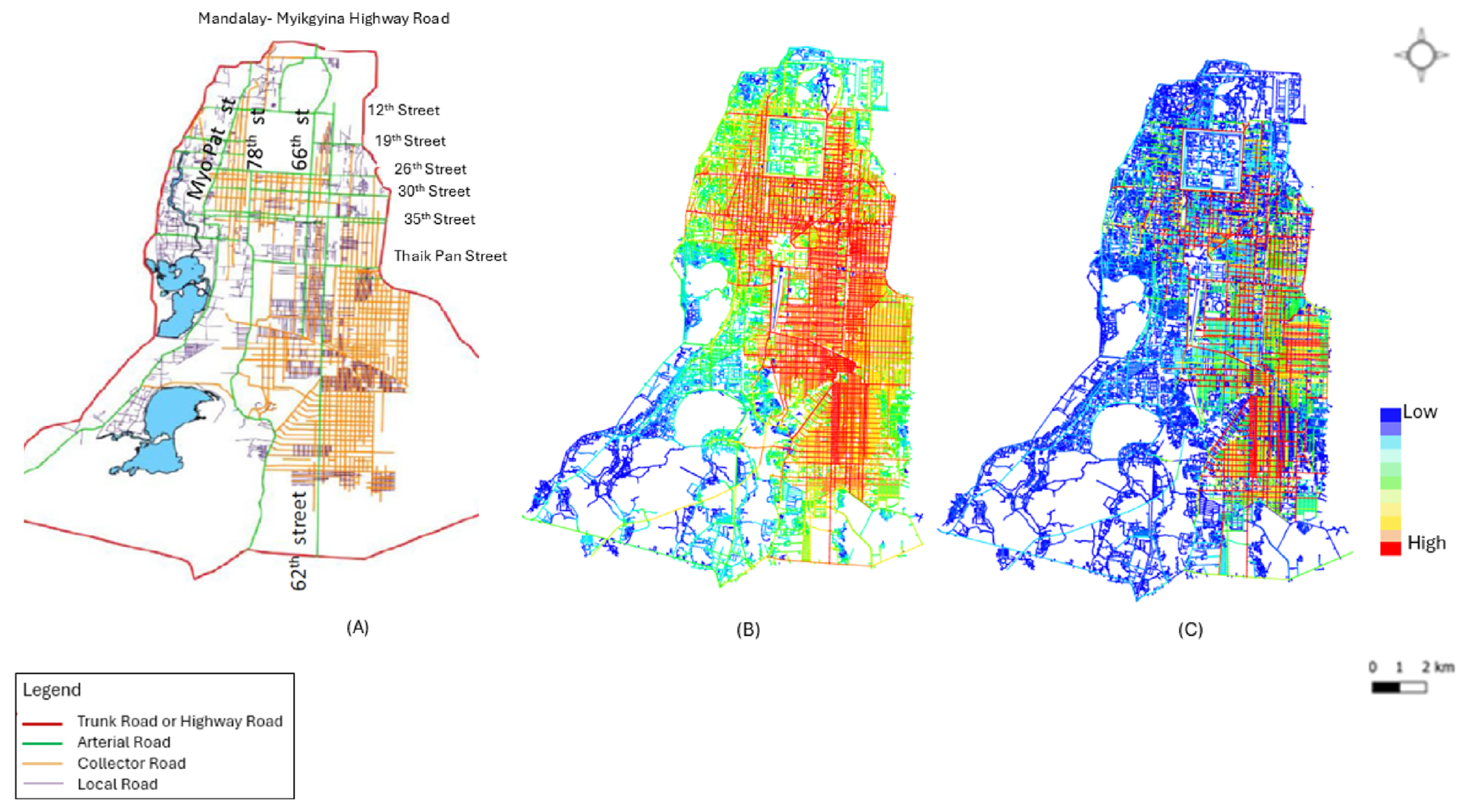
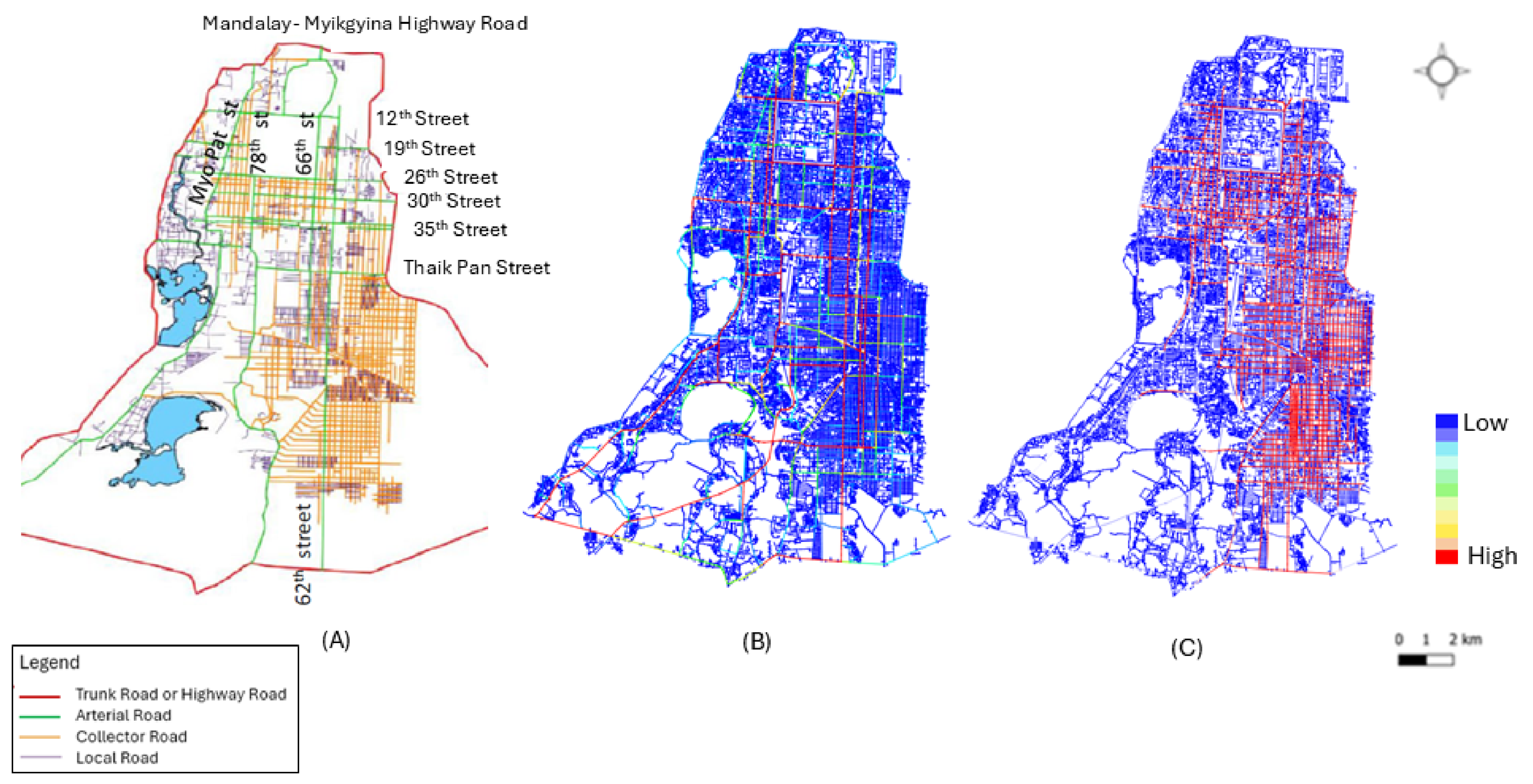
4.1. Citywide Accessibility in Mandalay: Global and Local Movement Patterns
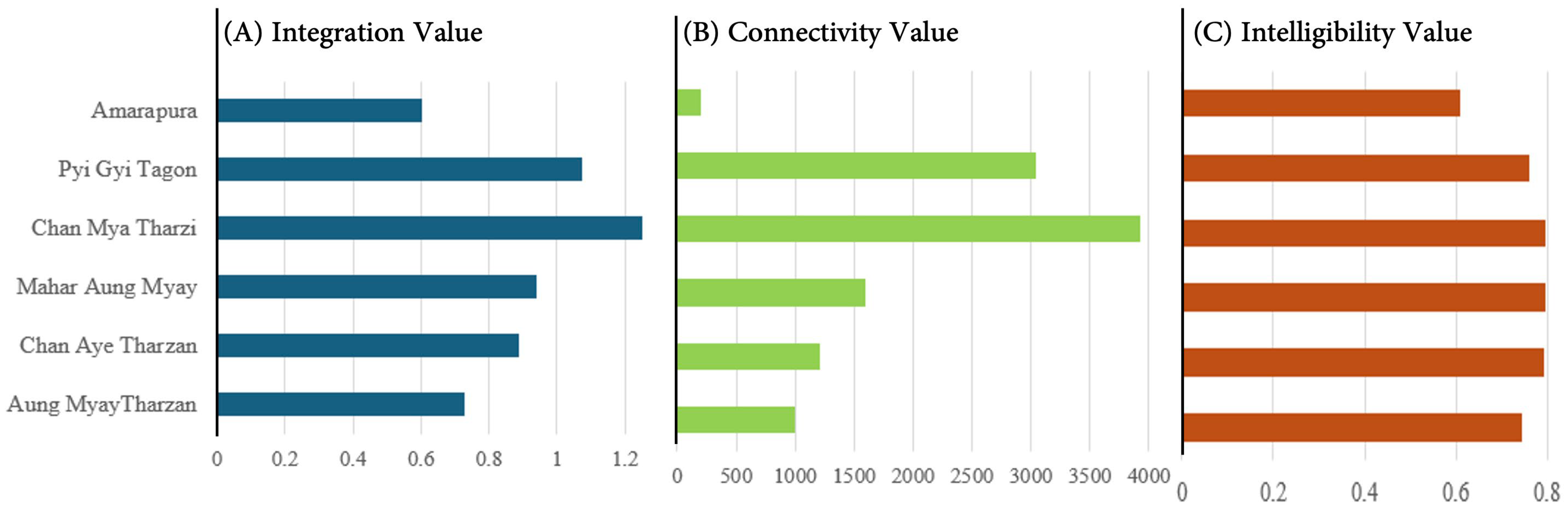
4.2. Township-Level Spatial Configuration in Mandalay: Analysing Integration, Connectivity, and Intelligibility
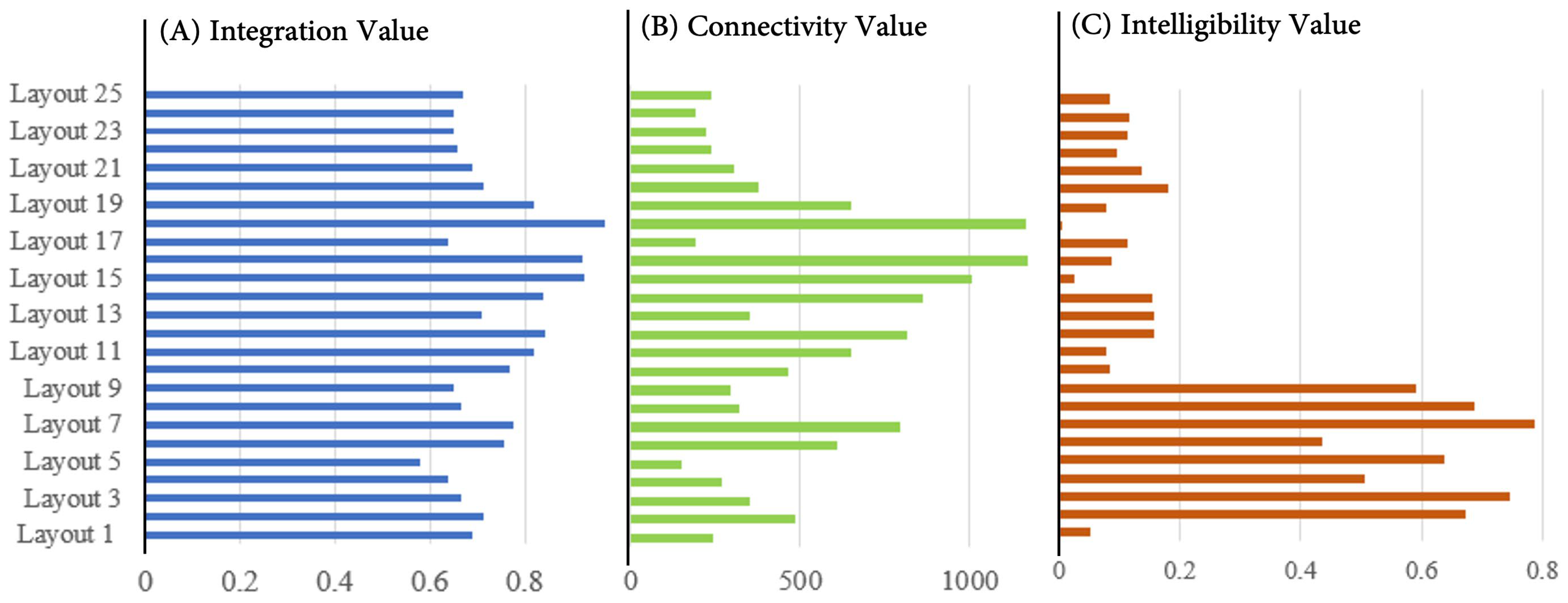
4.3. Micro Scale Level: Assessment of 25 Urban Layouts in Six Townships
4.4. Mandalay’s Spatial Structure in a Global Context: A Comparative Analysis with a 50-Cities Dataset
5. Discussion
6. Conclusions
Author Contributions
Funding
Data Availability Statement
Conflicts of Interest
References
- Yang, J.; Li, X.; Du, J.; Cheng, C. Exploring the relationship between urban street spatial patterns and street vitality: A case study of Guiyang, China. Int. J. Environ. Res. Public Health 2023, 20, 1646. [Google Scholar] [CrossRef]
- Postaria, R. Appraising the influence of street patterns on non-motorized travel behaviour in Ahmedabad City, India. WIT Trans. Built Environ. 2017, 176, 527–538. [Google Scholar] [CrossRef]
- Sarhan, A.E.N.; Farghaly, Y.A.; Mamdouh, A.A. The influence of urban fabric typologies on pedestrian wayfinding. J. Al-Azhar Univ. Eng. Sect. 2021, 16, 49–62. [Google Scholar] [CrossRef]
- Kang, C.-D. Measuring the effects of street network configurations on walking in Seoul, Korea. Cities 2017, 71, 30–40. [Google Scholar] [CrossRef]
- Boeing, G. Urban spatial order: Street network orientation, configuration, and entropy. Appl. Netw. Sci. 2019, 4, 67. [Google Scholar] [CrossRef]
- Govind, A.; Poorthuis, A.; Derudder, B. Quantifying the effects of Singapore’s street configurations on people’s activity spaces. Environ. Plan. B Urban Anal. City Sci. 2024, 52, 23998083241272093. [Google Scholar] [CrossRef]
- Bielik, M.; König, R.; Schneider, S.; Varoudis, T. Measuring the impact of street network configuration on the accessibility to people and walking attractors. Netw. Spat. Econ. 2018, 18, 657–676. [Google Scholar] [CrossRef]
- Askarizad, R.; He, J. Perception of spatial legibility and its association with human mobility patterns: An empirical assessment of the historical districts in rasht, iran. Int. J. Environ. Res. Public Health 2022, 19, 15258. [Google Scholar] [CrossRef]
- Askarizad, R.; He, J.; Khotbehsara, E.M. The legibility efficacy of historical neighbourhoods in creating a cognitive map for citizens. Sustainability 2022, 14, 9010. [Google Scholar] [CrossRef]
- Hillier, B.; Penn, A.; Hanson, J.; Grajewski, T.; Xu, J. Natural movement: Or, configuration and attraction in urban pedestrian movement. Environ. Plan. B Plan. Des. 1993, 20, 29–66. [Google Scholar] [CrossRef]
- Hillier, B. Cities as Movement Economies. Urban Des. Int. 1996, 1, 41–60. [Google Scholar] [CrossRef]
- Xiao, Y.; Sarkar, C.; Webster, C.; Chiaradia, A.; Lu, Y. Street network accessibility-based methodology for appraisal of land use master plans: An empirical case study of Wuhan, China. Land Use Policy 2017, 69, 193–203. [Google Scholar] [CrossRef]
- Boeing, G. Off the grid… and back again? The recent evolution of American street network planning and design. J. Am. Plan. Assoc. 2021, 87, 123–137. [Google Scholar] [CrossRef]
- Kolesnikova, D.A. Grids: Re-considering Infrastructural Politics of Urban Space. J. Front. Stud. 2024, 9, 187–210. [Google Scholar] [CrossRef]
- Zhao, X.; Feng, W.; Yang, L.; Tang, J.; Wu, Q. Analysis of Distribution Network Planning Strategy in Urban Centre based on Grid Concept. In Proceedings of the 2022 9th International Forum on Electrical Engineering and Automation (IFEEA), Zhuhai, China, 4–6 November 2022; IEEE: New York, NY, USA, 2022. [Google Scholar]
- Chen, S.; Yu, B.; Shi, G.; Cai, Y.; Wang, Y.; He, P. Scale-Dependent Relationships Between Urban Morphology and Noise Perception: A Multi-Scale Spatiotemporal Analysis in New York City. Land 2025, 14, 476. [Google Scholar] [CrossRef]
- Bin Asad, K.M.; Yuan, Y. The impact of scale on extracting individual mobility patterns from location-based social media. Sensors 2024, 24, 3796. [Google Scholar] [CrossRef] [PubMed]
- Lam, N.S.N. Fractals and scale in environmental assessment and monitoring. In Scale and Geographic Inquiry: Nature, Society, and Method; Wiley: Hoboken, NJ, USA, 2004; pp. 23–40. [Google Scholar]
- Mabrouk, M.; Han, H.; Mahran, M.G.N.; Abdrabo, K.I.; Yousry, A. Revisiting urban resilience: A systematic review of multiple-scale urban form indicators in flood resilience assessment. Sustainability 2024, 16, 5076. [Google Scholar] [CrossRef]
- Berghauser Pont, M. An analytical approach to urban form. In Teaching Urban Morphology; Springer: Berlin/Heidelberg, Germany, 2018; pp. 101–119. [Google Scholar]
- Karimi, K. The configurational structures of social spaces: Space syntax and urban morphology in the context of analytical, evidence-based design. Land 2023, 12, 2084. [Google Scholar] [CrossRef]
- Asriana, N.; Koerniawan, M.D.; Tambunan, L.; Paramita, B. The Effects Street-Network Configuration in Modelling Walkability Through Space Syntax. Dimens. (J. Archit. Built Environ.) 2023, 50, 13–20. [Google Scholar] [CrossRef]
- Beddiaf, W.; Dib, B. Informal urban development in urban cities. Spatial assessment in the city of Batna, Algeria. Tech. Soc. Sci. J. 2022, 37, 658. [Google Scholar] [CrossRef]
- Hanif, A.; Barak, T.; Loodin, N.; Duque, C.; Zakeri, J.A.; Mirzahi, S.; Nadeem, G.F. Physical features of unplanned settlements in Herat City, Afghanistan. Front. Urban Rural Plan. 2024, 2, 18. [Google Scholar] [CrossRef]
- Nusaputra, C.P.; Dwisusanto, Y.B. Fragmentation of street space usage in Chinatown Village Semarang, Indonesia. ARTEKS J. Tek. Arsit. 2022, 7, 33–42. [Google Scholar] [CrossRef]
- El Barmelgy, M.; Anwer, M.; Eissa, O.M. Upgrading Public Space in Informal Areas Utilizing Ict in Planning Process. In The International Conference on Civil and Architecture Engineering; Military Technical College: Cairo, Egypt, 2024. [Google Scholar]
- Zhao, L.; Wong, W.B.; Hanafi, Z.B. The evolution of George Town’s urban morphology in the Straits of Malacca, late 18th century-early 21st century. Front. Archit. Res. 2019, 8, 513–534. [Google Scholar] [CrossRef]
- Bigon, L.; Hart, T. Beneath the Cityʼs Grid: Vernacular and (Post) colonial Planning Interactions in Dakar, Senegal. In Gridded Worlds: An Urban Anthology; Springer: Berlin/Heidelberg, Germany, 2018; pp. 177–206. [Google Scholar]
- Kolnberger, T. Between planning and spontaneous order: The’equifinal’production of urban space in colonial Phnom Penh (1860s-1930s). Geogr. Z. 2014, 102, 86–105. [Google Scholar] [CrossRef]
- Yoo, C.; Lee, S. When organic urban forms and grid systems collide: Application of space syntax for analysing the spatial configuration of Barcelona, Spain. J. Asian Archit. Build. Eng. 2017, 16, 597–604. [Google Scholar] [CrossRef]
- Maw, T.T.L.; Seo, D. Historical geographies of grid city development: Mandalay from Burma to Myanmar. J. Hist. Geogr. 2024, 86, 133–148. [Google Scholar] [CrossRef]
- Jiang, H.; Zhou, Y. Evolution of the “Golden Royal City”: Analytical study on urban forms of ancient capital cities in Myanmar. Front. Archit. Res. 2023, 12, 714–731. [Google Scholar] [CrossRef]
- Sun, X. Comparative Analysis of Urban Morphology: Evaluating Space Syntax and Traditional Morphological Methods. Master’s Thesis, University of Gävle, Gävle, Sweden, 2013. [Google Scholar]
- Paul, A. Creating awareness of an evidence-based approach to urban design. J. Environ. Sci. Eng. 2012, 54, 175–180. [Google Scholar]
- Tun, D.T. Ne Hle Yazawain [Chronicle from the Field]; Nan Tha Press: Yangon, Myanmar, 1968; Volume 2. [Google Scholar]
- Rashid, M. Space syntax: A network-based configurational approach to studying urban morphology. In The Mathematics of Urban Morphology; Springer: Berlin/Heidelberg, Germany, 2019; pp. 199–251. [Google Scholar]
- Van Nes, A.; Yamu, C. Introduction to Space Syntax in Urban Studies; Springer Nature: Berlin/Heidelberg, Germany, 2021. [Google Scholar]
- Alobaydi, A.F.; Alobaydi, D.; Abdullah, S.F. Exploring the Impact of Streets’ Syntactic Properties on the Urban Functions and Land Use: Insights from Spatial Network Analysis. J. Eng. 2025, 31, 122–141. [Google Scholar] [CrossRef]
- Peponis, J. The space syntax of intelligible communities. In Community Wayfinding: Pathways to Understanding; Springer: Berlin/Heidelberg, Germany, 2016; pp. 35–60. [Google Scholar]
- Yesil, M.; Karabork, R.N.; Ozkul, V.E.; Guzel, M. Analysing the relationship between spatial configuration and land use of the Ordu city with the space syntax approach. J. Environ. Eng. Landsc. Manag. 2024, 32, 305–316. [Google Scholar] [CrossRef]
- Batty, M. Integrating space syntax with spatial interaction. Urban Inform. 2022, 1, 4. [Google Scholar] [CrossRef]
- Körmeçli, P.Ş. Evaluating accessibility of street network in neighbourhood by space syntax method: The Case of Çankırı. ICONARP Int. J. Archit. Plan. 2023, 11, 625–649. [Google Scholar]
- Penn, A. Space syntax and spatial cognition: Or why the axial line? Environ. Behav. 2003, 35, 30–65. [Google Scholar] [CrossRef]
- Kim, Y.O.; Penn, A. Linking the spatial syntax of cognitive maps to the spatial syntax of the environment. Environ. Behav. 2004, 36, 483–504. [Google Scholar] [CrossRef]
- Johnsson, C.; Camporeale, R. Exploring space syntax integration at public transport hubs and public squares using drone footage. Appl. Sci. 2022, 12, 6515. [Google Scholar] [CrossRef]
- Hillier, B.; Hanson, J. The Social Logic of Space; Cambridge University Press: Cambridge, UK, 1989. [Google Scholar]
- Penn, A.; Hillier, B.; Banister, D.; Xu, J. Configurational modelling of urban movement networks. Environ. Plan. B Plan. Des. 1998, 25, 59–84. [Google Scholar] [CrossRef]
- Turner, A. From axial to road-centre lines: A new representation for space syntax and a new model of route choice for transport network analysis. Environ. Plan. B Plan. Des. 2007, 34, 539–555. [Google Scholar] [CrossRef]
- López, P.; Da Silva, A.; Quispe, D.; Von Schoettler, W. Connectivity Analysis In The Urban Centres Of The Metropolitan District Of Quito. Medwave 2024, 24, eUTA36. [Google Scholar] [CrossRef]
- Bhiwapurkar, P. Space Syntax and Walkability Analysis in Support of Urban Design Decisions. In Proceedings of the ARCC Conference Repository, Philadelphia, PA, USA, 16–19 May 2018. [Google Scholar]
- Xiao, Y. Space syntax methodology Review. In Urban Morphology and Housing Market; Springer: Singapore, 2016; pp. 41–61. [Google Scholar]
- Alsaffar, N.H.; Alobaydi, D. Street Patterns, Visual Permeability, and Spatial Accessibility of Downtown: The Case of Baghdad. J. Eng. 2025, 31, 140–155. [Google Scholar] [CrossRef]
- Karimi, K. A configurational approach to analytical urban design:’Space syntax’methodology. Urban Des. Int. 2012, 17, 297–318. [Google Scholar] [CrossRef]
- Jiang, B.; Claramunt, C. Integration of space syntax into GIS: New perspectives for urban morphology. Trans. GIS 2002, 6, 295–309. [Google Scholar] [CrossRef]
- Mathivathany, V. The Application of Space Syntax Analysis in Urban Planning with Existing Practice: Case Study of Jaffna Municipal Council Area; South Eastern University of Sri Lanka: Oluvil, Sri Lanka, 2017. [Google Scholar]
- Crucitti, P.; Latora, V.; Porta, S. Centrality measures in spatial networks of urban streets. Phys. Rev. E 2006, 73, 036125. [Google Scholar] [CrossRef] [PubMed]
- Sheng, Q.; Jiao, J.; Pang, T. Understanding the impact of street patterns on pedestrian distribution: A case study in Tianjin, China. Urban Rail Transit 2021, 7, 209–225. [Google Scholar] [CrossRef]
- Yue, H.; Zhu, X. Exploring the relationship between urban vitality and street centrality based on social network review data in Wuhan, China. Sustainability 2019, 11, 4356. [Google Scholar] [CrossRef]
- Shpuza, E. Allometry in the syntax of street networks: Evolution of Adriatic and Ionian coastal cities 1800–2010. Environ. Plan. B Plan. Des. 2014, 41, 450–471. [Google Scholar] [CrossRef]
- Kim, H.; Joo, Y.; Jun, C. A study on transformation of urban layout patterns through analysis of spatial relationships with urban street configurations. Int. J. Urban Sci. 2011, 15, 25–34. [Google Scholar] [CrossRef]
- McCormack, G.R.; Koohsari, M.J.; Oka, K.; Friedenreich, C.M.; Blackstaffe, A.; Alaniz, F.U.; Farkas, B. Differences in transportation and leisure physical activity by neighbourhood design controlling for residential choice. J. Sport Health Sci. 2019, 8, 532–539. [Google Scholar] [CrossRef]
- Marshall, W.E.; Garrick, N.W. Effect of street network design on walking and biking. Transp. Res. Rec. 2010, 2198, 103–115. [Google Scholar] [CrossRef]
- Ribeiro, J.T.; Vieira, A.R.; Rosado, S.; Serdoura, F. Innovative Approach to Promoting Walkability in Lisbon. Urban Sci. 2024, 8, 61. [Google Scholar] [CrossRef]
- Hachi, R.; Lagesse, C. The impact of urban transformations on the morphology of streets networks. In Proceedings of the 11th International Space Syntax Symposium, Lisbonne, Portugal, 3–7 July 2017. [Google Scholar]
- Braza, M.; Shoemaker, W.; Seeley, A. Neighbourhood design and rates of walking and biking to elementary school in 34 California communities. Am. J. Health Promot. 2004, 19, 128–136. [Google Scholar] [CrossRef]
- Safizadeh, M.; Maghsoodi Tilaki, M.J.; Hedayati Marzbali, M.; Abdullah, A. Smart city and spatial configuration: Assessing accessibility and intelligibility to increase mobility in the George Town heritage site, Malaysia. Open House Int. 2023, 48, 521–541. [Google Scholar] [CrossRef]
- Günaydin, A.S.; Yücekaya, M. Evaluation of the history of cities in the context of spatial configuration to preview their future. Sustain. Cities Soc. 2020, 59, 102202. [Google Scholar] [CrossRef]
- Nophaket, N.; Fujii, A. Syntactic and network pattern structures of city-Comparison of grid and meandering street patterns in Kyojima and Honjo. J. Asian Archit. Build. Eng. 2004, 3, 349–356. [Google Scholar] [CrossRef]
- Eldesoky, A.H.; Abdeldayem, W.S. Disentangling the Relationship between Urban Form and Urban Resilience: A Systematic Literature Review. Urban Sci. 2023, 7, 93. [Google Scholar] [CrossRef]
- Al-Saaidy, H.J.E. A dramatic morphological transformation from a spontaneous, organic street pattern to pre-planned-based order: Learning from Baghdad city. Urban Plan. Transp. Res. 2024, 12, 2287569. [Google Scholar] [CrossRef]
- Askarizad, R.; Daudén, P.J.L.; Garau, C. Exploring the role of configurational accessibility of alleyways on facilitating wayfinding transportation within the organic street network systems. Transp. Policy 2024, 157, 179–194. [Google Scholar] [CrossRef]
- Mohajeri, N.; Gudmundsson, A. Analysing the variation in street patterns: Implications for urban planning. J. Archit. Plan. Res. 2014, 31, 112–127. [Google Scholar]
- Othengrafen, F.; Sievers, L.; Reinecke, E. From Vision to Reality: The Use of Artificial Intelligence in Different Urban Planning Phases. Urban Plan. 2024, 10, 8576. [Google Scholar] [CrossRef]
- Wu, C. A Spatial Data-Driven Urban Pattern Language Framework for Design and Planning. Ph.D. Thesis, University of Twente, Enschede, The Netherlands, 2024. [Google Scholar]
- Turner, A. Angular analysis. In Proceedings of the 3rd International Symposium on Space Syntax, Atlanta, GA, USA, 7–11 May 2001; Georgia Institute of Technology: Atlanta, GA, USA, 2001. [Google Scholar]
- Hillier, W.; Yang, T.; Turner, A. Normalising least angle choice in Depthmap-and how it opens up new perspectives on the global and local analysis of city space. J. Space Syntax 2012, 3, 155–193. [Google Scholar]
- Chen, W.; Huang, H.; Liao, S.; Gao, F.; Biljecki, F. Global urban road network patterns: Unveiling multiscale planning paradigms of 144 cities with a novel deep learning approach. Landsc. Urban Plan. 2024, 241, 104901. [Google Scholar] [CrossRef]



| NACH | NAIN | |
|---|---|---|
| Xmax | 1.5679 | 1.8705 |
| Xmean | 0.912 | 1.2206 |
| S (Xmean) | 0.098 | 0.522 |
| S (Xmax) | 0.0669 | 0.767 |
| Continents and Regions | Name of the 50 Cities |
|---|---|
| USA | Manhattan, Chicago, Chicago centre, Denver, Charleston, Las Vegas, Atlanta, New Orleans, Hollywood, and Washington |
| South and Central America | Santiago, Mexico City (central areas), Rio de Janeiro, Braslia, Recife, Teotihuacan, Uberlandia, Sao Paulo, Petropolis, and Ouro Preto |
| Europe | Barcelona, Mytilene, Nicosia, Nicosia in walls, Venice, Athens, Hamburg, Canterbury, Munich, Antwerp, London, Madrid, Alkmaar, Amsterdam, Rome, Bath, Apt, and Gouda |
| Middle East | Hamedan, Shiraz, Istanbul, Jeddah, Ahmedabad, and Konya |
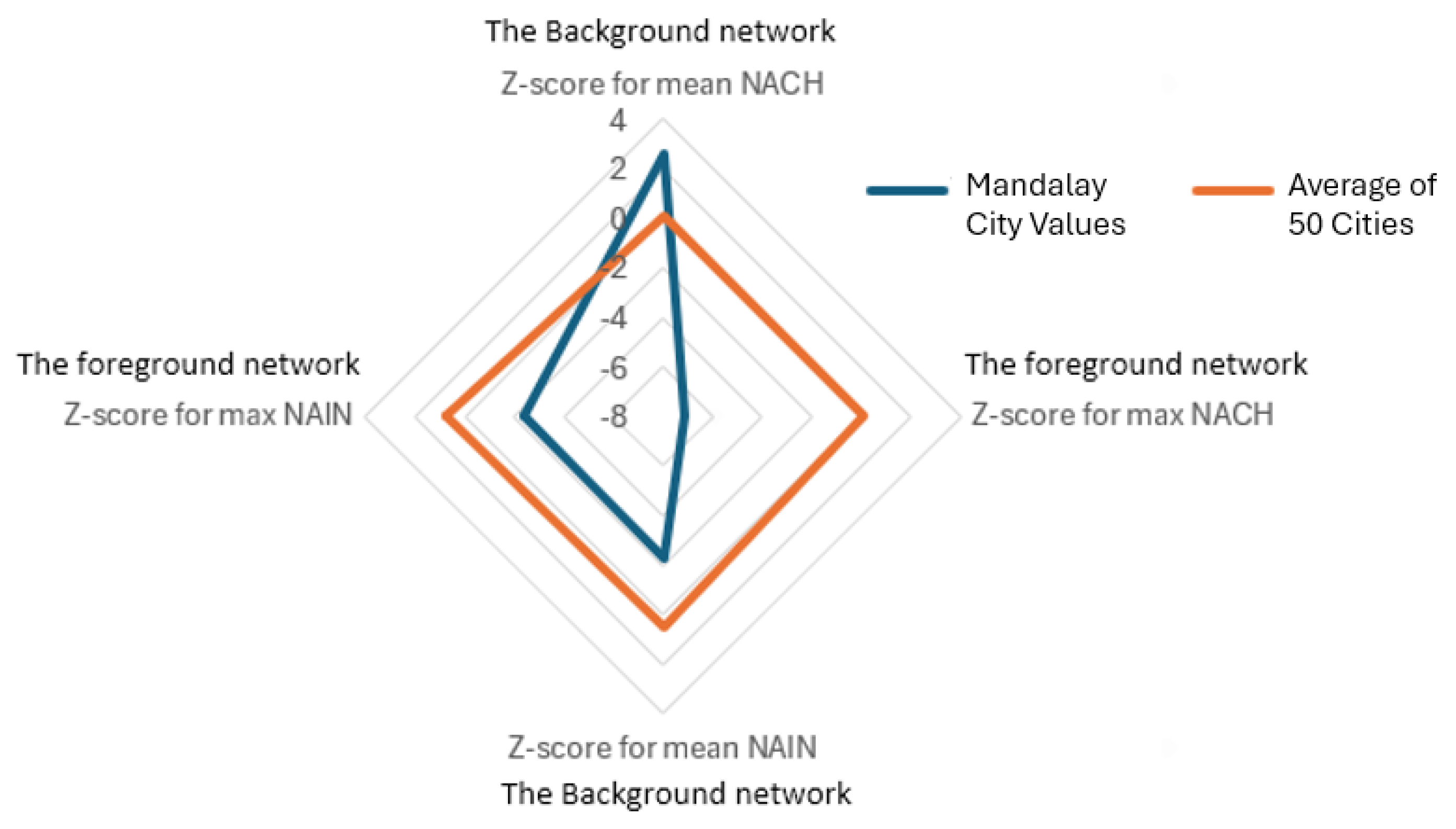
| NACH | NAIN | |
|---|---|---|
| Xmax | 1.1053 | 0.0022 |
| Xmean | 1.1930 | 0.0146 |
| S (Xmean) | 2.8664 | −2.3104 |
| S (Xmax) | −6.9150 | −2.4387 |
Disclaimer/Publisher’s Note: The statements, opinions and data contained in all publications are solely those of the individual author(s) and contributor(s) and not of MDPI and/or the editor(s). MDPI and/or the editor(s) disclaim responsibility for any injury to people or property resulting from any ideas, methods, instructions or products referred to in the content. |
© 2026 by the authors. Published by MDPI on behalf of the International Society for Photogrammetry and Remote Sensing. Licensee MDPI, Basel, Switzerland. This article is an open access article distributed under the terms and conditions of the Creative Commons Attribution (CC BY) license.
Share and Cite
Lay Maw, T.T.; Seo, D. Multi-Scale Space Syntax Analysis of Hybrid Urban Street Networks for Accessibility and Mobility Efficiency: The Case of Mandalay in Myanmar. ISPRS Int. J. Geo-Inf. 2026, 15, 62. https://doi.org/10.3390/ijgi15020062
Lay Maw TT, Seo D. Multi-Scale Space Syntax Analysis of Hybrid Urban Street Networks for Accessibility and Mobility Efficiency: The Case of Mandalay in Myanmar. ISPRS International Journal of Geo-Information. 2026; 15(2):62. https://doi.org/10.3390/ijgi15020062
Chicago/Turabian StyleLay Maw, Thwe Thwe, and Ducksu Seo. 2026. "Multi-Scale Space Syntax Analysis of Hybrid Urban Street Networks for Accessibility and Mobility Efficiency: The Case of Mandalay in Myanmar" ISPRS International Journal of Geo-Information 15, no. 2: 62. https://doi.org/10.3390/ijgi15020062
APA StyleLay Maw, T. T., & Seo, D. (2026). Multi-Scale Space Syntax Analysis of Hybrid Urban Street Networks for Accessibility and Mobility Efficiency: The Case of Mandalay in Myanmar. ISPRS International Journal of Geo-Information, 15(2), 62. https://doi.org/10.3390/ijgi15020062