
Article

Sensing Envelopes: Urban Envelopes in the Smart City Ontology Framework

1
DOBA Faculty of Applied Business and Social Studies, 2000 Maribor, Slovenia
2
Faculty of Civil Engineering, Transportation Engineering and Architecture, University of Maribor, 2000 Maribor, Slovenia
3
Faculty of Architecture, University of Ljubljana, 1000 Ljubljana, Slovenia
*
Author to whom correspondence should be addressed.
ISPRS Int. J. Geo-Inf. 2026, 15(1), 30; https://doi.org/10.3390/ijgi15010030
Submission received: 24 November 2025 / Revised: 30 December 2025 / Accepted: 3 January 2026 / Published: 8 January 2026

Abstract

The paper examines the phenomenon of urban envelopes, a conceptual parallel to building envelopes, which is considered an emerging theme in studies of the built environment. The term ‘envelope’ refers to various physical and non-physical occurrences in the built environment that delimit, enclose, or demarcate spatial configurations. In the first part of the paper, six distinct types of urban envelopes are identified: physical, programmatic, technological, ecological, environmental, and representational. These are defined based on a systematic literature review to clarify their form, role, and meaning in the context of contemporary cities. All six urban envelope types are formalised using ontology-building methods in Protégé and visualised through WebVOWL, producing domain-agnostic RDF/OWL models that support semantic interoperability. The results provide a concise definition of urban envelopes, which are becoming increasingly relevant in their non-physical representations, such as spaces of control (surveillance of public urban spaces), dynamic environmental and ecological phenomena (pollution, heat islands, and more), temporal or dynamic definitions of space use, and many others in the context of contemporary smart city development. The analysis of possible alignment with existing smart city-related ontologies is presented. By providing the methodology for linking urbanistic principles with data-driven smart city frameworks, the paper provides a unified methodological foundation for incorporating such emerging spatial phenomena into formal urban models.

1. Introduction

The manner in which contemporary cities and their concomitant phenomena are described at present differ from the manner in which they were described in the past. This change is characterised by a shift from conventional descriptions of their morphological, typological, functional and symbolic properties [1,2,3,4] to ones that highlight complexity of processes in physical and virtual space that define the contemporary urban phenomena [5,6,7,8]. It is evident that these phenomena are increasing in scale and becoming more intricate in all respects. Furthermore, our contemporary understanding of complexity, and our ability to discern it, has advanced profoundly. This progression encompasses infrastructural, administrative, economic, social, and technological domains, accompanied by environmental challenges. It has been demonstrated that the established traditional descriptions and terminology are no longer entirely adequate to describe and define novel phenomena, particularly those with less explicit occurrence. For example, terms such as ‘street’, ‘sidewalk’, ‘streetlight’, ‘curb’, ‘playground’, ‘pedestrian crossing’ and ‘urban green’ have traditionally been sufficient to describe the elements of public open space. However, it is evident that, in the present day, these terms must be supplemented by new ones that properly define its manifestations and complex programmatic configurations. The increasing presence of digital technologies makes this even more demanding, as the virtual/digital layer lacks the causality, manners and manifestations of traditional roles and spatial terminology.
In this context, this article explores and discusses the phenomenon of urban envelopes, which we perceive as a spatial phenomenon with a rich history and a recent radical redefinition. Envelopes are considered an important topic in studies of the built environment at different scales, with applications in various contexts such as social, cultural, economic, technological, environmental and political [9,10,11]. The term ‘envelope’ therefore represents a variety of physical and non-physical occurrences in our built environment that delimit, enclose or demarcate spatial configurations.

1.1. From Building Envelopes to Urban Envelopes

In the scale of architecture, the studies of building envelopes include phenomenological/aesthetic and technological approaches [12]. The performance of envelopes is related to the operation of boundaries between various domains, including, but not limited to, interior and exterior, private and public, natural and artificial, controlled and uncontrolled, and so forth. These boundaries function to regulate the flows of elements, movements, goods, people, and services. In this way, they facilitate the functioning of the enclosed environment [10].
The conception of architectural or building envelopes is a widely acknowledged concept. The building envelopes are designated as an extremely important architectural element, as it can form a boundary, edge, enclosure or joint with its immediate surrounding [9,12]. The traditional understanding of building envelopes is that of the building’s physical borders, such as facades, walls and roofs. However, due to technological developments and the introduction of new technical solutions, these elements can now be united as a single envelope. The building envelopes regulate atmospheric impacts while mediating heat, air, sound, water, and light transmission. New technological approaches emphasise environmental and energy efficiency [13,14,15,16], acoustic properties [17], biomimetic principles [18] as well as new production methods and performances [19,20]. The complex understanding of building envelopes include their representational, aesthetic [21] as well as political function [9,11].
On the other hand, urban envelopes are much more complex and therefore harder to define [10,22,23,24].
At the end of the millennium, Michael Sorkin [25] (p. xi) defined the contemporary city (especially advanced in the United States) as ageographical—“a city without a place attached to it”. Its characteristics are the dissipation of relations to locality, its obsession with security, manipulation and surveillance as well as new modes of segregation, and as a city of simulations that resembles a theme park. The ageographical city is realized upon generic urbanism, composed of bare functions floating in a ‘non-place urban realm’ [25]. After the Second World War, the recognition of the loss of place due to modernist planning mobilized different approaches to its re-introduction. Seeking an alternative to the non-place urban realm, the enclosed spatial propositions were advocated as a possible solution, albeit with specific analyses and approaches, led by Gordon Cullen, Kevin Lynch, and Robert Venturi and Denise Scott Brown. As Tom Avermate [26] (p. 46) argues, “Place is no longer associated with a specific and unique spatial and social momentum, but becomes a category autonomously set against, and capable of being isolated from, the time-space continuum of urbanism”. In contrast to a phenomenological [27] or anthropological [28] understanding of place, the enveloped concept of place became, first, open to the processes of thematization and then, before the turn of the millennium, recognised as its pathology [26]. Indeed, at the beginning of the millennium, Lieven De Cauter framed the discourse on urban enclosures, describing spatial conditions empowered by transcendental capitalism and its all-encompassing tendency to commodify, which results in the threat of high-intensity capsularisation of space [22].
As with the conditions of the ageographical city, next to its inherent fluidity, Manuel Castells’ concept of space of flows presupposes areas of seclusion in introverted or enveloped environments that mediate their spatial dependency on context. According to Castells [5] (pp. 441–442), space is an expression of society, “the material support of time-sharing social practices”, while the contemporary space of flows is “the material organization of time-sharing social practices that work through flows” of capital, information, technology, organisational interaction, images, sounds and symbols.
Different expressions related to the phenomenon of urban envelopes are found throughout literature, each with slightly different meaning depending on the context. Examples include boundaries, bubbles, capsules, capsularities, enclaves, enclosures, voluntary ghettoes, etc. A range of theoretical perspectives, including phenomenology, urban sociology, and political ecology, can be used to explain different terms that describe the unique characteristics of enclosed spatial phenomena in contemporary urban contexts. Since a detailed analysis of these terms’ theoretical perspectives exceeds the scope of this study, we elucidate their basic meanings and distinctions with the main references below.
Boundaries are physical or non-physical demarcations. They are static as they define edges and limits. Spatially, physical boundaries define the perimeter of an enclosure. Enclosures encompass both the structure of the boundary and its enclosing space. Contemporary spatial enclosures, known as “capsules,” have been theorised by Lieven De Cauter in terms of their social significance that involves the exclusion or seclusion of capsular environments with biopolitical connotations [22]. Peter Šenk has designated these phenomena as “capsularities” that denote capsular enclosures at different scales, from the scales of the individual living cell to territorial enclosures. The latter have been analysed with the use of the concept of urban envelopes, which are conceptualized as performative spatial formations that have a control and representational function [10,23,24]. Furthermore, Zygmunt Bauman defined enclosing spatial and social structures, such as gated communities and other voluntary, exclusive spatial formations, as “voluntary ghettos” [29] and Peter Sloterdijk’s Spheres project presents the organizational and spatial structure of such micro-spheres, in which shared life is organized, as “bubbles” [30]. While the terms boundary, enclosure, capsule, capsularity, voluntary ghetto and bubble do not directly refer to all the aforementioned perspectives (e.g., phenomenology, urban sociology, and political ecology), the concept of enclaves offers an inclusive multilayered structure in the context of contemporary recombinant urbanism, as promoted by David Grahame Shane [31]. The enclaves are sharing characteristics with the concept of urban envelopes [10,23,24]—such as viewing the city as fragmented into diverse, spatially or socially defined units that rely on physical and nonphysical boundaries, but their differences are phenomenological, social, and ecological. Enclaves are referred to as morphological units in the context of urban design. The enclave is a node in the space of flow, an attractor that enables the production of identity. An enclave is defined as “a self-organizing, self-centering, and self-regulating system created by urban actors, often governed by a rigid hierarchy with set boundaries” [31] (p. 177). In contrast, the concept of urban envelopes, as elucidated within the framework of critical urban analysis, has been delineated in a more integrative manner. The boundaries of urban envelopes extend from hard to soft and infrastructural, thereby encompassing a wider range of urban characteristics. According to accessibility and representation of the enclosed entity through different scales, these include physical complete and physical permeable envelopes, which can be either sealed or enclosing (with physical walls, borders or fences), and the non-physical ‘skin’ of the diffuse—IT controlled and surveilled territorial envelopes [10]. Since there are physical and non-physical intangible control mechanisms at work in contemporary space, many envelopes function as hybrid envelopes, either as complete and diffuse or permeable and diffuse.
In this sense, the urban envelope concept, which is more general and integrative, can include a wide scope of phenomenological, social, and ecological perspectives. It addresses issues related to spatial practices and representations, the democratic demand for the right to the city, and the production of space in general [32], as well as to various aspects of ecological urbanism, including approaches to and reactions to sustainable and landscape urbanism [33]. It provides an open framework for sensing, detecting, and monitoring spatial modalities and enables their incorporation into a smart city model.

1.2. Urban Envelopes in the Smart City Domain

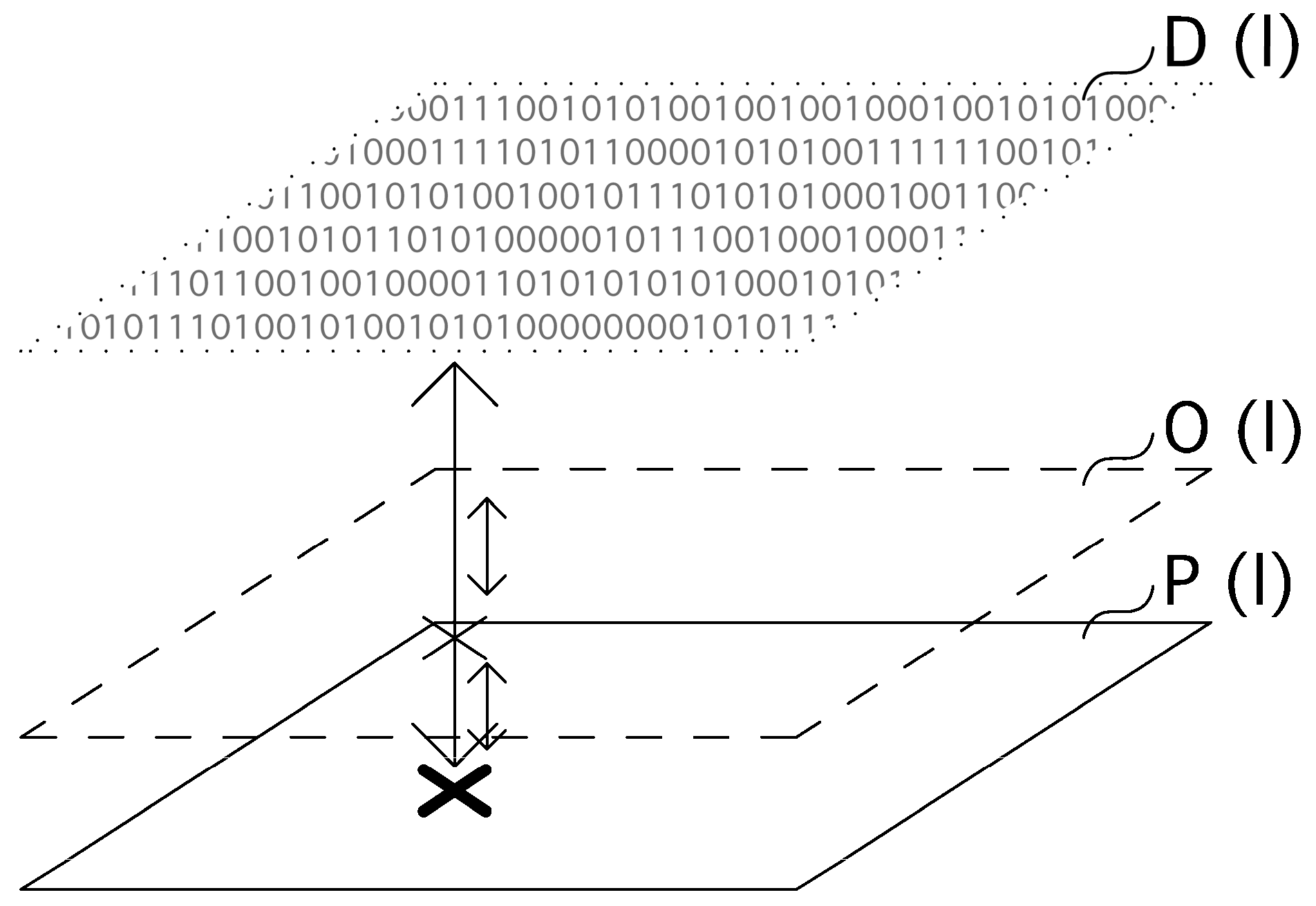
Smart city models typically reflect a layered structure, which can vary depending on the chosen model [34]. According to Komninos, smart city is produced by adding a digital layer over the physical and institutional layers of the city (Figure 1) [35]. The addition of a data layer can reveal spatial concepts that are not immediately visible or physically tangible in urban space [36]. Their invisibility may result from factors such as scale, complexity, location, or material characteristics. These spatial phenomena can be identified through data available in smart city platforms or digital twin models. The sources of this data vary, including spatial databases such as OpenStreetMap and Google Maps, as well as sensor-based data from environmental sensors, traffic monitoring systems, and other sources such as citizen apps, GIS layers, and administrative datasets [37,38]. To ensure semantic interoperability across these heterogeneous data sources and the different layers of a smart city platform or even digital twin model, ontologies are essential [39,40,41,42,43]. They provide the backbone for interpretation and reasoning [43]. In this context, we aim to connect the concept of envelopes with the models of a smart city, using ontology, as it enables universal interdisciplinary understanding of phenomena [44]. The purpose is also to facilitate knowledge exchange between different disciplines based on their individual domains; in this case, the domain is the smart city.
Many definitions describe a smart city as an urban space with innovative features [45,46], yet the important question remains: how is this knowledge development reflected and operationalised in the field of urbanism? The smart city domain nowadays involves a wide range of business sectors and disciplines, many of which are technologically oriented. Consequently, the rich body of knowledge historically central to city development has become somewhat challenged.
To address this imbalance, it is crucial to reintroduce urbanistic principles into the smart city domain in ways that describe new spatial relations and occurrences, to prevent spatial conflicts and support coherent urban development, with a focus on sustainable ecological development, mitigating climate change [33,42]. The concept of the urban envelope is example of such development in contemporary urbanism; additional principles may follow. Importantly, these principles are inherently configurational. They are related to the spatial and socio-economic patterns as described by Christopher Alexander’s A Pattern Language [47], which define configurational principles that have been historically established or addressed in particular ways. These patterns now require reinterpretation in a modern, data-rich context. By bringing configurational insights from urbanism into smart city or digital twin models, we can enrich these technological platforms with a deeper spatial logic. This integration supports more informed, interdisciplinary, and resilient approaches to urban development.

1.3. Aims of the Study

The paper examines the understanding of specific phenomena in the field of urbanism and spatial planning, focusing on Urban Envelopes (hereafter UE). Historically, urban phenomena were primarily associated with physical space, as urban structures and their placement within the city were considered essential for understanding how cities function. The contemporary perspective on smart cities encompasses a range of dynamic urban phenomena—processes, complex objects, and multi-domain phenomena—identified through collected data (using sensors, satellite imagery, etc.) that are otherwise difficult to detect due to factors such as scale, temporality, or even the absence of physical manifestation. New representational models of cities are being developed to reflect this reality [34].
Smart city models are based on core ontologies that capture/reflect new urban complexities. In general, collected data, combined with ontology-based understanding of structures, can potentially provide new opportunities to describe and identify a new category of urban phenomena defined as the urban envelope. The study aims to provide theoretical foundation for such identification as the necessary data becomes more broadly available for research purposes.
There are several objectives in defining urban envelopes within an ontological framework. Firstly, interdisciplinary understanding of urban phenomena from the urbanism domain is required within the knowledge framework of smart cities and digitals. Urban ontologies, which provide the semantic foundation for knowledge graph construction, aim to unify fragmented urban concepts, attributes, and relations through formal modelling [43]. Secondly, it is necessary to establish a mechanism for identifying envelopes as urban phenomena from collected data in smart cities (e.g., sensor data). This would enable the existence and further study of these phenomena. The same methodology could be applied to other phenomena within the urbanism domain. Thirdly, incorporating envelopes into the smart city framework would enable city managers to manage related processes more efficiently, which is crucial for further urban development in the areas of carbon neutrality and biodiversity.
The aim of the study is to explicitly define types of urban envelopes that can be recognised and studied through smart city data framework.
In relation to the main research aim, three research questions are posed:
  • How are urban envelopes defined in the fields of urbanism and urban planning?
  • What types of urban envelopes can be identified based on their common and distinct properties?
  • How can urban envelopes be identified within the frameworks of smart cities using related ontologies?
The paper is structured into three main chapters: Materials and Methods; Results, where different types of urban envelopes are presented according to defined parameters and ontologies of urban envelopes are constructed; and finally, a Discussion chapter.

2. Materials and Methods

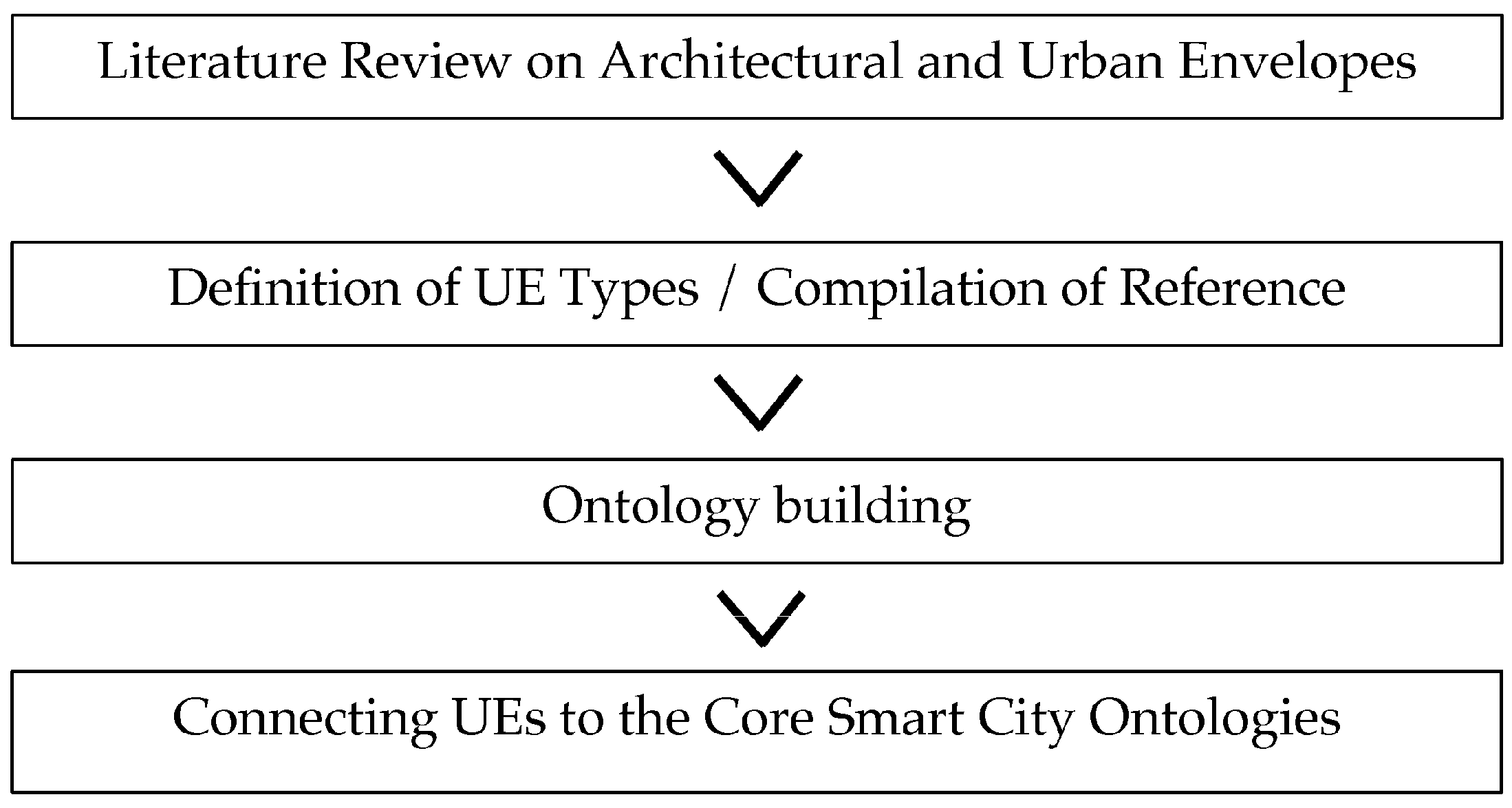
In this paper, a methodology comprising several steps was used (Figure 2). A more detailed description of each step is provided below.

2.1. Literature Review on Architectural and Urban Envelopes

Initially, urban envelopes are researched through a literature review of envelopes as they appear in the field of urbanism. A comparison is drawn with building envelopes, and distinctions in terminology are highlighted. Subsequently, the concept of envelopes is applied to the urban scale, where different types of urban envelopes are proposed. These are related to contemporary developments in ICT in smart cities.

2.2. Definition of UE Types/Compilation of Reference Descriptions

From the literature review and analysis of smart city concepts, six distinct UE types are defined. These are (a) depicted in explicit schematic drawings illustrating core concepts and (b) described in concise reference texts defining entities and relations for each type of UE, with the aim of creating a reference point to support the ontology-building process.
In this step, two key links are established: (a) a conceptual integration between foundational principles of urbanism and contemporary developments in the domain of smart cities, and (b) a connection between the urbanism knowledge domain and the explicit representation of the investigated phenomena within an ontological framework.

2.3. Ontology Building

The collected information forms the basis for constructing an ontological model for each UE type. The analysis and formalisation of all six UEs are conducted. Three UEs are presented in the Results chapter, while all six are available via the public link provided in the Data Availability Statement at the end of the paper, including the RDF/OWL code and graphical presentations.
Ontology development is carried out by first deriving concise key statements from comprehensive definitional descriptions of each UE. These key statements are then encoded into an RDF/OWL representation using GPT. The use of GPT in the initial phase of ontology development serves solely to reduce the manual effort required for compiling the RDF/OWL representation and does not involve any substantive contributions or conceptual additions by the large language model.
The provided code is then refined and reviewed using the Protégé ontology editor. The procedure includes identification of key concepts, entities, and domain-specific vocabulary, followed by their final formal representation within the editor. Relationships among the principal concepts, together with their associated properties, are created and verified using referenced source materials, thus completing the initial ontology construction.
For final verification, validation, and dissemination of the UE structures, each ontology is visualised using the WebVOWL application [48], which enables transparent inspection of the defined classes and relationships.
The output of this phase consists of six formally specified ontologies exported in RDF/OWL format from Protégé, along with their corresponding graphical representations of the UE models.

2.4. Connecting UEs to the Core Smart City Ontologies

To enable effective knowledge transfer between the urbanism domain and smart city models, key shared concepts and classes were identified to support the semantic alignment of urban envelope ontologies with the selected Smart City ontology.
The required number of shared concepts depends on several factors, including the scope, granularity, and semantic distance between the ontologies. One key shared concept (class) serves as an ontology alignment anchor, as the UE ontologies are considered domain-agnostic and limited in scope. The resulting set of shared ontology classes is presented in Section 3.3.
Finally, recommendations for future research are given.

3. Results

3.1. Types and Parameters of Urban Envelopes

The research identifies six distinct types of urban envelopes, derived from the concept of the building envelope and adapted to the urban scale and context. These are the physical urban envelope, programmatic urban envelope, technological urban envelope, ecological urban envelope, environmental urban envelope, and representative urban envelope.
They refer to how different functional boundaries in space are perceived, communicated, represented and recorded (to the digital SC layer), not only according to their physical or virtual existence. Unlike a boundary, which indicates a limit that separates, for example, two areas, conditions, or states, the envelope is considered a mediating surface that not only separates/connects but also regulates interactions (e.g., a public park with fences and entrance gates under a surveillance system) [44].
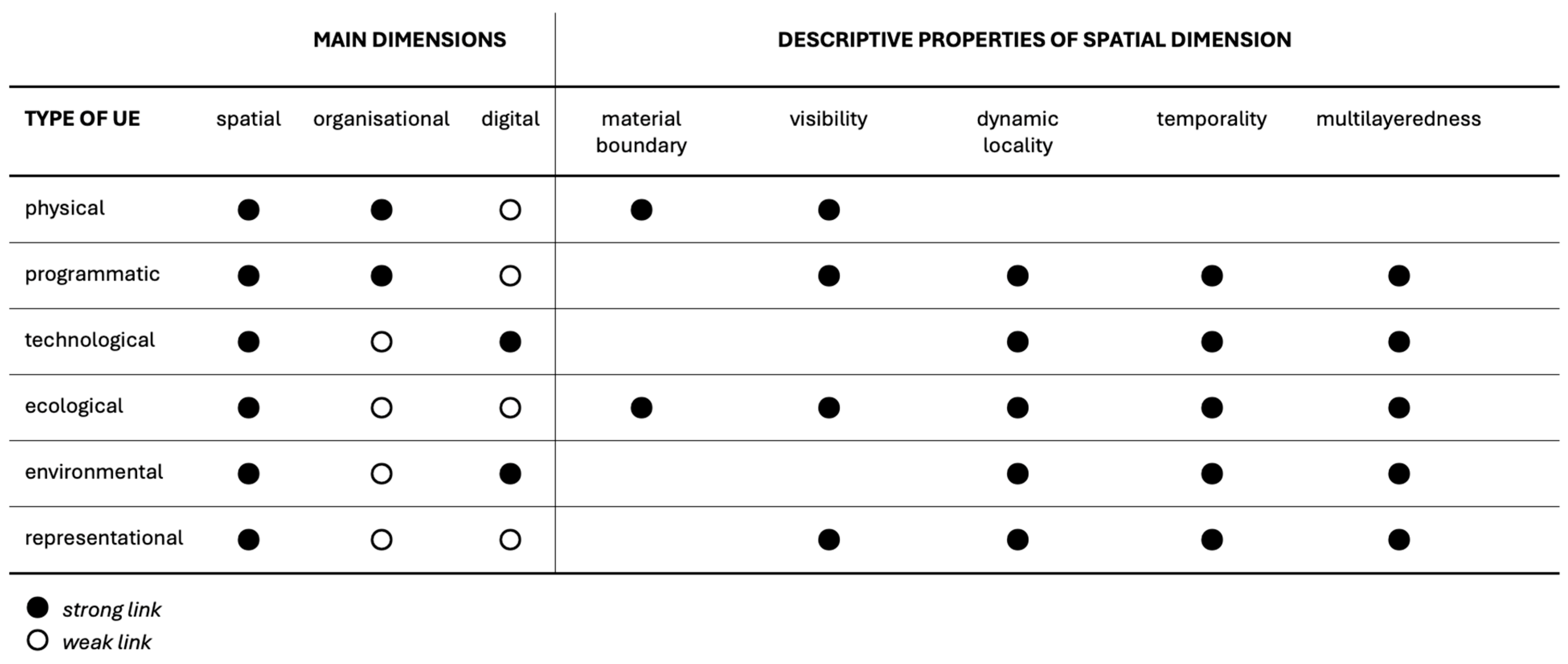
Urban envelopes are described by a set of properties. Three main dimensions reflect the layered structure of a smart city applied to the concept of urban envelopes; these are: (1) a spatial dimension/layer/geometry, (2) organisational dimension/institutional layer, and (3) digital dimension/informational layer. The UEs differ in the way they manifest properties in these three layers [35].
All urban envelopes possess a spatial dimension, whereas some have material, while others have immaterial. Boundaries may be visible or invisible, and can be impassable, permeable, or diffuse. They also vary in their attachment to location; some are fixed and static, while others have no fixed location and are dynamic, able to move, deform, expand, or contract.
The organisational dimension is defined as a set of man-made rules that apply to a specific area. Certain UEs are fully managed and cannot exist without this dimension (strong link), while others are only partially managed, self-organised, or self-sustained, and can still exist without this layer (weak link). The digital layer refers to whether the digital dimension forms the envelope (strong link) or is present to a lesser extent (weak link).
Temporality refers to the duration of their presence: some are always present, while others may appear or disappear over time. The final property considers whether a particular type of urban envelope can exist in multiple variants at certain locations. All observed properties are listed in Figure 3.
The selected properties are used to determine the nature of each urban envelope. The set of envelopes was also defined by how they can be detected or sensed. In this context, it is important to distinguish between environmental and ecological urban envelopes, as the terms appear related but stem from different conceptual frameworks and emphasise different scales and objectives. Urban environmental phenomena focus on the short- and medium-term impacts of human activity on air, water, soil, climate, and other living conditions, and often have an applied and regulatory orientation (e.g., emissions regulation, environmental impact assessment). Their performance can be monitored, for example, with sensors [49]. In contrast, ecology, as a biological science, is concerned with relationships among organisms and between organisms and their environments, focusing on green and blue infrastructure, including ecosystems, biodiversity, and long-term natural processes [50]. These foundational differences have led to the formulation of two distinct urban envelopes: the environmental urban envelope and the ecological urban envelope.
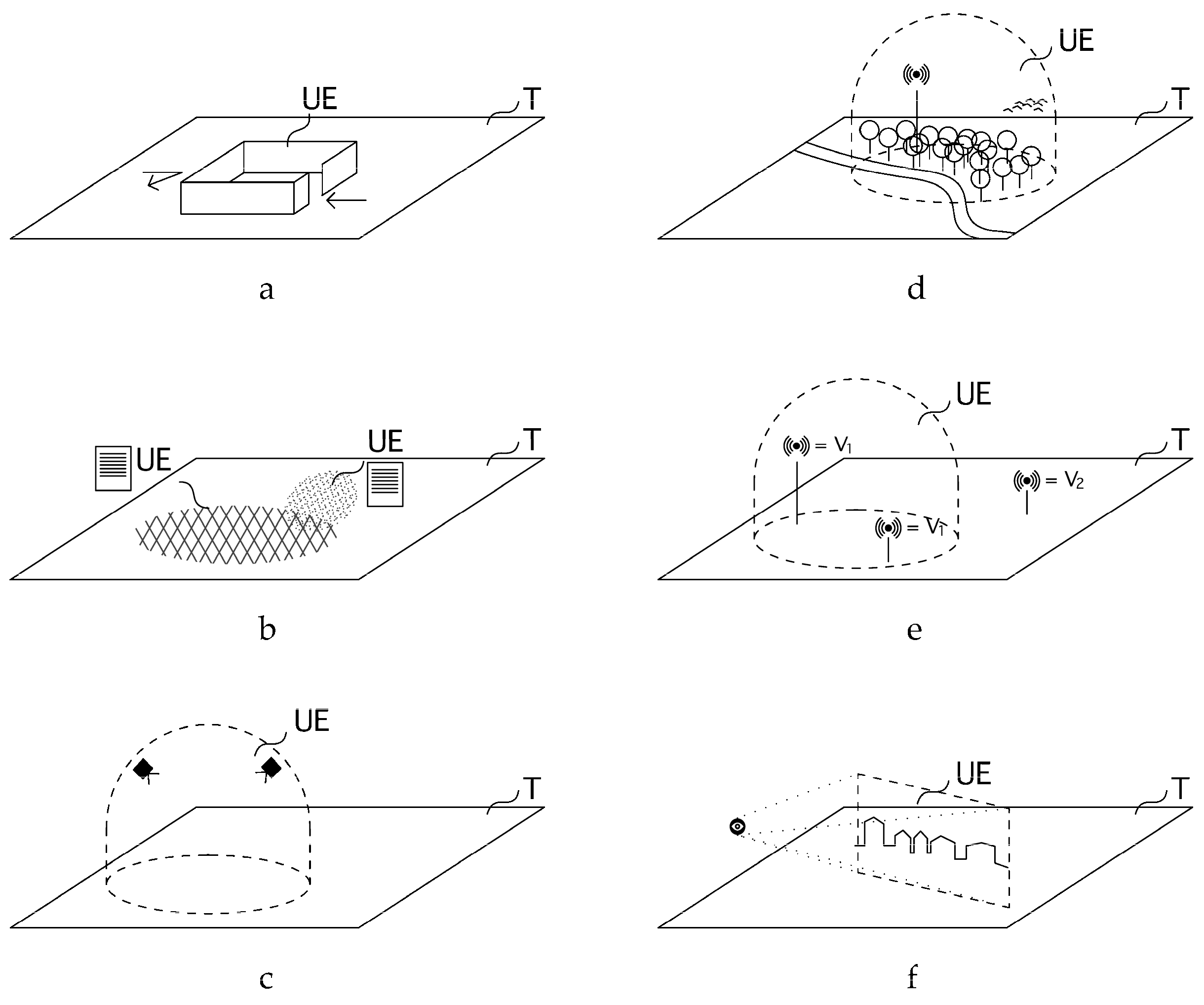
In the following section, each distinct urban envelope is described, with a brief explicit reference text as a definition provided at the end (Figure 4).

3.1.1. Physical Urban Envelope

The physical UE refers to areas of the city separated by material boundaries, such as walls and fences, which regulate access. These visible, tangible boundaries enclose and define localities with specific uses, such as gated communities, security facilities, fenced industrial complexes, shopping mall complexes, airports, and other sites that, according to De Cauter and Šenk are considered physical ‘capsules’ and ‘capsularities’ [10,22]. Access and operation are regulated by their organisational principles: these areas may be inaccessible to the general public, access may be conditional, or it may be free. Physical UEs are material structures that are static in form and lack intrinsic temporal adaptability or multilayeredness; nevertheless, they are present in the digital dimension as a geometric description.
  • Definition of the Physical UE
A physical urban envelope is defined by a tangible, material boundary—such as a fence, wall, or other built structure—that completely encloses an urban space, separating the ‘inside’ from the ‘outside’. The main function of the physical urban envelope is to control access and interaction within the urban space through its physical presence and design (Figure 4a).

3.1.2. Programmatic Urban Envelope

Programmatic UEs are spaces defined by planning, managerial, or legal texts, guidelines, and documents. They designate areas subject to various rules, which may have defined or undefined temporal expiration, or may undergo changes in the rules themselves. Programmatic UEs may overlap with others that have similar or different content and regulatory frameworks. Examples include areas covered by strategic documents and visions [51], regulatory spatial documents such as masterplans, land-use regulations and restrictions [52], areas designated for natural or cultural heritage protection, areas with developed guidelines for public space, urban design and mobility (e.g., urban furniture, bicycle sharing systems…) [53], areas covered by documents addressing environmental, social, and community-oriented topics (i.e., climate adaptation plans, housing strategies…), and areas governed by specific management and operational documents or policies (e.g., smart city initiatives) [54]. It also addresses categories of public and private space. In urban planning, a programmatic UE can be as small as the area around a building entrance (i.e., rules for maintenance) or as large as an entire district (i.e., masterplan). Programmatic UEs have a spatial dimension defined by location rather than explicit physical boundaries. Their strong organisational dimension is their main attribute, while their digital dimension is represented in rules and regulation stores as digital documents or encoded in software. Since they can change the areas they cover, or they can expand or contract in size, their locations can be considered dynamic, and their operations are temporary and multilayered.
  • Definition of the Programmatic UE
A programmatic UE refers to the conceptual boundary that defines and organises an urban space, shaping how it is experienced and used. Unlike a physical UE, which is strictly delineated by a material barrier, a programmatic UE operates through patterns of use and activity defined by regulatory formulation. It is defined by a described spatial location rather than by existing physical borders. Programmatic UE can transform in time. Multiple programmatic envelopes can coexist or overlap within the same urban fabric (Figure 4b).

3.1.3. Technological Urban Envelope

Technological UEs pertain to areas of technological surveillance and control, which fall under the umbrella of smart urban planning [55]. These technologies influence our daily lives and behaviour, as well as the design of urban spaces [36,37,38,56,57]. They can be characterised by: (a) surveillance systems—CCTV, facial recognition, motion sensors, etc.; (b) access-control technologies—smart cards, QR codes, biometric scanners, etc.; or (c) digital monitoring networks—GIS tracking, smart city data platforms, geofencing, etc. Technological UEs are spatially embedded, but do not necessarily involve an organisational dimension. Their technological dimension defines an immaterial boundary that is not visible; however, signs indicating areas of technological surveillance and hardware have only a weak visual presence. As areas of technological UE can easily contract or expand, their locality is dynamic and their presence temporary, allowing multilayered systems within the same territory. Their presence in urban areas is becoming increasingly significant.
  • Definition of the Technological UE
A technological urban envelope is a non-material, data-driven boundary that regulates space through control, monitoring, and surveillance technologies rather than purely physical barriers. It can be defined by surveillance systems, access-control technologies or digital monitoring networks. This type of urban envelope is ‘diffuse’, its borders are invisible, flexible and dynamic. Multiple technological UE can overlap and co-exist. They determine how events and actions are observed or recorded (Figure 4c).

3.1.4. Ecological Urban Envelope

While ecological building envelopes, or ‘Ecolopes’, have already been recognised as a strategy that can directly impact the urban environment [58,59], within the framework of ecological urbanism [33], a broader view is manifested in ecological UEs. They include areas of natural and designed habitats in the cities such as (a) green and blue infrastructure—parks, green belts, urban forests, wetlands, rivers and renatured brownfield environments; (b) climate and pollution buffers—vegetation zones that filter air, mitigate heat islands, and absorb stormwater; (c) habitat corridors—connecting ecosystems to support biodiversity within the city; and others. Ecological UE has a strong spatial dimension with boundaries that are material and visible, but also dynamic in form and subject to change. They can contract or expand and operate temporarily, accommodating multiple layers of ecological features, such as habitats or migration paths for animals, urban beekeeping, the growth of different plant species, the mitigation of risk environments, and recreational use. The ecological UE does not have a strong link to the organisational dimension, as it exists and operates without human-led organisation; however, this does not mean there is no interference or regulation. It also does not have a strong link to technological dimensions, due to its complexity. The unambiguously positive impact on city dwellers associated with increased awareness of green infrastructure in cities is becoming increasingly pertinent.
  • Definition of the Ecological UE
The ecological urban envelope is the network of natural and designed boundaries in a city that regulates ecological processes and interactions between urban areas and their environment. It operates at a larger, territorial scale and includes green and blue infrastructure, climate and pollution buffers, habitat corridors and others. Its boundaries are material and visible, yet dynamic and subject to constant change. Its aim is to balance urban development with ecological resilience, protecting environmental quality while shaping how the city breathes, cools, and sustains life (Figure 4d).

3.1.5. Environmental Urban Envelope

In the study of building envelope regulations (such as green roofs for humidity retention and reflective façades), Zaera-Polo & Anderson describe the direct environmental impact of buildings on the surrounding urban space [12]. This includes altering the local atmosphere, reducing the heat island effect, and addressing the influence of buildings on the urban climate. In this context, environmental urban envelopes embody environmental concerns within the urban realm, which can be measured and quantified. Examples of environmental urban envelopes include (a) heat islands; (b) zones of air, water, and soil pollution, as well as areas affected by light and sound pollution; (c) areas with altered wind flows or turbulence caused by building morphology, among others. Environmental UEs have spatial and technological dimensions and can exist independently of the organisational dimension. They are immaterial (in terms of built structures), invisible, and have dynamic, changing, temporary locations, which may include multiple layers.
  • Definition of the Environmental UE
The environmental urban envelope differs from the ecological urban envelope, capturing phenomena in urban areas resulting from natural climate dynamics influenced by human activities and the built environment. This type of urban envelope is ‘diffuse’, its boundaries are flexible and dynamic, often overlapping and are spatially distributed across the cityscape. Such envelopes are detected and monitored through environmental sensors and data networks, which record parameters such as temperature, humidity, particulate matter, sound levels, and radiation (Figure 4e).

3.1.6. Representational Urban Envelope

Zaera-Polo [9,11] has analysed building envelopes that traditionally included technical and aesthetic layers, which can have a strong communicative, psychological and political narrative. Similarly, one can perceive representational UEs as areas constructed by a symbolic narrative represented in space in the form of: (a) signs—such as areas of commercial advertisement, corporate branding, and art installations; (b) views or vistas—for example, historic landmarks, collective perception dominants, and curated visual settings; and (c) ritual settings or areas of performance, such as plazas that stage civic, political, or cultural events. Representational UEs are therefore not physically defined boundaries, but their definition is related to territorial cultural, economic, social, or even political identity. Representational UEs have a spatial dimension and can operate independently of organisational and digital dimensions. Their boundaries are not material, although their communicative essence is applied to material structures and is therefore visible. A representational UE can contract or expand temporarily in terms of location and can be composed of multiple layers.
  • Definition of the Representational UE
The representational urban envelope incorporates a set of social, cultural, economic, and political conditions that affect urban space. Representational urban envelopes function as urban sign systems through which institutions and communities project identity, values, power and empowerment into public space (Figure 4f).

3.2. Ontology of Urban Envelopes

The collected information serves as the basis for constructing an ontological model for each UE type. From the total of six identified UEs types, three are analysed and presented in the following chapter. However, the analysis and formalisation of all six UEs is available from the public link provided in the Data Availability Statement at the end of the paper, including the RDF/OWL code and graphical presentations.

3.2.1. Ontology of the Programmatic UE

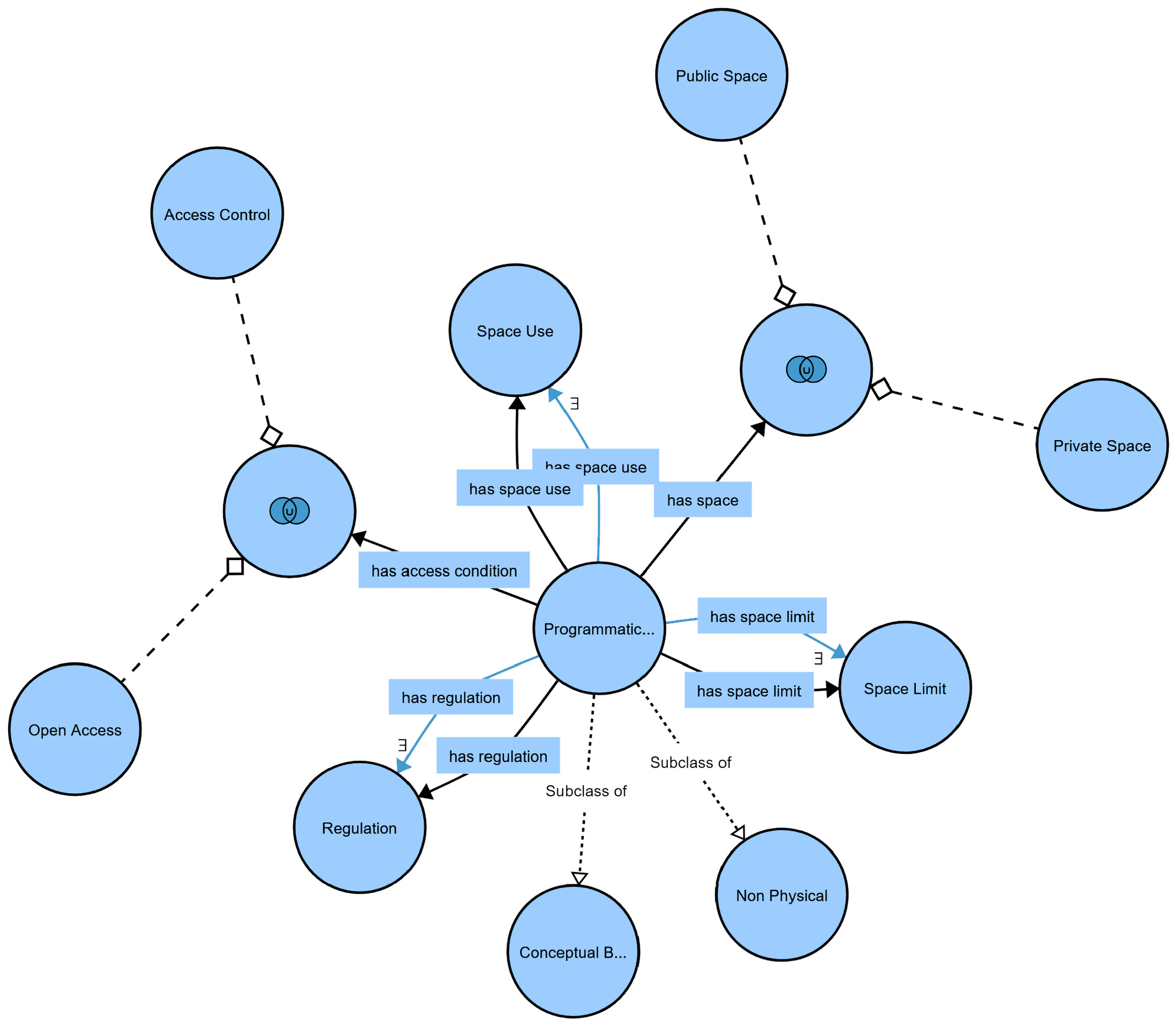
Statements are coded in the RDF language and visualised using the WebVOWL. Summary table is provided to enable identification of key concepts and classes that can be shared with other domain ontologies (Table 1 and Table 2 and Figure 5).

3.2.2. Ontology of Technological UE

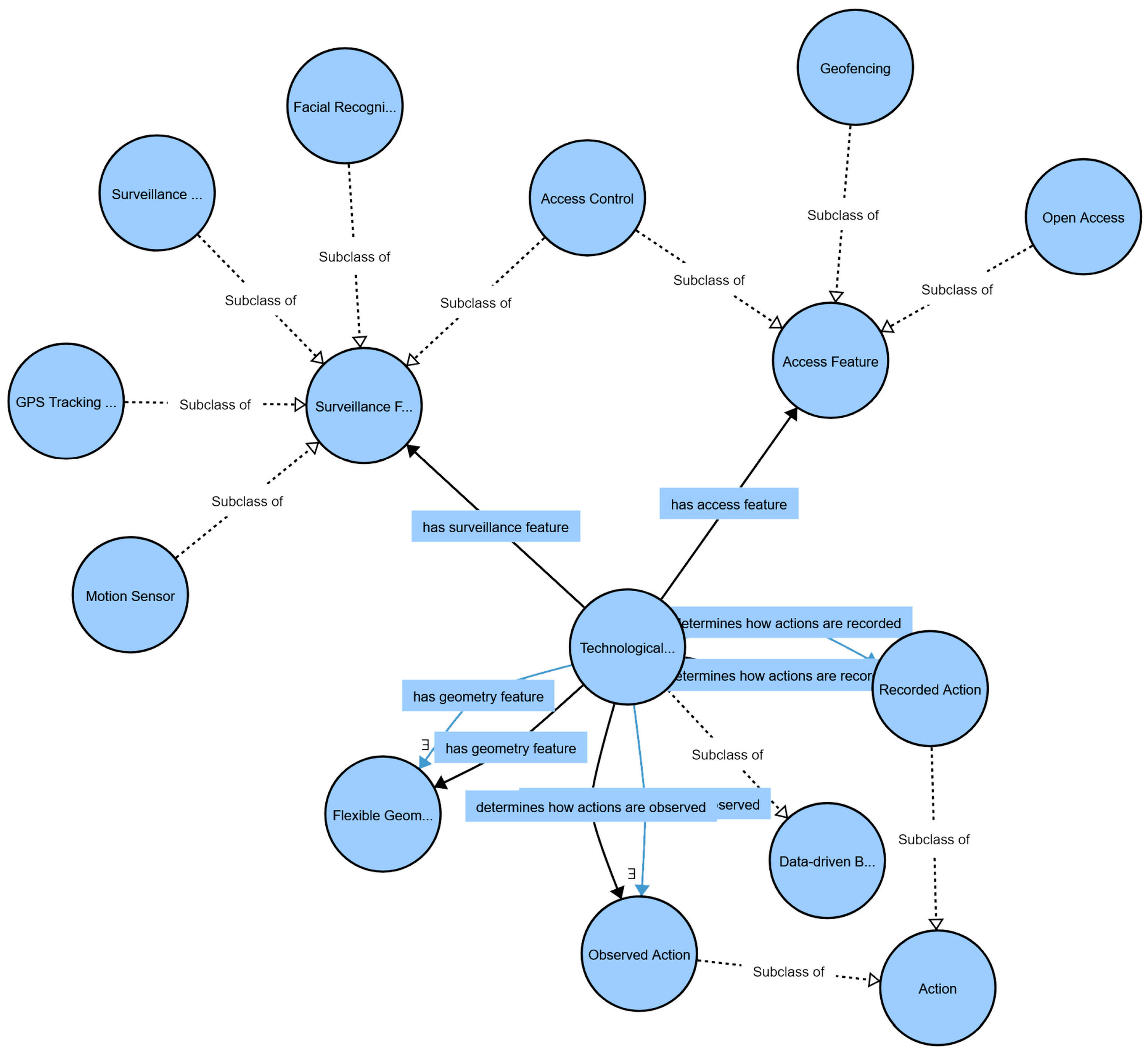
Statement analysis related to description of functional urban envelope in Section 3.1.3. Statements were coded in the RDF language and visualised using the WebVOWL (Table 3 and Table 4 and Figure 6).

3.2.3. Ontology of Environmental UE

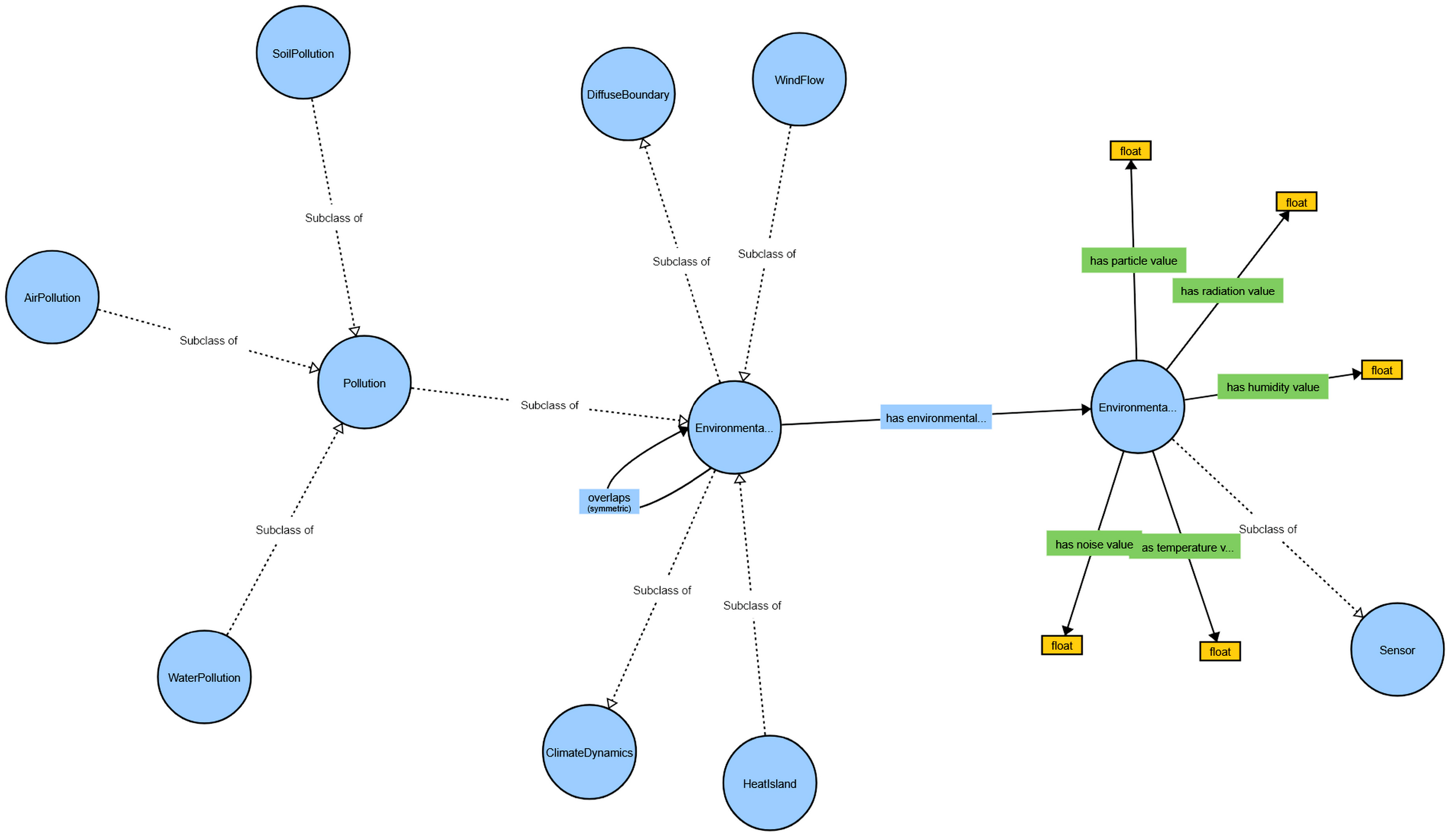
Statement analysis related to description of environmental urban envelope in Section 3.1.5. Statements were coded in the RDF language and visualised using the WebVOWL (Table 5 and Table 6 and Figure 7).
Of particular importance for the identification of environmental UEs are the predefined ranges of sensor values. An UE is positively identified only when the observed values fall within these specified ranges, which are determined by the corresponding use cases. For example, an urban heat island represents a type of environmental UE that is, by definition, an area exhibiting higher temperatures than its surroundings; accordingly, temperature values must be encoded to reflect this relative increase.

3.3. Connecting UEs to Five Smart City Related Ontologies

During the research process, several existing smart city ontologies are analysed to select the most relevant ones, with the aim of reusing key classes and class properties to describe envelopes in a functional way. As shown in the definitions of envelope types, reusing different existing classes is proposed to place UE in a broader context. These classes are not necessarily included in one particular existing smart city ontology. Five ontologies are selected for research on possible expansion: the Smart City Ontology Framework (SMOF), the Smart City Ontology 2.0 (SCO 2.0), the Urban Systems Ontology (iCity 1.2), the OSMonto and the Km4City. Description of selected ontologies and potential alignment is described in the remainder of this chapter (Table 7, Table 8 and Table 9).

3.3.1. The Smart City Ontology Framework (SMOF)

The Smart City Ontology Framework (SMOF) is designed to unify heterogeneous urban data from BIM, GIS, IoT, and relational data [43]. It is based on existing standard ontologies from several domains that are tangential to urbanism: Geospatial Standards, Urban Management, Building Information, Cross-domain Ontologies, Temporal & Semantic Standards. The authors provide a list of entities, properties, and relationships, which is presented in the paper and grouped into the following top-level classes defined in SMOF that are relevant to this paper: Building_infrastructure, Events, Geometry, Nature and Geographic Space, Time, and Urban Management Components. A key shared class related to Environmental urban envelope is the Events class, which has the following subclass structure: Major_Emergency_Incidents/Man-made_Disasters/Urban_Emergency_Incidents/Urban_Environmental_Emergencies.

3.3.2. The Smart City Ontology 2.0

The Smart City Ontology 2.0 (SCO 2) is an ontology designed to provide a clearer understanding and description of the smart/intelligent city landscape by identifying its main components, processes, terminology, and the relationships between physical, institutional, and digital dimensions [35]. It is a relevant candidate for identifying shared classes that could enable the expansion of the SCO with urban envelopes. The owl file is not available in 2025. However, analysis of the extensive specifications in the research paper enables the reconstruction of the ontology. Several first-level classes indicate close connections. For example, the SCO occurrent class Environmental Process could provide a key link for the inclusion of the environmental urban envelope into the high-level ontology. In the paper, the SCO class ‘environmental process’ is described as follows: “…describes environmental processes (not environmental monitoring and planning processes) that we can observe in cities and the surrounding natural ecosystems. Understanding the dynamic of these processes is essential to design urban policies and planning for environmental sustainability.” The SCO is broadly leaning on the Environment Ontology (ENVO) [60,61]. The environmental urban envelope, on the other hand, also aims to observe and describe environmental processes or a smaller, more isolated component of these processes.
When considering the potential connection between the technological urban envelope and the SCO, further similarities become evident. Both ontologies operate within a similar conceptual domain, specifically urban systems where physical city structures and digital/technological infrastructures interact. Classes such as Cyber–physical city, Data class, and 197 data properties are included in the SCO and could provide additional shared elements. Overlaps or useful alignment can reasonably be expected, particularly regarding the built environment, infrastructure, IoT/sensing, and environmental processes. The analysis shows that SCO is the best candidate ontology for alignment with UE.

3.3.3. iCity 1.2

The iCity 1.2 Ontology is a semantic data model designed to support integrated urban and territorial planning [62]. Although the ontology enables interoperability between datasets and planning tools, it has a partial focus on transportation and is therefore missing some elements needed for effective alignment with the UE ontologies.

3.3.4. OSMonto

OSMonto ontology is a semantic model designed to represent and formalise the data structure of OpenStreetMap (OSM). It provides a clear, machine-readable description of OSM elements—such as nodes, ways, relations, tags, and geometries—and their relationships. The ontology enables semantic interoperability, data integration, and reasoning over OSM data, making it easier to link OSM with other datasets, ontologies, and smart city or spatial planning systems. The analysis shows extensive overlap with UE ontologies. However, some key classes are missing, such as more flexible descriptions of Boundary (DataDrivenBoundary, DiffuseBoundary) and environmental classes related to pollution (e.g., heat island). OSMonto, aligned with newly developed tags and properties on the OSM platform, is another strong candidate for semantic alignment with the UE ontologies.

3.3.5. Km4City

Km4City is a comprehensive semantic model developed to support smart city and smart region ecosystems. It integrates data across key urban domains such as transport and mobility, energy, environment, public services, cultural heritage, tourism, and governance. It is widely used in linked open data and urban knowledge graph applications, particularly in large-scale metropolitan contexts. Similarly to the iCity 1.2 ontology, km4City has a partial focus on traffic and transport-related elements. As such, several key classes related to urban design and urban studies are missing, indicating that km4City is a distant candidate for possible semantic alignment with UE ontologies.
The analysis of five existing smart city-related ontologies shows that there is no direct overlapping of classes and that further alignment of ontologies is possible, particularly with SCO 2.0. However, the actual alignment is beyond the scope of this paper.

4. Discussion

Traditional spatial terminology no longer adequately captures the hybrid, dynamic, and multi-layered conditions of today’s cities, where physical form is increasingly intertwined with regulatory, technological, ecological, environmental, and representational forces. Urban envelopes represent an example of addressing this gap by defining the various material and immaterial boundaries describing different kinds of spatial objects. Moreover, the resulting six types of urban envelopes touch on key areas of contemporary urban research such as temporal nature of urban spaces, possible flexibility in urban regulation, evaluation of urban sustainability through environmental phenomena, impact of surveillance technologies in public spaces, analysing integration of green and blue infrastructures in urban fabric, impacting biodiversity and carbon neutrality and finally understanding large scale symbolic, cultural and heritage related objects in urban structure. The presented approach highlights the complexity of urban systems and the need for integrative models capable of bridging physical design with data-driven urban analysis.
By formalising these envelopes within an ontological framework, the study supports clearer interdisciplinary communication and enables integration of concepts from urban design into the domain of contemporary smart-cities. This contributes to more precise description and detection of urban phenomena but also to more timely approaches to urban planning.
Additionally, urban envelopes theory has several implications for practical urban policy and planning in the future, such as shift from classic static zoning approaches to planning that integrates complex spatial performances and interactions with measurable urban quality. The aim is to contribute to the field of smart cities, enabling users such as urbanists, managers, ecologists, sociologists, etc., to benefit from interdisciplinarity, phenomenology, and configurativity in practical terms. The focus should be on complex structures related to different ecosystem arrangements, such as zones designed to preserve biodiversity within urban centres, as related to the ecological urban envelope. Applying urban envelopes in platforms such as OSM would help detect and understand the configurational logic of elements for improved management, enabling both the collection and placement of data within a larger area of the city. However, the envelopes that are intertwined with technological systems might affect democratically accepted concepts of publicness, the right to privacy, and accessibility in public urban spaces.
By using ontologies, a methodology is introduced to connect domain oriented and more sectorial smart city ontologies with cutting edge ideas and research in the field of urbanism. At the same time, it is expected by the authors that through these new ontology frameworks valuable data could be detected and extracted from large and diverse smart city datasets. In the future, urbanism-oriented representational models can be developed in the frame of digital twin data-driven model of the contemporary city, thus enabling exploration and research of pertinent topics in urban sustainability.

Author Contributions

Conceptualization, Peter Šenk, Kaja Pogačar and Andrej Žižek; methodology, Andrej Žižek; formal analysis, Andrej Žižek; investigation, Peter Šenk, Kaja Pogačar and Andrej Žižek; writing—original draft preparation, Peter Šenk, Kaja Pogačar and Andrej Žižek; writing—review and editing, Peter Šenk, Kaja Pogačar and Andrej Žižek; visualization, Peter Šenk, Kaja Pogačar and Andrej Žižek. All authors have read and agreed to the published version of the manuscript.

Funding

The research presented in this paper was partially conducted in the scope of the research program “Sustainable planning for the quality living space”, funded by the Slovenian Research and Innovation Agency (ARIS) under grant no. P5-0068. This support is gratefully acknowledged.

Data Availability Statement

No new data were created or analyzed in this study. Data sharing is not applicable to this article. The OWL files of the envelope ontologies presented in the paper are available in RDF/XML syntax at the following link: https://netdoba-my.sharepoint.com/:u:/g/personal/andrej_zizek_net_doba_si/IQBKoG_Dusm-RKIa8UfT3cT-AWmDRCeqn8l1vsS0566S0Bo?e=209ZVs (accessed on 31 December 2025).

Acknowledgments

During the preparation of this study, the authors used GPT (ChatGPT version 5.2) to encode prepared definitions into RDF/OWL language for further analysis in the Protégé ontology editor (version 5.6.7) and in the WebVOWL visual editor (version 1.1.7). The authors have reviewed and edited the output and take full responsibility for the content of this publication.

Conflicts of Interest

The authors declare no conflicts of interest.

Abbreviations

The following abbreviations are used in this manuscript:
UEUrban Envelope
RDFResource Description Framework
OWLWeb Ontology Language
SCSmart City
GISGeographic Information System
CCTVClosed-Circuit Television
SMOFSmart City Ontology Framework
SCOSmart City Ontology
ENVOEnvironment Ontology
GPTGenerative Pre-Trained Transformer

References

  1. Mumford, L. The City in History: Its Origins, Its Transformations, and Its Prospects; Harvest Books, Harcourt: San Diego, CA, USA; New York, NY, USA; London, UK, 1961. [Google Scholar]
  2. Kostoff, S. The City Shaped: Urban Patterns and Meanings Through History; Thames & Hudson: London, UK, 1991. [Google Scholar]
  3. Lynch, K. Image of the City; MIT Press: Cambridge, MA, USA; London, UK, 1974. [Google Scholar]
  4. Rowe, C.; Koetter, F. Collage City; MIT Press: Cambridge, MA, USA, 1978. [Google Scholar]
  5. Castells, M. The Rise of the Network Society, 2nd ed.; Blackwell: Oxford, UK; Malden, MA, USA, 2000. [Google Scholar]
  6. Graham, S.; Marvin, S. Splintering Urbanism at 20 and the “Infrastructural Turn”. J. Urban Technol. 2022, 29, 169–175. [Google Scholar] [CrossRef]
  7. Bratton, B.H. The Stack: On Software and Sovereignty; MIT Press: Cambridge, MA, USA; London, UK, 2016. [Google Scholar]
  8. Sloterdijk, P. Foam City. Log 2007, 9, 63–76. [Google Scholar] [CrossRef]
  9. Zaera-Polo, A. The Politics of the Envelope. Log 2008, 13–14, 193–207. [Google Scholar]
  10. Šenk, P. On Capsularities: Physical and Diffuse Envelopes Between Accessibility and Representation. Spatium 2023, 50, 1–10. [Google Scholar] [CrossRef]
  11. Zaera-Polo, A. The Politics of the Envelope, Part II. Log 2009, 16, 97–132. [Google Scholar]
  12. Zaera-Polo, A.; Anderson, J.S. The Ecologies of the Building Envelope: A Meterial History and Theory of Architectural Surfaces; Actar Publishers: New York, NY, USA; Barcelona, Spain, 2021. [Google Scholar]
  13. Zaborova, D.; Musorina, T. Environmental and Energy-Efficiency Considerations for Selecting Building Envelopes. Sustainability 2022, 14, 5914. [Google Scholar] [CrossRef]
  14. Kamel, E.; Memari, A.M. Residential Building Envelope Energy Retrofit Methods, Simulation Tools, and Example Projects: A Review of the Literature. Buildings 2022, 12, 954. [Google Scholar] [CrossRef]
  15. Varriale, R. “Underground Built Heritage”: A Theoretical Approach for the Definition of an International Class. Heritage 2021, 4, 1092–1118. [Google Scholar] [CrossRef]
  16. Bungau, C.C.; Hanga Prada, F.I.; Bungau, T.; Bungau, C.; Bendea, G.; Prada, M.F. Web of Science Scientometrics on the Energy Efficiency of Buildings to Support Sustainable Construction Policies. Sustainability 2023, 15, 8772. [Google Scholar] [CrossRef]
  17. Balderrama, A.; Kang, J.; Prieto, A.; Luna-Navarro, A.; Arztmann, D.; Knaack, U. Effects of Façades on Urban Acoustic Environment and Soundscape: A Systematic Review. Sustainability 2022, 14, 9670. [Google Scholar] [CrossRef]
  18. Badarnah, L. Form Follows Environment: Biomimetic Approaches to Building Envelope Design for Environmental Adaptation. Buildings 2017, 7, 40. [Google Scholar] [CrossRef]
  19. Volpe, S.; Sangiorgio, V.; Petrella, A.; Coppola, A.; Notarnicola, M.; Fiorito, F. Building envelope prefabricated with 3d printing technology. Sustainability 2021, 13, 8923. [Google Scholar] [CrossRef]
  20. Zhou, Y.; Herr, C.M. A Review of Advanced Façade System Technologies to Support Net-Zero Carbon High-Rise Building Design in Subtropical China. Sustainability 2023, 15, 2913. [Google Scholar] [CrossRef]
  21. Lee, S.; Holzheu, S. Building Envelope as Surface. In Aesthetics of Sustainable Architecture; Lee, S., Ed.; 010 Publishers: Rotterdam, The Netherlands, 2011; pp. 120–133. [Google Scholar]
  22. De Cauter, L. The Capsular Civilization: On the City in the Age of Fear; NAi Publishers: Rotterdam, The Netherlands, 2004. [Google Scholar]
  23. Šenk, P. Koncept Kapsularnosti Kot Fenomen Sodobnega Prostora. Ph.D. thesis, Univerza na Primorskem, Koper, Slovenia, 2011. [Google Scholar]
  24. Šenk, P. Capsules: Typology of Other Architecture; Routledge: London, UK; New York, NY, USA, 2018. [Google Scholar]
  25. Sorkin, M. Introduction. In Variations on a Theme Park: The New American City and the End of Public Space; Sorkin, M., Ed.; Hill and Wang: New York, NY, USA, 1992. [Google Scholar]
  26. Avermaete, T. Capsulair Places Analysis and Therapy of the Public Space. Oase 2001, 54, 37–49. [Google Scholar]
  27. Casey, E.S. The Fate of Place: A Philosophical History, 1st ed.; University of California Press: Los Angeles, CA, USA, 1997. [Google Scholar]
  28. Augé, M. Non-Places: Introduction to an Anthropology of Supemodernity; Verso: London, UK; New York, NY, USA, 1995. [Google Scholar]
  29. Bauman, Z. Community: Seeking Safety in an Insecure World; Polity Press: Cambridge, UK, 2001; ISBN 9780745626352. [Google Scholar]
  30. Sloterdijk, P. Bubbles: Spheres Volume I: Microspherology; Semiotext(e), MIT Press: Los Angeles, CA, USA, 2011. [Google Scholar]
  31. Grahame Shane, D. Recombinant Urbanism: Conceptual Modeling in Architecture, Urban Design, and City Theory; John Wiley & Sons: Chichester, UK, 2005. [Google Scholar]
  32. Lefebvre, H. Writings on Cities; Kofman, E., Lebas, E., Eds.; Blackwell Publishers: Oxford, UK, 1996; ISBN 978-0631191889. [Google Scholar]
  33. Mostafavi, M.; Doherty, G. Ecological Urbanism, Revised Edition (2016), Revised ed.; Lars Müller Publishers/Harvard University Graduate School of Design: Zürich, Switzerland, 2016. [Google Scholar]
  34. Walletzký, L.; Bayarsaikhan, O.; Ge, M.; Schwarzová, Z. Evaluation of Smart City Models: A Conceptual and Structural View. In Proceedings of the 11th International Conference on Smart Cities and Green ICT Systems (SMARTGREENS 2022), Online, 27–29 April 2022; pp. 56–65. [Google Scholar] [CrossRef]
  35. Komninos, N.; Anastasia, P.; Kakderi, C. The Smart City Ontology 2.0; URENIO: Thessaloniki, Greece, 2020. [Google Scholar]
  36. Firmino, R.; Duarte, F. Private video monitoring of public spaces: The construction of new invisible territories. Urban Stud. 2016, 53, 741–754. [Google Scholar] [CrossRef]
  37. Graham, S.D.N. Software-sorted geographies. Prog. Hum. Geogr. 2005, 5, 562–580. [Google Scholar] [CrossRef]
  38. Socha, R.; Kogut, B. Urban video surveillance as a tool to improve security in public spaces. Sustainability 2020, 12, 6210. [Google Scholar] [CrossRef]
  39. Caglioni, M.; Rabino, G.A. Theoretical approach to urban ontology: A contribution from urban system analysis. Stud. Comput. Intell. 2007, 61, 109–119. [Google Scholar] [CrossRef]
  40. Azadi, S.; Kasraian, D.; Nourian, P.; van Wesemael, P. Formalizing-modelling-utilizing ontology: A semantic framework for adaptive stakeholder-specific urban digital twins in urban planning processes. Environ. Plan B Urban Anal. City Sci. 2025. [Google Scholar] [CrossRef]
  41. Rasmussen, M.H.; Pauwels, P.; Poveda-Villalón, M.; Tiwari, S.; García-Castro, R.; Bourreau, P. Ontologies and Building Digital Twins—Sphere; Academic Press: Cambridge, MA, USA, 1996; Volume 26. [Google Scholar]
  42. Cormenzana, B.; Fabregas, F.; Marinescu, M.C.; Marrero, M.; Rueda, S.; Uceda-Sosa, R. An ontology for ecological urbanism: Sum+ecology. AAAI Work.-Tech. Rep. 2014, WS-14-11, 2–8. [Google Scholar]
  43. He, X.; Kuai, X.; Li, X.; Qiu, Z.; He, B.; Guo, R. Smart City Ontology Framework for Urban Data Integration and Application. Smart Cities 2025, 8, 165. [Google Scholar] [CrossRef]
  44. Chadzynski, A.; Krdzavac, N.; Farazi, F.; Lim, M.Q.; Li, S.; Grisiute, A.; Herthogs, P.; von Richthofen, A.; Cairns, S.; Kraft, M. Semantic 3D City Database—An enabler for a dynamic geospatial knowledge graph. Energy AI 2021, 6, 100106. [Google Scholar] [CrossRef]
  45. Anthopoulos Leonidas Defining Smart City Architecture for Sustainability. In Electronic Government and Electronic Participation; IOS Press: Amsterdam, The Netherlands, 2015; pp. 140–147. ISBN 9781614995708. [CrossRef]
  46. Gracias, J.S.; Parnell, G.S.; Specking, E.; Pohl, E.A. Smart Cities—A Structured Literature Review. Smart Cities 2023, 6, 1719–1743. [Google Scholar] [CrossRef]
  47. Alexander, C.; Ishikawa, S.; Murray, S. A Pattern Language: Towns, Buildings, Constructions; Oxford University Press: New York, NY, USA, 1977. [Google Scholar]
  48. Wiens, V.; Lohmann, S.; Auer, S. WebVowl Editor: Device-independent visual ontology modeling. CEUR Workshop Proc. 2018, 2180, 2–5. [Google Scholar]
  49. Bebelaar, N.; Braggaar, R.C.; Kleijwegt, C.M.; Meulmeester, R.W.E.; Michailidou, G.; Salheb, N.; van der Spek, S.; Vaissier, N.; Verbree, E. Monitoring urban environmental phenomena through a wireless distributed sensor network. Smart Sustain. Built Environ. 2018, 7, 68–79. [Google Scholar] [CrossRef]
  50. Alberti, M. Advances in Urban Ecology: Integrating Humans and Ecological Processes in Urban Ecosystems; Springer: Seattle, WA, USA, 2008; ISBN 987-0-387-75509-0. [Google Scholar]
  51. Healey, P. Urban Complexity and Spatial Strategies: Towards a Relational Planning for Our Times; Routledge: New York, NY, USA, 2007. [Google Scholar]
  52. Birch, E. The Urban and Regional Planning Reader; Routledge: London, UK; New York, NY, USA, 2009. [Google Scholar]
  53. Pogačar, K.; Šenk, P. Alternative approaches and tools for the transformation of streetscapes direct physical interventions and different modes of participation. Prostor 2018, 26, 170–183. [Google Scholar]
  54. Wathne, M.W.; Haarstad, H. The smart city as mobile policy: Insights on contemporary urbanism. Geoforum 2020, 108, 130–138. [Google Scholar] [CrossRef]
  55. Myagmar-Ochir, Y.; Kim, W. A Survey of Video Surveillance Systems in Smart City. Electronics 2023, 12, 3567. [Google Scholar] [CrossRef]
  56. de Vaujany, F.X.; Leclercq-Vandelannoitte, A.; Munro, I.; Nama, Y.; Holt, R. Control and Surveillance in Work Practice: Cultivating Paradox in ‘New’ Modes of Organizing. Organ. Stud. 2021, 42, 675–695. [Google Scholar] [CrossRef]
  57. Jones, N.R.; Jones, A.; van Sluijs, E.M.F.; Panter, J.; Harrison, F.; Griffin, S.J. School environments and physical activity: The development and testing of an audit tool. Health Place 2010, 16, 776–783. [Google Scholar] [CrossRef] [PubMed]
  58. Perini, K.; Barath, S.; Canepa, M.; Hensel, M.; Mimet, A.; Uthaya Selvan, S.; Roccotiello, E.; Selami, T.; Sunguroglu Hensel, D.; Tyc, J.; et al. ECOLOPES: A multi-species design approach to building envelope design for regenerative urban ecosystems. In Proceedings of the Responsive Cities: Design with Nature Symposium 2021, Barcelona, Spain, 11–12 November 2021; pp. 368–380. [Google Scholar]
  59. Canepa, M.; Mosca, F.; Barath, S.; Changenet, A.; Hauck, T.E.; Ludwig, F.; Pianta, M.; Roccotiello, E.; Selvan, S.U.; Vogler, V.; et al. ECOLOPES, Beyond Greening: A multi-species approach for urban design. AGATHÓN-Int. J. Archit. Art Des. 2022, 11, 238–245. [Google Scholar] [CrossRef]
  60. Buttigieg, P.L.; Pafilis, E.; Lewis, S.E.; Schildhauer, M.P.; Walls, R.L.; Mungall, C.J. The environment ontology in 2016: Bridging domains with increased scope, semantic density, and interoperation. J. Biomed. Semant. 2016, 7, 57. [Google Scholar] [CrossRef] [PubMed]
  61. Buttigieg, P.L.; Morrison, N.; Smith, B.; Mungall, C.J.; Lewis, S.E. The environment ontology: Contextualising biological and biomedical entities. J. Biomed. Semant. 2013, 4, 43. [Google Scholar] [CrossRef] [PubMed]
  62. Katsumi, M.; Fox, M. iCity Ontology Version 1.2 Report; Pro.NET 2.0 Code Des. Stand. C#; University of Toronto: Toronto, ON, Canada, 2018; pp. 159–168. [Google Scholar]
Figure 1. Layered structure of a smart city: physical P (l), digital D (l) and organisational layers O (l) of the city. Crosses and arrows indicate ongoing information exchange between the layers.
Ijgi 15 00030 g001
Figure 2. Steps in the research process.
Ijgi 15 00030 g002
Figure 3. Selected properties of different types of urban envelopes.
Ijgi 15 00030 g003
Figure 4. Schematic diagrams presenting different types of urban envelopes (from left to right): (a) Physical urban envelope, (b) Programmatic urban envelope, (c) Technological urban envelope, (d) Ecological urban envelope, (e) Environmental urban envelope, and (f) Representational urban envelope.
Ijgi 15 00030 g004
Figure 5. Visual representation of the Programmatic UE from the RDF code (WebVOWL visualisation).
Ijgi 15 00030 g005
Figure 6. Visual representation of Technological UE from the RDF code (WebVOWL visualisation).
Ijgi 15 00030 g006
Figure 7. Visual representation of Environmental UE from the RDF code (WebVOWL visualisation).
Ijgi 15 00030 g007
Table 1. Statement analysis related to description of Programmatic UE in Section 3.1.2.
Programmatic Urban Envelope is Conceptual Boundary
Programmatic Urban Envelope has Regulation
Programmatic Urban Envelope has Space Limit
Programmatic Urban Envelope has Space Use
Programmatic Urban Envelope is Non-Physical
Programmatic Urban Envelope has Private Space or/and Public Space
Programmatic Urban Envelope has Access Control or Open Access
Table 2. Programmatic UE ontology summary table.
ClassesKey Axioms/SemanticsObject Properties (Relationships)
ProgrammaticUrbanEnvelopeIs Conceptual Boundary
Is Non-Physical
Must have Regulation (some)
Must have Space Limit (some)
Must have Space Use (some)
Must include Private or/and Public Space
Must allow Access Control or Open Access
hasRegulation
hasSpaceLimit
hasSpaceUse
hasSpace
hasAccess
ConceptualBoundaryAbstract, non-physical boundary(no direct properties)
NonPhysicalNot physically manifested(no direct properties)
RegulationRule or normative control(can be linked from
FunctionalUrbanEnvelope)
SpaceLimitDefines extent/limits of envelope(can be linked from
FunctionalUrbanEnvelope)
SpaceUseFunctional use (e.g., residential,
commercial)
(can be linked from
FunctionalUrbanEnvelope)
PrivateSpaceAccess restricted, privately controlledDisjoint with PublicSpace
PublicSpaceOpen to general publicDisjoint with PrivateSpace
AccessControlRestricted/controlled access mechanismDisjoint with OpenAccess
OpenAccessUnrestricted accessDisjoint with AccessControl
Table 3. Statement analysis related to description of Technological UE in Section 3.1.3.
Technological Urban Envelope is Data-driven Boundary
Technological Urban Envelope has Access Control or Open Access or Geofencing
Technological Urban Envelope has Surveillance Systems and/or Facial Recognition and/or Motion Sensors and/or Access Control and/or GPS Tracking Geofencing
Technological Urban Envelope has Flexible Geometry
Technological Urban Envelope determines how their actions are observed
and/or how their actions are recorded
Table 4. Technological UE ontology summary table.
ClassesKey Axioms/SemanticsObject Properties
(Relationships)
TechnologicalUrbanEnvelopeSubclass of DataDrivenBoundary
must have access feature (AccessControl/OpenAccess/Geofencing)
must have surveillance feature (SurveillanceSystem/FacialRecognition/MotionSensor/AccessControl/GPSTrackingGeofencing)
must have Flexible Geometry; determines how
actions are observed and recorded
hasAccessFeature
hasSurveillanceFeature
hasGeometryFeature
determinesHowActionsAreObserved
determinesHowActionsAreRecorded
DataDrivenBoundarySuperclass for boundaries driven by data
TechnologicalUrbanEnvelope ⊑
DataDrivenBoundary
-
AccessFeatureSuperclass for access-related mechanismsRange of hasAccessFeature
AccessControlSubclass of AccessFeature and SurveillanceFeature
dual role access + surveillance
Possible value in
hasAccessFeature and
hasSurveillanceFeature
OpenAccessSubclass of AccessFeature,
represents open access settings
Possible value in
hasAccessFeature
GeofencingSubclass of AccessFeature,
spatially constrained access
Possible value in
hasAccessFeature
SurveillanceFeatureSuperclass for surveillance mechanismsRange of hasSurveillanceFeature
SurveillanceSystemSubclass of SurveillanceFeature,
general surveillance infrastructure
Possible value in
hasSurveillanceFeature
FacialRecognitionSubclass of SurveillanceFeature,
facial recognition technology
Possible value in
hasSurveillanceFeature
MotionSensorSubclass of SurveillanceFeature,
motion sensing technology
Possible value in
hasSurveillanceFeature
GPSTrackingGeofencingSubclass of SurveillanceFeature,
GPS tracking and geofencing
Possible value in hasSurveillanceFeature
FlexibleGeometryRepresents adaptable/dynamic
spatial configuration
Range of hasGeometryFeature
ActionSuperclass for actions of agentsSuperclass of ObservedAction and RecordedAction
ObservedActionSubclass of Action, observed actionsRange of determinesHow
ActionsAreObserved
RecordedActionSubclass of Action, recorded actionsRange of determinesHow
ActionsAreRecorded
Table 5. Statement analysis related to description of Environmental UE in Section 3.1.5.
Environmental Urban Envelope is Diffuse Boundary
Environmental Urban Envelope can Overlap
Environmental Urban Envelope is Climate Dynamics
Heat Island, Wind Flow, Pollution is Environmental Urban Envelope
Air Pollution, Water Pollution, Soil Pollution is Pollution
Environmental Urban Envelope has Environmental Sensor
Environmental Sensor is Sensor
Environmental Sensor has Temperature Value, Humidity Value, Particle Value, Noise Value,
Radiation Value
Table 6. Environmental UE ontology summary table.
ClassesKey Axioms/SemanticsObject Properties
(Relationships)
EnvironmentalUrbanEnvelopeSubclass of DiffuseBoundary and
ClimateDynamics;
represents environmental shell of a city.
overlaps (symmetric),
hasEnvironmentalSensor
DiffuseBoundarySuperclass of EnvironmentalUrbanEnvelope;
represents spatially diffuse boundaries.
-
ClimateDynamicsSuperclass of EnvironmentalUrbanEnvelope;
represents climate-related processes.
-
HeatIslandSubclass of EnvironmentalUrbanEnvelope;
represents urban heat island phenomena.
inherits overlaps,
hasEnvironmentalSensor
WindFlowSubclass of EnvironmentalUrbanEnvelope;
represents wind flow dynamics.
inherits overlaps,
hasEnvironmentalSensor
PollutionSubclass of EnvironmentalUrbanEnvelope;
represents pollution in general.
inherits overlaps,
hasEnvironmentalSensor
AirPollutionSubclass of Pollution;
represents air-borne pollution.
inherits overlaps,
hasEnvironmentalSensor
WaterPollutionSubclass of Pollution;
represents water-borne pollution.
inherits overlaps,
hasEnvironmentalSensor
SoilPollutionSubclass of Pollution;
represents soil contamination.
inherits overlaps,
hasEnvironmentalSensor
SensorGeneric sensor class; superclass of
EnvironmentalSensor.
-
EnvironmentalSensorSubclass of Sensor; monitors environmental
envelope, has measurement data properties.
is range of
hasEnvironmentalSensor;
has data properties
Table 7. Analysis of shared classes and properties between Programmatic UE and five smart city-related ontologies.
Urban
Envelopes Key Entities/Classes
SMOFSCO 2.0
(Included ENVO 1 Classes)
iCity 1.2
(Urban Systems Ontology)
OSMonto
(Expanded Based on Available Tags on the OSM Platform)
Km4City 2
E2: Programmatic UE
AccessControlnullnullAccessRestriction, property: hasAccessaccess:conditional, access_controlAccessRestriction, EntryRule, property: hasAccess, entryType
ConceptualBoundaryField Boundary, Land Category_BoundaryBoundarynullk_boundary, v_boundarynull
PrivateSpacenullPrivate spacenullnullnull (yardType)
PublicSpacePublic_Space_Order_ManagementPublic spacenullnullnull (yardType)
RegulationnullGovernanceParkingPolicynullServiceSystem
SpaceLimitnullnullOM: Quantity, OM: Areanullnull
SpaceUseLand Planningnull (as social activity)LandUseClassificationlandusenull
1 ‘Environment Ontology’ (ENVO) developed by [60,61]. 2 Non-aligned classes are included in the table.
Table 8. Analysis of shared classes and properties between Technological UE and five smart city-related ontologies.
Urban
Envelopes Key Entities/Classes
SMOFSCO 2.0
(Included ENVO 3 Classes)
iCity 1.2
(Urban Systems Ontology)
OSMonto
(Expanded Based on Available Tags on the OSM Platform)
Km4City 4
E3: Technological UE (Cyber–physical city)
DataDrivenBoundarynullBoundarynullk_boundary, v_boundaryStatisticalArea/GeoArea
AccessFeaturenullFunction (G-dependent continuant), Access to servicesPublicTransit/AccessMethodaccessAccessRestriction, EntryRule, property: hasAccess, entryType
AccessControlnullnullTransportationSystem/AccessRestriction (TravelCost/
AccessFee,
PublicTransit/
AccessMethod)
access: conditional, access_controlAccessRestriction,
EntryRule,
property:
hasAccess, entryType
OpenAccessnullnullnullnullAccessRestriction,
EntryRule, property:
hasAccess, entryType
GeofencingUrban_Management_ComponentsnullnullnullCar Park Sensor
SurveillanceFeatureUrban_Management_Components/Sensors/
Sensor_Equipment
sensing, monitoring,
data processing,
algorithmic control, real-time systems
sosa: Sensorsurveillance: zonesosa: Sensor
SurveillanceSystemUrban_Management_Components/Sensors/
Sensor_Equipment
sensing, monitoring,
data processing,
algorithmic control, real-time systems
sosa: Sensorsurveillancesosa: Sensor
FacialRecognitionUrban_Management_Components/Sensors/
Sensor_Equipment
sensing,
data processing
sosa: Sensorcamera: typesosa: Sensor, Stimulus
MotionSensorUrban_Management_Components/Sensors/
Sensor_Equipment
sensing, monitoringsosa: Sensorv_sensorsosa: Sensor, Stimulus
GPSTrackingGeofencingUrban_Management_Components/Sensors/
Sensor_Equipment
sensing, monitoring,
algorithmic control,
sosa: Sensornullsosa: Sensor
FlexibleGeometrynullnullGeometrynullnull
ActionnullElement (Independent continuant, social element)Activity/ActivityActivityStimulus
ObservedActionnullsensing, monitoringActivity/ActivitysurveillanceStimulus
RecordedActionnullsensing, monitoringActivity/Activitysurveillanceonly as a part of the SOSA 5 (sosa:) concept
3 ‘Environment Ontology’ (ENVO) developed by [60,61]. 4 Non-aligned classes are included in the table. 5 SOSA (sosa: prefix) stands for Sensor, Observation, Sample, and Actuator.
Table 9. Analysis of shared classes and properties between environmental UE and five smart city-related ontologies.
Urban Envelopes Key Entities/ClassesSMOFSCO 2.0
(Included ENVO 6 Classes)
iCity 1.2
(Urban Systems Ontology)
OSMonto
(Expanded Based on Available Tags on the OSM Platform)
Km4City 7
E5: Environmental Urban Envelope (Environmental Process)
DiffuseBoundarynullGeneral architecture element: BoundaryOM/Areak_boundary, v_boundaryStatisticalArea/
GeoArea
ClimateDynamicsnullClimate processnullnullClimate or weather indicators, Stimulus
HeatIslandUrban_Environmental_EmergenciesTemperature-related processnullv_environmental_hazardnull
WindFlowUrban_Environmental_EmergenciesWind-related processnullv_windnull
PollutionUrban_Environmental_EmergenciesEnvironmental pollution processEnvironmentalCost (only indirectly)v_environmental_hazardsosa 8: ObservableProperty
AirPollutionUrban_Environmental_EmergenciesAirborne pollutantEnvironmentalCost (only indirectly)v_environmental_hazardAir Quality Criticality Index agglomeration
WaterPollutionUrban_Environmental_EmergenciesWaterborne pollutantnullv_environmental_hazardnull
SoilPollutionUrban_Environmental_EmergenciesSoil pollutantnullv_environmental_hazardnull
NoisePollutionUrban_Environmental_EmergenciesNoise pollutantnullv_environmental_hazardNoise index/acoustic indicators
SensorUrban_Management_Components/Sensors/
Sensor_Equipment
Digital elements/sensing/sensorsosa: Sensorv_monitoring_station, v_sensorsosa:Sensor,
Air quality monitoring station
6 ‘Environment Ontology’ (ENVO) developed by [60,61]. 7 Non-aligned classes are included in the table. 8 SOSA (sosa: prefix) stands for Sensor, Observation, Sample, and Actuator.
Disclaimer/Publisher’s Note: The statements, opinions and data contained in all publications are solely those of the individual author(s) and contributor(s) and not of MDPI and/or the editor(s). MDPI and/or the editor(s) disclaim responsibility for any injury to people or property resulting from any ideas, methods, instructions or products referred to in the content.