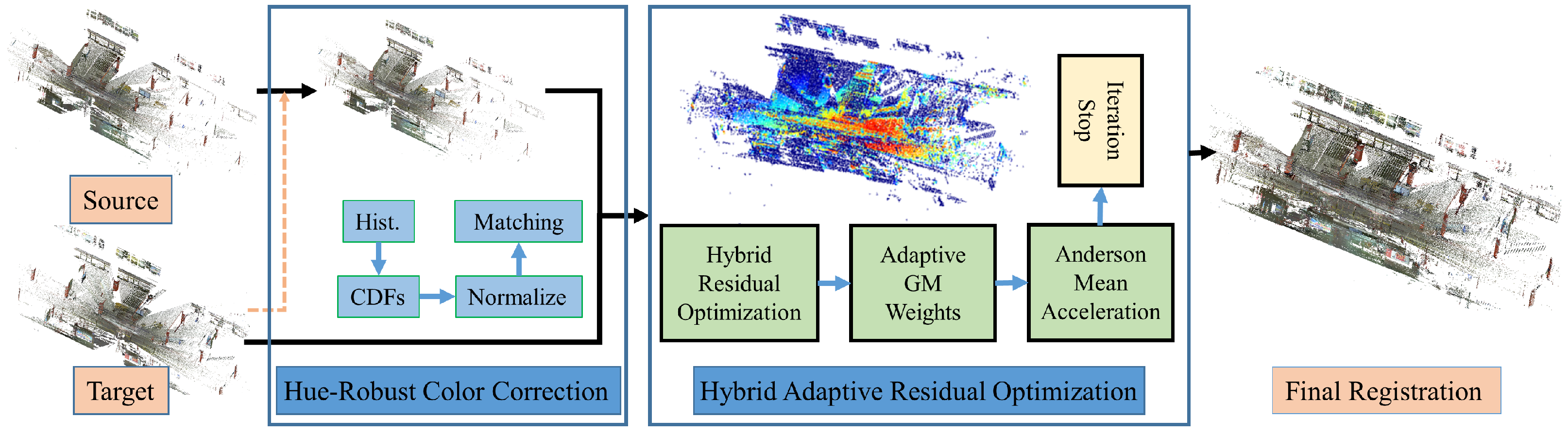
We propose Hybrid Adaptive Residual Optimization (HARO), a unified framework for large-scale point cloud registration that simultaneously enhances geometric alignment and photometric consistency, as illustrated in
Figure 1. Specifically, HARO comprises two core modules. First, a Hue-Robust Color Correction strategy is employed to improve inter-frame chromatic consistency and contrast, effectively mitigating illumination-induced color drift across overlapping regions. Subsequently, a Hybrid Residual Optimization module jointly optimizes geometric and hue residuals using an adaptive Geman–McClure (GM) kernel, which dynamically suppresses mismatches and outliers while balancing multi-modal constraints. Collectively, these components enable HARO to overcome the limitations of existing geometry-only and color-augmented approaches, providing robust, accurate, and scalable registration in structurally complex and large-scale environments.
3.1. Hue-Robust Color Correction Strategy
In colorized point cloud registration, photometric information provides complementary constraints to geometric features, enhancing texture consistency and improving robustness in weakly structured regions. However, data acquisitions often introduce distortions in color distributions due to uneven illumination, sensor limitations, and calibration errors. Over- or underexposed conditions, especially near object boundaries, further degrade the stability of color-augmented joint optimization.
To address these challenges, we propose a Hue-Robust Color Correction strategy in the HSV model. By decoupling chromaticity from intensity, the hue channel is largely invariant to illumination changes, providing a reliable basis for cross-view color alignment. Specifically, point cloud colors are first transformed from RGB to HSV space, and the hue channel is the primary feature for statistical analysis (Equation (
1)).
where
R,
G,
B denote the color channel values of the point cloud. This transformation spatially decouples the color channels, thereby enhancing the stability of color distribution alignment across point clouds and mitigating drift that could compromise registration accuracy.
To capture the statistical distribution of the hue channel, we compute the histogram of hue for the source point cloud
and the target point cloud
with
discrete levels, denoted as
and
, respectively. The cumulative distribution functions (CDFs) are then calculated using Equation (
2).
where
i denotes the hue level, typically normalized to
.
and
represent the cumulative probability of the
i-th hue level for the source and target point clouds, respectively.
To eliminate the influence of differing point cloud scales on the statistical distribution, the CDFs are normalized by the total number of overlapping points using Equation (
3).
where
and
denote the number of points in the overlapping regions of the source and target point clouds, respectively. The overlapping point is determined using the KNN [
35], where correspondences are established between points from the source and target point clouds if the Euclidean distance is less than threshold
.
The histogram matching for the hue channel mapping function
f is defined as Equation (
4).
where
denotes the inverse cumulative distribution function of the target distribution. The transformed hue values are obtained using Equation (
5).
where
is statistically aligned with
, thereby compensating for illumination differences and sensor response variations across point clouds. This correct process achieves fine registration of the hue distributions between point clouds
and
, effectively mitigating color drift caused by illumination differences.
In summary, the proposed hue histogram correction strategies in HSV space mitigate cross-view color drift and enhance statistical consistency across point clouds. By aligning the hue channel, it ensures a more robust color channel under weak geometric structures or varying illumination, thereby strengthening the robustness and accuracy of geometry–color hybrid optimization. This step establishes a stable basis for the subsequent optimization framework.
3.2. Hybrid Adaptive Residual Optimization
Traditional ICP methods, which rely only on geometric or color-fusion residuals, often become trapped in local minima and exhibit unstable convergence, particularly in scenes with repetitive or symmetric structures. To overcome these limitations, we propose a HARO framework that synergistically leverages geometric and hue-based color residuals within an adaptive robust kernel.
Specifically, HARO operates within a fixed-point iterative framework, where each iteration seeks a self-consistent alignment between the source and target point clouds. At the
k-th iteration, given the current rigid transformation estimates
and
, the source point cloud
is transformed to
, and the nearest neighbor of each transformed point in the target cloud
is searched to construct correspondences, as expressed in Equation (
6).
where
denotes the transformed source point. To accelerate NN search in large-scale point clouds, a KD-Tree structure is employed for efficient querying of
.
Once correspondences are established, the transformation parameters
and
are iteratively updated by minimizing estimated residuals. Classic ICP considers only geometric error, which is insufficient in regions with weak structure or texture degradation. To address this, we incorporate a hue-based color consistency constraint, constructing a hybrid residual function
, as expressed in Equation (
7).
where
is the weight for the hue channel,
is the geometric residual, and
is the color residual. The geometric residual is defined as Equation (
8).
and the hue channel is expressed as Equation (
9).
where
denotes the hue of the corresponding point. The hue channel is largely invariant to overall illumination variations and closely corresponds to real color perception, thereby mitigating the effects of lighting changes and sensor response inconsistencies.
After constructing correspondences and residuals, the optimization definition is a global minimization of the hybrid function, as expressed in Equation (
10):
where
n is the point cloud index, and
N is the number of correspondence points. This forms a closed-loop of alternating correspondence search and residual convergence. In each iteration, correspondence updates correct geometric and color deviations, while cost minimization refines the transformation to reduce residuals.
To enhance the robustness of point cloud registration in complex environments, we propose a hybrid adaptive residual framework integrated with a GM kernel, enabling an adaptive weighting mechanism for residuals. This framework adjusts the confidence weight of each correspondence during iterations and employs a Majorization–Minimization (MM) [
36] strategy for efficient energy minimization.
Euclidean distance used in conventional ICP is sensitive to non-uniform sampling and mismatches, especially in large-scale scenes. To mitigate this, the GM kernel
is applied to the hybrid residual
r:
where
v is the residual scale parameter controlling the suppression strength for outliers. As
,
, the weight of abnormal correspondences is effectively reduced.
To adapt the kernel to different scenes, the scale parameter
v is dynamically estimated using the median absolute deviation (MAD) of current iteration residuals:
where
s is a scaling factor, and
denotes the residuals of all correspondence pairs. This strategy enhances local consistency while suppressing the influence of global noise.
To optimize the robust residual model efficiently, an MM strategy is employed. Denoting the joint function as
, at the
k-th iteration, a agent function
is constructed satisfying
and the update is performed by minimizing the agent function:
Specifically, incorporating the GM kernel and hybrid residuals, the surrogate function is defined as Equation (
15):
with
is a non-convex robust penalty function.
Since
is concave with respect to the squared residual
, a quadratic majorizer can be derived via first-order Taylor expansion. At iteration
k, the surrogate function is given by
where the adaptive weight is defined as
and
.
By minimizing the surrogate function in Equation (
16), the transformation parameters are updated by solving a weighted least-squares problem:
This MM-based optimization guarantees a monotonic decrease of the original non-convex objective and converges to a stationary point under standard conditions.
3.3. Stopping Strategy
The iterative optimization in HARO is performed until a predefined convergence criterion is met, ensuring precise and stable alignment. Formally, let
denote the hybrid residual at the
k-th iteration. The stopping condition is defined as Equation (
19):
where
is the residual threshold, and
is the maximum number of iterations allowed. Once either condition is satisfied, the algorithm terminates and outputs the final transformation parameters
, corresponding to the optimal fine registration result.
To further enhance convergence efficiency, HARO integrates Anderson acceleration [
37] into the fixed-point iterative framework. By leveraging a linear combination of historical iterates, Anderson acceleration expedites convergence, mitigates oscillations, and stabilizes the update of the color–geometry hybrid residual. The fixed-point formulation of the MM update is expressed as Equation (
20):
where
denotes the update function derived from minimizing the fusion residuals, formally defined in Equation (
21):
To ensure stability in non-convex or noisy environments, it may induce oscillations or divergence in non-convex or noisy scenarios. To ensure stability, HARO adopts a conservative update strategy: the accelerated iterate is accepted only when the hybrid residual satisfies ; otherwise, the update reverts to the original MM output .
The HARO framework, underpinned by a fixed-point MM solver and enhanced by Anderson acceleration, simultaneously addresses the challenges of local minima, multi-source residual balancing, and slow convergence in large-scale colorized point clouds. By integrating geometric and hue constraints within an adaptive kernel, HARO achieves high-precision, robust, and computationally efficient registration, providing a theoretically grounded and practically effective solution for complex 3D reconstruction tasks.