1. Introduction
The outbreak of the COVID-19 pandemic has intensified the demand for effective, contactless disinfection solutions in public and clinical environments. Among the various technologies explored, ultraviolet-C (UV-C) light has emerged as a promising method for inactivating a wide range of pathogens, including SARS-CoV-2, due to its germicidal properties and chemical-free application [
1,
2,
3]. Traditional UV-C disinfection approaches, typically based on fixed lamp systems, often suffer from poor irradiation uniformity, limited surface reach, and static coverage inefficiencies.
Recent studies have demonstrated the potential of mobile robots equipped with UV-C light sources to overcome these limitations by dynamically navigating spaces and adapting to environmental geometry for improved irradiation distribution [
4,
5]. These platforms are capable of delivering higher UV-C doses more effectively than static systems and are particularly advantageous in cluttered or non-uniform spaces [
6].
Despite their advantages, many robotic UV-C solutions rely on pre-programmed trajectories or rigid manual control schemes. These methodologies constrain operational flexibility in unstructured spaces, limit the precision with which irradiation targets can be designated in real time, and provide operators with little situational awareness or intuitive means of interaction [
7].
This work presents both design and experimental evaluation of a UV-C disinfection mobile robot with omnidirectional mobility, operated through an AR-based teleoperation interface. The proposed system combines the spatial agility of omnidirectional navigation with the intuitive control capabilities of AR, aiming to support flexible operator-guided disinfection in varying environments. For this current validation, the robot was held at a fixed position during UV-C exposure, with mobile repositioning between surfaces demonstrating the platform’s navigational capabilities.
A semi-autonomous, operator-in-the-loop architecture is deliberately chosen over full autonomy for the following reasons: First, UV-C radiation poses a direct hazard to human operators or sanitizers [
8]. Given that operators must actively verify area clearance before and during exposure, a semi-autonomous system allows for this verification prior to sanitization. Autonomous systems cannot guarantee a reliable judgment in dynamic and populated environments. Second, disinfection priorities are context-dependent: a facility manager must decide which high-contact surfaces require targeted treatment based on occupancy patterns and hygiene protocols. Such decisions benefit from human situational awareness rather than coverage-maximizing path planners that treat all surfaces uniformly. Third, the static map generated prior to operation may not reflect real-time changes in the environment (e.g., furniture rearrangement, open doors), making adaptive operator guidance essential for ensuring complete and unobstructed surface irradiation. AR-based teleoperation addresses all three needs simultaneously, providing the operator with an immersive spatial view of the environment, real-time robot localization, and direct point-and-click control of UV-C payload activation without requiring physical presence in the irradiation zone.
While there exists growing interest in robotic UV-C disinfection, no existing work has integrated AR-based spatial teleoperation, omnidirectional mobility, and real-time operator control of UV-C payload activation into a single, experimentally demonstrated system. This work addresses that gap by proposing and evaluating a semi-autonomous AR-teleoperated platform designed for flexible, operator-guided disinfection in real indoor environments.
Therefore, the core contribution of this work lies at the system and application levels, focusing on integrating technologies into a novel, task-oriented solution. The specific contributions of this research include:
The design and implementation of an AR-based teleoperation workflow that, to the best of the authors’ knowledge, is the first to combine VSLAM-based 3D environment reconstruction, point-and-click waypoint navigation, and real-time UV-C payload control within a single operator interface.
A documented system architecture built entirely from commercial off-the-shelf components (Meta Quest 3, Unity, ROS, RTAB-Map), described in sufficient detail to serve as a reference implementation for similar research efforts.
A proof-of-concept experimental evaluation in a real-world classroom environment, demonstrating the functional integration of the system and preliminary evidence of surface microbial load reduction, with the operator safely outside the irradiation zone.
2. Related Work
As for UV-C disinfection robots, the impact of COVID-19 caused a demand in mobile robots with sanitizing capabilities. In a review presented by Pfleger et al. [
9], they state that the majority of the 96 studies reviewed either neglect correct UVGI dose delivery or lack automated methods to ensure it, that lamp positioning is typically chosen subjectively, and that most works incorporate no safety mechanisms to protect nearby humans from UV-C exposure. Furthermore, the review highlights that 59.4% of studies perform no robot localization and 60.4% conduct no environmental mapping, undermining disinfection reliability. In the same review, the absence of intuitive human–robot interfaces is discussed as a barrier to overall adoption, noting that disinfection robots ready for use by non-expert operators are not yet a reality. This highlights the need for operator-in-the-loop architectures that combine spatial awareness, real-time localization, and deliberate payload control. Most of the UV-C robots depend on planned trajectories, which may cause difficulties if the environment turns dynamic [
7]. Given that the environments that require most sanitization are highly dynamic, it is imperative for a mobile disinfection robot to be able to navigate in dynamic spaces, while ensuring a proper light distribution [
4,
5].
AR-based teleoperation offers a promising solution to these interface and situational awareness gaps identified in UV-C robotic systems, as well as offering more intuitive interaction, improved spatial awareness, and increased operational safety. Teleoperation research has extended to mobile robotic platforms designed for challenging terrains. As seen in Fieden et al. [
10] an omnidirectional tracked robot combining features of Mecanum wheels and traditional treads was evaluated across multiple surfaces using a vision-based measurement setup. The resulting trajectory data informed correction algorithms that improved motion accuracy, contributing to the design of more reliable mobile robots for teleoperated applications. In assistive retail scenarios, Saha et al. [
11] discuss how an AR-based framework incorporating intention recognition and variable autonomy significantly reduced collision rates by dynamically adjusting autonomy during goal switching.
Liang et al. [
12] demonstrate that mobile robots equipped with LiDAR can achieve autonomous 3D scanning of indoor environments with results comparable to manual survey methods, supporting the viability of robot-generated spatial models for task-specific applications.
Immersive AR teleoperation has been shown to improve operator perception and control fidelity. Loconsole et al. [
13] present an HMD-based system incorporating hand tracking, gesture recognition, and RGB-D sensing, which enabled direct manipulation of a Franka Emika Panda robot while mitigating latency and bandwidth constraints associated with conventional video streaming. Depth-aware visual cues enhanced situational awareness and resulted in measurable improvements in teleoperation performance. Complementing this approach in [
14], AR interfaces combining HMDs, motion sensors, and real-time visual feedback achieved low error rates during remote manipulation tasks, demonstrating high precision and reliability in structured environments.
AR and XR have further been applied to improve robot programming, teaching, and training workflows. Solanes et al. [
15] introduce an AR interface replacing traditional teach pendants, which allowed users to control an industrial robot using a gamepad and HMD, leading to faster task execution and reduced learning time regardless of prior robotics experience. Building on this concept, Audonnet et al. [
16] present a closed-loop mixed reality framework incorporating a digital twin, which enabled more immersive viewpoints and unrestricted operator movement. User studies demonstrated efficient task completion and reduced mental workload during manipulation tasks.
As seen in
Table 1 and
Table 2, existing UV-C robotic systems largely operate without localization, environmental mapping, or intuitive operator interfaces [
9], while AR teleoperation research has predominantly focused on manipulator arms in structured industrial settings [
13,
14] rather than mobile disinfection tasks. To the best of the authors’ knowledge, no existing work combines VSLAM-based environment reconstruction, AR waypoint teleoperation, and real-time UV-C payload control into a single operator workflow, thus providing an operator-in-the-loop architecture that compensates for the localization, mapping, and interface difficulties identified across the UV-C robotics literature.
3. System Overview
3.1. Robotic System
For the robotic system, it was decided to employ a robot equipped with omnidirectional wheels. Omnidirectional wheels are characterized by small rollers mounted obliquely along the circumference of the wheel, enabling a unique kinematic configuration. This specific arrangement allows the robot to execute a highly versatile set of motions, including linear displacements such as forward and backward movement, as well as lateral (strafing) translation and in-place rotation.
The kinematic model of such vehicles relies on the vector addition of the active rotation of the main wheel axis and the passive rotation of the obliquely mounted rollers. This structural configuration permits instantaneous omnidirectional mobility over planar surfaces without requiring the non-holonomic steering maneuvers typical of Ackerman or differential-drive platforms.
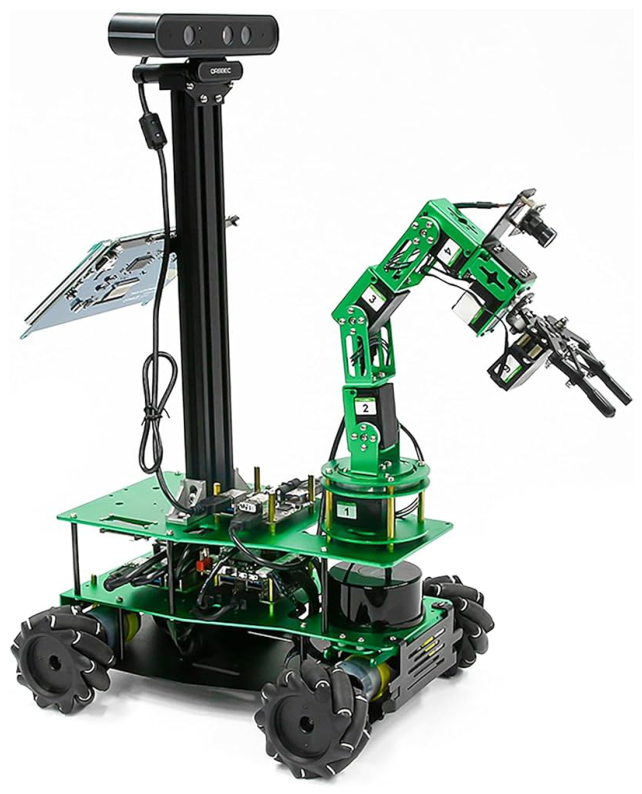
A commercially available system that integrates such a mobility platform is the ROSMASTER X3 Plus, developed by Yahboom (Shenzhen, China),
Figure 1. This robotic kit includes a series of advanced sensors and actuators, notably an ORBBEC Astra Pro PLus RGB-D camera for depth perception, a YDLIDAR 4ROS LiDAR unit for environmental mapping and obstacle detection, and a 6-DOF robotic arm for manipulation tasks [
17]. This combination allows the system to be particularly suitable for research and development applications in autonomous navigation and human–robot interaction scenarios. Yahboom offers the ROSMASTER X3 with a variety of controllers; in this case, the ROSMASTER used operates with an Orin NANO of 16 GB of RAM.
As its name implies, the ROSMASTER X3 Plus operates on the Robot Operating System (ROS).
3.2. ROS
The Robot Operating System (ROS) serves as the middleware layer coordinating all hardware and software components of the system. ROS Noetic was selected as it is the native distribution supported by the ROSMASTER X3 Plus platform, running on Ubuntu 20.04 LTS.
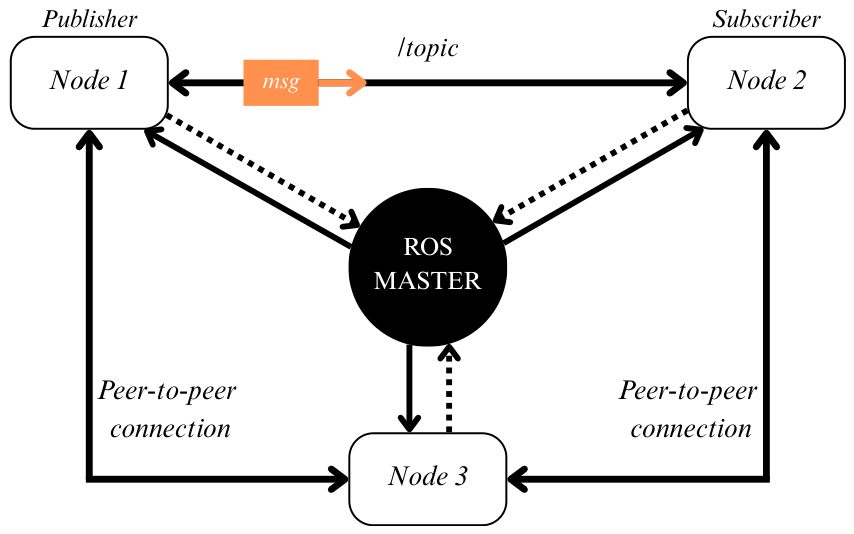
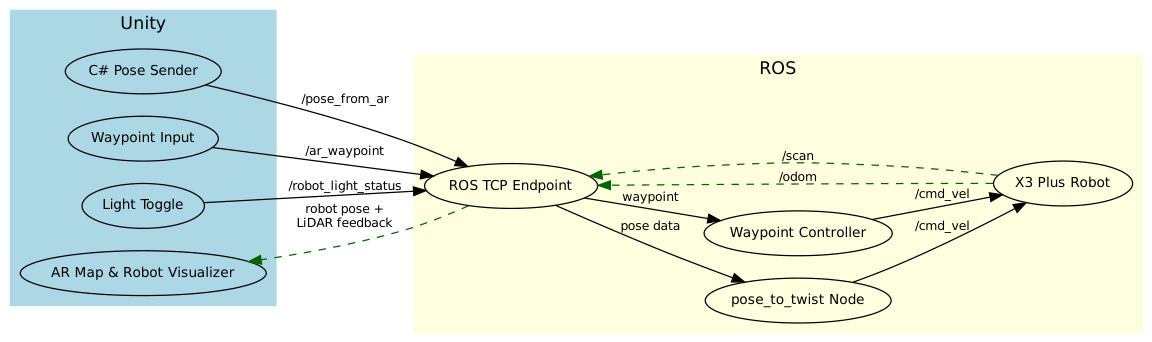
The system’s node architecture follows a publisher–subscriber model, illustrated in
Figure 2, where individual nodes handle discrete responsibilities and exchange data through named topics. A dedicated node,
pose_to_twist, acts as the primary bridge between the AR interface and the robot’s motion system, receiving virutal pose data from Unity, converting it into the ROS coordinate frame and publishing velocity commands to
cmd_vel. The complete set of topics used for teleoperation and feedback is detailed in
Table 3 and
Table 4.
3.3. Visual Simultaneous Localization and Mapping (VSLAM)
Visual Simultaneous Localization and Mapping (VSLAM) utilizes RGB-D cameras to detect and track visual landmarks across successive frames, estimating the robot’s motion while constructing a 3D map of the environment [
18]. Its rich textural and geometric output makes it particularly suitable for augmented reality teleoperation applications [
19].
3.4. Unity
To develop the Mixed Reality (MR) interface, the Unity game engine version 2023.2.6f1 was utilized to render a real-time 3D visualization of the operating environment. Unity serves as the primary bridge between the physical robotic hardware and the operator’s immersive display. Communication between the ROS middleware on the robot and the Unity simulation is facilitated by the Unity Robotics Hub toolset v0.7.0. Specifically, the ROS-TCP Connector package version v0.7.0 establishes a bidirectional network link, allowing Unity to subscribe to sensory inputs (e.g., LiDAR scans, coordinate transforms) and publish teleoperation control commands directly to ROS topics in real time [
20]. This architecture supports closed-loop interaction, where the digital twin reflects physical states while translating operator inputs into robotic actuation.
3.5. Meta Quest 3
For the augmented reality component of this project, the Meta Quest 3 built by Meta Platforms Inc. in Menlo Park, CA, USA. was selected as the head-mounted display (HMD) device. The headset features high-resolution stereoscopic passthrough cameras that capture real-world surroundings, allowing Unity-rendered virtual content to be overlaid with high spatial fidelity. The operator interacts with the virtual environment and issues waypoint commands via handheld controllers, localized via the headset’s internal inside-out tracking array. The hardware specifications are presented in
Table 5.
3.6. Methodology
A Lenovo IdeaPad Gaming 3 laptop (Lenovo IdeaPad Gaming 3 (Lenovo Group Limited, Beijing, China)) was used throughout the development and testing phase to build and deploy the Unity-based AR environment onto the Meta Quest 3 headset, as well as the ROS packages development. This machine served as the primary workstation, handling both the computational requirements of Unity and the packaging process for deployment. Its technical specifications, presented in
Table 6, outline the hardware configuration used during the experiment and provide context for the performance constraints of the development pipeline.
To enable remote control of the UV light, an optocoupler relay (Generic, China) was integrated into the system. This relay acted as the electrical interface between the Jetson Orin NX GPIO ((NVIDIA Corporation, Santa Clara, CA, USA)) outputs and the UV light circuit. Through this configuration, the relay could be triggered directly from user input on the controller, allowing the operator to activate or deactivate the UV light as needed. This approach ensured electrical isolation, safe handling, and precise control during testing.
Prior to disinfection operation, the target environment must be mapped to generate the spatial model used by the AR interface. The ROSMASTER X3 Plus was driven manually through the classroom while RTAB-Map gathered depth and positional data from the RGB-D camera and LiDAR, progressively building a 3D representation of the surroundings. All sensor readings were recorded in ROS .bag files for offline processing. To ensure reproducibility, RTAB-Map was configured with a grid cell size of 0.05 m. The update rate for the visual odometry was capped at 10 Hz to balance computational load and localization accuracy on the Jetson Orin NX, and standard ROS coordinate conventions (X-forward, Y-left, Z-up) were maintained throughout the spatial mapping and navigation pipeline. The processed data were exported as a .ply file and imported into Unity, where the reconstructed environment serves as the operator’s spatial reference for the duration of the operation. By generating this map once and reusing it across sessions, the system avoids the overhead of real-time reconstruction during teleoperation.
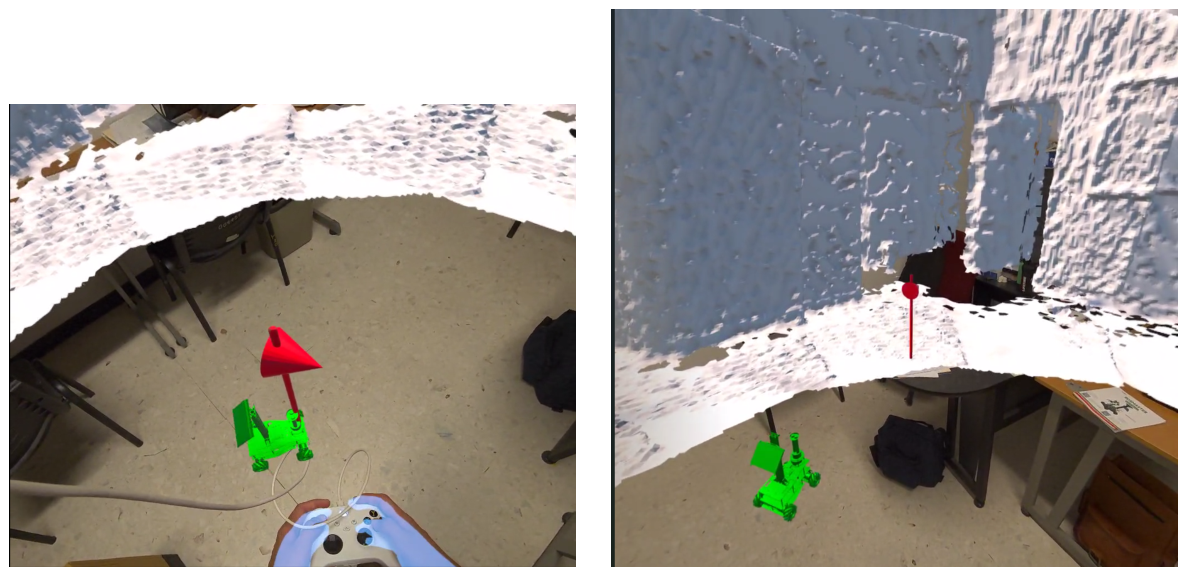
During operation, the operator wears the Meta Quest 3 headset and is presented with the reconstructed 3D model of the environment alongside a virtual representation of the robot’s current pose. This can be seen in
Figure 3. Navigation is commanded through point-and-click waypoint placement directly within this spatial view: the operator selects a target location in the Unity environment using the handheld controller, which is published to the
/ar_waypoint topic as a
geometry_msgs/Pose message. The
pose_to_twist node receives this waypoint, computes the offset from the robot’s current pose, and generates the corresponding velocity commands on
/cmd_vel. To maintain stable teleoperation over the local network, Unity was configured to publish these target poses to the ROS-TCP-Endpoint at a fixed frequency of 10 Hz. The proportional controller running on the ROS master node was constrained to maximum linear velocities of 0.25 m/s and angular velocities of 0.5 rad/s, employing conservative proportional gains (
for both linear and angular adjustments) to prevent aggressive acceleration and ensure safe indoor navigation. The operator can then issue successive waypoints at any time, adjusting the robot’s position based on the live pose feedback visible in the AR view.
UV-C payload activation is managed directly from the interface: the operator toggles the UV light on or off using the Y button on the controller, which publishes a state update to the
/robot_light_status topic. This allows the operator to control irradiation timing precisely, activating the lamp only once the robot is correctly positioned relative to the target surface and the operator has confirmed the area is clear, in line with the safety rationale described in
Section 1. A summary of the full communication flow between Unity, the ROS TCP bridge, and the robot’s control nodes is illustrated in
Figure 4.
The system architecture is documented at the implementation level, including hardware configuration, software stack, ROS topic structure, controller parameters, and mapping settings. This level of detail is intended to allow the approach to be replicated using the same category of commercial off-the-shelf components, without requiring any proprietary tools or custom hardware. Reproducibility in this context refers to architectural replicability rather than exact software reproduction.
4. Experiment
The UV source selected for the experiment was a commercially available 25 W UV-0 bulb operating at a wavelength of 253.7 nm. This type of lamp is commonly used in surface and air disinfection applications due to its germicidal properties, making it a suitable choice for evaluating the sanitization capability of the robotic platform. To provide context for the microbiological results, the delivered UV-C dose can be estimated based on the lamp’s nominal specifications. Assuming an electrical-to-UVC conversion efficiency typical of low-pressure mercury lamps (approx. 30%), the lamp emits roughly 7.5 W of UV-C power. Treating the source isotropically over a spherical area, the irradiance E at a radial distance of 1 m is approximately mW/cm2. Given an exposure time of 15 min (900 s), the estimated cumulative UV-C dose delivered to surfaces perpendicular to the source at a 1 m distance is roughly 54 mJ/cm2. This nominal dose falls within the range recognized to achieve a to reduction for common vegetative bacteria, aligning with the observed experimental outcomes.
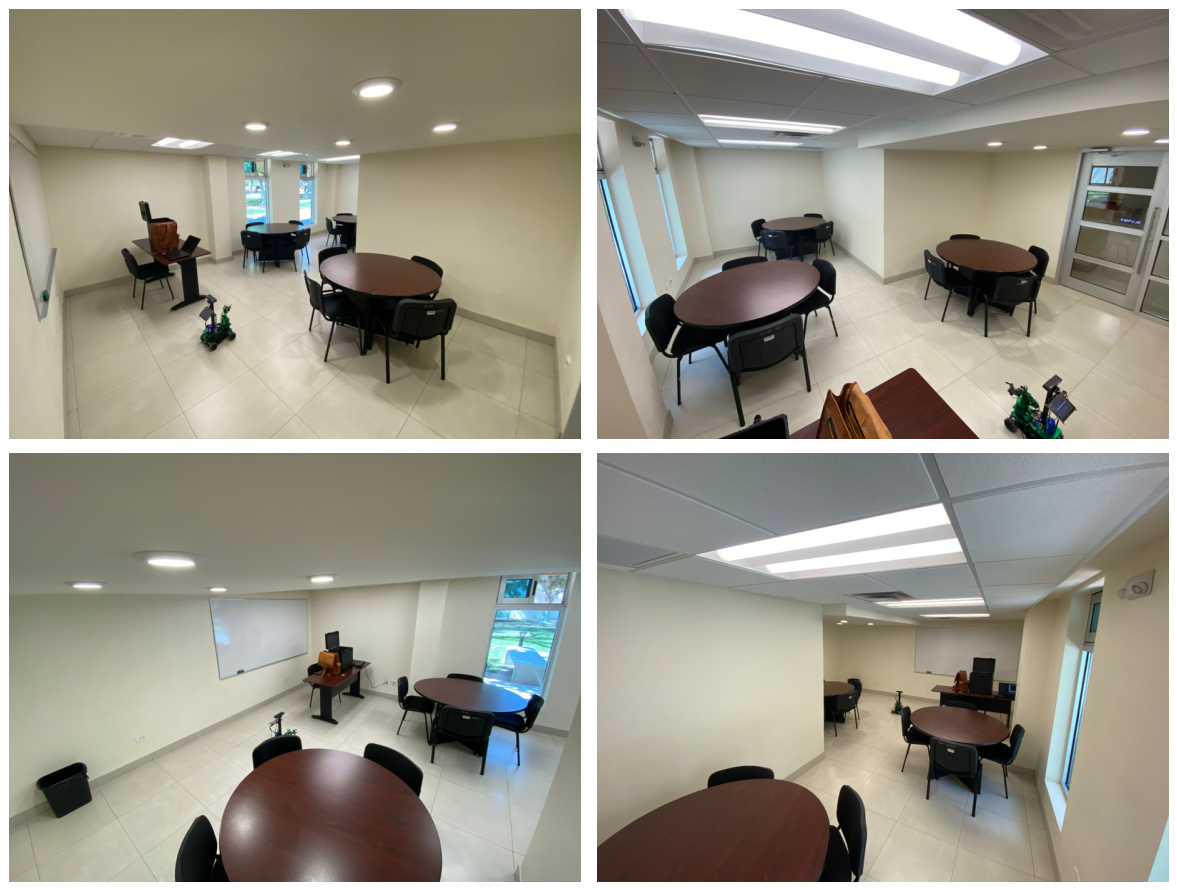
To assess the light’s effectiveness within a real environment, a small college classroom was chosen as the testing location. This room experiences frequent student circulation throughout the day, providing a realistic setting for evaluating both the UV system and the robot’s ability to navigate. The microbiological trials were conducted during the month of February in Ciudad Juárez, Chihuahua, Mexico. To isolate the effects of the UV-C payload and prevent potential photoreactivation of microorganisms or spectral interference, the ambient fluorescent lighting in the classroom was turned off during the 15 min exposure periods. Environmental conditions were reflective of the regional winter averages for indoor unheated spaces at the time, with an estimated ambient temperature of 12 °C to 18 °C and a relative humidity of approximately
. Images of the classroom can be seen on
Figure 5. Prior to the microbial testing, the entire area was scanned and mapped using VSLAM, specifically on RTAB-Map [
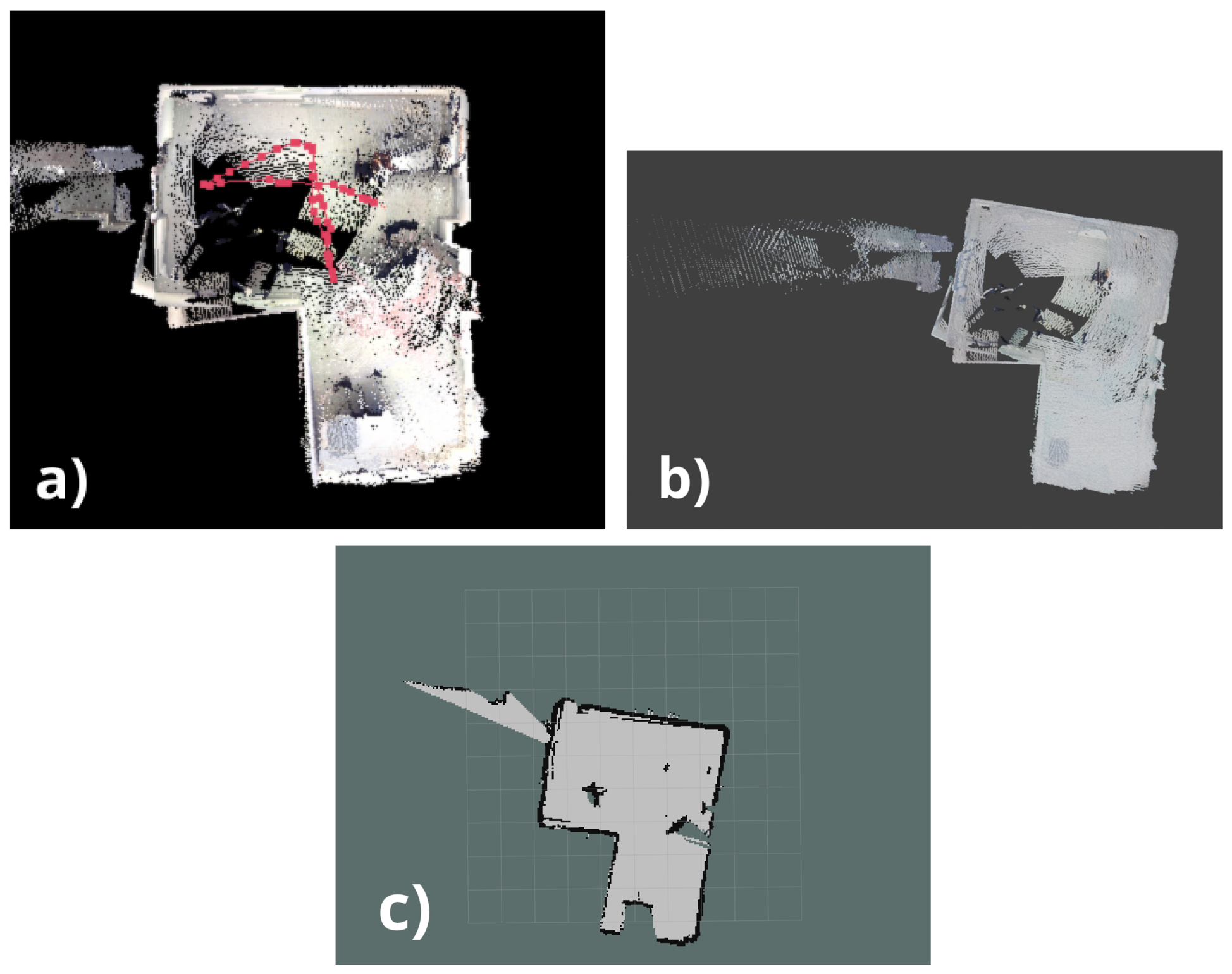
21] 0.21.9. allowing the robot to localize itself and position the UV source accurately with respect to the identified surfaces. Once the scans were generated, the mesh file was obtained through RTAB-Map and treated in Blender, version 4.4, in order to obtain the corresponding color shades for each point. Afterwards, it was converted into a single object that was then imported to Unity as a map. Images of the scans and the map can be observed in
Figure 6.
Validation of the UV-light sanitization method was performed through sterile swab sampling on several surfaces within the classroom. The selected surfaces represented a variety of materials and common contact points:
Desk;
Main table;
Adjacent wall;
Chair’s backrest.
The desk and main table consisted of laminated wooden panels, while the chair’s backrest was made of hard plastic. Before any UV exposure, swabs were collected from these areas to quantify the microbial load present under normal classroom usage conditions. To validate the end-to-end functionality of the AR-teleoperated robotic platform, a preliminary qualitative evaluation of the biological response was conducted. A single pre-exposure and single post-exposure swab were collected per surface to observe the immediate effects of the integrated system’s operation in a real-world setting.
Once the initial sampling was completed, the robot was positioned so that the UV-C bulb could adequately irradiate each of the tested surfaces. The UV light remained active for a continuous 15 min period with the robot held at a fixed location, ensuring consistent exposure and minimizing potential shadows or occlusions. Following this treatment, the same surfaces were swabbed again to obtain the post-sanitization microbial samples.
All samples collected, both pre- and post-exposure, underwent microbiological culture procedures. They were plated onto EMB (Eosin-Methylene Blue) agar, MacConkey agar, and blood agar to facilitate the growth of a broad range of microorganisms. The plates were incubated at 37 °C for 72 h to ensure sufficient development of colonies for visualization and identification. This allowed for a reliable comparison of microbial presence before and after the sanitization process.
5. Results
Subsequent quantification of the microbial load before and after the cleaning and disinfection procedure was conducted to determine the effectiveness of the UV sanitization method. Microbial contamination levels were expressed as colony-forming units per square centimeter (CFU/cm
2), a standard quantitative measure used in surface microbiology. The recorded values demonstrate preliminary reductions across all tested surfaces, ranging from 15% to 50%, which corresponds to Log
10 reductions between 0.07 and 0.30, as detailed in
Table 7. While these results are encouraging, repeated trials and controlled dosimetry measurements are planned to establish statistical significance and validate disinfection efficacy more rigorously.
Microbiological evaluation further showed that total and fecal coliforms were absent in both the pre- and post-sanitization samples. This confirms that the tested environment did not show signs of fecal contamination at the time and that the sanitization process did not introduce any form of microbial risk.
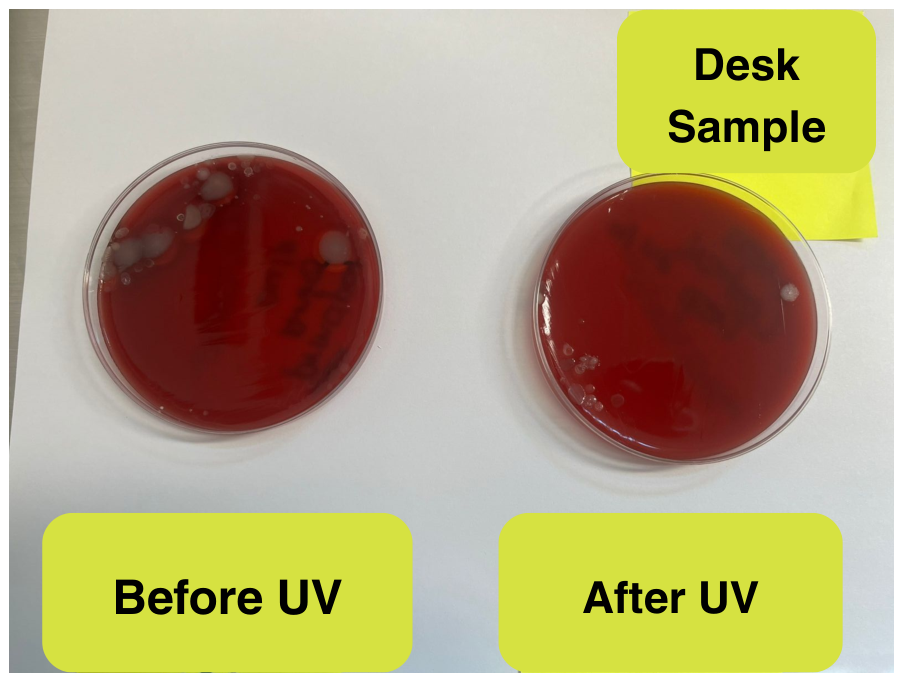
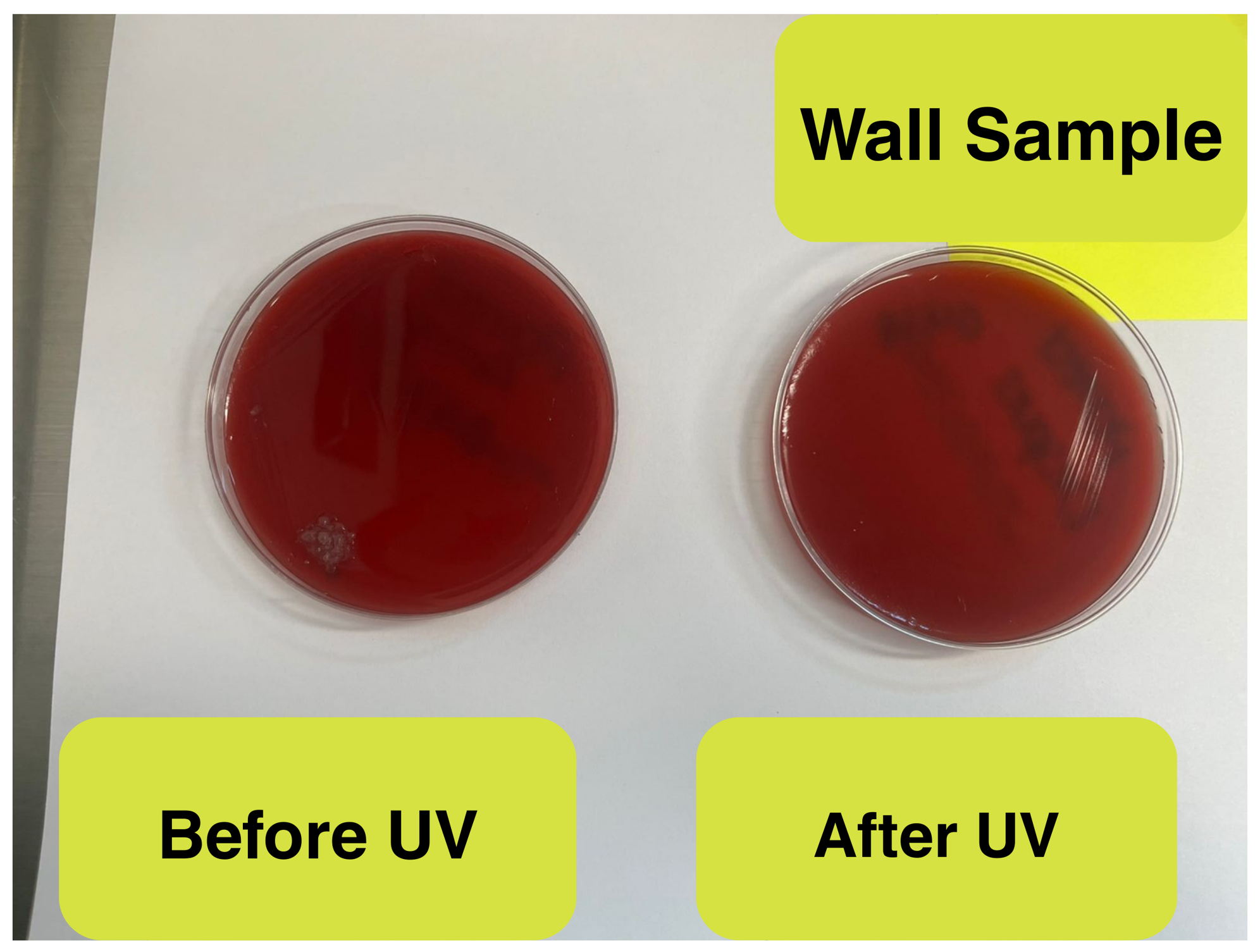
In addition to the quantitative results, visual inspection of the cultured agar plates provided a clear comparison between pre- and post-sanitization microbial growth. Images of the EMB, MacConkey, and blood agar plates for the desk samples and wall surface samples are shown in
Figure 7 and
Figure 8. These plates illustrate the reduction in colony formation following UV exposure and support the numerical findings presented in
Table 7.
Overall, these preliminary results serve primarily as a functional validation of the end-to-end system integration: demonstrating that the AR teleoperation workflow, the ROS communication pipeline, and the UV-C payload can operate together reliably in a real-world environment. The observed microbial reductions are consistent with expected UV-C dose–response behavior and support the feasibility of the approach, while more rigorous disinfection efficacy studies with replicated trials remain as future work.
6. Discussion
The results of this work suggest that the integration of an augmented reality interface with an omnidirectional mobile robot is a feasible approach for supporting UV-C disinfection tasks. The initial microbiological tests yielded promising preliminary reductions in aerobic mesophilic bacteria across the sampled surfaces, consistent with the known germicidal properties of UV-C light. These results motivate further investigation through multi-trial sampling regimens and direct environmental dosimetry to formally establish the efficacy and reliability of the proposed system.
The proposed system presents several practical advantages over existing UV-C robotic solutions. The use of commercial components, such as the Meta Quest 3, Unity, and the ROSMASTER X3 Plus, ensures that the architecture is reproducible and accessible. The AR interface provides the operator with a persistent spatial reference of the environment, enabling deliberate targeting of high-contact surfaces rather than relying on uniform coverage paths. Omnidirectional mobility allows the robot to reposition precisely, which is particularly advantageous in cluttered indoor settings. Critically, the operator-in-the-loop design ensures that UV-C activation only occurs when the operator chooses to, directly addressing the safety deficiencies identified by Pfleger et al. [
9] across the majority of existing disinfection robot deployments.
The system also presents limitations that should be considered when interpreting these results: the spatial model is generated prior to operation and does not update in real time. This means that dynamic changes to the environment are not directly reflected in the AR view during operation. The proportional waypoint controller does not incorporate obstacle avoidance, placing the responsibility for collision-free navigation on the operator’s spatial judgment. The microbiological validation was conducted in a single small classroom with a limited number of surface samples and no replications, which constrains the generalizability of the disinfection efficacy findings. While the preliminary logarithmic reductions observed are promising and conform to theoretical UV-C dose–response curves, future work must incorporate multi-trial sampling regimens to establish statistical significance. The present study focused on the functional integration of the robotic platform, meaning that extensive clinical validation with sample replication and direct environmental dosimetry remains a necessary next step to formally establish the efficacy limits and systemic reliability of the proposed teleoperation workflow. Additionally, key system performance metrics (such as mapping accuracy, waypoint-following error and AR-to-physical registration error) were not quantitatively measured in this study. However, future work should include systematic benchmarking of these parameters for proper reproducibility and allow meaningful comparisons between alternative teleoperation methodologies.
No formal usability evaluation was conducted in this study. Validating the AR interface as a teleoperation modality would require a comparative study involving alternative interfaces, such as traditional screen-based teleoperation or fully autonomous operation, alongside standardized human-factors metrics such as NASA-TLX or the System Usability Scale. These comparisons are identified as the primary direction for future work.
Even though the reductions observed in this study ranged from moderate to high, the results suggest several opportunities for further investigation. One important factor is exposure time. The disinfection cycles used in the current experiment were only limited to 15 min, and longer exposure durations may produce higher bacterial reductions or more consistent results across materials with different textures. Extending the tests to include varied illumination times would help establish more precise operating guidelines for real-world deployment.
Another direction for future work involves scaling the experiments to larger and more complex environments. The present tests were carried out in a controlled room and the robot performed well in terms of navigation and spatial mapping. Larger spaces may introduce additional challenges related to occlusions, shadowed regions, or areas that require multiple passes. Evaluating the system in classrooms, offices, hallways, or shared facilities would provide a more complete understanding of its capabilities and limitations.
Environmental conditions also play an important role. Temperature, humidity, surface reflectivity, and the amount of ambient light can all influence how UV-C energy interacts with surfaces. Running tests under different environmental settings would allow the system to be validated under more realistic conditions, especially in locations where disinfection is most needed.
This proof-of-concept study highlights several possible directions for continued development. Future work expanding the testing conditions, exposure parameters and operating environments will support the adequate maturation of this approach into a more thoroughly validated disinfection platform.
Author Contributions
Conceptualization, F.G.-L.; Methodology, D.L.-C. and F.G.-L.; Software, F.G.-L.; Validation, B.A.R. and V.M.A.-M.; Formal analysis, F.G.-L.; Investigation, A.d.l.R.-G. and D.O.-M.; Resources, A.G.R.-R. and I.S.-M.; Data curation, B.A.R. and V.M.A.-M.; Writing—original draft, A.d.l.R.-G.; Writing—review & editing, D.L.-C. and F.G.-L.; Visualization, A.d.l.R.-G. and D.O.-M.; Supervision, A.G.R.-R. and D.L.-C.; Project administration, F.G.-L.; Funding acquisition, A.d.l.R.-G. and I.S.-M. All authors have read and agreed to the published version of the manuscript.
Funding
This research was funded by the Consejo Nacional de Ciencia y Tecnología (CONAHCYT) graduate scholarship, with grant number 1313470 and by the Universidad Autónoma de Ciudad Juárez (UACJ) through the Proyectos de Investigación con Impacto Social (PIISO) in 2023.
Data Availability Statement
The original contributions presented in this study are included in the article. Further inquiries can be directed to the corresponding author.
Acknowledgments
We would like to thank our institution’s laboratory Diagnóstico Clínico Universitario (UACJ-ICB) and their technicians for the sample gathering, testing and result interpretation. During the preparation of this manuscript, the authors used Grammarly for the purposes of language polishing, grammar, and structural editing. The authors have reviewed and edited the output and take full responsibility for the content of this publication.
Conflicts of Interest
The authors declare no conflicts of interest.
Abbreviations
The following abbreviations are used in this manuscript:
| UV-C | Ultraviolet-C Light |
| AR | Augmented Reality |
| ROS | Robot Operating System |
| XR | Extended Reality |
| HMD | Head-Mounted Devices |
| VR | Virtual Reality |
| IMU | Inertial Measurement Unit |
| DOF | Degrees of Freedom |
| RGB-D | Red Green Blue-Depth |
| LiDAR | Light Detection and Ranging |
| RTAB-Map | Real-Time Appearance-Based Mapping |
| SLAM | Simultaneous Localization and Mapping |
| CFU | Colony-Forming Units |
| URDF | Unified Robot Description Format |
| MR | Mixed Reality |
| EMB | Eosin-Methylene Blue Agar |
| RViz | ROS Visualization Tool |
References
- Memarzadeh, F. A review of recent evidence for utilizing ultraviolet irradiation technology to disinfect both indoor air and surfaces. Appl. Biosaf. 2021, 26, 52–56. [Google Scholar] [CrossRef] [PubMed]
- Liang, J.-J.; Liao, C.-C.; Chang, C.-S.; Lee, C.-Y.; Chen, S.-Y.; Huang, S.-B.; Yeh, Y.-F.; Singh, K.J.; Kuo, H.-C.; Lin, Y.-L.; et al. The Effectiveness of Far-Ultraviolet (UVC) Light Prototype Devices with Different Wavelengths on Disinfecting SARS-CoV-2. Appl. Sci. 2021, 11, 10661. [Google Scholar] [CrossRef]
- Pereira, A.R.; Braga, D.F.O.; Vassal, M.; Gomes, I.B.; Simões, M. Ultraviolet C irradiation: A promising approach for the disinfection of public spaces? Sci. Total Environ. 2023, 879, 163007. [Google Scholar] [CrossRef] [PubMed]
- Marques, J.M.C.; Ramalingam, R.; Pan, Z.; Hauser, K. Optimized coverage planning for UV surface disinfection. arXiv 2021, arXiv:2103.14137. [Google Scholar] [CrossRef]
- Guettari, M.; Gharbi, I.; Hamza, S. UVC disinfection robot. Environ. Sci. Pollut. Res. 2020, 28, 40394–40399. [Google Scholar] [CrossRef] [PubMed]
- Katara, G.; Hemvani, N.; Chitnis, S.; Chitnis, V.; Chitnis, D. Surface Disinfection by Exposure to Germicidal UV Light. Indian J. Med. Microbiol. 2008, 26, 241–242. [Google Scholar] [CrossRef] [PubMed]
- Sanchez, A.G.; Smart, W.D. Verifiable Surface Disinfection Using Ultraviolet Light with a Mobile Manipulation Robot. Technologies 2022, 10, 48. [Google Scholar] [CrossRef]
- Ploydaeng, M.; Rajatanavin, N.; Rattanakaemakorn, P. UV-C light: A powerful technique for inactivating microorganisms and the related side effects to the skin. Photodermatol. Photoimmunol. Photomed. 2020, 37, 12–19. [Google Scholar] [CrossRef] [PubMed]
- Pfleger, S.G.; Haertel, M.E.M.; Plentz, P.D.M. UV-C disinfection Robots: A Systematic review. J. Field Robot. 2025, 42, 3323–3347. [Google Scholar] [CrossRef]
- Fiedeń, M.; Bałchanowski, J. A Mobile Robot with Omnidirectional Tracks—Design and Experimental Research. Appl. Sci. 2021, 11, 11778. [Google Scholar] [CrossRef]
- Saha, S.; Gaonkar, S.; Parab, S.; Lima, R.; Vatsal, V.; Vakharia, V.; Das, K. ATMAS: Assistive Teleoperation Method using Augmented Reality and Switching Control. In Proceedings of the 2024 IEEE Conference on Telepresence; IEEE: New York, NY, USA, 2024; pp. 24–29. [Google Scholar] [CrossRef]
- Liang, N.; Ang, Y.P.; Yeo, K.; Wu, X.; Xie, Y.; Cai, Y. BIMBOT for autonomous laser Scanning in built environments. Robotics 2024, 13, 22. [Google Scholar] [CrossRef]
- Loconsole, C.; Leonardis, D.; Frisoli, A. An augmented-reality-assisted immersive system for robotic arms teleoperation. In Intelligent Human Systems Integration (IHSI 2023): Integrating People and Intelligent Systems; AHFE International: New York, NY, USA, 2023. [Google Scholar] [CrossRef]
- Wang, X.; Guo, S.; Xu, Z.; Zhang, Z.; Sun, Z.; Xu, Y. A robotic teleoperation system enhanced by augmented reality for natural Human–Robot interaction. Cyborg Bionic Syst. 2024, 5, 0098. [Google Scholar] [CrossRef] [PubMed]
- Solanes, J.E.; Muñoz, A.; Gracia, L.; Martí, A.; Girbés-Juan, V.; Tornero, J. Teleoperation of industrial robot manipulators based on augmented reality. Int. J. Adv. Manuf. Technol. 2020, 111, 1077–1097. [Google Scholar] [CrossRef]
- Audonnet, F.P.; Ramirez-Alpizar, I.G.; Aragon-Camarasa, G. IMMERTWIN: A mixed reality framework for enhanced robotic arm teleoperation. arXiv 2024, arXiv:2409.08964. [Google Scholar] [CrossRef]
- Yahboom. ROS Educational Robot with 6DOF Robotic Arm for RPi 5 NVIDIA Jetson. Available online: https://category.yahboom.net/products/rosmaster-x3-plus (accessed on 27 April 2026).
- Dai, Y.; Wu, J.; Wang, D. A review of common techniques for visual simultaneous localization and mapping. J. Robot. 2023, 2023, 8872822. [Google Scholar] [CrossRef]
- Zheng, S.; Wang, J.; Rizos, C.; Ding, W.; El-Mowafy, A. Simultaneous Localization and Mapping (SLAM) for Autonomous Driving: Concept and analysis. Remote Sens. 2023, 15, 1156. [Google Scholar] [CrossRef]
- Unity-Technologies. GitHub—Unity-Technologies/Unity-Robotics-Hub: Central repository for Tools, Tutorials, Resources, and Documentation for Robotics Simulation in Unity. Available online: https://github.com/Unity-Technologies/Unity-Robotics-Hub (accessed on 27 April 2026).
- Labbé, M.; Michaud, F. RTAB-Map as an open-source lidar and visual simultaneous localization and mapping library for large-scale and long-term online operation. J. Field Robot. 2018, 36, 416–446. [Google Scholar] [CrossRef]
Figure 1.
ROSMASTER X3 Plus.
Figure 1.
ROSMASTER X3 Plus.
Figure 2.
ROS communication protocol.
Figure 2.
ROS communication protocol.
Figure 3.
Images depicting the operator’s view within the Meta Quest 3. The operator stands within a 3D recreation of the scanned map where he can observe a model of the robot along with the waypoint. The operator can move the waypoint to the desired position. A position which the robot will reach afterwards.
Figure 3.
Images depicting the operator’s view within the Meta Quest 3. The operator stands within a 3D recreation of the scanned map where he can observe a model of the robot along with the waypoint. The operator can move the waypoint to the desired position. A position which the robot will reach afterwards.
Figure 4.
A general overview of the communication flow between the Unity application, the ROS TCP Endpoint bridge, and the ROS control nodes managing the X3 Plus Robot.
Figure 4.
A general overview of the communication flow between the Unity application, the ROS TCP Endpoint bridge, and the ROS control nodes managing the X3 Plus Robot.
Figure 5.
Images of the selected classroom. This small-sized classroom was ideal due to it being constantly occupied prior to the scheduled sample testing, as well as useful for the mapping aspect of the operation.
Figure 5.
Images of the selected classroom. This small-sized classroom was ideal due to it being constantly occupied prior to the scheduled sample testing, as well as useful for the mapping aspect of the operation.
Figure 6.
Processing stages of the classroom 3D map: (a) upper view of the environment reconstructed in RTAB-Map after the scanning phase, (b) mesh imported into Blender for post-processing, including voxel density adjustment, point ratio refinement, and color assignment, and (c) visualization of the final reconstructed map within the ROS environment using RViz. The processed mesh was exported in Stanford Triangle Format (.ply) and subsequently imported into Unity for use as the operational map.
Figure 6.
Processing stages of the classroom 3D map: (a) upper view of the environment reconstructed in RTAB-Map after the scanning phase, (b) mesh imported into Blender for post-processing, including voxel density adjustment, point ratio refinement, and color assignment, and (c) visualization of the final reconstructed map within the ROS environment using RViz. The processed mesh was exported in Stanford Triangle Format (.ply) and subsequently imported into Unity for use as the operational map.
Figure 7.
Desk sample agar showing the growth pre-sanitization and post-sanitization.
Figure 7.
Desk sample agar showing the growth pre-sanitization and post-sanitization.
Figure 8.
Wall sample agar. Similar to
Figure 7, the reduction post-sanitization is notable. It can be considered relative to the amount of bacterial growth, since this sample’s agar pre-sanitization shows little microbial growth.
Figure 8.
Wall sample agar. Similar to
Figure 7, the reduction post-sanitization is notable. It can be considered relative to the amount of bacterial growth, since this sample’s agar pre-sanitization shows little microbial growth.
Table 1.
Summary of UV-C robotic disinfection systems.
Table 1.
Summary of UV-C robotic disinfection systems.
| Work | Robot Type | Navigation | Localization/Mapping | Operator Interface |
|---|
| Katara et al. [6] | Fixed UV lamp setup | None | None | None |
| Guettari et al. [5] | Mobile (custom Robot UVC) | Autonomous | Obstacle detection only | Wi-Fi phone/tablet monitor |
| Marques et al. [4] | Mobile UV robot | Autonomous (coverage planner) | Collision and occlusion constraints | None reported |
| Sanchez et al. [7] | Mobile (semi-autonomous) | Semi-autonomous | Limited | Supervisory UI with verification |
| Pfleger et al. [9] | Review (96 studies) | Mostly pre-programmed | 59.4% no localization, 60.4% no mapping | HRI largely absent |
| This Work | Mobile omnidirectional | Operator-guided waypoints | VSLAM (RTAB-Map) | AR HMD (Meta Quest 3) |
Table 2.
Summary of AR/XR-based teleoperation systems.
Table 2.
Summary of AR/XR-based teleoperation systems.
| Work | XR Modality | Robot Platform | Environment Representation | Key Benefit |
|---|
| Loconsole et al. [13] | AR | Manipulator | RGB-D spatial mapping | Improved perception and control fidelity |
| Wang et al. [14] | AR | Manipulator | Real-time camera feed | Low error rates in structured environments |
| Solanes et al. [15] | AR | 6R Industrial Robot | AR overlay of cell | Faster execution, reduced learning time |
| Audonnet et al. [16] | MR/DT | Industrial Robot | Digital Twin | Reduced mental workload |
| Fieden et al. [10] | XR | Mobile Robot | Vision-based tracking | Improved motion accuracy for teleoperation |
| Saha et al. [11] | AR | Mobile retail robot | Intention-based map | Reduced collisions via variable autonomy |
| Liang et al. [2] | None | Mobile (LiDAR) | 3D point cloud | Autonomous scanning comparable to manual survey |
| This Work | AR | Mobile UV-C Robot | RTAB-Map 3D reconstruction | Spatially-aware UV-C payload control |
Table 3.
Topics used by RTAB-Map for 3D map generation.
Table 3.
Topics used by RTAB-Map for 3D map generation.
| Topic | Message Type | Description |
|---|
| /camera/rgb/image_raw | sensor_msgs/Image | RGB camera image used for visual mapping |
| /camera/depth/image_raw | sensor_msgs/Image | Depth image used by RTAB-Map |
| /camera/rgb/camera_info | sensor_msgs/CameraInfo | Intrinsic parameters of the RGB camera |
| /rtabmap/odom | nav_msgs/Odometry | Visual–inertial odometry estimation |
| /rtabmap/cloud_map | sensor_msgs/PointCloud2 | Global point cloud generated by RTAB-Map |
| /rtabmap/mapData | rtabmap_msgs/MapData | Complete map structure with node positions |
| /rtabmap/info | rtabmap_msgs/Info | Mapping diagnostic and performance information |
Table 4.
Topics used by the final system for control and interaction.
Table 4.
Topics used by the final system for control and interaction.
| Topic | Message Type | Description |
|---|
| /tf | tf2_msgs/TFMessage | Transformations between reference frames |
| /cmd_vel | geometry_msgs/Twist | Linear and angular velocity commands sent to the robot |
| /odom | nav_msgs/Odometry | Estimation of the robot’s position and orientation |
| /scan | sensor_msgs/LaserScan | LiDAR data for environment perception |
| /pose_from_ar | geometry_msgs/Pose | Pose generated from Unity using AR markers |
| /ar_waypoint | geometry_msgs/Pose | Navigation goal defined by the user via AR marker |
Table 5.
Technical specifications of the Meta Quest 3.
Table 5.
Technical specifications of the Meta Quest 3.
| Specification | Value |
|---|
| Lens type | Pancake |
| Supported IPDs | 53–75 mm |
| Display type | Dual LCD |
| Chipset | Snapdragon XR2 Gen 2 (4 nm) |
| RAM | 8 GB |
| Wi-Fi | 6 GHz |
| Passthrough | True Color High Resolution |
| Field of View | 110° |
| Pixels per Eye | 2064 × 2208 |
| Max refresh rate | 120 Hz |
Table 6.
Technical specifications of the development workstation.
Table 6.
Technical specifications of the development workstation.
| Component | Specification |
|---|
| CPU | AMD Ryzen 5 5600H with Radeon Graphics (3.30 GHz) |
| GPU | NVIDIA GeForce RTX 3050 Ti |
| RAM | 16 GB |
| Storage | 1 TB |
| Operating System | Windows 11 Home |
Table 7.
Microbiological results before and after the sanitization process. Note: Post-treatment samples were collected immediately following a 15 min continuous, fixed-position UV-C exposure at an approximate perpendicular distance of 1 m to the targeted surfaces.
Table 7.
Microbiological results before and after the sanitization process. Note: Post-treatment samples were collected immediately following a 15 min continuous, fixed-position UV-C exposure at an approximate perpendicular distance of 1 m to the targeted surfaces.
| Surface | Before (CFU/cm2) | After (CFU/cm2) | Reduction (%) | Log10 Reduction | Total Coliforms | Fecal Coliforms |
|---|
| Desk | 160 | 110 | 31.25 | 0.16 | Absent | Absent |
| Main Table | 130 | 110 | 15.38 | 0.07 | Absent | Absent |
| Adjacent Wall | 20 | 10 | 50.00 | 0.30 | Absent | Absent |
| Chair’s backrest (outwards) | 20 | 10 | 50.00 | 0.30 | Absent | Absent |
| Disclaimer/Publisher’s Note: The statements, opinions and data contained in all publications are solely those of the individual author(s) and contributor(s) and not of MDPI and/or the editor(s). MDPI and/or the editor(s) disclaim responsibility for any injury to people or property resulting from any ideas, methods, instructions or products referred to in the content. |




 ,
,