MicroRNAs in Long COVID: Key Regulators, Biomarkers, and Therapeutic Targets of Post-SARS-CoV-2 Sequelae
 , ,
, ,  ,
,
Abstract
1. Introduction
2. Overview of miRNA Biology
2.1. Definition
2.2. Biosynthesis
2.3. mRNA Silencing and Feedback Regulation
2.4. Circulating miRNAs: Stability in Serum/Extracellular Vesicles and Value as Biomarkers
3. Evidence of miRNA Dysregulation in Long COVID
3.1. Clinical Profiling Studies
3.2. Immune and Inflammatory Regulation
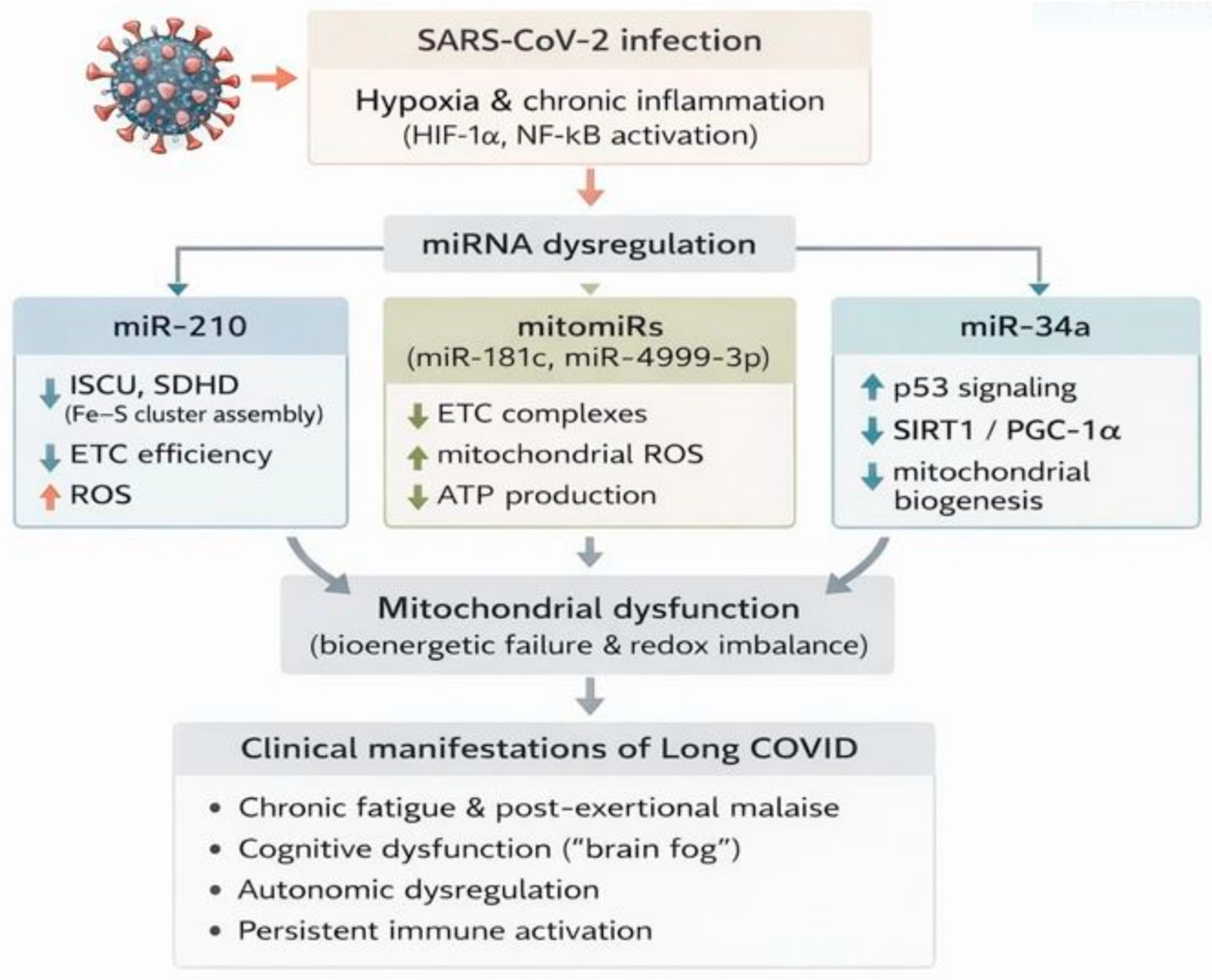
3.3. Mitochondrial and Metabolic Dysfunction
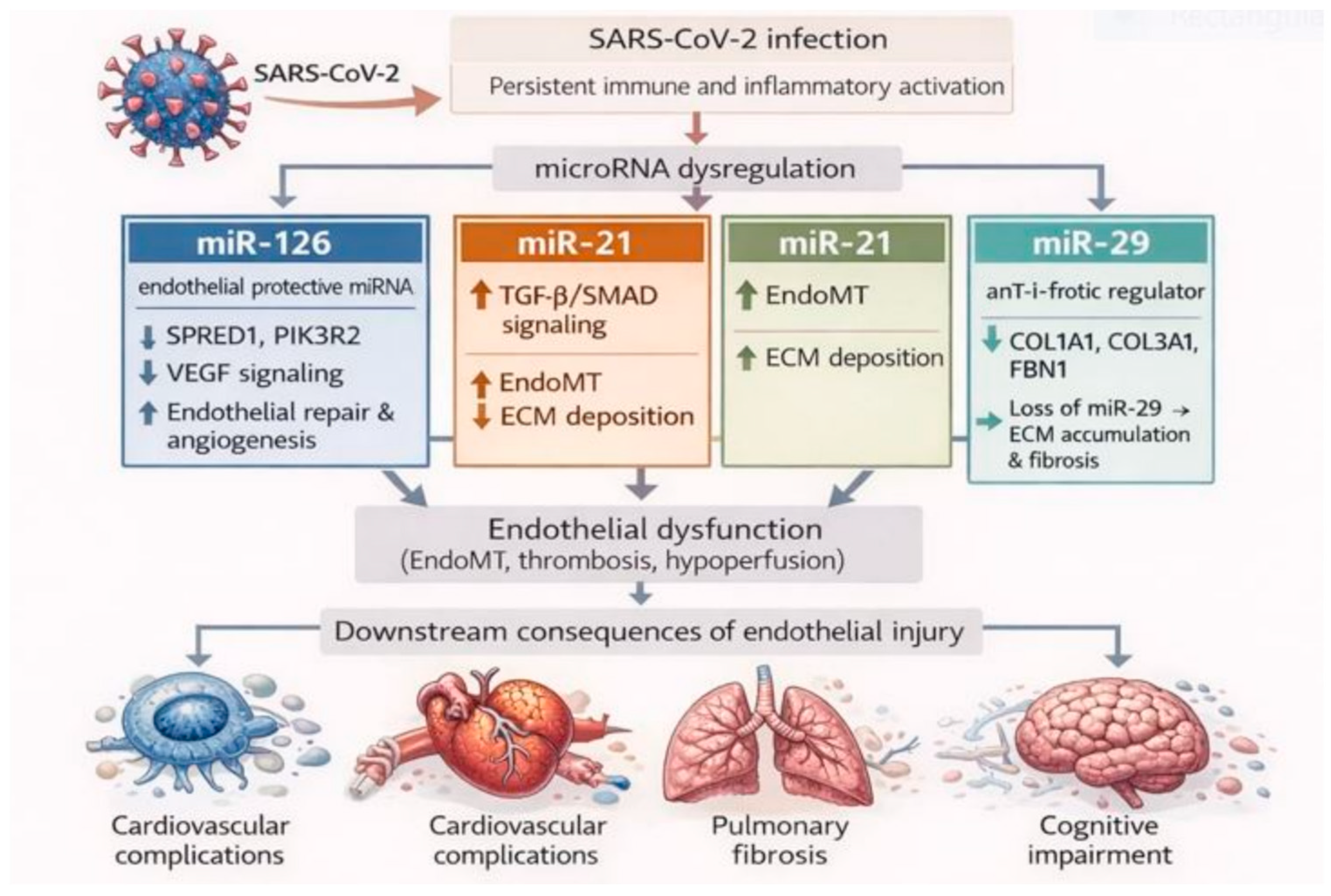
3.4. Endothelial Injury and Fibrosis
4. Circulating miRNAs as Biomarkers: Diagnostic and Prognostic Potential
5. Therapeutic Targeting of miRNAs in Long COVID
5.1. AntagomiRs to Dampen Persistent Inflammation
5.2. miRNA Mimics Restore Immune Homeostasis
6. Delivery Strategies: Lipid Nanoparticles (LNPs) and Exosome Engineering
7. Future Perspective
8. Conclusions
Author Contributions
Funding
Institutional Review Board Statement
Informed Consent Statement
Data Availability Statement
Acknowledgments
Conflicts of Interest
Abbreviations
References
- Zuo, W.; Liu, X.; Zhang, Y.; Li, J.; Chen, R.; Wang, H.; Zhao, L.; Sun, Q.; Yang, M.; Zhou, T.; et al. The persistence of SARS-CoV-2 in tissues and its association with long COVID symptoms: A cross-sectional cohort study in China. Lancet Infect. Dis. 2024, 24, 845–855. [Google Scholar] [CrossRef]
- Peluso, M.J.; Deitchman, A.N.; Torres, L.; Iyer, N.S.; Munter, S.E.; Nixon, C.C.; Donohue, K.C.; Tai, V.; Hernandez, M.M.; Yee, J.; et al. Plasma-based antigen persistence in the post-acute phase of SARS-CoV-2 infection. medRxiv 2023. [Google Scholar] [CrossRef]
- Prakash, S.; Kumar, A.; Singh, R.; Mehta, S.; Verma, N.; Patel, K.; Banerjee, S.; Malhotra, P.; Joshi, A.; Rao, P.; et al. Insights into Persistent SARS-CoV-2 Reservoirs in Chronic Long COVID. Viruses 2025, 17, 1310. [Google Scholar] [CrossRef]
- Liu, S.; Guo, Y.; Wang, F.S. Viral persistence in long COVID: Research advances and treatment strategies. Infect. Dis. Immun. 2025, 5, 272–288. [Google Scholar] [CrossRef]
- Hou, Y.; Gu, T.; Ni, Z.; Shi, X.; Ranney, M.L.; Mukherjee, B. Global Prevalence of Long COVID, Its Subtypes, and Risk Factors: An Updated Systematic Review and Meta-analysis. Open Forum Infect. Dis. 2025, 12, ofaf533. [Google Scholar] [CrossRef]
- Finamore, P.; De Sanctis, V.; Pecoraro, A.; Marchetti, F.; Esposito, S.; Marseglia, G.L.; Cutrera, R.; Chiappini, E.; Villani, A.; Corsello, G.; et al. Long COVID Syndrome: A Narrative Review on Burden of Age and Vaccination. J. Clin. Med. 2024, 13, 4756. [Google Scholar] [CrossRef]
- Gross, R.S.; Bick, J.; Morrow, A.K.; Hall, M.; Slater, K.; Cohn, K.; Goyal, M.K.; Newland, J.G.; Gelber, A.C.; Kahn, J.A.; et al. Characterizing Long COVID in Children and Adolescents. JAMA 2024, 332, 1174–1188. [Google Scholar] [CrossRef]
- Almas, T.; Malik, J.; Alsubai, A.; Jawad, A.; Hussain, A.; Iqbal, R.; Khan, M.A.; Riaz, H.; Khan, S.; Saleem, M.; et al. Post-acute COVID-19 syndrome and its prolonged effects: An updated systematic review. Ann. Med. Surg. 2022, 80, 103995. [Google Scholar] [CrossRef]
- Shi, J.; Han, L.; Zhang, Y.; Li, Z.; Wang, J.; Sun, H.; Xu, Y.; Chen, Q.; Zhao, Y.; Liu, P.; et al. Prevalence of and factors associated with long COVID among US adults: A nationwide survey. BMC Public Health 2025, 25, 1758. [Google Scholar] [CrossRef]
- Phetsouphanh, C.; Darley, D.R.; Wilson, D.B.; Howe, A.; Munier, C.M.L.; Patel, S.K.; Juno, J.A.; Burrell, L.M.; Kent, S.J.; Kelleher, A.D.; et al. Improvement of immune dysregulation in individuals with long COVID at 24-months following SARS-CoV-2 infection. Nat. Commun. 2024, 15, 3315. [Google Scholar] [CrossRef]
- Álvarez-Santacruz, C.; Tyrkalska, S.D.; Candel, S. The microbiota in long COVID. Int. J. Mol. Sci. 2024, 25, 1330. [Google Scholar] [CrossRef]
- Ancona, G.; Merra, G.; Romano, M.; Calvani, R.; Cesari, M.; Cammisotto, V.; Sisto, A.; Picca, A.; D’Ercole, C.; Gervasoni, J.; et al. Gut and airway microbiota dysbiosis and their role in COVID-19 and long-COVID. Front. Immunol. 2023, 14, 1080043. [Google Scholar] [CrossRef]
- El-Rhermoul, F.Z.; Boudjema, A.; Ziyyat, A.; Mzibri, M.E.; Benslimane, A.; Chakib, A.; El-Harti, J.; El-Khattabi, S.; Akarid, K.; Hassani, A.; et al. Autoimmunity in Long COVID and POTS. Oxf. Open Immunol. 2023, 4, iqad002. [Google Scholar] [CrossRef]
- Turner, S.; Khan, M.A.; Putrino, D.; Woodcock, A.; Kell, D.B.; Pretorius, E. Long COVID: Pathophysiological factors and abnormalities of coagulation. Trends Endocrinol. Metab. 2023, 34, 321–344. [Google Scholar] [CrossRef]
- Monje, M.; Iwasaki, A. The neurobiology of long COVID. Neuron 2022, 110, 3484–3496. [Google Scholar] [CrossRef]
- Fonte, L. Exploring the relationship between sex and long COVID. J. Allergy Infect. Dis. 2025, 6, 25–27. [Google Scholar] [CrossRef]
- Tsampasian, V.; Elghazaly, H.; Chattopadhyay, R.; Debski, M.; Naing, T.K.; Garg, P.; Clark, A.; Vassiliou, V.S.; Gupta, A.; Mamas, M.A.; et al. Risk Factors Associated with Post-COVID-19 Condition: A Systematic Review and Meta-analysis. JAMA Intern. Med. 2023, 183, 566–580. [Google Scholar] [CrossRef]
- Babicki, M.; Mastalerz-Migas, A.; Zgliczyński, W.S.; Pająk, A.; Pinkas, J.; Kalinowska, A.; Jankowski, M.; Bulska, M.; Jankowski, P.; Bandurska-Stankiewicz, E.; et al. The Course of COVID-19 and Long COVID: Identifying Risk Factors among Patients Suffering from the Disease before and during the Omicron-Dominant Period. Pathogens 2024, 13, 267. [Google Scholar] [CrossRef]
- Davis, H.E.; Assaf, G.S.; McCorkell, L.; Wei, H.; Low, R.J.; Re’em, Y.; Redfield, S.; Austin, J.P.; Akrami, A. Characterizing long COVID in an international cohort: 7 months of symptoms and their impact. EClinicalMedicine 2021, 38, 101019. [Google Scholar] [CrossRef]
- Haffke, M.; Freitag, H.; Rudolf, G.; Seifert, M.; Doehner, W.; Scherbakov, N.; Hanitsch, L.G.; Wittke, K.; Bauer, S.; Volk, H.D.; et al. Endothelial dysfunction and altered endothelial biomarkers in patients with post-COVID-19 syndrome and chronic fatigue syndrome (ME/CFS). J. Transl. Med. 2022, 20, 138. [Google Scholar] [CrossRef]
- Katsoularis, I.; Fonseca-Rodríguez, O.; Farrington, P.; Lindmark, K.; Fors Connolly, A.M. Risks of deep vein thrombosis, pulmonary embolism, and bleeding after COVID-19: Nationwide self-controlled cases series and matched cohort study. BMJ 2022, 377, e069590. [Google Scholar] [CrossRef]
- Pretorius, E.; Vlok, M.; Venter, C.; Bezuidenhout, J.A.; Laubscher, G.J.; Steenkamp, J.; Kell, D.B.; Page, M.J.; Louw, V.J.; van der Merwe, C.F.; et al. Persistent clotting protein pathology in Long COVID/Post-Acute Sequelae of COVID-19 (PASC) is accompanied by increased levels of antiplasmin. Cardiovasc. Diabetol. 2021, 20, 172. [Google Scholar] [CrossRef]
- Osiaevi, I.; Goudarzi, S.; Ding, Y.; Chen, Z.; Wu, X.; Klotz, L.; Schneider, H.; Schuler, G.; Hellmich, B.; Schulz, C.; et al. Persistent capillary rarefication in long COVID syndrome. Angiogenesis 2023, 26, 53–61. [Google Scholar] [CrossRef]
- Xie, Y.; Xu, E.; Bowe, B.; Al-Aly, Z. Long-term cardiovascular outcomes of COVID-19. Nat. Med. 2022, 28, 583–590. [Google Scholar] [CrossRef]
- Zhou, J.; Wang, Y.; Xu, R. Association of COVID-19 infection and the risk of new incident diabetes: A systematic review and meta-analysis. Front. Endocrinol. 2024, 15, 1429848. [Google Scholar] [CrossRef]
- Larsen, N.W.; Stiles, L.E.; Miglis, M.G.; Cortez, M.M.; Jacob, G.; Smith, S.; Lewis, D.; Raj, S.R.; Freeman, R.; Goodman, B.P.; et al. Characterization of autonomic symptom burden in long COVID: A global survey of 2314 adults. Front. Neurol. 2022, 13, 1012668. [Google Scholar] [CrossRef]
- Timofeeva, A.M.; Nikitin, A.O.; Nevinsky, G.A. Circulating miRNAs in the Plasma of Post-COVID-19 Patients with Typical Recovery and Those with Long-COVID Symptoms: Regulation of Immune Response-Associated Pathways. Noncoding RNA 2024, 10, 48. [Google Scholar] [CrossRef]
- Reyes-Long, S.; Navarro-Corcuera, A.; Cruz, J.; González-García, S.; López-Cuadrado, T.; Muñoz-Camargo, C.; Pérez-López, C.; González-Carmona, M.A.; García-García, F.; Jiménez-Jiménez, L.M.; et al. Role of the MicroRNAs in the pathogenic mechanism of painful symptoms in long COVID: Systematic review. Int. J. Mol. Sci. 2023, 24, 3574. [Google Scholar] [CrossRef]
- Paval, N.E.; Căliman-Sturdza, O.A.; Lobiuc, A.; Dimian, M.; Sirbu, I.O.; Covasa, M. MicroRNAs in long COVID: Roles, diagnostic biomarker potential and detection. Hum. Genom. 2025, 19, 90. [Google Scholar] [CrossRef]
- Fayyad-Kazan, M. MicroRNAs in SARS-CoV-2 infection: Emerging modulators of inflammation, pathogenesis, and therapeutic potential. Inflammopharmacology 2025, 33, 4895–4910. [Google Scholar] [CrossRef]
- Lu, T.X.; Rothenberg, M.E. MicroRNA. J. Allergy Clin. Immunol. 2018, 141, 1202–1207. [Google Scholar] [CrossRef]
- O’Brien, J.; Hayder, H.; Zayed, Y.; Peng, C. Overview of MicroRNA Biogenesis, Mechanisms of Actions, and Circulation. Front. Endocrinol. 2018, 9, 402. [Google Scholar] [CrossRef]
- Kabekkodu, S.P.; Shukla, V.; Varghese, V.K.; D’Souza, J.; Chakrabarty, S.; Satyamoorthy, K. Clustered miRNAs and their role in biological functions and diseases. Biol. Rev. Camb. Philos. Soc. 2018, 93, 1955–1986. [Google Scholar] [CrossRef] [PubMed]
- Saliminejad, K.; Khorram Khorshid, H.R.; Soleymani Fard, S.; Ghaffari, S.H. An overview of microRNAs: Biology, functions, therapeutics, and analysis methods. J. Cell. Physiol. 2019, 234, 5451–5465. [Google Scholar] [CrossRef]
- Shomron, N.; Levy, C. MicroRNA-biogenesis and pre-mRNA splicing crosstalk. BioMed Res. Int. 2009, 2009, 594678. [Google Scholar] [CrossRef]
- Wang, J.; Zhao, J. MicroRNA Dysregulation in Epilepsy: From Pathogenetic Involvement to Diagnostic Biomarker and Therapeutic Agent Development. Front. Mol. Neurosci. 2021, 14, 650372. [Google Scholar] [CrossRef]
- Martinez, N.J.; Walhout, A.J.M. The interplay between transcription factors and microRNAs in genome-scale regulatory networks. Bioessays 2009, 31, 435. [Google Scholar] [CrossRef] [PubMed]
- Lai, X.; Vera, J. MicroRNA Regulation, Feed-Forward Loops. In Encyclopedia of Systems Biology; Springer: Berlin/Heidelberg, Germany, 2013; pp. 1324–1328. [Google Scholar] [CrossRef]
- Lai, X.; Wolkenhauer, O.; Vera, J. Understanding microRNA-mediated gene regulatory networks through mathematical modelling. Nucleic Acids Res. 2016, 44, 6019. [Google Scholar] [CrossRef]
- Zhang, H.M.; Kuang, S.; Xiong, X.; Gao, T.; Liu, C.; Guo, A.Y. Transcription factor and microRNA co-regulatory loops: Important regulatory motifs in biological processes and diseases. Brief. Bioinform. 2015, 16, 45–58. [Google Scholar] [CrossRef] [PubMed]
- Pozniak, T.; Shcharbin, D.; Bryszewska, M. Circulating microRNAs in Medicine. Int. J. Mol. Sci. 2022, 23, 3996. [Google Scholar] [CrossRef]
- Ludwig, N.; Leidinger, P.; Becker, K.; Backes, C.; Fehlmann, T.; Pallasch, C.; Rheinheimer, S.; Meder, B.; Stähler, C.; Meese, E.; et al. Distribution of miRNA expression across human tissues. Nucleic Acids Res. 2016, 44, 3865–3877. [Google Scholar] [CrossRef]
- Zhou, S.S.; Jin, J.P.; Wang, J.Q.; Zhang, Z.G.; Freedman, J.H.; Zheng, Y.; Cai, L. miRNAS in cardiovascular diseases: Potential biomarkers, therapeutic targets and challenges. Acta Pharmacol. Sin. 2018, 39, 1073–1084. [Google Scholar] [CrossRef]
- Li, S.; Lei, Z.; Sun, T. The role of microRNAs in neurodegenerative diseases: A review. Cell Biol. Toxicol. 2022, 39, 53. [Google Scholar] [CrossRef]
- Di Leva, G.; Garofalo, M.; Croce, C.M. MicroRNAs in cancer. Annu. Rev. Pathol. Mech. Dis. 2014, 9, 287–314. [Google Scholar] [CrossRef]
- Poudineh, M.; Darweesh, O.; Mokhtari, M.; Zolfaghari, O.; Khaledi, A.; Piroozmand, A. Expression of microRNAs in the detection and therapeutic roles of viral infections: Mechanisms and applications. J. Virus Erad. 2025, 11, 100586. [Google Scholar] [CrossRef]
- Arghiani, N.; Nissan, T.; Matin, M.M. Role of microRNAs in COVID-19 with implications for therapeutics. Biomed. Pharmacother. 2021, 144, 112247. [Google Scholar] [CrossRef]
- Donyavi, T.; Bokharaei-Salim, F.; Baghi, H.B.; Khanaliha, K.; Janat-Makan, M.A.; Karimi, B.; Sadri Nahand, J.; Mirzaei, H.; Khatami, A.; Jafari, A.; et al. Acute and post-acute phase of COVID-19: Analyzing expression patterns of miRNA-29a-3p, 146a-3p, 155–5p, and let-7b-3p in PBMC. Int. Immunopharmacol. 2021, 97, 107641. [Google Scholar] [CrossRef] [PubMed]
- Sabbatinelli, J.; Giuliani, A.; Matacchione, G.; Ramini, D.; Rippo, M.R.; Procopio, A.D.; Olivieri, F. Decreased serum levels of the inflammaging marker miR-146a are associated with clinical non-response to tocilizumab in COVID-19 patients. Mech. Ageing Dev. 2020, 193, 111413. [Google Scholar] [CrossRef] [PubMed]
- Pieri, M.; Vayianos, P.; Nicolaidou, V.; Felekkis, K.; Papaneophytou, C. Alterations in Circulating miRNA Levels after Infection with SARS-CoV-2 Could Contribute to the Development of Cardiovascular Diseases: What We Know So Far. Int. J. Mol. Sci. 2023, 24, 2380. [Google Scholar] [CrossRef] [PubMed]
- Paris, D.; Chapatte, L.; Coudray, A.; Pichon, M.; Couturier, J.; Gouel-Cheron, A.; Vodovar, D.; Lacombe, K.; Katlama, C.; Calvez, V.; et al. The biomarkers’ landscape of post-COVID-19 patients can suggest selective clinical interventions. Sci. Rep. 2023, 13, 22496. [Google Scholar] [CrossRef]
- Zhou, J.; Wu, J.; Li, H.; Wang, L.; Xu, R.; Wang, Y.; Chen, S.; Zhang, Q.; Liu, P.; Sun, H.; et al. The involvement of circulating miR-146a and miR-27a in patients with atherosclerotic cardiovascular disease after SARS-CoV-2 infection. Clin. Cardiol. 2024, 47, e24274. [Google Scholar] [CrossRef]
- Zhang, Y.; Zhang, M.; Li, X.; Tang, J.; Cai, X.; Yang, J.; Wang, Y.; Liu, H.; Zhou, J.; Li, Y.; et al. MiR-208b/miR-21 Promotes the Progression of Cardiac Fibrosis Through the Activation of the TGF-β1/Smad-3 Signaling Pathway: An in vitro and in vivo Study. Front. Cardiovasc. Med. 2022, 9, 924629. [Google Scholar] [CrossRef]
- O’Connell, R.M.; Rao, D.S.; Chaudhuri, A.A.; Baltimore, D. MicroRNA-155 promotes autoimmune inflammation by enhancing inflammatory T cell development. Immunity 2010, 33, 607. [Google Scholar] [CrossRef]
- Wang, G.; Kwan, B.C.H.; Lai, F.M.M.; Chow, K.M.; Li, P.K.T.; Szeto, C.C. Urinary miR-21, miR-29, and miR-93: Novel Biomarkers of Fibrosis. Am. J. Nephrol. 2012, 36, 412–418. [Google Scholar] [CrossRef]
- Guo, B.; Gu, J.; Zhuang, T.; Zhang, J.; Fan, C.; Li, Y.; Zhao, M.; Chen, R.; Wang, R.; Kong, Y.; et al. MicroRNA-126: From biology to therapeutics. Biomed. Pharmacother. 2025, 185, 117953. [Google Scholar] [CrossRef]
- Brillante, S.; Volpe, M.; Indrieri, A. Advances in MicroRNA Therapeutics: From Preclinical to Clinical Studies. Hum. Gene Ther. 2024, 35, 628–648. [Google Scholar] [CrossRef] [PubMed]
- Neudecker, V.; Haneklaus, M.; Jensen, O.; Khailova, L.; Masterson, J.C.; Tye, H.; Biette, K.; Jedlicka, P.; Brodsky, K.S.; Gerich, M.E.; et al. Myeloid-derived miR-223 regulates intestinal inflammation via repression of the NLRP3 inflammasome. J. Exp. Med. 2017, 214, 1737–1752. [Google Scholar] [CrossRef] [PubMed]
- Houshmandfar, S.; Saeedi-Boroujeni, A.; Rashno, M.; Khodadadi, A.; Mahmoudian-Sani, M.R. miRNA-223 as a regulator of inflammation and NLRP3 inflammasome, the main fragments in the puzzle of immunopathogenesis of different inflammatory diseases and COVID-19. Naunyn-Schmiedeberg’s Arch. Pharmacol. 2021, 394, 2187–2195. [Google Scholar] [CrossRef] [PubMed]
- Thum, T.; Gross, C.; Fiedler, J.; Fischer, T.; Kissler, S.; Bussen, M.; Galuppo, P.; Just, S.; Rottbauer, W.; Frantz, S.; et al. MicroRNA-21 contributes to myocardial disease by stimulating MAP kinase signalling in fibroblasts. Nature 2008, 456, 980–984. [Google Scholar] [CrossRef]
- Surina, R.; Fontanella, A.; Scisciola, L.; Marfella, R.; Paolisso, G.; Barbieri, M. miR-21 in Human Cardiomyopathies. Front. Cardiovasc. Med. 2021, 8, 767064. [Google Scholar] [CrossRef]
- Xue, Y.; Chen, M.; Chen, D.; Wu, W.; Liu, Y.; Lin, F. The effect of microRNA-21 on myocardial fibrosis in mice with chronic viral myocarditis. Zhonghua Xin Xue Guan Bing Za Zhi 2018, 46, 450–457. [Google Scholar] [CrossRef] [PubMed]
- Mahesh, G.; Biswas, R. MicroRNA-155: A Master Regulator of Inflammation. J. Interferon Cytokine Res. 2019, 39, 321–330. [Google Scholar] [CrossRef]
- Wang, M.; Wang, X.; Zhang, Z.; Li, Y.; Yu, Y.; Wang, Z.; Zhang, X.; Liu, Y.; Sun, L.; Chen, X.; et al. The Role of MiR-29 in the Mechanism of Fibrosis. Mini-Rev. Med. Chem. 2023, 23, 1846–1858. [Google Scholar] [CrossRef]
- Ramírez-Martínez, G.; Rojas-García, A.E.; González-Torres, L.; Ortega-García, R.; Pérez-Ramírez, I.F.; Vázquez-Cárdenas, P.; Navarro-Hernández, R.E.; González-Amaro, R.; Portales-Pérez, D.P.; Sánchez-Zúñiga, A.; et al. Possible Role of Matrix Metalloproteinases and TGF-β in COVID-19 Severity and Sequelae. J. Interferon Cytokine Res. 2022, 42, 352. [Google Scholar] [CrossRef]
- Nie, H.; Jiang, Z. Bone mesenchymal stem cell-derived extracellular vesicles deliver microRNA-23b to alleviate spinal cord injury by targeting toll-like receptor TLR4 and inhibiting NF-κB pathway activation. Bioengineered 2021, 12, 8157–8172. [Google Scholar] [CrossRef] [PubMed]
- Lin, J.; Huang, Y.; Wang, L.; Zhang, Z.; Li, S.; Chen, X.; Zhou, H.; Liu, Y.; Xu, J.; Zhao, Y.; et al. Mannose-modified exosomes loaded with MiR-23b-3p target alveolar macrophages to alleviate acute lung injury in Sepsis. J. Control. Release 2025, 379, 832–847. [Google Scholar] [CrossRef] [PubMed]
- Keikha, R.; Hashemi-Shahri, S.M.; Jebali, A. The miRNA neuroinflammatory biomarkers in COVID-19 patients with different severity of illness. Neurología 2023, 38, e41–e51. [Google Scholar] [CrossRef]
- Sun, X.; Feinberg, M.W. MicroRNA-181b regulates NF-κB-mediated vascular inflammation. J. Clin. Investig. 2012, 122, 1973–1990. [Google Scholar] [CrossRef]
- Bueno, L.C.M.; Rangel, R.; Pereira, J.G.; Almeida, A.S.; Cruz, F.F.; Silva, J.D.; Silva, P.L.; Morales, M.M.; Pelosi, P.; Rocco, P.R.M.; et al. Increased Serum Mir-150-3p Expression Is Associated with Radiological Lung Injury Improvement in Patients with COVID-19. Viruses 2022, 14, 1363. [Google Scholar] [CrossRef]
- Sun, Y.; Wang, H.; Li, Z.; He, S.; Tang, Y.; Han, J.; Chen, Y.; Zhang, J.; Chen, X.; Li, Q.; et al. MicroRNA-124 Protects Neurons Against Apoptosis in Cerebral Ischemic Stroke. CNS Neurosci. Ther. 2013, 19, 813–819. [Google Scholar] [CrossRef]
- Ponomarev, E.D.; Veremeyko, T.; Barteneva, N.; Krichevsky, A.M.; Weiner, H.L. MicroRNA-124 promotes microglia quiescence and suppresses EAE by deactivating macrophages via the C/EBP-α-PU.1 pathway. Nat. Med. 2011, 17, 64–70. [Google Scholar] [CrossRef]
- Abdolahi, S.; Shamsizadeh, A.; Aghamollaei, H.; Khodadadi, A.; Hashemi-Shahri, S.M.; Jebali, A.; Rezaei, N.; Karimi, A.; Goudarzi, H.; Mirsaeidi, M.; et al. Evaluation of miR-200c-3p and miR-421-5p levels during immune responses in the admitted and recovered COVID-19 subjects. Infect. Genet. Evol. 2022, 98, 105207. [Google Scholar] [CrossRef] [PubMed]
- Lei, Z.; Chen, M.; Zhang, Y.; Wang, J.; Li, H.; Zhou, X.; Sun, L.; Chen, X.; Xu, J.; Wang, Z.; et al. MiR-142-3p represses TGF-β-induced growth inhibition through repression of TGFβR1 in non-small cell lung cancer. FASEB J. 2014, 28, 2696–2704. [Google Scholar] [CrossRef] [PubMed]
- Li, Z. Extracellular Vesicle: Biology and Translational Application; Springer: Berlin/Heidelberg, Germany, 2024; pp. 1–348. [Google Scholar] [CrossRef]
- Nair, S.; Rochford, R.; Chandra, R.; Haque, S.; Pathak, S.; Banerjee, A.; Mishra, A.; Ghosh, A.; Karmakar, S.; Mukherjee, S.; et al. Genomic communication via circulating extracellular vesicles and long-term health consequences of COVID-19. J. Transl. Med. 2023, 21, 709. [Google Scholar] [CrossRef]
- Gronau, L.; Becker, S.; Huber, S.; Ulrich, M.; Ciesek, S.; Wenzel, J.J.; Lütgehetmann, M.; Knop, J.; Schmidt, H.; Ziegler, A.; et al. Dual Role of microRNA-146a in Experimental Inflammation in Human Pulmonary Epithelial and Immune Cells and Expression in Inflammatory Lung Diseases. Int. J. Mol. Sci. 2024, 25, 7686. [Google Scholar] [CrossRef] [PubMed]
- Chen, D.; Wu, J.; Zhang, Y.; Huang, H.; Li, Y.; Wang, X.; Zhang, H.; Chen, Z.; Liu, Z.; Xu, Y.; et al. MicroRNAs in the Regulation of RIG-I-like Receptor Signaling Pathway: Possible Strategy for Viral Infection and Cancer. Biomolecules 2023, 13, 1344. [Google Scholar] [CrossRef]
- Gilyazova, I.; Miftakhova, R.; Garaeva, A.; Valeeva, A.; Garanina, E.; Rizvanov, A.; Salafutdinov, I.; Khaiboullina, S. MiRNA-146a—A Key Player in Immunity and Diseases. Int. J. Mol. Sci. 2023, 24, 12767. [Google Scholar] [CrossRef]
- Gedikbasi, A.; Yilmaz, H.; Aksoy, H.; Koc, M.; Kucuk, A.; Ozdemir, M.; Yildirim, S.; Aydin, S.; Tekin, M.; Kose, S.; et al. The Effect of Host miRNAs on Prognosis in COVID-19: miRNA-155 May Promote Severity via Targeting Suppressor of Cytokine Signaling 1 (SOCS1) Gene. Genes 2022, 13, 1146. [Google Scholar] [CrossRef]
- Papadopoulos, K.I.; Papadopoulou, A.; Aw, T.C. Beauty and the beast: Host microRNA-155 versus SARS-CoV-2. Hum. Cell 2023, 36, 908. [Google Scholar] [CrossRef]
- Zhang, R.L.; Liu, Y.; Zhang, Y.; Wang, J.; Li, H.; Zhou, X.; Sun, L.; Chen, X.; Xu, J.; Wang, Z.; et al. The role of miR-155 in cardiovascular diseases: Potential diagnostic and therapeutic targets. Int. J. Cardiol. Cardiovasc. Risk Prev. 2024, 24, 200355. [Google Scholar] [CrossRef]
- Murugaiyan, G.; Beynon, V.; Mittal, A.; Joller, N.; Weiner, H.L. MicroRNA-21 promotes Th17 differentiation and mediates experimental autoimmune encephalomyelitis. J. Clin. Investig. 2015, 125, 1069. [Google Scholar] [CrossRef]
- Yamada, M.; Kubo, H.; Ota, C.; Takahashi, T.; Tando, Y.; Suzuki, T.; Yamaya, M. The increase of microRNA-21 during lung fibrosis and its contribution to epithelial-mesenchymal transition in pulmonary epithelial cells. Respir. Res. 2013, 14, 95. [Google Scholar] [CrossRef]
- Nonaka, C.K.V.; Cavalcante, B.R.R.; Alcântara, A.C.; Silva, D.N.; Bezerra, M.D.; Rocha, M.S.; Medeiros, C.A.; Silva, K.N.; Figueiredo, C.A.; Soares, M.B.P.; et al. Therapeutic miR-21 Silencing Reduces Cardiac Fibrosis and Modulates Inflammatory Response in Chronic Chagas Disease. Int. J. Mol. Sci. 2021, 22, 3307. [Google Scholar] [CrossRef]
- Yao, X.C.; Wu, J.J.; Yuan, S.T.; Yuan, F.L. Recent insights and perspectives into the role of the miRNA-29 family in innate immunity (Review). Int. J. Mol. Med. 2025, 55, 53. [Google Scholar] [CrossRef]
- Letafati, A.; Najafi, S.; Mottahedi, M.; Karimzadeh, M.; Shahini, A.; Garshasbi, S.; Soleimani, A.; Mirzaei, H.; Jaafari, M.R.; Abdollahi, A.; et al. MicroRNA let-7 and viral infections: Focus on mechanisms of action. Cell. Mol. Biol. Lett. 2022, 27, 14. [Google Scholar] [CrossRef] [PubMed]
- Li, K.; Wang, Z. Non-coding RNAs: Key players in T cell exhaustion. Front. Immunol. 2022, 13, 959729. [Google Scholar] [CrossRef] [PubMed]
- García-Giménez, J.L.; Roma-Mateo, C.; Carbonell-Márquez, J.; Palacios, L.; Peiró-Chova, L.; Ibañez-Cabellos, J.S.; Pallardó, F.V.; Viña, J.; Bañuls, C.; Sanchis-Gomar, F.; et al. miRNAs Related to Immune Checkpoint Inhibitor Response: A Systematic Review. Int. J. Mol. Sci. 2024, 25, 1737. [Google Scholar] [CrossRef] [PubMed]
- Ward, C.; Schlichtholz, B. Post-Acute Sequelae and Mitochondrial Aberration in SARS-CoV-2 Infection. Int. J. Mol. Sci. 2024, 25, 9050. [Google Scholar] [CrossRef]
- Molnar, T.; Patai, R.; Siklos, L.; Szabo, L.; Varga, Z.; Papp, L.; Illes, Z.; Boda, K.; Kovacs, K.; Klekner, A.; et al. Mitochondrial dysfunction in long COVID: Mechanisms, consequences, and potential therapeutic approaches. Geroscience 2024, 46, 5267. [Google Scholar] [CrossRef]
- Merlo, A.; De Prisco, M.; Esposito, F.; Perna, A.; Coppola, A.; Zampetti, B.; Marotta, V.; Colao, A.; Faggiano, A. Identification of a Signaling Axis HIF-1α/MicroRNA-210/ISCU Independent of SDH Mutation That Defines a Subgroup of Head and Neck Paragangliomas. J. Clin. Endocrinol. Metab. 2012, 97, E2194–E2200. [Google Scholar] [CrossRef]
- Chan, Y.C.; Banerjee, J.; Choi, S.Y.; Sen, C.K. miR-210: The master hypoxamir. Microcirculation 2012, 19, 215. [Google Scholar] [CrossRef]
- Peluso, M.J.; Deeks, S.G. Mechanisms of Long COVID and the Path Toward Therapeutics. Cell 2024, 187, 5500. [Google Scholar] [CrossRef]
- Yamakuchi, M. MicroRNA Regulation of SIRT1. Front. Physiol. 2012, 3, 68. [Google Scholar] [CrossRef]
- Zhang, D.G.; Zheng, J.N.; Pei, D.S. P53/microRNA-34-induced metabolic regulation: New opportunities in anticancer therapy. Mol. Cancer 2014, 13, 115. [Google Scholar] [CrossRef]
- Choi, S.E.; Fu, T.; Seok, S.; Kim, D.H.; Yu, E.; Lee, K.W.; Kang, Y.; Li, X.; Kemper, B.; Kemper, J.K.; et al. Elevated microRNA-34a in obesity reduces NAD+ levels and SIRT1 activity by directly targeting NAMPT. Aging Cell 2013, 12, 1062–1072. [Google Scholar] [CrossRef] [PubMed]
- Das, S.; Ferlito, M.; Kent, O.A.; Fox-Talbot, K.; Wang, R.; Liu, D.; Raghavachari, N.; Yang, Y.; Wheelan, S.J.; Murphy, E.; et al. miR-181c Regulates the Mitochondrial Genome, Bioenergetics, and Propensity for Heart Failure In Vivo. PLoS ONE 2014, 9, e96820. [Google Scholar] [CrossRef]
- Wang, J.X.; Jiao, J.Q.; Li, Q.; Long, B.; Wang, K.; Liu, J.P.; Li, Y.R.; Li, P.F. miR-499 regulates mitochondrial dynamics by targeting calcineurin and dynamin-related protein-1. Nat. Med. 2011, 17, 71–78. [Google Scholar] [CrossRef] [PubMed]
- Chang, J.C.; Chang, H.S.; Wu, Y.C.; Cheng, W.L.; Lin, T.T.; Chang, H.J.; Kuo, S.J.; Chen, S.T.; Liu, C.S. Regulation of mitochondrial fusion and mitophagy by intra-tumoral delivery of membrane-fused mitochondria or Midiv-1 enhances sensitivity to doxorubicin in triple-negative breast cancer. Biomed. Pharmacother. 2022, 153, 113484. [Google Scholar] [CrossRef] [PubMed]
- Luo, L.; He, Y.; Wang, X.; Keyuan, Z.; Liu, H.; Xu, Y.; Zhao, J.; Zhang, Y.; Wang, L.; Chen, Z.; et al. Mitochondrial-related microRNAs and their roles in cellular senescence. Front. Physiol. 2023, 14, 1279548. [Google Scholar] [CrossRef]
- Harijith, A.; Ebenezer, D.L.; Natarajan, V. Reactive oxygen species at the crossroads of inflammasome and inflammation. Front. Physiol. 2014, 5, 352. [Google Scholar] [CrossRef]
- Zhang, X.; Shi, H.; Wang, Z.; Li, Y.; He, L.; Zhang, Y.; Xu, R.; Wang, J.; Liu, Y.; Chen, Z.; et al. Focus on the role of mitochondria in NLRP3 inflammasome activation: A prospective target for the treatment of ischemic stroke (Review). Int. J. Mol. Med. 2022, 49, 74. [Google Scholar] [CrossRef]
- SChan, Y.; Zhang, Y.Y.; Hemann, C.; Mahoney, C.E.; Zweier, J.L.; Loscalzo, J. MicroRNA-210 Controls Mitochondrial Metabolism during Hypoxia by Repressing the Iron-Sulfur Cluster Assembly Proteins ISCU1/2. Cell Metab. 2009, 10, 273. [Google Scholar] [CrossRef]
- Arderiu, G.; Peña, E.; Civit-Urgell, A.; Badimon, L. Endothelium-Released Microvesicles Transport miR-126 That Induces Proangiogenic Reprogramming in Monocytes. Front. Immunol. 2022, 13, 836662. [Google Scholar] [CrossRef]
- Wang, X.; He, B. Endothelial dysfunction: Molecular mechanisms and clinical implications. MedComm 2024, 5, e651. [Google Scholar] [CrossRef]
- Xu, X.; Hong, P.; Wang, Z.; Tang, Z.; Li, K. MicroRNAs in Transforming Growth Factor-Beta Signaling Pathway Associated With Fibrosis Involving Different Systems of the Human Body. Front. Mol. Biosci. 2021, 8, 707461. [Google Scholar] [CrossRef]
- Xiao, J.; Meng, X.M.; Huang, X.R.; Chung, A.C.K.; Feng, Y.L.; Hui, D.S.C.; Yu, C.M.; Sung, J.J.Y.; Lan, H.Y. miR-29 Inhibits Bleomycin-induced Pulmonary Fibrosis in Mice. Mol. Ther. 2012, 20, 1251. [Google Scholar] [CrossRef] [PubMed]
- Chioccioli, M.; Morbidelli, L.; Maggi, L.; Orlandi, M.; Frosali, F.; Vanni, R.; Del Rosso, M.; Calorini, L.; Valacchi, G.; Pini, A.; et al. A lung targeted miR-29 mimic as a therapy for pulmonary fibrosis. EBioMedicine 2022, 85, 104304. [Google Scholar] [CrossRef]
- Jin, Y.; Ji, W.; Yang, H.; Chen, S.; Zhang, W.; Duan, G. Endothelial activation and dysfunction in COVID-19: From basic mechanisms to potential therapeutic approaches. Signal Transduct. Target. Ther. 2020, 5, 293. [Google Scholar] [CrossRef]
- Mone, P.; Gambardella, J.; Wang, X.; Jankauskas, S.S.; Matarese, A.; Santulli, G. Endothelial Extracellular Vesicles Enriched in microRNA-34a Predict New-Onset Diabetes in Coronavirus Disease 2019 (COVID-19) Patients: Novel Insights for Long COVID Metabolic Sequelae. J. Pharmacol. Exp. Ther. 2024, 389, 34. [Google Scholar] [CrossRef]
- Keikha, R.; Hashemi-Shahri, S.M.; Jebali, A. The relative expression of miR-31, miR-29, miR-126, and miR-17 and their mRNA targets in the serum of COVID-19 patients with different grades during hospitalization. Eur. J. Med. Res. 2021, 26, 75. [Google Scholar] [CrossRef] [PubMed]
- Atri, C.; Guerfali, F.Z.; Laouini, D. MicroRNAs in diagnosis and therapeutics. In AGO-Driven Non-Coding RNAs; Academic Press: Cambridge, MA, USA, 2019; pp. 137–177. [Google Scholar] [CrossRef]
- Chen, M.; Wang, F.; Xia, H.; Yao, S. MicroRNA-155: Regulation of Immune Cells in Sepsis. Mediat. Inflamm. 2021, 2021, 8874854. [Google Scholar] [CrossRef]
- Soni, D.K.; Bhatia, A.; Ahuja, A.; Mishra, R.; Saxena, S.; Verma, A.; Jha, A.; Singh, A.; Gupta, R.; Tripathi, S.; et al. Suppression of miR-155 Attenuates Lung Cytokine Storm Induced by SARS-CoV-2 Infection. J. Interferon Cytokine Res. 2025, 45, 150–161. [Google Scholar] [CrossRef] [PubMed]
- Liu, G.; Friggeri, A.; Yang, Y.; Park, Y.J.; Tsuruta, Y.; Abraham, E. miR-21 mediates fibrogenic activation of pulmonary fibroblasts and lung fibrosis. J. Exp. Med. 2010, 207, 1589. [Google Scholar] [CrossRef]
- Chen, S.; Wu, H.; Chen, Y.; Li, S.; Xu, Y.; Wang, J.; Zhao, J.; Zhang, Q.; Liu, P.; Sun, H.; et al. MicroRNA-34a Inhibition Alleviates Lung Injury in Cecal Ligation and Puncture Induced Septic Mice. Front. Immunol. 2020, 11, 557371. [Google Scholar] [CrossRef]
- Xu, L.J.; Ouyang, Y.B.; Xiong, X.; Stary, C.M.; Giffard, R.G. Post-stroke treatment with miR-181 antagomir reduces injury and improves long-term behavioral recovery in mice after focal cerebral ischemia. Exp. Neurol. 2015, 264, 1–7. [Google Scholar] [CrossRef] [PubMed]
- Wang, Z. The guideline of the design and validation of MiRNA mimics. Methods Mol. Biol. 2011, 676, 211–223. [Google Scholar] [CrossRef]
- Ma, X.; Tian, D.; Lv, W.; Gao, B.; Ma, Z.; Zheng, X. Anti-inflammatory effects of microRNA-223 on sepsis-induced lung injury in rats by targeting the Toll-like receptor signaling pathway. Exp. Ther. Med. 2021, 22, 964. [Google Scholar] [CrossRef]
- Su, Y.L.; Wang, X.; Mann, M.; Zhao, L.; Cao, X.; Kim, S.; Hou, Z.; Park, Y.; Li, J.; Wang, Y.; et al. Myeloid cell–targeted miR-146a mimic inhibits NF-κB–driven inflammation and leukemia progression in vivo. Blood 2019, 135, 167. [Google Scholar] [CrossRef]
- Gaytán-Pacheco, N.; García-González, J.; Morales-García, E.; Ortiz-García, J.; Salazar-Mendoza, M.; Muñoz-Pérez, L.; Hernández-Jiménez, C.; Valencia-Manzo, D.; Ramírez-Villanueva, D.; Torres-Pérez, R.; et al. miR-146a, miR-221, and miR-155 are Involved in Inflammatory Immune Response in Severe COVID-19 Patients. Diagnostics 2023, 13, 133. [Google Scholar] [CrossRef]
- Sun, Y.; Li, Q.; Zhang, J.; Xiong, W.; Wei, J.; Wang, Y.; Zhang, S.; Liu, Y.; Li, D.; Chen, X.; et al. MicroRNA-124 mediates the cholinergic anti-inflammatory action through inhibiting the production of pro-inflammatory cytokines. Cell Res. 2013, 23, 1270. [Google Scholar] [CrossRef]
- Garvey, W.T. MicroRNA-150 Regulates Lipid Metabolism and Inflammatory Response. J. Metab. Syndr. 2014, 3, 1000131. [Google Scholar] [CrossRef]
- Pius-Sadowska, E.; Kulig, P.; Niedźwiedź, A.; Baumert, B.; Rogińska, D.; Łuczkowska, K.; Sobuś, A.; Parczewski, M.; Kawa, M.; Paczkowska, E.; et al. The micro-RNA expression profile predicts the severity of SARS-CoV-2 infection. Sci. Rep. 2025, 15, 17139. [Google Scholar] [CrossRef]
- Lee, S.W.L.; Paoletti, C.; Campisi, M.; Osaki, T.; Adriani, G.; Kamm, R.D.; Mattu, C.; Chiono, V. MicroRNA delivery through nanoparticles. J. Control. Release 2019, 313, 80–95. [Google Scholar] [CrossRef]
- Hou, X.; Zaks, T.; Langer, R.; Dong, Y. Lipid nanoparticles for mRNA delivery. Nat. Rev. Mater. 2021, 6, 1078–1094. [Google Scholar] [CrossRef]
- Hayakawa, K.; Okazaki, R.; Morioka, K.; Nakamura, K.; Tanaka, S.; Ogata, T.; Itoh, T.; Katayama, Y.; Maeda, M.; Chiba, T.; et al. MicroRNA-766-3p Contributes to Anti-Inflammatory Responses through the Indirect Inhibition of NF-κB Signaling. Int. J. Mol. Sci. 2019, 20, 809. [Google Scholar] [CrossRef]
- Dowling, L.; Duseja, A.; Vilaca, T.; Walsh, J.S.; Goljanek-Whysall, K. MicroRNAs in obesity, sarcopenia, and commonalities for sarcopenic obesity: A systematic review. J. Cachexia Sarcopenia Muscle 2022, 13, 68–85. [Google Scholar] [CrossRef] [PubMed]
- Paoletti, A.; Rizzo, G.; Cannata, S.; Ferraro, M.; Russo, R.; Ruscitti, P.; Giacomelli, R.; Paoletti, E.; Indrieri, A.; Volpe, M.; et al. Liposomal AntagomiR-155-5p Restores Anti-Inflammatory Macrophages and Improves Arthritis in Preclinical Models of Rheumatoid Arthritis. Arthritis Rheumatol. 2024, 76, 18–31. [Google Scholar] [CrossRef] [PubMed]
- Mallén, A.; López-Muñoz, A.; Sánchez-López, E.; Souto, E.B.; Cano, A.; García, M.L.; Calpena, A.C.; Pérez-Cano, F.J.; Esquena, J.; Espina, M.; et al. Development of cationic solid lipid nanoparticles incorporating cholesteryl-9-carboxynonanoate (9CCN) for delivery of antagomiRs to macrophages. Eur. J. Pharm. Biopharm. 2024, 197, 114238. [Google Scholar] [CrossRef]
- Khatami, A.R.; Ranjbar, R.; Khodadadi, A.; Ahmadi, A.; Jebali, A.; Hashemi-Shahri, S.M.; Rezaei, N.; Karimi, A.; Goudarzi, H.; Mirsaeidi, M.; et al. Evaluation of MicroRNA Expression Pattern (miR-28, miR-181a, miR-34a, and miR-31) in Patients with COVID-19 Admitted to ICU and Diabetic COVID-19 Patients. Intervirology 2023, 66, 63. [Google Scholar] [CrossRef] [PubMed]
- Tahamtan, A.; Teymoori-Rad, M.; Nakstad, B.; Salimi, V. Anti-inflammatory MicroRNAs and their potential for inflammatory diseases treatment. Front. Immunol. 2018, 9, 337488. [Google Scholar] [CrossRef]
- Li, J.; Yang, C.; Wang, Y. Mir-126 overexpression attenuates oxygen-glucose deprivation/reperfusion injury by inhibiting oxidative stress and inflammatory response via the activation of SIRT1/Nrf2 signaling pathway in human umbilical vein endothelial cells. Mol. Med. Rep. 2021, 23, 165. [Google Scholar] [CrossRef] [PubMed]
- Tang, Y.; Li, M.; Wang, J.; Pan, Y.; Wu, Q.; Zhang, H.; Zhou, L.; Liu, S.; Chen, X.; Deng, Y.; et al. MiR-126-Loaded Immunoliposomes against Vascular Endothelial Inflammation In Vitro and Vivo Evaluation. Pharmaceutics 2023, 15, 1379. [Google Scholar] [CrossRef] [PubMed]
- Liu, D.; Liu, J.; Li, C.; Li, W.; Wang, W.; Liu, J. Ultrasound-Aided Targeting Nanoparticles Loaded with miR-181b for Anti-Inflammatory Treatment of TNF-α-Stimulated Endothelial Cells. ACS Omega 2020, 5, 17102–17110. [Google Scholar] [CrossRef] [PubMed]
- Ding, N.; Zhang, Y.; Lyu, Z.; Wang, J.; Huang, Y.; Liu, Y.; Zhou, X.; Chen, Y.; Zhang, H.; Li, J.; et al. A Cyclodextrin-Based pH-Responsive MicroRNA Delivery Platform Targeting Polarization of M1 to M2 Macrophages for Sepsis Therapy. Adv. Healthc. Mater. 2023, 12, 2301243. [Google Scholar] [CrossRef]
- Kim, H.I.; Park, J.; Zhu, Y.; Wang, X.; Han, Y.; Zhang, D. Recent advances in extracellular vesicles for therapeutic cargo delivery. Exp. Mol. Med. 2024, 56, 836–849. [Google Scholar] [CrossRef]
- Liang, Y.; Duan, L.; Lu, J.; Xia, J. Engineering exosomes for targeted drug delivery. Theranostics 2021, 11, 3183. [Google Scholar] [CrossRef]
- Alexander, M.; Hu, R.; Runtsch, M.C.; Kagele, D.A.; Mosbruger, T.L.; Tolmachova, T.; Seabra, M.C.; Round, J.L.; Ward, D.M.; O’Connell, R.M.; et al. Exosome-delivered microRNAs modulate the inflammatory response to endotoxin. Nat. Commun. 2015, 6, 7321. [Google Scholar] [CrossRef]
- Jiang, Z.; Zhang, J. Mesenchymal stem cell-derived exosomes containing miR-145-5p reduce inflammation in spinal cord injury by regulating the TLR4/NF-κB signaling pathway. Cell Cycle 2021, 20, 993–1009. [Google Scholar] [CrossRef]



| miRNA | Expression Variation in Long COVID | Validated Molecular Target(s) | Sample | Key Pathways Affected | Evidence Type | Associated Long COVID Phenotype(s) | References |
|---|---|---|---|---|---|---|---|
| miR-146a | Downregulated | IRAK1, TRAF6 | Plasma, blood, exhaled breath condensate | Anti-inflammatory: TLR signaling, NF-κB pathway, IL-6 regulation (reported in sepsis/inflammation models) | Post-acute COVID cohorts; extrapolated mechanistic models | Persistent inflammation, fatigue | [48,51] |
| miR-223 | Downregulated | NLRP3 | Plasma, exhaled breath condensate | Anti-inflammatory: NLRP3 inflammasome, neutrophil activation, IL-1β production | Acute and post-acute COVID | Intestinal immune balance and epithelial integrity, gastrointestinal dysfunction | [56,57] |
| miR-21 | Mixed, often downregulated | PTEN, SMAD7 | Plasma, blood, exosomes | Pro-fibrotic and pro-inflammatory: NF-κB, STAT3, fibrosis, IFN modulation | Acute COVID; extrapolated fibrotic models | Cardiovascular complication, pulmonary fibrosis | [58,59,60] |
| miR-155 | Upregulated in acute COVID; dysregulated long COVID | SOCS1 | Plasma, serum, PBMC | Pro-inflammatory: SOCS1, NF-κB, JAK2/STAT3 pathways | Acute and post-acute COVID | Pulmonary and gastrointestinal complications | [61] |
| miR-29 (family) | Dysregulated; often reduced in long COVID fibrosis reports | TGF-β1/Smad, (PI3K/Akt/mTOR | Plasma, PBMC | Anti-fibrotic: TGF-β signaling, ECM remodeling | Acute and post-acute COVID | Renal, pulmonary and gastrointestinal dysfunction | [62,63] |
| miR-126 | Downregulated | SPRED1 | Exhaled breath condensate, plasma, endothelial exosomes | Anti-inflammatory and anti-fibrotic: endothelial function, angiogenesis, inflammation | Post-acute COVID cohorts | Endothelial dysfunction and contribute to vascular complications | [63] |
| miR-181b | Downregulated | Importin-α3, MAPK | Plasma, blood | Anti-inflammatory: NF-κB signaling, vascular inflammation | Acute and post-acute COVID | Vascular inflammation | [64] |
| miR-150 | Downregulated | AKT2, CXCR4 | Plasma, blood | Anti-inflammatory: immune response regulation, inflammation | Post-COVID follow-up cohorts | lung injury, immune dysregulation | [65] |
| miR-23b | Downregulated | NF-κb | Plasma, preclinical EV, lung tissue | Anti-inflammatory: NF-κB pathway, macrophage activation | Immune/endothelial models (extrapolated to long COVID) | Persistent inflammation, endothelial dysfunction | [66,67] |
| miR-124 | Downregulated | STAT3, CEBP-α | Blood, neural tissue models | Anti-inflammatory: neuroinflammation, immune signaling | Post-acute COVID | Gastrointestinal symptoms such as motility disorders and altered gut–brain communication, neurodegenerative diseases, and cognitive dysfunction | [68,69,70] |
| miR-200c-3p | Downregulated | ZEB1, ZEB2 | Plasma | Pro-fibrotic and pro-inflammatory: EMT activation by targeting ZEB1, ZEB2 | Post-COVID clinical cohorts | Inflammation, immune dysregulation, and impaired tissue repair | [27,71] |
| miR-142-3p | Downregulated | TGF-β | Plasma | Anti-inflammatory; regulates immune responses and TGF-β signaling, IL-1/IL-6 signaling | Post-COVID | Persistent inflammation, immune dysregulation | [27,29,72] |
| miR-766-3p | Downregulated | STAT3, TGF-β | Plasma | Anti-inflammatory and anti-fibrotic: STAT3, TGF-β pathway, NF-κB signaling | Post-COVID cohorts | Persistent inflammation, fibrosis | [27,73,74] |
| Cohort Size and Population | Long COVID Definition/Phenotype | Follow-Up Time | Biospecimen | Analytical Platform | Key miRNA Findings | Clinical/Mechanistic Associations | Major Limitations | Reference |
|---|---|---|---|---|---|---|---|---|
| Small cohort (<50); convalescent adults vs. healthy controls | Persistent post-COVID symptoms with reduced physical performance during rehabilitation | ~2 months after acute recovery | Exhaled breath condensate | qRT-PCR–based miRNA profiling | ↓ miR-126-3p, ↓ miR-223-3p, ↑ miR-146a-5p | Endothelial dysfunction, persistent inflammation | Small sample size; non-blood biospecimen; limited symptom stratification; cross-sectional design | [51] |
| Small cohort (<50); patients with long COVID rheumatological symptoms vs. COVID-19 recovered patients without complaints | Persistent rheumatological symptoms post-acute SARS-CoV-2 infection. | Several months post-infection | Plasma | qRT-PCR and immunochemical assays | ↓ miR-200c-3p, ↓ miR-142-3p, ↓ miR-766-3p; Altered IgG-mediated miRNA hydrolysis | Ongoing inflammation and endothelial dysfunction, contributing to rheumatological symptoms | Small sample sizes No causation proven between miRNA/antibody changes and symptoms | [27] |
| Small convalescent cohort metabolic follow-up | Post-COVID patients without diabetes at baseline | Months after recovery | Endothelial extracellular vesicles | EV isolation + miRNA profiling (qRT-PCR) | ↑ EV-associated miR-34a | Predicted new-onset diabetes; links endothelial dysfunction to metabolic sequelae | Limited cohort size; single complication focus; needs external validation | [111] |
| Therapeutic Strategy | miRNA | Main Molecular Targets/Pathways | Mechanism of Action | Relevance to Long COVID Pathology | References |
|---|---|---|---|---|---|
| AntagomiRs (miRNA inhibition) | miR-155 | SOCS1, SHIP1, NF-κB signaling | Inhibition of miR-155 reduces pro-inflammatory cytokine production (TNF-α, IL-6), dampens immune overactivation, and limits tissue injury | Persistent immune activation, cytokine elevation, lung inflammation | [114,115] |
| miR-21 | PTEN, SMAD7, TGF-β signaling | Anti-miR-21 attenuates fibroblast activation and fibrotic remodeling | Pulmonary fibrosis, chronic inflammation | [29,116] | |
| miR-34a | IL-6, TNF-α, metabolic signaling pathways | AntagomiR reduces excessive inflammation and endothelial dysfunction | Lung injury, metabolic sequelae (e.g., diabetes) | [117] | |
| miR-181a | NF-κB, neuronal inflammatory pathways | AntagomiR decreases neuroinflammation, immune cell infiltration, and neuronal damage | Neurocognitive impairment, neuroinflammation | [118] | |
| miRNA mimics (functional restoration) | miR-146a | IRAK1, TRAF6 → NF-κB | Mimics restore negative feedback on innate immune signaling and suppress cytokine storms | Persistent inflammation, immune dysregulation | [119] |
| miR-223 | NLRP3 inflammasome, IL-1β | Mimics suppress macrophage activation and systemic inflammation | Pulmonary and systemic inflammation | [120] | |
| miR-126 | VCAM-1, oxidative stress pathways | Mimics protect endothelial function and reduce vascular inflammation | Endothelial dysfunction, microvascular injury | [119,121,122] | |
| miR-124 | STAT3, TACE (TNF-α processing) | Mimics activate cholinergic anti-inflammatory pathway and reduce IL-6 and TNF-α | Neuroinflammation, systemic inflammation | [123] | |
| miR-150 | IL-1β, IL-6, TNF-α | Mimics suppress macrophage-driven inflammation | Sustained immune activation | [124] | |
| miR-181b | NF-κB-mediated vascular inflammation | Mimics reduce endothelial and vascular inflammation | Vascular dysfunction | [125] | |
| Lipid nanoparticles (LNPs) | miR-126, miR-223, miR-181b (mimics); miR-155, miR-125b (antagomiRs) | NF-κB, cytokine signaling, endothelial pathways | Protect miRNAs from degradation, enhance cellular uptake, enable targeted delivery | Multisystem inflammation, immune dysregulation | [126,127,128,129] |
| Engineered exosomes/EVs | miR-146a, miR-155, miR-23b, miR-145-5p | NF-κB, TLR4, inflammasome pathways | Natural vesicle-mediated delivery with low immunogenicity and tissue targeting | Persistent inflammation, lung and neuroinflammatory injury | [130,131] |
Disclaimer/Publisher’s Note: The statements, opinions and data contained in all publications are solely those of the individual author(s) and contributor(s) and not of MDPI and/or the editor(s). MDPI and/or the editor(s) disclaim responsibility for any injury to people or property resulting from any ideas, methods, instructions or products referred to in the content. |
© 2026 by the authors. Licensee MDPI, Basel, Switzerland. This article is an open access article distributed under the terms and conditions of the Creative Commons Attribution (CC BY) license.
Share and Cite
Makki, R.; Kassem-Moussa, S.; Al Nemer, F.; El Majzoub, R.; Fayyad-Kazan, H.; Rachidi, W.; Badran, B.; Fayyad-Kazan, M. MicroRNAs in Long COVID: Key Regulators, Biomarkers, and Therapeutic Targets of Post-SARS-CoV-2 Sequelae. Biomolecules 2026, 16, 283. https://doi.org/10.3390/biom16020283
Makki R, Kassem-Moussa S, Al Nemer F, El Majzoub R, Fayyad-Kazan H, Rachidi W, Badran B, Fayyad-Kazan M. MicroRNAs in Long COVID: Key Regulators, Biomarkers, and Therapeutic Targets of Post-SARS-CoV-2 Sequelae. Biomolecules. 2026; 16(2):283. https://doi.org/10.3390/biom16020283
Chicago/Turabian StyleMakki, Rawan, Sondos Kassem-Moussa, Fatima Al Nemer, Rania El Majzoub, Hussein Fayyad-Kazan, Walid Rachidi, Bassam Badran, and Mohammad Fayyad-Kazan. 2026. "MicroRNAs in Long COVID: Key Regulators, Biomarkers, and Therapeutic Targets of Post-SARS-CoV-2 Sequelae" Biomolecules 16, no. 2: 283. https://doi.org/10.3390/biom16020283
APA StyleMakki, R., Kassem-Moussa, S., Al Nemer, F., El Majzoub, R., Fayyad-Kazan, H., Rachidi, W., Badran, B., & Fayyad-Kazan, M. (2026). MicroRNAs in Long COVID: Key Regulators, Biomarkers, and Therapeutic Targets of Post-SARS-CoV-2 Sequelae. Biomolecules, 16(2), 283. https://doi.org/10.3390/biom16020283