Review

Update on Biomarkers Associated with Large-Artery Atherosclerosis Stroke

by
Madalena Rosário
1 and
Ana Catarina Fonseca
1,2,3,*
1
Stroke Unit, Neurology, Neuroscience Department, Hospital de Santa Maria, Centro Hospitalar Universitário Lisboa Norte, 1649-028 Lisboa, Portugal
2
Centro de Estudos Egas Moniz, Faculdade de Medicina da Universidade de Lisboa, 1649-028 Lisboa, Portugal
3
Instituto de Medicina Molecular João Lobo Antunes, 1649-028 Lisboa, Portugal
*
Author to whom correspondence should be addressed.
Biomolecules 2023, 13(8), 1251; https://doi.org/10.3390/biom13081251
Submission received: 25 June 2023 / Revised: 3 August 2023 / Accepted: 15 August 2023 / Published: 16 August 2023
(This article belongs to the Special Issue Classical and Novel Biomarkers for Cardiovascular Disease)

Abstract

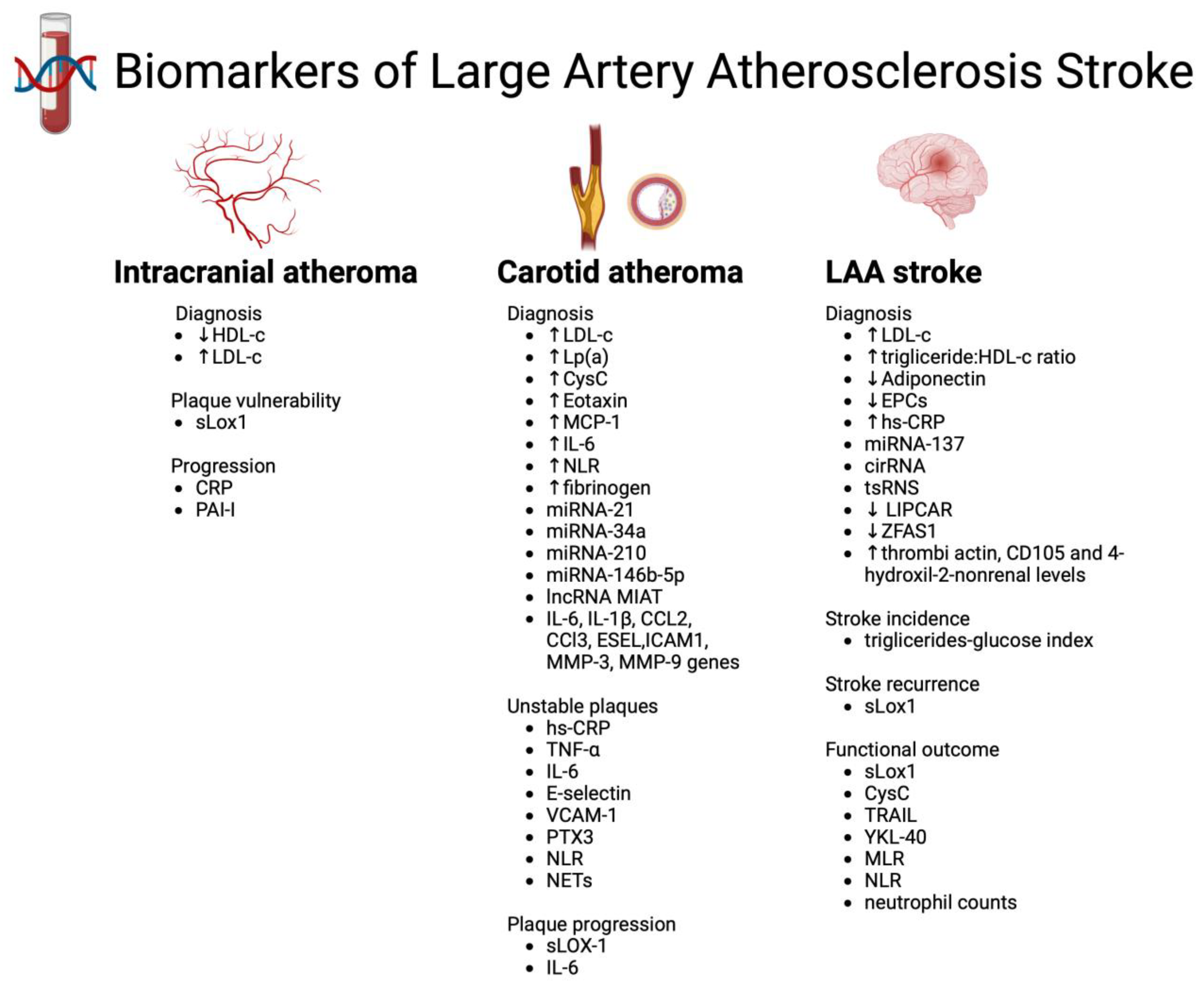
Intracranial and extracranial large-artery atherosclerosis (LAA) are a main cause of ischemic stroke. Biomarkers may aid in the diagnosis of LAA and help to stratify patients’ risk of stroke. We performed a narrative review of the literature, mainly published in the last five years, with the aim of identifying biomarkers associated either with intracranial or extracranial LAA in humans. Several potential biomarkers of LAA, mainly related to lipidic pathways and inflammation, have been studied. Diagnostic biomarkers of LAA were evaluated by measuring biomarkers levels in patients with LAA stroke and other stroke etiologies. Some biomarkers were associated with the functional prognosis of LAA stroke patients. Increased levels of IL-6 and sLOX-1 were associated with a risk of progression of carotid atherosclerotic disease. Findings support the notion that the immune system plays a central role in the pathogenesis of LAA. Overall, in most studies, results were not externally validated. In the future, biomarkers could be useful for the selection of patients for clinical trials. To adopt these biomarkers in clinical practice, we will need robust multicentric studies proving their reproducibility and a clear practical applicability for their use.
Keywords: atherosclerosis; stroke; carotid; stenosis; biomarker; plaque; inflammation; IL-6; metalloproteinases; lipids atherosclerosis; stroke; carotid; stenosis; biomarker; plaque; inflammation; IL-6; metalloproteinases; lipids