This is an early access version, the complete PDF, HTML, and XML versions will be available soon.
Review

Proteoglycans as Molecular Regulators of Bone Metastasis: Extracellular Matrix Remodeling, Tumor–Bone Crosstalk, Dormancy, and Therapeutic Opportunities


by
Zoila Mora Guzmán
1,2,†,
Ibzan Jahzeel Salvador Ibarra
3,†,
Patricia Juárez
4,
Anahí Jobeth Borrás Enríquez
5,
Edmar de Jésús Díaz García
2,
Hector Alejandro Cabrera-Fuentes
6,7,*,‡ and
María Teresa Hernández-Huerta
1,2,*,‡
1
Secretaría de Ciencia, Humanidades, Tecnología e Innovación (SECIHTI), Facultad de Medicina y Cirugía, Universidad Autónoma “Benito Juárez” de Oaxaca, Oaxaca 68020, Mexico
2
Centro de Investigación Facultad de Medicina UNAM-UABJO, Facultad de Medicina y Cirugía, Universidad Autónoma “Benito Juárez” de Oaxaca, Oaxaca 68020, Mexico
3
Instituto Mexicano del Seguro Social, Hospital General de Zona con Medicina Familiar No. 18, Torreón 27220, Mexico
4
Biomedical Innovation Department, Center for Scientific Research and Higher Education at Ensenada, Ensenada 22860, Mexico
5
División de Estudios de Posgrado e Investigación, Tecnológico Nacional de México/Instituto Tecnológico de Tuxtla Gutiérrez, Tuxtla Gutiérrez 29050, Mexico
6
R&D Group, Vice Presidency for Scientific Research and Innovation, Imam Abdulrahman Bin Faisal University, P.O. Box 1982, Dammam 31441, Saudi Arabia
7
División de Estudios de Posgrado e Investigación, Tecnológico Nacional de México/Instituto Tecnológico de Tijuana, Tijuana 22414, Mexico
*
Authors to whom correspondence should be addressed.
These authors contributed equally to this work as co-first authors.
These authors also contributed equally to this work as senior authors
Biomolecules 2026, 16(7), 1039; https://doi.org/10.3390/biom16071039
Submission received: 7 June 2026 / Revised: 10 July 2026 / Accepted: 14 July 2026 / Published: 16 July 2026

Abstract

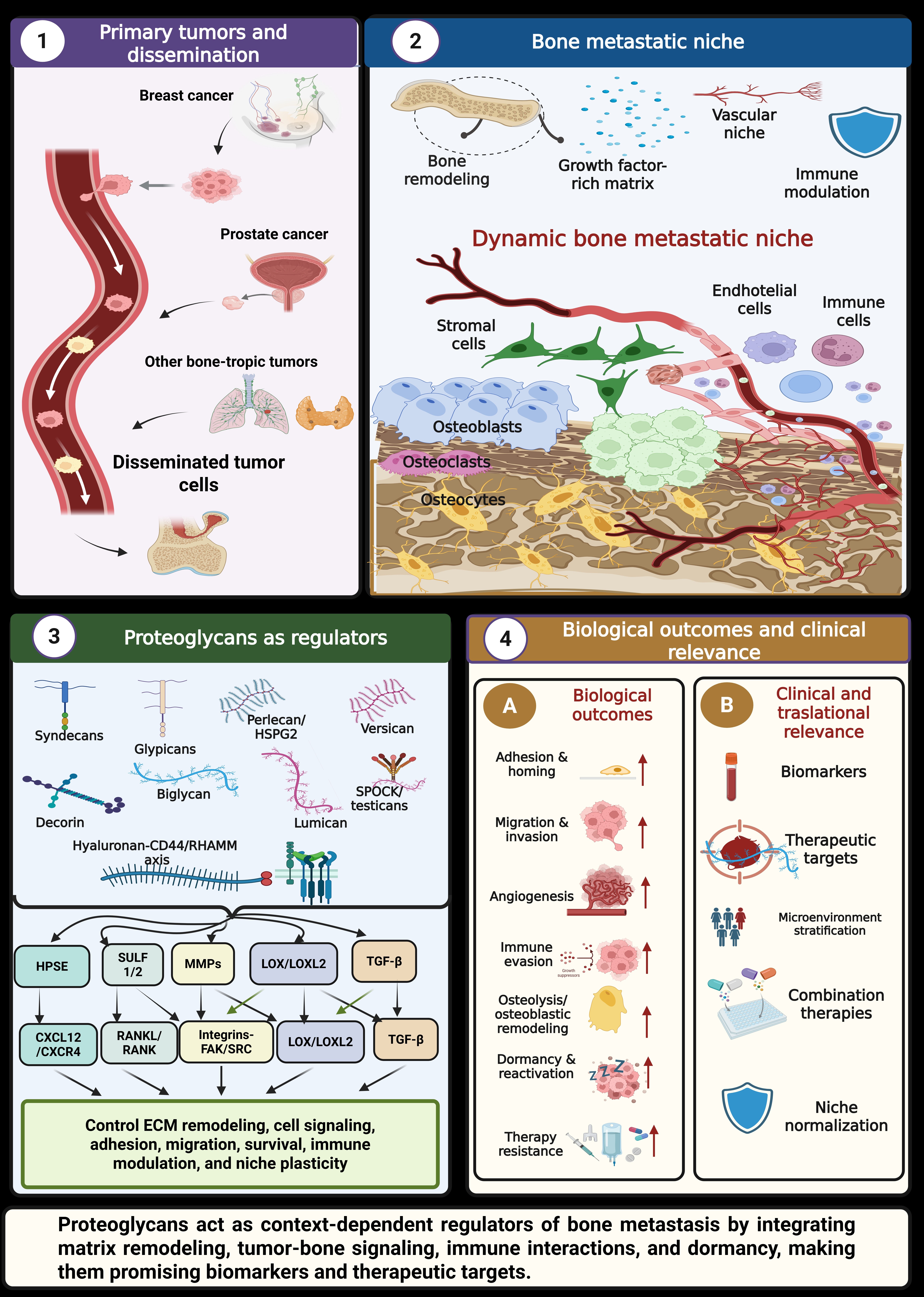
Background: Bone metastasis is a frequent and debilitating complication of advanced cancer, particularly in breast and prostate cancer, and is driven by complex interactions among tumor cells, bone-resident cells, immune populations, vascular components, and the extracellular matrix. Within this specialized microenvironment, proteoglycans have emerged as key molecular regulators of tumor–bone crosstalk, matrix remodeling, metastatic niche formation, dormancy, and therapeutic resistance. Methods: We conducted a narrative review using targeted searches of PubMed and Google Scholar for studies published through 31 May 2026. Search terms included combinations of proteoglycan- and glycosaminoglycan-related concepts, including “proteoglycans,” “glycosaminoglycans,” “heparan sulfate proteoglycans,” “hyaluronan,” “heparanase,” “syndecans,” “glypicans,” “perlecan/HSPG2,” “versican,” and “decorin,” with disease- and process-related terms such as “bone metastasis,” “extracellular matrix,” “tumor–bone crosstalk,” “breast cancer,” “prostate cancer,” “metastatic niche,” “osteolytic metastasis,” “osteoblastic metastasis,” “dormancy,” “reactivation,” “immune regulation,” and “therapy resistance.” Original studies, reviews, and translational reports were selected according to their relevance to cell-surface, pericellular, and extracellular proteoglycans in bone metastatic progression. Results: Proteoglycans and associated GAG/ECM axes are implicated in multiple processes involved in skeletal metastasis, including growth factor availability, extracellular matrix organization, osteolytic and osteoblastic niche formation, angiogenesis, immune evasion, metastatic dormancy, reactivation, and therapy resistance. These functions are highly context-dependent and are influenced by proteoglycan localization, core protein structure, glycosaminoglycan composition, sulfation patterns, proteolytic processing, and cellular source. Conclusions: Proteoglycans represent critical molecular nodes in the bone metastatic microenvironment and hold potential as biomarkers, therapeutic targets, and tools for stratifying metastatic niche heterogeneity. Their clinical translation will require validation in human bone metastasis samples, improved models that reproduce the mineralized and immune-rich bone niche, and a clearer distinction between causal mechanisms and correlative associations. Future studies should integrate matrisome profiling, spatial proteomics, single-cell and spatial transcriptomics, glycosaminoglycan omics, degradomics, and three-dimensional bone niche models to define actionable proteoglycan-dependent mechanisms and improve therapeutic targeting of metastatic bone disease.
Keywords: proteoglycans; bone metastasis; extracellular matrix; breast cancer; prostate cancer; perlecan; versican; decorin; hyaluronan; metastatic niche proteoglycans; bone metastasis; extracellular matrix; breast cancer; prostate cancer; perlecan; versican; decorin; hyaluronan; metastatic niche
Graphical Abstract