Correction: Bähr et al. Repurposing Nitazoxanide for Potential Treatment of Rare Disease Lymphangioleiomyomatosis. Biomolecules 2024, 14, 1236

 , , , and
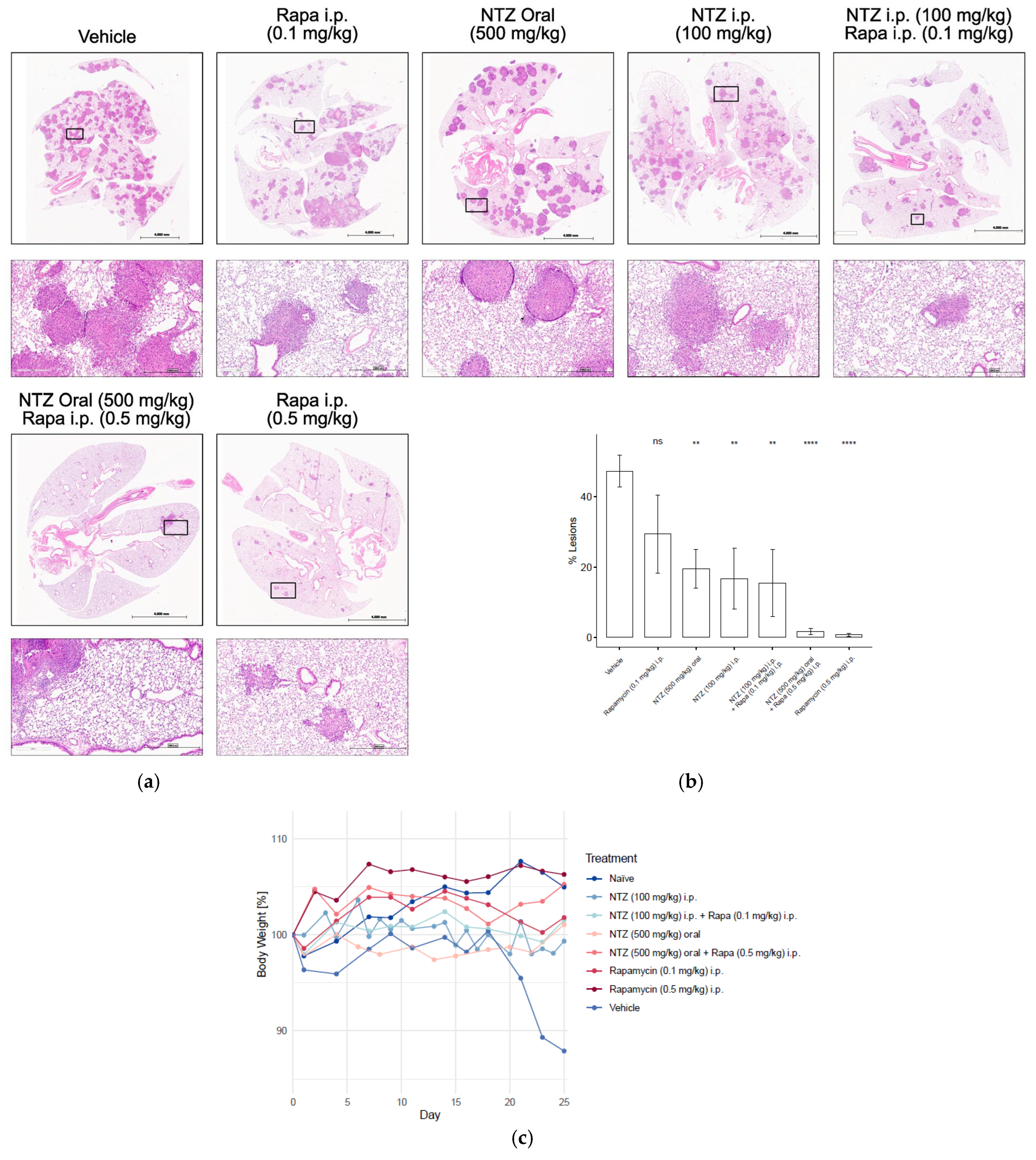
 - NTZ Oral (500 mg/kg): The correct images for this condition were present in the original dataset but had been placed incorrectly. In the published figure, these images (both whole lung and magnified view) were mistakenly used for the condition NTZ i.p. (100 mg/kg) + Rapa i.p. (0.1 mg/kg). This has now been corrected.
- NTZ i.p. (100 mg/kg) + Rapa i.p. (0.1 mg/kg): As a result of the misassignment described above, the correct images for this condition were not properly represented in the original publication. The appropriate whole lung image was absent, and the magnified image had been incorrectly assigned to NTZ Oral (500 mg/kg). Both images have now been replaced with the correct ones.
- NTZ i.p. (100 mg/kg) and NTZ Oral (500 mg/kg) + Rapa i.p. (0.5 mg/kg): These two conditions were mislabeled in the original figure (titles interchanged). The corresponding whole lung and magnified images were otherwise correctly matched to their respective conditions. The labeling has now been corrected.

Reference
- Bähr, S.; Rue, R.W.; Smith, C.J.; Evans, J.F.; Köster, H.; Krymskaya, V.P.; Pleimes, D. Repurposing Nitazoxanide for Potential Treatment of Rare Disease Lymphangioleiomyomatosis. Biomolecules 2024, 14, 1236. [Google Scholar] [CrossRef] [Scilit]
Disclaimer/Publisher’s Note: The statements, opinions and data contained in all publications are solely those of the individual author(s) and contributor(s) and not of MDPI and/or the editor(s). MDPI and/or the editor(s) disclaim responsibility for any injury to people or property resulting from any ideas, methods, instructions or products referred to in the content. |
© 2026 by the authors. Licensee MDPI, Basel, Switzerland. This article is an open access article distributed under the terms and conditions of the Creative Commons Attribution (CC BY) license.
Share and Cite
Bähr, S.; Rue, R.W.; Smith, C.J.; Evans, J.F.; Köster, H.; Krymskaya, V.P.; Pleimes, D. Correction: Bähr et al. Repurposing Nitazoxanide for Potential Treatment of Rare Disease Lymphangioleiomyomatosis. Biomolecules 2024, 14, 1236. Biomolecules 2026, 16, 1005. https://doi.org/10.3390/biom16071005
Bähr S, Rue RW, Smith CJ, Evans JF, Köster H, Krymskaya VP, Pleimes D. Correction: Bähr et al. Repurposing Nitazoxanide for Potential Treatment of Rare Disease Lymphangioleiomyomatosis. Biomolecules 2024, 14, 1236. Biomolecules. 2026; 16(7):1005. https://doi.org/10.3390/biom16071005
Chicago/Turabian StyleBähr, Stella, Ryan W. Rue, Carly J. Smith, Jillian F. Evans, Hubert Köster, Vera P. Krymskaya, and Dirk Pleimes. 2026. "Correction: Bähr et al. Repurposing Nitazoxanide for Potential Treatment of Rare Disease Lymphangioleiomyomatosis. Biomolecules 2024, 14, 1236" Biomolecules 16, no. 7: 1005. https://doi.org/10.3390/biom16071005
APA StyleBähr, S., Rue, R. W., Smith, C. J., Evans, J. F., Köster, H., Krymskaya, V. P., & Pleimes, D. (2026). Correction: Bähr et al. Repurposing Nitazoxanide for Potential Treatment of Rare Disease Lymphangioleiomyomatosis. Biomolecules 2024, 14, 1236. Biomolecules, 16(7), 1005. https://doi.org/10.3390/biom16071005