SGLT2 Inhibitors in Hypertrophic Cardiomyopathy: Emerging Evidence and Putative Mechanisms

Abstract
1. Introduction
2. Oxidative Stress in Hypertrophic Cardiomyopathy
2.1. ROS-Induced Alteration in Energy Metabolism
2.2. ROS-Mediated Pathways in Hypertrophy Development
2.3. ROS-Induced Alteration in the Protein Quality Control System
2.4. Other Pathways Associated with a Disturbed Redox State in HCM

3. Relationship Between Microvascular Dysfunction and Redox Imbalance in HCM
4. Therapeutic Strategies in HCM
5. Oxidative Stress as a Therapeutic Target in Hypertrophic Cardiomyopathy
6. Mechanisms of Action and Side Effects of SGLT2 Inhibitors
7. Cardiac SGLT2 Expression
8. Molecular Mechanisms of SGLT2 Inhibition in the Heart
- (i)
- They modulate nutrient transport by inhibiting glucose transporter type 1 (GLUT1). In HF, glucose metabolism is dysregulated due to a shift from GLUT4 to GLUT1 transport, leading to excessive glycolysis, the accumulation of glucose-6-phosphate, and adverse O-GlcNAcylation of proteins [67]. SGLT2 inhibitors counteract this by downregulating GLUT1, enhancing GLUT4 expression, and improving glucose oxidation [68].
- (ii)
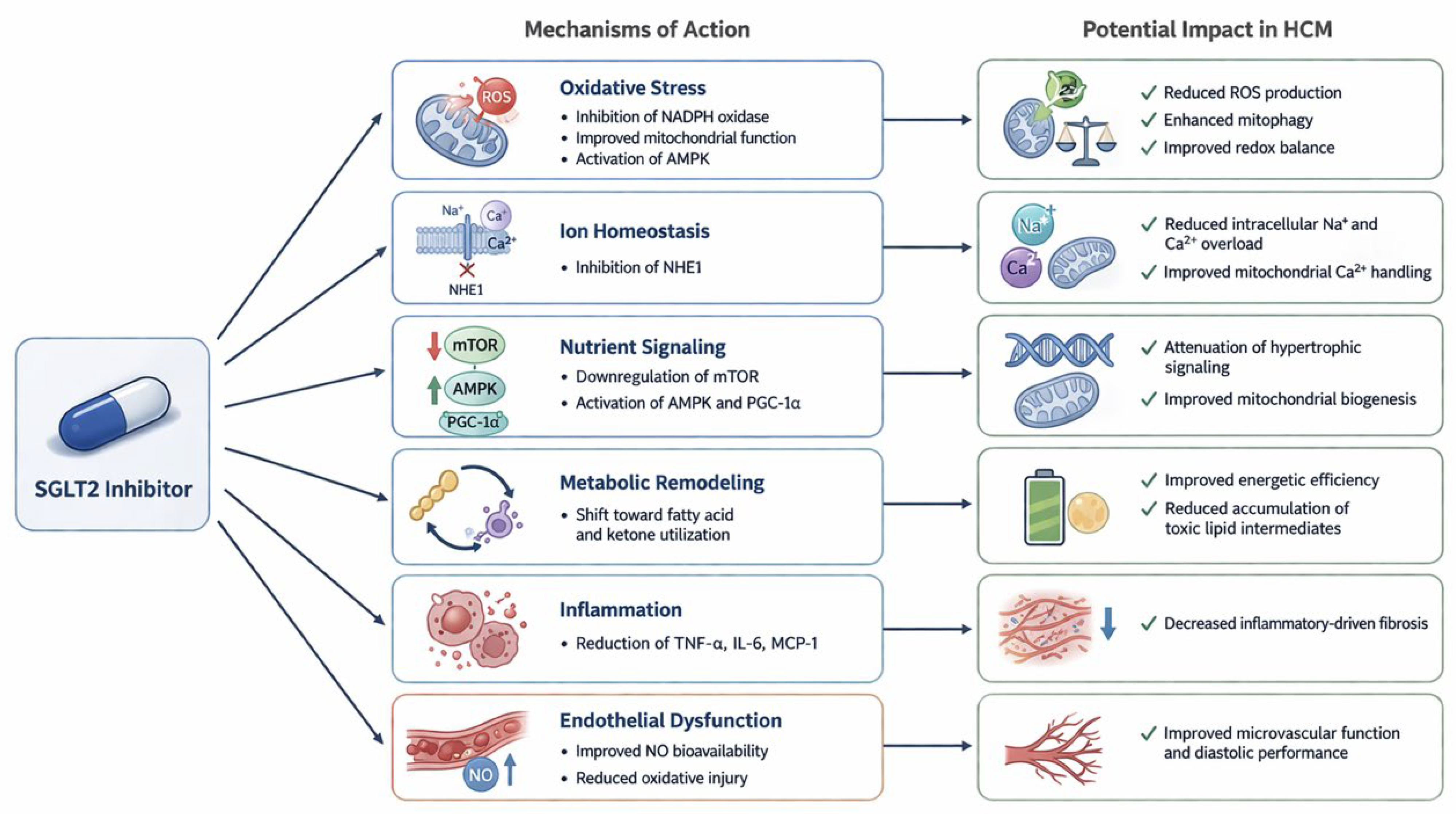
- They modulate Na+ homeostasis by inhibiting sodium–hydrogen exchanger 3 (NHE3) [69] on the cardiomyocyte plasma membrane. This effect results in decreased cytosolic Na+ and Ca+ concentrations and increased fatty acid oxidation and mitochondrial health, which facilitate the mitochondrial clearance of toxic byproducts and the reduction in ROS production and inflammation [70,71,72,73].
- (iii)
- They stimulate nutrient-deprivation signaling, reversing mTOR activation and improving oxidative phosphorylation and ATP synthesis [74].
- (iv)
- They enhance long-chain fatty acid (LCFA) oxidation by upregulating CD36, fatty-acid-binding protein type 4 (FABP4), carnitine palmitoyltransferase (CPT)-1, and peroxisome proliferator-activated receptor alpha (PPARα) signaling while decreasing mTOR activity and increasing AMPK and peroxisome proliferator-activated receptor-γ coactivator 1-alpha (PGC1α) levels [75]. This shift reduces the accumulation of cytotoxic lipids like ceramide and diacylglycerol [76]. They also reduce the intracellular accumulation of branched-chain amino acids by increasing their degradation, thereby downregulating mTOR and improving cell viability [77].
- (v)
- They increase the delivery of alternative fuels (ketone bodies and potentially short-chain fatty acids), which may act as signaling molecules rather than energy substrates. Ketonaemia induced by these drugs reduces inflammation, even without contributing significantly to ATP production [78].
9. Potential Benefits of SGLT2 Inhibitors in Hypertrophic Cardiomyopathy
- (i)
- Inhibition of the sodium–hydrogen exchanger on the myocyte membrane. Ex vivo studies on isolated myocardial cells showed that SGLT2i inhibited sodium–hydrogen exchanger 1 (NHE)-1 on the myocyte plasma membrane, thereby lowering intracellular sodium and calcium levels [32,53,54]. In patients with HF, the activation of NHE-1 in the plasma membrane and the potential SGLT2 upregulation induces intracellular sodium and calcium accumulation in cardiomyocytes [55] which, in turn, enhances mitochondrial dysfunction and oxidative stress via ROS generation and activates AMPK-dependent transforming growth factor (TGF)-β signaling in cardiac fibroblasts [56,57,58]. Because altered calcium pathways, mitochondrial impairment, ROS generation and fibrosis are implicated in the genesis and progression of HCM [59,60], the impact of SGLT2 inhibitions on intracellular sodium and calcium homeostasis might have potential benefits on the evolution of the disease [61].
- (ii)
- Modulation of metabolism. SGLT2i modulate cardiac energy metabolism by stimulating adipose tissue lipolysis and pancreatic glucagon release and suppressing insulin. These modifications increase circulating ketone concentrations and facilitate a metabolic shift from glucose oxidation to ketone body utilization as the predominant myocardial fuel source [62,63,84], which might contribute to counteract the altered energetics observed in HCM. By performing phosphorus magnetic resonance spectroscopy at rest and during peak dobutamine stress in 72 symptomatic patients with chronic HF receiving 12-week empagliflozin treatment, Hundertmark et al. did not find any significant change in the cardiac phosphocreatine:ATP ratio (PCr/ATP) [64]. Despite these results seeming to question the impact of gliflozins on myocardial energetics, the EMPA vision trial was plagued by several limitations, including its monocentric nature, the small recruited population and the relatively short treatment duration. Moreover, empagliflozin treatment was not associated with a significant improvement in functional capacity by the cardiopulmonary exercise test and natriuretic peptide reduction observed in previous clinical trials [42,44,52,65], suggesting that further studies would be necessary to clarify the impact of SGLT2i on myocardial metabolism.
- (iii)
- Modulation of oxidative stress. As seen previously, oxidative stress has a pivotal role in the progression of HCM. SGLT2i might positively impact mitochondrial function, thereby improving myocardial energetics and reducing ROS production. On the other hand, the systemic and hemodynamic effects of SGLT2 inhibitors include the reduction in epicardial-adipose-tissue-related inflammation [66], the modifications of apolipoprotein profiles, and the reduction in circulating advanced glycosylated end products (AGEs), which are well-known sources of oxidative stress in myocardial cells [67]. Also, activation of the nutrient-deprivation pathway promoted by SGLT2i, was found to activate the AMPK/sirtuin (SIRT)/PGC-1α pathway [66,68,69,70], improving mitochondrial dysfunction, thereby attenuating oxidative stress, endoplasmic reticulum (ER) stress, inflammation and apoptosis after myocardial infarction in diabetic hearts [71].
- (iv)
10. Gaps in Knowledge and Perspectives
11. Conclusions
Author Contributions
Funding
Institutional Review Board Statement
Informed Consent Statement
Data Availability Statement
Acknowledgments
Conflicts of Interest
Abbreviations
| ADP | Adenosine diphosphate |
| AGEs | Advanced glycosylated end products |
| Akt | Protein kinase B |
| AMP | Adenosine monophosphate |
| AMPK | AMP-activated protein kinase |
| ATP | Adenosine triphosphate |
| AT1R | Calcium/calmodulin-dependent protein kinase II |
| cGMP | 3′,5′-cyclic guanosine monophosphate |
| CPT1 | Carnitine palmitoyltransferase 1 |
| eNOS | Endothelial nitric oxide synthase |
| ERK 1 | Extracellular signal-regulated kinase 1 |
| ERK 2 | Extracellular signal-regulated kinase 2 |
| FABP4 | Fatty Acid-Binding Protein type 4 |
| FOXO | Forkhead Box O |
| GEO | Gene Expression Omnibus |
| GLUT1 | Glucose transporter type 1 |
| GLUT4 | Glucose transporter type 4 |
| HCM | Hypertrophic cardiomyopathy |
| HDAC4 | Histone deacetylase 4 |
| HF | Heart failure |
| 4-HNE | 4-Hydroxy-2-nonenal |
| H2O2 | Hydrogen peroxide |
| HSP | Heart shock protein |
| JNK | Jun N-terminal Kinase |
| ICAM-1 | Intercellular adhesion molecules-1 |
| IL-6 | Interleukin-6 |
| IL-18 | Interleukin-18 |
| LCFA | Mitogen-activated protein kinase |
| MYBPC3 | Myosin-binding protein |
| MYL3 | Myosin light chain 3 |
| MYH7 | Beta-myosin heavy chain |
| mTOR | Mammalian target of rapamycin |
| mTORC-1 | Mammalian target of rapamycin complex 1 |
| NADH | Nicotinamide adenine dinucleotide |
| NADPH | Nicotinamide adenine dinucleotide phosphate |
| NADPH oxidase | Nicotinamide adenine dinucleotide phosphate oxidase |
| NFAT | Nuclear factor of activated T cells |
| NF-κB | Nuclear factor-κB |
| NHE3 | Sodium/Hydrogen Exchanger 3 |
| NO | Nitric oxide |
| O2•- | Superoxide anion radical |
| OH• | Hydroxyl radical |
| PCr | Phosphocreatine |
| PGC1α | Peroxisome Proliferator-activated Receptor-γ Coactivator 1-alpha |
| PKC | Protein kinase G |
| PPARα | Peroxisome proliferator-activated receptor alpha |
| PQS | Protein quality control |
| ROS | Reactive oxygen species |
| SIRT | Sirtuin |
| sGC | Soluble guanylyl cyclase |
| SGLT1 | Sodium-glucose transporter 1 |
| SGLT2 | Sodium–Glucose transporter 2 |
| SGLT2i | Sodium–Glucose transporter 2 inhibitors |
| TLR-2 | Toll-like receptor-2 |
| TNF-α | Tumor necrosis factor-α |
| TNNI3 | Cardiac troponin I |
| TNNT2 | Cardiac troponin T |
| TPM1 | Tropomyosin alpha-1 chain |
| VCAM-1 | Vascular cell adhesion molecule-1 |
References
- Maron, B.J.; Desai, M.Y.; Nishimura, R.A.; Spirito, P.; Rakowski, H.; Towbin, J.A.; Rowin, E.J.; Maron, M.S.; Sherrid, M.V. Diagnosis and Evaluation of Hypertrophic Cardiomyopathy. J. Am. Coll. Cardiol. 2022, 79, 372–389. [Google Scholar] [CrossRef]
- 2014 ESC Guidelines on Diagnosis and Management of Hypertrophic Cardiomyopathy: The Task Force for the Diagnosis and Management of Hypertrophic Cardiomyopathy of the European Society of Cardiology (ESC). Eur. Heart J. 2014, 35, 2733–2779. [CrossRef]
- Hu, R.-G.; Sheng, J.; Qi, X.; Xu, Z.; Takahashi, T.T.; Varshavsky, A. The N-End Rule Pathway as a Nitric Oxide Sensor Controlling the Levels of Multiple Regulators. Nature 2005, 437, 981–986. [Google Scholar] [CrossRef]
- Hassoun, R.; Budde, H.; Zhazykbayeva, S.; Herwig, M.; Sieme, M.; Delalat, S.; Mostafi, N.; Gömöri, K.; Tangos, M.; Jarkas, M.; et al. Stress Activated Signalling Impaired Protein Quality Control Pathways in Human Hypertrophic Cardiomyopathy. Int. J. Cardiol. 2021, 344, 160–169. [Google Scholar] [CrossRef] [PubMed]
- Zhuo, J.; Geng, H.; Wu, X.; Fan, M.; Sheng, H.; Yao, J. AKT-mTOR Signaling-Mediated Rescue of PRKAG2 R302Q Mutant-Induced Familial Hypertrophic Cardiomyopathy by Treatment with β-Adrenergic Receptor (β-AR) Blocker Metoprolol. Cardiovasc. Diagn. Ther. 2022, 12, 360–369. [Google Scholar] [CrossRef]
- Anker, S.D.; Butler, J.; Filippatos, G.; Ferreira, J.P.; Bocchi, E.; Böhm, M.; Brunner–La Rocca, H.-P.; Choi, D.-J.; Chopra, V.; Chuquiure-Valenzuela, E.; et al. Empagliflozin in Heart Failure with a Preserved Ejection Fraction. N. Engl. J. Med. 2021, 385, 1451–1461. [Google Scholar] [CrossRef] [PubMed]
- McMurray, J.J.V.; Solomon, S.D.; Inzucchi, S.E.; Køber, L.; Kosiborod, M.N.; Martinez, F.A.; Ponikowski, P.; Sabatine, M.S.; Anand, I.S.; Bělohlávek, J.; et al. Dapagliflozin in Patients with Heart Failure and Reduced Ejection Fraction. N. Engl. J. Med. 2019, 381, 1995–2008. [Google Scholar] [CrossRef]
- Vaduganathan, M.; Docherty, K.F.; Claggett, B.L.; Jhund, P.S.; De Boer, R.A.; Hernandez, A.F.; Inzucchi, S.E.; Kosiborod, M.N.; Lam, C.S.P.; Martinez, F.; et al. SGLT2 Inhibitors in Patients with Heart Failure: A Comprehensive Meta-Analysis of Five Randomised Controlled Trials. Lancet 2022, 400, 757–767. [Google Scholar] [CrossRef] [PubMed]
- Cannarella, R.; Rubulotta, M.; Cannarella, V.; La Vignera, S.; Calogero, A.E. A Holistic View of SGLT2 Inhibitors: From Cardio-Renal Management to Cognitive and Andrological Aspects. Eur. J. Intern. Med. 2025, 138, 6–28. [Google Scholar] [CrossRef]
- Bertero, E.; Maack, C. Calcium Signaling and Reactive Oxygen Species in Mitochondria. Circ. Res. 2018, 122, 1460–1478. [Google Scholar] [CrossRef]
- Sequeira, V.; Waddingham, M.T.; Tsuchimochi, H.; Maack, C.; Pearson, J.T. Mechano-Energetic Uncoupling in Hypertrophic Cardiomyopathy: Pathophysiological Mechanisms and Therapeutic Opportunities. J. Mol. Cell. Cardiol. Plus 2023, 4, 100036. [Google Scholar] [CrossRef]
- Senthil, V.; Chen, S.N.; Tsybouleva, N.; Halder, T.; Nagueh, S.F.; Willerson, J.T.; Roberts, R.; Marian, A.J. Prevention of Cardiac Hypertrophy by Atorvastatin in a Transgenic Rabbit Model of Human Hypertrophic Cardiomyopathy. Circ. Res. 2005, 97, 285–292. [Google Scholar] [CrossRef]
- Christiansen, L.B.; Dela, F.; Koch, J.; Hansen, C.N.; Leifsson, P.S.; Yokota, T. Impaired Cardiac Mitochondrial Oxidative Phosphorylation and Enhanced Mitochondrial Oxidative Stress in Feline Hypertrophic Cardiomyopathy. Am. J. Physiol. Heart Circ. Physiol. 2015, 308, H1237–H1247. [Google Scholar] [CrossRef] [PubMed]
- Gilda, J.E.; Lai, X.; Witzmann, F.A.; Gomes, A.V. Delineation of Molecular Pathways Involved in Cardiomyopathies Caused by Troponin T Mutations. Mol. Cell. Proteom. MCP 2016, 15, 1962–1981. [Google Scholar] [CrossRef]
- Wilder, T.; Ryba, D.M.; Wieczorek, D.F.; Wolska, B.M.; Solaro, R.J. N-Acetylcysteine Reverses Diastolic Dysfunction and Hypertrophy in Familial Hypertrophic Cardiomyopathy. Am. J. Physiol. Heart Circ. Physiol. 2015, 309, H1720–H1730. [Google Scholar] [CrossRef] [PubMed]
- Lynch, T.L.; Sivaguru, M.; Velayutham, M.; Cardounel, A.J.; Michels, M.; Barefield, D.; Govindan, S.; dos Remedios, C.; van der Velden, J.; Sadayappan, S. Oxidative Stress in Dilated Cardiomyopathy Caused by MYBPC3 Mutation. Oxid. Med. Cell. Longev. 2015, 2015, 424751. [Google Scholar] [CrossRef] [PubMed]
- Koda, M.; Takemura, G.; Okada, H.; Kanoh, M.; Maruyama, R.; Esaki, M.; Li, Y.; Miyata, S.; Kanamori, H.; Li, L.; et al. Nuclear Hypertrophy Reflects Increased Biosynthetic Activities in Myocytes of Human Hypertrophic Hearts. Circ. J. Off. J. Jpn. Circ. Soc. 2006, 70, 710–718. [Google Scholar] [CrossRef]
- Zhang, S.; Li, T.; Sun, S.; Jiang, Y.; Sun, Y.; Meng, Y. The Key Role and Mechanism of Oxidative Stress in Hypertrophic Cardiomyopathy: A Systematic Exploration Based on Multi-Omics Analysis and Experimental Validation. Antioxidants 2025, 14, 557. [Google Scholar] [CrossRef]
- Xu, A.; Weissman, D.; Ermer, K.J.; Bertero, E.; Federspiel, J.M.; Stadler, F.; Grünler, E.; Tangos, M.; Zervou, S.; Waddingham, M.T.; et al. Hypercontractility and Oxidative Stress Drive Creatine Kinase Dysfunction in Hypertrophic Cardiomyopathy. Circulation 2025, 152, 1705–1727. [Google Scholar] [CrossRef]
- Wijnker, P.J.M.; Dinani, R.; van der Laan, N.C.; Algül, S.; Knollmann, B.C.; Verkerk, A.O.; Remme, C.A.; Zuurbier, C.J.; Kuster, D.W.D.; van der Velden, J. Hypertrophic Cardiomyopathy Dysfunction Mimicked in Human Engineered Heart Tissue and Improved by Sodium-Glucose Cotransporter 2 Inhibitors. Cardiovasc. Res. 2024, 120, 301–317. [Google Scholar] [CrossRef] [PubMed]
- Dai, D.-F.; Chen, T.; Szeto, H.; Nieves-Cintrón, M.; Kutyavin, V.; Santana, L.F.; Rabinovitch, P.S. Mitochondrial Targeted Antioxidant Peptide Ameliorates Hypertensive Cardiomyopathy. J. Am. Coll. Cardiol. 2011, 58, 73–82. [Google Scholar] [CrossRef] [PubMed]
- Ranjbarvaziri, S.; Kooiker, K.B.; Ellenberger, M.; Fajardo, G.; Zhao, M.; Vander Roest, A.S.; Woldeyes, R.A.; Koyano, T.T.; Fong, R.; Ma, N.; et al. Altered Cardiac Energetics and Mitochondrial Dysfunction in Hypertrophic Cardiomyopathy. Circulation 2021, 144, 1714–1731. [Google Scholar] [CrossRef] [PubMed]
- Khoo, M.S.C.; Li, J.; Singh, M.V.; Yang, Y.; Kannankeril, P.; Wu, Y.; Grueter, C.E.; Guan, X.; Oddis, C.V.; Zhang, R.; et al. Death, Cardiac Dysfunction, and Arrhythmias Are Increased by Calmodulin Kinase II in Calcineurin Cardiomyopathy. Circulation 2006, 114, 1352–1359. [Google Scholar] [CrossRef]
- Helms, A.S.; Alvarado, F.J.; Yob, J.; Tang, V.T.; Pagani, F.; Russell, M.W.; Valdivia, H.H.; Day, S.M. Genotype-Dependent and -Independent Calcium Signaling Dysregulation in Human Hypertrophic Cardiomyopathy. Circulation 2016, 134, 1738–1748. [Google Scholar] [CrossRef]
- Wagner, S.; Ruff, H.M.; Weber, S.L.; Bellmann, S.; Sowa, T.; Schulte, T.; Anderson, M.E.; Grandi, E.; Bers, D.M.; Backs, J.; et al. Reactive Oxygen Species–Activated Ca/Calmodulin Kinase IIδ Is Required for Late INa Augmentation Leading to Cellular Na and Ca Overload. Circ. Res. 2011, 108, 555–565. [Google Scholar] [CrossRef]
- Brown, D.I.; Griendling, K.K. Regulation of Signal Transduction by Reactive Oxygen Species in the Cardiovascular System. Circ. Res. 2015, 116, 531–549. [Google Scholar] [CrossRef]
- Wang, L.; Li, L.; Zhao, D.; Yuan, H.; Zhang, H.; Chen, J.; Pang, D.; Lu, Y.; Ouyang, H. MYH7 R453C Induced Cardiac Remodelling via Activating TGF-β/Smad2/3, ERK1/2 and Nox4/ROS/NF-κB Signalling Pathways. Open Biol. 2024, 14, 230427. [Google Scholar] [CrossRef]
- Nakamura, K.; Kusano, K.F.; Matsubara, H.; Nakamura, Y.; Miura, A.; Nishii, N.; Banba, K.; Nagase, S.; Miyaji, K.; Morita, H.; et al. Relationship Between Oxidative Stress and Systolic Dysfunction in Patients with Hypertrophic Cardiomyopathy. J. Card. Fail. 2005, 11, 117–123. [Google Scholar] [CrossRef]
- Calamaras, T.D.; Lee, C.; Lan, F.; Ido, Y.; Siwik, D.A.; Colucci, W.S. The Lipid Peroxidation Product 4-Hydroxy-Trans-2-Nonenal Causes Protein Synthesis in Cardiac Myocytes via Activated mTORC1–p70S6K–RPS6 Signaling. Free Radic. Biol. Med. 2015, 82, 137–146. [Google Scholar] [CrossRef]
- Tskhovrebova, L.; Trinick, J. Roles of Titin in the Structure and Elasticity of the Sarcomere. J. Biomed. Biotechnol. 2010, 2010, 612482. [Google Scholar] [CrossRef]
- Balasubramanian, S.; Johnston, R.K.; Moschella, P.C.; Mani, S.K.; Tuxworth, W.J.; Kuppuswamy, D. mTOR in Growth and Protection of Hypertrophying Myocardium. Cardiovasc. Hematol. Agents Med. Chem. 2009, 7, 52–63. [Google Scholar] [CrossRef]
- Bu, H.; Ding, Y.; Li, J.; Zhu, P.; Shih, Y.-H.; Wang, M.; Zhang, Y.; Lin, X.; Xu, X. Inhibition of mTOR or MAPK Ameliorates Vmhcl/Myh7 Cardiomyopathy in Zebrafish. JCI Insight 2021, 6, e154215. [Google Scholar] [CrossRef]
- Kaplan, J.L.; Rivas, V.N.; Walker, A.L.; Grubb, L.; Farrell, A.; Fitzgerald, S.; Kennedy, S.; Jauregui, C.E.; Crofton, A.E.; McLaughlin, C.; et al. Delayed-Release Rapamycin Halts Progression of Left Ventricular Hypertrophy in Subclinical Feline Hypertrophic Cardiomyopathy: Results of the RAPACAT Trial. J. Am. Vet. Med. Assoc. 2023, 261, 1628–1637. [Google Scholar] [CrossRef] [PubMed]
- De Gaspari, M.; Basso, C.; Perazzolo Marra, M.; Elia, S.; Bueno Marinas, M.; Angelini, A.; Thiene, G.; Rizzo, S. Small Vessel Disease: Another Component of the Hypertrophic Cardiomyopathy Phenotype Not Necessarily Associated with Fibrosis. J. Clin. Med. 2021, 10, 575. [Google Scholar] [CrossRef] [PubMed]
- Pei, H.; Yang, Y.; Zhao, H.; Li, X.; Yang, D.; Li, D.; Yang, Y. The Role of Mitochondrial Functional Proteins in ROS Production in Ischemic Heart Diseases. Oxid. Med. Cell. Longev. 2016, 2016, 5470457. [Google Scholar] [CrossRef]
- Kim, E.K.; Lee, S.-C.; Chang, S.-A.; Jang, S.-Y.; Kim, S.M.; Park, S.-J.; Choi, J.-O.; Park, S.W.; Jeon, E.-S.; Choe, Y.H. Prevalence and Clinical Significance of Cardiovascular Magnetic Resonance Adenosine Stress-Induced Myocardial Perfusion Defect in Hypertrophic Cardiomyopathy. J. Cardiovasc. Magn. Reson. Off. J. Soc. Cardiovasc. Magn. Reson. 2020, 22, 30. [Google Scholar] [CrossRef] [PubMed]
- Fernlund, E.; Schlegel, T.T.; Platonov, P.G.; Carlson, J.; Carlsson, M.; Liuba, P. Peripheral Microvascular Function Is Altered in Young Individuals at Risk for Hypertrophic Cardiomyopathy and Correlates with Myocardial Diastolic Function. Am. J. Physiol.-Heart Circ. Physiol. 2015, 308, H1351–H1358. [Google Scholar] [CrossRef]
- Tian, P.; Xu, L.; Zou, F.; Jia, Q.; Liu, Y.; Chen, J.; Wang, P. Endothelial-Specific Genes TMTC1, RPS6KA2, and F8 Are Downregulated in Hypertrophic Cardiomyopathy. Eur. J. Med. Res. 2025, 30, 1305. [Google Scholar] [CrossRef]
- Dimitrow, P.P.; Undas, A.; Bober, M.; Tracz, W.; Dubiel, J.S. Plasma Biomarkers of Endothelial Dysfunction in Patients with Hypertrophic Cardiomyopathy. Pharmacol. Rep. PR 2007, 59, 715–720. [Google Scholar]
- Fukai, T.; Ushio-Fukai, M. Cross-Talk between NADPH Oxidase and Mitochondria: Role in ROS Signaling and Angiogenesis. Cells 2020, 9, 1849. [Google Scholar] [CrossRef]
- Molkentin, J. Calcineurin?NFAT Signaling Regulates the Cardiac Hypertrophic Response in Coordination with the MAPKs. Cardiovasc. Res. 2004, 63, 467–475. [Google Scholar] [CrossRef]
- Arbelo, E.; Protonotarios, A.; Gimeno, J.R.; Arbustini, E.; Barriales-Villa, R.; Basso, C.; Bezzina, C.R.; Biagini, E.; Blom, N.A.; De Boer, R.A.; et al. 2023 ESC Guidelines for the Management of Cardiomyopathies. Eur. Heart J. 2023, 44, 3503–3626. [Google Scholar] [CrossRef]
- Olivotto, I.; Oreziak, A.; Barriales-Villa, R.; Abraham, T.P.; Masri, A.; Garcia-Pavia, P.; Saberi, S.; Lakdawala, N.K.; Wheeler, M.T.; Owens, A.; et al. Mavacamten for Treatment of Symptomatic Obstructive Hypertrophic Cardiomyopathy (EXPLORER-HCM): A Randomised, Double-Blind, Placebo-Controlled, Phase 3 Trial. Lancet 2020, 396, 759–769. [Google Scholar] [CrossRef] [PubMed]
- Maron, B.J.; Desai, M.Y.; Nishimura, R.A.; Spirito, P.; Rakowski, H.; Towbin, J.A.; Dearani, J.A.; Rowin, E.J.; Maron, M.S.; Sherrid, M.V. Management of Hypertrophic Cardiomyopathy: JACC State-of-the-Art Review. J. Am. Coll. Cardiol. 2022, 79, 390–414. [Google Scholar] [CrossRef] [PubMed]
- Kolijn, D.; Pabel, S.; Tian, Y.; Lódi, M.; Herwig, M.; Carrizzo, A.; Zhazykbayeva, S.; Kovács, Á.; Fülöp, G.Á.; Falcão-Pires, I.; et al. Empagliflozin Improves Endothelial and Cardiomyocyte Function in Human Heart Failure with Preserved Ejection Fraction via Reduced Pro-Inflammatory-Oxidative Pathways and Protein Kinase Gα Oxidation. Cardiovasc. Res. 2021, 117, 495–507. [Google Scholar] [CrossRef] [PubMed]
- Carlström, M.; Weitzberg, E.; Lundberg, J.O. Nitric Oxide Signaling and Regulation in the Cardiovascular System: Recent Advances. Pharmacol. Rev. 2024, 76, 1038–1062. [Google Scholar] [CrossRef]
- Marian, A.J.; Senthil, V.; Chen, S.N.; Lombardi, R. Antifibrotic Effects of Antioxidant N-Acetylcysteine in a Mouse Model of Human Hypertrophic Cardiomyopathy Mutation. J. Am. Coll. Cardiol. 2006, 47, 827–834. [Google Scholar] [CrossRef]
- Marian, A.J.; Tan, Y.; Li, L.; Chang, J.; Syrris, P.; Hessabi, M.; Rahbar, M.H.; Willerson, J.T.; Cheong, B.Y.; Liu, C.-Y.; et al. Hypertrophy Regression with N-Acetylcysteine in Hypertrophic Cardiomyopathy (HALT-HCM): A Randomized, Placebo-Controlled, Double-Blind Pilot Study. Circ. Res. 2018, 122, 1109–1118. [Google Scholar] [CrossRef]
- Rożnowska-Wójtowicz, A.; Janiec, I.; Pietrzak, R.; Szczałuba, K.; Werner, B. Rapamycin Treatment for Progressive Hypertrophic Cardiomyopathy in an Infant with Noonan Syndrome with Multiple Lentigines. Kardiol. Pol. 2025, 83, 1216–1218. [Google Scholar] [CrossRef]
- Hahn, A.; Lauriol, J.; Thul, J.; Behnke-Hall, K.; Logeswaran, T.; Schänzer, A.; Böğürcü, N.; Garvalov, B.K.; Zenker, M.; Gelb, B.D.; et al. Rapidly Progressive Hypertrophic Cardiomyopathy in an Infant with Noonan Syndrome with Multiple Lentigines: Palliative Treatment with a Rapamycin Analog. Am. J. Med. Genet. A 2015, 167, 744–751. [Google Scholar] [CrossRef] [PubMed]
- Plosker, G.L. Canagliflozin: A Review of Its Use in Patients with Type 2 Diabetes Mellitus. Drugs 2014, 74, 807–824. [Google Scholar] [CrossRef] [PubMed]
- Lytvyn, Y.; Bjornstad, P.; Udell, J.A.; Lovshin, J.A.; Cherney, D.Z.I. Sodium Glucose Cotransporter-2 Inhibition in Heart Failure: Potential Mechanisms, Clinical Applications, and Summary of Clinical Trials. Circulation 2017, 136, 1643–1658. [Google Scholar] [CrossRef] [PubMed]
- American Diabetes Association Professional Practice Committee. 9. Pharmacologic Approaches to Glycemic Treatment: Standards of Medical Care in Diabetes—2022. Diabetes Care 2022, 45, S125–S143. [Google Scholar] [CrossRef]
- Zelniker, T.A.; Wiviott, S.D.; Raz, I.; Im, K.; Goodrich, E.L.; Bonaca, M.P.; Mosenzon, O.; Kato, E.T.; Cahn, A.; Furtado, R.H.M.; et al. SGLT2 Inhibitors for Primary and Secondary Prevention of Cardiovascular and Renal Outcomes in Type 2 Diabetes: A Systematic Review and Meta-Analysis of Cardiovascular Outcome Trials. Lancet 2019, 393, 31–39. [Google Scholar] [CrossRef]
- Zannad, F.; Ferreira, J.P.; Pocock, S.J.; Anker, S.D.; Butler, J.; Filippatos, G.; Brueckmann, M.; Ofstad, A.P.; Pfarr, E.; Jamal, W.; et al. SGLT2 Inhibitors in Patients with Heart Failure with Reduced Ejection Fraction: A Meta-Analysis of the EMPEROR-Reduced and DAPA-HF Trials. Lancet 2020, 396, 819–829. [Google Scholar] [CrossRef]
- Solomon, S.D.; McMurray, J.J.V.; Claggett, B.; De Boer, R.A.; DeMets, D.; Hernandez, A.F.; Inzucchi, S.E.; Kosiborod, M.N.; Lam, C.S.P.; Martinez, F.; et al. Dapagliflozin in Heart Failure with Mildly Reduced or Preserved Ejection Fraction. N. Engl. J. Med. 2022, 387, 1089–1098. [Google Scholar] [CrossRef]
- Packer, M. Critical Reanalysis of the Mechanisms Underlying the Cardiorenal Benefits of SGLT2 Inhibitors and Reaffirmation of the Nutrient Deprivation Signaling/Autophagy Hypothesis. Circulation 2022, 146, 1383–1405. [Google Scholar] [CrossRef]
- D’Onofrio, L.; Pieralice, S.; Maddaloni, E.; Mignogna, C.; Sterpetti, S.; Coraggio, L.; Luordi, C.; Guarisco, G.; Leto, G.; Leonetti, F.; et al. Effects of the COVID-19 Lockdown on Glycaemic Control in Subjects with Type 2 Diabetes: The Glycalock Study. Diabetes Obes. Metab. 2021, 23, 1624–1630. [Google Scholar] [CrossRef]
- Mroueh, A.; Fakih, W.; Carmona, A.; Trimaille, A.; Matsushita, K.; Marchandot, B.; Qureshi, A.W.; Gong, D.-S.; Auger, C.; Sattler, L.; et al. COVID-19 Promotes Endothelial Dysfunction and Thrombogenicity: Role of Proinflammatory Cytokines/SGLT2 Prooxidant Pathway. J. Thromb. Haemost. 2024, 22, 286–299. [Google Scholar] [CrossRef]
- Park, S.-H.; Belcastro, E.; Hasan, H.; Matsushita, K.; Marchandot, B.; Abbas, M.; Toti, F.; Auger, C.; Jesel, L.; Ohlmann, P.; et al. Angiotensin II-Induced Upregulation of SGLT1 and 2 Contributes to Human Microparticle-stimulated Endothelial Senescence and Dysfunction: Protective Effect of Gliflozins. Cardiovasc. Diabetol. 2021, 20, 65. [Google Scholar] [CrossRef]
- Mylonas, N.; Nikolaou, P.E.; Karakasis, P.; Stachteas, P.; Fragakis, N.; Andreadou, I. Endothelial Protection by Sodium-Glucose Cotransporter 2 Inhibitors: A Literature Review of In Vitro and In Vivo Studies. Int. J. Mol. Sci. 2024, 25, 7274. [Google Scholar] [CrossRef]
- Dyck, J.R.B.; Sossalla, S.; Hamdani, N.; Coronel, R.; Weber, N.C.; Light, P.E.; Zuurbier, C.J. Cardiac Mechanisms of the Beneficial Effects of SGLT2 Inhibitors in Heart Failure: Evidence for Potential Off-Target Effects. J. Mol. Cell. Cardiol. 2022, 167, 17–31. [Google Scholar] [CrossRef] [PubMed]
- Ng, K.-M.; Lau, Y.-M.; Dhandhania, V.; Cai, Z.-J.; Lee, Y.-K.; Lai, W.-H.; Tse, H.-F.; Siu, C.-W. Empagliflozin Ammeliorates High Glucose Induced-Cardiac Dysfuntion in Human iPSC-Derived Cardiomyocytes. Sci. Rep. 2018, 8, 14872. [Google Scholar] [CrossRef] [PubMed]
- Marfella, R.; Scisciola, L.; D’Onofrio, N.; Maiello, C.; Trotta, M.C.; Sardu, C.; Panarese, I.; Ferraraccio, F.; Capuano, A.; Barbieri, M.; et al. Sodium-Glucose Cotransporter-2 (SGLT2) Expression in Diabetic and Non-Diabetic Failing Human Cardiomyocytes. Pharmacol. Res. 2022, 184, 106448. [Google Scholar] [CrossRef] [PubMed]
- Scisciola, L.; Paolisso, P.; Belmonte, M.; Gallinoro, E.; Delrue, L.; Taktaz, F.; Fontanella, R.A.; Degrieck, I.; Pesapane, A.; Casselman, F.; et al. Myocardial Sodium–Glucose Cotransporter 2 Expression and Cardiac Remodelling in Patients with Severe Aortic Stenosis: The BIO-AS Study. Eur. J. Heart Fail. 2024, 26, 471–482. [Google Scholar] [CrossRef]
- Mroueh, A.; Algara-Suarez, P.; Fakih, W.; Gong, D.-S.; Matsushita, K.; Park, S.-H.; Amissi, S.; Auger, C.; Kauffenstein, G.; Meyer, N.; et al. SGLT2 Expression in Human Vasculature and Heart Correlates with Low-Grade Inflammation and Causes eNOS-NO/ROS Imbalance. Cardiovasc. Res. 2025, 121, 643–657. [Google Scholar] [CrossRef]
- Fillmore, N.; Levasseur, J.L.; Fukushima, A.; Wagg, C.S.; Wang, W.; Dyck, J.R.B.; Lopaschuk, G.D. Uncoupling of Glycolysis from Glucose Oxidation Accompanies the Development of Heart Failure with Preserved Ejection Fraction. Mol. Med. 2018, 24, 3. [Google Scholar] [CrossRef]
- Tran, D.H.; May, H.I.; Li, Q.; Luo, X.; Huang, J.; Zhang, G.; Niewold, E.; Wang, X.; Gillette, T.G.; Deng, Y.; et al. Chronic Activation of Hexosamine Biosynthesis in the Heart Triggers Pathological Cardiac Remodeling. Nat. Commun. 2020, 11, 1771. [Google Scholar] [CrossRef]
- Li, X.; Römer, G.; Kerindongo, R.P.; Hermanides, J.; Albrecht, M.; Hollmann, M.W.; Zuurbier, C.J.; Preckel, B.; Weber, N.C. Sodium Glucose Co-Transporter 2 Inhibitors Ameliorate Endothelium Barrier Dysfunction Induced by Cyclic Stretch through Inhibition of Reactive Oxygen Species. Int. J. Mol. Sci. 2021, 22, 6044. [Google Scholar] [CrossRef] [PubMed]
- Chen, S.; Coronel, R.; Hollmann, M.W.; Weber, N.C.; Zuurbier, C.J. Direct Cardiac Effects of SGLT2 Inhibitors. Cardiovasc. Diabetol. 2022, 21, 45. [Google Scholar] [CrossRef] [PubMed]
- Koyani, C.N.; Plastira, I.; Sourij, H.; Hallström, S.; Schmidt, A.; Rainer, P.P.; Bugger, H.; Frank, S.; Malle, E.; Von Lewinski, D. Empagliflozin Protects Heart from Inflammation and Energy Depletion via AMPK Activation. Pharmacol. Res. 2020, 158, 104870. [Google Scholar] [CrossRef] [PubMed]
- Wang, C.-Y.; Chen, C.-C.; Lin, M.-H.; Su, H.-T.; Ho, M.-Y.; Yeh, J.-K.; Tsai, M.-L.; Hsieh, I.-C.; Wen, M.-S. TLR9 Binding to Beclin 1 and Mitochondrial SIRT3 by a Sodium-Glucose Co-Transporter 2 Inhibitor Protects the Heart from Doxorubicin Toxicity. Biology 2020, 9, 369. [Google Scholar] [CrossRef]
- Kondo, H.; Akoumianakis, I.; Badi, I.; Akawi, N.; Kotanidis, C.P.; Polkinghorne, M.; Stadiotti, I.; Sommariva, E.; Antonopoulos, A.S.; Carena, M.C.; et al. Effects of Canagliflozin on Human Myocardial Redox Signalling: Clinical Implications. Eur. Heart J. 2021, 42, 4947–4960. [Google Scholar] [CrossRef]
- Chen, L.; Qin, Y.; Liu, B.; Gao, M.; Li, A.; Li, X.; Gong, G. PGC-1α-Mediated Mitochondrial Quality Control: Molecular Mechanisms and Implications for Heart Failure. Front. Cell Dev. Biol. 2022, 10, 871357. [Google Scholar] [CrossRef]
- Moellmann, J.; Mann, P.A.; Kappel, B.A.; Kahles, F.; Klinkhammer, B.M.; Boor, P.; Kramann, R.; Ghesquiere, B.; Lebherz, C.; Marx, N.; et al. The Sodium-glucose Co-transporter-2 Inhibitor Ertugliflozin Modifies the Signature of Cardiac Substrate Metabolism and Reduces Cardiac mTOR Signalling, Endoplasmic Reticulum Stress and Apoptosis. Diabetes Obes. Metab. 2022, 24, 2263–2272. [Google Scholar] [CrossRef]
- Aragón-Herrera, A.; Feijóo-Bandín, S.; Otero Santiago, M.; Barral, L.; Campos-Toimil, M.; Gil-Longo, J.; Costa Pereira, T.M.; García-Caballero, T.; Rodríguez-Segade, S.; Rodríguez, J.; et al. Empagliflozin Reduces the Levels of CD36 and Cardiotoxic Lipids While Improving Autophagy in the Hearts of Zucker Diabetic Fatty Rats. Biochem. Pharmacol. 2019, 170, 113677. [Google Scholar] [CrossRef]
- Gong, Q.; Zhang, R.; Wei, F.; Fang, J.; Zhang, J.; Sun, J.; Sun, Q.; Wang, H. SGLT2 Inhibitor-Empagliflozin Treatment Ameliorates Diabetic Retinopathy Manifestations and Exerts Protective Effects Associated with Augmenting Branched Chain Amino Acids Catabolism and Transportation in Db/Db Mice. Biomed. Pharmacother. 2022, 152, 113222. [Google Scholar] [CrossRef]
- Thai, P.N.; Miller, C.V.; King, M.T.; Schaefer, S.; Veech, R.L.; Chiamvimonvat, N.; Bers, D.M.; Dedkova, E.N. Ketone Ester D-β-Hydroxybutyrate-(R)-1,3 Butanediol Prevents Decline in Cardiac Function in Type 2 Diabetic Mice. J. Am. Heart Assoc. 2021, 10, e020729. [Google Scholar] [CrossRef]
- Baartscheer, A.; Schumacher, C.A.; Wüst, R.C.I.; Fiolet, J.W.T.; Stienen, G.J.M.; Coronel, R.; Zuurbier, C.J. Empagliflozin Decreases Myocardial Cytoplasmic Na+ through Inhibition of the Cardiac Na+/H+ Exchanger in Rats and Rabbits. Diabetologia 2017, 60, 568–573. [Google Scholar] [CrossRef]
- Koizumi, T.; Watanabe, M.; Yokota, T.; Tsuda, M.; Handa, H.; Koya, J.; Nishino, K.; Tatsuta, D.; Natsui, H.; Kadosaka, T.; et al. Empagliflozin Suppresses Mitochondrial Reactive Oxygen Species Generation and Mitigates the Inducibility of Atrial Fibrillation in Diabetic Rats. Front. Cardiovasc. Med. 2023, 10, 1005408. [Google Scholar] [CrossRef]
- Yang, C.-C.; Chen, K.-H.; Yue, Y.; Cheng, B.-C.; Hsu, T.-W.; Chiang, J.Y.; Chen, C.-H.; Liu, F.; Xiao, J.; Yip, H.-K. SGLT2 Inhibitor Downregulated Oxidative Stress via Activating AMPK Pathway for Cardiorenal (CR) Protection in CR Syndrome Rodent Fed with High Protein Diet. J. Mol. Histol. 2024, 55, 803–823. [Google Scholar] [CrossRef]
- Baka, T.; Moore, J.; Qin, F.; Yurista, S.R.; Zhang, A.; He, H.; Chambers, J.M.; Croteau, D.; Goel, R.K.; Smith, H.; et al. Empagliflozin Enhances Metabolic Efficiency and Improves Left Ventricular Hypertrophy in a Hypertrophic Cardiomyopathy Mouse Model. Eur. Heart J. 2025, 46, 4105–4119. [Google Scholar] [CrossRef]
- Patel, T.A.; Zheng, H.; Patel, K.P. Sodium-Glucose Cotransporter 2 Inhibitors as Potential Antioxidant Therapeutic Agents in Cardiovascular and Renal Diseases. Antioxidants 2025, 14, 336. [Google Scholar] [CrossRef]
- Zinman, B.; Wanner, C.; Lachin, J.M.; Fitchett, D.; Bluhmki, E.; Hantel, S.; Mattheus, M.; Devins, T.; Johansen, O.E.; Woerle, H.J.; et al. Empagliflozin, Cardiovascular Outcomes, and Mortality in Type 2 Diabetes. N. Engl. J. Med. 2015, 373, 2117–2128. [Google Scholar] [CrossRef] [PubMed]
- Ding, C.; Lv, F.; Wang, L.; Xu, X. SGLT-2 Inhibitors Improve Cardiac Function in Hypertrophic Cardiomyopathy: A Real-World Propensity Score-Matched Study. Front. Cardiovasc. Med. 2026, 13, 1742682. [Google Scholar] [CrossRef]
- Jung, M.-H.; Cho, J.S.; Lee, S.-Y.; Youn, J.-C.; Choi, Y.; Chung, W.-B.; Lee, J.; Kang, D.; Kwon, W.; Kim, T.-S.; et al. Sodium–Glucose Cotransporter-2 Inhibitors and Clinical Outcomes in Patients with Hypertrophic Cardiomyopathy and Diabetes: A Population-Based Cohort Study. Eur. J. Prev. Cardiol. 2025, 32, 1103–1111. [Google Scholar] [CrossRef]
- Aglan, A.; Fath, A.R.; Eldaly, A.S.; Anderson, A.S.; Phillips, J.S.; Maron, B.J.; Maron, M.S.; Rowin, E.J. Impact of Sodium-Glucose Cotransporter 2 Inhibitors on Mortality in Hypertrophic Cardiomyopathy. JACC Adv. 2024, 3, 100843. [Google Scholar] [CrossRef]
- Badr, A.; Suppah, M.; Awad, K.; Abbas, M.T.; Abdullah, H.A.; Arsanjani, R.; Ayoub, C.; Alsidawi, S. Sodium-Glucose Cotransporter Inhibitors and Clinical Outcomes in Hypertrophic Cardiomyopathy, a Retrospective Cohort Study. Mayo Clin. Proc. 2026, 101, 525–528. [Google Scholar] [CrossRef]
- Chung, Y.J.; Park, K.C.; Tokar, S.; Eykyn, T.R.; Fuller, W.; Pavlovic, D.; Swietach, P.; Shattock, M.J. Off-Target Effects of Sodium-Glucose Co-Transporter 2 Blockers: Empagliflozin Does Not Inhibit Na+/H+ Exchanger-1 or Lower [Na+]i in the Heart. Cardiovasc. Res. 2021, 117, 2794–2806. [Google Scholar] [CrossRef]


| Study First Author (Ref.) | SGLT2 Inhibitor | Study Type | Experimental Setting | Molecular Target/Pathway | Key Findings |
|---|---|---|---|---|---|
| Wijnker et al. [20] | Canagliflozin, Dapagliflozin, Empagliflozin | Ex vivo | hiPSC-derived HCM (MYH7-R403Q) | Ca2+ handling/metabolism | Improved myocyte relaxation |
| Kolijn et al. [45] | Empagliflozin | Ex vivo | Human HFpEF myocardium | Oxidative stress/PKG signaling | ↓ pro-inflammatory oxidative pathways, improved myocardial function |
| Ng et al. [63] | Empagliflozin | Ex vivo | hiPSC-cardiomyocytes | Glucotoxicity pathways | Reduction in hyperglycemia-induced cardiac dysfunction |
| Baartscheer et al. [79] | Empagliflozin | Ex vivo | Rat/rabbit cardiomyocytes | NHE1 inhibition (Na+/H+ exchanger) | ↓ intracellular Na+ and improved ionic homeostasis |
| Koyani et al. [71] | Empagliflozin | In vitro and in vivo | Murine cardiomyocytes and adult mice | AMPK activation | AMPK-mediated protection against energy depletion |
| Wang et al. [72] | Empagliflozin | In vivo | Doxorubicin-induced cardiomyopathy in mice | Mitochondrial SIRT3/autophagy | Cardioprotection via the SIRT3 axis |
| Kondo et al. [73] | Canagliflozin | Translational | Human cardiomyocytes | Redox signaling | ↓ oxidative stress and apoptosis via improvement in NOS coupling |
| Moellmann et al. [75] | Ertugliflozin | In vivo | C57BL/6J mice | mTOR/ER stress | ↓mTOR signaling, ER stress, apoptosis |
| Aragón-Herrera et al. [76] | Empagliflozin | In vivo | Diabetic rats | Lipotoxicity (CD36, autophagy) | ↓ cardiotoxic lipids, ↑ autophagy |
| Koizumi et al. [80] | Empagliflozin | In vivo | Diabetic rats | Mitochondrial ROS | ↓ mitochondrial ROS and arrhythmogenicity |
| Yang et al. [81] | Empagliflozin | In vivo | Rats | AMPK/oxidative stress | ↓ oxidative stress via AMPK activation |
| Baka et al. [82] | Empagliflozin | In vivo | HCM mouse (R403Q mutation) | Glucose vs FA metabolism | ↓ glycolysis and lactate, ↑ FA oxidation → reduced hypertrophy and fibrosis |
Disclaimer/Publisher’s Note: The statements, opinions and data contained in all publications are solely those of the individual author(s) and contributor(s) and not of MDPI and/or the editor(s). MDPI and/or the editor(s) disclaim responsibility for any injury to people or property resulting from any ideas, methods, instructions or products referred to in the content. |
© 2026 by the authors. Licensee MDPI, Basel, Switzerland. This article is an open access article distributed under the terms and conditions of the Creative Commons Attribution (CC BY) license.
Share and Cite
Ryabenko, K.; Schini-Kerth, V.; Ohlmann, P.; Galli, E. SGLT2 Inhibitors in Hypertrophic Cardiomyopathy: Emerging Evidence and Putative Mechanisms. Biomolecules 2026, 16, 873. https://doi.org/10.3390/biom16060873
Ryabenko K, Schini-Kerth V, Ohlmann P, Galli E. SGLT2 Inhibitors in Hypertrophic Cardiomyopathy: Emerging Evidence and Putative Mechanisms. Biomolecules. 2026; 16(6):873. https://doi.org/10.3390/biom16060873
Chicago/Turabian StyleRyabenko, Khrystyna, Valérie Schini-Kerth, Patrick Ohlmann, and Elena Galli. 2026. "SGLT2 Inhibitors in Hypertrophic Cardiomyopathy: Emerging Evidence and Putative Mechanisms" Biomolecules 16, no. 6: 873. https://doi.org/10.3390/biom16060873
APA StyleRyabenko, K., Schini-Kerth, V., Ohlmann, P., & Galli, E. (2026). SGLT2 Inhibitors in Hypertrophic Cardiomyopathy: Emerging Evidence and Putative Mechanisms. Biomolecules, 16(6), 873. https://doi.org/10.3390/biom16060873