1. Introduction
Cyanobacteria are photosynthetic prokaryotes that account for an estimated 25% of oceanic net primary production [
1]. Their capacity to fix CO
2 using solar energy, combined with minimal nutritional requirements and a rapidly expanding genetic toolkit, has positioned them as compelling platforms for sustainable biomanufacturing [
2,
3]. Current industrial production of recombinant proteins relies predominantly on
Escherichia coli, which benefits from rapid growth, well-characterised genetics, and established bioprocesses at scale [
4,
5]. However,
E. coli-based systems impose non-trivial costs in terms of bioreactor costs, sterility requirements, organic feedstocks, aeration, and temperature control. Cyanobacteria circumvent several of these limitations: they require only light, inorganic carbon (in the form of CO
2 or NaHCO
3 typically), nitrates, phosphates, water, and trace minerals, and have already demonstrated the capacity to produce commercially relevant proteins at laboratory scale at low cost [
6,
7,
8,
9,
10,
11]. Moreover, recent advances in developing genetic toolkits for fast-growing cyanobacteria have paved the way for metabolic engineering and recombinant expression to be possible in these non-model organisms [
12,
13].
Among the expanding repertoire of genetically tractable cyanobacterial strains,
Synechococcus sp. PCC 11901 (hereafter PCC 11901), has emerged as a particularly promising production chassis. Originally isolated from the Johor river estuary in Singapore and characterised as a fast-growing, halotolerant strain [
14], PCC 11901 exhibits a doubling time of approximately two hours and sustains growth to cell densities exceeding 33 g dry cell weight (DCW) L
−1 [
14,
15]. The PCC 11901 genome (3.08 Mb; 3316 predicted protein-coding genes including plasmids; GenBank CP040360.1) [
14] has been the subject of comparative genomic analysis, which revealed a simplified electron transport chain and a reduced phycobilisome light-harvesting antenna relative to model cyanobacteria, features proposed to underlie its reduced susceptibility to photoinhibition and elevated photosynthetic and respiratory rates [
15,
16]. Most recently, comprehensive genetic engineering toolboxes have been established for PCC 11901, including validated neutral integration sites, constitutive and inducible promoter systems, CRISPRi-based gene repression, and CRISPR-Cas12a-mediated genome editing [
17,
18,
19]. Taken together, these attributes make PCC 11901 exceptionally well suited for industrial-scale biotechnology applications [
13,
20].
Despite these advances, a fundamental bottleneck constrains the industrial deployment of cyanobacterial protein production: recombinant products overwhelmingly accumulate inside the cell [
21]. Recovery of intracellular protein requires cell lysis, whether mechanical, chemical, or enzymatic, followed by multi-step chromatographic purification. Downstream processing typically accounts for 50–80% of total bioprocess costs [
22,
23,
24], and obligatory cell destruction precludes the continuous harvesting strategies that would substantially improve process economics. Engineering strains to secrete target proteins directly into the culture medium would bypass this bottleneck, enabling simplified purification workflows and, potentially, continuous product recovery from growing cultures.
Protein secretion in cyanobacteria is poorly characterised relative to well-studied heterotrophic bacteria. Only four of the eleven recognised bacterial secretion systems have been identified in cyanobacteria: the Type I (T1SS), Type IV (T4SS), Type V (T5SS), and Type IV pilus assembly (T4P) systems [
25]. Moreover, the outer membrane of
Synechocystis sp. PCC 6803 exhibits permeability approximately 20-fold lower than that of
E. coli [
26], a property that may be related in part to the presence of an S-layer, a paracrystalline protein lattice that forms the outermost layer of the cell envelope, in this species [
27,
28]. This low permeability has contributed to the prevailing view that cyanobacteria are inherently poor secretors. However, recent experimental evidence has challenged this view. Russo et al. (2019) reported secretion of a lytic polysaccharide monooxygenase at 779 ± 40 µg L
−1 from
S. elongatus UTEX 2973 [
29], and a highly sensitive NanoLuc-based secretion reporter subsequently enabled quantitative analysis of two-step protein secretion in
Synechocystis sp. PCC 6803 [
30]. More broadly, deep exoproteomic analysis using the EXCRETE workflow revealed that up to 85% of all potentially secreted proteins could be identified in the cyanobacterial exoproteome [
31].
Proteomic analyses have confirmed that the majority of proteins exported beyond the cytoplasmic membrane transit via two principal pathways: the general secretory pathway (Sec), which translocates unfolded proteins through the SecYEG translocon, and the twin-arginine translocation pathway (Tat), which uniquely transports fully folded proteins [
25,
31,
32]. In both routes, an N-terminal signal peptide directs the nascent polypeptide to the appropriate translocon and is proteolytically cleaved upon arrival in the periplasm. Pioneering work by Sergeyenko et al. (2003) demonstrated that fusion of signal peptides to the reporter enzyme lichenase enabled secretion into the culture medium of
Synechocystis sp. PCC 6803, providing the first proof-of-concept for heterologous protein secretion in cyanobacteria [
33]. More recent studies evaluated signal peptides for heterologous secretion in
Cyanobacterium aponinum PCC 10605, notably a cyanobacterial porin and the thermitase signal peptide [
34,
35], while Russo et al. (2019) demonstrated expression and secretion of a lytic polysaccharide monooxygenase in
S. elongatus UTEX 2973 using both Sec and Tat signal peptides [
29]. Subsequent work using a NanoLuc luciferase-based quantitative secretion reporter in
Synechocystis sp. PCC 6803 demonstrated that the Type IV pilus system is not directly involved in the secretion of non-pilin proteins, indicating that the outer membrane route for two-step secretion in cyanobacteria remains to be identified [
30]. A comprehensive review of cyanobacterial protein translocation systems has further highlighted the gap between the diversity of secreted proteins and the limited number of characterised secretion pathways [
25,
36].
Although a robust biotechnology platform has been established for PCC 11901 [
14,
15,
16,
17], no study has systematically compared the performance of Sec and Tat pathway signal peptides for heterologous protein secretion in this fast-growing strain. Here, we address this gap through a two-phase experimental programme: (i) screening seven signal peptides, five Sec and two Tat, for secretion of eYFP; (ii) validating the best-performing signal peptides with an industrially relevant enzyme lichenase. Lichenase (1,3-1,4-β-glucanase, EC 3.2.1.73) from
Clostridium thermocellum was selected as the validation cargo for three reasons: it is a thermostable monomeric enzyme (~36 kDa) that does not require cofactors or post-translational modifications for activity, providing a secretion readout independent of fluorescence; it has established industrial applications in brewing and animal feed for β-glucan degradation; and it was used as the secretion reporter in the research of Sergeyenko et al. (2003) in
Synechocystis sp. PCC 6803 [
33], enabling a direct cross-chassis comparison. We show that the Tat-pathway signal peptide FutA from
Synechocystis sp. PCC 6803 substantially outperforms all Sec candidates for eYFP secretion, that the platform is transferable to an enzymatic cargo protein, and that optimal signal peptide selection is cargo-dependent.
2. Materials and Methods
2.1. Bacterial Strains and Culture Conditions
Escherichia coli DH5α was used for routine cloning, plasmid maintenance, and propagation of all constructs. For biparental conjugation into PCC 11901, the diaminopimelic acid (DAP)-auxotrophic donor strain
E. coli MFDpir [
37] (Addgene #187385) (a generous gift from Antonio Lamb, ETH Zurich) was used as described in
Section 2.3.
Synechococcus sp. PCC 11901 was obtained from the Pasteur Culture Collection (PCC) and cultivated at 30 °C in MAD medium, as described by Włodarczyk et al. [
14] containing 1.8% NaCl under continuous illumination (200 µmol photons m
−2 s
−1) with orbital shaking (120 rpm). A wild-type (WT) strain and a non-secreting control (harbouring the P
cpc560 promoter driving eYFP without a signal peptide) were maintained under identical conditions. For selection of cyanobacterial transconjugants, spectinomycin was supplemented at 25 µg mL
−1. WT cultures were grown without antibiotic selection.
Liquid starter cultures used for growth experiments and genetic manipulation were grown in MAD medium in 40 mL volumes in 100 mL conical flasks at 30 °C under continuous warm white LED illumination (200 μmol photons m−2 s−1) with orbital shaking at 130 rpm. Cultures were incubated in custom-built temperature-controlled growth chambers based on modified refrigeration units. These chambers were retrofitted with microcontroller-based systems to regulate CO2 concentration, humidity, and illumination. LED arrays were manually adjusted using a calibrated light probe, and a diffusion panel ensured uniform light distribution across the culture surface. CO2 levels were maintained at 5% (50,000 ppm) using a sensor-controlled feedback loop (±5%), while humidity was controlled at approximately 80% using an integrated humidification system (±20%). The refrigeration system enabled efficient heat dissipation generated by the high-intensity LED illumination.
2.2. Signal Peptide Selection and Construct Design
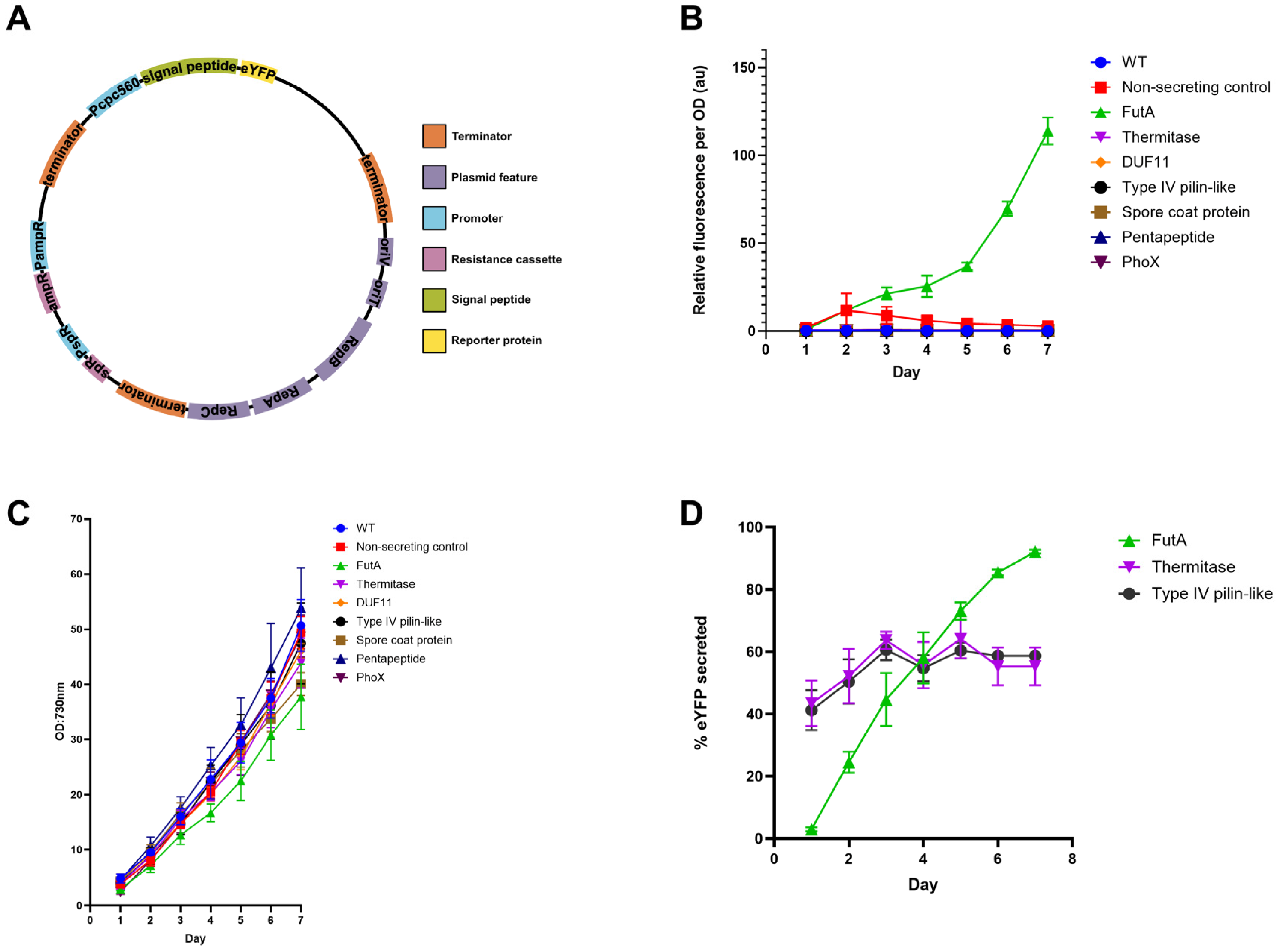
Seven signal peptides were selected to provide systematic coverage of the two principal cyanobacterial export pathways (
Table 1). Putative signal peptides from PCC 11901 were identified by mining the PCC 11901 proteome (GenBank CP040360.1) and cross-referencing with published exoproteomic datasets [
31,
34]. Predicted subcellular localisation and signal peptide type (Sec/SPI, Sec/SPII, or Tat/SPI) were determined using SignalP v6.0 [
38], and cleavage sites were annotated accordingly. For the Sec pathway, four native PCC 11901 signal peptides were selected on the basis of their predicted extracytoplasmic localisation and functional annotations suggestive of secretion or envelope association: (1) Type IV pilin-like G/H family protein (a pilin-like protein expected to engage the T4P-associated export machinery, T4P-like hereafter), (2) Pentapeptide repeat-containing protein (predicted periplasmic localization, Pentapeptide hereafter), (3) Spore coat U domain-containing protein (predicted cell envelope association, Spore coat protein hereafter), and (4) DUF11 domain-containing protein (predicted outer membrane localization, DUF11 hereafter). In addition, one heterologous Sec signal peptide was also included: (5) the thermitase signal peptide from
C. aponinum PCC 10605, which has been shown to drive GFP secretion in
C. aponinum using RSF1010-based plasmids [
21]. For the Tat pathway, two signal peptides carrying canonical twin-arginine motifs were selected: (6) FutA from
Synechocystis sp. PCC 6803, a well-characterised ferric iron-binding periplasmic protein [
39], and (7) PhoX, a PhoX family alkaline phosphatase native to PCC 11901.
All coding sequences were codon-optimised for the PCC 11901 codon usage table (derived from the GenBank CP040360.1 proteome) and synthesised by Twist Bioscience (San Francisco, CA, USA). Signal peptide–target gene fusions were assembled in-frame by Golden Gate assembly into the self-replicating broad-host-range plasmid RSF1010. The RSF1010-based expression system was selected over chromosomal integration at the
mrr neutral site based on preliminary experiments in our laboratory indicating that self-replicating plasmids yielded higher and more consistent recombinant protein expression in PCC 11901 (data presented in the discussion,
Section 4). The general construct architecture was: P
cpc560 promoter–signal peptide–target gene–native terminator from
E. coli ECK120010850. Upon secretion into the periplasm, the signal peptide is cleaved, leaving only the mature target protein. Correct assembly was verified by full plasmid sequencing.
2.3. Biparental Conjugation
RSF1010-derived constructs were introduced into PCC 11901 by biparental conjugation using the diaminopimelic acid (DAP)-auxotrophic donor strain E. coli MFDpir (Addgene #187385). The cargo plasmid was transformed into chemically competent MFDpir cells by heat shock and selected on LB agar supplemented with 0.3 mM DAP and spectinomycin (25 µg mL−1; Sigma-Aldrich, St. Louis, MO, USA). For conjugation, overnight cultures of the transformed donor were washed three times with LB + DAP without antibiotics. PCC 11901 cultures (OD730 0.5–2.0) were washed four times with fresh MAD medium. Equal volumes (900 µL) of donor and recipient were combined, mixed gently, and incubated at room temperature for 4–5 h. The mating mixture was pelleted (1500× g, 10 min), resuspended in residual supernatant, and was spread onto 0.45 µm membrane filters (HATF; MilliporeSigma, Burlington, MA, USA) placed on LB:MAD (1:1) agar containing DAP without antibiotics. After 24 h under illumination, membranes were transferred to MAD agar containing spectinomycin (25 µg mL−1) and lacking DAP, thereby counter-selecting the donor. Conjugant colonies appeared within 5–7 days and were verified by plasmid sequencing and sustained growth on selective medium.
2.4. Culture Conditions for Secretion Assays
Each transconjugant strain, together with the non-secreting control, was inoculated into MAD liquid medium (1.8% NaCl, 25 µg mL
−1 spectinomycin). The WT control was cultured in identical medium without spectinomycin. All strains were cultured for 7 days at 30 °C in a CO
2-controlled incubator maintained at 5% CO
2 (
v/
v), selected based on the optimised growth conditions established for PCC 11901 [
14,
15,
16], under continuous illumination at (200 µmol photons m
−2 s
−1) with shaking at (130 rpm).
n = 3 biological replicates. Samples were collected daily from day 1 through day 7 for subcellular fractionation and fluorescence quantification. Growth of all transconjugant strains was monitored by OD
730 measurements at each sampling point to assess potential fitness costs associated with signal peptide expression.
2.5. Subcellular Fractionation
To measure the intracellular and secreted protein fractions, aliquots of 2 mL from day 1 to day 7 cultures were collected in duplicate and OD
730 was recorded at each time point. Cells were pelleted by centrifugation (9500×
g, 10 min, 4 °C). The supernatant was retained as the extracellular fraction. The cell pellet was washed 5 times with 2 mL fresh MAD medium (10 min per wash) to remove residual extracellular protein and then resuspended in 1 mL MAD medium. Fluorescence of both supernatant and cell fractions was measured as described in
Section 2.6.
2.6. Fluorescence Quantification
For each fraction, 200 µL aliquots were dispensed in triplicate into 96-well Nunc™ plates (Thermo Fisher Scientific, Waltham, MA, USA). Fluorescence intensity was measured on a Tecan Infinite 200 PRO (Tecan Group Ltd., Männedorf, Switzerland) microplate reader using bottom-reading mode (excitation: 488 nm, bandwidth 9 nm; emission: 530 nm, bandwidth 20 nm; 25 flashes per well; gain: optimal; multiple reads per well in a 2 × 2 square-filled pattern). The excitation wavelength of 488 nm was selected rather than the eYFP excitation maximum (513 nm) to maintain sufficient spectral separation between excitation and emission wavelengths, as recommended for monochromator-based plate readers when excitation and emission peaks are closely spaced. Background fluorescence from WT fractions was subtracted from all readings. Fluorescence values were then divided by OD730 to yield relative fluorescence units per optical density (RFU/OD).
2.7. Calculation of Secretion Efficiency
The percentage of protein secreted to the extracellular space was calculated as
where F
extra denotes the background-corrected fluorescence of the cell-free supernatant (extracellular fraction) and F
intra denotes the background-corrected fluorescence of the washed, resuspended cell pellet (intracellular fraction), both normalised to OD
730.
2.8. Qualitative Imaging
Extracellular fractions, and intracellular fractions were photographed under blue-light (488 nm) excitation using a ChemiDoc imaging system (Bio-Rad, Hercules, CA, USA) equipped with the appropriate emission filter for eYFP. Images were acquired with identical exposure settings across all samples and time points to enable qualitative comparison.
2.9. Lichenase Secretion and Activity Assays
The lichenase gene (
licB) from
Clostridium thermocellum, encoding a 1,3–1,4-β-glucanase, was fused in-frame with the FutA and thermitase signal peptides using the same RSF1010 construct architecture as in Phase 1 (P
cpc560–signal peptide–
licB–terminator). An additional construct expressing lichenase fused to its native
C. thermocellum signal peptide was included as a dual-purpose control: this Gram-positive signal peptide was not expected to be recognised by the cyanobacterial secretion machinery, thereby serving simultaneously as a positive control for intracellular lichenase expression and a negative control for extracellular secretion. The wild-type strain (lacking the
licB gene) served as an additional negative control. Constructs were assembled by Golden Gate assembly, verified by full plasmid sequencing, and introduced into PCC 11901 by biparental conjugation as described in
Section 2.3. Expression and culture conditions were identical to Phase 1 (
Section 2.4).
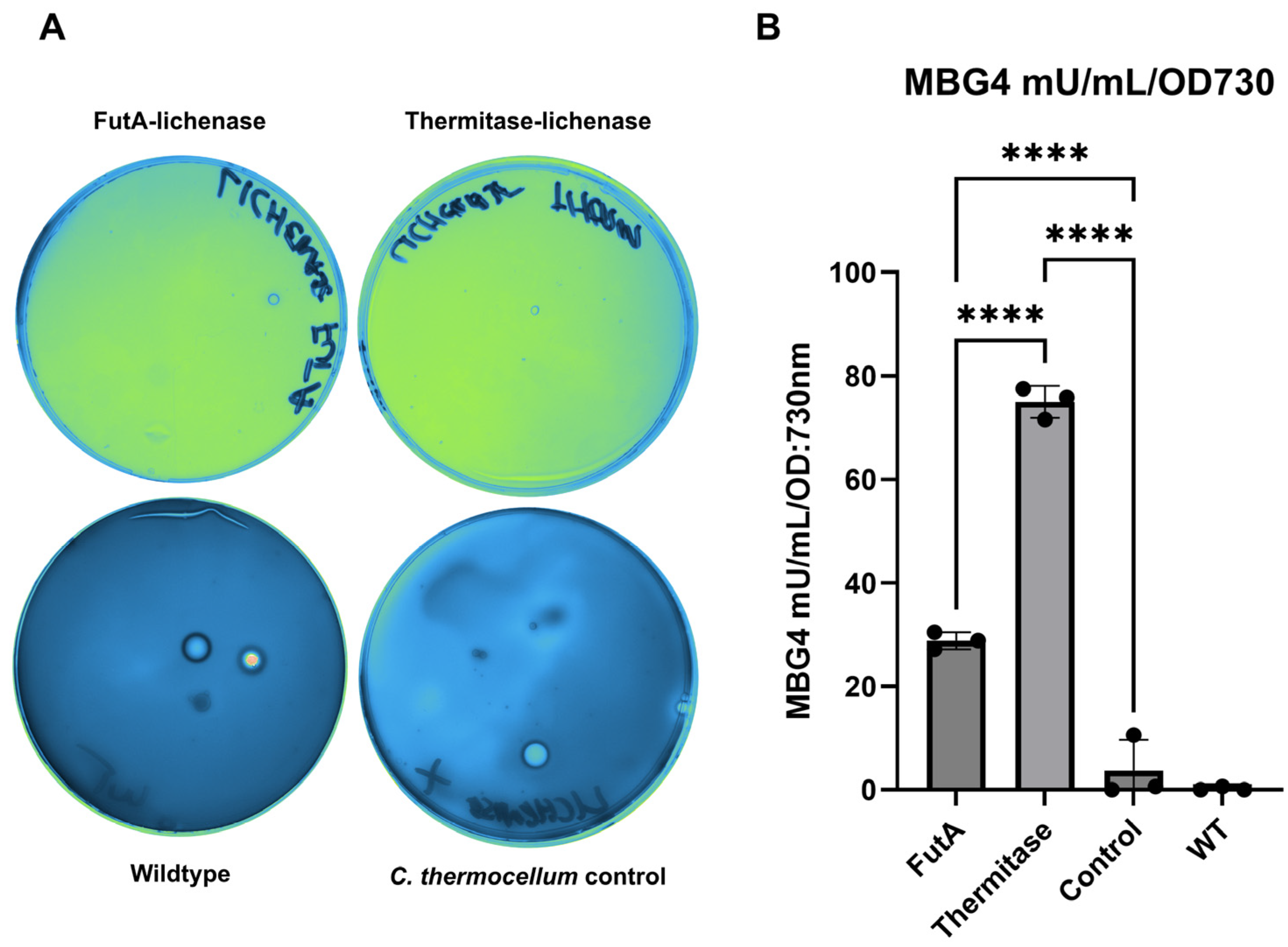
Qualitative assessment of extracellular lichenase activity was performed using two complementary Congo Red (Sigma-Aldrich, St. Louis, MO, USA) plate assay formats adapted from Sergeyenko et al. [
33]. In the colony overlay format, transconjugant cells were grown on MAD agar supplemented with 25 µg mL
−1 spectinomycin for 3 days at 30 °C under continuous illumination. Colonies were overlaid with top agar (0.7% agarose in 50 mM Tris-HCl pH 8.0) supplemented with 0.05% lichenan (Cat. No. G6513; Sigma-Aldrich, St. Louis, MO, USA). After polymerisation, plates were incubated at 65 °C for 4–6 h to allow the thermostable lichenase to digest the substrate while inactivating endogenous mesophilic enzymes. Plates were then stained with 0.5% Congo Red for 10 min at room temperature with gentle shaking and destained three times with 1 M NaCl for 5 min each. Lichenase activity was visualised as clear zones against a dark red background of undigested lichenan. In the liquid culture format, cell-free supernatants were prepared as described in
Section 2.5. Filtered supernatants were mixed with an equal volume of MAD medium containing 3% agar, poured into Petri dishes and allowed to solidify. Plates were then overlaid with lichenan-containing top agar and processed as above.
Quantitative assessment of extracellular lichenase activity was performed using the
Megazyme Malt β-Glucanase/Lichenase Assay Kit (K-MBG4, Megazyme, Bray, Ireland) following the manual lichenase assay procedure. The kit employs the chromogenic substrate BCNPBG4 (4,6-
O-benzylidene-2-chloro-4-nitrophenyl-β-(3
1-β-D-cellotriosyl-glucoside)), which is specifically cleaved by lichenase (EC 3.2.1.73) to release 2-chloro-4-nitrophenol (CNP). The benzylidene acetal blocking group prevents hydrolysis by exo-acting enzymes including β-glucosidase and cellobiohydrolase, ensuring assay specificity. Cell-free supernatants were prepared as described in
Section 2.5 and assayed undiluted. MBG4 substrate (100 µL) was dispensed into 13 mL glass tubes and pre-incubated at 40 °C for 3 min. Sample (200 µL) was added, vortexed, and incubated at 40 °C for exactly 10 min. The reaction was terminated by addition of 3000 µL stopping reagent (2%
w/
v Tris buffer, pH 10.0), which simultaneously develops the yellow phenolate colour of released CNP. Absorbance was measured at 400 nm against distilled water. For each strain, a sample blank was prepared by adding the stopping reagent prior to the sample and substrate (to correct for background absorbance of the culture supernatant), and a reagent blank was prepared using Buffer D (100 mM sodium phosphate, pH 6.5) in place of the sample. The assay was validated using a
Bacillus sp. lichenase standard supplied with the kit (recovery: 92%). Lichenase activity was calculated as MBG4 U/mL = ΔE
400 × 0.0994 × 50, where ΔE
400 = Abs(reaction) − Abs(sample blank) − Abs(reagent blank), where 50 is the Megazyme conversion factor relating activity to the original enzyme preparation and one MBG4 Unit is defined as the amount of enzyme releasing one micromole of CNP per minute (εmM = 16.6 at 400 nm in 2% Tris buffer, pH 10.0). Activity values were normalised to the optical density of the culture at harvest (OD
730) and expressed as mU/mL/OD
730.
2.10. Use of Generative Artificial Intelligence
During the preparation of this manuscript, no generative artificial intelligence (GenAI) tools were used for data analysis, experimental design, or interpretation of results. Claude, Anthropic (claude.ai, accessed 2025–2026) was used for language editing and manuscript preparation. The authors reviewed and take full responsibility for the content of this publication.
2.11. Statistical Analysis
All experiments were performed with a minimum of three biological replicates (n = 3). Data are presented as mean ± standard deviation (SD). Statistical significance was assessed by one-way ANOVA followed by Tukey’s multiple comparisons test. For pairwise comparisons, a two-tailed Student’s t-test was used. All statistical analyses were performed using GraphPad Prism v.11.0.0 (GraphPad Software, San Diego, CA, USA). Specific test statistics (F-values, degrees of freedom, p-values) are reported in the corresponding figure legends and in the Results text.
4. Discussion
This study establishes Synechococcus sp. PCC 11901 as a secretion-competent platform for extracellular recombinant protein production under industrially relevant CO2-supplemented growth conditions (5%) and identifies the Tat-pathway signal peptide FutA as the most effective leader for heterologous protein export in this strain. By combining a systematic signal peptide screen with daily secretion profiling and validation across two functionally distinct target proteins, we define a rational framework for engineering protein secretion in a fast-growing cyanobacterium.
As noted in the introduction, the traditional view that cyanobacteria are inherently poor secretors has already been challenged by recent exoproteomic data [
31] and was based partly on the low outer membrane permeability reported for
Synechocystis sp. PCC 6803 [
26]. Our results provide direct experimental support for this revised perspective in PCC 11901. An extracellular secretion efficiency of 92.2% for FutA-driven eYFP export exceeds the qualitative secretion observed with pilin-type leaders in PCC 6803 [
33] for which no quantitative efficiency was reported, and the secretion yield of 779 ± 40 µg L
−1 reported for a lytic polysaccharide monooxygenase in
S. elongatus UTEX 2973 [
29], indicating that PCC 11901 possesses a secretory capacity that is among the highest reported for cyanobacteria. This finding aligns with recent deep exoproteomic analyses that identified FutA2 as one of the most abundant secreted proteins in
Synechococcus sp. PCC 11901 and revealed that the cyanobacterial secretome is far more extensive than previously recognized [
31]. We note that the FutA signal peptide used here derives from the
Synechocystis sp. PCC 6803 FutA2 protein (characterised as a ferric iron- binding protein by Badarau et al. [
39]), rather than a native PCC 11901 orthologue; nonetheless, the high secretion efficiency observed suggests strong functional compatibility with the PCC 11901 Tat translocon. The closest orthologue of FutA2 in PCC 11901 is a Fe(3+) ABC transporter substrate-binding protein (WP_138071506.1; 50.9% amino acid identity), which carries a Sec-type rather than a Tat-type signal peptide, lacking the canonical twin-arginine motif. PCC 11901 therefore does not possess a native Tat-dependent iron uptake signal peptide, and a heterologous leader from PCC 6803 was required to evaluate Tat-mediated secretion in this strain. The basis for the permissive secretion phenotype of PCC 11901 remains to be fully elucidated. Comparative genomics revealed a streamlined electron transport chain relative to PCC 6803 [
15], and differences in cell envelope-related gene content have been noted, although whether these translate to altered outer membrane permeability or vesicle production remains to be determined. The rapid growth rate of PCC 11901, linked to lower photoinhibition and higher photosynthetic rates [
15,
16,
17], may also contribute through increased membrane dynamics during cell division, as faster-dividing cells undergo more frequent rounds of membrane remodelling that could facilitate outer membrane transit of periplasmic proteins.
The clear superiority of FutA over all five Sec-pathway candidates tested for eYFP secretion is likely multifactorial. One probable factor is the capacity of the Tat pathway to translocate fully folded proteins, enabling cytoplasmic chromophore maturation in eYFP before membrane translocation. Sec-mediated export threads unfolded polypeptides through the SecYEG translocon, exposing them to the oxidising periplasmic environment where aberrant disulfide bond formation can interfere with β-barrel assembly and chromophore cyclisation [
40,
41]. Because our assay measured fluorescence rather than total protein, the relative contributions of transport efficiency and post-translocation folding fidelity cannot be deconvolved from the present dataset. Importantly, however, the poor performance of PhoX (17.1%), the second Tat candidate tested, demonstrates that Tat pathway access alone is insufficient for efficient secretion, and that signal peptide-specific features play a dominant role. Analysis of the two Tat signal peptides offers insight into why FutA vastly outperformed PhoX. Although both carry a net charge of +5 and a canonical twin-arginine motif, they differ markedly in architecture. The FutA signal peptide (32 residues, GRAVY +0.27) has a short N-region of only 8 residues before the RR motif, followed by a well-defined 16-residue hydrophobic core (FFVGGTALTALVVANL). The PhoX signal peptide (57 residues, GRAVY −0.30) is nearly twice as long, with an extended 27-residue N-region containing three negatively charged residues (Asp/Glu) before the RR motif, and an overall hydrophilic character. This extended, polar N-region may reduce the efficiency of TatBC receptor recognition and membrane targeting, consistent with the established requirement for a compact, positively charged N-region and a sufficiently hydrophobic H-region for efficient Tat translocation. The cargo-dependent reversal observed in Phase 2, where thermitase outperformed FutA for lichenase secretion by 2.6-fold, can be rationalised by considering the biophysical properties of the two target proteins. eYFP (26.9 kDa, pI 5.6) is a rigid 11-stranded β-barrel that requires cytoplasmic folding and autocatalytic chromophore maturation before it becomes fluorescent; its two cysteine residues are also susceptible to aberrant disulfide bond formation in the oxidising periplasmic environment [
40,
41]. These properties strongly favour Tat-mediated export, which translocates the fully folded, fluorescence-competent protein. Lichenase from
C. thermocellum (~36 kDa, 334 residues, pI 4.8) is, by contrast, a thermostable (β/α)
8 TIM barrel enzyme with an activity optimum at 65 °C that does not require cofactors or post-translational modifications for enzymatic function. Its inherent thermostability likely enables rapid and efficient refolding after Sec-mediated translocation in an unfolded state, explaining why the Sec-pathway leader thermitase outperformed FutA for this particular cargo. Together, these observations underscore that no single signal peptide is universally optimal: Tat leaders may be favoured for folding-dependent cargo proteins, while Sec leaders may be preferable for thermostable enzymes that refold efficiently post-translocation.
The growth inhibition observed in signal peptide-bearing strains was comparable between Tat and Sec constructs (
Section 3.3), indicating that the metabolic cost of Tat-mediated export is not prohibitively higher than Sec-mediated secretion under the conditions tested. This is an encouraging finding for industrial applications, as it suggests that the superior secretion efficiency of FutA does not come at a disproportionate cost to biomass accumulation.
Among the Sec candidates, the superior performance of the heterologous thermitase signal peptide over all four native PCC 11901 leaders is noteworthy and consistent with the observation by Nandru et al. (2025) [
34] that thermitase drives effective eYFP secretion in
C. aponinum PCC 10605 using a similar RSF1010-based expression system [
34]. This result suggests that heterologous signal peptides should be routinely included in future secretion engineering campaigns in PCC 11901. One plausible explanation is that native signal peptides have co-evolved with their endogenous substrates and may exhibit suboptimal interactions with heterologous proteins of different size, charge, or folding kinetics. Empirical screening across both native and heterologous panels therefore remains essential.
The extension of the platform from eYFP (~27 kDa) to lichenase (~36 kDa) demonstrates that the system accommodates functionally diverse protein classes. Quantitative assessment of extracellular lichenase activity using the K-MBG4 chromogenic assay revealed activities of approximately 74.99 ± 1.78 mU/mL/OD
730 for thermitase and 28.83 ± 0.96 mU/mL/OD
730 for FutA. To our knowledge, these represent the first quantitative measurements of secreted enzymatic activity in any cyanobacterium. The only prior report of lichenase secretion in cyanobacteria, by Sergeyenko et al. (2003) [
33] in
Synechocystis sp. PCC 6803, relied exclusively on qualitative Congo Red plate assays without reporting activity units [
33], and the only other quantitative secretion yield reported for a cyanobacterium is the 779 ± 40 µg L
−1 estimated by densitometry for a lytic polysaccharide monooxygenase in
S. elongatus UTEX 2973 [
29]. The present work therefore establishes the first quantitative enzymatic benchmark for cyanobacterial heterologous protein secretion.
While the absolute activities remain below those achievable in optimised heterotrophic hosts, for example, secretion of a chimeric
C. thermocellum lichenase from
Bacillus subtilis has been reported at 80.56 U/mL through signal peptide hydrophobicity engineering [
42], this comparison must be considered in context, acknowledging differences in cultivation regimes, normalisation metrics, and the fundamentally distinct envelope architectures of Gram-positive and diderm organisms. PCC 11901 is a diderm cyanobacterium in which secreted proteins must traverse both the cytoplasmic and outer membranes, whereas
B. subtilis possesses a single membrane and has benefitted from decades of secretion optimisation. Moreover, PCC 11901 offers the distinct advantage of photoautotrophic production independent of organic carbon feedstocks, and the activities detected here validate the secretion platform as a functional system amenable to further optimisation through promoter engineering, signal peptide combinatorics, and culture condition development.
Notably, the rank order of signal peptide performance was reversed relative to Phase 1: whereas FutA substantially outperformed thermitase for eYFP secretion (92.2% vs. 55.7%), thermitase directed approximately 2.6-fold higher extracellular lichenase activity than FutA. This cargo-dependent reversal is consistent with the distinct translocation mechanisms of the two pathways: the Tat pathway preferentially exports folded substrates such as eYFP, whereas the Sec pathway may more efficiently handle proteins like lichenase that fold rapidly post-translocation and do not require cytoplasmic maturation for enzymatic activity. The lichenase experiments permit a direct comparison with Sergeyenko et al. (2003) [
33], who first demonstrated heterologous protein secretion in cyanobacteria using the same enzyme from
C. thermocellum in
Synechocystis sp. PCC 6803. Our work extends those findings in three important respects. First, we demonstrate lichenase secretion in the faster-growing PCC 11901, which offers superior biomass accumulation and industrial scalability. Second, we employ signal peptides that engage the canonical Sec (thermitase) and Tat (FutA) translocation pathways rather than pilin-type leaders whose routing through the Type IV pilus system is now considered distinct from general protein secretion [
30,
31]. Third, we provide quantitative activity measurements using the K-MBG4 chromogenic assay in addition to the qualitative Congo Red assay used by Sergeyenko et al. (2003) [
33].
A question left open by these experiments concerns outer membrane transit. The Sec and Tat pathways translocate proteins across the cytoplasmic membrane, but the mechanism by which proteins subsequently traverse the outer membrane remains uncharacterised. Several non-exclusive possibilities include outer membrane vesicle (OMV) release [
43,
44,
45], passage through porins, or unidentified secretion apparatus. Notably, our fluorescence-based assay does not distinguish between soluble extracellular eYFP and eYFP associated with extracellular vesicles (EVs). Recent work in
Synechocystis sp. PCC 6803 has demonstrated that periplasmic proteins can reach the extracellular space both as soluble protein and encapsulated within EVs [
43]. Determining the relative contribution of vesicle-mediated versus soluble export in PCC 11901, for example, by differential ultracentrifugation of culture supernatants, would be an important next step to fully characterise the secretion mechanism. Recent exoproteomic data indicate that the T4P system is dedicated to pilin secretion rather than serving as a general conduit [
31], and quantitative secretion assays in
Synechocystis confirmed that NanoLuc reporter secretion is Independent of T4P assembly [
30]. The successful extracellular recovery of two proteins of different sizes and properties suggests that the PCC 11901 outer membrane is more permissive than that of PCC 6803, consistent with the architectural differences revealed by comparative genomics [
15].
5. Limitations and Considerations
Several aspects of the experimental design merit discussion. First, all constructs were expressed from the self-replicating RSF1010 plasmid. To determine whether chromosomal integration would improve expression, we compared eYFP fluorescence from RSF1010 versus integration at the validated
mrr neutral site [
17] under the constitutive P
cpc560. RSF1010-based expression yielded approximately 2.8-fold higher fluorescence per OD
730 than chromosomal integration at 24 h (
Supplementary Figure S10). These results contrast with a previous report of higher expression from chromosomal loci in PCC 11901 [
17], a discrepancy that may reflect differences in growth conditions or locus-specific effects at the
mrr site. Critically, this finding demonstrates that the secretion efficiencies reported here could not be improved simply by moving to chromosomal integration, and that RSF1010 represents a validated expression platform for this strain. The copy number of RSF1010 in PCC 11901 has not been determined. The chromosome copy number, however, has recently been estimated at approximately 4–7 in wild-type cells by flow cytometry and shown to vary with growth phase, being highest in early exponential phase and declining thereafter [
18]. This polyploidy implies that chromosomally integrated constructs are present at multiple copies per cell, yet RSF1010 still outperformed genomic integration, suggesting that plasmid copy number exceeds the chromosome count under the conditions tested. The dynamic nature of chromosome copy number may also contribute to the inter-replicate variability observed across time points. Second, the non-secreting control (eYFP without signal peptide) did exhibit low-level extracellular fluorescence (9.3 ± 2.9% of total fluorescence at day 7), indicating that a degree of cell lysis occurs under the culture conditions employed. However, this baseline was substantially lower than the extracellular fluorescence observed for any signal peptide construct. The signal peptide-dependent rank order of secretion efficiencies, with FutA at 92.2% and several Sec candidates below 20%, is inconsistent with a lysis-driven mechanism, which would produce comparable extracellular fluorescence across all strains regardless of signal peptide identity. Furthermore, the temporal profile of extracellular fluorescence in the non-secreting control peaked at day 2 and declined thereafter, mirroring the intracellular fluorescence trajectory, whereas FutA-driven extracellular fluorescence increased continuously over 7 days, a pattern indicative of active export rather than passive release. Third, extracellular proteases could degrade secreted proteins in the culture medium, potentially leading to underestimation of true secretion efficiency. Fourth, as noted in
Section 3.4, the unequal representation of Sec (
n = 5) and Tat (
n = 2) signal peptides means that the present data establish FutA as the best individual signal peptide rather than demonstrating broad pathway-level superiority of Tat over Sec.
From a translational perspective, extracellular secretion eliminates the requirement for cell disruption, reduces purification steps, and enables continuous product harvesting. The thermodynamic case for cyanobacterial biomanufacturing has been further strengthened by recent analyses demonstrating that
Synechococcus sp. biomass formation captures ~275 kJ per mol of CO
2 fixed as an enthalpy change, energy that is theoretically recoverable in the secreted product [
12]. Combined with the exceptional growth kinetics of PCC 11901 (doubling time ~2 h), its halotolerance, its capacity for high cell-density cultivation to >33 g DCW L
−1 [
14,
15], and the comprehensive genetic engineering toolbox now available [
17], these results position PCC 11901 as one of the most promising cyanobacterial chassis for scalable biomanufacturing of extracellular recombinant proteins.




 ,
,