Review

Tuning the Fire: Context-Dependent Mitochondrial ROS Signaling, Mitohormesis, and Redox-Modulating Interventions


by
Evelina Charidemou
,
Eleni Andreou
and
Christos Papaneophytou
*
Department of Life Sciences, School of Life and Health Sciences, University of Nicosia, Nicosia 2417, Cyprus
*
Author to whom correspondence should be addressed.
Biomolecules 2026, 16(6), 867; https://doi.org/10.3390/biom16060867 (registering DOI)
Submission received: 12 May 2026 / Revised: 29 May 2026 / Accepted: 10 June 2026 / Published: 12 June 2026
(This article belongs to the Special Issue Mitochondrial ROS in Health and Disease: 2nd Edition)

Abstract

Mitochondrial reactive oxygen species (mtROS) are central regulators of cellular function, yet their biological roles are often reduced to an oxidative-stress/antioxidant dichotomy. This review reframes mtROS through the concept of mitohormesis, in which outcomes are neither inherently harmful nor beneficial but are determined by a defined set of contextual variables. We present a mechanistic framework in which mtROS effects depend on chemical species identity, sub-mitochondrial site of production, temporal dynamics, redox-buffering capacity, and metabolic state; together, these variables determine whether mtROS promote adaptive eustress or pathological distress. We then show that, across polyphenols, isothiocyanates, terpenoids, alkaloids, and quinones, the biologically relevant effects of natural redox-modulating compounds are mediated less by direct radical scavenging than by pro-hormetic mechanisms, including mild electron transport chain perturbation, nuclear factor erythroid 2-related factor 2/Kelch-like ECH-associated protein 1 (NRF2/KEAP1) activation, modulation of mitochondrial membrane potential, mitochondrial quality control, and NAD+/NADPH regulation. Applying this framework to disease reveals strong tissue and state dependence: neurodegeneration favors buffering expansion and mitophagy; metabolic disease may benefit from exercise-mimetic and NRF2-activating strategies; cardiovascular disease illustrates mitohormesis through ischemic preconditioning and CoQ10 supplementation; and cancer requires distinction between prevention and therapy because redox buffering can either protect normal tissue or support tumor survival. Finally, we argue that the failure of non-specific antioxidant supplementation is mechanistically predictable and propose context-aware, biomarker-guided, temporally optimized, and compartment-targeted redox interventions as a more rational translational path.

1. Introduction

Mitochondria are double-membrane-bound organelles that contain their own genomes and are present in nearly all known eukaryotic cells, from single-celled organisms to humans [1]. Through the electron transport chain (ETC) and oxidative phosphorylation (OxPhos), mitochondria couple nutrient oxidation to ATP synthesis, meeting acute and chronic bioenergetic demands [2]. Beyond this canonical “powerhouse” function, they also serve as biosynthetic and signaling hubs, producing metabolites, lipids, amino acids, nucleotides, and essential cofactors such as heme and iron–sulfur clusters [3,4]. This metabolic versatility, together with a membrane-rich architecture and a redox-active proteome, places mitochondria at the intersection of energy transduction, metabolic rewiring, and cellular signaling.
Over the past three decades, mitochondria have also been recognized as functionally heterogeneous organelles whose spatial organization and bioenergetic properties are dynamically remodeled in response to cellular demands and stress [5,6]. Within individual cells, mitochondrial subpopulations can meet compartment-specific bioenergetic demands [7]. This heterogeneity is maintained by mitochondrial dynamics, including fission, fusion, mitophagy, and intracellular transport [8]. Disruption of these processes alters mitochondrial function, affects cell fate, and contributes to a wide range of pathologies, including neurodegenerative, metabolic, and cardiovascular diseases, as well as cancers [9]. The concept of a mitochondrial information processing system (MIPS) has been proposed to formalize this integrative role, building on earlier recognition of mitochondria as central regulators of cell fate, including apoptosis mediated by cytochrome c (cytc) release [10,11].
A central, and historically underappreciated, output of mitochondrial metabolism is the regulated generation of reactive oxygen species (ROS) [12]. ROS comprise both free radicals, such as superoxide ( O 2 ) and hydroxyl radical (HO˙), and non-radical oxidants, such as hydrogen peroxide (H2O2) [13]. Although ROS are also generated by other cellular systems, including NADPH oxidases, xanthine oxidase, myeloperoxidase, iron- and copper-containing proteins, and cytochrome P450 enzymes [14], mitochondrial ROS (mtROS) arise primarily from defined redox centers within the ETC and, in a context-dependent manner, from other mitochondrial enzymes [15]. Mitochondria are therefore widely regarded as a major source of intracellular ROS, particularly under conditions of elevated membrane potential and electron backpressure [3]. Early estimates suggest that ~0.1–2% of the oxygen consumed is partially reduced to superoxide, although these values vary with metabolic state [16].
The biological meaning of mtROS depends on species identity, sub-mitochondrial site of production, stimulus intensity and duration, and local redox-buffering capacity [17,18]. Excessive or sustained mtROS can cause macromolecular damage and drive pathology, whereas transient mtROS signals regulate immune responses, cell-cycle progression, hypoxic adaptation, and stress-resistance pathways [19]. For example, mtROS can increase under hypoxic conditions and contribute to oxygen sensing by stabilizing hypoxia-inducible factor (HIF) by inhibiting prolyl hydroxylases [20,21]. This context dependence underlies mitohormesis, a response in which transient or low-level mitochondrial stress activates adaptive pathways that enhance cellular fitness, whereas sustained or excessive stress promotes dysfunction [22]. Perturbations such as nutrient limitation, exercise, toxin exposure, or genetic stress can trigger coordinated responses that restore metabolic, proteostatic, and redox homeostasis, with adaptive effects that may persist beyond the initiating stimulus [23]. These responses involve mitonuclear communication via ROS and TCA cycle metabolites, proteotoxic signaling via the mitochondrial unfolded protein response (UPRmt), and secreted mitokines such as fibroblast growth factor 21 (FGF21) and growth differentiation factor 15 (GDF15) [24].
Because ATP and TCA cycle intermediates regulate cytosolic pathways that control epigenetics, ion flux, and inflammation, shifts in mitohormetic balance can influence the progression of metabolic, cardiovascular, and neurological diseases [25]. Notably, many natural biomolecules and phytochemicals historically classified as “antioxidants,” including polyphenols, flavonoids, and terpenoids, act in a context-dependent manner via pro-oxidative, mitochondria-engaged mechanisms. Rather than directly scavenging radicals, these compounds can transiently increase mtROS or modulate electron flow, thereby activating adaptive pathways such as the nuclear factor erythroid 2-related factor 2/Kelch-like ECH-associated protein 1 (NRF2/KEAP1) axis, AMPK signaling, and sirtuin-dependent regulation [26,27].
This mechanistic reframing has significant translational implications. It helps explain why high-dose, non-specific antioxidant supplementation has largely failed in clinical trials and suggests that context-aware, pro-hormetic modulation of mtROS is a more rational therapeutic strategy [28,29]. In this review, we revisit mitohormesis through a mechanistic lens, emphasizing mtROS as tunable, context-dependent signals. We integrate the molecular determinants that distinguish protective from pathological ROS signaling, analyze how natural compounds modulate mitochondrial redox biology, and discuss implications for disease prevention and therapy.

2. Mitohormesis: Concept and Mechanistic Framework

Mitochondria occupy a central position at the intersection of energy metabolism and cellular signaling, and transient increases in mtROS can trigger adaptive responses that enhance cellular stress resistance [10]. The term mitohormesis captures this relationship and situates it within the broader conceptual framework of hormesis in toxicology and physiology [30]. In its general form, hormesis describes a biphasic rather than linear dose–response relationship, in which low-level exposure elicits qualitatively different, often beneficial, effects compared with high-dose exposure [31]. Applied to mitochondria, this framework predicts that mild perturbations of mitochondrial function, whether metabolic, pharmacological, or environmental, can activate conserved stress-response programs whose protective effects persist beyond the initiating stimulus, leaving cells and tissues in a more resilient state [32]. Understanding how this process is regulated has implications for disease susceptibility and provides a unifying perspective on biological aging.
The relevance of mitohormesis is particularly evident in aging and age-related disease [33]. Aging is increasingly conceptualized as a progressive decline in physiological function that increases vulnerability to chronic conditions and shortens healthspan, the period of life free from substantial disease burden [34,35]. Although life expectancy has increased markedly over the past century, healthspan has not kept pace; one analysis of the Global Burden of Disease Study 2017 attributed 51.3% of the total adult disease burden worldwide to 92 age-related conditions [35,36]. Within the hallmarks of aging, mitochondrial dysfunction plays a prominent cross-cutting role, recurring across neurodegeneration, cardiometabolic disease, and cancer [37]. Preserving mitochondrial function is therefore central to physiological integrity, and its progressive decline is closely associated with reduced resilience and increased morbidity [38]. Against this backdrop, the central question of mitohormesis, namely how mild mitochondrial stress can be protective rather than harmful, is directly relevant to strategies aimed at extending healthspan rather than simply prolonging survival [39].
The following subsections trace the conceptual evolution of mitohormesis, from early free-radical theories to current mechanistic models, and define the contextual parameters that determine whether a given mtROS signal results in adaptation or injury.

2.1. From the Free-Radical Theory of Aging to Mitohormesis

The link between mitochondrial electron transport and ROS generation placed mitochondria at the center of early theories linking oxidative chemistry to biological aging [40]. In 1956, Denham Harman proposed that endogenous free radicals, produced as byproducts of normal metabolism, progressively damage cellular macromolecules and drive aging [41]. He later refined this idea by identifying the mitochondrial electron transport chain as a principal intracellular source of these species, thereby giving rise to the mitochondrial free-radical theory of aging [42]. Together with the formalization of “oxidative stress” as an imbalance between oxidant production and antioxidant defense [43], these ideas shaped a paradigm in which mitochondrial ROS were viewed primarily as harmful byproducts of aerobic metabolism [44].
Several findings challenged this damage-centric model. Large-scale antioxidant supplementation trials generally failed to demonstrate consistent benefits for age-related outcomes, and some interventions were associated with adverse effects in specific contexts [45,46,47,48]. Genetic studies in model organisms also yielded paradoxical results: certain long-lived mutants in Caenorhabditis elegans and Drosophila melanogaster exhibited elevated, rather than reduced, ROS levels, and mild respiratory perturbation, including partial knockdown of ETC components or altered coupling efficiency, extended lifespan in a ROS-dependent manner [49,50]. Similarly, exercise, one of the most robust promoters of healthspan, induces transient mitochondrial O 2 /H2O signaling, and some exercise benefits are blunted by concurrent antioxidant supplementation [51]. Collectively, these observations indicate that mitochondrial oxidants can carry signaling information that may be lost when ROS are indiscriminately quenched [52].
These observations catalyzed a conceptual shift toward mitohormesis, in which mild, transient mitochondrial stress promotes adaptive remodeling rather than damage. The term “mitohormesis” emerged in the mid-2000s and was later developed into a framework linking transient increases in mtROS to stress-response activation and lifespan extension [27,53]. In parallel, redox biology refined oxidative-stress terminology by distinguishing oxidative eustress, physiological redox signaling that supports homeostasis and adaptation, from oxidative distress, oxidant exposure that exceeds buffering capacity and drives damage [54]. Thus, mitohormesis is best understood as a biphasic, context-dependent relationship between mtROS and biological outcome, rather than as a simple assertion that ROS are either beneficial or harmful [39,55].

2.2. Defining Features of the Mitohormetic Response

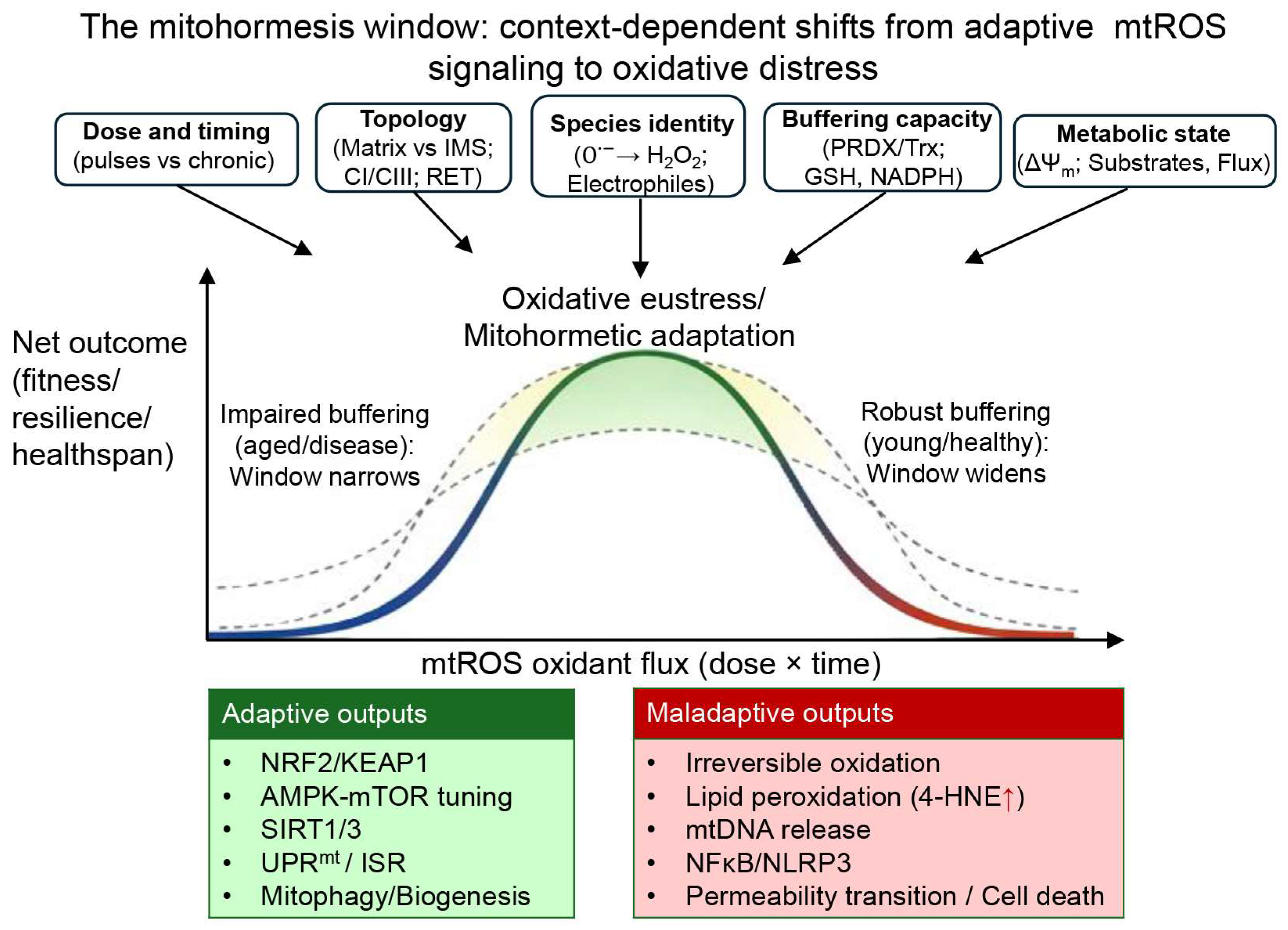
The mitohormetic response is defined by a set of interrelated features (Figure 1) that collectively distinguish it from both simple stress recovery and unchecked oxidative damage [33]. Understanding these features is essential for explaining why a given mtROS signal induces adaptation in one experimental or clinical context but contributes to pathology in another.

2.2.1. Biphasic Dose–Response and the Eustress–Distress Threshold

A hallmark of mitohormesis is a biphasic, or inverted-U (Figure 1), relationship between mtROS levels and biological outcomes [16]. At low to moderate levels, mtROS engage protective gene programs and enhance cellular fitness; beyond a context-specific threshold, the same species can overwhelm buffering systems and promote macromolecular damage [16]. Importantly, this threshold is not fixed: it shifts with cellular energetic state, antioxidant reserve, and the sub-mitochondrial site of ROS production. A physiologically intuitive example involves mitochondrial membrane potential (ΔΨm): when ATP demand is high, proton flux through ATP synthase increases, ΔΨm decreases, and mtROS production often remains within a signaling-competent range. When ATP demand drops, ΔΨm can rise, increasing electron backpressure and favoring ROS generation at Complexes I and III, potentially shifting signaling toward oxidative distress [56]. Mild mitochondrial uncoupling, whether pharmacological or endogenous, can lower ΔΨm and attenuate excessive ROS formation while preserving ATP output, thereby widening the hormetic window [57].

2.2.2. Temporal Dynamics: Transient Pulses Versus Chronic Elevation

The duration and temporal pattern of mtROS exposure are as important as amplitude in determining outcomes. Transient or pulsatile elevations in mtROS, such as those induced by exercise, brief ischemic episodes, or acute phytochemical exposure, can engage adaptive transcriptional programs and then resolve, allowing the cell to return to baseline with an enhanced protective repertoire [58]. By contrast, chronic or continuous mtROS elevation can sustain redox modifications beyond the reversible range, promote irreversible oxidation of catalytic cysteines, and bias pathways such as NF-κB and the NLRP3 inflammasome toward persistent inflammatory activation [52]. This temporal distinction helps reconcile otherwise paradoxical observations: intermittent mtROS signaling during exercise supports healthspan, whereas sustained mtROS associated with chronic mitochondrial dysfunction accelerates age-related decline; similarly, ischemic preconditioning can be protective, whereas prolonged ischemia–reperfusion promotes cardiomyocyte death [52].

2.2.3. Site Specificity of mtROS Production

The biological meaning of an mtROS signal depends on where it originates within the mitochondrion. Complex III-derived ROS released into the intermembrane space (IMS) can stabilize HIF-1α, linking ETC redox state to hypoxic adaptation. In this context, HIF-1α refers primarily to the cytosolic/nuclear transcription factor regulated by prolyl hydroxylase-dependent degradation, rather than specifically to an outer mitochondrial membrane-associated pool [12]. Within Complex I, electrons can leak at functionally distinct sites: the flavin site (IF) and the ubiquinone-binding site (IQ). ROS generated at IF are associated with age-related oxidative damage under conditions of NADH accumulation, whereas IQ-derived ROS generated during reverse electron transport (RET) have been implicated in stress adaptation, myotube differentiation, macrophage reprogramming, and oxygen sensing [59,60]. This intra-complex duality highlights a key principle: mitohormesis is not simply about “more or less” ROS, but about the appropriate species, at the appropriate site, for the appropriate duration.

2.2.4. Mitonuclear Communication

Because the mitochondrial genome encodes only 13 electron transport chain subunits, the vast majority of the mitochondrial proteome is encoded by the nuclear genome. Adaptive responses to mitochondrial stress therefore require bidirectional mitonuclear communication, including nuclear control of mitochondrial protein expression and retrograde signaling from mitochondria to the nucleus [61]. Retrograde signals include H2O2 and other redox cues, TCA-cycle metabolites such as α-ketoglutarate, succinate, fumarate, and acetyl-CoA, proteotoxic cues that activate the UPRmt, and mtDNA release that engages innate immune pathways such as cGAS–STING [62,63,64,65]. Together, these signals translate localized mitochondrial perturbations into coordinated transcriptional responses that rewire cellular metabolism, proteostasis, redox buffering, and inflammatory tone.

2.2.5. Activation of Conserved Adaptive Programs

Mitonuclear signals converge on conserved stress-response pathways that mediate the protective arm of mitohormesis. Key nodes include NRF2/KEAP1 signaling, which expands antioxidant and detoxification capacity [66], AMPK signaling, which promotes catabolism, autophagy, and mitochondrial biogenesis [67], sirtuin-dependent programs, which couple NAD+ availability to metabolic and longevity-associated transcriptional networks [68,69], UPRmt/ISR signaling, which restores mitochondrial proteostasis and is linked to lifespan extension in C. elegans [70,71]; and PINK1/Parkin-mediated mitophagy, which removes damaged mitochondria before they become persistent sources of pathological ROS [72]. Crosstalk among energy-sensing, redox, and quality-control programs forms an integrated adaptive network whose collective output exceeds that of individual components [73,74].

2.2.6. Persistence of Protective Effects Beyond the Stimulus

A defining and clinically significant feature of mitohormesis is that adaptive benefits can outlast the initiating stress. Once activated, transcriptional programs driven by NRF2, FOXO factors, PGC-1α, and UPRmt effectors remodel the proteome and metabolome over hours to days, producing durable changes in antioxidant capacity, mitochondrial mass and efficiency, proteostasis, and inflammatory tone. Epigenetic modifications supported by mitochondria-derived metabolites such as acetyl-CoA and α-ketoglutarate may further stabilize these adaptive states [63,75]. This persistence distinguishes mitohormesis from transient homeostatic buffering and provides a mechanistic basis for long-term phenotypes such as exercise-induced metabolic fitness, ischemic preconditioning memory, and lifespan extension in genetic or dietary models of mild mitochondrial stress [76].

2.2.7. Non-Cell-Autonomous Signaling: Mitokines and Systemic Hormesis

Mitohormetic responses can extend beyond the stressed cell or tissue through endocrine-like communication [40]. Mitochondrial stress can induce circulating factors, or mitokines, that convey adaptive signals to distant organs. The best-characterized mammalian examples include FGF21 and GDF15, which are induced by mitochondrial stress and regulate systemic metabolism, stress adaptation, and inflammatory tone [77,78]. In C. elegans, neuron-specific mitochondrial perturbation can activate UPRmt signaling in distal intestinal cells, providing genetic evidence for organism-wide coordination of mitohormetic responses [79,80]. Mitochondrial-derived peptides such as humanin and MOTS-c may provide an additional route through which the mitochondrial genome contributes to inter-organ communication [81].
Mechanistically, these factors act through distinct receptor and signaling axes: FGF21 signals primarily through FGFR1c/β-Klotho complexes to regulate systemic glucose, lipid, and energy metabolism, whereas GDF15 signals through the GFRAL/RET receptor complex in the hindbrain to coordinate appetite, stress responses, and systemic metabolic adaptation. Mitochondrial-derived peptides such as humanin and MOTS-c have been linked to cytoprotective and metabolic signaling, including pathways involving IGF-1, mTOR, AMPK, and inflammatory regulation, depending on cellular context [77,78,81].
This systemic dimension has important implications for natural-biomolecule interventions. A compound that triggers mild mitochondrial stress at a primary exposure site, such as the gut epithelium after oral ingestion, could confer broader effects through mitokines or other endocrine-like mediators, even when systemic distribution of the parent compound is limited. This concept overlaps with xenohormesis and broadens the therapeutic logic of mitohormesis-based strategies.

2.2.8. An Integrated Model of Mitohormetic Signaling

Together, the features described above define a mitochondrial redox-signaling circuit in which mtROS generated at defined ETC sites are converted into compartment-specific H2O2 signals, decoded by redox relays and metabolic sensors, and transmitted to cytosolic and nuclear adaptive pathways. Matrix-directed signals, including those produced during RET at Complex I, preferentially engage PRDX3/Trx2-dependent buffering, NAD+/sirtuin-linked programs, UPRmt/ISR activation, and mitochondrial quality-control pathways such as PINK1/Parkin-mediated mitophagy. In contrast, IMS-directed signals, particularly from Complex III, are positioned to influence cytosolic redox-sensitive pathways, including HIF-1α stabilization and NRF2/KEAP1-linked stress responses, while mitochondrial bioenergetic changes can independently converge on AMPK-dependent energy sensing. Thus, mitochondrial regulation of NRF2 is primarily mediated by redox/electrophilic signaling, whereas mitochondrial regulation of AMPK is primarily mediated by changes in cellular energy state and bioenergetic stress [62,67].
Matrix NAD+/NADH status further links mitochondrial function to longevity-associated pathways by regulating mitochondrial sirtuins, influencing metabolite-dependent retrograde signaling, and contributing to integrated cellular NAD+ metabolism rather than acting as a freely diffusible signal between compartments [63,68,69].
These local responses are integrated with anterograde nuclear control of the mitochondrial proteome, because most mitochondrial proteins are nuclear-encoded and require coordinated transcription, translation, import, and assembly. When sustained or amplified, mitochondrial stress responses can also propagate systemically through mitokines such as FGF21 and GDF15, as well as mitochondrial-derived peptides such as humanin and MOTS-c. Thus, mitohormesis should be viewed not as a single linear pathway but as an integrated redox–metabolic communication network linking ETC topology, buffering capacity, nuclear transcription, mitochondrial quality control, and organismal adaptation.

3. Molecular Determinants of Context-Dependent mtROS Signaling

Four interdependent factors determine the biological meaning of an mtROS signal: (i) the chemical identity and reactivity of the species produced, which define diffusion range and target selectivity; (ii) the sub-mitochondrial site of origin, which determines whether ROS are generated toward the matrix or intermembrane space and therefore which downstream targets are accessible; (iii) the mode of electron flow, especially reverse electron transport (RET), which generates functionally distinct ROS signals; and (iv) redox-buffering capacity, which shapes signal amplitude, duration, and spatial reach, thereby separating eustress from distress [82,83]. These factors are continuously tuned by metabolic conditions such as substrate supply, respiratory flux, and membrane potential, which modulate mtROS production and decoding in real time. Their interactions create a dynamic signaling landscape in which relatively small changes can shift mtROS from protective adaptation to pathological injury.

3.1. Chemical Identity and Signaling Competence of mtROS

The term mtROS encompasses several chemically distinct species, each with characteristic reactivity, half-life, diffusion range, and capacity for selective target engagement. These differences are consequential: the identity of the species produced determines which molecular targets are modified, over what spatial scale, and with what degree of reversibility—properties that collectively define signaling competence [84]. Table 1 summarizes the key physicochemical and signaling features that determine whether a mitochondrial oxidant functions primarily as a compartment-restricted intermediate, a diffusible redox signal, or a mediator of oxidative damage.
The subsections below briefly expand on the key physicochemical features of major mtROS species and explain how these properties constrain their roles in redox signaling.

3.1.1. Superoxide: The Proximal Mitochondrial ROS

Superoxide is the proximal ROS generated within mitochondria, formed by one-electron reduction of molecular oxygen at defined redox centers in the electron transport chain (ETC) [93]. At physiological pH, superoxide exists predominantly in its anionic form ( O 2 ) rather than as its protonated conjugate acid, the hydroperoxyl radical ( H O 2 ; pKₐ ~4.8) [94]. This negative charge limits membrane permeability, confining O 2 largely to the compartment in which it is produced—the matrix or the intermembrane space (IMS) [95]. Functionally, superoxide reacts efficiently with iron–sulfur cluster enzymes (e.g., aconitase), potentially mobilizing catalytic iron and promoting downstream Fenton chemistry, but it is comparatively ineffective at directly oxidizing most protein thiols under physiological conditions [96,97]. Given its short lifetime and compartmental restriction, O 2 acts primarily as a local intermediate with major signaling relevance is as the precursor of H2O2 via dismutation [98].

3.1.2. Superoxide Dismutases: A Gatekeeping Conversion Step

The conversion of superoxide to hydrogen peroxide is catalyzed by superoxide dismutases (SODs), a rapid, compartment-specific reaction. In mitochondria, SOD2 (MnSOD) converts matrix-derived O 2 to H2O2, whereas SOD1 (Cu/ZnSOD), present in the IMS and cytosol, performs the same reaction in those compartments [99,100]. This spatial organization effectively directs oxidant signaling: matrix H2O2 has privileged access to matrix redox circuitry such as PRDX3/Trx2, while IMS-derived H2O2 is positioned to communicate with the cytosol through outer-membrane permeability pathways, including VDAC, and facilitated diffusion. Thus, SOD activity is not merely detoxification; it is a signal-conversion and signal-partitioning step that channels superoxide into compartment-specific H2O2 signals [101].

3.1.3. Hydrogen Peroxide: The Principal Signaling Species

Among mitochondria-derived oxidants, H2O2 is widely regarded as the primary information-carrying molecule because it is sufficiently stable to diffuse over short distances, can traverse membranes (often facilitated by aquaporins such as AQP8), and reacts preferentially with a defined subset of redox-sensitive protein thiols rather than indiscriminately with all biomolecules [102]. Its effective lifetime (milliseconds to seconds, depending on local peroxidase activity) allows H2O2 to engage signaling networks and to interface with redox relay systems that convert oxidant flux into selective protein modifications [103].

3.1.4. The Cysteine Oxidation Hierarchy and the Eustress–Distress Boundary

The signaling specificity of H2O2 rests on cysteine chemistry. Most cysteine thiols (pKa ~8–9) are protonated at physiological pH and react slowly with H2O2. In contrast, a functionally important subset of cysteines resides in microenvironments that stabilize the thiolate anion (Cys–S; often with pKa ~5–6), enabling much faster reaction with H2O2 and creating selective redox “switches” [104]. Oxidation proceeds through a hierarchy with increasing irreversibility: sulfenic acid (Cys–SOH) and disulfides (Cys–S–S–Cys) are typically reversible and associated with signaling, whereas further oxidation to sulfinic (Cys–SO2H) and sulfonic (Cys–SO3H) states marks a transition toward distress and damage (with the notable exception that sulfiredoxin (Srx) can reverse sulfinylation of 2-Cys peroxiredoxins [105]. This chemistry provides a molecular basis for the mitohormetic threshold: transient H2O2 pulses favor reversible modifications, whereas sustained flux drives irreversible oxidation and loss of function. Canonical redox-regulated targets include protein tyrosine phosphatases (e.g., PTP1B, PTEN), KEAP1 (Nrf2 regulation), and ASK1 (Trx-dependent control) [106].

3.1.5. Redox Relays: Peroxiredoxins as Signal Transducers

A common objection to H2O2 signaling is the “kinetic paradox”: peroxiredoxins and glutathione peroxidases react with H2O2 far faster than most regulatory cysteines, implying that scavengers should outcompete signaling targets [107]. Redox relay models resolve this by positioning peroxiredoxins as signal receivers and transmitters. In this framework, PRDXs are oxidized by H2O2 to sulfenic intermediates and then transfer oxidizing equivalents to specific client proteins via transient protein–protein interactions and disulfide exchange, conferring both kinetic feasibility and target selectivity [108]. In mitochondria, PRDX3 coupled to thioredoxin 2 (Trx2) is central to matrix H2O2 handling, and its oxidation state, shaped by Trx2 recycling and NADPH supply, effectively encodes mitochondrial redox flux. When oxidant flux exceeds recycling capacity, PRDX hyperoxidation has been proposed to function as a “floodgate,” allowing H2O2 to escape high-affinity peroxidase buffering and engage broader, lower-affinity targets [109].

3.1.6. Lipid-Derived Electrophiles: An Extended Signaling Repertoire

Beyond protein thiol oxidation, mitochondrial ROS can generate secondary electrophilic messengers through lipid peroxidation. Oxidation of polyunsaturated fatty acyl chains, particularly in cardiolipin-rich mitochondrial membranes, can yield reactive aldehydes such as 4-hydroxynonenal (4-HNE) and malondialdehyde (MDA) [110]. At high levels, these products form damaging adducts with proteins and nucleic acids; at low to moderate levels, however, electrophiles like 4-HNE can act as signaling mediators via Michael addition to nucleophilic residues, thereby activating the NRF2/KEAP1 pathway [ 111]. Cardiolipin oxidation also intersects apoptosis by weakening cytochrome c retention at the inner membrane [112]. Notably, several phytochemicals are electrophilic and converge mechanistically on KEAP1 sensor cysteines, conceptually aligning endogenous and exogenous mitohormetic cues [113] as discussed further below.

3.2. Sub-Mitochondrial Topology of mtROS Generation

Beyond chemical identity, the intramitochondrial site of mtROS generation is critical because it determines which redox systems, molecular targets, and cytosolic escape routes are accessible. Complexes I and III are the most frequently implicated ETC sources [114]. A key topological distinction is that Complex I primarily releases ROS into the matrix, whereas Complex III can release ROS into either the intermembrane space (IMS) or the matrix, depending on Q-cycle occupancy and respiratory state [115]. Redox-proteomic studies support this spatial specificity, showing that inhibitor-induced ROS at Complexes I and III preferentially oxidize matrix or IMS proteins, respectively [116,117].
Electron flow through the ETC converges on the ubiquinone pool. Electrons enter via Complex I or Complex II, reduce ubiquinone (Q) to ubiquinol (QH2), and are then transferred through Complex III and cytochrome c to Complex IV, where oxygen is reduced to water [118]. Proton pumping by Complexes I, III, and IV generates the electrochemical gradient that drives ATP synthase [119]. Within this architecture, Complex I can generate matrix-directed ROS from functionally distinct sites. At the flavin site (IF), elevated matrix NADH/NAD+ and constrained downstream electron flow favor ROS production driven by redox pressure and bioenergetic stalling. In the ubiquinone-binding region (IQ), a highly reduced Q pool can drive reverse electron transport (RET), producing matrix-directed superoxide, which has been linked to adaptive signaling in oxygen sensing, macrophage activation, myotube differentiation, and lifespan extension [120]. Thus, even within a single complex, the site and mode of ROS formation can yield distinct biological outcomes. Complex II indirectly shapes mtROS topology by modulating the QH2/Q ratio. Under high-succinate conditions or with restricted downstream electron flow, Complex II can generate ROS at its FAD site and promote Q-pool over-reduction, thereby favoring RET at Complex I and ROS production at Complex III. This is particularly relevant in succinate-rich contexts such as ischemia–reperfusion and inflammatory macrophage activation [121]. Complex III is topologically distinctive because superoxide generated at the outer Q0 site can be released into the IMS, where SOD1 converts it to H2O2 and enables communication with cytosolic redox targets via outer-membrane pathways such as VDAC. This IMS-directed route is central to hypoxia-associated HIF-1α stabilization, whereas matrix-directed Complex III ROS primarily engages matrix redox relays such as PRDX3/Trx2 [122].
Additional mitochondrial enzymes provide context-dependent ROS inputs that reflect tissue metabolism and substrate state. OGDH and PDH can produce ROS when NADH/NAD+ is high and substrate supply is excessive [123,124]; mG3PDH can release ROS toward the IMS, whereas electron transfer flavoprotein:ubiquinone oxidoreductase (ETF-QO) becomes important during high fatty-acid β-oxidation [125,126]. DHODH may contribute during proliferative states with high pyrimidine demand [127], and outer-membrane monoamine oxidases generate H2O2 during amine metabolism, particularly in the heart and brain [128]. These sources indicate that mtROS topology is determined not only by ETC electron leak but also by metabolic specialization.
Local redox microdomains further refine this topology. ROS-generating sites, SOD isoforms, PRDX/Trx systems, VDAC-containing outer-membrane interfaces, and cardiolipin-rich IMM regions can localize oxidant sources, signal converters, buffering enzymes, and redox-sensitive targets in close proximity. Such an organization may create functional signaling hubs that allow compartment-restricted ROS production to be selectively decoded rather than spreading as nonspecific oxidation [101,109,117,122].
ETC supramolecular organization adds a final layer of spatial control. Complexes I, III, and IV assemble into respiratory supercomplexes that modulate electron-transfer dynamics and Q-domain behavior. Supercomplex formation can reduce electron residence at leak-prone intermediates, whereas disruption by genetic perturbation, cardiolipin depletion, aging, or disease can elevate mtROS and alter release patterns [129,130]. Complex II is generally excluded from these assemblies and feeds electrons into the bulk Q pool, which can promote Q over-reduction under succinate-rich conditions [131,132]. Because cardiolipin supports supercomplex stability, changes in cardiolipin remodeling may influence mitochondrial ROS topology at the supramolecular level [133,134].

3.3. Reverse Electron Transport as a Distinct mtROS Signaling Mode

RET through Complex I is a condition-dependent source of mtROS that is mechanistically and thermodynamically distinct from forward-electron leak. Accumulating evidence places RET-derived ROS at the center of adaptive responses relevant to mitohormesis (reviewed in [135]).

3.3.1. Thermodynamic Requirements and Experimental Discriminators

During forward transport, NADH reduces FMN at Complex I, and electrons traverse Fe–S centers to reduce Q at the IQ region, thereby coupling proton pumping [136]. RET reverses this process as electrons from a highly reduced QH2 pool flow backward through Complex I toward FMN, reducing mitochondrial matrix NAD+ to NADH [137]. RET requires both a high QH2/Q ratio (e.g., robust succinate oxidation by Complex II with insufficient downstream re-oxidation) and a high proton-motive force (Δp; ΔΨm + ΔpH) (e.g., low ATP demand relative to substrate supply). When these conditions are met, the IQ region becomes a major source of matrix-directed superoxide production [118]. Because the relevant RET-associated ROS-generating sites of Complex I face the matrix side of the IMM, RET-derived superoxide is primarily directed toward the matrix rather than released into the IMS. RET also intersects with pyridine-nucleotide metabolism: reverse electron flow reduces matrix NAD+ to NADH, and when the proton-motive force is sufficient, NADH can support NADPH regeneration via nicotinamide nucleotide transhydrogenase (NNT), thereby linking RET-derived ROS production to glutathione and thioredoxin recycling [118,138]. Two practical discriminators are used: rotenone, which blocks electron entry at the IQ site and inhibits RET-ROS (though it can increase IF-linked ROS by stalling forward flow), and mild uncouplers, which lower ΔΨm and suppress RET-ROS. These pharmacological criteria are essential controls for attributing phenotypes to RET [60,138].

3.3.2. Biological Contexts of RET-Derived Signaling

RET-ROS supports defined signaling roles across various settings, including carotid body oxygen sensing, where succinate-driven RET enhances mtROS that modulate ion channels in glomus cells, promoting depolarization and neurotransmitter release [139]. In macrophage activation, TCA cycle remodeling elevates succinate levels, and RET-ROS stabilizes HIF-1α, promoting IL-1β expression and linking metabolism to effector functions [59,140,141]. Elevating IQ/RET-ROS extends lifespan in Drosophila; this effect is abolished by AOX, which oxidizes QH2 and limits RET, indicating causality. During myogenesis, a transient mtROS pulse, partly mediated by RET, is required for myotube differentiation [60]. Additionally, ischemic preconditioning involves early reperfusion oxidizing accumulated succinate, creating a brief RET-ROS burst that activates protective pathways [142,143]. Collectively, these examples support RET as a regulated signaling mode with adaptive potential when activated in pulses and in a bounded manner, demonstrating its diverse roles in cellular processes.

3.3.3. Pathological Escalation: Ischemia–Reperfusion Injury

The same mechanism becomes damaging when RET-ROS is excessive or prolonged. During ischemia–reperfusion, succinate accumulates (partly via reversed SDH). Reoxygenation and rapid re-energization drive large-scale RET, overwhelm matrix buffers, promote permeability transition, and trigger cell death. Limiting succinate accumulation (e.g., SDH inhibition) or preventing RET at reperfusion (e.g., reversible Complex I inhibitors) reduces infarct size in preclinical models [142,143]. This contrast illustrates the mitohormetic dose–time principle: identical biochemistry, yet divergent outcomes set by flux magnitude/duration relative to buffering capacity.

3.3.4. Endogenous Control Points: Tuners of RET

RET is regulated by several interconnected control points. Succinate availability determines the extent of Complex II-mediated Q reduction; elevated succinate promotes RET, whereas limiting succinate oxidation attenuates it [142,144]. ΔΨm and Δp are particularly important because RET is highly sensitive to proton-motive force; mild uncoupling or increased ATP synthase flux can reduce RET-associated ROS while preserving ATP synthesis [118]. Supercomplex assembly may also influence RET by shaping Q-pool access: Complex I embedded within supercomplexes may experience a more directed Q environment, decreasing Q over-reduction, whereas free Complex I interacting with the bulk Q pool may be more prone to RET [145]. The NAD+/NADH ratio provides an additional constraint, as RET consumes NAD+; a low NAD+/NADH ratio limits further NAD+ reduction, whereas higher NAD+ availability can sustain RET flux, linking RET to broader metabolic and sirtuin-dependent pathways [83]. Finally, cardiolipin integrity stabilizes mitochondrial complexes and supercomplexes; cardiolipin oxidation can destabilize these structures and alter the local lipid environment around ROS-producing sites, potentially creating a feed-forward cycle of oxidative damage [146].

3.3.5. Implications for Mitohormesis and Interventions

RET is attractive as a tunable mitohormetic node because it (i) arises only under specific thermodynamic conditions, namely high QH2/Q and high Δp; (ii) supports adaptive programs when transient and bounded, including oxygen sensing, immune activation, differentiation, and preconditioning; and (iii) can be modulated at multiple levels, including succinate metabolism, ΔΨm, Q-pool redox state, and NAD+ availability [83]. Accordingly, natural-biomolecule strategies that mildly reduce ΔΨm, modulate succinate handling, adjust Q-pool dynamics, or transiently shift NAD+/NADH may tune RET-derived ROS into a protective range without tipping the system into oxidative distress [147].

3.4. Redox Buffering Systems as Signal Shapers

The chemical identity (Section 3.1), sub-mitochondrial origin (Section 3.2), and electron-flow mode (Section 3.3) define the initial mtROS signal. The biological outcome then depends on mitochondrial and cytosolic buffering systems that shape signal amplitude, duration, spatial reach, and target selectivity. Because their capacity and regeneration rates set the threshold between oxidative eustress and distress, these systems are integral components of the signaling machinery rather than mere scavengers.

3.4.1. Matrix Buffering: PRDX3/Trx2 and Glutathione Systems

The dominant H2O2-removing system in the mitochondrial matrix is the peroxiredoxin 3 (PRDX3)/thioredoxin 2 (Trx2)/thioredoxin reductase 2 (TrxR2) axis [109,148]. PRDX3 is a 2-Cys peroxiredoxin abundantly expressed in the matrix and can account for a large fraction of mitochondrial peroxidase activity in some cell types. PRDX3 reacts with H2O2 at near diffusion-limited rates (~107 M−1 s−1), forms an intermolecular disulfide with its partner subunit, and is recycled by Trx2, which is restored by the selenoenzyme TrxR2 using NADPH [109]. The oxidation state of PRDX3 encodes local H2O2 flux relative to recycling capacity, enabling redox relay signaling to client proteins [149]. When H2O2 flux exceeds recycling capacity, PRDX3 can become hyperoxidized at its peroxidatic cysteine (Cᴾ–SO2H), transiently inactivating peroxidase activity and opening a “floodgate” that allows H2O2 to accumulate and reach lower-affinity targets. Repair by sulfiredoxin (Srx) is ATP-dependent and relatively slow, thereby imparting temporal memory to the mitochondrial redox response [150,151,152]. The floodgate threshold depends on PRDX3 abundance, Trx2/TrxR2 kinetics, and NADPH supply.
The glutathione system provides a parallel layer of matrix H2O2 buffering. Mitochondria do not synthesize glutathione (GSH) de novo and therefore rely on import from the cytosol via inner-membrane carriers [153,154]. The mitochondrial GSH pool is typically maintained in the millimolar range and can behave as a semi-autonomous compartment whose redox state reflects local mitochondrial conditions [155]. Within the matrix, glutathione peroxidases (GPx) reduce H2O2 and lipid hydroperoxides using GSH, generating oxidized glutathione (GSSG), which is recycled to GSH by glutathione reductase (GR) in an NADPH-dependent reaction [156].
GPx4 uniquely reduces phospholipid hydroperoxides, including oxidized cardiolipin, thereby helping preserve respiratory supercomplex stability (Section 3.2) and cytochrome c retention/apoptotic control (Section 3.1); GPx4 loss predisposes to ferroptosis [157,158]. Kinetically, PRDX3 dominates soluble H2O2 removal under typical conditions, whereas GPx enzymes, especially GPx4, become critical during high flux, PRDX3 hyperoxidation, or lipid peroxide burden [159]. The GSH/GSSG ratio integrates buffering status; sustained oxidation promotes protein S-glutathionylation, regulating targets such as Complex I, OGDH, and ANT, with potential feed-forward effects on mtROS under severe depletion [160].

3.4.2. NADPH Supply and Δp Coupling

Matrix buffering by PRDX3/Trx2/TrxR2 and GSH/GPx/GR depends on NADPH. Thus, the mitochondrial NADPH regeneration rate is a primary determinant of matrix buffering capacity. Three principal sources contribute:
  • Nicotinamide nucleotide transhydrogenase (NNT): an IMM enzyme that generates NADPH from NADH and NADP+, driven by proton-motive force [161,162]. A widely used caveat is the C57BL/6J Nnt loss-of-function variant, which can impair NADPH regeneration and influence redox phenotypes [163,164].
  • Isocitrate dehydrogenase 2 (IDH2): produces NADPH while converting isocitrate to α-ketoglutarate, coupling TCA-cycle flux to buffering capacity. Oncogenic IDH mutations can alter NADPH homeostasis while generating 2-hydroxyglutarate, thereby reshaping redox states in cancer [165].
  • Malic enzyme 3 (ME3): generates NADPH during malate-to-pyruvate conversion, with tissue-dependent contribution [166].
Because Δp drives nicotinamide nucleotide transhydrogenase (NNT), NADPH buffering is coupled to the same bioenergetic variables that shape ROS production and RET (Section 3.3). Conditions that reduce Δp, limit TCA-cycle flux, or impose simultaneous high demand on both Trx and GSH recycling pathways lower buffering reserve, reduce the PRDX3 floodgate threshold, and contract the eustress window, an effect proposed to become more prominent with aging [167].

3.4.3. Cytosolic Decoding of IMS Signals

IMS-directed mtROS (Section 3.2) can reach the cytosol, where distinct buffering and relay networks govern propagation distance and target selectivity. PRDX1/2 serve as high-affinity sinks and relay hubs for pathways such as ASK1 and STAT3 [168]. Catalase, largely peroxisomal, provides high-capacity protection at elevated H2O2 rather than fine control in the low-signal range [169]. Cytosolic GSH/GPx1 adds further buffering capacity. Together, these systems create a spatial gradient: targets proximal to mitochondria experience higher effective H2O2 than those in the bulk cytosol, enabling selective signaling without global oxidation [170].

3.4.4. Context and Mitohormetic Implications

The buffering systems described above do not operate uniformly across the organism. Their capacity, composition, and regeneration kinetics vary substantially with tissue type, subcellular location, age, and disease state, creating a heterogeneous landscape that is central to the context dependence of mitohormetic signaling. High-oxidative tissues such as the heart, brain, and skeletal muscle generally express robust antioxidant defenses, yet they may remain vulnerable because high metabolic flux requires correspondingly high buffering throughput, leaving a limited reserve margin [171]. Neurons present a particularly instructive case: they combine low catalase expression with PUFA-rich membranes susceptible to lipid peroxidation, resulting in a narrow eustress window [172,173]. Heterogeneity also exists within individual organs; for example, periportal and perivenous hepatocytes maintain distinct redox thresholds reflecting differences in oxygen tension and metabolic specialization [174,175]. Aging compounds this heterogeneity by progressively reducing PRDX3, Trx2, SOD2, and mitochondrial GSH levels while altering NADPH supply, collectively lowering the floodgate threshold and contracting the range of mtROS that can be safely buffered [176,177]. Disease states further remodel these networks in divergent directions: metabolic disorders can deplete mitochondrial GSH and favor peroxiredoxin hyperoxidation, whereas cancers often upregulate PRDX3/Trx2/NNT-linked buffering to tolerate elevated oxidant flux and resist ROS-inducing therapies [178].
This heterogeneity has several direct implications for the design and evaluation of mitohormesis-based interventions using natural biomolecules. First, buffering state influences pharmacology: the same mtROS-inducing input can be beneficial when buffers are intact but harmful when they are depleted. Second, NRF2 programs expand the eustress window by upregulating the thioredoxin and glutathione systems and NADPH-supporting enzymes, which can be as critical as modulating ROS production itself. Third, NADPH-centric strategies can target Δp/NNT coupling, IDH2/ME3 flux, or cytosolic NADPH production to shift buffering set points independently of ROS generation. Finally, combining mild mtROS stimuli with buffer-regeneration support may yield more consistent mitohormetic outcomes than either approach alone.

4. Natural Biomolecules as Context-Dependent Modulators of mtROS

Natural biomolecules, including plant-derived phytochemicals, fungal metabolites, marine compounds, microbiome-derived metabolites, and endogenous redox-active molecules, can influence mitochondrial electron transport, membrane potential, and redox signaling either directly or indirectly [179]. A central theme of this review is that many compounds historically classified as “antioxidants” on the basis of in vitro radical-scavenging assays exert biologically relevant effects primarily by modulating mitochondria-dependent signaling pathways rather than by directly neutralizing ROS [180]. These mechanisms may include transient, low-level pro-oxidative signals that activate adaptive stress-response pathways. This mechanistic reframing has important implications for experimental design, formulation, delivery strategies, and the translation of natural biomolecules into clinically meaningful interventions [180].
We first define the principal mechanistic categories of mitochondrial engagement and then evaluate major compound classes through the lens of context dependence.

4.1. Mechanistic Categories of Action

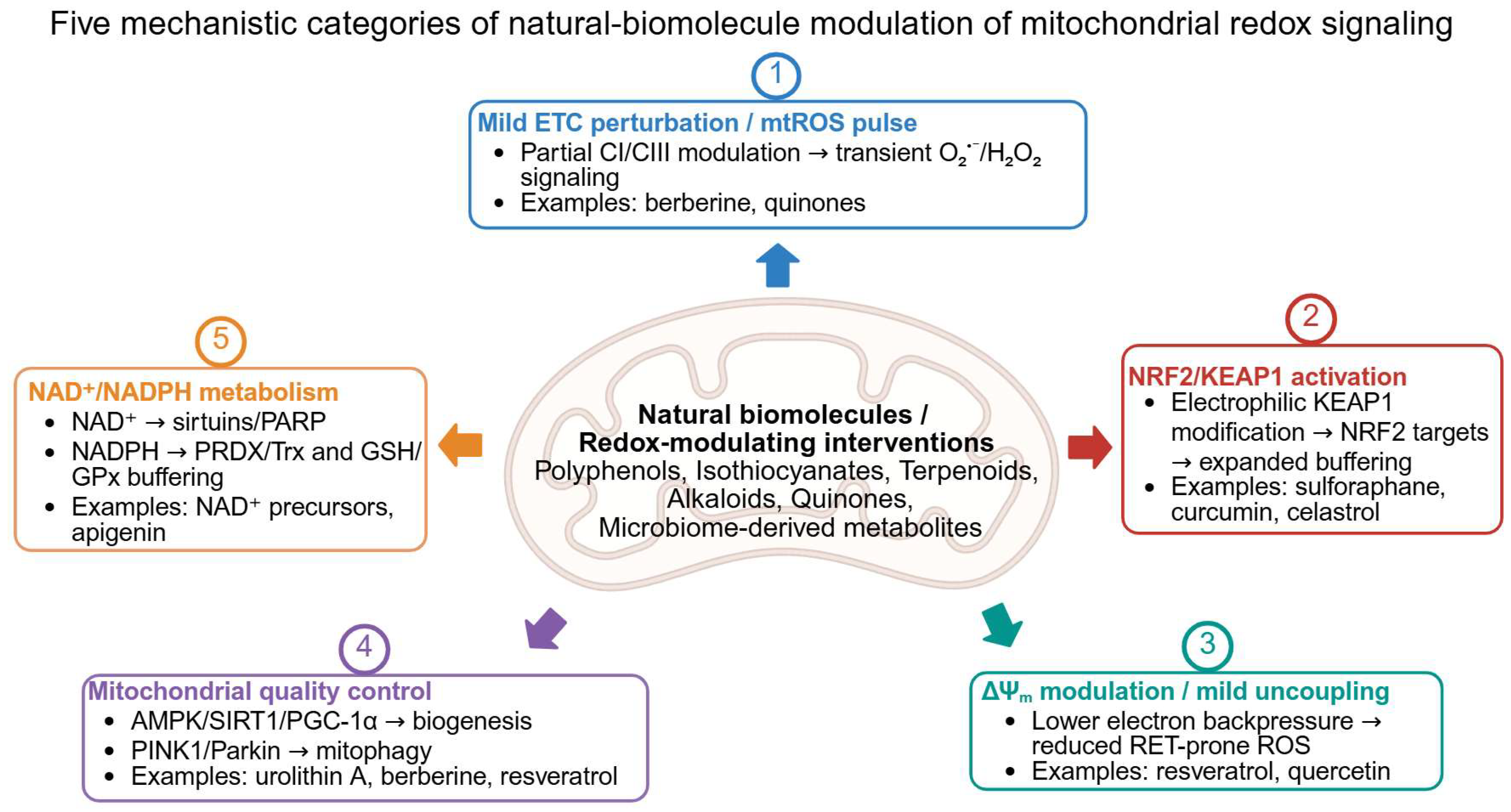
Before examining individual classes of compounds, it is useful to define the principal mechanisms by which natural biomolecules engage mitochondrial redox signaling. Based on current evidence, these mechanisms can be organized into five non-mutually exclusive categories (Figure 2).
The defining features of each category are summarized below.
  • Category 1: Mild ETC perturbation and transient mtROS pulses. Certain compounds interact with components of the ETC, most commonly Complex I or Complex III, producing a brief, controlled increase in superoxide and/or H2O2 generation [181]. When moderate and reversible, this oxidant flux can engage adaptive mitohormetic programs, including NRF2 activation, UPRmt induction, and mitophagy, without overwhelming buffering systems [182]. Representative examples include berberine, a partial Complex I inhibitor [183], and quinones that accept or shuttle electrons within the ETC [184].
  • Category 2: Electrophilic activation of the NRF2/KEAP1 axis with mitochondrial coupling. Many phytochemicals are soft electrophiles that modify reactive KEAP1 cysteine residues, enabling NRF2 nuclear translocation and ARE-driven transcription [185,186]. NRF2 activation has a mitochondrial dimension because its target genes include redox-buffering and quality-control components, including PRDX3, Trx2, TrxR2, glutathione-related enzymes, NQO1, HO-1, and mitochondrial quality-control machinery [187]. By expanding buffering capacity, electrophilic NRF2 activators can raise the PRDX3 hyperoxidation threshold and widen the eustress window [188,189]. Sulforaphane [190], curcumin [191], and several terpenoids [192] prominently engage this mechanism.
  • Category 3: Modulation of ΔΨm and mild uncoupling. Compounds that modestly reduce ΔΨm, either through weak protonophoric activity or endogenous uncoupling mechanisms, can attenuate excessive mtROS production, particularly RET-derived ROS, while maintaining adequate ATP output [57,193]. Several polyphenols, including resveratrol and quercetin, have been reported to exhibit mild uncoupling activity at low micromolar concentrations [194].
  • Category 4: Enhancement of mitochondrial quality control. By activating regulators such as AMPK, SIRT1, and PGC-1α, some natural compounds promote mitophagy, mitochondrial biogenesis, and network remodeling [195]. Over time, this can shift the mitochondrial network toward higher efficiency and lower ROS production per unit of ATP. Resveratrol, berberine, and urolithin A are prominent examples acting through SIRT1-linked signaling, AMPK activation, and mitophagy induction, respectively [196,197].
  • Category 5: Modulation of NAD+ metabolism and NADPH supply. Compounds that influence the NAD+/NADH ratio or NADPH availability affect mitohormesis by reshaping both mitochondrial signaling and buffering [198]. NAD+ precursors such as nicotinamide riboside and nicotinamide mononucleotide can support sirtuin and PARP activity and may contribute indirectly to NNT-linked NADPH regeneration [198,199]. Several plant-derived molecules also indirectly modulate NAD+ metabolism; for example, apigenin inhibits CD38, a major NAD+-consuming enzyme [200].
Most bioactive natural compounds engage more than one category (Table 2). This multi-target behavior should not be interpreted simply as nonspecificity; rather, it reflects the integrated nature of mitochondrial redox signaling and explains why compound effects depend strongly on dose, timing, metabolic state, and buffering capacity.
Although Section 4 focuses primarily on natural biomolecules, the clinical relevance of Category 2 is illustrated by omaveloxolone, a semi-synthetic oleanane triterpenoid and an NRF2 Pathway activator [231]. Omaveloxolone is approved for Friedreich ataxia in adults and adolescents aged 16 years and older, providing an important example of pharmacological modulation of redox pathways with clinical validation [232]. Its inclusion underscores that electrophilic activation of NRF2-linked adaptive programs can be therapeutically relevant, while also highlighting the need to distinguish clinically validated redox-modulating drugs from dietary or natural biomolecules whose efficacy is often supported primarily by preclinical or early human evidence [233,234].

4.2. Principal Classes of Natural Biomolecule Modulators

The main classes of natural biomolecules show how diverse compounds use limited mitochondrial redox-signaling mechanisms. Instead of exhaustive review, this section highlights examples and directs readers to Table 2 for detailed profiles.
Polyphenols and flavonoids are among the most extensively studied dietary phytochemicals with reported mitochondrial bioactivity [200,235]. This class includes stilbenes such as resveratrol, flavonols such as quercetin, flavanols such as EGCG, and curcuminoids such as curcumin. Despite structural diversity, many polyphenols contain redox-active catechol/galloyl motifs or electrophilic groups that enable redox cycling, thiol modification, and NRF2 engagement [236]. Resveratrol has been linked to AMPK/SIRT1/PGC-1α-associated mitochondrial biogenesis, fatty acid oxidation, autophagy/mitophagy, and stress-defense gene expression, although direct SIRT1 activation remains debated [201,237,238,239]. It may also modestly reduce ΔΨm and induce NRF2-dependent gene expression [194,240,241,242], but poor oral bioavailability limits straightforward clinical translation [243,244]. Quercetin similarly exhibits biphasic behavior: at low concentrations, it can support AMPK/PGC-1α-linked mitochondrial biogenesis, mild modulation of Complex I, and NRF2 signaling, whereas at higher concentrations, it can collapse Δψm, inhibit ATP synthase, deplete mitochondrial GSH, and induce apoptosis [203,204,245,246]. EGCG can inhibit Complex I and ATP synthase and activate AMPK/autophagy and NRF2-linked responses, but high-dose green tea extracts have been associated with rare cases of hepatotoxicity, underscoring dose- and exposure-dependent effects [205,247,248,249]. Curcumin, through its electrophilic α,β-unsaturated carbonyl groups, can activate NRF2/KEAP1 signaling and engage mitochondrial respiratory complexes, AMPK, SIRT1/PGC-1α, and PINK1/Parkin-associated mitophagy; however, poor bioavailability remains a major translational limitation [206,207,208,250,251,252].
Isothiocyanates provide a clearer example of electrophilic activation of NRF2/KEAP1. These compounds are generated from glucosinolates in cruciferous vegetables and readily react with nucleophilic thiolate ions [253]. Sulforaphane, produced from glucoraphanin, modifies KEAP1 sensor cysteines, classically Cys151, thereby enabling NRF2 nuclear translocation and ARE-driven transcription [209]. The mitochondrial relevance of sulforaphane lies in the NRF2-dependent expansion of glutathione and thioredoxin systems, which can support PRDX3/Trx2- and GSH/GPx/GR-dependent buffering and widen the eustress window [66]. Sulforaphane has also been linked to mitochondrial quality control and to transient increases in mtROS preceding NRF2 activation, consistent with a “trigger-then-buffer” model [182,254]. Translationally, sulforaphane is attractive because of its defined electrophilic chemistry, but internal exposure depends on food preparation, myrosinase activity, gut microbial conversion, formulation, and verification of NRF2 target engagement [255,256].
Terpenoids are structurally diverse natural products that often engage mitochondrial stress signaling, including electrophilic NRF2/KEAP1 activation, ΔΨm modulation, or mitochondrial quality-control effects [257,258]. Artemisinin derivatives illustrate the importance of chemical context: their endoperoxide bridge can undergo iron/heme-dependent activation, generating radical chemistry that may support adaptive signaling at low or transient exposure but promote oxidative distress in cells with high labile iron or limited buffering capacity [210,212,259,260]. Celastrol, a quinone methide triterpenoid, can modify KEAP1, inhibit HSP90, and alter mitochondrial bioenergetics, creating a narrow therapeutic window in which electrophilic/proteostatic signaling may become either adaptive or toxic depending on dose and buffering state [213,214,215,261,262,263,264].
Other terpenoids, including andrographolide, ursolic acid, and ginkgolide B, have been linked to NRF2 activation, AMPK/PGC-1α-associated mitochondrial biogenesis, preservation of ΔΨm, or PINK1-linked mitophagy in experimental models [75,216,217,218,219,265]. Overall, terpenoids reinforce the principle that dose, iron status, membrane environment, and redox-buffering capacity determine whether mitochondrial engagement remains hormetic or becomes damaging.
Alkaloids engage mitochondrial redox biology mainly through bioenergetic stress, AMPK activation, mitochondrial quality control, and, in some cases, NRF2 or NAD+/NADPH-linked mechanisms [266,267]. Berberine is the most prominent example: it partially inhibits Complex I, increases the AMP/ATP ratio sufficiently to activate AMPK, and has been linked to improved glucose metabolism, fatty acid oxidation, autophagy/mitophagy, and PINK1/Parkin-related quality control [183,220,221,268,269,270,271]. Its low oral bioavailability, despite reproducible metabolic effects, supports a possible gut-first mechanism involving intestinal exposure, microbiome-dependent metabolism, and bile-acid signaling. Caffeine has been associated with PGC-1α-dependent mitochondrial biogenesis and improved mitochondrial function, although its mitochondrial effects are difficult to separate from adenosine receptor antagonism and systemic neuroendocrine effects [222,272,273,274,275,276]. Piperine is most relevant as a bioavailability enhancer, particularly for curcumin, although it may also influence AMPK-linked metabolic pathways; its ability to alter drug metabolism and transporter function also raises interaction concerns [223,277,278].
Quinones and related redox-active compounds directly intersect mitochondrial electron flow because they can undergo reversible one- or two-electron reactions and influence Q-pool behavior [279,280]. CoQ10 is both an endogenous ETC component and a lipid-phase antioxidant in the inner mitochondrial membrane, where it supports electron transfer and protects membrane lipids, including cardiolipin [224,225,226,281]. In this framework, CoQ10 is best categorized as a Category 1-adjacent intervention that influences Q-pool electron transfer and the likelihood of mtROS formation, rather than as a traditional pro-hormetic stressor. Clinically, CoQ10 is relevant where deficiency or impaired Q-dependent electron transfer causes issues, like mitochondrial disorders, statin symptoms, and heart failure [282,283]. Thymoquinone illustrates biphasic quinone behavior: at low to moderate exposure, it can activate cytoprotective redox pathways, whereas at higher concentrations it can collapse ΔΨm, deplete GSH, drive oxidant flux beyond buffering capacity, and trigger apoptosis, particularly in tumor cells with limited residual buffering [227,284,285,286]. Paclitaxel is not a cytoprotective mitohormetic compound, but it is conceptually useful because its anticancer activity can involve mitochondrial ROS generation, mitochondrial permeability transition, ΔΨm loss, cytochrome c release, and caspase activation; resistance may also involve altered ROS handling and increased antioxidant capacity [228,229,230,287]. Thus, quinone-related redox biology can support either adaptive signaling or therapeutic induction of oxidative distress, depending on context.
The xenohormesis hypothesis provides an evolutionary rationale for why diverse natural biomolecules converge on conserved stress-response pathways [288]. Plants subjected to drought, UV radiation, pathogens, or nutrient limitations increase the levels of secondary metabolites such as polyphenols, terpenoids, alkaloids, and glucosinolate derivatives. When consumed, these molecules may act as external stress signals, activating pathways such as AMPK, sirtuins, NRF2, UPRmt/ISR, and mitophagy, overlapping with internal mitohormetic mechanisms. Electrophilic stress is a key point: many xenohormetic compounds, such as isothiocyanates, quinones, and α,β-unsaturated carbonyls, can modify KEAP1 sensor cysteines, similar to endogenous lipid electrophiles like 4-HNE [189,289]. Xenohormesis also helps explain the bioavailability paradox of compounds such as resveratrol and berberine, because local signaling in the gut or liver may induce mitokines or other endocrine-like mediators, including FGF21 and GDF15, even when systemic levels of the parent compound are low [290]. Microbiome metabolism adds another layer of context dependence; for example, urolithin A is produced from ellagitannins/ellagic acid in a microbiome-dependent manner and has been shown to induce mitophagy and improve mitochondrial function in preclinical models and early human studies [196,197,291]. Thus, dose, exposure pattern, microbiome metabolism, and systemic signaling determine whether natural biomolecules engage adaptive mitohormesis or shift vulnerable tissues toward distress.

5. Disease-Specific Contexts of Mitohormesis

The preceding sections established that the outcome of mtROS signaling is determined by the interplay of chemical species, sub-mitochondrial topology, temporal dynamics, buffering capacity, and metabolic state (Section 3), and that natural biomolecules can modulate this signaling at multiple nodes (Section 4). This section examines how these principles operate within specific disease contexts. A central theme is that the same mitohormetic mechanisms that promote cellular fitness in healthy tissues can become dysregulated, co-opted, or insufficient in disease states, where the eustress–distress threshold is often shifted by chronic inflammation, metabolic reprogramming, genetic vulnerability, or age-related decline in buffering capacity. Understanding these disease-specific contexts is essential for predicting when natural-biomolecule interventions are likely to engage beneficial adaptive programs and when they may risk exacerbating pathology. The discussion focuses on four disease contexts—neurodegeneration, metabolic disease, cardiovascular disease, and cancer—not because they exhaust the relevance of mitohormesis, but because they illustrate distinct ways in which disease biology reshapes the eustress–distress boundary: progressive buffering failure, nutrient-driven redox overload, acute and chronic mitochondrial stress, and tumor co-option of redox adaptation, respectively.
Table 3 summarizes the disease-specific mitohormetic landscapes discussed below, highlighting the dominant mitochondrial/redox disruptions, the direction of eustress–distress threshold shift, plausible intervention logic, representative natural biomolecules, and key translational caveats.

5.1. Neurodegeneration

Neurodegenerative diseases, including Alzheimer’s disease (AD), Parkinson’s disease (PD), amyotrophic lateral sclerosis (ALS), and Huntington’s disease (HD), share mitochondrial dysfunction as a convergent pathological feature despite differing in their primary molecular triggers [310]. The nervous system poses a uniquely challenging environment for mitohormetic signaling because neurons operate near the eustress–distress boundary even under basal conditions [311].
Several features explain this narrow neuronal eustress window. Neurons rely heavily on OxPhos and consume approximately 20% of total body oxygen despite representing only ~2% of body mass. Yet this high metabolic flux is coupled with limited antioxidant reserves, dependence on astrocyte-derived glutathione precursors, and PUFA-rich membranes vulnerable to lipid peroxidation [312]. Because neurons are post-mitotic, they cannot dilute damaged mitochondria through cell division and must maintain mitochondrial quality over decades through biogenesis, dynamics, transport, and mitophagy. Long axons further impose high demands on mitochondrial transport; disruption of this transport, as observed in AD, ALS, and HD, can cause local bioenergetic failure and increased mtROS generation at distal synapses [313]. Aging further contracts buffering capacity and reduces mitochondrial resilience, increasing the likelihood that otherwise adaptive redox signals cross into distress [314].
Disease-specific mechanisms reinforce this shift. In AD, amyloid-β oligomers impair mitochondrial respiration, interact with cyclophilin D at the mPTP, disrupt mitochondrial protein import, and elevate mtROS generation, while tau pathology impairs mitochondrial dynamics and axonal transport. APOE4 has also been linked to reduced mitochondrial respiratory efficiency [315,316]. Importantly, mitochondrial dysfunction is increasingly considered an early event in sporadic AD, potentially preceding overt amyloid pathology in at least some disease trajectories, which supports the rationale for early mitochondrial redox and quality-control interventions. In PD, PINK1 and Parkin regulate mitophagy, DJ-1 is a redox-sensitive mitochondrial protein, LRRK2 affects mitochondrial dynamics and calcium handling, and Complex I toxins such as MPTP and rotenone reproduce dopaminergic degeneration in experimental models [317,318]. In ALS, mutant SOD1 can accumulate in mitochondria and impair ETC function, while TDP-43 has been linked to altered expression of Complex I subunits [319,320].
These features suggest that the most plausible mitohormetic strategies in neurodegeneration are those that expand buffering capacity or improve mitochondrial quality control, rather than those that primarily generate additional mtROS. Sulforaphane, via NRF2 activation, has shown neuroprotective effects in models of AD, PD, and ALS [292]. Curcumin has shown protective effects in AD and PD models through NRF2 activation and mitochondrial biogenesis, although clinical translation is limited by poor bioavailability and blood–brain barrier penetration [294]. Urolithin A induces mitophagy and has shown benefit in C. elegans and murine AD models [293]. Caffeine is supported mainly by epidemiological associations with reduced PD risk and by preclinical evidence for mitochondrial biogenesis and mitophagy, although mitochondrial mechanisms are difficult to separate from adenosine receptor signaling [295].
Disease stage is a critical translational issue. In early or presymptomatic phases, when mitochondrial dysfunction is emerging but buffering reserve remains expandable, mitohormetic strategies may delay progression. In advanced disease, where mitochondrial networks are fragmented, redox buffering is exhausted, and neuroinflammation is established, the same interventions may be insufficient or destabilizing, particularly if they rely on Category 1 mtROS generation. This stage dependence argues for biomarker-guided stratification in clinical trials of natural biomolecules for neurodegeneration [321].

5.2. Metabolic Disease and Diabetes

Type 2 diabetes mellitus (T2DM), obesity, non-alcoholic fatty liver disease (NAFLD), and metabolic syndrome are interrelated conditions in which mitochondrial dysfunction and altered mtROS signaling act as both contributors to, and consequences of, disease progression. Unlike neurons, metabolic tissues such as liver, skeletal muscle, adipose tissue, and pancreatic β-cells generally possess substantial buffering capacity. However, chronic nutrient excess progressively depletes this reserve, leading to sustained oxidative stress that promotes insulin resistance, β-cell dysfunction, and hepatic steatosis [322].
Chronic caloric surplus drives pathological mtROS through converging mechanisms. Hyperglycemia increases glycolytic and TCA-cycle flux, elevates the matrix NADH/NAD+ ratio, promotes electron pressure at Complex I, and increases demand on NADPH-dependent antioxidant regeneration [323]. Excess fatty acid supply increases ETF-QO-mediated electron input into the Q pool and raises the QH2/Q ratio, favoring Q-pool over-reduction and Complex I ROS generation, including RET-derived matrix ROS, while incomplete fatty acid oxidation can generate acylcarnitines that further impair ETC function [324]. Succinate accumulation in obese adipose tissue and NAFLD hepatocytes may further promote Complex II-driven Q-pool over-reduction and RET, and elevated circulating succinate correlates with insulin resistance in T2DM [325]. Over time, sustained mtROS production depletes mitochondrial GSH, promotes PRDX3 hyperoxidation, reduces NAD+ availability through PARP activation, and establishes a feed-forward cycle of mitochondrial damage and further oxidant generation [58].
Pancreatic β-cells occupy a distinctive mitohormetic landscape because mitochondrial metabolism is central to glucose sensing. Glucose-stimulated increases in the ATP/ADP ratio trigger closure of KATP channels, membrane depolarization, Ca2+ influx, and insulin secretion. Moderate mtROS generation may contribute to this physiological signaling, whereas chronic hyperglycemia shifts the same system toward oxidative injury. Because β-cells express relatively low catalase and GPx1, they may be sensitive to H2O2 as a permissive signal for insulin secretion but vulnerable to sustained oxidative stress and apoptosis under diabetic conditions [326].
Skeletal muscle provides the clearest metabolic example of beneficial mitohormesis. Exercise transiently increases mitochondrial oxygen consumption and mtROS production, activating AMPK, PGC-1α, NRF2-dependent antioxidant programs, GLUT4 translocation, mitochondrial biogenesis, and improved insulin sensitivity. The mitohormetic nature of this response is supported by evidence that antioxidant vitamins C and E can blunt exercise-induced improvements in insulin sensitivity and mitochondrial biogenesis markers, indicating that mtROS signaling is necessary for full adaptation [327].
The metabolic disease context is favorable for natural-biomolecule interventions because target tissues are systemically accessible, buffering erosion may be reversible, and exercise and caloric restriction provide physiological precedents for mitohormesis. Berberine partially inhibits Complex I and activates AMPK, resembling an exercise-like bioenergetic stress; its glucose-lowering efficacy in T2DM is consistent with Category 1/Category 4 engagement [296]. Resveratrol shows context-dependent activity: in obese men, 30-day supplementation increased AMPK activity, elevated SIRT1 and PGC-1α protein levels, improved mitochondrial oxidative capacity, and enhanced insulin sensitivity, whereas mechanistic studies in muscle and C2C12 cells indicate that its effects are dose-dependent and not uniformly SIRT1-driven [297,298]. Sulforaphane has shown anti-diabetic effects in preclinical models and in a randomized trial of obese T2DM patients, in which broccoli sprout extract reduced fasting glucose and HbA1c, consistent with NRF2-mediated suppression of hepatic glucose production and buffering expansion [299]. Urolithin A, by inducing mitophagy and enhancing mitochondrial quality control, may help break the feed-forward cycle in which dysfunctional mitochondria generate excessive mtROS; early human data support improved muscle mitochondrial function in older sedentary adults [300].

5.3. Cardiovascular Disease

The heart is among the most mitochondria-dense organs, with mitochondria occupying approximately 30–40% of cardiomyocyte volume and supplying more than 95% of ATP required for continuous contractile activity. This dependence on OxPhos makes the myocardium both highly responsive to mitohormetic adaptation and highly vulnerable to mitochondrial distress [328].
Myocardial ischemia–reperfusion (IR) injury provides one of the clearest disease examples of the dual nature of mtROS. As discussed mechanistically in Section 3.3, ischemia promotes succinate accumulation, in part by reversing succinate dehydrogenase activity, along with adenine nucleotide depletion and altered mitochondrial membrane potential. Upon reperfusion, oxygen restoration and ETC re-energization drive rapid succinate oxidation and a burst of RET-derived superoxide at Complex I, contributing to mPTP opening, cytochrome c release, and cardiomyocyte death [142]. In contrast, ischemic preconditioning (IPC), in which brief ischemic episodes precede a sustained insult, represents a paradigmatic mitohormetic response. A controlled, transient ROS burst activates protective signaling pathways, including PKC-ε, mitochondrial ATP-sensitive potassium channels, NRF2, and HIF-1α, leading to improved calcium handling, enhanced antioxidant capacity, reduced mPTP sensitivity, and protection against subsequent prolonged IR [329]. Thus, the IPC paradigm demonstrates that cardioprotection versus cardiodestruction depends strongly on mtROS dose, duration, metabolic state, and buffering capacity.
In chronic heart failure (HF), sustained neurohormonal activation, pressure or volume overload, and substrate remodeling impose chronic stress on cardiomyocyte mitochondria. ETC complex activity declines, cardiolipin content and remodeling are disrupted, respiratory supercomplexes become destabilized, mitochondrial biogenesis and mitophagy are impaired, and CoQ10 levels may fall. Together, these changes shift the cardiomyocyte redox environment toward chronic distress, contributing to fibrosis, contractile dysfunction, and adverse remodeling [330].
Several natural-biomolecule interventions align mechanistically with this cardiovascular landscape. CoQ10 has one of the strongest clinical evidence bases among mitochondrial-targeted natural interventions: in the Q-SYMBIO trial, CoQ10 supplementation reduced major adverse cardiovascular events and cardiovascular mortality in chronic HF, consistent with restoration of Q-pool sufficiency, improved ETC efficiency, and enhanced IMM lipid antioxidant protection [301]. Resveratrol shows preclinical cardioprotection in IR, pressure overload, and doxorubicin-induced cardiotoxicity models through mechanisms involving SIRT1, AMPK, mild uncoupling, and NRF2 activation, although clinical translation remains inconsistent, likely reflecting bioavailability limitations and heterogeneity in baseline mitochondrial function [302]. Sulforaphane has shown cardioprotection in preclinical IR models, plausibly by expanding NRF2-dependent buffering capacity before injury and thereby mimicking aspects of late IPC [303]. Thymoquinone has shown preclinical benefit in IR and doxorubicin-induced cardiotoxicity models, with evidence for NRF2-mediated buffering expansion and preservation of ΔΨm and Complex I activity; however, clinical data remain limited [304,305].

5.4. Cancer: A Double-Edged Sword

Cancer represents one of the most complex disease contexts for mitohormesis. Tumor cells often exhibit elevated basal mtROS generation, altered mitochondrial metabolism, and expanded redox-buffering capacity, enabling them to tolerate oxidative pressure associated with oncogenic signaling, rapid proliferation, and metabolic rewiring. This creates a central paradox: mechanisms that protect normal cells from oxidative damage may also protect tumor cells from ROS-dependent death [331].
Cancer cells rewire mitochondrial metabolism to support biosynthesis and signaling rather than solely ATP production. Many tumors divert TCA-cycle intermediates toward lipogenesis, nucleotide synthesis, and redox balance, altering electron input into the ETC and reshaping mtROS production [332]. Mutations in SDH or fumarate hydratase lead to succinate or fumarate accumulation, stabilizing HIF-1α and modifying mtROS topology through altered Q-pool dynamics [333]. IDH1/2 mutations generate 2-hydroxyglutarate at the expense of NADPH, linking epigenetic dysregulation to altered redox-buffering capacity [334]. Complex III-derived mtROS have also been implicated in migration and metastasis through HIF-1α stabilization and matrix remodeling pathways, illustrating how mtROS topology can influence malignant behavior [335].
To survive elevated basal mtROS, many tumors upregulate redox-buffering machinery, including PRDX3, Trx2, TrxR2, glutathione biosynthesis, cystine import via xCT/SLC7A11, NADPH-generating pathways, and constitutive NRF2 signaling through KEAP1/NRF2 alterations or oncogene-driven activation. This expanded buffering allows tumor cells to maintain mtROS within a pro-survival range that supports proliferation, including through redox inhibition of PTP1B and PTEN and amplification of PI3K/Akt signaling, without crossing into apoptotic distress [336]. In this sense, cancer cells can co-opt mitohormetic machinery for survival and therapy resistance.
This co-opted landscape has direct implications for natural-biomolecule interventions. In cancer prevention, NRF2-activating compounds such as sulforaphane or curcumin may protect normal cells by expanding detoxification and redox-buffering capacity. In established tumors, however, the same buffering expansion could reinforce antioxidant defenses and contribute to chemoresistance, particularly in tumors with constitutive NRF2 activation; therefore, the prevention-versus-therapy distinction is critical [337]. Conversely, the distress arm of mtROS biology can be therapeutically exploited. Artemisinin derivatives generate iron-dependent radicals and may produce greater oxidative pressure in cancer cells with elevated labile iron or heme pools [306]. Paclitaxel-induced mitochondrial redox stress contributes to cytotoxicity, and resistance may intersect with redox-buffering logic because paclitaxel resistance has been associated with altered ROS dynamics, mitochondrial membrane potential, autophagy, and increased antioxidant capacity in tumor models [287,307]. High-dose quercetin can promote ΔΨm collapse, GSH depletion, and apoptosis in cancer models [308], while thymoquinone can similarly induce mitochondrial distress in tumor cells with limited residual buffering [309].
Thus, cancer requires a dual-phase interpretation of mitohormesis. Low-dose, buffering-expanding interventions may be most appropriate for prevention or normal-tissue protection, whereas treatment may require strategies that selectively overwhelm tumor redox buffering. This distinction demands careful dose optimization and patient stratification using biomarkers of oxidative vulnerability, including NRF2/KEAP1 status, GSH availability, SOD2 or PRDX3 expression, and mitochondrial dependence.

6. Translational Challenges and the Antioxidant Paradox

The mechanistic framework developed in Section 3, the natural-biomolecule profiles assembled in Section 4, and the disease-context analyses presented in Section 5 collectively support a compelling case for mitohormesis-based interventions. Yet clinical translation has been uneven: selected success stories, including CoQ10 in heart failure, berberine in T2DM, and sulforaphane for metabolic endpoints, coexist with a larger body of neutral or contradictory trial results, particularly for broadly acting “antioxidant” supplements. This section examines why this translational gap persists, why non-specific antioxidant strategies have often failed, and what a more rational, context-aware approach to mtROS modulation should look like.

6.1. Why Non-Specific Antioxidant Supplementation Fails

For decades, the oxidative-stress hypothesis of disease and aging predicted that exogenous antioxidants, including vitamins C and E, β-carotene, N-acetylcysteine, and selenium, should reduce oxidative damage, delay aging, and prevent chronic disease. This prediction was tested in numerous randomized controlled trials across cardiovascular disease, cancer, neurodegeneration, and all-cause mortality [338]. Overall, the results have been disappointing and, in some contexts, adverse.
Large clinical datasets illustrate this point. A Cochrane meta-analysis of 78 randomized trials involving 296,707 participants found no evidence that β-carotene, vitamin A, vitamin C, vitamin E, or selenium reduced all-cause mortality; β-carotene, vitamin A, and vitamin E were associated with increased mortality [339]. The SELECT trial reported that vitamin E did not reduce prostate cancer risk and was associated with a 17% increase in prostate cancer incidence [340]. In the ATBC trial, β-carotene increased lung cancer incidence and overall mortality in male smokers [341]. Similarly, the HOPE and HOPE-TOO trials found no cardiovascular benefit of vitamin E and suggested increased heart failure risk [342]. Finally, vitamin C and E supplementation during exercise training blunted improvements in insulin sensitivity and endogenous antioxidant responses, directly demonstrating that exogenous antioxidants can interfere with mitohormetic adaptation [48].
The mitohormetic framework explains why these outcomes are mechanistically plausible. First, non-specific scavenging can suppress adaptive eustress signals together with damaging oxidants. At physiological levels, mtROS activate NRF2, AMPK, UPRmt, mitophagy, and other adaptive pathways; broad ROS quenching may therefore reduce oxidation markers while impairing adaptive resilience [343]. Second, conventional antioxidants often operate with limited subcellular specificity. Vitamin C distributes primarily in aqueous compartments, whereas vitamin E partitions into membranes but is not selectively enriched in the mitochondrial matrix or cardiolipin-rich inner mitochondrial membrane domains. This compartmental mismatch may limit effects at key sites where mtROS are generated and decoded, including Complex I/III redox centers and matrix PRDX3/Trx2 and GSH/GPx systems [344]. Third, stoichiometric antioxidants cannot substitute for endogenous catalytic buffering systems such as PRDX3, GPx, TrxR2, and GR, which are continuously regenerated by NADPH-dependent pathways [345]. Fourth, antioxidant supplementation usually ignores context dependence. Trial populations were generally not stratified by mitochondrial function, redox-buffering capacity, age, disease stage, NADPH status, or baseline oxidative damage, even though the same intervention may be beneficial, neutral, or harmful depending on these variables [346]. Finally, some antioxidants can act as pro-oxidants under specific biochemical conditions: vitamin C can reduce Fe3+ or Cu2+ and potentially promote Fenton-type chemistry in metal-rich microenvironments, while α-tocopherol can form tocopheryl radicals if not efficiently regenerated [347]. Together, these mechanisms explain why non-specific antioxidant supplementation can fail, or even cause harm, despite the strong rationale behind the classical oxidative-stress model.

6.2. Toward Context-Aware Redox Interventions

The failure of non-specific antioxidants does not negate the therapeutic potential of redox modulation; rather, it indicates that redox interventions must account for biological context, temporal dynamics, and mitochondrial compartmentalization. The mitohormetic framework outlines several principles for rational intervention.
First, effective interventions should target the signal, rather than merely the ROS molecule. Rather than scavenging oxidants after they are produced, more rational strategies should modulate the source, timing, topology, or decoding of mtROS signals, or expand the buffering systems that determine their biological meaning. Natural biomolecules such as berberine, sulforaphane, and urolithin A illustrate this logic by engaging Complex I/AMPK signaling, NRF2-dependent buffering, and mitophagy, respectively.
Second, interventions should be matched to baseline buffering status. Category 1 compounds that mildly perturb the ETC are most likely to be beneficial when buffering capacity is intact or only moderately depleted, allowing a transient mtROS pulse to be decoded via PRDX/Trx and GSH-dependent signaling. In severely depleted systems, such as advanced neurodegeneration or end-stage heart failure, the same pulse may exceed the floodgate threshold and promote distress [108]. Conversely, NRF2 activators may be useful as preparatory or combination agents because they expand redox-buffering capacity and widen the hormetic window [348]. Pretreatment assessment of buffering status, using markers such as the GSH/GSSG ratio, peroxiredoxin hyperoxidation, thioredoxin-related markers, or NAD+ metabolomics, could support patient stratification and dose individualization [349].
Third, dosing should respect the temporal dimension of mitohormesis. Pulsatile or intermittent exposure is more likely to support adaptive remodeling than continuous exposure at the same average dose, because it preserves transient mtROS signaling while limiting chronic pathway activation. Exercise-timed administration of mild mitohormetic compounds is conceptually attractive, whereas co-administration with non-specific antioxidants may blunt exercise-induced adaptation [350]. In this context, pharmacokinetic features such as short half-life and peak–trough exposure may sometimes be advantageous because they preserve signal pulsatility.
Fourth, multi-category engagement should be leveraged rather than treated as non-specificity. Many natural biomolecules act at multiple nodes of the mitohormetic network. A compound or combination that generates a mild mtROS pulse, expands buffering capacity, and improves mitochondrial quality control may produce more durable adaptation than a single-target intervention. Such combinations remain hypotheses that require systematic testing of dose ratios, timing, and tissue-specific buffering status.
Finally, bioavailability and metabolic fate should be interpreted through a mitohormetic lens. Low systemic levels of parent compounds do not necessarily preclude biological activity if the compound acts locally in the gut or liver and triggers non-cell-autonomous signaling via mitokines, metabolites, or microbiome-dependent pathways. Microbiome-mediated bioactivation is also important; for example, ellagitannins can be converted into urolithin A, a mitophagy-inducing metabolite whose activity depends on individual metabotype [351]. Nevertheless, for diseases requiring direct target-organ exposure, such as neurodegeneration or myocardial injury, bioavailability remains a genuine constraint. Formulation strategies, prodrugs, bioavailability enhancers, and mitochondria-targeted delivery systems may therefore be necessary to translate mitohormetic mechanisms into reliable clinical effects.

6.3. Mitochondria-Targeted Redox Interventions

The compartmental mismatch problem, whereby conventional antioxidants act with limited subcellular specificity relative to the sites where mtROS are generated and decoded, has driven the development of mitochondria-targeted agents. Many of these compounds exploit the large negative membrane potential of the inner mitochondrial membrane (ΔΨm, approximately −150 to −180 mV) to accumulate within mitochondria. This strategy addresses one limitation of non-specific supplementation by delivering antioxidant, redox-modulating, or pro-hormetic payloads closer to compartments where mtROS production, buffering, and signaling are concentrated [352].
The most widely used targeting strategy conjugates bioactive molecules to lipophilic triphenylphosphonium (TPP+) cations. The delocalized positive charge of TPP+ enables membrane-potential-dependent mitochondrial accumulation, with matrix concentrations often estimated to be 100- to 1000-fold higher than cytosolic levels according to the Nernst relationship [353]. MitoQ, a TPP+-ubiquinone conjugate, is reduced to its ubiquinol form within mitochondria and can protect membrane lipids, including cardiolipin, from peroxidation. It has shown benefit in several preclinical models, although a Phase II Parkinson’s disease trial did not meet its primary endpoint despite demonstrating safety and tolerability; this negative result may reflect disease-stage limitations, insufficient target engagement, or disease-specific biology rather than simple failure of the targeting concept [344]. SkQ1, 10-(6′-plastoquinonyl)decyltriphenylphosphonium, is another TPP+-based mitochondria-targeted quinone developed by Skulachev’s group [354]. Although initially framed as a mitochondria-targeted antioxidant, some protective effects of SkQ-family compounds have also been linked to mild uncoupling and modulation of redox-dependent signaling pathways, consistent with the broader mitohormetic logic discussed here [355,356]. MitoTEMPO, a TPP+-piperidine nitroxide, functions as a mitochondria-targeted superoxide dismutase mimetic and may reduce superoxide-specific damage while preserving some H2O2-mediated signaling [357]. MitoSNO, a TPP+-S-nitrosothiol, transiently S-nitrosates Complex I during early reperfusion, slowing Complex I reactivation and reducing the RET-derived ROS burst that drives ischemia–reperfusion injury. This is mitohormetic in logic because it modulates the kinetics of ROS generation rather than simply scavenging ROS [358].
A complementary approach is represented by Szeto–Schiller (SS) peptides, including SS-31/elamipretide. Unlike TPP+ conjugates, SS peptides localize to the inner mitochondrial membrane primarily through interactions with cardiolipin rather than ΔΨm-dependent electrophoretic accumulation, which may preserve activity in depolarized or damaged mitochondria. SS-31 stabilizes cardiolipin–cytochrome c interactions, supports electron transfer, limits electron leakage, and protects cardiolipin from peroxidation, thereby helping preserve respiratory efficiency and membrane integrity [359]. Elamipretide has advanced into clinical testing in heart failure and primary mitochondrial myopathies, with mixed but informative results (reviewed in [360]).
Mitochondria-targeted natural-biomolecule conjugates extend this concept by linking known natural products to mitochondrial targeting moieties. MitoCurcumin has been reported to increase mitochondrial engagement and enhance cancer-cell cytotoxicity compared with unconjugated curcumin [361]. Mito-apigenin has shown enhanced mitochondria-directed anticancer activity in pancreatic cancer models [362]. These conjugates address bioavailability and compartmental mismatch simultaneously but introduce new challenges, including altered pharmacokinetics, potential mitochondrial overaccumulation, and dependence on ΔΨm for delivery. In severely depolarized mitochondria, TPP+-based compounds may accumulate less effectively precisely where intervention is most needed, a limitation that is partly addressed by Δψm-independent strategies such as SS peptides [363].

6.4. Redox-Based Biomarkers for Patient Stratification

A recurring theme throughout this review is that the efficacy and safety of mtROS-modulating interventions depend on baseline redox status, buffering capacity, metabolic state, and disease stage. Moving from population-level supplementation to precision redox medicine will therefore require clinically accessible biomarkers that capture these variables [364].
Several candidate biomarkers are relevant. The blood or erythrocyte GSH/GSSG ratio provides a systemic readout of glutathione redox status and may reflect aspects of cellular buffering reserve [365]. Plasma GDF15 and FGF21 can indicate mitochondrial stress in source tissues such as liver and muscle and may help determine whether mitochondrial stress-response pathways are already engaged [366]. Erythrocyte PRDX2 hyperoxidation may serve as a circulating reporter of peroxide exposure and systemic redox stress, although interpretation requires attention to erythrocyte-specific redox biology and turnover [367]. NAD+ metabolomics, including NAD+, NADH, nicotinamide, and related metabolites, can provide indirect information about the NAD+ pool available to support sirtuin activity, PARP-dependent repair, and NADPH-linked buffering pathways [368]. Classical oxidative damage markers, such as urinary 8-oxo-dG and F2-isoprostanes, remain useful when interpreted alongside buffering and mitokine markers because they help distinguish adaptive redox signaling from distress associated with macromolecular damage [369].
Validated biomarker panels integrating buffering status, mitohormetic pathway activation, mitochondrial stress signaling, and oxidative damage would substantially improve trial design. Such panels could enable patient stratification, dose individualization, and identification of disease stages in which mitohormetic interventions are most likely to be beneficial rather than neutral or harmful.

7. Future Directions

Despite substantial progress, several questions must be addressed before mitohormesis can move from a conceptual framework to a clinically operational paradigm.
First, the eustress–distress threshold remains difficult to quantify in vivo. Although this review has identified key determinants, ROS, sub-mitochondrial topology, electron-flow mode, buffering capacity, dose–time profile, and metabolic state, it is not yet possible to predict, for a given tissue or patient, which mtROS signal will be adaptive and which will be damaging. Progress will require quantitative models integrating real-time measurements of ΔΨm, compartment-specific H2O2 flux, PRDX oxidation state, GSH/GSSG ratio, NADPH availability, and downstream pathway activation.
Second, the physiological contribution of RET-derived ROS in humans remains incompletely defined. Evidence from model systems implicates RET in oxygen sensing, macrophage activation, myogenic differentiation, preconditioning, and lifespan regulation, but the extent to which RET operates as a regulated signaling mechanism in human tissues remains unresolved. Patient-derived cells, organoids, tissue-on-chip systems, and improved site-resolved redox reporters will be essential for determining when RET is adaptive, pathological, or therapeutically tunable.
Third, single-mitochondrion heterogeneity requires greater attention. Individual mitochondria within the same cell can differ in membrane potential, respiratory state, quality-control status, and likely mtROS output. Whether mitohormetic signaling reflects a population-average mitochondrial response or arises from spatially restricted signals generated by discrete mitochondrial subpopulations remains unclear. Super-resolution redox imaging and single-organelle functional assays could clarify how local mitochondrial signals are decoded at the cellular level.
Fourth, the role of the gut microbiome in systemic mitohormesis should be investigated more systematically. Microbial conversion of dietary precursors into bioactive metabolites, such as ellagitannins to urolithin A or daidzein to equol, may explain why some poorly bioavailable phytochemicals produce systemic effects. Inter-individual variation in microbiome composition and metabolite-producing capacity may therefore be a major determinant of the response to natural biomolecule interventions. Integrating metagenomics, metabolomics, and mitochondrial phenotyping into clinical studies will be essential.
Fifth, future work should determine whether mitokine signaling can be therapeutically harnessed. If mild mitochondrial stress in one tissue, such as the gut or liver, can induce FGF21, GDF15, humanin, MOTS-c, or related mediators that transmit adaptive signals systemically, then local mitohormetic activation could produce organism-wide benefits without requiring high systemic concentrations of the parent compound. However, the dose–response relationships, receptor mechanisms, tissue specificity, and risks of chronic mitokine elevation remain insufficiently understood.
Several methodological priorities follow from these unresolved questions. Site-specific and compartment-resolved mtROS reporters, including mitochondrial-targeted H2O2 sensors such as HyPer- and roGFP-based systems, should be adapted for physiologically relevant models, including organoids and tissue-on-chip platforms [370,371]. Redox reporting in natural-biomolecule studies should also be standardized, because many studies still rely on nonspecific probes, non-physiological concentrations, and incomplete characterization of baseline buffering status [372].
Preclinical studies should compare natural biomolecules using the five mechanistic categories defined in Section 4.1 across models with defined buffering capacity, age, disease state, and metabolic substrate conditions. Combination strategies should be systematically tested, particularly pairings combining a mild mtROS-generating stimulus with buffering expansion or mitochondrial quality-control support. Microbiome–mitochondria interactions should also be evaluated using defined microbial communities and standardized dietary precursor inputs.
Clinical translation will require biomarker-stratified trial designs. Trials of berberine in T2DM, sulforaphane in metabolic or neuroinflammatory endpoints, urolithin A in age-related mitochondrial decline, and CoQ10 in heart failure should incorporate baseline redox and mitochondrial stress biomarkers, including the GSH/GSSG ratio, PRDX hyperoxidation, plasma FGF21/GDF15, NAD+ metabolomics, and oxidative damage markers. Dosing studies should compare pulsatile versus continuous exposure, exercise-timed versus rest-timed administration, and fixed versus adaptive dosing schedules. In cancer, trials involving NRF2-activating compounds must distinguish prevention from treatment, because buffering expansion may protect normal cells but reinforce survival programs in established tumors with constitutive NRF2 activation.
Finally, technological development should focus on mitochondria-targeted delivery systems and disease-relevant human models. TPP+ conjugates, SS-peptide platforms, mitochondria-targeted natural-biomolecule derivatives, organ-on-chip models, and patient-derived organoids could help bridge the gap between mechanistic redox biology and clinically actionable intervention design.

8. Conclusions

Mitochondrial ROS are not intrinsically harmful or beneficial. Their biological meaning is determined by context: the chemical species produced, the sub-mitochondrial site of origin, the mode of electron flow, the temporal pattern of exposure, the capacity of local buffering systems, and the prevailing metabolic state. Together, these variables define a dynamic eustress–distress boundary that shifts with tissue type, age, disease state, and the timing of intervention.
Mitohormesis provides a coherent framework for understanding this biology. Low-to-moderate and transient mtROS signals can activate adaptive programs, including NRF2 signaling, AMPK and sirtuin pathways, UPRmt/ISR activation, mitophagy, and mitochondrial biogenesis. In contrast, excessive, sustained, or poorly buffered mtROS production promotes irreversible oxidation, lipid peroxidation, inflammation, permeability transition, and cell death. RET, redox relays, NADPH-dependent buffering, and mitochondrial quality control are therefore not peripheral details, but central determinants of whether mtROS signaling remains adaptive or becomes pathological.
This framework also reframes the biological actions of natural biomolecules. Many compounds historically described as “antioxidants” do not act primarily by stoichiometric radical scavenging at physiologically relevant exposures. Instead, polyphenols, isothiocyanates, terpenoids, alkaloids, quinones, microbiome-derived metabolites, and endogenous redox-active molecules often engage mitochondrial signaling through mild ETC perturbation, electrophilic activation of NRF2, modulation of ΔΨm, enhancement of mitochondrial quality control, or NAD+/NADPH-linked mechanisms. Their effects are therefore inherently context-dependent and frequently biphasic.
The inconsistent clinical evidence for antioxidant supplementation aligns with this view. Non-specific antioxidants can suppress adaptive eustress signals, act with limited subcellular specificity, fail to match endogenous catalytic buffering systems, and overlook inter-individual differences in redox state, disease stage, and mitochondrial function. The appropriate conclusion is not that redox-based interventions lack value, but that they must be redesigned around mitohormetic principles.
Disease context is decisive. In neurodegeneration, the narrow neuronal eustress window favors buffering expansion and mitochondrial quality control over direct mtROS-generating strategies. In metabolic disease, nutrient overload and buffering erosion create opportunities for exercise-mimetic, NRF2-activating, and mitophagy-inducing interventions. In cardiovascular disease, ischemic preconditioning provides mechanistic validation of mitohormesis, while CoQ10 provides one of the strongest clinical examples of mitochondrial redox support. In cancer, the same adaptive machinery can be co-opted by tumor cells, requiring a careful distinction between prevention, normal-tissue protection, and therapeutic induction of oxidative distress.
Future progress will depend on shifting from population-level antioxidant supplementation to context-aware, biomarker-guided, temporally optimized, and compartment-targeted redox modulation. The emerging tools—site-resolved ROS reporters, mitochondrial delivery platforms, redox biomarker panels, microbiome-informed metabolomics, and patient-derived models—make this transition increasingly feasible. The therapeutic goal is no longer simply to reduce ROS, but to tune mitochondrial redox signaling in the right direction, at the right time, in the right tissue, and for the right patient.

Author Contributions

Conceptualization, E.C. and C.P.; methodology, E.C., E.A. and C.P.; software, C.P.; validation, E.C. and C.P.; formal analysis, E.C. and C.P.; investigation, E.C., E.A. and C.P.; resources, E.C. and C.P.; data curation, E.C. and C.P.; writing—original draft preparation, E.C. and C.P.; writing—review and editing, E.C., E.A. and C.P.; visualization, E.A. and C.P.; supervision, C.P.; project administration, C.P.; funding acquisition, C.P. All authors have read and agreed to the published version of the manuscript.

Funding

This research received no external funding.

Institutional Review Board Statement

Not applicable.

Informed Consent Statement

Not applicable.

Data Availability Statement

Not applicable.

Acknowledgments

During the preparation of this manuscript, the authors used ChatGPT (OpenAI, GPT-5.4) for the purposes of improving the clarity, coherence, and grammar of this text. The authors have reviewed and edited the output and take full responsibility for the content of this publication.

Conflicts of Interest

The authors declare no conflicts of interest.

References

  1. Moura, J.P.; Oliveira, P.J.; Urbano, A.M. Mitochondria: An overview of their origin, genome, architecture, and dynamics. Biochim. Biophys. Acta Mol. Basis Dis. 2025, 1871, 167803. [Google Scholar] [CrossRef] [PubMed]
  2. Nolfi-Donegan, D.; Braganza, A.; Shiva, S. Mitochondrial electron transport chain: Oxidative phosphorylation, oxidant production, and methods of measurement. Redox Biol. 2020, 37, 101674. [Google Scholar] [CrossRef]
  3. Spinelli, J.B.; Haigis, M.C. The multifaceted contributions of mitochondria to cellular metabolism. Nat. Cell Biol. 2018, 20, 745–754. [Google Scholar] [CrossRef]
  4. Horvath, S.E.; Daum, G. Lipids of mitochondria. Prog. Lipid Res. 2013, 52, 590–614. [Google Scholar] [CrossRef]
  5. Han, M.; Bushong, E.A.; Segawa, M.; Tiard, A.; Wong, A.; Brady, M.R.; Momcilovic, M.; Wolf, D.M.; Zhang, R.; Petcherski, A.; et al. Spatial mapping of mitochondrial networks and bioenergetics in lung cancer. Nature 2023, 615, 712–719. [Google Scholar] [CrossRef]
  6. Aw, W.C.; Towarnicki, S.G.; Melvin, R.G.; Youngson, N.A.; Garvin, M.R.; Hu, Y.; Nielsen, S.; Thomas, T.; Pickford, R.; Bustamante, S.; et al. Genotype to phenotype: Diet-by-mitochondrial DNA haplotype interactions drive metabolic flexibility and organismal fitness. PLoS Genet. 2018, 14, e1007735. [Google Scholar] [CrossRef]
  7. Ryu, K.W.; Fung, T.S.; Baker, D.C.; Saoi, M.; Park, J.; Febres-Aldana, C.A.; Aly, R.G.; Cui, R.; Sharma, A.; Fu, Y.; et al. Cellular ATP demand creates metabolically distinct subpopulations of mitochondria. Nature 2024, 635, 746–754. [Google Scholar] [CrossRef]
  8. Fenton, A.R.; Jongens, T.A.; Holzbaur, E.L.F. Mitochondrial dynamics: Shaping and remodeling an organelle network. Curr. Opin. Cell Biol. 2021, 68, 28–36. [Google Scholar] [CrossRef] [PubMed]
  9. Chen, W.; Zhao, H.; Li, Y. Mitochondrial dynamics in health and disease: Mechanisms and potential targets. Signal Transduct. Target. Ther. 2023, 8, 333. [Google Scholar] [CrossRef] [PubMed]
  10. Picard, M.; Shirihai, O.S. Mitochondrial signal transduction. Cell Metab. 2022, 34, 1620–1653. [Google Scholar] [CrossRef]
  11. Ahmed Selim, N.; Wojtovich, A.P. Mitochondrial membrane potential and compartmentalized signaling: Calcium, ROS, and beyond. Redox Biol. 2025, 86, 103859. [Google Scholar] [CrossRef]
  12. Moura, J.P.; Oliveira, P.J.; Urbano, A.M. Mitochondrial classic metabolism and its often-underappreciated facets. Biochim. Biophys. Acta Mol. Basis Dis. 2025, 1871, 167839. [Google Scholar] [CrossRef] [PubMed]
  13. Checa, J.; Aran, J.M. Reactive Oxygen Species: Drivers of Physiological and Pathological Processes. J. Inflamm. Res. 2020, 13, 1057–1073. [Google Scholar] [CrossRef]
  14. Ansari, W.A.; Srivastava, K.; Nasibullah, M.; Khan, M.F. Reactive oxygen species (ROS): Sources, generation, disease pathophysiology, and antioxidants. Discov. Chem. 2025, 2, 191. [Google Scholar] [CrossRef]
  15. El-Osta, H.; Circu, M.L. Mitochondrial ROS and Apoptosis. In Mitochondrial Mechanisms of Degeneration and Repair in Parkinson’s Disease; Buhlman, L.M., Ed.; Springer International Publishing: Cham, Switzerland, 2016; pp. 1–23. [Google Scholar] [CrossRef]
  16. Ristow, M.; Schmeisser, K. Mitohormesis: Promoting Health and Lifespan by Increased Levels of Reactive Oxygen Species (ROS). Dose Response 2014, 12, 288–341. [Google Scholar] [CrossRef]
  17. Alshaabi, H.; Heininger, M.; Cunniff, B. Dynamic regulation of subcellular mitochondrial position for localized metabolite levels. J. Biochem. 2019, 167, 109–117. [Google Scholar] [CrossRef]
  18. Mukherjee, A.; Ghosh, K.K.; Chakrabortty, S.; Gulyás, B.; Padmanabhan, P.; Ball, W.B. Mitochondrial reactive oxygen species in infection and immunity. Biomolecules 2024, 14, 670. [Google Scholar] [CrossRef]
  19. Sendtner, N.; Seitz, R.; Brandl, N.; Müller, M.; Gülow, K. Reactive Oxygen Species Across Death Pathways: Gatekeepers of Apoptosis, Ferroptosis, Pyroptosis, Paraptosis, and Beyond. Int. J. Mol. Sci. 2025, 26, 10240. [Google Scholar] [CrossRef] [PubMed]
  20. Chandel, N.S. Mitochondria as signaling organelles. BMC Biol. 2014, 12, 34. [Google Scholar] [CrossRef] [PubMed]
  21. Waypa, G.B.; Smith, K.A.; Schumacker, P.T. O2 sensing, mitochondria and ROS signaling: The fog is lifting. Mol. Asp. Med. 2016, 47–48, 76–89. [Google Scholar] [CrossRef]
  22. Cheng, Y.-W.; Liu, J.; Finkel, T. Mitohormesis. Cell Metab. 2023, 35, 1872–1886. [Google Scholar] [CrossRef] [PubMed]
  23. Li, X.; Jiang, O.; Chen, M.; Wang, S. Mitochondrial homeostasis: Shaping health and disease. Curr. Med. 2024, 3, 5. [Google Scholar] [CrossRef]
  24. Kim, K.H.; Lee, C.B. Socialized mitochondria: Mitonuclear crosstalk in stress. Exp. Mol. Med. 2024, 56, 1033–1042. [Google Scholar] [CrossRef]
  25. Arnold, P.K.; Finley, L.W.S. Regulation and function of the mammalian tricarboxylic acid cycle. J. Biol. Chem. 2023, 299, 102838. [Google Scholar] [CrossRef]
  26. Forman, H.J.; Davies, K.J.; Ursini, F. How do nutritional antioxidants really work: Nucleophilic tone and para-hormesis versus free radical scavenging in vivo. Free Radic. Biol. Med. 2014, 66, 24–35. [Google Scholar] [CrossRef]
  27. Ristow, M.; Zarse, K. How increased oxidative stress promotes longevity and metabolic health: The concept of mitochondrial hormesis (mitohormesis). Exp. Gerontol. 2010, 45, 410–418. [Google Scholar] [CrossRef]
  28. Steinhubl, S.R. Why have antioxidants failed in clinical trials? Am. J. Cardiol. 2008, 101, S14–S19. [Google Scholar] [CrossRef]
  29. Cammisotto, V.; Nocella, C.; Bartimoccia, S.; Sanguigni, V.; Francomano, D.; Sciarretta, S.; Pastori, D.; Peruzzi, M.; Cavarretta, E.; D’Amico, A.; et al. The Role of Antioxidants Supplementation in Clinical Practice: Focus on Cardiovascular Risk Factors. Antioxidants 2021, 10, 146. [Google Scholar] [CrossRef] [PubMed]
  30. Yun, J.; Finkel, T. Mitohormesis. Cell Metab. 2014, 19, 757–766. [Google Scholar] [CrossRef]
  31. Mattson, M.P. Hormesis defined. Ageing Res. Rev. 2008, 7, 1–7. [Google Scholar] [CrossRef] [PubMed]
  32. Cavezzi, A.; Colucci, R.; d’Errico, G. Mitoresilience: Hormesis, Psycho-physical Resilience, Mitochondria and Heart Rate Variability as Relevant Interplaying Elements in Longevity Medicine. Curr. Aging Sci. 2023, 16, 25–32. [Google Scholar] [CrossRef] [PubMed]
  33. Bárcena, C.; Mayoral, P.; Quirós, P.M. Mitohormesis, an Antiaging Paradigm. Int. Rev. Cell Mol. Biol. 2018, 340, 35–77. [Google Scholar] [CrossRef]
  34. Franceschi, C.; Garagnani, P.; Morsiani, C.; Conte, M.; Santoro, A.; Grignolio, A.; Monti, D.; Capri, M.; Salvioli, S. The Continuum of Aging and Age-Related Diseases: Common Mechanisms but Different Rates. Front. Med. 2018, 5, 61. [Google Scholar] [CrossRef]
  35. Li, Z.; Zhang, Z.; Ren, Y.; Wang, Y.; Fang, J.; Yue, H.; Ma, S.; Guan, F. Aging and age-related diseases: From mechanisms to therapeutic strategies. Biogerontology 2021, 22, 165–187. [Google Scholar] [CrossRef]
  36. Chang, A.Y.; Skirbekk, V.F.; Tyrovolas, S.; Kassebaum, N.J.; Dieleman, J.L. Measuring population ageing: An analysis of the Global Burden of Disease Study 2017. Lancet Public Health 2019, 4, e159–e167. [Google Scholar] [CrossRef]
  37. Li, Y.; Berliocchi, L.; Li, Z.; Rasmussen, L.J. Interactions between mitochondrial dysfunction and other hallmarks of aging: Paving a path toward interventions that promote healthy old age. Aging Cell 2024, 23, e13942. [Google Scholar] [CrossRef] [PubMed]
  38. Ye, L.; Fu, X.; Li, Q. Mitochondrial Quality Control in Health and Disease. MedComm 2025, 6, e70319. [Google Scholar] [CrossRef]
  39. Gunawan, A.L.; Liparulo, I.; Stahl, A. Mammalian mitohormesis: From mitochondrial stressors to organismal benefits. EMBO J. 2025, 44, 5640–5661. [Google Scholar] [CrossRef]
  40. Zhao, R.Z.; Jiang, S.; Zhang, L.; Yu, Z.B. Mitochondrial electron transport chain, ROS generation and uncoupling (Review). Int. J. Mol. Med. 2019, 44, 3–15. [Google Scholar] [CrossRef] [PubMed]
  41. Harman, D. Aging: A theory based on free radical and radiation chemistry. J. Gerontol. 1956, 11, 298–300. [Google Scholar] [CrossRef] [PubMed]
  42. Harman, D. The Biologic Clock: The Mitochondria? J. Am. Geriatr. Soc. 1972, 20, 145–147. [Google Scholar] [CrossRef]
  43. Sies, H. Oxidative Stress; Academic Press: San Diego, CA, USA, 1985; pp. 1–8. [Google Scholar]
  44. Dai, X.; Hu, M.; Lyu, R. Move beyond free radical theory of aging. iMetaOmics 2026, 3, e70079. [Google Scholar] [CrossRef]
  45. Bjelakovic, G.; Nikolova, D.; Gluud, L.L.; Simonetti, R.G.; Gluud, C. Mortality in randomized trials of antioxidant supplements for primary and secondary prevention: Systematic review and meta-analysis. JAMA 2007, 297, 842–857. [Google Scholar] [CrossRef] [PubMed]
  46. Lin, J.; Cook, N.R.; Albert, C.; Zaharris, E.; Gaziano, J.M.; Van Denburgh, M.; Buring, J.E.; Manson, J.E. Vitamins C and E and beta carotene supplementation and cancer risk: A randomized controlled trial. J. Natl. Cancer Inst. 2009, 101, 14–23. [Google Scholar] [CrossRef]
  47. Age-Related Eye Disease Study Research Group. A Randomized, Placebo-Controlled, Clinical Trial of High-Dose Supplementation with Vitamins C and E and Beta Carotene for Age-Related Cataract and Vision Loss: AREDS Report No. 9. Arch. Ophthalmol. 2001, 119, 1439–1452. [Google Scholar] [CrossRef]
  48. Ristow, M.; Zarse, K.; Oberbach, A.; Klöting, N.; Birringer, M.; Kiehntopf, M.; Stumvoll, M.; Kahn, C.R.; Blüher, M. Antioxidants prevent health-promoting effects of physical exercise in humans. Proc. Natl. Acad. Sci. USA 2009, 106, 8665–8670. [Google Scholar] [CrossRef]
  49. Munkácsy, E.; Rea, S.L. The paradox of mitochondrial dysfunction and extended longevity. Exp. Gerontol. 2014, 56, 221–233. [Google Scholar] [CrossRef] [PubMed]
  50. Giorgi, C.; Marchi, S.; Simoes, I.C.M.; Ren, Z.; Morciano, G.; Perrone, M.; Patalas-Krawczyk, P.; Borchard, S.; Jędrak, P.; Pierzynowska, K.; et al. Mitochondria and Reactive Oxygen Species in Aging and Age-Related Diseases. Int. Rev. Cell Mol. Biol. 2018, 340, 209–344. [Google Scholar] [CrossRef] [PubMed]
  51. Guan, Y.; Yan, Z. Molecular Mechanisms of Exercise and Healthspan. Cells 2022, 11, 872. [Google Scholar] [CrossRef] [PubMed]
  52. Weinberg, S.E.; Chandel, N.S. Mitochondria reactive oxygen species signaling in immune responses. Immunity 2025, 58, 1904–1921. [Google Scholar] [CrossRef]
  53. Tapia, P.C. Sublethal mitochondrial stress with an attendant stoichiometric augmentation of reactive oxygen species may precipitate many of the beneficial alterations in cellular physiology produced by caloric restriction, intermittent fasting, exercise and dietary phytonutrients: “Mitohormesis” for health and vitality. Med. Hypotheses 2006, 66, 832–843. [Google Scholar] [CrossRef]
  54. Sies, H. Hydrogen peroxide as a central redox signaling molecule in physiological oxidative stress: Oxidative eustress. Redox Biol. 2017, 11, 613–619. [Google Scholar] [CrossRef]
  55. Palmeira, C.M.; Teodoro, J.S.; Amorim, J.A.; Steegborn, C.; Sinclair, D.A.; Rolo, A.P. Mitohormesis and metabolic health: The interplay between ROS, cAMP and sirtuins. Free Radic. Biol. Med. 2019, 141, 483–491. [Google Scholar] [CrossRef]
  56. Tovar-Ferrero, O.; Rubio, J.; Zorzano, A.; Martínez-Corrales, G.; Liesa, M. Measuring mitochondrial membrane potential. EMBO J. 2025, 44, 7334–7345. [Google Scholar] [CrossRef] [PubMed]
  57. Demine, S.; Renard, P.; Arnould, T. Mitochondrial Uncoupling: A Key Controller of Biological Processes in Physiology and Diseases. Cells 2019, 8, 795. [Google Scholar] [CrossRef]
  58. Zorov, D.B.; Juhaszova, M.; Sollott, S.J. Mitochondrial reactive oxygen species (ROS) and ROS-induced ROS release. Physiol. Rev. 2014, 94, 909–950. [Google Scholar] [CrossRef]
  59. Mills, E.L.; Kelly, B.; Logan, A.; Costa, A.S.H.; Varma, M.; Bryant, C.E.; Tourlomousis, P.; Däbritz, J.H.M.; Gottlieb, E.; Latorre, I.; et al. Succinate Dehydrogenase Supports Metabolic Repurposing of Mitochondria to Drive Inflammatory Macrophages. Cell 2016, 167, 457–470.e413. [Google Scholar] [CrossRef]
  60. Scialò, F.; Sriram, A.; Fernández-Ayala, D.; Gubina, N.; Lõhmus, M.; Nelson, G.; Logan, A.; Cooper, H.M.; Navas, P.; Enríquez, J.A.; et al. Mitochondrial ROS Produced via Reverse Electron Transport Extend Animal Lifespan. Cell Metab. 2016, 23, 725–734. [Google Scholar] [CrossRef] [PubMed]
  61. D’Souza, A.R.; Minczuk, M. Mitochondrial transcription and translation: Overview. Essays Biochem. 2018, 62, 309–320. [Google Scholar] [CrossRef]
  62. Reczek, C.R.; Chandel, N.S. ROS-dependent signal transduction. Curr. Opin. Cell Biol. 2015, 33, 8–13. [Google Scholar] [CrossRef]
  63. Matilainen, O.; Quirós, P.M.; Auwerx, J. Mitochondria and Epigenetics—Crosstalk in Homeostasis and Stress. Trends Cell Biol. 2017, 27, 453–463. [Google Scholar] [CrossRef] [PubMed]
  64. Shpilka, T.; Haynes, C.M. The mitochondrial UPR: Mechanisms, physiological functions and implications in ageing. Nat. Rev. Mol. Cell Biol. 2018, 19, 109–120. [Google Scholar] [CrossRef] [PubMed]
  65. West, A.P.; Khoury-Hanold, W.; Staron, M.; Tal, M.C.; Pineda, C.M.; Lang, S.M.; Bestwick, M.; Duguay, B.A.; Raimundo, N.; MacDuff, D.A.; et al. Mitochondrial DNA stress primes the antiviral innate immune response. Nature 2015, 520, 553–557. [Google Scholar] [CrossRef]
  66. Dinkova-Kostova, A.T.; Abramov, A.Y. The emerging role of Nrf2 in mitochondrial function. Free Radic. Biol. Med. 2015, 88, 179–188. [Google Scholar] [CrossRef] [PubMed]
  67. Herzig, S.; Shaw, R.J. AMPK: Guardian of metabolism and mitochondrial homeostasis. Nat. Rev. Mol. Cell Biol. 2018, 19, 121–135. [Google Scholar] [CrossRef]
  68. Sauve, A.A.; Youn, D.Y. Sirtuins: NAD+-dependent deacetylase mechanism and regulation. Curr. Opin. Chem. Biol. 2012, 16, 535–543. [Google Scholar] [CrossRef]
  69. Verdin, E. NAD+ in aging, metabolism, and neurodegeneration. Science 2015, 350, 1208–1213. [Google Scholar] [CrossRef]
  70. Boos, F.; Krämer, L.; Groh, C.; Jung, F.; Haberkant, P.; Stein, F.; Wollweber, F.; Gackstatter, A.; Zöller, E.; van der Laan, M.; et al. Mitochondrial protein-induced stress triggers a global adaptive transcriptional programme. Nat. Cell Biol. 2019, 21, 442–451. [Google Scholar] [CrossRef] [PubMed]
  71. Anderson, N.S.; Haynes, C.M. Folding the Mitochondrial UPR into the Integrated Stress Response. Trends Cell Biol. 2020, 30, 428–439. [Google Scholar] [CrossRef]
  72. Narendra, D.P.; Youle, R.J. The role of PINK1–Parkin in mitochondrial quality control. Nat. Cell Biol. 2024, 26, 1639–1651. [Google Scholar] [CrossRef]
  73. Guan, G.; Chen, Y.; Dong, Y. Unraveling the AMPK-SIRT1-FOXO Pathway: The In-Depth Analysis and Breakthrough Prospects of Oxidative Stress-Induced Diseases. Antioxidants 2025, 14, 70. [Google Scholar] [CrossRef]
  74. Mo, C.; Wang, L.; Zhang, J.; Numazawa, S.; Tang, H.; Tang, X.; Han, X.; Li, J.; Yang, M.; Wang, Z.; et al. The crosstalk between Nrf2 and AMPK signal pathways is important for the anti-inflammatory effect of berberine in LPS-stimulated macrophages and endotoxin-shocked mice. Antioxid. Redox Signal. 2014, 20, 574–588. [Google Scholar] [CrossRef]
  75. Gureev, A.P.; Shaforostova, E.A.; Popov, V.N. Regulation of Mitochondrial Biogenesis as a Way for Active Longevity: Interaction Between the Nrf2 and PGC-1α Signaling Pathways. Front. Genet. 2019, 10, 435. [Google Scholar] [CrossRef] [PubMed]
  76. Schulz, T.J.; Zarse, K.; Voigt, A.; Urban, N.; Birringer, M.; Ristow, M. Glucose Restriction Extends Caenorhabditis elegans Life Span by Inducing Mitochondrial Respiration and Increasing Oxidative Stress. Cell Metab. 2007, 6, 280–293. [Google Scholar] [CrossRef] [PubMed]
  77. Mottis, A.; Herzig, S.; Auwerx, J. Mitocellular communication: Shaping health and disease. Science 2019, 366, 827–832. [Google Scholar] [CrossRef]
  78. Zhang, B.; Chang, J.Y.; Lee, M.H.; Ju, S.H.; Yi, H.S.; Shong, M. Mitochondrial Stress and Mitokines: Therapeutic Perspectives for the Treatment of Metabolic Diseases. Diabetes Metab. J. 2024, 48, 1–18. [Google Scholar] [CrossRef]
  79. Chen, L.-T.; Lin, C.-T.; Lin, L.-Y.; Hsu, J.-M.; Wu, Y.-C.; Pan, C.-L. Neuronal mitochondrial dynamics coordinate systemic mitochondrial morphology and stress response to confer pathogen resistance in C. elegans. Dev. Cell 2021, 56, 1770–1785.e1712. [Google Scholar] [CrossRef]
  80. Durieux, J.; Wolff, S.; Dillin, A. The cell-non-autonomous nature of electron transport chain-mediated longevity. Cell 2011, 144, 79–91. [Google Scholar] [CrossRef] [PubMed]
  81. Wan, W.; Zhang, L.; Lin, Y.; Rao, X.; Wang, X.; Hua, F.; Ying, J. Mitochondria-derived peptide MOTS-c: Effects and mechanisms related to stress, metabolism and aging. J. Transl. Med. 2023, 21, 36. [Google Scholar] [CrossRef]
  82. Dan Dunn, J.; Alvarez, L.A.J.; Zhang, X.; Soldati, T. Reactive oxygen species and mitochondria: A nexus of cellular homeostasis. Redox Biol. 2015, 6, 472–485. [Google Scholar] [CrossRef]
  83. Scialò, F.; Fernández-Ayala, D.J.; Sanz, A. Role of Mitochondrial Reverse Electron Transport in ROS Signaling: Potential Roles in Health and Disease. Front. Physiol. 2017, 8, 428. [Google Scholar] [CrossRef]
  84. Hamanaka, R.B.; Chandel, N.S. Mitochondrial reactive oxygen species regulate cellular signaling and dictate biological outcomes. Trends Biochem. Sci. 2010, 35, 505–513. [Google Scholar] [CrossRef] [PubMed]
  85. Brand, M.D. Mitochondrial generation of superoxide and hydrogen peroxide as the source of mitochondrial redox signaling. Free Radic. Biol. Med. 2016, 100, 14–31. [Google Scholar] [CrossRef]
  86. Muller, F.L.; Liu, Y.; Van Remmen, H. Complex III Releases Superoxide to Both Sides of the Inner Mitochondrial Membrane. J. Biol. Chem. 2004, 279, 49064–49073. [Google Scholar] [CrossRef]
  87. Gardner, P.R.; Raineri, I.; Epstein, L.B.; White, C.W. Superoxide radical and iron modulate aconitase activity in mammalian cells. J. Biol. Chem. 1995, 270, 13399–13405. [Google Scholar] [CrossRef]
  88. Almasalmeh, A.; Krenc, D.; Wu, B.; Beitz, E. Structural determinants of the hydrogen peroxide permeability of aquaporins. FEBS J. 2014, 281, 647–656. [Google Scholar] [CrossRef] [PubMed]
  89. Muranov, K.O. Fenton Reaction in vivo and in vitro. Possibilities and Limitations. Biochemistry 2024, 89, S112–S126. [Google Scholar] [CrossRef] [PubMed]
  90. Halliwell, B.; Adhikary, A.; Dingfelder, M.; Dizdaroglu, M. Hydroxyl radical is a significant player in oxidative DNA damage in vivo. Chem. Soc. Rev. 2021, 50, 8355–8360. [Google Scholar] [CrossRef]
  91. Falabella, M.; Vernon, H.J.; Hanna, M.G.; Claypool, S.M.; Pitceathly, R.D.S. Cardiolipin, Mitochondria, and Neurological Disease. Trends Endocrinol. Metab. 2021, 32, 224–237. [Google Scholar] [CrossRef]
  92. Gao, Q.; Zhang, G.; Zheng, Y.; Yang, Y.; Chen, C.; Xia, J.; Liang, L.; Lei, C.; Hu, Y.; Cai, X.; et al. SLC27A5 deficiency activates NRF2/TXNRD1 pathway by increased lipid peroxidation in HCC. Cell Death Differ. 2020, 27, 1086–1104. [Google Scholar] [CrossRef]
  93. Murphy, M.P. How mitochondria produce reactive oxygen species. Biochem. J. 2009, 417, 1–13. [Google Scholar] [CrossRef]
  94. Winterbourn, C.C. Biological chemistry of superoxide radicals. ChemTexts 2020, 6, 7. [Google Scholar] [CrossRef]
  95. Powers, S.K.; Ji, L.L.; Kavazis, A.N.; Jackson, M.J. Reactive oxygen species: Impact on skeletal muscle. Compr. Physiol. 2011, 1, 941–969. [Google Scholar] [CrossRef]
  96. Scandroglio, F.; Tórtora, V.; Radi, R.; Castro, L. Metabolic control analysis of mitochondrial aconitase: Influence over respiration and mitochondrial superoxide and hydrogen peroxide production. Free Radic. Res. 2014, 48, 684–693. [Google Scholar] [CrossRef] [PubMed]
  97. Imlay, J.A. Pathways of Oxidative Damage. Annu. Rev. Microbiol. 2003, 57, 395–418. [Google Scholar] [CrossRef] [PubMed]
  98. Andrés, C.M.C.; Pérez de la Lastra, J.M.; Andrés Juan, C.; Plou, F.J.; Pérez-Lebeña, E. Superoxide Anion Chemistry—Its Role at the Core of the Innate Immunity. Int. J. Mol. Sci. 2023, 24, 1841. [Google Scholar] [CrossRef] [PubMed]
  99. Fridovich, I. Superoxide and the Superoxide Dismutases: An Introduction by Irwin Fridovich. In Redox-Active Therapeutics; Batinić-Haberle, I., Rebouças, J.S., Spasojević, I., Eds.; Springer International Publishing: Cham, Switzerland, 2016; pp. 1–4. [Google Scholar] [CrossRef]
  100. Fukai, T.; Ushio-Fukai, M. Superoxide dismutases: Role in redox signaling, vascular function, and diseases. Antioxid. Redox Signal. 2011, 15, 1583–1606. [Google Scholar] [CrossRef] [PubMed]
  101. Hoehne, M.N.; Jacobs, L.; Lapacz, K.J.; Calabrese, G.; Murschall, L.M.; Marker, T.; Kaul, H.; Trifunovic, A.; Morgan, B.; Fricker, M.; et al. Spatial and temporal control of mitochondrial H2O2 release in intact human cells. EMBO J. 2022, 41, e109169. [Google Scholar] [CrossRef]
  102. Di Marzo, N.; Chisci, E.; Giovannoni, R. The Role of Hydrogen Peroxide in Redox-Dependent Signaling: Homeostatic and Pathological Responses in Mammalian Cells. Cells 2018, 7, 156. [Google Scholar] [CrossRef]
  103. Holmström, K.M.; Finkel, T. Cellular mechanisms and physiological consequences of redox-dependent signalling. Nat. Rev. Mol. Cell Biol. 2014, 15, 411–421. [Google Scholar] [CrossRef]
  104. Nelson, K.J.; Bolduc, J.A.; Wu, H.; Collins, J.A.; Burke, E.A.; Reisz, J.A.; Klomsiri, C.; Wood, S.T.; Yammani, R.R.; Poole, L.B.; et al. H2O2 oxidation of cysteine residues in c-Jun N-terminal kinase 2 (JNK2) contributes to redox regulation in human articular chondrocytes. J. Biol. Chem. 2018, 293, 16376–16389. [Google Scholar] [CrossRef]
  105. Woo, H.A.; Jeong, W.; Chang, T.-S.; Park, K.J.; Park, S.J.; Yang, J.S.; Rhee, S.G. Reduction of Cysteine Sulfinic Acid by Sulfiredoxin Is Specific to 2-Cys Peroxiredoxins. J. Biol. Chem. 2005, 280, 3125–3128. [Google Scholar] [CrossRef]
  106. Trinh, V.H.; Nguyen Huu, T.; Sah, D.K.; Choi, J.M.; Yoon, H.J.; Park, S.C.; Jung, Y.S.; Lee, S.-R. Redox Regulation of PTEN by Reactive Oxygen Species: Its Role in Physiological Processes. Antioxidants 2024, 13, 199. [Google Scholar] [CrossRef]
  107. Rhee, S.G.; Woo, H.A.; Kang, D. The Role of Peroxiredoxins in the Transduction of H2O2 Signals. Antioxid. Redox Signal. 2018, 28, 537–557. [Google Scholar] [CrossRef]
  108. Netto, L.E.; Antunes, F. The Roles of Peroxiredoxin and Thioredoxin in Hydrogen Peroxide Sensing and in Signal Transduction. Mol. Cells 2016, 39, 65–71. [Google Scholar] [CrossRef]
  109. Gomes, F.; Turano, H.; Haddad, L.A.; Netto, L.E.S. Human mitochondrial peroxiredoxin Prdx3 is dually localized in the intermembrane space and matrix subcompartments. Redox Biol. 2024, 78, 103436. [Google Scholar] [CrossRef]
  110. Barrera, G.; Pizzimenti, S.; Daga, M.; Dianzani, C.; Arcaro, A.; Cetrangolo, G.P.; Giordano, G.; Cucci, M.A.; Graf, M.; Gentile, F. Lipid Peroxidation-Derived Aldehydes, 4-Hydroxynonenal and Malondialdehyde in Aging-Related Disorders. Antioxidants 2018, 7, 102. [Google Scholar] [CrossRef]
  111. Ayala, A.; Muñoz, M.F.; Argüelles, S. Lipid peroxidation: Production, metabolism, and signaling mechanisms of malondialdehyde and 4-hydroxy-2-nonenal. Oxid. Med. Cell. Longev. 2014, 2014, 360438. [Google Scholar] [CrossRef]
  112. Fiorucci, L.; Erba, F.; Santucci, R.; Sinibaldi, F. Cytochrome c Interaction with Cardiolipin Plays a Key Role in Cell Apoptosis: Implications for Human Diseases. Symmetry 2022, 14, 767. [Google Scholar] [CrossRef]
  113. Bhattacharjee, S.; Dashwood, R.H. Epigenetic Regulation of NRF2/KEAP1 by Phytochemicals. Antioxidants 2020, 9, 865. [Google Scholar] [CrossRef]
  114. Larosa, V.; Remacle, C. Insights into the respiratory chain and oxidative stress. Biosci. Rep. 2018, 38, BSR20171492. [Google Scholar] [CrossRef]
  115. Guzy, R.D.; Schumacker, P.T. Oxygen sensing by mitochondria at complex III: The paradox of increased reactive oxygen species during hypoxia. Exp. Physiol. 2006, 91, 807–819. [Google Scholar] [CrossRef]
  116. McMinimy, R.; Manford, A.G.; Gee, C.L.; Chandrasekhar, S.; Mousa, G.A.; Chuang, J.; Phu, L.; Shih, K.Y.; Rose, C.M.; Kuriyan, J.; et al. Reactive oxygen species control protein degradation at the mitochondrial import gate. Mol. Cell 2024, 84, 4612–4628.e4613. [Google Scholar] [CrossRef]
  117. Kisty, E.A.; Falco, J.A.; Weerapana, E. Redox proteomics combined with proximity labeling enables monitoring of localized cysteine oxidation in cells. Cell Chem. Biol. 2023, 30, 321–336.e326. [Google Scholar] [CrossRef]
  118. Onukwufor, J.O.; Berry, B.J.; Wojtovich, A.P. Physiologic Implications of Reactive Oxygen Species Production by Mitochondrial Complex I Reverse Electron Transport. Antioxidants 2019, 8, 285. [Google Scholar] [CrossRef]
  119. Wikström, M.; Sharma, V.; Kaila, V.R.I.; Hosler, J.P.; Hummer, G. New Perspectives on Proton Pumping in Cellular Respiration. Chem. Rev. 2015, 115, 2196–2221. [Google Scholar] [CrossRef]
  120. Okoye, C.N.; Koren, S.A.; Wojtovich, A.P. Mitochondrial complex I ROS production and redox signaling in hypoxia. Redox Biol. 2023, 67, 102926. [Google Scholar] [CrossRef] [PubMed]
  121. Korge, P.; John, S.A.; Calmettes, G.; Weiss, J.N. Reactive oxygen species production induced by pore opening in cardiac mitochondria: The role of complex II. J. Biol. Chem. 2017, 292, 9896–9905. [Google Scholar] [CrossRef] [PubMed]
  122. Lanciano, P.; Khalfaoui-Hassani, B.; Selamoglu, N.; Ghelli, A.; Rugolo, M.; Daldal, F. Molecular mechanisms of superoxide production by complex III: A bacterial versus human mitochondrial comparative case study. Biochim. Biophys. Acta 2013, 1827, 1332–1339. [Google Scholar] [CrossRef] [PubMed]
  123. Tretter, L.; Adam-Vizi, V. Generation of reactive oxygen species in the reaction catalyzed by alpha-ketoglutarate dehydrogenase. J. Neurosci. 2004, 24, 7771–7778. [Google Scholar] [CrossRef]
  124. Quinlan, C.L.; Perevoshchikova, I.V.; Hey-Mogensen, M.; Orr, A.L.; Brand, M.D. Sites of reactive oxygen species generation by mitochondria oxidizing different substrates. Redox Biol. 2013, 1, 304–312. [Google Scholar] [CrossRef]
  125. Mráček, T.; Drahota, Z.; Houštěk, J. The function and the role of the mitochondrial glycerol-3-phosphate dehydrogenase in mammalian tissues. Biochim. Biophys. Acta-Bioenerg. 2013, 1827, 401–410. [Google Scholar] [CrossRef]
  126. St-Pierre, J.; Buckingham, J.A.; Roebuck, S.J.; Brand, M.D. Topology of Superoxide Production from Different Sites in the Mitochondrial Electron Transport Chain. J. Biol. Chem. 2002, 277, 44784–44790. [Google Scholar] [CrossRef]
  127. Mailloux, R.J. Proline and dihydroorotate dehydrogenase promote a hyper-proliferative state and dampen ferroptosis in cancer cells by rewiring mitochondrial redox metabolism. Biochim. Biophys. Acta-Mol. Cell Res. 2024, 1871, 119639. [Google Scholar] [CrossRef]
  128. Kaludercic, N.; Arusei, R.J.; Di Lisa, F. Recent advances on the role of monoamine oxidases in cardiac pathophysiology. Basic Res. Cardiol. 2023, 118, 41. [Google Scholar] [CrossRef]
  129. den Brave, F.; Becker, T. Supercomplex formation boosts respiration. EMBO Rep. 2020, 21, e51830. [Google Scholar] [CrossRef]
  130. Guan, S.; Zhao, L.; Peng, R. Mitochondrial Respiratory Chain Supercomplexes: From Structure to Function. Int. J. Mol. Sci. 2022, 23, 13880. [Google Scholar] [CrossRef]
  131. Iverson, T.M.; Singh, P.K.; Cecchini, G. An evolving view of complex II—Noncanonical complexes, megacomplexes, respiration, signaling, and beyond. J. Biol. Chem. 2023, 299, 104761. [Google Scholar] [CrossRef] [PubMed]
  132. Stroh, A.; Anderka, O.; Pfeiffer, K.; Yagi, T.; Finel, M.; Ludwig, B.; Schägger, H. Assembly of Respiratory Complexes I, III, and IV into NADH Oxidase Supercomplex Stabilizes Complex I in Paracoccus denitrificans. J. Biol. Chem. 2004, 279, 5000–5007. [Google Scholar] [CrossRef] [PubMed]
  133. Maranzana, E.; Barbero, G.; Falasca, A.I.; Lenaz, G.; Genova, M.L. Mitochondrial respiratory supercomplex association limits production of reactive oxygen species from complex I. Antioxid. Redox Signal. 2013, 19, 1469–1480. [Google Scholar] [CrossRef] [PubMed]
  134. Oemer, G.; Lackner, K.; Muigg, K.; Krumschnabel, G.; Watschinger, K.; Sailer, S.; Lindner, H.; Gnaiger, E.; Wortmann, S.B.; Werner, E.R.; et al. Molecular structural diversity of mitochondrial cardiolipins. Proc. Natl. Acad. Sci. USA 2018, 115, 4158–4163. [Google Scholar] [CrossRef]
  135. Bao, Y.; Hu, C.; Wang, B.; Liu, X.; Wu, Q.; Xu, D.; Shi, Z.; Sun, C. Mitochondrial Reverse Electron Transport: Mechanisms, Pathophysiological Roles, and Therapeutic Potential. Biology 2025, 14, 1140. [Google Scholar] [CrossRef]
  136. Brandt, U. Energy converting NADH:quinone oxidoreductase (complex I). Annu. Rev. Biochem. 2006, 75, 69–92. [Google Scholar] [CrossRef]
  137. Chance, B.; Hollunger, G. The interaction of energy and electron transfer reactions in mitochondria: I. General properties and nature of the products of succinate-linked reduction of pyridine nucleotide. J. Biol. Chem. 1961, 236, 1534–1543. [Google Scholar] [CrossRef] [PubMed]
  138. Robb, E.L.; Hall, A.R.; Prime, T.A.; Eaton, S.; Szibor, M.; Viscomi, C.; James, A.M.; Murphy, M.P. Control of mitochondrial superoxide production by reverse electron transport at complex I. J. Biol. Chem. 2018, 293, 9869–9879. [Google Scholar] [CrossRef] [PubMed]
  139. Fernández-Agüera, M.C.; Gao, L.; González-Rodríguez, P.; Pintado, C.O.; Arias-Mayenco, I.; García-Flores, P.; García-Pergañeda, A.; Pascual, A.; Ortega-Sáenz, P.; López-Barneo, J. Oxygen Sensing by Arterial Chemoreceptors Depends on Mitochondrial Complex I Signaling. Cell Metab. 2015, 22, 825–837. [Google Scholar] [CrossRef]
  140. Yang, Y.; Cui, B.-B.; Li, J.; Shan, J.-J.; Xu, J.; Zhang, C.-Y.; Wei, X.-T.; Zhu, R.-R.; Wang, J.-Y. Tricarboxylic acid cycle metabolites: New players in macrophage. Inflamm. Res. 2024, 73, 531–539. [Google Scholar] [CrossRef]
  141. Tannahill, G.M.; Curtis, A.M.; Adamik, J.; Palsson-McDermott, E.M.; McGettrick, A.F.; Goel, G.; Frezza, C.; Bernard, N.J.; Kelly, B.; Foley, N.H.; et al. Succinate is an inflammatory signal that induces IL-1β through HIF-1α. Nature 2013, 496, 238–242. [Google Scholar] [CrossRef] [PubMed]
  142. Chouchani, E.T.; Pell, V.R.; Gaude, E.; Aksentijević, D.; Sundier, S.Y.; Robb, E.L.; Logan, A.; Nadtochiy, S.M.; Ord, E.N.J.; Smith, A.C.; et al. Ischaemic accumulation of succinate controls reperfusion injury through mitochondrial ROS. Nature 2014, 515, 431–435. [Google Scholar] [CrossRef]
  143. Chouchani, E.T.; Methner, C.; Nadtochiy, S.M.; Logan, A.; Pell, V.R.; Ding, S.; James, A.M.; Cochemé, H.M.; Reinhold, J.; Lilley, K.S.; et al. Cardioprotection by S-nitrosation of a cysteine switch on mitochondrial complex I. Nat. Med. 2013, 19, 753–759. [Google Scholar] [CrossRef]
  144. Goetzman, E.; Gong, Z.; Zhang, B.; Muzumdar, R. Complex II Biology in Aging, Health, and Disease. Antioxidants 2023, 12, 1477. [Google Scholar] [CrossRef]
  145. Lopez-Fabuel, I.; Le Douce, J.; Logan, A.; James, A.M.; Bonvento, G.; Murphy, M.P.; Almeida, A.; Bolaños, J.P. Complex I assembly into supercomplexes determines differential mitochondrial ROS production in neurons and astrocytes. Proc. Natl. Acad. Sci. USA 2016, 113, 13063–13068. [Google Scholar] [CrossRef]
  146. Paradies, G.; Paradies, V.; Ruggiero, F.M.; Petrosillo, G. Role of Cardiolipin in Mitochondrial Function and Dynamics in Health and Disease: Molecular and Pharmacological Aspects. Cells 2019, 8, 728. [Google Scholar] [CrossRef]
  147. Liao, X.; Han, Y.; He, Y.; Liu, J.; Wang, Y. Natural compounds targeting mitochondrial dysfunction: Emerging therapeutics for target organ damage in hypertension. Front. Pharmacol. 2023, 14, 1209890. [Google Scholar] [CrossRef]
  148. Cox, A.G.; Winterbourn, C.C.; Hampton, M.B. Mitochondrial peroxiredoxin involvement in antioxidant defence and redox signalling. Biochem. J. 2009, 425, 313–325. [Google Scholar] [CrossRef] [PubMed]
  149. Stöcker, S.; Maurer, M.; Ruppert, T.; Dick, T.P. A role for 2-Cys peroxiredoxins in facilitating cytosolic protein thiol oxidation. Nat. Chem. Biol. 2018, 14, 148–155. [Google Scholar] [CrossRef] [PubMed]
  150. Cardozo, G.; Mastrogiovanni, M.; Zeida, A.; Viera, N.; Radi, R.; Reyes, A.M.; Trujillo, M. Mitochondrial Peroxiredoxin 3 Is Rapidly Oxidized and Hyperoxidized by Fatty Acid Hydroperoxides. Antioxidants 2023, 12, 408. [Google Scholar] [CrossRef] [PubMed]
  151. Wood, Z.A.; Poole, L.B.; Karplus, P.A. Peroxiredoxin Evolution and the Regulation of Hydrogen Peroxide Signaling. Science 2003, 300, 650–653. [Google Scholar] [CrossRef]
  152. Biteau, B.; Labarre, J.; Toledano, M.B. ATP-dependent reduction of cysteine–sulphinic acid by S. cerevisiae sulphiredoxin. Nature 2003, 425, 980–984. [Google Scholar] [CrossRef]
  153. Ribas, V.; García-Ruiz, C.; Fernández-Checa, J.C. Glutathione and mitochondria. Front. Pharmacol. 2014, 5, 151. [Google Scholar] [CrossRef]
  154. Vázquez-Meza, H.; Vilchis-Landeros, M.M.; Vázquez-Carrada, M.; Uribe-Ramírez, D.; Matuz-Mares, D. Cellular Compartmentalization, Glutathione Transport and Its Relevance in Some Pathologies. Antioxidants 2023, 12, 834. [Google Scholar] [CrossRef]
  155. Marí, M.; Morales, A.; Colell, A.; García-Ruiz, C.; Fernández-Checa, J.C. Mitochondrial Glutathione, a Key Survival Antioxidant. Antioxid. Redox Signal. 2009, 11, 2685–2700. [Google Scholar] [CrossRef] [PubMed]
  156. Mailloux, R.J. Mitochondrial Antioxidants and the Maintenance of Cellular Hydrogen Peroxide Levels. Oxid. Med. Cell. Longev. 2018, 2018, 7857251. [Google Scholar] [CrossRef]
  157. Friedmann Angeli, J.P.; Schneider, M.; Proneth, B.; Tyurina, Y.Y.; Tyurin, V.A.; Hammond, V.J.; Herbach, N.; Aichler, M.; Walch, A.; Eggenhofer, E.; et al. Inactivation of the ferroptosis regulator Gpx4 triggers acute renal failure in mice. Nat. Cell Biol. 2014, 16, 1180–1191. [Google Scholar] [CrossRef]
  158. Stockwell, B.R.; Friedmann Angeli, J.P.; Bayir, H.; Bush, A.I.; Conrad, M.; Dixon, S.J.; Fulda, S.; Gascón, S.; Hatzios, S.K.; Kagan, V.E.; et al. Ferroptosis: A Regulated Cell Death Nexus Linking Metabolism, Redox Biology, and Disease. Cell 2017, 171, 273–285. [Google Scholar] [CrossRef]
  159. Yan, Y.; Gan, B. Hyperoxidized PRDX3 as a specific ferroptosis marker. Life Metab. 2023, 2, load042. [Google Scholar] [CrossRef]
  160. Mailloux, R.J.; Willmore, W.G. S-glutathionylation reactions in mitochondrial function and disease. Front. Cell Dev. Biol. 2014, 2, 68. [Google Scholar] [CrossRef]
  161. Rydström, J. Mitochondrial NADPH, transhydrogenase and disease. Biochim. Biophys. Acta 2006, 1757, 721–726. [Google Scholar] [CrossRef]
  162. Ronchi, J.A.; Figueira, T.R.; Ravagnani, F.G.; Oliveira, H.C.F.; Vercesi, A.E.; Castilho, R.F. A spontaneous mutation in the nicotinamide nucleotide transhydrogenase gene of C57BL/6J mice results in mitochondrial redox abnormalities. Free Radic. Biol. Med. 2013, 63, 446–456. [Google Scholar] [CrossRef]
  163. Toye, A.A.; Lippiat, J.D.; Proks, P.; Shimomura, K.; Bentley, L.; Hugill, A.; Mijat, V.; Goldsworthy, M.; Moir, L.; Haynes, A.; et al. A genetic and physiological study of impaired glucose homeostasis control in C57BL/6J mice. Diabetologia 2005, 48, 675–686. [Google Scholar] [CrossRef] [PubMed]
  164. Meimaridou, E.; Kowalczyk, J.; Guasti, L.; Hughes, C.R.; Wagner, F.; Frommolt, P.; Nürnberg, P.; Mann, N.P.; Banerjee, R.; Saka, H.N.; et al. Mutations in NNT encoding nicotinamide nucleotide transhydrogenase cause familial glucocorticoid deficiency. Nat. Genet. 2012, 44, 740–742. [Google Scholar] [CrossRef] [PubMed]
  165. Dang, L.; White, D.W.; Gross, S.; Bennett, B.D.; Bittinger, M.A.; Driggers, E.M.; Fantin, V.R.; Jang, H.G.; Jin, S.; Keenan, M.C.; et al. Cancer-associated IDH1 mutations produce 2-hydroxyglutarate. Nature 2009, 462, 739–744. [Google Scholar] [CrossRef]
  166. Simmen, F.A.; Alhallak, I.; Simmen, R.C.M. Malic enzyme 1 (ME1) in the biology of cancer: It is not just intermediary metabolism. J. Mol. Endocrinol. 2020, 65, R77–R90. [Google Scholar] [CrossRef]
  167. Corkey, B.E.; Deeney, J.T. The Redox Communication Network as a Regulator of Metabolism. Front. Physiol. 2020, 11, 567796. [Google Scholar] [CrossRef]
  168. Vo, T.N.; Malo Pueyo, J.; Wahni, K.; Ezeriņa, D.; Bolduc, J.; Messens, J. Prdx1 Interacts with ASK1 upon Exposure to H2O2 and Independently of a Scaffolding Protein. Antioxidants 2021, 10, 1060. [Google Scholar] [CrossRef]
  169. Gebicka, L.; Krych-Madej, J. The role of catalases in the prevention/promotion of oxidative stress. J. Inorg. Biochem. 2019, 197, 110699. [Google Scholar] [CrossRef]
  170. Yoboue, E.D.; Sitia, R.; Simmen, T. Redox crosstalk at endoplasmic reticulum (ER) membrane contact sites (MCS) uses toxic waste to deliver messages. Cell Death Dis. 2018, 9, 331. [Google Scholar] [CrossRef]
  171. Salim, S. Oxidative Stress and the Central Nervous System. J. Pharmacol. Exp. Ther. 2017, 360, 201–205. [Google Scholar] [CrossRef]
  172. Halliwell, B. Oxidative stress and neurodegeneration: Where are we now? J. Neurochem. 2006, 97, 1634–1658. [Google Scholar] [CrossRef]
  173. Shichiri, M. The role of lipid peroxidation in neurological disorders. J. Clin. Biochem. Nutr. 2014, 54, 151–160. [Google Scholar] [CrossRef]
  174. Lee-Montiel, F.T.; George, S.M.; Gough, A.H.; Sharma, A.D.; Wu, J.; DeBiasio, R.; Vernetti, L.A.; Taylor, D.L. Control of oxygen tension recapitulates zone-specific functions in human liver microphysiology systems. Exp. Biol. Med. 2017, 242, 1617–1632. [Google Scholar] [CrossRef]
  175. Jungermann, K.; Kietzmann, T. Oxygen: Modulator of metabolic zonation and disease of the liver. Hepatology 2000, 31, 255–260. [Google Scholar] [CrossRef]
  176. Sohal, R.S.; Orr, W.C. The redox stress hypothesis of aging. Free Radic. Biol. Med. 2012, 52, 539–555. [Google Scholar] [CrossRef]
  177. Barja, G. Free radicals and aging. Trends Neurosci. 2004, 27, 595–600. [Google Scholar] [CrossRef]
  178. Harris, I.S.; Treloar, A.E.; Inoue, S.; Sasaki, M.; Gorrini, C.; Lee, K.C.; Yung, K.Y.; Brenner, D.; Knobbe-Thomsen, C.B.; Cox, M.A.; et al. Glutathione and thioredoxin antioxidant pathways synergize to drive cancer initiation and progression. Cancer Cell 2015, 27, 211–222. [Google Scholar] [CrossRef]
  179. Ahmad, M.; Tahir, M.; Hong, Z.; Zia, M.A.; Rafeeq, H.; Ahmad, M.S.; Rehman, S.U.; Sun, J. Plant and marine-derived natural products: Sustainable pathways for future drug discovery and therapeutic development. Front. Pharmacol. 2024, 15, 1497668. [Google Scholar] [CrossRef]
  180. Gibellini, L.; Bianchini, E.; De Biasi, S.; Nasi, M.; Cossarizza, A.; Pinti, M. Natural Compounds Modulating Mitochondrial Functions. Evid. Based Complement. Altern. Med. 2015, 2015, 527209. [Google Scholar] [CrossRef]
  181. Zhu, X.; Chen, S.; Li, M.; Xiong, Y.; Cheng, Z.; Zhu, X.; Guo, Q. Mitochondrial dysfunction/hyperfunction inducing excessive mtROS in inflammatory and neuropathic pain. Mol. Pain 2025, 21, 17448069251359601. [Google Scholar] [CrossRef]
  182. Kasai, S.; Shimizu, S.; Tatara, Y.; Mimura, J.; Itoh, K. Regulation of Nrf2 by Mitochondrial Reactive Oxygen Species in Physiology and Pathology. Biomolecules 2020, 10, 320. [Google Scholar] [CrossRef]
  183. Yu, M.; Alimujiang, M.; Hu, L.; Liu, F.; Bao, Y.; Yin, J. Berberine alleviates lipid metabolism disorders via inhibition of mitochondrial complex I in gut and liver. Int. J. Biol. Sci. 2021, 17, 1693–1707. [Google Scholar] [CrossRef]
  184. Franza, T.; Gaudu, P. Quinones: More than electron shuttles. Res. Microbiol. 2022, 173, 103953. [Google Scholar] [CrossRef]
  185. Jain, R.; Vora, L.; Nathiya, D.; Khatri, D.K. Nrf2-Keap1 Pathway and NLRP3 Inflammasome in Parkinson’s Disease: Mechanistic Crosstalk and Therapeutic Implications. Mol. Neurobiol. 2025, 63, 91. [Google Scholar] [CrossRef] [PubMed]
  186. Eggler, A.L.; Savinov, S.N. Chemical and biological mechanisms of phytochemical activation of Nrf2 and importance in disease prevention. Recent Adv. Phytochem. 2013, 43, 121–155. [Google Scholar] [CrossRef] [PubMed]
  187. Goodfellow, M.J.; Borcar, A.; Proctor, J.L.; Greco, T.; Rosenthal, R.E.; Fiskum, G. Transcriptional activation of antioxidant gene expression by Nrf2 protects against mitochondrial dysfunction and neuronal death associated with acute and chronic neurodegeneration. Exp. Neurol. 2020, 328, 113247. [Google Scholar] [CrossRef] [PubMed]
  188. Cox, A.G.; Pearson, A.G.; Pullar, J.M.; Jönsson, T.J.; Lowther, W.T.; Winterbourn, C.C.; Hampton, M.B. Mitochondrial peroxiredoxin 3 is more resilient to hyperoxidation than cytoplasmic peroxiredoxins. Biochem. J. 2009, 421, 51–58. [Google Scholar] [CrossRef]
  189. Ma, Q. Role of Nrf2 in Oxidative Stress and Toxicity. Annu. Rev. Pharmacol. Toxicol. 2013, 53, 401–426. [Google Scholar] [CrossRef]
  190. Zhang, Y.; Talalay, P.; Cho, C.G.; Posner, G.H. A major inducer of anticarcinogenic protective enzymes from broccoli: Isolation and elucidation of structure. Proc. Natl. Acad. Sci. USA 1992, 89, 2399–2403. [Google Scholar] [CrossRef]
  191. Balogun, E.; Hoque, M.; Gong, P.; Killeen, E.; Green, C.J.; Foresti, R.; Alam, J.; Motterlini, R. Curcumin activates the haem oxygenase-1 gene via regulation of Nrf2 and the antioxidant-responsive element. Biochem. J. 2003, 371, 887–895. [Google Scholar] [CrossRef]
  192. Dinkova-Kostova, A.T.; Liby, K.T.; Stephenson, K.K.; Holtzclaw, W.D.; Gao, X.; Suh, N.; Williams, C.; Risingsong, R.; Honda, T.; Gribble, G.W.; et al. Extremely potent triterpenoid inducers of the phase 2 response: Correlations of protection against oxidant and inflammatory stress. Proc. Natl. Acad. Sci. USA 2005, 102, 4584–4589. [Google Scholar] [CrossRef]
  193. Goedeke, L.; Shulman, G.I. Therapeutic potential of mitochondrial uncouplers for the treatment of metabolic associated fatty liver disease and NASH. Mol. Metab. 2021, 46, 101178. [Google Scholar] [CrossRef]
  194. Dorta, D.J.; Pigoso, A.A.; Mingatto, F.E.; Rodrigues, T.; Prado, I.M.R.; Helena, A.F.C.; Uyemura, S.A.; Santos, A.C.; Curti, C. The interaction of flavonoids with mitochondria: Effects on energetic processes. Chem. Biol. Interact. 2005, 152, 67–78. [Google Scholar] [CrossRef]
  195. Rodgers, J.T.; Lerin, C.; Gerhart-Hines, Z.; Puigserver, P. Metabolic adaptations through the PGC-1 alpha and SIRT1 pathways. FEBS Lett. 2008, 582, 46–53. [Google Scholar] [CrossRef]
  196. Ryu, D.; Mouchiroud, L.; Andreux, P.A.; Katsyuba, E.; Moullan, N.; Nicolet-dit-Félix, A.A.; Williams, E.G.; Jha, P.; Lo Sasso, G.; Huzard, D.; et al. Urolithin A induces mitophagy and prolongs lifespan in C. elegans and increases muscle function in rodents. Nat. Med. 2016, 22, 879–888. [Google Scholar] [CrossRef]
  197. Andreux, P.A.; Blanco-Bose, W.; Ryu, D.; Burdet, F.; Ibberson, M.; Aebischer, P.; Auwerx, J.; Singh, A.; Rinsch, C. The mitophagy activator urolithin A is safe and induces a molecular signature of improved mitochondrial and cellular health in humans. Nat. Metab. 2019, 1, 595–603. [Google Scholar] [CrossRef] [PubMed]
  198. Canto, C. NAD+ Precursors: A Questionable Redundancy. Metabolites 2022, 12, 630. [Google Scholar] [CrossRef]
  199. Alegre, G.F.S.; Pastore, G.M. NAD+ Precursors Nicotinamide Mononucleotide (NMN) and Nicotinamide Riboside (NR): Potential Dietary Contribution to Health. Curr. Nutr. Rep. 2023, 12, 445–464. [Google Scholar] [CrossRef] [PubMed]
  200. Escande, C.; Nin, V.; Price, N.L.; Capellini, V.; Gomes, A.P.; Barbosa, M.T.; O’Neil, L.; White, T.A.; Sinclair, D.A.; Chini, E.N. Flavonoid Apigenin Is an Inhibitor of the NAD+ase CD38: Implications for Cellular NAD+ Metabolism, Protein Acetylation, and Treatment of Metabolic Syndrome. Diabetes 2013, 62, 1084–1093. [Google Scholar] [CrossRef]
  201. Price, N.L.; Gomes, A.P.; Ling, A.J.; Duarte, F.V.; Martin-Montalvo, A.; North, B.J.; Agarwal, B.; Ye, L.; Ramadori, G.; Teodoro, J.S.; et al. SIRT1 is required for AMPK activation and the beneficial effects of resveratrol on mitochondrial function. Cell Metab. 2012, 15, 675–690. [Google Scholar] [CrossRef]
  202. Gueguen, N.; Desquiret-Dumas, V.; Leman, G.; Chupin, S.; Baron, S.; Nivet-Antoine, V.; Vessières, E.; Ayer, A.; Henrion, D.; Lenaers, G.; et al. Resveratrol Directly Binds to Mitochondrial Complex I and Increases Oxidative Stress in Brain Mitochondria of Aged Mice. PLoS ONE 2015, 10, e0144290. [Google Scholar] [CrossRef] [PubMed]
  203. Houghton, M.J.; Kerimi, A.; Tumova, S.; Boyle, J.P.; Williamson, G. Quercetin preserves redox status and stimulates mitochondrial function in metabolically-stressed HepG2 cells. Free Radic. Biol. Med. 2018, 129, 296–309. [Google Scholar] [CrossRef]
  204. Metodiewa, D.; Jaiswal, A.K.; Cenas, N.; Dickancaité, E.; Segura-Aguilar, J. Quercetin may act as a cytotoxic prooxidant after its metabolic activation to semiquinone and quinoidal product. Free Radic. Biol. Med. 1999, 26, 107–116. [Google Scholar] [CrossRef]
  205. Tian, J.; Geiss, C.; Zarse, K.; Madreiter-Sokolowski, C.T.; Ristow, M. Green tea catechins EGCG and ECG enhance the fitness and lifespan of Caenorhabditis elegans by complex I inhibition. Aging 2021, 13, 22629–22648. [Google Scholar] [CrossRef] [PubMed]
  206. Naaz, A.; Zhang, Y.; Faidzinn, N.A.; Yogasundaram, S.; Dorajoo, R.; Alfatah, M. Curcumin Inhibits TORC1 and Prolongs the Lifespan of Cells with Mitochondrial Dysfunction. Cells 2024, 13, 1470. [Google Scholar] [CrossRef]
  207. Qu, Z.; Sun, J.; Zhang, W.; Yu, J.; Zhuang, C. Transcription factor NRF2 as a promising therapeutic target for Alzheimer’s disease. Free Radic. Biol. Med. 2020, 159, 87–102. [Google Scholar] [CrossRef] [PubMed]
  208. Rahban, M.; Habibi-Rezaei, M.; Mazaheri, M.; Saso, L.; Moosavi-Movahedi, A.A. Anti-Viral Potential and Modulation of Nrf2 by Curcumin: Pharmacological Implications. Antioxidants 2020, 9, 1228. [Google Scholar] [CrossRef] [PubMed]
  209. Hu, C.; Eggler, A.L.; Mesecar, A.D.; van Breemen, R.B. Modification of keap1 cysteine residues by sulforaphane. Chem. Res. Toxicol. 2011, 24, 515–521. [Google Scholar] [CrossRef]
  210. Zheng, D.; Liu, T.; Yu, S.; Liu, Z.; Wang, J.; Wang, Y. Antimalarial Mechanisms and Resistance Status of Artemisinin and Its Derivatives. Trop. Med. Infect. Dis. 2024, 9, 223. [Google Scholar] [CrossRef]
  211. Read, A.D.; Bentley, R.E.T.; Archer, S.L.; Dunham-Snary, K.J. Mitochondrial iron–sulfur clusters: Structure, function, and an emerging role in vascular biology. Redox Biol. 2021, 47, 102164. [Google Scholar] [CrossRef]
  212. Chen, G.Q.; Benthani, F.A.; Wu, J.; Liang, D.; Bian, Z.X.; Jiang, X. Artemisinin compounds sensitize cancer cells to ferroptosis by regulating iron homeostasis. Cell Death Differ. 2020, 27, 242–254. [Google Scholar] [CrossRef]
  213. Cleasby, A.; Yon, J.; Day, P.J.; Richardson, C.; Tickle, I.J.; Williams, P.A.; Callahan, J.F.; Carr, R.; Concha, N.; Kerns, J.K.; et al. Structure of the BTB Domain of Keap1 and Its Interaction with the Triterpenoid Antagonist CDDO. PLoS ONE 2014, 9, e98896. [Google Scholar] [CrossRef]
  214. Zhang, T.; Li, Y.; Yu, Y.; Zou, P.; Jiang, Y.; Sun, D. Characterization of Celastrol to Inhibit Hsp90 and Cdc37 Interaction. J. Biol. Chem. 2009, 284, 35381–35389. [Google Scholar] [CrossRef]
  215. Liang, L.; Lv, W.; Cheng, G.; Gao, M.; Sun, J.; Liu, N.; Zhang, H.; Guo, B.; Liu, J.; Li, Y.; et al. Impact of celastrol on mitochondrial dynamics and proliferation in glioblastoma. BMC Cancer 2025, 25, 412. [Google Scholar] [CrossRef]
  216. Seo, J.Y.; Pyo, E.; An, J.P.; Kim, J.; Sung, S.H.; Oh, W.K. Andrographolide Activates Keap1/Nrf2/ARE/HO-1 Pathway in HT22 Cells and Suppresses Microglial Activation by Aβ(42) through Nrf2-Related Inflammatory Response. Mediat. Inflamm. 2017, 2017, 5906189. [Google Scholar] [CrossRef] [PubMed]
  217. Chen, J.; Wong, H.S.; Leong, P.K.; Leung, H.Y.; Chan, W.M.; Ko, K.M. Ursolic acid induces mitochondrial biogenesis through the activation of AMPK and PGC-1 in C2C12 myotubes: A possible mechanism underlying its beneficial effect on exercise endurance. Food Funct. 2017, 8, 2425–2436. [Google Scholar] [CrossRef]
  218. Cao, Y.; Yang, L.; Cheng, H. Ginkgolide B Protects Against Ischemic Stroke via Targeting AMPK/PINK1. Front. Pharmacol. 2022, 13, 941094. [Google Scholar] [CrossRef]
  219. Calivarathan, L.; Praveen, I.M.; Anbiah, V.S. Ginkgolide B ameliorates MPTP-induced neuroinflammation and neurodegeneration by improving mitochondrial electron transport chain complex I. J. Cell. Neurosci. Oxidative Stress 2025, 16, 1214–1228. [Google Scholar] [CrossRef]
  220. Yin, J.; Gao, Z.; Liu, D.; Liu, Z.; Ye, J. Berberine improves glucose metabolism through induction of glycolysis. Am. J. Physiol. Endocrinol. Metab. 2008, 294, E148–156. [Google Scholar] [CrossRef] [PubMed]
  221. Huan, H.; Panteleeva, A.A.; Simonyan, R.A.; Avetisyan, A.V.; Sumbatyan, N.V.; Lyamzaev, K.G.; Chernyak, B.V. 13-Decyl Berberine Derivative Is a Novel Mitochondria-Targeted Antioxidant and a Potent Inhibitor of Ferroptosis. Cells 2025, 14, 1963. [Google Scholar] [CrossRef]
  222. Vaughan, R.A.; Garcia-Smith, R.; Bisoffi, M.; Trujillo, K.A.; Conn, C.A. Effects of caffeine on metabolism and mitochondria biogenesis in rhabdomyosarcoma cells compared with 2,4-dinitrophenol. Nutr. Metab. Insights 2012, 5, 59–70. [Google Scholar] [CrossRef] [PubMed]
  223. Kim, N.; Nam, M.; Kang, M.S.; Lee, J.O.; Lee, Y.W.; Hwang, G.S.; Kim, H.S. Piperine regulates UCP1 through the AMPK pathway by generating intracellular lactate production in muscle cells. Sci. Rep. 2017, 7, 41066. [Google Scholar] [CrossRef]
  224. Hidalgo-Gutiérrez, A.; González-García, P.; Díaz-Casado, M.E.; Barriocanal-Casado, E.; López-Herrador, S.; Quinzii, C.M.; López, L.C. Metabolic Targets of Coenzyme Q10 in Mitochondria. Antioxidants 2021, 10, 520. [Google Scholar] [CrossRef]
  225. Wang, Y.; Lilienfeldt, N.; Hekimi, S. Understanding coenzyme Q. Physiol. Rev. 2024, 104, 1533–1610. [Google Scholar] [CrossRef]
  226. Arias-Mayenco, I.; González-Rodríguez, P.; Torres-Torrelo, H.; Gao, L.; Fernández-Agüera, M.C.; Bonilla-Henao, V.; Ortega-Sáenz, P.; López-Barneo, J. Acute O2 Sensing: Role of Coenzyme QH2/Q Ratio and Mitochondrial ROS Compartmentalization. Cell Metab. 2018, 28, 145–158.e144. [Google Scholar] [CrossRef]
  227. Darakhshan, S.; Bidmeshki Pour, A.; Hosseinzadeh Colagar, A.; Sisakhtnezhad, S. Thymoquinone and its therapeutic potentials. Pharmacol. Res. 2015, 95–96, 138–158. [Google Scholar] [CrossRef]
  228. Varbiro, G.; Veres, B.; Gallyas, F., Jr.; Sumegi, B. Direct effect of Taxol on free radical formation and mitochondrial permeability transition. Free Radic. Biol. Med. 2001, 31, 548–558. [Google Scholar] [CrossRef] [PubMed]
  229. André, N.; Carré, M.; Brasseur, G.; Pourroy, B.; Kovacic, H.; Briand, C.; Braguer, D. Paclitaxel targets mitochondria upstream of caspase activation in intact human neuroblastoma cells. FEBS Lett. 2002, 532, 256–260. [Google Scholar] [CrossRef] [PubMed]
  230. Park, S.J.; Wu, C.H.; Gordon, J.D.; Zhong, X.; Emami, A.; Safa, A.R. Taxol induces caspase-10-dependent apoptosis. J. Biol. Chem. 2004, 279, 51057–51067. [Google Scholar] [CrossRef] [PubMed]
  231. Cordaro, M.; Neri, G.; Ansari, S.; Buccheri, R.; Scala, A.; Piperno, A. Synthesis and Biological Profile of Omaveloxolone: The Cornerstone for Friedreich Ataxia Treatment. Int. J. Mol. Sci. 2025, 26, 9747. [Google Scholar] [CrossRef]
  232. Lenahan, A.; Yano, S.; Graham, B.; Sen, K. Omaveloxolone approved for patients aged 16 years and older with Friedreich ataxia (FRDA): A therapeutics bulletin of the American College of Medical Genetics and Genomics (ACMG). Genet. Med. Open 2023, 1, 100832. [Google Scholar] [CrossRef]
  233. Costa, V.B.; de Matos, I.A.F.; Nogueira, I.R.G.; de Godoi, M.A.; Leite, F.R.M.; Guimarães-Stabili, M.R. Nrf2 Activation in Inflammatory Diseases: A Review of Natural and Synthetic Modulators. Oxid. Med. Cell. Longev. 2026, 2026, 4538420. [Google Scholar] [CrossRef]
  234. Reisman, S.A.; Gahir, S.S.; Lee, C.I.; Proksch, J.W.; Sakamoto, M.; Ward, K.W. Pharmacokinetics and pharmacodynamics of the novel Nrf2 activator omaveloxolone in primates. Drug Des. Dev. Ther. 2019, 13, 1259–1270. [Google Scholar] [CrossRef]
  235. Ciupei, D.; Colişar, A.; Leopold, L.; Stănilă, A.; Diaconeasa, Z.M. Polyphenols: From Classification to Therapeutic Potential and Bioavailability. Foods 2024, 13, 4131. [Google Scholar] [CrossRef]
  236. Ahmed, N.; El-Fateh, M.; Diarra, M.S.; Zhao, X. Dietary polyphenols as functional food bioactives: Nuclear factor erythroid 2-related factor 2 (Nrf2)-mediated antioxidant and immunomodulatory mechanisms in combating bacterial infections. J. Funct. Foods 2026, 137, 107165. [Google Scholar] [CrossRef]
  237. Lagouge, M.; Argmann, C.; Gerhart-Hines, Z.; Meziane, H.; Lerin, C.; Daussin, F.; Messadeq, N.; Milne, J.; Lambert, P.; Elliott, P.; et al. Resveratrol Improves Mitochondrial Function and Protects Against Metabolic Disease by Activating SIRT1 and PGC-1α. Cell 2006, 127, 1109–1122. [Google Scholar] [CrossRef]
  238. Lan, F.; Weikel, K.A.; Cacicedo, J.M.; Ido, Y. Resveratrol-Induced AMP-Activated Protein Kinase Activation Is Cell-Type Dependent: Lessons from Basic Research for Clinical Application. Nutrients 2017, 9, 751. [Google Scholar] [CrossRef]
  239. Cantó, C.; Gerhart-Hines, Z.; Feige, J.N.; Lagouge, M.; Noriega, L.; Milne, J.C.; Elliott, P.J.; Puigserver, P.; Auwerx, J. AMPK regulates energy expenditure by modulating NAD+ metabolism and SIRT1 activity. Nature 2009, 458, 1056–1060. [Google Scholar] [CrossRef]
  240. Choi, Y.; No, M.H.; Heo, J.W.; Cho, E.J.; Park, D.H.; Kang, J.H.; Kim, C.J.; Seo, D.Y.; Han, J.; Kwak, H.B. Resveratrol attenuates aging-induced mitochondrial dysfunction and mitochondria-mediated apoptosis in the rat heart. Nutr. Res. Pract. 2025, 19, 186–199. [Google Scholar] [CrossRef]
  241. Shen, Y.; Zhang, M.; Liu, X.; Jin, X.; Liu, Z.; Liu, S. Resveratrol-mediated NRF2/HO-1 signaling pathway to improve postoperative cognitive dysfunction in elderly rats. NeuroReport 2025, 36, 297–305. [Google Scholar] [CrossRef]
  242. Ungvari, Z.; Bagi, Z.; Feher, A.; Recchia, F.A.; Sonntag, W.E.; Pearson, K.; de Cabo, R.; Csiszar, A. Resveratrol confers endothelial protection via activation of the antioxidant transcription factor Nrf2. Am. J. Physiol. Heart Circ. Physiol. 2010, 299, H18–H24. [Google Scholar] [CrossRef]
  243. Salla, M.; Karaki, N.; El Kaderi, B.; Ayoub, A.J.; Younes, S.; Abou Chahla, M.N.; Baksh, S.; El Khatib, S. Enhancing the Bioavailability of Resveratrol: Combine It, Derivatize It, or Encapsulate It? Pharmaceutics 2024, 16, 569. [Google Scholar] [CrossRef]
  244. Espín, J.C.; González-Sarrías, A.; Tomás-Barberán, F.A. The gut microbiota: A key factor in the therapeutic effects of (poly)phenols. Biochem. Pharmacol. 2017, 139, 82–93. [Google Scholar] [CrossRef]
  245. Gao, F.J.; Zhang, S.H.; Xu, P.; Yang, B.Q.; Zhang, R.; Cheng, Y.; Zhou, X.J.; Huang, W.J.; Wang, M.; Chen, J.Y.; et al. Quercetin Declines Apoptosis, Ameliorates Mitochondrial Function and Improves Retinal Ganglion Cell Survival and Function in In Vivo Model of Glaucoma in Rat and Retinal Ganglion Cell Culture In Vitro. Front. Mol. Neurosci. 2017, 10, 285. [Google Scholar] [CrossRef]
  246. Zhu, Y.; Tchkonia, T.; Pirtskhalava, T.; Gower, A.C.; Ding, H.; Giorgadze, N.; Palmer, A.K.; Ikeno, Y.; Hubbard, G.B.; Lenburg, M.; et al. The Achilles’ heel of senescent cells: From transcriptome to senolytic drugs. Aging Cell 2015, 14, 644–658. [Google Scholar] [CrossRef]
  247. Capasso, L.; De Masi, L.; Sirignano, C.; Maresca, V.; Basile, A.; Nebbioso, A.; Rigano, D.; Bontempo, P. Epigallocatechin Gallate (EGCG): Pharmacological Properties, Biological Activities and Therapeutic Potential. Molecules 2025, 30, 654. [Google Scholar] [CrossRef]
  248. Elbling, L.; Herbacek, I.; Weiss, R.-M.; Jantschitsch, C.; Micksche, M.; Gerner, C.; Pangratz, H.; Grusch, M.; Knasmüller, S.; Berger, W. Hydrogen peroxide mediates EGCG-induced antioxidant protection in human keratinocytes. Free Radic. Biol. Med. 2010, 49, 1444–1452. [Google Scholar] [CrossRef] [PubMed]
  249. Mazzanti, G.; Di Sotto, A.; Vitalone, A. Hepatotoxicity of green tea: An update. Arch. Toxicol. 2015, 89, 1175–1191. [Google Scholar] [CrossRef]
  250. Eckert, G.P.; Schiborr, C.; Hagl, S.; Abdel-Kader, R.; Müller, W.E.; Rimbach, G.; Frank, J. Curcumin prevents mitochondrial dysfunction in the brain of the senescence-accelerated mouse-prone 8. Neurochem. Int. 2013, 62, 595–602. [Google Scholar] [CrossRef]
  251. Li, Z.; Xu, W.; Ren, S.; Zheng, Q.; Xing, J. Curcumin augments mitophagy via Nrf2-PINK1-mediated, Parkin-dependent ubiquitination to suppress ferroptosis in post-cardiac arrest brain injury. Phytomedicine 2026, 154, 158035. [Google Scholar] [CrossRef]
  252. Dei Cas, M.; Ghidoni, R. Dietary Curcumin: Correlation between Bioavailability and Health Potential. Nutrients 2019, 11, 2147. [Google Scholar] [CrossRef]
  253. Das, B.N.; Kim, Y.-W.; Keum, Y.-S. Mechanisms of Nrf2/Keap1-Dependent Phase II Cytoprotective and Detoxifying Gene Expression and Potential Cellular Targets of Chemopreventive Isothiocyanates. Oxid. Med. Cell. Longev. 2013, 2013, 839409. [Google Scholar] [CrossRef]
  254. Saso, L.; Ates, I.; Tunc, R.; Yilmaz, B.; Gallorini, M.; Carradori, S.; Suzen, S. Modulation of Nrf2 and Mitochondrial Function: Pharmacological Implications. Pharmaceuticals 2025, 18, 1698. [Google Scholar] [CrossRef]
  255. Greaney, A.J.; Maier, N.K.; Leppla, S.H.; Moayeri, M. Sulforaphane inhibits multiple inflammasomes through an Nrf2-independent mechanism. J. Leukoc. Biol. 2016, 99, 189–199. [Google Scholar] [CrossRef]
  256. Fahey, J.W.; Holtzclaw, W.D.; Wehage, S.L.; Wade, K.L.; Stephenson, K.K.; Talalay, P. Sulforaphane Bioavailability from Glucoraphanin-Rich Broccoli: Control by Active Endogenous Myrosinase. PLoS ONE 2015, 10, e0140963. [Google Scholar] [CrossRef]
  257. Câmara, J.S.; Perestrelo, R.; Ferreira, R.; Berenguer, C.V.; Pereira, J.A.M.; Castilho, P.C. Plant-Derived Terpenoids: A Plethora of Bioactive Compounds with Several Health Functions and Industrial Applications—A Comprehensive Overview. Molecules 2024, 29, 3861. [Google Scholar] [CrossRef]
  258. Civiletto, G.; Brunetti, D.; Lizzo, G.; Muller, K.; Jacot, G.E.; Daskalaki, I.; Sizzano, F.; Huh, M.; Di Meo, I.; Colombo, M.N.; et al. Herbal terpenoids activate autophagy and mitophagy through modulation of bioenergetics and protect from metabolic stress, sarcopenia and epigenetic aging. Nat. Aging 2025, 5, 2003–2021. [Google Scholar] [CrossRef]
  259. Liu, C.; Liu, X.; Duan, J. Artemisinin and Its Derivatives: Promising Therapeutic Agents for Age-Related Macular Degeneration. Pharmaceuticals 2025, 18, 535. [Google Scholar] [CrossRef]
  260. Liu, S.; Xu, S.; Wei, R.; Cui, Z.; Wu, X.; Wei, R.; Xie, L.; Zhou, Y.; Li, W.; Chen, W. Keap1 Cystenine 151 as a Potential Target for Artemisitene-Induced Nrf2 Activation. Biomed. Res. Int. 2019, 2019, 5198138. [Google Scholar] [CrossRef] [PubMed]
  261. Boridy, S.; Le, P.U.; Petrecca, K.; Maysinger, D. Celastrol targets proteostasis and acts synergistically with a heat-shock protein 90 inhibitor to kill human glioblastoma cells. Cell Death Dis. 2014, 5, e1216. [Google Scholar] [CrossRef]
  262. Venkatesha, S.H.; Dudics, S.; Astry, B.; Moudgil, K.D. Control of autoimmune inflammation by celastrol, a natural triterpenoid. Pathog. Dis. 2016, 74, ftw059. [Google Scholar] [CrossRef] [PubMed]
  263. Cascão, R.; Fonseca, J.E.; Moita, L.F. Celastrol: A Spectrum of Treatment Opportunities in Chronic Diseases. Front. Med. 2017, 4, 69. [Google Scholar] [CrossRef] [PubMed]
  264. Shi, J.; Li, J.; Xu, Z.; Chen, L.; Luo, R.; Zhang, C.; Gao, F.; Zhang, J.; Fu, C. Celastrol: A Review of Useful Strategies Overcoming its Limitation in Anticancer Application. Front. Pharmacol. 2020, 11, 558741. [Google Scholar] [CrossRef]
  265. Feng, Z.; Sun, Q.; Chen, W.; Bai, Y.; Hu, D.; Xie, X. The neuroprotective mechanisms of ginkgolides and bilobalide in cerebral ischemic injury: A literature review. Mol. Med. 2019, 25, 57. [Google Scholar] [CrossRef]
  266. Heinrich, M.; Mah, J.; Amirkia, V. Alkaloids Used as Medicines: Structural Phytochemistry Meets Biodiversity-An Update and Forward Look. Molecules 2021, 26, 1836. [Google Scholar] [CrossRef]
  267. He, L.; Zhuo, Y.; Yang, L.; Zhou, Y.; Liu, S.; Tang, X.; Huang, H.; Wang, X. Network pharmacology of natural alkaloids: Rewiring the vicious cycle of mitochondrial dysfunction. Phytomedicine 2025, 148, 157420. [Google Scholar] [CrossRef] [PubMed]
  268. Ai, X.; Yu, P.; Peng, L.; Luo, L.; Liu, J.; Li, S.; Lai, X.; Luan, F.; Meng, X. Berberine: A Review of its Pharmacokinetics Properties and Therapeutic Potentials in Diverse Vascular Diseases. Front. Pharmacol. 2021, 12, 762654. [Google Scholar] [CrossRef] [PubMed]
  269. Li, Z.; Geng, Y.N.; Jiang, J.D.; Kong, W.J. Antioxidant and anti-inflammatory activities of berberine in the treatment of diabetes mellitus. Evid. Based Complement. Altern. Med. 2014, 2014, 289264. [Google Scholar] [CrossRef]
  270. Visalli, F.; Capobianco, M.; Cappellani, F.; Rapisarda, L.; Spinello, A.; Avitabile, A.; Cannizzaro, L.; Gagliano, C.; Zeppieri, M. Mitochondrial Health Through Nicotinamide Riboside and Berberine: Shared Pathways and Therapeutic Potential. Int. J. Mol. Sci. 2026, 27, 485. [Google Scholar] [CrossRef]
  271. Solnier, J.; Zhang, Y.; Kuo, Y.C.; Du, M.; Roh, K.; Gahler, R.; Wood, S.; Chang, C. Characterization and Pharmacokinetic Assessment of a New Berberine Formulation with Enhanced Absorption In Vitro and in Human Volunteers. Pharmaceutics 2023, 15, 2567. [Google Scholar] [CrossRef]
  272. Tian, L.; Jia, Z.; Yan, Y.; Jia, Q.; Shi, W.; Cui, S.; Chen, H.; Han, Y.; Zhao, X.; He, K. Low-dose of caffeine alleviates high altitude pulmonary edema via regulating mitochondrial quality control process in AT1 cells. Front. Pharmacol. 2023, 14, 1155414. [Google Scholar] [CrossRef] [PubMed]
  273. Makinde, E.; Ma, L.; Mellick, G.D.; Feng, Y. Mitochondrial Modulators: The Defender. Biomolecules 2023, 13, 226. [Google Scholar] [CrossRef]
  274. Ikram, M.; Park, T.J.; Ali, T.; Kim, M.O. Antioxidant and Neuroprotective Effects of Caffeine against Alzheimer’s and Parkinson’s Disease: Insight into the Role of Nrf-2 and A2AR Signaling. Antioxidants 2020, 9, 902. [Google Scholar] [CrossRef]
  275. Hong, C.T.; Chan, L.; Bai, C.-H. The Effect of Caffeine on the Risk and Progression of Parkinson’s Disease: A Meta-Analysis. Nutrients 2020, 12, 1860. [Google Scholar] [CrossRef]
  276. Saraiva, S.M.; Jacinto, T.A.; Gonçalves, A.C.; Gaspar, D.; Silva, L.R. Overview of Caffeine Effects on Human Health and Emerging Delivery Strategies. Pharmaceuticals 2023, 16, 1067. [Google Scholar] [CrossRef]
  277. Shoba, G.; Joy, D.; Joseph, T.; Majeed, M.; Rajendran, R.; Srinivas, P.S. Influence of piperine on the pharmacokinetics of curcumin in animals and human volunteers. Planta Med. 1998, 64, 353–356. [Google Scholar] [CrossRef]
  278. Bhardwaj, R.K.; Glaeser, H.; Becquemont, L.; Klotz, U.; Gupta, S.K.; Fromm, M.F. Piperine, a major constituent of black pepper, inhibits human P-glycoprotein and CYP3A4. J. Pharmacol. Exp. Ther. 2002, 302, 645–650. [Google Scholar] [CrossRef] [PubMed]
  279. Sarewicz, M.; Osyczka, A. Electronic connection between the quinone and cytochrome C redox pools and its role in regulation of mitochondrial electron transport and redox signaling. Physiol. Rev. 2015, 95, 219–243. [Google Scholar] [CrossRef] [PubMed]
  280. Castejon-Vega, B.; Cordero, M.D.; Sanz, A. How the Disruption of Mitochondrial Redox Signalling Contributes to Ageing. Antioxidants 2023, 12, 831. [Google Scholar] [CrossRef]
  281. Suárez-Rivero, J.M.; Pastor-Maldonado, C.J.; Povea-Cabello, S.; Álvarez-Córdoba, M.; Villalón-García, I.; Munuera-Cabeza, M.; Suárez-Carrillo, A.; Talaverón-Rey, M.; Sánchez-Alcázar, J.A. Coenzyme Q10 Analogues: Benefits and Challenges for Therapeutics. Antioxidants 2021, 10, 236. [Google Scholar] [CrossRef]
  282. Tippairote, T.; Bjørklund, G.; Gasmi, A.; Semenova, Y.; Peana, M.; Chirumbolo, S.; Hangan, T. Combined Supplementation of Coenzyme Q10 and Other Nutrients in Specific Medical Conditions. Nutrients 2022, 14, 4383. [Google Scholar] [CrossRef] [PubMed]
  283. Testai, L.; Martelli, A.; Flori, L.; Cicero, A.F.G.; Colletti, A. Coenzyme Q10: Clinical Applications beyond Cardiovascular Diseases. Nutrients 2021, 13, 1697. [Google Scholar] [CrossRef] [PubMed]
  284. Dergarabetian, E.M.; Ghattass, K.I.; El-Sitt, S.B.; Mismar, R.M.A.; El-Baba, C.O.; Itani, W.S.; Melhem, N.M.; El-Hajj, H.A.; Bazarbachi, A.A.H.; Schneider-Stock, R.; et al. Thymoquinone induces apoptosis in malignant T-cells via generation of ROS. Front. Biosci. 2013, 5, 706–719. [Google Scholar] [CrossRef]
  285. El-Mahdy, M.A.; Zhu, Q.; Wang, Q.E.; Wani, G.; Wani, A.A. Thymoquinone induces apoptosis through activation of caspase-8 and mitochondrial events in p53-null myeloblastic leukemia HL-60 cells. Int. J. Cancer 2005, 117, 409–417. [Google Scholar] [CrossRef]
  286. Woo, C.C.; Hsu, A.; Kumar, A.P.; Sethi, G.; Tan, K.H.B. Thymoquinone Inhibits Tumor Growth and Induces Apoptosis in a Breast Cancer Xenograft Mouse Model: The Role of p38 MAPK and ROS. PLoS ONE 2013, 8, e75356. [Google Scholar] [CrossRef]
  287. Datta, S.; Choudhury, D.; Das, A.; Das Mukherjee, D.; Das, N.; Roy, S.S.; Chakrabarti, G. Paclitaxel resistance development is associated with biphasic changes in reactive oxygen species, mitochondrial membrane potential and autophagy with elevated energy production capacity in lung cancer cells: A chronological study. Tumour Biol. 2017, 39, 1010428317694314. [Google Scholar] [CrossRef]
  288. Howitz, K.T.; Sinclair, D.A. Xenohormesis: Sensing the chemical cues of other species. Cell 2008, 133, 387–391. [Google Scholar] [CrossRef]
  289. Kansanen, E.; Jyrkkänen, H.K.; Levonen, A.L. Activation of stress signaling pathways by electrophilic oxidized and nitrated lipids. Free Radic. Biol. Med. 2012, 52, 973–982. [Google Scholar] [CrossRef]
  290. Baur, J.A.; Sinclair, D.A. What is Xenohormesis? Am. J. Pharmacol. Toxicol. 2008, 3, 152–159. [Google Scholar] [CrossRef] [PubMed]
  291. Jyoti; Dey, P. Mechanisms and implications of the gut microbial modulation of intestinal metabolic processes. npj Metab. Health Dis. 2025, 3, 24. [Google Scholar] [CrossRef] [PubMed]
  292. Klomparens, E.A.; Ding, Y. The neuroprotective mechanisms and effects of sulforaphane. Brain Circ. 2019, 5, 74–83. [Google Scholar] [CrossRef]
  293. Hou, Y.; Chu, X.; Park, J.H.; Zhu, Q.; Hussain, M.; Li, Z.; Madsen, H.B.; Yang, B.; Wei, Y.; Wang, Y.; et al. Urolithin A improves Alzheimer’s disease cognition and restores mitophagy and lysosomal functions. Alzheimer’s Dement. 2024, 20, 4212–4233. [Google Scholar] [CrossRef] [PubMed]
  294. Islam, M.R.; Rauf, A.; Akter, S.; Akter, H.; Al-Imran, M.I.K.; Fakir, M.N.H.; Thufa, G.K.; Islam, M.T.; Hemeg, H.A.; Abdulmonem, W.A.; et al. Neuroprotective Potential of Curcumin in Neurodegenerative Diseases: Clinical Insights into Cellular and Molecular Signaling Pathways. J. Biochem. Mol. Toxicol. 2025, 39, e70369. [Google Scholar] [CrossRef]
  295. Ren, X.; Chen, J.F. Caffeine and Parkinson’s Disease: Multiple Benefits and Emerging Mechanisms. Front. Neurosci. 2020, 14, 602697. [Google Scholar] [CrossRef] [PubMed]
  296. Zieniuk, B.; Pawełkowicz, M. Berberine as a Bioactive Alkaloid: Multi-Omics Perspectives on Its Role in Obesity Management. Metabolites 2025, 15, 467. [Google Scholar] [CrossRef] [PubMed]
  297. Timmers, S.; Konings, E.; Bilet, L.; Houtkooper, R.H.; van de Weijer, T.; Goossens, G.H.; Hoeks, J.; van der Krieken, S.; Ryu, D.; Kersten, S.; et al. Calorie Restriction-like Effects of 30 Days of Resveratrol Supplementation on Energy Metabolism and Metabolic Profile in Obese Humans. Cell Metab. 2011, 14, 612–622. [Google Scholar] [CrossRef]
  298. Higashida, K.; Kim, S.H.; Jung, S.R.; Asaka, M.; Holloszy, J.O.; Han, D.H. Effects of resveratrol and SIRT1 on PGC-1α activity and mitochondrial biogenesis: A reevaluation. PLoS Biol. 2013, 11, e1001603. [Google Scholar] [CrossRef]
  299. Axelsson, A.S.; Tubbs, E.; Mecham, B.; Chacko, S.; Nenonen, H.A.; Tang, Y.; Fahey, J.W.; Derry, J.M.J.; Wollheim, C.B.; Wierup, N.; et al. Sulforaphane reduces hepatic glucose production and improves glucose control in patients with type 2 diabetes. Sci. Transl. Med. 2017, 9, eaah4477. [Google Scholar] [CrossRef] [PubMed]
  300. Singh, A.; D’Amico, D.; Andreux, P.A.; Fouassier, A.M.; Blanco-Bose, W.; Evans, M.; Aebischer, P.; Auwerx, J.; Rinsch, C. Urolithin A improves muscle strength, exercise performance, and biomarkers of mitochondrial health in a randomized trial in middle-aged adults. Cell Rep. Med. 2022, 3, 100633. [Google Scholar] [CrossRef]
  301. Mortensen, S.A.; Rosenfeldt, F.; Kumar, A.; Dolliner, P.; Filipiak, K.J.; Pella, D.; Alehagen, U.; Steurer, G.; Littarru, G.P. The effect of coenzyme Q10 on morbidity and mortality in chronic heart failure: Results from Q-SYMBIO: A randomized double-blind trial. JACC Heart Fail. 2014, 2, 641–649. [Google Scholar] [CrossRef]
  302. Hsu, C.-N.; Tain, Y.-L. Resveratrol and Redox Regulation in Cardiovascular Disease Across the Life Course: Mechanistic and Translational Perspectives. Antioxidants 2026, 15, 509. [Google Scholar] [CrossRef]
  303. Bai, Y.; Wang, X.; Zhao, S.; Ma, C.; Cui, J.; Zheng, Y. Sulforaphane Protects against Cardiovascular Disease via Nrf2 Activation. Oxid. Med. Cell. Longev. 2015, 2015, 407580. [Google Scholar] [CrossRef]
  304. Chen, Y.; Luo, W.; Wu, Y. Protective effect of thymoquinone against doxorubicin-induced cardiotoxicity and the underlying mechanism. Toxicol. Appl. Pharmacol. 2025, 495, 117179. [Google Scholar] [CrossRef]
  305. Fang, B.; Wang, X.; Ling, L.; Deng, W.; Zhang, W.; Liu, Z.; Li, L. Potent and broad-spectrum efficacy of thymoquinone in preclinical multi-organ ischemia-reperfusion injury a systematic review. Am. J. Transl. Res. 2025, 17, 7569–7585. [Google Scholar] [CrossRef]
  306. Hu, Y.; Guo, N.; Yang, T.; Yan, J.; Wang, W.; Li, X. The Potential Mechanisms by which Artemisinin and Its Derivatives Induce Ferroptosis in the Treatment of Cancer. Oxid. Med. Cell. Longev. 2022, 2022, 1458143. [Google Scholar] [CrossRef]
  307. Ramanathan, B.; Jan, K.Y.; Chen, C.H.; Hour, T.C.; Yu, H.J.; Pu, Y.S. Resistance to paclitaxel is proportional to cellular total antioxidant capacity. Cancer Res. 2005, 65, 8455–8460. [Google Scholar] [CrossRef]
  308. Lee, J.; Jang, C.H.; Kim, Y.; Oh, J.; Kim, J.S. Quercetin-Induced Glutathione Depletion Sensitizes Colorectal Cancer Cells to Oxaliplatin. Foods 2023, 12, 1733. [Google Scholar] [CrossRef]
  309. Abdualmjid, R.J.; Sergi, C.M. Mitochondrial Dysfunction and Induction of Apoptosis in Hepatocellular Carcinoma and Cholangiocarcinoma Cell Lines by Thymoquinone. Int. J. Mol. Sci. 2022, 23, 14669. [Google Scholar] [CrossRef]
  310. Yang, H.M. Mitochondrial Dysfunction in Neurodegenerative Diseases. Cells 2025, 14, 276. [Google Scholar] [CrossRef]
  311. Patergnani, S.; Morciano, G.; Carinci, M.; Leo, S.; Pinton, P.; Rimessi, A. The “mitochondrial stress responses”: The “Dr. Jekyll and Mr. Hyde” of neuronal disorders. Neural Regen. Res. 2022, 17, 2563–2575. [Google Scholar] [CrossRef]
  312. Lushchak, V.I.; Duszenko, M.; Gospodaryov, D.V.; Garaschuk, O. Oxidative Stress and Energy Metabolism in the Brain: Midlife as a Turning Point. Antioxidants 2021, 10, 1715. [Google Scholar] [CrossRef]
  313. Amadoro, G.; Corsetti, V.; Florenzano, F.; Atlante, A.; Bobba, A.; Nicolin, V.; Nori, S.L.; Calissano, P. Morphological and bioenergetic demands underlying the mitophagy in post-mitotic neurons: The pink-parkin pathway. Front. Aging Neurosci. 2014, 6, 18. [Google Scholar] [CrossRef]
  314. Reddy, P.H. Mitochondrial medicine for aging and neurodegenerative diseases. NeuroMol. Med. 2008, 10, 291–315. [Google Scholar] [CrossRef]
  315. Du, H.; Yan, S.S. Mitochondrial permeability transition pore in Alzheimer’s disease: Cyclophilin D and amyloid beta. Biochim. Biophys. Acta 2010, 1802, 198–204. [Google Scholar] [CrossRef]
  316. Reddy, P.H. Abnormal tau, mitochondrial dysfunction, impaired axonal transport of mitochondria, and synaptic deprivation in Alzheimer’s disease. Brain Res. 2011, 1415, 136–148. [Google Scholar] [CrossRef]
  317. Betarbet, R.; Sherer, T.B.; MacKenzie, G.; Garcia-Osuna, M.; Panov, A.V.; Greenamyre, J.T. Chronic systemic pesticide exposure reproduces features of Parkinson’s disease. Nat. Neurosci. 2000, 3, 1301–1306. [Google Scholar] [CrossRef]
  318. Pickrell, A.M.; Youle, R.J. The Roles of PINK1, Parkin, and Mitochondrial Fidelity in Parkinson’s Disease. Neuron 2015, 85, 257–273. [Google Scholar] [CrossRef]
  319. Li, Q.; Vande Velde, C.; Israelson, A.; Xie, J.; Bailey, A.O.; Dong, M.Q.; Chun, S.J.; Roy, T.; Winer, L.; Yates, J.R.; et al. ALS-linked mutant superoxide dismutase 1 (SOD1) alters mitochondrial protein composition and decreases protein import. Proc. Natl. Acad. Sci. USA 2010, 107, 21146–21151. [Google Scholar] [CrossRef]
  320. Wang, W.; Wang, L.; Lu, J.; Siedlak, S.L.; Fujioka, H.; Liang, J.; Jiang, S.; Ma, X.; Jiang, Z.; da Rocha, E.L.; et al. The inhibition of TDP-43 mitochondrial localization blocks its neuronal toxicity. Nat. Med. 2016, 22, 869–878. [Google Scholar] [CrossRef]
  321. Vodičková, A.; Koren, S.A.; Wojtovich, A.P. Site-specific mitochondrial dysfunction in neurodegeneration. Mitochondrion 2022, 64, 1–18. [Google Scholar] [CrossRef]
  322. Choi, W.; Woo, G.H.; Kwon, T.-H.; Jeon, J.-H. Obesity-Driven Metabolic Disorders: The Interplay of Inflammation and Mitochondrial Dysfunction. Int. J. Mol. Sci. 2025, 26, 9715. [Google Scholar] [CrossRef]
  323. Yan, L.J. Pathogenesis of chronic hyperglycemia: From reductive stress to oxidative stress. J. Diabetes Res. 2014, 2014, 137919. [Google Scholar] [CrossRef]
  324. Herrero Martín, J.C.; Salegi Ansa, B.; Álvarez-Rivera, G.; Domínguez-Zorita, S.; Rodríguez-Pombo, P.; Pérez, B.; Calvo, E.; Paradela, A.; Miguez, D.G.; Cifuentes, A.; et al. An ETFDH-driven metabolon supports OXPHOS efficiency in skeletal muscle by regulating coenzyme Q homeostasis. Nat. Metab. 2024, 6, 209–225. [Google Scholar] [CrossRef]
  325. Feng, Z.; Tan, Z.; Lu, D. Mitochondrial bioenergetics dysfunction in T2DM: Linking oxidative stress to insulin resistance. Front. Endocrinol. 2025, 16, 1674477. [Google Scholar] [CrossRef]
  326. Li, N.; Stojanovski, S.; Maechler, P. Mitochondrial hormesis in pancreatic β cells: Does uncoupling protein 2 play a role? Oxid. Med. Cell. Longev. 2012, 2012, 740849. [Google Scholar] [CrossRef]
  327. Vargas-Mendoza, N.; Angeles-Valencia, M.; Morales-González, Á.; Madrigal-Santillán, E.O.; Morales-Martínez, M.; Madrigal-Bujaidar, E.; Álvarez-González, I.; Gutiérrez-Salinas, J.; Esquivel-Chirino, C.; Chamorro-Cevallos, G.; et al. Oxidative Stress, Mitochondrial Function and Adaptation to Exercise: New Perspectives in Nutrition. Life 2021, 11, 1269. [Google Scholar] [CrossRef]
  328. Nguyen, B.Y.; Ruiz-Velasco, A.; Bui, T.; Collins, L.; Wang, X.; Liu, W. Mitochondrial function in the heart: The insight into mechanisms and therapeutic potentials. Br. J. Pharmacol. 2019, 176, 4302–4318. [Google Scholar] [CrossRef] [PubMed]
  329. Wojtovich, A.P.; Nadtochiy, S.M.; Brookes, P.S.; Nehrke, K. Ischemic preconditioning: The role of mitochondria and aging. Exp. Gerontol. 2012, 47, 1–7. [Google Scholar] [CrossRef] [PubMed]
  330. Mweene, B.C.; Hatwiko, H.; Povia, J.P.; Masenga, S.K. The Role of Mitochondrial Dysfunction and Dynamics in Hypertensive Heart Disease: Mechanisms and Recent Advances. Biology 2025, 14, 1212. [Google Scholar] [CrossRef] [PubMed]
  331. Zhong, H.; Pan, R.; Ouyang, Y.; Xiao, T.; Gu, W.; Yang, H.; Wang, H.; Li, H.; Peng, T.; Chen, P. Targeting mitochondrial homeostasis as a cancer treatment strategy: Current status and future prospects. Mol. Cancer 2026, 25, 38. [Google Scholar] [CrossRef]
  332. Weinberg, S.E.; Chandel, N.S. Targeting mitochondria metabolism for cancer therapy. Nat. Chem. Biol. 2015, 11, 9–15. [Google Scholar] [CrossRef]
  333. Sudarshan, S.; Sourbier, C.; Kong, H.S.; Block, K.; Valera Romero, V.A.; Yang, Y.; Galindo, C.; Mollapour, M.; Scroggins, B.; Goode, N.; et al. Fumarate hydratase deficiency in renal cancer induces glycolytic addiction and hypoxia-inducible transcription factor 1alpha stabilization by glucose-dependent generation of reactive oxygen species. Mol. Cell. Biol. 2009, 29, 4080–4090. [Google Scholar] [CrossRef]
  334. Molenaar, R.J.; Maciejewski, J.P.; Wilmink, J.W.; van Noorden, C.J.F. Wild-type and mutated IDH1/2 enzymes and therapy responses. Oncogene 2018, 37, 1949–1960. [Google Scholar] [CrossRef]
  335. Mao, B.-H.; Su, B.-K.; Wang, Y.-J.; Tu, T.-Y. Mitophagy and Ubiquitination Coordinate Context-Specific Mitochondrial Quality Control and EMT/MET Plasticity to Drive Cancer Cell Invasion. Adv. Sci. 2026, 13, e19792. [Google Scholar] [CrossRef]
  336. Liu, X.; Zhang, Y.; Zhuang, L.; Olszewski, K.; Gan, B. NADPH debt drives redox bankruptcy: SLC7A11/xCT-mediated cystine uptake as a double-edged sword in cellular redox regulation. Genes Dis. 2021, 8, 731–745. [Google Scholar] [CrossRef]
  337. Wu, S.; Lu, H.; Bai, Y. Nrf2 in cancers: A double-edged sword. Cancer Med. 2019, 8, 2252–2267. [Google Scholar] [CrossRef] [PubMed]
  338. Garcia-Llorens, G.; El Ouardi, M.; Valls-Belles, V. Oxidative Stress Fundamentals: Unraveling the Pathophysiological Role of Redox Imbalance in Non-Communicable Diseases. Appl. Sci. 2025, 15, 10191. [Google Scholar] [CrossRef]
  339. Bjelakovic, G.; Nikolova, D.; Gluud, L.L.; Simonetti, R.G.; Gluud, C. Antioxidant supplements for prevention of mortality in healthy participants and patients with various diseases. Cochrane Database Syst. Rev. 2012, 2012, CD007176. [Google Scholar] [CrossRef]
  340. Klein, E.A.; Thompson, I.M.; Tangen, C.M.; Crowley, J.J.; Lucia, M.S.; Goodman, P.J.; Minasian, L.M.; Ford, L.G.; Parnes, H.L.; Gaziano, J.M.; et al. Vitamin E and the Risk of Prostate Cancer: The Selenium and Vitamin E Cancer Prevention Trial (SELECT). JAMA 2011, 306, 1549–1556. [Google Scholar] [CrossRef]
  341. Alpha-Tocopherol, Beta Carotene Cancer Prevention Study Group. The effect of vitamin E and beta carotene on the incidence of lung cancer and other cancers in male smokers. N. Engl. J. Med. 1994, 330, 1029–1035. [CrossRef] [PubMed]
  342. The HOPE and HOPE-TOO Trial Investigators. Effects of Long-term Vitamin E Supplementation on Cardiovascular Events and Cancer A Randomized Controlled Trial. JAMA 2005, 293, 1338–1347. [CrossRef]
  343. Hartwick Bjorkman, S.; Oliveira Pereira, R. The Interplay Between Mitochondrial Reactive Oxygen Species, Endoplasmic Reticulum Stress, and Nrf2 Signaling in Cardiometabolic Health. Antioxid. Redox Signal. 2021, 35, 252–269. [Google Scholar] [CrossRef]
  344. Nahar, N.; Sohag, M.S.U. Advancements in mitochondrial-targeted antioxidants: Organelle-specific drug delivery for disease management. Adv. Redox Res. 2025, 17, 100142. [Google Scholar] [CrossRef]
  345. Traber, M.G.; Stevens, J.F. Vitamins C and E: Beneficial effects from a mechanistic perspective. Free Radic. Biol. Med. 2011, 51, 1000–1013. [Google Scholar] [CrossRef]
  346. Meulmeester, F.L.; Luo, J.; Martens, L.G.; Mills, K.; van Heemst, D.; Noordam, R. Antioxidant Supplementation in Oxidative Stress-Related Diseases: What Have We Learned from Studies on Alpha-Tocopherol? Antioxidants 2022, 11, 2322. [Google Scholar] [CrossRef]
  347. Timoshnikov, V.A.; Kobzeva, T.V.; Polyakov, N.E.; Kontoghiorghes, G.J. Redox Interactions of Vitamin C and Iron: Inhibition of the Pro-Oxidant Activity by Deferiprone. Int. J. Mol. Sci. 2020, 21, 3967. [Google Scholar] [CrossRef] [PubMed]
  348. Tebay, L.E.; Robertson, H.; Durant, S.T.; Vitale, S.R.; Penning, T.M.; Dinkova-Kostova, A.T.; Hayes, J.D. Mechanisms of activation of the transcription factor Nrf2 by redox stressors, nutrient cues, and energy status and the pathways through which it attenuates degenerative disease. Free Radic. Biol. Med. 2015, 88, 108–146. [Google Scholar] [CrossRef] [PubMed]
  349. Jones, D.P. Redefining Oxidative Stress. Antioxid. Redox Signal. 2006, 8, 1865–1879. [Google Scholar] [CrossRef] [PubMed]
  350. Da, W.; Chen, Q.; Shen, B. The current insights of mitochondrial hormesis in the occurrence and treatment of bone and cartilage degeneration. Biol. Res. 2024, 57, 37. [Google Scholar] [CrossRef] [PubMed]
  351. Zhang, F.; He, F.; Li, L.; Guo, L.; Zhang, B.; Yu, S.; Zhao, W. Bioavailability Based on the Gut Microbiota: A New Perspective. Microbiol. Mol. Biol. Rev. 2020, 84, e00072-19. [Google Scholar] [CrossRef]
  352. Fields, M.; Marcuzzi, A.; Gonelli, A.; Celeghini, C.; Maximova, N.; Rimondi, E. Mitochondria-Targeted Antioxidants, an Innovative Class of Antioxidant Compounds for Neurodegenerative Diseases: Perspectives and Limitations. Int. J. Mol. Sci. 2023, 24, 3739. [Google Scholar] [CrossRef]
  353. Zielonka, J.; Joseph, J.; Sikora, A.; Hardy, M.; Ouari, O.; Vasquez-Vivar, J.; Cheng, G.; Lopez, M.; Kalyanaraman, B. Mitochondria-Targeted Triphenylphosphonium-Based Compounds: Syntheses, Mechanisms of Action, and Therapeutic and Diagnostic Applications. Chem. Rev. 2017, 117, 10043–10120. [Google Scholar] [CrossRef]
  354. Antonenko, Y.N.; Avetisyan, A.V.; Bakeeva, L.E.; Chernyak, B.V.; Chertkov, V.A.; Domnina, L.V.; Ivanova, O.Y.; Izyumov, D.S.; Khailova, L.S.; Klishin, S.S.; et al. Mitochondria-targeted plastoquinone derivatives as tools to interrupt execution of the aging program. 1. Cationic plastoquinone derivatives: Synthesis and in vitro studies. Biochemistry 2008, 73, 1273–1287. [Google Scholar] [CrossRef]
  355. Plotnikov, E.Y.; Silachev, D.N.; Jankauskas, S.S.; Rokitskaya, T.I.; Chupyrkina, A.A.; Pevzner, I.B.; Zorova, L.D.; Isaev, N.K.; Antonenko, Y.N.; Skulachev, V.P.; et al. Mild uncoupling of respiration and phosphorylation as a mechanism providing nephro- and neuroprotective effects of penetrating cations of the SkQ family. Biochemistry 2012, 77, 1029–1037. [Google Scholar] [CrossRef] [PubMed]
  356. Zorov, D.B.; Andrianova, N.V.; Babenko, V.A.; Pevzner, I.B.; Popkov, V.A.; Zorov, S.D.; Zorova, L.D.; Plotnikov, E.Y.; Sukhikh, G.T.; Silachev, D.N. Neuroprotective Potential of Mild Uncoupling in Mitochondria. Pros and Cons. Brain Sci. 2021, 11, 1050. [Google Scholar] [CrossRef]
  357. Zeidan, E.M.; Nagarajan, S.A.; Sydykov, A.; Bier, J.; Brosien, M.; Taye, A.; Pak, O.; Ghofrani, H.A.; Schermuly, R.T.; Seeger, W.; et al. The effect of mitoTEMPO on the development of hypoxia-induced pulmonary hypertension in male mice. Physiol. Rep. 2026, 14, e70804. [Google Scholar] [CrossRef]
  358. Methner, C.; Chouchani, E.T.; Buonincontri, G.; Pell, V.R.; Sawiak, S.J.; Murphy, M.P.; Krieg, T. Mitochondria selective S-nitrosation by mitochondria-targeted S-nitrosothiol protects against post-infarct heart failure in mouse hearts. Eur. J. Heart Fail. 2014, 16, 712–717. [Google Scholar] [CrossRef] [PubMed]
  359. Mitchell, W.; Ng, E.A.; Tamucci, J.D.; Boyd, K.J.; Sathappa, M.; Coscia, A.; Pan, M.; Han, X.; Eddy, N.A.; May, E.R.; et al. The mitochondria-targeted peptide SS-31 binds lipid bilayers and modulates surface electrostatics as a key component of its mechanism of action. J. Biol. Chem. 2020, 295, 7452–7469. [Google Scholar] [CrossRef]
  360. Sabbah, H.N.; Alder, N.N.; Sparagna, G.C.; Bruce, J.E.; Stauffer, B.L.; Chao, L.H.; Pitceathly, R.D.S.; Maack, C.; Marcinek, D.J. Contemporary insights into elamipretide’s mitochondrial mechanism of action and therapeutic effects. Biomed. Pharmacother. 2025, 187, 118056. [Google Scholar] [CrossRef]
  361. Jayakumar, S.; Patwardhan, R.S.; Pal, D.; Singh, B.; Sharma, D.; Kutala, V.K.; Sandur, S.K. Mitochondrial targeted curcumin exhibits anticancer effects through disruption of mitochondrial redox and modulation of TrxR2 activity. Free Radic. Biol. Med. 2017, 113, 530–538. [Google Scholar] [CrossRef]
  362. Ashrafizadeh, M.; Bakhoda, M.R.; Bahmanpour, Z.; Ilkhani, K.; Zarrabi, A.; Makvandi, P.; Khan, H.; Mazaheri, S.; Darvish, M.; Mirzaei, H. Apigenin as Tumor Suppressor in Cancers: Biotherapeutic Activity, Nanodelivery, and Mechanisms with Emphasis on Pancreatic Cancer. Front. Chem. 2020, 8, 829. [Google Scholar] [CrossRef]
  363. Hao, L.; Sun, Q.; Zhong, W.; Zhang, W.; Sun, X.; Zhou, Z. Mitochondria-targeted ubiquinone (MitoQ) enhances acetaldehyde clearance by reversing alcohol-induced posttranslational modification of aldehyde dehydrogenase 2: A molecular mechanism of protection against alcoholic liver disease. Redox Biol. 2018, 14, 626–636. [Google Scholar] [CrossRef]
  364. Flensted-Jensen, M.; Weinreich, C.M.; Kleis-Olsen, A.S.; Hansen, F.; Skyggelund, N.S.; Pii, J.R.; Whitlock, R.; Karlsen, A.; Ingersen, A.; Reihmane, D.; et al. Resistance-based training improves mitochondrial capacity and redox balance in aging adults, independent of polyphenol supplementation. Redox Biol. 2026, 89, 103972. [Google Scholar] [CrossRef]
  365. Zitka, O.; Skalickova, S.; Gumulec, J.; Masarik, M.; Adam, V.; Hubalek, J.; Trnkova, L.; Kruseova, J.; Eckschlager, T.; Kizek, R. Redox status expressed as GSH:GSSG ratio as a marker for oxidative stress in paediatric tumour patients. Oncol. Lett. 2012, 4, 1247–1253. [Google Scholar] [CrossRef]
  366. Jena, J.; García-Peña, L.M.; Pereira, R.O. The roles of FGF21 and GDF15 in mediating the mitochondrial integrated stress response. Front. Endocrinol. 2023, 14, 1264530. [Google Scholar] [CrossRef] [PubMed]
  367. Sadowska-Bartosz, I.; Bartosz, G. Peroxiredoxin 2: An Important Element of the Antioxidant Defense of the Erythrocyte. Antioxidants 2023, 12, 1012. [Google Scholar] [CrossRef] [PubMed]
  368. Xie, N.; Zhang, L.; Gao, W.; Huang, C.; Huber, P.E.; Zhou, X.; Li, C.; Shen, G.; Zou, B. NAD+ metabolism: Pathophysiologic mechanisms and therapeutic potential. Signal Transduct. Target. Ther. 2020, 5, 227. [Google Scholar] [CrossRef] [PubMed]
  369. Il’yasova, D.; Scarbrough, P.; Spasojevic, I. Urinary biomarkers of oxidative status. Clin. Chim. Acta 2012, 413, 1446–1453. [Google Scholar] [CrossRef]
  370. Mailloux, R.J. An update on methods and approaches for interrogating mitochondrial reactive oxygen species production. Redox Biol. 2021, 45, 102044. [Google Scholar] [CrossRef]
  371. Galvan, D.L.; Badal, S.S.; Long, J.; Chang, B.H.; Schumacker, P.T.; Overbeek, P.A.; Danesh, F.R. Real-time in vivo mitochondrial redox assessment confirms enhanced mitochondrial reactive oxygen species in diabetic nephropathy. Kidney Int. 2017, 92, 1282–1287. [Google Scholar] [CrossRef]
  372. Griendling, K.K.; Touyz, R.M.; Zweier, J.L.; Dikalov, S.; Chilian, W.; Chen, Y.R.; Harrison, D.G.; Bhatnagar, A. Measurement of Reactive Oxygen Species, Reactive Nitrogen Species, and Redox-Dependent Signaling in the Cardiovascular System: A Scientific Statement from the American Heart Association. Circ. Res. 2016, 119, e39–75. [Google Scholar] [CrossRef]
Figure 1. The mitohormesis window: context-dependent decoding of mtROS signals. mtROS elicit biphasic biological effects: low-to-moderate, typically transient oxidant flux promotes oxidative eustress and adaptive remodeling, whereas excessive or sustained mtROS production drives oxidative distress and pathology. The position and width of the mitohormetic window are shifted by interacting contextual determinants, including oxidant dose and temporal pattern; ROS identity, such as O 2 , O 2 derived H2O2, and lipid-derived electrophiles; sub-mitochondrial topology of production, including matrix- versus intermembrane-space-facing sites at Complexes I and III and RET-associated signals; cellular redox-buffering capacity, including PRDX/Trx and glutathione systems and NADPH supply; and metabolic state, including ΔΨm, substrate availability, and respiratory flux. Adaptive outputs include NRF2 activation via KEAP1 modification, AMPK–mTOR tuning, sirtuin-linked programs, UPRmt/ISR activation, and mitophagy/biogenesis, whereas distress is associated with irreversible oxidation, excessive lipid peroxidation, inflammatory amplification through NF-κB/NLRP3, permeability transition, and cell death. Abbreviations: 4-HNE, 4-hydroxynonenal; AMPK, AMP-activated protein kinase; ATP, adenosine triphosphate; CI, Complex I; CIII, Complex III; ETC, electron transport chain; GSH, reduced glutathione; H2O2, hydrogen peroxide; IMM, inner mitochondrial membrane; IMS, intermembrane space; ISR, integrated stress response; KEAP1, Kelch-like ECH-associated protein 1; mTOR, mechanistic target of rapamycin; mtDNA, mitochondrial DNA; mtROS, mitochondrial reactive oxygen species; NADPH, reduced nicotinamide adenine dinucleotide phosphate; NF-κB, nuclear factor kappa-light-chain-enhancer of activated B cells; NLRP3, NOD-, LRR-, and pyrin domain-containing protein 3; NRF2, nuclear factor erythroid 2-related factor 2; O 2 , superoxide anion radical; PRDX, peroxiredoxin; RET, reverse electron transport; SIRT1/3, sirtuin 1 and sirtuin 3; Trx, thioredoxin; UPRmt, mitochondrial unfolded protein response; ΔΨm, mitochondrial membrane potential. Symbol ↑ indicates an increase.
Biomolecules 16 00867 g001
Figure 2. Mechanistic categories of natural biomolecules engaging mitochondrial redox signaling. Natural biomolecules and related redox-modulating interventions can engage mitochondrial ROS biology through five non-mutually exclusive mechanisms: mild ETC perturbation and transient mtROS pulses; electrophilic NRF2/KEAP1 activation; ΔΨm modulation and mild uncoupling; enhancement of mitochondrial quality control; and modulation of NAD+/NADPH metabolism. These mechanisms often overlap within the same compound and can yield adaptive or maladaptive outcomes depending on dose, timing, buffering capacity, metabolic state, topology, and disease context. Created in BioRender. Papaneophytou, C. (2026) https://BioRender.com/hlz8nn9 (accessed on 12 May 2026).
Biomolecules 16 00867 g002
Table 1. Key physicochemical and signaling features of mitochondrial ROS and ROS-derived electrophiles.
Species/
Messenger
Primary
Mitochondrial Origin
Membrane Permeability/
Spatial Range
Dominant
Chemistry
/Targets
Signaling
Competence
(Typical)
Notes/Context CaveatsRef.
Superoxide ( O 2 )One-electron reduction of O2 at ETC redox centers (mainly Complex I/III)Poor membrane permeability; compartment-restricted
(matrix or IMS)
Reacts with Fe–S clusters (e.g., aconitase); precursor of H2O2 via dismutationIndirect
(mainly via conversion to H2O2)
Short-lived, typically microseconds to milliseconds depending on SOD activity; compartment-restricted local intermediate; can mobilize Fe–S cluster iron and amplify damage via downstream chemistry if excessive[85,86,87]
Hydrogen
peroxide
(H2O2)
Dismutation of O 2 by SOD2 (matrix); SOD1 (IMS/cytosol); additional mitochondrial redox enzymes in some contextsModerately diffusible; transmembrane movement can be facilitated (e.g., aquaporins)Reversible oxidation of low-pKₐ cysteines; redox relays via peroxiredoxins/thioredoxinsHigh
(principal “information carrier”)
Longer-lived than superoxide, with effective persistence typically milliseconds to seconds depending on local peroxidase activity; principal diffusible redox signal; outcome depends on flux versus buffering[54,88]
Hydroxyl
Radical
(HO)
Secondary product via metal-catalyzed reactions (Fenton chemistry) from H2O2 in the presence of Fe2+Extremely short range (near the site of generation)Near-diffusion-limited
reactions;
largely indiscriminate damage to DNA, proteins, and lipids
Low
(rarely selective signaling)
Extremely short-lived, typically nanoseconds; reacts near the site of formation; best interpreted as a mediator of oxidative distress rather than regulated signaling[89,90]
Lipid-derived electrophiles (e.g., 4-HNE)ROS-initiated lipid peroxidation (notably cardiolipin-rich membranes)Diffusible within membranes and locally in cytosol; longer-lived than radicalsMichael addition to Cys/His/Lys can modify KEAP1 and other sensorsModerate–high (dose-dependent)Longer-lived secondary messengers than radicals; persistence depends on detoxification by glutathione conjugation, aldehyde dehydrogenases, and reductases; low/moderate levels can signal, whereas high levels form toxic adducts[91,92]
Abbreviations: ETC, electron transport chain; Fe–S, iron–sulfur; GPx, glutathione peroxidase; GSH/GSSG, reduced/oxidized glutathione; HNE/4-HNE, 4-hydroxy-2-nonenal; IMS, intermembrane space; KEAP1, Kelch-like ECH-associated protein 1; NADPH, nicotinamide adenine dinucleotide phosphate (reduced); NRF2, nuclear factor erythroid 2–related factor 2; PRDX, peroxiredoxin; SOD, superoxide dismutase; Trx, thioredoxin.
Table 2. Mechanistic profiles of natural biomolecules targeting mitochondrial redox signaling.
Compound
(Class)
Primary Mitochondrial
Target(s)
Category *Ref
12345
Resveratrol
(Stilbene)
Complex I (partial); SIRT1/AMPK axis++/−++++[201,202]
Quercetin
(Flavonol)
Complex I (partial);
ATP synthase
+++/−+[203,204]
EGCG
(Flavanol)
Complex I; ATP synthase; extracellular H2O2 generation+++[205]
Curcumin
(Curcuminoid)
Complexes I and II; KEAP1++++[206,207,208]
Sulforaphane
(Isothiocyanate)
KEAP1 (Cys151 primary); transient mtROS generation+/−++++[209]
Artemisinin
(Lactone)
Endoperoxide activation; Fe–S/heme chemistry; Complex I-linked stress++++/−[210,211,212]
Celastrol
(quinone methide)
KEAP1/NRF2; HSP90/TRAP1-linked
proteostasis
++++/−+/−[213,214,215]
Andrographolide
(Labdane diterpenoid)
KEAP1/NRF2-linked electrophilic signaling+++[216]
Ursolic acid
(Pentacyclic triterpene)
AMPK/PGC-1α axis+/−++[217]
Ginkgolide B
(Diterpene lactone)
Complex I support; ΔΨm preservation; PINK1/Parkin-linked signaling+/−++[218,219]
Berberine
(alkaloid)
Complex I (partial inhibition); AMPK axis++++[183,220,221]
Caffeine
(alkaloid)
PGC-1α axis; adenosine
receptors
+[222]
Piperine
(alkaloid)
Bioavailability enhancer; AMPK-linked metabolic
signaling
+/−[223]
CoQ10
(Benzoquinone)
Q pool; ETC electron transfer; IMM lipid antioxidant+/−[224,225,226]
Thymoquinone
(Benzoquinone)
Mitochondrial redox cycling; NRF2-linked signaling; ΔΨm/GSH disruption
at high dose
+++/−[227]
Paclitaxel
(taxane)
Microtubule stabilization; indirect mitochondrial dysfunction/mtROS;
intrinsic apoptosis
+/−[228,229,230]
* Categories: 1, mild ETC perturbation/mtROS pulse or ETC/Q-pool modulation; 2, electrophilic NRF2/KEAP1 activation; 3, ΔΨm modulation/mild uncoupling; 4, mitochondrial quality control, including biogenesis, dynamics, and mitophagy; 5, NAD+/NADPH modulation. Scoring key: (−) not reported or negligible; (+/−) weak, indirect, inconsistent, or context-dependent evidence; (+) moderate and documented; (++) strong and well characterized; (+++) primary or defining mechanism. Some compounds, such as CoQ10 and paclitaxel, are classified as category-adjacent because they modulate mitochondrial redox biology but are not classical pro-hormetic natural-biomolecule stressors. Cat., mechanistic category as defined in Section 4.1. Abbreviations: ETC, electron transport chain; IMM, inner mitochondrial membrane; NRF2, nuclear factor erythroid 2-related factor 2; ΔΨm, mitochondrial membrane potential; mtROS, mitochondrial reactive oxygen species.
Table 3. Disease-specific mitohormetic landscapes and intervention logic.
Disease
Context
Dominant Mitochondrial/Redox DisruptionEustress–Distress ShiftMost
Plausible
Intervention Logic
Representative Natural BiomoleculesKey Translational CaveatRef.
NeurodegenerationImpaired mitophagy, axonal transport defects, low buffering reserveNarrowed window; high risk of distressBuffering expansion; mitochondrial quality controlSulforaphane, urolithin A, curcumin, caffeineDisease stage; BBB 1 penetration; advanced degeneration[292,293,294,295]
Metabolic
disease/
T2DM 2
Nutrient overload, high NADH/NAD+, Q-pool reduction, buffering erosionReversible chronic distressExercise-mimetic AMPK activation; NRF2;
mitophagy
Berberine, sulforaphane, resveratrol, urolithin ABaseline metabolic state; dose timing; gut-mediated effects[296,297,298,299,300]
CVDs 3IR-induced RET, cardiolipin loss, ETC 4 impairment, CoQ10 depletionAcute RET 5 burst or chronic mitochondrial distressPreconditioning mimetics;
Q-pool support;
NRF2 buffering
CoQ10, sulforaphane, resveratrol, thymoquinoneTiming relative to ischemia; HF 5 phenotype; formulation[301,302,303,304,305]
CancerElevated basal mtROS,
expanded
buffering, NRF2/KEAP1 alterations
Tumor cells co-opt eustress; therapy aims for distressPrevention vs. treatment distinction; selective redox overloadSulforaphane/
curcumin for prevention; artemisinin, paclitaxel, thymoquinone for
distress
NRF2 status; GSH/SOD2/
PRDX3;
tumor mitochondrial dependence
[287,306,307,308,309]
1 BBB: Blood–brain barrier; 2 T2DM: Type 2 diabetes mellitus; 3 CVDs: Cardiovascular diseases; 4 ETC: Electron transport chain; 5 HF: Heart failure.
Disclaimer/Publisher’s Note: The statements, opinions and data contained in all publications are solely those of the individual author(s) and contributor(s) and not of MDPI and/or the editor(s). MDPI and/or the editor(s) disclaim responsibility for any injury to people or property resulting from any ideas, methods, instructions or products referred to in the content.