B7-H6/NKp30 Axis in Melanoma: Translational Rationale, Evidence Gaps, and Therapeutic Considerations
 , , , ,
Abstract
1. Introduction
Rationale for Focusing on Melanoma
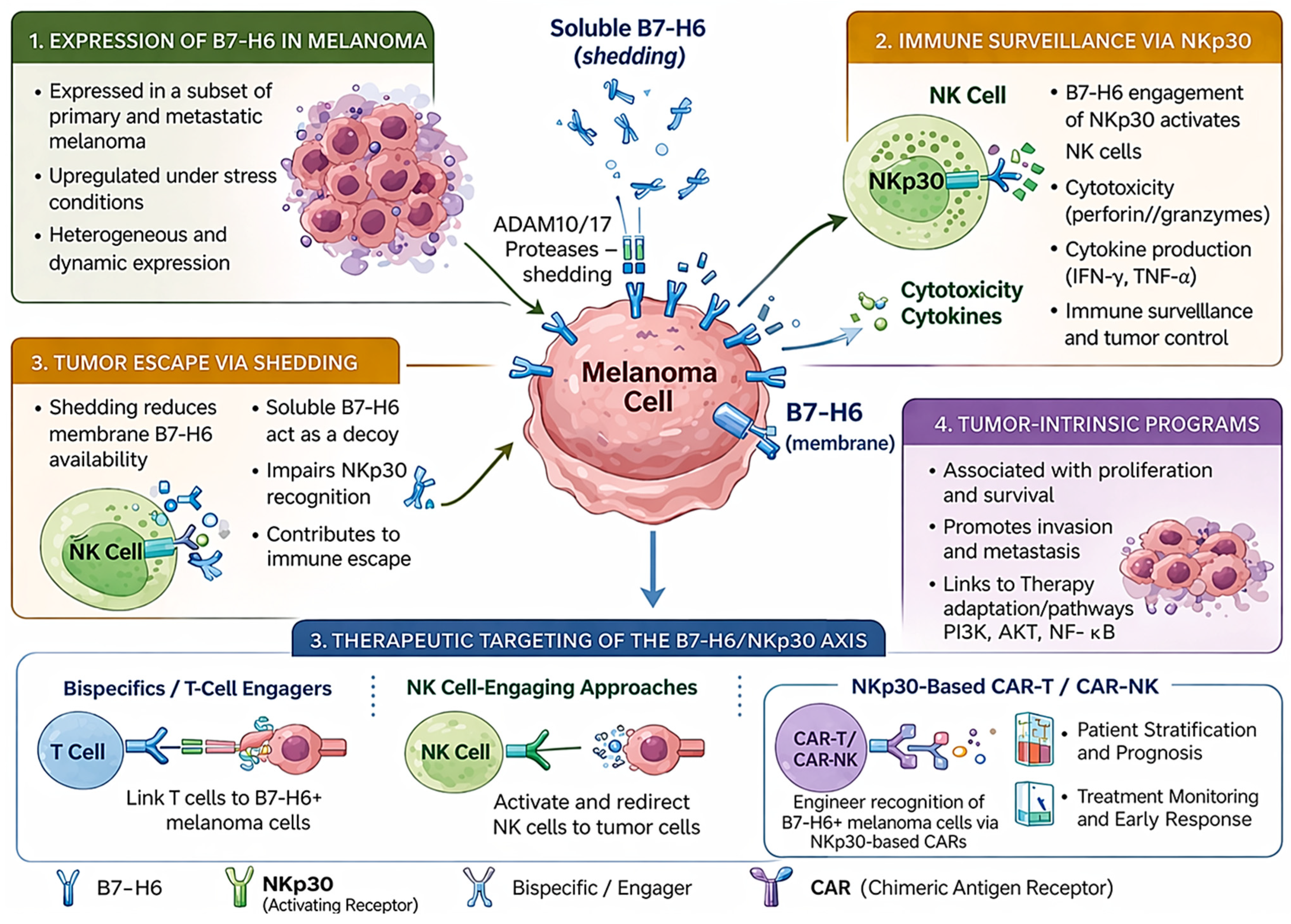
2. B7-H6/NKp30 Axis in Immune Surveillance in Melanoma
3. Tumor Escape Mechanisms: Shedding, Soluble B7-H6, and Target Loss
4. Regulation and Tumor-Intrinsic Functions
Potential Off-Tumor Expression Under Inflammatory Stress
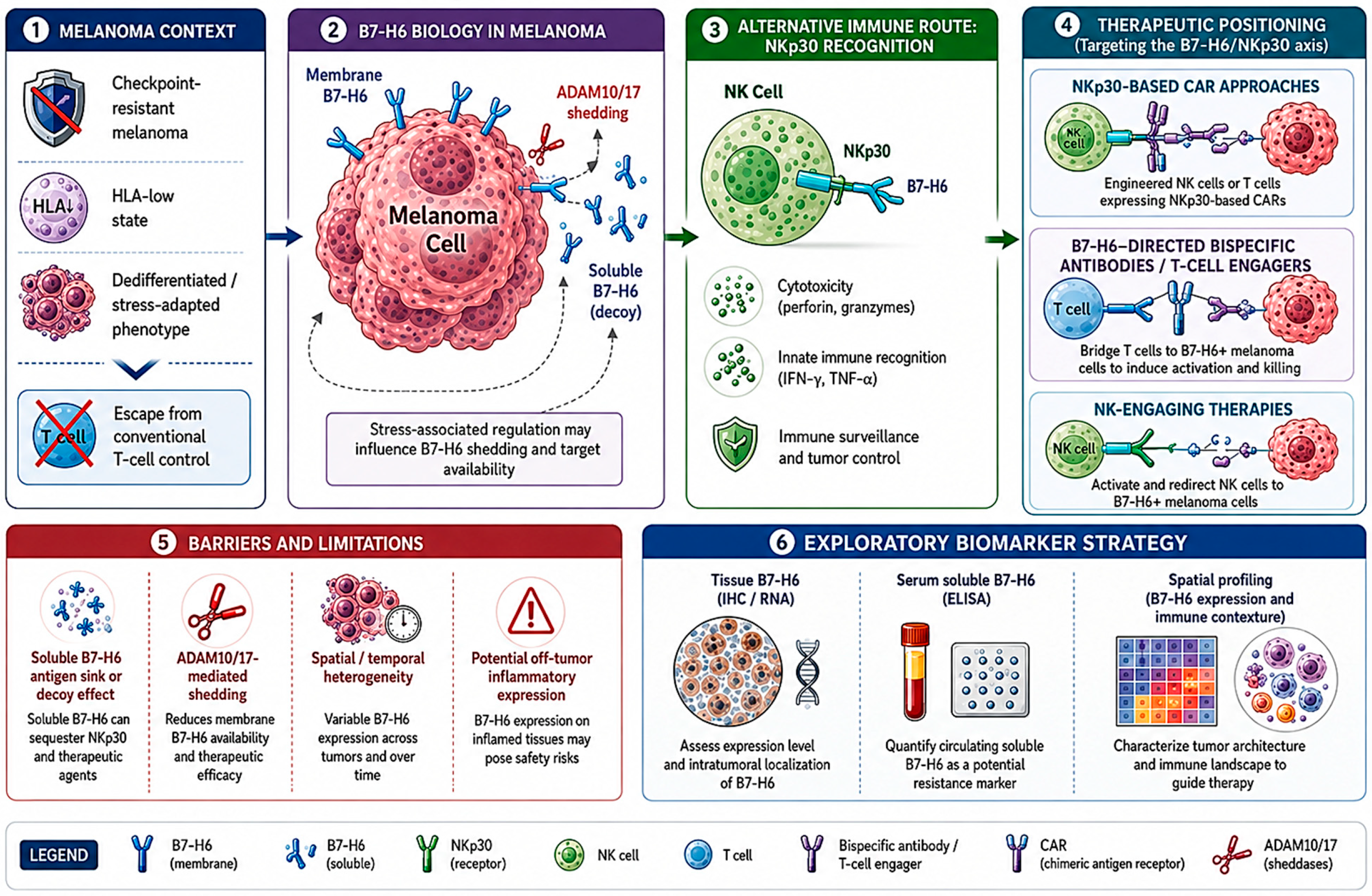
5. Expression Landscape and Biomarker Opportunities
Limitations of the Current Evidence in Melanoma
6. Therapeutic Targeting of the B7-H6/NKp30 Axis
6.1. T-Cell Redirection and Bispecific Engagers
6.2. NK Cell–Engaging Approaches
6.3. NKp30-Based CAR Therapies
7. Combination Strategies and Clinical Positioning
8. Conclusions
Author Contributions
Funding
Data Availability Statement
Conflicts of Interest
Abbreviations
| B7-H6 | B7 homolog 6 |
| NKp30 | Natural cytotoxicity receptor 3 (NCR3) |
| ADAM10 | A disintegrin and metalloproteinase domain-containing protein 10 |
| ADAM17 | A disintegrin and metalloproteinase domain-containing protein 17 |
| CAR-T | Chimeric antigenic receptor T-cell therapy |
| c-Myc | Cellular homolog of v-Myc oncogene |
| PERK | Protein kinase R (PKR)-like endoplasmic reticulum kinase |
| CRISPR/Cas9 | Clustered regularly interspaced short palindromic repeat/CRISPR-associated protein 9 |
| HDAC2/3 | Histone deacetylase 2/3 |
References
- Haugh, A.M.; Salama, A.K.S.; Johnson, D.B. Advanced Melanoma: Resistance Mechanisms to Current Therapies. Hematol. Oncol. Clin. N. Am. 2021, 35, 111–128. [Google Scholar] [CrossRef]
- Fenton, S.E.; Sosman, J.A.; Chandra, S. Resistance mechanisms in melanoma to immuneoncologic therapy with checkpoint inhibitors. Cancer Drug Resist. 2019, 2, 744–761. [Google Scholar] [CrossRef]
- Brandt, C.S.; Baratin, M.; Yi, E.C.; Kennedy, J.; Gao, Z.; Fox, B.; Haldeman, B.; Ostrander, C.D.; Kaifu, T.; Chabannon, C.; et al. The B7 family member B7-H6 is a tumor cell ligand for the activating natural killer cell receptor NKp30 in humans. J. Exp. Med. 2009, 206, 1495–1503. [Google Scholar] [CrossRef]
- Li, Y.; Wang, Q.; Mariuzza, R.A. Structure of the human activating natural cytotoxicity receptor NKp30 bound to its tumor cell ligand B7-H6. J. Exp. Med. 2011, 208, 703–714. [Google Scholar] [CrossRef]
- Pinheiro, P.F.; Justino, G.C.; Marques, M.M. NKp30—A prospective target for new cancer immunotherapy strategies. Br. J. Pharmacol. 2020, 177, 4563–4580. [Google Scholar] [CrossRef]
- Kaifu, T.; Escalière, B.; Gastinel, L.N.; Vivier, E.; Baratin, M. B7-H6/NKp30 interaction: A mechanism of alerting NK cells against tumors. Cell Mol. Life Sci. 2011, 68, 3531–3539. [Google Scholar] [CrossRef]
- Schlecker, E.; Fiegler, N.; Arnold, A.; Altevogt, P.; Rose-John, S.; Moldenhauer, G.; Sucker, A.; Paschen, A.; von Strandmann, E.P.; Textor, S.; et al. Metalloprotease-mediated tumor cell shedding of B7-H6, the ligand of the natural killer cell-activating receptor NKp30. Cancer Res. 2014, 74, 3429–3440. [Google Scholar] [CrossRef] [PubMed]
- Kageshita, T.; Hirai, S.; Ono, T.; Hicklin, D.J.; Ferrone, S. Down-regulation of HLA class I antigen-processing molecules in malignant melanoma: Association with disease progression. Am. J. Pathol. 1999, 154, 745–754. [Google Scholar] [CrossRef]
- Rambow, F.; Marine, J.C.; Goding, C.R. Melanoma plasticity and phenotypic diversity: Therapeutic barriers and opportunities. Genes. Dev. 2019, 33, 1295–1318. [Google Scholar] [CrossRef] [PubMed]
- Lee, J.H.; Shklovskaya, E.; Lim, S.Y.; Carlino, M.S.; Menzies, A.M.; Stewart, A.; Pedersen, B.; Irvine, M.; Alavi, S.; Yang, J.Y.H.; et al. Transcriptional downregulation of MHC class I and melanoma de- differentiation in resistance to PD-1 inhibition. Nat. Commun. 2020, 11, 1897. [Google Scholar] [CrossRef] [PubMed]
- Sottile, R.; Pangigadde, P.N.; Tan, T.; Anichini, A.; Sabbatino, F.; Trecroci, F.; Favoino, E.; Orgiano, L.; Roberts, J.; Ferrone, S.; et al. HLA class I downregulation is associated with enhanced NK-cell killing of melanoma cells with acquired drug resistance to BRAF inhibitors. Eur. J. Immunol. 2016, 46, 409–419. [Google Scholar] [CrossRef]
- Lehmann, J.; Caduff, N.; Krzywińska, E.; Stierli, S.; Salas-Bastos, A.; Loos, B.; Levesque, M.P.; Dummer, R.; Stockmann, C.; Münz, C.; et al. Escape from NK cell tumor surveillance by NGFR-induced lipid remodeling in melanoma. Sci. Adv. 2023, 9, eadc8825. [Google Scholar] [CrossRef]
- Porgador, A.; Mandelboim, O.; Restifo, N.P.; Strominger, J.L. Natural killer cell lines kill autologous beta2-microglobulin-deficient melanoma cells: Implications for cancer immunotherapy. Proc. Natl. Acad. Sci. USA 1997, 94, 13140–13145. [Google Scholar] [CrossRef] [PubMed]
- Mohammadi, A.; Najafi, S.; Amini, M.; Baradaran, B.; Firouzamandi, M. B7H6 silencing increases chemosensitivity to dacarbazine and suppresses cell survival and migration in cutaneous melanoma. Melanoma Res. 2023, 33, 173–183. [Google Scholar] [CrossRef]
- Zhang, W.; Auguste, A.; Liao, X.; Walterskirchen, C.; Bauer, K.; Lin, Y.H.; Yang, L.; Sayedian, F.; Fabits, M.; Bergmann, M.; et al. A Novel B7-H6-Targeted IgG-Like T Cell-Engaging Antibody for the Treatment of Gastrointestinal Tumors. Clin. Cancer Res. 2022, 28, 5190–5201. [Google Scholar] [CrossRef] [PubMed]
- Obiedat, A.; Charpak-Amikam, Y.; Tai-Schmiedel, J.; Seidel, E.; Mahameed, M.; Avril, T.; Stern-Ginossar, N.; Springuel, L.; Bolsée, J.; Gilham, D.E.; et al. The integrated stress response promotes B7H6 expression. J. Mol. Med. 2020, 98, 135–148. [Google Scholar] [CrossRef]
- Laskowski, T.J.; Biederstädt, A.; Rezvani, K. Natural killer cells in antitumour adoptive cell immunotherapy. Nat. Rev. Cancer 2022, 22, 557–575. [Google Scholar] [CrossRef]
- Lanier, L.L. NK cell recognition. Annu. Rev. Immunol. 2005, 23, 225–274. [Google Scholar] [CrossRef]
- Kärre, K. Natural killer cell recognition of missing self. Nat. Immunol. 2008, 9, 477–480. [Google Scholar] [CrossRef] [PubMed]
- Morgado, S.; Sanchez-Correa, B.; Casado, J.G.; Duran, E.; Gayoso, I.; Labella, F.; Solana, R.; Tarazona, R. NK cell recognition and killing of melanoma cells is controlled by multiple activating receptor-ligand interactions. J. Innate Immun. 2011, 3, 365–373. [Google Scholar] [CrossRef]
- Messaoudene, M.; Fregni, G.; Enot, D.; Jacquelot, N.; Neves, E.; Germaud, N.; Garchon, H.J.; Boukouaci, W.; Tamouza, R.; Chanal, J.; et al. NKp30 isoforms and NKp46 transcripts in metastatic melanoma patients: Unique NKp30 pattern in rare melanoma patients with favorable evolution. Oncoimmunology 2016, 5, e1154251. [Google Scholar] [CrossRef]
- Balsamo, M.; Scordamaglia, F.; Pietra, G.; Manzini, C.; Cantoni, C.; Boitano, M.; Queirolo, P.; Vermi, W.; Facchetti, F.; Moretta, A.; et al. Melanoma-associated fibroblasts modulate NK cell phenotype and antitumor cytotoxicity. Proc. Natl. Acad. Sci. USA 2009, 106, 20847–20852. [Google Scholar] [CrossRef] [PubMed]
- Jilani, S.; Saco, J.D.; Mugarza, E.; Pujol-Morcillo, A.; Chokry, J.; Ng, C.; Abril-Rodriguez, G.; Berger-Manerio, D.; Pant, A.; Hu, J.; et al. CAR-T cell therapy targeting surface expression of TYRP1 to treat cutaneous and rare melanoma subtypes. Nat. Commun. 2024, 15, 1244. [Google Scholar] [CrossRef] [PubMed]
- Anikeeva, N.; Panteleev, S.; Mazzanti, N.W.; Terai, M.; Sato, T.; Sykulev, Y. Efficient killing of tumor cells by CAR-T cells requires greater number of engaged CARs than TCRs. J. Biol. Chem. 2021, 297, 101033. [Google Scholar] [CrossRef]
- Ponath, V.; Hoffmann, N.; Bergmann, L.; Mäder, C.; Alashkar Alhamwe, B.; Preußer, C.; Pogge von Strandmann, E. Secreted Ligands of the NK Cell Receptor NKp30: B7-H6 Is in Contrast to BAG6 Only Marginally Released via Extracellular Vesicles. Int. J. Mol. Sci. 2021, 22, 2189. [Google Scholar] [CrossRef]
- Textor, S.; Bossler, F.; Henrich, K.O.; Gartlgruber, M.; Pollmann, J.; Fiegler, N.; Arnold, A.; Westermann, F.; Waldburger, N.; Breuhahn, K.; et al. The proto-oncogene Myc drives expression of the NK cell-activating NKp30 ligand B7-H6 in tumor cells. Oncoimmunology 2016, 5, e1116674. [Google Scholar] [CrossRef]
- Cao, G.; Wang, J.; Zheng, X.; Wei, H.; Tian, Z.; Sun, R. Tumor Therapeutics Work as Stress Inducers to Enhance Tumor Sensitivity to Natural Killer (NK) Cell Cytolysis by Up-regulating NKp30 Ligand B7-H6. J. Biol. Chem. 2015, 290, 29964–29973. [Google Scholar] [CrossRef]
- Chen, H.; Zhang, Y.; Shen, Y.; Jiang, L.; Zhang, G.; Zhang, X.; Xu, Y.; Fu, F. Deficiency of N-linked glycosylation impairs immune function of B7-H6. Front. Immunol. 2023, 14, 1255667. [Google Scholar] [CrossRef]
- Vendramin, R.; Katopodi, V.; Cinque, S.; Konnova, A.; Knezevic, Z.; Adnane, S.; Verheyden, Y.; Karras, P.; Demesmaeker, E.; Bosisio, F.M.; et al. Activation of the integrated stress response confers vulnerability to mitoribosome-targeting antibiotics in melanoma. J. Exp. Med. 2021, 218, e20210571. [Google Scholar] [CrossRef]
- Čaval, T.; Alisson-Silva, F.; Schwarz, F. Roles of glycosylation at the cancer cell surface: Opportunities for large scale glycoproteomics. Theranostics 2023, 13, 2605–2615. [Google Scholar] [CrossRef] [PubMed]
- Rodriguez, E. Tumor Glycosylation: A Main Player in the Modulation of Immune Responses. Eur. J. Immunol. 2025, 55, e202451318. [Google Scholar] [CrossRef]
- Givi, S.; Lohnes, B.J.; Ebrahimi, S.; Riedel, S.; Khokhali, S.; Khan, S.A.; Keller, M.; Wölfel, C.; Echchannaoui, H.; Bockamp, E.; et al. CRISPR/Cas9 TCR-Edited NKp30 CAR T Cells Exhibit Superior Anti-Tumor Immunity to B7H6-Expressing Leukemia and Melanoma. Int. J. Mol. Sci. 2025, 26, 8235. [Google Scholar] [CrossRef]
- Reuben, A.; Spencer, C.N.; Prieto, P.A.; Gopalakrishnan, V.; Reddy, S.M.; Miller, J.P.; Mao, X.; De Macedo, M.P.; Chen, J.; Song, X.; et al. Genomic and immune heterogeneity are associated with differential responses to therapy in melanoma. npj Genom. Med. 2017, 2, 10. [Google Scholar] [CrossRef]
- Rusakiewicz, S.; Perier, A.; Semeraro, M.; Pitt, J.M.; Pogge von Strandmann, E.; Reiners, K.S.; Aspeslagh, S.; Pipéroglou, C.; Vély, F.; Ivagnes, A.; et al. NKp30 isoforms and NKp30 ligands are predictive biomarkers of response to imatinib mesylate in metastatic GIST patients. Oncoimmunology 2017, 6, e1137418. [Google Scholar] [CrossRef]
- Ma, X.; He, H.; Zhu, Y.; Zuo, D.; Wang, F.; Feng, M.; Ji, K.; Chen, X. Dual T/NK cell engagement via B7-H6-targeted bispecific antibodies and IL-15 eradicates chemo-resistant solid tumors. Front. Immunol. 2025, 16, 1625813. [Google Scholar] [CrossRef]
- Zhang, T.; Wu, M.R.; Sentman, C.L. An NKp30-based chimeric antigen receptor promotes T cell effector functions and antitumor efficacy in vivo. J. Immunol. 2012, 189, 2290–2299. [Google Scholar] [CrossRef] [PubMed]
- Wu, M.R.; Zhang, T.; Gacerez, A.T.; Coupet, T.A.; DeMars, L.R.; Sentman, C.L. B7H6-Specific Bispecific T Cell Engagers Lead to Tumor Elimination and Host Antitumor Immunity. J. Immunol. 2015, 194, 5305–5311. [Google Scholar] [CrossRef] [PubMed]
- Pekar, L.; Klausz, K.; Busch, M.; Valldorf, B.; Kolmar, H.; Wesch, D.; Oberg, H.H.; Krohn, S.; Boje, A.S.; Gehlert, C.L.; et al. Affinity Maturation of B7-H6 Translates into Enhanced NK Cell-Mediated Tumor Cell Lysis and Improved Proinflammatory Cytokine Release of Bispecific Immunoligands via NKp30 Engagement. J. Immunol. 2021, 206, 225–236. [Google Scholar] [CrossRef] [PubMed]
- Wu, M.R.; Zhang, T.; DeMars, L.R.; Sentman, C.L. B7H6-specific chimeric antigen receptors lead to tumor elimination and host antitumor immunity. Gene Ther. 2015, 22, 675–684. [Google Scholar] [CrossRef]
- Butler, S.E.; Brog, R.A.; Chang, C.H.; Sentman, C.L.; Huang, Y.H.; Ackerman, M.E. Engineering a natural ligand-based CAR: Directed evolution of the stress-receptor NKp30. Cancer Immunol. Immunother. 2022, 71, 165–176. [Google Scholar] [CrossRef]
- Fiegler, N.; Textor, S.; Arnold, A.; Rölle, A.; Oehme, I.; Breuhahn, K.; Moldenhauer, G.; Witzens-Harig, M.; Cerwenka, A. Downregulation of the activating NKp30 ligand B7-H6 by HDAC inhibitors impairs tumor cell recognition by NK cells. Blood 2013, 122, 684–693. [Google Scholar] [CrossRef]


| (A) | |||||
| Study | Model or Evidence Type | Key Melanoma-Linked Observation | Translational Implication | Main Limitation | |
| Brandt et al. (2009) [3] | Discovery study; tumor cell-line expression analysis | Identified B7-H6 as the human tumor-cell ligand for NKp30; melanoma cell lines were included among tumor types reported to express B7-H6. | Establishes biologic plausibility for melanoma as a B7-H6-positive tumor context. | Discovery-phase evidence; limited melanoma-specific clinical annotation and no therapeutic validation in melanoma. | |
| Schlecker et al. (2014) [7] | Mechanistic shedding study | Demonstrated ADAM10/17-mediated shedding of B7-H6, reducing surface ligand availability and generating soluble B7-H6. | Provides a mechanistic basis for target loss, soluble biomarker development, and resistance to surface-directed strategies. | ADAM10/17 inhibition is mechanistically informative but not yet a clinically realistic melanoma strategy. | |
| Obiedat et al. (2020) [16] | Stress-response regulation | Showed that integrated stress response signaling can increase B7-H6 expression. | Supports the concept that B7-H6 may mark stress-adapted tumor states and could be dynamically regulated by therapy-related stress. | Not melanoma-specific; relevance to melanoma requires direct validation. | |
| Mohammadi et al. (2023) [14] | A375 melanoma cell-line study | B7-H6 silencing reduced melanoma cell survival, migration, and clonogenicity and increased dacarbazine sensitivity. | Suggests that B7-H6-positive melanoma states may have tumor-intrinsic relevance beyond NK-cell recognition. | Single-cell-line study; no in vivo melanoma validation and no patient-level correlation. | |
| Givi et al. (2025) [32] | Primary melanoma samples, melanoma cell lines, and A375 xenograft model | Reported B7-H6 expression in primary melanoma samples and melanoma cell lines; NKp30 CAR TCRKO cells showed antitumor activity against A375 melanoma in vitro and in vivo. | Provides the strongest direct preclinical support for B7-H6-directed cellular therapy in melanoma. | Small melanoma sample set; in vivo testing relied on an A375 xenograft model; no clinical melanoma efficacy data. | |
| (B) | |||||
| Study | Patient or Specimen Number | Sample Type | B7-H6/NKp30 Feature Assessed | Key Finding | Main Limitation |
| Schlecker et al. (2014) [7] | Melanoma tissue: stage III n = 21, stage IV n = 19; serum: melanoma n = 93, healthy donors n = 32; paired tissue/serum assessment in n = 3 stage IV cases | Melanoma tissue and serum | B7-H6 mRNA, soluble B7-H6, and tissue B7-H6 expression | Soluble B7-H6 was elevated in a subset of melanoma sera, and tissue B7-H6 was detectable in selected melanoma specimens. | No outcome-linked validation; limited paired tissue-serum analysis; does not define spatial heterogeneity, treatment response, or predictive value. |
| Messaoudene et al. (2016) [21] | Metastatic melanoma patient cohort; reported blood NKp30 isoform/NKp46 transcript profiling | Peripheral blood | NKp30 isoforms and NKp46 transcripts | Supports the clinical relevance of NK-cell receptor biology in melanoma progression and outcome. | Does not directly assess tumor-cell B7-H6 expression or B7-H6-directed therapy. |
| Givi et al. (2025) [32] | Primary melanoma samples n = 3; melanoma cell lines also assessed | Patient-derived melanoma samples and melanoma cell lines | B7-H6 mRNA and cell-surface protein expression | B7-H6 was detected in patient-derived melanoma samples and melanoma cell lines, with evidence of variable transcript/protein relationships. | Very small patient-sample set; no primary/metastatic cohort analysis, spatial profiling, longitudinal sampling, or clinical outcome association. |
| (A) | |||||
| Platform | Key Reference | Mechanistic Concept | Melanoma-Specific Evidence | Melanoma Patients Treated or Reported | Main Development Caveat |
| NKp30-based CAR-T cells | Zhang et al. (2012) [36] | Uses the extracellular domain of NKp30 to redirect T cells against B7-H6-positive tumor cells. | Provides proof-of-concept for NKp30 CAR recognition of B7-H6-positive tumors, but not melanoma-specific. | 0 | Preclinical platform; target density, soluble B7-H6, and melanoma heterogeneity were not addressed. |
| B7-H6-specific CAR-T cells | Wu et al. (2015) [39] | Uses a B7-H6-specific CAR design to target B7-H6-positive tumor cells. | Demonstrates CAR feasibility against B7-H6-positive tumors, but melanoma-specific validation remains limited. | 0 | Preclinical evidence; melanoma-specific efficacy, safety, antigen-density requirements, and resistance mechanisms remain undefined. |
| CRISPR/Cas9 TCR-edited NKp30 CAR-T cells | Givi et al. (2025) [32] | Combines NKp30-based CAR recognition with TCR deletion to generate allogeneic NKp30 CAR TCRKO cells. | Direct melanoma evidence in A375 in vitro and A375 NSG xenograft models; primary melanoma samples were assessed for B7-H6 expression. | 0 | Strongest melanoma-directed preclinical therapeutic evidence, but still limited to small sample numbers and xenograft modeling. |
| B7-H6/CD3 bispecific T-cell engagers | Wu et al. (2015) [37] | Redirects CD3-positive T cells toward B7-H6-positive tumor cells. | Supports druggability of B7-H6 through T-cell redirection, but not melanoma-specific. | 0 | Preclinical evidence; melanoma-specific efficacy, safety, and resistance mechanisms remain undefined. |
| B7-H6/CD3 IgG-like T-cell engager BI 765049 | Zhang et al. (2022) [15] | IgG-like bispecific antibody engaging B7-H6 on tumor cells and CD3 on T cells. | Public preclinical data are strongest in gastrointestinal tumor models, not melanoma. | 0 in melanoma-specific published data | Supports clinical tractability of the target, but does not validate B7-H6-directed therapy in melanoma. |
| Affinity-matured B7-H6/NKp30 immunoligands | Pekar et al. (2021) [38] | Enhances NK-cell engagement through optimized B7-H6/NKp30 interaction. | No melanoma-specific therapeutic validation. | 0 | May improve activity in low-density target settings, but melanoma relevance remains extrapolated. |
| Dual T/NK engagement plus localized IL-15/IL-15Rα signaling | Ma et al. (2025) [35] | Combines B7-H6-targeted immune redirection with cytokine-supported effector-cell activation. | Not melanoma-specific. | 0 | Cytokine dosing, safety, and generalizability to melanoma remain unresolved. |
| Shedding-aware strategies | Schlecker et al. (2014) [7] | Attempts to preserve membrane B7-H6 by limiting ADAM10/17-mediated shedding. | Mechanistically relevant because soluble B7-H6 has been detected in melanoma serum. | 0 | ADAM10/17 inhibition is not yet a realistic clinical melanoma strategy; soluble B7-H6 may still limit CAR or engager efficacy. |
| (B) | |||||
| Agent or Strategy | Clinical-Development Context | Melanoma-Specific Clinical Data | Melanoma Patients Treated or Reported | Interpretation for Melanoma | |
| BI 765049, B7-H6/CD3 T-cell engager, with or without ezabenlimab | Phase I/early clinical testing in advanced B7-H6-positive solid tumors [15] | No melanoma-specific response or outcome data reported in the cited melanoma-focused literature. | Not reported as melanoma-specific | Demonstrates that B7-H6 is being pursued clinically, but it does not establish B7-H6 as a validated melanoma target. | |
| B7-H6-directed CAR-T or NKp30 CAR-T therapy | Preclinical cellular therapy development | No clinical melanoma cohort reported in the reviewed literature. | 0 | Melanoma translation remains preclinical and should be framed as investigational. | |
| B7-H6/NKp30 as a biomarker-guided therapeutic strategy | Proposed tissue plus soluble B7-H6 assessment | No prospective melanoma trial has validated B7-H6 selection, soluble B7-H6 monitoring, or membrane B7-H6 density as predictive biomarkers. | 0 | Future trials should incorporate membrane target density, soluble B7-H6, spatial heterogeneity, and NK-cell competence before patient selection can be justified. | |
Disclaimer/Publisher’s Note: The statements, opinions and data contained in all publications are solely those of the individual author(s) and contributor(s) and not of MDPI and/or the editor(s). MDPI and/or the editor(s) disclaim responsibility for any injury to people or property resulting from any ideas, methods, instructions or products referred to in the content. |
© 2026 by the authors. Licensee MDPI, Basel, Switzerland. This article is an open access article distributed under the terms and conditions of the Creative Commons Attribution (CC BY) license.
Share and Cite
Truong-Balderas, K.M.; Chang, R.C.; Lasalle, C.; Gao, Y.; Nowak, N.C.; Amber, K.T.; Mansini, A.P. B7-H6/NKp30 Axis in Melanoma: Translational Rationale, Evidence Gaps, and Therapeutic Considerations. Biomolecules 2026, 16, 862. https://doi.org/10.3390/biom16060862
Truong-Balderas KM, Chang RC, Lasalle C, Gao Y, Nowak NC, Amber KT, Mansini AP. B7-H6/NKp30 Axis in Melanoma: Translational Rationale, Evidence Gaps, and Therapeutic Considerations. Biomolecules. 2026; 16(6):862. https://doi.org/10.3390/biom16060862
Chicago/Turabian StyleTruong-Balderas, Kevin M., Rachel C. Chang, Claudia Lasalle, Yi Gao, Nicole C. Nowak, Kyle T. Amber, and Adrian P. Mansini. 2026. "B7-H6/NKp30 Axis in Melanoma: Translational Rationale, Evidence Gaps, and Therapeutic Considerations" Biomolecules 16, no. 6: 862. https://doi.org/10.3390/biom16060862
APA StyleTruong-Balderas, K. M., Chang, R. C., Lasalle, C., Gao, Y., Nowak, N. C., Amber, K. T., & Mansini, A. P. (2026). B7-H6/NKp30 Axis in Melanoma: Translational Rationale, Evidence Gaps, and Therapeutic Considerations. Biomolecules, 16(6), 862. https://doi.org/10.3390/biom16060862