The Complex Role of Methylation in Regulating Vascular Smooth Muscle Cell Phenotypic States in Vascular Remodeling and Atherosclerosis


Abstract
1. Introduction
2. Histone Methylation, Methyltransferases and Demethylases
2.1. Histone Methylation: Function, Writers, and Erasers
2.2. Regulation of VSMC Contractile Gene Expression and Proliferation by Histone Methyltransferases and Demethylases
2.3. Genetic and Pharmacological Targeting of Histone Methylation Regulatory Enzymes in Atherosclerosis
3. DNA Methyltransferases and Demethylases
3.1. DNA Methylation: Function and Regulation
3.2. Regulation of VSMC Contractile Gene Expression and Proliferation by DNMTs and TETs
3.3. DNA Methylation and Hydroxymethylation in Atherosclerosis
4. N6-Methyladenosine (m6A) Methyltransferases, Binding Proteins, and Demethylases
4.1. RNA Methylation: Function and Regulation
4.2. Role of RNA Methylation in the Regulation of VSMC Contractile Gene Expression and Proliferation
4.3. Epitranscriptomic Regulation of VSMC Phenotype in Atherosclerosis
5. Modulation of Methyltransferase and Demethylase Expression and Activity by Atherosclerosis-Associated Environmental Cues
5.1. The Atherosclerotic Plaque Microenvironment
5.2. Cell Metabolic State
5.3. Inflammation
5.4. Hypoxia
5.5. Epigenetic Control of Inflammatory and Metabolic Memory
6. Crosstalk Between Histone, DNA, and RNA Methylation
7. Elucidating Non-Canonical Functions of Methylation Regulators
8. Conclusions and Remaining Questions
Author Contributions
Funding
Institutional Review Board Statement
Informed Consent Statement
Data Availability Statement
Acknowledgments
Conflicts of Interest
References
- Owens, G.K.; Kumar, M.S.; Wamhoff, B.R. Molecular regulation of vascular smooth muscle cell differentiation in development and disease. Physiol. Rev. 2004, 84, 767–801. [Google Scholar] [CrossRef] [Scilit]
- Campbell, G.R.; Chamley-Campbell, J.H. Smooth muscle phenotypic modulation: Role in atherogenesis. Med. Hypotheses 1981, 7, 729–735. [Google Scholar] [CrossRef] [Scilit] [PubMed]
- Chamley-Campbell, J.; Campbell, G.R.; Ross, R. The smooth muscle cell in culture. Physiol. Rev. 1979, 59, 1–61. [Google Scholar] [CrossRef] [Scilit] [PubMed]
- Brown, I.A.; Diederich, L.; Good, M.E.; DeLalio, L.J.; Murphy, S.A.; Cortese-Krott, M.M.; Hall, J.L.; Le, T.H.; Isakson, B.E. Vascular Smooth Muscle Remodeling in Conductive and Resistance Arteries in Hypertension: VSMC in hypertension. Arterioscler. Thromb. Vasc. Biol. 2018, 38, 9. [Google Scholar] [CrossRef] [Scilit]
- Varik, B.J.v.; Rennenberg, R.J.M.W.; Reutelingsperger, C.P.; Kroon, A.A.; Leeuw, P.W.d.; Schurgers, L.J. Mechanisms of arterial remodeling: Lessons from genetic diseases. Front. Genet. 2012, 3, 290. [Google Scholar] [CrossRef] [Scilit]
- Glagov, S.; Weisenberg, E.; Zarins, C.K.; Stankunavicius, R.; Kolettis, G.J. Compensatory Enlargement of Human Atherosclerotic Coronary Arteries. N. Engl. J. Med. 1987, 316, 1371–1375. [Google Scholar] [CrossRef] [Scilit]
- Serbulea, V.; Martin, J.M.; Owens, G.K. Role of Diverse Smooth Muscle Cell Phenotypic Transitions in Atherosclerosis Development and Late-Stage Pathogenesis. Annu. Rev. Physiol. 2026, 88, 345–370. [Google Scholar] [CrossRef] [Scilit]
- Azar, P.; Jarr, K.U.; Gomez, D.; Jorgensen, H.F.; Leeper, N.J.; Bochaton-Piallat, M.L. Smooth muscle cells in atherosclerosis: Essential but overlooked translational perspectives. Eur. Heart J. 2025, 46, 4862–4875. [Google Scholar] [CrossRef] [Scilit]
- Chappell, J.; Harman, J.L.; Narasimhan, V.M.; Yu, H.; Foote, K.; Simons, B.D.; Bennett, M.R.; Jorgensen, H.F. Extensive Proliferation of a Subset of Differentiated, yet Plastic, Medial Vascular Smooth Muscle Cells Contributes to Neointimal Formation in Mouse Injury and Atherosclerosis Models. Circ. Res. 2016, 119, 1313–1323. [Google Scholar] [CrossRef] [Scilit] [PubMed]
- Worssam, M.D.; Lambert, J.; Oc, S.; Taylor, J.C.K.; Taylor, A.L.; Dobnikar, L.; Chappell, J.; Harman, J.L.; Figg, N.L.; Finigan, A.; et al. Cellular mechanisms of oligoclonal vascular smooth muscle cell expansion in cardiovascular disease. Cardiovasc. Res. 2023, 119, 1279–1294. [Google Scholar] [CrossRef] [Scilit]
- Liu, M.; Gomez, D. Smooth Muscle Cell Phenotypic Diversity. Arterioscler. Thromb. Vasc. Biol. 2019, 39, 1715–1723. [Google Scholar] [CrossRef] [Scilit]
- Gomez, D.; Shankman, L.S.; Nguyen, A.T.; Owens, G.K. Detection of histone modifications at specific gene loci in single cells in histological sections. Nat. Methods 2013, 10, 171–177. [Google Scholar] [CrossRef] [Scilit]
- Shankman, L.S.; Gomez, D.; Cherepanova, O.A.; Salmon, M.; Alencar, G.F.; Haskins, R.M.; Swiatlowska, P.; Newman, A.A.; Greene, E.S.; Straub, A.C.; et al. KLF4-dependent phenotypic modulation of smooth muscle cells has a key role in atherosclerotic plaque pathogenesis. Nat. Med. 2015, 21, 628–637. [Google Scholar] [CrossRef] [Scilit]
- Alencar, G.F.; Owsiany, K.M.; Karnewar, S.; Sukhavasi, K.; Mocci, G.; Nguyen, A.T.; Williams, C.M.; Shamsuzzaman, S.; Mokry, M.; Henderson, C.A.; et al. Stem Cell Pluripotency Genes Klf4 and Oct4 Regulate Complex SMC Phenotypic Changes Critical in Late-Stage Atherosclerotic Lesion Pathogenesis. Circulation 2020, 142, 2045–2059. [Google Scholar] [CrossRef] [Scilit]
- Wirka, R.C.; Wagh, D.; Paik, D.T.; Pjanic, M.; Nguyen, T.; Miller, C.L.; Kundu, R.; Nagao, M.; Coller, J.; Koyano, T.K.; et al. Atheroprotective roles of smooth muscle cell phenotypic modulation and the TCF21 disease gene as revealed by single-cell analysis. Nat. Med. 2019, 25, 1280–1289. [Google Scholar] [CrossRef] [Scilit] [PubMed]
- Pan, H.; Xue, C.; Auerbach, B.J.; Fan, J.; Bashore, A.C.; Cui, J.; Yang, D.Y.; Trignano, S.B.; Liu, W.; Shi, J.; et al. Single-Cell Genomics Reveals a Novel Cell State During Smooth Muscle Cell Phenotypic Switching and Potential Therapeutic Targets for Atherosclerosis in Mouse and Human. Circulation 2020, 142, 2060–2075. [Google Scholar] [CrossRef] [Scilit]
- Mosquera, J.V.; Auguste, G.; Wong, D.; Turner, A.W.; Hodonsky, C.J.; Alvarez-Yela, A.C.; Song, Y.; Cheng, Q.; Lino Cardenas, C.L.; Theofilatos, K.; et al. Integrative single-cell meta-analysis reveals disease-relevant vascular cell states and markers in human atherosclerosis. Cell Rep. 2023, 42, 113380. [Google Scholar] [CrossRef] [Scilit] [PubMed]
- Bashore, A.C.; Yan, H.; Xue, C.; Zhu, L.Y.; Kim, E.; Mawson, T.; Coronel, J.; Chung, A.; Sachs, N.; Ho, S.; et al. High-Dimensional Single-Cell Multimodal Landscape of Human Carotid Atherosclerosis. Arterioscler. Thromb. Vasc. Biol. 2024, 44, 930–945. [Google Scholar] [CrossRef] [Scilit]
- Alsaigh, T.; Evans, D.; Frankel, D.; Torkamani, A. Decoding the transcriptome of calcified atherosclerotic plaque at single-cell resolution. Commun. Biol. 2022, 5, 1084. [Google Scholar] [CrossRef] [Scilit]
- Owens, G.K. Molecular control of vascular smooth muscle cell differentiation and phenotypic plasticity. Novartis Found. Symp. 2007, 283, 174–191; discussion 191–173, 238–141. [Google Scholar] [PubMed]
- Yoshida, T.; Sinha, S.; Dandre, F.; Wamhoff, B.R.; Hoofnagle, M.H.; Kremer, B.E.; Wang, D.Z.; Olson, E.N.; Owens, G.K. Myocardin is a key regulator of CArG-dependent transcription of multiple smooth muscle marker genes. Circ. Res. 2003, 92, 856–864. [Google Scholar] [CrossRef] [Scilit]
- Du, K.L.; Ip, H.S.; Li, J.; Chen, M.; Dandre, F.; Yu, W.; Lu, M.M.; Owens, G.K.; Parmacek, M.S. Myocardin is a critical serum response factor cofactor in the transcriptional program regulating smooth muscle cell differentiation. Mol. Cell. Biol. 2003, 23, 2425–2437. [Google Scholar] [CrossRef] [Scilit] [PubMed]
- Chen, J.; Kitchen, C.M.; Streb, J.W.; Miano, J.M. Myocardin: A component of a molecular switch for smooth muscle differentiation. J. Mol. Cell. Cardiol. 2002, 34, 1345–1356. [Google Scholar] [CrossRef]
- Sartorelli, V.; Kurabayashi, M.; Kedes, L. Muscle-specific gene expression. A comparison of cardiac and skeletal muscle transcription strategies. Circ. Res. 1993, 72, 925–931. [Google Scholar] [CrossRef] [Scilit]
- Wang, D.; Chang, P.S.; Wang, Z.; Sutherland, L.; Richardson, J.A.; Small, E.; Krieg, P.A.; Olson, E.N. Activation of cardiac gene expression by myocardin, a transcriptional cofactor for serum response factor. Cell 2001, 105, 851–862. [Google Scholar] [CrossRef] [Scilit] [PubMed]
- Alexander, M.R.; Owens, G.K. Epigenetic control of smooth muscle cell differentiation and phenotypic switching in vascular development and disease. Annu. Rev. Physiol. 2012, 74, 13–40. [Google Scholar] [CrossRef] [Scilit] [PubMed]
- Manabe, I.; Owens, G.K. Recruitment of serum response factor and hyperacetylation of histones at smooth muscle-specific regulatory regions during differentiation of a novel P19-derived in vitro smooth muscle differentiation system. Circ. Res. 2001, 88, 1127–1134. [Google Scholar] [CrossRef] [Scilit]
- McDonald, O.G.; Wamhoff, B.R.; Hoofnagle, M.H.; Owens, G.K. Control of SRF binding to CArG box chromatin regulates smooth muscle gene expression in vivo. J. Clin. Invest. 2006, 116, 36–48. [Google Scholar] [CrossRef] [Scilit]
- Liu, R.; Leslie, K.L.; Martin, K.A. Epigenetic regulation of smooth muscle cell plasticity. Biochim. Biophys. Acta 2015, 1849, 448–453. [Google Scholar] [CrossRef] [Scilit]
- Lambert, J.; Jorgensen, H.F. Epigenetic regulation of vascular smooth muscle cell phenotypes in atherosclerosis. Atherosclerosis 2025, 401, 119085. [Google Scholar] [CrossRef] [Scilit]
- Cheung, P.; Allis, C.D.; Sassone-Corsi, P. Signaling to chromatin through histone modifications. Cell 2000, 103, 263–271. [Google Scholar] [CrossRef] [Scilit]
- Millan-Zambrano, G.; Burton, A.; Bannister, A.J.; Schneider, R. Histone post-translational modifications-cause and consequence of genome function. Nat. Rev. Genet. 2022, 23, 563–580. [Google Scholar] [CrossRef] [Scilit]
- Bannister, A.J.; Kouzarides, T. Regulation of chromatin by histone modifications. Cell Res. 2011, 21, 381–395. [Google Scholar] [CrossRef] [Scilit]
- Heintzman, N.D.; Stuart, R.K.; Hon, G.; Fu, Y.; Ching, C.W.; Hawkins, R.D.; Barrera, L.O.; Van Calcar, S.; Qu, C.; Ching, K.A.; et al. Distinct and predictive chromatin signatures of transcriptional promoters and enhancers in the human genome. Nat. Genet. 2007, 39, 311–318. [Google Scholar] [CrossRef] [Scilit] [PubMed]
- Jenuwein, T.; Allis, C.D. Translating the histone code. Science 2001, 293, 1074–1080. [Google Scholar] [CrossRef] [Scilit]
- Shi, Y.; Lan, F.; Matson, C.; Mulligan, P.; Whetstine, J.R.; Cole, P.A.; Casero, R.A.; Shi, Y. Histone demethylation mediated by the nuclear amine oxidase homolog LSD1. Cell 2004, 119, 941–953. [Google Scholar] [CrossRef] [Scilit] [PubMed]
- Whetstine, J.R.; Nottke, A.; Lan, F.; Huarte, M.; Smolikov, S.; Chen, Z.; Spooner, E.; Li, E.; Zhang, G.; Colaiacovo, M.; et al. Reversal of histone lysine trimethylation by the JMJD2 family of histone demethylases. Cell 2006, 125, 467–481. [Google Scholar] [CrossRef] [Scilit]
- Zhou, Y.; Sharma, S.; Sun, X.; Guan, X.; Hou, Y.; Yang, Z.; Shi, H.; Zou, M.H.; Song, P.; Zhou, J.; et al. SMYD2 regulates vascular smooth muscle cell phenotypic switching and intimal hyperplasia via interaction with myocardin. Cell Mol. Life Sci. 2023, 80, 264. [Google Scholar] [CrossRef] [Scilit] [PubMed]
- Zhong, X.; Wei, X.; Xu, Y.; Zhu, X.; Huo, B.; Guo, X.; Feng, G.; Zhang, Z.; Feng, X.; Fang, Z.; et al. The lysine methyltransferase SMYD2 facilitates neointimal hyperplasia by regulating the HDAC3-SRF axis. Acta Pharm. Sin. B 2024, 14, 712–728. [Google Scholar] [CrossRef] [Scilit]
- Donlin, L.T.; Andresen, C.; Just, S.; Rudensky, E.; Pappas, C.T.; Kruger, M.; Jacobs, E.Y.; Unger, A.; Zieseniss, A.; Dobenecker, M.-W.; et al. Smyd2 controls cytoplasmic lysine methylation of Hsp90 and myofilament organization. Genes Dev. 2012, 26, 114–119. [Google Scholar] [CrossRef] [Scilit]
- Voelkel, T.; Andresen, C.; Unger, A.; Just, S.; Rottbauer, W.; Linke, W.A. Lysine methyltransferase Smyd2 regulates Hsp90-mediated protection of the sarcomeric titin springs and cardiac function. Biochim. Et. Biophys. Acta (BBA) -Mol. Cell Res. 2013, 1833, 812–822. [Google Scholar] [CrossRef] [Scilit]
- Sesé, B.; Barrero, M.J.; Fabregat, M.-C.; Sander, V.; Izpisua Belmonte, J.C.; Sesé, B.; Barrero, M.J.; Fabregat, M.-C.; Sander, V.; Izpisua Belmonte, J.C. SMYD2 is induced during cell differentiation and participates in early development | The International Journal of Developmental Biology. Int. J. Dev. Biol. 2013, 57, 357–364. [Google Scholar] [CrossRef] [Scilit]
- Yang, D.; Su, Z.; Wei, G.; Long, F.; Zhu, Y.C.; Ni, T.; Liu, X.; Zhu, Y.Z. H3K4 Methyltransferase Smyd3 Mediates Vascular Smooth Muscle Cell Proliferation, Migration, and Neointima Formation. Arterioscler. Thromb. Vasc. Biol. 2021, 41, 1901–1914. [Google Scholar] [CrossRef] [Scilit] [PubMed]
- Long, F.; Yang, D.; Wang, J.; Wang, Q.; Ni, T.; Wei, G.; Zhu, Y.; Liu, X. SMYD3-PARP16 axis accelerates unfolded protein response and mediates neointima formation. Acta Pharm. Sin. B 2021, 11, 1261–1273. [Google Scholar] [CrossRef] [Scilit]
- Farina, F.M.; Serio, S.; Hall, I.F.; Zani, S.; Cassanmagnago, G.A.; Climent, M.; Civilini, E.; Condorelli, G.; Quintavalle, M.; Elia, L. The epigenetic enzyme DOT1L orchestrates vascular smooth muscle cell-monocyte crosstalk and protects against atherosclerosis via the NF-kappaB pathway. Eur. Heart J. 2022, 43, 4562–4576. [Google Scholar] [CrossRef] [Scilit]
- Chatterjee, P.; Chakraborty, R.; Sizer, A.J.; O’Brien, B.J.; Xu, P.; Hwa, J.M.; Xie, Y.; Yan, Q.; Hwa, J.; Martin, K.A. SUV39H1 Regulates KLF4 and Chromatin Remodeling in Smooth Muscle Cell Phenotypic Plasticity. Arterioscler. Thromb. Vasc. Biol. 2025, 45, 2015–2033. [Google Scholar] [CrossRef] [Scilit] [PubMed]
- Yang, Y.; Zhang, Q.; Liu, S.; Yuan, H.; Wu, X.; Zou, Y.; Zhang, Y.; Guo, J. Suv39h1 Regulates Phenotypic Modulation of Smooth Muscle Cells and Contributes to Vascular Injury by Repressing HIC1 Transcription. Arterioscler. Thromb. Vasc. Biol. 2025, 45, 965–978. [Google Scholar] [CrossRef] [Scilit]
- Harman, J.L.; Dobnikar, L.; Chappell, J.; Stokell, B.G.; Dalby, A.; Foote, K.; Finigan, A.; Freire-Pritchett, P.; Taylor, A.L.; Worssam, M.D.; et al. Epigenetic Regulation of Vascular Smooth Muscle Cells by Histone H3 Lysine 9 Dimethylation Attenuates Target Gene-Induction by Inflammatory Signaling. Arterioscler. Thromb. Vasc. Biol. 2019, 39, 2289–2302. [Google Scholar] [CrossRef] [Scilit]
- Lino Cardenas, C.L.; Kessinger, C.W.; MacDonald, C.; Jassar, A.S.; Isselbacher, E.M.; Jaffer, F.A.; Lindsay, M.E. Inhibition of the methyltranferase EZH2 improves aortic performance in experimental thoracic aortic aneurysm. JCI Insight 2018, 3, 97493. [Google Scholar] [CrossRef] [Scilit] [PubMed]
- Lino Cardenas, C.L.; Kessinger, C.W.; Cheng, Y.; MacDonald, C.; MacGillivray, T.; Ghoshhajra, B.; Huleihel, L.; Nuri, S.; Yeri, A.S.; Jaffer, F.A.; et al. An HDAC9-MALAT1-BRG1 complex mediates smooth muscle dysfunction in thoracic aortic aneurysm. Nat. Commun. 2018, 9, 1009. [Google Scholar] [CrossRef] [Scilit]
- Xiaoling, Y.; Li, Z.; ShuQiang, L.; Shengchao, M.; Anning, Y.; Ning, D.; Nan, L.; Yuexia, J.; Xiaoming, Y.; Guizhong, L.; et al. Hyperhomocysteinemia in ApoE-/-Mice Leads to Overexpression of Enhancer of Zeste Homolog 2 via miR-92a Regulation-PubMed. PLoS ONE 2016, 11, e0167744. [Google Scholar] [CrossRef] [Scilit]
- Lv, Y.; Tang, Y.; Zhang, P.; Wan, W.; Yao, F.; He, P.; Xie, W.; Mo, Z.; Shi, J.; Wu, J.; et al. Histone Methyltransferase Enhancer of Zeste Homolog 2-Mediated ABCA1 Promoter DNA Methylation Contributes to the Progression of Atherosclerosis-PubMed. PLoS ONE 2016, 11, e0157265. [Google Scholar] [CrossRef] [Scilit]
- Wei, X.; Zhang, Y.; Xie, L.; Wang, K.; Wang, X. Pharmacological inhibition of EZH2 by GSK126 decreases atherosclerosis by modulating foam cell formation and monocyte adhesion in apolipoprotein E-deficient mice. Exp. Ther. Med. 2021, 22, 841. [Google Scholar] [CrossRef] [Scilit]
- Liang, J.; Li, Q.; Cai, W.; Zhang, X.; Yang, B.; Li, X.; Jiang, S.; Tian, S.; Zhang, K.; Song, H.; et al. Inhibition of polycomb repressor complex 2 ameliorates neointimal hyperplasia by suppressing trimethylation of H3K27 in vascular smooth muscle cells. Br. J. Pharmacol. 2019, 176, 3206–3219. [Google Scholar] [CrossRef] [Scilit]
- Lockman, K.; Taylor, J.M.; Mack, C.P. The histone demethylase, Jmjd1a, interacts with the myocardin factors to regulate SMC differentiation marker gene expression. Circ. Res. 2007, 101, e115–e123. [Google Scholar] [CrossRef] [Scilit]
- Manea, S.A.; Vlad, M.L.; Lazar, A.G.; Muresian, H.; Simionescu, M.; Manea, A. Pharmacological Inhibition of Lysine-Specific Demethylase 1A Reduces Atherosclerotic Lesion Formation in Apolipoprotein E-Deficient Mice by a Mechanism Involving Decreased Oxidative Stress and Inflammation; Potential Implications in Human Atherosclerosis. Antioxidants 2022, 11, 2382. [Google Scholar] [CrossRef] [Scilit]
- Strand, K.A.; Lu, S.; Mutryn, M.F.; Li, L.; Zhou, Q.; Enyart, B.T.; Jolly, A.J.; Dubner, A.M.; Moulton, K.S.; Nemenoff, R.A.; et al. High Throughput Screen Identifies the DNMT1 (DNA Methyltransferase-1) Inhibitor, 5-Azacytidine, as a Potent Inducer of PTEN (Phosphatase and Tensin Homolog). Arterioscler. Thromb. Vasc. Biol. 2020, 40, 1854–1869. [Google Scholar] [CrossRef] [Scilit]
- Kong, C.H.; Sun, Y.; Wu, L.D.; Zhou, W.Y.; Wang, D.C.; Jiang, Z.H.; Jiang, X.M.; Ye, P.; Gu, Y.; Chen, A.Q.; et al. GRK2 Orchestrates VSMC Phenotypic Modulation via DNMT1-Mediated DNA Methylation Reprogramming. Arterioscler. Thromb. Vasc. Biol. 2025, 45, 1818–1834. [Google Scholar] [CrossRef] [Scilit]
- Jeong, K.; Murphy, J.M.; Kim, J.H.; Campbell, P.M.; Park, H.; Rodriguez, Y.A.R.; Choi, C.S.; Kim, J.S.; Park, S.; Kim, H.J.; et al. FAK Activation Promotes SMC Dedifferentiation via Increased DNA Methylation in Contractile Genes. Circ. Res. 2021, 129, e215–e233. [Google Scholar] [CrossRef] [Scilit]
- Liu, R.; Jin, Y.; Tang, W.H.; Qin, L.; Zhang, X.; Tellides, G.; Hwa, J.; Yu, J.; Martin, K.A. Ten-eleven translocation-2 (TET2) is a master regulator of smooth muscle cell plasticity. Circulation 2013, 128, 2047–2057. [Google Scholar] [CrossRef] [Scilit]
- Zhang, C.; Chen, X.; Wang, J.K.; Li, Y.; Cui, S.J.; Wang, Z.; Luo, T. Phenotypic Switching of Atherosclerotic Smooth Muscle Cells is Regulated by Activated PARP1-Dependent TET1 Expression. J. Atheroscler. Thromb. 2021, 28, 716–729. [Google Scholar] [CrossRef] [Scilit]
- Elia, L.; Kunderfranco, P.; Carullo, P.; Vacchiano, M.; Farina, F.M.; Hall, I.F.; Mantero, S.; Panico, C.; Papait, R.; Condorelli, G.; et al. UHRF1 epigenetically orchestrates smooth muscle cell plasticity in arterial disease. J. Clin. Invest. 2018, 128, 2473–2486. [Google Scholar] [CrossRef] [Scilit]
- Chensee, G.; Lee, B.S.; Green, I.D.; Tieng, J.; Song, R.; Pinello, N.; Lee, Q.; Mehravar, M.; Robinson, D.A.; Wang, M.; et al. METTL14 promotes intimal hyperplasia through m6A-mediated control of vascular smooth muscle dedifferentiation genes. JCI Insight 2025, 10, 184444. [Google Scholar] [CrossRef] [Scilit]
- Wang, L.; Xia, G.; Tang, Y.; Xu, Y.; Li, Q.; Chen, Z.; Wen, T.; Wei, Y.; Wei, C.; Zhou, J. METTL14 Promotes Vascular Smooth Muscle Cell Proliferation and Neointima Formation via m6A Methylation TEAD1 mRNA. J. Biochem. Mol. Toxicol. 2025, 39, e70284. [Google Scholar] [CrossRef] [Scilit]
- Jian, D.; Wang, Y.; Jian, L.; Tang, H.; Rao, L.; Chen, K.; Jia, Z.; Zhang, W.; Liu, Y.; Chen, X.; et al. METTL14 aggravates endothelial inflammation and atherosclerosis by increasing FOXO1 N6-methyladeosine modifications. Theranostics 2020, 10, 8939–8956. [Google Scholar] [CrossRef] [Scilit]
- Zhao, Y.; Xia, A.; Li, C.; Long, X.; Bai, Z.; Qiu, Z.; Xiong, W.; Gu, N.; Shen, Y.; Zhao, R.; et al. Methyltransferase like 3-mediated N6-methylatidin methylation inhibits vascular smooth muscle cells phenotype switching via promoting phosphatidylinositol 3-kinase mRNA decay. Front. Cardiovasc. Med. 2022, 9, 913039. [Google Scholar] [CrossRef] [Scilit]
- Gao, X.F.; Chen, A.Q.; Tang, H.Y.; Kong, X.Q.; Zhang, H.; Wang, Z.M.; Lu, W.; Wang, L.G.; Wang, F.; Zhou, W.Y.; et al. m(6)A Modification of Profilin-1 in Vascular Smooth Muscle Cells Drives Phenotype Switching and Neointimal Hyperplasia via Activation of the p-ANXA2/STAT3 Pathway. Arterioscler. Thromb. Vasc. Biol. 2024, 44, 2543–2559. [Google Scholar] [CrossRef] [Scilit]
- Li, S.; Pang, F.; Guo, W.; Guan, W. PARP1 contributes to intimal hyperplasia by regulating METTL3-mediated m6A methylation of TRAIL. Cell Biol. Toxicol. 2025, 41, 140. [Google Scholar] [CrossRef] [Scilit]
- Guo, M.; Yan, R.; Ji, Q.; Yao, H.; Sun, M.; Duan, L.; Xue, Z.; Jia, Y. IFN regulatory Factor-1 induced macrophage pyroptosis by modulating m6A modification of circ_0029589 in patients with acute coronary syndrome. Int. Immunopharmacol. 2020, 86, 106800. [Google Scholar] [CrossRef] [Scilit]
- Li, Q.; Yu, L.; Gao, A.; Ren, R.; Zhang, J.; Cao, L.; Wang, X.; Liu, Y.; Qi, W.; Cai, L.; et al. METTL3 (Methyltransferase Like 3)-Dependent N6-Methyladenosine Modification on Braf mRNA Promotes Macrophage Inflammatory Response and Atherosclerosis in Mice. Arterioscler. Thromb. Vasc. Biol. 2023, 43, 755–773. [Google Scholar] [CrossRef] [Scilit]
- Pan, H.; Ho, S.E.; Xue, C.; Cui, J.; Ross, L.S.; Reilly, M.P. Retinoic acid signaling modulates smooth muscle cell phenotypic switching in atherosclerosis through epigenetic regulation of gene expression. bioRxiv 2022, 146, 515888. [Google Scholar] [CrossRef] [Scilit]
- Feng, M.; Tu, W.; Zhou, Q.; Du, Y.; Xu, K.; Wang, Y. circHECTD1 Promotes the Proliferation and Migration of Human Brain Vascular Smooth Muscle Cells via Interacting with KHDRBS3 to Stabilize EZH2 mRNA Expression. J. Inflamm. Res. 2023, 16, 1311–1323. [Google Scholar] [CrossRef] [Scilit]
- Liu, M.; Espinosa-Diez, C.; Mahan, S.; Du, M.; Nguyen, A.T.; Hahn, S.; Chakraborty, R.; Straub, A.C.; Martin, K.A.; Owens, G.K.; et al. H3K4 di-methylation governs smooth muscle lineage identity and promotes vascular homeostasis by restraining plasticity. Dev. Cell 2021, 56, 2765–2782 e10. [Google Scholar] [CrossRef] [Scilit]
- Majesky, M.W.; Horita, H.; Ostriker, A.; Lu, S.; Regan, J.N.; Bagchi, A.; Dong, X.R.; Poczobutt, J.; Nemenoff, R.A.; Weiser-Evans, M.C. Differentiated Smooth Muscle Cells Generate a Subpopulation of Resident Vascular Progenitor Cells in the Adventitia Regulated by Klf4. Circ. Res. 2017, 120, 296–311. [Google Scholar] [CrossRef] [Scilit]
- Wang, Y.; Dubland, J.A.; Allahverdian, S.; Asonye, E.; Sahin, B.; Jaw, J.E.; Sin, D.D.; Seidman, M.A.; Leeper, N.J.; Francis, G.A. Smooth Muscle Cells Contribute the Majority of Foam Cells in ApoE (Apolipoprotein E)-Deficient Mouse Atherosclerosis. Arterioscler. Thromb. Vasc. Biol. 2019, 39, 876–887. [Google Scholar] [CrossRef] [Scilit]
- Villeneuve, L.M.; Reddy, M.A.; Lanting, L.L.; Wang, M.; Meng, L.; Natarajan, R. Epigenetic histone H3 lysine 9 methylation in metabolic memory and inflammatory phenotype of vascular smooth muscle cells in diabetes. Proc. Natl. Acad. Sci. USA 2008, 105, 9047–9052. [Google Scholar] [CrossRef] [Scilit]
- Tanwar, V.S.; Malek, V.; Wang, J.; Luo, Y.; Malhi, N.K.; Zhang, H.; Abdollahi, M.; Lanting, L.; Senapati, P.; Das, S.; et al. Single-Cell Multimodal Profiling Highlights Persistent Aortic Smooth Muscle Cell Changes in Diabetic Mice Despite Glycemic Control. Arterioscler. Thromb. Vasc. Biol. 2026, 46, e324012. [Google Scholar] [CrossRef] [Scilit]
- Greissel, A.; Culmes, M.; Burgkart, R.; Zimmermann, A.; Eckstein, H.H.; Zernecke, A.; Pelisek, J. Histone acetylation and methylation significantly change with severity of atherosclerosis in human carotid plaques. Cardiovasc. Pathol. 2016, 25, 79–86. [Google Scholar] [CrossRef] [Scilit]
- Panduga, S.; Vasishta, S.; Subramani, R.; Vincent, S.; Mutalik, S.; Joshi, M.B. Epidrugs in the clinical management of atherosclerosis: Mechanisms, challenges and promises. Eur. J. Pharmacol. 2024, 980, 176827. [Google Scholar] [CrossRef] [Scilit]
- Fang, S.; Alrumaihi, F.; Alwanian, W.; Alharbi, H.; Alnughymishi, N.; Alfifi, S.; Bennett, E.; Zhang, P. The dual functionality of EZH2 in cardiovascular disease: Bridging cancer biology and cardiac pathophysiology through epigenetic regulation, metabolic reprogramming, and novel therapeutic interventions-PubMed. Curr. Probl. Cardiol. 2025, 50, 103104. [Google Scholar] [CrossRef] [Scilit]
- McCabe, M.; Ott, H.; Ganji, G.; Korenchuk, S.; Thompson, C.; Aller, G.V.; Liu, Y.; Graves, A.; Pietra, A.D.; Diaz, E.; et al. EZH2 inhibition as a therapeutic strategy for lymphoma with EZH2-activating mutations-PubMed. Nature 2012, 492, 108–112. [Google Scholar] [CrossRef] [Scilit]
- Marzochi, L.; Cuzziol, C.; Filho, C.N.; Santos, J.D.; Castanhole-Nunes, M.; Pavarino, E.; Guerra, E.; Goloni-Bertollo, E. Use of histone methyltransferase inhibitors in cancer treatment: A systematic review-PubMed. Eur. J. Pharmacol. 2023, 944, 175590. [Google Scholar] [CrossRef] [Scilit]
- Joshi, D.; Chakraborty, R.; Bhogale, T.; Furtado, J.; Deng, H.; Traylor, J.G.; Orr, A.W.; Martin, K.A.; Schwartz, M.A. Polycomb Repressive Complex 2 promotes atherosclerotic plaque vulnerability. bioRxiv 2024. [Google Scholar] [CrossRef] [Scilit] [PubMed]
- Holliday, R.; Pugh, J.E. DNA Modification Mechanisms and Gene Activity During Development. Science 1975, 187, 226–232. [Google Scholar] [CrossRef] [Scilit]
- Romero Charria, P.; Navarrete, C.; Ovchinnikov, V.; Xu, L.; Sarre, L.A.; Shabardina, V.; Ksiezopolska, E.; Casacuberta, E.; Lara-Astiaso, D.; Sebé-Pedrós, A.; et al. Adenine DNA methylation associated with transcriptionally permissive chromatin is widespread across eukaryotes. Nat. Genet. 2025, 57, 12. [Google Scholar] [CrossRef] [Scilit]
- Deaton, A.M.; Bird, A. CpG islands and the regulation of transcription. Genes Dev. 2011, 25, 1010–1022. [Google Scholar] [CrossRef] [Scilit] [PubMed]
- Maunakea, A.K.; Nagarajan, R.P.; Bilenky, M.; Ballinger, T.J.; D’Souza, C.; Fouse, S.D.; Johnson, B.E.; Hong, C.; Nielsen, C.; Zhao, Y.; et al. Conserved role of intragenic DNA methylation in regulating alternative promoters. Nature 2010, 466, 253–257. [Google Scholar] [CrossRef] [Scilit]
- Lyko, F. The DNA methyltransferase family: A versatile toolkit for epigenetic regulation. Nat. Rev. Genet. 2018, 19, 81–92. [Google Scholar] [CrossRef] [Scilit]
- Del Castillo Falconi, V.M.; Torres-Arciga, K.; Matus-Ortega, G.; Diaz-Chavez, J.; Herrera, L.A. DNA Methyltransferases: From Evolution to Clinical Applications. Int. J. Mol. Sci. 2022, 23, 8994. [Google Scholar] [CrossRef] [Scilit] [PubMed]
- Zhu, Y.; Mao, W.; Hosseini, R.; Chikina, M. Methylation Data Analysis and Interpretation. Annu. Rev. Biomed. Data. Sci. 2025, 8, 605–632. [Google Scholar] [CrossRef] [Scilit]
- Tahiliani, M.; Koh, K.P.; Shen, Y.; Pastor, W.A.; Bandukwala, H.; Brudno, Y.; Agarwal, S.; Iyer, L.M.; Liu, D.R.; Aravind, L.; et al. Conversion of 5-methylcytosine to 5-hydroxymethylcytosine in mammalian DNA by MLL partner TET1. Science 2009, 324, 930–935. [Google Scholar] [CrossRef] [Scilit] [PubMed]
- Ito, S.; Shen, L.; Dai, Q.; Wu, S.C.; Collins, L.B.; Swenberg, J.A.; He, C.; Zhang, Y. Tet proteins can convert 5-methylcytosine to 5-formylcytosine and 5-carboxylcytosine. Science 2011, 333, 1300–1303. [Google Scholar] [CrossRef] [Scilit]
- Joshi, K.; Liu, S.; Breslin, S.J.P.; Zhang, J. Mechanisms that regulate the activities of TET proteins. Cell Mol. Life Sci. 2022, 79, 363. [Google Scholar] [CrossRef] [Scilit]
- Liutkeviciute, Z.; Lukinavicius, G.; Masevicius, V.; Daujotyte, D.; Klimasauskas, S. Cytosine-5-methyltransferases add aldehydes to DNA. Nat. Chem. Biol. 2009, 5, 400–402. [Google Scholar] [CrossRef] [Scilit] [PubMed]
- Kohli, R.M.; Zhang, Y. TET enzymes, TDG and the dynamics of DNA demethylation. Nature 2013, 502, 472–479. [Google Scholar] [CrossRef] [Scilit]
- Rozenberg, J.M.; Tesfu, D.B.; Musunuri, S.; Taylor, J.M.; Mack, C.P. DNA methylation of a GC repressor element in the smooth muscle myosin heavy chain promoter facilitates binding of the Notch-associated transcription factor, RBPJ/CSL1. Arterioscler. Thromb. Vasc. Biol. 2014, 34, 2624–2631. [Google Scholar] [CrossRef] [Scilit]
- Horita, H.; Wysoczynski, C.L.; Walker, L.A.; Moulton, K.S.; Li, M.; Ostriker, A.; Tucker, R.; McKinsey, T.A.; Churchill, M.E.A.; Nemenoff, R.A.; et al. Nuclear PTEN functions as an essential regulator of SRF-dependent transcription to control smooth muscle differentiation. Nat. Commun. 2016, 7, 10830. [Google Scholar] [CrossRef] [Scilit]
- Jeong, K.; Kim, J.; Murphy, J.; Park, H.; Kim, S.; Rodriguez, Y.; Kong, H.; Choi, C.; Guan, J.; Taylor, J.; et al. Nuclear Focal Adhesion Kinase Controls Vascular Smooth Muscle Cell Proliferation and Neointimal Hyperplasia Through GATA4-Mediated Cyclin D1 Transcription-PubMed. Circ. Res. 2019, 125, 152–166. [Google Scholar] [CrossRef] [Scilit]
- Zeng, Z.; Xia, L.; Fan, S.; Zheng, J.; Qin, J.; Fan, X.; Liu, Y.; Tao, J.; Liu, Y.; Li, K.; et al. Circular RNA CircMAP3K5 Acts as a MicroRNA-22-3p Sponge to Promote Resolution of Intimal Hyperplasia Via TET2-Mediated Smooth Muscle Cell Differentiation. Circulation 2021, 143, 354–371. [Google Scholar] [CrossRef] [Scilit]
- Ostriker, A.C.; Xie, Y.; Chakraborty, R.; Sizer, A.J.; Bai, Y.; Ding, M.; Song, W.-L.; Huttner, A.; Hwa, J.; Martin, K.A. TET2 Protects Against Vascular Smooth Muscle Cell Apoptosis and Intimal Thickening in Transplant Vasculopathy. Circulation 2021, 144, 455–470. [Google Scholar] [CrossRef] [Scilit] [PubMed]
- Wu, F.; Li, X.; Looso, M.; Liu, H.; Ding, D.; Günther, S.; Kuenne, C.; Liu, S.; Weissmann, N.; Boettger, T.; et al. Spurious transcription causing innate immune responses is prevented by 5-hydroxymethylcytosine. Nat. Genet. 2022, 55, 100–111. [Google Scholar] [CrossRef] [Scilit]
- Zaina, S.; Heyn, H.; Carmona, F.; Varol, N.; Sayols, S.; Condom, E.; Ramírez-Ruz, J.; Gomez, A.; Gonçalves, I.; Moran, S.; et al. DNA methylation map of human atherosclerosis-PubMed. Circ. Cardiovasc. Genet. 2014, 7, 692–700. [Google Scholar] [CrossRef] [Scilit]
- Zhuang, J.; Luan, P.; Li, H.; Wang, K.; Zhang, P.; Xu, Y.; Peng, W. The Yin-Yang Dynamics of DNA Methylation Is the Key Regulator for Smooth Muscle Cell Phenotype Switch and Vascular Remodeling. Arterioscler. Thromb. Vasc. Biol. 2017, 37, 84–97. [Google Scholar] [CrossRef] [Scilit] [PubMed]
- Dunn, J.; Qiu, H.; Kim, S.; Jjingo, D.; Hoffman, R.; Kim, C.W.; Jang, I.; Son, D.J.; Kim, D.; Pan, C.; et al. Flow-dependent epigenetic DNA methylation regulates endothelial gene expression and atherosclerosis. J. Clin. Investig. 2014, 124, 3187–3199. [Google Scholar] [CrossRef] [Scilit] [PubMed]
- Cao, Q.; Wang, X.; Jia, L.; Mondal, A.K.; Diallo, A.; Hawkins, G.A.; Das, S.K.; Parks, J.S.; Yu, L.; Shi, H.; et al. Inhibiting DNA Methylation by 5-Aza-2′-deoxycytidine Ameliorates Atherosclerosis Through Suppressing Macrophage Inflammation. Endocrinology 2014, 155, 4925–4938. [Google Scholar] [CrossRef] [Scilit]
- Azechi, T.; Sato, F.; Sudo, R.; Wachi, H. 5-aza-2’-Deoxycytidine, a DNA methyltransferase inhibitor, facilitates the inorganic phosphorus-induced mineralization of vascular smooth muscle cells-PubMed. J. Atheroscler. Thromb. 2014, 21, 463–476. [Google Scholar] [CrossRef] [Scilit]
- Jaiswal, S.; Natarajan, P.; Silver, A.J.; Gibson, C.J.; Bick, A.G.; Shvartz, E.; McConkey, M.; Gupta, N.; Gabriel, S.; Ardissino, D.; et al. Clonal Hematopoiesis and Risk of Atherosclerotic Cardiovascular Disease. N. Engl. J. Med. 2017, 377, 111–121. [Google Scholar] [CrossRef] [Scilit]
- Fuster, J.J.; MacLauchlan, S.; Zuriaga, M.A.; Polackal, M.N.; Ostriker, A.C.; Chakraborty, R.; Wu, C.L.; Sano, S.; Muralidharan, S.; Rius, C.; et al. Clonal hematopoiesis associated with TET2 deficiency accelerates atherosclerosis development in mice. Science 2017, 355, 842–847. [Google Scholar] [CrossRef] [Scilit] [PubMed]
- Sendinc, E.; Shi, Y. RNA m6A methylation across the transcriptome. Mol. Cell 2023, 83, 428–441. [Google Scholar] [CrossRef] [Scilit]
- Meyer, K.D.; Jaffrey, S.R. Rethinking m(6)A Readers, Writers, and Erasers. Annu. Rev. Cell Dev. Biol. 2017, 33, 319–342. [Google Scholar] [CrossRef] [Scilit]
- Shi, H.; Wei, J.; He, C. Where, When, and How: Context-Dependent Functions of RNA Methylation Writers, Readers, and Erasers. Mol. Cell 2019, 74, 640–650. [Google Scholar] [CrossRef] [Scilit]
- Ma, H.; Wang, X.; Cai, J.; Dai, Q.; Natchiar, S.K.; Lv, R.; Chen, K.; Lu, Z.; Chen, H.; Shi, Y.G.; et al. N(6-)Methyladenosine methyltransferase ZCCHC4 mediates ribosomal RNA methylation. Nat. Chem. Biol. 2019, 15, 88–94. [Google Scholar] [CrossRef] [Scilit]
- Zheng, G.; Dahl, J.A.; Niu, Y.; Fedorcsak, P.; Huang, C.M.; Li, C.J.; Vagbo, C.B.; Shi, Y.; Wang, W.L.; Song, S.H.; et al. ALKBH5 is a mammalian RNA demethylase that impacts RNA metabolism and mouse fertility. Mol. Cell 2013, 49, 18–29. [Google Scholar] [CrossRef] [Scilit]
- Hess, M.E.; Hess, S.; Meyer, K.D.; Verhagen, L.A.; Koch, L.; Bronneke, H.S.; Dietrich, M.O.; Jordan, S.D.; Saletore, Y.; Elemento, O.; et al. The fat mass and obesity associated gene (Fto) regulates activity of the dopaminergic midbrain circuitry. Nat. Neurosci. 2013, 16, 1042–1048. [Google Scholar] [CrossRef] [Scilit]
- Mauer, J.; Luo, X.; Blanjoie, A.; Jiao, X.; Grozhik, A.V.; Patil, D.P.; Linder, B.; Pickering, B.F.; Vasseur, J.J.; Chen, Q.; et al. Reversible methylation of m(6)A(m) in the 5’ cap controls mRNA stability. Nature 2017, 541, 371–375. [Google Scholar] [CrossRef] [Scilit]
- Lan, J.; Rajan, N.; Bizet, M.; Penning, A.; Singh, N.K.; Guallar, D.; Calonne, E.; Li Greci, A.; Bonvin, E.; Deplus, R.; et al. Functional role of Tet-mediated RNA hydroxymethylcytosine in mouse ES cells and during differentiation. Nat. Commun. 2020, 11, 4956. [Google Scholar] [CrossRef] [Scilit]
- Du, H.; Zhao, Y.; He, J.; Zhang, Y.; Xi, H.; Liu, M.; Ma, J.; Wu, L. YTHDF2 destabilizes m6A-containing RNA through direct recruitment of the CCR4–NOT deadenylase complex. Nat. Commun. 2016, 7, 12626. [Google Scholar] [CrossRef] [Scilit]
- Shi, H.; Wang, X.; Lu, Z.; Zhao, B.S.; Ma, H.; Hsu, P.J.; Liu, C.; He, C. YTHDF3 facilitates translation and decay of N6-methyladenosine-modified RNA. Cell Res. 2017, 27, 315–328. [Google Scholar] [CrossRef] [Scilit]
- Wang, X.; Zhao, B.S.; Roundtree, I.A.; Lu, Z.; Han, D.; Ma, H.; Weng, X.; Chen, K.; Shi, H.; He, C. N6-methyladenosine Modulates Messenger RNA Translation Efficiency. Cell 2015, 161, 1388–1399. [Google Scholar] [CrossRef] [Scilit]
- Xiao, W.; Adhikari, S.; Dahal, U.; Chen, Y.; Hao, Y.; Sun, B.; Sun, H.; Li, A.; Ping, X.; Lai, W.; et al. Nuclear m(6)A Reader YTHDC1 Regulates mRNA Splicing-PubMed. Mol. Cell 2016, 61, 507–519. [Google Scholar] [CrossRef] [Scilit]
- Zhao, Y.; Li, Z.; Ma, H.; Pan, Z.; Cai, B.; Zhang, C.; Jiao, J. METTL3-Mediated m6A mRNA Modification Facilitates Neointimal Hyperplasia in Arteriovenous Fistula. Arterioscler. Thromb. Vasc. Biol. 2025, 45, 1124–1144. [Google Scholar] [CrossRef] [Scilit]
- Fang, Z.M.; Zhang, S.M.; Luo, H.; Jiang, D.S.; Huo, B.; Zhong, X.; Feng, X.; Cheng, W.; Chen, Y.; Feng, G.; et al. Methyltransferase-like 3 suppresses phenotypic switching of vascular smooth muscle cells by activating autophagosome formation. Cell Prolif. 2023, 56, e13386. [Google Scholar] [CrossRef] [Scilit]
- Tian, K.; Cai, D.; Yang, S.; Zhao, W.; Mei, X.; Chen, S.Y. YTH N(6)-methyladenosine RNA Binding Protein 1 Inhibits Smooth Muscle Cell Phenotypic Modulation and Neointimal Hyperplasia. Cells 2025, 14, 160. [Google Scholar] [CrossRef] [Scilit]
- Zhou, Y.; Jiang, R.; Jiang, Y.; Fu, Y.; Manafhan, Y.; Zhu, J.; Jia, E. Exploration of N6-Methyladenosine Profiles of mRNAs and the Function of METTL3 in Atherosclerosis. Cells 2022, 11, 2980. [Google Scholar] [CrossRef] [Scilit]
- Stuck, J.; Osman, I. Novel role of vascular smooth muscle cell-expressed METTL3 in atherosclerosis. Cardiovasc. Res. 2025, 121, 526–527. [Google Scholar] [CrossRef] [Scilit]
- Cai, Y.; Yu, R.; Kong, Y.; Feng, Z.; Xu, Q. METTL3 regulates LPS-induced inflammatory response via the NOD1 signaling pathway. Cell. Signal. 2022, 93, 110283. [Google Scholar] [CrossRef] [Scilit]
- Zhang, X.; Li, X.; Jia, H.; An, G.; Ni, J. The m6A methyltransferase METTL3 modifies PGC-1α mRNA promoting mitochondrial dysfunction and oxLDL-induced inflammation in monocytes. J. Biol. Chem. 2021, 297, 101058. [Google Scholar] [CrossRef] [Scilit]
- Zheng, Y.; Li, Y.; Ran, X.; Wang, D.; Zheng, X.; Zhang, M.; Yu, B.; Sun, Y.; Wu, J. Mettl14 mediates the inflammatory response of macrophages in atherosclerosis through the NF-kappaB/IL-6 signaling pathway. Cell Mol. Life Sci. 2022, 79, 311. [Google Scholar] [CrossRef] [Scilit]
- Liu, Y.-X.; Guo, F.-M.; Qiu, W.-J.; Gao, Y.-P.; Han, X.-Y.; Shen, B.; Liu, Y.-X.; Guo, F.-M.; Qiu, W.-J.; Gao, Y.-P.; et al. Metabolic Reprogramming and Cell Interaction in Atherosclerosis: From Molecular Mechanisms to Therapeutic Strategies. J. Cardiovasc. Dev. Dis. 2025, 12, 384. [Google Scholar] [CrossRef] [Scilit]
- Ye, W.; Chen, Z.; Xia, Z.; Li, D. Single-cell RNA sequencing in human atherosclerotic plaques reveals a novel smooth muscle cell subtype that possesses multi differentiation potential and shapes the microenvironment. Clin. Exp. Med. 2025, 25, 251. [Google Scholar] [CrossRef] [Scilit]
- Xue, Y.; Luo, M.; Hu, X.; Li, X.; Shen, J.; Zhu, W.; Huang, L.; Hu, Y.; Guo, Y.; Liu, L.; et al. Macrophages regulate vascular smooth muscle cell function during atherosclerosis progression through IL-1β/STAT3 signaling-PubMed. Commun. Biol. 2022, 5, 1316. [Google Scholar] [CrossRef] [Scilit]
- Ho-Tin-Noe, B.; Le Dall, J.; Gomez, D.; Louedec, L.; Vranckx, R.; El-Bouchtaoui, M.; Legres, L.; Meilhac, O.; Michel, J.B. Early atheroma-derived agonists of peroxisome proliferator-activated receptor-gamma trigger intramedial angiogenesis in a smooth muscle cell-dependent manner. Circ. Res. 2011, 109, 1003–1014. [Google Scholar] [CrossRef] [Scilit]
- Moreno, P.; Purushothaman, K.; Fuster, V.; Echeverri, D.; Truszczynska, H.; Sharma, S.; Badimon, J.; O’Connor, W. Plaque neovascularization is increased in ruptured atherosclerotic lesions of human aorta: Implications for plaque vulnerability-PubMed. Circulation 2004, 110, 2032–2038. [Google Scholar] [CrossRef] [Scilit]
- Wang, X.; de Carvalho Ribeiro, M.; Iracheta-Vellve, A.; Lowe, P.; Ambade, A.; Satishchandran, A.; Bukong, T.; Catalano, D.; Kodys, K.; Szabo, G. Macrophage-Specific Hypoxia-Inducible Factor-1α Contributes to Impaired Autophagic Flux in Nonalcoholic Steatohepatitis. Hepatology 2019, 69, 545–563. [Google Scholar] [CrossRef] [Scilit]
- Takusagawa, F.; Kamitori, S.; Markham, G. Structure and function of S-adenosylmethionine synthetase: Crystal structures of S-adenosylmethionine synthetase with ADP, BrADP, and PPi at 28 angstroms resolution. Biochemistry 1996, 35, 2586–2596. [Google Scholar] [CrossRef] [Scilit] [PubMed]
- Sakata, S.F.; Shelly, L.L.; Ruppert, S.; Schutz, G.; Chou, J.Y. Cloning and expression of murine S-adenosylmethionine synthetase. J. Biol. Chem. 1993, 268, 13978–13986. [Google Scholar] [CrossRef] [Scilit]
- Reytor, E.; Pérez-Miguelsanz, J.; Alvarez, L.; Pérez-Sala, D.; Pajares, M. Conformational signals in the C-terminal domain of methionine adenosyltransferase I/III determine its nucleocytoplasmic distribution-PubMed. FASEB J. Off. Publ. Fed. Am. Soc. Exp. Biol. 2009, 23, 3347–3360. [Google Scholar] [CrossRef] [Scilit]
- Etchegaray, J.; Mostoslavsky, R. Interplay between Metabolism and Epigenetics: A Nuclear Adaptation to Environmental Changes. Mol. Cell 2016, 62, 695–711. [Google Scholar] [CrossRef] [Scilit] [PubMed]
- Dai, X.; Liu, S.; Cheng, L.; Huang, T.; Guo, H.; Wang, D.; Xia, M.; Ling, W.; Xiao, Y. Epigenetic Upregulation of H19 and AMPK Inhibition Concurrently Contribute to S-Adenosylhomocysteine Hydrolase Deficiency-Promoted Atherosclerotic Calcification. Circ. Res. 2022, 130, 1565–1582. [Google Scholar] [CrossRef] [Scilit]
- Mentch, S.J.; Mehrmohamadi, M.; Huang, L.; Liu, X.; Gupta, D.; Mattocks, D.; Padilla, P.G.; Ables, G.; Bamman, M.M.; Thalacker-Mercer, A.E.; et al. Histone Methylation Dynamics and Gene Regulation Occur through the Sensing of One-Carbon Metabolism-PubMed. Cell Metab. 2015, 22, 861–873. [Google Scholar] [CrossRef] [Scilit]
- Shyh-Chang, N.; Locasale, J.; Lyssiotis, C.; Zheng, Y.; Teo, R.; Ratanasirintrawoot, S.; Zhang, J.; Onder, T.; Unternaehrer, J.; Zhu, H.; et al. Influence of threonine metabolism on S-adenosylmethionine and histone methylation-PubMed. Science 2013, 339, 222–226. [Google Scholar] [CrossRef] [Scilit]
- Martínez-Reyes, I.; Chandel, N. Mitochondrial TCA cycle metabolites control physiology and disease-PubMed. Nat. Commun. 2020, 11, 102. [Google Scholar] [CrossRef] [Scilit] [PubMed]
- Mullen, A.; Wheaton, W.; Jin, E.; Chen, P.; Sullivan, L.; Cheng, T.; Yang, Y.; Linehan, W.; Chandel, N.; DeBerardinis, R. Reductive carboxylation supports growth in tumour cells with defective mitochondria-PubMed. Nature 2011, 481, 385–388. [Google Scholar] [CrossRef] [Scilit] [PubMed]
- Letouzé, E.; Martinelli, C.; Loriot, C.; Burnichon, N.; Abermil, N.; Ottolenghi, C.; Janin, M.; Menara, M.; Nguyen, A.; Benit, P.; et al. SDH mutations establish a hypermethylator phenotype in paraganglioma-PubMed. Cancer Cell 2013, 23, 739–752. [Google Scholar] [CrossRef] [Scilit] [PubMed]
- Xu, W.; Yang, H.; Liu, Y.; Yang, Y.; Wang, P.; Kim, S.; Ito, S.; Yang, C.; Wang, P.; Xiao, M.; et al. Oncometabolite 2-hydroxyglutarate is a competitive inhibitor of α-ketoglutarate-dependent dioxygenases-PubMed. Cancer Cell 2011, 19, 17–30. [Google Scholar] [CrossRef] [Scilit]
- Zhou, J.; Moller, J.; Danielsen, C.C.; Bentzon, J.; Ravn, H.B.; Austin, R.C.; Falk, E. Dietary supplementation with methionine and homocysteine promotes early atherosclerosis but not plaque rupture in ApoE-deficient mice. Arterioscler. Thromb. Vasc. Biol. 2001, 21, 1470–1476. [Google Scholar] [CrossRef] [Scilit]
- Yang, A.N.; Zhang, H.P.; Sun, Y.; Yang, X.L.; Wang, N.; Zhu, G.; Zhang, H.; Xu, H.; Ma, S.C.; Zhang, Y.; et al. High-methionine diets accelerate atherosclerosis by HHcy-mediated FABP4 gene demethylation pathway via DNMT1 in ApoE(-/-) mice. FEBS Lett. 2015, 589, 3998–4009. [Google Scholar] [CrossRef] [Scilit]
- Shen, X.; Xie, X.; Wu, Q.; Shi, F.; Chen, Y.; Yuan, S.; Xing, K.; Li, X.; Zhu, Q.; Li, B.; et al. S-adenosylmethionine attenuates angiotensin II-induced aortic dissection formation by inhibiting vascular smooth muscle cell phenotypic switch and autophagy. Biochem. Pharmacol. 2024, 219, 115967. [Google Scholar] [CrossRef] [Scilit]
- Tsai, J.C.; Perrella, M.A.; Yoshizumi, M.; Hsieh, C.M.; Haber, E.; Schlegel, R.; Lee, M.E. Promotion of vascular smooth muscle cell growth by homocysteine: A link to atherosclerosis. Proc. Natl. Acad. Sci. USA 1994, 91, 6369–6373. [Google Scholar] [CrossRef] [Scilit]
- Peyton, K.J.; Liu, X.M.; Durante, G.L.; Durante, W. The Glutamine-alpha-Ketoglutarate Metabolic Axis Controls Vascular Smooth Muscle Cell Function. Cells 2026, 15, 230. [Google Scholar] [CrossRef] [Scilit]
- Fu, M.; Lan, Z.; Ye, Y.; Gong, Y.; Liang, Q.; Li, M.; Feng, L.; Chen, A.; Dong, Q.; Li, Y.; et al. The metabolite alpha-ketoglutarate inhibits vascular calcification partially through modulation of the TET2/NLRP3 inflammasome signaling pathway. Kidney Int. 2025, 108, 233–252. [Google Scholar] [CrossRef] [Scilit]
- Takeshima, H.; Niwa, T.; Yamashita, S.; Takamura-Enya, T.; Iida, N.; Wakabayashi, M.; Nanjo, S.; Abe, M.; Sugiyama, T.; Kim, Y.-J.; et al. TET repression and increased DNMT activity synergistically induce aberrant DNA methylation. J. Clin. Investig. 2020, 130, 5370–5379. [Google Scholar] [CrossRef] [Scilit]
- Zhang, Q.; Zhao, K.; Shen, Q.; Han, Y.; Gu, Y.; Li, X.; Zhao, D.; Liu, Y.; Wang, C.; Zhang, X.; et al. Tet2 is required to resolve inflammation by recruiting Hdac2 to specifically repress IL-6. Nature 2015, 525, 389–393. [Google Scholar] [CrossRef] [Scilit] [PubMed]
- Deng, S.; Zhang, J.; Su, J.; Zuo, Z.; Zeng, L.; Liu, K.; Zheng, Y.; Huang, X.; Bai, R.; Zhuang, L.; et al. RNA m(6)A regulates transcription via DNA demethylation and chromatin accessibility. Nat. Genet. 2022, 54, 1427–1437. [Google Scholar] [CrossRef] [Scilit]
- Kurozumi, A.; Nakano, K.; Yamagata, K.; Okada, Y.; Nakayamada, S.; Tanaka, Y. IL-6 and sIL-6R induces STAT3-dependent differentiation of human VSMCs into osteoblast-like cells through JMJD2B-mediated histone demethylation of RUNX2. Bone 2019, 124, 53–61. [Google Scholar] [CrossRef] [Scilit] [PubMed]
- Kim, J.; Tchernyshyov, I.; Semenza, G.; Dang, C. HIF-1-mediated expression of pyruvate dehydrogenase kinase: A metabolic switch required for cellular adaptation to hypoxia-PubMed. Cell Metab. 2006, 3, 177–185. [Google Scholar] [CrossRef] [Scilit]
- Lee, P.; Chandel, N.S.; Simon, M.C. Cellular adaptation to hypoxia through HIFs and beyond. Nat. Rev. Mol. Cell Biol. 2020, 21, 268–283. [Google Scholar] [CrossRef] [Scilit]
- Intlekofer, A.M.; Dematteo, R.G.; Venneti, S.; Finley, L.W.; Lu, C.; Judkins, A.R.; Rustenburg, A.S.; Grinaway, P.B.; Chodera, J.D.; Cross, J.R.; et al. Hypoxia Induces Production of L-2-Hydroxyglutarate. Cell Metab. 2015, 22, 304–311. [Google Scholar] [CrossRef] [Scilit]
- Beyer, S.; Kristensen, M.M.; Jensen, K.S.; Johansen, J.V.; Staller, P. The histone demethylases JMJD1A and JMJD2B are transcriptional targets of hypoxia-inducible factor HIF. J. Biol. Chem. 2008, 283, 36542–36552. [Google Scholar] [CrossRef] [Scilit]
- Krieg, A.J.; Rankin, E.B.; Chan, D.; Razorenova, O.; Fernandez, S.; Giaccia, A.J. Regulation of the histone demethylase JMJD1A by hypoxia-inducible factor 1 alpha enhances hypoxic gene expression and tumor growth. Mol. Cell. Biol. 2010, 30, 344–353. [Google Scholar] [CrossRef] [Scilit] [PubMed]
- Pollard, P.J.; Loenarz, C.; Mole, D.R.; McDonough, M.A.; Gleadle, J.M.; Schofield, C.J.; Ratcliffe, P.J. Regulation of Jumonji-domain-containing histone demethylases by hypoxia-inducible factor (HIF)-1alpha. Biochem. J. 2008, 416, 387–394. [Google Scholar] [CrossRef] [Scilit]
- Matuleviciute, R.; Cunha, P.P.; Johnson, R.S.; Foskolou, I.P. Oxygen regulation of TET enzymes. FEBS J. 2021, 288, 7143–7161. [Google Scholar] [CrossRef] [Scilit] [PubMed]
- Thienpont, B.; Steinbacher, J.; Zhao, H.; D’Anna, F.; Kuchnio, A.; Ploumakis, A.; Ghesquiere, B.; Van Dyck, L.; Boeckx, B.; Schoonjans, L.; et al. Tumour hypoxia causes DNA hypermethylation by reducing TET activity. Nature 2016, 537, 63–68. [Google Scholar] [CrossRef] [Scilit]
- He, P.; Lei, J.; Zou, L.X.; Zhou, G.Z.; Peng, L.; Deng, Q.; Liu, X.L. Effects of hypoxia on DNA hydroxymethylase Tet methylcytosine dioxygenase 2 in a KG-1 human acute myeloid leukemia cell line and its mechanism. Oncol. Lett. 2021, 22, 692. [Google Scholar] [CrossRef] [Scilit]
- Sluimer, J.C.; Gasc, J.M.; van Wanroij, J.L.; Kisters, N.; Groeneweg, M.; Sollewijn Gelpke, M.D.; Cleutjens, J.P.; van den Akker, L.H.; Corvol, P.; Wouters, B.G.; et al. Hypoxia, hypoxia-inducible transcription factor, and macrophages in human atherosclerotic plaques are correlated with intraplaque angiogenesis. J. Am. Coll. Cardiol. 2008, 51, 1258–1265. [Google Scholar] [CrossRef] [Scilit]
- Fong, G.H. Potential contributions of intimal and plaque hypoxia to atherosclerosis. Curr. Atheroscler. Rep. 2015, 17, 510. [Google Scholar] [CrossRef] [Scilit]
- Thomas, C.; Leleu, D.; Masson, D. Cholesterol and HIF-1alpha: Dangerous Liaisons in Atherosclerosis. Front. Immunol. 2022, 13, 868958. [Google Scholar] [CrossRef] [Scilit]
- Karshovska, E.; Wei, Y.; Subramanian, P.; Mohibullah, R.; Geissler, C.; Baatsch, I.; Popal, A.; Corbalan Campos, J.; Exner, N.; Schober, A. HIF-1alpha (Hypoxia-Inducible Factor-1alpha) Promotes Macrophage Necroptosis by Regulating miR-210 and miR-383. Arterioscler. Thromb. Vasc. Biol. 2020, 40, 583–596. [Google Scholar] [CrossRef] [Scilit] [PubMed]
- Liu, D.; Lei, L.; Desir, M.; Huang, Y.; Cleman, J.; Jiang, W.; Fernandez-Hernando, C.; Di Lorenzo, A.; Sessa, W.C.; Giordano, F.J. Smooth Muscle Hypoxia-Inducible Factor 1alpha Links Intravascular Pressure and Atherosclerosis--Brief Report. Arterioscler. Thromb. Vasc. Biol. 2016, 36, 442–445. [Google Scholar] [CrossRef] [Scilit] [PubMed]
- Chen, Z.; Miao, F.; Braffett, B.H.; Lachin, J.M.; Zhang, L.; Wu, X.; Roshandel, D.; Carless, M.; Li, X.A.; Tompkins, J.D.; et al. DNA methylation mediates development of HbA1c-associated complications in type 1 diabetes. Nat. Metab. 2020, 2, 744–762. [Google Scholar] [CrossRef] [Scilit] [PubMed]
- Bekkering, S.; Munckhof, I.v.D.; Nielen, T.; Lamfers, E.; Dinarello, C.; Rutten, J.; de Graaf, J.; Joosten, L.A.; Netea, M.G.; Gomes, M.E.; et al. Innate immune cell activation and epigenetic remodeling in symptomatic and asymptomatic atherosclerosis in humans in vivo-PubMed. Atherosclerosis 2016, 254, 228–236. [Google Scholar] [CrossRef] [Scilit]
- Riksen, N.P.; Netea, M.G. Immunometabolic control of trained immunity. Mol. Asp. Med. 2020, 77, 100897. [Google Scholar] [CrossRef] [Scilit]
- Quarto, G.; Li Greci, A.; Bizet, M.; Penning, A.; Primac, I.; Murisier, F.; Garcia-Martinez, L.; Borges, R.L.; Gao, Q.; Cingaram, P.K.R.; et al. Fine-tuning of gene expression through the Mettl3-Mettl14-Dnmt1 axis controls ESC differentiation. Cell 2025, 188, 998–1018.e26. [Google Scholar] [CrossRef] [Scilit]
- Xu, W.; Li, J.; He, C.; Wen, J.; Ma, H.; Rong, B.; Diao, J.; Wang, L.; Wang, J.; Wu, F.; et al. METTL3 regulates heterochromatin in mouse embryonic stem cells. Nature 2021, 591, 317–321. [Google Scholar] [CrossRef] [Scilit] [PubMed]
- Sehrawat, A.; Gao, L.; Wang, Y.; Bankhead, A.; McWeeney, S.; King, C.; Schwartzman, J.; Urrutia, J.; Bisson, W.; Coleman, D.; et al. LSD1 activates a lethal prostate cancer gene network independently of its demethylase function-PubMed. Proc. Natl. Acad. Sci. USA 2018, 115, E4179–E4188. [Google Scholar] [CrossRef] [Scilit] [PubMed]
- Zeng, C.; Chen, J.; Cooke, E.W.; Subuddhi, A.; Roodman, E.T.; Chen, F.X.; Cao, K.; Zeng, C. Demethylase-independent roles of LSD1 in regulating enhancers and cell fate transition. Nat. Commun. 2023, 14, 4944. [Google Scholar] [CrossRef] [Scilit]
- Malla, S.; Kumari, K.; García-Prieto, C.A.; Caroli, J.; Nordin, A.; Phan, T.T.T.; Bhattarai, D.P.; Martinez-Gamero, C.; Dorafshan, E.; Stransky, S.; et al. The scaffolding function of LSD1 controls DNA methylation in mouse ESCs. Nat. Commun. 2024, 15, 7758. [Google Scholar] [CrossRef] [Scilit] [PubMed]
- Cao, K.; Ugarenko, M.; Ozark, P.A.; Wang, J.; Marshall, S.A.; Rendleman, E.J.; Liang, K.; Wang, L.; Zou, L.; Smith, E.R.; et al. DOT1L-controlled cell-fate determination and transcription elongation are independent of H3K79 methylation. Proc. Natl. Acad. Sci. USA 2020, 117, 27365–27373. [Google Scholar] [CrossRef] [Scilit]
- Sze, C.; Cao, K.; Collings, C.; Marshall, S.; Rendleman, E.; Ozark, P.; Chen, F.; Morgan, M.; Wang, L.; Shilatifard, A. Histone H3K4 methylation-dependent and -independent functions of Set1A/COMPASS in embryonic stem cell self-renewal and differentiation-PubMed. Genes Dev. 2017, 31, 1732–1737. [Google Scholar] [CrossRef] [Scilit]
- Dorighi, K.; Swigut, T.; Henriques, T.; Bhanu, N.; Scruggs, B.; Nady, N.; Still, C.; Garcia, B.; Adelman, K.; Wysocka, J. Mll3 and Mll4 Facilitate Enhancer RNA Synthesis and Transcription from Promoters Independently of H3K4 Monomethylation-PubMed. Mol. Cell 2017, 66, 568–576.e4. [Google Scholar] [CrossRef] [Scilit] [PubMed]
- Jiang, S.; Liu, X.; Zhang, Z.; Yang, M.; Zhu, X.; Ma, L.; Zhao, L.; Ling, X.; Zhou, Z.; Wu, Z.; et al. JMJD2 regulates enhancer-promoter interactions via biomolecular condensate formation. Nat. Genet. 2025, 58, 593–606. [Google Scholar] [CrossRef] [Scilit]
- Ito, K.; Lee, J.; Chrysanthou, S.; Zhao, Y.; Josephs, K.; Sato, H.; Teruya-Feldstein, J.; Zheng, D.; Dawlaty, M.M.; Ito, K. Non-catalytic Roles of Tet2 Are Essential to Regulate Hematopoietic Stem and Progenitor Cell Homeostasis. Cell Rep. 2019, 28, 2480–2490 e4. [Google Scholar] [CrossRef] [Scilit] [PubMed]
- Montagner, S.; Leoni, C.; Emming, S.; Della Chiara, G.; Balestrieri, C.; Barozzi, I.; Piccolo, V.; Togher, S.; Ko, M.; Rao, A.; et al. TET2 Regulates Mast Cell Differentiation and Proliferation through Catalytic and Non-catalytic Activities. Cell Rep. 2016, 15, 1566–1579. [Google Scholar] [CrossRef] [Scilit] [PubMed]
- Chen, Q.; Chen, Y.; Bian, C.; Fujiki, R.; Yu, X. TET2 promotes histone O-GlcNAcylation during gene transcription. Nature 2013, 493, 561–564. [Google Scholar] [CrossRef] [Scilit] [PubMed]


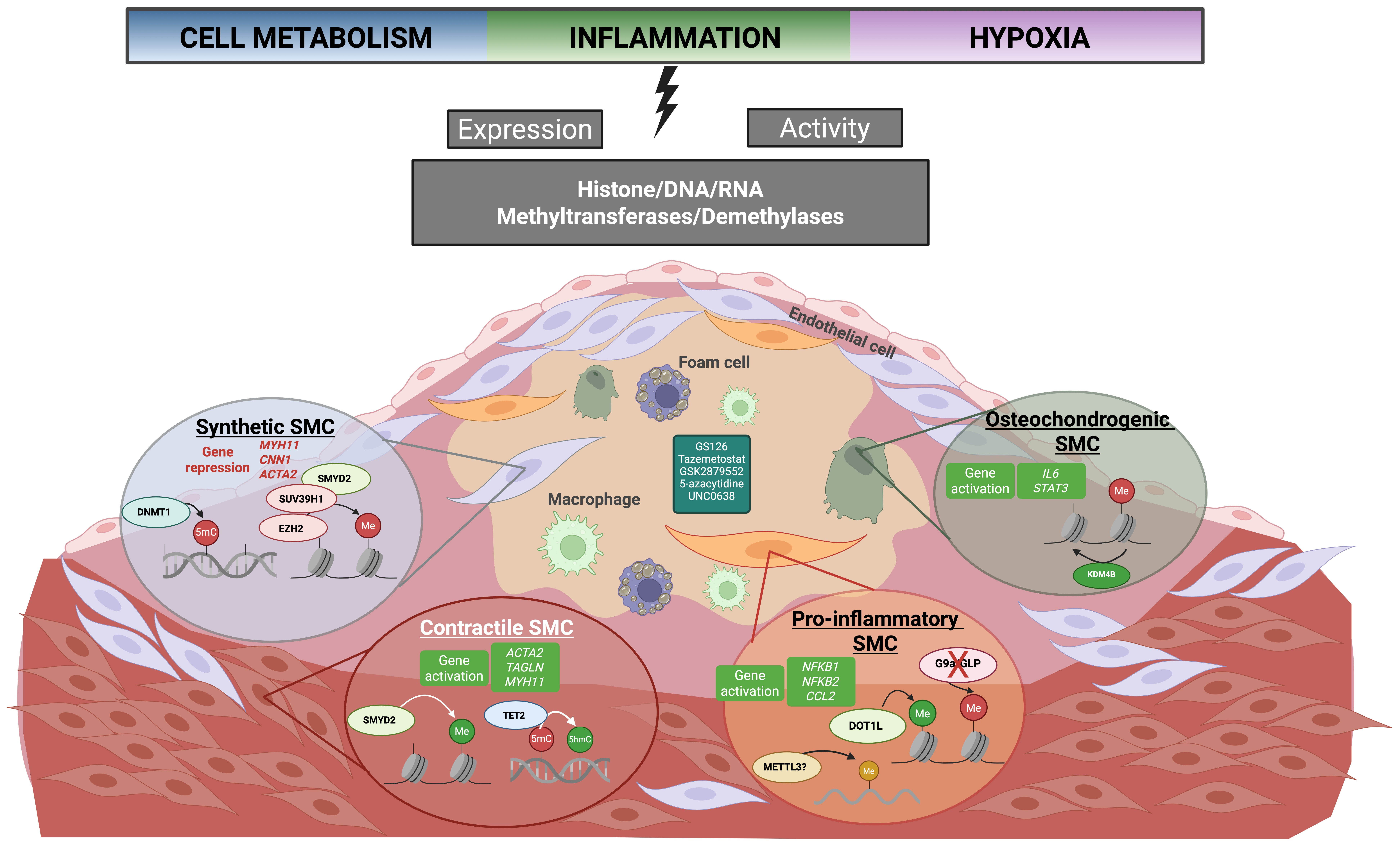
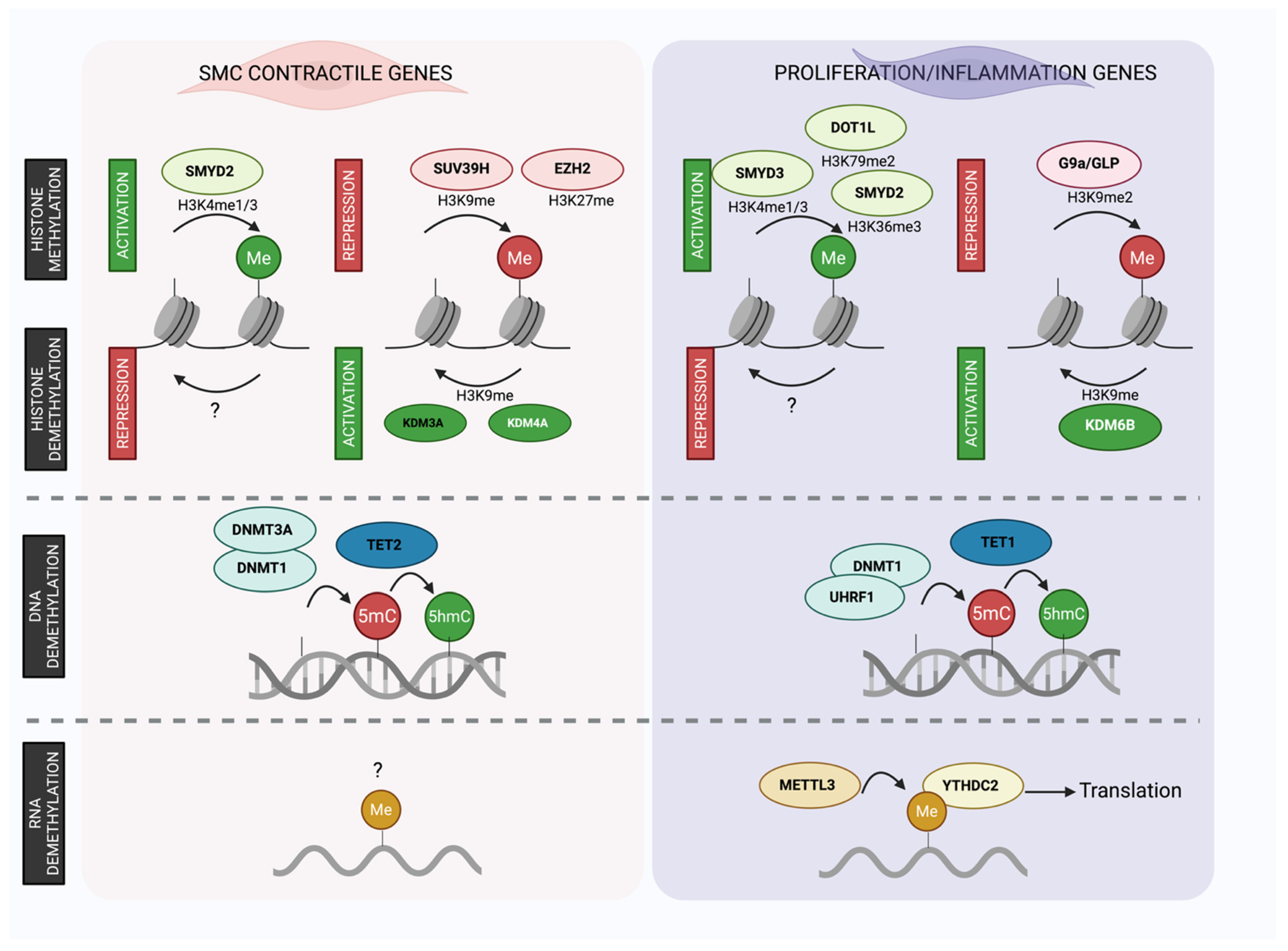
| Name | Gene | Methylation | Regulation of SMC Contractile Genes | Regulation of Proliferation/ Inflammation Genes | Atherosclerosis Studies | Epidrugs | |
|---|---|---|---|---|---|---|---|
| Histone methyl-transferases | SMYD2 | SMYD2 | H3K4me1/3 | Yes [38] | Yes [39] | - | - |
| SMYD3 | SMYD3 | H3K4me1/3 | n/k | Yes [43,44] | - | - | |
| DOT1L | DOT1L | H3K79me2 | n/k | Yes [45] | [45] | - | |
| SUV39H1 | SUV39H1 | H3K9me3 | Yes [46,47] | n/k | - | - | |
| G9A | EHMT2 | H3K9me1/2 | n/k | Yes [48] | - | UNC0638 [48] | |
| GLP | EHMT1 | H3K9me1/2 | n/k | Yes [48] | - | UNC0638 [48] | |
| EZH2 | EZH2 | H3K27 | Yes [49,50] | n/k | [51,52] | GS126 [53], GSK343 [49], UNC1999 [54] | |
| Histone demethylases | JMJD1A | KDM3A | H3K9me2 | Yes [55] | n/k | - | - |
| JMJD2A | KDM4A | H3K9me2 | Yes [46] | n/k | - | - | |
| LSD1 | KDM1a | H3K4me1/2 | n/k | n/k | [56] | GSK2879552 [56] | |
| H3K9me | |||||||
| DNA methyltransferases | DNMT1 | DNMT1 | 5mC | Yes [57,58] | n/k | - | 5-azacytidine [57] |
| DNMT3A | DNMT3A | 5mC | Yes [59] | n/k | - | 5-azacytidine [57] | |
| DNA methyl cytosine dioxygenase | TET2 | TET2 | 5hmC | Yes [60] | n/k | - | - |
| TET1 | TET1 | 5hmc | n/k | Yes [61] | - | - | |
| DNA methylation reader | UHRF1 | UHRF1 | 5mC/5hmC | n/k | Yes [62] | [62] | - |
| RNA methyltransferases | METTL14 | METTL14 | m6A | n/k | Yes [63,64] | [65] | - |
| METTL3 | METTL3 | m6A | n/k | Yes [66,67,68] | [69,70] | - | |
| RNA Reader | YTHDF1 | YTHDF1 | m6A | n/k | n/k | - | - |
| YTHDC2 | YTHDC2 | m6A | n/k | n/k | - | - |
Disclaimer/Publisher’s Note: The statements, opinions and data contained in all publications are solely those of the individual author(s) and contributor(s) and not of MDPI and/or the editor(s). MDPI and/or the editor(s) disclaim responsibility for any injury to people or property resulting from any ideas, methods, instructions or products referred to in the content. |
© 2026 by the authors. Licensee MDPI, Basel, Switzerland. This article is an open access article distributed under the terms and conditions of the Creative Commons Attribution (CC BY) license.
Share and Cite
Basak, S.C.; Gomez, D. The Complex Role of Methylation in Regulating Vascular Smooth Muscle Cell Phenotypic States in Vascular Remodeling and Atherosclerosis. Biomolecules 2026, 16, 825. https://doi.org/10.3390/biom16060825
Basak SC, Gomez D. The Complex Role of Methylation in Regulating Vascular Smooth Muscle Cell Phenotypic States in Vascular Remodeling and Atherosclerosis. Biomolecules. 2026; 16(6):825. https://doi.org/10.3390/biom16060825
Chicago/Turabian StyleBasak, Sanjana C., and Delphine Gomez. 2026. "The Complex Role of Methylation in Regulating Vascular Smooth Muscle Cell Phenotypic States in Vascular Remodeling and Atherosclerosis" Biomolecules 16, no. 6: 825. https://doi.org/10.3390/biom16060825
APA StyleBasak, S. C., & Gomez, D. (2026). The Complex Role of Methylation in Regulating Vascular Smooth Muscle Cell Phenotypic States in Vascular Remodeling and Atherosclerosis. Biomolecules, 16(6), 825. https://doi.org/10.3390/biom16060825