Molecular Mechanisms and Therapeutic Targets of RNA-Based and Traditional Lipid-Lowering Agents in Residual Cardiovascular Risk: A Scoping Review of Key Directions Towards Future Perspectives

 , ,
, ,  , and
, and
Abstract
1. Introduction
2. Methods
2.1. Protocol
2.2. Search Strategy
2.3. Eligibility Criteria
2.4. Source Selection Process
2.5. Quality Appraisal
3. Results
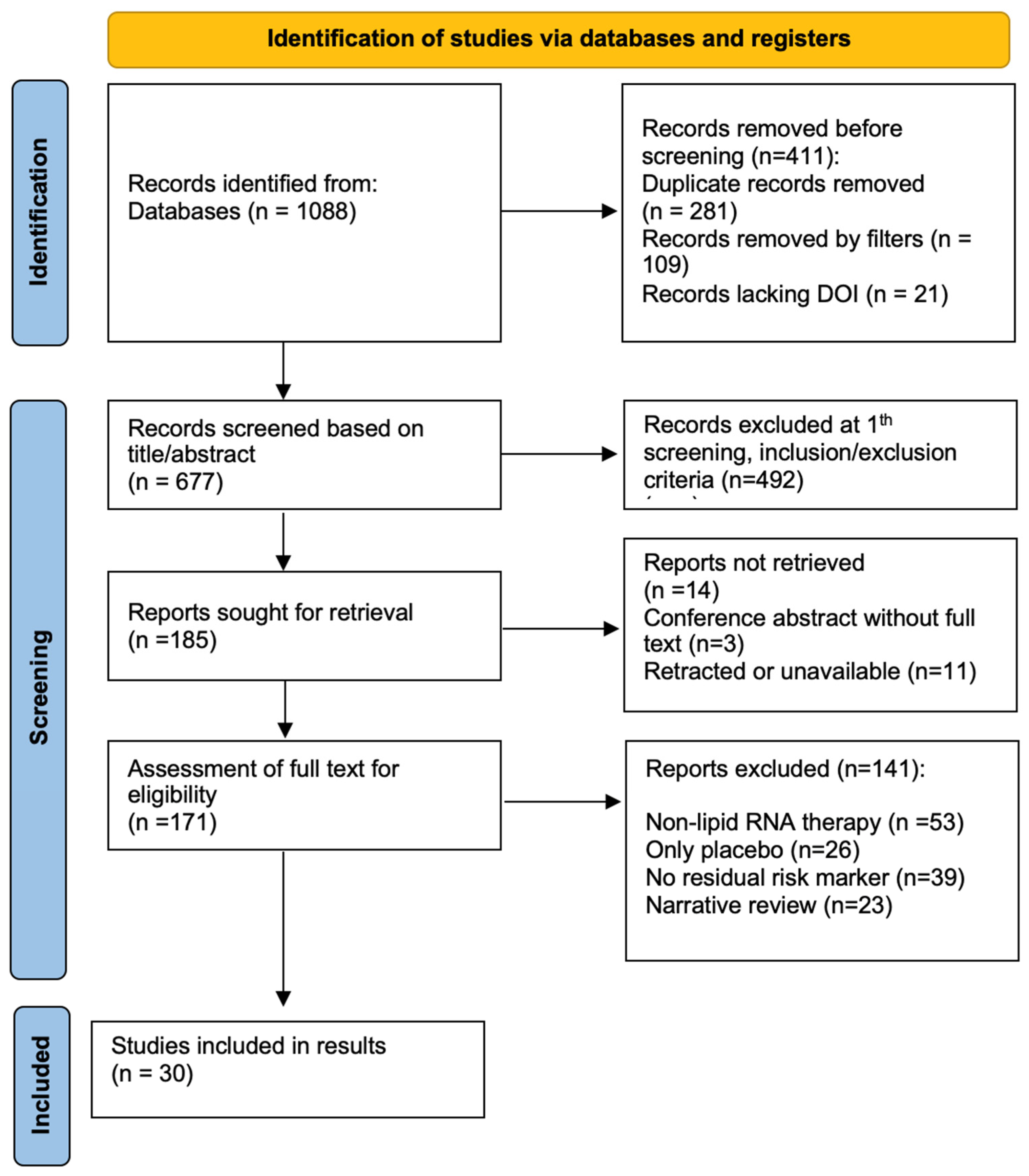
3.1. Selection of Studies
3.2. Overview of Selected Studies
3.3. Summary of Results
3.3.1. Molecular Mechanisms and Target Pathways
3.3.2. Efficacy Outcomes
3.3.3. Safety Profiles
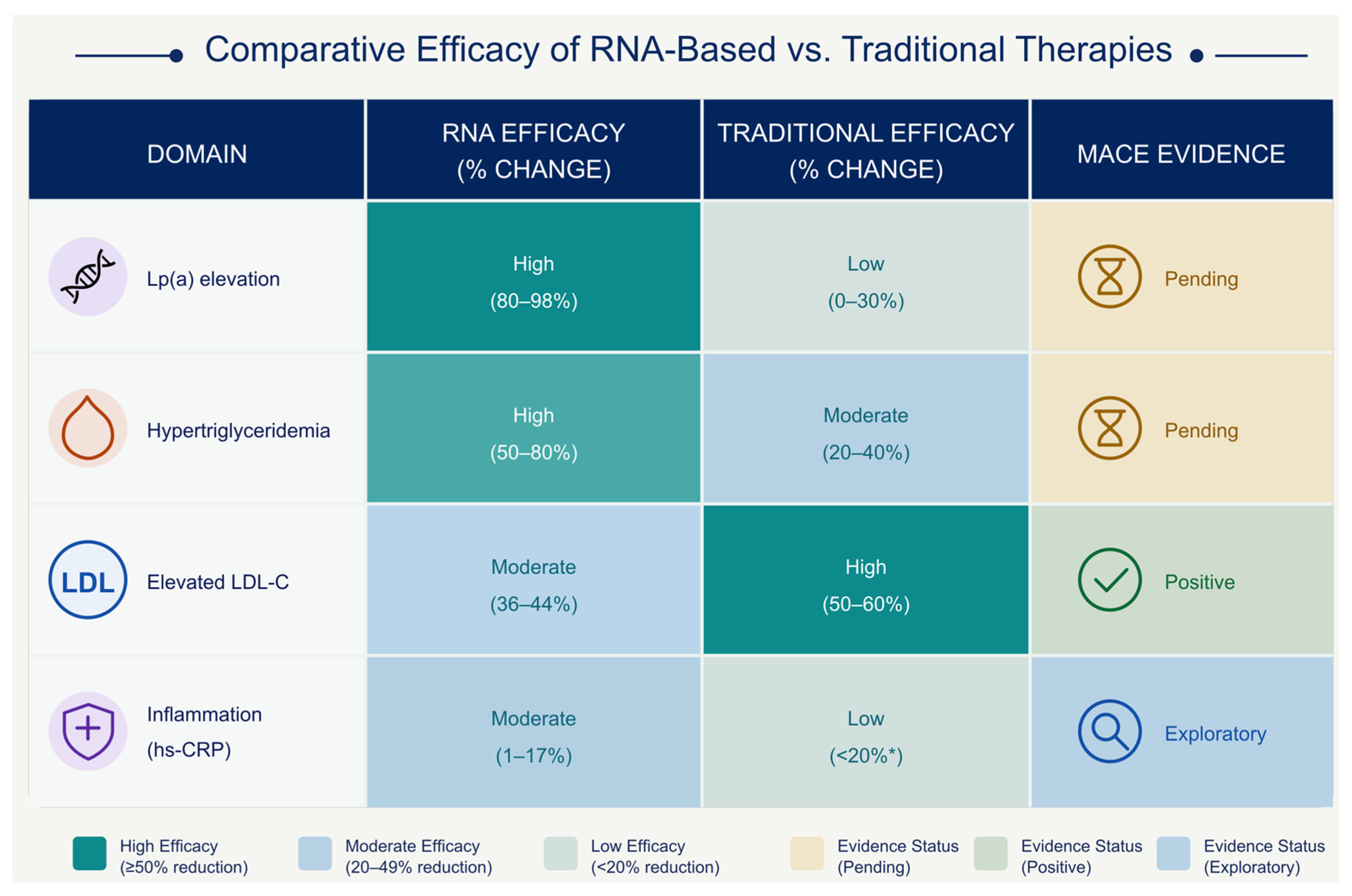
3.3.4. Comparative Efficacy and Safety Profiles
3.3.5. Evidence Gaps Identified
4. Discussion
4.1. Lipoprotein(a): A Divergence Between RNA and Traditional Approaches
4.2. Triglycerides and Remnant Cholesterol: RNA Superiority with Safety Caveats
4.3. LDL-C and Non-HDL Cholesterol: Comparative Efficacy
4.4. Residual Risk: The Unanswered Question
4.5. Future Directions
- Elucidate the dynamics of RISC complexes. Studies on Ago2 turnover rates, determinants of RISC stability, and factors influencing siRNA dissociation from RISC would facilitate the development of next-generation siRNAs with improved durability.
- Improve endosomal escape. Ionizable lipids, pH-sensitive polymers, and cell-penetrating peptides are some of the new technologies that could help more siRNA enter the cell and reach the cytosol. This could mean that lower doses are needed.
- Complete phase 3 outcomes trials. The cardiology community is very excited to see the results of the Lp(a)HORIZON (pelacarsen), OCEAN(a)-Outcomes (olpasiran), and ALPINE (lepodesiran) clinical trials. These studies will demonstrate whether lowering Lp(a) levels leads to a lower risk of MACE, which is the ultimate test of the Lp(a) hypothesis.
- Explore novel RNA targets. Beyond PCSK9, LPA, APOC3, and ANGPTL3, novel targets include Lp(a) assembly factors, inflammatory mediators (IL-6, NLRP3), and fibrosis-related genes (CTGF, TIMP1).
- Develop RNA combination therapies. The ability to simultaneously silence multiple targets (such as LPA and APOC3) with a single RNA construct is a promising approach for mixed dyslipidemia.
4.6. Clinical Relevance
4.6.1. Patient Selection: Who Are the Best Responders to RNA-Based Therapies?
4.6.2. Clinical Scenarios Where Traditional Agents Remain Preferred
4.7. Limitations of This Scoping Review
5. Conclusions
Supplementary Materials
Author Contributions
Funding
Institutional Review Board Statement
Informed Consent Statement
Data Availability Statement
Conflicts of Interest
References
- Raal, F.J.; Bergeron, J.; Gaudet, D.; Rosenson, R.S.; Sullivan, D.R.; Turner, T.; Hegele, R.A.; Ballantyne, C.M.; Knowles, J.W.; Leeper, N.J.; et al. Zodasiran, an RNAi Therapeutic Targeting ANGPTL3, for Treating Patients with Homozygous Familial Hypercholesterolaemia (GATEWAY): An Open-Label, Randomised, Phase 2 Trial. Lancet Diabetes Endocrinol. 2026, 14, 123–136. [Google Scholar] [CrossRef]
- Rosenson, R.S.; Gaudet, D.; Hegele, R.A.; Ballantyne, C.M.; Nicholls, S.J.; Lucas, K.J.; San Martin, J.; Zhou, R.; Muhsin, M.; Chang, T.; et al. Zodasiran, an RNAi Therapeutic Targeting ANGPTL3, for Mixed Hyperlipidemia. N. Engl. J. Med. 2024, 391, 913–925. [Google Scholar] [CrossRef] [PubMed]
- Nissen, S.E.; Wang, Q.; Nicholls, S.J.; Navar, A.M.; Ray, K.K.; Schwartz, G.G.; Szarek, M.; Stroes, E.S.G.; Troquay, R.; Dorresteijn, J.A.N.; et al. Zerlasiran—A Small-Interfering RNA Targeting Lipoprotein(a): A Phase 2 Randomized Clinical Trial. JAMA 2024, 332, 1992–2002. [Google Scholar] [CrossRef] [PubMed]
- O’Donoghue, M.L.; Rosenson, R.S.; López, J.A.G.; Lepor, N.E.; Baum, S.J.; Stout, E.; Gaudet, D.; Knusel, B.; Kuder, J.F.; Murphy, S.A.; et al. The Off-Treatment Effects of Olpasiran on Lipoprotein(a) Lowering: OCEAN(a)-DOSE Extension Period Results. J. Am. Coll. Cardiol. 2024, 84, 790–797. [Google Scholar] [CrossRef]
- Nissen, S.E.; Wolski, K.; Watts, G.F.; Koren, M.J.; Fok, H.; Nicholls, S.J.; Rider, D.A.; Cho, L.; Romano, S.; Melgaard, C.; et al. Single Ascending and Multiple-Dose Trial of Zerlasiran, a Short Interfering RNA Targeting Lipoprotein(a): A Randomized Clinical Trial. JAMA 2024, 331, 1534–1543. [Google Scholar] [CrossRef]
- Rivera, F.B.; Cha, S.W.; Aparece, J.P.; Rocimo, A.; Ong, B.A.; Golbin, J.M.; Alfonso, P.G.; Enkhmaa, B.; Khan, S.U.; Cainzos-Achirica, M.; et al. Sex Differences in Cardiovascular Outcomes and Cholesterol-Lowering Efficacy of PCSK9 Inhibitors: Systematic Review and Meta-Analysis. JACC Adv. 2023, 2, 100669. [Google Scholar] [CrossRef] [PubMed]
- Taub, P.R.; Gutierrez, A.; Wewers, D.; Garcia Cantu, E.; Cao, H.; Deck, C.; Lesogor, A.; Ott, D.; Mena-Madrazo, J.; Zang, X.; et al. Safety and Lipid-Lowering Efficacy of Inclisiran Monotherapy in Patients Without ASCVD: The VICTORION-Mono Randomized Clinical Trial. J. Am. Coll. Cardiol. 2025, 86, 196–208. [Google Scholar] [CrossRef]
- Alzarroug, A.F.; Al Gahtani, H.K.; Algahtani, S.; Alghamdi, H.K.; Alhinti, M.F.; Almutairi, K.A.; Algahtani, S. Safety and Effectiveness of Evolocumab During Acute and Sub-Acute Phases of Acute Coronary Syndrome (ACS): A Systematic Review and Meta-Analysis. Cureus 2023, 15, e35514. [Google Scholar] [CrossRef]
- Zimerman, A.; Wiviott, S.D.; Park, J.-G.; Murphy, S.A.; Ran, X.; Bramson, C.R.; Curto, M.; Ramos, V.; Jevne, A.; Kuder, J.F.; et al. Reductions in Remnant Cholesterol and VLDL Cholesterol through Inhibition of ANGPTL3 Protein Synthesis: An Analysis from the TRANSLATE-TIMI 70 Trial. Eur. J. Prev. Cardiol. 2024, 31, 1216–1223. [Google Scholar] [CrossRef]
- Koren, M.J.; Moriarty, P.M.; Baum, S.J.; Neutel, J.; Hernandez-Illas, M.; Weintraub, H.S.; Florio, M.; Kassahun, H.; Melquist, S.; Varrieur, T.; et al. Preclinical Development and Phase 1 Trial of a Novel siRNA Targeting Lipoprotein(a). Nat. Med. 2022, 28, 96–103. [Google Scholar] [CrossRef]
- Ballantyne, C.M.; Vasas, S.; Azizad, M.; Clifton, P.; Rosenson, R.S.; Chang, T.; Melquist, S.; Zhou, R.; Mushin, M.; Leeper, N.J.; et al. Plozasiran, an RNA Interference Agent Targeting APOC3, for Mixed Hyperlipidemia. N. Engl. J. Med. 2024, 391, 899–912. [Google Scholar] [CrossRef]
- Watts, G.F.; Rosenson, R.S.; Hegele, R.A.; Goldberg, I.J.; Gallo, A.; Mertens, A.; Baass, A.; Zhou, R.; Muhsin, M.; Hellawell, J.; et al. Plozasiran for Managing Persistent Chylomicronemia and Pancreatitis Risk. N. Engl. J. Med. 2025, 392, 127–137. [Google Scholar] [CrossRef]
- Gaudet, D.; Pall, D.; Watts, G.F.; Nicholls, S.J.; Rosenson, R.S.; Modesto, K.; San Martin, J.; Hellawell, J.; Ballantyne, C.M. Plozasiran (ARO-APOC3) for Severe Hypertriglyceridemia: The SHASTA-2 Randomized Clinical Trial. JAMA Cardiol. 2024, 9, 620–630. [Google Scholar] [CrossRef] [PubMed]
- Sohn, W.; Winkle, P.; Neutel, J.; Wu, Y.; Jabari, F.; Terrio, C.; Varrieur, T.; Wang, J.; Hellawell, J. Pharmacokinetics, Pharmacodynamics, and Tolerability of Olpasiran in Healthy Japanese and Non-Japanese Participants: Results from a Phase I, Single-Dose, Open-Label Study. Clin. Ther. 2022, 44, 1237–1247. [Google Scholar] [CrossRef] [PubMed]
- Yan, J.-H.; Taylor, A.J.; Clough, T.; Burmeister-Getz, E.; Pazdirkova, M.; Russo, C. Pharmacokinetics and Safety of Pelacarsen, a GalNAc3-Conjugated Antisense Oligonucleotide Targeting Apo(a), in Participants with Mild Hepatic Impairment. Clin. Transl. Sci. 2025, 18, e70344. [Google Scholar] [CrossRef] [PubMed]
- Li, W.; Sun, L.; Yan, S. PCSK9 Inhibitors and Inclisiran with or without Statin Therapy on Incident Muscle Symptoms and Creatine Kinase: A Systematic Review and Network Meta-Analysis. Front. Cardiovasc. Med. 2024, 11, 1375040. [Google Scholar] [CrossRef]
- Rosenson, R.S.; López, J.A.G.; Gaudet, D.; Baum, S.J.; Stout, E.; Lepor, N.E.; Park, J.-G.; Murphy, S.A.; Knusel, B.; Wang, J.; et al. Olpasiran, Oxidized Phospholipids, and Systemic Inflammatory Biomarkers: Results from the OCEAN(a)-DOSE Trial. JAMA Cardiol. 2025, 10, 482–486. [Google Scholar] [CrossRef]
- Marston, N.A.; Bergmark, B.A.; Alexander, V.J.; Prohaska, T.A.; Kang, Y.M.; Moura, F.A.; Zimerman, A.; Waldman, E.; Weinland, J.; Murphy, S.A.; et al. Olezarsen for Managing Severe Hypertriglyceridemia and Pancreatitis Risk. N. Engl. J. Med. 2026, 394, 429–441. [Google Scholar] [CrossRef]
- Bergmark, B.A.; Marston, N.A.; Prohaska, T.A.; Alexander, V.J.; Zimerman, A.; Moura, F.A.; Murphy, S.A.; Goodrich, E.L.; Zhang, S.; Gaudet, D.; et al. Olezarsen for Hypertriglyceridemia in Patients at High Cardiovascular Risk. N. Engl. J. Med. 2024, 390, 1770–1780. [Google Scholar] [CrossRef]
- Kosmas, C.E.; Bousvarou, M.D.; Tsamoulis, D.; Gianniou, M.; Papakonstantinou, E.J.; Rallidis, L.S. Novel RNA-Based Therapies in the Management of Dyslipidemias. Int. J. Mol. Sci. 2025, 26, 1026. [Google Scholar] [CrossRef]
- Ostadal, P.; Steg, P.G.; Poulouin, Y.; Bhatt, D.L.; Bittner, V.A.; Chua, T.; Diaz, R.; Goodman, S.G.; Huo, Y.; Jukema, J.W.; et al. Metabolic Risk Factors and Effect of Alirocumab on Cardiovascular Events after Acute Coronary Syndrome: A Post-Hoc Analysis of the ODYSSEY OUTCOMES Randomised Controlled Trial. Lancet Diabetes Endocrinol. 2022, 10, 330–340. [Google Scholar] [CrossRef]
- Casares, J.A.; Jaramillo, A.P.; Nizamudeen, S.; Abdul Samad, S.K. Evolocumab Versus Statins and Placebo in Patients with Cardiovascular Disease and Comorbidities: A Systematic Review and Meta-Analysis. Cureus 2025, 17, e82037. [Google Scholar] [CrossRef] [PubMed]
- Schwartz, G.G.; Szarek, M.; Bittner, V.A.; Diaz, R.; Goodman, S.G.; Jukema, J.W.; Landmesser, U.; López-Jaramillo, P.; Manvelian, G.; Pordy, R.; et al. Lipoprotein(a) and Benefit of PCSK9 Inhibition in Patients with Nominally Controlled LDL Cholesterol. J. Am. Coll. Cardiol. 2021, 78, 421–433. [Google Scholar] [CrossRef] [PubMed]
- Maidman, S.D.; Rosenson, R.S. Lipid-Lowering RNA Therapeutics for Atherosclerotic Cardiovascular Disease Prevention: A State-of-the-Art Review. BioDrugs 2025, 39, 753–768. [Google Scholar] [CrossRef]
- Nissen, S.E.; Linnebjerg, H.; Shen, X.; Wolski, K.; Ma, X.; Lim, S.; Michael, L.F.; Ruotolo, G.; Gribble, G.; Navar, A.M.; et al. Lepodisiran, an Extended-Duration Short Interfering RNA Targeting Lipoprotein(a): A Randomized Dose-Ascending Clinical Trial. JAMA 2023, 330, 2075–2083. [Google Scholar] [CrossRef]
- Nissen, S.E.; Ni, W.; Shen, X.; Wang, Q.; Navar, A.M.; Nicholls, S.J.; Wolski, K.; Michael, L.; Haupt, A.; Krege, J.H.; et al. Lepodisiran—A Long-Duration Small Interfering RNA Targeting Lipoprotein(a). N. Engl. J. Med. 2025, 392, 1673–1683. [Google Scholar] [CrossRef]
- Jang, Y.; Rhee, E.-J.; Choi, S.H. Innovative Lipid-Lowering Strategies: RNA-Based, Small Molecule, and Protein-Based Therapies. Endocrinol. Metab. 2025, 40, 668–686. [Google Scholar] [CrossRef]
- Satyam, S.M.; El-Tanani, M.; Patni, M.A.; Rehman, A.; Irshad, S.M.; Raheem, R.; Junais, E.; John, A.A.; Rassal, R.Y.; Kumari, R.; et al. Inclisiran SiRNA Therapy for Durable LDL-C Reduction: A Systematic Review and Meta-Analysis Highlighting a Breakthrough in Long-Term Cardiovascular Risk Management. BMC Cardiovasc. Disord. 2026, 26, 94. [Google Scholar] [CrossRef] [PubMed]
- Landmesser, U.; Koenig, W.; Leiter, L.A.; Raal, F.J.; Ray, K.K.; Wright, R.S.; Han, J.; Conde, L.G.; Schwartz, G.G. Inclisiran in Patients with Prior Myocardial Infarction: A Post Hoc Pooled Analysis of the ORION-10 and ORION-11 Phase 3 Randomised Trials. Atherosclerosis 2023, 386, 117354. [Google Scholar] [CrossRef]
- Raal, F.; Durst, R.; Bi, R.; Talloczy, Z.; Maheux, P.; Lesogor, A.; Kastelein, J.J.P.; ORION-5 Study Investigators. Efficacy, Safety, and Tolerability of Inclisiran in Patients with Homozygous Familial Hypercholesterolemia: Results from the ORION-5 Randomized Clinical Trial. Circulation 2024, 149, 354–362. [Google Scholar] [CrossRef]
- Ray, K.K.; Oru, E.; Rosenson, R.S.; Jones, J.; Ma, X.; Walgren, J.; Haupt, A.; Verma, S.; Gaudet, D.; Nicholls, S.J.; et al. Durability and Efficacy of Solbinsiran, a GalNAc-Conjugated siRNA Targeting ANGPTL3, in Adults with Mixed Dyslipidaemia (PROLONG-ANG3): A Double-Blind, Randomised, Placebo-Controlled, Phase 2 Trial. Lancet 2025, 405, 1594–1607. [Google Scholar] [CrossRef] [PubMed]
- Gouni-Berthold, I.; Alexander, V.J.; Yang, Q.; Hurh, E.; Steinhagen-Thiessen, E.; Moriarty, P.M.; Hughes, S.G.; Gaudet, D.; Hegele, R.A.; O’Dea, L.S.L.; et al. Efficacy and Safety of Volanesorsen in Patients with Multifactorial Chylomicronaemia (COMPASS): A Multicentre, Double-Blind, Randomised, Placebo-Controlled, Phase 3 Trial. Lancet Diabetes Endocrinol. 2021, 9, 264–275. [Google Scholar] [CrossRef] [PubMed]
- Bergmark, B.A.; Marston, N.A.; Bramson, C.R.; Curto, M.; Ramos, V.; Jevne, A.; Kuder, J.F.; Park, J.-G.; Murphy, S.A.; Verma, S.; et al. Effect of Vupanorsen on Non-High-Density Lipoprotein Cholesterol Levels in Statin-Treated Patients with Elevated Cholesterol: TRANSLATE-TIMI 70. Circulation 2022, 145, 1377–1386. [Google Scholar] [CrossRef]
- Cho, L.; Nicholls, S.J.; Nordestgaard, B.G.; Landmesser, U.; Tsimikas, S.; Blaha, M.J.; Leitersdorf, E.; Lincoff, A.M.; Lesogor, A.; Manning, B.; et al. Design and Rationale of Lp(a)HORIZON Trial: Assessing the Effect of Lipoprotein(a) Lowering with Pelacarsen on Major Cardiovascular Events in Patients with CVD and Elevated Lp(a). Am. Heart J. 2025, 287, 1–9. [Google Scholar] [CrossRef]
- Hagström, E.; Steg, P.G.; Szarek, M.; Bhatt, D.L.; Bittner, V.A.; Danchin, N.; Diaz, R.; Goodman, S.G.; Harrington, R.A.; Jukema, J.W.; et al. Apolipoprotein B, Residual Cardiovascular Risk After Acute Coronary Syndrome, and Effects of Alirocumab. Circulation 2022, 146, 657–672. [Google Scholar] [CrossRef]
- Ray, K.K.; Gunn, L.H.; Conde, L.G.; Raal, F.J.; Wright, R.S.; Gosselin, N.H.; Leiter, L.A.; Koenig, W.; Schwartz, G.G.; Landmesser, U.; et al. Estimating Potential Cardiovascular Health Benefits of Improved Population Level Control of LDL Cholesterol through a Twice-Yearly siRNA-Based Approach: A Simulation Study of a Health-System Level Intervention. Atherosclerosis 2024, 391, 117472. [Google Scholar] [CrossRef]
- Surma, S.; Shapiro, M.D.; Banach, M. Breaking New Ground in Lipid Management: Insights from the 2024 American College of Cardiology Scientific Sessions. Pharmacol. Res. 2024, 205, 107246. [Google Scholar] [CrossRef] [PubMed]
- Zimerman, A.; Wiviott, S.D.; Park, J.-G.; Murphy, S.A.; Ran, X.; Bramson, C.R.; Curto, M.; Ramos, V.; Jevne, A.; Kuder, J.F.; et al. Hepatic Fat Changes with Antisense Oligonucleotide Therapy Targeting ANGPTL3. J. Clin. Lipidol. 2024, 18, e261–e268. [Google Scholar] [CrossRef]
- Malick, W.A.; Waksman, O.; Do, R.; Koenig, W.; Pradhan, A.D.; Stroes, E.S.G.; Rosenson, R.S. Clinical Trial Design for Triglyceride-Rich Lipoprotein-Lowering Therapies. J. Am. Coll. Cardiol. 2023, 81, 1646–1658. [Google Scholar] [CrossRef]
- Mach, F.; Visseren, F.L.J.; Cater, N.B.; Salhi, N.; Soronen, J.; Ray, K.K.; Delgado, V.; Jukema, J.W.; Laufs, U.; Zamorano, J.-L.; et al. Addressing Residual Risk beyond Statin Therapy: New Targets in the Management of Dyslipidaemias–A Report from the European Society of Cardiology Cardiovascular Round Table. J. Clin. Lipidol. 2024, 18, e685–e700. [Google Scholar] [CrossRef]
- Ballantyne, C.M.; Gaudet, D.; Rosenson, R.S.; Hegele, R.A.; Zhou, R.; Melquist, S.; Hellawell, J.; Leeper, N.J. Effect of Targeting ApoC-III with Plozasiran on Lipoprotein Particle Size and Number in Hypertriglyceridemia. J. Am. Coll. Cardiol. 2025, 85, 1839–1854. [Google Scholar] [CrossRef] [PubMed]
- Tricco, A.C.; Lillie, E.; Zarin, W.; O’Brien, K.K.; Colquhoun, H.; Levac, D.; Moher, D.; Peters, M.D.J.; Horsley, T.; Weeks, L.; et al. PRISMA Extension for Scoping Reviews (PRISMA-ScR): Checklist and Explanation. Ann. Intern. Med. 2018, 169, 467–473. [Google Scholar] [CrossRef] [PubMed]


| Category | Inclusion Criteria | Exclusion Criteria |
|---|---|---|
| Study Design | RCTs, post hoc analyses, prospective cohorts, ongoing trials (with design data) | Case series <10, animal/in vitro |
| Population | Human adults (≥18 years) with residual cardiovascular risk (prior CVD, diabetes, CKD, elevated Lp(a)/TG/hs-CRP despite statin) | Pediatric, rare monogenic lipid disorders without generalizable data |
| Concept | RNA-based therapeutics (siRNA, ASO) targeting PCSK9, LPA, APOC3, or ANGPTL3 | RNA therapeutics for non-cardiometabolic diseases |
| Outcomes | At least one of: molecular mechanisms, target pathways, efficacy (Lp(a), non-HDL-C, apoB, TG, hs-CRP, MACE), safety | LDL-C only without residual risk markers |
| Publication | English language | Non-peer-reviewed (theses, patents); |
| Non-English (without translation available). |
| Ref. | First Author | RNA Type | Study Design | Target | Trial Name | N | Primary Outcome |
|---|---|---|---|---|---|---|---|
| [1] | Raal (2026) | siRNA | Phase 2 open-label RCT | ANGPTL3 | GATEWAY | 46 | LDL-C reduction |
| [2] | Rosenson (2024) | siRNA | Phase 2b RCT | ANGPTL3 | ARCHES-2 | 353 | TG reduction |
| [3] | Nissen (2024) | siRNA | Phase 2 RCT | Lp(a) | ALPACAR-360 | 178 | Lp(a) reduction |
| [4] | O’Donoghue (2024) | siRNA | Phase 2 extension | Lp(a) | OCEAN(a)-DOSE | 281 | Off-treatment durability |
| [5] | Nissen (2024) | siRNA | Phase ½ dose-escalation | Lp(a) | — | 32 | Safety & PK |
| [6] | Rivera (2023) | Traditional agent review | Systematic review + meta-analysis | PCSK9 antibodies | — | 18,234 | Sex differences |
| [7] | Taub (2025) | siRNA | Phase 3 RCT | PCSK9 | VICTORION-Mono | 456 | LDL-C reduction |
| [8] | Alzarroug (2023) | Traditional agent review | Systematic review + meta-analysis | PCSK9 antibodies | — | 2845 | ACS safety |
| [9] | Zimerman (2024) | Post hoc analysis | Post hoc analysis | ANGPTL3 | TRANSLATE-TIMI 70 | 286 | Remnant C reduction |
| [10] | Koren (2022) | siRNA | Phase 1 first-in-human | Lp(a) | — | 32 | Safety & PK |
| [11] | Ballantyne (2024) | siRNA | Phase 2b RCT | APOC3 | MUIR | 353 | TG reduction |
| [12] | Watts (2025) | siRNA | Phase 3 RCT | APOC3 | PALISADE | 75 | AP reduction |
| [13] | Gaudet (2024) | siRNA | Phase 2 RCT | APOC3 | SHASTA-2 | 229 | TG reduction |
| [17] | Rosenson (2025) | siRNA | Phase 2 biomarker | Lp(a) | OCEAN(a)-DOSE | 281 | OxPL reduction |
| [18] | Marston (2026) | ASO | Phase 2b RCT | APOC3 | — | 304 | TG reduction |
| [19] | Bergmark (2024) | ASO | Phase 2b RCT | APOC3 | BRIDGE-TIMI 73a | 154 | TG reduction |
| [21] | Ostadal (2022) | Post hoc analysis | Post hoc analysis | PCSK9 | ODYSSEY OUTCOMES | 18,924 | MACE |
| [22] | Casares (2025) | Traditional agent review | Systematic review + meta-analysis | PCSK9 antibodies | — | 12,348 | CV outcomes |
| [23] | Schwartz (2021) | Post hoc analysis | Post hoc analysis | PCSK9 | ODYSSEY OUTCOMES | 18,924 | Lp(a) effect |
| [25] | Nissen (2023) | siRNA | Phase 1 dose-ascending | Lp(a) | — | 48 | Safety & PK |
| [26] | Nissen (2025) | siRNA | Phase 2 RCT | Lp(a) | ALPACA | 320 | Lp(a) reduction |
| [28] | Satyam (2026) | Traditional agent review | Systematic review + meta-analysis | PCSK9 (inclisiran) | — | 3660 | LDL-C reduction |
| [29] | Landmesser (2023) | siRNA | Post hoc pooled analysis | PCSK9 | ORION-10/11 | 3661 | MACE |
| [30] | Raal (2024) | siRNA | Phase 3 RCT | PCSK9 | ORION-5 | 48 | LDL-C reduction |
| [31] | Ray (2025) | siRNA | Phase 2 RCT | ANGPTL3 | PROLONG-ANG3 | 189 | LDL-C reduction |
| [32] | Gouni-Berthold (2021) | ASO | Phase 3 RCT | APOC3 | COMPASS | 114 | TG reduction |
| [33] | Bergmark (2022) | ASO | Phase 2 RCT | ANGPTL3 | TRANSLATE-TIMI 70 | 286 | Non-HDL-C reduction |
| [34] | Cho (2025) | ASO | Phase 3 trial design | Lp(a) | Lp(a)HORIZON | 8000 | MACE |
| [35] | Hagström (2022) | Post hoc analysis | Post hoc analysis | PCSK9 | ODYSSEY OUTCOMES | 18,924 | apoB reduction |
| [36] | Ray (2024) | Simulation study | Simulation study | PCSK9 | — | 10,000 | Population health |
| Gene Target | Protein Product | RNA Agents | Residual Risk Marker | References |
|---|---|---|---|---|
| PCSK9 | PCSK9 | Inclisiran | LDL-C, non-HDL-C | [6,7,21,22,23,28,29,30,35,36] |
| Apolipoprotein(a) | Apolipoprotein(a) | Pelacarsen, olpasiran, zerlasiran, lepodisiran | Lp(a) | [3,4,5,10,17,23,25,26,34] |
| Apolipoprotein C-III | Apolipoprotein C-III | Olezarsen, plozasiran, volanesorsen | Triglycerides, remnant cholesterol | [11,12,13,18,19,32] |
| Angiopoietin-like 3 | Angiopoietin-like 3 | Zodasiran, vupanorsen, solbinsiran | Mixed dyslipidemia | [1,2,9,31,33] |
| Drug | Trial | N | Lp(a) Reduction | Durability | References |
|---|---|---|---|---|---|
| Zerlasiran | ALPACAR-360 | 178 | ↓ 80–90% | 36 weeks | [3] |
| Zerlasiran | Phase 1/2 pilot | 32 | ↓ 98% | Dose-dependent | [5] |
| Olpasiran | OCEAN(a)-DOSE | 281 | ↓ 95–100% | >6 months off-treatment | [4] |
| Lepodisiran | ALPACA | 320 | ↓ 93.9% | >540 days | [26] |
| SLN360 (Zerlasiran) | Phase 1 | 32 | ↓ 98% | — | [10] |
| Drug | Trial | N | Triglyceride Reduction | APOC3 Reduction | References |
|---|---|---|---|---|---|
| Olezarsen | BRIDGE-TIMI 73a | 304 | ↓ 55% | — | [18,19] |
| Plozasiran | MUIR | 353 | ↓ 50% | — | [11] |
| Plozasiran | SHASTA-2 | 229 | ↓ 70% | ↓ 80% | [13] |
| Plozasiran | PALISADE | 75 | ↓ 80% | ↓ 80% | [12] |
| Volanesorsen | COMPASS | 114 | ↓ 71% | — | [32] |
| Vupanorsen | TRANSLATE-TIMI 70 | 286 | Remnant C ↓ 45% | — | [33] |
| Agent Class | ISR Rate | Hepatotoxicity | Thrombocytopenia | Program Status |
|---|---|---|---|---|
| siRNAs (inclisiran, olpasiran, zerlasiran, lepodisiran, plozasiran, zodasiran, solbinsiran) | 4–12% [7,28,30] | <1% [2,11,26,31] | 0% [2,11,26,31] | Active [1,2,3,4,5,11,12,13,25,26,31] |
| GalNAc-conjugated ASOs (pelacarsen, olezarsen) | 5–11% [18,19] | <1% [18,19] | 0% [18,19] | Active [18,19,34] |
| Non-GalNAc ASO (volanesorsen) | >20% [32] | 2–4% [32] | Less than 14% [32] | Limited use [32] |
| Vupanorsen | — | 6% LFT elevation [33] | 0% [33] | Discontinued [33] |
| Domain | RNA-Based Therapeutics | Traditional Agents | Key Correlation | Direct Evidence Available |
|---|---|---|---|---|
| Lp(a) reduction | ↓ 80–98% [3,4,5,10,17,25,26] | ↓ 0–30% [23] | RNA superior; no traditional agent effective | Yes |
| Triglyceride reduction | ↓ 50–80% [11,12,13,18,19] | ↓ 20–40% * | RNA superior; GalNAc conjugation improves safety | No direct |
| LDL-C reduction | ↓ 36–44% (inclisiran) [7,28,29,30,36] | ↓ 30–60% (statins, PCSK9 Ab) [6,8,22,35] | Comparable; RNA offers infrequent dosing | Yes |
| MACE reduction | HR 0.75 (inclisiran only) [29] | HR 0.85 (PCSK9 Ab) [21] | Inclisiran positive; others pending | Yes |
| Thrombocytopenia | 0% (GalNAc-conjugated); 14% (volanesorsen) [32] | Not reported in included studies | GalNAc conjugation mitigates risk | No direct |
| Hepatotoxicity | <1% (siRNAs); 6% (vupanorsen) [33] | Not reported in included studies | Vupanorsen discontinued | No direct |
| Gap | Description | Implication | Bibliography |
|---|---|---|---|
| Lack of MACE data for Lp(a) and APOC3 agents | No completed outcomes trials for Lp(a)- or APOC3-targeting RNA agents; results pending from Lp(a)HORIZON, OCEAN(a)-Outcomes | Inability to confirm whether biomarker improvement translates into clinical event reduction | [4,34] |
| Limited head-to-head comparisons | Most RNA trials compared agent to placebo on background statin, not directly against traditional agents | Difficulty establishing comparative effectiveness | [2,3,11,12,19,26,31] |
| Short follow-up duration | Most trials reported follow-up of 6–18 months; long-term safety (>5 years) unknown | Potential for late-emergent adverse events unknown | [2,3,4,7,11,13,26,31] |
| Discontinued programs (vupanorsen) | Liver toxicity led to discontinuation despite efficacy | Highlights safety challenges for non-GalNAc-conjugated ASOs | [33] |
| Heterogeneity in outcome measures | Variable Lp(a) assays, different MACE definitions, inconsistent safety reporting | Limits cross-trial comparability | Lp(a) assays: [3,5,25,26]; MACE definitions: [21,23,29,35]; Safety reporting: [8,22,28] |
Disclaimer/Publisher’s Note: The statements, opinions and data contained in all publications are solely those of the individual author(s) and contributor(s) and not of MDPI and/or the editor(s). MDPI and/or the editor(s) disclaim responsibility for any injury to people or property resulting from any ideas, methods, instructions or products referred to in the content. |
© 2026 by the authors. Licensee MDPI, Basel, Switzerland. This article is an open access article distributed under the terms and conditions of the Creative Commons Attribution (CC BY) license.
Share and Cite
Tatarciuc, D.; Esanu, I.M.; Trandafirescu, M.F.; Pauna, A.M.R.; Vasilcu, T.F.; Foia, I.; Armencia, A.O.; Antohe, M.E.; Ghica, D.C.; Stamatin, O.; et al. Molecular Mechanisms and Therapeutic Targets of RNA-Based and Traditional Lipid-Lowering Agents in Residual Cardiovascular Risk: A Scoping Review of Key Directions Towards Future Perspectives. Biomolecules 2026, 16, 807. https://doi.org/10.3390/biom16060807
Tatarciuc D, Esanu IM, Trandafirescu MF, Pauna AMR, Vasilcu TF, Foia I, Armencia AO, Antohe ME, Ghica DC, Stamatin O, et al. Molecular Mechanisms and Therapeutic Targets of RNA-Based and Traditional Lipid-Lowering Agents in Residual Cardiovascular Risk: A Scoping Review of Key Directions Towards Future Perspectives. Biomolecules. 2026; 16(6):807. https://doi.org/10.3390/biom16060807
Chicago/Turabian StyleTatarciuc, Diana, Irina Mihaela Esanu, Mioara Florentina Trandafirescu, Ana Maria Raluca Pauna, Teodor Flaviu Vasilcu, Iolanda Foia, Adina Oana Armencia, Magda Ecaterina Antohe, Dragos Catalin Ghica, Ovidiu Stamatin, and et al. 2026. "Molecular Mechanisms and Therapeutic Targets of RNA-Based and Traditional Lipid-Lowering Agents in Residual Cardiovascular Risk: A Scoping Review of Key Directions Towards Future Perspectives" Biomolecules 16, no. 6: 807. https://doi.org/10.3390/biom16060807
APA StyleTatarciuc, D., Esanu, I. M., Trandafirescu, M. F., Pauna, A. M. R., Vasilcu, T. F., Foia, I., Armencia, A. O., Antohe, M. E., Ghica, D. C., Stamatin, O., & Vasluianu, R. I. (2026). Molecular Mechanisms and Therapeutic Targets of RNA-Based and Traditional Lipid-Lowering Agents in Residual Cardiovascular Risk: A Scoping Review of Key Directions Towards Future Perspectives. Biomolecules, 16(6), 807. https://doi.org/10.3390/biom16060807