Antimicrobial Properties of Ti- and Zr-Based Nanotextured Thin Film Metallic Glasses Against Pseudomonas aeruginosa

 , ,
, , 
Abstract
1. Introduction
2. Experimental Methods
2.1. Sample Preparation
2.2. Surface Wettability Test
2.3. Bactericidal Tests
2.4. Quantitative Analysis
3. Results and Discussion
3.1. Surface Wettability Analysis
3.2. Bacterial Studies
3.2.1. Bacterial Adhesion
3.2.2. Bacterial Viability of the Thin Films on the Ti Substrate
3.2.3. Bacterial Viability of the Thin Films on the SS316L Substrate
3.2.4. Live/Dead Quantitative Analysis
3.3. Bactericidal/Antibacterial Mechanism
4. Conclusions
Supplementary Materials
Author Contributions
Funding
Institutional Review Board Statement
Informed Consent Statement
Data Availability Statement
Acknowledgments
Conflicts of Interest
Abbreviations
| AFM | Atomic Force Microscopy |
| BE | Bactericidal Efficacy |
| CFU | Colony-Forming Units |
| CLSM | Confocal Laser Scanning Microscopy |
| DLVO | Derjaguin–Landau–Verwey–Overbeek |
| EPS | Extracellular Polymeric Substances |
| FE-SEM | Field Emission Scanning Electron Microscopy |
| FIB | Focused Ion Beam |
| FIB-SEM | Focused Ion Beam Scanning Electron Microscopy |
| FOV | Field of View |
| ISO | International Organisation for Standardisation |
| LB | Luria–Bertani (broth) |
| PBS | Phosphate-Buffered Saline |
| PI | Propidium Iodide |
| Ra | Arithmetic Mean Surface Roughness |
| RFU | Relative Fluorescence Units |
| ROS | Reactive Oxygen Species |
| SEM | Scanning Electron Microscopy |
| SS316L | Stainless Steel 316L |
| TFMG | Thin Film Metallic Glass |
| UV | Ultraviolet |
| WCA | Water Contact Angle |
| XPS | X-ray Photoelectron Spectroscopy |
| XRD | X-ray Diffraction |
References
- Cheng, Y.T.; Rodak, D.E.; Wong, C.A.; Hayden, C.A. Effects of micro- and nano-structures on the self-cleaning behaviour of lotus leaves. Nanotechnology 2006, 17, 1359–1362. [Google Scholar] [CrossRef]
- Ma, J.; Sun, Y.; Gleichauf, K.; Lou, J.; Li, Q. Nanostructure on Taro Leaves Resists Fouling by Colloids and Bacteria under Submerged Conditions. Langmuir 2011, 27, 10035–10040. [Google Scholar] [CrossRef] [PubMed]
- Senevirathne, S.W.M.A.I.; Hasan, J.; Mathew, A.; Woodruff, M.; Yarlagadda, P.K.D.V. Bactericidal efficiency of micro- and nanostructured surfaces: A critical perspective. RSC Adv. 2021, 11, 1883–1900. [Google Scholar] [CrossRef]
- Wang, L.; Hu, C.; Shao, L. The antimicrobial activity of nanoparticles: Present situation and prospects for the future. Int. J. Nanomed. 2017, 12, 1227–1249. [Google Scholar] [CrossRef]
- Tripathy, A.; Sen, P.; Su, B.; Briscoe, W.H. Natural and bioinspired nanostructured bactericidal surfaces. Adv. Colloid Interface Sci. 2017, 248, 85–104. [Google Scholar] [CrossRef] [PubMed]
- Ivanova, E.P.; Linklater, D.P.; Werner, M.; Baulin, V.A.; Xu, X.; Vrancken, N.; Rubanov, S.; Hanssen, E.; Wandiyanto, J.; Truong, V.K.; et al. The multi-faceted mechano-bactericidal mechanism of nanostructured surfaces. Proc. Natl. Acad. Sci. USA 2020, 117, 12598–12605. [Google Scholar] [CrossRef]
- Jaggessar, A.; Mathew, A.; Wang, H.; Tesfamichael, T.; Yan, C.; Yarlagadda, P.K. Mechanical, bactericidal and osteogenic behaviours of hydrothermally synthesised TiO2 nanowire arrays. J. Mech. Behav. Biomed. Mater. 2018, 80, 311–319. [Google Scholar] [CrossRef]
- Inoue, A. Bulk amorphous and nanocrystalline alloys with high functional properties. Mater. Sci. Eng. A 2001, 304–306, 1–10. [Google Scholar] [CrossRef]
- Ashby, M.F.; Greer, A.L. Metallic glasses as structural materials. Scr. Mater. 2006, 54, 321–326. [Google Scholar] [CrossRef]
- Du, X.H.; Huang, J.C.; Hsieh, K.C.; Lai, Y.H.; Chen, H.M.; Jang, J.S.C.; Liaw, P.K. Two-glassy-phase bulk metallic glass with remarkable plasticity. Appl. Phys. Lett. 2007, 91, 131901. [Google Scholar] [CrossRef]
- Villapún, V.M.; Tardío, S.; Cumpson, P.; Burgess, J.G.; Dover, L.G.; González, S. Antimicrobial properties of Cu-based bulk metallic glass composites after surface modification. Surf. Coat. Technol. 2019, 372, 111–120. [Google Scholar] [CrossRef]
- Villapún, V.M.; Qu, B.; Lund, P.A.; Wei, W.; Dover, L.; Thompson, J.R.; Adesina, J.O.; Hoerdemann, C.; Cox, S.; González, S. Optimizing the antimicrobial performance of metallic glass composites through surface texturing. Mater. Today Commun. 2020, 23, 101074. [Google Scholar] [CrossRef]
- Chen, H.-W.; Hsu, K.-C.; Chan, Y.-C.; Duh, J.-G.; Lee, J.-W.; Jang, J.S.-C.; Chen, G.-J. Antimicrobial properties of Zr–Cu–Al–Ag thin film metallic glass. Thin Solid Films 2014, 561, 98–101. [Google Scholar] [CrossRef]
- Tian, L.; Wang, X.-L.; Shan, Z.-W. Mechanical Behavior of Micronanoscaled Metallic Glasses. Mater. Res. Lett. 2016, 4, 63–74. [Google Scholar] [CrossRef]
- Wu, W.-P.; Şopu, D.; Yuan, X.; Eckert, J. Aspect ratio-dependent nanoindentation behavior of Cu64Zr36 metallic glass nanopillars investigated by molecular dynamics simulations. J. Appl. Phys. 2020, 128, 084303. [Google Scholar] [CrossRef]
- Li, H.F.; Zheng, Y.F. Recent advances in bulk metallic glasses for biomedical applications. Acta Biomater. 2016, 36, 1–20. [Google Scholar] [CrossRef] [PubMed]
- Schroers, J.; Kumar, G.; Hodges, T.M.; Chan, S.; Kyriakides, T.R. Bulk metallic glasses for biomedical applications. JOM 2009, 61, 21–29. [Google Scholar] [CrossRef]
- Li, H.X.; Lu, Z.C.; Wang, S.L.; Wu, Y.; Lu, Z.P. Fe-based bulk metallic glasses: Glass formation, fabrication, properties and applications. Prog. Mater. Sci. 2019, 103, 235–318. [Google Scholar] [CrossRef]
- Louzguine-Luzgin, D.V.; Inoue, A. Chapter Three—Bulk Metallic Glasses: Formation, Structure, Properties, and Applications. In Handbook of Magnetic Materials; Buschow, K.H.J., Ed.; Elsevier: Amsterdam, The Netherlands, 2013; Volume 21, pp. 131–171. [Google Scholar] [CrossRef]
- Biały, M.; Hasiak, M.; Łaszcz, A. Review on Biocompatibility and Prospect Biomedical Applications of Novel Functional Metallic Glasses. J. Funct. Biomater. 2022, 13, 245. [Google Scholar] [CrossRef]
- Khan, M.M.; Nemati, A.; Rahman, Z.U.; Shah, U.H.; Asgar, H.; Haider, W. Recent Advancements in Bulk Metallic Glasses and Their Applications: A Review. Crit. Rev. Solid State Mater. Sci. 2018, 43, 233–268. [Google Scholar] [CrossRef]
- Dayem, A.A.; Hossain, M.K.; Lee, S.B.; Kim, K.; Saha, S.K.; Yang, G.-M.; Choi, H.Y.; Cho, S.-G. The Role of Reactive Oxygen Species (ROS) in the Biological Activities of Metallic Nanoparticles. Int. J. Mol. Sci. 2017, 18, 120. [Google Scholar] [CrossRef] [PubMed]
- Fu, P.P.; Xia, Q.; Hwang, H.-M.; Ray, P.C.; Yu, H. Mechanisms of nanotoxicity: Generation of reactive oxygen species. J. Food Drug Anal. 2014, 22, 64–75. [Google Scholar] [CrossRef]
- Kumar, A.; Kumar, A.; Vats, C.; Sangwan, P.; Kumar, V.; Abhineet; Chauhan, P.; Chauhan, R.S.; Chaudhary, K. Recent insights into metallic nanoparticles in shelf-life extension of agrifoods: Properties, green synthesis, and major applications. Front. Sustain. Food Syst. 2022, 6, 1025342. [Google Scholar] [CrossRef]
- Yu, Z.; Li, Q.; Wang, J.; Yu, Y.; Wang, Y.; Zhou, Q.; Li, P. Reactive Oxygen Species-Related Nanoparticle Toxicity in the Biomedical Field. Nanoscale Res. Lett. 2020, 15, 115. [Google Scholar] [CrossRef]
- Naz, S.; Gul, A.; Zia, M.; Javed, R. Synthesis, biomedical applications, and toxicity of CuO nanoparticles. Appl. Microbiol. Biotechnol. 2023, 107, 1039–1061. [Google Scholar] [CrossRef]
- Zhan, Y.; Yu, S.; Amirfazli, A.; Siddiqui, A.R.; Li, W. Recent Advances in Antibacterial Superhydrophobic Coatings. Adv. Eng. Mater. 2022, 24, 2101053. [Google Scholar] [CrossRef]
- Ribeiro, M.; Monteiro, F.J.; Ferraz, M.P. Infection of orthopedic implants with emphasis on bacterial adhesion process and techniques used in studying bacterial-material interactions. Biomatter 2012, 2, 176–194. [Google Scholar] [CrossRef]
- Wekwejt, M.; Rościszewska, M.; Pałubicka, A. The problem of infections associated with implants—An overview. Eur. J. Med. Technol. 2018, 4, 19–26. [Google Scholar]
- Amankwah, S.; Adisu, M.; Gorems, K.; Abdella, K.; Kassa, T. Assessment of Phage-Mediated Inhibition and Removal of Multidrug-Resistant Pseudomonas aeruginosa Biofilm on Medical Implants. Infect. Drug Resist. 2022, 15, 2797–2811. [Google Scholar] [CrossRef]
- Fernandez, T.; Rogers, N.; Whittle, J.D. Thin film coatings for stem cell technologies. In Thin Film Coatings for Biomaterials and Biomedical Applications; Elsevier: Amsterdam, The Netherlands, 2016; pp. 197–223. [Google Scholar] [CrossRef]
- Vasilev, K.; Cook, J.; Griesser, H.J. Antibacterial surfaces for biomedical devices. Expert Rev. Med. Devices 2009, 6, 553–567. [Google Scholar] [CrossRef] [PubMed]
- Onyeagba, C.R.; Valashani, M.; Wang, H.; Brown, C.; Yarlagadda, P.; Tesfamichael, T. Nanomechanical surface properties of co-sputtered thin film polymorphic metallic glasses based on Ti-Fe-Cu, Zr-Fe-Al, and Zr-W-Cu. Surf. Interfaces 2023, 40, 103090. [Google Scholar] [CrossRef]
- Onyeagba, C.R.; Will, G.; Barclay, M.; Brown, C.; Wang, H.; Tesfamichael, T. Polymorphous nanostructured metallic glass coatings for corrosion protection of medical grade Ti substrate. Intermetallics 2024, 165, 108167. [Google Scholar] [CrossRef]
- Crouzet, M.; Claverol, S.; Lomenech, A.-M.; Le Sénéchal, C.; Costaglioli, P.; Barthe, C.; Garbay, B.; Bonneu, M.; Vilain, S. Pseudomonas aeruginosa cells attached to a surface display a typical proteome early as 20 minutes of incubation. PLoS ONE 2017, 12, e0180341. [Google Scholar] [CrossRef]
- Mountcastle, S.E.; Vyas, N.; Villapun, V.M.; Cox, S.C.; Jabbari, S.; Sammons, R.L.; Shelton, R.M.; Walmsley, A.D.; Kuehne, S.A. Biofilm viability checker: An open-source tool for automated biofilm viability analysis from confocal microscopy images. npj Biofilms Microbiomes 2021, 7, 44. [Google Scholar] [CrossRef] [PubMed]
- Liu, Y.; Yang, S.-F.; Li, Y.; Xu, H.; Qin, L.; Tay, J.-H. The influence of cell and substratum surface hydrophobicities on microbial attachment. J. Biotechnol. 2004, 110, 251–256. [Google Scholar] [CrossRef]
- Donlan, R.M. Biofilms: Microbial Life on Surfaces. Emerg. Infect. Dis. 2002, 8, 881–890. [Google Scholar] [CrossRef]
- Hwang, G.; Lee, C.H.; Ahn, I.S.; Mhin, B.J. Analysis of the adhesion of Pseudomonas putida NCIB 9816-4 to a silica gel as a model soil using extended DLVO theory. J. Hazard. Mater. 2010, 179, 983–988. [Google Scholar] [CrossRef] [PubMed]
- Wu, S.; Altenried, S.; Zogg, A.; Zuber, F.; Maniura-Weber, K.; Ren, Q. Role of the Surface Nanoscale Roughness of Stainless Steel on Bacterial Adhesion and Microcolony Formation. ACS Omega 2018, 3, 6456–6464. [Google Scholar] [CrossRef] [PubMed]
- Alam, F.; Balani, K. Adhesion force of staphylococcus aureus on various biomaterial surfaces. J. Mech. Behav. Biomed. Mater. 2017, 65, 872–880. [Google Scholar] [CrossRef] [PubMed]
- Gottenbos, B.; van der Mei, H.C.; Busscher, H.J. Initial adhesion and surface growth of Staphylococcus epidermidis and Pseudomonas aeruginosa on biomedical polymers. J. Biomed. Mater. Res. 2000, 50, 208–214. [Google Scholar] [CrossRef]
- Viljoen, A.; Mignolet, J.; Viela, F.; Mathelié-Guinlet, M.; Dufrêne, Y.F. How Microbes Use Force to Control Adhesion. J. Bacteriol. 2020, 202, e00125-20. [Google Scholar] [CrossRef]
- Wang, C.; Hou, J.; van der Mei, H.C.; Busscher, H.J.; Ren, Y. Emergent Properties in Streptococcus mutans Biofilms Are Controlled through Adhesion Force Sensing by Initial Colonizers. mBio 2019, 10, e01908-19. [Google Scholar] [CrossRef]
- Straub, H.; Bigger, C.M.; Valentin, J.; Abt, D.; Qin, X.; Eberl, L.; Maniura-Weber, K.; Ren, Q. Bacterial Adhesion on Soft Materials: Passive Physicochemical Interactions or Active Bacterial Mechanosensing? Adv. Healthc. Mater. 2019, 8, 1801323. [Google Scholar] [CrossRef] [PubMed]
- Ren, Y.; Wang, C.; Chen, Z.; Allan, E.; van der Mei, H.C.; Busscher, H.J. Emergent heterogeneous microenvironments in biofilms: Substratum surface heterogeneity and bacterial adhesion force-sensing. FEMS Microbiol. Rev. 2018, 42, 259–272. [Google Scholar] [CrossRef]
- Yang, K.; Shi, J.; Wang, L.; Chen, Y.; Liang, C.; Yang, L.; Wang, L.-N. Bacterial anti-adhesion surface design: Surface patterning, roughness and wettability: A review. J. Mater. Sci. Technol. 2022, 99, 82–100. [Google Scholar] [CrossRef]
- Boks, N.P.; Busscher, H.J.; Van Der Mei, H.C.; Norde, W. Bond-strengthening in staphylococcal adhesion to hydrophilic and hydrophobic surfaces using atomic-force microscopy. Langmuir 2008, 24, 12990–12994. [Google Scholar] [CrossRef] [PubMed]
- Zhao, G.; Chen, W.-N. Enhanced PVDF membrane performance via surface modification by functional polymer poly(N-isopropylacrylamide) to control protein adsorption and bacterial adhesion. React. Funct. Polym. 2015, 97, 19–29. [Google Scholar] [CrossRef]
- Cunliffe, A.J.; Askew, P.D.; Stephan, I.; Iredale, G.; Cosemans, P.; Simmons, L.M.; Verran, J.; Redfern, J. How Do We Determine the Efficacy of an Antibacterial Surface? A Review of Standardised Antibacterial Material Testing Methods. Antibiotics 2021, 10, 1069. [Google Scholar] [CrossRef]
- Scuri, S.; Petrelli, F.; Grappasonni, I.; Idemudia, L.; Marchetti, F.; Di Nicola, C. Evaluation of the antimicrobial activity of novel composite plastics containing two silver (I) additives, acyl pyrazolonate and acyl pyrazolone. Acta Bio Medica Atenei Parm. 2019, 90, 370–377. [Google Scholar] [CrossRef]
- Toplitsch, D.; Lackner, J.M.; Schwan, A.M.; Hinterer, A.; Stögmüller, P.; Horn, K.; Fritzlar, N.; Pfuch, A.; Kittinger, C. Antimicrobial Activity of a Novel Cu(NO3)2-Containing Sol–Gel Surface under Different Testing Conditions. Materials 2021, 14, 6488. [Google Scholar] [CrossRef]
- Bogachev, M.I.; Volkov, V.Y.; Markelov, O.A.; Trizna, E.Y.; Baydamshina, D.R.; Melnikov, V.; Murtazina, R.R.; Zelenikhin, P.V.; Sharafutdinov, I.S.; Kayumov, A.R. Fast and simple tool for the quantification of biofilm-embedded cells sub-populations from fluorescent microscopic images. PLoS ONE 2018, 13, e0193267. [Google Scholar] [CrossRef]
- Rezvan, A.; Sharifikolouei, E.; Lassnig, A.; Soprunyuk, V.; Gammer, C.; Spieckermann, F.; Schranz, W.; Najmi, Z.; Cochis, A.; Scalia, A.C.; et al. Antibacterial activity, cytocompatibility, and thermomechanical stability of Ti40Zr10Cu36Pd14 bulk metallic glass. Mater. Today Bio 2022, 16, 100378. [Google Scholar] [CrossRef]
- Tardelli, J.D.C.; Bagnato, V.S.; dos Reis, A.C. Bacterial Adhesion Strength on Titanium Surfaces Quantified by Atomic Force Microscopy: A Systematic Review. Antibiotics 2023, 12, 994. [Google Scholar] [CrossRef]
- Doyle, R.J. Contribution of the hydrophobic effect to microbial infection. Microbes Infect. 2000, 2, 391–400. [Google Scholar] [CrossRef]
- Addorisio, S.R.; Shteynberg, R.; Dasilva, M.; Mixon, J.; Mucciarone, K.; Vu, L.; Arsenault, K.; Briand, V.; Parker, S.; Smith, S.; et al. Oxidative Stress Response in Bacteria: A Review. Fine Focus 2022, 8, 36–46. [Google Scholar] [CrossRef]
- Chautrand, T.; Souak, D.; Chevalier, S.; Duclairoir-Poc, C. Gram-Negative Bacterial Envelope Homeostasis under Oxidative and Nitrosative Stress. Microorganisms 2022, 10, 924. [Google Scholar] [CrossRef] [PubMed]
- Jindai, K.; Nakade, K.; Masuda, K.; Sagawa, T.; Kojima, H.; Shimizu, T.; Shingubara, S.; Ito, T. Adhesion and bactericidal properties of nanostructured surfaces dependent on bacterial motility. RSC Adv. 2020, 10, 5673–5680. [Google Scholar] [CrossRef]
- Seil, J.T.; Webster, T.J. Antimicrobial applications of nanotechnology: Methods and literature. Int. J. Nanomed. 2012, 7, 2767–2781. [Google Scholar] [CrossRef] [PubMed]
- Luo, J.; Chan, W.-B.; Wang, L.; Zhong, C.-J. Probing interfacial interactions of bacteria on metal nanoparticles and substrates with different surface properties. Int. J. Antimicrob. Agents 2010, 36, 549–556. [Google Scholar] [CrossRef]
- Ren, E.; Zhang, C.; Li, D.; Pang, X.; Liu, G. Leveraging metal oxide nanoparticles for bacteria tracing and eradicating. View 2020, 1, 20200052. [Google Scholar] [CrossRef]
- Yoon, S.; Rungraeng, N.; Song, W.; Jun, S. Superhydrophobic and superhydrophilic nanocomposite coatings for preventing Escherichia coli K-12 adhesion on food contact surface. J. Food Eng. 2014, 131, 135–141. [Google Scholar] [CrossRef]
- Yamamura, H.; Hagiwara, T.; Hayashi, Y.; Osawa, K.; Kato, H.; Katsu, T.; Masuda, K.; Sumino, A.; Yamashita, H.; Jinno, R.; et al. Antibacterial Activity of Membrane-Permeabilizing Bactericidal Cyclodextrin Derivatives. ACS Omega 2021, 6, 31831–31842. [Google Scholar] [CrossRef]
- Espejo, H.M.; Bahr, D.F. Application of oxidized metallic surfaces as a medium to store biochemical agents with antimicrobial properties. Surf. Coat. Technol. 2019, 372, 312–318. [Google Scholar] [CrossRef]
- Chu, Y.Y.; Lin, Y.S.; Chang, C.M.; Liu, J.-K.; Chen, C.H.; Huang, J.C. Promising antimicrobial capability of thin film metallic glasses. Mater. Sci. Eng. C 2014, 36, 221–225. [Google Scholar] [CrossRef]
- Chatterjee, S.; Bandyopadhyay, A.; Sarkar, K. Effect of iron oxide and gold nanoparticles on bacterial growth leading towards biological application. J. Nanobiotechnol. 2011, 9, 34. [Google Scholar] [CrossRef]
- Silhavy, T.J.; Kahne, D.; Walker, S. The Bacterial Cell Envelope. Cold Spring Harb. Perspect. Biol. 2010, 2, a000414. [Google Scholar] [CrossRef]
- Zhang, S.; Lin, L.; Huang, X.; Lu, Y.-G.; Zheng, D.-L.; Feng, Y. Antimicrobial Properties of Metal Nanoparticles and Their Oxide Materials and Their Applications in Oral Biology. J. Nanomater. 2022, 2022, e2063265. [Google Scholar] [CrossRef]
- Liu, T.; Xiao, B.; Xiang, F.; Tan, J.; Chen, Z.; Zhang, X.; Wu, C.; Mao, Z.; Luo, G.; Chen, X.; et al. Ultrasmall copper-based nanoparticles for reactive oxygen species scavenging and alleviation of inflammation related diseases. Nat. Commun. 2020, 11, 2788. [Google Scholar] [CrossRef] [PubMed]
- Wang, M.; Tang, T. Surface treatment strategies to combat implant-related infection from the beginning. J. Orthop. Transl. 2018, 17, 42–54. [Google Scholar] [CrossRef] [PubMed]





| Sample | Deposition Power (Watts) | Time (min) | ||
|---|---|---|---|---|
| Element 1 | Element 2 | Element 3 | ||
| Ti–Fe–Cu | Ti = 150 | Fe = 50 | Cu = 50 | 30 |
| Zr–Fe–Al | Zr = 150 | Fe = 50 | Al = 50 | 30 |
| Zr–W–Cu | Zr = 150 | W = 50 | Cu = 50 | 30 |
| Sample | Film Thickness (nm) | Surface Roughness (nm) | |
|---|---|---|---|
| SS316L | Ti | ||
| Bare substrate | - | 1.6 | 4.0 |
| Ti47Fe41Cu12 | 190 | 3.5 | 3.0 |
| Zr71Fe3Al26 | 298 | 8.1 | 2.0 |
| Zr58W31Cu11 | 280 | 4.9 | 1.5 |
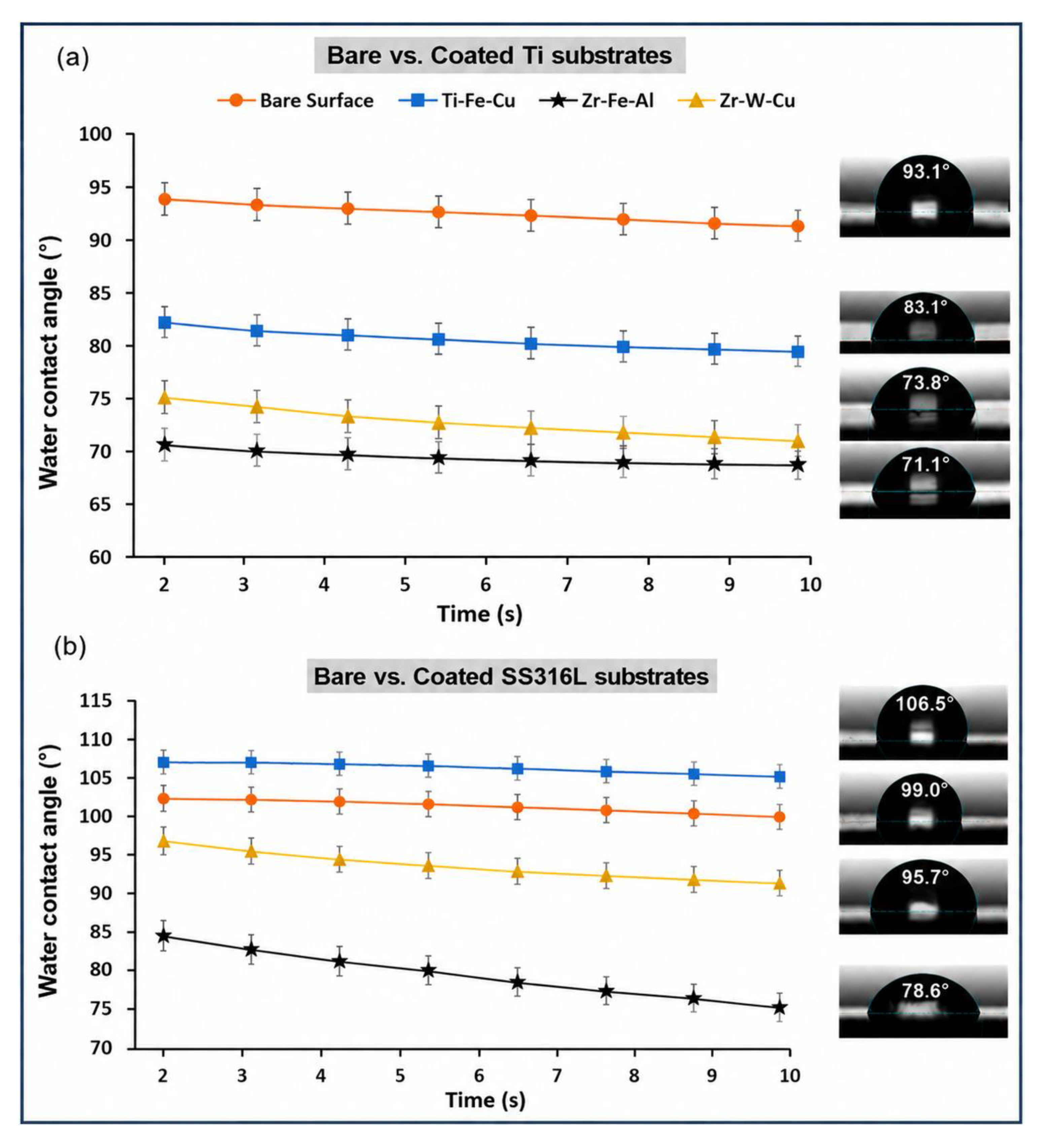
| Samples | Mean WCA (Degree) | Roughness (nm) | ||
|---|---|---|---|---|
| SS316L | Ti | SS316L | Ti | |
| Bare | 99.0 ± 1.7 | 93.1 ± 7.4 | 1.6 | 4.0 |
| Ti47Fe41Cu12 | 106.5 ± 3.5 | 83.4 ± 4.3 | 3.5 | 3.0 |
| Zr71Fe3Al26 | 78.6 ± 5.2 | 71.1 ± 5.6 | 8.1 | 2.0 |
| Zr58W31Cu11 | 94.5 ± 8.1 | 73.8 ± 2.8 | 4.9 | 1.5 |
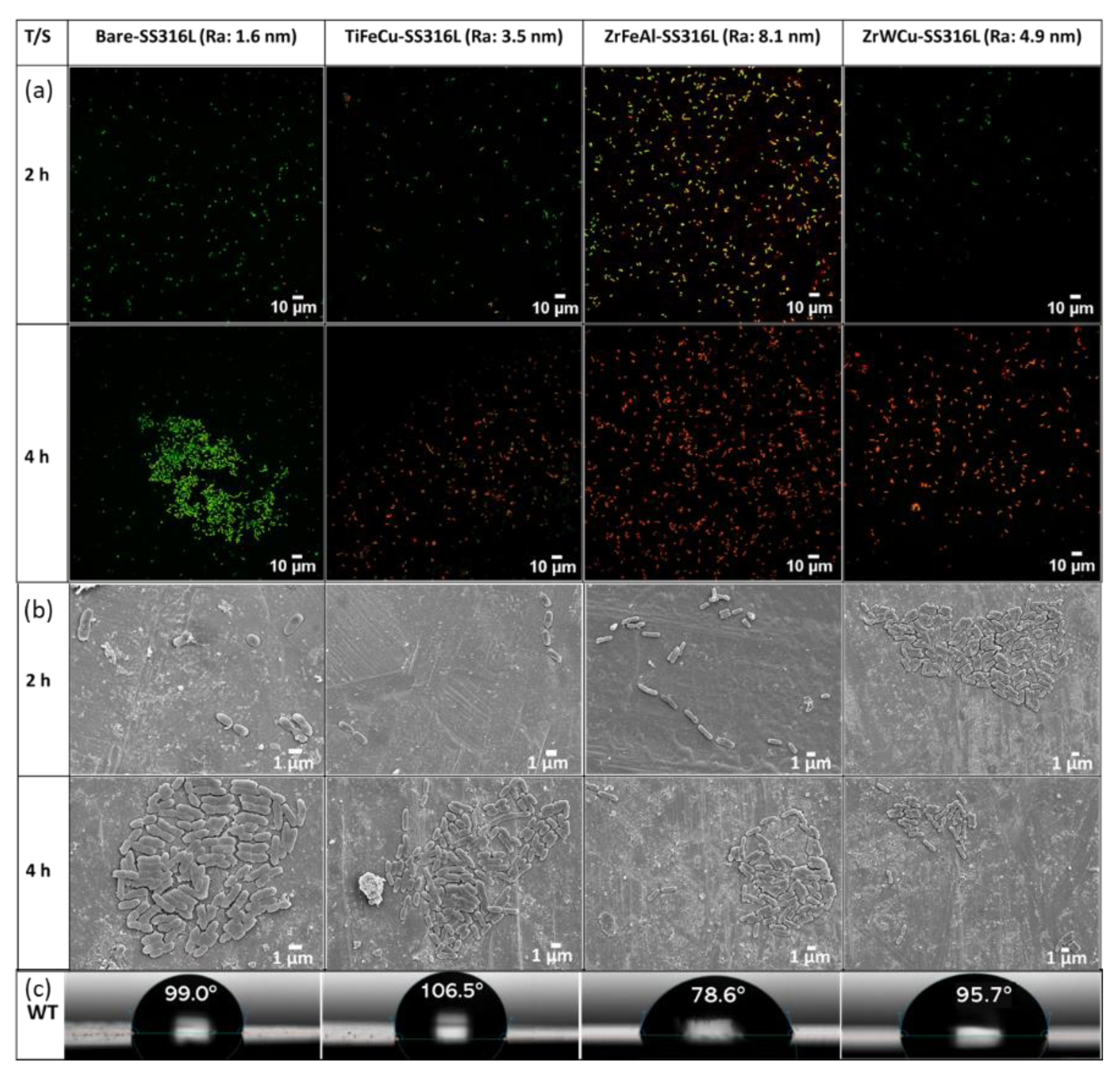
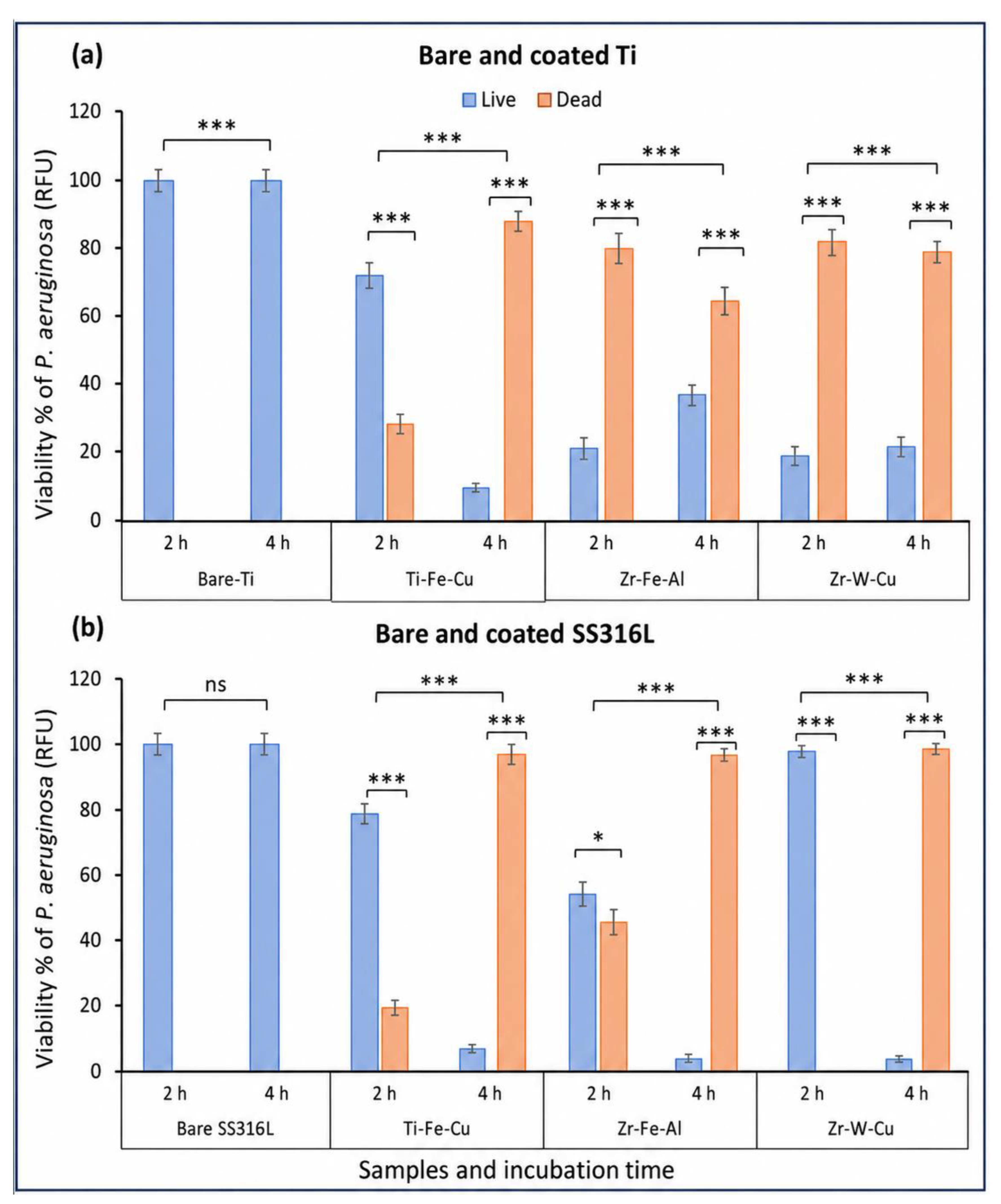
| Substrate | Sample | Active Cell Ratio (%) 2 h | Reduction (%) 2 h | Active Cell Ratio (%) 4 h | Reduction (%) 4 h |
|---|---|---|---|---|---|
| Ti | Bare Ti | 100 ± 1 | 0 | 100 ± 1 | 0 |
| Ti-Fe-Cu | 70 ± 5 | 30 ± 4 | 10 ± 4 | 90 ± 5 | |
| Zr-Fe-Al | 25 ± 3 | 75 ± 5 | 38 ± 6 | 62 ± 5 | |
| Zr-W-Cu | 18 ± 4 | 80 ± 5 | 20 ± 5 | 78 ± 5 | |
| SS316L | Bare SS316L | 100 ± 0 | 0 | 100 ± 0 | 0 |
| Ti-Fe-Cu | 80 ± 6 | 20 ± 2 | 0 ± 1 | 100 ± 0 | |
| Zr-Fe-Al | 58 ± 3 | 52 ± 3 | 0 ± 1 | 100 ± 1 | |
| Zr-W-Cu | 100 ± 1 | 0 ± 1 | 0 ± 1 | 100 ± 1 |
Disclaimer/Publisher’s Note: The statements, opinions and data contained in all publications are solely those of the individual author(s) and contributor(s) and not of MDPI and/or the editor(s). MDPI and/or the editor(s) disclaim responsibility for any injury to people or property resulting from any ideas, methods, instructions or products referred to in the content. |
© 2026 by the authors. Licensee MDPI, Basel, Switzerland. This article is an open access article distributed under the terms and conditions of the Creative Commons Attribution (CC BY) license.
Share and Cite
Onyeagba, C.R.; Harris, J.M.; Egbo, T.E.; Brown, C.; Wang, H.; Tesfamichael, T. Antimicrobial Properties of Ti- and Zr-Based Nanotextured Thin Film Metallic Glasses Against Pseudomonas aeruginosa. Biomolecules 2026, 16, 759. https://doi.org/10.3390/biom16060759
Onyeagba CR, Harris JM, Egbo TE, Brown C, Wang H, Tesfamichael T. Antimicrobial Properties of Ti- and Zr-Based Nanotextured Thin Film Metallic Glasses Against Pseudomonas aeruginosa. Biomolecules. 2026; 16(6):759. https://doi.org/10.3390/biom16060759
Chicago/Turabian StyleOnyeagba, Chijioke R., Jonathan M. Harris, Timothy E. Egbo, Cameron Brown, Hongxia Wang, and Tuquabo Tesfamichael. 2026. "Antimicrobial Properties of Ti- and Zr-Based Nanotextured Thin Film Metallic Glasses Against Pseudomonas aeruginosa" Biomolecules 16, no. 6: 759. https://doi.org/10.3390/biom16060759
APA StyleOnyeagba, C. R., Harris, J. M., Egbo, T. E., Brown, C., Wang, H., & Tesfamichael, T. (2026). Antimicrobial Properties of Ti- and Zr-Based Nanotextured Thin Film Metallic Glasses Against Pseudomonas aeruginosa. Biomolecules, 16(6), 759. https://doi.org/10.3390/biom16060759