


Abstract
The pharmaceutical industry has seen significant growth in the development of antibody-based therapeutics, especially monoclonal antibodies (mAbs) and bispecific antibodies (bsAbs), used in the treatment of cancer and neurodegenerative diseases. However, their production and purification remain challenging. It is difficult to achieve both high product yield and the strict purity required for clinical use. Downstream processing is expensive and often involves trade-offs between efficiency and product quality. In addition, current purification methods do not fully remove contaminants, especially host cell proteins, residual DNA, and protein aggregates, affecting the safety and effectiveness of the final product. Recent advances in purification technologies, such as improved chromatography techniques and alternative separation methods, have shown promise in addressing some of these limitations. Process optimization and the integration of continuous manufacturing approaches are being explored to enhance efficiency and scalability. Furthermore, increased regulatory expectations are driving the need for more robust and reproducible purification strategies. As the antibody therapeutics market continues to expand, optimizing manufacturing and purification processes is crucial to achieve cost efficiency and large-scale production. This article discusses the main challenges in antibody production and downstream purification, focusing on monoclonal and bispecific antibodies, and compares current strategies to increase yield, improve purity, and reduce contaminants.
1. Introduction
The production of antibodies and antibody-based therapeutics involves multiple downstream purification steps that are essential for achieving high purity and preserving structural integrity. A key challenge in these processes is the presence of both process- and product-related impurities. Process-related impurities originate from the expression system, most commonly animal cell cultures used for large-scale production. Despite their capability to yield substantial quantities of recombinant protein, these systems also contribute host cell proteins (HCPs) and other residual contaminants that must be efficiently eliminated during downstream processing, typically accompanied by some loss of the target product at each purification stage.
Conversely, product-related impurities stem from the physicochemical properties and inherent stability of the therapeutic protein. Attributes such as molecular complexity, elevated protein concentrations, and exposure to diverse mechanical and chemical stresses throughout manufacturing—including mixing, agitation, filtration, freeze–thaw cycles, and interfacial interactions—can facilitate the generation of aggregates, misfolded conformers, or other molecular variants that compromise product quality. These complexities are especially magnified in advanced molecular formats such as bispecific antibodies (bsAbs), necessitating rigorous control over both impurity clearance and product stability [1,2,3].
Given these considerations, optimizing the downstream purification processes is critical to effectively reduce both process- and product-related impurities while maintaining yield and structural integrity. Table 1 summarizes the key steps involved in downstream processing of antibody-based therapeutics, and Table 2 provides an overview of commonly used large-scale manufacturing equipment along with their advantages and limitations [4,5,6,7].
Table 1.
Steps involved in the downstream processes of antibody-based therapeutic production.
Table 2.
Equipment in antibody therapeutic manufacturing. The table summarizes main advantages and limitations.
2. Product- and Process-Related Impurities
2.1. Product-Related Impurities
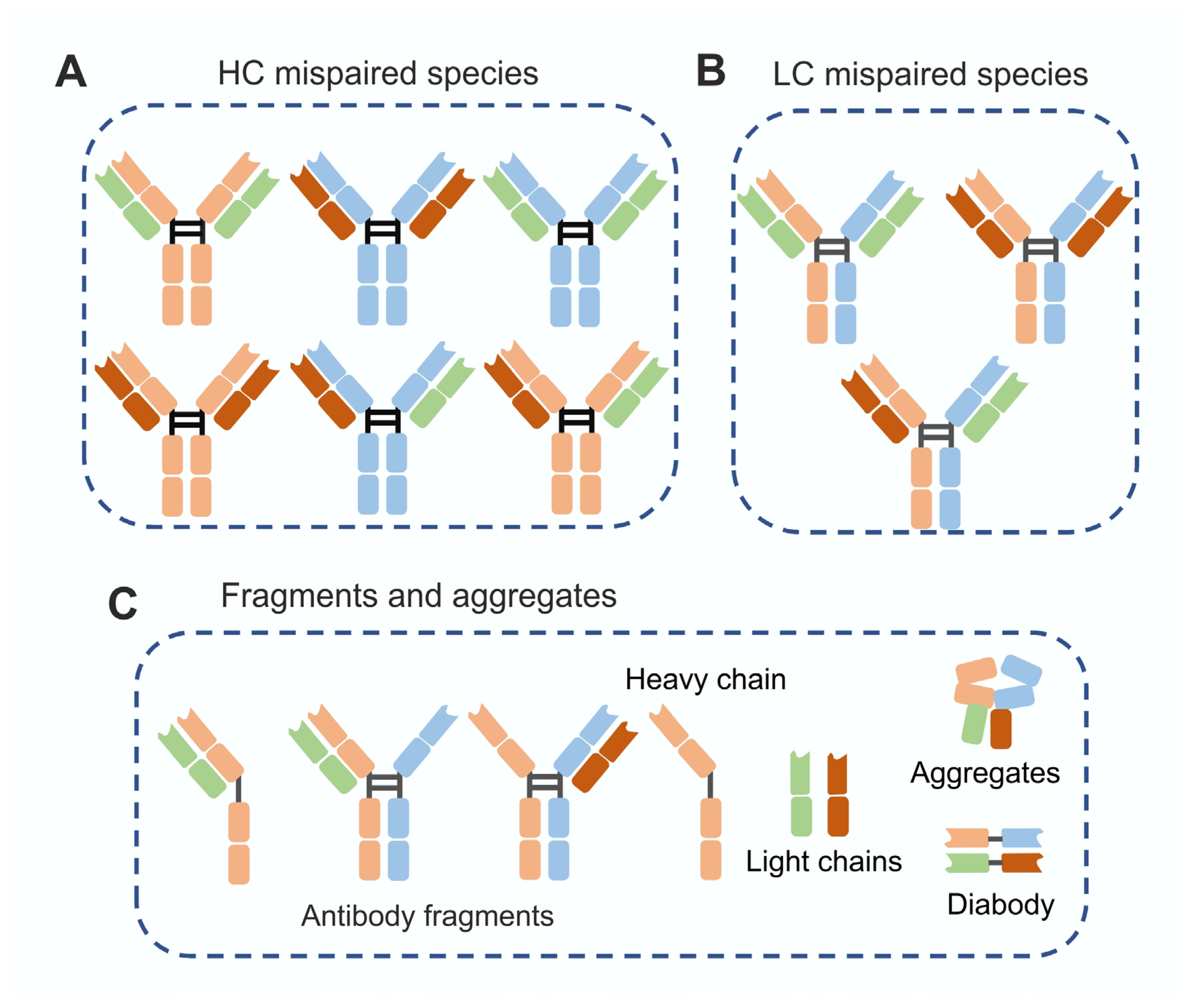
Product-related impurities generate heterogeneous populations of the target protein encompassing variants that may exhibit either conserved or altered physicochemical properties. Variants with distinct structures, such as aggregates, are generally easier to separate, whereas impurities with similar physicochemical characteristics present a greater challenge. Figure 1 and Figure 2 illustrate common product-related impurities with both similar and dissimilar physicochemical properties observed during the production of monoclonal antibodies (mAbs) and bispecific antibodies (bsAbs).
Changes in pH, exposure to elevated temperatures or oxidative conditions, and variations in ionic strength can also affect the tertiary and quaternary structure, as well as the molecular orientation of the final product. In addition, host cell-related factors, including undesirable post-translational modifications (PTMs), proteolytic degradation, cell culture conditions, and genetic instability, have been shown to significantly impact mAb quality attributes [8].
Common impurities in mAb production include incorrect chain assembly products and truncation variants encompassing heavy chains (HC), light chains (LC), and single-chain variable fragments (scFvs), as well as post-translational modification (PTM) variants such as glycosylation, charge, oxidation, and disulfide bond variants (Figure 1). Truncated forms of mAbs arise from inefficient or aberrant assembly of heavy and light chains, resulting in species such as isolated light chains (LC), heavy chains (HC), half-antibodies, heavy-chain dimers, and H2L variants (Figure 1A). Glycosylation occurs in both Fc and Fab regions, with common types including N-glycosylation, O-fucosylation, and O-mannosylation, which can affect binding affinity, solubility, immunogenicity, stability, and protein folding (Figure 1B) [9]. Fc glycosylation typically involves N-glycosylation with core fucosylation at Asn297 in the CH2 domain and modulates effector functions such as ADCC [10], while variable-region glycosylation is less common but present in antibodies like cetuximab [11].
Charge variants include acidic forms (e.g., sialylation, deamidation, N-terminal modifications, and glycation) and basic forms (e.g., C-terminal lysine clipping and succinimide formation), as well as structural variants such as racemization and acetone aldimine formation (Figure 1C) [12]. These modifications can alter pI, binding affinity, and stability; for example, CDR deamidation can reduce binding up to 14-fold [13], while glycation can mask positive charges and affect stability [14]. C-terminal lysine clipping generally has minimal impact on potency [15].
Oxidation of methionine and tryptophan residues can disrupt hydrophobic interactions and induce conformational changes, increasing polarity and reducing antibody stability (Figure 1D) [16]. Disulfide bond variants, including mismatches or non-native formations among the 16 bonds in IgG antibodies, can compromise structural integrity and folding (Figure 1E) [17].
Due to the greater structural complexity of bsAbs compared with mAbs, product-related impurities tend to form at increased frequency and diversity during bsAb production [18]. Depending on the bsAb format (e.g., symmetric, asymmetric, or fragment-based) and the host cell line used, various mismatched by-product species may be generated (Figure 2). Although many of these mismatches can be removed through downstream purification strategies, some homodimers and mispaired structures exhibit physicochemical properties similar to those of the desired product and may therefore co-purify [19]. This co-purification contributes to reduced overall process yields commonly observed in bsAb manufacturing and represents a major challenge in their production [20]. Among the different bsAb formats, fragment-based constructs tend to generate the highest levels of product-related impurities due to their increased ability for aggregation [20,21].
Figure 1.
Product-related impurities in mAb production can be classified as follows: (A) fragments/truncated forms—low-molecular-weight species including half-antibodies, light- or heavy-chain fragments, or specific domain fragments (e.g., Fab or Fc). (B) Glycosylation variants—differences in glycan structures attached to the Fc region, including variations in monosaccharide composition, branching patterns, or the presence or absence of specific residues (e.g., fucose or sialic acid). (C) Charge variants—acidic or basic forms of the antibody that differ in net surface charge. (D) Oxidation variants—modifications resulting from the addition of oxygen atoms to susceptible amino acid residues, such as methionine, tryptophan, and histidine. (E) Disulfide bond variants—species with partially reduced disulfide bonds, incorrectly paired (scrambled) disulfide linkages, or unpaired cysteine residues (adapted from [22]).
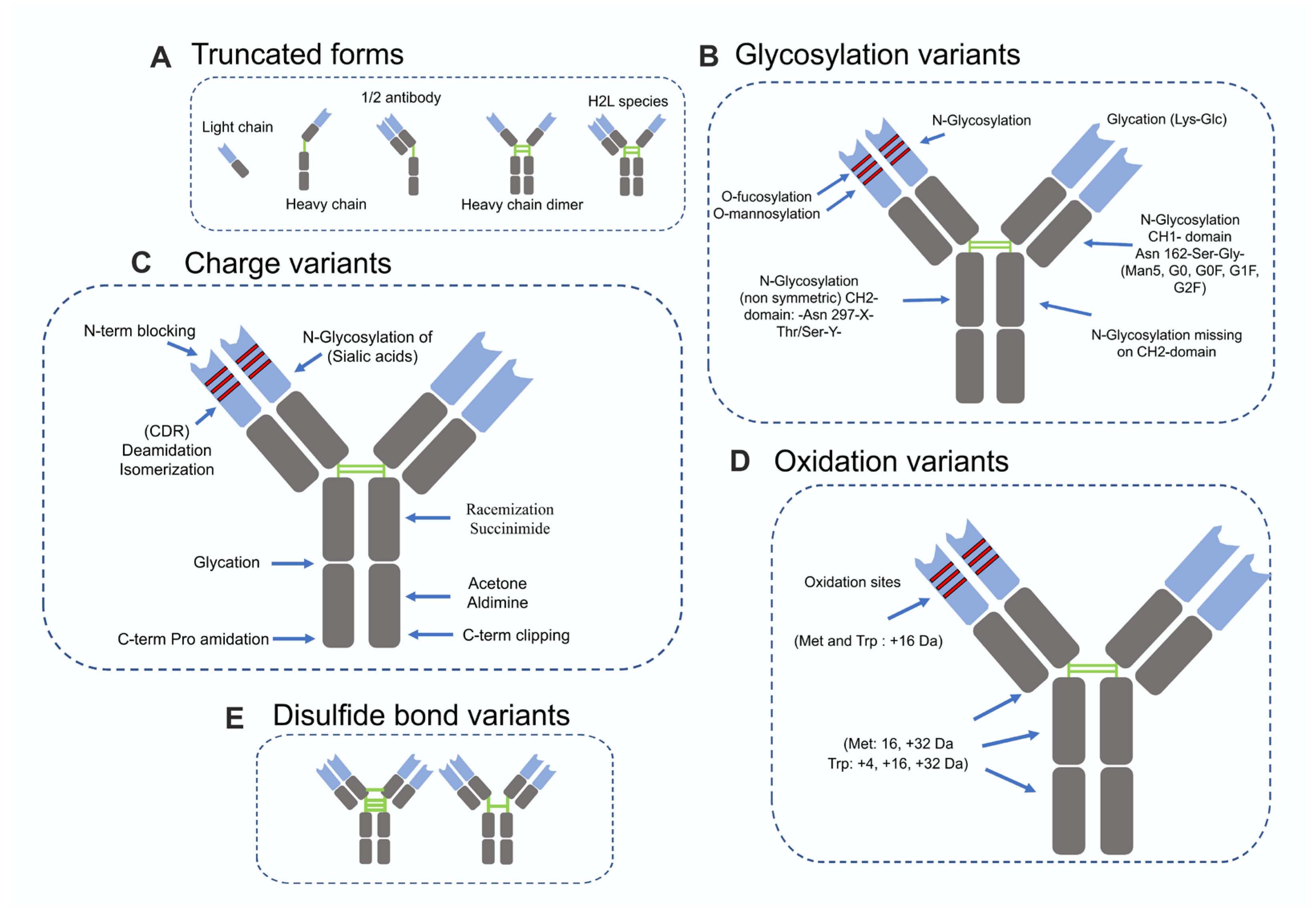
Figure 2.
Common product-related impurities observed in bsAb production. (A,B) Symmetric mispaired species—these comprise mispaired heavy-chain (HC) and light-chain (LC) species generated through aberrant chain pairing during biosynthesis and assembly. (C) Orientation mismatches—species resulting from improper assembly or incomplete structures, including half-antibodies, three-quarter antibodies, isolated heavy- or light-chain species, diabodies, and nonspecific aggregates formed due to incomplete or misoriented chain assembly and aberrant association events (adapted from [2]).
2.2. Process-Related Impurities
Host cell proteins and contaminants (HCPs/HCC) are process-related impurities derived from the intracellular metabolic and biosynthetic machinery of the cells used to produce therapeutic recombinant proteins. Additional process-related impurities include residual host cell DNA, endotoxins, and viruses, all of which have been reported to compromise product quality and contribute to significant losses during downstream processing and manufacturing [23].
Residual host cell DNA and bacterial endotoxins primarily originate during production, whereas viral contaminants may arise from viral vectors, such as adeno-associated virus (AAV), used for protein expression. Regulatory authorities, including the WHO and FDA, have established strict guidelines to control these impurities. Residual DNA is limited to 10 ng per dose with fragment sizes below 200 base pairs [24], while bacterial endotoxins must not exceed a maximum pyrogenic dose of 5 EU/kg for parenteral drugs [25]. In addition, viral clearance is ensured through validated inactivation steps and nanofiltration using 30–35 nm filters to remove viruses such as adenoviruses, retroviruses, and herpes simplex viruses [26].
Although these measures effectively minimize most process-related impurities and ensure high safety standards for antibody-based therapies, HCPs remain particularly challenging to eliminate. Residual HCPs may persist due to strong interactions with recombinant proteins or co-elution driven by similar physicochemical properties [27]. Furthermore, nonspecific interactions can promote their association with target proteins throughout downstream purification, although many are reduced through binding to chromatography resins [28].
Importantly, HCPs can negatively affect product stability and safety. For example, proteolytic HCPs, such as cathepsins, may induce antibody degradation, while others can trigger adverse immunological responses with potentially severe clinical consequences [29]. Currently, there are no strict official guidelines or limits specifying permissible levels of HCPs in the therapeutic products by any regulatory bodies. However, as a standard, regulatory bodies advise a standard limit of 100 ppm [30]. Accordingly, the main focus of this review is to provide an overview of recent advances in the removal of process-related impurities, with particular emphasis on HCP clearance strategies.
Table 3 summarizes several HCPs commonly detected during antibody production, along with their potential impacts on antibody quality and immunogenicity.
Table 3.
Common CHO-derived HCPs co-eluting with monoclonal antibodies.
However, these guidelines do not specify the individual HCP species. Strategies to reduce HCP levels include optimizing upstream conditions, such as adding media supplements like folic acid, thiamine, riboflavin, ascorbic acid, and insulin and essential amino acids and vitamins, or adjusting culture parameters, such as mild hypothermic conditions, which have been shown to decrease HCP levels by up to 36% [30]. Optimized cell culture duration, timing of harvest, and cell viability are critical. Additionally, minimizing cellular stress—by maintaining optimal pH, temperature, and osmolality, reducing shear stress from agitation, and media replacement—can further lower HCP levels. Finally, using knockout or knockdown cell lines for problematic HCPs, as discussed further, provides another effective strategy.
3. Expression Systems for the Production of Therapeutic Proteins
Mammalian cell lines serve as the major backbone in the industry for production of antibodies, due to their lower immunogenic risk, which is attributed to phenotypic and genetic similarities, as well as their ability to perform essential PTMs. Mammalian expression systems include Chinese hamster ovary (CHO) cells, NS0 murine myeloma cells, human embryonic retinal cells (PER.C6®), and Human Embryonic Kidney (HEK) 293 cells [40]. Protein production is a complex multistage process. Therefore, selecting an appropriate cell line and employing a compatible expression system are essential for achieving optimal protein expression. However, a key limitation of using cell culture-based expression systems is the potential contamination of the final product with HCPs, which, even at trace levels, can significantly impact antibody quality, function, and overall yields [42].
3.1. Chinese Hamster Ovary (CHO) Cells
The CHO cell line is the most widely used for therapeutic protein production, recognized for its high production efficiency, robust tolerance to manufacturing stresses, ability to perform human-like PTMs, and low risk of triggering cross-species immune responses. Over 70% of all recombinant immunotherapies are produced in CHO cells [43,44]. While mAb production in CHO cells can be scaled up to 10 g/L, bsAbs often exhibit lower expression yields ranging from 1 to 3 g/L [42].
CHO cells naturally lack dihydrofolate reductase (DHFR) activity. By introducing a DHFR gene on the expression vector, only cells that take up the vector can survive in a medium lacking DHFR or in the presence of methotrexate (MTX). This allows the selective growth of cells that are producing the therapeutic protein and serves as a selection and gene amplification system [45].
Examples of mAbs produced in CHO cells include Rituximab, Bevacizumab, Panitumumab, and Tocilizumab [46]. Blinatumomab is an innovative bsAb used for the treatment of specific forms of acute lymphoblastic leukemia (ALL). It is the second bsAb to receive FDA approval and shows enhanced antigen-binding affinity when manufactured in CHO cells compared with production in Escherichia coli [47].
Proteome and glycoproteome analyses have identified over 6000 HCPs across various CHO cell lines [48]. A detailed evaluation of HCPs in 29 FDA-approved and commercially available mAbs and bsAbs produced in CHO cells revealed 79 common HCPs present in most therapeutics within the standard limit of 100 ppm, as determined by LC-MS profiling. However, certain HCP species, including protein S20, flavin reductase, phospholipase B-like protein, and protein S100, were detected above the limit [35]. Several studies have reported a high presence of clusterin, lipoprotein lipase (LPL), a common HCP arising from the degradation of polysorbates (e.g., polysorbate 80 and 20), which are frequently employed to prevent aggregation and degradation of therapeutic proteins [49]. Since LPL is particularly challenging to remove during downstream processing [50], Chiu et al. generated an LPL-knockout CHO cell line using the CRISPR system, which led to a significant reduction of up to 57% [37]. Similarly, matriptase-1 knockout CHO-K1 cells were generated using transcription activator-like effector nucleases (TALENs) to eliminate the serine protease matriptase-1 (MT-SP1), which is primarily responsible for proteolytic degradation of recombinant antibodies. These knockout cells exhibited comparable viability and higher antibody yields compared to wild-type CHO cells [51].
Unlike these examples, which targeted a single gene, Kol et al. performed multiplex genome editing to target up to 14 different HCP genes [52]. Testing production of the monoclonal antibody Rituximab showed that 6 x KO cells produced more antibody than 11 x KO cells and slightly more than wild-type CHO cells, whereas 14 x KO cells had very low productivity. Downstream purification using a three-step process further demonstrated minimal HCP levels in the knockout cells, with the 11 x KO cells showing the lowest HCP load (3 ppm), followed by 6 x KO cells (18 ppm), compared to wild-type cells (45 ppm).
Although generating knockout cell lines involves considerable production time and cost, these studies collectively demonstrate that targeted gene knockouts can reduce specific HCP loads during production and enhance expression of the gene of interest. This, in turn, can simplify downstream purification and reduce associated costs.
3.2. Human Embryonic Kidney (HEK) Cells
HEK cells are derived from embryonic kidney tissue and widely used for transient and stable expression of recombinant proteins. HEK cells are expected to become a major platform for novel antibody-based therapeutics due to their human-like PTMs and physiologically relevant glycosylation patterns [53]. Several HEK cell line variants are widely employed depending on expression requirements, including Expi293, HEK 293E (expressing the Epstein–Barr virus nuclear antigen), HEK 293F (Freestyle), HEK 293G, HEK 293T (expressing the SV40 T antigen), HEK 293S (suspension culture), and HEK 293SG lacking N-glycans due to knockout of the N-acetyl-glucosaminyltransferase I (GnT-I) gene. HEK-based systems are cost-effective and can produce large amounts of proteins efficiently [54], while Expi293 cells can produce up to six times more protein than standard HEK 293 cells.
Nevertheless, the potential of HEK cells should be further explored, particularly for producing antibody fragments that are difficult to express in other systems. This capability could be highly beneficial for the production of bsAbs and trispecific antibodies [55]. Despite these advantages, CHO cells remain the predominant choice for both research and industrial production because HEK cells require additional biosafety measures to prevent contamination from human viruses.
3.3. Human Embryonic Retinal Cells
Other human-derived production systems include human embryonic retinal cells, such as PER.C6®, which are obtained by immortalizing retinal cells from human embryos using the E1 genes of adenovirus 5 DNA. These cells exhibit minimal immunogenicity, do not add potentially harmful and reactive glycans to recombinant proteins, can rapidly grow to densities of 5 × 10⁶ cells/mL, and have stable IgG expression [56].
3.4. Cell-Free Expression
Cell-free expression is an alternative method for producing proteins without relying on living cells. This approach utilizes cellular extracts containing only the essential components required for transcription and translation, thereby facilitating protein production without the cells. Various lysates have been developed, including E. coli lysate, wheat germ extract (WGE), insect cell extract, yeast extract, and eukaryotic extracts such as rabbit reticulocytes, CHO, and HeLa (immortal human epithelial cells) lysates. Xu et al. employed an E. coli-based cell-free system (Xpress CF) to design four knob-into-hole (KiH) antibody targeting tumor antigen epithelial cell adhesion molecule (EpCAM) and human epidermal growth factor receptor 2 (HER2) [57].
While cell-free expression offers significant advantages in terms of production time and the potential for minimal HCP contamination, several challenges remain for large-scale applications. Scalable production is a major concern, as production costs and maintaining extract activity are comparatively high. Additional limitations include the risk of endotoxin contamination when using E. coli-based extracts [58]. Regulatory approval is another major limitation [59]. A summary of expression systems is provided in Table 4.
Table 4.
Summary of cell expression systems used for antibody-based therapeutic development.
4. Monitoring of HCPs
Monitoring HCPs in each cell culture batch is challenging, as many HCPs are small and may bind to the therapeutic protein. While enzyme-linked immunosorbent assay (ELISA) is considered the analytical gold standard for evaluating HCP presence [76], one- and two-dimensional liquid chromatography–mass spectrometry (LC–MS) provides powerful platforms for comprehensive HCP profiling [77]. Commercial ELISA kits are widely used due to their simplicity, cost-effectiveness, and compatibility with routine monitoring [78]. However, ELISA has limitations: it may fail to detect novel or unspecified HCPs and cannot easily identify individual HCP species. SDS-PAGE can provide quantitative assessment but is rarely used because of low specificity and limited sensitivity for low-abundance HCPs [79].
LC-MS provides high-resolution profiling of HCPs. Data-dependent acquisition (DDA) enables identification of novel HCPs, although method optimization can be challenging. For precise, sensitive, and quantitative detection, targeted MS techniques—such as multiple reaction monitoring (MRM) and parallel reaction monitoring (PRM)—can detect HCPs approximately 10 ppm. With proper optimization, MS-based methods offer reproducible and highly accurate quantitative HCP analysis [80]. Independent studies indicate that combining immuno-based assays with mass spectrometry provides a more comprehensive analysis of HCPs in the final product. This approach enables improved detection of HCPs, including nonspecific tightly bound species, making it a more effective method for HCP identification [80]. It was demonstrated that capillary electrophoresis combined with LC offered broader HCP coverage [81].
Recent advances in HCP detection include Orbitrap Astral mass spectrometry combined with high-field asymmetric waveform ion mobility spectrometry (FAIMS), enabling the detection of HCPs at concentrations below 10 ng/mg and the identification of up to 236 unique HCPs [82]. Despite these developments, many HCPs remain unidentified, highlighting the critical need for continued discovery of novel HCP species and further improvement of analytical methods to ensure the safety of antibody-based therapeutics. In this context, regulatory bodies should broaden their approach by incorporating orthogonal techniques such as LC–MS [83]. Furthermore, current detection strategies can be enhanced through the use of more specific HCP detection kits, tagging approaches for improved identification, and molecular methods to eliminate problematic HCPs. Detection kits should also be adaptable to newly identified HCPs, compatible with different production cell lines, and sensitive enough to detect low-abundance proteins. Purification of bsAbs is more challenging than that of standard monoclonal antibodies due to their unique and complex structures. The capture stage of protein purification primarily relies on chromatographic techniques, which are essential for separating structural by-products and HCPs. Several studies have shown that customizing conventional chromatographic approaches used for mAbs can improve yields and enhance separation from impurities such as HCPs and low- or high-molecular-weight (HMW) species in bsAb production [84].
Non-IgG-like antibody formats, such as BiTEs, DARTs, and tandem diabodies (TandAbs), are particularly prone to aggregation, which further complicates their purification [85]. Key factors influencing purification strategy include antibody heterodimerization format, selection of chromatographic resins, surface charge, hydrodynamic radius, hydrophobicity, glycosylation, and other structural attributes.
4.1. Affinity Chromatography for Antibody Purification
Currently, Protein A-based affinity chromatography is the most widely used single-step method for antibody purification. Protein A has strong affinity for the Fc region as well as the VH domain of antibodies, making it effective for conventional antibody purification [86]. IgG typically binds to five domains of Protein A—E, D, A, B, and C4—in a pH-dependent manner. The B domain, which exhibits the highest binding affinity, was used as the basis to engineer Z-domain resins.
Improved Z-domain resins can bind both the Fc and VH3 regions of antibodies at neutral pH and remain bound under alkaline conditions, with antibody elution typically achieved using acidic or low-pH buffers [87]. This multi-binding ability is both advantageous and challenging for modified heterodimeric antibodies, such as bsAbs and trispecific antibodies. Careful design of VH domains is critical, as the VH3 subfamily can bind non-covalently to Protein A resins, potentially complicating the separation of by-products formed from heterodimeric antibodies [88].
Protein A chromatography is particularly useful for separating half-antibodies containing only one Fc and Fab arm, which generally have lower binding affinity compared to fully structured mAbs or bsAbs. Modern Protein A resins, such as MabSelect SuRe LX, MabSelect SuRe, and MabSelect PrismA, have shown strong performance in separating various by-products generated during bsAb production. MabSelect PrismA, in particular, can differentiate bsAb by-products lacking one Fab arm, one light chain, or a knob half-antibody, due to its additional binding affinity to the VH3 region, unlike older resins that only bind CH2–CH3 and may fail to capture bsAbs lacking a light chain [89,90].
Recently, a cellulose-based resin, Fibro PrismA, containing the same Protein A ligand as MabSelect PrismA, has shown promising results. Zhang et al. demonstrated that Fibro PrismA provided superior resolution in separating difficult single-arm species from asymmetric IgG-like bsAbs, achieving yields up to 80.2% with shorter retention times under similar pH gradient elution conditions [91]. Supporting these findings, Napoleone et al. scaled up production of a low-titer tetravalent bsAb using piggyBac transposon-mediated HEK-293 cells. Using Fibro PrismA at high flow rates (30 mL/min), they achieved high-purity recovery within 4.5 h, significantly reducing processing time compared to conventional Protein A columns of similar size [92].
Protein A chromatography, despite its widespread use, has notable drawbacks, including low binding capacity, strong acidic elution conditions, ligand leaching, short shelf life, and high cost [93]. Nevertheless, its simplicity makes it the preferred choice for initial capture steps to remove process-related impurities.
Other affinity proteins, such as Protein G and Protein L, can also be used. Protein G, like Protein A, binds the heavy chain; however, its stability and binding affinity are generally lower than Protein A. Protein L, derived from Peptostreptococcus magnus, specifically binds the variable region of κ light chains, making it suitable for capturing bsAbs lacking a Fc fragment [94]. Because Protein L binds in the Fab region, by-products such as half-antibodies or three-quarter antibodies, which contain only one light chain, exhibit lower binding and can be separated. This property allows Protein L-based chromatography to further separate functional versus non-functional Fab arms, enabling purification of monovalent and bivalent bsAbs [85].
Downstream purification using Protein L can be enhanced with a three-step system involving Protein A, KappaSelect, and LambdaFabSelect resins. This approach is particularly useful for bsAbs with common heavy chains and heterodimeric light chains. Potential mispairings, such as κκ or λλ chains, are first captured by Protein A resins, and the desired bsAbs with two distinct light chains (κλ) are subsequently captured using KappaSelect and LambdaFabSelect resins [95].
Limitations of these resins include variability in binding affinity depending on the bsAb structure—for example, bsAbs with only one κ light chain bind differently than those with two κ chains—and the high cost of the resins must also be considered [96]. The combination of multiple chromatographic modalities can further enhance overall product purity, as certain process-related impurities have binding affinities similar to the target bsAb, making such combination strategies widely employed in both the capture and polishing stages of bsAb purification.
4.2. Size-Exclusion Chromatography (SEC)
Size-exclusion chromatography is one of the most widely used chromatographic techniques for the analytical characterization of biomolecules based on their size and shape [97]. For bsAbs, SEC offers a key advantage in enabling the detection and monitoring of aggregates and mispaired fragments [98].
Recent advances in ultra-high-performance size-exclusion chromatography (UHP-SEC) have led to substantial improvements in analytical performance, including higher resolution and reduced analysis times. UHP-SEC employs shorter columns with ≈3 µm particles, enabling operation at pressures up to 250–480 bar [97]. A recent study demonstrated that ultra-high-performance size-exclusion chromatography (UHP-SEC) can effectively differentiate FDA-approved therapeutic monoclonal antibodies based on variations in molecular size and hydrodynamic and conformational properties [99]. Optimization of the mobile phase composition according to antibody characteristics improves separation efficiency and reduces analysis time; phosphate-buffered saline (PBS) and ammonium acetate are widely employed under neutral/alkaline and acidic conditions, respectively [100].
To further enhance separation performance, mixed-mode SEC has been introduced, in which additional interactions—such as hydrophobicity, hydrogen bonding, and electrostatic effects—are exploited alongside molecular weight and hydrodynamic radius. This approach is particularly valuable for resolving bsAbs with similar sizes but differing physicochemical properties [100]. Because of the minimal size differences between bsAbs and their parental antibodies, Yang and team reported that high-efficiency SEC columns with 3 µm particle sizes (e.g., Zenix SEC 300 or Agilent Bio SEC-300) provided effective purification of half-molecule exchange IgG4 bsAbs, with improved resolution obtained through mixed-mode interactions [101]. Similarly, high-resolution SEC using a 300 × 4.6 mm column with 1.7 µm particle size and 200 Å pore diameter enabled the differentiation of scFv–IgG bsAb size variants generated as by-products of cysteine residue incorporation for enhanced stability [102].
Furthermore, the integration of mixed-mode SEC with mass spectrometry enables precise mass discrimination between desired bsAb constructs and undesired homodimeric species, providing an additional level of structural characterization [103].
4.3. Hydrophobic Interaction Chromatography (HIC)
Hydrophobic interaction chromatography separates proteins based on differences in their surface hydrophobicity.
High-salt conditions promote interactions between exposed hydrophobic residues on the protein surface and hydrophobic ligands on the stationary phase, while subsequent salt reduction weakens these interactions and enables protein elution [19].
HIC is widely used to distinguish mispaired homodimers from correctly assembled antibody species, making it an effective tool in monoclonal and bispecific antibody production workflows [1]. However, excessively high salt concentrations can result in irreversible binding of mAbs and bsAbs to the resin, leading to reduced recovery yields [104,105]. Consequently, parameters such as salt type and concentration, column dimensions, flow rate, and operating temperature must be carefully optimized to maximize separation efficiency and protein recovery [106].
HIC was employed to separate structural variants of trastuzumab and demonstrated that modifications to standard protocols—such as using longer columns and sodium chloride as the mobile phase—resulted in enhanced resolution, reduced elution times, and improved variant separation [107]. Additional strategies to facilitate protein elution include the incorporation of mobile-phase additives such as 5% hexylene glycol or 1 M arginine, which weaken hydrophobic interactions between proteins and the stationary phase [108].
Notably, extended interaction with the resin at elevated temperatures has been shown to induce conformational changes in certain bsAbs, resulting in multiple elution peaks and reduced chromatographic resolution [109].
4.4. Ion Exchange Chromatography (IEX)
Ion exchange chromatography is an effective method for downstream purification of therapeutic mAbs and bsAbs, provided the charge properties and isoelectric point (pI) of the molecules are known. IEX can effectively reduce impurities such as host cell proteins, mispaired bsAb variants, DNA, and homodimer aggregates, thereby facilitating subsequent downstream processing [110].
Cation exchange chromatography (CEX) relies on charge-based separation, wherein proteins with net positive charge in the mobile phase interact non-covalently with negatively charged ion-exchange resins. Proteins bind to cation exchange resins with varying strengths and are subsequently eluted using buffers with increasing ionic strength or pH, typically ranging from 5.0 to 8.1. At lower pH, positively charged antibodies bind strongly to the resin, and elution is commonly achieved using sodium chloride. For bsAbs, this approach is particularly effective for separating homodimers from correctly assembled bsAb formats with differing isoelectric points (pI) [111]. Loading buffer pH, usually adjusted to 1–4 units away from the bsAb’s pI, and the salt gradient are key factors in sequential elution during CEX. Salt gradients have been shown to provide effective separation for traditional monoclonal antibodies; however, for complex bispecific antibodies, this approach often produces multiple elution peaks. To achieve higher resolution for bsAbs with closely similar pI values—such as species with mispaired light chains or homodimers—pH gradients have proven more effective, allowing differentiation of bsAb structures with pI differences as small as 0.1 units. This was further demonstrated in a study in which a common light chain IgG-like bsAb was successfully separated from its homodimer, with pI values of 8.95 and 8.36, respectively, using a MonoS 10/100 GL column and a pH gradient from 6.5 to 8.0 [112]. Alternatively, alkaline pH conditions near the pI of the target bsAb have been employed to purify bsAbs from monoclonal Ab–diabody aggregates containing mispaired disulfide bonds. Using POROS® HS50 cation exchange columns and SP Sepharose HP for polishing, this approach achieved aggregate reductions of up to 99.3%, with potential for further optimization at large scale [113].
Both reversible and irreversible conformational changes, resulting in multiple elution peaks of monoclonal antibodies, have been reported by several studies. These changes are largely independent of pH, resin type, ligand chemistry, or aggregate presence, and are instead influenced by prolonged interaction times of mAbs and bsAbs with the column at varying binding strengths [114,115].
Another challenge is that the use of strong chromatographic conditions or elevated temperatures can lead to protein denaturation. This can be mitigated by preserving antibody structure through glycosylation, employing alkaline pH buffers, and adding stabilizing agents such as arginine to the loading buffer, which helps reduce both low- and high-molecular-weight aggregates and other impurities [116]. To further enhance purification efficiency, Duivelshof et al. compared different bsAbs and mAbs and found that pH gradients were more effective than salt gradients. The addition of solvents such as isopropyl alcohol (IPA), ethanol (EtOH), and acetonitrile (ACN) in the mobile phase markedly improved variant separation, though it also increased elution times. Optimization of the mobile-phase solvent composition can further enhance resolution, with the optimal solvent combination potentially differing for each bsAb construct [117].
Anion exchange chromatography (AEX) utilizes columns packed with positively charged resins, making it suitable for monoclonal antibodies and bispecific antibodies that exhibit neutral to positive charges. Under these conditions, the antibodies typically do not bind to the resin and are collected in the flow-through, while impurities are retained and subsequently eluted using salt gradients [118].
To enhance purity, especially in the presence of multiple impurity types, weak partitioning chromatography (WPC) is frequently employed. Unlike AEX, which is operated under conditions minimizing product-resin interactions and allowing impurities to bind to the stationary phase, WPC uses an isocratic method with an optimized mobile phase that promotes partial binding of the product. The elution buffer pH, usually ranging from 7 to 11, facilitates the release of partially bound bsAbs, enabling improved separation of closely related species [119]. While AEX is commonly used during initial capture steps, WPC is more effective in polishing stages.
Similar to CEX, AEX and WPC can be combined to remove impurities such as HCPs, host cell DNA, and protein aggregates. Liang et al. demonstrated that using a single-step POROS 50 HQ column in AEX mode efficiently cleared HCPs and DNA, and the subsequent application of WPC in the polishing step significantly increased the purity of knob-into-hole (KiH) bsAbs [110]. A similar strategy using Capto adhere (mixed-mode) anion exchange chromatography for KiH bsAbs achieved a 60% recovery rate and 98% purity from cell culture fluid, while also providing considerable viral clearance. Optimal loading conditions of pH 7.8 ± 0.2 and conductivity below 3.0 milliSiemens/centimeter (mS/cm) contributed to high yields [120].
Multiple studies have highlighted the potential of AEX in combination with other chromatographic techniques as part of two- or multi-step purification systems for various bsAb formats, including WuXiBodies with relatively low pI values compared to mAbs, and fragment-based Bispecific killer engager (BiKE) and trispecific killer engagers (TriKE) [111,120,121].
4.5. Mixed-Mode Chromatography
Neutral proteins are often difficult to separate and may require process optimization or buffer adjustment to enhance binding. Additional challenges in bsAb purification include aggregation—particularly in constructs containing scFvs—and the presence of HCPs in the product. BsAbs with scFvs are especially prone to aggregation, and conventional pH-gradient elution methods frequently fail to achieve high yields of purified protein [88,122]. Aggregation often occurs within chromatography columns, complicating elution and reducing recovery, which underscores the importance of optimizing column selection and loading concentrations based on the specific bsAb format for efficient purification [123].
For years, researchers have explored single-step chromatography to save time and reduce downstream costs. However, this approach may compromise the removal of product-related impurities. Given the structural complexity of bsAbs, mixed-mode chromatography (MMC), which combines multiple separation mechanisms in a single resin, offers significant advantages. Numerous studies have demonstrated the effectiveness of commercially available multimodal resins—such as Capto MMC, Capto adhere, Diamond MMC (Cytiva), TOYOPEARL MX-Trp 650M (Tosoh Bioscience) as well as other platforms like hydrophobic charge induction chromatography (HCIC) and ceramic hydroxyapatite, for the purification of diverse bsAb formats [19,124].
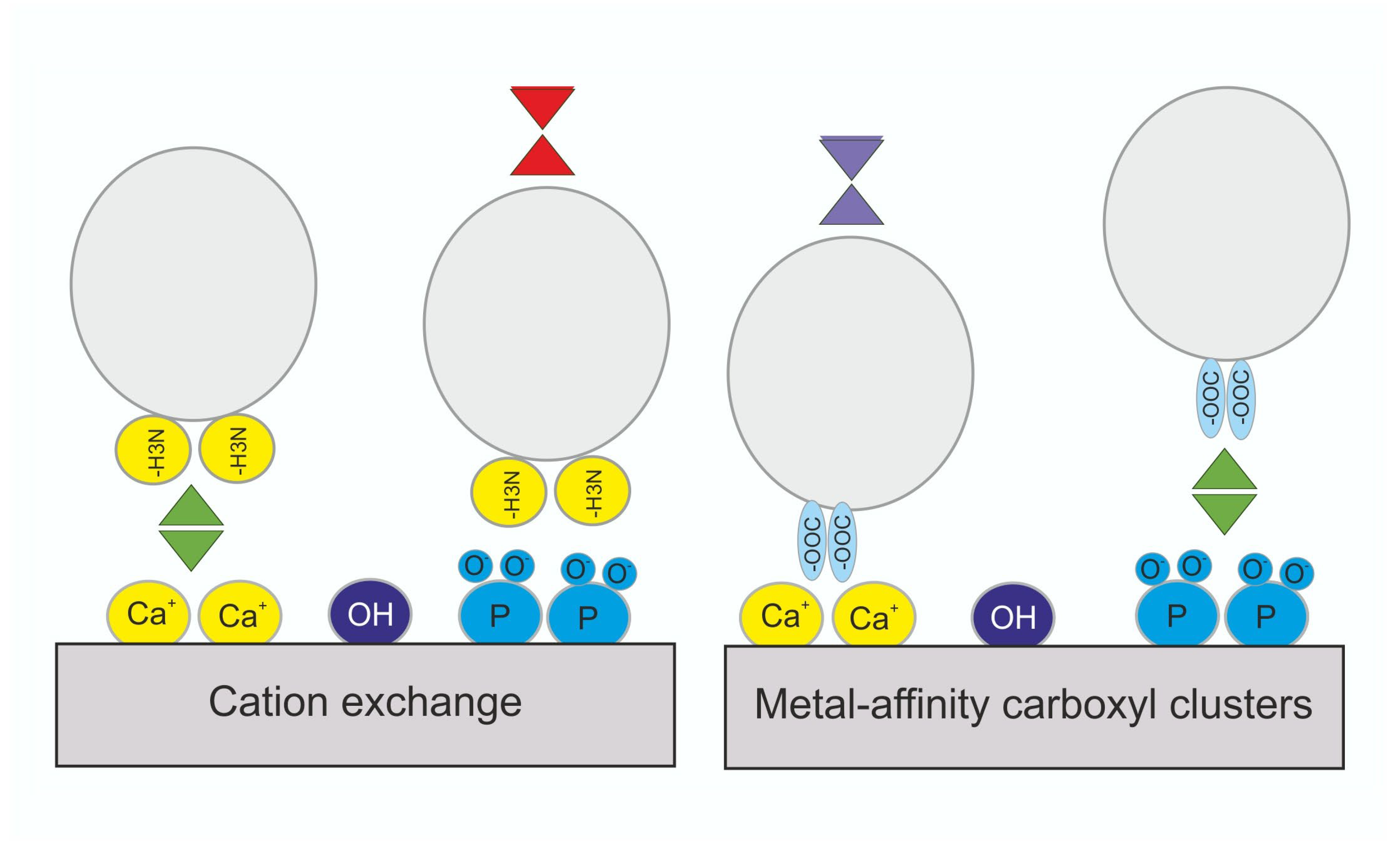
Ceramic hydroxyapatite (CHT) chromatography is based on a hydroxyapatite matrix (Ca10(PO4)6(OH)2) containing five positively charged calcium pairs (C-sites) and phosphate triplets (P-sites). Its dual-mode binding combines metal affinity via the calcium sites, which interact with negatively charged HCPs, and cation exchange via the phosphate sites, which bind positively charged proteins (Figure 3). Typically, carboxyl groups on proteins interact with calcium sites (C-sites), whereas amino groups interact with phosphate sites (P-sites). Elution is achieved by increasing salt or phosphate concentrations, often via gradient methods, as NaCl can weaken repulsive interactions. Due to its ability to remove both product- and process-related impurities and to separate species with similar physical properties, CHT is widely applied for purifying biological molecules—including antibodies, antibody fragments, and viruses—during both initial capture and polishing steps [125].
Compared to CEX, CHT has demonstrated superior control of high-molecular-weight (HMW) and low-molecular-weight (LMW) impurities, achieving a reduction in HMW species to approximately 0.5% and a 48% decrease in LMW species, indicating its suitability for both symmetric and asymmetric bsAb formats.
Additionally, CHT efficiently reduces HCPs, including polysorbate-80-associated degradative enzymes, lipases, carboxypeptidase, and 78 kDa glucose-regulated proteins, yielding highly pure bsAb heterodimers [126].
CHT also provides effective separation of bsAb-related impurities such as Fc homodimers, half-antibody fragments, persistent low-molecular-weight species, and closely resembling bsAb formats reported in the study [127]. In the same study, two elution strategies were compared: CHT with a sodium phosphate linear gradient (CHT-P) and CHT with a sodium chloride gradient (CHT-NaCl). CHT-P provided superior separation of HMW and LMW aggregates in larger bsAbs but was less effective at HCP removal, whereas CHT-NaCl efficiently eluted bsAbs similar in size to IgG but with limited LMW clearance. Both methods achieved an average purity of 97%.
A 200 L pilot-scale study further optimized CHT by using arginine hydrochloride as the eluent, in addition to conventional phosphate- or sodium chloride-based eluents, to reduce hydrophobic interactions between highly hydrophobic bsAbs and the resin. This approach improved both purity (99%) and yield (80.7%) compared to Capto MMC and Capto adhere chromatography [128].
Figure 3.
Ceramic hydroxyapatite chromatography. This technique combines cation exchange and metal affinity interaction mechanisms. The crystalline calcium phosphate matrix interacts with proteins through two distinct modes: cation exchange and calcium-mediated metal affinity. Elution is achieved using a NaCl gradient to release molecules bound via cation exchange, while a phosphate gradient is used to elute molecules bound through calcium-mediated interactions (metal affinity) [129].
Commercial multimodal resins such as Capto MMC combine electrostatic (cation exchange), hydrophobic, and thiophilic interactions to enable selective protein separation. These resins are salt-tolerant and feature a rigid agarose matrix, allowing high flow rates. N-benzoyl-homocysteine ligands mediate the multiple interaction modes, and protein elution depends on pH for ionic interactions and salt gradients for hydrophobic interactions.
Capto MMC has demonstrated significant efficacy in removing aggregates from scFv-containing bsAbs. Chen et al. observed a 17–35-fold reduction in HCPs after Protein A capture followed by Capto Butyl ImpRes and Capto adhere MMC polishing, with improved loading densities and impurity removal in flow-through steps. Aggregate content decreased from 20% post-Protein A chromatography to 0.7% with linear gradient elution and 2.6% with stepwise elution [123].
Comparative studies between Capto MMC and Diamond MMC Mustang (Bestchrom) for asymmetric bsAb purification reported purities of 96.5% and 97.4%, respectively, from 69.6% after Protein A capture, with average yields of 63.2% and 62.1% [130]. For complex asymmetric bsAb formats such as WuXiBodies, Capto MMC effectively separated homodimers, aggregates, light chain mispaired by-products, and half-antibodies compared with IEX [131]. Aggregate removal efficiency with Capto MMC can vary between 1 and 5%, depending on the bsAb structure and hydrophobicity. Two studies by the same group reported aggregate reduction from 11.1% to 1.2% using dual pH–NaCl gradient elution [132,133].
The presence of a weakly acidic carboxyl functional group in Capto MMC resins renders the net resin charge highly dependent on buffer pH. As a result, electrostatic interactions may be insufficient to counterbalance hydrophobic interactions, which can hinder efficient elution of the target protein. In contrast, Capto adhere ImpRes (Cytiva) is a hydrophobic anion-exchange resin functionalized with N-benzyl-N-methyl ethanolamine ligands, conferring strong anion-exchange properties and enhanced electrostatic interaction capacity. This enables effective elution using salt gradients, even for negatively charged antibodies at pH values above their isoelectric point (pI) [19].
An optimization study evaluating Capto adhere in both bind-and-elute and flow-through polishing modes for monoclonal and bispecific antibodies demonstrated a 6% reduction in HMW species, along with a substantial decrease in HCP levels. The resin further exhibited efficient HCP clearance and the capacity to achieve above-average yields when process parameters were tailored to specific bsAb formats [124].
Capto adhere has been successfully applied for the purification and polishing of bsAbs under conditions of pH 7.90 ± 0.1 and conductivity of approximately 5.0 mS/cm, resulting in product purities exceeding 98% and average yields of ~60% [120]. Notably, for bsAbs with high surface hydrophobicity, Capto adhere demonstrated superior performance in removing by-products during polishing compared to the cation-exchange-based Capto MMC.
Furthermore, a two-column purification strategy incorporating Capto adhere achieved final impurity levels as low as 0.5% HMW and 0.4% LMW species, with an overall yield of 50.5% using Protein L-based MabSelect VL. This performance surpasses that of comparable three-column workflows incorporating Capto MMC, which yielded 5.9% HMW and 1.8% LMW species, with a slightly lower overall yield of 48.3% [134].
Another example of chromatography combining weak cation-exchange and hydrophobic interaction mechanisms is Toyopearl MX-Trp-650M. This resin incorporates a tryptophan ligand, in which the carboxyl group mediates weak cation-exchange interactions, while the indole ring enables hydrophobic interactions. It has been successfully applied to the purification of κλ bispecific antibodies (bsAbs) from IgG homodimers, mispaired species, and aggregates using a sequential NaCl gradient. Elution at approximately 75 mM NaCl was sufficient to recover the κλ bsAb, whereas homodimeric impurities were primarily detected in the flow-through or required higher salt concentrations (up to 500 mM NaCl) for elution [131]. However, several studies indicate that high purity and yield using this approach are achievable only for specific bsAb formats, which limits its broader applicability [19].
For bsAbs with more diverse and complex architectures, resins with tailored multimodal properties, such as Eshmuno CMX, have demonstrated improved purification performance and higher yields [131]. Eshmuno CMX combines cation-exchange functionality with moderate hydrophobic interaction, enabling effective separation of structurally complex molecules, including bsAbs and trispecific antibodies. The resin is functionalized with 2-amino-4-methylpentanoic acid ligands, which provide balanced hydrophobic interactions and facilitate efficient elution compared to more strongly hydrophobic multimodal resins such as Capto MMC.
For antibodies exhibiting a broad range of hydrophobicity, the partition coefficient (Kp) has been utilized as a high-throughput screening (HTS) parameter to identify optimal ligand chemistries and separation conditions. Koehnlein et al. evaluated multiple resins, including Eshmuno CMX, Capto MMC ImpRes, and Nuvia cPrime, and demonstrated that 2-amino-4-methylpentanoic acid provides moderate hydrophobic interaction strength relative to simpler functional groups. This balanced interaction profile helps mitigate excessive hydrophobic binding while maintaining effective separation. Using this approach, bsAb purification achieved approximately 70% yield and 97% purity [131].
Similarly, Song et al. evaluated the purification of hydrophobic asymmetric bsAbs that closely resemble homodimeric species, comparing Eshmuno CPX with other multimodal cation-exchange resins such as Capto MMC, Toyopearl MX-Trp-650M, and Nuvia cPrime.
Through systematic HTS optimization using pH and salt gradients, Eshmuno CPX demonstrated superior performance, achieving yields of 77%, reducing HCP levels from 5643 ppm to 7.5 ppm, and reaching purities exceeding 99%. Enhanced binding capacity was also observed under optimized conditions [128].
Despite these advances, the growing diversity of multimodal chromatography (MMC) platforms makes the selection of optimal resins and process conditions increasingly complex. Even with HTS-based optimization, trace levels of both process- and product-related impurities may persist after advanced purification steps. Therefore, a comprehensive set of parameters must be considered, including protein concentration, molecular size, net charge, isoelectric point, binding site preferences, partition coefficient (Kp), buffer composition, resin chemistry, interaction mechanisms, retention behavior, and overall process yield.
The Kp, which reflects the relative binding affinity of the target protein compared to co-existing impurities, serves as a powerful HTS metric for defining optimal separation conditions. Kp values are influenced by variables such as pH, conductivity, and resin type, and can be used to determine the separation factor under different operating conditions. A higher separation factor generally correlates with improved resolution of by-products [135]. Chen et al. reported that a minimum separation factor of 10 is required to achieve effective separation between the desired product and impurities. In their study, the highest separation factor (19) was obtained using the mixed-mode Eshmuno HCX resin [136].
In addition, logarithmic Kp values have been shown to be particularly useful for distinguishing half-antibody fragments from intact bsAbs and serve as reliable predictors of binding behavior for antibody fragments and aggregates, complementing MMC-based purification strategies [137]. Table 5 summarizes the major purification techniques, highlighting their advantages, limitations, and suitability for different bsAb formats.
Table 5.
Key parameters and applications of chromatographic methods.
5. Alternative Approaches for Polishing Techniques for Large-Scale Production
5.1. Conventional Batch Chromatography
Conventional batch chromatography typically employs a single Protein A column and is therefore time-intensive and operationally inefficient. In addition, the full binding capacity of the resin is often not utilized, resulting in increased buffer consumption per purification cycle and consequently higher operational costs [159]. Another major limitation of batch chromatography is the trade-off between purity and yield arising from overlapping adsorption regions of impurities and the target product, which can lead to substantial product losses. Although this effect can be mitigated by adjusting the column load, such modifications typically decrease overall process productivity [160]. Despite its limitations, batch chromatography remains widely used for laboratory-scale production of therapeutic proteins due to its procedural simplicity and ease of implementation.
5.2. Continuous Chromatography
In contrast, from both cost efficiency and productivity perspectives, continuous chromatography represents a compelling alternative for the manufacture of recombinant fusion proteins. Continuous chromatography employs a cyclic, multicolumn configuration—such as simulated moving bed (SMB) or periodic counter-current chromatography (PCC)—that enables uninterrupted feed loading and product collection. Multiple columns operate in parallel while sequentially performing loading, washing, elution, cleaning, and re-equilibration steps. This integrated, continuous operation significantly improves resin utilization, reduces buffer consumption and equipment footprint, and lowers operational costs, while achieving yields and product purity comparable to those obtained with conventional batch chromatography. Consequently, continuous chromatography is well-suited for large-scale biopharmaceutical manufacturing [159].
5.3. Multicolumn Chromatography (MCC)
MCC is a widely adopted form of continuous chromatography that employs multiple small columns operating in parallel in a defined sequence to maximize interaction between the target molecule and the stationary phase. Typically, three to four columns operate simultaneously, with each column assigned to a specific step of the purification cycle. In MCC, the concept of breakthrough capture refers to the retention of target molecules that bypass the initial column due to saturation and are subsequently captured by downstream columns. During cyclic operation, once a column becomes saturated, the feed is redirected to the next column, while the saturated column undergoes washing, elution, and regeneration steps [161].
Several MCC configurations have been developed to optimize monoclonal antibody purification. For example, Angarita et al. employed a dual-flow, twin-column counter-current chromatography system (Capture SMB), which achieved a higher yield (89%) compared with batch chromatography using Amsphere™ and MabSelect Sure resins [162]. One variation in MCC is SMB chromatography, which is designed to approximate true counter-current operation by enabling the stationary and mobile phases to move in opposite directions. This is accomplished through precise and periodic valve switching that simulates a moving bed, thereby maximizing resin–sample interactions. Similar to other MCC systems, SMB employs interconnected columns operating in a continuous mode.
The effectiveness of SMB has been demonstrated using commercial platforms such as the Cadence BioSMB PD system, which achieved a 75% mAb recovery from a 25 L harvested cell culture, along with a 4.5 log or more than 99.99% reduction in HCPs and a 50% reduction in aggregate content [163]. In SMB processes, the outlet streams are typically divided into an extract fraction, containing strongly binding target molecules, and a raffinate fraction, containing weakly binding species. This approach has proven effective for purifying scFvs. For instance, Cristancho and Seidel-Morgenstern reported purification of scFvs from cell culture supernatant using an open-loop, three-zone pH-gradient SMB process, achieving a 91% yield—9% higher than batch chromatography—along with an 11-fold increase in productivity and reduced buffer consumption [164]. Despite these advantages, SMB technology has limitations when applied to complex mixtures containing multiple target proteins. Due to its restricted ability to process multiple product fractions simultaneously, SMB is not well suited for the purification of two or more products, thereby limiting its industrial application for therapeutic protein purification.
5.4. Multicolumn Counter Current Solvent Gradient Purification (MCSGP)
MCSGP, in contrast to SMB chromatography, enables three-fraction separation using buffer gradients while employing conventional stationary phases and columns [165]. Typically implemented as a two- or three-column system with automated valve switching, MCSGP has emerged as a robust purification and polishing technique for monoclonal antibodies, bispecific antibodies, and antibody fragments. Müller-Späth et al. reported efficient monoclonal antibody isolation from cell culture supernatant using Protein A, multimodal anion exchange, and cation exchange resins in an MCSGP process, achieving 89–91% yields, ~97% purity, and improved HCP clearance relative to batch chromatography [166].
Further studies by the same group evaluated the applicability of MCSGP to commercially available mAbs, including Avastin®, Herceptin®, and Erbitux®, exhibiting charge heterogeneity. These investigations showed enhanced purity, improved yields, and preserved bioactivity relative to optimized batch processes [165]. Similarly, twin-column MCSGP has been applied to the purification of common light-chain bsAbs, achieving near-complete removal of closely related homodimeric impurities with yields up to 87%—approximately 50% higher than batch chromatography—along with aggregate levels of ~1%, DNA content below 10%, and HCP levels below 30 ppm in the final product [166]. Collectively, these studies highlight MCSGP as a highly effective alternative for polishing steps, offering enhanced resolution and process accuracy.
5.5. Periodic Counter-Current Chromatography (PCCC)
PCCC represents another continuous counter-current purification strategy. A typical PCCC system consists of two to four columns connected in series, with column functions periodically switched to maximize interactions between the stationary and mobile phases. Column number and switching times are optimized according to breakthrough behavior and desorption kinetics [167]. Following sample loading, column saturation is detected—commonly via UV absorbance—triggering column role switching and initiation of washing, elution, and regeneration steps. PCCC has been particularly effective in capture operations, where its continuous nature enables high resin utilization and consistent product recovery.
Comparative studies indicate that PCCC achieves purification performance, resin lifetime (up to 250 cycles), and HCP clearance comparable to batch chromatography, while offering advantages in reduced equipment footprint and capital costs [168]. With appropriate process optimization, PCCC has demonstrated the potential to deliver higher yields and product purity, supporting its suitability for industrial-scale antibody manufacturing [160]. Notably, Tustian et al. reported high-capacity capture of bsAbs using MabSelect SuRe Protein A resin in a PCCC configuration, achieving product purities of 98.1–98.5%, HCP levels of 210–229 ppm, and yields of 83–92.4% [169]. Nevertheless, PCCC commonly depends on UV-triggered switching and empirically defined step durations, which, together with limited use of advanced process analytics, can limit process optimization and flexibility [168].
5.6. Tangential Flow Filtration (TFF)
Tangential flow filtration is a versatile size-based separation technique in which the feed flows tangentially across the membrane, allowing selective separation of target proteins from impurities. In this configuration, the parallel flow minimizes membrane fouling by preventing accumulation of impurities, while permitting the passage of smaller contaminants and retaining the target proteins (retentate). TFF effectively concentrates proteins and significantly reduces HCP content. Important operational parameters—such as transmembrane pressure (TMP), crossflow velocity, and tangential flow rate—play critical roles in separation efficiency, reducing membrane fouling and enhancing membrane reusability and operational lifetime, which are common limitations in direct flow filtration [170,171].
Despite its advantages, conventional TFF has certain limitations, including low recovery rates, extended processing times due to recirculation of the retentate, and potential structural alterations in proteins caused by high shear forces during pumping. To address these issues, single-pass tangential flow filtration (SP-TFF) has been developed. Unlike traditional TFF, SP-TFF achieves protein separation in a single pass, eliminating recirculation and minimizing unnecessary interaction of the target protein with the membrane [172].
Using SP-TFF, highly concentrated and purified mAb solutions can be obtained, achieving low impurity levels (DNA < 2 ppm, HCP < 29 ppm) and yields above 96% [173].
SP-TFF performance depends on flow rate and membrane area; lower flow rates and longer residence times can improve protein concentration but may induce aggregation, while high-concentration feeds may promote membrane fouling and reduce product recovery efficiency [174].
5.7. High-Performance Tangential Flow Filtration (HP-TFF)
HP-TFF is an advanced filtration technique that offers enhanced selectivity by controlling the transmembrane pressure gradient, enabling the purification of biomolecules with similar sizes and charges. HP-TFF membranes are typically positively charged, allowing positively charged antibodies to be retained as the retentate, while negatively charged contaminants pass through into the permeate. Cellulose-based membranes with a 100 kDa molecular weight cut-off (MWCO) have demonstrated up to 10-fold improved removal of HCPs, achieving 98% recovery of Fab’2 antibody fragments at an industrial scale—a 12% improvement over conventional methods [175]. HP-TFF has also been effective in clearing aggregates, particularly for bsAbs; for example, a 300 kDa cut-off membrane with a 50 cm2 area successfully removed aggregates from scFv-IgG bsAbs produced in CHO cells [176].
Achieving high purity with HP-TFF requires large membrane areas, which increases buffer consumption and processing time. Although the membranes are reusable with long lifespans, repeated use can result in fouling. Additionally, maintaining uniform flow distribution and consistent transmembrane pressure becomes more challenging at large scales [19,177]. Despite these limitations, HP-TFF represents a powerful single-stage purification approach with significant potential for high-yield, high-purity protein production.
5.8. Charged Ultrafiltration (UF) Membranes
An emerging alternative to conventional chromatographic methods in polishing steps is the use of charged ultrafiltration membranes. In this approach, the membrane surface charge is tailored to the target protein, enabling selective retention or passage and thereby isolating the protein of interest from residual impurities [178]. These membranes are typically polymeric and can have their surface charge modified according to process requirements. Commonly used materials include polyether sulfone (PES), polysulfide (PSU), polyvinylidene fluoride (PVDF), and polypropylene (PP). One of the earliest quantitative studies on charged UF membranes was conducted by Mehta et al., who demonstrated how membrane and protein charge influence protein passage through the pores using charged cellulose membranes [179]. Charged UF membranes have also been shown to separate proteins with similar isoelectric points but different sizes. For example, Arunkumar and Etzel (2021) successfully separated α-lactalbumin from β-lactoglobulin using a 300 kDa UF membrane, achieving 87% purity of the isolated ALA [180]. While charged UF membranes offer scalability and efficiency for protein purification, they can impose higher interfacial stresses on antibodies due to charge-based interactions, which may impact protein stability compared with traditional chromatographic techniques [180].
Several studies have highlighted that although chromatographic techniques generally offer high yields, protein denaturation and aggregation can still occur during or after purification. Factors contributing to these effects include interactions between proteins and resins, protein concentration, the type of resin and ligands used, as well as low pH and temperature conditions during elution. Such destabilization often manifests as double or multiple peaks in chromatograms, underscoring the need to carefully manage protein–resin interactions [180]. While the addition of excipients such as arginine has been effective in mitigating aggregation, the destabilization of certain proteins remains a challenge. Alternatively, a flow-through mode, wherein the target antibodies flow through the resin and the impurities and are bound to the resin, can be used to purify therapeutic proteins, and due to this, it is also called a negative purification mode. Typically, the flow-through mode is carried out using anion exchange chromatography. This in turn shows great advantages over the positive purification system (bind and elute) with respect to overall time, buffer utilization and recovery rates [181].
This flow-through approach is particularly beneficial for recombinant proteins that are structurally or functionally sensitive to interactions with resins and has shown significant potential for continuous production processes. Yamada et al. reported that a complete flow-through purification strategy can simplify processing, reduce time, achieve low HCP levels (<100 ppm), and high purity for mAbs, offering a cost-effective alternative for antibody manufacturing. However, the reported yields were modest (42–47%) and required further optimization [182].
Lorek et al. demonstrated that flow-through mode with low partition coefficients (Kp) on anion exchange (AEX) and multimodal resins can achieve 99% protein recovery while reducing HCP levels by 23% (<100 ppm) for monovalent antibodies [183]. Similarly, Chen et al. employed a complete flow-through polishing strategy for scFv-containing bispecific antibodies, using mixed-mode hydrophobic interaction chromatography resins (Capto Butyl ImpRes) in combination with Capto adhere resins. This approach bypassed the high salt concentrations required in conventional bind-and-elute processes, resulting in high purity, HCP loads below 100 ppm (17–35-fold reduction post-rotein A elution), <1% high-molecular-weight species (HMW), and overall recoveries between 56 and 87% [89]. To minimize HCP contamination after purification, affinity tags can be attached to antibodies. Commonly used tags include Streptavidin, His, GST, arginine, Protein A and G, and FLAG tags. These tags can be attached to the N-terminus, C-terminus, or internal regions of the protein; however, they must be removed from the final product, typically using endopeptidases. While tag-assisted purification is widely employed for therapeutic proteins, it presents several challenges, including reduced protein quality, interference with host cell metabolism, aggregation, loss of functionality following proteolytic cleavage, and high costs associated with tag removal. Efficient tag removal is critical; as residual tags can provoke adverse immunogenic responses.
A promising alternative is a tag-free approach using self-cleaving protein tags mediated by inteins (intervening proteins). Inteins are self-splicing protein elements that excise themselves from precursor proteins, ligating the flanking N- and C-terminal exteins and some inteins are naturally split across two genes and are referred to as split inteins [184]. In this system, split inteins are co-expressed with the affinity tag and the target protein. Following affinity purification, the tag is removed through self-cleavage of the split intein, which can be induced by adjusting factors such as pH and temperature. The efficiency of cleavage is further enhanced by the addition of thiol groups [185].
Wu et al. demonstrated a single-step intein-based purification platform for two human antibody fragments containing disulfide bonds (EGF VH dAb and human light chain κ) expressed in E. coli. The constructs included a PelB leader sequence, a C-terminal intein (IntC), and a His tag. The IntC domain contains a chitin-binding domain (CBD), which becomes activated upon binding to chitin, triggering cleavage of the His tag and the intein while eluting the antibody in a tag-free form via pH-induced cleavage [186].
Beyond purification, split inteins can serve as a powerful high-throughput screening tool for evaluating large libraries of bispecific antibody formats generated during cloning. Hofmann and colleagues demonstrated this by high-throughput screening of a combinatorial pool of bsAb variants to identify constructs with minimal product-related impurities using Npu DnaE split inteins. In their approach, bsAb fragments were separately expressed in mammalian cells as His tag–IntN–Fab and His tag–IntC–Fc or one-armed (oa) SEED fragments. The fragments were then combined to reconstitute a functional intein, followed by affinity purification.
The split intein subsequently spliced itself, removing the His tags and intein sequences to yield the final bsAb product with comparable yield and purity to large-scale production [187]. While split inteins effectively preserve protein structure during processing, optimization of both product yield and cleavage efficiency remains essential to ensure scalable and robust manufacturing.
Table 6 shows the pros and cons of alternative methods used for purification and polishing steps.
Table 6.
Summary of alternate approaches for purification and polishing steps.
6. Innovations in the Purification of Therapeutic Proteins
The precise removal of HCPs as well as aggregates formed during different stages of production of mAbs, bsAbs and other formats, remains a major unresolved challenge in downstream processing. Several novel strategies are currently under investigation aiming toward near-complete or maximized clearance of HCPs and structurally related impurities in mAb production, which could potentially be extended to bsAbs and related constructs. One of the examples is using a 3D-printed stationary phase chromatographic purification of IgG mAb in capture stages to tackle the costly adsorbents and buffer consumption. The columns consisted of a 30 µm microchannel structures and were functionalized with Protein A. For polishing steps, cation exchange ligand SO3 were utilized. The results after capture step were encouraging with >85% yields and 98% purity along with logarithmic reduction in HCPs (log reduction value > 2.5), and these results were observed. These 3D printed column designs could be reused for up to 20 cycles, thereby reducing the costs [203].
For effective HCP reduction, a high-performance counter-current membrane purification (HPCMP) was utilized by Mohammadzadehmarandi and group and showed a 100-fold reduction in HCPs in the final eluate and also achieved >95% of mAb yields within two days. The HPCMP, unlike other membranes, works on the principle of selective diffusion instead of relying on pressure and has a thin-walled hollow fiber structure with an added benefit of continuous downstream processing [196]. Further studies are required to understand the efficiency of HPCMP in purifying complex structures and in competing with traditional chromatography techniques.
A phase-separation-based technique, aqueous two-phase extraction (ATPE), has also shown promising results for mAb purification at laboratory scale [204]. IgG produced in CHO and PER.C6® cell lines was purified using a continuous PEG/phosphate ATPE system. This approach achieved 80% and 100% yields, with 155-fold and 22-fold reductions in HCP/IgG ratios from CHO and PER.C6® supernatants, respectively. In a separate study, the same authors also highlighted the cost-effectiveness of ATPE [205]. A key advantage of this method is the minimal interfacial stress on proteins, as it is based on liquid–liquid extraction, where biomolecules partition between two immiscible aqueous phases under defined conditions. The soluble component from the mixture will fall into the lower phase, and the proteins will be on the hydrophobic top phase. Furthermore, the proteins are segregated by adjusting the partition coefficient (K) factors such as hydrophobicity, ionic strength, molecular weight, affinity specificity and additions of salts [206]. In a much more recent study, APTE was utilized to purify an mAb of 150 kDa size, expressed in CHO cells. The author observed a >80% yield with 97% purity. However, for significant reduction in HCP, ion exchange chromatography was used in the polishing step to achieve HCP levels below 100 ppm [207]. Due to limited efforts in scale-up and industrial implementation, ATPE currently remains largely limited to laboratory-scale applications. Additional limitations include challenges in accurately predicting optimal partitioning conditions for different proteins and process systems.
Several researchers have also pointed out that precipitation-based capture using ZnCl2 and PEG target precipitation system. This was shown in a study for purification of therapeutic mAb with IgG1 structure. The precipitation was followed by solid–liquid extraction and the resultant yields of 79% and low HCP levels of 2 ppb and 99% purity were achieved by the team [208]. Rumanek and colleagues further applied a combination of multistage precipitation and solid–liquid extraction (SLE) to evaluate its effectiveness in purifying mAbs from clarified cell culture fluid [209]. PREC8-SLE consisted of a tubular flow precipitation reactor for continuous precipitation, wherein the cell culture fluid was added along with precipitating agents ZnCl2 and PEG. An optimal precipitation pH for separation of LMWI at pH 8 (PREC8) followed by SLE at pH 5 provided separation of HMWI. The overall purity of 99%, 78% yield and HCP reduction of 99.9%, i.e., from 300 µg/mL to 0.07 µg/ML was observed in a pilot study of clarified mAb with 3.0 mg/mL concentration [209]. This study showed two stage precipitation at pH 8 or PREC8-SLE potential to replace Protein A chromatography with equal to or better purity and HCP clearance and less time. This, however, needs to be studied in larger and complex antibody formats to establish it as a replacement for Protein A. Similar approach was utilized to analyze the capture and purification efficacy of three different commercially available mAbs viz., Adalimumab, Trastuzumab and Denosumab, wherein PEG was replaced with ZnCl2, as PEG makes the solution more viscous and thereby increases transmembrane pressure. Zinc has the ability to crosslink proteins to form a bigger aggregate, and using this principle 6 Mm of ZnCl2 was used in this study. The study showed 85% purity, <2% HMWI and lower HCPs (1246 ± 174 μg/mL to 160 ± 11 μg/mL) however similar yields of Adalimumab and Trastuzumab were observed as they are structurally similar (IgG1 type) but lower yields of Denosumab (IgG2 type) [210]. This indicates that further optimization is required, particularly for structurally diverse and more complex antibody formats, to fully establish the broader applicability of this precipitation-based capture strategy.
7. Limitations, Challenges and Future of Antibody-Based Therapy
Over several decades, antibody-based therapeutics have become a cornerstone of modern medicine due to their high specificity and ability to provide sustained therapeutic effects. However, their translation from concept to clinical application has revealed several biological and economic limitations. Biologically, the large molecular size of antibodies restricts their penetration across physiological barriers and limits their effectiveness against intracellular targets. In addition, despite high specificity, antibodies may elicit immunogenic responses [211], including the formation of anti-drug antibodies [212], and can exhibit relatively short half-lives compared to other therapeutic proteins. From an economic perspective, antibody production requires substantial capital investment due to complex upstream and downstream processing requirements [213]. These costs are further amplified by reduced long-term efficacy in areas such as oncology and by burdensome administration routes that can be time-consuming and inconvenient for patients.
As a result, there is a growing shift toward gene- and DNA-based therapeutic strategies. These approaches offer improved durability by targeting the genetic basis of disease and enabling potentially curative single-dose interventions. Their smaller molecular nature facilitates cellular uptake and access to intracellular machinery, enabling precise genome-level correction using technologies such as CRISPR. Moreover, their production relies on comparatively simplified manufacturing workflows, which can significantly reduce production and purification costs relative to antibody-based systems. Collectively, these next-generation modalities represent a promising and more efficient alternative, with the potential to substantially advance global healthcare outcomes.
8. Conclusions
Monoclonal antibodies (mAbs) and bispecific antibodies (bsAbs) have great potential for diagnosing and treating complex diseases, benefiting human health. However, producing and purifying these therapeutic proteins is still challenging, time-consuming, and expensive, creating a bottleneck in antibody-based therapy development. Most approved mAbs and bsAbs are produced in CHO cells, which inevitably introduce both process- and product-related impurities along with the target protein.
Chromatography remains the main method for downstream purification of antibodies. While it removes most impurities, trace amounts of host cell proteins (HCPs) can remain, which may reduce effectiveness or cause side effects in patients. To address this, it is important to both reduce impurity formation during production and fully remove remaining contaminants during purification. Specifically, several areas were highlighted for improving efficiency in antibody-based manufacturing: (1) selecting appropriate expression systems based on the antibody format and physicochemical properties to minimize yield loss (e.g., using CHO cells for complex glycosylated IgG antibodies or yeast systems for simpler antibody fragments); (2) developing high-producing cell lines through advanced genetic engineering approaches (e.g., CRISPR/Cas-mediated knockout of problematic host cell proteins such as proteases); (3) implementing robust host cell protein (HCP) detection and monitoring systems for accurate identification and characterization (e.g., combining ELISA with LC–MS-based proteomics for comprehensive HCP profiling); and (4) applying optimized purification strategies that ensure high yield and purity while preserving antibody structure, with consideration of transitioning toward continuous production workflows.
Apart from that, identifying rate-limiting steps in the current production strategy can provide room for further improvements. Table 7 shows rate-limiting obstacles faced in the production and purifications stages and possible improvements for an efficient production pipeline.
Table 7.
Key rate-limiting steps in therapeutic antibody production and strategies for their mitigation.
To conclude, creating a reliable and efficient production process for therapeutic proteins is still possible, especially with different antibody formats that can be optimized for specific needs. Improving production stability and purification methods is essential to support the development of new antibody-based drugs.
Author Contributions
Conceptualization was carried out by K.J.; the original draft was prepared by K.J., P.M., and A.K.; review and editing were performed by A.K. All authors have read and agreed to the published version of the manuscript.
Funding
This work was supported by APVV-22-0313, VEGA 2/0075/24, EU NextGenerationEU through the Recovery and Resilience Plan for Slovakia under the project No. 09I03-03-V03-00086.
Institutional Review Board Statement
Not applicable.
Informed Consent Statement
Not applicable.
Data Availability Statement
This study did not generate or analyze any new data. Therefore, data sharing is not applicable.
Conflicts of Interest
The authors declare no conflicts of interest.
Abbreviations
The following abbreviations are used in this manuscript:
| AEX | Anion Exchange Chromatography |
| bsAbs | Bispecific Antibodies |
| CEX | Cation Exchange Chromatography |
| HC | Heavy Chain |
| CHO | Chinese Hamster Ovary |
| CHT | Ceramic Hydroxyapatite |
| DBC | Dynamic Binding Capacity |
| DHFR | Dihydrofolate Reductase |
| ELISA | Enzyme-Linked Immunosorbent Assay |
| EpCAM | Epithelial Cell Adhesion Molecule |
| Fab | Fragment Antigen-Binding |
| Fc | Fragment Crystallizable |
| HCP/HCC | Host Cell Proteins/Contaminants |
| HEK | Human Embryonic Kidney |
| HIC | Hydrophobic Interaction Chromatography |
| HP-TFF | High-Performance Tangential Flow Filtration |
| IEX | Ion Exchange Chromatography |
| KiH | Knob-Into-Hole |
| LC-MS | Liquid Chromatography–Mass Spectrometry |
| mAbs | Monoclonal Antibodies |
| MCC | Multicolumn Chromatography |
| MCSGP | Multicolumn Counter-Current Solvent Gradient Purification |
| MMC | Mixed-Mode Chromatography |
| mS/cm | MilliSiemens per Centimeter |
| PCC | Periodic Counter-Current Chromatography |
| PTM | Post-Translational Modifications |
| scFv | Single-Chain Variable Fragment |
| SEC | Size-Exclusion Chromatography |
| SMB | Simulated Moving Bed |
| SP-TFF | Single-Pass Tangential Flow Filtration |
| TFF | Tangential Flow Filtration |
| VH | Variable Heavy Chain |
| VL | Variable Light Chain |
| WPC | Weak Partitioning Chromatography |
References
- Wang, S.; Zhang, W.; Yang, B.; Zhang, X.; Fang, J.; Rui, H.; Chen, Z.; Gu, J.; Chen, Z.; Xu, J. A Case Study of a Bispecific Antibody Manufacturability Assessment and Optimization during Discovery Stage and Its Implications. Antib. Ther. 2024, 7, 189–198. [Google Scholar] [CrossRef] [Scilit]
- Sadek, M.; Mantha, N.; Lippold, S.; Li, D.; Spitler, K.; Li, R.; Spinosa, P.; Liu, B.; Luu, S.; Woon, N.; et al. Characterization of Free Light Chain Impurity in a Bispecific Antibody. mAbs 2025, 17, 2527689. [Google Scholar] [CrossRef] [Scilit]
- Nowak, C.; Cheung, J.K.; Dellatore, S.M.; Katiyar, A.; Bhat, R.; Sun, J.; Ponniah, G.; Neill, A.; Mason, B.; Beck, A.; et al. Forced Degradation of Recombinant Monoclonal Antibodies: A Practical Guide. mAbs 2017, 9, 1217–1230. [Google Scholar] [CrossRef] [Scilit]
- Gronemeyer, P.; Ditz, R.; Strube, J. Trends in Upstream and Downstream Process Development for Antibody Manufacturing. Bioengineering 2014, 1, 188–212. [Google Scholar] [CrossRef] [Scilit]
- Tripathi, N.K.; Shrivastava, A. Recent Developments in Bioprocessing of Recombinant Proteins: Expression Hosts and Process Development. Front. Bioeng. Biotechnol. 2019, 7, 420. [Google Scholar] [CrossRef] [Scilit] [PubMed]
- Fratz-Berilla, E.J.; Angart, P.; Graham, R.J.; Powers, D.N.; Mohammad, A.; Kohnhorst, C.; Faison, T.; Velugula-Yellela, S.R.; Trunfio, N.; Agarabi, C. Impacts on product quality attributes of monoclonal antibodies produced in CHO cell bioreactor cultures during intentional mycoplasma contamination events. Biotechnol. Bioeng. 2020, 117, 2802–2815. [Google Scholar] [CrossRef] [Scilit] [PubMed]
- Shukla, A.A.; Wolfe, L.S.; Mostafa, S.S.; Norman, C. Evolving trends in mAb production processes. Bioeng. Transl. Med. 2017, 2, 58–69. [Google Scholar] [CrossRef] [Scilit] [PubMed]
- Brämer, C.; Tünnermann, L.; Gonzalez Salcedo, A.; Reif, O.-W.; Solle, D.; Scheper, T.; Beutel, S. Membrane Adsorber for the Fast Purification of a Monoclonal Antibody Using Protein A Chromatography. Membranes 2019, 9, 159. [Google Scholar] [CrossRef] [Scilit]
- Wada, R.; Matsui, M.; Kawasaki, N. Influence of N-Glycosylation on Effector Functions and Thermal Stability of Glycoengineered IgG1 Monoclonal Antibody with Homogeneous Glycoforms. mAbs 2018, 11, 350–372. [Google Scholar] [CrossRef] [Scilit]
- Boune, S.; Hu, P.; Epstein, A.L.; Khawli, L.A. Principles of N-Linked Glycosylation Variations of IgG-Based Therapeutics: Pharmacokinetic and Functional Considerations. Antibodies 2020, 9, 22. [Google Scholar] [CrossRef] [Scilit] [PubMed]
- Saporiti, S.; Bianchi, D.; Ben Mariem, O.; Rossi, M.; Guerrini, U.; Eberini, I.; Centola, F. In Silico Evaluation of the Role of Fab Glycosylation in Cetuximab Antibody Dynamics. Front. Immunol. 2024, 15, 1429600. [Google Scholar] [CrossRef] [Scilit]
- Gupta, S.; Jiskoot, W.; Schöneich, C.; Rathore, A.S. Oxidation and Deamidation of Monoclonal Antibody Products: Potential Impact on Stability, Biological Activity, and Efficacy. J. Pharm. Sci. 2022, 111, 903–918. [Google Scholar] [CrossRef] [Scilit]
- Spanov, B.; Govorukhina, N.; van de Merbel, N.C.; Bischoff, R. Analytical Tools for the Characterization of Deamidation in Monoclonal Antibodies. J. Chromatogr. Open 2022, 2, 100025. [Google Scholar] [CrossRef] [Scilit]
- Wei, B.; Berning, K.; Quan, C.; Zhang, Y.T. Glycation of Antibodies: Modification, Methods and Potential Effects on Biological Functions. mAbs 2017, 9, 586–594. [Google Scholar] [CrossRef] [Scilit]
- Beck, A.; Nowak, C.; Meshulam, D.; Reynolds, K.; Chen, D.; Pacardo, D.B.; Nicholls, S.B.; Carven, G.J.; Gu, Z.; Fang, J.; et al. Risk-Based Control Strategies of Recombinant Monoclonal Antibody Charge Variants. Antibodies 2022, 11, 73. [Google Scholar] [CrossRef] [Scilit]
- Folzer, E.; Diepold, K.; Bomans, K.; Finkler, C.; Schmidt, R.; Bulau, P.; Huwyler, J.; Mahler, H.; Koulov, A.V. Selective Oxidation of Methionine and Tryptophan Residues in a Therapeutic IgG1 Molecule. J. Pharm. Sci. 2015, 104, 2824–2831. [Google Scholar] [CrossRef] [Scilit]
- Prade, E.; Zeck, A.; Stiefel, F.; Unsoeld, A.; Mentrup, D.; Arango Gutierrez, E.; Gorr, I.H. Cysteine in Cell Culture Media Induces Acidic IgG1 Species by Disrupting the Disulfide Bond Network. Biotechnol. Bioeng. 2021, 118, 1091–1104. [Google Scholar] [CrossRef] [Scilit]
- Amash, A.; Volkers, G.; Farber, P.; Griffin, D.; Davison, K.S.; Goodman, A.; Tonikian, R.; Yamniuk, A.; Barnhart, B.; Jacobs, T. Developability Considerations for Bispecific and Multispecific Antibodies. mAbs 2024, 16, 2394229. [Google Scholar] [CrossRef] [Scilit]
- Chen, S.W.; Zhang, W. Current Trends and Challenges in the Downstream Purification of Bispecific Antibodies. Antib. Ther. 2021, 4, 73–88. [Google Scholar] [CrossRef] [Scilit] [PubMed]
- Gadamasetti, K. Bioprocessing, Bioengineering and Process Chemistry in the Biopharmaceutical Industry: Using Chemistry and Bioengineering to Improve the Performance of Biologics, 1st ed.; Chemistry and Materials Science Series; Springer: Cham, Switzerland, 2024; pp. 3–21. [Google Scholar]
- Chen, S.W.; Tan, D.; Yang, Y.S.; Zhang, W. Investigation of the Effect of Salt Additives in Protein L Affinity Chromatography for the Purification of Tandem Single-Chain Variable Fragment Bispecific Antibodies. mAbs 2020, 12, 1718440. [Google Scholar] [CrossRef] [Scilit] [PubMed]
- Beck, A.; Wagner-Rousset, E.; Ayoub, D.; Van Dorsselaer, A.; Sanglier-Cianférani, S. Characterization of Therapeutic Antibodies and Related Products. Anal. Chem. 2013, 85, 715–736. [Google Scholar] [CrossRef] [Scilit]
- WHO Guideline for the Safe Production and Quality Control of Monoclonal Antibodies for Use in Humans. Available online: https://www.who.int/publications/m/item/guideline-for-the-safe-production-and-quality-control-of-monoclonal-antibodies (accessed on 11 May 2026).
- Yang, H. Establishing Acceptable Limits of Residual DNA. PDA J. Pharm. Sci. Technol. 2013, 67, 155–163. [Google Scholar] [CrossRef] [Scilit] [PubMed]
- Bacterial Endotoxins/Pyrogens. Available online: https://www.fda.gov/inspections-compliance-enforcement-and-criminal-investigations/inspection-technical-guides/bacterial-endotoxinspyrogens (accessed on 11 May 2026).
- Jaber, T.; Tessarz, A. Viral Clearance Studies: Challenges and Beyond. BioPharm Int. 2022, 35, 18–21,33. [Google Scholar]
- Levy, N.E.; Valente, K.N.; Choe, L.H.; Lee, K.H.; Lenhoff, A.M. Identification and Characterization of Host Cell Protein Product-associated Impurities in Monoclonal Antibody Bioprocessing. Biotechnol. Bioeng. 2014, 111, 904–912. [Google Scholar] [CrossRef] [Scilit]
- Levy, N.E.; Valente, K.N.; Lee, K.H.; Lenhoff, A.M. Host Cell Protein Impurities in Chromatographic Polishing Steps for Monoclonal Antibody Purification. Biotechnol. Bioeng. 2016, 113, 1260–1272. [Google Scholar] [CrossRef] [Scilit]
- Hu, L.; Liu, S.; Xia, L.; Cong, X.; Xu, C.; Wang, L.; Li, Y. CHO Cathepsin B Identified as the Protease Responsible for a Target Bispecific Antibody Fragmentation. Protein Expr. Purif. 2022, 199, 106144. [Google Scholar] [CrossRef] [Scilit]
- Valente, K.N.; Levy, N.E.; Lee, K.H.; Lenhoff, A.M. Applications of Proteomic Methods for CHO Host Cell Protein Characterization in Biopharmaceutical Manufacturing. Curr. Opin. Biotechnol. 2018, 53, 144–150. [Google Scholar] [CrossRef] [Scilit] [PubMed]
- Jones, M.; Palackal, N.; Wang, F.; Gaza-Bulseco, G.; Hurkmans, K.; Zhao, Y.; Chitikila, C.; Clavier, S.; Liu, S.; Menesale, E.; et al. “High-risk” Host Cell Proteins (HCPs): A Multi-company Collaborative View. Biotechnol. Bioeng. 2021, 118, 2870–2885. [Google Scholar] [CrossRef] [Scilit]
- Liu, X.; Chen, Y.; Zhao, Y.; Liu-Compton, V.; Chen, W.; Payne, G.; Lazar, A.C. Identification and characterization of co-purifying CHO host cell proteins in monoclonal antibody purification process. J. Pharm. Biomed. Anal. 2019, 174, 500–508. [Google Scholar] [CrossRef] [Scilit] [PubMed]
- Vanderlaan, M.; Zhu-Shimoni, J.; Lin, S.; Gunawan, F.; Waerner, T.; Van Cott, K.E. Experience with Host Cell Protein Impurities in Biopharmaceuticals. Biotechnol. Prog. 2018, 34, 828–837. [Google Scholar] [CrossRef] [Scilit]
- Zhang, Q.; Goetze, A.M.; Cui, H.; Wylie, J.; Tillotson, B.; Hewig, A.; Hall, M.P.; Flynn, G.C. Characterization of the Co-elution of Host Cell Proteins with Monoclonal Antibodies during Protein A Purification. Biotechnol. Prog. 2016, 32, 708–717. [Google Scholar] [CrossRef] [Scilit]
- Gilgunn, S.; Bones, J. Challenges to Industrial mAb Bioprocessing—Removal of Host Cell Proteins in CHO Cell Bioprocesses. Curr. Opin. Chem. Eng. 2018, 22, 98–106. [Google Scholar] [CrossRef] [Scilit]
- Park, J.H.; Jin, J.H.; Lim, M.S.; An, H.J.; Kim, J.W.; Lee, G.M. Proteomic Analysis of Host Cell Protein Dynamics in the Culture Supernatants of Antibody-Producing CHO Cells. Sci. Rep. 2017, 7, 44246. [Google Scholar] [CrossRef] [Scilit] [PubMed]
- Chiu, J.; Valente, K.N.; Levy, N.E.; Min, L.; Lenhoff, A.M.; Lee, K.H. Knockout of a Difficult-to-remove CHO Host Cell Protein, Lipoprotein Lipase, for Improved Polysorbate Stability in Monoclonal Antibody Formulations. Biotechnol. Bioeng. 2017, 114, 1006–1015. [Google Scholar] [CrossRef] [Scilit] [PubMed]
- McShan, A.C.; Kei, P.; Ji, J.A.; Kim, D.C.; Wang, Y.J. Hydrolysis of Polysorbate 20 and 80 by a Range of Carboxylester Hydrolases. PDA J. Pharm. Sci. Technol. 2016, 70, 332–345. [Google Scholar] [CrossRef] [Scilit] [PubMed]
- Fukuda, N.; Senga, Y.; Honda, S. Anxa2- and Ctsd-knockout CHO Cell Lines to Diminish the Risk of Contamination with Host Cell Proteins. Biotechnol. Prog. 2019, 35, e2820. [Google Scholar] [CrossRef] [Scilit]
- Spens, E.; Häggström, L. Defined Protein and Animal Component-Free NS0 Fed-Batch Culture. Biotechnol. Bioeng. 2007, 98, 1183–1194. [Google Scholar] [CrossRef] [Scilit]
- Valente, K.N.; Lenhoff, A.M.; Lee, K.H. Expression of Difficult-to-remove Host Cell Protein Impurities during Extended Chinese Hamster Ovary Cell Culture and Their Impact on Continuous Bioprocessing. Biotechnol. Bioeng. 2015, 112, 1232–1242. [Google Scholar] [CrossRef] [Scilit]
- Iskra, T.; Sacramo, A.; Scarcelli, J.J. Process Development and Manufacturing Considerations for Multispecific (Bispecific and Trispecific) Antibodies: Case Study. In Bioprocessing, Bioengineering and Process Chemistry in the Biopharmaceutical Industry: Using Chemistry and Bioengineering to Improve the Performance of Biologics; Gadamasetti, K., Kolodziej, S.A., Eds.; Springer Nature: Cham, Switzerland, 2024; pp. 105–131. [Google Scholar]
- Masuda, K.; Kubota, M.; Nakazawa, Y.; Iwama, C.; Watanabe, K.; Ishikawa, N.; Tanabe, Y.; Kono, S.; Tanemura, H.; Takahashi, S.; et al. Establishment of a Novel Cell Line, CHO-MK, Derived from Chinese Hamster Ovary Tissues for Biologics Manufacturing. J. Biosci. Bioeng. 2024, 137, 471–479. [Google Scholar] [CrossRef] [Scilit]
- Li, W.; Fan, Z.; Lin, Y.; Wang, T.-Y. Serum-Free Medium for Recombinant Protein Expression in Chinese Hamster Ovary Cells. Front. Bioeng. Biotechnol. 2021, 9, 646363. [Google Scholar] [CrossRef] [Scilit]
- Yeo, J.H.M.; Ho, S.C.L.; Mariati, M.; Koh, E.; Tay, S.J.; Woen, S.; Zhang, P.; Yang, Y. Optimized Selection Marker and CHO Host Cell Combinations for Generating High Monoclonal Antibody Producing Cell Lines. Biotechnol. J. 2017, 12, 1700175. [Google Scholar] [CrossRef] [Scilit]
- Zhang, J.-H.; Shan, L.-L.; Liang, F.; Du, C.-Y.; Li, J.-J. Strategies and Considerations for Improving Recombinant Antibody Production and Quality in Chinese Hamster Ovary Cells. Front. Bioeng. Biotechnol. 2022, 10, 856049. [Google Scholar] [CrossRef] [Scilit]
- Misorin, A.K.; Chernyshova, D.O.; Karbyshev, M.S. State-of-the-Art Approaches to Heterologous Expression of Bispecific Antibodies Targeting Solid Tumors. Biochemistry 2023, 88, 1215–1231. [Google Scholar] [CrossRef] [Scilit] [PubMed]
- Baycin-Hizal, D.; Tabb, D.L.; Chaerkady, R.; Chen, L.; Lewis, N.E.; Nagarajan, H.; Sarkaria, V.; Kumar, A.; Wolozny, D.; Colao, J.; et al. Proteomic Analysis of Chinese Hamster Ovary Cells. J. Proteome Res. 2012, 11, 5265–5276. [Google Scholar] [CrossRef] [Scilit] [PubMed]
- Doneanu, C.; Xenopoulos, A.; Fadgen, K.; Murphy, J.; Skilton, S.J.; Prentice, H.; Stapels, M.; Chen, W. Analysis of Host-Cell Proteins in Biotherapeutic Proteins by Comprehensive Online Two-Dimensional Liquid Chromatography/Mass Spectrometry. mAbs 2012, 4, 24–44. [Google Scholar] [CrossRef] [Scilit]
- Aboulaich, N.; Chung, W.K.; Thompson, J.H.; Larkin, C.; Robbins, D.; Zhu, M. A Novel Approach to Monitor Clearance of Host Cell Proteins Associated with Monoclonal Antibodies. Biotechnol. Prog. 2014, 30, 1114–1124. [Google Scholar] [CrossRef] [Scilit]
- Laux, H.; Romand, S.; Nuciforo, S.; Farady, C.J.; Tapparel, J.; Buechmann-Moeller, S.; Sommer, B.; Oakeley, E.J.; Bodendorf, U. Degradation of Recombinant Proteins by Chinese Hamster Ovary Host Cell Proteases Is Prevented by Matriptase-1 Knockout. Biotechnol. Bioeng. 2018, 115, 2530–2540. [Google Scholar] [CrossRef] [Scilit]
- Kol, S.; Ley, D.; Wulff, T.; Decker, M.; Arnsdorf, J.; Schoffelen, S.; Hansen, A.H.; Jensen, T.L.; Gutierrez, J.M.; Chiang, A.W.T.; et al. Multiplex Secretome Engineering Enhances Recombinant Protein Production and Purity. Nat. Commun. 2020, 11, 1908. [Google Scholar] [CrossRef] [Scilit] [PubMed]
- Abaandou, L.; Quan, D.; Shiloach, J. Affecting HEK293 Cell Growth and Production Performance by Modifying the Expression of Specific Genes. Cells 2021, 10, 1667. [Google Scholar] [CrossRef] [Scilit]
- Nigi, I.; Fairall, L.; Schwabe, J.W.R. Expression and Purification of Protein Complexes Suitable for Structural Studies Using Mammalian HEK 293F Cells. Curr. Protoc. Protein Sci. 2017, 90, 5.28.1–5.28.16. [Google Scholar] [CrossRef] [Scilit]
- Vazquez-Lombardi, R.; Nevoltris, D.; Luthra, A.; Schofield, P.; Zimmermann, C.; Christ, D. Transient Expression of Human Antibodies in Mammalian Cells. Nat. Protoc. 2018, 13, 99–117. [Google Scholar] [CrossRef] [Scilit]
- Jones, D.; Kroos, N.; Anema, R.; Van Montfort, B.; Vooys, A.; Kraats, S.V.D.; Helm, E.V.D.; Smits, S.; Schouten, J.; Brouwer, K.; et al. High-Level Expression of Recombinant IgG in the Human Cell Line PER.C6. Biotechnol. Prog. 2003, 19, 163–168. [Google Scholar] [CrossRef] [Scilit]
- Xu, Y.; Lee, J.; Tran, C.; Heibeck, T.H.; Wang, W.D.; Yang, J.; Stafford, R.L.; Steiner, A.R.; Sato, A.K.; Hallam, T.J.; et al. Production of Bispecific Antibodies in “Knobs-into-Holes” Using a Cell-Free Expression System. mAbs 2015, 7, 231–242. [Google Scholar] [CrossRef] [Scilit]
- Albrecht, S.; Kaisermayer, C.; Gallagher, C.; Farrell, A.; Lindeberg, A.; Bones, J. Proteomics in Biomanufacturing Control: Protein Dynamics of CHO-K1 Cells and Conditioned Media during Apoptosis and Necrosis. Biotechnol. Bioeng. 2018, 115, 1509–1520. [Google Scholar] [CrossRef] [Scilit]
- Niazi, S.K.; Magoola, M. Advances in Escherichia coli-Based Therapeutic Protein Expression: Mammalian Conversion, Continuous Manufacturing, and Cell-Free Production. Biologics 2023, 3, 380–401. [Google Scholar] [CrossRef] [Scilit]
- Xu, T.; Zhang, J.; Wang, T.; Wang, X. Recombinant Antibodies Aggregation and Overcoming Strategies in CHO Cells. Appl. Microbiol. Biotechnol. 2022, 106, 3913–3922. [Google Scholar] [CrossRef] [Scilit]
- Jones, M.B.; Tomiya, N.; Betenbaugh, M.J.; Krag, S.S. Analysis and metabolic engineering of lipid-linked oligosaccharides in glycosylation-deficient CHO cells. Biochem. Biophys. Res. Commun. 2010, 395, 36–41. [Google Scholar] [CrossRef] [Scilit]
- Zhang, J.; Robinson, D. Development of Animal-Free, Protein-Free and Chemically-Defined Media for NS0 Cell Culture. Cytotechnology 2005, 48, 59–74. [Google Scholar] [CrossRef] [Scilit]
- Yagi, Y.; Kakehi, K.; Hayakawa, T.; Ohyama, Y.; Suzuki, S. Specific Detection of N-Glycolylneuraminic Acid and Galα1–3Gal Epitopes of Therapeutic Antibodies by Partial-Filling Capillary Electrophoresis. Anal. Biochem. 2012, 431, 120–126. [Google Scholar] [CrossRef] [Scilit]
- Rezaei, N. Monoclonal Antibodies; IntechOpen: London, UK, 2021; Available online: https://directory.doabooks.org/handle/20.500.12854/131133 (accessed on 11 May 2026).
- Green, E.A.; Fu, Q.; Ndahiro, N.; Leibiger, T.M.; Wang, Y.; Lee, Y.; Lee, K.H.; Betenbaugh, M.; Yoon, S.; McNally, D.J. Development of an HEK293 Suspension Cell Culture Medium, Transient Transfection Optimization Workflow, and Analytics for Batch rAAV Manufacturing. Biotechnol. Bioeng. 2025, 122, 1640–1655. [Google Scholar] [CrossRef] [Scilit]
- Göritzer, K.; Maresch, D.; Altmann, F.; Obinger, C.; Strasser, R. Exploring Site-Specific N-Glycosylation of HEK293 and Plant-Produced Human IgA Isotypes. J. Proteome Res. 2017, 16, 2560–2570. [Google Scholar] [CrossRef] [Scilit]
- Guglielmi, L.; Martineau, P. Expression of Single-Chain Fv Fragments in E. coli Cytoplasm. In Antibody Phage Display: Methods and Protocols; Aitken, R., Ed.; Humana Press: Totowa, NJ, USA, 2009; pp. 215–224. [Google Scholar]
- Rashid, M.H. Full-Length Recombinant Antibodies from Escherichia coli: Production, Characterization, Effector Function (Fc) Engineering, and Clinical Evaluation. mAbs 2022, 14, 2111748. [Google Scholar] [CrossRef] [Scilit]
- de Marco, A. Strategies for Successful Recombinant Expression of Disulfide Bond-Dependent Proteins in Escherichia coli. Microb. Cell Fact. 2009, 8, 26. [Google Scholar] [CrossRef] [Scilit]
- Baker, K.; Eastwood, T.A.; Garcia, E.; Lennon, C.; Mulvihill, D.P. Simple Recombinant Monoclonal Antibody Production from Escherichia coli. Open Biol. 2025, 15, 240229. [Google Scholar] [CrossRef] [Scilit]
- Mustafa, M.I.; Alzebair, A.A.; Mohammed, A. Development of Recombinant Antibody by Yeast Surface Display Technology. Curr. Res. Pharmacol. Drug Discov. 2024, 6, 100174. [Google Scholar] [CrossRef] [Scilit]
- Shenoy, A. Antibody Expression and Engineering Using Saccharomyces cerevisiae—ProQuest. Available online: https://www.proquest.com/openview/84066fd4afe130f71d953d23ccc70a14/1?pq-origsite=gscholar&cbl=18750&diss=y (accessed on 20 April 2026).
- Haueis, L.; Stech, M.; Kubick, S. A Cell-Free Expression Pipeline for the Generation and Functional Characterization of Nanobodies. Front. Bioeng. Biotechnol. 2022, 10, 896763. [Google Scholar] [CrossRef] [Scilit]
- White, E. Sutro Biopharma and Boehringer Ingelheim BioXcellenceTM Collaboration: Established First-in-Class Cell-Free Capabilities at Commercial Scale; Sutro Biopharma, Inc.: South San Francisco, CA, USA, 2025. [Google Scholar]
- Hunt, A.C.; Vögeli, B.; Hassan, A.O.; Guerrero, L.; Kightlinger, W.; Yoesep, D.J.; Krüger, A.; DeWinter, M.; Diamond, M.S.; Karim, A.S.; et al. A Rapid Cell-Free Expression and Screening Platform for Antibody Discovery. Nat. Commun. 2023, 14, 3897. [Google Scholar] [CrossRef] [Scilit]
- Waldera-Lupa, D.M.; Jasper, Y.; Köhne, P.; Schwichtenhövel, R.; Falkenberg, H.; Flad, T.; Happersberger, P.; Reisinger, B.; Dehghani, A.; Moussa, R.; et al. Host Cell Protein Detection Gap Risk Mitigation: Quantitative IAC-MS for ELISA Antibody Reagent Coverage Determination. mAbs 2021, 13, 1955432. [Google Scholar] [CrossRef] [Scilit]
- Kiyonami, R.; Melani, R.; Chen, Y.; Leon, A.D.; Du, M. Applying UHPLC-HRAM MS/MS Method to Assess Host Cell Protein Clearance during the Purification Process Development of Therapeutic mAbs. Int. J. Mol. Sci. 2024, 25, 9687. [Google Scholar] [CrossRef] [Scilit]
- Meleady, P. (Ed.) Heterologous Protein Production in CHO Cells: Methods and Protocols, 2nd ed.; Methods in Molecular Biology; Springer: New York, NY, USA, 2025. [Google Scholar]
- Bracewell, D.G.; Smith, V.; Delahaye, M.; Smales, C.M. Analytics of Host Cell Proteins (HCPs): Lessons from Biopharmaceutical mAb Analysis for Gene Therapy Products. Curr. Opin. Biotechnol. 2021, 71, 98–104. [Google Scholar] [CrossRef] [Scilit]
- Pilely, K.; Nielsen, S.B.; Draborg, A.; Henriksen, M.L.; Hansen, S.W.K.; Skriver, L.; Mørtz, E.; Lund, R.R. A Novel Approach to Evaluate ELISA Antibody Coverage of Host Cell Proteins—Combining ELISA-based Immunocapture and Mass Spectrometry. Biotechnol. Prog. 2020, 36, e2983. [Google Scholar] [CrossRef] [Scilit]
- Kumar, R.; Shah, R.L.; Rathore, A.S. Harnessing the Power of Electrophoresis and Chromatography: Offline Coupling of Reverse Phase Liquid Chromatography-Capillary Zone Electrophoresis-Tandem Mass Spectrometry for Peptide Mapping for Monoclonal Antibodies. J. Chromatogr. A 2020, 1620, 460954. [Google Scholar] [CrossRef] [Scilit]
- Host Cell Protein Analysis in Biologics: Orbitrap Astral MS Benefits. Available online: https://www.omnicuris.com/medshots/daily_updates/host-cell-protein-analysis-orbitrap-astral-ms-biologics-safety (accessed on 18 April 2026).
- Guo, J.; Kufer, R.; Li, D.; Wohlrab, S.; Greenwood-Goodwin, M.; Yang, F. Technical Advancement and Practical Considerations of LC-MS/MS-Based Methods for Host Cell Protein Identification and Quantitation to Support Process Development. mAbs 2023, 15, 2213365. [Google Scholar] [CrossRef] [Scilit]
- LeBarre, J.; Bhandari, D.; Barbieri, E.; Shu, Q.; Li, X.; Chandra, D.; Xu, X.; Phillips, M.; Bill, J.; Williams, T.; et al. Modernizing the Platform Process of Antibody Purification for Enhanced Impurity Clearance. Sep. Purif. Technol. 2026, 382, 136113. [Google Scholar] [CrossRef] [Scilit]
- Li, Y. General Strategies for IgG-like Bispecific Antibody Purification. Biotechnol. Prog. 2025, 41, e3515. [Google Scholar] [CrossRef] [Scilit]
- Kuwahara, A.; Nazuka, M.; Kuroki, Y.; Ito, K.; Watanabe, S.; Kumagai, I.; Asano, R. Functional Integration of Protein A Binding Ability to Antibody Fragments for Convenient and Tag-Free Purification. Bioengineered 2023, 14, 2259093. [Google Scholar] [CrossRef] [Scilit]
- Linhult, M.; Gülich, S.; Gräslund, T.; Simon, A.; Karlsson, M.; Sjöberg, A.; Nord, K.; Hober, S. Improving the Tolerance of a Protein a Analogue to Repeated Alkaline Exposures Using a Bypass Mutagenesis Approach. Proteins 2004, 55, 407–416. [Google Scholar] [CrossRef] [Scilit]
- Brinkmann, U.; Kontermann, R.E. The Making of Bispecific Antibodies. mAbs 2017, 9, 182–212. [Google Scholar] [CrossRef] [Scilit]
- Chen, S.W.; Hoi, K.M.; Mahfut, F.B.; Yang, Y.; Zhang, W. Effective Flow-through Polishing Strategies for Knob-into-Hole Bispecific Antibodies. Bioresour. Bioprocess. 2022, 9, 98. [Google Scholar] [CrossRef] [Scilit]
- Tustian, A.D.; Endicott, C.; Adams, B.; Mattila, J.; Bak, H. Development of Purification Processes for Fully Human Bispecific Antibodies Based upon Modification of Protein A Binding Avidity. mAbs 2016, 8, 828–838. [Google Scholar] [CrossRef] [Scilit]
- Zhang, T.; Wan, Y.; Wang, Y.; Li, Y. Removing a Single-Arm Species by Fibro PrismA in Purifying an Asymmetric IgG-like Bispecific Antibody. Protein Expr. Purif. 2021, 182, 105847. [Google Scholar] [CrossRef] [Scilit]
- Napoleone, A.; Laurén, I.; Linkgreim, T.; Dahllund, L.; Persson, H.; Andersson, O.; Olsson, A.; Hultqvist, G.; Frank, P.; Hall, M.; et al. Fed-Batch Production Assessment of a Tetravalent Bispecific Antibody: A Case Study on piggyBac Stably Transfected HEK293 Cells. New Biotechnol. 2021, 65, 9–19. [Google Scholar] [CrossRef] [Scilit] [PubMed]
- Ramos-de-la-Peña, A.M.; González-Valdez, J.; Aguilar, O. Protein A Chromatography: Challenges and Progress in the Purification of Monoclonal Antibodies. J. Sep. Sci. 2019, 42, 1816–1827. [Google Scholar] [CrossRef] [Scilit] [PubMed]
- Tatli, O.; Oz, Y.; Dingiloglu, B.; Yalcinkaya, D.; Basturk, E.; Korkmaz, M.; Akbulut, L.; Hatipoglu, D.; Kirmacoglu, C.; Akgun, B.; et al. A Two-Step Purification Platform for Efficient Removal of Fab-Related Impurities: A Case Study for Ranibizumab. Heliyon 2023, 9, e21001. [Google Scholar] [CrossRef] [Scilit] [PubMed]
- Li, Y. A Brief Introduction of IgG-like Bispecific Antibody Purification: Methods for Removing Product-Related Impurities. Protein Expr. Purif. 2019, 155, 112–119. [Google Scholar] [CrossRef] [Scilit]
- Qin, T.; Wang, Y.; Li, Y. Separating Antibody Species Containing One and Two Kappa Light Chain Constant Region by KappaSelect Affinity Chromatography. Protein Expr. Purif. 2020, 171, 105618. [Google Scholar] [CrossRef] [Scilit]
- Burgess, R.R. A Brief Practical Review of Size Exclusion Chromatography: Rules of Thumb, Limitations, and Troubleshooting. Protein Expr. Purif. 2018, 150, 81–85. [Google Scholar] [CrossRef] [Scilit]
- Fekete, S.; Goyon, A.; Veuthey, J.L.; Guillarme, D. Size exclusion chromatography of protein biopharmaceuticals: Past, present and future. Am. Pharm. Rev. 2018, 21, 1–4. [Google Scholar]
- Goyon, A.; Beck, A.; Veuthey, J.-L.; Guillarme, D.; Fekete, S. Comprehensive Study on the Effects of Sodium and Potassium Additives in Size Exclusion Chromatographic Separations of Protein Biopharmaceuticals. J. Pharm. Biomed. Anal. 2017, 144, 242–251. [Google Scholar] [CrossRef] [Scilit]
- Tian, M.; Li, D.; Hu, L.; Dong, W.; Wang, T.; Li, Y. Monitoring of the Disulfide Scrambled Species by Mixed-Mode SEC-HPLC during the Purification of a Bispecific Antibody. Protein Expr. Purif. 2024, 223, 106544. [Google Scholar] [CrossRef] [Scilit]
- Yang, X.; Zhang, Y.; Wang, F.; Wang, L.J.; Richardson, D.; Shameem, M.; Ambrogelly, A. Analysis and Purification of IgG4 Bispecific Antibodies by a Mixed-Mode Chromatography. Anal. Biochem. 2015, 484, 173–179. [Google Scholar] [CrossRef] [Scilit]
- Cao, M.; Wang, C.; Chung, W.K.; Motabar, D.; Wang, J.; Christian, E.; Lin, S.; Hunter, A.; Wang, X.; Liu, D. Characterization and Analysis of scFv-IgG Bispecific Antibody Size Variants. mAbs 2018, 10, 1236–1247. [Google Scholar] [CrossRef] [Scilit] [PubMed]
- Yan, Y.; Xing, T.; Wang, S.; Daly, T.J.; Li, N. Coupling Mixed-Mode Size Exclusion Chromatography with Native Mass Spectrometry for Sensitive Detection and Quantitation of Homodimer Impurities in Bispecific IgG. Anal. Chem. 2019, 91, 11417–11424. [Google Scholar] [CrossRef] [Scilit]
- Estep, P.; Caffry, I.; Yu, Y.; Sun, T.; Cao, Y.; Lynaugh, H.; Jain, T.; Vásquez, M.; Tessier, P.M.; Xu, Y. An Alternative Assay to Hydrophobic Interaction Chromatography for High-Throughput Characterization of Monoclonal Antibodies. mAbs 2015, 7, 553–561. [Google Scholar] [CrossRef] [Scilit] [PubMed]
- Manzke, O.; Tesch, H.; Diehl, V.; Bohlen, H. Single-Step Purification of Bispecific Monoclonal Antibodies for Immunotherapeutic Use by Hydrophobic Interaction Chromatography. J. Immunol. Methods 1997, 208, 65–73. [Google Scholar] [CrossRef] [Scilit] [PubMed]
- BestChrom. The Application of HIC Resin in bsAbs Purification. Available online: https://www.bestchrom.com/the-application-of-hic-resin-in-bsabs-purification/#:~:text=HIC%2C%20as%20the%20key%20step,scale%2Dup%20of%20bsAb%20production (accessed on 17 October 2025).
- Ewonde, R.E.; Böttinger, K.; De Vos, J.; Lingg, N.; Jungbauer, A.; Pohl, C.A.; Huber, C.G.; Desmet, G.; Eeltink, S. Selectivity and Resolving Power of Hydrophobic Interaction Chromatography Targeting the Separation of Monoclonal Antibody Variants. Anal. Chem. 2024, 96, 1121–1128. [Google Scholar] [CrossRef] [Scilit]
- Hall, T.; Kelly, G.M.; Emery, W.R. Use of Mobile Phase Additives for the Elution of Bispecific and Monoclonal Antibodies from Phenyl Based Hydrophobic Interaction Chromatography Resins. J. Chromatogr. B 2018, 1096, 20–30. [Google Scholar] [CrossRef] [Scilit]
- Kimerer, L.K.; Pabst, T.M.; Hunter, A.K.; Carta, G. Chromatographic Behavior of Bivalent Bispecific Antibodies on Hydrophobic Interaction Chromatography Columns. J. Chromatogr. A 2020, 1617, 460836. [Google Scholar] [CrossRef] [Scilit]
- Liang, X.; He, Q.; Qin, G.; Li, G.; Li, Q.; Tan, H.; Wang, Z.; Fan, M.; Xu, D. Effectively Removing the Homodimer in Bispecific Antibodies by Weak Partitioning Mode of Anion Exchange Chromatography. J. Chromatogr. B 2023, 1225, 123767. [Google Scholar] [CrossRef] [Scilit]
- Li, Q.; Zhao, H.; Liang, X.; He, Q.; Wang, Z.; Qin, G.; Li, G.; Xu, D. The Downstream Purification of Bispecific Antibodies. Anal. Biochem. 2025, 696, 115692. [Google Scholar] [CrossRef] [Scilit]
- Sharkey, B.; Pudi, S.; Wallace Moyer, I.; Zhong, L.; Prinz, B.; Baruah, H.; Lynaugh, H.; Kumar, S.; Wittrup, K.D.; Nett, J.H. Purification of Common Light Chain IgG-like Bispecific Antibodies Using Highly Linear pH Gradients. mAbs 2017, 9, 257–268. [Google Scholar] [CrossRef] [Scilit]
- Hall, T.; Wilson, J.J.; Brownlee, T.J.; Swartling, J.R.; Langan, S.E.; Lambooy, P.K. Alkaline Cation-Exchange Chromatography for the Reduction of Aggregate and a Mis-Formed Disulfide Variant in a Bispecific Antibody Purification Process. J. Chromatogr. B 2015, 975, 1–8. [Google Scholar] [CrossRef] [Scilit] [PubMed]
- Luo, H.; Macapagal, N.; Newell, K.; Man, A.; Parupudi, A.; Li, Y.; Li, Y. Effects of Salt-Induced Reversible Self-Association on the Elution Behavior of a Monoclonal Antibody in Cation Exchange Chromatography. J. Chromatogr. A 2014, 1362, 186–193. [Google Scholar] [CrossRef] [Scilit]
- Kimerer, L.K.; Pabst, T.M.; Hunter, A.K.; Carta, G. Chromatographic Behavior of Bivalent Bispecific Antibodies on Cation Exchange Columns. II. Biomolecular Perspectives. J. Chromatogr. A 2019, 1601, 133–144. [Google Scholar] [CrossRef] [Scilit] [PubMed]
- Gillespie, R.; Nguyen, T.; Macneil, S.; Jones, L.; Crampton, S.; Vunnum, S. Cation Exchange Surface-Mediated Denaturation of an Aglycosylated Immunoglobulin (IgG1). J. Chromatogr. A 2012, 1251, 101–110. [Google Scholar] [CrossRef] [Scilit]
- Duivelshof, B.L.; Bouvarel, T.; Pirner, S.; Larraillet, V.; Knaupp, A.; Koll, H.; D’Atri, V.; Guillarme, D. Enhancing Selectivity of Protein Biopharmaceuticals in Ion Exchange Chromatography through Addition of Organic Modifiers. Int. J. Mol. Sci. 2023, 24, 16623. [Google Scholar] [CrossRef] [Scilit]
- Morawska, A.; Milek, P.; Urbaniak, M. Ion-Exchange Chromatography in Monoclonal Antibodies Purification. Available online: https://www.mabion.eu/wp-content/uploads/2024/11/Ion-exchange-chromatography-in-monoclonal-antibodies-purification.pdf (accessed on 11 May 2026).
- Zhang, T.; Wan, Y.; Duan, J.; Li, Y. Removing a Light-Chain Missing Byproduct by MMC ImpRes Mixed-Mode Chromatography under Weak Partitioning Mode in Purifying a WuXiBody-Based Bispecific Antibody. Protein Expr. Purif. 2021, 186, 105927. [Google Scholar] [CrossRef] [Scilit]
- Wang, X.; Li, M.; Li, M.; Hong, H.; Gao, K.; Zhao, P. Non-Affinity Platform for Processing Knob-into-Hole Bispecific Antibody. Bioresour. Bioprocess. 2024, 11, 110. [Google Scholar] [CrossRef] [Scilit]
- Guo, G.; Han, J.; Wang, Y.; Li, Y. A Potential Downstream Platform Approach for WuXiBody-Based IgG-like Bispecific Antibodies. Protein Expr. Purif. 2020, 173, 105647. [Google Scholar] [CrossRef] [Scilit]
- Ingavat, N.; Dzulkiflie, N.; Liew, J.M.; Wang, X.; Leong, E.; Loh, H.P.; Ng, S.K.; Yang, Y.; Zhang, W. Investigation on Environmental Factors Contributing to Bispecific Antibody Stability and the Reversal of Self-Associated Aggregates. Bioresour. Bioprocess. 2024, 11, 82. [Google Scholar] [CrossRef] [Scilit] [PubMed]
- Chen, S.W.; Hoi, K.M.; Mahfut, F.B.; Yang, Y.; Zhang, W. Excellent Removal of Knob-into-Hole Bispecific Antibody Byproducts and Impurities in a Single-Capture Chromatography. Bioresour. Bioprocess. 2022, 9, 72. [Google Scholar] [CrossRef] [Scilit] [PubMed]
- Karbyshev, M.S.; Kalashnikova, I.V.; Dubrovskaya, V.V.; Baskakova, K.O.; Kuzmichev, P.K.; Sandig, V. Trends and Challenges in Bispecific Antibody Production. J. Chromatogr. A 2025, 1744, 465722. [Google Scholar] [CrossRef] [Scilit]
- Hilbrig, F.; Freitag, R. Isolation and Purification of Recombinant Proteins, Antibodies and Plasmid DNA with Hydroxyapatite Chromatography. Biotechnol. J. 2012, 7, 90–102. [Google Scholar] [CrossRef] [Scilit] [PubMed]
- Waller, J.A.; Zheng, J.; Dyer, R.; Slaney, T.; Wu, W.; Tao, L.; Ghose, S. Ceramic Hydroxyapatite Chromatography Plays a Critical Role in Bispecific Antibody Purification Process for Impurity Removal. Antib. Ther. 2023, 6, 30–37. [Google Scholar] [CrossRef] [Scilit]
- Ingavat, N.; Wang, X.; Liew, J.M.; Mahfut, F.B.; But, K.P.; Kok, Y.J.; Bi, X.; Yang, Y.; Shintaro, K.; Tsoumpra, M.; et al. Harnessing Ceramic Hydroxyapatite as an Effective Polishing Strategy to Remove Product- and Process-Related Impurities in Bispecific Antibody Purification. Bioresour. Bioprocess. 2023, 10, 93. [Google Scholar] [CrossRef] [Scilit]
- Song, M.; Yang, H.; Cao, W.; Liu, Q. Separation of Bispecific Antibody Related Impurities with Mixed-Mode Chromatography. Process Biochem. 2023, 132, 110–120. [Google Scholar] [CrossRef] [Scilit]
- Jones, H. Enhancing Biotherapeutic Purification Workflows with Mixed-Mode Chromatography. Available online: https://www.bioradiations.com/biotherapeutic-purification-with-mixed-mode-chromatography-824 (accessed on 11 May 2026).
- Zhang, S.; Wan, Y.; Duan, J.; Li, Y. Evaluating a New Mixed-Mode Resin Diamond MMC Mustang Using Capto MMC ImpRes as a Benchmark. Protein Expr. Purif. 2021, 186, 105930. [Google Scholar] [CrossRef] [Scilit]
- Koehnlein, W.; Holzgreve, A.; Schwendner, K.; Skudas, R.; Schelter, F. Purification of Hydrophobic Complex Antibody Formats Using a Moderately Hydrophobic Mixed Mode Cation Exchange Resin. J. Chromatogr. A 2023, 1687, 463696. [Google Scholar] [CrossRef] [Scilit] [PubMed]
- Wan, Y.; Zhang, T.; Wang, Y.; Wang, Y.; Li, Y. Removing Light Chain-Missing Byproducts and Aggregates by Capto MMC ImpRes Mixed-Mode Chromatography during the Purification of Two WuXiBody-Based Bispecific Antibodies. Protein Expr. Purif. 2020, 175, 105712. [Google Scholar] [CrossRef] [Scilit]
- Wan, Y.; Wang, Y.; Zhang, T.; Zhang, S.; Wang, Y.; Li, Y. Application of pH-Salt Dual Gradient Elution in Purifying a WuXiBody-Based Bispecific Antibody by MMC ImpRes Mixed-Mode Chromatography. Protein Expr. Purif. 2021, 181, 105822. [Google Scholar] [CrossRef] [Scilit] [PubMed]
- Dong, W.; Zhang, P.; Wu, D.; Wan, Y.; Li, Y. A Two-Column Process for Bispecific Antibody Purification Based on MabSelect VL Resin’s Strong Byproduct Removal Capability. J. Biol. Methods 2025, 12, e99010045. [Google Scholar] [CrossRef] [Scilit] [PubMed]
- Ram, J.; Snyder, M.; Belisle, C.; Koley, S.; Vecchiarello, N. Defining Operating Regimes for Partition Coefficient Measurements in Protein Chromatography. J. Chromatogr. A 2025, 1745, 465730. [Google Scholar] [CrossRef] [Scilit]
- Chen, W.; Zhang, T.; Wang, P.K.; Liao, C.-C.; Li, Y.; Wan, Y. Partition Coefficient Screening—An Effective Approach for Finding the Best Conditions for Byproduct Removal as Demonstrated by a Bispecific Antibody Purification Case. Protein Expr. Purif. 2025, 225, 106583. [Google Scholar] [CrossRef] [Scilit]
- Giese, G.; Williams, A.; Rodriguez, M.; Persson, J. Bispecific Antibody Process Development: Assembly and Purification of Knob and Hole Bispecific Antibodies. Biotechnol. Prog. 2018, 34, 397–404. [Google Scholar] [CrossRef] [Scilit]
- Jafarzadehchehraghi, E.A.; Akbarzadehlaleh, P.; Shamsasenjan, K. Purification Technologies of Monoclonal Antibodies: Chromatographic Methods. Adv. Pharm. Bull. 2025, 15, 27–45. [Google Scholar] [CrossRef] [Scilit]
- Ghose, S.; Zhang, J.; Conley, L.; Caple, R.; Williams, K.P.; Cecchini, D. Maximizing Binding Capacity for Protein A Chromatography. Biotechnol. Prog. 2014, 30, 1335–1340. [Google Scholar] [CrossRef] [Scilit]
- Cytiva Purifying Bispecific Antibodies in a Single Step. Available online: https://www.cytivalifesciences.com/en/us/insights/purifying-bispecific-antibodies-in-a-single-step (accessed on 11 May 2026).
- Jett Appel, D.H. Advanced Affinity Chromatography Tools for Bispecific Antibody Purification. Available online: https://documents.thermofisher.com/TFS-Assets/BPD/posters/affinity-chromatography-tools-bispecific-poster.pdf (accessed on 11 May 2026).
- MabSelect PrismATM Protein A Chromatography Resin. Available online: https://www.cytivalifesciences.com/en/us/products/items/mabselect-prisma-protein-a-chromatography-resin-p-09659 (accessed on 11 May 2026).
- Yoshikawa, D.M. Overcoming Challenges in Bispecific Antibody Production with Chromatography & Purification Solutions. Available online: https://www.iptonline.com/articles/overcoming-challenges-in-bispecific-antibody-production-with-mixed-mode-chromatography-and-scalable-purification-solutions-spring-2025 (accessed on 11 May 2026).
- Yuan, G.; Qu, M.; Geng, Q.; Dong, W.; Zhang, X.; Li, Y. Antibody Aggregation Can Lead to Reduced Protein A Binding Capacity and Low Step Yield. Protein Expr. Purif. 2023, 210, 106315. [Google Scholar] [CrossRef] [Scilit]
- Li, Y.; Wang, Y.; Shen, P.; Zhou, W. A Roadmap for IgG-like Bispecific Antibody Purification. In Approaches to the Purification, Analysis and Characterization of Antibody-Based Therapeutics; Matte, A., Ed.; Elsevier: Amsterdam, The Netherlands, 2020; pp. 167–179. [Google Scholar]
- Antibody Purification–3 Methods Explained. Available online: https://www.evitria.com/journal/antibodies/antibody-purification/ (accessed on 11 May 2026).
- Too, G.T.; Hill, J.B. Hypertensive Crisis during Pregnancy and Postpartum Period. Semin. Perinatol. 2013, 37, 280–287. [Google Scholar] [CrossRef] [Scilit]
- Suh, D.; Kim, M.; Lee, C.; Baek, Y. Virus Filtration in Biopharmaceutical Downstream Processes: Key Factors and Current Limitations. Sep. Purif. Rev. 2024, 53, 26–39. [Google Scholar] [CrossRef] [Scilit]
- Ghose, S.; Tao, Y.; Conley, L.; Cecchini, D. Purification of Monoclonal Antibodies by Hydrophobic Interaction Chromatography under No-Salt Conditions. mAbs 2013, 5, 795–800. [Google Scholar] [CrossRef] [Scilit]
- Challenger, C. Determining and Optimizing Dynamic Binding Capacity. BioPharm Int. 2023, 36, 10–14+34. [Google Scholar]
- O’Farrell, P.A. Hydrophobic Interaction Chromatography. In Protein Purification Protocols, 2nd ed.; Cutler, P., Ed.; Humana Press: Totowa, NJ, USA, 2004; Volume 244, pp. 133–138. [Google Scholar]
- Liu, H.F.; Ma, J.; Winter, C.; Bayer, R. Recovery and Purification Process Development for Monoclonal Antibody Production. mAbs 2010, 2, 480–499. [Google Scholar] [CrossRef] [Scilit] [PubMed]
- Khandelwal, P.; Snyder, M. A Non-Affinity Chromatography Resin Alternative for Capture Purification of Antibodies. Available online: https://www.bio-rad.com/sites/default/files/2021-09/Bulletin_7134.pdf (accessed on 11 May 2026).
- Fan, J.; Boi, C.; Lemma, S.M.; Lavoie, J.; Carbonell, R.G. Iminodiacetic Acid (IDA) Cation-Exchange Nonwoven Membranes for Efficient Capture of Antibodies and Antibody Fragments. Membranes 2021, 11, 530. [Google Scholar] [CrossRef] [Scilit]
- Fekete, S.; Beck, A.; Veuthey, J.-L.; Guillarme, D. Ion-Exchange Chromatography for the Characterization of Biopharmaceuticals. J. Pharm. Biomed. Anal. 2015, 113, 43–55. [Google Scholar] [CrossRef] [Scilit]
- Zhao, P.; Qi, Y.; Gao, K. Removal of Aggregates During Bispecific Antibody Purification Using Hydrophobic Interaction Chromatography. Membranes 2025, 15, 299. [Google Scholar] [CrossRef] [Scilit]
- Maria, S.; Joucla, G.; Garbay, B.; Dieryck, W.; Lomenech, A.-M.; Santarelli, X.; Cabanne, C. Purification Process of Recombinant Monoclonal Antibodies with Mixed Mode Chromatography. J. Chromatogr. A 2015, 1393, 57–64. [Google Scholar] [CrossRef] [Scilit]
- Capto TM MMC ImpRes Resin. Available online: https://cdn.cytivalifesciences.com.cn/api/public/content/digi-16468-pdf#:~:text=Bead%20size%20optimized%20for%20high,cation%20exchanger%2C%20Capto%20MMC%20resin (accessed on 3 May 2026).
- Pollock, J.; Bolton, G.; Coffman, J.; Ho, S.V.; Bracewell, D.G.; Farid, S.S. Optimising the Design and Operation of Semi-Continuous Affinity Chromatography for Clinical and Commercial Manufacture. J. Chromatogr. A 2013, 1284, 17–27. [Google Scholar] [CrossRef] [Scilit]
- Steinebach, F. Multi-Column Chromatography for Continuous Integrated Biomanufacturing. Ph.D. Thesis, ETH Zurich, Zurich, Switzerland, 2017. [Google Scholar]
- John, B. Multi Column Chromatography System. U.S. Patent 7790026-B2, 7 September 2010. Available online: https://pubchem.ncbi.nlm.nih.gov/patent/US-7790026-B2 (accessed on 19 April 2026).
- Angarita, M.; Müller-Späth, T.; Baur, D.; Lievrouw, R.; Lissens, G.; Morbidelli, M. Twin-Column CaptureSMB: A Novel Cyclic Process for Protein A Affinity Chromatography. J. Chromatogr. A 2015, 1389, 85–95. [Google Scholar] [CrossRef] [Scilit] [PubMed]
- Gjoka, X.; Gantier, R.; Schofield, M. Transfer of a Three Step mAb Chromatography Process from Batch to Continuous: Optimizing Productivity to Minimize Consumable Requirements. J. Biotechnol. 2017, 242, 11–18. [Google Scholar] [CrossRef] [Scilit]
- Martínez Cristancho, C.A.; Seidel-Morgenstern, A. Purification of Single-Chain Antibody Fragments Exploiting pH-Gradients in Simulated Moving Bed Chromatography. J. Chromatogr. A 2016, 1434, 29–38. [Google Scholar] [CrossRef] [Scilit]
- Müller-Späth, T.; Krättli, M.; Aumann, L.; Ströhlein, G.; Morbidelli, M. Increasing the Activity of Monoclonal Antibody Therapeutics by Continuous Chromatography (MCSGP). Biotechnol. Bioeng. 2010, 107, 652–662. [Google Scholar] [CrossRef] [Scilit]
- Purifying Common Light-Chain Bispecific Antibodies. BioProcess Int. 2013, 11, 36–45.
- Steinebach, F.; Müller-Späth, T.; Morbidelli, M. Continuous Counter-current Chromatography for Capture and Polishing Steps in Biopharmaceutical Production. Biotechnol. J. 2016, 11, 1126–1141. [Google Scholar] [CrossRef] [Scilit]
- Mahajan, E.; George, A.; Wolk, B. Improving Affinity Chromatography Resin Efficiency Using Semi-Continuous Chromatography. J. Chromatogr. A 2012, 1227, 154–162. [Google Scholar] [CrossRef] [Scilit]
- Tustian, A.D.; Laurin, L.; Ihre, H.; Tran, T.; Stairs, R.; Bak, H. Development of a Novel Affinity Chromatography Resin for Platform Purification of Bispecific Antibodies with Modified Protein a Binding Avidity. Biotechnol. Prog. 2018, 34, 650–658. [Google Scholar] [CrossRef] [Scilit]
- Fernandez-Cerezo, L.; Rayat, A.C.M.E.; Chatel, A.; Pollard, J.M.; Lye, G.J.; Hoare, M. An Ultra Scale-down Method to Investigate Monoclonal Antibody Processing during Tangential Flow Filtration Using Ultrafiltration Membranes. Biotechnol. Bioeng. 2019, 116, 581–590. [Google Scholar] [CrossRef] [Scilit]
- Dizon-Maspat, J.; Bourret, J.; D’Agostini, A.; Li, F. Single Pass Tangential Flow Filtration to Debottleneck Downstream Processing for Therapeutic Antibody Production. Biotechnol. Bioeng. 2012, 109, 962–970. [Google Scholar] [CrossRef] [Scilit] [PubMed]
- Malladi, S.; Coolbaugh, M.J.; Thomas, C.; Krishnan, S.; Varner, C.T.; Walther, J.; Brower, K.P. Design of a Process Development Workflow and Control Strategy for Single-Pass Tangential Flow Filtration and Implementation for Integrated and Continuous Biomanufacturing. J. Membr. Sci. 2023, 677, 121633. [Google Scholar] [CrossRef] [Scilit]
- Brinkmann, A.; Elouafiq, S.; Pieracci, J.; Westoby, M. Leveraging Single-pass Tangential Flow Filtration to Enable Decoupling of Upstream and Downstream Monoclonal Antibody Processing. Biotechnol. Prog. 2018, 34, 405–411. [Google Scholar] [CrossRef] [Scilit] [PubMed]
- Jesubalan, N.G.; Thakur, G.; Rathore, A.S. Deep Neural Network for Prediction and Control of Permeability Decline in Single Pass Tangential Flow Ultrafiltration in Continuous Processing of Monoclonal Antibodies. Front. Chem. Eng. 2023, 5, 1182817. [Google Scholar] [CrossRef] [Scilit]
- Lebreton, B.; Brown, A.; Van Reis, R. Application of High-performance Tangential Flow Filtration (HPTFF) to the Purification of a Human Pharmaceutical Antibody Fragment Expressed in Escherichia coli. Biotechnol. Bioeng. 2008, 100, 964–974. [Google Scholar] [CrossRef] [Scilit]
- Andrade, C.; Arnold, L.; Motabar, D.; Aspelund, M.; Tang, A.; Hunter, A.; Chung, W.K. An Integrated Approach to Aggregate Control for Therapeutic Bispecific Antibodies Using an Improved Three Column Mab Platform-Like Purification Process. Biotechnol. Prog. 2019, 35, e2720. [Google Scholar] [CrossRef] [Scilit]
- Van Reis, R.; Gadam, S.; Frautschy, L.N.; Orlando, S.; Goodrich, E.M.; Saksena, S.; Kuriyel, R.; Simpson, C.M.; Pearl, S.; Zydney, A.L. High Performance Tangential Flow Filtration. Biotechnol. Bioeng. 1997, 56, 71–82. [Google Scholar] [CrossRef] [Scilit]
- Etzel, M.R.; Arunkumar, A. Charged ultrafiltration and microfiltration membranes for antibody purification. In Process Scale Purification of Antibodies; Gottschalk, U., Ed.; Wiley: Hoboken, NJ, USA, 2017; pp. 247–267. [Google Scholar]
- Mehta, A.; Zydney, A.L. Effect of Membrane Charge on Flow and Protein Transport during Ultrafiltration. Biotechnol. Prog. 2006, 22, 484–492. [Google Scholar] [CrossRef] [Scilit]
- Arunkumar, A.; Jang, D. Interfacial Stresses During Drug Substance Purification Processes. In Protein Instability at Interfaces During Drug Product Development: Fundamental Understanding, Evaluation, and Mitigation; Li, J., Krause, M.E., Tu, R., Eds.; Springer International Publishing: Cham, Switzerland, 2021; pp. 115–130. [Google Scholar]
- De Souza, M.C.M.; Bresolin, I.T.L.; Bueno, S.M.A. Purification of Human IgG by Negative Chromatography on ω-Aminohexyl-Agarose. J. Chromatogr. B 2010, 878, 557–566. [Google Scholar] [CrossRef] [Scilit]
- Yamada, T.; Yamamoto, K.; Ishihara, T.; Ohta, S. Purification of Monoclonal Antibodies Entirely in Flow-through Mode. J. Chromatogr. B 2017, 1061–1062, 110–116. [Google Scholar] [CrossRef] [Scilit]
- Lorek, J.K.; Karkov, H.S.; Matthiesen, F.; Dainiak, M. High Throughput Screening for Rapid and Reliable Prediction of Monovalent Antibody Binding Behavior in Flowthrough Mode. Biotechnol. Bioeng. 2024, 121, 2332–2346. [Google Scholar] [CrossRef] [Scilit]
- Mahmoudi Gomari, M.; Saraygord-Afshari, N.; Farsimadan, M.; Rostami, N.; Aghamiri, S.; Farajollahi, M.M. Opportunities and Challenges of the Tag-Assisted Protein Purification Techniques: Applications in the Pharmaceutical Industry. Biotechnol. Adv. 2020, 45, 107653. [Google Scholar] [CrossRef] [Scilit]
- Wood, D.W.; Camarero, J.A. Intein Applications: From Protein Purification and Labeling to Metabolic Control Methods. J. Biol. Chem. 2014, 289, 14512–14519. [Google Scholar] [CrossRef] [Scilit]
- Wu, W.-Y.; Miller, K.D.; Coolbaugh, M.; Wood, D.W. Intein-Mediated One-Step Purification of Escherichia coli Secreted Human Antibody Fragments. Protein Expr. Purif. 2011, 76, 221–228. [Google Scholar] [CrossRef] [Scilit]
- Hofmann, T.; Schmidt, J.; Ciesielski, E.; Becker, S.; Rysiok, T.; Schütte, M.; Toleikis, L.; Kolmar, H.; Doerner, A. Intein Mediated High Throughput Screening for Bispecific Antibodies. mAbs 2020, 12, 1731938. [Google Scholar] [CrossRef] [Scilit]
- Ranbhor, R. Advancing Monoclonal Antibody Manufacturing: Process Optimization, Cost Reduction Strategies, and Emerging Technologies. Biologics 2025, 19, 177–187. [Google Scholar] [CrossRef] [Scilit]
- Silva, T.C.; Isaksson, M.; Nilsson, B.; Eppink, M.; Ottens, M. Optimization of Multi-column Chromatography for Capture and Polishing at High Protein Load. Biotechnol. Prog. 2025, 41, e70047. [Google Scholar] [CrossRef] [Scilit]
- De Luca, C.; Felletti, S.; Lievore, G.; Chenet, T.; Morbidelli, M.; Sponchioni, M.; Cavazzini, A.; Catani, M. Modern Trends in Downstream Processing of Biotherapeutics through Continuous Chromatography: The Potential of Multicolumn Countercurrent Solvent Gradient Purification. TrAC Trends Anal. Chem. 2020, 132, 116051. [Google Scholar] [CrossRef] [Scilit]
- Jing, S.-Y.; Shi, C.; Gao, D.; Wang, H.-B.; Yao, S.-J.; Lin, D.-Q. Improved Process Design for Monoclonal Antibody Charge Variants Separation with Multicolumn Counter-Current Solvent Gradient Purification. J. Chromatogr. A 2023, 1707, 464292. [Google Scholar] [CrossRef] [Scilit]
- Kim, T.K.; Botti, C.; Angelo, J.; Xu, X.; Ghose, S.; Li, Z.J.; Morbidelli, M.; Sponchioni, M. Experimental Design of the Multicolumn Countercurrent Solvent Gradient Purification (MCSGP) Unit for the Separation of PEGylated Proteins. Ind. Eng. Chem. Res. 2021, 60, 10764–10776. [Google Scholar] [CrossRef] [Scilit]
- Konoike, F.; Taniguchi, M.; Yamamoto, S. Integrated Continuous Downstream Process of Monoclonal Antibody Developed by Converting the Batch Platform Process Based on the Process Characterization. Biotechnol. Bioeng. 2024, 121, 2269–2277. [Google Scholar] [CrossRef] [Scilit]
- Gomis-Fons, J.; Andersson, N.; Nilsson, B. Optimization Study on Periodic Counter-Current Chromatography Integrated in a Monoclonal Antibody Downstream Process. J. Chromatogr. A 2020, 1621, 461055. [Google Scholar] [CrossRef] [Scilit]
- Christy, C.; Adams, G.; Kuriyel, R.; Bolton, G.; Seilly, A. High-Performance Tangential Flow Filtration: A Highly Selective Membrane Separation Process. Desalination 2002, 144, 133–136. [Google Scholar] [CrossRef] [Scilit]
- Mohammadzadehmarandi, A.; Determan, A.; Krumm, C.; McIntosh, L.D.; Zydney, A.L. High-performance Countercurrent Membrane Purification for Host Cell Protein Removal from Monoclonal Antibody Products. Biotechnol. Bioeng. 2023, 120, 3585–3591. [Google Scholar] [CrossRef] [Scilit]
- Minervini, M.; Behboudi, A.; Marzella, J.R.; Zydney, A.L. Optimizing Particle Morphology during Antibody Precipitation for Enhanced Tangential Flow Filtration Performance. Sep. Purif. Technol. 2024, 338, 126574. [Google Scholar] [CrossRef] [Scilit]
- Wagner, A.; Ferraria, A.M.; Do Rego, A.M.; Mateus, M.; Azevedo, A.M. Purification of Monoclonal Antibodies in a Stirred Cell with Polyethyleneimine-modified Polyethersulfone Ultrafiltration Membrane. J. Chem. Technol. Biotechnol. 2019, 94, 3548–3558. [Google Scholar] [CrossRef] [Scilit]
- Ratnaningsih, E.; Reynard, R.; Khoiruddin, K.; Wenten, I.G.; Boopathy, R. Recent Advancements of UF-Based Separation for Selective Enrichment of Proteins and Bioactive Peptides—A Review. Appl. Sci. 2021, 11, 1078. [Google Scholar] [CrossRef] [Scilit]
- Yamada, R.; Nakahara, I.; Kumagai, I.; Asano, R.; Nakanishi, T.; Makabe, K. Construction of IgG–Fab2 Bispecific Antibody via Intein-Mediated Protein Trans-Splicing Reaction. Sci. Rep. 2023, 13, 15961. [Google Scholar] [CrossRef] [Scilit]
- Han, L.; Chen, J.; Ding, K.; Zong, H.; Xie, Y.; Jiang, H.; Zhang, B.; Lu, H.; Yin, W.; Gilly, J.; et al. Efficient Generation of Bispecific IgG Antibodies by Split Intein Mediated Protein Trans-Splicing System. Sci. Rep. 2017, 7, 8360. [Google Scholar] [CrossRef] [Scilit]
- Prabhala, S.V.; Marshall, B.; Galiardi, J.; Fan, Y.; Creamer, E.; Wood, D.W. Highly Selective Split Intein Method for Efficient Separation and Purification of Recombinant Therapeutic Proteins from Mammalian Cell Culture Fluid. J. Chromatogr. A 2024, 1736, 465430. [Google Scholar] [CrossRef] [Scilit]
- Conti, M.; Boland, D.; Heeran, C.; Symington, J.A.; Pullen, J.R.; Dimartino, S. Purification of monoclonal antibodies using novel 3D printed ordered stationary phases. J. Chromatogr. A. 2024, 1722, 464873. [Google Scholar] [CrossRef] [Scilit]
- Azevedo, A.M.; Rosa, P.A.J.; Ferreira, I.F.; Pisco, A.M.M.O.; De Vries, J.; Korporaal, R.; Visser, T.J.; Aires-Barros, M.R. Affinity-Enhanced Purification of Human Antibodies by Aqueous Two-Phase Extraction. Sep. Purif. Technol. 2009, 65, 31–39. [Google Scholar] [CrossRef] [Scilit]
- Rosa, P.A.J.; Azevedo, A.M.; Sommerfeld, S.; Mutter, M.; Bäcker, W.; Aires-Barros, M.R. Continuous Purification of Antibodies from Cell Culture Supernatant with Aqueous Two-phase Systems: From Concept to Process. Biotechnol. J. 2013, 8, 352–362. [Google Scholar] [CrossRef] [Scilit]
- Asenjo, J.A.; Andrews, B.A. Aqueous Two-Phase Systems for Protein Separation: Phase Separation and Applications. J. Chromatogr. A 2012, 1238, 1–10. [Google Scholar] [CrossRef] [Scilit]
- Anupa, A.; Metya, S.; Mihooliya, K.N.; Rathore, A.S. Development of Continuous Processing Platform Utilizing Aqueous Two-Phase Extraction for Purification of Monoclonal Antibodies. J. Chromatogr. A 2024, 1715, 464605. [Google Scholar] [CrossRef] [Scilit]
- Kołodziej, M.; Poplewska, I.; Antos, D. From Harvest to Crystalline Product Form: A Combination of Crystallization with Non-Chromatography Pre-Purification Steps for Monoclonal Antibody Capture, Purification, and Formulation. Sep. Purif. Technol. 2025, 372, 133478. [Google Scholar] [CrossRef] [Scilit]
- Rumanek, T.; Kołodziej, M.; Piątkowski, W.; Antos, D. Isolation and Purification of a Monoclonal Antibody from a Cell Culture Supernatant by Multistage Precipitation and Solid-Liquid Extraction. Food Bioprod. Process. 2024, 147, 34–41. [Google Scholar] [CrossRef] [Scilit]
- Dutra, G.; Komuczki, D.; Jungbauer, A.; Satzer, P. Continuous Capture of Recombinant Antibodies by ZnCl2 Precipitation without Polyethylene Glycol. Eng. Life Sci. 2020, 20, 265–274. [Google Scholar] [CrossRef] [Scilit]
- Zhang, D.; Liu, H.; Zhong, Y. Monoclonal Antibodies Production in Microbial Systems: Current Status, Challenges and Perspectives. New Biotechnol. 2025, 90, 163–173. [Google Scholar] [CrossRef] [Scilit]
- Howard, E.L.; Goens, M.M.; Susta, L.; Patel, A.; Wootton, S.K. Anti-Drug Antibody Response to Therapeutic Antibodies and Potential Mitigation Strategies. Biomedicines 2025, 13, 299. [Google Scholar] [CrossRef] [Scilit]
- Motta-Santos, A.S.; Noronha, K.V.M.d.S.; Ribeiro, L.C.; Gow, J.; Alam, K.; Andrade, M.V. The Market for Monoclonal Antibodies: Trends, Challenges, and Opportunities. BioDrugs 2026. [Google Scholar] [CrossRef] [Scilit]
- Cervera, L.; Gutiérrez, S.; Gòdia, F.; Segura, M.M. Optimization of HEK 293 Cell Growth by Addition of Non-Animal Derived Components Using Design of Experiments. BMC Proc. 2011, 5, P126. [Google Scholar] [CrossRef] [Scilit]
- Lipkens, B.; Masi, L.; Kowalski, S., III; Presz, W.M., Jr.; Dionne, J.; Dutra, B.; Mercado, A.; Kennedy, T.J., III; Martin, A. Bioreactor Using Acoustic Standing Waves. U.S. Patent 9,416,344, 16 August 2017. [Google Scholar]
- Shukla, A.; Kandula, J.R. Harvest and Recovery of Monoclonal Antibodies from Large-Scale Mammalian Cell Culture. BioPharm Int. 2008, 21, 18–25. [Google Scholar]
- Gröner, A. Integration of Planova Filters in Manufacturing Processes of Biologicals Improve the Virus Safety Effectively: A Review of Publicly Available Data. Biotechnol. Prog. 2024, 40, e3398. [Google Scholar] [CrossRef] [Scilit]

Disclaimer/Publisher’s Note: The statements, opinions and data contained in all publications are solely those of the individual author(s) and contributor(s) and not of MDPI and/or the editor(s). MDPI and/or the editor(s) disclaim responsibility for any injury to people or property resulting from any ideas, methods, instructions or products referred to in the content. |
© 2026 by the authors. Licensee MDPI, Basel, Switzerland. This article is an open access article distributed under the terms and conditions of the Creative Commons Attribution (CC BY) license.