Mcl1 as a Molecular Switch Linking Inflammatory Bowel Diseases to Colorectal Tumorigenesis


Abstract
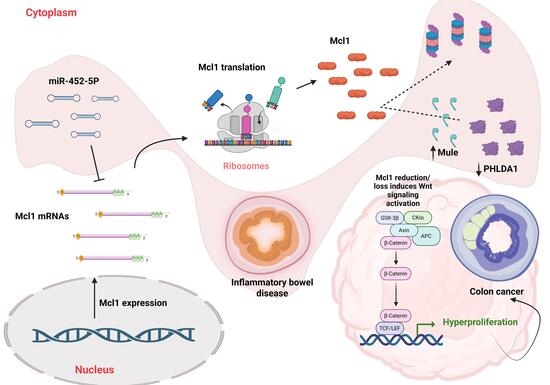
1. Introduction
2. Mcl1 Overview
3. Mcl1 as a Switch Between IBD and Carcinogenesis
4. Therapeutic Targeting of Mcl1 in IBD-Derived Cancers
5. Discussion and Challenges
6. Conclusions
Author Contributions
Funding
Institutional Review Board Statement
Informed Consent Statement
Data Availability Statement
Acknowledgments
Conflicts of Interest
References
- Fakhoury, M.; Negrulj, R.; Mooranian, A.; Al-Salami, H. Inflammatory bowel disease: Clinical aspects and treatments. J. Inflamm. Res. 2014, 7, 113–120. [Google Scholar] [CrossRef]
- Laredo, V.; García-Mateo, S.; Martínez-Domínguez, S.J.; López de la Cruz, J.; Gargallo-Puyuelo, C.J.; Gomollón, F. Risk of Cancer in Patients with Inflammatory Bowel Diseases and Keys for Patient Management. Cancers 2023, 15, 871. [Google Scholar] [CrossRef] [PubMed]
- Axelrad, J.E.; Lichtiger, S.; Yajnik, V. Inflammatory bowel disease and cancer: The role of inflammation, immunosuppression, and cancer treatment. World J. Gastroenterol. 2016, 22, 4794–4801. [Google Scholar] [CrossRef] [PubMed]
- Häfner, M.F.; Debus, J. Radiotherapy for Colorectal Cancer: Current Standards and Future Perspectives. Visc. Med. 2016, 32, 172–177. [Google Scholar] [CrossRef]
- Holch, J.; Stintzing, S.; Heinemann, V. Treatment of Metastatic Colorectal Cancer: Standard of Care and Future Perspectives. Visc. Med. 2016, 32, 178–183. [Google Scholar] [CrossRef]
- Liang, Y.Y.; Niu, F.Y.; Xu, A.A.; Jiang, L.L.; Liu, C.S.; Liang, H.P.; Huang, Y.F.; Shao, X.F.; Mo, Z.W.; Yuan, Y.W. Increased MCL-1 synthesis promotes irradiation-induced nasopharyngeal carcinoma radioresistance via regulation of the ROS/AKT loop. Cell Death Dis. 2022, 13, 131. [Google Scholar] [CrossRef]
- Shi, X.; Liu, S.; Kleeff, J.; Friess, H.; Büchler, M.W. Acquired resistance of pancreatic cancer cells towards 5-Fluorouracil and gemcitabine is associated with altered expression of apoptosis-regulating genes. Oncology 2002, 62, 354–362. [Google Scholar] [CrossRef] [PubMed]
- Hu, C.J.; Wang, B.; Tang, B.; Chen, B.J.; Xiao, Y.F.; Qin, Y.; Yong, X.; Luo, G.; Zhang, J.W.; Zhang, D.; et al. The FOXM1-induced resistance to oxaliplatin is partially mediated by its novel target gene Mcl-1 in gastric cancer cells. Biochim. Biophys. Acta 2015, 1849, 290–299. [Google Scholar] [CrossRef]
- Fu, D.; Pfannenstiel, L.; Demelash, A.; Phoon, Y.P.; Mayell, C.; Cabrera, C.; Liu, C.; Zhao, J.; Dermawan, J.; Patil, D.; et al. MCL1 nuclear translocation induces chemoresistance in colorectal carcinoma. Cell Death Dis. 2022, 13, 63. [Google Scholar] [CrossRef]
- Lin, Q.; Liu, S.; Jiang, H.; Wang, S.; Duan, Y. Maritoclax Overcomes FBW7 Deficiency-Driven Irinotecan Resistance in Colorectal Cancer by Targeting MCL1. Cancer Med. 2025, 14, e71419. [Google Scholar] [CrossRef]
- Widden, H.; Placzek, W.J. The multiple mechanisms of MCL1 in the regulation of cell fate. Commun. Biol. 2021, 4, 1029. [Google Scholar] [CrossRef]
- Kozopas, K.M.; Yang, T.; Buchan, H.L.; Zhou, P.; Craig, R.W. MCL1, a gene expressed in programmed myeloid cell differentiation, has sequence similarity to BCL2. Proc. Natl. Acad. Sci. USA 1993, 90, 3516–3520. [Google Scholar] [CrossRef]
- Teh, C.E.; Robbins, A.K.; Henstridge, D.C.; Dewson, G.; Diepstraten, S.T.; Kelly, G.; Febbraio, M.A.; Gabriel, S.S.; O’Reilly, L.A.; Strasser, A.; et al. MCL-1 is essential for survival but dispensable for metabolic fitness of FOXP3(+) regulatory T cells. Cell Death Differ. 2020, 27, 3374–3385. [Google Scholar] [CrossRef] [PubMed]
- Moyzis, A.G.; Lally, N.S.; Liang, W.; Leon, L.J.; Najor, R.H.; Orogo, A.M.; Gustafsson, Å.B. Mcl-1-mediated mitochondrial fission protects against stress but impairs cardiac adaptation to exercise. J. Mol. Cell. Cardiol. 2020, 146, 109–120. [Google Scholar] [CrossRef] [PubMed]
- Sancho, M.; Leiva, D.; Lucendo, E.; Orzáez, M. Understanding MCL1: From cellular function and regulation to pharmacological inhibition. FEBS J. 2022, 289, 6209–6234. [Google Scholar] [CrossRef]
- Anilkumar, U.; Khacho, M.; Cuillerier, A.; Harris, R.; Patten, D.A.; Bilen, M.; Iqbal, M.A.; Guo, D.Y.; Trudeau, L.-E.; Park, D.S.; et al. MCL-1Matrix maintains neuronal survival by enhancing mitochondrial integrity and bioenergetic capacity under stress conditions. Cell Death Dis. 2020, 11, 321. [Google Scholar] [CrossRef]
- Thomas, R.L.; Gustafsson, A.B. MCL1 is critical for mitochondrial function and autophagy in the heart. Autophagy 2013, 9, 1902–1903. [Google Scholar] [CrossRef] [PubMed]
- Thomas, R.L.; Roberts, D.J.; Kubli, D.A.; Lee, Y.; Quinsay, M.N.; Owens, J.B.; Fischer, K.M.; Sussman, M.A.; Miyamoto, S.; Gustafsson, Å.B. Loss of MCL-1 leads to impaired autophagy and rapid development of heart failure. Genes Dev. 2013, 27, 1365–1377. [Google Scholar] [CrossRef]
- Perciavalle, R.M.; Opferman, J.T. Delving deeper: MCL-1’s contributions to normal and cancer biology. Trends Cell Biol. 2013, 23, 22–29. [Google Scholar] [CrossRef]
- Kale, J.; Osterlund, E.J.; Andrews, D.W. BCL-2 family proteins: Changing partners in the dance towards death. Cell Death Differ. 2018, 25, 65–80. [Google Scholar] [CrossRef]
- Wei, M.C.; Zong, W.X.; Cheng, E.H.; Lindsten, T.; Panoutsakopoulou, V.; Ross, A.J.; Roth, K.A.; MacGregor, G.R.; Thompson, C.B.; Korsmeyer, S.J. Proapoptotic BAX and BAK: A requisite gateway to mitochondrial dysfunction and death. Science 2001, 292, 727–730. [Google Scholar] [CrossRef]
- Goldstein, J.C.; Waterhouse, N.J.; Juin, P.; Evan, G.I.; Green, D.R. The coordinate release of cytochrome c during apoptosis is rapid, complete and kinetically invariant. Nat. Cell Biol. 2000, 2, 156–162. [Google Scholar] [CrossRef]
- Jabbour, A.M.; Heraud, J.E.; Daunt, C.P.; Kaufmann, T.; Sandow, J.; O’Reilly, L.A.; Callus, B.A.; Lopez, A.; Strasser, A.; Vaux, D.L.; et al. Puma indirectly activates Bax to cause apoptosis in the absence of Bid or Bim. Cell Death Differ. 2009, 16, 555–563. [Google Scholar] [CrossRef]
- Srivastava, S.; Sekar, G.; Ojoawo, A.; Aggarwal, A.; Ferreira, E.; Uchikawa, E.; Yang, M.; Grace, C.R.; Dey, R.; Lin, Y.-L.; et al. Structural basis of BAK sequestration by MCL-1 in apoptosis. Mol. Cell 2025, 85, 1606–1623.e1610. [Google Scholar] [CrossRef]
- Sancho, M.; Orzáez, M. BOK-MCL1 transmembrane interactions: A challenging target for cancer therapy. Mol. Cell. Oncol. 2021, 8, 1859918. [Google Scholar] [CrossRef] [PubMed]
- Tantawy, S.I.; Timofeeva, N.; Sarkar, A.; Gandhi, V. Targeting MCL-1 protein to treat cancer: Opportunities and challenges. Front. Oncol. 2023, 13, 1226289. [Google Scholar] [CrossRef] [PubMed]
- Wang, H.; Guo, M.; Wei, H.; Chen, Y. Targeting MCL-1 in cancer: Current status and perspectives. J. Hematol. Oncol. 2021, 14, 67. [Google Scholar] [CrossRef] [PubMed]
- Wei, A.H.; Roberts, A.W.; Spencer, A.; Rosenberg, A.S.; Siegel, D.; Walter, R.B.; Caenepeel, S.; Hughes, P.; McIver, Z.; Mezzi, K.; et al. Targeting MCL-1 in hematologic malignancies: Rationale and progress. Blood Rev. 2020, 44, 100672. [Google Scholar] [CrossRef]
- Desai, P.; Lonial, S.; Cashen, A.; Kamdar, M.; Flinn, I.; O’Brien, S.; Garcia, J.S.; Korde, N.; Moslehi, J.; Wey, M.; et al. A Phase 1 First-in-Human Study of the MCL-1 Inhibitor AZD5991 in Patients with Relapsed/Refractory Hematologic Malignancies. Clin. Cancer Res. Off. J. Am. Assoc. Cancer Res. 2024, 30, 4844–4855. [Google Scholar] [CrossRef]
- Yuda, J.; Will, C.; Phillips, D.C.; Abraham, L.; Alvey, C.; Avigdor, A.; Buck, W.; Besenhofer, L.; Boghaert, E.; Cheng, D.; et al. Selective MCL-1 inhibitor ABBV-467 is efficacious in tumor models but is associated with cardiac troponin increases in patients. Commun. Med. 2023, 3, 154. [Google Scholar] [CrossRef]
- Healy, M.E.; Boege, Y.; Hodder, M.C.; Böhm, F.; Malehmir, M.; Scherr, A.L.; Jetzer, J.; Chan, L.K.; Parrotta, R.; Jacobs, K.; et al. MCL1 Is Required for Maintenance of Intestinal Homeostasis and Prevention of Carcinogenesis in Mice. Gastroenterology 2020, 159, 183–199. [Google Scholar] [CrossRef]
- Kapel, N.; Ouni, H.; Benahmed, N.A.; Barbot-Trystram, L. Fecal Calprotectin for the Diagnosis and Management of Inflammatory Bowel Diseases. Clin. Transl. Gastroenterol. 2023, 14, e00617. [Google Scholar] [CrossRef] [PubMed]
- Smits, R.; Kielman, M.F.; Breukel, C.; Zurcher, C.; Neufeld, K.; Jagmohan-Changur, S.; Hofland, N.; van Dijk, J.; White, R.; Edelmann, W.; et al. Apc1638T: A mouse model delineating critical domains of the adenomatous polyposis coli protein involved in tumorigenesis and development. Genes Dev. 1999, 13, 1309–1321. [Google Scholar] [CrossRef] [PubMed]
- Ambrosi, G.; Voloshanenko, O.; Eckert, A.F.; Kranz, D.; Nienhaus, G.U.; Boutros, M. Allele-specific endogenous tagging and quantitative analysis of β-catenin in colorectal cancer cells. eLife 2022, 11, e64498. [Google Scholar] [CrossRef]
- Rodon, J.; Argilés, G.; Connolly, R.M.; Vaishampayan, U.; de Jonge, M.; Garralda, E.; Giannakis, M.; Smith, D.C.; Dobson, J.R.; McLaughlin, M.E.; et al. Phase 1 study of single-agent WNT974, a first-in-class Porcupine inhibitor, in patients with advanced solid tumours. Br. J. Cancer 2021, 125, 28–37. [Google Scholar] [CrossRef]
- Deng, M.; Hu, J.; Tong, R.; Guo, H.; Li, X.; Liu, Y. miR-452-5p regulates the responsiveness of intestinal epithelial cells in inflammatory bowel disease through Mcl-1. Exp. Ther. Med. 2021, 22, 813. [Google Scholar] [CrossRef] [PubMed]
- Zeng, Z.; Shi, Y.; Cai, Y.; Yang, X.; Zheng, X.; Huang, L.; Liang, Z.; Liu, Z.; Luo, S.; Xiong, L.; et al. PHLDA1 protects intestinal barrier function via restricting intestinal epithelial cells apoptosis in inflammatory bowel disease. Exp. Cell Res. 2024, 443, 114322. [Google Scholar] [CrossRef]
- Chen, Y.; Takikawa, M.; Tsutsumi, S.; Yamaguchi, Y.; Okabe, A.; Shimada, M.; Kawase, T.; Sada, A.; Ezawa, I.; Takano, Y.; et al. PHLDA1, another PHLDA family protein that inhibits Akt. Cancer Sci. 2018, 109, 3532–3542. [Google Scholar] [CrossRef]
- Nijhuis, A.; Curciarello, R.; Mehta, S.; Feakins, R.; Bishop, C.L.; Lindsay, J.O.; Silver, A. MCL-1 is modulated in Crohn’s disease fibrosis by miR-29b via IL-6 and IL-8. Cell Tissue Res. 2017, 368, 325–335. [Google Scholar] [CrossRef]
- Seco-Cervera, M.; Ortiz-Masiá, D.; Macias-Ceja, D.C.; Coll, S.; Gisbert-Ferrándiz, L.; Cosín-Roger, J.; Bauset, C.; Ortega, M.; Heras-Morán, B.; Navarro-Vicente, F.; et al. Resistance to apoptosis in complicated Crohn’s disease: Relevance in ileal fibrosis. Biochim. Biophys. Acta (BBA) Mol. Basis Dis. 2024, 1870, 166966. [Google Scholar] [CrossRef]
- Demelash, A.; Pfannenstiel, L.W.; Tannenbaum, C.S.; Li, X.; Kalady, M.F.; DeVecchio, J.; Gastman, B.R. Structure-Function Analysis of the Mcl-1 Protein Identifies a Novel Senescence-regulating Domain. J. Biol. Chem. 2015, 290, 21962–21975. [Google Scholar] [CrossRef] [PubMed]
- Mittal, P.; Battaglin, F.; Baca, Y.; Xiu, J.; Farrell, A.; Soni, S.; Lo, J.H.; Torres-Gonzalez, L.; Algaze, S.; Jayachandran, P.; et al. Comprehensive characterization of MCL-1 in patients with colorectal cancer: Expression, molecular profiles, and outcomes. Int. J. Cancer 2025, 156, 1583–1593. [Google Scholar] [CrossRef]
- Ulrich-Pur, H.; Erovic, B.M.; Soleiman, A.; Jech, B.; Pennwieser, W.; Czembirek, C.; Zielinski, C.C.; Thurnher, D. Changes in Mcl-1 expression in rectal cancer in relation to neo-adjuvant radiotherapy. Wien. Klin. Wochenschr. 2005, 117, 136–140. [Google Scholar] [CrossRef]
- Yu, X.; Zhou, L.; Liu, W.; Liu, L.; Gao, F.; Li, W.; Liu, H. Skp2 stabilizes Mcl-1 and confers radioresistance in colorectal cancer. Cell Death Dis. 2022, 13, 249. [Google Scholar] [CrossRef]
- Tong, J.; Wang, P.; Tan, S.; Chen, D.; Nikolovska-Coleska, Z.; Zou, F.; Yu, J.; Zhang, L. Mcl-1 Degradation Is Required for Targeted Therapeutics to Eradicate Colon Cancer Cells. Cancer Res. 2017, 77, 2512–2521. [Google Scholar] [CrossRef] [PubMed]
- Song, X.; Shen, L.; Tong, J.; Kuang, C.; Zeng, S.; Schoen, R.E.; Yu, J.; Pei, H.; Zhang, L. Mcl-1 inhibition overcomes intrinsic and acquired regorafenib resistance in colorectal cancer. Theranostics 2020, 10, 8098–8110. [Google Scholar] [CrossRef]
- Gan, Y.; Li, X.; Han, S.; Zhou, L.; Li, W. Targeting Mcl-1 Degradation by Bergenin Inhibits Tumorigenesis of Colorectal Cancer Cells. Pharmaceuticals 2023, 16, 241. [Google Scholar] [CrossRef] [PubMed]
- Pandey, P.; Lakhanpal, S.; Mahmood, D.; Kang, H.N.; Kim, B.; Kang, S.; Choi, J.; Moon, S.; Pandey, S.; Ballal, S.; et al. Bergenin, a bioactive flavonoid: Advancements in the prospects of anticancer mechanism, pharmacokinetics and nanoformulations. Front. Pharmacol. 2024, 15, 1481587. [Google Scholar] [CrossRef]
- Tong, J.; Tan, S.; Nikolovska-Coleska, Z.; Yu, J.; Zou, F.; Zhang, L. FBW7-Dependent Mcl-1 Degradation Mediates the Anticancer Effect of Hsp90 Inhibitors. Mol. Cancer Ther. 2017, 16, 1979–1988. [Google Scholar] [CrossRef]
- Liebing, E.; Krug, S.M.; Neurath, M.F.; Siegmund, B.; Becker, C. Wall of Resilience: How the Intestinal Epithelium Prevents Inflammatory Onslaught in the Gut. Cell. Mol. Gastroenterol. Hepatol. 2025, 19, 101423. [Google Scholar] [CrossRef]
- Dzhagalov, I.; Dunkle, A.; He, Y.W. The anti-apoptotic Bcl-2 family member Mcl-1 promotes T lymphocyte survival at multiple stages. J. Immunol. 2008, 181, 521–528. [Google Scholar] [CrossRef] [PubMed]
- Dzhagalov, I.; St John, A.; He, Y.W. The antiapoptotic protein Mcl-1 is essential for the survival of neutrophils but not macrophages. Blood 2007, 109, 1620–1626. [Google Scholar] [CrossRef]
- Vikström, I.B.; Slomp, A.; Carrington, E.M.; Moesbergen, L.M.; Chang, C.; Kelly, G.L.; Glaser, S.P.; Jansen, J.H.; Leusen, J.H.; Strasser, A.; et al. MCL-1 is required throughout B-cell development and its loss sensitizes specific B-cell subsets to inhibition of BCL-2 or BCL-XL. Cell Death Dis. 2016, 7, e2345. [Google Scholar] [CrossRef]
- Dhani, S.; Zhao, Y.; Zhivotovsky, B. A long way to go: Caspase inhibitors in clinical use. Cell Death Dis. 2021, 12, 949. [Google Scholar] [CrossRef] [PubMed]
- Opferman, J.T.; Iwasaki, H.; Ong, C.C.; Suh, H.; Mizuno, S.; Akashi, K.; Korsmeyer, S.J. Obligate role of anti-apoptotic MCL-1 in the survival of hematopoietic stem cells. Science 2005, 307, 1101–1104. [Google Scholar] [CrossRef] [PubMed]
- Wang, X.; Bathina, M.; Lynch, J.; Koss, B.; Calabrese, C.; Frase, S.; Schuetz, J.D.; Rehg, J.E.; Opferman, J.T. Deletion of MCL-1 causes lethal cardiac failure and mitochondrial dysfunction. Genes Dev. 2013, 27, 1351–1364. [Google Scholar] [CrossRef]
- Guo, L.; Eldridge, S.; Furniss, M.; Mussio, J.; Davis, M. Role of Mcl-1 in regulation of cell death in human induced pluripotent stem cell-derived cardiomyocytes in vitro. Toxicol. Appl. Pharmacol. 2018, 360, 88–98. [Google Scholar] [CrossRef]
- Falchook, G.; Patel, M.; McKean, M.; Philipovskiy, A.; Chiaverelli, R.; Sun, W.; Fossler, M.; Novotny, W.; Kurman, M.; Rowe, S.; et al. Abstract CT172: A phase 1, open-label, dose-escalation study of PRT1419, a selective induced myeloid leukemia cell differentiation protein (MCL-1) inhibitor, in patients (pts) with advanced/metastatic solid tumors. Cancer Res. 2023, 83, CT172. [Google Scholar] [CrossRef]
- Mak, P.Y.; Maiti, A.; Tomczyk, T.; Cottens, S.; Walczak, M.; Andreeff, M.; Carter, B. Cardio-safe degrader CT-03p degrades MCL-1 and overcomes venetoclax resistance in AML. Blood 2025, 146, 3266. [Google Scholar] [CrossRef]
- Wang, Z.; He, N.; Guo, Z.; Niu, C.; Song, T.; Guo, Y.; Cao, K.; Wang, A.; Zhu, J.; Zhang, X.; et al. Proteolysis Targeting Chimeras for the Selective Degradation of Mcl-1/Bcl-2 Derived from Nonselective Target Binding Ligands. J. Med. Chem. 2019, 62, 8152–8163. [Google Scholar] [CrossRef]
- Elshazly, A.M.; Hosseini, N.; Shen, S.; Neely, V.; Harada, H.; Grant, S.; Radhakrishnan, S.K. Proteasome Inhibition Enhances Lysosome-mediated Targeted Protein Degradation. bioRxiv 2025, bioRxiv, 2025.2001.2031.634950. [Google Scholar] [CrossRef]
- Elshazly, A.M.; Wright, P.A.; Xu, J.; Gewirtz, D.A. Topoisomerase I poisons-induced autophagy: Cytoprotective, Cytotoxic or Non-protective. Autophagy Rep. 2023, 2, 1–16. [Google Scholar] [CrossRef] [PubMed]
- Elshazly, A.M.; Elzahed, A.A.; Gewirtz, D.A. The Cytoprotective and Cytotoxic Functions of Autophagy in Response to mTOR Inhibitors. Front. Biosci. 2024, 29, 231. [Google Scholar] [CrossRef] [PubMed]
- Elshazly, A.M.; Hosseini, N.; Elzahed, A.A.; Gewirtz, D.A. An overview of autophagy inhibition as a potential clinical strategy in cancer therapy. Mol. Pharmacol. 2025, 107, 100056. [Google Scholar] [CrossRef] [PubMed]



| Model/System | Mcl1 Targeting Strategy | Treatment Context | Key Outcome | Stage | Reference |
|---|---|---|---|---|---|
| CRC cell lines (HCT116, HT29) | Genetic depletion (knockdown) | Radiation therapy | Mcl1 depletion significantly sensitized cells to irradiation | Preclinical | [44] |
| CRC cell lines + xenografts | Genetic knockdown + pharmacologic inhibition (UMI-77) | Kinase inhibitors (regorafenib, sorafenib) | Mcl1 targeting restored drug sensitivity and apoptosis | Preclinical | [45] |
| Resistant CRC cell lines + xenografts | Pharmacologic inhibition (S63845, AZD5991, AMG176) | Regorafenib-resistant models | Combination therapy overcame acquired resistance | Preclinical | [46] |
| CRC cell lines + xenografts | Indirect pharmacologic degradation (bergenin) | NA | Induced apoptosis and suppressed tumor growth | Preclinical | [47] |
| Advanced/metastatic solid tumors | PRT1419 | NA | Phase 1 trial showed acceptable safety with no cardiac toxicity, and stable disease was achieved in some patients. | Clinical | NCT04837677 |
Disclaimer/Publisher’s Note: The statements, opinions and data contained in all publications are solely those of the individual author(s) and contributor(s) and not of MDPI and/or the editor(s). MDPI and/or the editor(s) disclaim responsibility for any injury to people or property resulting from any ideas, methods, instructions or products referred to in the content. |
© 2026 by the authors. Licensee MDPI, Basel, Switzerland. This article is an open access article distributed under the terms and conditions of the Creative Commons Attribution (CC BY) license.
Share and Cite
Elshazly, A.M.; Li, J.; Yang, G.-Y.; Radhakrishnan, S.K. Mcl1 as a Molecular Switch Linking Inflammatory Bowel Diseases to Colorectal Tumorigenesis. Biomolecules 2026, 16, 694. https://doi.org/10.3390/biom16050694
Elshazly AM, Li J, Yang G-Y, Radhakrishnan SK. Mcl1 as a Molecular Switch Linking Inflammatory Bowel Diseases to Colorectal Tumorigenesis. Biomolecules. 2026; 16(5):694. https://doi.org/10.3390/biom16050694
Chicago/Turabian StyleElshazly, Ahmed M., Jiong Li, Guang-Yu Yang, and Senthil K. Radhakrishnan. 2026. "Mcl1 as a Molecular Switch Linking Inflammatory Bowel Diseases to Colorectal Tumorigenesis" Biomolecules 16, no. 5: 694. https://doi.org/10.3390/biom16050694
APA StyleElshazly, A. M., Li, J., Yang, G.-Y., & Radhakrishnan, S. K. (2026). Mcl1 as a Molecular Switch Linking Inflammatory Bowel Diseases to Colorectal Tumorigenesis. Biomolecules, 16(5), 694. https://doi.org/10.3390/biom16050694