


The Complement System in the Setting of Critical Illness—A Narrative Review

 ,
,  , and
, and
Abstract
1. Introduction
2. The Complement System
Complement Regulation
3. Bacterial Sepsis
Complement Regulatory Proteins and Bacterial Sepsis in ICU
4. Viral Sepsis—Coronavirus Disease-2019 (COVID-19)
5. ICU Admission Due to Other Pathogens
6. Trauma
7. Burn
8. Clinical Implications—ICU Prognosis and Potential Therapeutic Targets
9. Conclusions
Author Contributions
Funding
Institutional Review Board Statement
Informed Consent Statement
Data Availability Statement
Conflicts of Interest
Abbreviations
| ICU | intensive care unit |
| MODS | multiple organ dysfunction syndrome |
| MAC | membrane attack complex |
| PRPs | pattern recognition proteins |
| MBL | mannose binding lectin |
| MASPs | MBL-associated serine proteases |
| FB | factor B |
| FD | factor D |
| FH | factor H |
| CRegPs | complement regulatory proteins |
| DAF | decay accelerating factor |
| MCP | membrane cofactor protein |
| LPS | lipopolysaccharide |
| CR1 | complement receptor-1 |
| C1-INH | C1 esterase inhibitor |
| LARMA | Respiratory Management of Acute Lung Injury |
| SAILS | Statins for Acutely Injured Lungs from Sepsis |
| ALIR | Acute Lung Injury Registry and Biospecimen Repository |
| COVID-19 | Coronavirus disease |
| PBMCs | peripheral blood mononuclear cells |
| IFN | interferon |
| ARDS | acute respiratory distress syndrome |
References
- van der Poll, T.; van de Veerdonk, F.L.; Scicluna, B.P.; Netea, M.G. The immunopathology of sepsis and potential therapeutic targets. Nat. Rev. Immunol. 2017, 17, 407–420. [Google Scholar] [CrossRef]
- Singer, M.; Deutschman, C.S.; Seymour, C.W.; Shankar-Hari, M.; Annane, D.; Bauer, M.; Bellomo, R.; Bernard, G.R.; Chiche, J.D.; Coopersmith, C.M.; et al. The Third International Consensus Definitions for Sepsis and Septic Shock (Sepsis-3). Jama 2016, 315, 801–810. [Google Scholar] [CrossRef]
- Mannes, M.; Mastellos, D.C.; Ekdahl, K.N.; Nilsson, B.; Yancopoulou, D.; Lambris, J.D.; Huber-Lang, M. Complement C3 activation in the ICU: Disease and therapy as Bonnie and Clyde. Semin. Immunol. 2022, 60, 101640. [Google Scholar] [CrossRef]
- Detsika, M.G.; Diamanti, E.; Ampelakiotou, K.; Jahaj, E.; Tsipilis, S.; Athanasiou, N.; Dimopoulou, I.; Orfanos, S.E.; Tsirogianni, A.; Kotanidou, A. C3a and C5b-9 Differentially Predict COVID-19 Progression and Outcome. Life 2022, 12, 1335. [Google Scholar] [CrossRef]
- Yu, J.; Gerber, G.F.; Chen, H.; Yuan, X.; Chaturvedi, S.; Braunstein, E.M.; Brodsky, R.A. Complement dysregulation is associated with severe COVID-19 illness. Haematologica 2022, 107, 1095–1105. [Google Scholar] [CrossRef]
- Snyder, E.L.; Root, R.K.; McLeod, B.; Dalmasso, A.P. Activation of complement by blood transfusion filters. Vox Sang. 1983, 45, 288–293. [Google Scholar] [CrossRef] [PubMed]
- Merle, N.S.; Church, S.E.; Fremeaux-Bacchi, V.; Roumenina, L.T. Complement System Part I—Molecular Mechanisms of Activation and Regulation. Front. Immunol. 2015, 6, 262. [Google Scholar] [CrossRef] [PubMed]
- Noris, M.; Remuzzi, G. Overview of complement activation and regulation. Semin. Nephrol. 2013, 33, 479–492. [Google Scholar] [CrossRef]
- Detsika, M.G.; Palamaris, K.; Dimopoulou, I.; Kotanidou, A.; Orfanos, S.E. The complement cascade in lung injury and disease. Respir. Res. 2024, 25, 20. [Google Scholar] [CrossRef] [PubMed]
- Bexborn, F.; Andersson, P.O.; Chen, H.; Nilsson, B.; Ekdahl, K.N. The tick-over theory revisited: Formation and regulation of the soluble alternative complement C3 convertase (C3(H2O)Bb). Mol. Immunol. 2008, 45, 2370–2379. [Google Scholar] [CrossRef]
- Haas, P.J.; van Strijp, J. Anaphylatoxins: Their role in bacterial infection and inflammation. Immunol. Res. 2007, 37, 161–175. [Google Scholar] [CrossRef]
- Lublin, D.M.; Atkinson, J.P. Decay-accelerating factor: Biochemistry, molecular biology, and function. Annu. Rev. Immunol. 1989, 7, 35–58. [Google Scholar] [CrossRef]
- Lukacik, P.; Roversi, P.; White, J.; Esser, D.; Smith, G.P.; Billington, J.; Williams, P.A.; Rudd, P.M.; Wormald, M.R.; Harvey, D.J.; et al. Complement regulation at the molecular level: The structure of decay-accelerating factor. Proc. Natl. Acad. Sci. USA 2004, 101, 1279–1284. [Google Scholar] [CrossRef]
- Kim, D.D.; Song, W.C. Membrane complement regulatory proteins. Clin. Immunol. 2006, 118, 127–136. [Google Scholar] [CrossRef]
- Liszewski, M.K.; Atkinson, J.P. Membrane cofactor protein (MCP; CD46): Deficiency states and pathogen connections. Curr. Opin. Immunol. 2021, 72, 126–134. [Google Scholar] [CrossRef]
- Podack, E.R. Molecular composition of the tubular structure of the membrane attack complex of complement. J. Biol. Chem. 1984, 259, 8641–8647. [Google Scholar] [CrossRef]
- Couves, E.C.; Gardner, S.; Voisin, T.B.; Bickel, J.K.; Stansfeld, P.J.; Tate, E.W.; Bubeck, D. Structural basis for membrane attack complex inhibition by CD59. Nat. Commun. 2023, 14, 890. [Google Scholar] [CrossRef]
- Rawal, N.; Rajagopalan, R.; Salvi, V.P. Stringent regulation of complement lectin pathway C3/C5 convertase by C4b-binding protein (C4BP). Mol. Immunol. 2009, 46, 2902–2910. [Google Scholar] [CrossRef]
- Rodriguez de Cordoba, S.; Sanchez-Corral, P.; Rey-Campos, J. Structure of the gene coding for the alpha polypeptide chain of the human complement component C4b-binding protein. J. Exp. Med. 1991, 173, 1073–1082. [Google Scholar] [CrossRef]
- Blom, A.M.; Villoutreix, B.O.; Dahlback, B. Mutations in alpha-chain of C4BP that selectively affect its factor I cofactor function. J. Biol. Chem. 2003, 278, 43437–43442. [Google Scholar] [CrossRef]
- Varghese, P.M.; Murugaiah, V.; Beirag, N.; Temperton, N.; Khan, H.A.; Alrokayan, S.H.; Al-Ahdal, M.N.; Nal, B.; Al-Mohanna, F.A.; Sim, R.B.; et al. C4b Binding Protein Acts as an Innate Immune Effector Against Influenza A Virus. Front. Immunol. 2020, 11, 585361. [Google Scholar] [CrossRef]
- Davis, A.E., 3rd; Lu, F.; Mejia, P. C1 inhibitor, a multi-functional serine protease inhibitor. Thromb. Haemost. 2010, 104, 886–893. [Google Scholar] [CrossRef]
- Zeerleder, S. C1-inhibitor: More than a serine protease inhibitor. Semin. Thromb. Hemost. 2011, 37, 362–374. [Google Scholar] [CrossRef] [PubMed]
- Ferreira, V.P.; Pangburn, M.K.; Cortes, C. Complement control protein factor H: The good, the bad, and the inadequate. Mol. Immunol. 2010, 47, 2187–2197. [Google Scholar] [CrossRef]
- Kopp, A.; Hebecker, M.; Svobodova, E.; Jozsi, M. Factor h: A complement regulator in health and disease, and a mediator of cellular interactions. Biomolecules 2012, 2, 46–75. [Google Scholar] [CrossRef]
- Parente, R.; Clark, S.J.; Inforzato, A.; Day, A.J. Complement factor H in host defense and immune evasion. Cell. Mol. Life Sci. 2017, 74, 1605–1624. [Google Scholar] [CrossRef]
- Wu, J.; Wu, Y.Q.; Ricklin, D.; Janssen, B.J.; Lambris, J.D.; Gros, P. Structure of complement fragment C3b-factor H and implications for host protection by complement regulators. Nat. Immunol. 2009, 10, 728–733. [Google Scholar] [CrossRef]
- Milis, L.; Morris, C.A.; Sheehan, M.C.; Charlesworth, J.A.; Pussell, B.A. Vitronectin-mediated inhibition of complement: Evidence for different binding sites for C5b-7 and C9. Clin. Exp. Immunol. 1993, 92, 114–119. [Google Scholar] [CrossRef]
- Alcorlo, M.; Tortajada, A.; Rodriguez de Cordoba, S.; Llorca, O. Structural basis for the stabilization of the complement alternative pathway C3 convertase by properdin. Proc. Natl. Acad. Sci. USA 2013, 110, 13504–13509. [Google Scholar] [CrossRef] [PubMed]
- Blatt, A.Z.; Pathan, S.; Ferreira, V.P. Properdin: A tightly regulated critical inflammatory modulator. Immunol. Rev. 2016, 274, 172–190. [Google Scholar] [CrossRef] [PubMed]
- Wirthmueller, U.; Dewald, B.; Thelen, M.; Schafer, M.K.; Stover, C.; Whaley, K.; North, J.; Eggleton, P.; Reid, K.B.; Schwaeble, W.J. Properdin, a positive regulator of complement activation, is released from secondary granules of stimulated peripheral blood neutrophils. J. Immunol. 1997, 158, 4444–4451. [Google Scholar] [CrossRef]
- Li, H.; Chen, J.; Hu, Y.; Cai, X.; Tang, D.; Zhang, P. Serum C1q Levels Have Prognostic Value for Sepsis and are Related to the Severity of Sepsis and Organ Damage. J. Inflamm. Res. 2021, 14, 4589–4600. [Google Scholar] [CrossRef] [PubMed]
- Trzeciak, A.; Mongre, R.K.; Kim, M.R.; Lim, K.; Madero, R.A.; Parkhurst, C.N.; Pietropaoli, A.P.; Kim, M. Neutrophil heterogeneity in complement C1q expression associated with sepsis mortality. Front. Immunol. 2022, 13, 965305. [Google Scholar] [CrossRef] [PubMed]
- Eichenberger, E.M.; Dagher, M.; Ruffin, F.; Park, L.; Hersh, L.; Sivapalasingam, S.; Fowler, V.G., Jr.; Prasad, B.C. Complement levels in patients with bloodstream infection due to Staphylococcus aureus or Gram-negative bacteria. Eur. J. Clin. Microbiol. Infect. Dis. 2020, 39, 2121–2131. [Google Scholar] [CrossRef]
- Al-Fares, A.; Pettenuzzo, T.; Del Sorbo, L. Extracorporeal life support and systemic inflammation. Intensive Care Med. Exp. 2019, 7, 46. [Google Scholar] [CrossRef] [PubMed]
- Bengtson, A.; Heideman, M. Anaphylatoxin formation in sepsis. JAMA Surg. 1988, 123, 645–649. [Google Scholar] [CrossRef]
- Stöve, S.; Welte, T.; Wagner, T.O.; Kola, A.; Klos, A.; Bautsch, W.; Köhl, J. Circulating complement proteins in patients with sepsis or systemic inflammatory response syndrome. Clin. Diagn. Lab. Immunol. 1996, 3, 175–183. [Google Scholar] [CrossRef]
- Nakae, H.; Endo, S.; Inada, K.; Yoshida, M. Chronological changes in the complement system in sepsis. Surg. Today 1996, 26, 225–229. [Google Scholar] [CrossRef]
- Nordahl, E.A.; Rydengård, V.; Nyberg, P.; Nitsche, D.P.; Mörgelin, M.; Malmsten, M.; Björck, L.; Schmidtchen, A. Activation of the complement system generates antibacterial peptides. Proc. Natl. Acad. Sci. USA 2004, 101, 16879–16884. [Google Scholar] [CrossRef]
- Xu, Z.; Hou, X.F.; Feng, C.M.; Zheng, L.; Xu, D.X.; Zhao, H.; Fu, L. The association between serum complement C3a and severity in patients with community-acquired pneumonia. Front. Immunol. 2023, 14, 1034233. [Google Scholar] [CrossRef]
- Villa, A.; Dewar, F.; Pisciotta, W.; Rai, A.; Kerneis, S.; Batum, G.; McDonnell, T.; Scully, M.; McHugh, T.D.; Hilpert, K.; et al. Systematic review and meta-analysis of humoral immunity proteins and mortality in sepsis. Crit. Care 2025, 30, 41. [Google Scholar] [CrossRef]
- Johnson, A.E.W.; Bulgarelli, L.; Shen, L.; Gayles, A.; Shammout, A.; Horng, S.; Pollard, T.J.; Hao, S.; Moody, B.; Gow, B.; et al. MIMIC-IV, a freely accessible electronic health record dataset. Sci. Data 2023, 10, 1. [Google Scholar] [CrossRef]
- Stover, C.M.; McDonald, J.; Byrne, S.; Lambert, D.G.; Thompson, J.P. Properdin levels in human sepsis. Front. Immunol. 2015, 6, 24. [Google Scholar] [CrossRef]
- Abe, T.; Saito, K.; Nagano, T.; Yamada, Y.; Ochiai, H. Complement system activation through the alternative pathway associates with disseminated intravascular coagulation to increase mortality in sepsis. Thromb. Res. 2025, 247, 109281. [Google Scholar] [CrossRef]
- Takahashi, K.; Ezekowitz, R.A. The role of the mannose-binding lectin in innate immunity. Clin. Infect. Dis. 2005, 41, S440–S444. [Google Scholar] [CrossRef] [PubMed]
- Bouwman, L.H.; Roep, B.O.; Roos, A. Mannose-binding lectin: Clinical implications for infection, transplantation, and autoimmunity. Hum. Immunol. 2006, 67, 247–256. [Google Scholar] [CrossRef]
- Smithson, A.; Muñoz, A.; Suarez, B.; Soto, S.M.; Perello, R.; Soriano, A.; Martinez, J.A.; Vila, J.; Horcajada, J.P.; Mensa, J.; et al. Association between mannose-binding lectin deficiency and septic shock following acute pyelonephritis due to Escherichia coli. Clin. Vaccine Immunol. 2007, 14, 256–261. [Google Scholar] [CrossRef]
- Chong, Y.P.; Park, K.H.; Kim, E.S.; Kim, M.N.; Kim, S.H.; Lee, S.O.; Choi, S.H.; Jeong, J.Y.; Woo, J.H.; Kim, Y.S. Association of mannose-binding lectin 2 gene polymorphisms with persistent Staphylococcus aureus bacteremia. PLoS ONE 2014, 9, e89139. [Google Scholar] [CrossRef] [PubMed]
- Hack, C.E.; Nuijens, J.H.; Felt-Bersma, R.J.; Schreuder, W.O.; Eerenberg-Belmer, A.J.; Paardekooper, J.; Bronsveld, W.; Thijs, L.G. Elevated plasma levels of the anaphylatoxins C3a and C4a are associated with a fatal outcome in sepsis. Am. J. Med. 1989, 86, 20–26. [Google Scholar] [CrossRef] [PubMed]
- Solomkin, J.S.; Jenkins, M.K.; Nelson, R.D.; Chenoweth, D.; Simmons, R.L. Neutrophil dysfunction in sepsis. II. Evidence for the role of complement activation products in cellular deactivation. Surgery 1981, 90, 319–327. [Google Scholar]
- Furebring, M.; Håkansson, L.D.; Venge, P.; Nilsson, B.; Sjölin, J. Expression of the C5a receptor (CD88) on granulocytes and monocytes in patients with severe sepsis. Crit. Care 2002, 6, 363–370. [Google Scholar] [CrossRef]
- Hallström, T.; Riesbeck, K. Haemophilus influenzae and the complement system. Trends Microbiol. 2010, 18, 258–265. [Google Scholar] [CrossRef]
- Amdahl, H.; Haapasalo, K.; Tan, L.; Meri, T.; Kuusela, P.I.; van Strijp, J.A.; Rooijakkers, S.; Jokiranta, T.S. Staphylococcal protein Ecb impairs complement receptor-1 mediated recognition of opsonized bacteria. PLoS ONE 2017, 12, e0172675. [Google Scholar] [CrossRef]
- Vanderelst, J.; Rousseau, A.; Selvais, N.; Biston, P.; Zouaoui Boudjeltia, K.; Piagnerelli, M. Evolution of red blood cell membrane complement regulatory proteins and rheology in septic patients: An exploratory study. Front. Med. 2022, 9, 880657. [Google Scholar] [CrossRef] [PubMed]
- Honda-Ogawa, M.; Ogawa, T.; Terao, Y.; Sumitomo, T.; Nakata, M.; Ikebe, K.; Maeda, Y.; Kawabata, S. Cysteine proteinase from Streptococcus pyogenes enables evasion of innate immunity via degradation of complement factors. J. Biol. Chem. 2013, 288, 15854–15864. [Google Scholar] [CrossRef]
- Wang, X.; Zhang, D.; Sjölinder, M.; Wan, Y.; Sjölinder, H. CD46 accelerates macrophage-mediated host susceptibility to meningococcal sepsis in a murine model. Eur. J. Immunol. 2017, 47, 119–130. [Google Scholar] [CrossRef] [PubMed]
- Bain, W.; Tabary, M.; Moore, S.R.; An, X.; Kitsios, G.D.; McVerry, B.J.; Ray, P.; Ray, A.; Mallampalli, R.K.; Ferreira, V.P.; et al. Factor H preserves alternative complement function during ARDS, linked to improved survival. ERJ Open Res. 2023, 9, 00702-2022. [Google Scholar] [CrossRef]
- Inman, K.; Chernus, J.; Lee, M.; Alder, J.K.; Shah, F.A.; Mayr, F.B.; Dempsey, T.; Nouraie, S.M.; Dela Cruz, C.; Ferreira, V.P.; et al. Genetic Variation in the Alternative Complement Pathway Contributes to Individual Susceptibility to Bacteremia and Sepsis. Crit. Care Explor. 2025, 7, e1339. [Google Scholar] [CrossRef]
- Ackermann, M.; Verleden, S.E.; Kuehnel, M.; Haverich, A.; Welte, T.; Laenger, F.; Vanstapel, A.; Werlein, C.; Stark, H.; Tzankov, A.; et al. Pulmonary Vascular Endothelialitis, Thrombosis, and Angiogenesis in COVID-19. N. Engl. J. Med. 2020, 383, 120–128. [Google Scholar] [CrossRef] [PubMed]
- Alosaimi, B.; Mubarak, A.; Hamed, M.E.; Almutairi, A.Z.; Alrashed, A.A.; AlJuryyan, A.; Enani, M.; Alenzi, F.Q.; Alturaiki, W. Complement Anaphylatoxins and Inflammatory Cytokines as Prognostic Markers for COVID-19 Severity and In-Hospital Mortality. Front. Immunol. 2021, 12, 668725. [Google Scholar] [CrossRef]
- Henry, B.M.; Szergyuk, I.; de Oliveira, M.H.S.; Lippi, G.; Benoit, J.L.; Vikse, J.; Benoit, S.W. Complement levels at admission as a reflection of coronavirus disease 2019 (COVID-19) severity state. J. Med. Virol. 2021, 93, 5515–5522. [Google Scholar] [CrossRef] [PubMed]
- de Nooijer, A.H.; Grondman, I.; Janssen, N.A.F.; Netea, M.G.; Willems, L.; van de Veerdonk, F.L.; Giamarellos-Bourboulis, E.J.; Toonen, E.J.M.; Joosten, L.A.B.; RCI-COVID-19 Study Group. Complement Activation in the Disease Course of Coronavirus Disease 2019 and Its Effects on Clinical Outcomes. J. Infect. Dis. 2021, 223, 214–224. [Google Scholar] [CrossRef] [PubMed]
- Sinkovits, G.; Mezo, B.; Reti, M.; Muller, V.; Ivanyi, Z.; Gal, J.; Gopcsa, L.; Remenyi, P.; Szathmary, B.; Lakatos, B.; et al. Complement Overactivation and Consumption Predicts In-Hospital Mortality in SARS-CoV-2 Infection. Front. Immunol. 2021, 12, 663187. [Google Scholar] [CrossRef]
- Carvelli, J.; Demaria, O.; Vely, F.; Batista, L.; Chouaki Benmansour, N.; Fares, J.; Carpentier, S.; Thibult, M.L.; Morel, A.; Remark, R.; et al. Association of COVID-19 inflammation with activation of the C5a-C5aR1 axis. Nature 2020, 588, 146–150. [Google Scholar] [CrossRef]
- de Andrade, L.V.; Vasconcelos, B.; Khouri, R.; de Souza, C.D.F.; Armstrong, A.D.C.; do Carmo, R.F. Impact of complement system proteins on the clinical progression of hospitalized patients with COVID-19. BMC Infect. Dis. 2025, 25, 1231. [Google Scholar] [CrossRef]
- Shivshankar, P.; Mueller-Ortiz, S.L.; Domozhirov, A.Y.; Bi, W.; Collum, S.D.; Doursout, M.F.; Patel, M.; LeFebvre, I.N.; Akkanti, B.; Yau, S.; et al. Complement activity and autophagy are dysregulated in the lungs of patients with nonresolvable COVID-19 requiring lung transplantation. Respir. Res. 2025, 26, 68. [Google Scholar] [CrossRef]
- Detsika, M.G.; Sakkou, M.; Triantafyllidou, V.; Konstantopoulos, D.; Grigoriou, E.; Psarra, K.; Jahaj, E.; Dimopoulou, I.; Orfanos, S.E.; Tsirogianni, A.; et al. CD55 upregulation in T cells of COVID-19 patients suppresses type-I interferon responses. Commun. Biol. 2025, 8, 690. [Google Scholar] [CrossRef]
- Georg, P.; Astaburuaga-Garcia, R.; Bonaguro, L.; Brumhard, S.; Michalick, L.; Lippert, L.J.; Kostevc, T.; Gabel, C.; Schneider, M.; Streitz, M.; et al. Complement activation induces excessive T cell cytotoxicity in severe COVID-19. Cell 2022, 185, 493–512.e25. [Google Scholar] [CrossRef]
- Skendros, P.; Mitsios, A.; Chrysanthopoulou, A.; Mastellos, D.C.; Metallidis, S.; Rafailidis, P.; Ntinopoulou, M.; Sertaridou, E.; Tsironidou, V.; Tsigalou, C.; et al. Complement and tissue factor-enriched neutrophil extracellular traps are key drivers in COVID-19 immunothrombosis. J. Clin. Investig. 2020, 130, 6151–6157. [Google Scholar] [CrossRef] [PubMed]
- Lambris, J.D.; Ricklin, D.; Geisbrecht, B.V. Complement evasion by human pathogens. Nat. Rev. Microbiol. 2008, 6, 132–142. [Google Scholar] [CrossRef]
- Jayaraman, A.; Walachowski, S.; Bosmann, M. The complement system: A key player in the host response to infections. Eur. J. Immunol. 2024, 54, e2350814. [Google Scholar] [CrossRef]
- Paramythiotou, E.; Frantzeskaki, F.; Flevari, A.; Armaganidis, A.; Dimopoulos, G. Invasive fungal infections in the ICU: How to approach, how to treat. Molecules 2014, 19, 1085–1119. [Google Scholar] [CrossRef]
- Vincent, J.L.; Rello, J.; Marshall, J.; Silva, E.; Anzueto, A.; Martin, C.D.; Moreno, R.; Lipman, J.; Gomersall, C.; Sakr, Y.; et al. International study of the prevalence and outcomes of infection in intensive care units. JAMA 2009, 302, 2323–2329. [Google Scholar] [CrossRef]
- Iliev, I.D.; Brown, G.D.; Bacher, P.; Gaffen, S.L.; Heitman, J.; Klein, B.S.; Lionakis, M.S. Focus on fungi. Cell 2024, 187, 5121–5127. [Google Scholar] [CrossRef]
- Desai, J.V.; Kumar, D.; Freiwald, T.; Chauss, D.; Johnson, M.D.; Abers, M.S.; Steinbrink, J.M.; Perfect, J.R.; Alexander, B.; Matzaraki, V.; et al. C5a-licensed phagocytes drive sterilizing immunity during systemic fungal infection. Cell 2023, 186, 2802–2822.e22. [Google Scholar] [CrossRef]
- Tsoni, S.V.; Kerrigan, A.M.; Marakalala, M.J.; Srinivasan, N.; Duffield, M.; Taylor, P.R.; Botto, M.; Steele, C.; Brown, G.D. Complement C3 plays an essential role in the control of opportunistic fungal infections. Infect. Immun. 2009, 77, 3679–3685. [Google Scholar] [CrossRef]
- Voelz, K.; May, R.C. Cryptococcal interactions with the host immune system. Eukaryot. Cell 2010, 9, 835–846. [Google Scholar] [CrossRef]
- Macher, A.M.; Bennett, J.E.; Gadek, J.E.; Frank, M.M. Complement depletion in cryptococcal sepsis. J. Immunol. 1978, 120, 1686–1690. [Google Scholar] [CrossRef]
- Rhodes, J.C. Contribution of complement component C5 to the pathogenesis of experimental murine cryptococcosis. Sabouraudia 1985, 23, 225–234. [Google Scholar] [CrossRef]
- Shen, L.; Zheng, J.; Wang, Y.; Zhu, M.; Zhu, H.; Cheng, Q.; Li, Q. Increased activity of the complement system in cerebrospinal fluid of the patients with Non-HIV Cryptococcal meningitis. BMC Infect. Dis. 2017, 17, 7. [Google Scholar] [CrossRef]
- Harpf, V.; Rambach, G.; Parth, N.; Neurauter, M.; Fleischer, V.; Lackner, M.; Lass-Florl, C.; Wurzner, R.; Speth, C. Complement, but Not Platelets, Plays a Pivotal Role in the Outcome of Mucormycosis In Vivo. J. Fungi 2023, 9, 162. [Google Scholar] [CrossRef] [PubMed]
- Shao, S.; Sun, X.; Chen, Y.; Zhan, B.; Zhu, X. Complement Evasion: An Effective Strategy That Parasites Utilize to Survive in the Host. Front. Microbiol. 2019, 10, 532. [Google Scholar] [CrossRef]
- Silver, K.L.; Higgins, S.J.; McDonald, C.R.; Kain, K.C. Complement driven innate immune response to malaria: Fuelling severe malarial diseases. Cell. Microbiol. 2010, 12, 1036–1045. [Google Scholar] [CrossRef]
- Kim, H.; Erdman, L.K.; Lu, Z.; Serghides, L.; Zhong, K.; Dhabangi, A.; Musoke, C.; Gerard, C.; Cserti-Gazdewich, C.; Liles, W.C.; et al. Functional roles for C5a and C5aR but not C5L2 in the pathogenesis of human and experimental cerebral malaria. Infect. Immun. 2014, 82, 371–379. [Google Scholar] [CrossRef]
- Sacks, D.; Sher, A. Evasion of innate immunity by parasitic protozoa. Nat. Immunol. 2002, 3, 1041–1047. [Google Scholar] [CrossRef] [PubMed]
- Xiao, J.; Li, Y.; Gressitt, K.L.; He, H.; Kannan, G.; Schultz, T.L.; Svezhova, N.; Carruthers, V.B.; Pletnikov, M.V.; Yolken, R.H.; et al. Cerebral complement C1q activation in chronic Toxoplasma infection. Brain Behav. Immun. 2016, 58, 52–56. [Google Scholar] [CrossRef] [PubMed]
- Shinjyo, N.; Hikosaka, K.; Kido, Y.; Yoshida, H.; Norose, K. Toxoplasma Infection Induces Sustained Up-Regulation of Complement Factor B and C5a Receptor in the Mouse Brain via Microglial Activation: Implication for the Alternative Complement Pathway Activation and Anaphylatoxin Signaling in Cerebral Toxoplasmosis. Front. Immunol. 2020, 11, 603924. [Google Scholar] [CrossRef] [PubMed]
- Sikorski, P.M.; Commodaro, A.G.; Grigg, M.E. A Protective and Pathogenic Role for Complement During Acute Toxoplasma gondii Infection. Front. Cell. Infect. Microbiol. 2021, 11, 634610. [Google Scholar] [CrossRef]
- Krisinger, M.J.; Goebeler, V.; Lu, Z.; Meixner, S.C.; Myles, T.; Pryzdial, E.L.; Conway, E.M. Thrombin generates previously unidentified C5 products that support the terminal complement activation pathway. Blood 2012, 120, 1717–1725. [Google Scholar] [CrossRef]
- Amara, U.; Flierl, M.A.; Rittirsch, D.; Klos, A.; Chen, H.; Acker, B.; Bruckner, U.B.; Nilsson, B.; Gebhard, F.; Lambris, J.D.; et al. Molecular intercommunication between the complement and coagulation systems. J. Immunol. 2010, 185, 5628–5636. [Google Scholar] [CrossRef]
- Hoth, J.J.; Wells, J.D.; Jones, S.E.; Yoza, B.K.; McCall, C.E. Complement mediates a primed inflammatory response after traumatic lung injury. J. Trauma Acute Care Surg. 2014, 76, 601–608; Discussion 608–609. [Google Scholar] [CrossRef][Green Version]
- Foley, J.H.; Peterson, E.A.; Lei, V.; Wan, L.W.; Krisinger, M.J.; Conway, E.M. Interplay between fibrinolysis and complement: Plasmin cleavage of iC3b modulates immune responses. J. Thromb. Haemost. 2015, 13, 610–618. [Google Scholar] [CrossRef]
- Amara, U.; Rittirsch, D.; Flierl, M.; Bruckner, U.; Klos, A.; Gebhard, F.; Lambris, J.D.; Huber-Lang, M. Interaction between the coagulation and complement system. Adv. Exp. Med. Biol. 2008, 632, 71–79. [Google Scholar] [CrossRef]
- Didiasova, M.; Wujak, L.; Schaefer, L.; Wygrecka, M. Factor XII in coagulation, inflammation and beyond. Cell Signal. 2018, 51, 257–265. [Google Scholar] [CrossRef]
- Huber-Lang, M.S.; Ignatius, A.; Kohl, J.; Mannes, M.; Braun, C.K. Complement in trauma-Traumatised complement? Br. J. Pharmacol. 2021, 178, 2863–2879. [Google Scholar] [CrossRef]
- Mannes, M.; Schmidt, C.Q.; Nilsson, B.; Ekdahl, K.N.; Huber-Lang, M. Complement as driver of systemic inflammation and organ failure in trauma, burn, and sepsis. Semin. Immunopathol. 2021, 43, 773–788. [Google Scholar] [CrossRef]
- Fosse, E.; Pillgram-Larsen, J.; Svennevig, J.L.; Nordby, C.; Skulberg, A.; Mollnes, T.E.; Abdelnoor, M. Complement activation in injured patients occurs immediately and is dependent on the severity of the trauma. Injury 1998, 29, 509–514. [Google Scholar] [CrossRef]
- Burk, A.M.; Martin, M.; Flierl, M.A.; Rittirsch, D.; Helm, M.; Lampl, L.; Bruckner, U.; Stahl, G.L.; Blom, A.M.; Perl, M.; et al. Early complementopathy after multiple injuries in humans. Shock 2012, 37, 348–354. [Google Scholar] [CrossRef] [PubMed]
- Ganter, M.T.; Brohi, K.; Cohen, M.J.; Shaffer, L.A.; Walsh, M.C.; Stahl, G.L.; Pittet, J.F. Role of the alternative pathway in the early complement activation following major trauma. Shock 2007, 28, 29–34. [Google Scholar] [CrossRef] [PubMed]
- Modi, S.; Rashid, M.; Malik, A.; Shahid, M. Study of complement activation, C3 and interleukin-6 levels in burn patients and their role as prognostic markers. Indian J. Med. Microbiol. 2014, 32, 137–142. [Google Scholar] [CrossRef] [PubMed]
- Kang, H.J.; Kim, J.H.; Lee, E.H.; Lee, Y.K.; Hur, M.; Lee, K.M. Change of complement system predicts the outcome of patients with severe thermal injury. J. Burn Care Rehabil. 2003, 24, 148–153. [Google Scholar] [CrossRef]
- Moran, K.T.; O’Reilly, T.J.; Allo, M.; Munster, A.M. Anaphylotoxin levels following thermal injury. Burn. Incl. Therm. Inj. 1987, 13, 266–268. [Google Scholar] [CrossRef]
- Wan, K.C.; Lewis, W.H.; Leung, P.C.; Chien, P.; Hung, L.K. A longitudinal study of C3, C3d and factor Ba in burn patients in Hong Kong Chinese. Burn. J. Int. Soc. Burn Inj. 1998, 24, 241–244. [Google Scholar] [CrossRef] [PubMed]
- Lim, E.H.T.; van Amstel, R.B.E.; de Boer, V.V.; van Vught, L.A.; de Bruin, S.; Brouwer, M.C.; Vlaar, A.P.J.; van de Beek, D. Complement activation in COVID-19 and targeted therapeutic options: A scoping review. Blood Rev. 2023, 57, 100995. [Google Scholar] [CrossRef] [PubMed]
- Zelek, W.M.; Harrison, R.A. Complement and COVID-19: Three years on, what we know, what we don’t know, and what we ought to know. Immunobiology 2023, 228, 152393. [Google Scholar] [CrossRef]
- Vlaar, A.P.J.; Witzenrath, M.; van Paassen, P.; Heunks, L.M.A.; Mourvillier, B.; de Bruin, S.; Lim, E.H.T.; Brouwer, M.C.; Tuinman, P.R.; Saraiva, J.F.K.; et al. Anti-C5a antibody (vilobelimab) therapy for critically ill, invasively mechanically ventilated patients with COVID-19 (PANAMO): A multicentre, double-blind, randomised, placebo-controlled, phase 3 trial. Lancet Respir. Med. 2022, 10, 1137–1146. [Google Scholar] [CrossRef]
- Lo, M.W.; Kemper, C.; Woodruff, T.M. COVID-19: Complement, Coagulation, and Collateral Damage. J. Immunol. 2020, 205, 1488–1495. [Google Scholar] [CrossRef]
- Rambaldi, A.; Gritti, G.; Mico, M.C.; Frigeni, M.; Borleri, G.; Salvi, A.; Landi, F.; Pavoni, C.; Sonzogni, A.; Gianatti, A.; et al. Endothelial injury and thrombotic microangiopathy in COVID-19: Treatment with the lectin-pathway inhibitor nar-soplimab. Immunobiology 2020, 225, 152001. [Google Scholar] [CrossRef] [PubMed]
- Mastellos, D.C.; Pires da Silva, B.G.P.; Fonseca, B.A.L.; Fonseca, N.P.; Auxiliadora-Martins, M.; Mastaglio, S.; Ruggeri, A.; Sironi, M.; Radermacher, P.; Chrysanthopoulou, A.; et al. Complement C3 vs C5 inhibition in severe COVID-19: Early clinical findings reveal differential biological efficacy. Clin. Immunol. 2020, 220, 108598. [Google Scholar] [CrossRef]
- Skendros, P.; Germanidis, G.; Mastellos, D.C.; Antoniadou, C.; Gavriilidis, E.; Kalopitas, G.; Samakidou, A.; Liontos, A.; Chrysanthopoulou, A.; Ntinopoulou, M.; et al. Complement C3 inhibition in severe COVID-19 using compstatin AMY-101. Sci. Adv. 2022, 8, eabo2341. [Google Scholar] [CrossRef]
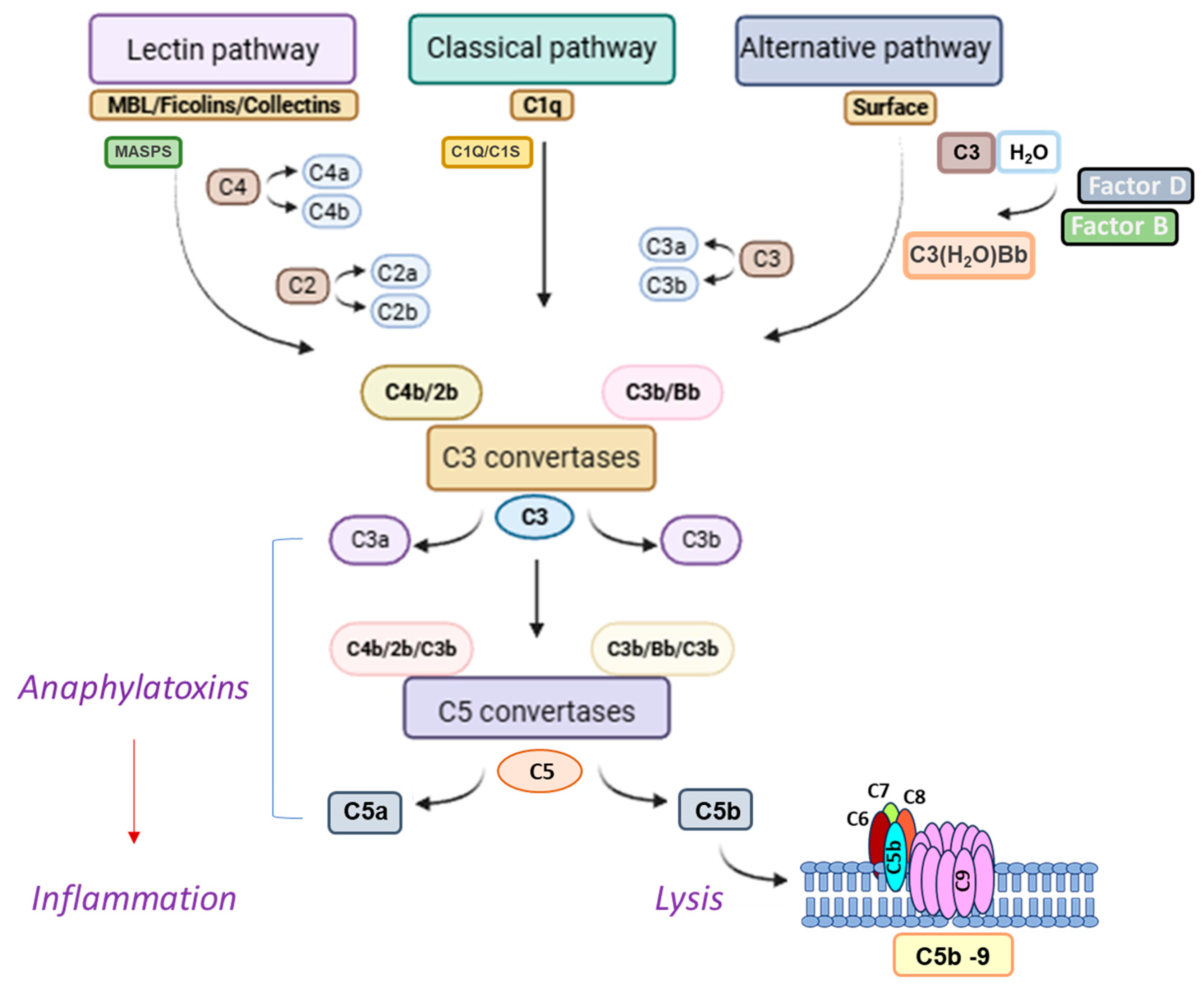
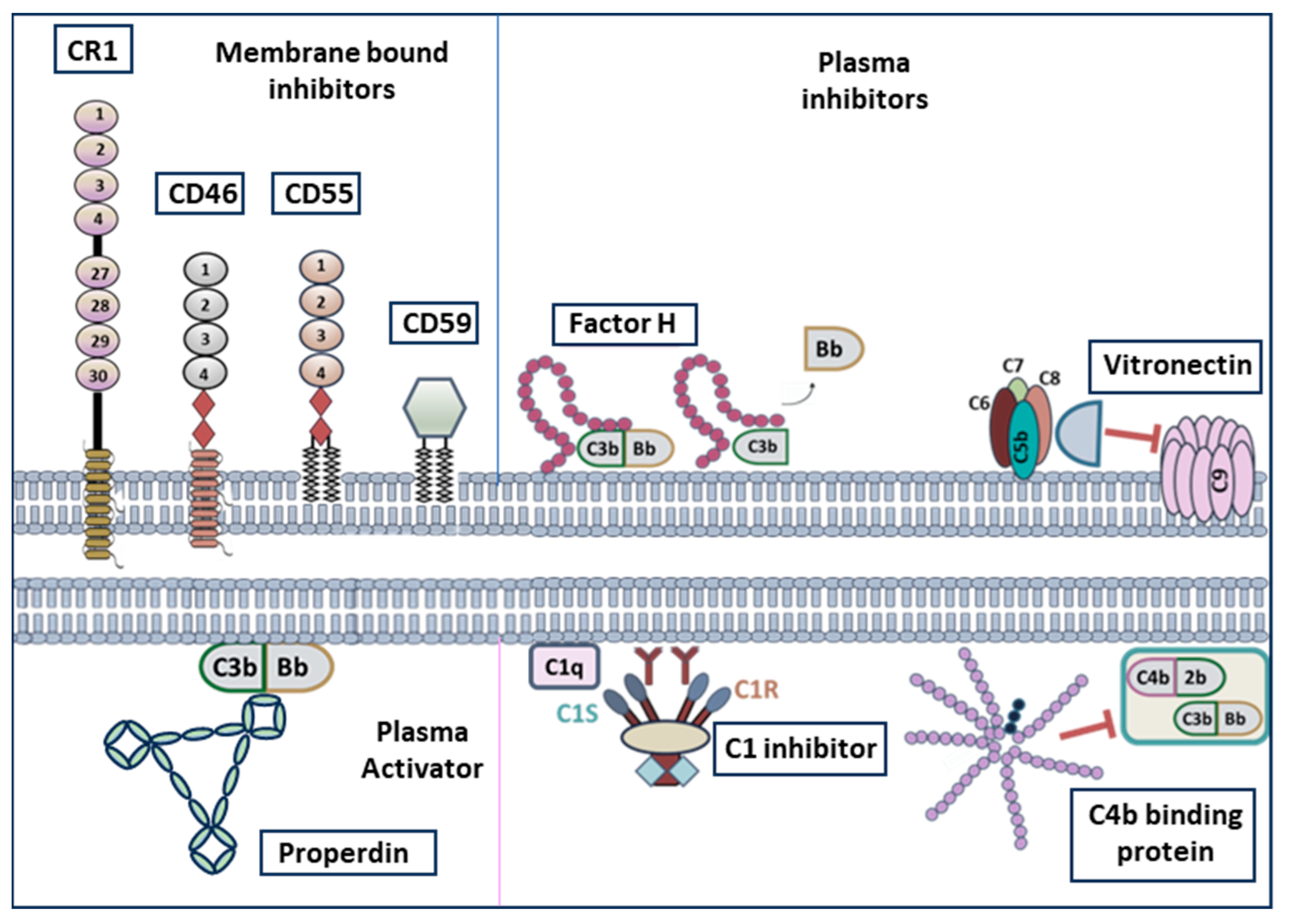

| Membrane Bound | Structure | Function | Reference |
|---|---|---|---|
| CR1 | Attachment via a transmembrane domain- 30 SCRs | Binds and deactivates C1r and C1s | Kim D.D et al., 2006 [14] |
| CD55 (Decay accelerating factor, DAF) | Attachment via a gpi anchor, 4 SCRs, serine–threonine-rich structure | Accelerates decay of C3 and C5 convertases | Lublin D.M. et al., 1989 [12] |
| CD46 (Membrane cofactor protein, MCP) | Attachment via transmembrane domain- 4 SCRs, serine–threonine-rich structure | Acts as a cofactor for factor I-mediated degradation of C3b and C4b | Kim D.D et al., 2006 [14] |
| CD59 | Attachment via a gpi anchor, extracellular domain with disulphide bond-linked amino acids | Prevents C5a binding and C5b-9 assembly | Podack E.R. et al., 1984 [16] |
| Plasma/circulating proteins | |||
| C1 inhibitor | Serine protease inhibitor (serpin) consists of 2 domains, a C-terminal serpin domain and a N-terminal non-serpin domain | Prevents C1s and C1r activation by binding to C1q | Davis A.E et al., 2010 [22] |
| C4b binding protein | 7 identical α-chains and one β-chain α-chain; 8 SCRs and a C-terminal oligomerization domain, β-chain; 3 SCRs and a C-terminal oligomerization domain | Facilitates C3 convertases dissociation | Rodriguez de Cordoba S. et al., 1991 [19] |
| Factor H | 20 SCRs | Binds the alternative pathway C3 convertase and facilitates its dissociation | Wu J. et al., 2009 [27] |
| Vitronectin | 75 kDa single chain, or 2 chains: (65 and 10 kDa) linked by a disulphide bond | Prevents C5b-9 assembly | Milis L. et al., 1993 [28] |
| Properdin (positive regulator) | Monomeric subunits structures, each containing 6 full TSRs | Stabilizes alternative pathway C3 convertase and promotes C3b and FB association for C3 convertases formation | Alcorlo M. et al., 2013 [29] |
| Component Altered | Complement Pathway Modulation | Reference | |
|---|---|---|---|
| Bacterial sepsis | |||
| C1q |  | Li H. et al., 2021 [32] | |
| C3 | | Eichenberger E. M. et al., 2020 [34] | |
| C3a |  | Bengtson A. et al., 1988 [36] | |
| C4 | | Eichenberger E. M. et al., 2020 [34] | |
| Properdin | | Stover C. M. et al., 2015 [43] | |
| MBL | | Chong Y. P. et al., 2014 [48] | |
| C5a | | Bengtson A. et al., 1988 [36] | |
| C5aR | | Furebring M. et al., 2002 [51] | |
| COVID-19 | |||
| C3a | | Alosaimi B. et al., 2021 [60] | |
| C5a | | Alosaimi B. et al., 2021 [60] | |
| C4d | | Sinkovitz G. et al., 2021 [63] | |
| sC5b9 | | Henry B.M. et al., 2021 [61] | |
| C5aR | | Carvelli J. et al., 2020 [64] | |
| CD55 | | Detsika M.G. et al., 2025 [67] | |
| C2, C5a, FB, FD | | de Andrande. V. L. et al., 2025 [65] | |
| Trauma | |||
| sC5b-9 | | Fosse E. et al., 1998 [97] | |
| C3bc | | Fosse E. et al., 1998 [97] | |
| C3 | | Zillow G. et al., 1992 [99] | |
| C3a | | Mannes M. et al., 2021 [96] | |
| C5a | | Burk A. M. et al., 2012 [98] | |
| C4 | | Zillow G. et al., 1992 [99] | |
| FH | | Zillow G. et al., 1992 [99] | |
| Factor I | | Zillow G. et al., 1992 [99] | |
| Burn | |||
| C3 | | Modi S. et al., 2014 [100] | |
| C3a | | Moran K. T. et al., 1987 [102] | |
| C5a | | Moran K. T. et al., 1987 [102] | |
| FB | | Wan K. C. et al., 1998 [103] |
: increase, : decrease.Disclaimer/Publisher’s Note: The statements, opinions and data contained in all publications are solely those of the individual author(s) and contributor(s) and not of MDPI and/or the editor(s). MDPI and/or the editor(s) disclaim responsibility for any injury to people or property resulting from any ideas, methods, instructions or products referred to in the content. |
© 2026 by the authors. Licensee MDPI, Basel, Switzerland. This article is an open access article distributed under the terms and conditions of the Creative Commons Attribution (CC BY) license.
Share and Cite
Ampelakiotou, K.; Nikitopoulou, I.; Kokkoris, S.; Kotanidou, A.; Dimopoulou, I.; Detsika, M.G. The Complement System in the Setting of Critical Illness—A Narrative Review. Biomolecules 2026, 16, 505. https://doi.org/10.3390/biom16040505
Ampelakiotou K, Nikitopoulou I, Kokkoris S, Kotanidou A, Dimopoulou I, Detsika MG. The Complement System in the Setting of Critical Illness—A Narrative Review. Biomolecules. 2026; 16(4):505. https://doi.org/10.3390/biom16040505
Chicago/Turabian StyleAmpelakiotou, Kleio, Ioanna Nikitopoulou, Stelios Kokkoris, Anastasia Kotanidou, Ioanna Dimopoulou, and Maria G. Detsika. 2026. "The Complement System in the Setting of Critical Illness—A Narrative Review" Biomolecules 16, no. 4: 505. https://doi.org/10.3390/biom16040505
APA StyleAmpelakiotou, K., Nikitopoulou, I., Kokkoris, S., Kotanidou, A., Dimopoulou, I., & Detsika, M. G. (2026). The Complement System in the Setting of Critical Illness—A Narrative Review. Biomolecules, 16(4), 505. https://doi.org/10.3390/biom16040505