Preeclampsia Is a Double-Hit Vascular Disorder: The VEGF-HO-1-CSE Axis


Abstract
1. Epidemiology and Clinical Burden
2. The Angiogenic Imbalance Model: From Hypothesis to Validation (Hit 1)
2.1. Placental VEGF Signalling
2.2. Hypoxia, HIF Signalling, and sFlt-1 Regulation

2.3. Soluble Endoglin Strengthens the Anti-Angiogenic State

| Year | Discovery | Explanation | References |
|---|---|---|---|
| 1993 | VEGF mRNA expression and localisation in human placenta. | VEGF mRNA localised to first trimester villous trophoblast, term extravillous trophoblast, foetal Hofbauer cells and maternal decidual cells, supporting placental and decidual VEGF expression during pregnancy. | [15] |
| 1994 | Discovery of VEGF receptor-1 (Flt-1) in placental trophoblast. | Molecular evidence that placental trophoblast expresses VEGF receptor 1 (Flt-1), indicating the capacity for VEGF-responsive signalling within placental tissue. | [14] |
| 1995 | VEGF–Flt-1 co-localisation in human placenta. | Co-localisation of VEGF protein and Flt-1 receptor in trophoblast, decidua and Hofbauer cells, supporting autocrine and paracrine VEGF signalling within the placenta. | [16] |
| 1996 | PlGF localisation in human placenta. | PlGF mRNA and protein localised in term human placenta with methodological detail and images, establishing PlGF as a placental ligand relevant to angiogenic balance. | [17] |
| 1997 | Loss of VEGF activity hypothesis in preeclampsia. | Proposed that preeclampsia arises from loss of VEGF bioactivity, plausibly mediated by endogenous soluble Flt-1. First explicit mechanistic hypothesis centred on VEGF antagonism. | [13] |
| 1998 | Human placenta produces and releases soluble VEGF receptor-1 (sFlt-1). | sFlt-1 mRNA demonstrated in trophoblast, villous explants release sFlt-1, and maternal serum contains a VEGF-binding protein consistent with sFlt-1, establishing placental source and release into the maternal circulation. | [18] |
| 2000 | Heme oxygenase-1 (HO-1) protective pathway in human placenta (first direct evidence). | HO-1 induction attenuates TNF-α-mediated cytotoxicity in human placental villous explants and causes carbon monoxide-dependent vasorelaxation; HO-1 protein is reduced in preeclamptic placenta, supporting HO-1 as an endogenous placental cytoprotective pathway in pregnancy. | [37] |
| 2001 | Functional imbalance (PlGF to sFlt-1 relationship). | Early evidence that lower PlGF to sFlt-1 relationship associates with worse biological outcomes, anticipating later ratio-based approaches. | [19] |
| 2003 | In vivo maternal causality (pregnant rats). | Systemic sFlt-1 in pregnant rats induces hypertension, proteinuria and glomerular endotheliosis; reduced free VEGF and PlGF and endothelial dysfunction are reversible with VEGF and PlGF. | [24] |
| 2004 | Human mechanistic causality. | Selective removal of sFlt-1 from preeclamptic placental conditioned medium restores angiogenesis ex vivo, providing direct human tissue evidence for sFlt-1 mediated angiogenic suppression. Direct human tissue proof of causality. | [26] |
| 2004 | Early clinical validation. | Rising sFlt-1 and falling free PlGF precede clinical preeclampsia, track severity, and fall postpartum, providing clinical evidence consistent with the angiogenic imbalance mechanism. Provided the first large clinical evidence for the angiogenic imbalance theory. | [23,27,28] |
| 2006 | Soluble endoglin (sEng) enters the preeclampsia model. | Circulating sEng is elevated before preeclampsia and, together with sFlt-1, intensifies endothelial dysfunction; the co-administration of sEng and sFlt-1 produces a more severe preeclampsia-like phenotype in pregnant animals, supporting synergistic anti-angiogenic drive. sFlt-1 plus sEng is a “high-toxicity” combination. | [35,36] |
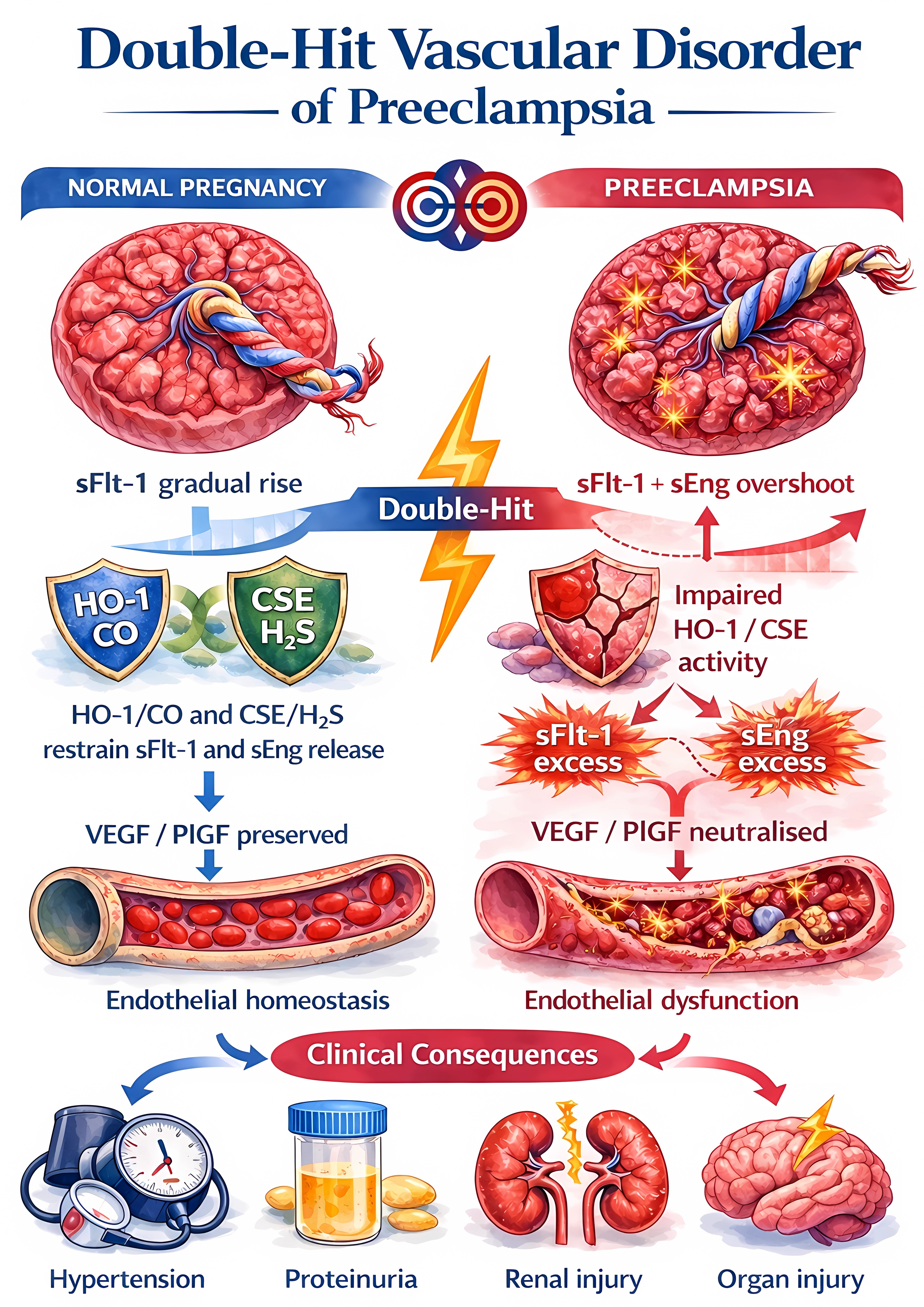
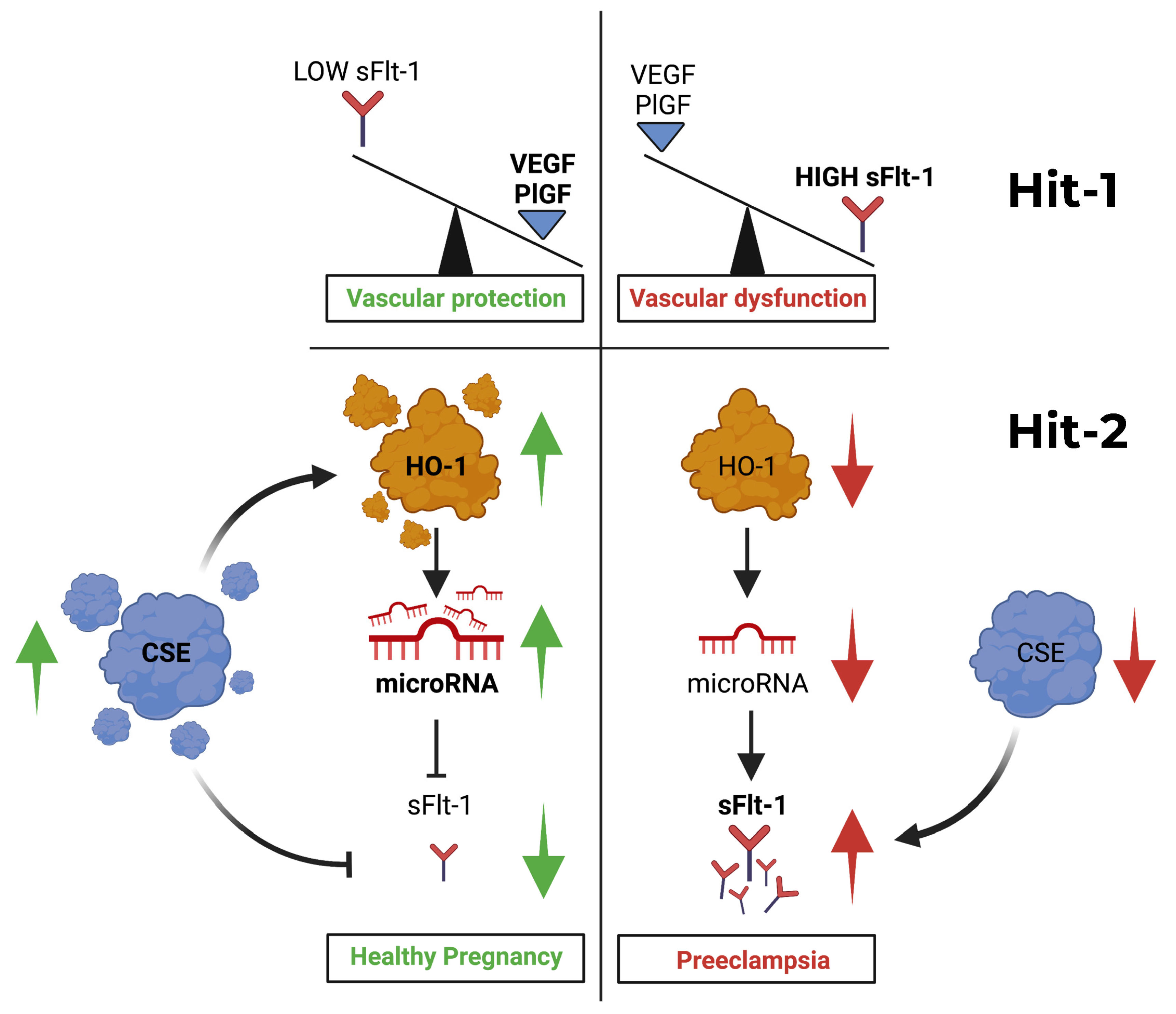
| 2007 | HO-1/CO protective brake. | Upregulation of HO-1 reduces sFlt-1 and sEng release; HO-1 deficiency increases both, identifying HO-1 as an endogenous pathway restraining anti-angiogenic factor release. | [29] |
| 2013 | CSE/(H2S) protective brake. | CSE is reduced in preeclampsia; CSE inhibition increases sFlt-1 and sEng, whereas an H2S donor reduces anti-angiogenic factors and improves foetal growth in mice. | [30] |
| 2016 | Clinical triage adoption (PROGNOSIS). | Multicentre validation of the sFlt-1 to PlGF ratio; a cut-off ≤38 reliably rules out preeclampsia within 1 week in women with suspected disease. | [38] |
| 2019 | Real world effectiveness and implementation: PARROT trial. | Subsequent analyses extended rule out to up to 4 weeks and informed retesting strategies. A randomised trial of PlGF-based testing in UK maternity units showed a shorter time to diagnosis and reduced severe maternal adverse outcomes. | [39,40] |
| 2020–2021 | Oral small molecule therapy development (MZe786). | In refined mouse RUPP models, MZe786 lowers sFlt-1, reduces MAP and oxidative stress, and improves foetal outcomes. In an HO-1-compromised, high-sFlt-1 pregnancy model, MZe786 reduces circulating sFlt-1 and sEng, whereas aspirin does not, with improved maternal and foetal outcomes across complementary models. | [31,32] |
| 2025–2026 | Translational/Developmental. | M-PREG® is a clinical decision support system for risk stratification in suspected preeclampsia. In parallel, GMP grade manufacturing and the formulation of MZe786 have been completed, and IND submission is in preparation. |
2.4. Heme Oxygenase-1: A Master Cytoprotective Brake
2.5. Nitric Oxide Bioavailability as a Convergent Downstream Effector
2.6. Aspirin Prophylaxis: Mechanistic Alignment and Limitations
2.7. Conceptual Evolution: From Protective Pathways to the Double Hit Model
3. Failure of Cytoprotective Brakes Amplifies Disease (Hit 2)
3.1. Cytoprotective Pathways: HO-1/CO and CSE/H2S
3.2. HO-1 Promoter Activity and Genetic Vulnerability
3.3. From Mechanism to Medicine: Translational Implications of Restoring the HO-1/CSE Axis
3.4. Validating the Axis: Recent Advances in Therapeutics and Subphenotyping
3.5. Therapeutic Validation Targeting the Axis
- •
- Direct sFlt-1 Removal: Building on the finding that immunodepleting of sFlt-1 restores angiogenesis ex vivo [26], dextran sulphate apheresis has been explored as a strategy to reduce circulating sFlt-1 in severe, early-onset preeclampsia, with reports of gestational prolongation providing in vivo human proof-of-concept [34]. However, because apheresis is not molecularly selective, the concomitant depletion of other circulating proteins cannot be excluded and could contribute to observed effects.
- •
- Restoring the Protective Brakes: The oral H2S-donor MZe786 represents a mechanism-informed approach targeting Hit 2. In complementary preclinical models, including a genetic model of HO-1 deficiency, MZe786 consistently reduces sEng, improves maternal hemodynamics, and, critically, improves foetal growth [31]. This validates the core therapeutic strategy of brake restoration.
3.6. Subphenotyping and the Double-Hit Clinical Spectrum
3.7. Linking to Long-Term Cardiovascular Risk
4. From Biomarkers to Bedside Pathways: Short Term Triage and Real-World Implementation
5. M-PREG®: Clinical Decision Support for Risk Stratification
6. Towards Prediction and Prevention of Preeclampsia
- MZe786 is an orally active drug that stimulates the CSE and H2S pathway, restores angiogenic balance (a healthy balance for blood vessel growth factors), and protects maternal blood vessels. In preclinical studies, it has been shown to reduce sFlt-1, improve blood vessel function, and prevent the clinical features of preeclampsia in three separate animal models.
- M-PREG® is a UKCA-marked digital medical device for Great Britain. It uses angiogenic biomarkers (including sFlt-1 and PlGF) combined with an algorithmic analysis of routinely available laboratory measures, including bilirubin as a surrogate of HO-1 pathway activity, together with selected electrolyte and liver function parameters, to aid clinicians in risk stratifying women with suspected preeclampsia and identifying those at highest risk of deterioration within a stratified care pathway. UKCA marking indicates conformity with applicable UK medical device regulatory requirements; certification is issued by a UK Approved Body (where required) and the device is registered with the MHRA.
7. Conclusions and Future Directions
Author Contributions
Funding
Institutional Review Board Statement
Informed Consent Statement
Data Availability Statement
Acknowledgments
Conflicts of Interest
References
- MacDorman, M.F.; Thoma, M.; Declcerq, E.; Howell, E.A. Racial and Ethnic Disparities in Maternal Mortality in the United States Using Enhanced Vital Records, 2016–2017. Am. J. Public Health 2021, 111, 1673–1681. [Google Scholar] [CrossRef] [PubMed]
- Grandi, S.M.; Filion, K.B.; Yoon, S.; Ayele, H.T.; Doyle, C.M.; Hutcheon, J.A.; Smith, G.N.; Gore, G.C.; Ray, J.G.; Nerenberg, K.; et al. Cardiovascular Disease-Related Morbidity and Mortality in Women with a History of Pregnancy Complications. Circulation 2019, 139, 1069–1079. [Google Scholar] [CrossRef] [PubMed]
- Pijnenborg, R.; Vercruysse, L.; Hanssens, M. The uterine spiral arteries in human pregnancy: Facts and controversies. Placenta 2006, 27, 939–958. [Google Scholar] [CrossRef]
- Fisher, S.J. Why is placentation abnormal in preeclampsia? Am. J. Obstet. Gynecol. 2015, 213, S115–S122. [Google Scholar] [CrossRef]
- Lynch, A.M.; Salmon, J.E. Dysregulated complement activation as a common pathway of injury in preeclampsia and other pregnancy complications. Placenta 2010, 31, 561–567. [Google Scholar] [CrossRef] [PubMed]
- Burwick, R.M.; Java, A.; Regal, J.F. The role of complement in normal pregnancy and preeclampsia. Front. Immunol. 2025, 16, 1643896. [Google Scholar] [CrossRef]
- Redman, C.W.; Sargent, I.L. Pre-eclampsia, the placenta and the maternal systemic inflammatory response—A review. Placenta 2003, 24, S21–S27. [Google Scholar] [CrossRef]
- Redman, C.W.; Sargent, I.L. Placental stress and pre-eclampsia: A revised view. Placenta 2009, 30, S38–S42. [Google Scholar] [CrossRef]
- Wallukat, G.; Homuth, V.; Fischer, T.; Lindschau, C.; Horstkamp, B.; Jupner, A.; Baur, E.; Nissen, E.; Vetter, K.; Neichel, D.; et al. Patients with preeclampsia develop agonistic autoantibodies against the angiotensin AT1 receptor. J. Clin. Investig. 1999, 103, 945–952. [Google Scholar] [CrossRef]
- Hubel, C.A.; Wallukat, G.; Wolf, M.; Herse, F.; Rajakumar, A.; Roberts, J.M.; Markovic, N.; Thadhani, R.; Luft, F.C.; Dechend, R. Agonistic angiotensin II type 1 receptor autoantibodies in postpartum women with a history of preeclampsia. Hypertension 2007, 49, 612–617. [Google Scholar] [CrossRef]
- Dechend, R.; Homuth, V.; Wallukat, G.; Muller, D.N.; Krause, M.; Dudenhausen, J.; Haller, H.; Luft, F.C. Agonistic antibodies directed at the angiotensin II, AT1 receptor in preeclampsia. J. Soc. Gynecol. Investig. 2006, 13, 79–86. [Google Scholar] [CrossRef]
- Irani, R.A.; Xia, Y. Renin angiotensin signaling in normal pregnancy and preeclampsia. Semin. Nephrol. 2011, 31, 47–58. [Google Scholar] [CrossRef]
- Ahmed, A. Heparin-binding angiogenic growth factors in pregnancy. Placenta 1997, 10, 215–258. [Google Scholar] [CrossRef]
- Charnock-Jones, D.S.; Sharkey, A.M.; Boocock, C.A.; Ahmed, A.; Plevin, R.; Ferrara, N.; Smith, S.K. Vascular endothelial growth factor receptor localization and activation in human trophoblast and choriocarcinoma cells. Biol. Reprod. 1994, 51, 524–530. [Google Scholar] [CrossRef]
- Sharkey, A.M.; Charnock-Jones, D.S.; Boocock, C.A.; Brown, K.D.; Smith, S.K. Expression of mRNA for vascular endothelial growth factor in human placenta. Reproduction 1993, 99, 609–615. [Google Scholar] [CrossRef] [PubMed]
- Ahmed, A.; Li, X.F.; Dunk, C.; Whittle, M.J.; Rushton, D.I.; Rollason, T. Colocalisation of vascular endothelial growth factor and its Flt-1 receptor in human placenta. Growth Factors 1995, 12, 235–243. [Google Scholar] [CrossRef]
- Khaliq, A.; Li, X.F.; Shams, M.; Sisi, P.; Acevedo, C.A.; Whittle, M.J.; Weich, H.; Ahmed, A. Localisation of placenta growth factor (PIGF) in human term placenta. Growth Factors 1996, 13, 243–250. [Google Scholar] [CrossRef] [PubMed]
- Clark, D.E.; Smith, S.K.; He, Y.; Day, K.A.; Licence, D.R.; Corps, A.N.; Lammoglia, R.; Charnock-Jones, D.S. A vascular endothelial growth factor antagonist is produced by the human placenta and released into the maternal circulation. Biol. Reprod. 1998, 59, 1540–1548. [Google Scholar] [CrossRef] [PubMed]
- Ahmad, S.; Ahmed, A. Regulation of soluble VEGFR-1 by VEGF and oxygen and its elevation in pre-eclampsia and fetal growth restriction. Placenta 2001, 22, A.7. [Google Scholar]
- Gerber, H.P.; Condorelli, F.; Park, J.; Ferrara, N. Differential transcriptional regulation of the two vascular endothelial growth factor receptor genes. Flt-1, but not Flk-1/KDR, is up-regulated by hypoxia. J. Biol. Chem. 1997, 272, 23659–23667. [Google Scholar] [CrossRef]
- Sasagawa, T.; Nagamatsu, T.; Morita, K.; Mimura, N.; Iriyama, T.; Fujii, T.; Shibuya, M. HIF-2alpha, but not HIF-1alpha, mediates hypoxia-induced up-regulation of Flt-1 gene expression in placental trophoblasts. Sci. Rep. 2018, 8, 17375. [Google Scholar] [CrossRef]
- Nevo, O.; Soleymanlou, N.; Wu, Y.; Xu, J.; Kingdom, J.; Many, A.; Zamudio, S.; Caniggia, I. Increased expression of sFlt-1 in in vivo and in vitro models of human placental hypoxia is mediated by HIF-1. Am. J. Physiol. Regul. Integr. Comp. Physiol. 2006, 291, R1085–R1093. [Google Scholar] [CrossRef]
- Levine, R.J.; Maynard, S.E.; Qian, C.; Lim, K.H.; England, L.J.; Yu, K.F.; Schisterman, E.F.; Thadhani, R.; Sachs, B.P.; Epstein, F.H.; et al. Circulating angiogenic factors and the risk of preeclampsia. N. Engl. J. Med. 2004, 350, 672–683. [Google Scholar] [CrossRef]
- Maynard, S.E.; Min, J.Y.; Merchan, J.; Lim, K.H.; Li, J.; Mondal, S.; Libermann, T.A.; Morgan, J.P.; Sellke, F.W.; Stillman, I.E.; et al. Excess placental soluble fms-like tyrosine kinase 1 (sFlt1) may contribute to endothelial dysfunction, hypertension, and proteinuria in preeclampsia. J. Clin. Investig. 2003, 111, 649–658. [Google Scholar] [CrossRef]
- Ikeda, T.; Yoshitomi, Y.; Saito, H.; Shimasaki, T.; Yamaya, H.; Kobata, T.; Ishigaki, Y.; Tomosugi, N.; Yoshitake, Y.; Yonekura, H. Regulation of soluble Flt-1 (VEGFR-1) production by hnRNP D and protein arginine methylation. Mol. Cell. Biochem. 2016, 413, 155–164. [Google Scholar] [CrossRef] [PubMed]
- Ahmad, S.; Ahmed, A. Elevated placental soluble vascular endothelial growth factor receptor-1 inhibits angiogenesis in preeclampsia. Circ. Res. 2004, 95, 884–891. [Google Scholar] [CrossRef] [PubMed]
- Thadhani, R.; Mutter, W.P.; Wolf, M.; Levine, R.J.; Taylor, R.N.; Sukhatme, V.P.; Ecker, J.; Karumanchi, S.A. First trimester placental growth factor and soluble fms-like tyrosine kinase 1 and risk for preeclampsia. J. Clin. Endocrinol. Metab. 2004, 89, 770–775. [Google Scholar] [CrossRef]
- McKeeman, G.C.; Ardill, J.E.; Caldwell, C.M.; Hunter, A.J.; McClure, N. Soluble vascular endothelial growth factor receptor-1 (sFlt-1) is increased throughout gestation in patients who have preeclampsia develop. Am. J. Obstet. Gynecol. 2004, 191, 1240–1246. [Google Scholar] [CrossRef]
- Cudmore, M.; Ahmad, S.; Al-Ani, B.; Fujisawa, T.; Coxall, H.; Chudasama, K.; Devey, L.R.; Wigmore, S.J.; Abbas, A.; Hewett, P.W.; et al. Negative regulation of soluble Flt-1 and soluble endoglin release by heme oxygenase-1. Circulation 2007, 115, 1789–1797. [Google Scholar] [CrossRef]
- Wang, K.; Ahmad, S.; Cai, M.; Rennie, J.; Fujisawa, T.; Crispi, F.; Baily, J.; Miller, M.R.; Cudmore, M.; Hadoke, P.W.; et al. Dysregulation of hydrogen sulfide producing enzyme cystathionine gamma-lyase contributes to maternal hypertension and placental abnormalities in preeclampsia. Circulation 2013, 127, 2514–2522. [Google Scholar] [CrossRef]
- Saif, J.; Ahmad, S.; Rezai, H.; Litvinova, K.; Sparatore, A.; Alzahrani, F.A.; Wang, K.; Ahmed, A. Hydrogen sulfide releasing molecule MZe786 inhibits soluble Flt-1 and prevents preeclampsia in a refined RUPP mouse model. Redox Biol. 2021, 38, 101814. [Google Scholar] [CrossRef]
- Rezai, H.; Ahmad, S.; Alzahrani, F.A.; Sanchez-Aranguren, L.; Dias, I.H.; Agrawal, S.; Sparatore, A.; Wang, K.; Ahmed, A. MZe786, a hydrogen sulfide-releasing aspirin prevents preeclampsia in heme oxygenase-1 haplodeficient pregnancy under high soluble flt-1 environment. Redox Biol. 2021, 38, 101768. [Google Scholar] [CrossRef]
- Thadhani, R.; Kisner, T.; Hagmann, H.; Bossung, V.; Noack, S.; Schaarschmidt, W.; Jank, A.; Kribs, A.; Cornely, O.A.; Kreyssig, C.; et al. Pilot study of extracorporeal removal of soluble fms-like tyrosine kinase 1 in preeclampsia. Circulation 2011, 124, 940–950. [Google Scholar] [CrossRef]
- Thadhani, R.; Hagmann, H.; Schaarschmidt, W.; Roth, B.; Cingoez, T.; Karumanchi, S.A.; Wenger, J.; Lucchesi, K.J.; Tamez, H.; Lindner, T.; et al. Removal of Soluble Fms-Like Tyrosine Kinase-1 by Dextran Sulfate Apheresis in Preeclampsia. J. Am. Soc. Nephrol. 2016, 27, 903–913. [Google Scholar] [CrossRef]
- Venkatesha, S.; Toporsian, M.; Lam, C.; Hanai, J.; Mammoto, T.; Kim, Y.M.; Bdolah, Y.; Lim, K.H.; Yuan, H.T.; Libermann, T.A.; et al. Soluble endoglin contributes to the pathogenesis of preeclampsia. Nat. Med. 2006, 12, 642–649. [Google Scholar] [CrossRef]
- Levine, R.J.; Lam, C.; Qian, C.; Yu, K.F.; Maynard, S.E.; Sachs, B.P.; Sibai, B.M.; Epstein, F.H.; Romero, R.; Thadhani, R.; et al. Soluble endoglin and other circulating antiangiogenic factors in preeclampsia. N. Engl. J. Med. 2006, 355, 992–1005. [Google Scholar] [CrossRef]
- Ahmed, A.; Rahman, M.; Zhang, X.; Acevedo, C.H.; Nijjar, S.; Rushton, I.; Bussolati, B.; St John, J. Induction of placental heme oxygenase-1 is protective against TNFalpha-induced cytotoxicity and promotes vessel relaxation. Mol. Med. 2000, 6, 391–409. [Google Scholar] [CrossRef]
- Zeisler, H.; Llurba, E.; Chantraine, F.; Vatish, M.; Staff, A.C.; Sennstrom, M.; Olovsson, M.; Brennecke, S.P.; Stepan, H.; Allegranza, D.; et al. Predictive Value of the sFlt-1:PlGF Ratio in Women with Suspected Preeclampsia. N. Engl. J. Med. 2016, 374, 13–22. [Google Scholar] [CrossRef] [PubMed]
- Zeisler, H.; Llurba, E.; Chantraine, F.J.; Vatish, M.; Staff, A.C.; Sennstrom, M.; Olovsson, M.; Brennecke, S.P.; Stepan, H.; Allegranza, D.; et al. Soluble fms-like tyrosine kinase-1 to placental growth factor ratio: Ruling out pre-eclampsia for up to 4 weeks and value of retesting. Ultrasound Obstet. Gynecol. 2019, 53, 367–375. [Google Scholar] [CrossRef]
- Duhig, K.E.; Myers, J.; Seed, P.T.; Sparkes, J.; Lowe, J.; Hunter, R.M.; Shennan, A.H.; Chappell, L.C.; Bahl, R.; Bambridge, G.; et al. Placental growth factor testing to assess women with suspected pre-eclampsia: A multicentre, pragmatic, stepped-wedge cluster-randomised controlled trial. Lancet 2019, 393, 1807–1818. [Google Scholar] [CrossRef]
- Baranano, D.E.; Rao, M.; Ferris, C.D.; Snyder, S.H. Biliverdin reductase: A major physiologic cytoprotectant. Proc. Natl. Acad. Sci. USA 2002, 99, 16093–16098. [Google Scholar] [CrossRef] [PubMed]
- Lerner-Marmarosh, N.; Miralem, T.; Gibbs, P.E.; Maines, M.D. Human biliverdin reductase is an ERK activator; hBVR is an ERK nuclear transporter and is required for MAPK signaling. Proc. Natl. Acad. Sci. USA 2008, 105, 6870–6875. [Google Scholar] [CrossRef]
- Park, C.; Alahari, S.; Ausman, J.; Liu, R.; Nguyen, F.; Sallais, J.; Post, M.; Caniggia, I. Placental Hypoxia-Induced Ferroptosis Drives Vascular Damage in Preeclampsia. Circ. Res. 2025, 136, 361–378. [Google Scholar] [CrossRef]
- Zhang, Y.; Lu, Y.; Jin, L. Iron Metabolism and Ferroptosis in Physiological and Pathological Pregnancy. Int. J. Mol. Sci. 2022, 23, 9395. [Google Scholar] [CrossRef]
- Kaartokallio, T.; Klemetti, M.M.; Timonen, A.; Uotila, J.; Heinonen, S.; Kajantie, E.; Kere, J.; Kivinen, K.; Pouta, A.; Lakkisto, P.; et al. Microsatellite polymorphism in the heme oxygenase-1 promoter is associated with nonsevere and late-onset preeclampsia. Hypertension 2014, 64, 172–177. [Google Scholar] [CrossRef]
- Ahmed, A.; Dunk, C.; Kniss, D.; Wilkes, M. Role of VEGF receptor-1 (Flt-1) in mediating calcium-dependent nitric oxide release and limiting DNA synthesis in human trophoblast cells. Lab. Investig. 1997, 76, 779–791. [Google Scholar]
- Bussolati, B.; Dunk, C.; Grohman, M.; Kontos, C.D.; Mason, J.; Ahmed, A. Vascular endothelial growth factor receptor-1 modulates vascular endothelial growth factor-mediated angiogenesis via nitric oxide. Am. J. Pathol. 2001, 159, 993–1008. [Google Scholar] [CrossRef]
- Choi, Y.K.; Kim, Y.M. Regulation of Endothelial and Vascular Functions by Carbon Monoxide via Crosstalk with Nitric Oxide. Front. Cardiovasc. Med. 2021, 8, 649630. [Google Scholar] [CrossRef]
- Szijarto, I.A.; Marko, L.; Filipovic, M.R.; Miljkovic, J.L.; Tabeling, C.; Tsvetkov, D.; Wang, N.; Rabelo, L.A.; Witzenrath, M.; Diedrich, A.; et al. Cystathionine gamma-Lyase-Produced Hydrogen Sulfide Controls Endothelial NO Bioavailability and Blood Pressure. Hypertension 2018, 71, 1210–1217. [Google Scholar] [CrossRef] [PubMed]
- Guerby, P.; Tasta, O.; Swiader, A.; Pont, F.; Bujold, E.; Parant, O.; Vayssiere, C.; Salvayre, R.; Negre-Salvayre, A. Role of oxidative stress in the dysfunction of the placental endothelial nitric oxide synthase in preeclampsia. Redox Biol. 2021, 40, 101861. [Google Scholar] [CrossRef] [PubMed]
- Kaihara, J.N.S.; Minami, C.K.; Peracoli, M.T.S.; Romao-Veiga, M.; Ribeiro-Vasques, V.R.; Peracoli, J.C.; Palei, A.C.T.; Cavalli, R.C.; Nunes, P.R.; Luizon, M.R.; et al. Plasma eNOS Concentration in Healthy Pregnancy and in Hypertensive Disorders of Pregnancy: Evidence of Reduced Concentrations in Pre-Eclampsia from Two Independent Studies. Diseases 2023, 11, 155. [Google Scholar] [CrossRef]
- Huang, S.; Zhang, Y.; Guo, Y.; Zhang, Y.; Huang, J.; Yang, Y.; Qi, Q.; Zhao, L.; Xu, X.; Shen, Y.; et al. Constructing a Preeclampsia Organoid Model to Elucidate the Mechanism of Aspirin. Hypertension 2025, 82, e171–e185. [Google Scholar] [CrossRef]
- Rolnik, D.L.; Wright, D.; Poon, L.C.; O’Gorman, N.; Syngelaki, A.; de Paco Matallana, C.; Akolekar, R.; Cicero, S.; Janga, D.; Singh, M.; et al. Aspirin versus Placebo in Pregnancies at High Risk for Preterm Preeclampsia. N. Engl. J. Med. 2017, 377, 613–622. [Google Scholar] [CrossRef]
- Henderson, J.T.; Vesco, K.K.; Senger, C.A.; Thomas, R.G.; Redmond, N. Aspirin Use to Prevent Preeclampsia and Related Morbidity and Mortality: Updated Evidence Report and Systematic Review for the US Preventive Services Task Force. JAMA 2021, 326, 1192–1206. [Google Scholar] [CrossRef] [PubMed]
- Henderson, J.T.; Whitlock, E.P.; O’Connor, E.; Senger, C.A.; Thompson, J.H.; Rowland, M.G. Low-dose aspirin for prevention of morbidity and mortality from preeclampsia: A systematic evidence review for the U.S. Preventive Services Task Force. Ann. Intern. Med. 2014, 160, 695–703. [Google Scholar] [CrossRef]
- Roberge, S.; Bujold, E.; Nicolaides, K.H. Meta-analysis on the effect of aspirin use for prevention of preeclampsia on placental abruption and antepartum hemorrhage. Am. J. Obstet. Gynecol. 2018, 218, 483–489. [Google Scholar] [CrossRef] [PubMed]
- Ghesquiere, L.; Guerby, P.; Marchant, I.; Kumar, N.; Zare, M.; Foisy, M.A.; Roberge, S.; Bujold, E. Comparing aspirin 75 to 81 mg vs 150 to 162 mg for prevention of preterm preeclampsia: Systematic review and meta-analysis. Am. J. Obstet. Gynecol. MFM 2023, 5, 101000. [Google Scholar] [CrossRef] [PubMed]
- Ngwira, M.M.; Makris, A.; Shanmugalingam, R.; Mbotwa, J.L.; Mayani, J.; Gadama, L.A.; Hennessy, A. Calcium Aspirin Preeclampsia Early Prevention and Response (CASPER) Trial in Blantyre, Malawi: A Double-Blinded Cluster Randomized Trial. Hypertension 2025, 82, 1316–1325. [Google Scholar] [CrossRef]
- Ahmed, A. New insights into the etiology of preeclampsia: Identification of key elusive factors for the vascular complications. Thromb. Res. 2011, 127, S72–S75. [Google Scholar] [CrossRef]
- Ramma, W.; Ahmed, A. Is inflammation the cause of pre-eclampsia? Biochem. Soc. Trans. 2011, 39, 1619–1627. [Google Scholar] [CrossRef]
- Kaartokallio, T.; Utge, S.; Klemetti, M.M.; Paananen, J.; Pulkki, K.; Romppanen, J.; Tikkanen, I.; Heinonen, S.; Kajantie, E.; Kere, J.; et al. Fetal Microsatellite in the Heme Oxygenase 1 Promoter Is Associated with Severe and Early-Onset Preeclampsia. Hypertension 2018, 71, 95–102. [Google Scholar] [CrossRef]
- Yang, J.; Pearl, M.; DeLorenze, G.N.; Romero, R.; Dong, Z.; Jelliffe-Pawlowski, L.; Currier, R.; Flessel, M.; Kharrazi, M. Racial-ethnic differences in midtrimester maternal serum levels of angiogenic and antiangiogenic factors. Am. J. Obstet. Gynecol. 2016, 215, 359.e1–359.e9. [Google Scholar] [CrossRef]
- Wright, A.; von Dadelszen, P.; Magee, L.A.; Syngelaki, A.; Akolekar, R.; Wright, D.; Nicolaides, K.H. Effect of race on the measurement of angiogenic factors for prediction and diagnosis of pre-eclampsia. BJOG 2023, 130, 78–87. [Google Scholar] [CrossRef] [PubMed]
- Saad, A.F.; Haas, D.M.; Chang, E.; Shainker, S.A.; Denbo, M.; Silasi, M.; Saade, G.; Rana, S.; Kawakita, T.; Pacheco, L.D.; et al. Reference Range Determination for the sFlt-1/PlGF Ratio in a Diverse Cohort of Pregnant Women in the United States. J. Appl. Lab. Med. 2025, 10, 937–948. [Google Scholar] [CrossRef]
- Sun, T.; Cruz, G.I.; Mousavi, N.; Maric, I.; Brewer, A.; Wong, R.J.; Aghaeepour, N.; Sayed, N.; Wu, J.C.; Stevenson, D.K.; et al. HMOX1 Genetic Polymorphisms Display Ancestral Diversity and May Be Linked to Hypertensive Disorders in Pregnancy. Reprod. Sci. 2022, 29, 3465–3476. [Google Scholar] [CrossRef]
- Schmaier, A.H. The kallikrein-kinin and the renin-angiotensin systems have a multilayered interaction. Am. J. Physiol. Regul. Integr. Comp. Physiol. 2003, 285, R1–R13. [Google Scholar] [CrossRef]
- Kakoki, M.; Smithies, O. The kallikrein-kinin system in health and in diseases of the kidney. Kidney Int. 2009, 75, 1019–1030. [Google Scholar] [CrossRef]
- Cluver, C.A.; Thake, J.; Hassim, T.; van Greunen, A.; Budhram, S.; Knipe, K.; Decloedt, E.; Brink, L.; Langenegger, E.; Bergman, L.; et al. Safety and potential efficacy of DM199, a tissue kallikrein-1 analogue, for treating pre-eclampsia and fetal growth restriction: Study protocol for a South African, hospital-based phase I/II open-label trial. BMJ Open 2025, 15, e104035. [Google Scholar] [CrossRef]
- ClinicalTrial.org. DM199 for Pregnancy Complications. 2025, NCT06875141. Available online: https://clinicaltrials.gov/study/NCT06875141 (accessed on 5 March 2026).
- Wu, P.; Haththotuwa, R.; Kwok, C.S.; Babu, A.; Kotronias, R.A.; Rushton, C.; Zaman, A.; Fryer, A.A.; Kadam, U.; Chew-Graham, C.A.; et al. Preeclampsia and Future Cardiovascular Health: A Systematic Review and Meta-Analysis. Circ. Cardiovasc. Qual. Outcomes 2017, 10, e003497. [Google Scholar] [CrossRef]
- Unitaid. Commodity and Service Delivery Innovations for Detection and Management of Pre-Eclampsia: Landscape Report; Unitaid: Geneva, Switzerland, 2024. [Google Scholar]
| Characteristic | Oral Small-Molecule Pathway Modulator | siRNA/Oligonucleotide Targeting sFlt-1 | Recombinant Biologic Protein Therapy |
|---|---|---|---|
| Primary mechanistic level | Upstream modulation of cytoprotective signalling with downstream reduction in anti-angiogenic drive | Direct suppression of sFlt-1 production at mRNA level | Augmentation of endogenous vasoactive or endothelial-protective protein pathways |
| Target specificity | Pathway-level modulation affecting multiple redox and angiogenic regulators | Highly specific transcript-level inhibition of FLT1 | Protein-level receptor or enzymatic pathway activation |
| Route of administration | Oral | Parenteral (typically subcutaneous or intravenous) | Parenteral (intravenous or subcutaneous) |
| Pharmacokinetics | Small molecule distribution; potential for sustained systemic exposure | Dependent on delivery vehicle (e.g. lipid nanoparticle); transient effect; repeat dosing required | Protein half-life dependent; may require repeated monitored dosing |
| Placental transfer considerations | Molecular weight dependent; requires evaluation | Limited placental transfer expected but requires confirmation | Large protein structure; placental transfer generally low but requires evaluation |
| Manufacturing complexity | Chemical synthesis; scalable small molecule production | Complex oligonucleotide synthesis and nanoparticle formulation | Recombinant protein production, purification, and cold-chain stability |
| Iron/redox interface | Directly influences redox buffering and iron handling via HO-1 induction and antioxidant pathways | Indirect; reduces angiogenic stress but does not directly regulate iron metabolism | Mechanism dependent; may improve endothelial function without directly modifying iron homeostasis |
| Effect on ferroptotic susceptibility | Potential modulation via enhanced antioxidant buffering and reduced labile iron stress | Reduction in upstream angiogenic stress; ferroptosis effects indirect | Primarily vascular signalling effects; ferroptosis impact unclear |
| Clinical positioning | Suitable for prevention or early-intervention strategies in targeted high-risk populations | Potentially suited for treatment of severe cases in hospital | Likely to be suited for stabilisation in established disease |
| Health-system deployment considerations | Potential outpatient administration | Requires monitored administration and specialised handling | Typically requires supervised administration and logistics infrastructure |
| Integration with risk stratification tools | Compatible with longitudinal preventive use in biomarker-defined populations | Likely requires biomarker enrichment to optimise responder identification | May benefit from diagnostic enrichment to demonstrate rapid clinical impact |
Disclaimer/Publisher’s Note: The statements, opinions and data contained in all publications are solely those of the individual author(s) and contributor(s) and not of MDPI and/or the editor(s). MDPI and/or the editor(s) disclaim responsibility for any injury to people or property resulting from any ideas, methods, instructions or products referred to in the content. |
© 2026 by the authors. Licensee MDPI, Basel, Switzerland. This article is an open access article distributed under the terms and conditions of the Creative Commons Attribution (CC BY) license.
Share and Cite
Ahmed, A.; Smith, S.K.; Ahmad, S.; Wang, K. Preeclampsia Is a Double-Hit Vascular Disorder: The VEGF-HO-1-CSE Axis. Biomolecules 2026, 16, 436. https://doi.org/10.3390/biom16030436
Ahmed A, Smith SK, Ahmad S, Wang K. Preeclampsia Is a Double-Hit Vascular Disorder: The VEGF-HO-1-CSE Axis. Biomolecules. 2026; 16(3):436. https://doi.org/10.3390/biom16030436
Chicago/Turabian StyleAhmed, Asif, Stephen K. Smith, Shakil Ahmad, and Keqing Wang. 2026. "Preeclampsia Is a Double-Hit Vascular Disorder: The VEGF-HO-1-CSE Axis" Biomolecules 16, no. 3: 436. https://doi.org/10.3390/biom16030436
APA StyleAhmed, A., Smith, S. K., Ahmad, S., & Wang, K. (2026). Preeclampsia Is a Double-Hit Vascular Disorder: The VEGF-HO-1-CSE Axis. Biomolecules, 16(3), 436. https://doi.org/10.3390/biom16030436