Challenges and Opportunities in Multi-Omics Data Acquisition and Analysis: Toward Integrative Solutions



Abstract
1. Introduction
2. Defining Multi-Omics and Its Core Study Types
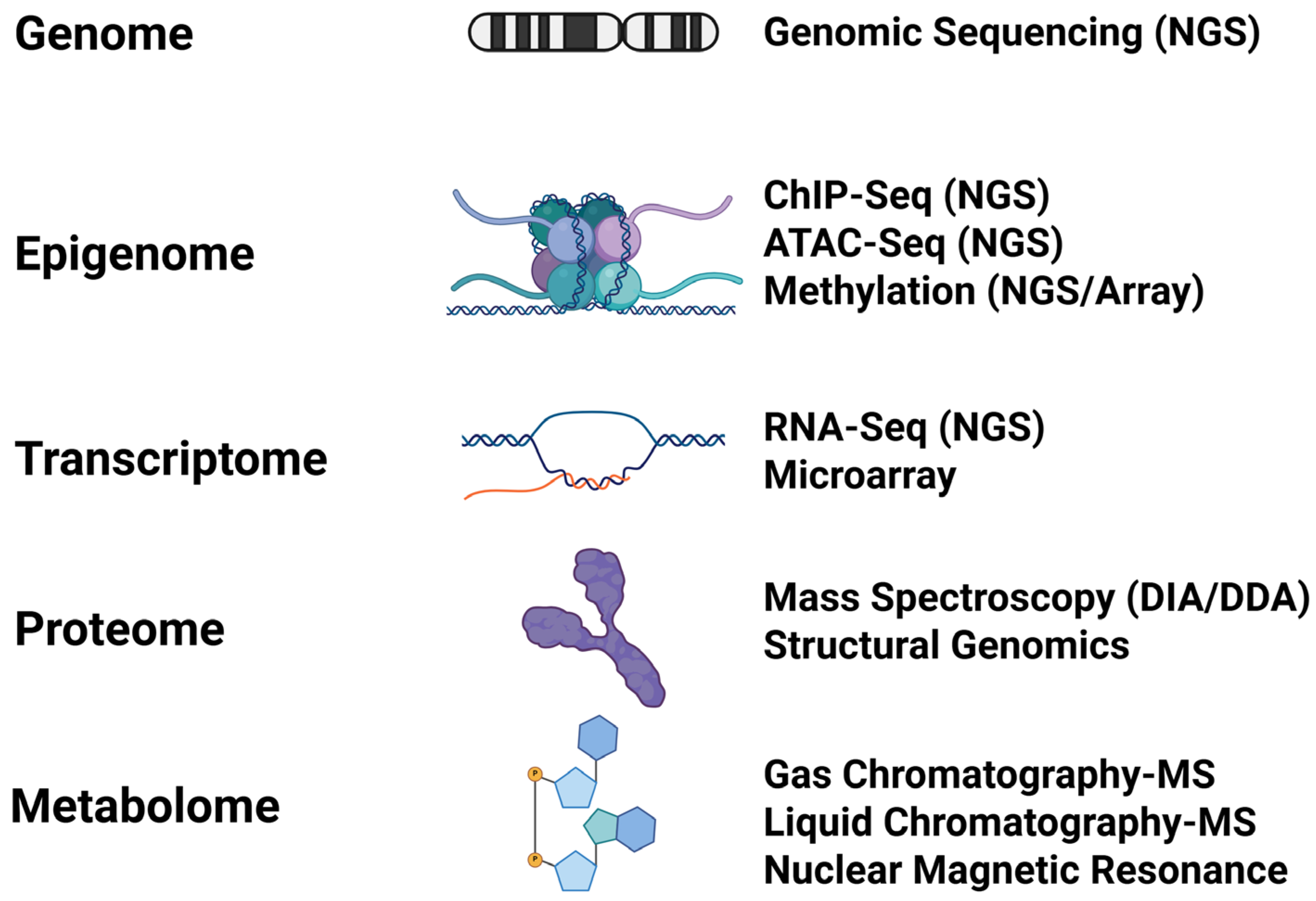
- Genome—The entire complement of genetic material in the cell, including chromosomes, plasmids, or other non-chromosomal elements. The genome is typically annotated to include protein-coding sequences (genes), non-coding regions (introns, promoters, regulatory elements, non-coding RNAs, etc.), and uncharacterized regions. The genome is generally considered to be static and represents the blueprint of the cell. Reference genomes for most model organisms have been sequenced and are available for public use [40,41,42,43,44].
- Transcriptome—The complement of transcribed genes under a given set of conditions at a given time. The transcriptome is dynamic and may be described in spatial or temporal terms depending on the experiment. Transcriptomics is the most well-defined of the functional (i.e., dynamic) omics methods [45,46].
- Epigenome—Epigenomics includes any modifications to the DNA (e.g., methylation) or histones that affect chromatin accessibility. The most common epigenomic methods are methylation, ChIP-Seq (for assessing chromatin accessibility linked to histone modification or for identifying protein-binding sites in DNA), and ATAC-seq (for assessing chromatin accessibility between nucleosomes) [47]. The epigenome has been implicated in many disease-related phenomena such as oncogenesis, aging, and toxicology [48,49].
- Proteome—The entire complement of active proteins in the cell. Proteomics is the preferred omics level for pharmaceutical science applications because proteins are typically the targets for drugs [50]. Proteomics also encompasses post-translational modifications of proteins (e.g., phosphorylation, glycosylation, etc.) and can be used to identify protein–protein networks [51,52]. Proteomics technology has improved significantly in recent years, allowing for more complete assessment of proteomes even in low-biomass samples such as biological fluids [53,54].
- Metabolomics—The entire complement of small molecules in the cell. Subsets of metabolomics include glycomics (sugars) and lipidomics (lipids) [55,56,57]. Metabolomics using radioisotope-labelled substrates can be used to assess the flow of metabolites through metabolic pathways (fluxomics) for purposes of metabolic engineering [58].
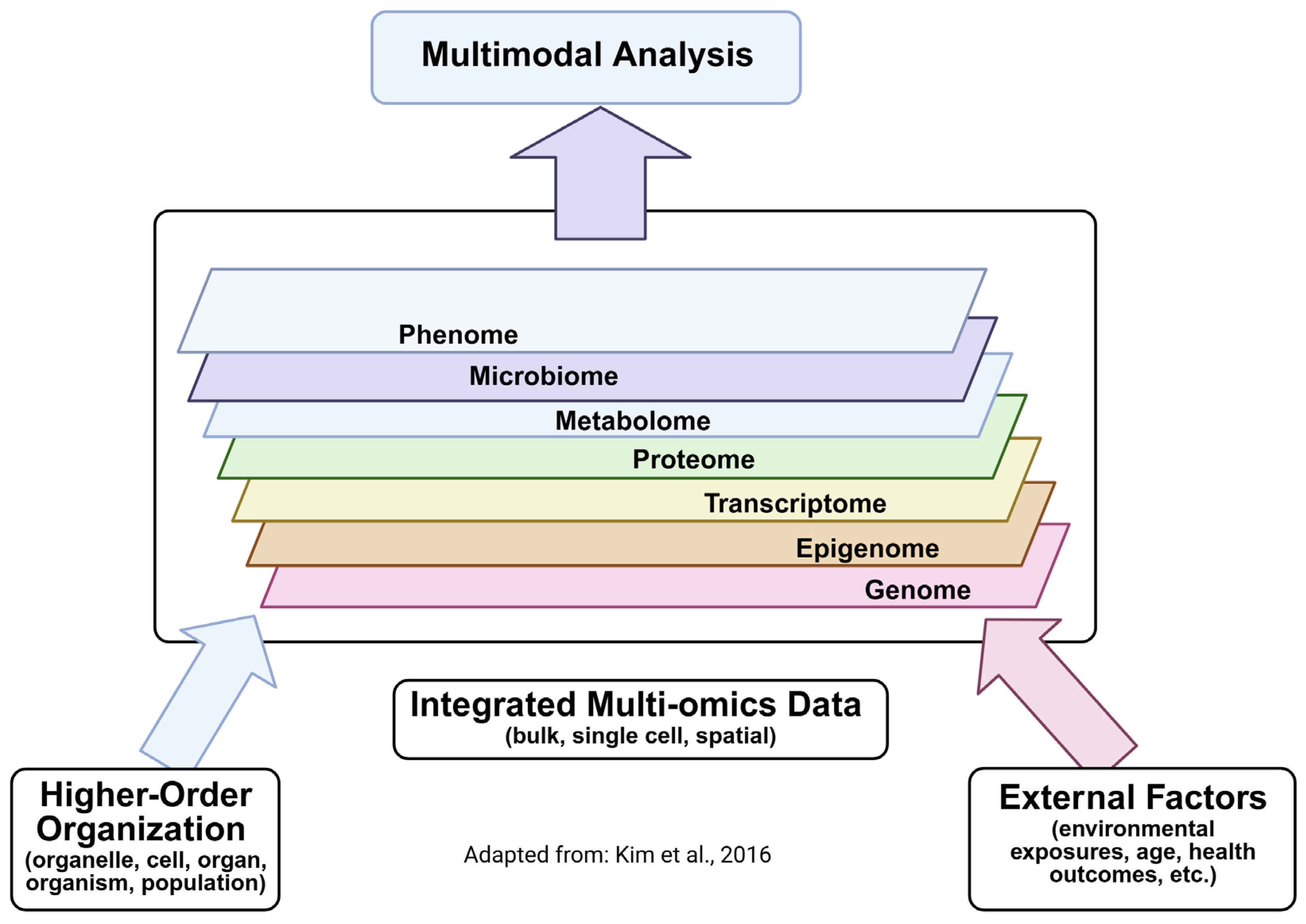
- Microbiome Omics—Omics studies of host-associated or free-living microbial communities. These methods correspond to the methods described above (metagenomics, metatranscriptomics, metaproteomics, etc.) [59]. Microbiome studies involve complex communities of multiple organisms and are increasingly included in multi-omics studies to identify molecular interactions between the host and its microbiome [42,60,61].
- ChIP-Seq + ATAC Seq + Methylation—ChIP-Seq is used to analyze the effects of histone modifications on chromatin accessibility. ATAC-seq complements this analysis by analyzing free chromatin between histones. Methylation, in contrast, analyzes methylation of cytosines in DNA molecules, which can affect transcription or chromatin accessibility. In combination, these methods provide a high-level assessment of chromatin accessibility [62,63].
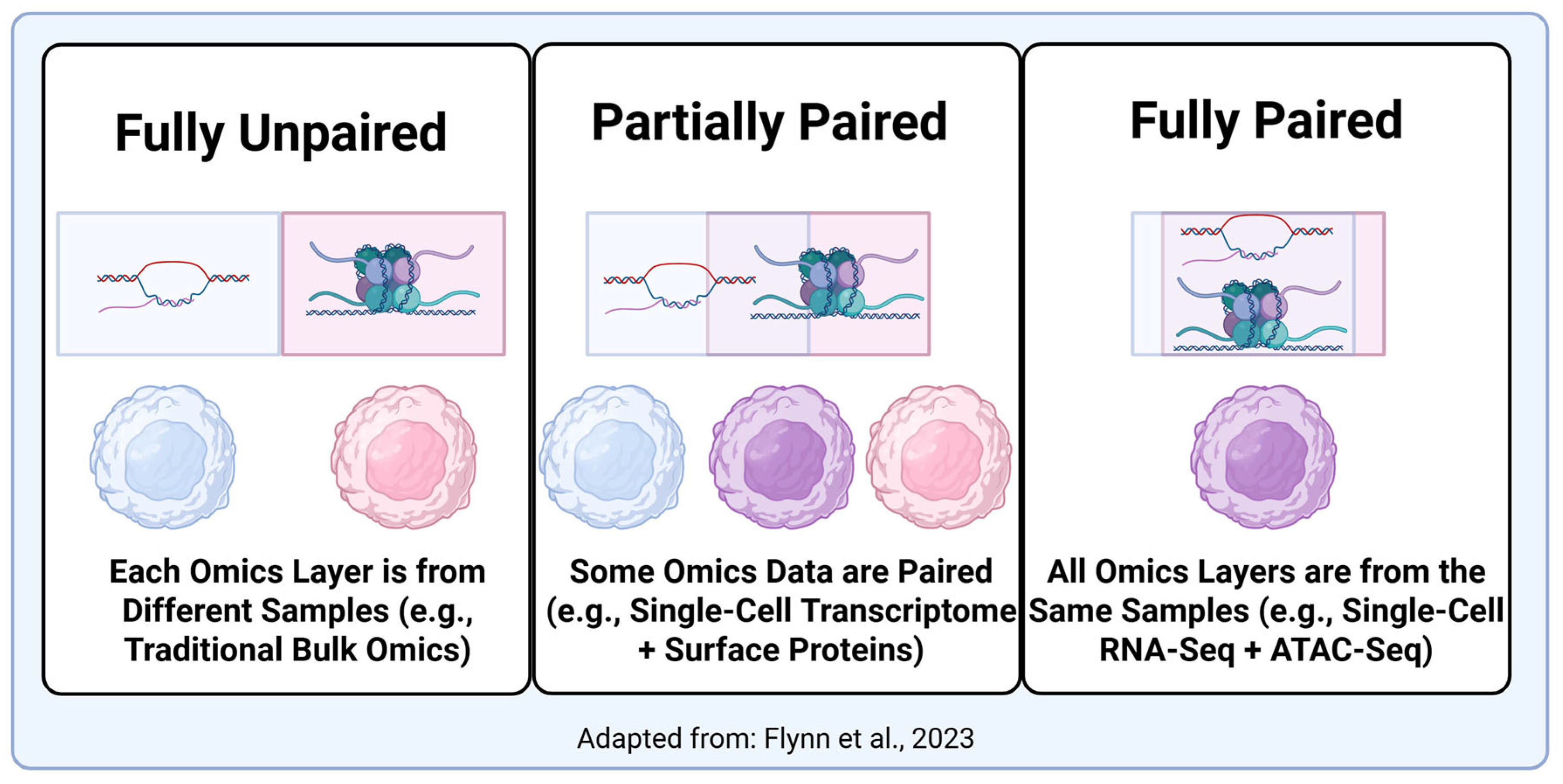
- Transcriptomics + Epigenomics—The epigenomics methods described above can also be combined with RNA-seq to gain a deeper understanding of gene transcription by linking chromatin accessibility to transcription. RNA-seq can also be linked to ChIP-seq for identification of DNA-binding proteins, which is a crucial method for identifying and characterizing regulatory networks [64,65]. Because of the utility of these approaches, companies have recently released several protocols for paired transcriptomic–epigenomic sample prep and analysis, which reduces technical and biological variability (see Challenges in Multi-Omics Analysis).
- Transcriptomics + Proteomics—A crucial step in the flow of biological information is translation of mRNA transcripts to active proteins. While the translation process is well-known, less clear are the multitude of post-translational modifications possible before an active protein is produced. Recent multi-omics work has clearly demonstrated a disconnect between the transcriptome and proteome due to post-transcriptional and post-translational regulatory mechanisms [1,3,66,67,68,69]. A multi-omics approach to transcription and proteomics can help elucidate these processes [70].
- Proteomics + Metabolomics—Proteins carry out many chemical reactions in the cell, which can be assessed by metabolomics. Metabolomics gives a sense of which proteins are active and how active they are [71,72]. This can be assessed directly through fluxomics, which uses radioisotope-labelled substrates to measure the flow of metabolites through metabolic pathways, which is essential for metabolic engineering [73,74,75].
- GWAS + Transcriptomics or Proteomics—Genome-wide association studies (GWAS) seek to associate genetic variants such as single-nucleotide polymorphisms (SNPs) and insertions-deletions (indels) with diseases or other phenotypes, often in the context of an external environmental exposure. The association alone, however, does not provide much information on the molecular mechanism linking the variant to the phenotype. Some variants may occur in intergenic regions, which may affect gene transcription. Other variants may occur in protein-coding genes, which may change the structure and/or activity of the translated protein. By coupling transcriptomics and proteomics to GWAS, the mechanisms by which genetic variants lead to disease phenotypes can be elucidated [76,77,78].
- Host Omics + Microbiome Omics—Interactions between the host and its microbiomes are increasingly recognized as critical to understanding and treating human health conditions such as inflammatory bowel disease or Type 2 diabetes [79]. Interactions of the microbiome with the host immune system or through metabolite production can manifest in a variety of ways, including emergence of or protection from pathogens, efficiency of digestion, and microbial metabolism. Terms such as the gut–brain axis describe how host–microbiome interactions in one part of the body can manifest in other parts of the body, either through immune system interactions or through the production of microbial metabolites such as small-chain fatty acids [79,80,81]. Increasingly, microbiome data is being included in pharmacogenomic analyses along with immunology data from the host to provide a more complete understanding of how both the host and the microbiome react to drugs [82,83]. The broad coupling of pharmacology and systems biology is often referred to as systems pharmacology [84,85]. Furthermore, multi-omics approaches are increasingly applied to infectious diseases to map host–pathogen interactions, simultaneously capturing pathogen virulence factor expression (transcriptomics) and the host immune proteome [79].
3. Challenges in Multi-Omics Analysis
4. Addressing the Challenges in Multi-Omics Analysis
5. Strategies for Analyzing Multi-Omics Data
5.1. Paired Data Acquisition
5.2. Integration Architectures (Early, Intermediate, Late)
5.3. Multimodal Mediation Frameworks

6. Conclusions
Author Contributions
Funding
Institutional Review Board Statement
Informed Consent Statement
Data Availability Statement
Conflicts of Interest
Abbreviations
| AI | Artificial Intelligence |
| ATAC-seq | Assay for Transposase-Accessible Chromatin using sequencing |
| ChIP-seq | Chromatin Immunoprecipitation followed by sequencing |
| DNA | Deoxyribonucleic Acid |
| GC | Gas Chromatography |
| GWAS | Genome-Wide Association Study |
| LC | Liquid Chromatography |
| ML | Machine Learning |
| mRNA | messenger RNA |
| MS | Mass Spectrometry |
| NGS | Next-Generation Sequencing |
| RNA | Ribonucleic Acid |
| RNA-seq | RNA sequencing |
| SNPs | Single-Nucleotide Polymorphisms |
| WNN | Weighted Nearest Neighbor (algorithm in Seurat) |
References
- Hasin, Y.; Seldin, M.; Lusis, A. Multi-omics approaches to disease. Genome Biol. 2017, 18, 83. [Google Scholar] [CrossRef]
- Liu, J.; Yang, L.; Liu, D.; Wu, Q.; Yu, Y.; Huang, X.; Li, J.; Liu, S. The role of multi-omics in biomarker discovery, diagnosis, prognosis, and therapeutic monitoring of tissue repair and regeneration processes. J. Orthop. Translat. 2025, 54, 131–151. [Google Scholar] [CrossRef]
- Wang, N.N.; Cao, F.; Zhang, L.H.; Zheng, Y.F.; Xu, D. Multi-omics: A bridge connecting genotype and phenotype for epilepsy? Biomark. Res. 2025, 13, 86. [Google Scholar] [CrossRef]
- Naylor, S.; Chen, J.Y. Unraveling human complexity and disease with systems biology and personalized medicine. Per. Med. 2010, 7, 275–289. [Google Scholar] [CrossRef]
- Goodrich, J.A.; Wang, H.; Jia, Q.; Stratakis, N.; Zhao, Y.; Maitre, L.; Bustamante, M.; Vafeiadi, M.; Aung, M.; Andrušaitytė, S.; et al. Integrating Multi-Omics with environmental data for precision health: A novel analytic framework and case study on prenatal mercury induced childhood fatty liver disease. Environ. Int. 2024, 190, 108930. [Google Scholar] [CrossRef]
- Kim, J.; Woo, H.R.; Nam, H.G. Toward Systems Understanding of Leaf Senescence: An Integrated Multi-Omics Perspective on Leaf Senescence Research. Mol. Plant 2016, 9, 813–825. [Google Scholar] [CrossRef]
- Illumina. The Power of Multiomics; 2022; p. 19. San Diego, CA, USA.
- Health, National Human Genome Research Institute. National Institutes of Health Multi-Omics for Health and Disease (MOHD). Available online: https://www.genome.gov/research-funding/Funded-Programs-Projects/Multi-Omics-for-Health-and-Disease (accessed on 28 August 2024).
- Al-Daffaie, F.M.; Al-Daffaie, M.M.; Abuhelwa, A.Y.; Alqudah, M.A.Y.; Aleidi, S.M.; El-Huneidi, W.; Abu-Gharbieh, E.; Alzoubi, K.H.; Bustanji, Y.; Semreen, M.H. Exosomal biomarkers in cancer: Insights from Multi-OMIC approaches. Clin. Chim. Acta 2025, 579, 120606. [Google Scholar] [CrossRef]
- Chen, W.; Zhang, L.; Qi, H. CD44 as a novel therapeutic target in pulmonary arterial hypertension: Insights from multi-omics integration and molecular docking. PLoS ONE 2025, 20, e0332817. [Google Scholar] [CrossRef]
- Gómez, F.; Pérez-Sánchez, N.; Macías-Camero, A.; Núñez, R.; Contreras, N.; Cañas, J.A.; Jiménez-Sánchez, I.M.; Díez-Echave, P.; Barbas, C.; Guéant, J.L.; et al. Multi-omics analysis of a prebiotic intervention with pectin in lipid transfer proteins (LTPs) allergic patients. Carbohydr. Polym. 2025, 369, 124236. [Google Scholar] [CrossRef]
- Hao, Y.; Stuart, T.; Kowalski, M.H.; Choudhary, S.; Hoffman, P.; Hartman, A.; Srivastava, A.; Molla, G.; Madad, S.; Fernandez-Granda, C.; et al. Dictionary learning for integrative, multimodal and scalable single-cell analysis. Nat. Biotechnol. 2024, 42, 293–304. [Google Scholar] [CrossRef]
- Argelaguet, R.; Arnol, D.; Bredikhin, D.; Deloro, Y.; Velten, B.; Marioni, J.C.; Stegle, O. MOFA+: A statistical framework for comprehensive integration of multi-modal single-cell data. Genome Biol. 2020, 21, 111. [Google Scholar] [CrossRef]
- Krämer, A.; Green, J.; Pollard, J., Jr.; Tugendreich, S. Causal analysis approaches in Ingenuity Pathway Analysis. Bioinformatics 2014, 30, 523–530. [Google Scholar] [CrossRef]
- Kohl, P.; Crampin, E.J.; Quinn, T.A.; Noble, D. Systems biology: An approach. Clin. Pharmacol. Ther. 2010, 88, 25–33. [Google Scholar] [CrossRef]
- O’Connor, J.E.; Herrera, G.; Martínez-Romero, A.; de Oyanguren, F.S.; Díaz, L.; Gomes, A.; Balaguer, S.; Callaghan, R.C. Systems Biology and immune aging. Immunol. Lett. 2014, 162, 334–345. [Google Scholar] [CrossRef]
- Chuang, H.Y.; Hofree, M.; Ideker, T. A decade of systems biology. Annu. Rev. Cell Dev. Biol. 2010, 26, 721–744. [Google Scholar] [CrossRef]
- Huang, H.; Vangay, P.; McKinlay, C.E.; Knights, D. Multi-omics analysis of inflammatory bowel disease. Immunol. Lett. 2014, 162, 62–68. [Google Scholar] [CrossRef]
- Nie, W.; Yan, L.; Lee, Y.H.; Guha, C.; Kurland, I.J.; Lu, H. Advanced mass spectrometry-based multi-omics technologies for exploring the pathogenesis of hepatocellular carcinoma. Mass. Spectrom. Rev. 2016, 35, 331–349. [Google Scholar] [CrossRef]
- Williams, E.G.; Auwerx, J. The Convergence of Systems and Reductionist Approaches in Complex Trait Analysis. Cell 2015, 162, 23–32. [Google Scholar] [CrossRef]
- Chen, D.; Gyllensten, U. Lessons and implications from association studies and post-GWAS analyses of cervical cancer. Trends Genet. 2015, 31, 41–54. [Google Scholar] [CrossRef]
- Buono, R.J. Genome wide association studies (GWAS) and common forms of human epilepsy. Epilepsy Behav. 2013, 28, S63–S65. [Google Scholar] [CrossRef]
- Sullivan, P.F. The psychiatric GWAS consortium: Big science comes to psychiatry. Neuron 2010, 68, 182–186. [Google Scholar] [CrossRef]
- Prakadan, S.M.; Shalek, A.K.; Weitz, D.A. Scaling by shrinking: Empowering single-cell ‘omics’ with microfluidic devices. Nat. Rev. Genet. 2017, 18, 345–361. [Google Scholar] [CrossRef]
- Wang, D.; Bodovitz, S. Single cell analysis: The new frontier in ‘omics’. Trends Biotechnol. 2010, 28, 281–290. [Google Scholar] [CrossRef]
- Wang, D.C.; Wang, X. Systems heterogeneity: An integrative way to understand cancer heterogeneity. Semin. Cell Dev. Biol. 2017, 64, 1–4. [Google Scholar] [CrossRef]
- Koutsogiannouli, E.; Papavassiliou, A.G.; Papanikolaou, N.A. Complexity in cancer biology: Is systems biology the answer? Cancer Med. 2013, 2, 164–177. [Google Scholar] [CrossRef]
- Yiu, T.; Chen, B.; Wang, H.; Feng, G.; Fu, Q.; Hu, H. Transformative advances in single-cell omics: A comprehensive review of foundation models, multimodal integration and computational ecosystems. J. Transl. Med. 2025, 23, 1176. [Google Scholar] [CrossRef]
- Bressan, D.; Battistoni, G.; Hannon, G.J. The dawn of spatial omics. Science 2023, 381, eabq4964. [Google Scholar] [CrossRef]
- Koppad, S.; B, A.; Gkoutos, G.V.; Acharjee, A. Cloud Computing Enabled Big Multi-Omics Data Analytics. Bioinform. Biol. Insights 2021, 15, 11779322211035921. [Google Scholar] [CrossRef]
- Gao, F.; Huang, K.; Xing, Y. Artificial Intelligence in Omics. Genom. Proteom. Bioinform. 2022, 20, 811–813. [Google Scholar] [CrossRef]
- Breitling, R. What is systems biology? Front. Physiol. 2010, 1, 1–9. [Google Scholar] [CrossRef]
- Sidoli, S.; Kulej, K.; Garcia, B.A. Why proteomics is not the new genomics and the future of mass spectrometry in cell biology. J. Cell Biol. 2017, 216, 21–24. [Google Scholar] [CrossRef]
- Johnson, C.H.; Gonzalez, F.J. Challenges and opportunities of metabolomics. J. Cell Physiol. 2012, 227, 2975–2981. [Google Scholar] [CrossRef]
- Workman, J., Jr. Advancements and Emerging Techniques in Mass Spectrometry: A Comprehensive Review. LCGC Supplements, 7 November 2024; pp. 22–27. [Google Scholar]
- Subramanian, I.; Verma, S.; Kumar, S.; Jere, A.; Anamika, K. Multi-omics Data Integration, Interpretation, and Its Application. Bioinform. Biol. Insights 2020, 14, 1177932219899051. [Google Scholar] [CrossRef]
- Flynn, E.; Almonte-Loya, A.; Fragiadakis, G.K. Single-Cell Multiomics. Annu. Rev. Biomed. Data Sci. 2023, 6, 313–337. [Google Scholar] [CrossRef]
- Babu, M.; Snyder, M. Multi-Omics Profiling for Health. Mol. Cell. Proteom. 2023, 22, 100561. [Google Scholar] [CrossRef]
- Morabito, A.; De Simone, G.; Pastorelli, R.; Brunelli, L.; Ferrario, M. Algorithms and tools for data-driven omics integration to achieve multilayer biological insights: A narrative review. J. Transl. Med. 2025, 23, 425. [Google Scholar] [CrossRef]
- Collins, F.S.; Morgan, M.; Patrinos, A. The Human Genome Project: Lessons from large-scale biology. Science 2003, 300, 286–290. [Google Scholar] [CrossRef]
- Frazer, K.A.; Ballinger, D.G.; Cox, D.R.; Hinds, D.A.; Stuve, L.L.; Gibbs, R.A.; Belmont, J.W.; Boudreau, A.; Hardenbol, P.; Leal, S.M.; et al. A second generation human haplotype map of over 3.1 million SNPs. Nature 2007, 449, 851–861. [Google Scholar] [CrossRef]
- Proctor, L.M.; Creasy, H.H.; Fettweis, J.M.; Lloyd-Price, J.; Mahurkar, A.; Zhou, W.; Buck, G.A.; Snyder, M.P.; Strauss, J.F.; Weinstock, G.M.; et al. The Integrative Human Microbiome Project. Nature 2019, 569, 641–648. [Google Scholar] [CrossRef]
- Waterston, R.H.; Lindblad-Toh, K.; Birney, E.; Rogers, J.; Abril, J.F.; Agarwal, P.; Agarwala, R.; Ainscough, R.; Alexandersson, M.; An, P.; et al. Initial sequencing and comparative analysis of the mouse genome. Nature 2002, 420, 520–562. [Google Scholar] [CrossRef]
- Celniker, S.E.; Rubin, G.M. The Drosophila melanogaster genome. Annu. Rev. Genom. Hum. Genet. 2003, 4, 89–117. [Google Scholar] [CrossRef]
- Jeffries, A.M.; Yu, T.; Ziegenfuss, J.S.; Tolles, A.K.; Baer, C.E.; Sotelo, C.B.; Kim, Y.; Weng, Z.; Lodato, M.A. Single-cell transcriptomic and genomic changes in the ageing human brain. Nature 2025, 646, 657–666. [Google Scholar] [CrossRef]
- Xue, J.; Schmidt, S.V.; Sander, J.; Draffehn, A.; Krebs, W.; Quester, I.; De Nardo, D.; Gohel, T.D.; Emde, M.; Schmidleithner, L.; et al. Transcriptome-based network analysis reveals a spectrum model of human macrophage activation. Immunity 2014, 40, 274–288. [Google Scholar] [CrossRef]
- Ma, S.; Zhang, Y. Profiling chromatin regulatory landscape: Insights into the development of ChIP-seq and ATAC-seq. Mol. Biomed. 2020, 1, 9. [Google Scholar] [CrossRef]
- Farsetti, A.; Illi, B.; Gaetano, C. How epigenetics impacts on human diseases. Eur. J. Intern. Med. 2023, 114, 15–22. [Google Scholar] [CrossRef]
- Lister, R.; Pelizzola, M.; Dowen, R.H.; Hawkins, R.D.; Hon, G.; Tonti-Filippini, J.; Nery, J.R.; Lee, L.; Ye, Z.; Ngo, Q.M.; et al. Human DNA methylomes at base resolution show widespread epigenomic differences. Nature 2009, 462, 315–322. [Google Scholar] [CrossRef]
- Hewick, R.M.; Lu, Z.; Wang, J.H. Proteomics in Drug Discovery. In Advances in Protein Chemistry; Smith, R.D., Veenstra, T.D., Eds.; Academic Press: Cambridge, MA, USA, 2003; Volume 65, pp. 309–342. [Google Scholar]
- Wang, S.; Osgood, A.O.; Chatterjee, A. Uncovering post-translational modification-associated protein-protein interactions. Curr. Opin. Struct. Biol. 2022, 74, 102352. [Google Scholar] [CrossRef]
- Palukuri, M.V.; Patil, R.S.; Marcotte, E.M. Molecular complex detection in protein interaction networks through reinforcement learning. BMC Bioinform. 2023, 24, 306. [Google Scholar] [CrossRef]
- Dayon, L.; Cominetti, O.; Affolter, M. Proteomics of human biological fluids for biomarker discoveries: Technical advances and recent applications. Expert. Rev. Proteom. 2022, 19, 131–151. [Google Scholar] [CrossRef]
- Rozanova, S.; Barkovits, K.; Nikolov, M.; Schmidt, C.; Urlaub, H.; Marcus, K. Quantitative Mass Spectrometry-Based Proteomics: An Overview. Methods Mol. Biol. 2021, 2228, 85–116. [Google Scholar] [CrossRef]
- Sun, Y.; Zhang, X.; Hang, D.; Lau, H.C.; Du, J.; Liu, C.; Xie, M.; Pan, Y.; Wang, L.; Liang, C.; et al. Integrative plasma and fecal metabolomics identify functional metabolites in adenoma-colorectal cancer progression and as early diagnostic biomarkers. Cancer Cell 2024, 42, 1386–1400.e1388. [Google Scholar] [CrossRef]
- Jové, M.; Mota-Martorell, N.; Torres, P.; Portero-Otin, M.; Ferrer, I.; Pamplona, R. New insights into human prefrontal cortex aging with a lipidomics approach. Expert. Rev. Proteom. 2021, 18, 333–344. [Google Scholar] [CrossRef]
- Bua, R.O.; Messina, A.; Sturiale, L.; Barone, R.; Garozzo, D.; Palmigiano, A. N-Glycomics of Human Erythrocytes. Int. J. Mol. Sci. 2021, 22, 8063. [Google Scholar] [CrossRef]
- Moiz, B.; Li, A.; Padmanabhan, S.; Sriram, G.; Clyne, A.M. Isotope-Assisted Metabolic Flux Analysis: A Powerful Technique to Gain New Insights into the Human Metabolome in Health and Disease. Metabolites 2022, 12, 1066. [Google Scholar] [CrossRef]
- Nyholm, L.; Koziol, A.; Marcos, S.; Botnen, A.B.; Aizpurua, O.; Gopalakrishnan, S.; Limborg, M.T.; Gilbert, M.T.P.; Alberdi, A. Holo-Omics: Integrated Host-Microbiota Multi-omics for Basic and Applied Biological Research. iScience 2020, 23, 101414. [Google Scholar] [CrossRef]
- Kunath, B.J.; De Rudder, C.; Laczny, C.C.; Letellier, E.; Wilmes, P. The oral-gut microbiome axis in health and disease. Nat. Rev. Microbiol. 2024, 22, 791–805. [Google Scholar] [CrossRef]
- Carmona-Cruz, S.; Orozco-Covarrubias, L.; Sáez-de-Ocariz, M. The Human Skin Microbiome in Selected Cutaneous Diseases. Front. Cell. Infect. Microbiol. 2022, 12, 834135. [Google Scholar] [CrossRef]
- Lhoumaud, P.; Sethia, G.; Izzo, F.; Sakellaropoulos, T.; Snetkova, V.; Vidal, S.; Badri, S.; Cornwell, M.; Di Giammartino, D.C.; Kim, K.T.; et al. EpiMethylTag: Simultaneous detection of ATAC-seq or ChIP-seq signals with DNA methylation. Genome Biol. 2019, 20, 248. [Google Scholar] [CrossRef]
- Spektor, R.; Tippens, N.D.; Mimoso, C.A.; Soloway, P.D. methyl-ATAC-seq measures DNA methylation at accessible chromatin. Genome Res. 2019, 29, 969–977. [Google Scholar] [CrossRef]
- Sun, N.; Victor, M.B.; Park, Y.P.; Xiong, X.; Scannail, A.N.; Leary, N.; Prosper, S.; Viswanathan, S.; Luna, X.; Boix, C.A.; et al. Human microglial state dynamics in Alzheimer’s disease progression. Cell 2023, 186, 4386–4403.e4329. [Google Scholar] [CrossRef]
- Zhang, D.; Deng, Y.; Kukanja, P.; Agirre, E.; Bartosovic, M.; Dong, M.; Ma, C.; Ma, S.; Su, G.; Bao, S.; et al. Spatial epigenome-transcriptome co-profiling of mammalian tissues. Nature 2023, 616, 113–122. [Google Scholar] [CrossRef]
- Samih, A.; de Moura Ferreira, M.A.; Nikoloski, Z. Gene expression and protein abundance: Just how associated are these molecular traits? Biotechnol. Adv. 2026, 86, 108720. [Google Scholar] [CrossRef]
- Spielmann, M.; Mundlos, S. Looking beyond the genes: The role of non-coding variants in human disease. Human. Mol. Genet. 2016, 25, R157–R165. [Google Scholar] [CrossRef]
- Liu, Y.; Beyer, A.; Aebersold, R. On the Dependency of Cellular Protein Levels on mRNA Abundance. Cell 2016, 165, 535–550. [Google Scholar] [CrossRef]
- Schwanhäusser, B.; Busse, D.; Li, N.; Dittmar, G.; Schuchhardt, J.; Wolf, J.; Chen, W.; Selbach, M. Global quantification of mammalian gene expression control. Nature 2011, 473, 337–342. [Google Scholar] [CrossRef]
- Fagerberg, L.; Hallström, B.M.; Oksvold, P.; Kampf, C.; Djureinovic, D.; Odeberg, J.; Habuka, M.; Tahmasebpoor, S.; Danielsson, A.; Edlund, K.; et al. Analysis of the human tissue-specific expression by genome-wide integration of transcriptomics and antibody-based proteomics. Mol. Cell. Proteom. 2014, 13, 397–406. [Google Scholar] [CrossRef]
- Chen, Z.Z.; Gerszten, R.E. Metabolomics and Proteomics in Type 2 Diabetes. Circ. Res. 2020, 126, 1613–1627. [Google Scholar] [CrossRef]
- van Vugt, M.; Finan, C.; Chopade, S.; Providencia, R.; Bezzina, C.R.; Asselbergs, F.W.; van Setten, J.; Schmidt, A.F. Integrating metabolomics and proteomics to identify novel drug targets for heart failure and atrial fibrillation. Genome Med. 2024, 16, 120. [Google Scholar] [CrossRef]
- Alghamdi, N.; Chang, W.; Dang, P.; Lu, X.; Wan, C.; Gampala, S.; Huang, Z.; Wang, J.; Ma, Q.; Zang, Y.; et al. A graph neural network model to estimate cell-wise metabolic flux using single-cell RNA-seq data. Genome Res. 2021, 31, 1867–1884. [Google Scholar] [CrossRef]
- Brejchova, K.; Rahm, M.; Benova, A.; Domanska, V.; Reyes-Gutierez, P.; Dzubanova, M.; Trubacova, R.; Vondrackova, M.; Cajka, T.; Tencerova, M.; et al. Uncovering mechanisms of thiazolidinediones on osteogenesis and adipogenesis using spatial fluxomics. Metabolism 2025, 166, 156157. [Google Scholar] [CrossRef]
- Hackett, S.R.; Zanotelli, V.R.; Xu, W.; Goya, J.; Park, J.O.; Perlman, D.H.; Gibney, P.A.; Botstein, D.; Storey, J.D.; Rabinowitz, J.D. Systems-level analysis of mechanisms regulating yeast metabolic flux. Science 2016, 354, aaf2786. [Google Scholar] [CrossRef]
- Ferkingstad, E.; Sulem, P.; Atlason, B.A.; Sveinbjornsson, G.; Magnusson, M.I.; Styrmisdottir, E.L.; Gunnarsdottir, K.; Helgason, A.; Oddsson, A.; Halldorsson, B.V.; et al. Large-scale integration of the plasma proteome with genetics and disease. Nat. Genet. 2021, 53, 1712–1721. [Google Scholar] [CrossRef]
- Mishra, A.; Malik, R.; Hachiya, T.; Jürgenson, T.; Namba, S.; Posner, D.C.; Kamanu, F.K.; Koido, M.; Le Grand, Q.; Shi, M.; et al. Stroke genetics informs drug discovery and risk prediction across ancestries. Nature 2022, 611, 115–123. [Google Scholar] [CrossRef]
- Daskalakis, N.P.; Iatrou, A.; Chatzinakos, C.; Jajoo, A.; Snijders, C.; Wylie, D.; DiPietro, C.P.; Tsatsani, I.; Chen, C.Y.; Pernia, C.D.; et al. Systems biology dissection of PTSD and MDD across brain regions, cell types, and blood. Science 2024, 384, eadh3707. [Google Scholar] [CrossRef]
- Lloyd-Price, J.; Arze, C.; Ananthakrishnan, A.N.; Schirmer, M.; Avila-Pacheco, J.; Poon, T.W.; Andrews, E.; Ajami, N.J.; Bonham, K.S.; Brislawn, C.J.; et al. Multi-omics of the gut microbial ecosystem in inflammatory bowel diseases. Nature 2019, 569, 655–662. [Google Scholar] [CrossRef]
- Lavelle, A.; Sokol, H. Gut microbiota-derived metabolites as key actors in inflammatory bowel disease. Nat. Rev. Gastroenterol. Hepatol. 2020, 17, 223–237. [Google Scholar] [CrossRef]
- Verma, A.; Inslicht, S.S.; Bhargava, A. Gut-Brain Axis: Role of Microbiome, Metabolomics, Hormones, and Stress in Mental Health Disorders. Cells 2024, 13, 1436. [Google Scholar] [CrossRef]
- Allegaert, K. Integrated in a systems pharmacology approach, pharmacogenetics holds the promise for personalized medicine in neonates. Pharmacogenomics 2022, 23, 667–670. [Google Scholar] [CrossRef]
- Zhao, Q.; Chen, Y.; Huang, W.; Zhou, H.; Zhang, W. Drug-microbiota interactions: An emerging priority for precision medicine. Signal Transduct. Target. Ther. 2023, 8, 386. [Google Scholar] [CrossRef]
- Antman, E.; Weiss, S.; Loscalzo, J. Systems pharmacology, pharmacogenetics, and clinical trial design in network medicine. Wiley Interdiscip. Rev. Syst. Biol. Med. 2012, 4, 367–383. [Google Scholar] [CrossRef]
- Bloomingdale, P.; Karelina, T.; Cirit, M.; Muldoon, S.F.; Baker, J.; McCarty, W.J.; Geerts, H.; Macha, S. Quantitative systems pharmacology in neuroscience: Novel methodologies and technologies. CPT Pharmacomet. Syst. Pharmacol. 2021, 10, 412–419. [Google Scholar] [CrossRef]
- Luo, Y.; Zhao, C.; Chen, F. Multiomics Research: Principles and Challenges in Integrated Analysis. Biodes Res. 2024, 6, 0059. [Google Scholar] [CrossRef]
- Movassaghi, C.S.; Sun, J.; Jiang, Y.; Turner, N.; Chang, V.; Chung, N.; Chen, R.J.; Browne, E.N.; Lin, C.; Schweppe, D.K.; et al. Recent Advances in Mass Spectrometry-Based Bottom-Up Proteomics. Anal. Chem. 2025, 97, 4728–4749. [Google Scholar] [CrossRef]
- Ugidos, M.; Nueda, M.J.; Prats-Montalbán, J.M.; Ferrer, A.; Conesa, A.; Tarazona, S. MultiBaC: An R package to remove batch effects in multi-omic experiments. Bioinformatics 2022, 38, 2657–2658. [Google Scholar] [CrossRef]
- Molania, R.; Foroutan, M.; Gagnon-Bartsch, J.A.; Gandolfo, L.C.; Jain, A.; Sinha, A.; Olshansky, G.; Dobrovic, A.; Papenfuss, A.T.; Speed, T.P. Removing unwanted variation from large-scale RNA sequencing data with PRPS. Nat. Biotechnol. 2023, 41, 82–95. [Google Scholar] [CrossRef]
- Scherer, A. Batch Effects and Noise in Microarray Experiments: Sources and Solutions; Wiley: Chichester, UK, 2009. [Google Scholar]
- Misra, B.B. Data normalization strategies in metabolomics: Current challenges, approaches, and tools. Eur. J. Mass Spectrom. 2020, 26, 165–174. [Google Scholar] [CrossRef]
- Baião, A.R.; Cai, Z.; Poulos, R.C.; Robinson, P.J.; Reddel, R.R.; Zhong, Q.; Vinga, S.; Gonçalves, E. A technical review of multi-omics data integration methods: From classical statistical to deep generative approaches. Brief. Bioinform. 2025, 26, bbaf355. [Google Scholar] [CrossRef]
- Flores, J.E.; Claborne, D.M.; Weller, Z.D.; Webb-Robertson, B.M.; Waters, K.M.; Bramer, L.M. Missing data in multi-omics integration: Recent advances through artificial intelligence. Front. Artif. Intell. 2023, 6, 1098308. [Google Scholar] [CrossRef]
- Rautenstrauch, P.; Vlot, A.H.C.; Saran, S.; Ohler, U. Intricacies of single-cell multi-omics data integration. Trends Genet. 2022, 38, 128–139. [Google Scholar] [CrossRef]
- Das, S.; Mukhopadhyay, I. TiMEG: An integrative statistical method for partially missing multi-omics data. Sci. Rep. 2021, 11, 24077. [Google Scholar] [CrossRef]
- Abir, A.R.; Dip, S.A.; Zhang, L. UnCOT-AD: Unpaired Cross-Omics Translation Enables Multi-Omics Integration for Alzheimer’s Disease Prediction. Brief. Bioinform. 2025, 26, bbaf438. [Google Scholar] [CrossRef]
- Movasat, H.; Giacopino, E.; Shahdoost, A.; Dorri Nokoorani, Y.; Abrbekouh, A.H.; Tahamtani, Y.; Shakiba, N. A systems view of cellular heterogeneity: Unlocking the “wheel of fate”. Cell Syst. 2025, 16, 101300. [Google Scholar] [CrossRef]
- Muto, Y.; Wilson, P.C.; Ledru, N.; Wu, H.; Dimke, H.; Waikar, S.S.; Humphreys, B.D. Single cell transcriptional and chromatin accessibility profiling redefine cellular heterogeneity in the adult human kidney. Nat. Commun. 2021, 12, 2190. [Google Scholar] [CrossRef]
- Sanches, P.H.G.; de Melo, N.C.; Porcari, A.M.; de Carvalho, L.M. Integrating Molecular Perspectives: Strategies for Comprehensive Multi-Omics Integrative Data Analysis and Machine Learning Applications in Transcriptomics, Proteomics, and Metabolomics. Biology 2024, 13, 848. [Google Scholar] [CrossRef]
- Ritchie, M.D.; Holzinger, E.R.; Li, R.; Pendergrass, S.A.; Kim, D. Methods of integrating data to uncover genotype-phenotype interactions. Nat. Rev. Genet. 2015, 16, 85–97. [Google Scholar] [CrossRef]
- FDA-NIH Biomarker Working Group. BEST (Biomarkers, EndpointS, and Other Tools) Resource [Internet]; US Food and Drug Administration and US National Institutes of Health: Silver Spring, MD, USA; Bethesda, MD, USA, 2016.
- WHO International Programme on Chemical Safety. Biomarkers in Risk Assessment: Validity and Validation. Available online: https://inchem.org/documents/ehc/ehc/ehc222.htm (accessed on 28 August 2024).
- Herzog, C.M.S.; Goeminne, L.J.E.; Poganik, J.R.; Barzilai, N.; Belsky, D.W.; Betts-LaCroix, J.; Chen, B.H.; Chen, M.; Cohen, A.A.; Cummings, S.R.; et al. Challenges and recommendations for the translation of biomarkers of aging. Nat. Aging 2024, 4, 1372–1383. [Google Scholar] [CrossRef]
- Schöll, M.; Verberk, I.M.W.; del Campo, M.; Delaby, C.; Therriault, J.; Chong, J.R.; Palmqvist, S.; Alcolea, D. Challenges in the practical implementation of blood biomarkers for Alzheimer’s disease. Lancet Healthy Longev. 2024, 5, 100630. [Google Scholar] [CrossRef]
- Dai, X.; Shen, L. Advances and Trends in Omics Technology Development. Front. Med. 2022, 9, 1–25. [Google Scholar] [CrossRef]
- Titkare, N.; Chaturvedi, S.; Borah, S.; Sharma, N. Advances in mass spectrometry for metabolomics: Strategies, challenges, and innovations in disease biomarker discovery. Biomed. Chromatogr. 2024, 38, e6019. [Google Scholar] [CrossRef]
- Vidanagamachchi, S.M.; Waidyarathna, K. Opportunities, challenges and future perspectives of using bioinformatics and artificial intelligence techniques on tropical disease identification using omics data. Front. Digit. Health 2024, 6, 1471200. [Google Scholar] [CrossRef]
- Bittremieux, W.; Wang, M.; Dorrestein, P.C. The critical role that spectral libraries play in capturing the metabolomics community knowledge. Metabolomics 2022, 18, 94. [Google Scholar] [CrossRef]
- Hayes, C.N.; Nakahara, H.; Ono, A.; Tsuge, M.; Oka, S. From Omics to Multi-Omics: A Review of Advantages and Tradeoffs. Genes 2024, 15, 1551. [Google Scholar] [CrossRef]
- Jiang, W.; Ye, W.; Tan, X.; Bao, Y.J. Network-based multi-omics integrative analysis methods in drug discovery: A systematic review. BioData Min. 2025, 18, 27. [Google Scholar] [CrossRef]
- Sachs, K.; Perez, O.; Pe’er, D.; Lauffenburger, D.A.; Nolan, G.P. Causal Protein-Signaling Networks Derived from Multiparameter Single-Cell Data. Science 2005, 308, 523–529. [Google Scholar] [CrossRef]
- Sato, T. Computational Framework for Causal Inference in Molecular Dynamics Analysis of Lipid–Protein Interactions. J. Chem. Inf. Model. 2026, 66, 1167–1178. [Google Scholar] [CrossRef]
- Borsari, B.; Frank, M.; Wattenberg, E.S.; Xu, K.; Liu, S.X.; Yu, X.; Gerstein, M. The chronODE framework for modelling multi-omic time series with ordinary differential equations and machine learning. Nat. Commun. 2025, 16, 7021. [Google Scholar] [CrossRef]
- Toumpe, I.; Choudhury, S.; Hatzimanikatis, V.; Miskovic, L. The Dawn of High-Throughput and Genome-Scale Kinetic Modeling: Recent Advances and Future Directions. ACS Synth. Biol. 2025, 14, 2906–2919. [Google Scholar] [CrossRef]
- Picard, M.; Scott-Boyer, M.-P.; Bodein, A.; Périn, O.; Droit, A. Integration strategies of multi-omics data for machine learning analysis. Comput. Struct. Biotechnol. J. 2021, 19, 3735–3746. [Google Scholar] [CrossRef] [PubMed]
- Kan, Y.; Qi, Y.; Zhang, Z.; Liang, X.; Wang, W.; Jin, S. Integration of unpaired single cell omics data by deep transfer graph convolutional network. PLoS Comput. Biol. 2025, 21, e1012625. [Google Scholar] [CrossRef]
- Zhou, Y.; Geng, P.; Zhang, S.; Xiao, F.; Cai, G.; Chen, L.; Lu, Q. Multimodal functional deep learning for multiomics data. Brief. Bioinform. 2024, 25, bbae448. [Google Scholar] [CrossRef]
- Lin, X.; Jiang, S.; Gao, L.; Wei, Z.; Wang, J. MultiSC: A deep learning pipeline for analyzing multiomics single-cell data. Brief. Bioinform. 2024, 25, bbae492. [Google Scholar] [CrossRef]
- Coleman, K.; Schroeder, A.; Loth, M.; Zhang, D.; Park, J.H.; Sung, J.Y.; Blank, N.; Cowan, A.J.; Qian, X.; Chen, J.; et al. Resolving tissue complexity by multimodal spatial omics modeling with MISO. Nat. Methods 2025, 22, 530–538. [Google Scholar] [CrossRef]
- Kobayashi-Kirschvink, K.J.; Comiter, C.S.; Gaddam, S.; Joren, T.; Grody, E.I.; Ounadjela, J.R.; Zhang, K.; Ge, B.; Kang, J.W.; Xavier, R.J.; et al. Prediction of single-cell RNA expression profiles in live cells by Raman microscopy with Raman2RNA. Nat. Biotechnol. 2024, 42, 1726–1734. [Google Scholar] [CrossRef]
- Jurj, E.D.; Colibășanu, D.; Vasii, S.O.; Suciu, L.; Dehelean, C.A.; Udrescu, L. Redefining Breast Cancer Care by Harnessing Computational Drug Repositioning. Medicina 2025, 61, 1640. [Google Scholar] [CrossRef]
- Huang, J.; Gao, J.; Chen, Q. An Interpretable Deep Learning and Molecular Docking Framework for Repurposing Existing Drugs as Inhibitors of SARS-CoV-2 Main Protease. Molecules 2025, 30, 3409. [Google Scholar] [CrossRef] [PubMed]
- Wei, S.; Sasi, C.; Piepenbrock, J.; Huynen, M.A.; t Hoen, P.A.C. The use of knowledge graphs for drug repurposing: From classical machine learning algorithms to graph neural networks. Comput. Biol. Med. 2025, 196, 110873. [Google Scholar] [CrossRef]
- Ahmed, M.; Dar, A.R.; Helfert, M.; Khan, A.; Kim, J. Data Provenance in Healthcare: Approaches, Challenges, and Future Directions. Sensors 2023, 23, 6495. [Google Scholar] [CrossRef]
- Simjanoska Misheva, M.; Shahpaski, D.; Dobreva, J.; Bukovec, D.; Gjorgjioski, B.; Nikolov, M.; Frtunikj, D.; Lameski, P.; Aliu, A.; Mishev, K.; et al. AI Act Compliance Within the MyHealth@EU Framework: Tutorial. J. Med. Internet Res. 2025, 27, e81184. [Google Scholar] [CrossRef]
- Carini, C.; Seyhan, A.A. Tribulations and future opportunities for artificial intelligence in precision medicine. J. Transl. Med. 2024, 22, 411. [Google Scholar] [CrossRef] [PubMed]
- Huizing, G.-J.; Deutschmann, I.M.; Peyré, G.; Cantini, L. Paired single-cell multi-omics data integration with Mowgli. Nat. Commun. 2023, 14, 7711. [Google Scholar] [CrossRef]
- Xu, F.; Cong, P.; Lu, Z.; Shi, L.; Xiong, L.; Zhao, G. Integration of ATAC-Seq and RNA-Seq identifies key genes and pathways involved in the neuroprotection of S-adenosylmethionine against perioperative neurocognitive disorder. Comput. Struct. Biotechnol. J. 2023, 21, 1942–1954. [Google Scholar] [CrossRef] [PubMed]
- Hao, Y.; Hao, S.; Andersen-Nissen, E.; Mauck, W.M.; Zheng, S.; Butler, A.; Lee, M.J.; Wilk, A.J.; Darby, C.; Zager, M.; et al. Integrated analysis of multimodal single-cell data. Cell 2021, 184, 3573–3587.e3529. [Google Scholar] [CrossRef] [PubMed]
- Lee, B.; Zhang, S.; Poleksic, A.; Xie, L. Heterogeneous multi-layered network model for omics data integration and analysis. Front. Genet. 2020, 10, 1381. [Google Scholar] [CrossRef]
- Ma, T.; Zhang, A. Omics informatics: From scattered individual software tools to integrated workflow management systems. IEEE/ACM Trans. Comput. Biol. Bioinform. 2016, 14, 926–946. [Google Scholar] [CrossRef]
- Ogris, C.; Hu, Y.; Arloth, J.; Müller, N.S. Versatile knowledge guided network inference method for prioritizing key regulatory factors in multi-omics data. Sci. Rep. 2021, 11, 6806. [Google Scholar] [CrossRef]
- Papadaki, E.; Kakkos, I.; Vlamos, P.; Petropoulou, O.; Miloulis, S.T.; Palamas, S.; Vrahatis, A.G. Recent Web Platforms for Multi-Omics Integration Unlocking Biological Complexity. Appl. Sci. 2025, 15, 329. [Google Scholar] [CrossRef]
- Cao, Z.-J.; Gao, G. Multi-omics single-cell data integration and regulatory inference with graph-linked embedding. Nat. Biotechnol. 2022, 40, 1458–1466. [Google Scholar] [CrossRef] [PubMed]
- Liu, T.; Salguero, P.; Petek, M.; Martinez-Mira, C.; Balzano-Nogueira, L.; Ramšak, Ž.; McIntyre, L.; Gruden, K.; Tarazona, S.; Conesa, A. PaintOmics 4: New tools for the integrative analysis of multi-omics datasets supported by multiple pathway databases. Nucleic Acids Res. 2022, 50, W551–W559. [Google Scholar] [CrossRef]
- Zhou, G.; Pang, Z.; Lu, Y.; Ewald, J.; Xia, J. OmicsNet 2.0: A web-based platform for multi-omics integration and network visual analytics. Nucleic Acids Res. 2022, 50, W527–W533. [Google Scholar] [CrossRef] [PubMed]
- Maitre, L.; Bustamante, M.; Hernández-Ferrer, C.; Thiel, D.; Lau, C.-H.E.; Siskos, A.P.; Vives-Usano, M.; Ruiz-Arenas, C.; Pelegrí-Sisó, D.; Robinson, O.; et al. Multi-omics signatures of the human early life exposome. Nat. Commun. 2022, 13, 7024. [Google Scholar] [CrossRef]
- Gill, N.P.; Kuang, A.; Scholtens, D.M. Multi-omics mediation pipeline reveals differential pathways of maternal SNPs affecting newborn adiposity outcomes. BMC Genom. Data 2025, 26, 66. [Google Scholar] [CrossRef] [PubMed]
- Huang, L.; Long, J.P.; Irajizad, E.; Doecke, J.D.; Do, K.-A.; Ha, M.J. A unified mediation analysis framework for integrative cancer proteogenomics with clinical outcomes. Bioinformatics 2023, 39, btad023. [Google Scholar] [CrossRef]
- Jiang, H.; Miao, X.; Thairu, M.W.; Beebe, M.; Grupe, D.W.; Davidson, R.J.; Handelsman, J.; Sankaran, K. Multimedia: Multimodal mediation analysis of microbiome data. Microbiol. Spectr. 2025, 13, e01131–01124. [Google Scholar] [CrossRef]


Disclaimer/Publisher’s Note: The statements, opinions and data contained in all publications are solely those of the individual author(s) and contributor(s) and not of MDPI and/or the editor(s). MDPI and/or the editor(s) disclaim responsibility for any injury to people or property resulting from any ideas, methods, instructions or products referred to in the content. |
© 2026 by the authors. Licensee MDPI, Basel, Switzerland. This article is an open access article distributed under the terms and conditions of the Creative Commons Attribution (CC BY) license.
Share and Cite
Hemme, C.L.; Atoyan, J.; Cai, A.; Liu, C. Challenges and Opportunities in Multi-Omics Data Acquisition and Analysis: Toward Integrative Solutions. Biomolecules 2026, 16, 271. https://doi.org/10.3390/biom16020271
Hemme CL, Atoyan J, Cai A, Liu C. Challenges and Opportunities in Multi-Omics Data Acquisition and Analysis: Toward Integrative Solutions. Biomolecules. 2026; 16(2):271. https://doi.org/10.3390/biom16020271
Chicago/Turabian StyleHemme, Christopher L., Janet Atoyan, Ang Cai, and Chang Liu. 2026. "Challenges and Opportunities in Multi-Omics Data Acquisition and Analysis: Toward Integrative Solutions" Biomolecules 16, no. 2: 271. https://doi.org/10.3390/biom16020271
APA StyleHemme, C. L., Atoyan, J., Cai, A., & Liu, C. (2026). Challenges and Opportunities in Multi-Omics Data Acquisition and Analysis: Toward Integrative Solutions. Biomolecules, 16(2), 271. https://doi.org/10.3390/biom16020271