Review

CXCR4: A Promising Novel Strategy for Lung Cancer Treatment

1
Department of Immunology, Zunyi Medical University, Zunyi 563000, China
2
Key Laboratory for Cancer Prevention and Treatment of Guizhou Province, Zunyi 563000, China
*
Authors to whom correspondence should be addressed.
Biomolecules 2026, 16(2), 188; https://doi.org/10.3390/biom16020188
Submission received: 15 December 2025 / Revised: 13 January 2026 / Accepted: 13 January 2026 / Published: 26 January 2026
(This article belongs to the Section Biomacromolecules: Proteins, Nucleic Acids and Carbohydrates)

Abstract

Lung cancer remains a major public health challenge due to high incidence and mortality. The chemokine receptor CXCR4 and its ligand CXCL12 (SDF-1) constitute a critical axis in tumor biology, influencing tumor cell proliferation, invasion, angiogenesis, and immune evasion. Aberrant CXCR4 expression is frequently observed in lung cancer and is closely associated with adverse prognosis, enhanced metastatic potential, and therapeutic resistance. Mechanistically, CXCR4 activates signaling pathways including PI3K/AKT, MAPK/ERK, JAK/STAT, and FAK/Src, promoting epithelial–mesenchymal transition, stemness, and survival. The CXCL12/CXCR4 axis also orchestrates interactions with the tumor microenvironment, facilitating chemotaxis toward CXCL12-rich niches (e.g., bone marrow and brain) and modulating anti-tumor immunity via regulatory cells. Regulation of CXCR4 occurs at transcriptional, epigenetic, and post-transcriptional levels, with modulation by hypoxia, inflammatory signals, microRNAs, and post-translational modifications. Clinically, high CXCR4 expression correlates with metastasis, poor prognosis, and reduced response to certain therapies, underscoring its potential as a prognostic biomarker and therapeutic target. Therapeutic strategies targeting CXCR4 include small-molecule antagonists (e.g., AMD3100/plerixafor; balixafortide), anti-CXCR4 antibodies, and CXCL12 decoys, as well as imaging probes for patient selection and response monitoring (e.g., 68Ga-pentixafor PET). Preclinical and early clinical studies suggest that CXCR4 blockade can impair tumor growth, limit metastatic spread, and enhance chemotherapy and immunotherapy efficacy, although hematopoietic side effects and infection risk necessitate careful therapeutic design. This review synthesizes the molecular features, regulatory networks, and translational potential of CXCR4 in lung cancer and discusses future directions for precision therapy and biomarker-guided intervention.

1. Introduction

Lung cancer remains a major global health burden, with incidence and mortality rising worldwide since 2011. According to the 2022 Global Cancer statistics, it was the most prevalent cancer, accounting for approximately 2.5 million new cases (about 12.4% of all cancers) and the leading cause of cancer-related death, responsible for about 1.8 million deaths (18.7%) [1]. Lung cancer is primarily categorized into two major types: non-small cell lung cancer (NSCLC) and small cell lung cancer (SCLC). NSCLC accounts for approximately 80% to 85% of cases, including histological subtypes such as adenocarcinoma and squamous cell carcinoma, while SCLC constitutes the remaining portion [2]. As the most common type of lung cancer, NSCLC exhibits high incidence and mortality rates. Current treatment options primarily include surgical resection, chemotherapy, targeted therapy, and radiation therapy. Despite recent advancements in lung cancer research, the overall prognosis for patients remains grim due to the complex and poorly understood mechanisms of the disease, leading to low five-year survival rates. Consequently, there is an urgent need to explore more effective treatment strategies and identify new clinical treatment approaches.
Recent advancements in biotechnology and interdisciplinary research have led to breakthrough opportunities in the field of lung cancer treatment [3,4,5]. Notably, the advent of gene therapy offers significant potential for the identification and development of novel therapeutic targets [6]. In this context, the C-X-C chemokine receptor 4 (CXCR4) and its ligand CXCL12 have garnered widespread attention. Research indicates that CXCR4 plays a central role in tumor occurrence, development, and metastasis. It regulates cancer cell proliferation, survival, angiogenesis, and invasive capacity, while also influencing the formation and maintenance of the tumor microenvironment. Moreover, CXCR4 participates in the dynamic balance of the immune system by regulating the migration and hematopoietic function of immune cells. Therefore, abnormal overexpression of CXCR4 is closely associated with the occurrence, development, and prognosis of various tumors, including lung cancer, leukemia, breast cancer, prostate cancer, and multiple myeloma.
Given the critical role of CXCR4 in lung cancer progression, researchers have conducted in-depth explorations into its potential as a therapeutic target. Targeting CXCR4 through various intervention strategies is anticipated to provide new treatment options for lung cancer patients, thereby enhancing their survival rates and quality of life. This paper aims to systematically review the expression patterns and mechanisms of action of CXCR4 in lung cancer, as well as summarize the current status and future prospects of its use as a therapeutic target. By doing so, it seeks to offer new perspectives and directions for the precision diagnosis and treatment of lung cancer.

2. Overview of CXCR4

The CXCR4 gene, located on chromosome 2q22.1, is an important member of the G protein-coupled receptor (GPCR) family [7]. It features the characteristic seven transmembrane domain structure and is composed of 352 amino acid residues. This structure includes a highly conserved N-terminal extracellular domain, seven transmembrane α-helical regions (TM1–TM7), and an intracellular loop domain [8,9,10]. CXCR4 is widely expressed in human tissues, particularly showing significant expression patterns in organs such as bone marrow, thymus, stomach, and lungs, highlighting its key critical regulatory role in various physiological and pathological processes [10].
At the molecular level, the N-terminal extracellular domain of CXCR4 exhibits a high affinity for its ligand, stromal cell-derived factor 1 (SDF-1, also known as CXCL12). Notably, the third intracellular loop of CXCR4 demonstrates a unique structure-function duality: it not only directly engages in ligand recognition and binding through specific amino acid residues but also facilitates G protein-coupled signal transduction via conformational changes. This process precisely regulates the intensity and duration of downstream signaling. During signal transduction, CXCR4 relies on the conserved DRY motif (Asp-Arg-Tyr triplet) in the transmembrane region and requires the coordinated formation of specific spatial conformations among the seven transmembrane domains. Recent studies revealthat the tetrameric conformation of CXCR4, multi-ligand competitive binding, and oligomerization regulation provide new avenues for investigating the co-receptor functional domain and ligand-binding domain, thereby advancing the development of precision-targeted therapeutics in tumor metastasis and related fields [11,12,13].
CXCR4 fulfills numerous roles, such as mediating cellular signal transduction by coupling with inhibitory G proteins to affect cell migration, adhesion, and gene transcription [14]. In hematopoietic stem cell homing, CXCR4 interacts with CXCL12 to regulate the migration of CD34+ hematopoietic stem cells within the bone marrow [15]. Additionally, CXCR4 binds with high affinity to CXCL12, facilitating the migration of various cell types [16]. It also plays a crucial role in coordinating innate and adaptive immune responses by regulating leukocyte transport and distribution in peripheral tissues, promoting lymph node tissue formation, stabilizing immune synapses, and maintaining T cell activation [17]. In the context of tumor growth and metastasis, CXCR4 is instrumental in processes such as tumor growth, invasion, angiogenesis, metastasis, and treatment resistance. Moreover, the CXCL12/CXCR4 axis promotes angiogenesis, with signaling molecules stimulating CXCL12/CXCR4 expression [18].
CXCL12 (also known as SDF-1) is the sole ligand for CXCR4, and the CXCR4/CXCL12 axis participates in numerous biological processes by activating pathways such as PI3K-AKT, MAPK/ERK, JAK/STAT, and others to regulate migration, invasion, and metastasis [19]. The axis is prominently expressed across multiple tumor types and plays a significant role in shaping the tumor microenvironment (TME) by modulating immune cell trafficking and function, thereby supporting tumor progression. Specifically, the CXCR4/CXCL12 axis interacts with T cell and B cell receptors (TCR and BCR), in conjunction with CD47, to promote macrophage phagocytosis of tumor cells, an interaction referred to as immune gene surrender (IGS) [8]. Therefore, the CXCR4/CXCL12 axis holds significant promise in tumor immunotherapy. The diversity of the CXCR4/CXCL12 axis is reflected in the different subtypes of its ligand, CXCL12. Currently, seven CXCL12 subtypes have been identified (α, β, γ, δ, ε, θ, and the predicted iso7), with α and β being the most extensively studied forms, consisting of 89 and 93 amino acids, respectively [20,21]. The γ subtype is highly expressed in organs with low vascularization, such as the heart and brain. Although it has lower efficacy, it exhibits the highest binding affinity for CXCR4 and the longest duration of downstream effects [22,23].
In lung cancer, metastasis is the primary cause of poor prognosis and high recurrence rates, while epithelial–mesenchymal transition (EMT) is a key pathological factor in the early metastasis of primary lung cancer. Studies have shown that abnormalities in the CXCL12-CXCR4 signaling axis play a significant role in tumor cell EMT, invasion, and chemotherapy resistance [24]. Beyond tumor cell–intrinsic effects, the axis participates in shaping immune cell infiltration and organ-specific colonization, acting as a guiding, driving, and targeting signal for metastatic spread.
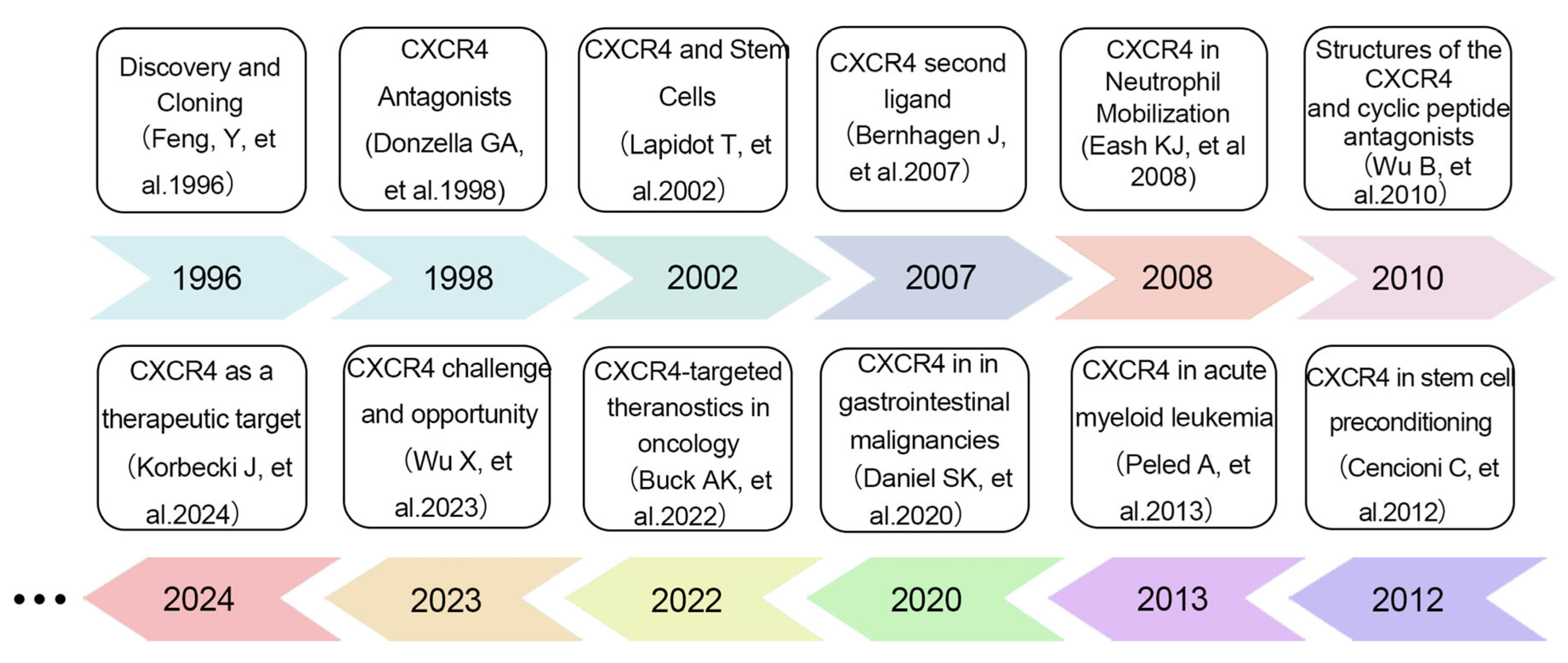
In summary, as a multifunctional GPCR, CXCR4 exhibits widespread distribution and diverse functions that are important in both normal physiology and disease (Figure 1). Landmark studies over the past three decades have continuously deepened our understanding of its pleiotropic roles. In 1996, Feng et al. published a seminal work in Science that first cloned CXCR4 and identified it as a key coreceptor mediating HIV-1 entry into T cells, laying the fundamental groundwork for subsequent functional explorations of this receptor [25]. Two years later, Donzella et al. reported in Nature Medicine that the small-molecule inhibitor AMD3100 blocks HIV-1 infection by targeting CXCR4, which was the first demonstration of the action mechanism of CXCR4 antagonists and provided critical candidate molecules for anti-HIV drug development [26]. A pivotal breakthrough in deciphering CXCR4 ligand interactions came in 2007, when Bernhagen J et al. identified macrophage migration inhibitory factor (MIF) as a second endogenous ligand for CXCR4, challenging the long-held dogma of exclusive CXCL12-CXCR4 binding and revealing the receptor’s ligand diversity [27]. The molecular underpinnings of CXCR4 function were further elucidated in 2010, when Wu B et al. resolved the first crystal structure of CXCR4 in complex with a small-molecule antagonist, offering an essential structural blueprint for targeted drug design [28]. In the realm of oncology, CXCR4 has steadily emerged as a promising therapeutic target, with accumulating evidence highlighting its involvement in tumor pathogenesis and progression across multiple malignancies. In 2013, Peled et al. demonstrated in Theranostics its critical role in the pathogenesis of acute myeloid leukemia (AML), clarifying its context-specific regulatory mechanisms in hematologic malignancies [29]. In 2019, Daniel et al. expanded this perspective in Seminars in Cancer Biology, revealing that the CXCL12-CXCR4/CXCR7 signaling axis mediates immune resistance in gastrointestinal malignancies and providing novel insights for combining targeted therapy with immunotherapy [30]. Progress in clinical translation was summarized in 2022 by Buck et al. in European Journal of Nuclear Medicine and Molecular Imaging, who systematically reviewed advances in CXCR4-targeted theranostic strategies and accelerated the translation of basic research into clinical practice [31]. Most recently, in 2024, Korbecki et al. further validated the feasibility of CXCR4 as a therapeutic target in AML in a study published in Leukemia, proposing optimized intervention strategies that offer updated support for precision oncology [32]. Against this backdrop of expanding insights into CXCR4-mediated oncogenic pathways across cancer types. In the context of lung cancer, the CXCR4/CXCL12 axis holds considerable potential for understanding tumor occurrence, progression, and metastasis, offering valuable insights for future therapeutic strategies. In the context of lung cancer, the CXCR4/CXCL12 axis holds considerable potential for understanding tumor occurrence, progression, and metastasis, offering valuable insights for future therapeutic strategies.

3. Molecular Regulation of CXCR4 Expression

CXCR4 is a chemokine receptor widely expressed across various cell types, particularly in immune cells, hematopoietic stem cells, and multiple tumor cell types. It is notably overexpressed in diverse tumors, including lung cancer [23]. Beyond facilitating tumor cell migration and invasion, CXCR4 also modulates tumor immune responses by impacting immune cell functions within the tumor microenvironment. Studies highlight that CXCR4 expression is particularly elevated in lung cancer cells, closely linked to its critical roles in tumor cell proliferation, metastasis, and the formation of the tumor microenvironment [37]. High CXCR4 expression is not only associated with tumor initiation and progression but also closely related to patient prognosis, making it clinically significant to thoroughly investigate its expression patterns and regulatory mechanisms. CXCR4 expression is regulated at multiple levels, including transcriptional regulation, post-transcriptional modifications, and post-translational modifications. Together, these multi-level regulatory mechanisms determine the functional changes in CXCR4 under various physiological and pathological conditions.

3.1. Regulation of CXCR4 Transcription Levels

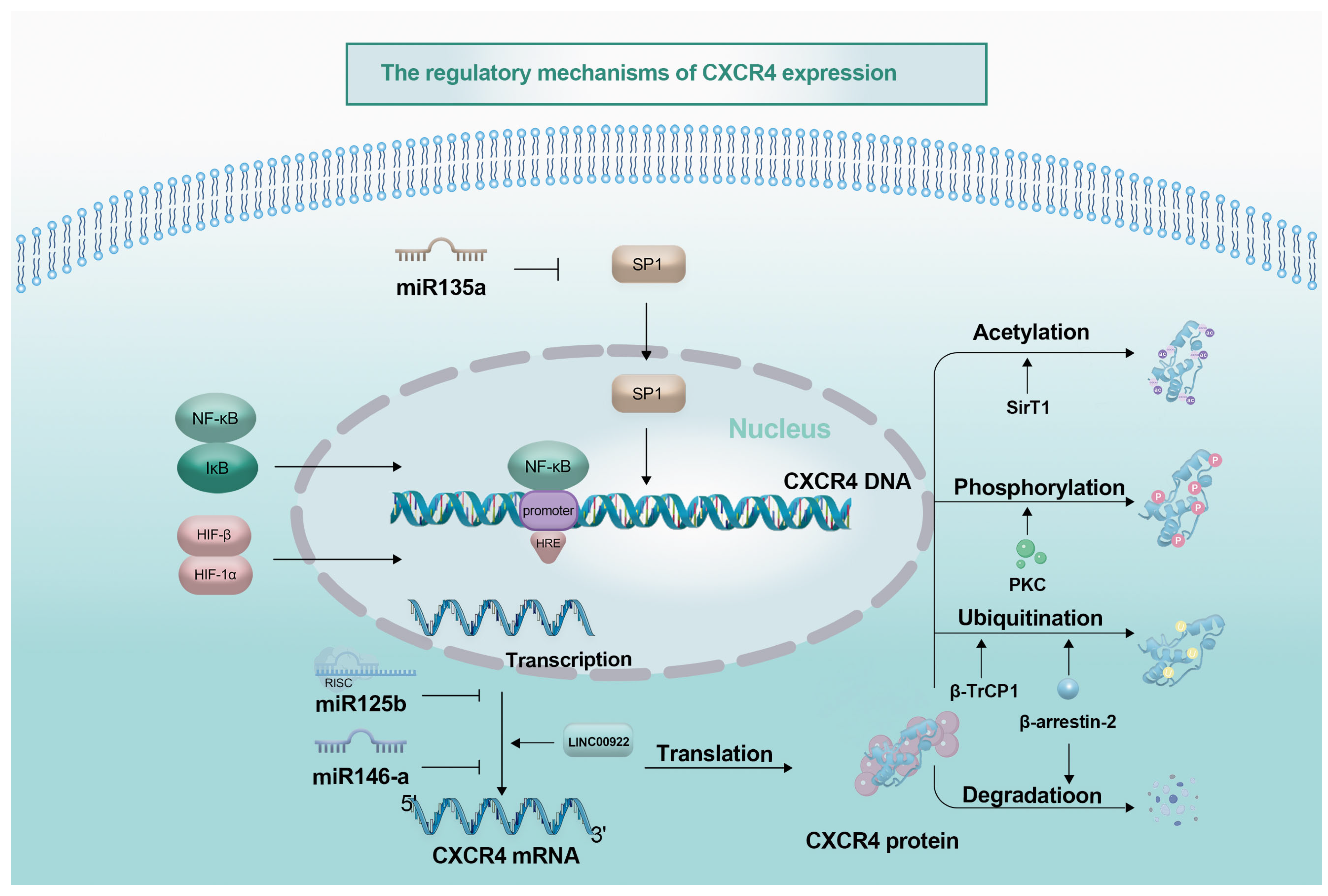
Transcription factors directly control CXCR4 transcription levels by binding to its gene promoter region. For example, c-Myb has been shown to regulate CXCR4 expression, with at least 10 potential c-Myb binding sites identified in the CXCR4 promoter region and regulated by Myb protein [38]. Another study found that SP1 is a frequently binding transcription factor in the core promoter region of CXCR4, with evidence showing that miR-135a can inhibit CXCR4 expression by targeting SP1 [39]. Quintana AM’s team also noted SP1 binding sites in the CXCR4 promoter region and suggested that SP1 may promote CXCR4 transcription by binding to the CXCR4 promoter [40]. Additionally, NF-κB can bind to the CXCR4 promoter region, boosting its transcriptional activity and substantially increasing CXCR4 expression, with this regulatory effect being particularly pronounced in inflammatory and tumor cells [7]. NF-κB can also promote cancer cell migration and invasion through the CXCL12/CXCR4 axis [41]. Furthermore, under hypoxic conditions in vitro, HIF-1α can bind to the CXCR4 promoter region, significantly upregulating CXCR4 expression and thereby enhancing cellular migration capacity [42,43].
Notably, inflammatory signaling pathways form a positive feedback loop to regulate CXCR4 transcription. For instance, in in vitro glioblastoma cell models, TNF-α stimulation increases NF-κB binding to the CXCR4 promoter, leading to upregulation of CXCR4 expression—a mechanism also validated in in vitro NSCLC cell lines [44]. Moreover, downstream signaling pathways activated by CXCR4 can feedback-regulate its transcription: sustained activation of the PI3K-AKT pathway promotes CXCR4 gene transcription by phosphorylating transcription factors such as NF-κB [45].
DNA methylation also significantly influences CXCR4 expression as a key epigenetic modification. For example, in peripheral blood mononuclear cells from patients with chronic hepatitis B-related liver fibrosis/cirrhosis, hypomethylation of the CXCR4 promoter region was significantly associated with increased CXCR4 expression levels [46]; whereas in pancreatic cancer, hypermethylation of the CXCR4 promoter was associated with low expression. In normal pancreatic tissue, the 5′ CpG island of the CXCR4 gene is unmethylated, whereas hypermethylation of the promoter region was detected in 45% of pancreatic cancer cell lines and 46% of primary pancreatic adenocarcinomas, with a significant negative correlation between methylation and CXCR4 mRNA expression levels [47]; Additionally, in hepatocellular carcinoma, downregulation of UHRF1 activates the CXCR4/AKT-JNK/IL-6/Snail signaling axis, thereby increasing tumor malignancy [48]. Other studies have also indicated a negative correlation between DNA methylation and CXCR4 expression, with high methylation of the CXCR4 gene promoter region inhibiting its transcription. Analyzing the DNA methylation status of the CXCR4 promoter region in gastric cancer cells found that high methylation was significantly associated with CXCR4 expression downregulation [49]. These factors influencing CXCR4 expression provide important references for the diagnosis and treatment of lung cancer.
In addition to transcription factors and epigenetic modifications, the tumor microenvironment regulates CXCR4 transcription via paracrine mechanisms. Immune-suppressive cells such as tumor-associated macrophages (TAMs) and regulatory T cells (Tregs) secrete cytokines like CXCL12 and IL-6, inducing tumor cells to upregulate CXCR4 expression. Meanwhile, growth factors secreted by tumor-associated fibroblasts (CAFs), such as EGF and bFGF, enhance CXCR4 transcriptional activity through downstream signaling pathways [50]. This microenvironment-mediated regulation tightly links CXCR4 expression to the tumor’s immunosuppressive state and stromal remodeling processes.
Ligand-receptor interaction and co-receptor crosstalk also contribute to transcriptional regulation of CXCR4. As the high-affinity ligand of CXCR4, CXCL12 binds specifically to CXCR4 to trigger conformational changes in the receptor’s intracellular domain, initiating G protein coupling and signal cascades. Sustained CXCL12 stimulation further upregulates CXCR4 expression on tumor cell surfaces, forming a positive feedback loop that amplifies its oncogenic functions [30,51]. CXCR7, another functional receptor for CXCL12, modulates CXCR4 activity through dual mechanisms: forming heterodimers with CXCR4 to synergistically enhance downstream PI3K-AKT and MAPK/ERK signaling, or competitively binding CXCL12 to regulate local ligand concentrations and indirectly affect CXCR4-mediated chemotaxis [30,52].

3.2. Post-Transcriptional Regulation

Post-transcriptional regulation of CXCR4 plays a critical role in various cellular functions and disease processes. Recent studies have revealed that non-coding RNAs (including miRNAs and lncRNAs) significantly affect the post-transcriptional regulation of CXCR4, influencing its expression levels and functional activity through complex regulatory networks.

3.2.1. miRNA Regulation of CXCR4

Direct targeting regulation: Studies have shown that miR-125b [53], miR-146a [51], miR-155 [54], and miR-21 [55] can inhibit CXCR4 translation by directly binding to its mRNA 3′UTR region. For instance, miR-146a is induced by the LMP1 protein in EB virus-infected cells. LMP1, an EB virus-encoded protein, activates multiple intracellular signaling pathways, including the NF-κB signaling pathway, thereby inducing the expression of miR-146a. miR-146a then binds to the 3′UTR region of CXCR4 mRNA, inhibiting CXCR4 translation, forming an LMP1-miR-146a-CXCR4 regulatory axis, ultimately affecting cellular proliferation and metastasis capacity [53,56]. In breast cancer cells, miR-146 can directly target CXCR4, inhibiting its expression, suppressing NF-κB activity, and reducing the cells’ metastatic potential. In colorectal cancer, miR-125b, induced by the CXCL12/CXCR4 axis, can bind to CXCR4 mRNA 3′UTR, enhancing autophagy, thereby promoting the invasion of colorectal cancer cells while conferring resistance to 5-fluorouracil. Furthermore, miR-9a-5p can directly target and downregulate CXCR4 expression, thus inhibiting MAPK pathway activation and alleviating lung injury in rats [57,58].
Notably, miRNA-mediated regulation of CXCR4 exhibits tumor-specific and functional diversity. In colorectal cancer, miR-126 expression is significantly reduced, and it directly targets the 3′UTR of CXCR4 to suppress its expression, thereby blocking the RhoA signaling pathway and reducing tumor cell migration, invasion, and epithelial–mesenchymal transition (EMT) processes; patients with low miR-126 expression have poorer prognosis [59,60,61]. In hepatocellular carcinoma, activation of the CXCL12/CXCR4 axis induces miR-125b expression, which in turn enhances CXCR4 activity, forming a positive feedback loop that promotes tumor stemness and resistance to 5-fluorouracil (5-FU) chemotherapy [51]. Additionally, miR-372 expression is downregulated in hepatocellular carcinoma tissues, and it directly targets CXCR4 mRNA to inhibit cell proliferation, EMT, and anti-apoptotic capacity [62]. miR-9a-5p also directly targets the CXCR4 3′UTR, reducing MAPK/ERK pathway activity by 42% [44]. Moreover, miR-126-3p/miR-221-3p inhibits PIK3R2/PTEN, thereby blocking the CXCR4/AKT signaling axis with an inhibition efficiency of 68% [44].
Indirect pathway regulation: Recent studies highlight that in macrophages, the absence of miR-301a can diminish cell migration and phagocytic capacity through the YY1/CXCR4 pathway [63]. In colorectal cancer, miR-1269a targets PCDHGA9, activating CXCR4 and β-catenin signaling pathways, promoting tumor cell invasion and metastasis [64]. miR-1910-5p influences angiogenesis by regulating CXCR4 function through MMRN2, thereby affecting vascular permeability [65]. miR-1910-5p regulates vascular permeability via the MMRN2/CXCR4 pathway; additionally, studies have shown that miR-9a-5p alleviates lung injury through the CXCR4/MAPK pathway.

3.2.2. Long Non-Coding RNAs Participate in CXCR4 Regulation Through the Formation of Complex ceRNA Networks

Liang et al. found that CXCR4 is upregulated in lung cancer cells, with LINC00922 promoting lung cancer progression through the miR-204/CXCR4 signaling axis. Experimental evidence shows that overexpression of LINC00922 significantly upregulates CXCR4 expression levels and enhances the migration and invasion capabilities of lung cancer cells. Clinical correlation analysis indicates that this mechanism is associated with poor patient outcomes [66].
An interesting finding is that lncRNA NORAD exhibits cell-type-specific regulation of CXCR4. In the NSCLC cell line A549 cells, lncRNA NORAD can downregulate CXCR4 levels, significantly inhibiting cell proliferation, migration, and invasion [67]. However, this regulatory mechanism is controversial, as other studies report minimal basal CXCR4 expression in A549 cells, yet NORAD overexpression enhances tumor spheroid formation, proliferation, and EMT progression, suggesting CXCR4 fosters a more invasive tumor phenotype [68]. These seemingly contradictory findings may reflect the complexity of the CXCR4 regulatory network, suggesting that its function may be highly dependent on the cellular microenvironment or specific pathological states. Further investigation into the dynamic regulatory mechanisms of CXCR4 in different cell types and disease progression could not only clarify its dual role in tumorigenesis but also provide new theoretical basis and therapeutic strategies for targeted interventions.
Additional lncRNAs and circular RNAs (circRNAs) have been identified as key regulators of CXCR4 through ceRNA networks. In hepatocellular carcinoma, high expression of lncRNA HULC specifically binds to miR-372, releasing its targeted suppression of CXCR4 and thereby promoting cell proliferation, EMT, and anti-apoptotic processes [62]. In breast cancer, loss of lncRNA MEG3 is common; MEG3 directly binds to the chromatin regulator CTCF, preventing CTCF from binding to the CXCR4 promoter and inhibiting its transcription. Overexpression of MEG3 significantly reduces breast cancer cell migration [69]. Moreover, hormonal regulation via the ERβ/circ-TMX4/miR-622 pathway upregulates CXCR4 expression through epigenetic modifications: circ-TMX4 acts as a sponge for miR-622, alleviating its inhibitory effect on CXCR4 mRNA and enhancing lung cancer cell invasion capacity by 2.3-fold [70,71,72]. Additionally, CXCR4-modified mesenchymal stem cell-derived exosomes can carry miR-320, which suppresses VEGF/IGF-1 signaling to regulate pathological angiogenesis in diabetes-associated tumors, indirectly influencing CXCR4-mediated angiogenic functions [50,73].
These findings reveal the high complexity of post-transcriptional regulation of CXCR4: (1) regulatory mechanisms exhibit cell type and disease specificity; (2) they form multi-layered regulatory networks, including miRNA-lncRNA interactions; (3) they engage in cross-talk with multiple signaling pathways, such as MAPK and Wnt/β-catenin. Elucidating these regulatory mechanisms provides new targets for precision therapy in related diseases, particularly those involving CXCR4 overactivation, such as tumors and inflammatory conditions. Future research should further investigate the synergistic interactions among different regulatory elements and their dynamic changes under various pathological conditions.

3.3. Post-Translational Modification

Post-translational modification of CXCR4 mainly includes multiple processes such as phosphorylation, glycosylation, and ubiquitination. Regarding phosphorylation, studies have shown that the lack of phosphorylation hinders ligand-induced receptor endocytosis and cytoskeletal rearrangement, but does not significantly affect cell adhesion and chemotaxis [74]. CXCR4 can be phosphorylated by multiple kinases, affecting its coupling with G proteins and the activation of downstream signaling pathways [75]. Structural studies have also indicated that phosphorylation of serine/threonine residues in the intracellular loop and carboxy-terminal region of CXCR4 can regulate the recruitment of β-arrestin and signal transduction [76]. Additionally, protein kinase C (PKC) phosphorylates the Ser-324/5 site of CXCR4, matching PKC’s phosphorylation recognition sequence, activated post-CXCL12 stimulation, regulating CXCR4 endocytosis and degradation. G protein-coupled receptor kinase 6 (GRK6) plays a crucial role in CXCR4 phosphorylation at multiple sites. Under CXCL12 stimulation, GRK6 rapidly phosphorylates the Ser-324/5 site on CXCR4, delays Ser-330 phosphorylation, and rapidly phosphorylates the Ser-339 site, regulating CXCR4 signaling [77]. Meanwhile, GRK2 and GRK3 also participate in the phosphorylation process of CXCR4, phosphorylating the Ser-346/347 sites of CXCR4 and affecting the coupling of CXCR4 with G proteins, thereby regulating signal transduction such as calcium ion release [77]. These studies underscore the complexity and dynamic nature of CXCR4 phosphorylation, involving multiple kinases’ cooperation to finely regulate its signal transduction and cellular functions by phosphorylating different CXCR4 sites [74].
Ubiquitination modification significantly impacts CXCR4 function. Studies indicate that CXCR4 undergoes K63- and K48-specific ubiquitination. Inhibition of its ubiquitination reduces protein stability, cell surface expression, and signal transduction capacity, thereby restricting cell migration [78]. The E3 ubiquitin ligase β-TrCP1 regulates CXCR4 stability, modulating CXCR4-dependent signaling and HIV-1 entry. Interaction between β-TrCP1 and CXCR4 leads to decreased CXCR4 protein levels [79]. Freedman NJ et al. [80] found that β-arrestin-2 regulates CXCR4 ubiquitination and degradation, impacting its cell surface expression.
Glycosylation modifications also hold significance. Absence of glycosylation in CXCR4 reduces receptor stability, lowers its surface expression, and affects ligand binding and signal transduction [81]. Further research indicates that N-glycosylation (a ubiquitous post-translational modification process of proteins) is crucial for maintaining CXCR4’s normal folding, stability, and surface expression, with glycosylation site mutations impairing its function [82].
CXCR4 also undergos acetylation, influencing its G protein binding and downstream signaling pathway activation, thereby affecting cellular chemotaxis and migration [83]. Research suggests Sirt1-dependent CXCR4 acetylation impacts CXCR4 co-receptor activity [84]. Additionally, CXCR4 nitrosylation alters its conformation, affecting ligand binding and signal transduction, thereby regulating cellular immune responses and HIV-1 invasion [85].
Notably, downstream signaling pathways of CXCR4 also regulate its function through post-translational modifications. The MAPK/ERK pathway enhances CXCR4 protein stability by regulating post-translational modifications, reducing its degradation [45]. Furthermore, during CXCR4-mediated EMT, activation of transcription factors such as Snail and Twist can conversely upregulate CXCR4 expression, forming a “signaling pathway—transcription factor—CXCR4” feedback loop that sustains the malignant phenotype of tumor cells [50].
CXCR4 expression is regulated at multiple levels, including transcriptional, post-transcriptional, and post-translational modifications (Figure 2). These regulatory mechanisms collectively influence the onset, progression, and outcome of tumors. In-depth investigation of the expression patterns and regulatory mechanisms of CXCR4 not only helps elucidate its role in tumors such as lung cancer but also offers potential opportunities for developing new targeted therapeutic strategies. Targeting CXCR4 and associated regulatory factors (such as miRNAs and lncRNAs) enables the design of precise treatments to inhibit tumor cell migration, invasion, and metastasis, improving patient outcomes.

4. The Dual Role of CXCR4 in Lung Cancer Progression and the Tumor Microenvironment

4.1. Significant Heterogeneity in the Relationship Between CXCR4 Expression and Clinical Prognosis

As an important member of the chemokine receptor family, CXCR4 plays multiple biological roles in the development and progression of malignant tumors. Studies have shown that CXCR4 exhibits significantly high expression in both primary and metastatic lesions of NSCLC [86]. This expression pattern is closely associated with various clinical and pathological characteristics of lung cancer. Notably, CXCR4 expression varies significantly between histological subtypes. Meta-analysis data reveal that the positive expression rate of CXCR4 in lung adenocarcinoma is 51.8% (337/650), compared to 50.3% (224/445) in lung squamous cell carcinoma, with a statistically significant difference between the two. Interestingly, other studies have found an even stronger association of CXCR4 expression with lung squamous cell carcinoma.
As an important biomarker for NSCLC, CXCR4 expression levels and their relationship with clinical prognosis have become major research foci. Extensive clinical evidence indicates that the overexpression of CXCR4 in NSCLC tissue is significantly positively correlated with early tumor metastasis and poor clinical outcomes. However, there remains some heterogeneity in the assessment of the prognostic value of CXCR4 across different studies. Based on existing research data, multiple meta-analysis results indicate that high CXCR4 expression is an independent risk factor for poor prognosis in NSCLC patients. Notably, histological subtype analyses have identified significant gene mutation differences between patients with high and low CXCR4 expression in lung squamous cell carcinoma and lung adenocarcinoma [24]. Additionally, CXCR4 expression levels exhibit distinct specificity concerning histological subtypes. Zhu et al. found that in the specific pathological subtype of adenocarcinoma–squamous cell carcinoma (ASC), high CXCR4 expression is significantly associated with aggressive clinical features such as lymph node metastasis (pN+) and advanced TNM staging (stages III-IV). Moreover, patients with high CXCR4 expression have significantly lower 5-year disease-free survival (DFS) and overall survival (OS) rates, findings that remain statistically significant in multivariate Cox regression analysis [24,57,87].
Otsuka’s pioneering research in 2011 found that CXCR4 was overexpressed in 78% of NSCLC tissues and significantly associated with shorter overall survival in stage IV patients (HR = 1.89, p < 0.01), with the effect being more pronounced in male patients [88]. However, Fung’s recent research presents a different perspective: Although CXCR4 expression levels increase with disease progression (Stage I: 1729 ± 1083 vs. Stage IV: 2640 ± 1541), it is relatively low in early-stage patients, with no significant association between CXCR4 expression and recurrence-free survival (p = 0.60) or overall survival (p = 0.30), and no observed gender differences. Notably, a co-expression pattern of CXCR4 in both the nucleus and cell membrane was observed in advanced-stage patients [89], aligning with findings from Qiu’s team [90]. These findings further confirm that the CXCR4 signaling pathway is a key molecular mechanism mediating tumor cell–matrix interactions and promoting tumor growth and metastasis.

4.2. Multiple Mechanisms by Which CXCR4 Promotes Tumor Progression

CXCR4 is critically involved in numerous pathways that facilitate tumor progression, acting through a diverse array of mechanisms.

4.2.1. Epithelial–Mesenchymal Transition (EMT) and Tumor Progression

One of the key processes promoted by CXCR4 is epithelial–mesenchymal transition (EMT), a pivotal event in cancer metastasis. CXCR4 orchestrates EMT through dual mechanisms: classical signaling pathways and autocrine loops. In the classical pathway, the activation of the CXCL12/CXCR4/β-catenin/PPARδ axis leads to an increase in β-catenin nuclear translocation, significantly inducing changes in EMT marker expression (upregulation of N-cadherin and downregulation of E-cadherin) [91]. These changes facilitate the cellular transitions necessary for enhanced metastatic potential.
In addition to these pathways, a novel autocrine signaling loop has been identified in CXCR4-overexpressing lung cancer A549 cells. Here, the Macrophage Migration Inhibitory Factor (MIF), a less typical ligand for CXCR4 compared to CXCL12, is secreted at levels 4.5 times higher, establishing an MIF-CXCR4 positive feedback loop. This loop dramatically enhances the tumor’s spheroid formation capacity [92]. Intriguingly, experimental interventions that disrupt this feedback mechanism can reverse EMT and curtail cell migration [93], underscoring this loop’s therapeutic potential.

4.2.2. CXCR4 and the Immunosuppressive Tumor Microenvironment

Beyond promoting EMT, CXCR4 plays a key role in shaping the immunosuppressive microenvironment. In lung adenocarcinoma, CXCR4 expression is correlated with a complex immune landscape: it exhibits a moderate negative correlation with tumor purity and a moderate positive correlation with the infiltration of various immune cells, including B cells, CD4+ and CD8+ T cells, macrophages, and dendritic cells. This distinct expression pattern implies that CXCR4 is integral to the crosstalk between tumors and the immune system, impacting tumor-immune interactions significantly. Furthermore, CXCR4’s expression level is of substantial clinical prognostic value.
In NSCLC patients, high CXCR4 expression on tumor cells is strongly associated with poor prognosis and high response rates to immunotherapy [57,58,94,95,96,97]. Studies have shown that in mouse transplanted tumor models in vivo CXCR4+ cells promote myeloid-derived suppressor cell (MDSC) recruitment, suppress cytotoxic T cell function, and activate Treg cells. This orchestrated action contributes to the establishment of an immunosuppressive milieu [98,99].
The results demonstrate that within the CXCR4-high expressing subpopulation of MICs, cells concurrently exhibit high PD-L1 expression, suggesting a significant positive correlation between high CXCR4 expression status and high PD-L1 expression. Notably, despite the concomitant high PD-L1 expression (generally considered to mediate immune evasion), this subpopulation exhibits markedly enhanced sensitivity to immunotherapy, resulting in a 3.2-fold increase in immunotherapy response rate [57]. This observation has spurred the development of targeted therapeutic strategies. For instance, CXCL12 inhibitors have been shown to enhance T cell infiltration in mouse transplanted tumor models in vivo. Moreover, when these inhibitors are combined with PD-1 blockers, there is a notable extension in survival in mouse models, showcasing promising translational potential [100,101].

4.3. Small Cell Lung Cancer

CXCR4 can mediate the migration and adhesion of SCLC cells to mesenchymal cells. Some studies have found that it is precisely due to the migration of cancer cells to mesenchymal cells mediated by CXCR4 and integrin that cancer cells escape necrosis caused by chemotherapy [102]. The team found through Kaplan–Meier survival analysis that the level of CXCR4 expression significantly affects patients’ DFS (p = 0.005). with patients in the high CXCR4 expression group exhibiting reduced DFS. A study used tissue microarray technology and immunohistochemistry to detect CXCR4 protein expression in 110 lung cancer tissues and 12 corresponding normal lung tissues. The results showed that CXCR4 protein was primarily expressed on the cell membrane and in the cytoplasm, with positive expression rates increasing in corresponding normal lung tissue, lung adenocarcinoma, lung squamous cell carcinoma, and small cell lung cancer, respectively, at 8.3%, 87.1%, 65.2%, and 100%. Additionally, CXCR4 protein expression was closely associated with lung cancer tissue type and the invasive and metastatic capacity of lung cancer tissue [57]. Additionally, studies have reported that the CXCR4/FOXM1/RRM2 axis is regulated by miR-1, thereby inhibiting the growth and metastasis of SCLC [103].
Multiple studies have demonstrated that cancer cells with high CXCR4 expression exhibit increased tumor cell growth, invasion, and metastasis. In summary, increased CXCR4 expression indicates poor prognosis across various cancer types. The CXCR4 receptor, which uses chemokine CXCL12 as its ligand, is overexpressed in SCLC patient samples and serves as the primary chemokine receptor in primary SCLC cells [104].
When chemotherapy is combined with CXCR4 inhibitors, it reduces tumor growth to levels comparable to those achieved with combination chemotherapy alone. Combination therapy with chemotherapy and CXCR4 antagonists can reduce metastasis in SCLC. In summary, combination therapy holds significant potential for clinical application, potentially improving overall survival rates and quality of life for SCLC patients [105].

5. Molecular Targeted Therapy Strategies for CXCR4

As a key regulatory molecule involved in tumor progression, CXCR4 plays a pivotal role in mediating tumor cell migration, invasion, angiogenesis, and immunosuppressive microenvironment formation, which are closely associated with tumor metastasis and poor prognosis (Section 3 has elaborated on its multi-level regulatory mechanisms). The abnormal activation of CXCR4 and its regulatory network provides important targets for tumor targeted therapy, and precise targeting of CXCR4 has become a promising strategy to inhibit tumor metastasis and improve clinical outcomes.

Exploration of CXCR4-Targeted Therapeutic Strategies

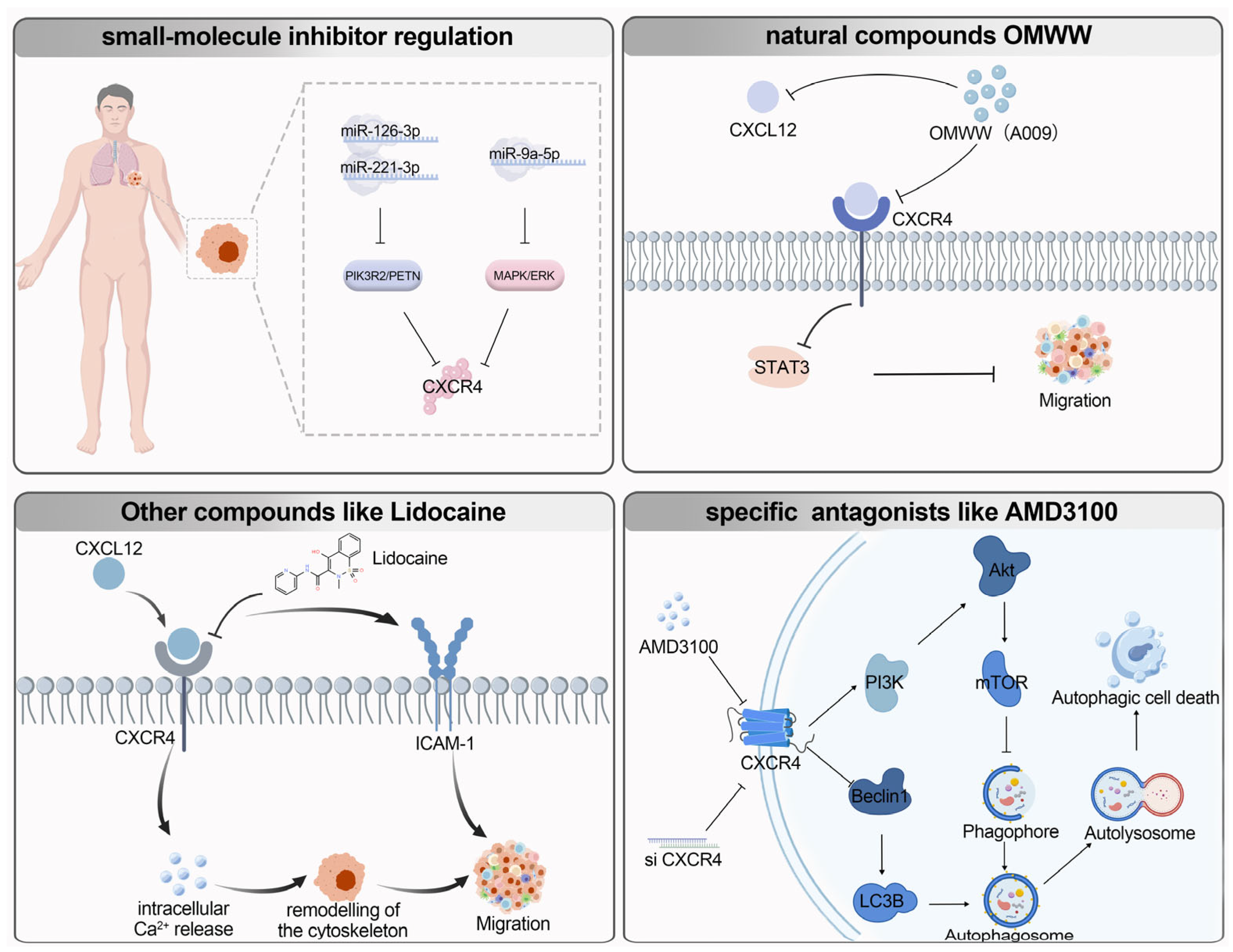
Based on a deep understanding of the CXCR4 regulatory network, various targeted therapy strategies have been developed. For example, in terms of small-molecule inhibitor regulation, Daniela Di Paolo’s team noted that co-targeting miR-126-3p and miR-221-3p inhibits PIK3R2 and PTEN, thereby blocking AKT and CXCR4 signaling pathways to reduce lung cancer growth and metastasis [94]. Similarly, miR-9a-5p targets CXCR4 to inhibit MAPK/ERK pathway activation, alleviating lung injury [90,106]. In natural compounds, Matteo Gallazzi’s team found that the A009 extract from Olive Mill Wastewater (OMWW), rich in soluble polyphenols, can reduce lung cancer cell lines migration in vivo through dual inhibition of CXCR4/CXCL12 [107]. Clinically, lidocaine disrupts the CXCL12/Ca2+ pathway, significantly slowing NSCLC A549 cell migration [108]. Furthermore, specific CXCR4 antagonists, such as AMD3100, can reduce metastasis by competitively binding to CXCR4 [109].
Combination therapy strategies also show promising results. For example, gefitinib, which upregulates CXCR4 and EMT in PC9 lung adenocarcinoma cells, relies on TGF-β1/Smad2 signaling. Blocking CXCR4 significantly inhibits gefitinib-induced migration, increasing EMT reversal in PC9 lung adenocarcinoma cells in vitro [110]. Notably, CXCR4 antagonists can reverse the pro-metastatic microenvironment induced by cisplatin, reducing metastatic-initiating cells and decreasing inflammatory factor release of CCL2 and CXCL12, respectively [111]. In radiation therapy, the CXCR4/STAT3/Slug pathway confers radiation resistance, whereas siRNA-mediated Slug knockout increases radiation sensitivity. Notably, engineered locked dimerized CXCL12 has been reported to exert radiosensitizing effects by targeting the CXCR4 axis, providing a novel strategy for enhancing radiation therapy efficacy in CXCR4-positive tumors [112], which aligns with the critical role of the CXCL12/CXCR4 axis in maintaining cancer stem cells (CSCs) and inducing tumor dissemination, while also increasing chemotherapy resistance [113]. For example, CXCR4 influences tumor cell resistance through the CXCR4/STAT3 signaling pathway in chemotherapy resistance mediated by bone marrow stromal cells in acute myeloid leukemia [114]. Recent studies have revealed the potential mechanism by which the CXCR4/STAT3/Slug signaling pathway is involved in NSCLC cell radiation resistance. Slug has been identified as the downstream effector molecule of the CXCR4/STAT3 signaling pathway in NSCLC cell radiation resistance, and CXCR4-mediated STAT3 activation is crucial for NSCLC cell radiation resistance. Upregulation of Slug via the CXCR4/STAT3 signaling pathway and siRNA-mediated downregulation can enhance the sensitivity of NSCLC cells to ionizing radiation (IR). This suggests that the CXCR4/STAT3 signaling pathway could serve as a therapeutic target to enhance NSCLC cell sensitivity to IR, offering potential for targeting CXCR4 signaling pathway inhibition and eliminating NSCLC tumor stem cells. Blocking the CXCR4/STAT3 pathway may be an effective method to enhance NSCLC cell sensitivity to IR, thereby providing beneficial assistance for NSCLC radiotherapy [115].
In immunotherapy, CXCR4 exhibits a cell-type-dependent dual role Table 1. Specifically, CXCR4 antagonists target CXCR4 expressed on immunosuppressive cells rather than tumor cells, and their combination with PD-1 inhibitors shows positive synergistic effects: this combination increases CD8+ T cell infiltration and reduces Treg proportions in the tumor microenvironment, thereby extending survival in the MC38 model. In contrast, when the proportion of CXCR4+ Tregs in peripheral blood exceeds 25%, the objective response rate of immunotherapy decreases by 42%, and progression-free survival is shortened by 5.3 months—consistent with the role of CXCR4 in mediating Treg recruitment to the tumor microenvironment and suppressing anti-tumor immunity. In terms of microenvironment remodeling, CXCR4-targeted therapy promotes the formation of tertiary lymphoid structures, increasing tertiary lymphoid structures (TLS) numbers by 3.5 per field of view and significantly enhancing antigen presentation efficiency. Additionally, in a human melanoma PES43 xenograft model expressing PD-1, the combination of the human-specific CXCR4 antagonist Pep R54 with nivolumab also demonstrated tumor growth inhibition effects [116]. Further studies indicate that the combination of CXCR4 antagonists and PD-1 blockade holds significant potential in hepatocellular carcinoma (HCC) models. Concurrent blockade of CXCR4 and PD-1 can reprogram conventional type 1 dendritic cells (cDC1s) within tumors, thereby enhancing antitumor immune responses [117]. In breast cancer, the combination of the CXCR4 antagonist balixafortide with anti-PD-1 therapy has demonstrated significant therapeutic potential. The combination therapy not only reduced tumor growth and prolonged overall survival but also increased the formation of TLS in the tumor microenvironment, as shown by histological analysis. Further single-cell RNA sequencing analysis indicated that this combination therapy reduced the expression of immune checkpoint genes and exhaustion markers in T cells, suggesting a overall reduction in myeloid-mediated immune suppression [118].
In immunotherapy prediction, particularly in NSCLC studies, CXCR4 and its interactions with the immune microenvironment have emerged as critical factors influencing the efficacy of immunotherapy. In patients with stage IA to IIB NSCLC who underwent surgery, studies have shown that CXCL12 is expressed in most NSCLC tissue sections, and its expression levels are closely associated with the degree of tumor inflammation. Specifically, the co-existence of CXCL12 and activated TILs CD4+CXCR4+CD69+ cells may influence tumor progression by shaping the immune cell population infiltrating lung adenocarcinoma [59]. In this context, CXCR4 blockade has been found to potentially increase the number of tumor-infiltrating T lymphocytes and exhibit synergistic effects with immune checkpoint inhibitors. However, high CXCR4 expression in peripheral T lymphocytes may be associated with poorer immunotherapy efficacy, suggesting that CXCR4 plays a complex role in immunotherapy. These findings highlight the dual role of CXCR4 in immunotherapy across different tumor types: it may enhance immunotherapy efficacy in some cases while potentially weakening it in others, depending on its specific function and expression pattern within the tumor microenvironment (Figure 3).

6. Outlook

In terms of disease diagnosis and treatment, the expression levels of CXCR4 may vary across different types of tumors, potentially serving as a biomarker for disease prognosis and a potential drug target [9]. In NSCLC, CXCR4 expression levels could serve as a novel tumor marker for predicting patient outcomes. Higher CXCR4 expression in NSCLC has been linked to shorter overall survival (OS) [19]. In a study of 2932 lung cancer patients, high CXCR4 expression was associated with shorter OS and disease-free survival compared to low expression. In NSCLC, poor overall survival was significantly associated with CXCR4 expression in the cell membrane and cytoplasm. The study also showed that CXCR4 expression is associated with male gender, advanced tumor stage, advanced nodular stage, distant metastasis, advanced TNM staging, and epidermal growth factor receptor expression. However, it is not associated with age, smoking history, histopathology, lymphatic invasion, or local recurrence [23]. However, the current detection of CXCR4 expression lacks a standardized system, with inconsistent immunohistochemistry interpretation criteria and mRNA quantification methods employed across different studies. Therefore, the clinical applicability of CXCR4 as a prognostic biomarker still requires validation through multicenter large-scale studies.
Given the important role of CXCR4 in NSCLC, its genetic and structural characteristics have also attracted widespread attention. Research indicates that CXCR4 is translated into five different splice variants of varying lengths, each with distinct amino acids at the N-terminal end. Since the N-terminal end is the first recognition site for chemokines, CXCR4 variants may exhibit different responses to CXCL12. Hee-Kyung Park’s team [82] explored CXCR4 variants expression in cell lines and found that most cell lines express more than one variant. The N-terminal sequence of each CXCR4 variant determines receptor expression and influences ligand recognition. Functional analyses suggest that CXCR4 variants may also interact or influence each other during CXCL12-stimulated cellular responses. These findings suggest that CXCR4 variants could have unique functional roles warranting further investigation and may pave the way for new drug interventions, particularly for lung cancer. The impact of N-terminal sequence variations among CXCR4 splice variants on ligand recognition affinity, downstream signal transduction specificity, and tumor subtype adaptability remains a critical scientific question to be urgently elucidated in this field.
Additionally, Nanako Kawaguchi’s team revealed through studies using gene-knockout mice that CXCR4 is involved in cardiac development and brain development. Mice with homozygous CXCR4 knockout died before birth. Thus, CXCR4 is a key molecule for normal development. Interestingly, CXCL12-expressing cells are present in the outflow tract, while CXCR4+ cells are found in the neural cREST. Thus, CXCR4 may be involved in the migration of neural cREST cells during normal development [119]. The core regulatory role of CXCR4 in normal physiological processes provides an important reference for reverse inference of its aberrant activation mechanisms in tumors, yet the molecular regulatory network connections between the two remain to be further elucidated.
In terms of therapeutic development, several small molecules antagonizing CXCR4 have been created [120]. The FDA-approved first CXCR4 antagonist, plerixafor (AMD3100), is currently used to mobilize hematopoietic stem cells for the treatment of non-Hodgkin lymphoma [10,119] and has been shown not to exhibit cross-resistance with T134 (another small-molecule CXCR4 inhibitor that binds to CXCR4) [121]. Similarly, MSX-122 for vascular diseases and AMD11070 for HIV treatment have completed clinical trials [10]. A C-terminally modified small cyclopeptide, LY2510924 [116], will also serve as a universal scaffold for developing CXCR4-targeted probes or therapeutic agents for tumor imaging or treatment [122]. Additionally, an anti-CXCR4 antibody, LY2624587 has been developed for targeting tumors and cancers [105,118]. Additional CXCR4 antagonists are listed in Table 2.
Current clinical application of CXCR4-targeted therapeutics remains challenged by side effects such as hematopoietic suppression and infection risk, necessitating formulation optimization (e.g., tumor microenvironment-responsive preparations) and adjustment of combination regimens to reduce systemic toxicity and enhance tumor targeting specificity. Meanwhile, the development and clinical translation of CXCR4-specific molecular imaging probes (such as 68Ga-pentixafor PET) hold promise for integrating precise patient selection with dynamic monitoring of therapeutic efficacy. Moreover, the crosstalk mechanisms between CXCR4 and signaling pathways including PI3K/AKT, MAPK/ERK, and Wnt/β-catenin provide novel insights for developing multi-target combination therapeutic strategies, which will require validation of their efficacy and safety through additional preclinical and early-phase clinical studies in the future.

7. Conclusions

CXCR4 has emerged as a promising diagnostic and therapeutic target in lung cancer due to its abnormal high expression in both NSCLC and SCLC, with significant histological subtype heterogeneity, and strong association with tumor progression. Research indicates that CXCR4 expression correlates with the invasiveness and metastatic potential of lung cancer and directly impacts patient prognosis—especially in adenosquamous carcinoma (ASC), high CXCR4 expression is closely associated with lymph node metastasis and advanced TNM staging, serving as an independent poor prognostic factor. As a crucial regulator of tumor cell migration and invasion, CXCR4 may also modulate tumor immune responses by influencing immune cell function within the tumor microenvironment, such as recruiting myeloid-derived suppressor cells and activating regulatory T cells. CXCR4 expression is regulated at transcriptional (transcription factor binding, DNA methylation), post-transcriptional (miRNA/lncRNA ceRNA network), and post-translational (phosphorylation, ubiquitination, glycosylation)multiple levels, and its expression levels can serve as a prognostic biomarker for lung cancer and represent a potential drug target. Recent research advances indicate that CXCR4-targeted therapy—including small-molecule antagonists, anti-CXCR4 antibodies, and combination strategies with chemotherapy, immunotherapy, or targeted therapy—shows promising potential in enhancing treatment efficacy and reducing tumor recurrence, offering new directions for future treatment strategies. However, the exact mechanisms of CXCR4 in lung cancer and its role as an optimal therapeutic target require further clarification.

8. Discussion

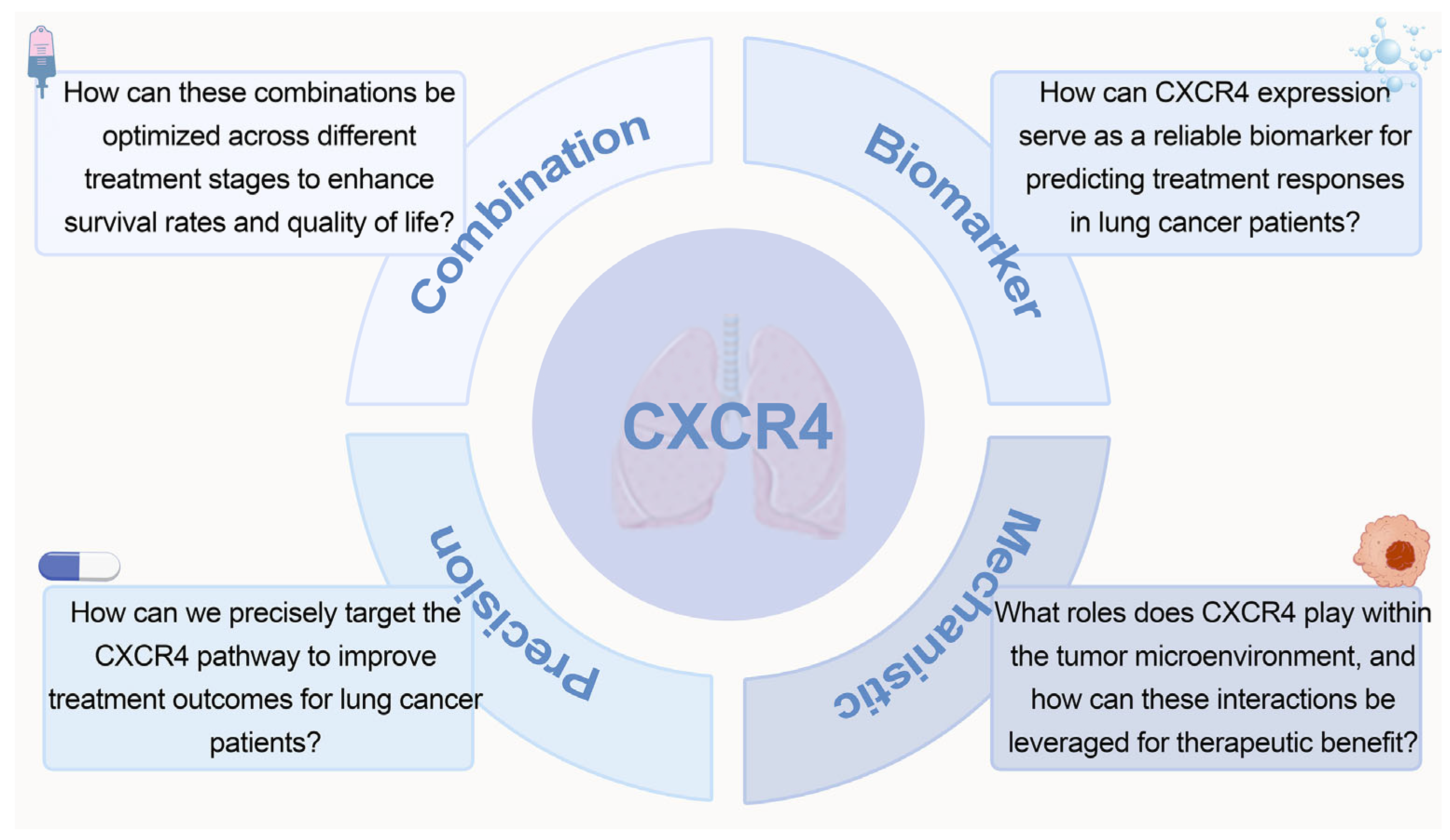
As summarized earlier, CXCR4 acts as a core regulatory hub in lung cancer, integrating multiple oncogenic processes including tumor cell proliferation, invasion, distant metastasis, tumor microenvironment (TME) remodeling, and chemoresistance, which collectively supports its potential as a translational therapeutic target. Despite this well-established theoretical basis, current research progress and clinical translation of CXCR4-targeted strategies still face multiple unresolved bottlenecks. At the basic research level, the functional specificity of CXCR4 splice variants remains undefined—the impact of N-terminal amino acid sequence variations on ligand binding affinity and downstream signal transduction lacks systematic validation, precluding explanation of differential responses to targeted therapy among patients. Simultaneously, bidirectional regulatory mechanisms between CXCR4 and stromal/immune cells in the tumor microenvironment remain poorly understood, particularly the regulatory threshold for tumor progression concerning the synergistic/competitive relationship between the CXCL12/CXCR4 axis and CXCR7. At the clinical translation level, the primary issue is the lack of a standardized system for CXCR4 expression detection, with inconsistent immunohistochemistry interpretation criteria and mRNA quantification methods across studies, limiting its clinical applicability as a prognostic biomarker. Second, current CXCR4 antagonists exhibit side effects including hematopoietic suppression and infection risk, with insufficient tumor tissue targeting, and mature solutions for toxicity reduction through formulation optimization or combination regimens have yet to be established. Furthermore, predictive models for CXCR4-targeted therapy response in lung cancer patients with different pathological subtypes and genetic backgrounds (e.g., EGFR mutations, ALK fusions) remain undeveloped, and precise identification of beneficiary populations remains a critical issue requiring urgent breakthrough. Finally, research on mechanisms of CXCR4-mediated chemoresistance in SCLC lags behind that in NSCLC, with clinical exploration of related targeted strategies still in early stages. Future studies should advance the precision application of CXCR4-targeted strategies. At the basic research level, it is necessary to thoroughly investigate the functional heterogeneity of CXCR4 splice variants and clarify their expression profiles and regulatory networks across different lung cancer subtypes. Simultaneously, through technologies such as single-cell sequencing and spatial transcriptomics, elucidate the cell-specific functions of CXCR4 in the tumor microenvironment and reveal its synergistic regulatory mechanisms with immune checkpoint molecules. In the field of technology development, clinical translation of CXCR4-specific molecular probes should be promoted. Meanwhile, optimize targeted drug design and develop tumor microenvironment-responsive novel antagonists or antibody-drug conjugates (ADCs) to enhance targeting specificity and reduce systemic toxicity. At the clinical translation level, multicenter, large-scale clinical studies are needed to validate the synergistic prognostic value of CXCR4 expression with existing clinical indicators (such as TNM staging, genetic test results) and establish standardized detection protocols. Design individualized combination therapy regimens for different lung cancer subtypes, such as combining CXCR4 antagonists with PD-1/PD-L1 inhibitors in NSCLC and with chemotherapy agents in SCLC. Future research should focus on the following key questions: First, how can the CXCR4 pathway be precisely targeted to improve patient treatment responses? Second, can CXCR4 expression serve as a reliable biomarker for predicting patient responses to specific treatments? Additionally, can the combination of CXCR4-targeted therapy with other treatment methods (such as immunotherapy) yield more significant therapeutic effects? The answers to these questions will have a significant impact on the application of CXCR4 in lung cancer treatment and may provide patients with more effective treatment options. By thoroughly exploring the mechanism of action of CXCR4 and its integration with other treatment strategies, future research holds promise for bringing new hope to lung cancer patients (Figure 4).
In summary, relying on its core regulatory role in lung cancer progression, CXCR4 remains a highly translational therapeutic target. The success of its clinical application depends on in-depth analysis of core mechanisms, effective breakthrough of technical bottlenecks, and precise optimization of clinical protocols. In the future, through interdisciplinary collaboration, it is expected to provide new treatment options for lung cancer patients and ultimately improve patient prognosis.

Author Contributions

M.L.: Writing—review and editing, Writing—original draft, Drawing figures. J.W.: Writing—original draft, Draw figures. T.D.: Writing—original draft. G.L.: Writing—original draft. J.Z. (Jiayi Zhang): Writing—original draft. Y.Z.: Writing—original draft. L.X.: Supervision, Conceptualization. J.Z. (Juanjuan Zhao): Supervision, Conceptualization, Funding acquisition. All authors have read and agreed to the published version of the manuscript.

Funding

This manuscript was supported by National Natural Science Foundation of China (82272812, 82360018, 82500673), the collaborative Innovation Center of Chinese Ministry of Education (2020-39), Key Laboratory for Cancer Prevention and treatment of Guizhou Province (QKHPT [2025]031), the Project of Guizhou Provincial Department of Science and Technology (QKHZC [2024]-127), Medical Research Union Fund for High-quality health development of Guizhou Province (2024GZYXKYJJXM0002), Program for Excellent Young Talents of Zunyi Medical University (15ZY-001). “12345 Future Talent Training Plan” of Zunyi Medical University—Future science and technology Elite talent project (ZYSE-2022-04).

Institutional Review Board Statement

Not applicable.

Informed Consent Statement

Not applicable.

Data Availability Statement

No new data were created or analyzed in this study. Data sharing is not applicable to this article.

Acknowledgments

In the course of preparing this manuscript, the authors utilized DouBao (version: 11.8.0) and Kimi (https://kimi.nuantang.net) to assist with language polishing, grammar refinement, structural optimization, and spelling verification. All generated outputs have been carefully reviewed, revised, and edited by the authors, who hereby assume full responsibility for the accuracy, integrity, and content of this publication.

Conflicts of Interest

The authors declare no conflicts of interest.

Abbreviations

NSCLCnon-small cell lung cancer
SCLCsmall cell lung cancer
CXCR4C-X-C chemokine receptor 4
GPCRG protein-coupled receptor
SDF-1stromal cell-derived factor 1
DRY motifAspartate-Arginine-Tyrosine triplet
PI3KPhosphoinositide 3-kinase
AKTProtein kinase B
JNKc-Jun N-terminal kinase
TMEtumor microenvironment
TCR and BCRT cell and B cell receptors
IGSimmune gene surrender
EMTepithelial–mesenchymal transition
LMP1EB virus-encoded protein
LINC00922Long Intergenic Non-Protein Coding RNA 00922
PKCprotein kinase C
GRK6G protein-coupled receptor kinase 6
HIV-1Human Immunodeficiency Virus type 1
ASCadenocarcinoma-squamous cell carcinoma
DFSdisease-free survival
OSoverall survival rates
MIFMacrophage migration inhibitory factor
MDSCMyeloid-derived suppressor cells
MICsmetastasis-initiating cells
OMWWOlive Mill Wastewater
CSCscancer stem cells
IRionizing radiation
TLStertiary lymphoid structures
HCChepatocellular carcinoma
cDC1stype 1 dendritic cells

References

  1. Smolarz, B.; Łukasiewicz, H.; Samulak, D.; Piekarska, E.; Kołaciński, R.; Romanowicz, H. Lung Cancer—Epidemiology, Pathogenesis, Treatment and Molecular Aspect (Review of Literature). Int. J. Mol. Sci. 2025, 26, 2049. [Google Scholar] [CrossRef] [PubMed]
  2. Abdelaziz, H.M.; Gaber, M.; Abd-Elwakil, M.M.; Mabrouk, M.T.; Elgohary, M.M.; Kamel, N.M.; Kabary, D.M.; Freag, M.S.; Samaha, M.W.; Mortada, S.M.; et al. Inhalable particulate drug delivery systems for lung cancer therapy: Nanoparticles, microparticles, nanocomposites and nanoaggregates. J. Control. Release 2018, 269, 374–392. [Google Scholar] [CrossRef] [PubMed]
  3. Zhao, D.; Deshpande, R.; Wu, K.; Tyagi, A.; Sharma, S.; Wu, S.-Y.; Xing, F.; O’NEill, S.; Ruiz, J.; Lyu, F.; et al. Identification of TUBB3 as an immunotherapy target in lung cancer by genome wide in vivo CRISPR screening. Neoplasia 2025, 60, 101100. [Google Scholar] [CrossRef] [PubMed]
  4. Jin, M.; Huang, Y.; Li, B.; Wang, Y.; Li, Y.; Chen, Z.; Tang, Z.; Liu, C.; Zhang, L.; Yuan, X.; et al. Genetic Regulation of Alternative Polyadenylation Provides Novel Insights into Molecular Mechanisms Underlying Non-small Cell Lung Cancer. Adv. Sci. 2025, 12, e2502008. [Google Scholar] [CrossRef]
  5. Cao, Z.; Meng, Z.; Li, J.; Tian, Y.; Lu, L.; Wang, A.; Huang, J.; Wang, J.; Sun, J.; Chen, L.; et al. Interferon-γ-stimulated antigen-presenting cancer-associated fibroblasts hinder neoadjuvant chemoimmunotherapy efficacy in lung cancer. Cell Rep. Med. 2025, 6, 102017. [Google Scholar] [CrossRef]
  6. Li, Y.; Yan, B.; He, S. Advances and challenges in the treatment of lung cancer. Biomed. Pharmacother. 2023, 169, 115891. [Google Scholar] [CrossRef]
  7. Katoh, M.; Katoh, M. Integrative genomic analyses of CXCR4: Transcriptional regulation of CXCR4 based on TGFβ, Nodal, Activin signaling and POU5F1, FOXA2, FOXC2, FOXH1, SOX17, and GFI1 transcription factors. Int. J. Oncol. 2010, 36, 415–420. [Google Scholar] [CrossRef]
  8. Mezzapelle, R.; Leo, M.; Caprioglio, F.; Colley, L.S.; Lamarca, A.; Sabatino, L.; Colantuoni, V.; Crippa, M.P.; Bianchi, M.E. CXCR4/CXCL12 Activities in the Tumor Microenvironment and Implications for Tumor Immunotherapy. Cancers 2022, 14, 2314. [Google Scholar] [CrossRef]
  9. Bao, S.; Darvishi, M.; Amin, A.H.; Al-Haideri, M.T.; Patra, I.; Kashikova, K.; Ahmad, I.; Alsaikhan, F.; Al-Qaim, Z.H.; Al-Gazally, M.E.; et al. CXC chemokine receptor 4 (CXCR4) blockade in cancer treatment. J. Cancer Res. Clin. Oncol. 2023, 149, 7945–7968. [Google Scholar] [CrossRef]
  10. Yang, J.; Tian, E.; Chen, L.; Liu, Z.; Ren, Y.; Mao, W.; Zhang, Y.; Zhang, J. Development and therapeutic perspectives of CXCR4 antagonists for disease therapy. Eur. J. Med. Chem. 2024, 275, 116594. [Google Scholar] [CrossRef]
  11. Zhang, Z.; Zhang, H.; Zheng, L.; Chen, S.; Du, S.; Xiao, J.; Patel, D.J. CXCR4 mediated recognition of HIV envelope spike and inhibition by CXCL12. Nat. Commun. 2025, 16, 8653. [Google Scholar] [CrossRef] [PubMed]
  12. Penfield, J.; Zhang, L. Interaction and dynamics of chemokine receptor CXCR4 binding with CXCL12 and hBD-3. Commun. Chem. 2024, 7, 205. [Google Scholar] [CrossRef]
  13. Kim, H.-T.; Jeong, J.-Y.; Huh, W.-K. Regulation of CXCR4 function by S1P1 through heteromerization. Cell Commun. Signal. 2025, 23, 111. [Google Scholar] [CrossRef] [PubMed]
  14. Murdoch, C.; Finn, A. Chemokine receptors and their role in inflammation and infectious diseases. Blood 2000, 95, 3032–3043. [Google Scholar] [CrossRef] [PubMed]
  15. Zou, Y.-R.; Kottmann, A.H.; Kuroda, M.; Taniuchi, I.; Littman, D.R. Function of the chemokine receptor CXCR4 in haematopoiesis and in cerebellar development. Nature 1998, 393, 595–599. [Google Scholar] [CrossRef]
  16. Wang, M.; Yang, X.; Wei, M.; Wang, Z. The Role of CXCL12 Axis in Lung Metastasis of Colorectal Cancer. J. Cancer 2018, 9, 3898–3903. [Google Scholar] [CrossRef]
  17. Kallikourdis, M.; Trovato, A.E.; Anselmi, F.; Sarukhan, A.; Roselli, G.; Tassone, L.; Badolato, R.; Viola, A. The CXCR4 mutations in WHIM syndrome impair the stability of the T-cell immunologic synapse. Blood 2013, 122, 666–673. [Google Scholar] [CrossRef]
  18. Orimo, A.; Gupta, P.B.; Sgroi, D.C.; Arenzana-Seisdedos, F.; Delaunay, T.; Naeem, R.; Carey, V.J.; Richardson, A.L.; Weinberg, R.A. Stromal fibroblasts present in invasive human breast carcinomas promote tumor growth and angiogenesis through elevated SDF-1/CXCL12 secretion. Cell 2005, 121, 335–348. [Google Scholar] [CrossRef]
  19. Woodard, L.E.; Nimmagadda, S. CXCR4-based imaging agents. J. Nucl. Med. 2011, 52, 1665–1669. [Google Scholar] [CrossRef]
  20. Righetti, A.; Giulietti, M.; Šabanović, B.; Occhipinti, G.; Principato, G.; Piva, F. CXCL12 and Its Isoforms: Different Roles in Pancreatic Cancer? J. Oncol. 2019, 2019, 9681698. [Google Scholar] [CrossRef]
  21. English, E.J.; Mahn, S.A.; Marchese, A. Endocytosis is required for CXC chemokine receptor type 4 (CXCR4)-mediated AKT activation and antiapoptotic signaling. J. Biol. Chem. 2018, 293, 11470–11480. [Google Scholar] [CrossRef] [PubMed]
  22. Laguri, C.; Sadir, R.; Rueda, P.; Baleux, F.; Gans, P.; Arenzana-Seisdedos, F.; Lortat-Jacob, H. The novel CXCL12γ isoform encodes an unstructured cationic domain which regulates bioactivity and interaction with both glycosaminoglycans and CXCR4. PLoS ONE 2007, 2, e1110. [Google Scholar] [CrossRef] [PubMed]
  23. Yang, Y.; Li, J.; Lei, W.; Wang, H.; Ni, Y.; Liu, Y.; Yan, H.; Tian, Y.; Wang, Z.; Yang, Z.; et al. CXCL12-CXCR4/CXCR7 Axis in Cancer: From Mechanisms to Clinical Applications. Int. J. Biol. Sci. 2023, 19, 3341–3359. [Google Scholar] [CrossRef] [PubMed]
  24. Zhang, C.; Li, J.; Han, Y.; Jiang, J. A meta-analysis for CXCR4 as a prognostic marker and potential drug target in non-small cell lung cancer. Drug Des. Dev. Ther. 2015, 9, 3267–3278. [Google Scholar] [CrossRef]
  25. Feng, Y.; Broder, C.C.; Kennedy, P.E.; Berger, E.A. HIV-1 entry cofactor: Functional cDNA cloning of a seven-transmembrane, G protein-coupled receptor. Science 1996, 272, 872–877. [Google Scholar] [CrossRef]
  26. Donzella, G.A.; Schols, D.; Lin, S.W.; Esté, J.A.; Nagashima, K.A.; Maddon, P.J.; Allaway, G.P.; Sakmar, T.P.; Henson, G.; De Clercq, E.; et al. AMD3100, a small molecule inhibitor of HIV-1 entry via the CXCR4 co-receptor. Nat. Med. 1998, 4, 72–77. [Google Scholar] [CrossRef]
  27. Bernhagen, J.; Krohn, R.; Lue, H.; Gregory, J.L.; Zernecke, A.; Koenen, R.R.; Dewor, M.; Georgiev, I.; Schober, A.; Leng, L.; et al. MIF is a noncognate ligand of CXC chemokine receptors in inflammatory and atherogenic cell recruitment. Nat. Med. 2007, 13, 587–596. [Google Scholar] [CrossRef]
  28. Wu, B.; Chien, E.Y.T.; Mol, C.D.; Fenalti, G.; Liu, W.; Katritch, V.; Abagyan, R.; Brooun, A.; Wells, P.; Bi, F.C.; et al. Structures of the CXCR4 chemokine GPCR with small-molecule and cyclic peptide antagonists. Science 2010, 330, 1066–1071. [Google Scholar] [CrossRef]
  29. Peled, A.; Tavor, S. Role of CXCR4 in the pathogenesis of acute myeloid leukemia. Theranostics 2013, 3, 34–39. [Google Scholar] [CrossRef]
  30. Daniel, S.K.; Seo, Y.D.; Pillarisetty, V.G. The CXCL12-CXCR4/CXCR7 axis as a mechanism of immune resistance in gastrointestinal malignancies. Semin Cancer Biol. 2020, 65, 176–188. [Google Scholar] [CrossRef]
  31. Buck, A.K.; Serfling, S.E.; Lindner, T.; Hänscheid, H.; Schirbel, A.; Hahner, S.; Fassnacht, M.; Einsele, H.; Werner, R.A. CXCR4-targeted theranostics in oncology. Eur. J. Nucl. Med. Mol. Imaging 2022, 49, 4133–4144. [Google Scholar] [CrossRef] [PubMed]
  32. Korbecki, J.; Bosiacki, M.; Kupnicka, P.; Barczak, K.; Chlubek, D.; Baranowska-Bosiacka, I. CXCR4 as a therapeutic target in acute myeloid leukemia. Leukemia 2024, 38, 2303–2317. [Google Scholar] [CrossRef] [PubMed]
  33. Lapidot, T.; Kollet, O. The essential roles of the chemokine SDF-1 and its receptor CXCR4 in human stem cell homing and repopulation of transplanted immune-deficient NOD/SCID and NOD/SCID/B2mnull mice. Leukemia 2002, 16, 1992–2003. [Google Scholar] [CrossRef]
  34. Eash, K.J.; Means, J.M.; White, D.W.; Link, D.C. CXCR4 is a key regulator of neutrophil release from the bone marrow under basal and stress granulopoiesis conditions. Blood 2009, 113, 4711–4719. [Google Scholar] [CrossRef] [PubMed]
  35. Cencioni, C.; Capogrossi, M.C.; Napolitano, M. The SDF-1/CXCR4 axis in stem cell preconditioning. Cardiovasc. Res. 2012, 94, 400–407. [Google Scholar] [CrossRef]
  36. Wu, X.; Qian, L.; Zhao, H.; Lei, W.; Liu, Y.; Xu, X.; Li, J.; Yang, Z.; Wang, D.; Zhang, Y.; et al. CXCL12/CXCR4: An amazing challenge and opportunity in the fight against fibrosis. Ageing Res. Rev. 2023, 83, 101809. [Google Scholar] [CrossRef]
  37. Jung, M.-J.; Rho, J.-K.; Kim, Y.-M.; Jung, J.E.; Jin, Y.B.; Ko, Y.-G.; Lee, J.-S.; Lee, S.-J.; Lee, J.C.; Park, M.-J. Upregulation of CXCR4 is functionally crucial for maintenance of stemness in drug-resistant non-small cell lung cancer cells. Oncogene 2013, 32, 209–221. [Google Scholar] [CrossRef]
  38. Quintana, A.M.; Liu, F.; O’Rourke, J.P.; Ness, S.A. Identification and regulation of c-Myb target genes in MCF-7 cells. BMC Cancer 2011, 11, 30. [Google Scholar] [CrossRef]
  39. Yang, Q.; Wu, H.; Wang, H.; Li, Y.; Zhang, L.; Zhu, L.; Wang, W.; Zhou, J.; Fu, Y.; Chen, S.; et al. N-terminal polypeptide derived from vMIP-II exerts its antitumor activity by inhibiting the CXCR4 pathway in human glioma. Int. J. Oncol. 2017, 50, 1160–1174. [Google Scholar] [CrossRef]
  40. Lin, X.; Yang, Y.; Ji, Y.; Wang, G.; Xu, W.; Wang, B.; Guo, H.; Ren, J.; Yan, J.; Wang, N. miR-135a-5p/SP1 Axis Regulates Spinal Astrocyte Proliferation and Migration. Neuroscience 2023, 515, 12–24. [Google Scholar] [CrossRef]
  41. Yang, K.; Zhi, Y.; Duan, Y.; Zhou, X.; Yin, X.; Guan, G.; Zhang, H.; Dong, Q. NF-κB signaling pathway confers neuroblastoma cells migration and invasion ability via the regulation of CXCR4. Med. Sci. Monit. 2014, 20, 2746–2752. [Google Scholar] [CrossRef]
  42. Jin, L.; Tabe, Y.; Konoplev, S.; Xu, Y.; Leysath, C.E.; Lu, H.; Kimura, S.; Ohsaka, A.; Rios, M.-B.; Calvert, L.; et al. CXCR4 up-regulation by imatinib induces chronic myelogenous leukemia (CML) cell migration to bone marrow stroma and promotes survival of quiescent CML cells. Mol. Cancer Ther. 2008, 7, 48–58. [Google Scholar] [CrossRef]
  43. Jin, Z.; Xiang, R.; Dai, J.; Wang, Y.; Xu, Z. HIF-1α mediates CXCR4 transcription to activate the AKT/mTOR signaling pathway and augment the viability and migration of activated B cell-like diffuse large B-cell lymphoma cells. Mol. Carcinog. 2023, 62, 676–684. [Google Scholar] [CrossRef]
  44. Zhi, Y.; Lu, H.; Duan, Y.; Sun, W.; Guan, G.; Dong, Q.; Yang, C. Involvement of the nuclear factor-κB signaling pathway in the regulation of CXC chemokine receptor-4 expression in neuroblastoma cells induced by tumor necrosis factor-α. Int. J. Mol. Med. 2015, 35, 349–357. [Google Scholar] [CrossRef] [PubMed] [PubMed Central]
  45. Liu, L.; Rascón, I.A.; Lin, D.; Ni, Y.; Dong, X.; Xue, H.; Lin, Y.-Y.; Haegert, A.; Sar, F.; Peacock, J.W.; et al. CXCR4-LASP1-G9a-Snail axis drives NEPC transdifferentiation via induction of EMT and downregulation of REST. Cell Genom. 2025, 5, 100916. [Google Scholar] [CrossRef]
  46. Chen, N.; Sun, Y.; Luo, P.; Tang, Y.; Fan, Y.; Han, L.; Wang, K. Association of CXCR4 gene expression and promoter methylation with chronic hepatitis B-related fibrosis/cirrhosis. Int. Immunopharmacol. 2024, 139, 112686. [Google Scholar] [CrossRef]
  47. Sato, N.; Matsubayashi, H.; Fukushima, N.; Goggins, M. The chemokine receptor CXCR4 is regulated by DNA methylation in pancreatic cancer. Cancer Biol. Ther. 2005, 4, 77–83. [Google Scholar] [CrossRef][Green Version]
  48. Kim, J.-H.; Shim, J.-W.; Eum, D.-Y.; Kim, S.D.; Choi, S.H.; Yang, K.; Heo, K.; Park, M.-T. Downregulation of UHRF1 increases tumor malignancy by activating the CXCR4/AKT-JNK/IL-6/Snail signaling axis in hepatocellular carcinoma cells. Sci. Rep. 2017, 7, 2798. [Google Scholar] [CrossRef]
  49. Reyes, M.E.; Pulgar, V.; Vivallo, C.; Ili, C.G.; Mora-Lagos, B.; Brebi, P. Epigenetic modulation of cytokine expression in gastric cancer: Influence on angiogenesis, metastasis and chemoresistance. Front. Immunol. 2024, 15, 1347530. [Google Scholar] [CrossRef]
  50. Al-Souhibani, N.; Al-Ghamdi, M.; Al-Ahmadi, W.; Khabar, K.S. Posttranscriptional control of the chemokine receptor CXCR4 expression in cancer cells. Carcinogenesis 2014, 35, 1983–1992. [Google Scholar] [CrossRef]
  51. Yu, X.; Shi, W.; Zhang, Y.; Wang, X.; Sun, S.; Song, Z.; Liu, M.; Zeng, Q.; Cui, S.; Qu, X. CXCL12/CXCR4 axis induced miR-125b promotes invasion and confers 5-fluorouracil resistance through enhancing autophagy in colorectal cancer. Sci. Rep. 2017, 7, 42226. [Google Scholar] [CrossRef] [PubMed]
  52. Wald, O. CXCR4 Based Therapeutics for Non-Small Cell Lung Cancer (NSCLC). J. Clin. Med. 2018, 7, 303. [Google Scholar] [CrossRef] [PubMed]
  53. Wang, W.; Zhang, Y.; Liu, W.; Xiao, H.; Zhang, Q.; Wang, J.; Luo, B. LMP1–miR-146a–CXCR4 axis regulates cell proliferation, apoptosis and metastasis. Virus Res. 2019, 270, 197654. [Google Scholar] [CrossRef] [PubMed]
  54. Liang, Z.; Wu, H.; Reddy, S.; Zhu, A.; Wang, S.; Blevins, D.; Yoon, Y.; Zhang, Y.; Shim, H. Blockade of invasion and metastasis of breast cancer cells via targeting CXCR4 with an artificial microRNA. Biochem. Biophys. Res. Commun. 2007, 363, 542–546. [Google Scholar] [CrossRef]
  55. Liu, F.; Yang, B. Double-Targeted Knockdown of miR-21 and CXCR4 Inhibits Malignant Glioma Progression by Suppression of the PI3K/AKT and Raf/MEK/ERK Pathways. BioMed Res. Int. 2020, 2020, 7930160. [Google Scholar] [CrossRef]
  56. Bhaumik, D.; Scott, G.K.; Schokrpur, S.; Patil, C.K.; Campisi, J.; Benz, C.C. Expression of microRNA-146 suppresses NF-κB activity with reduction of metastatic potential in breast cancer cells. Oncogene 2008, 27, 5643–5647. [Google Scholar] [CrossRef]
  57. Guo, W.; Huai, Q.; Zhou, B.; Guo, L.; Sun, L.; Xue, X.; Tan, F.; Xue, Q.; Gao, S.; He, J. Comprehensive analysis of the immunological implication and prognostic value of CXCR4 in non-small cell lung cancer. Cancer Immunol. Immunother. 2023, 72, 1029–1045. [Google Scholar] [CrossRef]
  58. Scala, S. Molecular Pathways: Targeting the CXCR4CXCL12 Axis—Untapped Potential in the Tumor Microenvironment. Clin. Cancer Res. 2015, 21, 4278–4285. [Google Scholar] [CrossRef]
  59. Di Paolo, D.; Pontis, F.; Moro, M.; Centonze, G.; Bertolini, G.; Milione, M.; Mensah, M.; Segale, M.; Petraroia, I.; Borzi, C.; et al. Cotargeting of miR-126-3p and miR-221-3p inhibits PIK3R2 and PTEN, reducing lung cancer growth and metastasis by blocking AKT and CXCR4 signalling. Mol. Oncol. 2021, 15, 2969–2988. [Google Scholar] [CrossRef]
  60. Li, Z.; Li, N.; Wu, M.; Li, X.; Luo, Z.; Wang, X. Expression of miR-126 suppresses migration and invasion of colon cancer cells by targeting CXCR4. Mol. Cell. Biochem. 2013, 381, 233–242. [Google Scholar] [CrossRef]
  61. Yuan, W.; Guo, Y.-Q.; Li, X.-Y.; Deng, M.-Z.; Shen, Z.-H.; Bo, C.-B.; Dai, Y.-F.; Huang, M.-Y.; Yang, Z.-Y.; Quan, Y.-S.; et al. MicroRNA-126 inhibits colon cancer cell proliferation and invasion by targeting the chemokine (C-X-C motif) receptor 4 and Ras homolog gene family, member A, signaling pathway. Oncotarget 2016, 7, 60230–60244. [Google Scholar] [CrossRef] [PubMed]
  62. Wang, W.-T.; Ye, H.; Wei, P.-P.; Han, B.-W.; He, B.; Chen, Z.H.; Chen, Y.-Q. LncRNAs H19 and HULC, activated by oxidative stress, promote cell migration and invasion in cholangiocarcinoma through a ceRNA manner. J. Hematol. Oncol. 2016, 9, 117. [Google Scholar] [CrossRef] [PubMed]
  63. Xu, J.; Fu, L.; Deng, J.; Zhang, J.; Zou, Y.; Liao, L.; Ma, X.; Li, Z.; Xu, Y.; Xu, Y.; et al. miR-301a Deficiency Attenuates the Macrophage Migration and Phagocytosis through YY1/CXCR4 Pathway. Cells 2022, 11, 3952. [Google Scholar] [CrossRef]
  64. Mei, H.; Luo, Q.; Weng, J.; Hao, J.; Cai, J.; Zhou, R.; Bian, C.; Ye, Y.; Luo, S.; Wen, Y. The miR-1269a/PCDHGA9/CXCR4/β-catenin pathway promotes colorectal cancer invasion and metastasis. Cell. Mol. Biol. Lett. 2024, 29, 144, Erratum in Cell. Mol. Biol. Lett. 2025, 30, 17. https://doi.org/10.1186/s11658-025-00688-9. [Google Scholar] [CrossRef]
  65. Wang, X.; Cui, Z.; Chen, X.; Luo, Q.; Jiang, Z.; Liu, X.; Huang, Y.; Jiang, J.; Chen, S.; Qiu, J.; et al. The CXCR4/miR-1910-5p/MMRN2 Axis Is Involved in Corneal Neovascularization by Affecting Vascular Permeability. Investig. Opthalmol. Vis. Sci. 2023, 64, 10. [Google Scholar] [CrossRef]
  66. Liang, T.; Wang, B.; Li, J.; Liu, Y. LINC00922 Accelerates the Proliferation, Migration and Invasion of Lung Cancer Via the miRNA-204/CXCR4 Axis. Med. Sci. Monit. 2019, 25, 5075–5086. [Google Scholar] [CrossRef]
  67. Wu, Y.; Shen, Q.W.; Niu, Y.X.; Chen, X.Y.; Liu, H.W.; Shen, X.Y. LncNORAD interference inhibits tumor growth and lung cancer cell proliferation, invasion and migration by down-regulating CXCR4 to suppress RhoA/ROCK signaling pathway. Eur. Rev. Med. Pharmacol. Sci. 2020, 24, 5446–5455. [Google Scholar] [CrossRef]
  68. Wan, Y.; Yao, Z.; Chen, W.; Li, D. The lncRNA NORAD/miR-520a-3p Facilitates Malignancy in Non-Small Cell Lung Cancer via PI3K/AKT/mTOR Signaling Pathway. OncoTargets Ther. 2020, 13, 1533–1544. [Google Scholar] [CrossRef]
  69. Elhassan, G.; Bu, X.; Liu, J.; Hou, S.; Yan, J.; Lei, H. LncRNA MEG3/CTCF-CXCR4 axis functions in the regulation of breast cancer cell migration. Non-Coding RNA Res. 2025, 14, 117–128. [Google Scholar] [CrossRef]
  70. Yu, W.; Ding, J.; He, M.; Chen, Y.; Wang, R.; Han, Z.; Xing, E.Z.; Zhang, C.; Yeh, S. Estrogen receptor β promotes the vasculogenic mimicry (VM) and cell invasion via altering the lncRNA-MALAT1/miR-145-5p/NEDD9 signals in lung cancer. Oncogene 2019, 38, 1225–1238. [Google Scholar] [CrossRef]
  71. Siegfried, J.M.; Gubish, C.T.; Rothstein, M.E.; Henry, C.; Stabile, L.P. Combining the multitargeted tyrosine kinase inhibitor vandetanib with the antiestrogen fulvestrant enhances its antitumor effect in non-small cell lung cancer. J. Thorac. Oncol. 2012, 7, 485–495. [Google Scholar] [CrossRef] [PubMed]
  72. Liu, S.; Hu, C.; Li, M.; An, J.; Zhou, W.; Guo, J.; Xiao, Y. Estrogen receptor beta promotes lung cancer invasion via increasing CXCR4 expression. Cell Death Dis. 2022, 13, 70. [Google Scholar] [CrossRef] [PubMed]
  73. Wu, S.; Luo, X.; Liu, Y.; Gao, J. AMSC/CXCR4-derived exosomes and miRNA-320 regulate pathological angiogenesis in diabetes. Ir. J. Med. Sci. 2025, 194, 2127–2138. [Google Scholar] [CrossRef] [PubMed]
  74. Busillo, J.M.; Armando, S.; Sengupta, R.; Meucci, O.; Bouvier, M.; Benovic, J.L. Site-specific phosphorylation of CXCR4 is dynamically regulated by multiple kinases and results in differential modulation of CXCR4 signaling. J. Biol. Chem. 2010, 285, 7805–7817. [Google Scholar] [CrossRef]
  75. Cronshaw, D.G.; Nie, Y.; Waite, J.; Zou, Y.-R. An essential role of the cytoplasmic tail of CXCR4 in G-protein signaling and organogenesis. PLoS ONE 2010, 5, e15397. [Google Scholar] [CrossRef]
  76. D’aGostino, G.; Artinger, M.; Locati, M.; Perez, L.; Legler, D.F.; Bianchi, M.E.; Rüegg, C.; Thelen, M.; Marchese, A.; Rocchi, M.B.L.; et al. β-Arrestin1 and β-Arrestin2 Are Required to Support the Activity of the CXCL12/HMGB1 Heterocomplex on CXCR4. Front. Immunol. 2020, 11, 550824. [Google Scholar] [CrossRef]
  77. Zhuo, Y.; Crecelius, J.M.; Marchese, A. G protein–coupled receptor kinase phosphorylation of distal C-tail sites specifies βarrestin1-mediated signaling by chemokine receptor CXCR4. J. Biol. Chem. 2022, 298, 102351. [Google Scholar] [CrossRef]
  78. Marchese, A.; Benovic, J.L. Agonist-promoted ubiquitination of the G protein-coupled receptor CXCR4 mediates lysosomal sorting. J. Biol. Chem. 2001, 276, 45509–45512. [Google Scholar] [CrossRef]
  79. Zhang, H.-G.; Guo, J.; Yuan, Y.; Zuo, Y.; Liu, J.; Zhu, L.; Miao, Y.; Chen, X.; Jin, L.; Huang, F.; et al. Ubiquitin E3 Ligase c-Cbl Is a Host Negative Regulator of Nef Protein of HIV-1. Front. Microbiol. 2020, 11, 597972. [Google Scholar] [CrossRef]
  80. Freedman, N.J.; Shenoy, S.K. Regulation of inflammation by β-arrestins: Not just receptor tales. Cell. Signal. 2018, 41, 41–45. [Google Scholar] [CrossRef] [PubMed] [PubMed Central]
  81. Saotome, K.; McGoldrick, L.L.; Ho, J.-H.; Ramlall, T.F.; Shah, S.; Moore, M.J.; Kim, J.H.; Leidich, R.; Olson, W.C.; Franklin, M.C. Structural insights into CXCR4 modulation and oligomerization. Nat. Struct. Mol. Biol. 2025, 32, 315–325. [Google Scholar] [CrossRef]
  82. Park, H.-K.; Nguyen, L.P.; Nguyen, T.U.; Cho, M.; Nguyen, H.T.; Hurh, S.; Kim, H.-R.; Seong, J.Y.; Lee, C.S.; Ham, B.-J.; et al. The N-terminus of CXCR4 splice variants determines expression and functional properties. PLoS ONE 2023, 18, e0283015. [Google Scholar] [CrossRef]
  83. Santagata, S.; Ieranò, C.; Trotta, A.M.; Capiluongo, A.; Auletta, F.; Guardascione, G.; Scala, S. CXCR4 and CXCR7 Signaling Pathways: A Focus on the Cross-Talk Between Cancer Cells and Tumor Microenvironment. Front. Oncol. 2021, 11, 591386. [Google Scholar] [CrossRef] [PubMed]
  84. Eckert, J.J.; Porter, R.; Watkins, A.J.; Burt, E.; Brooks, S.; Leese, H.J.; Humpherson, P.G.; Cameron, I.T.; Fleming, T.P. Metabolic induction and early responses of mouse blastocyst developmental programming following maternal low protein diet affecting life-long health. PLoS ONE 2012, 7, e52791. [Google Scholar] [CrossRef]
  85. Zhang, C.; Zhu, R.; Cao, Q.; Yang, X.; Huang, Z.; An, J. Discoveries and developments of CXCR4-targeted HIV-1 entry inhibitors. Exp. Biol. Med. 2020, 245, 477–485. [Google Scholar] [CrossRef] [PubMed]
  86. Roumeliotou, A.; Pantazaka, E.; Xagara, A.; Dimitrakopoulos, F.-I.; Koutras, A.; Christopoulou, A.; Kourelis, T.; Aljarba, N.H.; Alkahtani, S.; Koinis, F.; et al. Phenotypic Characterization of Circulating Tumor Cells Isolated from Non-Small and Small Cell Lung Cancer Patients. Cancers 2022, 15, 171. [Google Scholar] [CrossRef]
  87. Zhu, Q.; Luo, R.; Gu, J.; Hou, Y.; Chen, Z.; Xu, F.; Wang, L.; Mao, W.; Lu, C.; Ge, D. High CXCR4 Expression Predicts a Poor Prognosis in Resected Lung Adenosquamous Carcinoma. J. Cancer 2020, 11, 810–818. [Google Scholar] [CrossRef]
  88. Otsuka, S.; Klimowicz, A.C.; Kopciuk, K.; Petrillo, S.K.; Konno, M.; Hao, D.; Muzik, H.; Stolte, E.; Boland, W.; Morris, D.; et al. CXCR4 overexpression is associated with poor outcome in females diagnosed with stage IV non-small cell lung cancer. J. Thorac. Oncol. 2011, 6, 1169–1178. [Google Scholar] [CrossRef]
  89. Fung, A.S.; Kopciuk, K.; Dean, M.L.; D’silva, A.; Otsuka, S.; Klimowicz, A.; Hao, D.; Morris, D.; Bebb, D.G. CXCR4 expression in lung carcinogenesis: Evaluating gender-specific differences in survival outcomes based on CXCR4 expression in early stage non-small cell lung cancer patients. PLoS ONE 2021, 16, e0241240. [Google Scholar] [CrossRef]
  90. Qiu, L.; Xu, Y.; Xu, H.; Yu, B. The clinicopathological and prognostic value of CXCR4 expression in patients with lung cancer: A meta-analysis. BMC Cancer 2022, 22, 681. [Google Scholar] [CrossRef]
  91. Panneerselvam, J.; Jin, J.; Shanker, M.; Lauderdale, J.; Bates, J.; Wang, Q.; Zhao, Y.D.; Archibald, S.J.; Hubin, T.J.; Ramesh, R. IL-24 inhibits lung cancer cell migration and invasion by disrupting the SDF-1/CXCR4 signaling axis. PLoS ONE 2015, 10, e0122439. [Google Scholar] [CrossRef] [PubMed]
  92. Ouyang, G.; Wang, Z.; Fang, X.; Liu, J.; Yang, C.J. Molecular signaling of the epithelial to mesenchymal transition in generating and maintaining cancer stem cells. Cell. Mol. Life Sci. 2010, 67, 2605–2618. [Google Scholar] [CrossRef] [PubMed]
  93. Jäger, B.; Klatt, D.; Plappert, L.; Golpon, H.; Lienenklaus, S.; Barbosa, P.D.; Schambach, A.; Prasse, A. CXCR4/MIF axis amplifies tumor growth and epithelial-mesenchymal interaction in non-small cell lung cancer. Cell. Signal. 2020, 73, 109672. [Google Scholar] [CrossRef] [PubMed]
  94. Wang, Z.; Sun, J.; Feng, Y.; Tian, X.; Wang, B.; Zhou, Y. Oncogenic roles and drug target of CXCR4/CXCL12 axis in lung cancer and cancer stem cell. Tumor Biol. 2016, 37, 8515–8528. [Google Scholar] [CrossRef]
  95. Dubrovska, A.; Cojoc, M.; Peitzsch, C.; Trautmann, F.; Polishchuk, L.; Telegeev, G.D. Emerging targets in cancer management: Role of the CXCL12/CXCR4 axis. OncoTargets Ther. 2013, 6, 1347–1361. [Google Scholar] [CrossRef]
  96. Richard, C.L.; Tan, E.Y.; Blay, J. Adenosine upregulates CXCR4 and enhances the proliferative and migratory responses of human carcinoma cells to CXCL12/SDF-1α. Int. J. Cancer 2006, 119, 2044–2053. [Google Scholar] [CrossRef]
  97. Allard, B.; Turcotte, M.; Stagg, J. CD73-generated adenosine: Orchestrating the tumor-stroma interplay to promote cancer growth. J. Biomed. Biotechnol. 2012, 2012, 485156. [Google Scholar] [CrossRef]
  98. Jiang, K.; Li, J.; Zhang, J.; Wang, L.; Zhang, Q.; Ge, J.; Guo, Y.; Wang, B.; Huang, Y.; Yang, T.; et al. SDF-1/CXCR4 axis facilitates myeloid-derived suppressor cells accumulation in osteosarcoma microenvironment and blunts the response to anti-PD-1 therapy. Int. Immunopharmacol. 2019, 75, 105818. [Google Scholar] [CrossRef]
  99. Zeng, Y.; Li, B.; Liang, Y.; Reeves, P.M.; Qu, X.; Ran, C.; Liu, Q.; Callahan, M.V.; Sluder, A.E.; Gelfand, J.A.; et al. Dual blockade of CXCL12-CXCR4 and PD-1–PD-L1 pathways prolongs survival of ovarian tumor–bearing mice by prevention of immunosuppression in the tumor microenvironment. FASEB J. 2019, 33, 6596–6608. [Google Scholar] [CrossRef]
  100. Perrone, C.; Bozzano, F.; Bello, M.G.D.; Del Zotto, G.; Antonini, F.; Munari, E.; Maggi, E.; Moretta, F.; Farshchi, A.H.; Pariscenti, G.; et al. CD34+DNAM-1brightCXCR4+ haemopoietic precursors circulate after chemotherapy, seed lung tissue and generate functional innate-like T cells and NK cells. Front. Immunol. 2024, 15, 1332781. [Google Scholar] [CrossRef]
  101. Wang, Y.; Lan, W.; Xu, M.; Song, J.; Mao, J.; Li, C.; Du, X.; Jiang, Y.; Li, E.; Zhang, R.; et al. Cancer-associated fibroblast-derived SDF-1 induces epithelial-mesenchymal transition of lung adenocarcinoma via CXCR4/β-catenin/PPARδ signalling. Cell Death Dis. 2021, 12, 214, Erratum in Cell Death Dis. 2025, 16, 136. https://doi.org/10.1038/s41419-025-07368-8. [Google Scholar] [CrossRef]
  102. Lai, X.-R.; Wang, C.-L.; Qin, F.-Z. The mechanism of LncRNA01977 in lung adenocarcinoma through the SDF-1/CXCR4 pathway. Transl. Cancer Res. 2022, 11, 475–487. [Google Scholar] [CrossRef] [PubMed]
  103. Khan, P.; Siddiqui, J.A.; Kshirsagar, P.G.; Venkata, R.C.; Maurya, S.K.; Mirzapoiazova, T.; Perumal, N.; Chaudhary, S.; Kanchan, R.K.; Fatima, M.; et al. MicroRNA-1 attenuates the growth and metastasis of small cell lung cancer through CXCR4/FOXM1/RRM2 axis. Mol. Cancer 2023, 22, 1. [Google Scholar] [CrossRef] [PubMed]
  104. Burger, M.; Glodek, A.; Hartmann, T.; Schmitt-Gräff, A.; Silberstein, L.E.; Fujii, N.; Kipps, T.J.; Burger, J.A. Functional expression of CXCR4 (CD184) on small-cell lung cancer cells mediates migration, integrin activation, and adhesion to stromal cells. Oncogene 2003, 22, 8093–8101. [Google Scholar] [CrossRef] [PubMed]
  105. Khan, P.; Fatima, M.; Khan, A.; Batra, S.K.; Nasser, M.W. Emerging role of chemokines in small cell lung cancer: Road signs for metastasis, heterogeneity, and immune response. Semin. Cancer Biol. 2022, 87, 117–126. [Google Scholar] [CrossRef]
  106. He, S.; Chen, Z.; Xue, C.; Zhou, L.; Li, C.; Jiang, W.; Lian, S.; Shen, Y.; Liao, M.; Zhang, X. miR-9a-5p alleviates ventilator-induced lung injury in rats by inhibiting the activation of the MAPK signaling pathway via CXCR4 expression downregulation. Int. Immunopharmacol. 2022, 112, 109288. [Google Scholar] [CrossRef]
  107. Gallazzi, M.; Festa, M.; Corradino, P.; Sansone, C.; Albini, A.; Noonan, D.M. An Extract of Olive Mill Wastewater Downregulates Growth, Adhesion and Invasion Pathways in Lung Cancer Cells: Involvement of CXCR4. Nutrients 2020, 12, 903. [Google Scholar] [CrossRef]
  108. Xing, B.; Yang, L.; Cui, Y. Lidocaine inhibited migration of NSCLCA549 cells via the CXCR4 regulation. Cancer Biomarkers 2022, 33, 317–330. [Google Scholar] [CrossRef]
  109. Wang, J.; Tannous, B.A.; Poznansky, M.C.; Chen, H. CXCR4 antagonist AMD3100 (plerixafor): From an impurity to a therapeutic agent. Pharmacol. Res. 2020, 159, 105010. [Google Scholar] [CrossRef]
  110. Zhu, Q.; Zhang, Z.; Lu, C.; Xu, F.; Mao, W.; Zhang, K.; Shou, H.; Liu, Z.; Gu, J.; Ge, D. Gefitinib promotes CXCR4-dependent epithelial to mesenchymal transition via TGF-β1 signaling pathway in lung cancer cells harboring EGFR mutation. Clin. Transl. Oncol. 2020, 22, 1355–1363. [Google Scholar] [CrossRef]
  111. Bertolini, G.; Cancila, V.; Milione, M.; Russo, G.L.; Fortunato, O.; Zaffaroni, N.; Tortoreto, M.; Centonze, G.; Chiodoni, C.; Facchinetti, F.; et al. A novel CXCR4 antagonist counteracts paradoxical generation of cisplatin-induced pro-metastatic niches in lung cancer. Mol. Ther. 2021, 29, 2963–2978. [Google Scholar] [CrossRef]
  112. Espinosa, O.V.; Awan, M.; Memon, A.A.; Frei, A.; Foeckler, J.; Kuehn, R.; Bruening, J.; Massey, B.; Wong, S.; Shukla, M.; et al. Locked Dimerized CXCL12 Exerts Radiosensitizing Effects in Head and Neck Cancer. Head Neck 2025, 47, 1379–1391. [Google Scholar] [CrossRef]
  113. Fortunato, O.; Belisario, D.C.; Compagno, M.; Giovinazzo, F.; Bracci, C.; Pastorino, U.; Horenstein, A.; Malavasi, F.; Ferracini, R.; Scala, S.; et al. CXCR4 Inhibition Counteracts Immunosuppressive Properties of Metastatic NSCLC Stem Cells. Front. Immunol. 2020, 11, 02168. [Google Scholar] [CrossRef] [PubMed]
  114. Liao, Y.-X.; Lv, J.-Y.; Zhou, Z.-F.; Xu, T.-Y.; Yang, D.; Gao, Q.-M.; Fan, L.; Li, G.-D.; Yu, H.-Y.; Liu, K.-Y. CXCR4 blockade sensitizes osteosarcoma to doxorubicin by inducing autophagic cell death via PI3K-AKT-mTOR pathway inhibition. Int. J. Oncol. 2021, 59, 49. [Google Scholar] [CrossRef] [PubMed]
  115. Kim, J.-Y.; Kim, H.-J.; Jung, C.-W.; Lee, T.S.; Kim, E.H.; Park, M.-J. CXCR4 uses STAT3-mediated slug expression to maintain radioresistance of non-small cell lung cancer cells: Emerges as a potential prognostic biomarker for lung cancer. Cell Death Dis. 2021, 12, 48. [Google Scholar] [CrossRef] [PubMed]
  116. Sun, X.; Cheng, G.; Hao, M.; Zheng, J.; Zhou, X.; Zhang, J.; Taichman, R.S.; Pienta, K.J.; Wang, J. CXCL12/CXCR4/CXCR7 chemokine axis and cancer progression. Cancer Metastasis Rev. 2010, 29, 709–722, Erratum in Cancer Metastasis Rev. 2011, 30, 269–270. [Google Scholar] [CrossRef]
  117. Morita, S.; Lei, P.-J.; Shigeta, K.; Ando, T.; Kobayashi, T.; Kikuchi, H.; Matsui, A.; Huang, P.; Pittet, M.J.; Duda, D.G. Combination CXCR4 and PD-1 Blockade Enhances Intratumoral Dendritic Cell Activation and Immune Responses Against Hepatocellular Carcinoma. Cancer Immunol. Res. 2024, 13, 162–170. [Google Scholar] [CrossRef]
  118. Ciavattone, N.G.; Bevoor, A.; Farfel, A.; Rehman, A.; Ho, K.K.Y.; Rock, E.C.; Chen, Y.-C.; Luker, K.E.; Humphries, B.A.; Luker, G.D. Inhibiting CXCR4 reduces immunosuppressive effects of myeloid cells in breast cancer immunotherapy. Sci. Rep. 2025, 15, 5204. [Google Scholar] [CrossRef]
  119. Kawaguchi, N.; Zhang, T.-T.; Nakanishi, T. Involvement of CXCR4 in Normal and Abnormal Development. Cells 2019, 8, 185. [Google Scholar] [CrossRef]
  120. Debnath, B.; Xu, S.; Grande, F.; Garofalo, A.; Neamati, N. Small molecule inhibitors of CXCR4. Theranostics 2013, 3, 47–75. [Google Scholar] [CrossRef]
  121. Arakaki, R.; Tamamura, H.; Premanathan, M.; Kanbara, K.; Ramanan, S.; Mochizuki, K.; Baba, M.; Fujii, N.; Nakashima, H. T134, a small-molecule CXCR4 inhibitor, has no cross-drug resistance with AMD3100, a CXCR4 antagonist with a different structure. J. Virol. 1999, 73, 1719–1723. [Google Scholar] [CrossRef] [PubMed]
  122. Suzuki, K.; Ui, T.; Nagano, A.; Hino, A.; Arano, Y. C-terminal–modified LY2510924: A versatile scaffold for targeting C-X-C chemokine receptor type 4. Sci. Rep. 2019, 9, 15284. [Google Scholar] [CrossRef] [PubMed]
  123. De Clercq, E. The bicyclam AMD3100 story. Nat. Rev. Drug Discov. 2003, 2, 581–587. [Google Scholar] [CrossRef] [PubMed]
  124. Badolato, R.; Alsina, L.; Azar, A.; Bertrand, Y.; Bolyard, A.A.; Dale, D.; Deyà-Martínez, À.; Dickerson, K.E.; Ezra, N.; Hasle, H.; et al. A phase 3 randomized trial of mavorixafor, a CXCR4 antagonist, for WHIM syndrome. Blood 2024, 144, 35–45. [Google Scholar] [CrossRef]
  125. Cho, B.-S.; Zeng, Z.; Mu, H.; Wang, Z.; Konoplev, S.; McQueen, T.; Protopopova, M.; Cortes, J.; Marszalek, J.R.; Peng, S.-B.; et al. Antileukemia activity of the novel peptidic CXCR4 antagonist LY2510924 as monotherapy and in combination with chemotherapy. Blood 2015, 126, 222–232. [Google Scholar] [CrossRef]
  126. Karpova, D.; Bräuninger, S.; Wiercinska, E.; Krämer, A.; Stock, B.; Graff, J.; Martin, H.; Wach, A.; Escot, C.; Douglas, G.; et al. Mobilization of hematopoietic stem cells with the novel CXCR4 antagonist POL6326 (balixafortide) in healthy volunteers—Results of a dose escalation trial. J. Transl. Med. 2017, 15, 2. [Google Scholar] [CrossRef]
  127. Ghasemi, K.; Ghasemi, K. MSX-122: Is an effective small molecule CXCR4 antagonist in cancer therapy? Int. Immunopharmacol. 2022, 108, 108863. [Google Scholar] [CrossRef]
  128. Zhou, Y.; Zhang, B.; Li, C.; Huang, X.; Cheng, H.; Bao, X.; Zhao, F.; Cheng, Q.; Yue, S.; Han, J.; et al. Megakaryocytes participate in the occurrence of bleomycin-induced pulmonary fibrosis. Cell Death Dis. 2019, 10, 648. [Google Scholar] [CrossRef]
  129. Li, H.; Li, X.; Sun, L.; He, Y.; Wang, L.; Gao, Y.; Zeng, D.; Pang, X.; Xu, J. 18F-Radiolabeling and Evaluation of an AMD3465 Derivative for PET Imaging of CXCR4 in a Mouse Breast Tumor Model. Bioconjug. Chem. 2024, 35, 567–574. [Google Scholar] [CrossRef]
  130. Hatse, S.; Princen, K.; De Clercq, E.; Rosenkilde, M.M.; Schwartz, T.W.; Hernandez-Abad, P.E.; Skerlj, R.T.; Bridger, G.J.; Schols, D. AMD3465, a monomacrocyclic CXCR4 antagonist and potent HIV entry inhibitor. Biochem. Pharmacol. 2005, 70, 752–761. [Google Scholar] [CrossRef]
  131. Murakami, T.; Nakajima, T.; Koyanagi, Y.; Tachibana, K.; Fujii, N.; Tamamura, H.; Yoshida, N.; Waki, M.; Matsumoto, A.; Yoshie, O.; et al. A Small Molecule CXCR4 Inhibitor that Blocks T Cell Line–tropic HIV-1 Infection. J. Exp. Med. 1997, 186, 1389–1393. [Google Scholar] [CrossRef]
  132. Ueda, S.; Oishi, S.; Wang, Z.-X.; Araki, T.; Tamamura, H.; Cluzeau, J.; Ohno, H.; Kusano, S.; Nakashima, H.; Trent, J.O.; et al. Structure-activity relationships of cyclic peptide-based chemokine receptor CXCR4 antagonists: Disclosing the importance of side-chain and backbone functionalities. J. Med. Chem. 2006, 50, 192–198. [Google Scholar] [CrossRef] [PubMed]
  133. Sokkar, P.; Harms, M.; Stürzel, C.; Gilg, A.; Kizilsavas, G.; Raasholm, M.; Preising, N.; Wagner, M.; Kirchhoff, F.; Ständker, L.; et al. Computational modeling and experimental validation of the EPI-X4/CXCR4 complex allows rational design of small peptide antagonists. Commun. Biol. 2021, 4, 1113. [Google Scholar] [CrossRef] [PubMed]
  134. Cheng, S.-L.; Wu, C.-H.; Tsai, Y.-J.; Song, J.-S.; Chen, H.-M.; Yeh, T.-K.; Shen, C.-T.; Chiang, J.-C.; Lee, H.-M.; Huang, K.-W.; et al. CXCR4 antagonist-loaded nanoparticles reprogram the tumor microenvironment and enhance immunotherapy in hepatocellular carcinoma. J. Control. Release 2025, 379, 967–981. [Google Scholar] [CrossRef] [PubMed]
  135. Jia, D.; Li, Y.; Han, R.; Wang, K.; Cai, G.; He, C.; Yang, L. miR-146a-5p expression is upregulated by the CXCR4 antagonist TN14003 and attenuates SDF-1-induced cartilage degradation. Mol. Med. Rep. 2019, 19, 4388–4400. [Google Scholar] [CrossRef]
  136. Bockorny, B.; Semenisty, V.; Macarulla, T.; Borazanci, E.; Wolpin, B.M.; Stemmer, S.M.; Golan, T.; Geva, R.; Borad, M.J.; Pedersen, K.S.; et al. BL-8040, a CXCR4 antagonist, in combination with pembrolizumab and chemotherapy for pancreatic cancer: The COMBAT trial. Nat. Med. 2020, 26, 878–885. [Google Scholar] [CrossRef]
  137. Kuhne, M.R.; Mulvey, T.; Belanger, B.; Chen, S.; Pan, C.; Chong, C.; Cao, F.; Niekro, W.; Kempe, T.; Henning, K.A.; et al. BMS-936564/MDX-1338: A fully human anti-CXCR4 antibody induces apoptosis in vitro and shows antitumor activity in vivo in hematologic malignancies. Clin. Cancer Res. 2013, 19, 357–366. [Google Scholar] [CrossRef]
  138. Liu, S.-H.; Gu, Y.; Pascual, B.; Yan, Z.; Hallin, M.; Zhang, C.; Fan, C.; Wang, W.; Lam, J.; Spilker, M.E.; et al. A novel CXCR4 antagonist IgG1 antibody (PF-06747143) for the treatment of hematologic malignancies. Blood Adv. 2017, 1, 1088–1100. [Google Scholar] [CrossRef]
Figure 1. Overview of the Major Advances in Research on the Association Between CXCR4 and Various Diseases [25,26,27,28,29,30,31,32,33,34,35,36]. 1996, Feng et al. cloned CXCR4 and identified it as a key co-receptor for HIV-1 entry into T cells [25]; 1998, Donzella et al. demonstrated AMD3100 blocks HIV-1 via CXCR4, elucidating the first CXCR4 antagonist mechanism [26]; 2002, Lapidot et al. clarified the CXCR4/SDF-1 axis’s core role in human hematopoietic stem cell homing and post-transplant reconstitution via immunodeficient mouse models, providing critical clinical translation evidence [33]; 2007, Bernhagen J et al. identified MIF as a second endogenous ligand of CXCR4 [27]; 2008, Eash KJ et al. confirmed CXCR4’s central role in neutrophil release from bone marrow [34]; 2010, Wu B et al. resolved the crystal structure of CXCR4 in complex with a small-molecule antagonist [28]; 2012, Cencioni et al. revealed CXCR4’s role in stem cell pretreatment and cardiovascular repair [35]; 2013, Peled et al. explored CXCR4’s role in AML pathogenesis [29]; 2020, Daniel et al. reported the CXCL12-CXCR4/CXCR7 axis mediates immune resistance in gastrointestinal malignancies [30]; 2022, Buck et al. reviewed CXCR4-targeted theranostic advances in oncology [31]; 2023, Wu et al. defined the CXCL12/CXCR4 axis’s regulatory role in fibrotic diseases [36]; 2024, Korbecki et al. validated CXCR4 as a therapeutic target in AML [32].
Biomolecules 16 00188 g001
Figure 2. Regulatory mechanisms of CXCR4 expression: The regulatory mechanisms of CXCR4 expression are primarily divided into two major parts: transcriptional regulation and post-transcriptional regulation. Transcriptional regulation mainly involves transcription factors binding to the promoter region of the CXCR4 gene to directly regulate its transcriptional level, as well as the influence of DNA methylation. In post-transcriptional regulation, the direct and indirect regulation of CXCR4 by microRNAs (miRNAs) is primarily involved; phosphorylation of CXCR4 affects its coupling with G proteins and activation of downstream signaling pathways; β-arrestin-2 can regulate the ubiquitination and degradation process of CXCR4. Specific details are described in the main text.
Biomolecules 16 00188 g002
Figure 3. CXCR4: molecular mechanisms and targeted therapy in lung cancer.
Biomolecules 16 00188 g003
Figure 4. A diagram of several key scientific issues that remain to be addressed in the future.
Biomolecules 16 00188 g004
Table 1. The Dual Role of CXCR4 in Immunotherapy.
Direction of EffectLevel of ActionSpecific MechanismsBiological Effect/Clinical Significance
Positive Effects [116,117,118]Tumor Microenvironment Level
  • Promotes the formation of Tertiary Lymphoid Structures (TLS);
  • Reprograms Type 1 Conventional Dendritic Cells (cDC1s)
  • Increases TLS count by 3.5 per field of view, enhancing antigen presentation efficiency;
  • Boosts T cell-mediated anti-tumor immune response
Tumor Cell—Immune Cell Interaction Level
  • Used in combination with PD-1 inhibitors;
  • Reduces the proportion of Regulatory T Cells (Tregs);
  • Attenuates myeloid-mediated immunosuppression
  • Increases CD8+ cytotoxic T cell infiltration by 2.1-fold;
  • Decreases Treg proportion from 32% to 15%, relieving immunosuppression;
  • Extends survival by 37%, amplifying the efficacy of immunotherapy
Negative Effects [116,118]Tumor Microenvironment Level
  • Over-activation of the CXCR4/CXCL12 axis;
  • Recruits immunosuppressive cell infiltration (Tregs, MDSCs, etc.)
  • Strengthens the immunosuppressive microenvironment;
  • Impairs the anti-tumor function of effector T cells
Immune Cell Level
  • Aberrantly high expression of CXCR4 on T cells;
  • Affects T cell activation, migration, and functional maintenance
  • Decreases the objective response rate to immunotherapy by 42%;
  • Shortens progression-free survival by 5.3 months
Table 2. Overview of CXCR4-Related Antagonists Research.
CategoryAntagonist NameCore Data
Small-molecule antagonistsAMD3100 (Plerixafor)Clinically approved for hematopoietic stem cell mobilization [109,123];
AMD11070 (Mavorixafor)The first oral CXCR4 antagonist proven effective in Phase III clinical trials [124];
LY2510924Specifically blocks the CXCR4/CXCL12 axis, exerting significant in vitro/in vivo anti-leukemia activity (covering AML, CLL, ALL);Exerts a synergistic effect when combined with chemotherapeutic drugs such as cytarabine and daunorubicin, enabling reduced chemotherapy dosage and enhanced efficacy [125];
POL6326 (balixafortide)Exhibits dose-dependent hematopoietic stem cell mobilization after subcutaneous injection [126];
MSX-122Particularly important in the treatment of metastatic cancer [127];
WZ811Characterized by rapid in vivo metabolism and low tissue distribution specificity [128];
AMD3465High affinity, high selectivity, low cytotoxicity, and good water solubility [129,130];
Peptide antagonistsT22Potent CXCR4 peptide antagonist with anti-HIV-1 and anti-tumor metastasis activities [131];
FC131High affinity, with anti-HIV and anti-tumor activities [132];
EPI-X4-8merSmaller molecular weight and easier to synthesize [133];
BPRCX807Remodels the tumor microenvironment by inhibiting the CXCR4/CXCL12 axis, thereby enhancing the efficacy of PD-1 inhibitors [134];
TN14003Low cytotoxicity and specific regulation of miR-146a-5p [135];
Motixafortide (BL-8040)BL-8040 combined with pembrolizumab + chemotherapy (nab-Paclitaxel + Gemcitabine) for the treatment of advanced pancreatic cancer;Mobilizes hematopoietic stem cells, reduces MDSC infiltration in the tumor microenvironment, increases CD8+T cell infiltration, reverses the immunosuppressive microenvironment, and enhances the anti-tumor activity of PD-1 inhibitors [136];
Monoclonal antibody antagonistsBMS-936564Phase II clinical study for multiple myeloma (NCT01837091);Combination with PD-1 inhibitors prolongs progression-free survival by 4.2 months [137];
PF-06747143Preclinical data confirms potent in vitro and in vivo activity against various hematological malignancies (MM, ALL, CLL), with extremely low toxicity to normal hematopoietic stem cells and good safety profile [138]
Disclaimer/Publisher’s Note: The statements, opinions and data contained in all publications are solely those of the individual author(s) and contributor(s) and not of MDPI and/or the editor(s). MDPI and/or the editor(s) disclaim responsibility for any injury to people or property resulting from any ideas, methods, instructions or products referred to in the content.