

Review

Adoptive Virus-Specific T Cell Therapy for Viral Infections After Allogeneic Hematopoietic Stem Cell Transplantation: Current Strategies and Future Perspectives

by
Eva M. Weissinger
1,2,*,
Lisa M. Schulz
1,
Debora Basilio-Queiros
1,3,
Michael Stadler
1 and
Penelope Kay-Fedorov
2,4
1
Department of Haematology, Haemostasis, Oncology and Stem Cell Transplantation, Hannover Medical School, 30625 Hannover, Germany
2
German Center for Infection Research (DZIF, TTU-IICH), Hannover-Braunschweig Site, 30625 Hannover, Germany
3
Miltenyi, 51429 Bergisch-Gladbach, Germany
4
Institute of Virology, Hannover Medical School, 30625 Hannover, Germany
*
Author to whom correspondence should be addressed.
Biomolecules 2026, 16(10), 1465; https://doi.org/10.3390/biom16101465
Submission received: 10 August 2026 / Revised: 25 September 2026 / Accepted: 25 September 2026 / Published: 8 October 2026

Abstract

Viral infections remain a major cause of morbidity and mortality after allogeneic hematopoietic stem cell transplantation (HSCT), particularly in patients with delayed immune reconstitution or prolonged immunosuppression. Although antiviral drugs have substantially reduced the incidence of viral disease, their use is limited by toxicity, resistance, and the inability to restore long-term antiviral immunity. Adoptive transfer of virus-specific T cells represents a targeted immunotherapeutic strategy to re-establish pathogen-specific immune responses while minimizing the risk of graft-versus-host disease (GvHD). This review focuses on the development and clinical application of adoptive virus-specific T cell therapy after allogeneic HSCT, with particular emphasis on cytomegalovirus (CMV). We summarize the evolution of adoptive antiviral T cell therapy, compare current manufacturing and selection strategies, and critically review available clinical evidence regarding efficacy, persistence, safety, and alloreactivity. In addition to CMV-directed products, we discuss approaches targeting Epstein–Barr virus (EBV), adenovirus (AdV), and other clinically relevant pathogens in the context of multipathogen-specific T cell products and third-party donor approaches. We further address current knowledge on immune monitoring, factors influencing antiviral immune reconstitution, as well as practical challenges that still limit broader clinical use. Finally, we discuss emerging strategies to improve product standardization, availability, and integration of adoptive T cell therapy with modern antiviral prophylaxis and graft-engineering approaches.

1. Introduction

1.1. Allogeneic HSCT: Advances and Remaining Challenges in Immune Reconstitution

Allogeneic hematopoietic stem cell transplantation (HSCT) is the only curative treatment for hematologic malignancies in adults. Over the seven decades since the first successful HSCT, major progress has been achieved [1,2,3]. Improved human leukocyte antigen (HLA)-typing, donor selection, and prophylactic and preemptive therapy of infectious complications made HSCT more effective [4]. Reduction of the toxicity of conditioning regimens, improved graft-versus-host disease (GvHD) prophylaxis, and the transfer of donor leukocytes (DLI) as treatment or prophylaxis of relapse allowed broader application of HSCT. These improvements led to higher survival rates after HSCT, even in patients with aggressive diseases such as acute leukemia (AL). Reduced toxicity allowed transplantation of elderly patients and patients with higher comorbidity scores. However, serious complications do still limit the application of HSCT. The most serious complication with the largest single cause of mortality is recurrence of the primary disease. About 50% of mortality is due to leukemia relapse [5,6,7]. Acute and chronic GvHD are the leading causes of non-relapse mortality (NRM) and contribute to about 25% of transplant-related mortality (TRM) [8,9]. GvHD results from an allogeneic reaction of donor T cells against healthy tissues of the recipient, triggered by major and/or minor histocompatibility antigen (mHag) differences between recipient and donor [10]. Opportunistic infections occur during periods of immunosuppression and become particularly relevant when immunosuppression is intensified, for example, during the treatment of severe acute or chronic GvHD. Latent viruses, including cytomegalovirus (CMV), Epstein–Barr virus (EBV), human herpes virus 6 (HHV-6), and others, are the major contributors to morbidity and, in some cases, mortality, followed by fungal infections and bacterial sepsis. One of the biggest challenges of HSCT is to achieve a balance between tolerance and rejection, as well as between relapse prevention and graft-versus-leukemia (GvL) effects on the one hand and severe GvHD and serious infections on the other.
Donor leukocytes initially served as a treatment for relapse of chronic myeloid leukemia (CML), but their beneficial effects in controlling viral infections and avoiding graft rejection became clear [11,12,13]. DLI is a mixture of leukocytes containing T, B, and NK cells as well as monocytes and limited numbers of dendritic cells. A major complication of DLI is GvHD, with the associated need for immunosuppressive treatment, which in turn increases the risk of viral reactivation and, additionally, disease relapse. The introduction of DLI as a post-transplant treatment of HSCT made clear that immune modulation after HSCT is essential for increased relapse–free and overall survival of transplant recipients. Peripheral blood stem cell transplantation (PBSC) allowed for CD34+ enrichment in the late 1990s [14]. In HSCT, CD34+ enrichment, either in vivo or ex vivo T cell depletion, had the potential to reduce the incidence and severity of acute GvHD [15]. However, while CD34-enrichment was successful in reducing GvHD, it also led to increased rates of graft rejection, viral reactivation, and disease relapse [16]. The beneficial effects of CD34+ enrichment appear to be particularly pronounced in haploidentical HSCT, where improved overall survival of the patients has been reported. In the late 1990s, T cell repletion using genetically modified donor T cells was investigated in European clinical trials. These approaches mainly used herpes simplex thymidine kinase (HSV-Tk) as a safety switch, allowing T cell depletion in case of GvHD development, with the aim of reducing the risk of severe acute GvHD [17,18,19]. Others used T cell repletion strategies without gene transfer, starting with small doses of T cells early after HSCT and slowly increasing doses in the absence of GvHD [20]. DLI therefore profits from both the GvL and antiviral effects of donor T cells [21,22]. Specific T cell clones and T cell lines have been developed and successfully used for the treatment of both disease relapse and post-transplant infections [23,24,25]. To understand why virus-specific T cell therapy has become an important therapeutic approach after HSCT, it is first necessary to consider the infectious complications that occur during immune reconstitution.

1.2. Infectious Complications After Allogeneic HSCT

Opportunistic infections are serious complications that affect the morbidity and mortality of transplant patients [26]. Important risk factors include immunodeficiency and mucosal injury caused by the pre-transplant conditioning regimen [27], T cell-depleted allogeneic transplantation [28], delayed immune reconstitution due to HLA differences between donor and host as well as immunosuppressive therapy for GvHD [29]. Prophylaxis and treatment of transplant patients with medication is effective, either by killing the pathogens or controlling their replication. However, viral infections or invasive fungal infections may be refractory to treatment due to drug resistance or treatment-limiting toxicities [30,31]. The most common infections in immunocompromised patients are caused by viral, bacterial, parasitic, and fungal pathogens. Most of these pathogens are effectively controlled by the immune system in healthy individuals, in whom infections are often asymptomatic or cause only mild disease. In HSCT patients, however, infection or reactivation can lead to rehospitalization, prolonged morbidity, and even to reduced overall survival [32,33]. Antibiotics, antifungals, and antiparasitic and antiviral medications have substantially improved the prevention and treatment of infectious complications after HSCT. Nevertheless, these approaches have important limitations, including drug-related toxicities. Although prophylactic and preemptive therapies, such as letermovir and ganciclovir, respectively, effectively reduce the risk of viral disease, durable protection against recurrent reactivation and invasive infections ultimately depends on the reconstitution of pathogen-specific T cell, B cell, and NK cell immunity [34,35,36]. In addition, prophylactic treatment, for example with letermovir, can hinder the development of pathogen-specific immune responses, allowing infection or reactivation to occur, albeit at a later stage of recovery after HSCT [37].
CMV, EBV, and adenovirus (AdV) are among the major viral pathogens leading to complications post-HSCT. Other critical non-viral infections include invasive fungal infections, which are mainly caused by pathogens such as Aspergillus or Candida. Invasive mold infections remain one of the leading causes of mortality in allo-HSCT [38].

1.3. CMV Reactivation and Monitoring of Antiviral Immune Reconstitution

In the following section, we will focus on CMV, a herpes virus that typically produces mild or no symptoms upon initial infection in immunocompetent individuals and subsequently persists lifelong in the host, with sporadic reactivations that often remain unnoticed [39,40]. In immunocompromised people, however, CMV infection and reactivation can have serious consequences. CMV seroprevalence varies significantly according to geographic, socioeconomic, and demographic factors and generally increases with age, with higher rates observed in lower-income settings [41]. CMV persists lifelong in infected individuals in certain blood cells as well as endothelial and epithelial cells. Reactivations are controlled primarily by T cells specific for CMV [42].
The CMV serostatus of both donor and recipient has a profound effect on the risk and clinical outcome of CMV reactivation after HSCT. For example, CMV-seropositive (CMV+) patients receiving a graft from a CMV-seronegative (CMV-) donor have the highest risk of clinically significant CMV reactivation with prolonged complications [43,44]. The most common manifestations of CMV disease include gastrointestinal disease, pneumonia/interstitial pneumonitis, hepatitis, retinitis, and encephalitis. Additionally, several studies have reported a correlation between CMV reactivation and the onset or aggravation of GvHD [45,46,47]. Treatment of HSCT patients with CMV reactivation and GvHD is challenging, since the immunosuppressive therapy required to control GvHD further increases the risk of CMV reactivation. Conversely, reducing immunosuppression to allow better CMV control may increase the risk of recurrent GvHD. CMV seropositivity can, however, have beneficial effects on post-transplant outcomes. We and others have reported that CMV-seropositivity may be associated with a reduced risk of relapse, especially in the presence of at least one CMV-specific cytotoxic T lymphocyte (CMV-CTL)/µL in peripheral blood [48,49].
Monitoring immune reconstitution using either tetramer staining or a cytokine capture assay for virus-specific CTLs is essential for identifying patients with quantitative or qualitative deficiencies in CMV-specific T cell immunity who may benefit from adoptive T cell transfer. In addition, this type of monitoring allows clinical follow-up data to be linked with CMV reactivation and the presence of CMV-CTLs. These observations have provided the rationale for therapeutic strategies aimed at restoring virus-specific immunity through the adoptive transfer of donor-derived T cells.

1.4. Development of Adoptive Antiviral T Cell Therapy

In 1992 and 1995, Greenberg and colleagues published the first studies investigating the prophylactic transfusion of in vitro expanded CMV-specific CD3+/CD8+ T cell clones for protection against CMV reactivation [23,50]. Following these initial studies, many researchers developed approaches to enrich T cell subpopulations reactive to virus lysate or to establish virus-specific T cell lines/clones. Einsele and colleagues were one of the first groups to report the safe and efficient transfer of CMV-specific T cells expanded in the presence of dendritic cells (DCs) loaded with virus-infected cell lysate or peptides [24].
Since 2000, the safety of transplantation protocols has increased significantly by reducing the toxicity of the conditioning regimen (reduced intensity conditioning, RIC). Around this time, it became possible to isolate antigen-specific T cells directly ex vivo based on antigen-induced secretion of interferon-γ (IFN-γ) using cytokine-capture assays followed by selection with magnetic microbeads, thereby eliminating the need for prolonged ex vivo expansion. This approach enabled the selection of both CD3+/CD4+ and CD3+/CD8+ T cells. Over the last few decades, several cellular treatment options have been developed and successfully implemented. Nevertheless, cellular therapy is still associated with several challenges; complex manufacturing processes and the resulting high costs, in particular, limit the broad implementation of cellular transfer into clinical routine. In the following sections, we focus primarily on CMV as the best-characterized model for adoptive antiviral T cell therapy after allogeneic HSCT. Evidence from EBV, AdV, and other pathogen-specific or multipathogen-specific T cell approaches is discussed where it provides complementary insights into manufacturing, safety, clinical efficacy, and broader implementation.
Over the last 25 years, adoptive T cell therapy has emerged as a potential alternative to pharmacologic treatment for patients with refractory post-transplant infections [51,52,53]. DLI is a treatment option largely used to prevent or treat relapse in HSCT patients, but severe GvHD unfortunately remains a concomitant risk [54,55]. In the early 1990s, it became evident that DLI was also beneficial for the treatment of viral infections due to the presence of virus-specific memory T cells among lymphocytes from seropositive donors [12]. Despite these considerable benefits, the treatment of viral infections with DLI had limitations in both safety and efficacy, mainly due to the high frequency of allo-reactive T cells and the low frequency of antigen-specific T cells [23,56]. These limitations led to efforts to enrich antigen-specific T cells and/or to deplete allo-reactive T cells, with the aim of enhancing pathogen-specific immune reconstitution while reducing the risk of GvHD. One of the pioneering studies by Ridell et al. demonstrated successful reconstitution of virus-specific T cell immunity in HSCT patients at high risk of developing CMV disease following the prophylactic transfusion of in vitro expanded CMV-specific CD8+ T cell clones [23]. Although this approach successfully restored CMV-specific immunity, the in vitro expansion of virus-specific T cell clones had several drawbacks for integration into routine clinical practice. Since then, innovative technological developments and novel basic immunological findings have led to improvements and advances in the uptake of the treatment of infectious diseases using adoptive anti-pathogen T cell transfer.

2. Generation of Antiviral T Cell Products

2.1. In Vitro GMP Manufacturing of Antiviral T Cell Products

There are two main strategies for the generation of good manufacturing practice (GMP)-grade antiviral T cell products: the expansion of virus-specific T cells and the direct selection of antigen-specific T cells from donor blood. The first approach relies on repetitive in vitro stimulation of donor blood cells with viral antigens and antigen-presenting cells to produce virus-specific T cell clones or lines [23,57]. A main disadvantage of this type of cellular product is the long and laborious preparation process of several weeks. An alternative approach became possible with the development of magnetic selection methods that allow rare virus-specific T cells to be isolated directly from peripheral blood. These methods are based either on IFN-γ secretion (cytokine capture assay, Feuchtinger et al.) or peptide/MHC multimer labeling, allowing a significant reduction in the preparation time of the cellular product under GMP conditions to just one to two days [58].
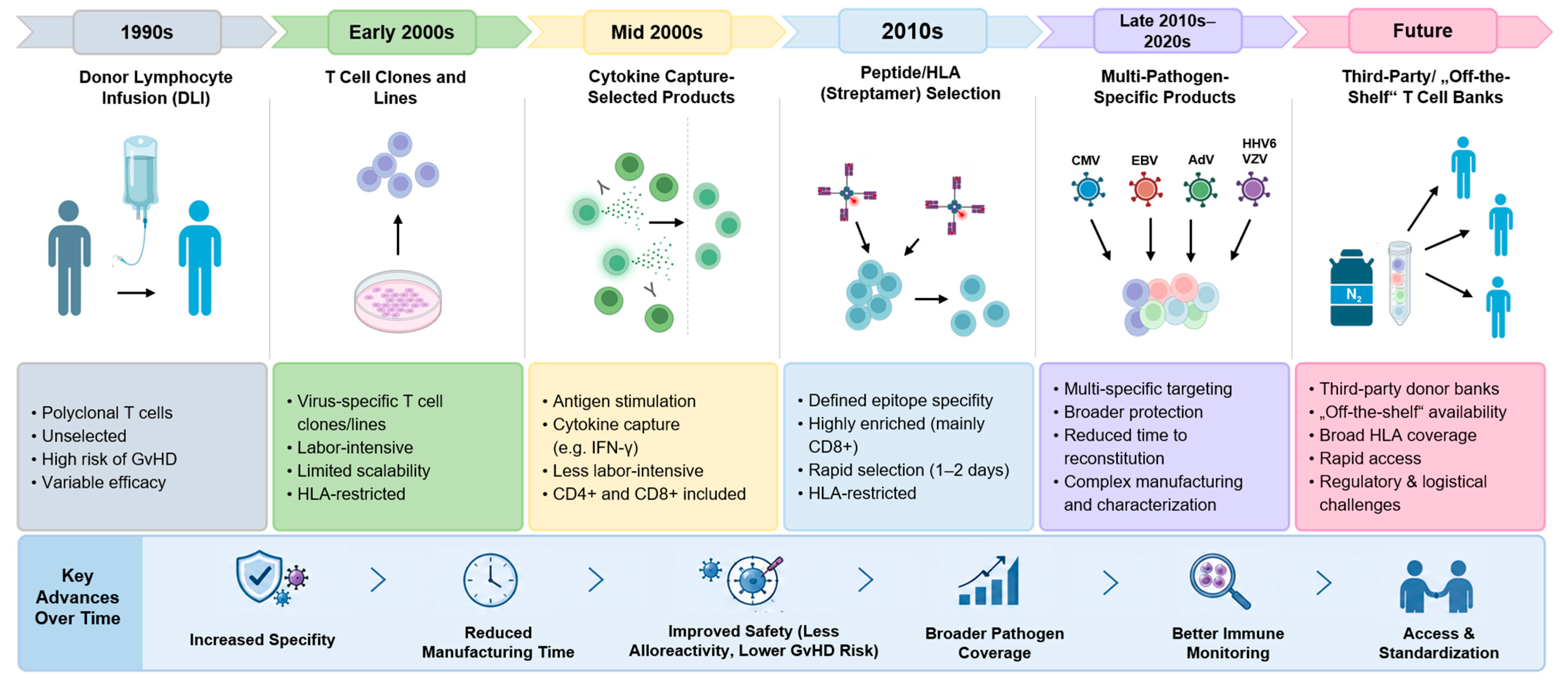
The cytokine capture assay requires stimulation of peripheral blood samples with viral antigens, such as peptides or proteins, for about 4 to 16 h to induce IFN-γ production by virus-specific T cells. Antigen-activated T cells are incubated with a capture matrix that immobilizes secreted IFN-γ on the cell surface. Subsequently, the IFN-γ-producing T cells are selected via microbeads coated with anti-IFN-γ antibodies. Peptide/MHC multimer technology, in contrast, allows the selection of peptide-specific CD8+ T cells via binding of peptide-MHC multimers to cognate T cell receptors (TCR), followed by magnetic enrichment. This method does not require any prior antigen stimulation or ex vivo expansion of peripheral blood cells before selection. Both cytokine capture and peptide/MHC selection enable rapid and effective production of antigen-specific T cells in a very short time, and both are equally compatible with GMP production. However, the two approaches differ in their applicability. Whereas the number of available peptide/MHC multimer reagents is limited to the most common HLA/epitope pairs, the cytokine capture assay allows isolation of virus-reactive T cells independent of HLA allotypes. A disadvantage of the cytokine capture assay compared to peptide/MHC multimer technology is the need for a short ex vivo antigen-stimulation step. At the same time, this step offers greater flexibility, as the antigen used for stimulation can be selected according to the patient’s clinical needs. A broad range of stimulating antigens can be used, including individual peptides, peptide pools, proteins, or combinations of viral antigens. A broad panel of viral protein antigens is now available as premixed GMP-grade peptide cocktails, covering a wide range of CD4+ as well as CD8+ T cell epitopes across multiple HLA alleles. Although these rapid manufacturing technologies have considerably improved the availability of virus-specific T cell products, their clinical application depends not only on manufacturing efficiency but also on their safety profile. The principal manufacturing and selection platforms currently used for the generation of virus-specific T cell products differ substantially with regard to starting material, production time, HLA dependence, product composition, and clinical applicability (Table 1). Overall, the development of these technologies reflects a transition from labor-intensive expansion of virus-specific T cell lines toward more rapid antigen-specific selection and, more recently, the generation of multipathogen-specific and third-party T cell products (Figure 1).

2.2. Alloreactivity: Product Composition and Safety

2.2.1. Product Composition: CD4+ Versus CD8+ T Cells

Over the past three decades, techniques for the isolation and generation of pathogen-specific T cells under GMP conditions have significantly improved. These approaches allow the isolation of both pathogen-specific CD4+ and CD8+ T cells using the cytokine capture system [59] or the Streptamer-based selection of CD8+ T cells restricted by defined HLA alleles and virus-specific peptides [60]. Despite these advances, several issues still need clarification before this approach can become standard clinical practice. In particular, contradictory data on the protective role of CD4+ and CD8+ T cells left unresolved whether adoptive T cell products should contain both subsets or primarily CD8+ T cells. Several studies support a critical role for CD4+ T cells in antiviral immunity. Prophylactic infusion of CMV-specific CD4+ T cells in patients lacking CMV-specific T-helper responses increased CMV-CTL frequencies in both CD4+ and CD8+ T cell subpopulations and resulted in successful viral clearance [24]. Subsequent studies by Riddell et al. and Walter et al. demonstrated that transfused CMV-specific CD8+ T cell clones progressively declined in patients lacking CD4+ T cells [23,50]. Consistent with these findings, subsequent studies have demonstrated the critical role of CD4+ T cells in both maintaining the functionality of cytotoxic CD8+ T cells and directly fighting the viral infection [61,62]. On the other hand, the transfusion of CMV-specific CD8+ T cells alone has also been proven efficient in clearing the viremia and increasing the frequency of donor-derived CMV-specific CD8+ T cells as well as in recruiting CD4+ T cells in recipients [63]. In a multicenter study, Leen et al. observed that transfusions of either CD4+ or CD8+ T cells were equally protective against viral infections [64]. The inclusion of CD4+ T cells remains the most controversial issue for adoptive immunotherapy, however, as several studies have reported a higher alloreactive potential of this T cell subset [65,66].

2.2.2. In Vitro Alloreactivity Versus Clinical GvHD Risk

Although the allogeneic reactivity of pathogen-specific T cells has been thoroughly investigated, their potential to induce clinically relevant GvHD still needs to be clarified, particularly when HLA-mismatched donors are used. Several in vitro studies have reported the cross-reactive potential of expanded virus-specific T cells toward allogeneic HLA antigens [67,68,69,70,71]. Single-virus-specific CD4+ and CD8+ T cell lines or clones directed against CMV, EBV, VZV, and influenza virus have been shown in vitro to recognize and lyse cells expressing allo-HLA class I and class II molecules, including normal cell subsets [67]. Long-term culture and repeated antigenic stimulation during the generation of T cell clones may contribute to the alloreactivity observed in these experimental settings.
In the clinical setting, however, this alloreactivity has not been reported, including in selected HLA-mismatched clinical settings [68]. This discrepancy may be due to differences between long-term expanded T cell clones used in experimental studies and antigen-selected products used in clinical protocols. The latter are typically generated with shorter ex vivo manipulation and contain an enriched population of virus-specific T cells. In products generated using the cytokine capture system (CCS), alloreactivity could be decreased by 1.27 log (mean value after three independent experiments) following the selection and expansion of AdV-specific T cells using the CliniMACS CCS IFN-γ system [72]. Comparable results were shown for CMV-specific T cells, with a 95% reduction in alloreactivity following antigen-specific selection [73].
One limitation of the data above is that alloreactivity was generally not assessed against recipient-derived target cells. In clinical practice, such testing is not feasible because of the limited time available before treatment and the practical challenges of obtaining representative target cells from organs commonly affected by GvHD, including the skin, gastrointestinal tract, and liver.
A distinction should therefore be made between in vitro evidence of alloreactivity and clinically observed GvHD after adoptive transfer of virus-specific T cells. Detection of alloreactivity in vitro does not necessarily predict clinically relevant tissue damage or the development of GvHD after infusion. Antigen-specific enrichment reduces the proportion of nonspecific donor T cells, and the transferred cells may require appropriate antigenic stimulation for substantial in vivo expansion. In addition, in vitro target-cell assays cannot fully reproduce the complex conditions governing tissue homing, local inflammation, and immune activation in vivo. Nevertheless, the currently favorable clinical safety profile should not be interpreted as proof that alloreactivity is irrelevant. Rather, the potential risk of clinically relevant alloreactivity should be considered in relation to the individual product and clinical setting, particularly in HLA-mismatched and third-party settings.
In a recent study from our group, CMV-CTLs isolated by IFN-γ secretion assay and subsequently expanded in vitro did not induce relevant cutaneous tissue damage in an in vitro skin explant model while maintaining high antiviral activity [74]. At low cell doses (5 × 10⁵), none of the CMV-CTLs led to GvH reactions in the HLA-mismatched recipient’s skin, whereas at the high cell dose (1 × 10⁶), two of nine CMV-CTL preparations induced mild GvH-associated skin damage. These reactions were associated with higher CD4+ T cell frequencies in the respective lines. These findings provide additional experimental evidence that the alloreactive potential of virus-specific T cell products may depend on both product composition and cell dose. At the same time, they underline the limitations of extrapolating from experimental models to clinical GvHD risk and support the need for product characterization and clinical monitoring.

2.3. Risk Mitigation and Safety Monitoring

Taken together, the available experimental and clinical data support a favorable clinical safety profile of antigen-selected virus-specific T cell products. Nevertheless, risk assessment remains particularly important in HLA-mismatched and third-party settings. Relevant factors include donor selection and HLA compatibility, product composition and antigen specificity, the intended cell dose, and, where feasible, functional testing for alloreactivity. Following infusion, patients should be monitored for GvHD as well as viral load and virus-specific immune reconstitution. Key elements of risk mitigation are summarized in Table 2.
It is also important to correlate the phenotype and functionality of the infused cells with the clinical outcome. The following section therefore discusses clinical responses, including viral clearance and the kinetics of virus-specific immune recovery, following cellular therapies based on the cytokine secretion and Streptamer selection technologies.

3. Clinical Application of Virus-Specific T Cell Therapy

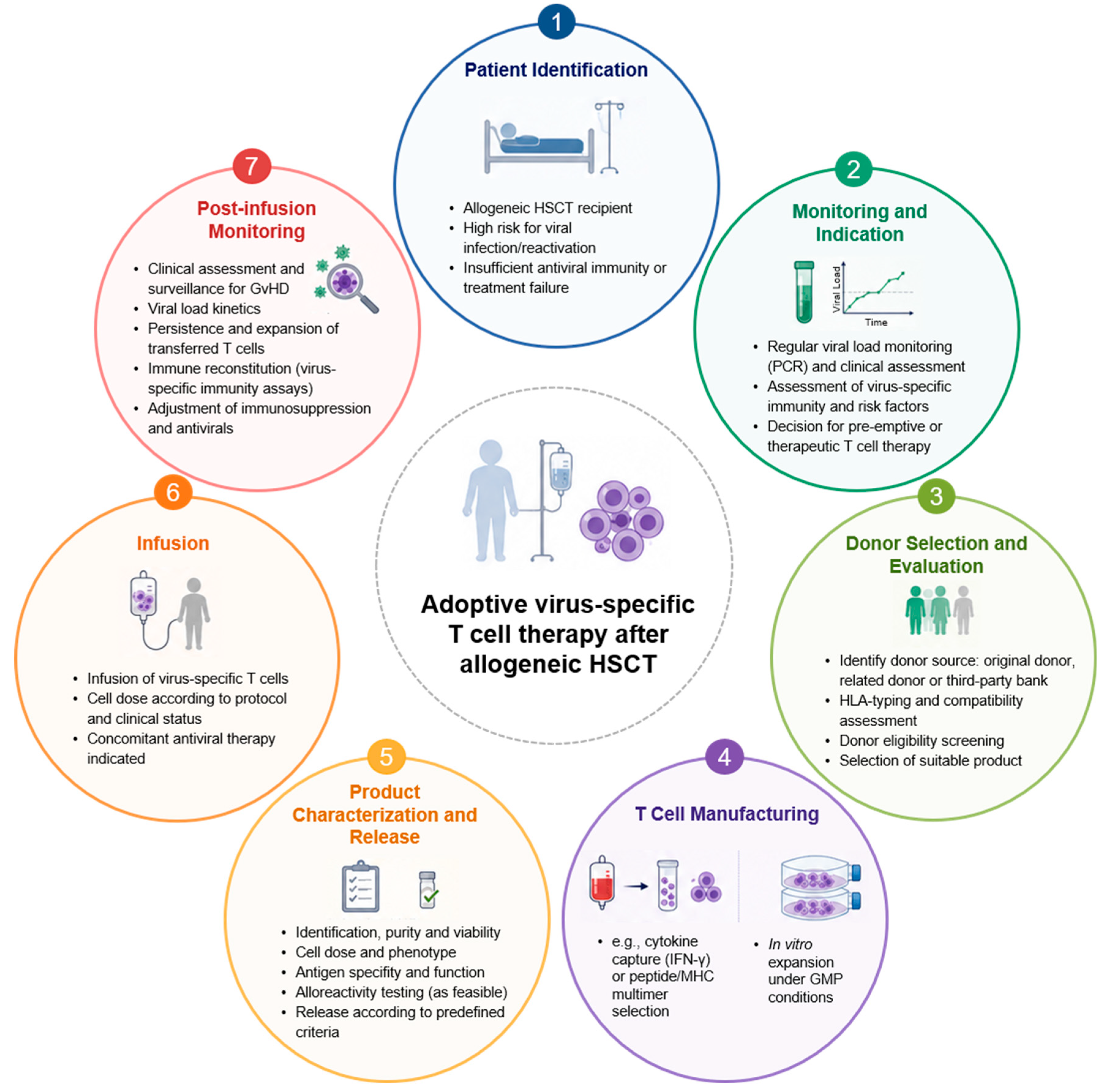
The clinical implementation of adoptive virus-specific T cell therapy involves several consecutive steps, including viral and immune monitoring, patient selection, donor or product selection, manufacturing and product release, infusion, and subsequent assessment of viral and immunological responses (Figure 2).

3.1. Cytokine Capture Assay-Based Selection–Clinical Trials

Several studies have made use of the IFN-γ capture assay to select antigen-specific T cells. Feuchtinger and colleagues published the clinical data from 13 patients treated at multiple centers across Germany with an infusion of pp65-specific IFN-γ-secreting CD4+ and CD8+ T cells for refractory CMV infection or CMV disease after HSCT [75]. The cellular products contained naïve, central memory, and effector memory cells. In vivo expansion of the transferred cells correlated with clearance or significant reduction in viremia and was observed for both the CD4+ and CD8+ subsets. Transferred T cells could be detected in vivo for an average of 3–6 weeks after infusion, and, in some patients, pp65-specific immunity persisted for more than 6 months [75].
Moosmann and colleagues used the IFN-γ capture assay following stimulation with EBV-derived peptides to generate EBV-specific T cells to treat post-transplant lymphoproliferative disease induced by EBV [76]. Three of six patients achieved complete and stable remission following combined treatment with rituximab, an anti-CD20 antibody, and low numbers of CD4+ and CD8+ EBV-specific T cells. Non-responders suffered from late-stage disease with multiorgan dysfunction at the time of T cell transfer. In two responders, transferred EBV-specific T cells underwent rapid in vivo expansion, remained detectable at high levels for approximately six months, and subsequently contracted to stable levels comparable to those observed in healthy individuals. This expansion and contraction pattern is characteristic of antigen-specific T cell responses and was associated with protection for at least two years after transfer. Detailed analyses early after transfer revealed that EBV-specific T cells had an effector memory phenotype, which after contraction evolved toward central memory or terminally differentiated effector cells [76]. The use of a combination of immunodominant antigens from different viruses also allowed simultaneous selection of CMV-, EBV-, and AdV-specific CD4+ and CD8+ T cells, extending the applicability of the cytokine-capture approach to multivirus-specific T cell products [77].

3.2. Peptide/MHC Multimer (Streptamer)-Based Selection–Clinical Trials

The development of “reversible” TCR staining using Streptamers allowed the selection of phenotypically and functionally intact cells [58]. This technique has subsequently been used for adoptive T cell transfer, since it has been shown that antigen-specific CD8+ T cells selected with Streptamers induce long-lasting immune responses without increasing the risk for GvHD. Schmitt and colleagues reported the treatment of two patients for recurrent CMV antigenemia after HSCT using CMVpp65-specific, Streptamer-selected T cells [63]. The infused cells had an effector/memory phenotype and were capable of secreting IFN-γ upon in vitro stimulation. They rapidly expanded in vivo, acquired an effector phenotype, and cleared CMV reactivation without any signs of GvHD [63]. Odendahl and colleagues further demonstrated the potential of Streptamer-selected T cells to restore antiviral immunity in patients with refractory CMV viraemia. In this study, 22 cell products displayed excellent viability, cytotoxicity and purity, with effectively removed selection reagents [60]. More recently, GMP-compliant Streptamer technology was implemented to enrich EBV- and AdV-specific T cells. Because EBV- and AdV-specific T cells occur at very low frequencies in peripheral blood, the purity of large-scale products was limited, reaching 44% and 6.7%, respectively, among CD3+ cells [78]. Higher purity could, however, successfully be achieved by small-scale selection or simultaneous application of EBV- and AdV-Streptamers. Most products displayed antigen-specific IFN-γ responses and were enriched for effector-memory and central-memory phenotypes, supporting their suitability for clinical application [78].
Overall, clinical trials to date have confirmed the safety and efficacy of the adoptive transfer of virus-specific T cells. A comparative overview of representative clinical studies is provided in Table 3. However, controlled clinical trials, involving the tracking of the infused cells, are required in order to further investigate the optimal conditions for successful and long-lasting effects of the adoptive transfer. Despite encouraging clinical experience, several challenges remain before adoptive virus-specific T cell therapy can be broadly implemented in routine clinical practice.

4. Future Perspectives

4.1. Next-Generation T Cell Products

Adoptive transfer of virus-specific T cells has emerged as a promising strategy for restoring antiviral immunity in immunocompromised patients, particularly after allogeneic HSCT. An important future direction is the development of multipathogen-specific T cell products targeting several clinically relevant viruses simultaneously. Such products may be particularly useful after HSCT, where patients are susceptible to reactivation or infection with multiple pathogens, including CMV, EBV, and AdV. Several strategies have been developed to simultaneously generate T cells specific for multiple viral and, more recently, fungal pathogens. Initial studies focused on CMV, EBV, and AdV and used the clinical-grade adenovirus vector Ad5f35 encoding viral antigens such as CMV pp65 to transduce antigen-presenting cells (APCs), including dendritic cells or EBV-transformed B cells. This enabled efficient stimulation and expansion of virus-specific T cells [67,79,80]. Although effective, these approaches required the genetic modification of APCs.
To overcome this limitation, a new enrichment strategy based on activation-induced transient CD154 (CD40L) expression has been exploited to isolate antigen-reactive T cells, particularly CD4+ T cells and, to a lesser extent, CD8+ T cells. This approach enables the production of multipathogen-specific T cell preparations without genetic modification of APCs. Alloantigen-depleted CD4+ and CD8+ T cell lines could be generated within 14 days, with high specificity for the most common post-transplantation pathogens, together with substantial proliferative capacity and preserved in vitro functionality [81].
More recently, DNA plasmids or peptide pools have been used to pulse APCs, thereby avoiding safety and regulatory issues associated with viral-vector transduction. Combining the “pepmix” (peptide mixture) approach or plasmid-transfected DCs with expansion in gas permeable rapid-expansion (G-Rex) bioreactors provided further advances, increasing both feasibility and applicability of T cell therapy. These rapidly (10–12 days) expanded multivirus-specific T cells provided effective antiviral protection in clinical trials [79,82].
Beyond increasing the number of targeted pathogens, future development will need to focus on the composition and functional quality of these cellular products. Multipathogen-specific products may reduce the need to manufacture separate products for individual infections, but broader pathogen coverage also increases manufacturing and characterization requirements. The frequency, specificity, and functional activity of individual pathogen-specific T cell populations therefore need to be carefully assessed.
A further challenge is the definition of appropriate potency assays and release criteria. Current virus-specific T cell products differ in donor source, antigen stimulation, manufacturing platform, cellular composition, and antigen specificity. Standardized criteria for identity, purity, specificity, viability, and functional potency would facilitate comparison between clinical studies and support broader clinical implementation. Because no single assay is likely to fully capture the complex in vivo activity of a cellular product, a combination of phenotypic and functional measures, including antigen-specific activation, cytokine production, cytotoxicity, or antiviral activity, may be required.

4.2. Broadening the Use of Immunotherapy

Several barriers prevent the broader use of virus-specific T cell therapies after HSCT, including the use of pathogen-naïve donors and umbilical cord blood grafts. To address this limitation, several strategies have been developed. One approach involves the in vitro priming of donor-derived cells using antigen-pulsed or genetically modified APCs [83]. Another option is the transfer of virus-specific TCR genes into donor primary T cells using viral vectors [84]. Antigen-specific responses in recipients can also be boosted by vaccination with peptide-loaded donor-derived DCs [85].
Apart from the above-mentioned strategies, the selection of virus-specific T cells from healthy, seropositive third-party donors is another attractive alternative. Haque and colleagues showed for the first time that partially matched third-party EBV-CTLs led to the control of post-transplant lymphoproliferative disorder after solid organ transplantation [86]. Subsequent studies confirmed successful post-HSCT treatment of refractory CMV, EBV, and AdV infections using third-party virus-specific T cells [83,87]. These findings initiated the idea of donor registries and biobanks with cryopreserved antigen-specific T cells, which could provide an “off-the-shelf” immunotherapy product.
Third-party and banked T cell products could substantially reduce the time required for patient- or donor-specific manufacturing and may therefore be particularly valuable in patients with rapidly progressive viral disease. Their broader use, however, remains dependent on HLA compatibility and the HLA restriction of the virus-specific T cell population. Establishing broadly applicable donor banks will consequently require sufficient HLA diversity and careful donor selection to achieve adequate population coverage. In addition, although third-party T cells can mediate effective antiviral responses, the extent and duration of their in vivo expansion and persistence, as well as their contribution to long-term immune reconstitution, remain incompletely understood.
In parallel, rapid manufacturing and magnetic enrichment technologies have also expanded the application of adoptive T cell therapy in HSCT patients with refractory CMV, EBV, and AdV infections [75,76]. More recently, adoptive T cell therapy has been extended to other viral infections, including varicella zoster virus, BK virus, or human herpesvirus 6 [88,89], as well as invasive fungal infections caused by Aspergillus or Candida [90]. This broader pathogen coverage expands the potential clinical applications of pathogen-specific cellular therapy beyond the most extensively studied viruses but also increases the challenge of developing standardized products for less common or rapidly evolving pathogens.
Regulatory, logistical, and economic factors will also influence broader implementation. GMP-compliant manufacturing, donor screening, quality control, cryopreservation, storage, and distribution require specialized infrastructure. Centralized or regional cell banks and standardized manufacturing procedures may facilitate access beyond specialized transplantation centers. Prospective health-economic analyses are needed to determine in which clinical settings adoptive T cell therapy provides a cost-effective alternative or complement to conventional antiviral treatment.
Long-term efficacy remains another challenge. Persistence and functionality of transferred T cells likely depend on their differentiation state, antigen exposure, immunosuppression, donor-recipient compatibility, and the recipient’s endogenous immune recovery. Future clinical studies should therefore assess not only short-term viral clearance but also the durability of antiviral responses and long-term persistence of transferred cells.
Another potential limitation is viral immune escape. Products targeting a restricted number of viral epitopes may be affected by viral sequence variation or loss of target antigens. Targeting multiple antigens and maintaining broader T cell repertoires may reduce this risk, although this may increase manufacturing complexity. A better understanding of pathogen diversity, antigen selection, and mechanisms of immune escape will therefore be important for the design of future products.
The role of adoptive T cell therapy also needs to be considered in the context of contemporary antiviral prophylaxis and treatment. In particular, the introduction of letermovir has substantially changed the prevention of CMV infection in high-risk patients after allogeneic HSCT. While prophylaxis reduces the incidence of clinically significant CMV reactivation, its effects on CMV-specific immune recovery and the best timing of immune-based therapies are still unclear. Virus-specific T cell therapy may complement antiviral treatment in patients with recurrent or refractory infections, antiviral resistance, drug intolerance, or delayed immune reconstitution. Combining T cell therapy with antiviral prophylaxis and viral and immune monitoring may improve the management of viral infections after allogeneic HSCT.

5. Conclusions

Adoptive transfer of virus-specific T cells has evolved from an experimental concept into a promising immunotherapeutic strategy for the treatment of viral infections after allogeneic HSCT. By restoring pathogen-specific immunity rather than solely suppressing viral replication, this approach may provide more durable antiviral protection than conventional antiviral treatment alone. Despite encouraging clinical results, several challenges remain. Further development will require a better understanding of the mechanisms of action of virus-specific T cells. Improved biomarkers and immune monitoring strategies are also needed to better predict therapeutic responses, persistence of transferred T cells, and immune competence following allogeneic HSCT. At the same time, standardized product characterization, potency testing, and release criteria are needed to ensure consistent manufacturing and facilitate comparison between clinical studies. Regulatory requirements and the costs and logistics of GMP-compliant manufacturing and distribution remain important barriers to clinical implementation. The combination of antiviral prophylaxis, such as letermovir for CMV, viral load monitoring, immune monitoring, and appropriately timed virus-specific T cell therapy may allow a more individualized approach to infection prevention and treatment. Further improvements in graft engineering, including strategies such as CD34-positive selection, TCRαβ depletion, and CD45RA depletion, may further reduce transplant-related complications while preserving antiviral immunity. Together with standardized, readily available, and pathogen-specific T cell products, these approaches are expected to further improve immune reconstitution and clinical outcome after allogeneic HSCT.

Author Contributions

Writing—original draft preparation, E.M.W. and L.M.S.; writing—review and editing, E.M.W., L.M.S., M.S., P.K.-F. and D.B.-Q.; visualization, L.M.S.; supervision, E.M.W. and P.K.-F.; data source: n/a. All authors have read and agreed to the published version of the manuscript.

Funding

This research received no external funding.

Institutional Review Board Statement

Not applicable.

Informed Consent Statement

Not applicable.

Data Availability Statement

No new data were created or analyzed in this study. Data sharing is not applicable to this article.

Conflicts of Interest

Author Debora Basilio-Queiros was employed by the company Miltenyi. The remaining authors declare that the research was conducted in the absence of any commercial or financial relationships that could be construed as a potential conflict of interest.

References

  1. Cieri, N.; Maurer, K.; Wu, C.J. 60 Years Young: The Evolving Role of Allogeneic Hematopoietic Stem Cell Transplantation in Cancer Immunotherapy. Cancer Res. 2021, 81, 4373–4384. [Google Scholar] [CrossRef] [Scilit] [PubMed]
  2. Storb, R. HSCT: Historical Perspective BT—The EBMT Handbook: Hematopoietic Stem Cell Transplantation and Cellular Therapies; Carreras, E., Dufour, C., Mohty, M., Kröger, N., Eds.; Springer International Publishing: Cham, Switzerland, 2019; pp. 3–9. [Google Scholar]
  3. Granot, N.; Storb, R. History of hematopoietic cell transplantation: Challenges and progress. Haematologica 2020, 105, 2716–2729. [Google Scholar] [CrossRef] [Scilit] [PubMed]
  4. Ogonek, J.; Juric, M.K.; Ghimire, S.; Varanasi, P.R.; Holler, E.; Greinix, H.; Weissinger, E. Immune reconstitution after allogeneic hematopoietic stem cell transplantation. Front. Immunol. 2016, 7, 507. [Google Scholar] [CrossRef] [Scilit] [PubMed]
  5. Kaphan, E.; Bettega, F.; Forcade, E.; Labussière-Wallet, H.; Fegueux, N.; Robin, M.; Peffault De Latour, R.; Huynh, A.; Lapierre, L.; Berceanu, A.; et al. Late relapse after hematopoietic stem cell transplantation for acute leukemia: A retrospective study by SFGM-TC. Transplant. Cell. Ther. 2023, 29, 362.e1–362.e12. [Google Scholar] [CrossRef] [Scilit] [PubMed]
  6. Lin, C.-H.; Chen, T.-C.; Shih, Y.-H.; Chou, C.-W.; Hsu, C.-Y.; Li, P.-H.; Teng, C.-L.J. Acute myeloid leukemia relapse after allogeneic hematopoietic stem cell transplantation: A retrospective study from a single institution. J. Int. Med. Res. 2022, 50, 3000605221078466. [Google Scholar] [CrossRef] [Scilit] [PubMed]
  7. Shouval, R.; Fein, J.A.; Labopin, M.; Kröger, N.; Duarte, R.F.; Bader, P.; Chabannon, C.; Kuball, J.; Basak, G.W.; Dufour, C.; et al. Outcomes of allogeneic haematopoietic stem cell transplantation from HLA-matched and alternative donors: A European Society for Blood and Marrow Transplantation registry retrospective analysis. Lancet Haematol. 2019, 6, e573–e584. [Google Scholar] [CrossRef] [Scilit] [PubMed]
  8. DeFilipp, Z.; Alousi, A.M.; Pidala, J.A.; Carpenter, P.A.; Onstad, L.E.; Arai, S.; Arora, M.; Cutler, C.S.; Flowers, M.E.D.; Kitko, C.L.; et al. Nonrelapse mortality among patients diagnosed with chronic GVHD: An updated analysis from the Chronic GVHD Consortium. Blood Adv. 2021, 5, 4278–4284. [Google Scholar] [CrossRef] [Scilit] [PubMed]
  9. Ramdial, J.L.; Mehta, R.S.; Saliba, R.M.; Alousi, A.M.; Bashir, Q.; Hosing, C.; Kebriaei, P.; Olson, A.L.; Oran, B.; Qazilbash, M.H.; et al. Acute graft-versus-host disease is the foremost cause of late nonrelapse mortality. Bone Marrow Transplant. 2021, 56, 2005–2012. [Google Scholar] [CrossRef] [Scilit] [PubMed]
  10. Summers, C.; Sheth, V.S.; Bleakley, M. Minor Histocompatibility Antigen-Specific T Cells. Front. Pediatr. 2020, 8, 284. [Google Scholar] [CrossRef] [Scilit] [PubMed]
  11. Kolb, H.J.; Mittermüller, J.; Clemm, C.; Holler, E.; Ledderose, G.; Brehm, G.; Heim, M.; Wilmanns, W. Donor Leukocyte Transfusions for Treatment of Recurrent Chronic Myelogenous Leukemia in Marrow Transplant Patients. Blood 1990, 76, 2462–2465. [Google Scholar] [CrossRef] [Scilit]
  12. Papadopoulos, E.; Marc, L.; David, E.; Stephen, M.; Farid, B.; Carabasi, M.; Hugo, C.-M.; Childs, B.; Gillio, A.; Small, T.; et al. Infusions of Donor Leukocytes to Treat Epstein-Barr Virus-Associated Lymphoproliferative Disorders After Allogeneic Bone Marrow Transplantation. N. Engl. J. Med. 1994, 330, 1185–1191. [Google Scholar] [CrossRef] [Scilit] [PubMed]
  13. Pagliuca, S.; Schmid, C.; Santoro, N.; Simonetta, F.; Battipaglia, G.; Guillaume, T.; Greco, R.; Onida, F.; Sánchez-Ortega, I.; Yakoub-Agha, I.; et al. Donor lymphocyte infusion after allogeneic haematopoietic cell transplantation for haematological malignancies: Basic considerations and best practice recommendations from the EBMT. Lancet Haematol. 2024, 11, e448–e458. [Google Scholar] [CrossRef] [Scilit] [PubMed]
  14. Shpall, E.J.; Cagnoni, P.J.; Bearman, S.I.; Ross, M.; Nieto, Y.; Jones, R.B. Peripheral Blood Stem Cell Harvesting and CD34-Positive Cell Selection BT-Blood Stem Cell Transplantation; Winter, J.N., Ed.; Springer: Boston, MA, USA, 1997; pp. 143–157. [Google Scholar]
  15. Handgretinger, R.; Klingebiel, T.; Lang, P.; Schumm, M.; Neu, S.; Geiselhart, A.; Bader, P.; Schlegel, P.G.; Greil, J.; Stachel, D.; et al. Megadose transplantation of purified peripheral blood CD34+progenitor cells from HLA-mismatched parental donors in children. Bone Marrow Transplant. 2001, 27, 777–783. [Google Scholar] [CrossRef] [Scilit] [PubMed]
  16. Bryant, A.R.; Perales, M.-A. Advances in Ex Vivo T Cell Depletion-Where Do We Stand? Adv. Cell Gene Ther. 2019, 2, e29. [Google Scholar] [CrossRef] [Scilit] [PubMed]
  17. Verzeletti, S.; Bonini, C.; Marktel, S.; Nobili, N.; Ciceri, F.; Traversari, C.; Bordignon, C. Herpes simplex virus thymidine kinase gene transfer for controlled graft-versus-host disease and graft-versus-leukemia: Clinical follow-up and improved new vectors. Hum. Gene Ther. 1998, 9, 2243–2251. [Google Scholar] [CrossRef] [Scilit] [PubMed]
  18. Ciceri, F.; Bonini, C.; Stanghellini, M.T.L.; Bondanza, A.; Traversari, C.; Salomoni, M.; Turchetto, L.; Colombi, S.; Bernardi, M.; Peccatori, J.; et al. Infusion of suicide-gene-engineered donor lymphocytes after family haploidentical haemopoietic stem-cell transplantation for leukaemia (the TK007 trial): A non-randomised phase I-II study. Lancet Oncol. 2009, 10, 489–500. [Google Scholar] [CrossRef] [Scilit] [PubMed]
  19. Ciceri, F.; Bonini, C.; Labopin, M.; Oliveira, G.; Nagler, A.; Yannaki, E.; Stanghellini, M.T.L.; Bondanza, A.; Greco, R.; Olavarria, E.; et al. Safety and Efficacy of Donor T Cells Engineered with Herpes Simplex Virus Thymidine-Kinase Suicide Gene (TK Cells) Given After T-Cell Depleted (TCD) Haploidentical Hematopoietic Transplantation (Haplo-HSCT): Results of a 14-Year Follow-Up in 45 Patients. Biol. Blood Marrow Transplant. 2017, 23, S54–S55. [Google Scholar] [CrossRef] [Scilit]
  20. Schaap, N.; Schattenberg, A.; Bär, B.; Preijers, F.; van de Wiel van Kemenade, E.; de Witte, T. Induction of graft-versus-leukemia to prevent relapse after partially lymphocyte-depleted allogeneic bone marrow transplantation by pre-emptive donor leukocyte infusions. Leukemia 2001, 15, 1339–1346. [Google Scholar] [CrossRef] [Scilit] [PubMed][Green Version]
  21. Pei, X.-Y.; Liu, X.-F.; Zhao, X.-Y.; Lv, M.; Mo, X.-D.; Chang, Y.-J.; Shang, Q.-N.; Sun, Y.-Q.; Chen, Y.-H.; Xu, L.-P.; et al. Comparable anti-CMV responses of transplant donor and third-party CMV-specific T cells for treatment of CMV infection after allogeneic stem cell transplantation. Cell. Mol. Immunol. 2022, 19, 482–491. [Google Scholar] [CrossRef] [Scilit] [PubMed]
  22. Maurer, K.; Antin, J.H. The graft versus leukemia effect: Donor lymphocyte infusions and cellular therapy. Front. Immunol. 2024, 15, 1328858. [Google Scholar] [CrossRef] [Scilit] [PubMed]
  23. Riddell, S.R.; Watanabe, K.S.; Goodrich, J.M.; Li, C.R.; Agha, M.E.; Greenberg, P.D. Restoration of Viral Immunity in Immunodeficient Humans by the Adoptive Transfer of T Cell Clones. Science 1992, 257, 238–241. [Google Scholar] [CrossRef] [Scilit] [PubMed]
  24. Einsele, H.; Roosnek, E.; Rufer, N.; Sinzger, C.; Riegler, S.; Löffler, J.; Grigoleit, U.; Moris, A.; Rammensee, H.-G.; Kanz, L.; et al. Infusion of cytomegalovirus (CMV)-specific T cells for the treatment of CMV infection not responding to antiviral chemotherapy. Blood 2002, 99, 3916–3922. [Google Scholar] [CrossRef] [Scilit] [PubMed]
  25. Tzannou, I.; Papadopoulou, A.; Naik, S.; Leung, K.; Martinez, C.A.; Ramos, C.A.; Carrum, G.; Sasa, G.; Lulla, P.; Watanabe, A.; et al. Off-the-Shelf Virus-Specific T Cells to Treat BK Virus, Human Herpesvirus 6, Cytomegalovirus, Epstein-Barr Virus, and Adenovirus Infections After Allogeneic Hematopoietic Stem-Cell Transplantation. J. Clin. Oncol. Off. J. Am. Soc. Clin. Oncol. 2017, 35, 3547–3557. [Google Scholar] [CrossRef] [Scilit] [PubMed]
  26. Akhmedov, M. Infectious complications in allogeneic hematopoietic cell transplant recipients: Review of transplant-related risk factors and current state of prophylaxis. Clin. Transplant. 2021, 35, e14172. [Google Scholar] [CrossRef] [Scilit] [PubMed]
  27. Dandoy, C.E.; Kim, S.; Chen, M.; Ahn, K.W.; Ardura, M.I.; Brown, V.; Chhabra, S.; Diaz, M.A.; Dvorak, C.; Farhadfar, N.; et al. Incidence, Risk Factors, and Outcomes of Patients Who Develop Mucosal Barrier Injury-Laboratory Confirmed Bloodstream Infections in the First 100 Days After Allogeneic Hematopoietic Stem Cell Transplant. JAMA Netw. Open 2020, 3, e1918668. [Google Scholar] [CrossRef] [Scilit] [PubMed]
  28. Yeung, T.W.; Chan, W.Y.K.; Wong, S.C.Y.; Lee, P.P.W.; Cheuk, D.K.L.; Leung, W. High infection rates and risk-adapted prevention strategies in contemporary pediatric allogeneic hematopoietic stem cell transplantation. Pediatr. Discov. 2024, 2, e101. [Google Scholar] [CrossRef] [Scilit] [PubMed]
  29. Bejanyan, N.; Brunstein, C.G.; Cao, Q.; Lazaryan, A.; Luo, X.; Curtsinger, J.; Mehta, R.S.; Warlick, E.; Cooley, S.A.; Blazar, B.R.; et al. Delayed immune reconstitution after allogeneic transplantation increases the risks of mortality and chronic GVHD. Blood Adv. 2018, 2, 909–922. [Google Scholar] [CrossRef] [Scilit] [PubMed]
  30. Tio, S.Y.; Neoh, C.F.; Ritchie, D.; Chee, L.; Kong, D.C.M.; Worth, L.J.; Yong, M.K.; Slavin, M.A. The Changing Epidemiology of Breakthrough Invasive Fungal Disease in Allogeneic Hematopoietic Stem Cell Transplant Recipients in the Era of Modified-Release Posaconazole Prophylaxis. Transpl. Infect. Dis. Off. J. Transplant. Soc. 2025, 27, e70104. [Google Scholar] [CrossRef] [Scilit] [PubMed]
  31. Fung, J.S.T.; Wright, R.C.; Bharaj, D.K.; Alghamdi, A.; Hesson, D.; Delisle, J.-S.; Schweitzer, L.; Avery, R.K.; Belga, S. Virus-Specific T-Cell Therapy for Prophylaxis and Treatment of Cytomegalovirus Infections After Transplantation: A Scoping Review. Clin. Infect. Dis. Off. Publ. Infect. Dis. Soc. Am. 2025, 81, e218–e228. [Google Scholar] [CrossRef] [Scilit] [PubMed]
  32. Teschner, D.; Knop, J.; Piehl, C.; Junker, S.; Witzke, O. Cytomegalovirus infection and rehospitalization rates after allogeneic hematopoietic stem cell and solid organ transplantation: A retrospective cohort study using German claims data. Infection 2022, 50, 1543–1555. [Google Scholar] [CrossRef] [Scilit] [PubMed]
  33. Ji, J.; Klaus, J.; Burnham, J.P.; Michelson, A.; McEvoy, C.A.; Kollef, M.H.; Lyons, P.G. Bloodstream Infections and Delayed Antibiotic Coverage Are Associated with Negative Hospital Outcomes in Hematopoietic Stem Cell Transplant Recipients. Chest 2020, 158, 1385–1396. [Google Scholar] [CrossRef] [Scilit] [PubMed]
  34. Marty, F.; Per, L.; Chemaly, R.; Johan, M.; Dadwal, S.; Duarte, R.; Shariq, H.; Ullmann, A.; Yuta, K.; Janice, B.; et al. Letermovir Prophylaxis for Cytomegalovirus in Hematopoietic-Cell Transplantation. N. Engl. J. Med. 2017, 377, 2433–2444. [Google Scholar] [CrossRef] [Scilit] [PubMed]
  35. Kim, S.T.; Lee, M.H.; Kim, S.Y.; Kim, S.J.; Kim, D.H.; Jang, J.H.; Kim, K.; Kim, W.S.; Jung, C.W. A randomized trial of preemptive therapy for prevention of cytomegalovirus disease after allogeneic hematopoietic stem cell transplantation. Int. J. Hematol. 2010, 91, 886–891. [Google Scholar] [CrossRef] [Scilit] [PubMed]
  36. Drylewicz, J.; Schellens, I.M.M.; Gaiser, R.; Nanlohy, N.M.; Quakkelaar, E.D.; Otten, H.; van Dorp, S.; Jacobi, R.; Ran, L.; Spijkers, S.; et al. Rapid reconstitution of CD4 T cells and NK cells protects against CMV-reactivation after allogeneic stem cell transplantation. J. Transl. Med. 2016, 14, 230. [Google Scholar] [CrossRef] [Scilit] [PubMed]
  37. Busca, A.; Dellacasa, C.; Passera, R.; Legato, L.; Celona, L.; Zompi, S.; Muccio, S.; Bassi, F.; Secreto, C.; Giaccone, L.; et al. Risk Stratification for Late-Onset CMV Infection Following Prophylaxis With Letermovir in Allogeneic Stem Cell Transplant Recipients: Unraveling the Potential Role of CMV-Specific Cell-Mediated Immunity. Transpl. Infect. Dis. 2026, 70254. [Google Scholar] [CrossRef] [Scilit] [PubMed]
  38. Roth, R.S.; Masouridi-Levrat, S.; Chalandon, Y.; Mamez, A.-C.; Giannotti, F.; Riat, A.; Fischer, A.; Poncet, A.; Glampedakis, E.; Van Delden, C.; et al. Invasive Mold Infections in Allogeneic Hematopoietic Cell Transplant Recipients in 2020: Have We Made Enough Progress? Open Forum Infect. Dis. 2022, 9, ofab596. [Google Scholar] [CrossRef] [Scilit] [PubMed]
  39. Sijmons, S.; Van Ranst, M.; Maes, P. Genomic and functional characteristics of human cytomegalovirus revealed by next-generation sequencing. Viruses 2014, 6, 1049–1072. [Google Scholar] [CrossRef] [Scilit] [PubMed]
  40. Al Mana, H.; Yassine, H.M.; Younes, N.N.; Al-Mohannadi, A.; Al-Sadeq, D.W.; Alhababi, D.; Nasser, E.A.; Nasrallah, G.K. The Current Status of Cytomegalovirus (CMV) Prevalence in the MENA Region: A Systematic Review. Pathogens 2019, 8, 213. [Google Scholar] [CrossRef] [Scilit] [PubMed]
  41. Fowler, K.; Mucha, J.; Neumann, M.; Lewandowski, W.; Kaczanowska, M.; Grys, M.; Schmidt, E.; Natenshon, A.; Talarico, C.; Buck, P.O.; et al. A systematic literature review of the global seroprevalence of cytomegalovirus: Possible implications for treatment, screening, and vaccine development. BMC Public Health 2022, 22, 1659. [Google Scholar] [CrossRef] [Scilit] [PubMed]
  42. Griffiths, P.; Reeves, M. Pathogenesis of human cytomegalovirus in the immunocompromised host. Nat. Rev. Microbiol. 2021, 19, 759–773. [Google Scholar] [CrossRef] [Scilit] [PubMed]
  43. Liu, J.; Fu, Q.; Wang, Y.; Wang, F.R.; Han, W.; Ma, Y.R.; Yan, C.H.; Han, T.T.; Wang, J.Z.; Wang, Z.D.; et al. The effect of donor cytomegalovirus serological status on the outcome of allogeneic stem cell transplantation. Zhonghua Nei Ke Za Zhi 2021, 60, 459–465. [Google Scholar] [CrossRef] [PubMed]
  44. Borchers, S.; Luther, S.; Lips, U.; Hahn, N.; Kontsendorn, J.; Stadler, M.; Buchholz, S.; Diedrich, H.; Eder, M.; Koehl, U.; et al. Tetramer monitoring to assess risk factors for recurrent cytomegalovirus reactivation and reconstitution of antiviral immunity post allogeneic hematopoietic stem cell transplantation. Transpl. Infect. Dis. 2011, 13, 222–236. [Google Scholar] [CrossRef] [Scilit] [PubMed]
  45. Gul, N.; Tariq, H.; Mahnoor, M.; Iftikhar, R. The Interplay between Cytomegalovirus Reactivation, Conditioning Regimens and Acute Graft Versus Host Disease in Allogenic Stem Cell Transplantation: A 9-Year Retrospective Analysis from Resource-Limited Setting. Transplant. Cell. Ther. 2026, 32, S285–S286. [Google Scholar] [CrossRef] [Scilit]
  46. Ueda Oshima, M.; Xie, H.; Zamora, D.; Flowers, M.E.; Hill, G.R.; Mielcarek, M.B.; Sandmaier, B.M.; Gooley, T.A.; Boeckh, M.J. Impact of GVHD prophylaxis on CMV reactivation and disease after HLA-matched peripheral blood stem cell transplantation. Blood Adv. 2023, 7, 1394–1403. [Google Scholar] [CrossRef] [Scilit] [PubMed]
  47. Isleyen, E.; Dağdaş, S.; Kayaaslan, B.; Ceran, F.; Pepeler, M.S.; Kaya, A.; Korkmaz, G.; Yön, M.E.E.; Öztürk, F.; Ceylan, A.; et al. Bidirectional Temporal Association Between Cytomegalovirus Reactivation and Graft-Versus-Host Disease Following Allogeneic Hematopoietic Stem Cell Transplantation: A Single-Center Real-World Cohort Study. Viruses 2026, 18, 874. [Google Scholar] [CrossRef] [Scilit] [PubMed]
  48. Ogonek, J.; Varanasi, P.; Luther, S.; Schweier, P.; Kühnau, W.; Göhring, G.; Dammann, E.; Stadler, M.; Ganser, A.; Borchers, S.; et al. Possible Impact of Cytomegalovirus-Specific CD8+ T Cells on Immune Reconstitution and Conversion to Complete Donor Chimerism after Allogeneic Stem Cell Transplantation. Biol. Blood Marrow Transplant. 2017, 23, 1046–1053. [Google Scholar] [CrossRef] [Scilit] [PubMed]
  49. Luo, X.-H.; Poiret, T.; Liu, Z.; Meng, Q.; Nagchowdhury, A.; Ljungman, P. Different recovery patterns of CMV-specific and WT1-specific T cells in patients with acute myeloid leukemia undergoing allogeneic hematopoietic cell transplantation: Impact of CMV infection and leukemia relapse. Front. Immunol. 2022, 13, 1027593. [Google Scholar] [CrossRef] [Scilit] [PubMed]
  50. Walter, E.A.; Greenberg, P.D.; Gilbert, M.J.; Finch, R.J.; Watanabe, K.S.; Thomas, E.D.; Riddell, S.R. Reconstitution of Cellular Immunity Against Cytomegalovirus in Recipients of Allogeneic Bone Marrow by Transfer of T-Cell Clones from the Donor. N. Engl. J. Med. 1995, 333, 1038–1044. [Google Scholar] [CrossRef] [Scilit] [PubMed]
  51. Marsères, G.; Gentil, C.; Tinevez, C.; Courant, M.; Cosentino, A.; Cornillot-Clément, S.; Bigot, V.; Pitard, V.; Zouine, A.; Izotte, J.; et al. Adoptive γδ T cell therapy controls cytomegalovirus infection in preclinical transplantation models. Nat. Commun. 2026, 17, 2847. [Google Scholar] [CrossRef] [Scilit] [PubMed]
  52. Mehdizadeh, M.; Karami, S.; Ghaffari Nazari, H.; Sankanian, G.; Hamidpour, M.; Hajifathali, A. Immunotherapy with adoptive cytomegalovirus-specific T cells transfer: Summarizing latest gene engineering techniques. Heal. Sci. Rep. 2021, 4, e322. [Google Scholar] [CrossRef] [Scilit] [PubMed]
  53. Withers, B.; Blyth, E.; Clancy, L.E.; Yong, A.; Fraser, C.; Burgess, J.; Simms, R.; Brown, R.; Kliman, D.; Dubosq, M.-C.; et al. Long-term control of recurrent or refractory viral infections after allogeneic HSCT with third-party virus-specific T cells. Blood Adv. 2017, 1, 2193–2205. [Google Scholar] [CrossRef] [Scilit] [PubMed]
  54. Bergsma, J.E.; Argiro, E.M.; Oosterink, K.; van Balen, P.; van der Hem, J.G.K.; van Lammeren, D.; Marijt, W.A.F.; Snijders, T.J.F.; Tjon, J.M.-L.; Veelken, H.; et al. Long-term Outcome of a DLI-Based Treatment Strategy in Patients with Relapsed AML After TCD Allogeneic Stem Cell Transplantation Is Hampered by GvHD and Late Relapse. Transplant. Cell. Ther. 2026. [Google Scholar] [CrossRef] [Scilit] [PubMed]
  55. Koster, E.A.S.; von dem Borne, P.A.; van Balen, P.; Marijt, E.W.A.; Tjon, J.M.L.; Snijders, T.J.F.; van Lammeren, D.; Veelken, H.; Falkenburg, J.H.F.; Halkes, C.J.M.; et al. Risk factors for graft-versus-host-disease after donor lymphocyte infusion following T-cell depleted allogeneic stem cell transplantation. Front. Immunol. 2024, 15, 1335341. [Google Scholar] [CrossRef] [Scilit] [PubMed]
  56. Qian, C.; Wang, Y.; Reppel, L.; D’aveni, M.; Campidelli, A.; Decot, V.; Bensoussan, D. Viral-specific T-cell transfer from HSCT donor for the treatment of viral infections or diseases after HSCT. Bone Marrow Transplant. 2018, 53, 114–122. [Google Scholar] [CrossRef] [Scilit] [PubMed]
  57. Geyeregger, R.; Freimüller, C.; Stemberger, J.; Artwohl, M.; Witt, V.; Lion, T.; Fischer, G.; Lawitschka, A.; Ritter, J.; Hummel, M.; et al. First-in-man clinical results with good manufacturing practice (GMP)-compliant polypeptide-expanded adenovirus-specific T cells after haploidentical hematopoietic stem cell transplantation. J. Immunother. 2014, 37, 245–249. [Google Scholar] [CrossRef] [Scilit] [PubMed]
  58. Knabel, M.; Franz, T.J.; Schiemann, M.; Wulf, A.; Villmow, B.; Schmidt, B.; Bernhard, H.; Wagner, H.; Busch, D.H. Reversible MHC multimer staining for functional isolation of T-cell populations and effective adoptive transfer. Nat. Med. 2002, 8, 631–637. [Google Scholar] [CrossRef] [Scilit] [PubMed]
  59. Kim, N.; Nam, Y.-S.; Im, K.-I.; Lim, J.-Y.; Jeon, Y.-W.; Song, Y.; Lee, J.W.; Cho, S.-G. Robust Production of Cytomegalovirus pp65-Specific T Cells Using a Fully Automated IFN-γ Cytokine Capture System. Transfus. Med. Hemotherapy Off. Organ Der Dtsch. Ges. Fur Transfusionsmedizin Und Immunhamatol. 2018, 45, 13–22. [Google Scholar] [CrossRef] [Scilit] [PubMed]
  60. Neuenhahn, M.; Albrecht, J.; Odendahl, M.; Schlott, F.; Dössinger, G.; Schiemann, M.; Lakshmipathi, S.; Martin, K.; Bunjes, D.; Harsdorf, S.; et al. Transfer of minimally manipulated CMV-specific T cells from stem cell or third-party donors to treat CMV infection after allo-HSCT. Leukemia 2017, 31, 2161–2171. [Google Scholar] [CrossRef] [Scilit] [PubMed]
  61. Lai, L.; Ran, S.; Li, Y.; Cui, J.; Zhang, X.; Yu, J.; Zou, Y.; Zhou, C.; Xia, J.; Wu, J. Cytotoxic CD4+ T cells: Origin, biological functions, diseases and therapeutic targets. Signal Transduct. Target. Ther. 2026, 11, 85. [Google Scholar] [CrossRef] [Scilit] [PubMed]
  62. Topchyan, P.; Lin, S.; Cui, W. The Role of CD4 T Cell Help in CD8 T Cell Differentiation and Function During Chronic Infection and Cancer. Immune Netw. 2023, 23, e41. [Google Scholar] [CrossRef] [Scilit] [PubMed]
  63. Schmitt, A.; Tonn, T.; Busch, D.H.; Grigoleit, G.U.; Einsele, H.; Odendahl, M.; Germeroth, L.; Ringhoffer, M.; Ringhoffer, S.; Wiesneth, M.; et al. Adoptive transfer and selective reconstitution of streptamer-selected cytomegalovirus-specific CD8+ T cells leads to virus clearance in patients after allogeneic peripheral blood stem cell transplantation. Transfusion 2011, 51, 591–599. [Google Scholar] [CrossRef] [Scilit] [PubMed]
  64. Leen, A.M.; Bollard, C.M.; Mendizabal, A.M.; Shpall, E.J.; Szabolcs, P.; Antin, J.H.; Kapoor, N.; Pai, S.-Y.; Rowley, S.D.; Kebriaei, P.; et al. Multicenter study of banked third-party virus-specific T cells to treat severe viral infections after hematopoietic stem cell transplantation. Blood 2013, 121, 5113–5123. [Google Scholar] [CrossRef] [Scilit] [PubMed]
  65. Saha, I.; Chawla, A.S.; Oliveira, A.P.B.N.; Elfers, E.E.; Warrick, K.; Meibers, H.E.; Jain, V.G.; Hagan, T.; Katz, J.D.; Pasare, C. Alloreactive memory CD4 T cells promote transplant rejection by engaging DCs to induce innate inflammation and CD8 T cell priming. Proc. Natl. Acad. Sci. USA 2024, 121, e2401658121. [Google Scholar] [CrossRef] [Scilit] [PubMed]
  66. Kalin, B.; Metafuni, E.; Ter Borg, M.; Wijers, R.; Braakman, E.; Lamers, C.H.J.; Bacigalupo, A.; Cornelissen, J.J. CD4+ T-cell alloreactivity after haploidentical hematopoietic stem cell transplantation. Haematologica 2021, 106, 585–588. [Google Scholar] [CrossRef] [Scilit] [PubMed]
  67. Amir, A.L.; D’Orsogna, L.J.A.; Roelen, D.L.; van Loenen, M.M.; Hagedoorn, R.S.; de Boer, R.; van der Hoorn, M.A.W.G.; Kester, M.G.D.; Doxiadis, I.I.N.; Falkenburg, J.H.F.; et al. Allo-HLA reactivity of virus-specific memory T cells is common. Blood 2010, 115, 3146–3157. [Google Scholar] [CrossRef] [Scilit] [PubMed]
  68. Melenhorst, J.J.; Leen, A.M.; Bollard, C.M.; Quigley, M.F.; Price, D.A.; Rooney, C.M.; Brenner, M.K.; Barrett, A.J.; Heslop, H.E. Allogeneic virus-specific T cells with HLA alloreactivity do not produce GVHD in human subjects. Blood 2010, 116, 4700–4702. [Google Scholar] [CrossRef] [Scilit] [PubMed]
  69. Huisman, W.; Leboux, D.A.T.; van der Maarel, L.E.; Hageman, L.; Amsen, D.; Falkenburg, J.H.F.; Jedema, I. Magnitude of Off-Target Allo-HLA Reactivity by Third-Party Donor-Derived Virus-Specific T Cells Is Dictated by HLA-Restriction. Front. Immunol. 2021, 12, 630440. [Google Scholar] [CrossRef] [Scilit] [PubMed]
  70. D’Orsogna, L.; van den Heuvel, H.; van Kooten, C.; Heidt, S.; Claas, F.H.J. Infectious pathogens may trigger specific allo-HLA reactivity via multiple mechanisms. Immunogenetics 2017, 69, 631–641. [Google Scholar] [CrossRef] [Scilit] [PubMed]
  71. Karahan, G.E.; Claas, F.H.J.; Heidt, S. Heterologous Immunity of Virus-Specific T Cells Leading to Alloreactivity: Possible Implications for Solid Organ Transplantation. Viruses 2021, 13, 2359. [Google Scholar] [CrossRef] [Scilit] [PubMed]
  72. Aïssi-Rothé, L.; Decot, V.; Venard, V.; Jeulin, H.; Salmon, A.; Clement, L.; Kennel, A.; Mathieu, C.; Dalle, J.H.; Rauser, G.; et al. Rapid generation of full clinical-grade human antiadenovirus cytotoxic T cells for adoptive immunotherapy. J. Immunother. 2010, 33, 414–424. [Google Scholar] [CrossRef] [Scilit] [PubMed]
  73. Rauser, G.; Einsele, H.; Sinzger, C.; Wernet, D.; Kuntz, G.; Assenmacher, M.; Campbell, J.D.M.; Topp, M.S. Rapid generation of combined CMV-specific CD4+ and CD8+ T-cell lines for adoptive transfer into recipients of allogeneic stem cell transplants. Blood 2004, 103, 3565–3572. [Google Scholar] [CrossRef] [Scilit] [PubMed]
  74. Dickinson, A.; Wang, X.N.; Mischak-Weissinger, E.; Ogonek, J.; Richter, A.; Qesari, M. Cytomegalovirus-Specific T Cells Isolated by IFN-γ Secretion Assay Do Not Induce Significant Graft-Versus-Host Reactions In Vitro. Transplantation 2016, 100, 2352–2361. [Google Scholar] [CrossRef] [Scilit] [PubMed]
  75. Feuchtinger, T.; Opherk, K.; Bethge, W.A.; Topp, M.S.; Schuster, F.R.; Weissinger, E.M.; Mohty, M.; Or, R.; Maschan, M.; Schumm, M.; et al. Adoptive transfer of pp65-specific T cells for the treatment of chemorefractory cytomegalovirus disease or reactivation after haploidentical and matched unrelated stem cell transplantation. Blood 2010, 116, 4360–4367. [Google Scholar] [CrossRef] [Scilit] [PubMed]
  76. Moosmann, A.; Bigalke, I.; Tischer, J.; Schirrmann, L.; Kasten, J.; Tippmer, S.; Leeping, M.; Prevalšek, D.; Jaeger, G.; Ledderose, G.; et al. Effective and long-term control of EBV PTLD after transfer of peptide-selected T cells. Blood 2010, 115, 2960–2970. [Google Scholar] [CrossRef] [Scilit] [PubMed]
  77. Pfeiffer, T.; Tzannou, I.; Wu, M.; Ramos, C.; Sasa, G.; Martinez, C.; Lulla, P.; Krance, R.A.; Scherer, L.; Ruderfer, D.; et al. Posoleucel, an Allogeneic, Off-the-Shelf Multivirus-Specific T-Cell Therapy, for the Treatment of Refractory Viral Infections in the Post-HCT Setting. Clin. Cancer Res. Off. J. Am. Assoc. Cancer Res. 2023, 29, 324–330. [Google Scholar] [CrossRef] [Scilit] [PubMed]
  78. Freimüller, C.; Stemberger, J.; Artwohl, M.; Germeroth, L.; Witt, V.; Fischer, G.; Tischer, S.; Eiz-Vesper, B.; Knippertz, I.; Dörrie, J.; et al. Selection of adenovirus-specific and Epstein-Barr virus-specific T cells with major histocompatibility class I streptamers under Good Manufacturing Practice (GMP)-compliant conditions. Cytotherapy 2015, 17, 989–1007. [Google Scholar] [CrossRef] [Scilit] [PubMed]
  79. Gerdemann, U.; Katari, U.L.; Papadopoulou, A.; Keirnan, J.M.; Craddock, J.A.; Liu, H.; Martinez, C.A.; Kennedy-Nasser, A.; Leung, K.S.; Gottschalk, S.M.; et al. Safety and clinical efficacy of rapidly-generated trivirus-directed T cells as treatment for adenovirus, EBV, and CMV infections after allogeneic hematopoietic stem cell transplant. Mol. Ther. 2013, 21, 2113–2121. [Google Scholar] [CrossRef] [Scilit] [PubMed]
  80. Leen, A.M.; Christin, A.; Myers, G.D.; Liu, H.; Cruz, C.R.; Hanley, P.J.; Kennedy-Nasser, A.A.; Leung, K.S.; Gee, A.P.; Krance, R.A.; et al. Cytotoxic T lymphocyte therapy with donor T cells prevents and treats adenovirus and Epstein-Barr virus infections after haploidentical and matched unrelated stem cell transplantation. Blood 2009, 114, 4283–4292. [Google Scholar] [CrossRef] [Scilit] [PubMed]
  81. Khanna, N.; Stuehler, C.; Conrad, B.; Lurati, S.; Krappmann, S.; Einsele, H.; Berges, C.; Topp, M.S. Generation of a multipathogen-specific T-cell product for adoptive immunotherapy based on activation-dependent expression of CD154. Blood 2011, 118, 1121–1131. [Google Scholar] [CrossRef] [Scilit] [PubMed]
  82. Vasileiou, S.; Turney, A.M.; Kuvalekar, M.; Mukhi, S.S.; Watanabe, A.; Lulla, P.; Ramos, C.A.; Naik, S.; Vera, J.F.; Tzannou, I.; et al. Rapid generation of multivirus-specific T lymphocytes for the prevention and treatment of respiratory viral infections. Haematologica 2020, 105, 235–243. [Google Scholar] [CrossRef] [Scilit] [PubMed]
  83. Leen, A.M.; Gee, A.P.; Leung, K.S.; Martinez, C.A.; Krance, R.A.; Liu, H.; Brenner, M.K.; Heslop, H.E.; Rooney, C.M.; Bollard, C.M. Multi-Virus-Specific T-Cell Therapy For Patients After Hematopoietic Stem Cell and Cord Blood Transplantation. Blood 2013, 122, 140. [Google Scholar] [CrossRef] [Scilit]
  84. Tang, J.; Wen, Y.; Yang, T.; Liu, Q.; Li, F.; Wang, L.; Gu, Z.; Wu, Y.; Luan, S.; Ma, C.; et al. CMV-specific T-cell receptor-engineered T-cell therapy as first-line treatment for CMV reactivation after haploidentical hematopoietic stem cell transplantation: A phase 2 trial. Front. Immunol. 2026, 17, 1820399. [Google Scholar] [CrossRef] [Scilit] [PubMed]
  85. Rastogi, I.; Guo, W.; Moseman, J.E.; McNeel, D.G. CD8+ T Cells Primed by Antigenic Peptide-Pulsed B Cells or Dendritic Cells Generate Similar Anti-Tumor Response. Vaccines 2025, 13, 953. [Google Scholar] [CrossRef] [Scilit] [PubMed]
  86. Haque, T.; Taylor, C.; Wilkie, G.M.; Murad, P.; Amlot, P.L.; Beath, S.; McKiernan, P.J.; Crawford, D.H. Complete regression of posttransplant lymphoproliferative disease using partially HLA-matched Epstein Barr virus-specific cytotoxic T cells. Transplantation 2001, 72, 1399–1402. [Google Scholar] [CrossRef] [Scilit] [PubMed]
  87. Jiang, W.; Clancy, L.E.; Avdic, S.; Sutrave, G.; Street, J.; Simms, R.; McGuire, H.M.; Patrick, E.; Chan, A.S.; McCaughan, G.; et al. Third-party CMV- and EBV-specific T-cells for first viral reactivation after allogeneic stem cell transplant. Blood Adv. 2022, 6, 4949–4966. [Google Scholar] [CrossRef] [Scilit] [PubMed]
  88. Koukoulias, K.; Papayanni, P.G.; Leen, A.M.; Vasileiou, S. Virus-Specific T-Cell Therapy for the Management of Viral Infections in the Immunocompromised. Transfus. Med. Hemotherapy 2025, 52, 5–26. [Google Scholar] [CrossRef] [Scilit] [PubMed]
  89. Ma, C.K.K.; Blyth, E.; Clancy, L.; Simms, R.; Burgess, J.; Brown, R.; Deo, S.; Micklethwaite, K.P.; Gottlieb, D.J. Addition of varicella zoster virus-specific T cells to cytomegalovirus, Epstein-Barr virus and adenovirus tri-specific T cells as adoptive immunotherapy in patients undergoing allogeneic hematopoietic stem cell transplantation. Cytotherapy 2015, 17, 1406–1420. [Google Scholar] [CrossRef] [Scilit] [PubMed]
  90. Seif, M.; Kakoschke, T.K.; Ebel, F.; Bellet, M.M.; Trinks, N.; Renga, G.; Pariano, M.; Romani, L.; Tappe, B.; Espie, D.; et al. CAR T cells targeting Aspergillus fumigatus are effective at treating invasive pulmonary aspergillosis in preclinical models. Sci. Transl. Med. 2022, 14, eabh1209. [Google Scholar] [CrossRef] [Scilit] [PubMed]
Figure 1. Evolution of adoptive antiviral T cell therapy. Schematic overview of the major developments in adoptive antiviral T cell therapy, from donor lymphocyte infusion (DLI) and virus-specific T cell clones or lines to antigen-specific selection approaches, including cytokine capture and peptide/MHC multimer- or Streptamer-based selection. More recent strategies include multipathogen-specific T cell products and third-party donor-derived T cell banks, aiming to reduce manufacturing time and enable broader and more readily available treatment options. The figure illustrates the evolution from individually generated, extensively expanded products toward rapidly selected, multipathogen-specific, and potentially off-the-shelf cellular therapies. Abbreviations: AdV, adenovirus; BKV, BK virus; CMV, cytomegalovirus; DLI, donor lymphocyte infusion; EBV, Epstein–Barr virus; GvHD, graft-versus-host disease; HLA, human leukocyte antigen; IFN, interferon; VZV, varicella zoster virus.
Biomolecules 16 01465 g001
Figure 2. Clinical workflow for adoptive virus-specific T cell therapy after allogeneic HSCT. Schematic representation of the potential clinical workflow from patient identification and viral and immune monitoring to donor or product selection, GMP-compliant T cell manufacturing, product characterization and release, infusion, and post-infusion monitoring. Depending on the clinical setting, therapy may involve donor-derived or third-party virus-specific T cell products and may be administered alongside antiviral therapy. Post-infusion assessment includes monitoring of viral load, GvHD, persistence of transferred T cells, and virus-specific immune reconstitution. Abbreviations: GMP: good manufacturing practice; GvHD: graft-versus-host disease; HLA: human leukocyte antigen; HSCT: hematopoietic stem cell transplantation; IFN: interferon.
Biomolecules 16 01465 g002
Table 1. Comparison of major manufacturing and selection strategies for virus-specific T cell products.
StrategyStarting MaterialAntigen StimulationHLA RestrictionPredominant T Cell CompositionTypical Manufacturing TimeGMP FeasibilityMain AdvantagesMain LimitationsClinical Applicability
In vitro expansion of virus-specific T cell lines/clonesDonor PBMCs or T cellsRepeated stimulation with viral antigens, peptides, APCs, or virus-transformed cellsDepends on antigen-presentation strategyCD4+ and/or CD8+Several weeksYes, but complexHigh cell numbers; broad antigen specificity; multipathogen products possibleLabor-intensive; long manufacturing time; risk of phenotypic changes during culture; limited suitability for urgent treatmentEstablished proof-of-concept and clinical use; suitable for planned or banked products
IFN-γ cytokine capture assay (CCS)Donor PBMCsShort antigen stimulation with peptides, peptide pools, proteins, or antigen preparationsNot restricted to predefined HLA/epitope pairsCD4+ and CD8+Approximately 1–2 daysGMP-compatibleRapid generation; broad antigen flexibility; enrichment of functional CD4+ and CD8+ cellsRequires sufficient precursor frequency and short ex vivo stimulation; product composition may varyClinical application for CMV, EBV, AdV, and multipathogen products
Peptide/MHC multimer or Streptamer selectionDonor PBMCsNo prior antigen stimulation requiredRestricted to available peptide/HLA combinationsPrimarily CD8+ Hours to ~1 dayGMP-compatibleVery rapid; highly specific; reversible Streptamer technology preserves cell functionHLA restriction and reagent availability; low precursor frequencies may limit yieldClinical application particularly for CMV; extended to EBV and AdV
CD154-based selectionDonor PBMCsAntigen stimulation inducing transient CD154 expressionLess dependent on predefined peptide/HLA pairsPrimarily CD4+, with limited CD8+ enrichmentApproximately 14 days for expanded productsPotentially GMP-compatibleEnables enrichment of antigen-reactive helper T cells; useful for multipathogen productsCD4+ bias; longer production compared with direct selectionExperimental/early clinical development for multipathogen-specific products
Multipathogen-specific T cell expansionDonor PBMCs or T cellsMulti-antigen stimulationDepends on antigen-presentation strategyCD4+ and CD8+~10–14 days in rapid-expansion platformsGMP-compatible approaches availableSimultaneous targeting of multiple pathogensMore complex manufacturing and product characterization; potential antigen competitionClinical studies targeting CMV, EBV, AdV, BKV, and HHV-6
Third-party virus-specific T cell products/banksHealthy donor PBMCsDirect selection or prior expansionRequires a compatible HLA-restricted specificityDepends on manufacturing platformVariable; cryopreserved products allow rapid availabilityGMP-compliant banking possible“Off-the-shelf” availability; useful when original donor is unavailable or pathogen-naïveHLA matching constraints; limited persistence; donor selection and regulatory complexityClinical use for refractory CMV, EBV, and AdV infections, particularly in selected centers
Abbreviations: AdV, adenovirus; APC, antigen-presenting cell; BKV, BK virus; CCS, cytokine capture system; CMV, cytomegalovirus; EBV, Epstein–Barr virus; GMP, good manufacturing practice; HLA, human leukocyte antigen; HHV-6, human herpesvirus 6; MHC, major histocompatibility complex; PBMC, peripheral blood mononuclear cell.
Table 2. Risk-mitigation framework for alloreactivity and GvHD in adoptive virus-specific T cell therapy.
Risk DomainPotential ConcernRisk-Mitigation Strategy
Donor selectionPathogen-naïve donor; high degree of HLA mismatch; low precursor frequencyPrefer virus-seropositive donors where possible; consider HLA compatibility and known restriction elements
Product specificityResidual nonspecific/alloreactive T cellsAntigen-specific enrichment; assessment of antigen responsiveness and product purity
CD4/CD8 compositionPotentially increased alloreactivity of some CD4+ populationsCharacterize CD4/CD8 composition and adapt to the clinical indication
Manufacturing processLong-term culture may alter phenotype and potentially enrich cross-reactive clonesMinimize unnecessary ex vivo expansion when rapid selection is feasible
HLA restrictionInappropriate recognition in third-party settingsMatch relevant HLA restriction elements between product and recipient
Cell doseHigher doses may off-target alloreactivityConservative starting doses and, where appropriate, dose escalation
Preclinical testingIn vitro assays may not predict tissue-specific GvHDPerform functional alloreactivity testing where feasible
Post-infusion monitoringDelayed GvHD or unexpected tissue toxicityMonitor for GvHD, viral load, T cell persistence, and immune reconstitution
Table 3. Representative clinical studies of adoptive virus-specific T cell therapy after allogeneic HSCT.
StudyPatientsPathogen/IndicationDonor SourceProductKey Clinical OutcomePersistence/Immune ReconstitutionGvHD/SafetyMain Limitations
Riddell et al. [23]3CMV prophylaxis after allo-HSCTOriginal HSCT donorIn vitro expanded CMV-specific CD8+ T cell clonesRestoration of CMV-specific immunity; no CMV viremia or pneumonia after transferCMV-specific CTL responses were restored and persistedNo significant toxicity reportedVery small study; prolonged clonal expansion
Walter et al. [50]14CMV prophylaxis after allo-HSCTOriginal donorCMV-specific T cell clonesCMV-specific CTL responses increased; no CMV viremia or diseasePersistence of transferred clones demonstrated in 3 patients; responses declined in some patients without CD4+ T cell helpNo major toxicity reportedSmall early study; prolonged manufacturing; limited CD4+ T cell support
Einsele et al. [24]8Refractory CMV infectionOriginal HSCT donorIn vitro expanded polyclonal CMV-specific CD4+ and CD8+ T cellsCMV infection cleared in 5/7 evaluable patientsSupported reconstitution of CMV-specific immunityNo major GvHD signal reportedSmall cohort; complex manufacturing
Feuchtinger et al. [75]18Chemorefractory CMV infection/diseaseHSCT donorpp65-specific IFN-γ-secreting CD4+ and CD8+ T cellsCMV cleared or markedly reduced in 15/18 patients (83%)In vivo expansion in 12/16 evaluable patients; antiviral T cell responses persisted in some patients for >6 monthsNo GvHD induction or acute infusion-related toxicity reportedSmall, heterogeneous cohort; limited long-term follow-up
Moosmann et al. [76]6EBV-associated PTLDDonor-derivedIFN-γ capture-selected EBV-specific T cellsComplete remission in 3/6 patientsExpansion and persistence for months; 2 responses sustained >2 yearsNo GvHD reported; one severe non-GvHD adverse event reportedVery small cohort; concomitant rituximab
Schmitt et al. [63]2Recurrent CMV antigenemia/viremiaHSCT donorCMV pp65-specific Streptamer-selected CD8+ T cellsClearance of CMV reactivation in both patientsRapid in vivo expansion and effector differentiationNo GvHD observedVery small cohort; HLA/epitope restricted
Leen et al. [64]50Severe CMV, EBV, and/or AdV infectionsThird-party donorsBanked virus-specific T cellsCR/PR in 74% overall at 6 weeks; CMV 74%, AdV 78%, and EBV 67%In vivo expansion observed; persistence varied between patientsNo immediate infusion toxicity; de novo GvHD in 2/50 patientsHLA matching constraints; limited pathogen coverage; heterogeneous products
Gerdemann et al. [79]11AdV, EBV, and CMVHSCT donorRapidly generated multivirus-directed T cellsClinical and virological responses reported across treated infectionsVirus-specific T cell expansion associated with viral controlGenerally favorable safety profile; limited GvHD reportedSmall early study; heterogeneous patient population
Abbreviations: AdV, adenovirus; allo-HSCT, allogeneic hematopoietic stem cell transplantation; CMV, cytomegalovirus; CR, complete remission; CTL, cytotoxic T lymphocyte; EBV, Epstein–Barr virus; GvHD, graft-versus-host disease; HLA, human leukocyte antigen; IFN-γ, interferon-gamma; pp65, phosphoprotein 65; PR, partial remission; PTLD, post-transplant lymphoproliferative disease.
Disclaimer/Publisher’s Note: The statements, opinions and data contained in all publications are solely those of the individual author(s) and contributor(s) and not of MDPI and/or the editor(s). MDPI and/or the editor(s) disclaim responsibility for any injury to people or property resulting from any ideas, methods, instructions or products referred to in the content.