
Review

Carbon Capture and Utilization Through Microalgae and Carbonic Anhydrases: Opportunities, Challenges and Future Directions


by
Alfonso Ferrara
1,
Paola Imbimbo
1,
Rocco Acciaio
1,
Vincenzo Massimiliano Vivenzio
2,
Simona Maria Monti
2,* and
Daria Maria Monti
1,*
1
Department of Chemical Sciences, University of Naples Federico II, Via Cinthia 4, 80126 Naples, Italy
2
Institute of Biostructures and Bioimaging, CNR, Via Pietro Castellino 111, 80131 Naples, Italy
*
Authors to whom correspondence should be addressed.
Biomolecules 2026, 16(10), 1388; https://doi.org/10.3390/biom16101388
Submission received: 6 July 2026 / Revised: 8 September 2026 / Accepted: 21 September 2026 / Published: 23 September 2026
(This article belongs to the Section Enzymology)

Abstract

The continuous increase in carbon dioxide (CO2) has intensified the need for sustainable technologies to mitigate greenhouse gas emissions. Carbon Capture and Utilization (CCU) represents a promising strategy to convert captured CO2 into valuable products, contributing to climate change mitigation and the circular economy. This review provides an overview of the main carbon management pathways, including Carbon Capture and Storage (CCS), Carbon Capture, Utilization and Storage (CCUS), and CCU, with a focus on biological CCU (bio-CCU) based on microalgae and carbonic anhydrases (CAs). Particular attention is given to the role of CAs as highly efficient biocatalysts that accelerate CO2 hydration, enhancing inorganic carbon availability. Recent advances in enzyme immobilization technologies and support materials are examined, highlighting their potential to improve enzyme stability, reusability, and process performance. Furthermore, the integration of immobilized CAs with microalgal cultivation systems is explored as an emerging strategy in which CAs facilitate inorganic carbon availability and delivery, potentially enhancing its photosynthetic fixation by microalgae and biomass productivity. Building on previous studies on microalgal bio-CCU and CA-assisted carbon capture, this review provides an integrated perspective on CA immobilization strategies, support materials, and their potential implementation in microalgal bio-CCU systems, highlighting how enzyme immobilization can connect enzymatic CO2 conversion with microalgal carbon fixation and contribute to sustainable CO2 valorization and environmental remediation.

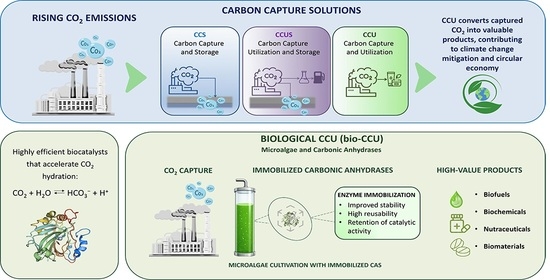
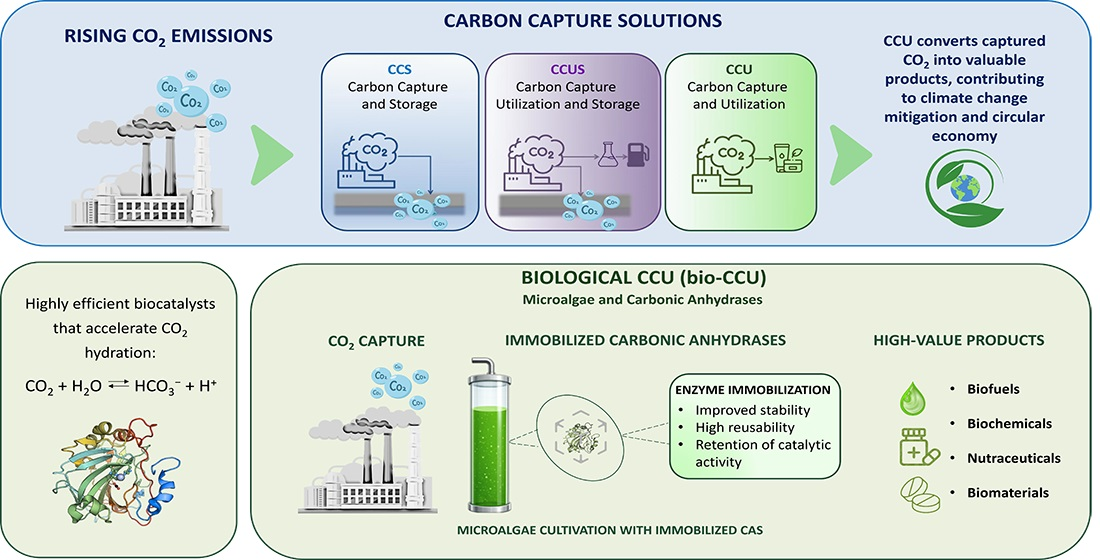
Graphical Abstract

1. Introduction

More than 80% of global energy production comes from fossil fuel combustion, which is responsible for a substantial release of greenhouse gases (GHGs), such as CO2, CH4, N2O, and chlorofluorocarbons, with CO2 accounting for almost 70% of total emissions [1]. GHGs are essential for supporting life on Earth, as they maintain a stable climate, but an excess in GHG concentration leads to global warming and severe environmental consequences, including rising average temperatures, melting glaciers, sea-level rise, biodiversity loss, and the increasing frequency of extreme weather events [2]. Over the past decades, anthropogenic activities, such as rapid industrialization, urbanization, and energy demand, have significantly increased emissions, thus accelerating climate change and threatening natural ecosystems and human societies [1]. The persistent increase in atmospheric CO2 concentrations is one of the leading causes of the current climate crisis, with long-term impacts on water resources, food security, public health, and the global economy [2,3]. Consequently, reducing GHG emissions has become an urgent international priority. In response to these environmental concerns, several international agreements and climate policies have been established to limit global warming and to promote sustainable development. Among them, the Paris Agreement represents one of the major global commitments to fight climate change, aiming to limit the increase in global average temperature to below 2 °C compared to pre-industrial levels, while pursuing efforts to limit it to 1.5 °C [4]. To achieve these objectives, participating governments are working on the transition toward low-carbon and renewable energy systems [5].
Despite these international efforts, global emissions remain at critically high levels, thus highlighting the urgency for stronger environmental policies, technological innovation, and sustainable industrial practices [6,7]. In this context, setting up effective mitigation strategies could represent a crucial step to achieve climate neutrality and a more sustainable future. So far, approaches such as fuel switching, electrification, and energy efficiency improvements have been proven to be not sufficient to offset increasing fossil energy demand, especially in fast-growing regions [8]. As a result, research is focused on the development of complementary technologies capable of actively removing CO2 and, ideally, converting it into products with a high market value. Thus, innovative carbon capture technologies can represent a new challenge to decrease GHG levels, achieving net zero and, ultimately, net negative emissions. The deployment of these technologies, however, is strictly bound to the thermodynamic behavior of CO2, which can exist as a gas, liquid, or supercritical fluid, depending on pressures and temperatures. While these physical features allow different sequestration strategies, they also pose serious environmental and health risks due to their interactions with pipeline systems and geological storage formations, which can result in corrosion, leakage and material degradation [9].
Here, an updated review of scientific papers on different innovative carbon capture technologies is reported, with a special focus on biological processes involving microalgae. Microalgae are photoautotrophic microorganisms able to fix atmospheric CO2 and can therefore represent a biological tool for carbon capture [10]. Particular emphasis is given to three interrelated aspects: (i) enzymatic systems; (ii) materials used for enzyme immobilization; and (iii) microalgae. By integrating the available knowledge, this review aims to provide a critical perspective on the state-of-the-art of these methodologies, highlighting the potential of biological systems as environmentally friendly approaches for CO2 mitigation, while emphasizing that research in the field is still at an early stage.

2. Carbon Capture Technologies

Over the past decade, three main carbon capture strategies have been proposed: Carbon Capture and Storage (CCS), Carbon Capture Utilization and Storage (CCUS), and Carbon Capture and Utilization (CCU). Although they rely on common basic principles, they differ in the fate of captured CO2. In CCS, CO2 is captured, transported, and safely stored in suitable geological sites to meet emissions targets [11]. Taking advantage of well-established injection technologies, CO2 can be permanently stored in deep saline aquifers, depleted hydrocarbon reservoirs, or basalt formations, which offer enormous theoretical storage capacities estimated in thousands of Gigatons (Gts) [12,13]. A critical prerequisite for CO2 safe storage is a low-permeable or impermeable layer above the storage site to prevent potential leaks [14]. Saline aquifers are one of the most promising solutions due to the presence of water-bearing strata and their vast volumetric capacity. However, the elevated pressure may trigger fracturing and lead to CO2 leakage, posing risks to groundwater quality and thus necessitating stringent monitoring of the whole system and regulatory compliance [15]. On the other hand, depleted hydrocarbon reservoirs are estimated to store an amount of CO2 about 13 times higher than aquifers [15]. However, independent of the geological site, CCS deployment still faces major limitations, such as high operational costs (estimated at US$123–341/tCO2) [16], extensive infrastructure requirements, such as pipelines and storage hubs, and low public acceptance, particularly due to CO2 leaks [11,17]. Finally, CO2 can also be injected and stored into reactive basaltic rocks, where a carbonation reaction may occur due to the presence of carbon-fixing minerals. For this reason, basalt formations are considered a good long-term solution, as they allow permanent storage while minimizing the risk of leakage [14].
CCUS addresses CCS challenges by combining CO2 capture and long-term storage with its partial use as a carbon feedstock to produce fuels, chemicals, and construction materials. This technological framework relies on three consecutive stages: carbon capture, safe transportation and permanent storage [18]. By coupling CO2 mitigation with the generation of high-value products, the resulting revenue can support the transition toward more sustainable industrial systems.
However, despite its potential, CCUS exploitation is constrained by technological issues, social acceptance, the absence of defined regulatory frameworks and high investment costs. Many utilization pathways remain economically challenging, with costs often higher than CCS, contributing to the cancellation of 43% of announced projects [19]. In addition, CO2 utilization can increase overall energy consumption by 20–30% and may significantly increase water and land requirements, thereby introducing further environmental burdens [20]. Furthermore, possible CO2 leakage from storage sites, along with soil and ocean acidification, remains a risk with broader climate impact. These challenges are further intensified by complex supply chains, which increase infrastructure demands and logistical constraints, thus compromising the overall system efficiency.
Unlike the other strategies, CCU encompasses a variety of applications that rely on the use of captured CO2 from industrial sites or directly from the atmosphere, converting it through chemical, electrochemical, or biological processes into marketable products, without requiring transportation or geological storage [21]. CCU is primarily driven by economic value generation and emissions reduction, positioning captured CO2 as a strategic industrial feedstock rather than waste, thereby promoting the circular economy [22]. From a life-cycle assessment (LCA) perspective, CCU offers several distinct advantages that support its integration into industrial decarbonization strategies. First, by directly using captured CO2, CCU prevents its additional release into the atmosphere; second, by displacing carbon-intensive conventional products, it provides CO2-substitution credits; finally, by using renewable energy, it further reduces net emissions [22]. Consequently, CCU is strategically critical to reach EU net-zero objectives by 2050 and should be fully recognized and supported as a key tool to reduce emissions, especially in hard-to-abate sectors. Indeed, it has been estimated that CCU-derived products could reduce industrial GHG emissions by at least 20% [23]. In 2025, the global CCU market was estimated to be approximately USD 5 billion and is projected to grow at a compound annual growth rate (CAGR) of 25%, reaching USD 15 billion by 2033, driven by tightening regulatory frameworks, carbon pricing mechanisms, and increasing private investments. These data are even more encouraging when considering that global CCS was valued at approximately USD 4 billion in 2025 and is projected to reach USD 20 billion by 2034, growing at a CAGR of 18.0% from 2026 to 2034 [24]. Meanwhile, the global CCUS absorption market size was valued at about USD 6 billion in 2025, with a market projection up to USD 50 billion by 2034, exhibiting a CAGR of 25% during the forecast period [24]. Notably, the global CCU chemicals market was valued at USD 60 billion in 2024 and is expected to grow to about USD 500 billion in 2034, at a CAGR of 20.5% (according to the latest report published by Global Market Insights Inc., 6 May 2026). Thus, evidence underscores that CCU is not only a technically viable pathway but also an increasingly robust economic opportunity aligned with the EU 2050 net-zero ambitions.
While increasingly recognized as an effective decarbonization strategy, CCU still faces important technical and economic barriers, such as energy intensity [25]. Electrochemical and chemical conversions require substantial energy inputs, thus constraining scalability and economic competitiveness where low-cost, low-carbon electricity is not readily available [26,27]. Consequently, the search for less energy-intensive and more sustainable CO2 utilization routes has expanded beyond conventional physicochemical systems toward biological platforms, where carbon fixation is driven by microbial metabolism rather than by external energy-intensive catalysis.

3. Carbonic Anhydrases as Efficient Biocatalysts for Bio-CCU

Carbonic anhydrases (CAs, EC 4.2.1.1) are among the most promising biological tools for carbon capture and utilization due to their exceptional catalytic efficiency in CO2 conversion [28,29]. These enzymes, widely distributed in animals, plants, algae, and microorganisms, catalyze the reversible hydration of CO2 to bicarbonate and protons under mild conditions, according to the reaction:
CO2 + H2O ⇌ H+ + HCO3−
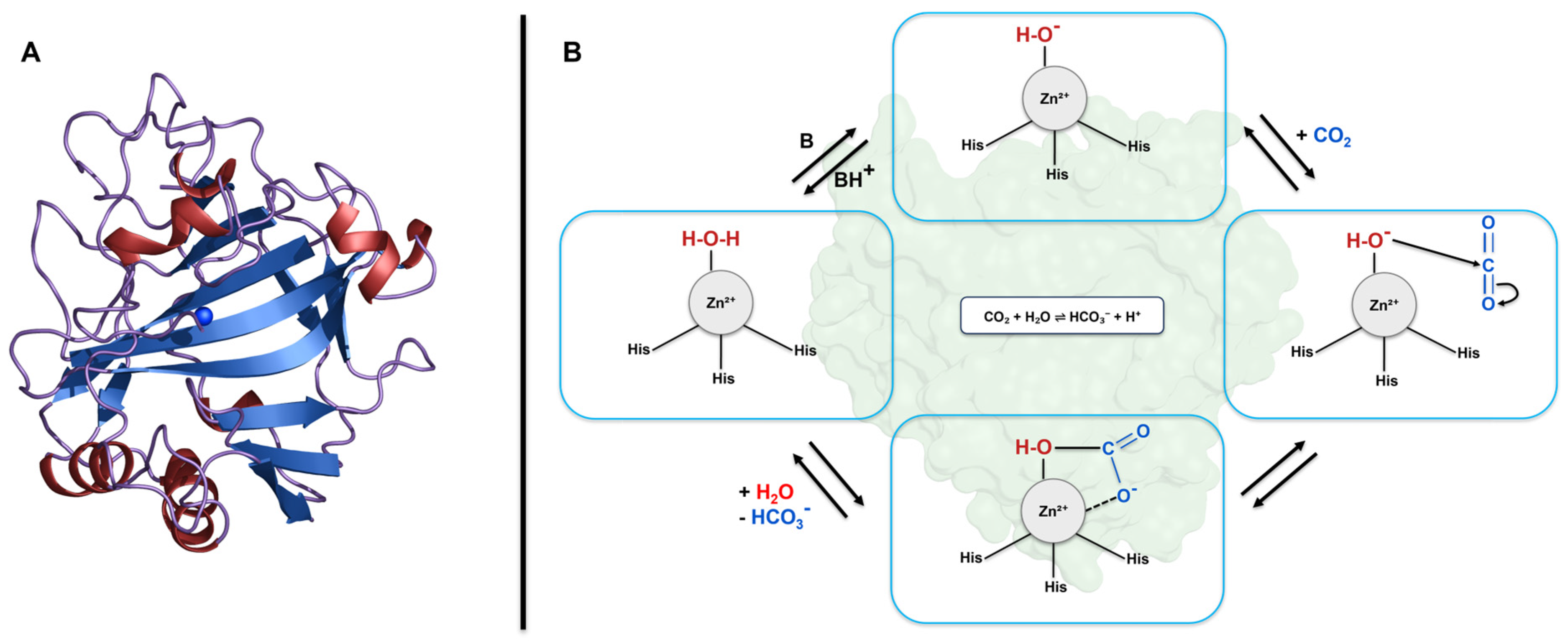
CAs are essential in several physiological processes, including respiration, photosynthesis, inorganic carbon transport, calcification, and acid–base regulation [30]. Their remarkably high turnover rates make them among the fastest known enzymes; certain isoforms, such as human carbonic anhydrase II (hCA II), can catalyze up to approximately 106 CO2 molecules per second [31,32]. CA catalytic activity is usually mediated by a metal ion located in the active site, most commonly Zn2+, although other metal cofactors, such as Co2+, Mn2+, Fe2+, and Cd2+−, can occur depending on the enzyme family [33,34,35]. These metalloenzymes are currently classified into eight genetically distinct families, named α-, β-, γ-, δ-, ζ- η-, θ-, and ι-CAs, which are phylogenetically unrelated and differ in sequence, structure, metal cofactor preference, cellular localization, and organism distribution. For instance, α-CAs are widely represented in animals, plants, algae, fungi, protozoa, and bacteria [36,37,38], whereas β-CAs are common in plants, algae, cyanobacteria, and non-photosynthetic organisms [39,40,41]; γ-CAs have been identified in archaea, certain bacteria, and plants [41]. Other families show a more restricted distribution; for example, δ- and ζ-CAs are mainly reported in marine photosynthetic organisms [42,43], whereas η-, θ-, and ι-CAs have been identified more recently in selected protists, algae, diatoms, bacteria, and archaea [44,45,46]. This diversity reflects the multiple biological roles of CAs in inorganic carbon management, including respiration, pH regulation, photosynthesis, and Carbon-Concentrating Mechanisms (CCM). In CCM, CAs can accelerate the conversion of CO2 into bicarbonate and, in the presence of suitable cations, facilitate mineralization pathways leading to stable carbonate products such as CaCO3 [47]. Beyond carbonate precipitation, the enzymatically generated bicarbonate provides a soluble and bioavailable source of inorganic carbon for photosynthetic microorganisms such as microalgae and cyanobacteria. Therefore, these enzymes can support biological CCU routes by enhancing photosynthetic carbon assimilation, biomass accumulation [48], and the production of value-added bioproducts. hCA II (Figure 1A) is often considered a reference CA isoform due to its exceptionally high CO2 hydration activity, with kcat and kcat/Km values of 1.4 × 10⁶ s−1 and 1.5 × 10⁸ M−1 s−1, respectively [49] and is thus frequently used as a model system for CCU. As schematically illustrated in Figure 1B, the catalytic mechanism of hCA II relies on the Zn2+ ion located in the active site, which is coordinated by three histidine residues and a water molecule. The metal-bound water is deprotonated to generate a Zn2+-bound hydroxide ion, which acts as a nucleophile and attacks CO2, leading to the formation of a bicarbonate intermediate, which is subsequently released and replaced by a new water molecule, restoring the initial catalytic state. Through this cycle, hCA II efficiently catalyzes the reversible hydration of CO2 to bicarbonate and protons.
By accelerating CO2/HCO3− interconversion through CA enzymatic activity, it is possible to mitigate kinetic bottlenecks in inorganic carbon supply [50]. However, while the physiological CA concentration and localization are sufficient to support microalgae growth, the net amount of fixed CO2 is insufficient to achieve a significant GHG reduction from high-emission sites. To overcome these problems, exogenous CAs represent a biotechnological strategy to improve inorganic carbon availability in microalgal cultivation systems. However, their practical application remains constrained by several factors, including enzyme selection, delivery mode, high costs, susceptibility to deactivation, and, particularly for free CA, difficulties in recovery and reuse [51]. In addition, CA instability may result not only from protein denaturation, but also from metal ion leaching from the active site [52,53]. To improve enzyme stability and catalytic performance, several approaches have been proposed, including genetic engineering [54,55], chemical modifications [56], and enzyme immobilization [57]. Indeed, several factors must be considered when evaluating the feasibility and scalability of CCU technologies: while the addition of free CA to the culture medium can enhance CO2/HCO3− interconversion, it limits enzyme recovery and reuse; on the other hand, immobilization can facilitate enzyme recovery and repeated use, but it may compromise catalytic activity depending on the immobilization strategy and support material. In the following paragraphs, the main immobilization strategies employed for CCU applications will be discussed.

4. Immobilization Systems for CCU

4.1. General Immobilization Methods in CCU

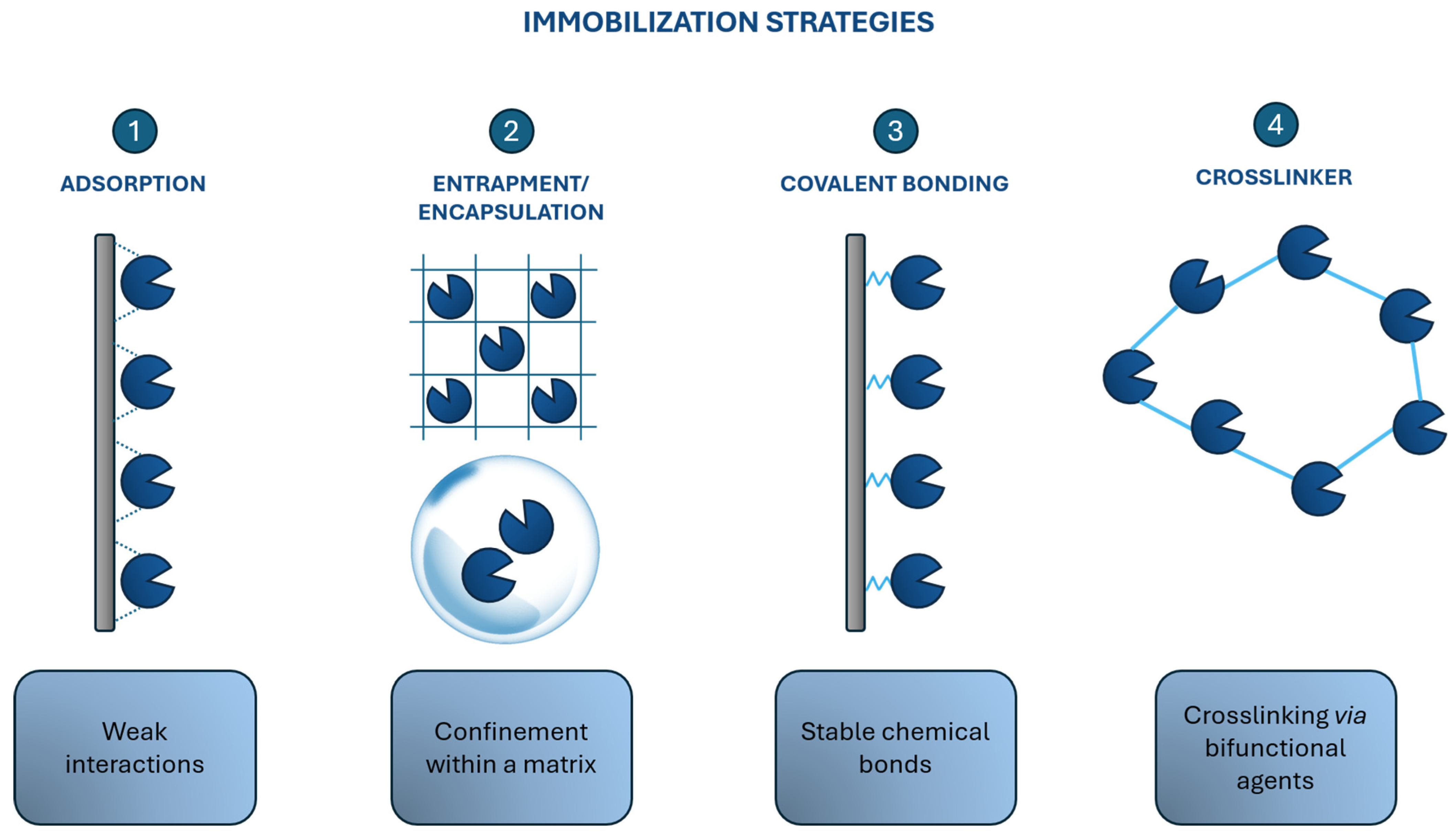
Enzyme immobilization represents a strategic tool to boost catalytic efficiency, enhance enzyme stability under different experimental conditions, such as pH and temperature fluctuations, improve shelf-life, and facilitate enzyme recovery and reusability [58,59,60]. Several immobilization techniques are currently employed, which are mainly classified as “non-covalent methods”, such as adsorption, ionic binding and entrapment/encapsulation, and “covalent methods”, such as covalent binding and cross-linked enzyme [61,62], as schematically illustrated in Figure 2. Independently of the technique used, enzyme immobilization can represent a reliable and efficient approach to reduce extensive downstream processes to make the process cost-effective [62].
Adsorption is a simple and non-invasive enzyme immobilization strategy, based on reversible physical interactions, in which an enzyme is weakly bound to the surface matrix through van der Waals, hydrophobic interactions, ionic and/or hydrogen bonding [63]. These interactions have a minimal impact on protein structure and function, as no harsh chemical treatments are required [64] and their cumulative effect is sufficient to allow a strong interaction between the enzyme and the matrix [65]. Similarly, ionic immobilization can be achieved by using an ion-exchange resin, whose choice depends on the enzyme’s net surface charge, and therefore on the relationship between solution pH and protein isoelectric point (pI) [62,66,67]. Enzymes are predominantly positively charged at pH < pI and negatively charged at pH > pI, determining their interaction with oppositely charged supports. Near the pI, the reduced net charge may weaken the electrostatic contribution to binding, making these systems sensitive to pH fluctuations and potentially favoring enzyme desorption [62]. Changes in ionic strength, temperature, or the presence of competing molecules may also contribute to protein desorption, representing a serious limitation in CCU [47].
Entrapment and encapsulation are based on the physical confinement of enzymes within protective matrices or compartments [68,69]. In entrapment, enzymes are embedded in a polymeric network, such as gels, fibers, or hydrogels, whereas in encapsulation they are enclosed within capsules, particles, or semipermeable membranes [68,70,71]. Since these methods do not require covalent bonding between the enzyme and the support, they generally reduce the risk of chemically induced conformational changes and activity loss. Matrix thickness, pore size, and membrane permeability play key roles in preventing enzyme leakage while allowing the free diffusion of substrates and products [62,70]. Enzymes can be incorporated either during matrix formation or after the network generation.
Covalent immobilization techniques include strategies that differ in the orientation of the enzyme on the support, the number and position of attachment points, and the use of crosslinkers [62,72]. Compared with physical adsorption, covalent attachment generally provides higher storage and operational stability by reducing enzyme desorption and strengthening enzyme–support interactions [59,65,73,74]. Multiple covalent attachments can further increase protein rigidity and limit conformational flexibility, thereby enhancing overall stability [65,75,76,77]. Usually, the binding between protein and matrix is mediated by bifunctional crosslinkers, such as glutaraldehyde, carbodiimides, or silanes [78,79]. However, covalent immobilization often requires longer reaction times, higher production costs, and careful optimization of parameters, such as pH, temperature, crosslinker concentration, and support functionalization. In addition, excessive rigidification, unfavorable enzyme orientation, or the involvement of residues essential for catalysis may negatively affect enzyme activity. Thus, a precise control of immobilization conditions is required to balance stability and catalytic performance.
Finally, cross-linked enzymes (CLEs), cross-linked enzyme crystals (CLECs) and aggregates (CLEAs) represent a class of support-free strategies in which enzymes are covalently bound in their soluble, crystalline or aggregated state, respectively [78]. In CLEs and CLEAs, the free amino groups of surface lysine residues are mainly responsible for cross-linking with glutaraldehyde polymers. CLEs represent the simplest carrier-free immobilization method, although protein purification is required, thus increasing the overall costs. Furthermore, their practical application is limited by poor chemical and mechanical stability and low reproducibility [80]. Conversely, the first step of CLEC preparation is the obtainment of a highly purified protein. After crystallization, the enzyme has a well-ordered structure, so that cross-linkers will primarily affect the surface groups, leaving the active site fully accessible to the substrate. This results in enhanced catalytic and chemical stability, along with a controllable particle size coupled with high productivity. Moreover, CLECs can be easily recovered and reused, even if the crystallization step dramatically increases the overall costs.
To reduce purification-related costs, an alternative procedure was developed, in which a crude protein extract is first precipitated and subsequently cross-linked, leading to CLEA formation. CLEAs show good operational and storage stability, good reusability and, even if they are all derived from crude extracts, they have high catalytic specificity and selectivity. Furthermore, cross-linking confers enhanced rigidity to the tertiary structure, preventing the dissociation of multimeric enzymes and reducing the risk of denaturation. However, since aggregation strictly depends on the specific enzyme, a case-by-case optimization procedure is required.
In spite of their advantages, these carrier-free systems are often constrained by limitations, including enzyme inactivation, conformational alteration of the enzyme, reduced mass transfer, and lower reaction rate [63,81,82]. Therefore, designing an optimal immobilization strategy requires a meticulous selection of the crosslinker, taking into account the enzyme’s functional groups and the specific bonding chemistry [62,83].

4.2. Materials for Enzyme Immobilization

Apart from CLEs, CLECs and CLEAs, all other immobilization techniques require solid support to stabilize enzymes and preserve their activity by enhancing their resistance to the surrounding environment. Many matrices, including inorganic or organic materials with distinct physical and chemical properties, have been proposed to optimize protein immobilization, with the common goal of preserving enzyme activity [84]. Choosing an appropriate material is crucial because it strongly influences enzyme catalytic performance. Support suitability depends on key structural factors, such as geometry, size, pore diameter, surface area, and the degree of functionalization [85]. An ideal carrier should be cost-effective, inert, stable, mechanically strong, and capable of enhancing enzyme specificity or activity, while reducing product inhibition and preventing microbial contamination [68]. Inorganic supports offer high mechanical, chemical, and thermal stability, large surface areas, and improved reusability, whereas organic supports are favored for their biocompatibility, mild processing conditions, and sustainability.
Among inorganic supports, silica gels and metal oxides are the most widely used. Silica is extensively used due to its strong thermal and chemical stability and robust mechanical properties, high surface area and porous structure. All these features provide excellent sorption capacity, enabling efficient enzyme attachment while minimizing diffusional limitations [86]. Additionally, the presence of surface hydroxyl groups facilitates functionalization with different crosslinkers [87]. Mesoporous silica, SBA-15, dendritic mesoporous silica and sol–gel silica beads have all been investigated for enzyme immobilization. Recent work on dendritic mesoporous silica highlights how their open radial channels and large pore entrances reduce diffusion limitations [88].
Among metal inorganic oxides, titanium, aluminum and zirconium oxides are well-known for their chemical inertness, high stability, mechanical robustness and good sorption capacity. The presence of hydroxyl groups on their surface renders these materials highly hydrophilic, enhancing surface modification that favors the formation of stable enzyme-matrix interactions. Nanostructured materials provide a large surface area, leading to higher enzyme loading on the matrix surface. Nanoparticles show minimal diffusional limitations, as enzymes are attached to the surface of the nonporous particles, ensuring high catalytic activity retention due to the accessibility of the active site. In particular, iron oxide nanoparticles can combine short diffusion paths with magnetic separation, significantly improving their recovery and reusability [89,90].
Among organic supports, chitosan, alginate and silk-fibroin-based hydrogels are the most widely used [91]. Chitosan is a natural, sustainable, hydrophilic and chemically modifiable polymer, which can be assembled in different forms and shapes. The primary amino groups on the chitosan backbone are responsible for electrostatic interactions and covalent bonding required for enzyme immobilization [92]. However, in biological systems, where pH fluctuations may occur, chitosan can undergo protonation, alter its surface charge and potentially affect crosslinking efficiency. Besides chitosan’s natural binding sites, bifunctional crosslinkers, such as glutaraldehyde and genipin, are often employed to improve mechanical stability, even if they can alter pore structure and mass transfer [92,93]. Due to its high biocompatibility and natural origin, chitosan can be employed in biological systems [94]. Alginate, on the other hand, is generally employed for enzyme entrapment under mild experimental conditions. Its gel network results from the interaction between calcium ions and carboxyl groups of uronic acid residues in alginate chains. The presence of these negatively charged carboxyl groups is responsible for its water solubility [94,95]. The literature provides contrasting evidence on alginate-based enzyme immobilization. While the relatively low mechanical stability of alginate gels and their diffusional limitations can affect substrate and product transport [96], the entrapped enzyme exhibits good catalytic activity, despite enzyme leaching often being observed [94]. Besides these biopolymeric matrices, biochar, obtained through pyrolysis of lignocellulosic biomass or non-lignocellulosic feedstocks, is emerging as a sustainable carbon-based support that combines enzyme immobilization with waste biomass valorization [97,98,99,100,101]. Usually, enzyme immobilization is achieved by adsorption and covalent bonding, strategies that can improve the pH, thermal, storage, and operational stability of the immobilized enzyme. However, biochar is still a pioneering material to be used for enzyme immobilization, as mass transfer, immobilization efficiency, and long-term reusability remain poorly characterized [97].
Recently, novel materials emerged as innovative supports for enzyme immobilization, such as metal–organic frameworks (MOFs), covalent organic frameworks (COFs), and hydrogen-bonded organic frameworks (HOFs). These materials serve as excellent carriers for immobilized enzymes due to their high porosity, surface area, controlled pore structure and designable functionality [102,103,104].
MOFs are a class of supports characterized by modular construction of their components, in which organic links and metal-based nodes are assembled to form extended networks [103,104,105]. This results in precise tailoring, a high degree of crystallinity, remarkable surface areas and pore volumes [106]. When enzymes are encapsulated within MOF structures, the enzyme is effectively protected within a confined catalytic environment [107,108]. Their application is encouraging but still at a primordial stage, mainly due to aqueous instability, pH tolerance, synthesis costs and scaling-up. Moreover, because the framework integrity entirely relies on coordination bonds, metal ion leakage and structural degradation can occur. For these reasons, MOFs are still preferred for specific high-value applications rather than for large-scale supports. Different is the case of COFs, where covalent bonds are responsible for framework stabilization, offering higher stability, uniform pore size distribution and excellent thermal stability. Within these structures, encapsulated enzymes retain their native conformation. However, the size compatibility between pore structure and target enzymes is still a critical parameter to be considered, along with the harsh conditions required for their synthesis [107].
Finally, HOFs are a novel porous crystalline material in which weak interactions, such as hydrogen bonding between organic tectons, are responsible for cage stability. In this case, mild conditions are required to immobilize the enzyme, and the absence of metal confers biocompatibility [107,109]. Different methods and materials are summarized in Table 1, where advantages and limitations are reported. It should be noted that cost-related limitations associated with some immobilization methods are based on qualitative assessments reported in the literature, as the available studies generally lack the standardized technical and economic data required for a robust techno-economic comparison.

4.3. Immobilization CAs Applied to CCU

As discussed above, CAs can act as efficient biocatalysts in carbon mitigation processes. Within the CCU framework, the deployment of exogenous CAs represents an innovative strategy to maximize carbon fixation. However, the enzyme, in its free form, cannot be recycled and might be susceptible to degradation and proteolytic events. To overcome these bottlenecks, its successful immobilization is essential, as this could extend operational lifetime and allow enzyme recycling [110,111]. Once immobilized, other factors might be responsible for a successful CCU, such as reactor geometry and transport phenomena. The first strongly influences enzyme performance, being responsible for an efficient aeration system, which in turn is responsible for increasing CO2 concentration and local CO2 availability. On the other hand, enzymatic reactions are constrained by transport phenomena, in particular by internal diffusion pathways, proton transport, and bicarbonate diffusion, which are directly dictated by the structural morphology and nature of the chosen support. Moreover, during repeated reuse cycles, a progressive loss of enzymatic activity can occur; however, the available studies generally do not clarify whether this is due to enzyme leaching, denaturation, or a combination of both mechanisms.
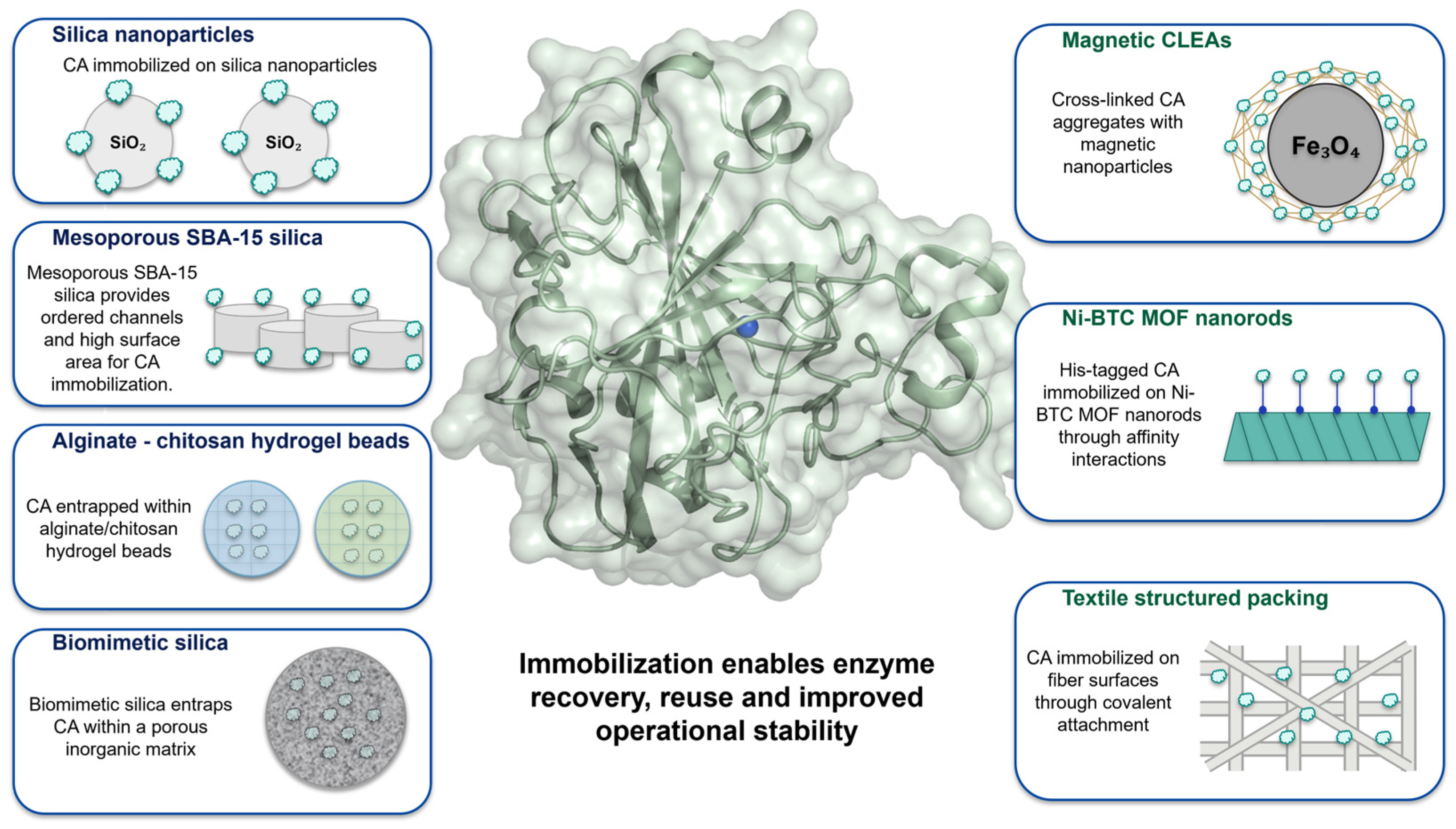
Different supports have been used to immobilize CAs, as summarized in Table 2 and schematically represented in Figure 3. In the case of silica-based systems, Zhang and colleagues demonstrated that immobilizing bovine CA on nonporous silica nanoparticles (NPs) improved enzyme loading, activity and thermal and chemical stability, with smaller nanoparticles yielding the best performance compared to porous micron-sized supports [112]. In particular, the best ratio between enzyme loading and catalytic activity was observed after 90 min incubation, with a final yield of 45 mgCA/gNP, and a relative activity of 100%. Hydration was measured by a manometric method, using a stirred tank reactor. Similar results were obtained by Fei and colleagues who used an amine-functionalized SBA-15 to covalently immobilize bovine CA [113]. Results indicated that the immobilized protein showed good reusability, as the catalytic activity was retained up to 20 cycles, and the storage stability was similar to that of free CA. Vinoba used a human CA on gold nanoparticles assembled over thiol-functionalized mesoporous SBA-15, demonstrating that silica can retain CA activity while improving reuse and stability [114,115]. The amount of CaCO3 precipitated by functionalized particles was similar to that obtained with free CA, and their activity was retained up to 20 days at 25 °C and for up to 20 recycling runs, with a similar hydration ability to that observed for free CA. Hsieh and colleagues successfully entrapped a bacterial CA from Sulfurihydrogenibium azorense into biomimetic silica support, with a 100% entrapment efficiency and an activity recovery of 91% compared to free CA [116]. The immobilization strategy enhanced enzyme longevity, as the residual activity after 35 days of storage at 25 °C was two-fold higher than free CA, along with good reusability, as entrapped CA retained 86% activity, up to 10 consecutive cycles. However, when tested for the ability to sequester CO2 as CaCO3, the immobilized CA showed a slightly longer reaction time compared to the enzyme in its free form. Focusing on sustainability, research moved towards the use of natural polymeric matrices, such as alginate and chitosan, known to be biocompatible. Yadav et al. [117] successfully used alginate-immobilized bovine CA to promote CO2 transformation to calcite, and the immobilized enzyme retained about 70% of its initial activity up to six cycles. Oviya et al. [118] reported immobilization of bacterial CA in a chitosan-alginate hydrogel for CO2 sequestration. In this case, the optimum temperature was 37 °C with 100% activity for free and immobilized CA. Shen et al. [119] reported CA immobilization on chitosan-coated cotton fibers, in which glutaraldehyde induced enzyme immobilization and CLEAs formation. Immobilization preserved enzyme activity, as about 50% of the initial activity was retained, whereas the free protein reached 2% activity after 30 days of incubation in an accelerated longevity test. The innovative material showed a 66.7% CO2 capture efficiency and up to 1-year stability (85%). To improve protein recovery and reusability, magnetic supports were investigated. Magnetic nanoparticles and magnetic CLEAs have been studied for enzymatic CO2 capture, showing the practical value of combining catalytic density with magnetic recovery [120,121,122]. As an example, Peirce and colleagues crosslinked bovine CA on magnetic nanoparticles to obtain CLEAs upon precipitation with glutaraldehyde [121]. Even if the binding efficiency and residual activity were successful, the nanoparticles failed to efficiently absorb CO2, probably because of the CLEAs distribution at the gas–liquid interface, as well as possible enzyme inactivation during cross-linking. Kim and colleagues developed a 3D-printed platform that serves as an interfacial device to accommodate immobilized bovine CA. The enzyme was immobilized on polystyrene-poly(styrene-co-maleic anhydride) fibers (PS-PSMA) via an enzyme precipitate coating (EPC) protocol. The hydratase activity of EPC-CA/fibers was 1.53 ± 0.06 WAU/mg fiber, 11 times higher than CA COV-CA/fiber (CA covalently immobilized on fibers) used as a control. However, no information on the free enzyme and on immobilization efficiency was reported. Interestingly, the authors calculated the CO2 conversion rate of the system, demonstrating that the maximum rate of 78.3 mmol/min/m2 was obtained at the aqueous interface. Moreover, the CA-loaded interfacial device demonstrated excellent stability, retaining 99.3% of its initial conversion efficiency after 10 reuse cycles and 88.2% after 459 days of storage in an aqueous buffer at 4 °C [123]. Finally, MOF-based CA systems represent a newer direction, as demonstrated by Jiao and colleagues, who used His-tagged hCA II immobilized on Ni-based MOF nanorods to improve storage, temperature and pH stability [108]. The authors demonstrated that the presence of the tag positively influenced the binding to the nanorods.
The overall applications converge on the same principle: CA immobilization improves process feasibility by enhancing enzyme stability and enabling its reuse, allowing the reduction in process costs up to 50%, and making it a powerful tool for industrial implementation of CO2 capture and conversion processes. However, despite these advantages, the overall performance remains strongly dependent on mass-transfer phenomena, which can limit process efficiency [47,124,125,126,127,128].
Although these systems are not based on the direct use of biological systems, they pave the way for biological carbon capture and utilization (bio-CCU) applications. CA-immobilized supports can be employed not merely as particle suspensions, but as modular process units, facilitating their integration with microbial metabolism that utilizes the captured CO2 as a carbon source for the production of value-added compounds.

5. The Biological Route: Bio-CCU for Carbon Conversion

Biological carbon capture and utilization (bio-CCU) can be defined as the use of living cells or biological catalysts to transform inorganic carbon into biomass, bioproducts or metabolic intermediates. Compared with conventional chemical capture, bio-CCU separates CO2 from a gas stream, which is metabolized into molecules with economic value. Depending on the biological source, these molecules may include proteins, lipids, carbohydrates, pigments, extracellular polymers, organic acids, biofuels, or precursors to be used in biorefineries [129].

5.1. Microalgae Mediated Bio-CCU

Autotrophic microorganisms utilize sunlight to drive CO2 fixation into organic compounds that serve as building blocks for their growth, thus effectively storing carbon in biomass and representing an excellent candidate for bio-CCU [130]. Among them, microalgae and cyanobacteria have gained attention for their ability to convert, via photosynthesis, inorganic carbon into organic carbon-based compounds with economic value [131].
Compared to terrestrial crops, microalgae and cyanobacteria are especially attractive because they possess relatively high photosynthetic efficiency, rapid growth, ability to grow on non-arable land, and capacity to thrive in wastewater streams [132]. Their faster growth rate allows them to fix CO2 at a rate up to 50 times higher than that of terrestrial plants [133].
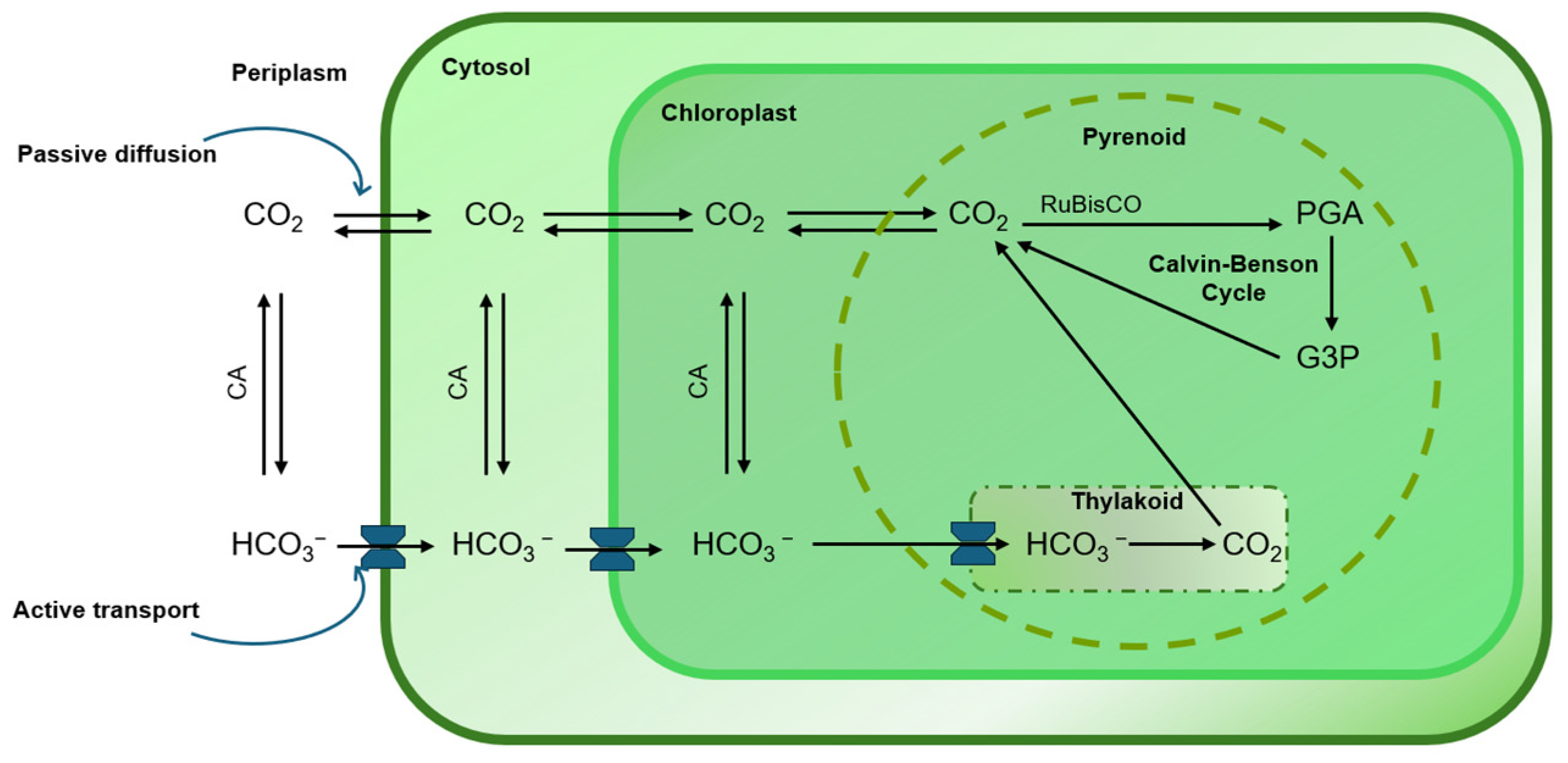
Microalgae-mediated CCU has considerable potential to be a good strategy for enhancing carbon capture, but several limitations still hinder their full exploitation at a large scale. These limitations are mostly rooted in technical factors, with inefficiency in CO2 delivery being the most important. Atmospheric CO2, the most abundant and sustainable source, has a very low concentration (about 0.04%) and dissolves slowly [134]. In aquatic systems, the chemistry of inorganic carbon is central. Once in water, CO2 is hydrated to carbonic acid (H2CO3), which subsequently dissociates into bicarbonate (HCO3−), a form of inorganic carbon that can enter the cells. Under equilibrium conditions with atmospheric air, dissolved CO2 may represent less than 1% of total dissolved inorganic carbon (Ci), which includes CO2, HCO3− or CO32−, whose ratio is strongly influenced by the pH of the medium. During microalgae growth, high CO2 concentration can lower the culture pH and inhibit cell growth, while insufficient CO2 transfer can limit productivity [133,135]. As an adaptive response to external inorganic carbon limitation, cyanobacteria and microalgae rely on carbon-concentrating mechanisms (CCMs) to enhance photosynthetic carbon fixation by increasing CO2 availability in the Rubisco microenvironment. Microalgae CCMs are summarized in Figure 4.
Unlike higher plants, in which CO2 uptake mainly occurs by passive diffusion, cyanobacteria and microalgae CCMs combine CO2 diffusion with energy-dependent uptake systems for inorganic carbon (iC), especially HCO3− [48]. The induction of the CCM is strongly linked to light availability and low-Ci conditions, since light provides the energy required for iC uptake while regulating the expression, localization, and assembly of several CCM components. A central feature of this mechanism is the rapid equilibration between CO2 and HCO3−, a process mediated by CAs, which plays a fundamental role in the CCM of both microalgae and cyanobacteria. CAs cooperate with Rubisco, thereby increasing the local CO2 concentration around Rubisco and improving carboxylation efficiency. Once internalized, HCO3− can be converted back into CO2 by CAs, facilitating CO2 delivery to Rubisco-containing compartments [33,34]. Then, Rubisco catalyzes the carboxylation of ribulose-1,5-bisphosphate, RuBP, producing two molecules of 3-phosphoglycerate. This Calvin–Benson cycle intermediate can then enter central carbon metabolism and contribute to the formation of acetyl-CoA, a key precursor for the biosynthesis of lipids and other value-added compounds [28,35]. Although cyanobacteria and eukaryotic microalgae both rely on CCM to enhance photosynthetic CO2 fixation, their structural organization differs substantially. In cyanobacteria, CCM mainly relies on active HCO3− uptake and CO2 uptake systems coupled to carboxysomes, proteinaceous microcompartments in which RuBisCO and CAs are co-localized. Within carboxysomes, CAs convert accumulated HCO3− into CO2 in close proximity to RuBisCO, thereby increasing the local CO2 concentration and improving carboxylation efficiency. In eukaryotic microalgae, CCMs are generally more compartmentalized, involving inorganic carbon transport across the plasma membrane, the chloroplast envelope and, in some species, the thylakoid membranes (Figure 4). Accordingly, CA isoforms can be localized in periplasmic regions, the cytosol, mitochondria, chloroplasts or pyrenoid-associated compartments, where they regulate CO2/HCO3− interconversion and facilitate inorganic carbon delivery to the photosynthetic machinery. From a bio-CCU perspective, this structural distinction is crucial, as cyanobacteria and eukaryotic microalgae may respond differently to CO2 supply, bicarbonate availability and pH changes, depending on how their CCMs and CA isoforms are organized. Therefore, carbon uptake should not be considered only as a function of CO2 concentration in the inlet gas, but also as the result of inorganic carbon conversion, transport, and local availability both at the cell surface and in proximity to the RuBisCO carboxylation site. CAs are fundamental enzymes in CCM regulation, and for this reason they are sensitive to environmental conditions. Increasing CO2 concentration above a certain threshold (>20%) can decrease CA expression, thereby reducing CO2/HCO3− interconversion [30]. In microalgae-mediated bio-CCU, biological processes and transport phenomena are strongly interconnected, since light distribution, gas–liquid transfer, carbonate chemistry, culture pH, nutrient availability, cell density, microbial interactions and bioreactor geometry all simultaneously influence the final CO2 fixation rate [30,136]. Optimizing these cultivation parameters represents therefore a first strategy to maximize carbon-fixing potential and enhance carbon capture [36]. However, even under optimized cultivation conditions, each strain possesses its own metabolic features, which ultimately determine its maximum carbon fixation capacity. Some examples of microalgal strains commonly used for CO2 capture are summarized in Table 3.

5.2. Immobilized CAs Applied to Bio-CCU

An integrated bio-CCU approach can be achieved by combining microalgae with immobilized CAs. In this system, the immobilized enzyme acts as an auxiliary tool by catalyzing the interconversion between CO2 and bicarbonate, thereby increasing the availability of inorganic carbon in the microalgal culture medium and facilitating its uptake by the cells. The subsequent biological fixation and utilization of inorganic carbon are instead performed by microalgae through photosynthesis.
To date, only a few studies have investigated the use of immobilized CAs on reusable matrices to support microalgae growth, thus contributing to bio-CCU [148,149,150,151]. Among these, Kim’s group used immobilized bovine CA on composites of carboxylated polyaniline nanofibers to improve Dunaliella tertiolecta (ATCC 30929) growth [110]. The authors crosslinked CA to nanofibers and then to magnetic nanoparticles. While both esterase and hydration catalytic activities were successfully evaluated, the authors could not determine the immobilization yield or specific activity of the enzyme.
Accordingly, no data on the amount of protein per nanoparticle was reported. When these nanoparticles were tested on D. tertiolecta in the presence of atmospheric CO2, the system induced a 1.8-fold increase in microalgae growth after 6 days of incubation, and the immobilized enzyme was able to sustain this growth up to two cycles. Martin’s group worked on a different support to covalently entrap CA to be tested on Nannochloropsis salina cultivation [111]. The authors cross-linked CA with glutaraldehyde before encapsulating it into buoyant calcium alginate beads, with an immobilization yield of 80%, but with no indication of the amount of immobilized CA per bead. Notably, as these beads are buoyant, they could theoretically eliminate the need for air sparging to supply CO2, as beads may capture CO2 directly from the water-air interface. When CA-GA beads were added to microalgae culture in the absence of air sparging, the authors observed a 40% increase in biomass accumulation after 7 days of incubation. However, CA-GA beads were not able to induce biomass growth to the same extent as cells grown in the presence of air sparging. Recently, Wang and colleagues used CA coated onto a polysulfone membrane through a layer-by-layer method [152]. Specifically, they evaluated CA immobilization on membranes consisting of 1-, 3-, and 5-layers, with the 3-layer configuration exhibiting the highest enzymatic activity. However, the authors did not determine the specific catalytic activity or the immobilization yield. When tested on microalgae, the immobilized CA increased biomass growth by approximately 50% after 7 days of cultivation compared to the control. Interestingly, this system also increased the carbon fixation rate by 50% compared with cultures supplied with a commercial air-stone sparger. Furthermore, the membranes could be reused for up to five consecutive cultivation cycles while fully maintaining their growth-promoting effect.
He et al. cultivated microalgae cells within a silk/alginate hydrogel, in which CA was encapsulated in silk nanoparticles and co-embedded with microalgae in the hydrogel [53]. After 7 days of incubation, a 50% increase in biomass accumulation was observed in cells grown in the presence of CA-loaded hydrogel, along with a 50% enhancement in carbon fixation rate, with respect to control cells. The hydrogel was further improved by a microfluidic system, which allowed moisturization of the gel. Relative activity of the encapsulated CA was about 85%; however, no data on protein immobilization yield was reported.
Thakur et al. immobilized CA from Corynebacterium flavescens onto ZIF-8/graphene oxide nanocomposites through covalent bonding and onto biochar through physical adsorption [153]. Although both systems achieved high immobilization yields, biochar was found to better preserve the catalytic activity, maintaining it at a level comparable to that of the free enzyme. Accordingly, when tested in a Chlorella sp. culture, only the biochar-immobilized CA resulted in an 80% increase in microalgal growth. However, no information was provided regarding the CO2 fixation rate or the reusability of the immobilized enzyme. Liu and colleagues encapsulated a recombinant dimeric CA from Sulfurihydrogenibium azorense into silica particles, which were then dispersed in epoxy resin [154]. The enzyme loading directly increased with the amount of silica particles added, reaching the best results when 200 mg of silica particles were used for the preparation of silica coatings, as the highest specific activity was reached. The innovative material showed a 30% increase in Chlorella biomass concentration after 5 days of growth. Wang and colleagues used delignified bamboo to obtain cellulose as a structural building block for particle formation [155]. Bovine CA was covalently encapsulated through a Schiff-base link to obtain 6 mm particles. When tested for their catalytic activity, they showed lower activity with respect to free CA, and no data on encapsulation efficiency was reported. Finally, CA-loaded particles were able to induce Chlorella growth by 16% after 8 days of incubation; however, it was not possible to recover CA-loaded particles after use. The main outcomes of the studies described above are summarized in Table 4.
Overall, the comparison among these studies highlights several limitations that currently hinder a comprehensive assessment of the potential of immobilized CAs for microalgae-based bio-CCU. First, enzyme loading efficiency, immobilization yield, and the specific catalytic activity of the immobilized enzyme are not always reported, limiting a direct comparison of immobilization performance.
Moreover, although several studies have demonstrated the possibility of recycling immobilized CA, reusability is often evaluated through consecutive cycles performed in clean buffer systems rather than under actual microalgal cultivation conditions. This distinction is particularly relevant because prolonged operation in biological systems may introduce additional factors, including biofouling, cell adhesion or entrapment, accumulation of extracellular biomolecules, changes in pH and ionic strength, and progressive enzyme leaching and/or denaturation, all of which may negatively affect the catalytic performance of the immobilized system.
The studies reported to date are therefore very promising but should still be regarded as pioneering proof-of-concept investigations, as they have predominantly been performed at a laboratory scale and under conditions that do not fully reproduce industrial CO2 streams. In particular, most experiments have been conducted using atmospheric CO2 or simplified CO2-enriched conditions, whereas industrial flue gases can contain substantially higher CO2 concentrations together with other gases, which may affect both CA stability and microalgae physiology. The tolerance of immobilized CAs and their supporting matrices to these potentially inhibitory compounds represents an important knowledge gap for future studies.

6. Conclusions

Carbon Capture and Utilization allow the transformation of captured CO2 into high-value products, fostering the transition toward a circular economy. The integration of microalgae culture medium with exogenous immobilized carbonic anhydrases represents a promising bio-CCU strategy, even if a significant gap between literature claims and industrial feasibility remains. Current literature focuses on critical deployment barriers, including high enzyme production and immobilization costs, low operational biocatalyst stability, mass transfer bottlenecks, energy-intensive harvesting, and photobioreactor design constraints. Critically, delivering sufficient CO2 without driving the culture pH to growth-inhibiting levels remains an unresolved issue. Moreover, studies frequently report short-term biomass growth, rather than carbon fixation rates, carbon partitioning or downstream product yields. The analysis of the immobilized CA systems (Table 4) further highlights the limited standardization of available data. Indeed, immobilization yield was not reported in 50% of the studies, reusability was not evaluated in 63% of the cases, while specific CO2 fixation rate was not determined in 75% of analyzed papers. This lack of key parameters limits the quantitative comparison of immobilization strategies and the assessment of relationships between enzyme loading, retained catalytic activity, and microalgae performance. Future research should adopt a multidisciplinary approach, focusing on advanced nanostructured supports, hybrid organic-inorganic matrices, and porous functional materials capable of enhancing enzyme performance under harsh operational conditions. More systematic and standardized reports of immobilization yield, enzyme loading, and specific activity will be essential to allow a reliable comparison among immobilized CA systems. These data are necessary to perform techno-economic analyses and life-cycle assessments needed to evaluate the scalability, economic and environmental feasibility of the process at an industrial scale. Overcoming these issues is crucial to establish an integrated microalgae-CA system as a viable industrial technology and to avoid bio-CCU remaining a mere concept.

Author Contributions

Conceptualization, writing—original draft preparation, A.F., P.I., R.A. and V.M.V.; validation, supervision and writing—review and editing, S.M.M. and D.M.M. All authors have read and agreed to the published version of the manuscript.

Funding

This research received no external funding.

Institutional Review Board Statement

Not applicable.

Informed Consent Statement

Not applicable.

Data Availability Statement

No new data were created or analyzed in this study. Data sharing is not applicable to this article.

Acknowledgments

This work was supported by the PRIN 2022, “Protecting the Environment with microAlgae and Carbonic anhydrasEs (PEACE)” funded by the Italian Ministry of University and Research (ID: 2022BCKHW4). P.I. acknowledges financial support from the arCHIMede project of the Department of Chemical Sciences, University of Naples Federico II, within the Department of Excellence programme 2023–2027 (CUP E63C22003710006).

Conflicts of Interest

The authors declare no conflicts of interest.

Abbreviations

The following abbreviations are used in this manuscript:
GHGsGreenhouse gases
CCUCarbon capture and utilization
CCSCarbon capture and storage
CCUSCarbon capture utilization and storage
bio-CCUBiological carbon capture and utilization
CAsCarbonic anhydrases
GtGigatons
EUEuropean Union
USDUnited States dollars
CAGRCompound Annual Growth Rate
hCAIIHuman carbonic anhydrase II
CLEscross-linked enzymes
CLECscross-linked enzyme crystals
CLEAscross-linked enzyme aggregates
MOFsMetal–organic frameworks
COFsCovalent-organic frameworks
HOFsHydrogen-bonded organic frameworks
NPAp-nitrophenyl acetate assay
W.A.Wilbur Anderson assay
W.A.U.Wilbur Anderson unit
SBA-15Santa Barbara amorphous-15

References

  1. Saxena, V. Water Quality, Air Pollution, and Climate Change: Investigating the Environmental Impacts of Industrialization and Urbanization. Water Air Soil Pollut. 2025, 236, 73. [Google Scholar] [CrossRef] [Scilit]
  2. Nunes, L.J.R. The Rising Threat of Atmospheric CO2: A Review on the Causes, Impacts, and Mitigation Strategies. Environments 2023, 10, 66. [Google Scholar] [CrossRef] [Scilit]
  3. Bhatti, U.A.; Bhatti, M.A.; Tang, H.; Syam, M.S.; Awwad, E.M.; Sharaf, M.; Ghadi, Y.Y. Global production patterns: Understanding the relationship between greenhouse gas emissions, agriculture greening and climate variability. Environ. Res. 2024, 245, 118049. [Google Scholar] [CrossRef] [Scilit] [PubMed]
  4. Rodrigues, C.F.A.; Rocha, H.; Tasinari, C.; de Sousa, M.J.L. Developments and Evolution of CCUS Technologies: A Review. In BT—Carbon Capture Utilization and Storage: Law, Policy and Standardization Perspectives; Pereira, E.G., Fossa, A.J., Muinzer, T.L., Eds.; Springer Nature: Cham, Switzerland, 2025; pp. 35–85. [Google Scholar] [CrossRef] [Scilit]
  5. Ur Rehman, A.; Sanjari, M.J.; Elavarasan, R.M.; Jamal, T. Sustainability-aligned pathways for energy transition: A review of low-carbon energy network solutions. Renew. Sustain. Energy Rev. 2026, 226, 116428. [Google Scholar] [CrossRef] [Scilit]
  6. IEA. Available online: https://www.iea.org/reports/world-energy-outlook-2025 (accessed on 6 May 2026).
  7. UNEP. Available online: https://www.unep.org/resources/annual-report-2024 (accessed on 6 May 2026).
  8. Hanson, E.; Nwakile, C.; Hammed, V.O. Carbon capture, utilization, and storage (CCUS) technologies: Evaluating the effectiveness of advanced CCUS solutions for reducing CO2 emissions. Results Surf. Interfaces 2025, 18, 100381. [Google Scholar] [CrossRef] [Scilit]
  9. Helmi, M.E.; Mahmoud, M.; Tariq, Z.; Raza, A.; Abdalla, M.; Khan, A.; Mohammed, I.; Kamal, M.S. The Impact of CO2 on Infrastructure Integrity: Pipelines and Storage Site Durability in CCUS Applications. Arab. J. Sci. Eng. 2026, 51, 14667–14706. [Google Scholar] [CrossRef] [Scilit]
  10. Onyeaka, H.; Miri, T.; Obileke, K.; Hart, A.; Anumudu, C.; Al-Sharify, Z.T. Minimizing carbon footprint via microalgae as a biological capture. Carbon Capture Sci. Technol. 2021, 1, 100007. [Google Scholar] [CrossRef] [Scilit]
  11. Rashidi, S.; Shariatipour, S.; Bagheri, M. CO2 Storage Site Selection: A Comprehensive Review of Current Approaches. Greenh. Gases Sci. Technol. 2025, 15, 487–510. [Google Scholar] [CrossRef] [Scilit]
  12. Pakchotanon, P.; Chaianansutcharit, T.; Benjamin, P.T.; Wilson, M.; Jankaew, K.; Noosri, R.; Pakchotanon, P.; Chaianansutcharit, T.; Benjamin, P.T. Development of a ranking-based framework for saline aquifers for CO2 storage. Carbon Manag. 2025, 16, 2514528. [Google Scholar] [CrossRef] [Scilit]
  13. Amarante, F.B.D.; Kuchle, J.; Scherer, C.M.D.S.; Dashtgard, S.E.; Haag, M.B. Geological screening of onshore saline aquifers for CO2 storage: Paraná and Espírito Santo basins, Brazil. Adv. Geosci. 2024, 65, 19–35. [Google Scholar] [CrossRef] [Scilit]
  14. Cai, J.; Wu, D.; Xu, X.; Wang, R.; Ma, H.; Pan, Y. Review of carbon dioxide sequestration by basalt mineral carbonation. Environ. Prog. Sustain. Energy. 2026, 45, e70266. [Google Scholar] [CrossRef] [Scilit]
  15. Alsubaih, A.; Sepehrnoori, K.; Mojdeh, D.; Lopez, M.A. A comprehensive review of CO2 subsurface storage: Integrity, safety, and economic viability. Energy Geosci. 2025, 6, 100441. [Google Scholar] [CrossRef] [Scilit]
  16. IEEFA. Available online: https://ieefa.org/resources/carbon-capture-and-storage-europes-climate-gamble (accessed on 6 May 2026).
  17. Zoback, M.; Smit, D. Meeting the challenges of large-scale carbon storage and hydrogen production. Proc. Natl. Acad. Sci. USA 2023, 120, e2202397120. [Google Scholar] [CrossRef] [Scilit] [PubMed]
  18. Lin, K.; Wei, N.; Jiang, D.; Zhang, Y. Progress and perspectives in source-sink matching for CCUS: A critical review. Renew. Sustain. Energy Rev. 2026, 226, 116313. [Google Scholar] [CrossRef] [Scilit]
  19. Wang, N.; Akimoto, K.; Nemet, G.F. What went wrong? Learning from three decades of carbon capture, utilization and sequestration (CCUS) pilot and demonstration projects. Energy Policy 2021, 158, 112546. [Google Scholar] [CrossRef] [Scilit]
  20. Liu, L.; Liu, C.; Wei, J.; Ge, J. Prospects of CCUS technology under resource utilization and environmental risks. iScience 2025, 28, 113608. [Google Scholar] [CrossRef] [Scilit] [PubMed]
  21. Kumar, H.; Sharma, R.; Malik, A.K.; Sharma, A.K.; Kumar, P.; Singh, D. Advancements in carbon capture and utilization technologies: Transforming CO2 into valuable resources for a sustainable carbon economy. Next Energy 2026, 10, 100476. [Google Scholar] [CrossRef] [Scilit]
  22. Rafiq, A.; Gheewala, S.H. From cycling to climate benefit: A perspective on redefining CO2 utilization for reduction and storage. Carbon Footpr. 2026, 5, 6. [Google Scholar] [CrossRef] [Scilit]
  23. CO2 Value Europe. Available online: https://co2value.eu/the-contribution-of-carbon-capture-and-utilisation-ccu-towards-climate-neutrality-in-europe/ (accessed on 6 May 2026).
  24. Fortune Business Insights. Available online: https://www.fortunebusinessinsights.com/industry-reports/carbon-capture-and-sequestration-market-100819 (accessed on 6 May 2026).
  25. Overa, S.; Ko, B.H.; Zhao, Y.; Jiao, F. Electrochemical Approaches for CO2 Conversion to Chemicals: A Journey toward Practical Applications. Acc. Chem. Res. 2022, 55, 638–648. [Google Scholar] [CrossRef] [Scilit] [PubMed]
  26. Belsa, B.; Xia, L.; García de Arquer, F.P. CO2 Electrolysis Technologies: Bridging the Gap toward Scale-up and Commercialization. ACS Energy Lett. 2024, 9, 4293–4305. [Google Scholar] [CrossRef] [Scilit] [PubMed]
  27. Kumar, B.; Muchharla, B.; Dikshit, M.; Dongare, S.; Kumar, K.; Gurkan, B.; Spurgeon, J.M. Electrochemical CO2 Conversion Commercialization Pathways: A Concise Review on Experimental Frontiers and Technoeconomic Analysis. Environ. Sci. Technol. Lett. 2024, 11, 1161–1174. [Google Scholar] [CrossRef] [Scilit] [PubMed]
  28. Rodriguez, S.R.; Maciel, A.D.O.; Romero, O.; Guillén, M.; Antonopoulou, I. Carbonic anhydrase boosts multi-step CO2 conversion: A synergistic approach of co-immobilized enzymes for CO2 valorization. Chem. Eng. J. 2026, 541, 177653. [Google Scholar] [CrossRef] [Scilit]
  29. Supuran, C.T. Structure and function of carbonic anhydrases. Biochem. J. 2016, 473, 2023–2032. [Google Scholar] [CrossRef] [Scilit] [PubMed]
  30. Supuran, C.T. Carbonic anhydrase versatility: From pH regulation to CO2 sensing and metabolism. Front. Mol. Biosci. 2023, 10, 1326633. [Google Scholar] [CrossRef] [Scilit] [PubMed]
  31. Langella, E.; Di Fiore, A.; Alterio, V.; Monti, S.M.; De Simone, G.; D’Ambrosio, K. α-CAs from Photosynthetic Organisms. Int. J. Mol. Sci. 2022, 23, 12045. [Google Scholar] [CrossRef] [Scilit] [PubMed]
  32. D’Ambrosio, K.; Di Fiore, A.; Alterio, V.; Langella, E.; Monti, S.M.; Supuran, C.T.; De Simone, G. Multiple Binding Modes of Inhibitors to Human Carbonic Anhydrases: An Update on the Design of Isoform-Specific Modulators of Activity. Chem. Rev. 2025, 125, 150–222. [Google Scholar] [CrossRef] [Scilit] [PubMed]
  33. Alterio, V.; Langella, E.; Viparelli, F.; Vullo, D.; Ascione, G.; Dathan, N.A.; Morel, F.M.M.; Supuran, C.T.; De Simone, G.; Monti, S.M. Structural and inhibition insights into carbonic anhydrase CDCA1 from the marine diatom Thalassiosira weissflogii. Biochimie 2012, 94, 1232–1241. [Google Scholar] [CrossRef] [Scilit] [PubMed]
  34. Lionetto, M.G.; Caricato, R.; Giordano, M.E.; Schettino, T. The Complex Relationship between Metals and Carbonic Anhydrase: New Insights and Perspectives. Int. J. Mol. Sci. 2016, 17, 127. [Google Scholar] [CrossRef] [Scilit] [PubMed]
  35. Hirakawa, Y.; Senda, M.; Fukuda, K.; Yu, H.Y.; Ishida, M.; Taira, M.; Kinbara, K.; Senda, T. Characterization of a novel type of carbonic anhydrase that acts without metal cofactors. BMC Biol. 2021, 19, 105. [Google Scholar] [CrossRef] [Scilit] [PubMed]
  36. Del Giudice, R.; Monti, D.M.; Truppo, E.; Arciello, A.; Supuran, C.T.; De Simone, G.; Monti, S.M. Human carbonic anhydrase VII protects cells from oxidative damage. Biol. Chem. 2013, 394, 1343–1348. [Google Scholar] [CrossRef] [Scilit] [PubMed]
  37. Buonanno, M.; Di Fiore, A.; Langella, E.; D’Ambrosio, K.; Supuran, C.T.; Monti, S.M.; De Simone, G. The Crystal Structure of a hCA VII Variant Provides Insights into the Molecular Determinants Responsible for Its Catalytic Behavior. Int. J. Mol. Sci. 2018, 19, 1571. [Google Scholar] [CrossRef] [Scilit] [PubMed]
  38. DiMario, R.J.; Clayton, H.; Mukherjee, A.; Ludwig, M.; Moroney, J.V. Plant Carbonic Anhydrases: Structures, Locations, Evolution, and Physiological Roles. Mol. Plant. 2017, 10, 30–46. [Google Scholar] [CrossRef] [Scilit] [PubMed]
  39. Monti, S.M.; De Simone, G.; Dathan, N.A.; Ludwig, M.; Vullo, D.; Scozzafava, A.; Capasso, C.; Supuran, C.T. Kinetic and anion inhibition studies of a β-carbonic anhydrase (FbiCA 1) from the C4 plant Flaveria bidentis. Bioorg. Med. Chem. Lett. 2013, 23, 1626–1630. [Google Scholar] [CrossRef] [Scilit] [PubMed]
  40. Dathan, N.A.; Alterio, V.; Troiano, E.; Vullo, D.; Ludwig, M.; De Simone, G.; Supuran, C.T.; Monti, S.M. Biochemical characterization of the chloroplastic β-carbonic anhydrase from Flaveria bidentis (L.) “Kuntze”. J. Enzym. Inhib. Med. Chem. 2014, 29, 500–504. [Google Scholar] [CrossRef] [Scilit] [PubMed]
  41. Vivenzio, V.M.; Braga, R.; Bonardi, A.; Alterio, V.; Scaloni, A.; Supuran, C.T.; Patrauchan, M.A.; De Simone, G.; Monti, S.M. Multi-faceted exploration of the novel active γ-carbonic anhydrase PaCAγ1 in the human pathogen Pseudomonas aeruginosa. Int. J. Biol. Macromol. 2025, 322, 146755. [Google Scholar] [CrossRef] [Scilit] [PubMed]
  42. Lapointe, M.; MacKenzie, T.D.B.; Morse, D. An External δ-Carbonic Anhydrase in a Free-Living Marine Dinoflagellate May Circumvent Diffusion-Limited Carbon Acquisition. Plant Physiol. 2008, 147, 1427–1436. [Google Scholar] [CrossRef] [Scilit] [PubMed]
  43. Viparelli, F.; Monti, S.M.; De Simone, G.; Innocenti, A.; Scozzafava, A.; Xu, Y.; Morel, F.M.M.; Supuran, C.T. Inhibition of the R1 fragment of the cadmium-containing ζ-class carbonic anhydrase from the diatom Thalassiosira weissflogii with anions. Bioorg. Med. Chem. Lett. 2010, 20, 4745–4748. [Google Scholar] [CrossRef] [Scilit] [PubMed]
  44. Del Prete, S.; Vullo, D.; Fisher, G.M.; Andrews, K.T.; Poulsen, S.-A.; Capasso, C.; Supuran, C.T. Discovery of a new family of carbonic anhydrases in the malaria pathogen Plasmodium falciparum--the η-carbonic anhydrases. Bioorg. Med. Chem. Lett. 2014, 24, 4389–4396. [Google Scholar] [CrossRef] [Scilit] [PubMed]
  45. Kikutani, S.; Nakajima, K.; Nagasato, C.; Tsuji, Y.; Miyatake, A.; Matsuda, Y. Thylakoid luminal θ-carbonic anhydrase critical for growth and photosynthesis in the marine diatom Phaeodactylum tricornutum. Proc. Natl. Acad. Sci. USA 2016, 113, 9828–9833. [Google Scholar] [CrossRef] [Scilit] [PubMed]
  46. Jensen, E.L.; Clement, R.; Kosta, A.; Maberly, S.C.; Gontero, B. A new widespread subclass of carbonic anhydrase in marine phytoplankton. ISME J. 2019, 13, 2094–2106. [Google Scholar] [CrossRef] [Scilit] [PubMed]
  47. Russo, M.E.; Capasso, C.; Marzocchella, A.; Salatino, P. Immobilization of carbonic anhydrase for CO2 capture and utilization. Appl. Microbiol. Biotechnol. 2022, 106, 3419–3430. [Google Scholar] [CrossRef] [Scilit] [PubMed]
  48. Kupriyanova, E.V.; Pronina, N.A.; Los, D.A. Adapting from Low to High: An Update to CO2-Concentrating Mechanisms of Cyanobacteria and Microalgae. Plants 2023, 12, 1569. [Google Scholar] [CrossRef] [Scilit] [PubMed]
  49. Hilvo, M.; Baranauskiene, L.; Salzano, A.M.; Scaloni, A.; Matulis, D.; Innocenti, A.; Scozzafava, A.; Monti, S.M.; Di Fiore, A.; De Simone, G.; et al. Biochemical characterization of CA IX, one of the most active carbonic anhydrase isozymes. J. Biol. Chem. 2008, 283, 27799–27809. [Google Scholar] [CrossRef] [Scilit] [PubMed]
  50. Sun, Z.; Chen, W.; Xie, Y.; Guo, S.; Sun, L.; Wang, Q. Engineering and Biological Mechanisms of Microalgal CO2 Fixation: A Review from Molecular Regulation to System Optimization. Microorganisms 2026, 14, 999. [Google Scholar] [CrossRef] [Scilit] [PubMed]
  51. Ren, S.; Jiang, S.; Yan, X.; Chen, R.; Cui, H. Challenges and Opportunities: Porous Supports in Carbonic Anhydrase Immobilization. J. CO2 Util. 2020, 42, 101305. [Google Scholar] [CrossRef] [Scilit]
  52. Kim, J.K.; Lee, C.; Lim, S.W.; Adhikari, A.; Andring, J.T.; McKenna, R.; Ghim, C.-M.; Kim, C.U. Elucidating the role of metal ions in carbonic anhydrase catalysis. Nat. Commun. 2020, 11, 4557. [Google Scholar] [CrossRef] [Scilit] [PubMed]
  53. He, T.; Yin, Y.; Li, X.; Zhu, L.; Zheng, Z.; Li, G.; Wang, X.; Kaplan, D.L. Carbonic Anhydrase-Integrated Silk Hydrogels for Efficient Microalgae Growth and Carbon Fixation. ACS ES&T Eng. 2025, 5, 1373–1384. [Google Scholar] [CrossRef] [Scilit]
  54. Alvizo, O.; Nguyen, L.J.; Savile, C.K.; Bresson, J.A.; Lakhapatri, S.L.; Solis, E.O.P.; Fox, R.J.; Broering, J.M.; Benoit, M.R.; Zimmerman, S.A.; et al. Directed evolution of an ultrastable carbonic anhydrase for highly efficient carbon capture from flue gas. Proc. Natl. Acad. Sci. USA 2014, 111, 16436–16441. [Google Scholar] [CrossRef] [Scilit] [PubMed]
  55. Jo, B.H.; Park, T.Y.; Park, H.J.; Yeon, Y.J.; Yoo, Y.J.; Cha, H.J. Engineering de novo disulfide bond in bacterial α-type carbonic anhydrase for thermostable carbon sequestration. Sci. Rep. 2016, 6, 29322. [Google Scholar] [CrossRef] [Scilit] [PubMed]
  56. Peirce, S.; Elena, M.; De Luca, V.; Capasso, C. Immobilization of Carbonic Anhydrase for Biomimetic CO2 Capture in a Slurry Absorber as Cross-Linked Enzyme Aggregates (CLEA). Chem. Eng. Trans. 2015, 43, 259–264. [Google Scholar] [CrossRef] [Scilit]
  57. Jun, S.-H.; Yang, J.; Jeon, H.; Kim, H.S.; Pack, S.P.; Jin, E.; Kim, J. Stabilized and Immobilized Carbonic Anhydrase on Electrospun Nanofibers for Enzymatic CO2 Conversion and Utilization in Expedited Microalgal Growth. Environ. Sci. Technol. 2020, 54, 1223–1231. [Google Scholar] [CrossRef] [Scilit] [PubMed]
  58. Mohidem, N.A.; Mohamad, M.; Rashid, M.U.; Norizan, M.N.; Hamzah, F.; Mat, H.B. Recent Advances in Enzyme Immobilisation Strategies: An Overview of Techniques and Composite Carriers. J. Compos. Sci. 2023, 7, 488. [Google Scholar] [CrossRef] [Scilit]
  59. Guisan, J.M.; Fernandez-Lorente, G.; Rocha-Martin, J.; Moreno-Gamero, D. Enzyme immobilization strategies for the design of robust and efficient biocatalysts. Curr. Opin. Green Sustain. Chem. 2022, 35, 100593. [Google Scholar] [CrossRef] [Scilit]
  60. Gan, Z.; Zhang, T.; Liu, Y.; Wu, D. Temperature-Triggered Enzyme Immobilization and Release Based on Cross-Linked Gelatin Nanoparticles. PLoS ONE 2012, 7, e47154. [Google Scholar] [CrossRef] [Scilit] [PubMed]
  61. Patti, S.; Magrini Alunno, I.; Pedroni, S.; Riva, S.; Ferrandi, E.E.; Monti, D. Advances and Challenges in the Development of Immobilized Enzymes for Batch and Flow Biocatalyzed Processes. ChemSusChem 2025, 18, e202402007. [Google Scholar] [CrossRef] [Scilit] [PubMed]
  62. Robescu, M.S.; Bavaro, T. A Comprehensive Guide to Enzyme Immobilization: All You Need to Know. Molecules 2025, 30, 939. [Google Scholar] [CrossRef] [Scilit] [PubMed]
  63. Maghraby, Y.R.; El-Shabasy, R.M.; Ibrahim, A.H.; Azzazy, H.M.E.-S. Enzyme Immobilization Technologies and Industrial Applications. ACS Omega 2023, 8, 5184–5196. [Google Scholar] [CrossRef] [Scilit] [PubMed]
  64. Kaur, N.; Bhardwaj, P.; Singh, G.; Arya, S.K. Applicative Insights on Nascent Role of Biochar Production, Tailoring and Immobilization in Enzyme Industry—A Review. Process Biochem. 2021, 107, 153–163. [Google Scholar] [CrossRef] [Scilit]
  65. Holyavka, M.G.; Artyukhov, V.G. Prospects and problems in enzyme immobilization methodology: Comprehensive review. Biophys. Rev. 2025, 17, 1471–1509. [Google Scholar] [CrossRef] [Scilit] [PubMed]
  66. Wang, K.; Zhao, L.; Li, T.; Wang, Q.; Ding, Z.; Dong, W. Selective Immobilization of His-Tagged Enzyme on Ni-Chelated Ion Exchange Resin and Its Application in Protein Purification. Int. J. Mol. Sci. 2023, 24, 3864. [Google Scholar] [CrossRef] [Scilit] [PubMed]
  67. Jiang, Y.; Zheng, J.; Wang, M.; Xu, W.; Wang, Y.; Wen, L.; Dong, J. Pros and Cons in Various Immobilization Techniques and Carriers for Enzymes. Appl. Biochem. Biotechnol. 2024, 196, 5633–5655. [Google Scholar] [CrossRef] [Scilit] [PubMed]
  68. Datta, S.; Christena, L.R.; Rajaram, Y.R.S. Enzyme immobilization: An overview on techniques and support materials. 3 Biotech 2013, 3, 1–9. [Google Scholar] [CrossRef] [Scilit] [PubMed]
  69. Imam, H.T.; Marr, P.C.; Marr, A.C. Enzyme entrapment, biocatalyst immobilization without covalent attachment. Green Chem. 2021, 23, 4980–5005. [Google Scholar] [CrossRef] [Scilit]
  70. Nguyen, H.H.; Kim, M. An Overview of Techniques in Enzyme Immobilization. Appl. Sci. Converg. Technol. 2017, 26, 157–163. Available online: https://www.e-asct.org/journalDOIx.php?id=10.5757/ASCT.2017.26.6.157 (accessed on 6 May 2026). [CrossRef] [Scilit]
  71. Yavari Maroufi, L.; Rashidi, M.; Tabibiazar, M.; Mohammadi, M.; Pezeshki, A.; Ghorbani, M. Recent Advances of Macromolecular Hydrogels for Enzyme Immobilization in the Food Products. Adv. Pharm. Bull. 2022, 12, 309–318. [Google Scholar] [CrossRef] [Scilit] [PubMed]
  72. Pereira, A.d.S.; Souza, C.P.L.; Moraes, L.; Fontes-Sant’Ana, G.C.; Amaral, P.F.F. Polymers as Encapsulating Agents and Delivery Vehicles of Enzymes. Polymers 2021, 13, 4061. [Google Scholar] [CrossRef] [Scilit] [PubMed]
  73. Lyu, X.; Gonzalez, R.; Horton, A.; Li, T. Immobilization of Enzymes by Polymeric Materials. Catalysts 2021, 11, 1211. [Google Scholar] [CrossRef] [Scilit]
  74. Rodrigues, R.C.; Berenguer-Murcia, Á.; Carballares, D.; Morellon-Sterling, R.; Fernandez-Lafuente, R. Stabilization of enzymes via immobilization: Multipoint covalent attachment and other stabilization strategies. Biotechnol. Adv. 2021, 52, 107821. [Google Scholar] [CrossRef] [Scilit] [PubMed]
  75. Pedroche, J.; del Mar Yust, M.; Mateo, C.; Fernández-Lafuente, R.; Girón-Calle, J.; Alaiz, M.; Vioque, J.; Guisán, J.M.; Millán, F. Effect of the support and experimental conditions in the intensity of the multipoint covalent attachment of proteins on glyoxyl-agarose supports: Correlation between enzyme–support linkages and thermal stability. Enzym. Microb. Technol. 2007, 40, 1160–1166. [Google Scholar] [CrossRef] [Scilit]
  76. Braham, S.A.; Morellon-Sterling, R.; de Andrades, D.; Rodrigues, R.C.; Siar, E.-H.; Aksas, A.; Pedroche, J.; Millán, M.d.C.; Fernandez-Lafuente, R. Effect of Tris Buffer in the Intensity of the Multipoint Covalent Immobilization of Enzymes in Glyoxyl-Agarose Beads. Appl. Biochem. Biotechnol. 2021, 193, 2843–2857. [Google Scholar] [CrossRef] [Scilit] [PubMed]
  77. Morellon-Sterling, R.; Siar, E.-H.; Braham, S.A.; de Andrades, D.; Pedroche, J.; Millán, M.d.C.; Fernandez-Lafuente, R. Effect of amine length in the interference of the multipoint covalent immobilization of enzymes on glyoxyl agarose beads. J. Biotechnol. 2021, 329, 128–142. [Google Scholar] [CrossRef] [Scilit] [PubMed]
  78. Oraby, K.R.M.; Villalonga, A.; Hassan, F.S.M.; Zayed, M.A.; Mubarak, M.F.; Ojeda, I.; Sánchez, A.; Villalonga, R. Immobilization of laccase on Fe3O4@SiO2 core@shell magnetic nanoparticles for methylene blue biodegradation. Process Biochem. 2025, 148, 10–16. [Google Scholar] [CrossRef] [Scilit]
  79. Oro, C.E.D.; Saorin Puton, B.M.; Venquiaruto, L.D.; Dallago, R.M.; Tres, M.V. Immobilization of Enzymes in Polymeric Materials Based on Polyamide: A Review. Processes 2025, 13, 200. [Google Scholar] [CrossRef] [Scilit]
  80. Roessl, U.; Nahálka, J.; Nidetzky, B. Carrier-free immobilized enzymes for biocatalysis. Biotechnol. Lett. 2010, 32, 341–350. [Google Scholar] [CrossRef] [Scilit] [PubMed]
  81. Tadesse, M.; Liu, Y. Recent Advances in Enzyme Immobilization: The Role of Artificial Intelligence, Novel Nanomaterials, and Dynamic Carrier Systems. Catalysts 2025, 15, 571. [Google Scholar] [CrossRef] [Scilit]
  82. Bolivar, J.M.; Woodley, J.M.; Fernandez-Lafuente, R. Is enzyme immobilization a mature discipline? Some critical considerations to capitalize on the benefits of immobilization. Chem. Soc. Rev. 2022, 51, 6251–6290. [Google Scholar] [CrossRef] [Scilit] [PubMed]
  83. Prabhakar, T.; Giaretta, J.; Zulli, R.; Rath, R.J.; Farajikhah, S.; Talebian, S.; Dehghani, F. Covalent immobilization: A review from an enzyme perspective. Chem. Eng. J. 2025, 503, 158054. [Google Scholar] [CrossRef] [Scilit]
  84. Awasthi, N.S. Enzyme Immobilization: Present Status and Scope for Pharmaceutical Application. In BT—Pharmaceutically Relevant Microbial Enzymes: Insights into Enzymatic Diagnosis and Product Development; Sharma, V., Salwan, R., Eds.; Springer Nature: Singapore, 2026; pp. 187–203. [Google Scholar] [CrossRef] [Scilit] [PubMed]
  85. Bilal, M.; Iqbal, H.M.N. Sustainable bioconversion of food waste into high-value products by immobilized enzymes to meet bio-economy challenges and opportunities—A review. Food Res. Int. 2019, 123, 226–240. [Google Scholar] [CrossRef] [Scilit] [PubMed]
  86. Zdarta, J.; Meyer, A.S.; Jesionowski, T.; Pinelo, M. A General Overview of Support Materials for Enzyme Immobilization: Characteristics, Properties, Practical Utility. Catalysts 2018, 8, 92. [Google Scholar] [CrossRef] [Scilit]
  87. Zucca, P.; Sanjust, E. Inorganic materials as supports for covalent enzyme immobilization: Methods and mechanisms. Molecules 2014, 19, 14139–14194. [Google Scholar] [CrossRef] [Scilit] [PubMed]
  88. Zhang, S.; Bai, J.; Kong, W.; Song, H.; Liu, Y.; Liu, G.; Ma, L.; Zhou, L.; Jiang, Y. Dendritic mesoporous silica nanoparticles for enzyme immobilization. Green Chem. Eng. 2024, 5, 173–186. [Google Scholar] [CrossRef] [Scilit]
  89. Cavalcante, A.L.G.; Dari, D.N.; Aires, F.I.d.S.; de Castro, E.C.; dos Santos, K.M.; dos Santos, J.C.S. Advancements in enzyme immobilization on magnetic nanomaterials: Toward sustainable industrial applications. RSC Adv. 2024, 14, 17946–17988. [Google Scholar] [CrossRef] [Scilit] [PubMed]
  90. Papatola, F.; Slimani, S.; Peddis, D.; Pellis, A. Biocatalyst immobilization on magnetic nano-architectures for potential applications in condensation reactions. Microb. Biotechnol. 2024, 17, e14481. [Google Scholar] [CrossRef] [Scilit] [PubMed]
  91. Katona, G.; Sipos, B.; Csóka, I. Advancements in the Field of Protein-Based Hydrogels: Main Types, Characteristics, and Their Applications. Gels 2025, 11, 306. [Google Scholar] [CrossRef] [Scilit] [PubMed]
  92. Bai, Y.; Jing, Z.; Ma, R.; Wan, X.; Liu, J.; Huang, W. A critical review of enzymes immobilized on chitosan composites: Characterization and applications. Bioprocess Biosyst. Eng. 2023, 46, 1539–1567. [Google Scholar] [CrossRef] [Scilit] [PubMed]
  93. Sapuła, P.; Bialik-Wąs, K.; Malarz, K. Are Natural Compounds a Promising Alternative to Synthetic Cross-Linking Agents in the Preparation of Hydrogels? Pharmaceutics 2023, 15, 253. [Google Scholar] [CrossRef] [Scilit] [PubMed]
  94. Weng, Y.; Yang, G.; Li, Y.; Xu, L.; Chen, X.; Song, H.; Zhao, X. Alginate-based materials for enzyme encapsulation. Adv. Colloid Interface Sci. 2023, 318, 102957. [Google Scholar] [CrossRef] [Scilit] [PubMed]
  95. So-udorn, N.; Lekakarn, H.; Bunterngsook, B.; Thanyacharoen, T.; Chuysinuan, P.; Techasakul, S.; Ummartyotin, S. pH-responsive carboxymethyl chitosan and sodium alginate hydrogel beads for the controlled release of a water-soluble turmeric extract with antioxidant activity. Carbohydr. Polym. Technol. Appl. 2026, 14, 101162. [Google Scholar] [CrossRef] [Scilit]
  96. Liang, X.; Chen, S.; Liang, Y.; Wang, M.; Wang, Q.; Chen, D.; Ma, X.; Ding, H.; Zhong, H. Alginate-Based Hydrogels: Recent Progress in Preparation, Property Tuning, and Multifunctional Applications. Gels 2026, 12, 182. [Google Scholar] [CrossRef] [Scilit] [PubMed]
  97. Pandey, D.; Daverey, A.; Arunachalam, K. Biochar: Production, properties and emerging role as a support for enzyme immobilization. J. Clean. Prod. 2020, 255, 120267. [Google Scholar] [CrossRef] [Scilit]
  98. Noritomi, H. Application of Biochar to Enzyme. In Biochar—An Imperative Amendment for Soil and the Environment; IntechOpen: London, UK, 2019; p. 75. [Google Scholar] [CrossRef] [Scilit]
  99. Lonappan, L.; Liu, Y.; Rouissi, T.; Pourcel, F.; Kaur, S.; Verma, M.; Surampalli, R.Y. Covalent immobilization of laccase on citric acid functionalized micro- biochars derived from di ff erent feedstock and removal of diclofenac. Chem. Eng. J. 2018, 351, 985–994. [Google Scholar] [CrossRef] [Scilit]
  100. Lonappan, L.; Liu, Y.; Rouissi, T.; Kaur, S.; Verma, M.; Surampalli, R.Y. Science of the Total Environment Adsorptive immobilization of agro-industrially produced crude laccase on various micro-biochars and degradation of diclofenac. Sci. Total Environ. 2018, 640–641, 1251–1258. [Google Scholar] [CrossRef] [Scilit] [PubMed]
  101. Naghdi, M.; Taheran, M.; Brar, S.K.; Kermanshahi-pour, A.; Verma, M.; Surampalli, R.Y. Pinewood nanobiochar: A unique carrier for the immobilization of crude laccase by covalent bonding. Int. J. Biol. Macromol. 2018, 115, 563–571. [Google Scholar] [CrossRef] [Scilit] [PubMed]
  102. Shi, Y.; Dai, L.; Liu, D.; Du, W. Covalent Organic Frameworks for Enzyme Immobilization: Synthesis, Pore Structure Modification, and Applications. ACS Mater. Lett. 2025, 7, 3320−3340. [Google Scholar] [CrossRef] [Scilit]
  103. Liang, W.; Wied, P.; Carraro, F.; Sumby, C.J.; Nidetzky, B.; Tsung, C.; Falcaro, P.; Doonan, C.J. Metal—Organic Framework-Based Enzyme Biocomposites. Chem. Rev. 2021, 121, 1077–1129. [Google Scholar] [CrossRef] [Scilit] [PubMed]
  104. Ye, N.; Kou, X.; Shen, J.; Huang, S.; Chen, G. Metal-Organic Frameworks: A New Platform for Enzyme Immobilization. ChemBioChem 2020, 21, 2585–2590. [Google Scholar] [CrossRef] [Scilit] [PubMed]
  105. Furukawa, H.; Cordova, K.E.; O’Keeffe, M.; Yaghi, O.M. The Chemistry and Applications of Metal-Organic Frameworks. Science 2013, 341, 1230444. [Google Scholar] [CrossRef] [Scilit] [PubMed]
  106. Zuo, Q.; Liu, T.; Chen, C.; Ji, Y.; Gong, X.; Mai, Y.; Zhou, Y. Ultrathin Metal–Organic Framework Nanosheets with Ultrahigh Loading of Single Pt Atoms for Efficient Visible-Light-Driven Photocatalytic H2 Evolution. Angew. Chemie. 2019, 131, 10304–10309. [Google Scholar] [CrossRef] [Scilit]
  107. Liu, S.; Deng, P.; Chen, Q.; Sun, Q.; Wang, Y.; Shi, H.; Liang, K. Reticular Chemistry: A Versatile Platform for Engineering Heterogenous Biocatalysts. Adv. Sci. 2026, 13, e19207. [Google Scholar] [CrossRef] [Scilit] [PubMed]
  108. Jiao, M.; He, J.; Sun, S.; Vriesekoop, F.; Yuan, Q.; Liu, Y.; Liang, H. Fast Immobilization of Human Carbonic Anhydrase II on Ni-Based Metal-Organic Framework Nanorods with High Catalytic Performance. Catalysts 2020, 10, 401. [Google Scholar] [CrossRef] [Scilit]
  109. Tang, Z.; Li, X.; Tong, L.; Yang, H.; Wu, J.; Zhang, X.; Song, T.; Huang, S.; Zhu, F.; Chen, G.; et al. A Biocatalytic Cascade in an Ultrastable Mesoporous Hydrogen-Bonded Organic Framework for Point-of-Care Biosensing. Angew. Chem. Int. Ed. Engl. 2021, 60, 23608–23613. [Google Scholar] [CrossRef] [Scilit] [PubMed]
  110. Hong, S.-G.; Jeon, H.; Kim, H.S.; Jun, S.-H.; Jin, E.; Kim, J. One-Pot Enzymatic Conversion of Carbon Dioxide and Utilization for Improved Microbial Growth. Environ. Sci. Technol. 2015, 49, 4466–4472. [Google Scholar] [CrossRef] [Scilit] [PubMed]
  111. Xu, X.; Kentish, S.E.; Martin, G.J.O. Direct Air Capture of CO2 by Microalgae with Buoyant Beads Encapsulating Carbonic Anhydrase, ACS Sustain. Chem. Eng. 2021, 9, 9698–9706. [Google Scholar] [CrossRef] [Scilit]
  112. Zhang, S.; Lu, Y.; Ye, X. Catalytic behavior of carbonic anhydrase enzyme immobilized onto nonporous silica nanoparticles for enhancing CO2 absorption into a carbonate solution. Int. J. Greenh. Gas. Control. 2013, 13, 17–25. [Google Scholar] [CrossRef] [Scilit]
  113. Fei, X.; Chen, S.; Liu, D.; Huang, C.; Zhang, Y. Comparison of amino and epoxy functionalized SBA-15 used for carbonic anhydrase immobilization. J. Biosci. Bioeng. 2016, 122, 314–321. [Google Scholar] [CrossRef] [Scilit] [PubMed]
  114. Vinoba, M.; Lim, K.S.; Lee, S.H.; Jeong, S.K.; Alagar, M. Immobilization of Human Carbonic Anhydrase on Gold Nanoparticles Assembled onto Amine/Thiol-Functionalized Mesoporous SBA-15 for Biomimetic Sequestration of CO2. Langmuir 2011, 27, 6227–6234. [Google Scholar] [CrossRef] [Scilit] [PubMed]
  115. Vinoba, M.; Bhagiyalakshmi, M.; Jeong, S.K.; Yoon, Y.I.I.; Nam, S.C. Capture and Sequestration of CO2 by Human Carbonic Anhydrase Covalently Immobilized onto Amine-Functionalized SBA-15. J. Phys. Chem. C. 2011, 115, 20209–20216. [Google Scholar] [CrossRef] [Scilit]
  116. Hsieh, C.-J.; Cheng, J.-C.; Hu, C.-J.; Yu, C.-Y. Entrapment of the Fastest Known Carbonic Anhydrase with Biomimetic Silica and Its Application for CO2 Sequestration. Polymers 2021, 13, 2452. [Google Scholar] [CrossRef] [Scilit] [PubMed]
  117. Yadav, R.R.; Mudliar, S.N.; Shekh, A.Y.; Fulke, A.B.; Devi, S.S.; Krishnamurthi, K.; Juwarkar, A.; Chakrabarti, T. Immobilization of carbonic anhydrase in alginate and its influence on transformation of CO2 to calcite. Process Biochem. 2012, 47, 585–590. [Google Scholar] [CrossRef] [Scilit]
  118. Oviya, M.; Giri, S.S.; Sukumaran, V.; Natarajan, P. Immolbilization of Carbonic Anhydrase enzyme purified from Bacillus subtilis VSG-4 and its application as CO2 sequesterer. Prep. Biochem. Biotechnol. 2012, 42, 462–475. [Google Scholar] [CrossRef] [Scilit] [PubMed]
  119. Shen, J.; Yuan, Y.; Salmon, S. Durable and Versatile Immobilized Carbonic Anhydrase on Textile Structured Packing for CO2 Capture. Catalysts 2022, 12, 1108. [Google Scholar] [CrossRef] [Scilit]
  120. Vinoba, M.; Bhagiyalakshmi, M.; Jeong, S.K.; Nam, S.C.; Yoon, Y. Carbonic Anhydrase Immobilized on Encapsulated Magnetic Nanoparticles for CO2 Sequestration. Chem.—A Eur. J. 2012, 18, 12028–12034. [Google Scholar] [CrossRef] [Scilit] [PubMed]
  121. Peirce, S.; Russo, M.E.; Isticato, R.; Lafuente, R.F.; Salatino, P.; Marzocchella, A. Structure and activity of magnetic cross-linked enzyme aggregates of bovine carbonic anhydrase as promoters of enzymatic CO2 capture. Biochem. Eng. J. 2017, 127, 188–195. [Google Scholar] [CrossRef] [Scilit]
  122. Peirce, S.; Russo, M.E.; Perfetto, R.; Capasso, C.; Rossi, M.; Fernandez-Lafuente, R.; Salatino, P.; Marzocchella, A. Kinetic characterization of carbonic anhydrase immobilized on magnetic nanoparticles as biocatalyst for CO2 capture. Biochem. Eng. J. 2018, 138, 1–11. [Google Scholar] [CrossRef] [Scilit]
  123. Sol, H.; Hong, S.; Yang, J.; Ju, Y.; Ok, J.; Kwon, S.; Yeon, K.; Dordick, J.S.; Kim, J. 3D-Printed interfacial devices for biocatalytic CO2 conversion at gas-liquid interface. J. CO2 Util. 2020, 38, 291–298. [Google Scholar] [CrossRef] [Scilit]
  124. Nguyen, K.; Iliuta, I.; Pasquier, L.-C.; Bougie, F.; Iliuta, M.C. Enzymatic CO2 Capture in intensified packed-bed column bioreactors: A techno-economic assessment. Appl. Energy. 2024, 376, 124207. [Google Scholar] [CrossRef] [Scilit]
  125. Leonzio, G.; Shah, N. Recent advancements and challenges in carbon capture, utilization and storage. Curr. Opin. Green Sustain. Chem. 2024, 46, 100895. [Google Scholar] [CrossRef] [Scilit]
  126. Molina-Fernández, C.; Luis, P. Immobilization of carbonic anhydrase for CO2 capture and its industrial implementation: A review. J. CO2 Util. 2021, 47, 101475. [Google Scholar] [CrossRef] [Scilit]
  127. Rasouli, H.; Nguyen, K.; Iliuta, M.C. Recent advancements in carbonic anhydrase immobilization and its implementation in CO2 capture technologies: A review. Sep. Purif. Technol. 2022, 296, 121299. [Google Scholar] [CrossRef] [Scilit]
  128. de Oliveira Maciel, A.; Christakopoulos, P.; Rova, U.; Antonopoulou, I. Carbonic anhydrase to boost CO2 sequestration: Improving carbon capture utilization and storage (CCUS). Chemosphere 2022, 299, 134419. [Google Scholar] [CrossRef] [Scilit] [PubMed]
  129. Zahed, M.A.; Movahed, E.; Khodayari, A.; Zanganeh, S.; Badamaki, M. Biotechnology for carbon capture and fixation: Critical review and future directions. J. Environ. Manag. 2021, 293, 112830. [Google Scholar] [CrossRef] [Scilit] [PubMed]
  130. Ugya, A.Y.; Sheng, Y.; Chen, H.; Wang, Q. Microalgal bioengineering: A futuristic tool for carbon capture. Results Eng. 2024, 24, 102990. [Google Scholar] [CrossRef] [Scilit]
  131. Liberti, D.; Imbimbo, P.; Giustino, E.; D’Elia, L.; Silva, M.; Barreira, L.; Monti, D.M. Shedding Light on the Hidden Benefit of Porphyridium cruentum Culture. Antioxidants 2023, 12, 337. [Google Scholar] [CrossRef] [Scilit] [PubMed]
  132. Gallo, G.; Imbimbo, P.; Aulitto, M. The Undeniable Potential of Thermophiles in Industrial Processes. Int. J. Mol. Sci. 2024, 25, 7685. [Google Scholar] [CrossRef] [Scilit] [PubMed]
  133. Ashour, M.; Mansour, A.T. Usage of Chlorella and diverse microalgae for CO2 capture—Towards a bioenergy revolution. Front. Bioeng. Biotechnol. 2024, 12, 1387519. [Google Scholar] [CrossRef] [Scilit] [PubMed]
  134. Abas, N.; Khan, N. Carbon conundrum, climate change, CO2 capture and consumptions. J. CO2 Util. 2014, 8, 39–48. [Google Scholar] [CrossRef] [Scilit]
  135. Yao, D.; Wu, L.; Tan, D.; Yu, Y.; Jiang, Q. Enhancing CO2 fixation by microalgae in a Photobioreactor: Molecular mechanisms with exogenous carbonic anhydrase. Bioresour. Technol. 2024, 408, 131176. [Google Scholar] [CrossRef] [Scilit] [PubMed]
  136. Sen, R.; Mukherjee, S. Recent advances in microalgal carbon capture and utilization (bio-CCU) process vis-à-vis conventional carbon capture and storage (CCS) technologies. Crit. Rev. Environ. Sci. Technol. 2024, 54, 1777–1802. [Google Scholar] [CrossRef] [Scilit]
  137. Shinkevich, P.S.; Velmozhina, K.A.; Politaeva, N.A.; Chusov, A.N. Assessment of the ability of microalgae to absorb carbon dioxide in various conditions using Chlorella kessleri and other species. Int. J. Hydrog. Energy. 2026, 200, 153073. [Google Scholar] [CrossRef] [Scilit]
  138. Wang, Y.; Liu, A.; Amanze, C.; Ontita, N.C.; Zeng, W. Isolation and Whole-genome analysis of Desmodesmus sp. SZ-1: Novel acid-tolerant carbon-fixing microalga. Bioresour. Technol. 2024, 414, 131572. [Google Scholar] [CrossRef] [Scilit] [PubMed]
  139. Sadeghizadeh, A.; Farhad Dad, F.; Moghaddasi, L.; Rahimi, R. CO2 capture from air by Chlorella vulgaris microalgae in an airlift photobioreactor. Bioresour. Technol. 2017, 243, 441–447. [Google Scholar] [CrossRef] [Scilit] [PubMed]
  140. Chiu, S.-Y.; Tsai, M.-T.; Kao, C.-Y.; Ong, S.-C.; Lin, C.-S. The air-lift photobioreactors with flow patterning for high-density cultures of microalgae and carbon dioxide removal. Eng. Life Sci. 2009, 9, 254–260. [Google Scholar] [CrossRef] [Scilit]
  141. Rodas-Zuluaga, L.I.; Castañeda-Hernández, L.; Castillo-Vacas, E.I.; Gradiz-Menjivar, A.; López-Pacheco, I.Y.; Castillo-Zacarías, C.; Boully, L.; Iqbal, H.M.N.; Parra-Saldívar, R. Bio-capture and influence of CO2 on the growth rate and biomass composition of the microalgae Botryococcus braunii and Scenedesmus sp. J. CO2 Util. 2021, 43, 101371. [Google Scholar] [CrossRef] [Scilit]
  142. Liu, X.; Chen, G.; Tao, Y.; Wang, J. Application of ef fl uent from WWTP in cultivation of four microalgae for nutrients removal and lipid production under the supply of CO2. Renew. Energy. 2020, 149, 708–715. [Google Scholar] [CrossRef] [Scilit]
  143. Uguz, S.; Anderson, G.; Yang, X.; Simsek, E.; Osabutey, A.; Yilmaz, M.; Min, K. Microalgae cultivation using ammonia and carbon dioxide concentrations typical of pig barns. Environ. Technol. 2024, 45, 5899–5911. [Google Scholar] [CrossRef] [Scilit] [PubMed]
  144. Chen, Y.; Xu, C. How to narrow the CO2 gap from growth-optimal to flue gas levels by using microalgae for carbon capture and sustainable biomass production. J. Clean. Prod. 2021, 280, 124448. [Google Scholar] [CrossRef] [Scilit]
  145. Zhu, B.; Xiao, T.; Shen, H.; Li, Y.; Ma, X.; Zhao, Y.; Pan, K. Effects of CO2 concentration on carbon fixation capability and production of valuable substances by Spirulina in a columnar photobioreactor. Algal Res. 2021, 56, 102310. [Google Scholar] [CrossRef] [Scilit]
  146. Plengsakul, J.; Motlagh, S.R.; Powtongsook, S.; In-na, P.; Lam, M.K.; Nootong, K. Comparative evaluation of growth, CO2 capture, and biomass biochemical composition between Chlorococcum humicola and Chlorella vulgaris under varying CO2 concentrations and simulated cement flue gas. Algal Res. 2025, 91, 104334. [Google Scholar] [CrossRef] [Scilit]
  147. Moraes, L.; da Rosa, G.M.; Santos, L.O.; Costa, J.A.V. Innovative development of membrane sparger for carbon dioxide supply in microalgae cultures. Biotechnol. Prog. 2020, 36, e2987. [Google Scholar] [CrossRef] [Scilit] [PubMed]
  148. Mukherjee, S.; Sen, R.; Ralph, P.J.; Poddar, N. The catalytic role of carbonic anhydrase in optimizing carbon fixation in microalgal cultures. J. Clean. Prod. 2025, 505, 145461. [Google Scholar] [CrossRef] [Scilit]
  149. Chen, X.; Ling, X.; Xu, Z.; Xia, Y. Engineering Carbonic Anhydrase for Enhanced CO2 Capture and Valorization: A Review. Clean Technol. 2026, 8, 63. [Google Scholar] [CrossRef] [Scilit]
  150. You, S.K.; Ko, Y.J.; Shin, S.K.; Hwang, D.; Kang, D.H.; Park, H.M.; Han, S.O. Bioresource Technology Enhanced CO2 fixation and lipid production of Chlorella vulgaris through the carbonic anhydrase complex. Bioresour. Technol. 2020, 318, 124072. [Google Scholar] [CrossRef] [Scilit] [PubMed]
  151. Salbitani, G.; Del Prete, S.; Bolinesi, F.; Mangoni, O.; De Luca, V.; Carginale, V.; Donald, W.A.; Supuran, C.T.; Carfagna, S.; Capasso, C.; et al. Use of an immobilised thermostable α -CA (SspCA) for enhancing the metabolic efficiency of the freshwater green microalga Chlorella sorokiniana Use of an immobilised thermostable a -CA (SspCA) for enhancing the metabolic. J. Enzym. Inhib. Med. Chem. 2020, 35, 913–920. [Google Scholar] [CrossRef] [Scilit] [PubMed]
  152. Wang, R.-L.; Li, M.-J.; Martin, G.J.O.; Kentish, S.E. Enhancing direct air carbon capture into microalgae: A membrane sparger design with carbonic anhydrase integration. Algal Res. 2025, 85, 103875. [Google Scholar] [CrossRef] [Scilit]
  153. Thakur, B.; Kant, A.; Dhar, H.; Nadda, A.K. Immobilized carbonic anhydrase-assisted cultivation of a microalgal strain for enhanced production of lutein. Process Biochem. 2026, 168, 26–38. [Google Scholar] [CrossRef] [Scilit]
  154. Liu, G.; Li, K.; Yuan, H.; Zhou, R.; Mao, L.; Zhang, R.; Zhang, G. An antifouling epoxy coated metal surface containing silica-immobilized carbonic anhydrase supraparticles for CO2 capture through microalgae. Int. J. Biol. Macromol. 2024, 269, 132075. [Google Scholar] [CrossRef] [Scilit] [PubMed]
  155. Wang, X.; Li, M.; Liu, Z.; Shi, Z.; Yu, D.; Ge, B.; Huang, F. Carbonic anhydrase encapsulation using bamboo cellulose scaffolds for efficient CO2 capture and conversion. Int. J. Biol. Macromol. 2024, 277, 134410. [Google Scholar] [CrossRef] [Scilit] [PubMed]
Figure 1. Human carbonic anhydrase II (hCA II) structure and catalytic mechanism schematically represented. (A) hCA II (PDB ID: 1CA2) is shown as a representative α-carbonic anhydrase structure. α-Helices are colored in red, β-sheets in blue, and loops in purple, while the catalytic Zn2+ ion is highlighted as a bright blue sphere within the active site. (B) Schematic representation of the hCA II catalytic mechanism: the Zn2+ ion cofactor is coordinated by three amino acid residues from the protein backbone; the fourth metal ion ligand is a water molecule/hydroxide ion that acts as the nucleophile in the enzyme catalytic cycle.
Biomolecules 16 01388 g001
Figure 2. Schematic classification of enzyme immobilization strategies.
Biomolecules 16 01388 g002
Figure 3. Carbonic anhydrase immobilization platforms for CCU applications. Human carbonic anhydrase II (hCA II, PDB ID: 1CA2) is shown as a representative CA model. The surrounding panels graphically summarize the main CA immobilization supports as reported in Table 2.
Biomolecules 16 01388 g003
Figure 4. Schematic representation of the Carbon-Concentrating Mechanism (CCM) and carbon fixation pathway in microalgae. PGA, 3-phosphoglycerate; G3P, glyceraldehyde-3-phosphate.
Biomolecules 16 01388 g004
Table 1. Overview of non-covalent and covalent enzyme immobilization methods, including materials, crosslinker requirements, enzyme-matrix interactions, main advantages, and operational limitations.
MethodMaterialsCrosslinker RequirementEnzyme-Matrix InteractionAdvantagesLimitations
AdsorptionSilica, polymeric resins, chitosan, cellulose, zeolites, biochar, MOFs, HOFs, COFsGenerally not requiredWeak and reversible interactions including Van der Waals forces, hydrophobic interactions, hydrogen bonds, electrostatic interactions)Simple, inexpensive, mild chemical conditions, good preservation of enzyme structure and activityEnzyme desorption, sensitivity to fluctuation in pH, temperature, ionic strength, competition with other molecules
Ionic bindingCellulose, ionic-exchange resinGenerally not requiredIonic interaction between charged amino acid residues and oppositely charged matrix groupsFast and reversible immobilization, minimal impact on enzyme catalytic activitySensitivity to pH and ionic strength fluctuations
EntrapmentSol–gel silica, alginate, carrageenan, biochar, MOFs, HOFs, COFsGenerally not required; optional for matrix stabilizationPhysical confinement within pores or gel/polymer network Mild conditions, good enzyme preservationDiffusion limitations, enzyme leakage if pore size is unsuitable
EncapsulationLiposomes, chitosan/alginate microcapsules, biochar, MOFs, HOFs, COFsSometimes requiredPhysical confinement of the enzyme within semipermeable membranes (no direct interactions)Good preservation of enzyme structure and activityMass transfer limitations; complex preparation; high cost
Covalent immobilizationActivated agarose, epoxy resins, functionalized silica, chitosan, magnetic nanoparticles, biocharGenerally required, e.g., glutaraldehyde, carbodiimides, genipinCovalent bond between functional groups on the enzyme surface, such as amino, carboxyl, thiol, or hydroxyl groups and activated groups on the supportHigh chemical stability; low enzyme leakage; good recovery and reusabilityPossible enzyme conformational changes; loss of catalytic activity; complex procedures, higher costs
Cross-Linked Enzymes (CLEs)No solid support required; enzyme aggregatesYes, commonly glutaraldehydeCovalent cross-linking mainly between lysine and ε-NH2 residues of enzymes and glutaraldehydeSimple and carrier-free method; increased thermal stabilityPoor mechanical stability; possible loss of activity; limited reproducibility
Cross-Linked Enzyme Aggregates (CLEAs)No solid support required; enzyme aggregatesYes, commonly glutaraldehydeCovalent cross-linking mainly between lysine ε-NH2 residues of enzymes and glutaraldehydeHigh thermal, solvent, and proteolytic stability, low enzyme-purity requirement, high catalyst density, easy recoveryFull recovery is hard to achieve; mass transfer limitations for high molecular weight substrates; possible activity loss; limited reproducibility
Cross-Linked Enzyme Crystals (CLECs)No solid support required; enzyme crystalsYes, commonly glutaraldehydeCovalent cross-linking mainly between lysine ε-NH2 residues of enzymes within enzyme crystals and glutaraldehyde, forming a rigid and insoluble 3D networkHigh operational stability; tunable particle size; high productivity; low enzyme leakage; easy recovery and reusabilityMandatory enzyme crystallization; requirement of highly pure enzyme; difficult procedure; higher costs
Metal–Organic Frameworks (MOFs)-based covalent immobilizationFunctionalized MOFs, e.g., amino- or carboxyl-functionalized MOFsSometimes required, e.g., carbodiimides/EDC-NHS or glutaraldehyde, depending on functional groupsCovalent interactions between enzyme surface groups, such as amino or carboxyl groups, and activated functional groups on the MOF surface, forming mainly amide bondsMild synthetic conditions; simple loading process; high surface area; tunable pore size; retention of catalytic activity; good enzyme accessibility; reusabilitySynthesis complexity; recovery and scalability issues; higher costs
Table 2. Immobilization strategies, catalytic performance, stability, and reusability of immobilized CAs.
CA OriginImmobilization SupportImmobilization MethodImmobilization EfficiencyEnzyme ActivityStabilityReusabilityReference
Hydration ActivityEsterase Activity
Human CAThiol functionalized SBA-15/mesoporous silicaAdsorption or covalent immobilization289.13 mgCA/gsilican.r.27.75 mM (immobilized), 13.07 mM (free)100% residual activity after 20 days at 25 °C 20 cycles[114,115]
Bovine CANonporous silica nanoparticlesCovalent immobilization45 mgCA/gNPsRelative activity: 100%n.r.38% residual activity after 30 days, pH 10.5, 50 °Cn.r.[112]
Bovine CAAlginateEntrapment7%3.30 U/bead (immobilized), 3944 U/mgprotein (specific activity free)n.r.Stable up to 20 days at 4 °C67% residual activity after 6 cycles[117]
B. subtilis CA Chitosan-alginate hydrogelEntrapmentn.r.163 U/mL (immobilized), free n.r.
480 mg CaCO3/mgprotein (immobilized), 340 mg CaCO3/mgprotein (free)
n.r.93% residual activity after 50 days at 4 °Cn.r.[118]
Bovine CAEpoxy-functionalized SBA-15Covalent immobilization222 mgCA/gsupportn.r.3.1 mM (immobilized), 2.4 mM (free CA)91% residual activity up to 30 days at 4 °CUp to 20 cycles[113]
Bovine CACLEA and magnetic CLEACross-linking/magnetic cross-linked enzyme aggregate84%12.7 WAU/mL (immobilized), 36.2 WAU/mL (free)n.r.E > 1 for CLEAs compared to E = 3.4 for free CA5 cycles of CO2 absorption tests[121]
Human CANi-BTC MOF nanorodsCoordination/affinity immobilization31.8%8296.3 U/mg (immobilized),1.96 U/mg (free)n.r.n.r.65% residual activity after 6 cycles[108]
S. azorense CABiomimetic silicaEntrapment/biosilicification100%16,887 WAU/mg corresponding to 91% free CA activityn.r.62% residual activity up to 35 days at 25 °C86% residual activity after 10 cycles[116]
Thermostable bacterial CATextile structured packingCovalent0.188 U/gcellulosen.r.n.r.85% residual activity up to 1 year10 cycles[119]
BovinePS-PSMA fibersCovalent attachment and enzyme precipitation coatingn.r.1.53 WAU/mg fibers (immobilized); free enzyme n.r.n.r.88.2% CO2 conversion rate up to 459 days at 4 °C99.3% CO2 conversion rate after 10 cycles[123]
n.r. = not reported; WAU = Wilbur-Anderson Units; E = CO2 absorption rate enhancement factor.
Table 3. Microalgae-mediated bio-CCU: CO2 removal efficiency and fixation rate of selected microalgal strains.
Microalgal SpeciesBiomass Concentration
(g L−1)
CO2 Concentration
(vol%)
CO2 Removal Efficiency (%)CO2 Fixation Rate
(g L−1 d−1)
References
Chlorella kesslerin.r.23n.r.0.187[137]
Desmodesmus sp. SZ-12.710n.r.0.5[138]
Chlorella vulgarisn.r.10–20400.51[139]
Chlorella sp.2.4550.35[140]
Scenedesmus sp.1.95106.62.18[141]
Scenedesmus
dimorphus
0.581094.60.20[142]
Scenedesmus
dimorphus
1.160.23514.40.432[143]
Dunaliella salina0.256n.r.0.067[144]
Spirulina LAMB 220215n.r.0.4[145]
Chlamydomonas sp.n.r.23n.r.0.18[137]
Chlorococcum
humicola
0.8965n.r.0.154[146]
Chlorella vulgaris1.35n.r.0.214[146]
Spirulina sp. LEB181.98n.r.80.50.231[147]
n.r. not reported.
Table 4. Immobilized CA systems used to enhance microalgal growth and CO2 utilization, including support materials, immobilization methods, enzymatic activity, immobilization yield, and reusability.
CA SourceImmobilization
Support
Immobilization
Method
Microalgae
Strain
CA Activity
Assay
Immobilization
Yield
Growth
Enhancement
CO2 Capture
Enhancement
Reuse on Microalgae (Cycles)Reference
BovineNanofibersCrosslinkingD. tertiolectap-NPA and W.A.; specific CA activity not determinedn.r.1.8-fold increasen.r.2[110]
BovineAlginateCrosslinkingN. salinap-NPA and W.A.; specific CA activity not determined80%40% increase with respect to algae not supplied with CO2n.r.3[111]
n.r.Polysulfone membraneAdsorptionC. vulgarisW.A.; specific CA activity not determinedn.r.50% increase50% increase5[152]
BovineSilk fibroin nanoparticles co-embedded with microalgae in a sodium alginate hydrogelEncapsulationChlorella sp.p-NPA; specific CA activity not determinedn.r.50% increase50% increasen.r.[53]
C.
flavescens
Graphene oxide nanocompositesCovalentChlorella sp. (TKGA8)p-NPA; 535.67 U/mg immobilized CA; 597.30 U/mg free CA94.5%80% increasen.r.n.r.[153]
C.
flavescens
BiocharAdsorptionChlorella sp. (TKGA8)p-NPA; 473.86 U/mg
597.30 U/mg free CA
82%No effectn.r.n.r.[153]
S. azorenseSilica particles dispersed in epoxy resinEncapsulationC. vulgaris0.176 WAU/ cm20.12 mg/cm229% increasen.r.n.r.[154]
BovineCelluloseCovalentC. vulgaris2.2 WAU; 2.9 WAU free CAn.r.16% increasen.r.n.r.[155]
n.r. = not reported; p-NPA = p-nitrophenyl acetate assay; W.A. = Wilbur-Anderson assay.
Disclaimer/Publisher’s Note: The statements, opinions and data contained in all publications are solely those of the individual author(s) and contributor(s) and not of MDPI and/or the editor(s). MDPI and/or the editor(s) disclaim responsibility for any injury to people or property resulting from any ideas, methods, instructions or products referred to in the content.