Review

PCSK9 in Cancer: Biological Mechanisms and Implications for Therapeutic Resistance

by
Nuriza Ulul Azmi
1,2,*,
Rezi Riadhi Syahdi
3,
Meidi Utami Puteri
2,4,
Arry Yanuar
3,
Mitsuyasu Kato
1,5 and
Fadlina Chany Saputri
2,4,*
1
Department of Experimental Pathology, Faculty of Medicine, University of Tsukuba, Tsukuba 305-8575, Ibaraki, Japan
2
Department of Pharmacology and Toxicology, Faculty of Pharmacy, Universitas Indonesia, Kampus UI Depok, Depok 16424, Indonesia
3
Biomedical Computation and Drug Design Laboratory, Faculty of Pharmacy, Universitas Indonesia, Kampus UI Depok, Depok 16424, Indonesia
4
National Metabolomics Collaborative Research Centre, Faculty of Pharmacy, Universitas Indonesia, Kampus UI Depok, Depok 16424, Indonesia
5
Faculty of Pharmacy, Universitas Indonesia, Kampus UI Depok, Depok 16424, Indonesia
*
Authors to whom correspondence should be addressed.
Biomolecules 2026, 16(1), 67; https://doi.org/10.3390/biom16010067
Submission received: 24 November 2025 / Revised: 20 December 2025 / Accepted: 23 December 2025 / Published: 31 December 2025
(This article belongs to the Section Molecular Medicine)

Abstract

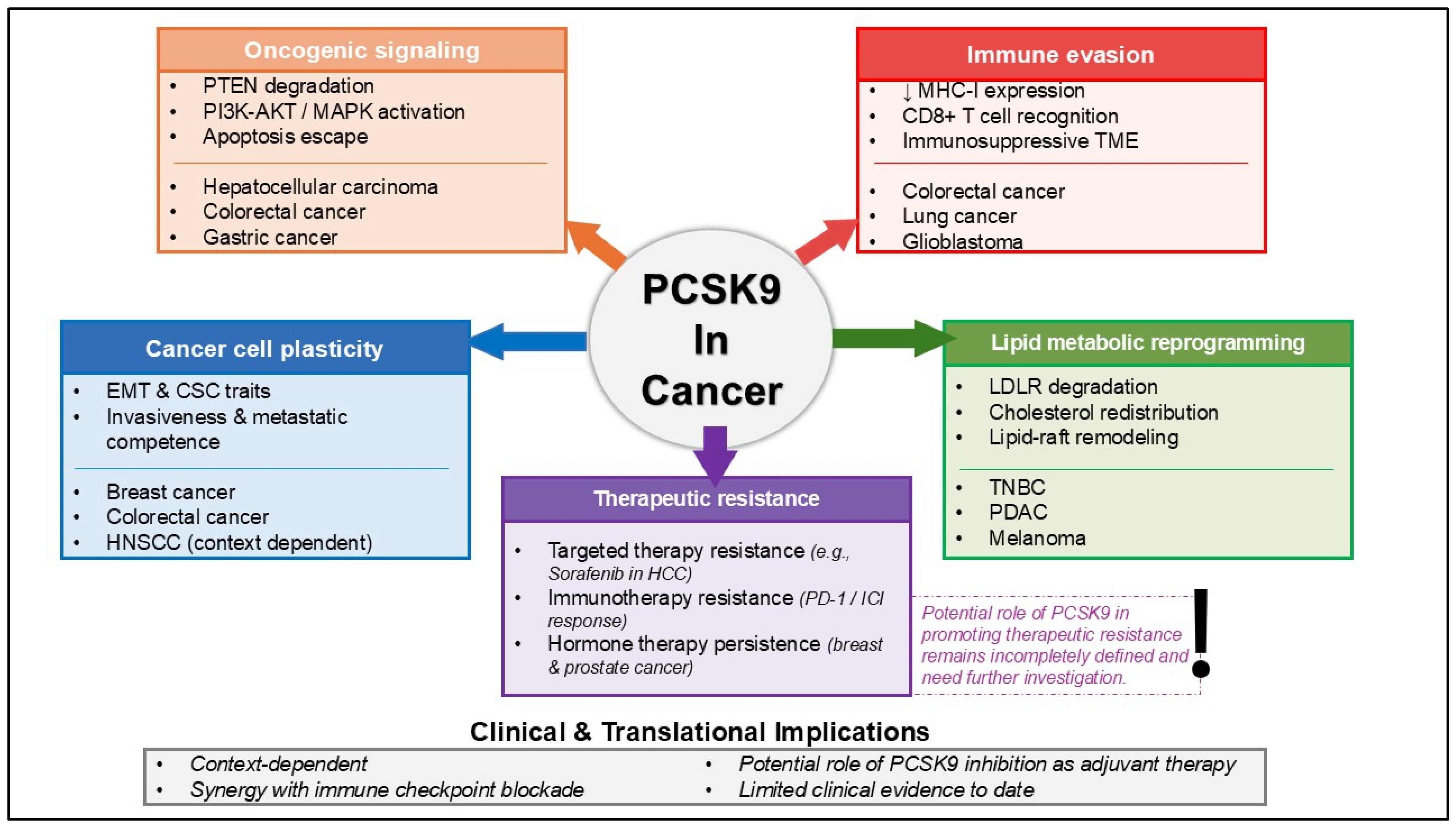
Cancer remains a major global health challenge, largely due to its biological heterogeneity and the capacity of tumor cells to adapt under metabolic and environmental stress. Lipid metabolism has increasingly been recognized as a contributor to tumor progression and treatment response. Proprotein convertase subtilisin/kexin type 9 (PCSK9), widely known for regulating low-density lipoprotein (LDL) receptor turnover and systemic cholesterol levels, has recently been implicated in cancer biology. Emerging evidence shows that PCSK9 influences processes such as cell survival, MHC-I-mediated immune recognition, membrane receptor trafficking, and cellular stress responses, indicating roles that extend beyond its canonical metabolic function. These mechanisms also raise the potential relevance of PCSK9 to affect treatment tolerance and drug responsiveness. This review summarizes current knowledge on the biological functions of PCSK9 in cancer and examines how these pathways may have implications for therapeutic resistance.
Keywords: cancer; chemoresistance; hypercholesterolemia; lipid metabolism; PCSK9 cancer; chemoresistance; hypercholesterolemia; lipid metabolism; PCSK9