Article

Characterization of Novel Variants in P2YRY12, GP6 and TBXAS1 in Patients with Lifelong History of Bleeding


by
Ana Zamora-Cánovas
1,†,
Ana Marín-Quílez
1,†,
Lorena Díaz-Ajenjo
2,
Ana Sánchez-Fuentes
1,
Pedro Luis Gómez-González
1,
Marilena Crescente
3,
Nuria Fernández-Mosteirín
4,
José Padilla
1,
José Ramón González-Porras
2,5,
Rocío Benito
2,
María Luisa Lozano
1,
José María Bastida
2,5,‡ and
José Rivera Pozo
1,*,‡
1
Servicio de Hematología, Hospital Universitario Morales Meseguer, Centro Regional de Hemodonación, Universidad de Murcia, IMIB-Pascual Parrilla, CIBERER-ISCIII, 30003 Murcia, Spain
2
Instituto de Investigación Biomédica de Salamanca (IBSAL), Centro de Investigación del Cáncer, IBMCC-CSIC, Universidad de Salamanca (USAL), 37007 Salamanca, Spain
3
Centre for Immunobiology, Faculty of Medicine and Dentistry, Blizard Institute, Queen Mary University of London, London E1 2AD, UK
4
Servicio de Hematología, Hospital Universitario Miguel Servet, 50009 Zaragoza, Spain
5
Departamento de Hematología, Complejo Asistencial Universitario de Salamanca (CAUSA), 37007 Salamanca, Spain
*
Author to whom correspondence should be addressed.
These authors contributed equally to this work.
On behalf of Grupo Español de Alteraciones Plaquetarias Congénitas (GEAPC). Share senior authorship.
Biomolecules 2025, 15(12), 1639; https://doi.org/10.3390/biom15121639
Submission received: 22 October 2025 / Revised: 14 November 2025 / Accepted: 16 November 2025 / Published: 21 November 2025
(This article belongs to the Section Molecular Biology)

Abstract

Inherited platelet function disorders (IPFDs) are rare diseases caused by defects in platelet surface receptors, enzymes, granules, or signaling proteins. In humans, GPVI and P2Y12 deficiency cause autosomal recessive bleeding disorders, while TBXAS1 deficiency is related to Ghosal hematodiaphyseal dysplasa, a rare autosomal recessive disorder characterized by increased long bone density and platelet dysfunction without bleeding. To date, at least 20 patients have been identified with molecular defects in P2RY12, 12 cases with molecular defects in GP6, and 34 cases with molecular defects in TBXAS1. Here, we report a novel nonsense and missense variants in P2RY12, a novel nonsense variant in GP6, and a novel missense variant in TBXAS1. These variants selectively affect the platelet reactivity to ADP and collagen/CRP, predisposing to bleeding. P2RY12 c.835 G>A [p.Val279Met] variant did not affect receptor expression whereas P2RY12 c.44delG [p.Ser15Ilefs*33] lead to decreased levels of the receptor in one of the patients. This was confirmed both by RT-qPCR and immunoblotting analysis. Decreased expression of both GPVI and FcRγ-chain was detected in patients carrying GPVI nonsense variant in heterozygosis. The deleterious effect of these variants was also confirmed in a transfected cell line model. TBXAS1 variant triggered decreased TxA2 production using a cell line model. These variants expand the genetic landscape of P2RY12, GPVI and TBXAS1 inherited deficiency.

1. Introduction

Inherited platelet disorders (IPDs) comprise a heterogeneous group of rare diseases, generally caused by molecular alterations in genes that are relevant in platelet formation and/or function [1]. Two main groups of IPDs can be distinguished as follows: inherited thrombocytopenias (IT), characterized by low platelet counts, and inherited platelet function disorders (IPFD), in which patients display normal platelet counts but altered platelet function [2,3]. The risk of bleeding is a common characteristic of these types of disorders [4].
The diagnosis of IPDs is limited due to their high clinical and laboratory heterogeneity, as well as the poor reproducibility and specificity of platelet function tests [1]. Therefore, expert guidelines recommend different approaches for its diagnosis [5,6]. Firstly, a comprehensive clinical assessment is usually performed by exploring different signs of bleeding and discussing family history [6]. This is usually followed by a laboratory study with different standardized techniques, including blood count and smear, semi-automated screening assays, such as Platelet Function Analizer-100 assay (PFA-100), and other analyses of platelet function [7]. Later, genetic diagnosis helps to outline the precise cause of IPDs, especially when other laboratory tests are not informative [6,8].
Sanger sequencing has long been the standard assay used to discern the candidate variants [9]. However, we were only able to achieve genetic diagnosis in 40% of cases suspected to have an inherited platelet disorder using this candidate gene approach [10]. The recent incorporation of high-throughput sequencing (HTS) has enhanced the genetic diagnosis of IPDs, with many specialized laboratories now implementing this approach [11,12]. Using this novel approach, we achieved a genetic diagnosis rate of 70% [12]. In the largest series of cases described so far, the diagnostic rate was 47.8% for inherited thrombocytopenia, 26.1% for platelet dysfunction, and 63.6% for coagulation disorders [11]. Moreover, the advent of third generation sequencing techniques, such as Nanopore sequencing, allows long-read sequencing of DNA and characterization of structural variants (SVs) [13].
The specificity of a clinical phenotype provides critical information for the interpretation of genetic data and determining clinical significance [8]. This enables researchers to establish relationships between platelet phenotype and genotype, since an early phenotypic and genetic diagnosis is crucial for effective patient management [6,14].
IPFD are heterogeneous in severity, mechanisms, and frequency, and few are characterized at the molecular level. To date, roughly 20 different disorders have been described [3]. These are caused mainly by defects of the membrane receptors (Glanzmann thrombasthenia, P2Y12 deficiency, glycoprotein VI (GPVI) deficiency, among others), granules (Hermansky–Pudlak syndrome, among others), elements involved in signal transduction, or other defects of the biochemical platelet machinery (such as thromboxane A synthase 1 (TBXAS1) deficiency) [15].
Here we present a comprehensive review of the IPFD affecting the adenosine diphosphate (ADP) receptor P2Y12, the collagen receptor GPVI, and TBXAS1. This will be followed by a brief description of three patients with two novel heterozygous variants in P2RY12, two patients with a novel heterozygous nonsense variant in GP6 and finally, a novel heterozygous variant in TBXAS1. Clinical evaluation and platelet phenotyping assays were performed to assess the effect of all variants. Finally, the deleterious effect was also evaluated in a cell line model transfected with wild-type proteins and all variants.

1.1. P2Y12-Related Disorder

The P2Y12 receptor gene (P2RY12), encodes a major G-protein-coupled receptor (GPCR) in platelets that maps to chromosome 3q25.1. P2RY12 contains three exons. The receptor consists of 342 amino acids with a molecular weight of 39 kDa.
Binding to ADP triggers G protein subunit alpha i2 (Gαi2) protein (associated with P2Y12) activation, leading to the inhibition of adenylate cyclase (AC), and therefore cyclic adenosine monophosphate (cAMP) production [16] (Figure 1). This inhibition impairs protein kinase A (PKA) activity and subsequent activation of downstream effectors such as vasodilator-stimulated phosphoprotein (VASP) [17] (Figure 1). This pathway is not sufficient to start platelet aggregation, but it can promote platelet activation. The receptor also leads to the activation of the phosphoinositide 3-kinase (PI3K) pathway, through the mediation of G protein subunit βγ (Giβγ). This mechanism promotes integrin αIIbβ3 (fibrinogen receptor) and stabilization of platelet aggregation [18] (Figure 1). Therefore, co-activation of both P2Y1 and P2Y12 is required for normal ADP-induced platelet aggregation [19].
Different roles for P2Y12 have been described. P2Y12 activation is thought to induce an inflammatory state in vascular smooth muscle cells (VSMC), promoting atherosclerotic plaque instability [20]. But also, P2Y12 has a role in microglial cell activation, as well as communication with neurons [21]. Finally, other studies have proposed P2Y12 implication in the purinergic signaling in leukocytes [22].
Moreover, P2Y12 has been used as a target for various treatments. Several clinical antiplatelet drugs (copidrogel and ticagrelor) have been designed as antagonists of the P2Y12 receptor [23]. The use of these inhibitors has shown in patients with acute coronary syndrome (ACS) a decrease in the risk of thrombotic events.
P2Y12 deficiency (OMIM #609821) caused an autosomal recessive bleeding disorder. This deficiency is characterized by decreased P2Y12 expression, mild to moderate mucocutaneous bleeding, and excessive bleeding in response to ADP and trauma or after surgery [24].
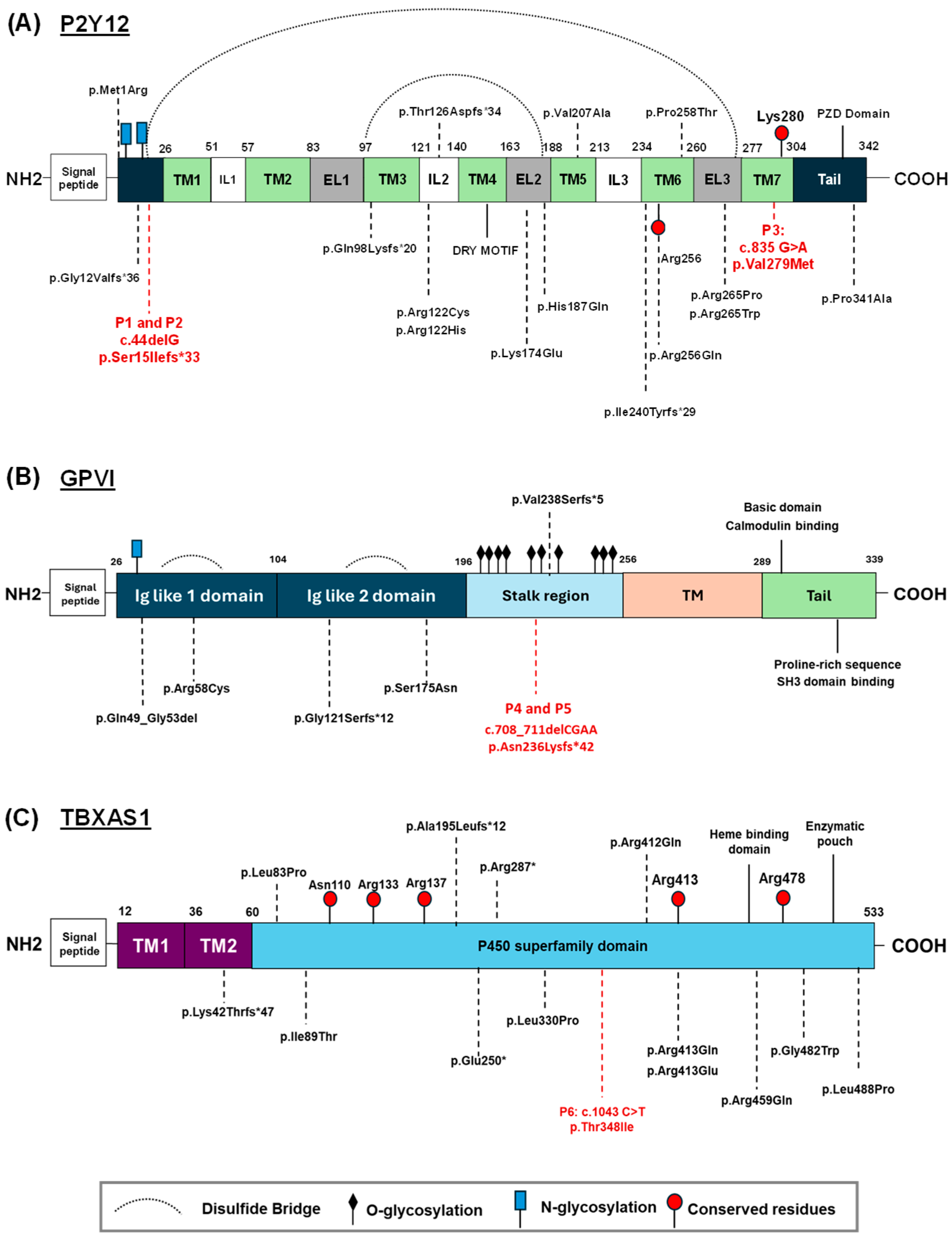
To date, at least 20 patients have been identified with molecular defects in P2RY12, causing quantitative and qualitative defects in the receptor (Figure 2A, Supplemental Table S1) [25,26,27,28,29,30,31,32,33,34,35,36,37,38] of which six have been described with variants decreasing P2Y12 expression [25,26,27,30,31,34]. It was assumed that heterozygous variant carriers were asymptomatic. However, in one study, the authors described a patient carrying the p.Ile240Tyrfs*29 variant in heterozygosis with reduced P2Y12 expression [34]. These results suggest that the disease associated with defects in P2Y12 can also cause a pathological phenotype in heterozygosis.

1.2. GPVI-Related Disorder

The GP6 gene encodes for the glycoprotein VI (GPVI), and it is located at 19q13.4, within the leukocyte receptor cluster (LCR), and its expression is restricted to platelets and megakaryocytes [39,40]. GP6 comprises eight exons, while GPVI is a 339 amino acid transmembrane protein (60kDa) with a high presence of carbohydrates (45%).
GPVI belongs to the immunoglobulin-like receptor superfamily and is co-expressed on the platelet surface in a non-covalent bond with the common Fc receptor-γ-chain (FcRγ-chain), which contains the ITAM responsible for intracellular signaling [39,41]. The glycoprotein has been described as the main receptor involved in platelet activation upon interaction with collagen [40]. However, several studies have reported the interaction of GPVI with other vascular wall ligands such as laminin, fibrinogen, fibronectin or vitronectin, or plasma ligands such as the hormone adiponectin and histones [42,43,44,45,46,47]. Apart from GPVI, platelets express two other immune-like receptors, the podoplanin receptor C-type lectin domain family 2 (CLEC-2) and the low-affinity IgG receptor FcγRIIA [48]. All three receptors have in common their role in the transmission of activation signals into the platelet via immunoreceptor tyrosine-based activation motifs (ITAMs) [49].
The GPVI transmembrane region contains critical residues that interact with the FcRγ-chain [50]. Moreover, the cytosolic region of GPVI contains a basic sequence that contributes to this interaction [50,51]. This region also presents a calmodulin-binding motif and a proline-rich domain (PRD) [50,51]. Tyrosine-protein kinases Lyn and Fyn, both Src family kinases, constrictively bind to this domain [52]. Upon interaction of GPVI with its ligands, these kinases phosphorylate the ITAM domains of the GPVI-bound FcRγ-chain homodimer, leading to recruitment and activation of the tyrosine kinase Syk [40] (Figure 1). This triggers new downstream signaling events, with recruitment of new signaling proteins and kinases, such as LAT, SLP-76, and others, forming a potent signalosome, which mediates the activation of phospholipase C (PLCγ2) and the subsequent generation of the second messengers diacylglycerol (DAG) and inositol triphosphate [53]. These messengers mediate Protein kinase C (PKC) activation and Ca2+ release from intraplatelet stores, respectively, and ultimately platelet responses to thromboxane A2 generation (TxA2), secretion, integrin activation αIIbβ3 and aggregation (Figure 1).
Moreover, GPVI transmits outside-in activation signals that contribute to platelet spreading and platelet aggregation under flow conditions [47]. Therefore, GPVI acts as a key element both in the initiation of thrombus formation at sites of vascular injury, as well as in subsequent thrombus growth through the recruitment of new platelets [54].
The role of GPVI in platelet–collagen interactions, and thus in haemostasis, was demonstrated by the development of GPVI knock-out (KO) mice [55,56]. Several studies have demonstrated, using murine models, the importance of the interaction with the FcRγ-chain for GPVI expression on the platelet’s surface [57,58,59]. Platelets from GPVI KO mice show impaired platelet aggregation and significant failure of platelet activation with collagen, collagen-related-peptide (CRP), or the snake venom convulxin, which are selective GPV agonists [55]. In heterozygous mice, hypo-reactivity to collagen is evident at low doses, but recovers at high doses [55,56].
Interestingly, tail bleeding time is minimally prolonged, indicating that the haemostatic role of GPVI can be performed by other platelet elements [56]. This is consistent with the observation of moderate clinical hemorrhage in the few patients with congenital GPVI deficiency identified to date [60]. However, GPVI KO mice without GPVI appear to be protected from thrombosis, in models of experimental thrombosis induced by collagen injection or in models of thrombosis with FeCl3 [56,61].
In humans, GPVI deficiency (OMIM #614201) causes an autosomal recessive bleeding disorder. GPVI deficiency, both acquired and congenital, is a rarely described pathology, either because it is infrequent, or because it is associated with an insignificant clinical presentation, and affected patients go unnoticed [62].
Around 10 patients have been described with immune or pseudo-immune conditions associated with quantitative GPVI deficiencies [63]. This was associated with the presence of antibodies that were not always detectable. Almost all cases were female, displayed thrombocytopenia, and responded to treatment with steroids or other drugs used in immune thrombocytopenia (ITP) [62,63].
Regarding inherited GPVI deficiency, a dozen cases have been reported in the literature [54]. Among these, molecular defects in the GP6 gene were identified in nine cases with five different variants [54] (Figure 2B, Supplemental Table S2). Two cases involve patients with two compound heterozygous mutations, while a small group of unrelated Chilean patients share the same nucleotide insertion that breaks the normal reading phase and results in a truncated GPVI [64]. All evidence suggests a founder effect. The Chilean patients had mild bleeding, while heterozygous family members were asymptomatic [64].
Inherited GPVI deficiency is characterized by impaired response to CRP, collagen, and convulxin. Some of the patients displayed reduced levels of GPVI expression, confirmed both by flow cytometry and Western blot [64]. However, in other cases, the expression levels were normal [65]. Decreased levels of FcRγ-chain were also found in all Chilean homozygous patients [66]. Furthermore, normal levels were reported in heterozygous patients carrying p.Arg58Cys variant [67].

1.3. TBXAS1—Related Disorder

Thromboxane synthase (TBXAS1) is a microsomal enzyme found in platelets and several other tissues [68]. It is a cytochrome P450 enzyme that catalyzes the conversion of prostaglandin H2 (PGH2) into TxA2 [69]. TBXAS1 locates in chromosome 7q33-34 and contains 17 exons (4 noncoding and 13 coding) [70]. TBXAS1 protein has 533 acids (60 kDa) and contains a heme prosthetic group.
Upon platelet activation, the increase in intracellular Ca2+ levels activates phospholipase A2 (cPLA2α), which releases arachidonic acid (AA) from the membrane phospholipids [71]. This substrate is rapidly processed in different pathways, including its conversion TxA2 by the sequential actions of cicloxigenase-1 (COX1) and thromboxane synthase [72]. TxA2 acts as a potent prothrombotic agent, contributing to platelet aggregation and thrombus formation at sites of vascular injury [73]. Following its release, TxA2 bind to the TxA2 receptor (TP) on the platelet surface, triggering Ca2+ mobilization, protein phosphorylation, secretion and ultimately platelet aggregation [74] (Figure 1).
Ghosal hematodiaphyseal dysplasia (GHDD; OMIM #231095) is a rare autosomal recessive disorder characterized by bone marrow dysfunction and increased long bone density with metadiaphyseal dysplasia [75]. After its initial report [76], roughly 34 more cases have been reported in the literature (Supplemental Table S3). The manifestations of GHDD are present in childhood with bony changes and normocytic anemia often requiring multiple transfusions [77].
GHDD is caused by homozygous or compound heterozygous variants in TBXAS1 (Figure 2C, Supplemental Table S3). Heterozygous carriers do not develop GHDD symptoms. Although TBXAS1 alterations were thought to be responsible for a mild bleeding disorder, none of the described patients with GHDD reported bleeding manifestations [75,77,78,79,80,81,82,83,84,85,86,87,88,89,90,91,92,93,94]. Only one of the cases reported in the literature described a patient with gastrointestinal bleeding [95]. However, no molecular diagnosis assays were performed to identify variants in TBXAS1. Noteworthy, some patients also presented mild thrombocytopenia (Supplemental Table S3). Platelets from these patients do not aggregate in response to AA, but they respond to the synthetic Tx analog U46619. Furthermore, patients present decreased levels of TxA2 in serum [96].
Moreover, it has been described that TBXAS1 polymorphisms may be relevant for the pharmacogenetics of aspirin and other nonsteroidal anti-inflammatory drugs (NSAIDs), and TxA2 has been linked to the cardiovascular toxicity of COX2 specific inhibitors [97].

2. Materials and Methods

2.1. Patients, Blood Sampling, and DNA Isolation

Six patients with suspected IPFD were recruited in the Spanish multicenter project “Functional and Molecular Characterization of Patients with Inherited Platelet Disorders”. This project obtained approval from the Ethics Committee of the Hospital Reina Sofía (Murcia, Spain) and follows the Helsinki Declaration rules. All participants gave written informed consent. Clinical data were reviewed, and bleeding symptoms were scored using the International Society on Thrombosis and Haemostasis bleeding assessment tool (ISTH-BAT) [98,99].
Venous blood was drawn from each patient into commercial 7.5% K3 ethylenediaminetetraacetic acid (EDTA) tubes (for complete blood count and DNA isolation), and into buffered 3.2% sodium citrate for platelet function studies. Blood counts were performed using a Sysmex® XS1000i hematology counter (Sysmex España, Sant Just Desvern, Barcelona, Spain). Genomic DNA was isolated using a DNeasy blood and tissue kit, following the manufacturer’s protocol (Qiagen, Hilden, Germany). DNA concentration was measured using a fluorometer Qubit 2.0 (Life Technologies, Carlsbad, CA, USA).

2.2. Molecular Analysis by HTS Gene Panel and Sanger Sequencing

Patients’ DNA was analyzed by HTS using a panel approach including all exons, 3′ untranslated region and flanking regions of 102 genes relate with IPDs [12]. Samples were sequenced using a MiSeq Illumina platform (Illumina, San Diego, CA, USA), or an Ion Torrent PGM platform (Thermo Fisher Scientific, Waltham, MA, USA). Sequences were aligned to the hg19 reference genome. Variant calling and annotation was performed using an in-house pipeline (VarScan v2.3.9, SAMTools v1.3.1, ANNOVAR (v.20190oct24), Ensembl-VEP v99, and dbNFSP v4.0a bioinformatic tools). Selected variants were confirmed and segregated in the families by Sanger sequencing. General information regarding gene variants (chromosome position, Human Genome Variation Society [HGVS] name, reference single nucleotide polymorphism (SNP) cluster ID number [RS ID], frequency in different populations, pathogenicity and conservation scores, automated classification, ClinVar annotation, etc.) was initially obtained using the Varsome tool (https://varsome.com, accessed on 21 October 2025).
Further analysis of variants was achieved using DIGEVAR ‘’Discovering Genetic Variants’’, a web tool developed in-house for user-friendly analysis of HTS data (https://digevar.imib.es, accessed on 21 October 2025). DIGEVAR was developed in JAVA to access variant calling files (VCF) and allows multiple variant filtering strategies regarding variant gene location, minor allele frequency (MAF), among others. After this selection, DIGEVAR provides the user with a list of candidate variants that match the filtering criteria. As DIGEVAR incorporates information from public databases (ENSEMBL, NCBI, CLINVAR, ExAC, etc.) and from variant analysis software (MutationTaster, Polyphen, Sift, PDB, etc.), it also allows analysis of the allele frequency, nucleotide/protein change, CLINVAR significance, among others.

2.3. GP6 and P2RY12 mRNA Quantification by RT-qPCR

Platelet RNA was isolated by using Trizol (Thermo Fisher Scientific, Waltham, MA, USA). GP6 and P2RY12 mRNA expressions were measured to investigate the effect of candidate variants on expression levels. cDNA synthesis was performed using the SuperScript IV™ First-Strand cDNA Synthesis System from Invitrogen™, and specific probes for both GP6 and P2RY12 were purchased from Thermo Fisher. Procedures were followed as described previously [100].

2.4. Platelet Aggregation

Platelet-rich plasma (PRP) and platelet-poor plasma (PPP) were prepared from citrate whole blood by centrifugation (140× g, 10 min and 1000× g, 10 min, respectively). Light transmission aggregometry (LTA) was performed in PRP (~250 × 109 platelets/L) as previously described [101] using a Stago aggregometer (Stago, Asnieres-sur-Seine, France). Maximum percentages of light transmission of PRP over baseline PPP were recorded for 300 s following stimulation with the following platelet agonists: 25 μM thrombin receptor—activating peptide (TRAP); 2.5, 5, and 10 μM ADP; 1.25 mg/mL ristocetin; 2, 5, and 10 µg/mL collagen; 1.6 mM AA; and 2 and 5 μg CRP.

2.5. Platelet Flow Cytometry

Platelet expression of different membrane glycoproteins (GPs), including GPIa (integrin α2, CD49), GPIbα (CD42b), GPIX (CD42a), GPIIb (CD41), and GPIIIa (CD61), and GPVI, were evaluated by flow cytometry in citrated whole blood diluted 1:10 in sterile phosphate-buffered saline (PBS).
Platelet activation was analyzed by evaluating platelet granule secretion and αIIbβ3 activation as previously described [101]. Briefly, diluted PRP (∼20 × 109 platelets/L) was incubated under static conditions: 30 min at room temperature [RT]) with Tyrode’s buffer, as control for non-stimulated platelets, or with agonists (25 μM TRAP, 2 and 10 μg CRP, 2.5 and 10 μM ADP), in the presence of anti-CD41*APC (as a platelet marker), fibrinogen--Alexa488 (Thermo Fisher) and anti-CD62*PE (α-granule secretion) or anti-CD63*PE (dense granule secretion) (BD Biosciences, Madrid, Spain). Reactions were stopped with 4% paraformaldehyde (PFA) (v/v) (15 min, RT). Samples were diluted with PBS and run in an Accuri C6 flow cytometer (BD Biosciences). A total of 10,000 platelets were gated on both CD41+ and forward scatter-side scatter (FSC-SSC), and results were expressed as median fluorescence intensity (MFI).
Quantification of receptor molecules (1G5, CD42b, GPVI) per platelet was performed by using a commercial kit (Platelet GP Screen, Biocytex, Stago, Asnières, France).

2.6. VASP Phosphorylation Assessment

VASP phosphorylation upon stimulation of the P2Y12 receptor was analyzed by using Biocytex VASP phosphorylation assay (PLT VASP/P2Y12 (Stago). The test was performed according to the manufacturer’s instructions within 48 h of blood collection [102]. The results were expressed as platelet reactivity index (PRI).

2.7. Immunofluorescence Studies

The general organization of the platelet cytoskeleton was evaluated by immunofluorescence assays. Washed platelet samples were placed onto coverslips on a 24-well plate under spreading conditions, as previously described [100]. Briefly, platelets were allowed to adhere and to spread in two different matrices of fibrinogen and collagen for 10 and 30 min, and, after fixation with 4% PFA, platelets were visualized with fluorochrome-labeled phalloidin antibodies (Phalloidin–Atto 647N Merck, 1:100) on a Leica SP8 (Leica Microsystems, Madrid, Spain). Spreading of platelets was calculated by analyzing platelets present in 10 different images.

2.8. Cell Line Models

The effect of the P2RY12, TBXAS1, and GP6 variants was evaluated in HEK 293T cells. Additionally, a HEK 293 [100] in-house cell line with a stable expression of COX-1 wild-type (HEK 293 COX1), previously described [101], was also used for the study of the TBXAS1 variant. The wild-type HEK 293 cell line does not express P2Y12 and GPVI receptors, albeit they express low levels of TBXAS1.
Transient expression experiments were performed using pcDNA3.1+/C-(K)-DYK with complementary DNA (cDNA) wild-type of P2RY12, TBXAS1 and GP6, or mutants, all of them available commercially (OHu14933D, GenScript, Rijswijk, The Netherlands).
HEK 293 cell line (ATCC, LGC Standards S.L.U, Barcelona, Spain) was grown in Dulbecco’s modified Eagle’s medium (DMEM) supplemented with 10% of fetal bovine serum (FBS). Transient expression assays were performed by plating 7 × 10⁴ cells/well and adding all 2 µg/well of all plasmids using Lipofectamine 3000 kit (Thermo Fisher Scientific). Transfection efficiency was assessed by flow cytometry using BD IntraSure (BD Biosciences) and the antibody α-DYKDDDDK*PE (BioLegend, San Diego, CA, USA, Cat#637309). Cell lysates were prepared 48 h after successful transfection for immunoblotting assays. Moreover, 30 × 104 cells/vector transfected were stimulated either with PBS or AA 2 μM (37 °C, 30 min, 500 rpm in a shaker). Samples were centrifuged 1000× g for 3 min and supernatants were collected to be stored at −80 °C for TxA2 determination (TxB2 ELISA kit, Cayman Chemical, Ann Arbor, MI, USA), as described [101]. Statistical analysis was performed using GraphPad Prism 10.0 (San Diego, CA, USA). Ordinary one-way ANOVA and two-way ANOVA followed by Tukey’s test were used. p values below 0.05 were considered statistically significant.

2.9. Preparation of Washed Platelets and Immunoblotting

PRP samples were washed with ACD-Tyrode modified buffer (22.0 g/L citric acid, trisodium salt, dihydrate; 7.3 g/L citric acid, anhydrous; and 24.5 3 g/L D-(+)-Glucose, 134 mmol/L de NaCl, 2,9 mmol/L de KCl, 0,34 mmol/L de Na2HPO4, 12 mmol/L NaHCO3, 1 mmol/L de MgCl2 and HEPES 20 mmol/L, pH 7,4; Merck Life Science S.L.U, Madrid, Spain) and centrifugated at 1000× g 15 min. Prostacyclin I2 (PGI2) was added in every step to avoid platelet activation [100].
Washed platelets (~1 × 10⁹ platelets/mL) were resuspended in Tyrode modified buffer and were lysed in ice with an in-house Buffer Lysis containing protease inhibitors (Complete™ Protease Inhibitor Cocktail, Merck, Madrid, Spain). Cells transfected with the plasmids (~1 × 10⁶ cells/mL) were resuspended in PBS and lysed following the same protocol. All samples were reduced with LB-SDS solutions. Proteins were separated by 8% SDS–PAGE for 60 min and transferred to polyvinylidene fluoride membranes (Millipore, Billerica, MA, USA, Merck).
Standard Western blotting procedures were used [101]. Membranes were incubated with primary antibodies anti-P2Y12 receptor (Merck Life Science, Rabbit, #ABS1487-25UG, 1:500), anti-TBXAS1 (Cayman, Rabbit, #160715, 1:500), anti-GPVI IG5 (gently provided by Dr Elizabeth Gardiner, Melbourne, Australia Rabbit, 1:1000), anti-GPVI tail (also from Dr Elizabeth Gardiner, Rabbit 1:1000), anti-FcRI-γ (Santa Cruz Biotechnology, Dallas, TX, USA, Mouse, sc-390221, 1:1000), anti-DYKDDDK Tag (Cell Signaling Technology, Rabbit, #14793 1:1000) and anti-β actin-HRP (Merck Life Science, Rabbit cat# A3854, 1:10,000) followed by secondary horseradish peroxidase–conjugated goat anti-rabbit and anti-mouse IgG antibody (Merck Life Science, 1:10,000 and 1:5000, respectively).
Washed platelet samples were stimulated either with PBS or 3 and 10 μg/μL of CRP for 30 min at 37 °C, 500 × rpm in a shaker. Reactions were stopped, adding Buffer lysis solution following the exact procedure described for platelet samples. Membranes were incubated with primary antibodies anti-Phospho SYK (Tyr525/526) (Cell Signaling Technology, Danvers, MA, USA, rabbit, #2710, 1:1000), anti-Phospho-LAT (Tyr220) (Cell Signaling Technology, Rabbit #3584, 1:200), anti-Syk (4D10) (Santa Cruz Biotechnology, Mouse, sc-1240, 1:200), anti-LAT(B-3) (Santa Cruz Biotechnology, Mouse, sc-373706, mouse, 1:1000) followed by secondary horseradish peroxidase–conjugated goat anti-rabbit and anti-mouse IgG antibody (Merck Life Science, 1:5000). Proteins were detected by chemiluminescence (ECL prime; GE Healthcare, Madrid, Spain).

3. Results

3.1. Patient Clinical Descriptions and Molecular Diagnosis

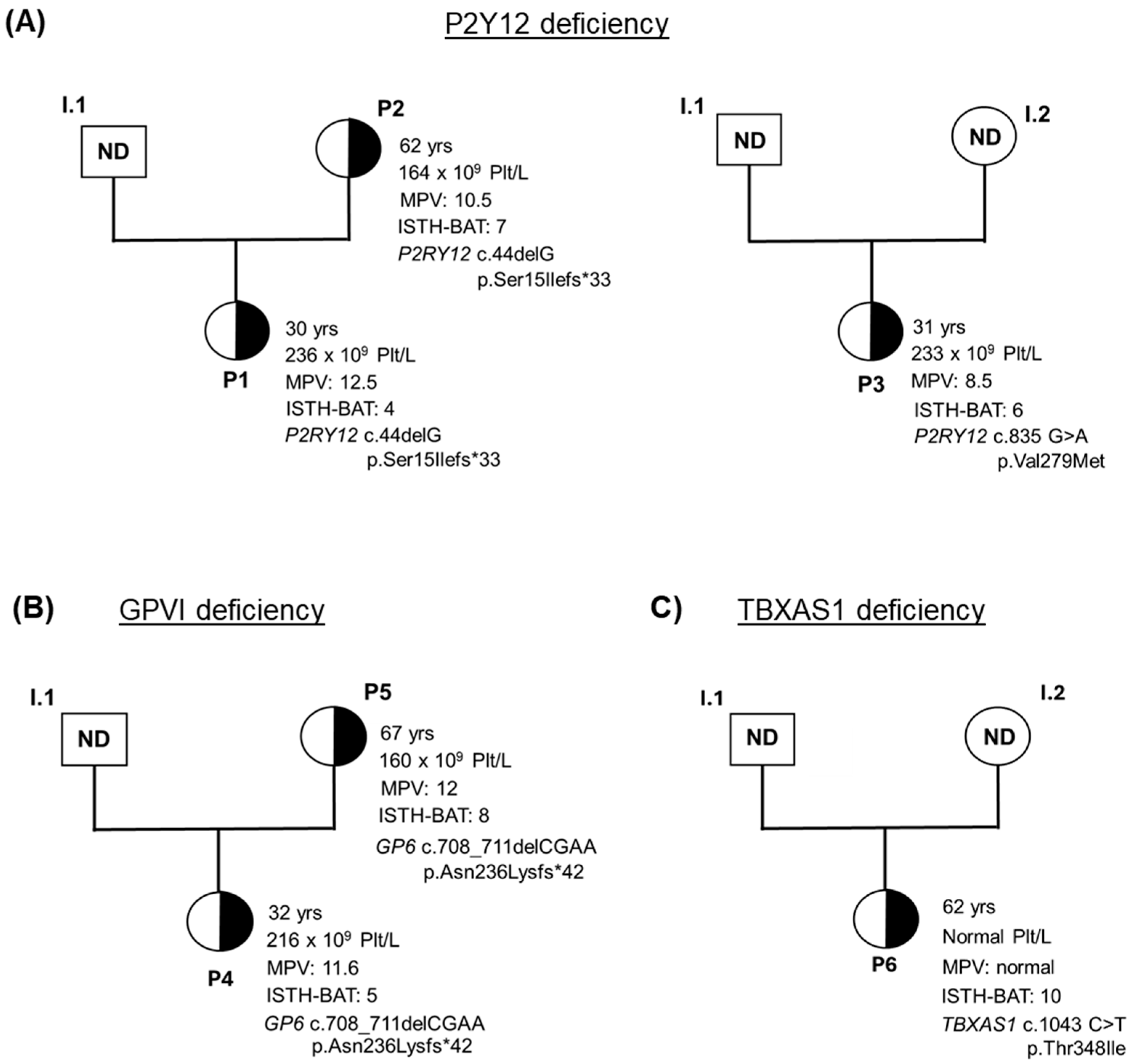
Six female patients from four unrelated families with suspected IPFD were recruited. All of them presented normal platelet counts and mean platelet volume. Conversely, all cases had a long-standing history of moderate bleeding (ISTH –BAT scores between 4 and 8) (Table 1). None of them presented alterations in coagulation parameters or in von Willebrand factor, nor other appreciable clinical complications.
Patient’s DNA analysis identified different candidate heterozygous variants (Table 1). A novel nonsense variant (c.44delG [p.Ser15Ilefs*33]) was found in P2RY12 (NM_022788.5) both in patient 1 (P1) and patient 2 (P2), located at the beginning of the protein, while patient 3 (P3) presented a novel missense variant (c.835 G>A [p.Val279Met]) located closed to a highly conserved residue involved in ADP binding (Figure 2A and Figure 3A). According to the ACMG/AMP (American College of Medical Genetics and Genomics/Association for Molecular Pathology) criteria, these variants were classified as likely pathogenic and a variant of uncertain significance (VUS), respectively (Table 1).
The novel nonsense variant c.708_711delCGAA [p.Asn236Lysfs*42], located in the stalk region of GP6 (NM_016363.5), was identified in patient 4 and patient 5 (P4, P5) (Figure 2B and Figure 3B). This variant was classified as pathogenic, according to the ACMG/AMP classification.
Finally, patient 6 (P6) was diagnosed with a novel missense variant in TBXAS1 (NM_001061.7) (c.1043 C>T [p.Thr348Ile]) in heterozygosis, classified as VUS. It is predicted that the variant is located in the P450 domain (Figure 2C and Figure 3C).
Our genetic studies in these patients identified no likely pathogenic or pathogenic variants in other genes that are relevant to platelet function or the VWF gene.

3.2. Platelet Phenotyping

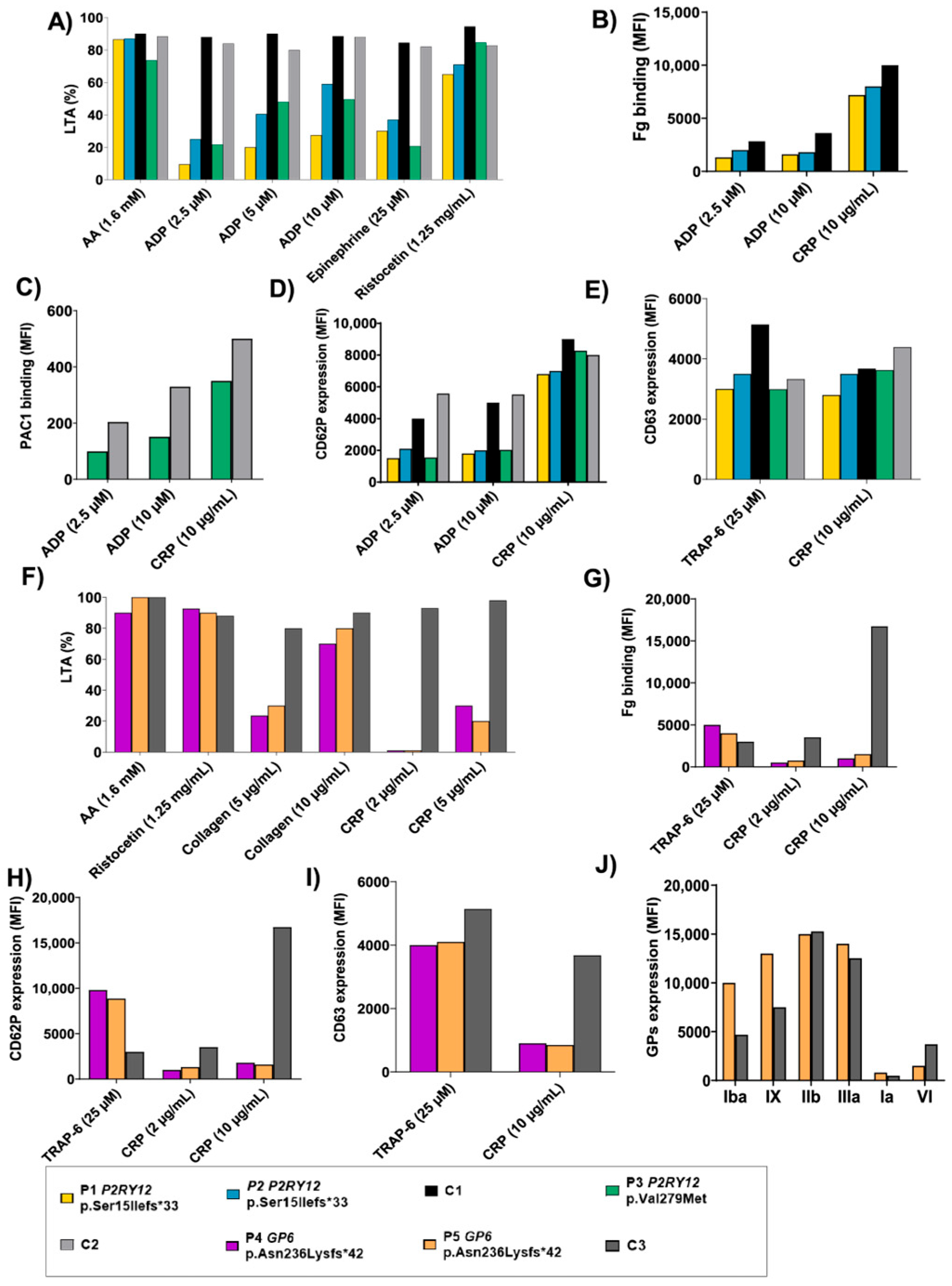
Initial laboratory assessment of P1, P2, and P3 showed impaired platelet aggregation upon stimulation with different agonists, mainly with ADP, even at high concentrations (Figure 4A). Moreover, the three patients displayed decreased αIIbβ3 integrin activation after ADP stimulation, evaluated as fibrinogen-binding (P1, P2) or PAC1 binding (P3) (Figure 4B,C), but also reduced alpha granule secretion (Figure 4D). Dense granule expression was normal compared to the controls (Figure 4E).
On the other hand, P4 and P5 displayed a decreased platelet response to different concentrations of CRP and mild doses of collagen in platelet aggregation assays (Figure 4F). The defective response to different concentrations of CRP was also observed when evaluating fibrinogen binding, alpha granule, and dense granule secretion (Figure 4G–I).
Finally, while the expression of all major platelet glycoproteins (GPs) was normal in P1, P2, and P3, there was a decreased expression of GPVI (50%) in P5 (Figure 4J). Unfortunately, the GPs could not be evaluated in P4.
Unfortunately, P6, carrying the TBXAS1 (c.1043 C>T [p.Thr348Ile]) variant declined to be recruited for the platelet phenotype profiling.

3.3. Expression of Affected Proteins

We next examined the effect of all variants in P2RY12 and GP6.
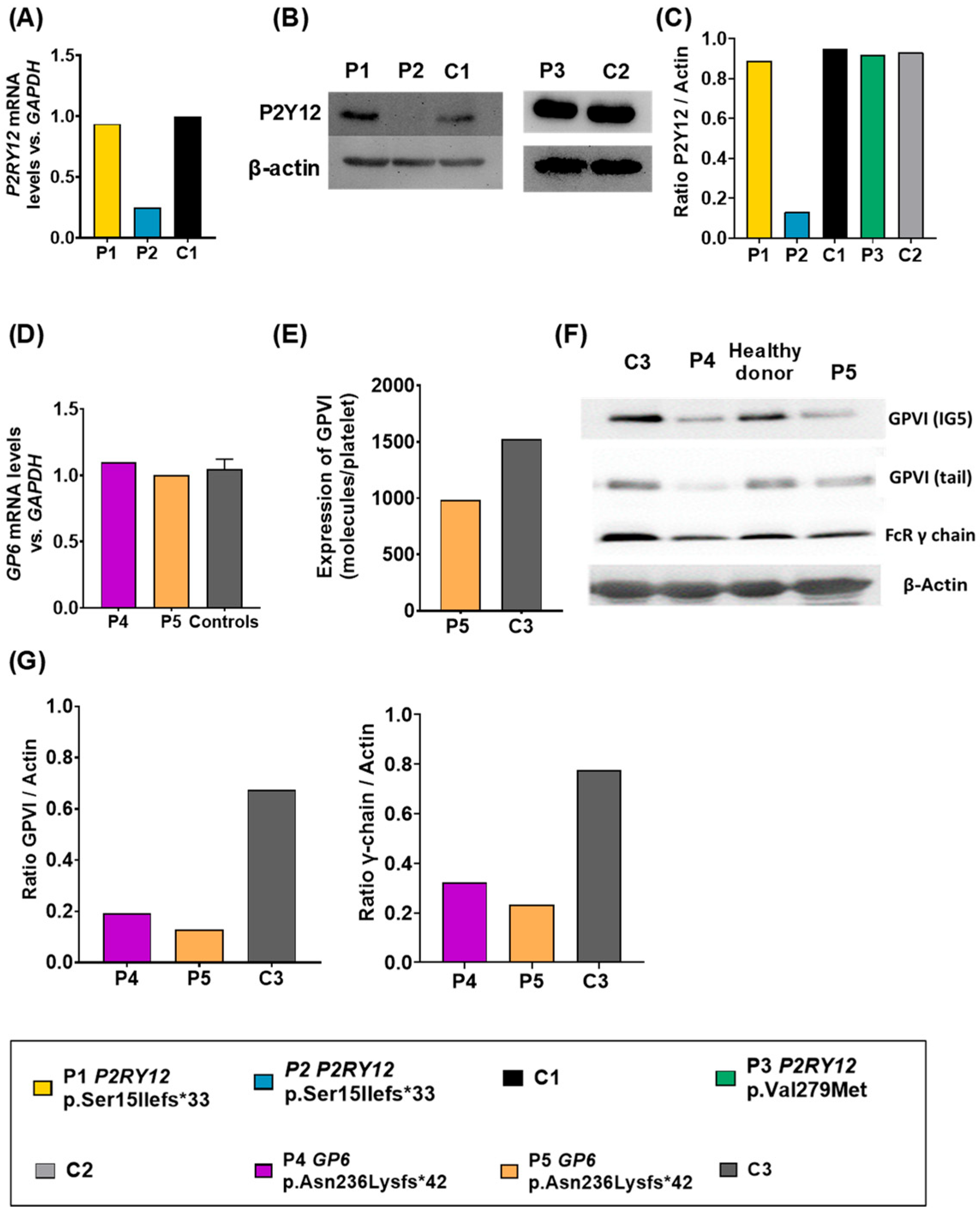
P1, carrying the P2RY12 c.44delG [p.Ser15Ilefs*33] had normal mRNA expression levels compared to the controls, whereas P2, carrier of the same variant, presented decreased levels of P2RY12 mRNA (Figure 5A). Unfortunately, P2RY12 mRNA levels could not be evaluated in P3.
Interestingly, immunoblotting of P2Y12 confirmed normal protein expression of the receptor in P1, but severely reduced levels in P2, while in P3, carrier of the missense variant c.835 G>A [p.Val279Met], we observed normal expression levels of the receptor (Figure 5B,C).
On the other hand, and regarding patients with GPVI defects, we observed that P4 and P5, carriers of the frameshift variant c.708_711delCGAA [p.Asn236Lysfs*42] presented normal mRNA expression levels compared to the controls (Figure 5D). However, quantitative flow cytometry assays showed decreased levels of GPVI molecules (50%) in P5 compared to the control (Figure 5E), as expected due to the creation of a premature stop codon in heterozygosis. P4 samples were not available for this test. This deleterious defect was also proven in immunoblotting assays in both patients (Figure 5F,G), since we detected a 50% reduction in levels with respect to the controls. Decreased levels of FcRγ-chain compared to the controls were also detected in P4 and P5 (Figure 5F,G). These results suggest that reduced levels of GPVI affect the expression of the γ chain.

3.4. Defects in P2Y12 and GPVI Signaling Pathways

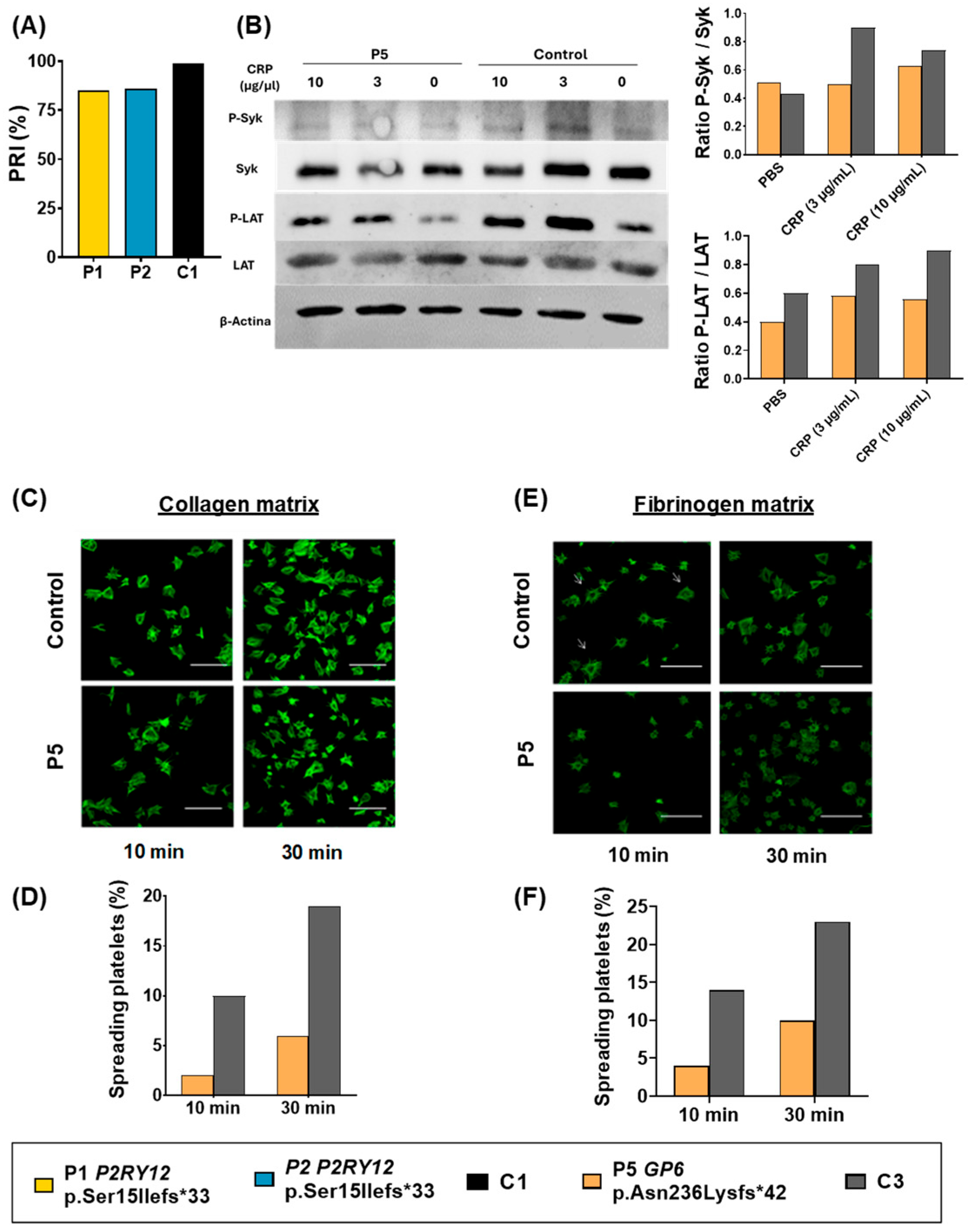
Platelet VASP phosphorylation, which is a Secondary messenger in the P2Y12 pathway, was evaluated in P1 and P2 by using a PLT VASP/P2Y12 kit (Biocytex, Stago). We observed that both patients presented slightly reduced levels of platelet VASP phosphorylation in response to ADP (Figure 6A). P3 samples were not available for this test.
We also evaluated the GPVI downstream signaling cascade. Tyrosine phosphorylation of P-LAT and P-SYK was decreased in P5 compared to the control (Figure 6B). Thus, decreased expression of both GPVI and FcRγ-chain could explain platelet dysfunction in response to specific GPVI agonists.
Moreover, we also observed reduced platelet adhesion to a collagen matrix (Figure 6C,D) and fibrinogen matrix (Figure 6E,F). Further studies evaluating GPVI function as a fibrinogen and fibrin receptor will be required.

3.5. Disease Models in Cell Lines

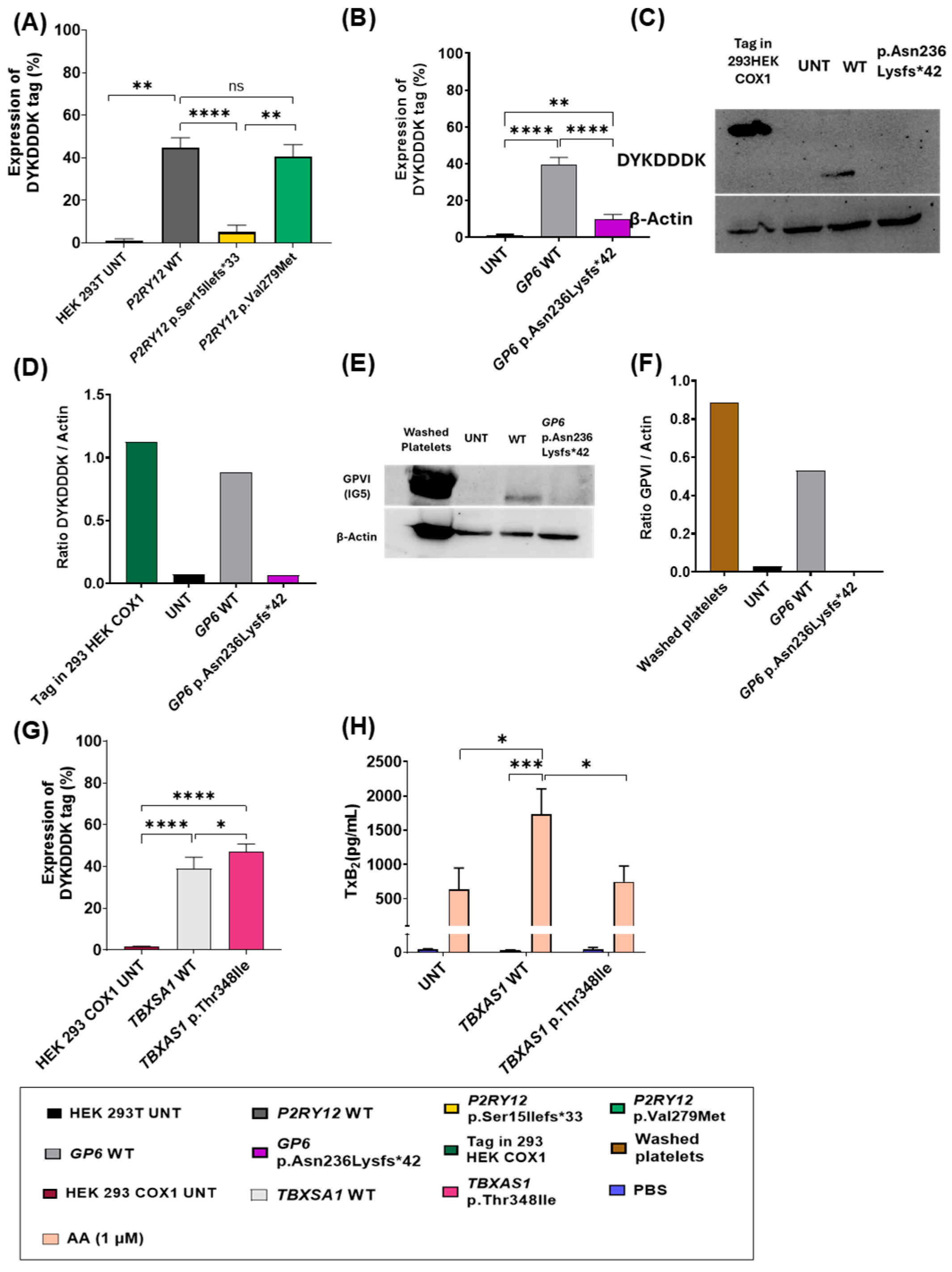
We assessed the deleterious effect of all P2RY12, GP6, and TBXAS1 variants in a cell line model. Equivalent concentrations of DYKDDDD-tagged-WT cDNA or DYKDDDK-tagged variants cDNA were transiently transfected into HEK293T cells and HEK293 COX1 (only for the TBXAS1 variant).
Total expression of DYKDDDK-tagged-P2RY12 p.Ser15Ilefs*33 levels were decreased compared to the wild-type protein (Figure 7A). Conversely, DYKDDDK-tagged-P2RY12 p.Val279Met expression levels were normal, as expected considering that it is a missense variant (Figure 7A).
We also confirmed decreased levels of DYKDDDK-tagged-GP6 p.Asn236Lysfs*42 evaluated by flow cytometry (Figure 7B). Moreover, immunoblotting revealed the absence of bands for DYKDDDK and GPVI in the transfected GPVI p.Asn236Lysfs*42 variant in HEK 293T, confirming its deleterious effect (Figure 7C–F). HEK293 cell line with a stable transfection of DYKDDK-tagged-COX1 with a molecular weight of 70kDa was used as a control (Figure 7C, first lane).
Finally, we detected normal levels of expression of DYKDDDK-tagged-TBXAS1 p.Thr348Ile by flow cytometry (Figure 7G), suggesting that the missense variant in the patient does not affect the TBXAS1 protein levels.
Next, 293 HEK COX1 cells transfected with the wild-type and TBXAS1 p.Thr348Ile variant were stimulated with either PBS or AA (1 μM). This in-house cell line model has a stable transfection of the COX1 protein, which is required for the production of thromboxane. Total levels of TxB2 were decreased in TBXAS1 p.Thr348Ile transfected cells compared to the control after AA stimulation (Figure 7H). This demonstrates that the missense variant in TBXAS1 impairs TxA2 production in response to AA.

4. Discussion

IPFDs are heterogeneous in severity, mechanisms, and frequency, and present a rare prevalence [3,15]. As such, diagnosis of IPFD is challenging, as the correlation between platelet phenotype and genetic variants is often complex and not fully understood [6]. This study expands the current knowledge on P2Y12, GPVI, and TBXAS1-related disorders by reporting the effect of four novel variants in six patients from four unrelated pedigrees.
Regarding P2Y12-associated disease, we observed a somewhat different landscape in the three patients. The variant P2RY12 p.Ser15Ilefs*33, found in P1 and P2, associates with different P2Y12 levels in both patients, since decreased mRNA and protein levels were found in P2 compared to both P1 and control. These results are surprising, as they suggest a different functional platelet phenotype in carriers of the same variant. However, this has been previously reported in other IPDs. Our group previously reported a family of six members carrying the TPM4 c.322C>T [p.Gln108*] variant, where the proband displayed lower TPM4 protein levels than the rest of her relatives [103]. All these results suggest that there are many factors, apart from the variant of study, that can modify the phenotype of patients, and it is becoming increasingly evident that monogenic diseases, such as those causing IPDs, may have a polygenic nature [104]. Of note, the P2RY12 p.Ser15Ilefs*33 variant in the cellular model is associated with a reduction in the protein levels, as we observed in P2. These results suggest that the variant generates a premature stop codon in heterozygosity, which is associated with a 50% reduction in protein levels, but that P1 has some compensatory mechanism that makes its levels higher.
On the other hand, patient 3, who is a heterozygous carrier of the c.835 G>A [p.Val279Met] in P2RY12, displayed normal protein levels. This is expected considering that most of the missense variants do not affect the protein levels, but it does affect the function. Remarkably, all these results were validated in the cellular model. However, further functional studies are needed to investigate the pathogenic mechanisms of both variants.
In this paper, we have also demonstrated the deleterious effect of the variant GP6 p.Asn236Lysfs*42 in the heterozygosity status. We observed 50% expression of GPVI protein levels, as expected for a nonsense variant. Noteworthy, we have also reported decreased levels (50%) of FcRγ-chain.
It has been previously described in the literature that the association of GPVI and FcRγ-chain in the membrane [39,105]. To date, decreased levels of FcRγ-chain have been detected only in the homozygote carriers of GP6 p.Val238Serfs*5 variant [66]. In fact, in another study, normal levels of FcRγ-chain were reported in the patient with compound heterozygous GP6 p.Arg58Cys and GP6 p.Gly121Serfs*12 extracellular domains variants [67]. Noteworthy, the patient displayed a qualitative GPVI deficiency, as demonstrated by the presence of a 58kDa band corresponding to the protein. Meanwhile, our variant truncates the transmembrane region of the protein. This region is crucial for the interaction with FcRγ-chain via a salt bridge between these proteins [50]. Consequently, these results justify the decrease in FcRγ-chain since only 50% of GPVI could be detected in the membrane.
Here, we have also shown impaired phosphorylation levels of GPVI downstream signaling mediators (P-SYK and P-LAT), which suggests that the functional impairment in these patients may be caused by a defect in these signaling pathways. Of note, none of the previous studies concerning inherited GPVI disorder have performed downstream signaling analysis. Thus, there is a wide field of study in this area and disorder.
Furthermore, we have also confirmed decreased binding of spreading platelets to a fibrinogen matrix. As mentioned before, GPVI can act as a receptor of different ligands, including fibrinogen, furthering GPVI’s role in thrombus growth [47]. This ligand can interact with both monomeric and dimeric GPVI. However, dimeric clustering of GPVI increases the receptor affinity for fibrinogen [106]. Decreased expression of the receptor due to the deleterious effect of the GP6 p.Asn236Lysfs*42 variant could lead to decreased clustering. Thus, this triggers impaired spreading of platelets to the matrix. This phenomenon was confirmed in Chilean probands who are homozygous carriers of the GP6 p.Val238Serfs*5 variant [47].
Finally, regarding the novel TBXAS1 p.Thr348Ile variant, we have demonstrated that the presence of this variant impairs TxA2 production in a cell line model. Interestingly, flow cytometry analysis of DYKDDDK expression confirmed normal levels of the mutated TBXAS1 protein. We have not been able to verify the protein levels of TBXAS1, and we cannot rule out the possibility of protein instability due to the variant, as reported in the literature for other missense variants [107].
Unfortunately, the study of this variant has been limited, as we have not been able to functionally characterize the patient carrying the variant. Thus, we could not validate the impairment of TxA2 production observed in a cell line model. However, this patient carrying the TBXAS1 p.Thr348Ile variant is the first described in the literature with a history of significant bleeding and without the classic characteristics of Ghosal syndrome. These results suggest that heterozygous variants in TBXAS1 could cause a mild clinical condition, where bleeding could be present due to platelet dysfunction in the arachidonic acid and thromboxane signaling pathway, while homozygous variants cause a more severe clinical condition.
Therefore, the study of these variants expands the genetic landscape of P2Y12, GPVI, and TBXAS1 deficiencies. We demonstrate for the first time that P2RY12 heterozygous variants associate with reduced protein levels, and they can also lead to bleeding in patients. GP6 p.Asn236Lysfs*42 further confirms the importance of GPVI expression for the FcRγ-chain expression. And finally, TBXAS1 variants in heterozygosis can lead to bleeding diathesis.

5. Conclusions

In the current study, we have described two new variants for the P2Y12 receptor, and a new variant for GPVI and TBXAS1.
We demonstrated that P2RY12 p.Ser15Ilefs*33 and p.Val279Met variants, in heterozygosis, lead to bleeding and platelet dysfunction in response to ADP. Apart from the qualitative defect in P2Y12, we also observed that the p.Val279Met missense variant did not have an effect on the receptor expression. Interestingly, the p.Ser15Ilefs*33 variant is associated with lower protein levels, as seen in P2 and in the cell model. The mechanisms by which P1 has higher levels are unknown.
We demonstrated that p.Asn236Lysfs*42 in GP6, in heterozygous status, leads to platelet dysfunction in response to CRP and collagen. This variant is the first one described that truncates the transmembrane region of the glycoprotein, as well as decreases both GPVI and FcRγ-chain in heterozygosis status.
Finally, we confirmed in the cell line model that the p.Thr348Ile variant triggers decreased levels of TBX2 in the transfected cell line model. Our patient did not report other complications, apart from the bleeding diathesis clinical history.

Supplementary Materials

The following supporting information can be downloaded at: https://www.mdpi.com/article/10.3390/biom15121639/s1, Figure S1: Original Western blot images. Table S1: P2YRY12 variants in patients with inherited P2Y12 defects previously described in literature. ND: not determined; Table S2: GP6 variants in patients with inherited GPVI defects previously described in literature. ND: not determined; Table S3: TBXAS1 variants in patients with inherited TBXAS1 defects previously described in literature. ND: not determined.

Author Contributions

A.Z.-C., A.M.-Q., L.D.-A., A.S.-F., P.L.G.-G., M.C., J.P. and R.B. performed and analyzed experiments. A.S.-F., N.F.-M., J.R.G.-P., M.L.L. and J.M.B. recruited and performed clinical evaluation and follow-up of the patients. J.M.B., J.R.G.-P., M.L.L., J.M.B. and J.R.P. designed the study and interpreted results. A.Z.-C., A.M.-Q., J.M.B. and J.R.P. wrote and critically reviewed the manuscript. All authors have read and agreed to the published version of the manuscript.

Funding

This work was supported by grants from: Instituto de Salud Carlos III (ISCIII) and co-funded by the European Union (PI23/00624, PI24/01458); ISCIII and European Union- NextGeneration EU and for PRTR (PMP21/00052); ISCIII and CIBER (CB15/00055); Fundación Séneca—Agencia de Ciencia y Tecnología de la Región de Murcia (21920/PI/22); Gerencia Regional de Salud (GRS2551/A/22, GRS2907/A1/2023, GRS2727/A1/23); Sociedad Española de Trombosis y Hemostasia (SETH, Ayuda a Grupos de Trabajo-GEAPC).

Institutional Review Board Statement

The authors’ project on Inherited Platelet Disorders is conducted in accordance with the objectives of the Grupo Español de Alteraciones Plaquetarias Congénitas (GEAPC), supported by the SETH. It has approval by the Ethics Committee of the Hospital Reina Sofía (Murcia, Spain), and complied with the standards of the Declaration of Helsinki. The approval code is PI23-00624. The approval date is 28 November 2023.

Informed Consent Statement

Written informed consent was obtained from all patients.

Data Availability Statement

The original contributions presented in this study are included in the article/Supplementary Material. Further inquiries can be directed to the corresponding author.

Acknowledgments

We thank Ana Isabel Antón and Angel Esteban for assistance in DNA sequencing. The authors would like to thank all patients and clinicians collaborating in the project on Inherited Platelet Disorders from GEAPC.

Conflicts of Interest

The authors declare no conflict of interest.

Abbreviations

AAArachidonic acid
ACAdenylate cyclase
ACMG/AMPAmerican College of Medical Genetics and Genomics/Association for Molecular Pathology
ACSAcute coronary syndrome
ADAM10Disintegrin and metalloproteinase domain-containing protein 10
ADPAdenosine diphosphate
ATCCAmerican Type Culture Collection
cAMPCyclic adenosine monophosphate
CLEC-2C-type lectin domain family 2
COX1Cicloxigenase-1
COX2Cicloxigenase-2
cPLA2αCytosolic phospholipase A2
CRPCollagen-related-peptide
DAGDiacylglycerol
DIGEVARDiscovering Genetic Variants
DMEMDulbecco’s modified Eagle’s medium
DNADeoxyribonucleic acid
cDNAComplementary DNA
EDTAEthylenediaminetetraacetic acid
ELExtracellular loop
ELISAEnzyme-Linked Immunosorbent Assay
FBSFetal bovine serum
FcRγ-chainFc receptor-γ-chain
FcγRIIALow-affinity IgG receptor
FynTyrosine-protein kinase Fyn
Gαi2Gi protein subunit α2
GiβγG protein subunit βγ
GHDDGhosal hematodiaphyseal dysplasia
GPGlycoprotein
GPCRG-protein-coupled receptor
GPIaIntegrin α2
GPIbαGlycoprotein Ib (GPIb), also known as CD42b
GPIIbIntegrin αIIb, also known as CD41
GPIIIaIntegrin β, also known as CD61
GPIXGlycoprotein IX, also known CD49b
GPVIPlatelet glycoprotein VI
GP6Platelet glycoprotein VI gene
HGVSHuman Genome Variation Society
HTSHigh-throughput sequencing
ILIntracellular loop
IPDsInherited Platelet Disorders
IPFDInherited Platelet Function Disorders
ISTH-BATInternational Society on Thrombosis and Haemostasis Bleeding Assessment Tool
ITInherited thrombocytopenias
ITAMImmunoreceptor tyrosine-based activation motifs
KOKnock-out
LATLinker for activation of T-cells family member 1 protein
LB-SDSLoading buffer and
LCRLeukocyte receptor cluster
LTALight transmission aggregometry
LynTyrosine-protein kinase Lyn
MAFMinor allele frequency
MFIMedian Fluorescence Intensity
MPVMean platelet volume
MUTMutant
NSAIDsNonsteroidal anti-inflammatory drugs
P2RY12Purinergic Receptor P2Y12 gene
P2Y12Purinergic Receptor P2Y12 protein
PBSPhosphate-Buffered Saline
PDZPostsynaptic density 95/disk large/zonula occludens-1
PFAParaformaldehyde
PFA-100Platelet Function Analizer-100 assay
PGE2Prostaglandin E2
PGH2prostaglandin H2
PGI2Prostacyclin I2
PI3KPhosphoinositide 3-kinase
PKAProtein kinase A
PKCProtein kinase C
PLCγ2Phospholipase C
PRDProline-rich domain
PRIPlatelet Reactivity Index
PRPPlatelet rich plasma
PPPPlatelet poor plasma
SDS-PAGESodium dodecyl sulfate-polyacrylamide gel electrophoresis
SLP-76Lymphocyte cytosolic protein 2
SNPSingle nucleotide polymorphism
SykTyrosine-protein kinase Syk
SVsStructural variants
TBXAS1Thromboxane synthase gene
TBXAS1Thromboxane synthase protein
TRAPThrombin receptor-activating peptide
TxA2Thromboxane A2
TxB2Thromboxane B2
VASPVasodilator-stimulated phophoprotein
VCFVariant calling files
VSMCVascular smooth muscle cells
VUSVariant of uncertain significance
WTWild-type

References

  1. Palma-Barqueros, V.; Revilla, N.; Sánchez, A.; Zamora Cánovas, A.; Rodriguez-Alén, A.; Marín-Quílez, A.; González-Porras, J.R.; Vicente, V.; Lozano, M.L.; Bastida, J.M.; et al. Inherited Platelet Disorders: An Updated Overview. Int. J. Mol. Sci. 2021, 22, 4521. [Google Scholar] [CrossRef]
  2. Nurden, A.T.; Nurden, P. Inherited Thrombocytopenias: History, Advances and Perspectives. Haematologica 2020, 105, 2004–2019. [Google Scholar] [CrossRef]
  3. Nurden, P.; Stritt, S.; Favier, R.; Nurden, A.T. Inherited Platelet Diseases with Normal Platelet Count: Phenotypes, Genotypes and Diagnostic Strategy. Haematologica 2020, 106, 337. [Google Scholar] [CrossRef]
  4. Melazzini, F.; Zaninetti, C.; Balduini, C.L. Bleeding Is Not the Main Clinical Issue in Many Patients with Inherited Thrombocytopaenias. Haemophilia 2017, 23, 673–681. [Google Scholar] [CrossRef]
  5. Gresele, P.; Harrison, P.; Gachet, C.; Hayward, C.; Kenny, D.; Mezzano, D.; Mumford, A.D.; Nugent, D.; Nurden, A.T.; Cattaneo, M. Diagnosis of Inherited Platelet Function Disorders: Guidance from the SSC of the ISTH. J. Thromb. Haemost. 2015, 13, 314–322. [Google Scholar] [CrossRef] [PubMed]
  6. Sánchez-Fuentes, A.; Pérez-Botero, J.; Bastida, J.M.; Rivera, J. Diagnosis of Inherited Platelet Disorders: Clinical Evaluation and Functional and Molecular Assays. Biomolecules 2025, 15, 846. [Google Scholar] [CrossRef] [PubMed]
  7. Szanto, T.; Zetterberg, E.; Ramström, S.; Leinøe, E.B.; Holme, P.A.; Antovic, J.P.; Holmström, M.; Onundarson, P.T.; Pikta, M.; Vaide, I.; et al. Platelet Function Testing: Current Practice among Clinical Centres in Northern Europe. Haemophilia 2022, 28, 642. [Google Scholar] [CrossRef] [PubMed]
  8. Kim, B. Diagnostic Workup of Inherited Platelet Disorders. Blood Res. 2022, 57, S11–S19. [Google Scholar] [CrossRef]
  9. Bastida, J.M.; Benito, R.; Lozano, M.L.; Marín-Quilez, A.; Janusz, K.; Martín-Izquierdo, M.; Hernández-Sánchez, J.; Palma-Barqueros, V.; Hernández-Rivas, J.M.; Rivera, J.; et al. Molecular Diagnosis of Inherited Coagulation and Bleeding Disorders. Semin. Thromb. Hemost. 2019, 45, 695–707. [Google Scholar] [CrossRef]
  10. Sánchez-Guiu, I.; Antón, A.I.; Padilla, J.; Velasco, F.; Lucia, J.F.; Lozano, M.; Cid, A.R.; Sevivas, T.; Lopez-Fernandez, M.F.; Vicente, V.; et al. Functional and Molecular Characterization of Inherited Platelet Disorders in the Iberian Peninsula: Results from a Collaborative Study. Orphanet J. Rare Dis. 2014, 9, 213. [Google Scholar] [CrossRef]
  11. Downes, K.; Megy, K.; Duarte, D.; Vries, M.; Gebhart, J.; Hofer, S.; Shamardina, O.; Deevi, S.V.V.; Stephens, J.; Mapeta, R.; et al. Diagnostic High-Throughput Sequencing of 2396 Patients with Bleeding, Thrombotic, and Platelet Disorders. Blood 2019, 134, 2082–2091. [Google Scholar] [CrossRef]
  12. Bastida, J.M.; Lozano, M.L.; Benito, R.; Janusz, K.; Palma-Barqueros, V.; Del Rey, M.; Hernández-Sánchez, J.M.; Riesco, S.; Bermejo, N.; González-García, H.; et al. Introducing High-Throughput Sequencing into Mainstream Genetic Diagnosis Practice in Inherited Platelet Disorders. Haematologica 2018, 103, 148–162. [Google Scholar] [CrossRef]
  13. Zamora-Cánovas, A.; de la Morena-Barrio, B.; Marín-Quilez, A.; Sierra-Aisa, C.; Male, C.; Fernández-Mosteirin, N.; Trapero-Marugán, M.; Padilla, J.; Garrido-Rodriguez, P.; Sánchez-Fuentes, A.; et al. Targeted Long-Read Sequencing Identifies and Characterizes Structural Variants in Cases of Inherited Platelet Disorders. J. Thromb. Haemost. 2024, 22, 851–859. [Google Scholar] [CrossRef]
  14. Ver Donck, F.; Downes, K.; Freson, K. Strengths and Limitations of High-Throughput Sequencing for the Diagnosis of Inherited Bleeding and Platelet Disorders. J. Thromb. Haemost. 2020, 18, 1839–1845. [Google Scholar] [CrossRef] [PubMed]
  15. Rao, A.K. Inherited Platelet Function Disorders: Overview and Disorders of Granules, Secretion, and Signal Transduction. Hematol. Oncol. Clin. N. Am. 2013, 27, 585–611. [Google Scholar] [CrossRef] [PubMed]
  16. Entsie, P.; Kang, Y.; Amoafo, E.B.; Schöneberg, T.; Liverani, E. The Signaling Pathway of the ADP Receptor P2Y12 in the Immune System: Recent Discoveries and New Challenges. Int. J. Mol. Sci. 2023, 24, 6709. [Google Scholar] [CrossRef] [PubMed]
  17. Cattaneo, M. P2Y12 Receptors: Structure and Function. J. Thromb. Haemost. 2015, 13, S10–S16. [Google Scholar] [CrossRef]
  18. Zou, J.; Swieringa, F.; de Laat, B.; de Groot, P.G.; Roest, M.; Heemskerk, J.W.M. Reversible Platelet Integrin αIIbβ3 Activation and Thrombus Instability. Int. J. Mol. Sci. 2022, 23, 12512. [Google Scholar] [CrossRef]
  19. Hechler, B.; Gachet, C. P2 Receptors and Platelet Function. Purinergic Signal. 2011, 7, 293–303. [Google Scholar] [CrossRef]
  20. Pi, S.; Mao, L.; Chen, J.; Shi, H.; Liu, Y.; Guo, X.; Li, Y.; Zhou, L.; He, H.; Yu, C.; et al. The P2RY12 Receptor Promotes VSMC-Derived Foam Cell Formation by Inhibiting Autophagy in Advanced Atherosclerosis. Autophagy 2021, 17, 980–1000. [Google Scholar] [CrossRef]
  21. Gu, N.; Eyo, U.B.; Murugan, M.; Peng, J.; Matta, S.; Dong, H.; Wu, L.J. Microglial P2Y12 Receptors Regulate Microglial Activation and Surveillance during Neuropathic Pain. Brain Behav. Immun. 2015, 55, 82. [Google Scholar] [CrossRef]
  22. Alberto, A.V.P.; da Silva Ferreira, N.C.; Bonavita, A.G.C.; Nihei, O.K.; de Farias, F.P.; da Cunha Bisaggio, R.; de Albuquerque, C.; Savino, W.; Coutinho-Silva, R.; Persechini, P.M.; et al. Physiologic Roles of P2 Receptors in Leukocytes. J. Leukoc. Biol. 2022, 112, 983–1012. [Google Scholar] [CrossRef]
  23. Kamran, H.; Jneid, H.; Kayani, W.T.; Virani, S.S.; Levine, G.N.; Nambi, V.; Khalid, U. Oral Antiplatelet Therapy after Acute Coronary Syndrome: A Review. JAMA-J. Am. Med. Assoc. 2021, 325, 1545–1555. [Google Scholar] [CrossRef]
  24. Scavone, M.; Femia, E.A.; Cattaneo, M. P2Y12 Receptor Gene Mutations Associated with Bleeding. Platelets 2017, 28, 421–423. [Google Scholar] [CrossRef]
  25. Cattaneo, M. Molecular Defects of the Platelet P2 Receptors. Purinergic Signal. 2011, 7, 333–339. [Google Scholar] [CrossRef]
  26. Shiraga, M.; Miyata, S.; Kato, H.; Kashiwagi, H.; Honda, S.; Kurata, Y.; Tomiyama, Y.; Kanakura, Y. Impaired Platelet Function in a Patient with P2Y12 Deficiency Caused by a Mutation in the Translation Initiation Codon. J. Thromb. Haemost. 2005, 3, 2315–2323. [Google Scholar] [CrossRef]
  27. Cattaneo, M.; Lecchi, A.; Randi, A.M.; McGregor, J.L.; Mannucci, P.M. Identification of a New Congenital Defect of Platelet Function Characterized by Severe Impairment of Platelet Responses to Adenosine Diphosphate. Blood 1992, 80, 2787–2796. [Google Scholar] [CrossRef] [PubMed]
  28. Patel, Y.M.; Lordkipanidzé, M.; Lowe, G.C.; Nisar, S.P.; Garner, K.; Stockley, J.; Daly, M.E.; Mitchell, M.; Watson, S.P.; Austin, S.K.; et al. A Novel Mutation in the P2Y12 Receptor and a Function-Reducing Polymorphism in Protease-Activated Receptor 1 in a Patient with Chronic Bleeding. J. Thromb. Haemost. 2014, 12, 716–725. [Google Scholar] [CrossRef] [PubMed]
  29. Jones, M.L.; Norman, J.E.; Morgan, N.V.; Mundell, S.J.; Lordkipanidzé, M.; Lowe, G.C.; Daly, M.E.; Simpson, M.A.; Drake, S.; Watson, S.P.; et al. Diversity and Impact of Rare Variants in Genes Encoding the Platelet G Protein-Coupled Receptors. Thromb. Haemost. 2015, 113, 826–837. [Google Scholar] [CrossRef] [PubMed]
  30. Cattaneo, M.; Lecchi, A.; Lombardi, R.; Gachet, C.; Zighetti, M.L. Platelets from a Patient Heterozygous for the Defect of P2CYC Receptors for ADP Have a Secretion Defect despite Normal Thromboxane A2 Production and Normal Granule Stores: Further Evidence That Some Cases of Platelet “primary Secretion Defect” Are Heterozygous for a Defect of P2CYC Receptors. Arterioscler. Thromb. Vasc. Biol. 2000, 20. [Google Scholar] [CrossRef]
  31. Fontana, G.; Ware, J.; Cattaneo, M. Haploinsufficiency of the Platelet P2Y12 Gene in a Family with Congenital Bleeding Diathesis. Haematologica 2009, 94, 581–584. [Google Scholar] [CrossRef][Green Version]
  32. Lunghi, B.; Lecchi, A.; Santacroce, R.; Scavone, M.; Paniccia, R.; Artoni, A.; Gachet, C.; Castaman, G.; Margaglione, M.; Bernardi, F.; et al. Severe Bleeding and Absent ADP-Induced Platelet Aggregation Associated with Inherited Combined CalDAG-GEFI and P2Y12 Deficiencies. Haematologica 2020, 105, E361–E364. [Google Scholar] [CrossRef]
  33. Daly, M.E.; Dawood, B.B.; Lester, W.A.; Peake, I.R.; Rodeghiero, F.; Goodeve, A.C.; Makris, M.; Wilde, J.T.; Mumford, A.D.; Watson, S.P.; et al. Identification and Characterization of a Novel P2Y12 Variant in a Patient Diagnosed with Type 1 von Willebrand Disease in the European MCMDM-1VWD Study. Blood 2009, 113, 4110–4113. [Google Scholar] [CrossRef]
  34. Hollopeter, G.; Jantzen, H.M.; Vincent, D.; Li, G.; England, L.; Ramakrishnan, V.; Yang, R.B.; Nurden, P.; Nurden, A.; Julius, D.; et al. Identification of the Platelet ADP Receptor Targeted by Antithrombotic Drugs. Nature 2001, 409, 202–207. [Google Scholar] [CrossRef]
  35. Remijn, J.A.; Ijsseldijk, M.J.W.; Strunk, A.L.M.; Abbes, A.P.; Engel, H.; Dikkeschei, B.; Dompeling, E.C.; Groot, P.G.D.; Slingerland, R.J. Novel Molecular Defect in the Platelet ADP Receptor P2Y12 of a Patient with Haemorrhagic Diathesis. Clin. Chem. Lab. Med. 2007, 45, 187–189. [Google Scholar] [CrossRef]
  36. Mundell, S.J.; Rabbolini, D.; Gabrielli, S.; Chen, Q.; Aungraheeta, R.; Hutchinson, J.L.; Kilo, T.; Mackay, J.; Ward, C.M.; Stevenson, W.; et al. Receptor Homodimerization Plays a Critical Role in a Novel Dominant Negative P2RY12 Variant Identified in a Family with Severe Bleeding. J. Thromb. Haemost. 2018, 16, 44–53. [Google Scholar] [CrossRef] [PubMed]
  37. Nisar, S.; Daly, M.E.; Federici, A.B.; Artoni, A.; Mumford, A.D.; Watson, S.P.; Mundell, S.J. An Intact PDZ Motif Is Essential for Correct P2Y12 Purinoceptor Traffic in Human Platelets. Blood 2011, 118, 5641–5651. [Google Scholar] [CrossRef] [PubMed]
  38. Cattaneo, M.; Zighetti, M.L.; Lombardi, R.; Martinez, C.; Lecchi, A.; Conley, P.B.; Ware, J.; Ruggeri, Z.M. Molecular Bases of Defective Signal Transduction in the Platelet P2Y12 Receptor of a Patient with Congenital Bleeding. Proc. Natl. Acad. Sci. USA 2003, 100, 1978–1983. [Google Scholar] [CrossRef] [PubMed]
  39. Gibbins, J.M.; Okuma, M.; Farndale, R.; Barnes, M.; Watson, S.P. Glycoprotein VI Is the Collagen Receptor in Platelets Which Underlies Tyrosine Phosphorylation of the Fc Receptor γ-Chain. FEBS Lett. 1997, 413, 255–259. [Google Scholar] [CrossRef]
  40. Moroi, M.; Jung, S.M. Platelet Glycoprotein VI: Its Structure and Function. Thromb. Res. 2004, 114, 221–233. [Google Scholar] [CrossRef]
  41. Rayes, J.; Watson, S.P.; Nieswandt, B. Functional Significance of the Platelet Immune Receptors GPVI and CLEC-2. J. Clin. Investig. 2019, 129, 12–23. [Google Scholar] [CrossRef]
  42. Bültmann, A.; Li, Z.; Wagner, S.; Peluso, M.; Schönberger, T.; Weis, C.; Konrad, I.; Stellos, K.; Massberg, S.; Nieswandt, B.; et al. Impact of Glycoprotein VI and Platelet Adhesion on Atherosclerosis-A Possible Role of Fibronectin. J. Mol. Cell. Cardiol. 2010, 49, 532–542. [Google Scholar] [CrossRef]
  43. Inoue, O.; Suzuki-Inoue, K.; McCarty, O.J.T.; Moroi, M.; Ruggeri, Z.M.; Kunicki, T.J.; Ozaki, Y.; Watson, S.P. Laminin Stimulates Spreading of Platelets through Integrin A6β1-Dependent Activation of GPVI. Blood 2006, 107, 1405–1412. [Google Scholar] [CrossRef]
  44. Slater, A.; Khattak, S.; Thomas, M.R. GPVI Inhibition: Advancing Antithrombotic Therapy in Cardiovascular Disease. Eur. Heart J.-Cardiovasc. Pharmacother. 2024, 10, 465–473. [Google Scholar] [CrossRef] [PubMed]
  45. Riba, R.; Hughes, C.E.; Graham, A.; Watson, S.P.; Naseem, K.M. Globular Adiponectin Induces Platelet Activation through the Collagen Receptor GPVI-Fc Receptor γ Chain Complex. J. Thromb. Haemost. 2008, 6, 1012–1020. [Google Scholar] [CrossRef]
  46. Alshehri, O.M.; Montague, S.; Watson, S.; Carter, P.; Sarker, N.; Manne, B.K.; Miller, J.L.C.; Herr, A.B.; Pollitt, A.Y.; O’Callaghan, C.A.; et al. Activation of Glycoprotein VI (GPVI) and C-Type Lectin-like Receptor-2 (CLEC-2) Underlies Platelet Activation by Diesel Exhaust Particles and Other Charged/Hydrophobic Ligands. Biochem. J. 2015, 468, 459–473. [Google Scholar] [CrossRef]
  47. Mangin, P.H.; Onselaer, M.B.; Receveur, N.; Le Lay, N.; Hardy, A.T.; Wilson, C.; Sanchez, X.; Loyau, S.; Dupuis, A.; Babar, A.K.; et al. Immobilized Fibrinogen Activates Human Platelets through Glycoprotein VI. Haematologica 2018, 103, 898–907. [Google Scholar] [CrossRef]
  48. Martin, E.M.; Clark, J.C.; Montague, S.J.; Morán, L.A.; Di, Y.; Bull, L.J.; Whittle, L.; Raka, F.; Buka, R.J.; Zafar, I.; et al. Trivalent Nanobody-Based Ligands Mediate Powerful Activation of GPVI, CLEC-2, and PEAR1 in Human Platelets Whereas FcγRIIA Requires a Tetravalent Ligand. J. Thromb. Haemost. 2024, 22, 271–285. [Google Scholar] [CrossRef]
  49. Bergmeier, W.; Stefanini, L. Platelet ITAM Signaling. Curr. Opin. Hematol. 2013, 20, 445–450. [Google Scholar] [CrossRef]
  50. Watson, S.P.; Auger, J.M.; McCarty, O.J.T.; Pearce, A.C. GPVI and Integrin alphaIIb Beta3 Signaling in Platelets. J. Thromb. Haemost. JTH 2005, 3, 1752–1762. [Google Scholar] [CrossRef]
  51. Bori-Sanz, T.; Inoue, K.S.; Berndt, M.C.; Watson, S.P.; Tulasne, D. Delineation of the Region in the Glycoprotein VI Tail Required for Association with the Fc Receptor γ-Chain. J. Biol. Chem. 2003, 278, 35914–35922. [Google Scholar] [CrossRef]
  52. Suzuki-Inoue, K.; Tulasne, D.; Shen, Y.; Bori-Sanz, T.; Inoue, O.; Jung, S.M.; Moroi, M.; Andrews, R.K.; Berndt, M.C.; Watson, S.P. Association of Fyn and Lyn with the Proline-Rich Domain of Glycoprotein VI Regulates Intracellular Signaling. J. Biol. Chem. 2002, 277, 21561–21566. [Google Scholar] [CrossRef]
  53. Inoue, O.; Suzuki-Inoue, K.; Dean, W.L.; Frampton, J.; Watson, S.P. Integrin A2β1 Mediates Outside-in Regulation of Platelet Spreading on Collagen through Activation of Src Kinases and PLCγ2. J. Cell Biol. 2003, 160, 769–780. [Google Scholar] [CrossRef]
  54. Jandrot-Perrus, M.; Hermans, C.; Mezzano, D. Platelet Glycoprotein VI Genetic Quantitative and Qualitative Defects. Platelets 2019, 30, 708–713. [Google Scholar] [CrossRef] [PubMed]
  55. Lockyer, S.; Okuyama, K.; Begum, S.; Le, S.; Sun, B.; Watanabe, T.; Matsumoto, Y.; Yoshitake, M.; Kambayashi, J.; Tandon, N.N. GPVI-Deficient Mice Lack Collagen Responses and Are Protected against Experimentally Induced Pulmonary Thromboembolism. Thromb. Res. 2006, 118, 371–380. [Google Scholar] [CrossRef] [PubMed]
  56. Kato, K.; Kanaji, T.; Russell, S.; Kunicki, T.J.; Furihata, K.; Kanaji, S.; Marchese, P.; Reininger, A.; Ruggeri, Z.M.; Ware, J. The Contribution of Glycoprotein VI to Stable Platelet Adhesion and Thrombus Formation Illustrated by Targeted Gene Deletion. Blood 2003, 102, 1701–1707. [Google Scholar] [CrossRef]
  57. Berlanga, O.; Tulasne, D.; Bori, T.; Snell, D.C.; Miura, Y.; Jung, S.; Moroi, M.; Frampton, J.; Watson, S.P. The Fc Receptor γ-Chain Is Necessary and Sufficient to Initiate Signalling through Glycoprotein VI in Transfected Cells by the Snake C-Type Lectin, Convulxin. Eur. J. Biochem. 2002, 269, 2951–2960. [Google Scholar] [CrossRef]
  58. Jobe, S.M.; Leo, L.; Eastvold, J.S.; Dickneite, G.; Ratliff, T.L.; Lentz, S.R.; Di Paola, J. Role of FcRγ and Factor XIIIA in Coated Platelet Formation. Blood 2005, 106, 4146. [Google Scholar] [CrossRef]
  59. Marjoram, R.J.; Li, Z.; He, L.; Tollefsen, D.M.; Kunicki, T.J.; Dickeson, S.K.; Santoro, S.A.; Zutter, M.M. A2β1 Integrin, Gpvi Receptor, and Common Fcrγ Chain on Mouse Platelets Mediate Distinct Responses to Collagen in Models of Thrombosis. PLoS ONE 2014, 9, e114035. [Google Scholar] [CrossRef] [PubMed]
  60. Nurden, A.T. Clinical Significance of Altered Collagen-Receptor Functioning in Platelets with Emphasis on Glycoprotein VI. Blood Rev. 2019, 38, 100592. [Google Scholar] [CrossRef]
  61. Eckly, A.; Hechler, B.; Freund, M.; Zerr, M.; Cazenave, J.P.; Lanza, F.; Mangin, P.H.; Gachet, C. Mechanisms Underlying FeCl3-Induced Arterial Thrombosis. J. Thromb. Haemost. 2011, 9, 779–789. [Google Scholar] [CrossRef]
  62. Arthur, J.F.; Dunkley, S.; Andrews, R.K. Platelet Glycoprotein VI-Related Clinical Defects. Br. J. Haematol. 2007, 139, 363–372. [Google Scholar] [CrossRef]
  63. Loyau Inserm, S.; Faille, D.; Gautier, P.; Nurden, P.; Jandrot-Perrus, M.; Ajzenberg, N. Absence of Bleeding upon Dual Antiplatelet Therapy in a Patient with a Immune GPVI Deficiency. Platelets 2020, 32, 705–709. [Google Scholar] [CrossRef]
  64. Matus, V.; Valenzuela, G.; Sáez, C.G.; Hidalgo, P.; Lagos, M.; Aranda, E.; Panes, O.; Pereira, J.; Pillois, X.; Nurden, A.T.; et al. An Adenine Insertion in Exon 6 of Human GP6 Generates a Truncated Protein Associated with a Bleeding Disorder in Four Chilean Families. J. Thromb. Haemost. 2013, 11, 1751–1759. [Google Scholar] [CrossRef] [PubMed]
  65. Hermans, C.; Wittevrongel, C.; Thys, C.; Smethurst, P.A.; Van Geet, C.; Freson, K. A Compound Heterozygous Mutation in Glycoprotein VI in a Patient with a Bleeding Disorder. J. Thromb. Haemost. 2009, 7, 1356–1363. [Google Scholar] [CrossRef] [PubMed]
  66. Nagy, M.; Perrella, G.; Dalby, A.; Becerra, M.F.; Quintanilla, L.G.; Pike, J.A.; Morgan, N.V.; Gardiner, E.E.; Heemskerk, J.W.M.; Ocar, L.A.; et al. Flow Studies on Human GPVI-Deficient Blood under Coagulating and Noncoagulating Conditions. Blood Adv. 2020, 4, 2953–2961. [Google Scholar] [CrossRef]
  67. Dumont, B.; Lasne, D.; Rothschild, C.; Bouabdelli, M.; Ollivier, V.; Oudin, C.; Ajzenberg, N.; Grandchamp, B.; Jandrot-Perrus, M. Absence of Collagen-Induced Platelet Activation Caused by Compound Heterozygous GPVI Mutations. Blood 2009, 114, 1900–1903. [Google Scholar] [CrossRef]
  68. Ekambaram, P.; Lambiv, W.; Cazzolli, R.; Ashton, A.W.; Honn, K.V. The Thromboxane Synthase and Receptor Signaling Pathway in Cancer: An Emerging Paradigm in Cancer Progression and Metastasis. Cancer Metastasis Rev. 2011, 30, 397–408. [Google Scholar] [CrossRef]
  69. Svirid, A.V.; Ershov, P.V.; Yablokov, E.O.; Kaluzhskiy, L.A.; Mezentsev, Y.V.; Florinskaya, A.V.; Sushko, T.A.; Strushkevich, N.V.; Gilep, A.A.; Usanov, S.A.; et al. Direct Molecular Fishing of New Protein Partners for Human Thromboxane Synthase. Acta Naturae 2017, 9, 92–100. [Google Scholar] [CrossRef]
  70. Tazawa, R.; Green, E.D.; Ohashi, K.; Wu, K.K.; Wang, L.H. Characterization of the Complete Genomic Structure of Human Thromboxane Synthase Gene and Functional Analysis of Its Promoter. Arch. Biochem. Biophys. 1996, 334, 349–356. [Google Scholar] [CrossRef]
  71. Kirkby, N.S.; Reed, D.M.; Edin, M.L.; Rauzi, F.; Mataragka, S.; Vojnovic, I.; Bishop-Bailey, D.; Milne, G.L.; Longhurst, H.; Zeldin, D.C.; et al. Inherited Human Group IVA Cytosolic Phospholipase A2 Deficiency Abolishes Platelet, Endothelial, and Leucocyte Eicosanoid Generation. FASEB J. 2015, 29, 4568–4578. [Google Scholar] [CrossRef]
  72. Vane, J.R.; Bakhle, Y.S.; Botting, R.M. Cyclooxygenases 1 and 2. Annu. Rev. Pharmacol. Toxicol. 1998, 38, 97–120. [Google Scholar] [CrossRef]
  73. Crescente, M.; Menke, L.; Chan, M.V.; Armstrong, P.C.; Warner, T.D. Eicosanoids in Platelets and the Effect of Their Modulation by Aspirin in the Cardiovascular System (and Beyond). Br. J. Pharmacol. 2019, 176, 988–999. [Google Scholar] [CrossRef]
  74. Rivera, J.; Lozano, M.L.; Navarro-Núñez, L.; Vicente García, V. Platelet Receptors and Signaling in the Dynamics of Thrombus Formation. Haematologica 2009, 94, 700–711. [Google Scholar] [CrossRef] [PubMed]
  75. Geneviève, D.; Proulle, V.; Isidor, B.; Bellais, S.; Serre, V.; Djouadi, F.; Picard, C.; Vignon-Savoye, C.; Bader-Meunier, B.; Blanche, S.; et al. Thromboxane Synthase Mutations in an Increased Bone Density Disorder (Ghosal Syndrome). Nat. Genet. 2008, 40, 284–286. [Google Scholar] [CrossRef] [PubMed]
  76. Ghosal, S.P.; Mukherjee, A.K.; Mukherjee, D.; Ghosh, A.K. Diaphyseal Dysplasia Associated with Anemia. J. Pediatr. 1988, 113, 49–57. [Google Scholar] [CrossRef] [PubMed]
  77. Ravikumar, D.B.; Sivasubramanian, B.P.; Thungala, S.; Srinivasan, G.; Khader, A.H.S.A.; Qadeer, H.; Panchal, V.; Venkata, V.S. Middle-Aged Women with Hematodiaphyseal Dysplasia: Ghosal Syndrome: Case Report. Radiol. Case Rep. 2024, 19, 4578–4582. [Google Scholar] [CrossRef]
  78. Mondal, R.K.; Karmakar, B.; Chandra, P.K.; Mukherjee, K. Ghosal Type Hemato-Diaphyseal Dysplasia: A Rare Variety of Engelmann’s Disease. Indian J. Pediatr. 2007, 74, 291–293. [Google Scholar] [CrossRef]
  79. Mondal, R.; Sil, A.; Nag, S.S.; Sabui, T. Ghosal Syndrome—Ten Years Follow-Up. Indian J. Pediatr. 2015, 82, 568–569. [Google Scholar] [CrossRef]
  80. Ciftciler, R.; Buyukasık, Y.; Saglam, E.A.; Haznedaroglu, I.C. Ghosal Hematodiaphyseal Dysplasia with Autoimmune Anemia in Two Adult Siblings. Transfus. Apher. Sci. 2019, 58, 449–452. [Google Scholar] [CrossRef]
  81. John, R.R.; Boddu, D.; Chaudhary, N.; Yadav, V.K.; Mathew, L.G. Steroid-Responsive Anemia in Patients of Ghosal Hematodiaphyseal Dysplasia: Simple to Diagnose and Easy to Treat. J. Pediatr. Hematol./Oncol. 2015, 37, 285–289. [Google Scholar] [CrossRef]
  82. Arora, R.; Aggarwal, S.; Deme, S. Ghosal Hematodiaphyseal Dysplasia—A Concise Review Including an Illustrative Patient. Skelet. Radiol. 2015, 44, 447–450. [Google Scholar] [CrossRef]
  83. Kini, P.G.; Kumar, S.; Moideen, A.; Narain, A.T. Ghosal Hemato-Diaphyseal Dysplasia: A Rare Variety of Hypoplastic Anemia with Good Response to Steroid Therapy. Indian J. Hematol. Blood Transfus. 2018, 34, 181–182. [Google Scholar] [CrossRef]
  84. Datta, K.; Karmakar, M.; Hira, M.; Halder, S.; Pramanik, K.; Banerjee, G. Ghosal Hematodiaphyseal Dysplasia with Myelofibrosis. Indian J. Pediatr. 2013, 80, 1050–1052. [Google Scholar] [CrossRef]
  85. Sharma, R.; Sierra Potchanant, E.; Schwartz, J.E.; Nalepa, G. Chronic Steroid-Response Pancytopenia and Increased Bone Density Due to Thromboxane Synthase Deficiency. Pediatr. Blood Cancer 2018, 65. [Google Scholar] [CrossRef]
  86. Kim, S.Y.; Ing, A.; Gong, S.; Yap, K.L.; Bhat, R. Novel Compound Heterozygous Variants of TBXAS1 Presenting with Ghosal Hematodiaphyseal Dysplasia Treated with Steroids. Mol. Genet. Genom. Med. 2021, 9, e1494. [Google Scholar] [CrossRef] [PubMed]
  87. Uludağ Alkaya, D.; Usluer, E.; Alp Ünkar, Z.; Şeker, A.; Adaletli, İ.; Güneş, N.; Madazlı, R.; Kadıoğlu, P.; Derbent, M.; Tüysüz, B. Insights into Natural History, Phenotypic, and Molecular Spectrum in a Large Cohort of Osteosclerotic Disorders. Calcif. Tissue Int. 2025, 116, 59. [Google Scholar] [CrossRef]
  88. Brown, T.J.; Barrett, N.; Meng, H.; Ricciotti, E.; McDonnell, C.; Dancis, A.; Qualtieri, J.; FitzGerald, G.A.; Cotter, M.; Babushok, D.V. Nonsteroidal Anti-Inflammatory Drugs as a Targeted Therapy for Bone Marrow Failure in Ghosal Hematodiaphyseal Dysplasia. Blood 2023, 141, 1553–1559. [Google Scholar] [CrossRef] [PubMed]
  89. Shakiba, M.; Shamsian, S.; Malekzadeh, H.; Yasaei, M. Ghosal Hematodiaphyseal Dysplasia: A Case Report. Int. J. Hematol.-Oncol. Stem Cell Res. 2020, 14, 127–129. [Google Scholar] [CrossRef]
  90. Jeevan, A.; Doyard, M.; Kabra, M.; Daire, V.C.; Gupta, N. Ghosal Type Hematodiaphyseal Dysplasia. Indian Pediatr. 2016, 53, 347–348. [Google Scholar] [CrossRef] [PubMed]
  91. Joy, P.; Yoganathan, S.; Korula, S.; Abraham, S.S.C.; Barney, A.M.; Walter, V.M.; Gibikote, S.; Danda, S. Ghosal Hematodiaphyseal Dysplasia and Response to Corticosteroid Therapy. Am. J. Med. Genet. Part A 2021, 185, 596–599. [Google Scholar] [CrossRef]
  92. Selina, A.; Kandagaddala, M.; Madhuri, V. A Recurrent Biallelic Pathogenic Variant in TBXAS1 Gene Causing Ghosal Hematodiaphyseal Dysplasia. Indian J. Pediatr. 2021, 88, 381–382. [Google Scholar] [CrossRef]
  93. Ong, S.G.; Ding, H.J.; Chan, M.Y.; Loh, W.K.; Mahmood, M.J. Case Report: Ghosal Hematodiaphyseal Dysplasia—A Rare Cause of Skeletal Dysplasia and Cytopenia. Int. J. Rheum. Dis. 2024, 27, e15220. [Google Scholar] [CrossRef]
  94. Sudhakar, M.; Sharma, M.; Kandasamy, S.; Gummadi, A.; Rawat, A.; Vignesh, P. Novel TBXAS1 Variants in Two Indian Children with Ghosal Hematodiaphyseal Dysplasia: A Concise Report. Eur. J. Med. Genet. 2022, 65, 104498. [Google Scholar] [CrossRef]
  95. Mestel, F.; Oetliker, O.; Beck, E.; Felix, R.; Imbach, P.; Wagner, H.P. Severe Bleeding Associated with Defective Thromboxane Synthetase. Lancet 1980, 315, 157. [Google Scholar] [CrossRef] [PubMed]
  96. Bury, L.; Falcinelli, E.; Gresele, P. Inherited Platelet Function Disorders: Algorithms for Phenotypic and Genetic Investigation. Semin. Thromb. Hemost. 2016, 42, 292–305. [Google Scholar] [CrossRef] [PubMed]
  97. Ulrich, C.M.; Carlson, C.S.; Sibert, J.; Poole, E.M.; Yu, J.H.; Wang, L.H.; Sparks, R.; Potter, J.D.; Bigler, J. Thromboxane Synthase (TBXAS1) Polymorphisms in African-American and Caucasian Populations: Evidence for Selective Pressure. Hum. Mutat. 2005, 26, 394–395. [Google Scholar] [CrossRef] [PubMed]
  98. Rodeghiero, F.; Tosetto, A.; Abshire, T.; Arnold, D.M.; Coller, B.; James, P.; Neunert, C.; Lillicrap, D. ISTH/SSC Bleeding Assessment Tool: A Standardized Questionnaire and a Proposal for a New Bleeding Score for Inherited Bleeding Disorders. J. Thromb. Haemost. 2010, 8, 2063–2065. [Google Scholar] [CrossRef]
  99. Gresele, P.; Orsini, S.; Noris, P.; Falcinelli, E.; Alessi, M.C.; Bury, L.; Borhany, M.; Santoro, C.; Glembotsky, A.C.; Cid, A.R.; et al. Validation of the ISTH/SSC Bleeding Assessment Tool for Inherited Platelet Disorders: A Communication from the Platelet Physiology SSC. J. Thromb. Haemost. 2020, 18, 732–739. [Google Scholar] [CrossRef]
  100. Caparrós-Pérez, E.; Teruel-Montoya, R.; Palma-Barquero, V.; Torregrosa, J.M.; Blanco, J.E.; Delgado, J.L.; Lozano, M.L.; Vicente, V.; Sola-Visner, M.; Rivera, J.; et al. Down Regulation of the Munc18b-Syntaxin-11 Complex and Β1-Tubulin Impairs Secretion and Spreading in Neonatal Platelets. Thromb. Haemost. 2017, 117, 2079–2091. [Google Scholar] [CrossRef]
  101. Palma-Barqueros, V.; Bury, L.; Kunishima, S.; Lozano, M.L.; Rodrıguez-Alen, A.; Revilla, N.; Bohdan, N.; Padilla, J.; Fernandez-Perez, M.P.; de la Morena-Barrio, M.E.; et al. Expanding the Genetic Spectrum of TUBB1-Related Thrombocytopenia. Blood Adv. 2021, 5, 5453–5467. [Google Scholar] [CrossRef]
  102. Mallouk, N.; Varvat, J.; Berger, A.; Epinat, M.; Accassat, S.; Garcin, A.; Montmartin, A.; Li, G.; Garnier, P.; Mismetti, P.; et al. Assessment of a Flow Cytometry Technique for Studying Signaling Pathways in Platelets: Monitoring of VASP Phosphorylation in Clinical Samples. Pract. Lab. Med. 2018, 11, 10. [Google Scholar] [CrossRef]
  103. Marín-Quílez, A.; Vuelta, E.; Díaz-Ajenjo, L.; Fernández-Infante, C.; García-Tuñón, I.; Benito, R.; Palma-Barqueros, V.; Hernández-Rivas, J.M.; González-Porras, J.R.; Rivera, J.; et al. A Novel Nonsense Variant in TPM4 Caused Dominant Macrothrombocytopenia, Mild Bleeding Tendency and Disrupted Cytoskeleton Remodeling. J. Thromb. Haemost. 2022, 20, 1248–1255. [Google Scholar] [CrossRef]
  104. Stefanucci, L.; Collins, J.; Sims, M.C.; Barrio-Hernandez, I.; Sun, L.; Burren, O.S.; Perfetto, L.; Bender, I.; Callahan, T.J.; Fleming, K.; et al. The Effects of Pathogenic and Likely Pathogenic Variants for Inherited Hemostasis Disorders in 140 214 UK Biobank Participants. Blood 2023, 142, 2055–2068. [Google Scholar] [CrossRef]
  105. Ezumi, Y.; Shindoh, K.; Tsuji, M.; Takayama, H. Physical and Functional Association of the Src Family Kinases Fyn and Lyn with the Collagen Receptor Glycoprotein VI-Fc Receptor γ Chain Complex on Human Platelets. J. Exp. Med. 1998, 188, 267. [Google Scholar] [CrossRef] [PubMed]
  106. Xu, R.G.; Gauer, J.S.; Baker, S.R.; Slater, A.; Martin, E.M.; McPherson, H.R.; Duval, C.; Manfield, I.W.; Bonna, A.M.; Watson, S.P.; et al. GPVI (Glycoprotein VI) Interaction With Fibrinogen Is Mediated by Avidity and the Fibrinogen αC-Region. Arterioscler. Thromb. Vasc. Biol. 2021, 41, 1092–1104. [Google Scholar] [CrossRef] [PubMed]
  107. Marín-Quílez, A.; Di Buduo, C.A.; Díaz-Ajenjo, L.; Abbonante, V.; Vuelta, E.; Soprano, P.M.; Miguel-García, C.; Santos-Mínguez, S.; Serramito-Gómez, I.; Ruiz-Sala, P.; et al. Novel Variants in GALE Cause Syndromic Macrothrombocytopenia by Disrupting Glycosylation and Thrombopoiesis. Blood 2022, 141, 406. [Google Scholar] [CrossRef] [PubMed]
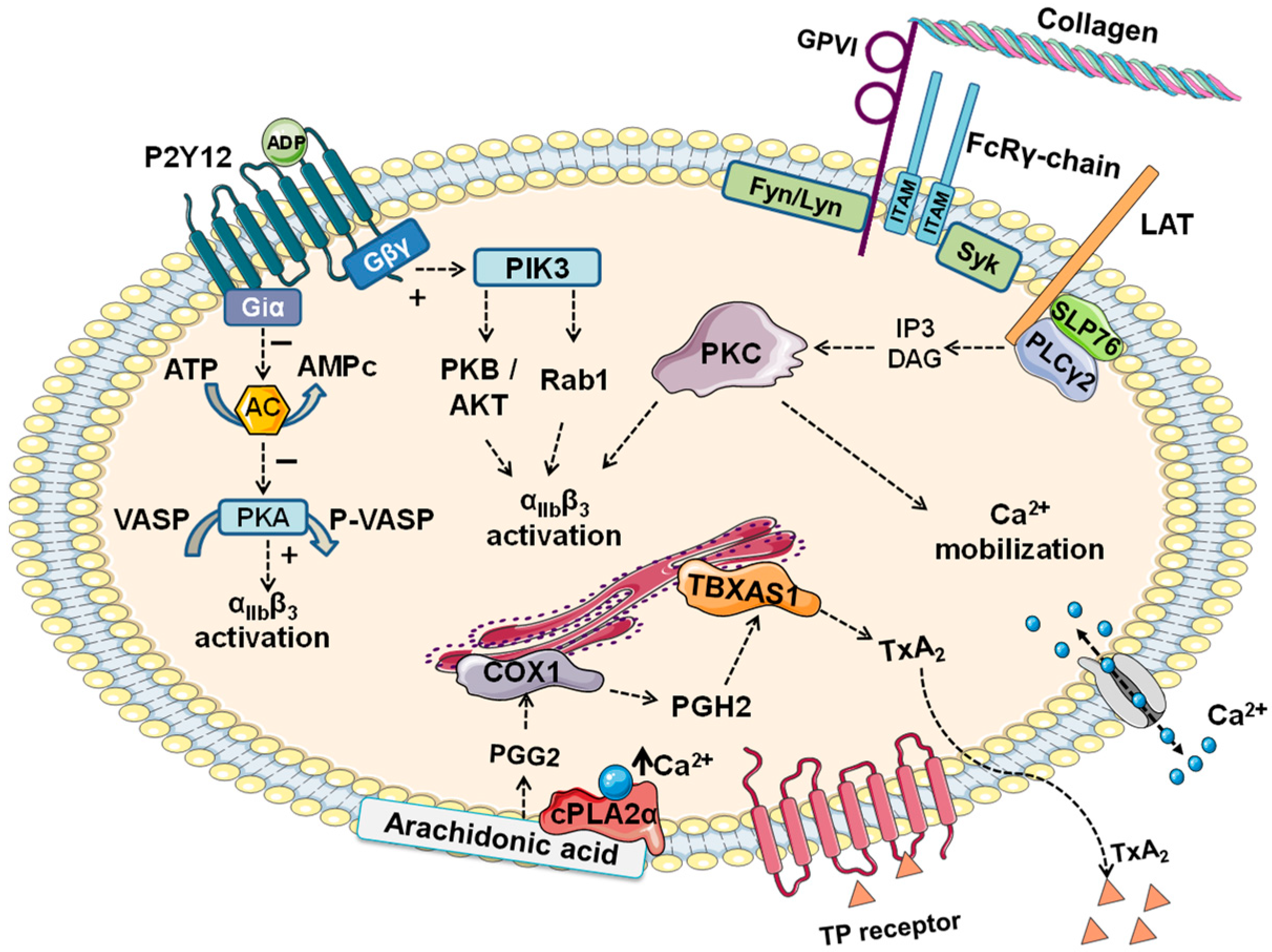
Figure 1. Schematic representation of P2Y12 (top left), GPVI (top right), and TBXAS1 (bottom) pathways. Top left: ADP binds to the receptor, triggering G protein subunit alpha i2 (Gαi2) protein activation. This leads to inhibition of adenylate cyclase, decreasing cyclic adenosine monophosphate (cAMP) production. Thus, protein kinase A (PKA) activity decreases, leading to inactivation of the downstream effector vasodilator-stimulated phosphoprotein (VASP). On the other hand, activation of βγ subunits of Gi promotes activation of phosphoinositide 3-kinase (PI3K). Finally, both Ras-related protein (Rap1b) and protein kinase B (PKB/Akt) contribute to integrin αIIbβ3 (fibrinogen receptor) activation and stabilization of platelet aggregation. Top right: Binding to collagen triggers clustering of GPVI with FcRγ-chain, promoting tyrosine-protein kinases Lyn and Fyn phosphorylation of the immunoreceptor tyrosine-based activation motifs (ITAM). These events lead to the formation of a signalosome due to the recruitment of LAT and SLP-76 kinases. Furthermore, activation of phospholipase C (PLCγ2) promotes diacylglycerol (DAG) and inositol triphosphate (IP3). These messengers mediate Protein kinase C (PKC) activation and Ca2+ mobilization. Bottom: Intracellular Ca2+ levels increase, activating phospholipase A2 (cPLA2α), releasing arachidonic acid (AA) from the membrane. Then, Prostaglandin G2 (PGG2) is processed into Prostaglandin H2 (PGH2) by the action of cicloxigenase-1 (COX1). Afterwards, thromboxane A synthase 1 (TBXAS1) catalyzes the conversion to thromboxane A2 (TxA2). The metabolite binds to the TxA2 receptor (TP) on the membrane, triggering Ca2+ mobilization promoting platelet aggregation. Image was drawn adapting images provided by Servier Medical Art (https://smart.servier.com/, accessed on 21 October 2025), licensed under CC BY 4.0 (https://creativecommons.org/licenses/by/4.0/, accessed on 21 October 2025).
Biomolecules 15 01639 g001
Figure 2. Schematic representation of P2Y12, GPVI, and TBXAS1 structures and domains. (A) Localization of the P2RY12 variants presented in all probands (dotted red lines), as well as all previously reported variants (black dotted lines). Its structure comprises seven transmembrane α-helices (TM), connected by three intracellular (IL), and three extracellular loops (EL). Two potential N-linked glycosylation sites and two disulfide bridges have been identified. Two highly conserved residues (Arg256 and Lys280) are predicted to bind to ADP. (B) Localization of novel GP6 frameshift variant (red dotted line) as well as all previously reported variants (black dotted lines). The extracellular part contains two Ig-like domains (D1 and D2). These domains are followed by a highly O-glycosylated mucin-like region. GPVI also contains different sites of action of protease ADAM10, which allow cleavage of its extracellular portion in response to different stimuli. (C) Localization of novel missense variant in TBXAS1 (red dotted line), as well as previously reported variants (black dotted lines). All relevant residues are highlighted in red circles. N-glycosylation sites are highlighted by blue squares. O-glycosylation sites are highlighted by a dark rhombus. Finally, disulfide bridges are highlighted in black.
Biomolecules 15 01639 g002
Figure 3. Family pedigrees from the patients involved in the study. (A) Pedigrees of two unrelated families with P2Y12 deficiency. (B) Pedigree of a family with GPVI deficiency. (C) Pedigree of a family with TBXAS1 deficiency. Relevant clinical information is highlighted in all probands. MPV: mean platelet volume. ND: not determined.
Biomolecules 15 01639 g003
Figure 4. Platelet function characterization of patients with P2Y12 and GPVI deficiency. (A) Platelet-rich plasma aggregation profiles in response to the indicated agonists. (BE) Flow cytometric analysis of fibrinogen and PAC1 binding, and alpha and dense granules secretion (CD62 and CD63, respectively). (F) Platelet-rich plasma aggregation profiles in response to the indicated agonists. % of maximal aggregation is represented. (GI) Flow cytometric analysis of fibrinogen and PAC1 binding, and alpha and dense granules secretion (CD62 and CD63, respectively). (J) Flow cytometric analysis of platelet glycoproteins expression, only in the P5 patient. Unfortunately, P6, carrying the TBXAS1 (c.1043 C>T [p.Thr348Ile]) variant, declined to be recruited for the platelet phenotype profiling.
Biomolecules 15 01639 g004
Figure 5. Evaluation of the effect of variants in P2RY12 and GP6 in patients’ platelets. (A) P2RY12 mRNA expression in patient platelets relative to the GAPDH gene, used as a housekeeping gene. Unfortunately, P3 samples were not available for this assay. (B) Western blot determination of P2Y12 (β-actin was used as an internal control). (C) Densitometric analysis of protein bands of P2Y12 compared to β-Actin as a control. (D) GP6 mRNA expression in patient platelets relative to the GAPDH gene, used as a housekeeping gene. (E) Quantitative flow cytometric analysis of GPVI expression. Unfortunately, P4 samples were not available for this assay (F) Western blot determination of GPVI (IG5), GPVI (tail), and FcRγ-chain (β-actin was used as an internal control). (G) Densitometric analysis of protein bands of GPVI (IG5) and FcRγ-chain compared to β-Actin as a control. Original Western blot images can be found in Figure S1.
Biomolecules 15 01639 g005
Figure 6. Evaluation of P2Y12 and GPVI signaling pathways in patients’ platelets. (A) VASP phosphorylation assessment expressed by platelet reactivity index (PRI) and determined by the VASP kit PLT VASP/P2Y12 (Biocytex, Stago, Asnières, France). (B) Western blot determination and densitometric analysis of P-SYK, SYK, P-LAT, and LAT expression in washed platelets stimulated with CRP 0–10 μg/μL. β-actin was used as an internal control. P4 samples were not available for this analysis. Original Western blot images can be found in Figure S1. (C) Immunofluorescence analysis of spreading platelets on collagen-coated coverslips incubated for 10–30 min. Platelets were labeled with fluorescein isothiocyanate-phalloidin (green). (D) Quatification of the spreading platelets on collagen. (E) Immunofluorescence analysis of spreading platelets on fibrinogen-coated coverslips incubated for 10–30 min. Platelets were labeled with fluorescein isothiocyanate-phalloidin (green). (F) Quantification of the spreading platelets on fibrinogen. Unfortunately, P4 samples were not available for this analysis.
Biomolecules 15 01639 g006
Figure 7. Characterization of the P2RY12, GP6, and TBXAS1 variants in a cellular model. (A) Flow cytometric determination of DYKDDDK expression in HEK 293 T cells untransfected (UNT) and cells transfected with wild-type P2RY12 and mutant p.Ser15Ilefs*33 and p.Val279Met vectors; N = 4. (B) Flow cytometric determination of DYKDDDK expression in HEK 293 T cells untransfected (UNT) and cells transfected with wild-type GP6 and mutant p.Asn236Lysfs*42 vectors; N = 4. (C) Western blot determination of DYKDDDK expression in 293HEK COX1 cells as a control and 293 T HEK cells untransfected (UNT) and transfected with wild-type GPVI and with p.Asn236Lysfs*42 vectors. β-actin was used as an internal control. (D) Densitometric analysis of protein bands of DYKDDDK compared to β-Actin as a control; N = 1. (E) Western blot determination of GPVI expression in 293 T HEK cells untransfected (UNT) and transfected with wild-type GPVI and with p.Asn236Lysfs*42 vectors. β-actin was used as an internal control. (F) Densitometric analysis of protein bands of GPVI compared to β-Actin as a control. N = 1 (G) Flow cytometric determination of DYKDDDK expression in HEK 293 T cells untransfected (UNT) and cells transfected with wild-type TBXAS1 and mutant p.Thr348Ile vectors;. N = 4. (H) TxB2 levels (ng/mL) in supernatants of cell stimulation reactions from the WT and mutant were measured by ELISA. N = 4. Statistical analysis one-way ANOVA was performed in flow cytometric assays. Statistical analysis two-way ANOVA followed by Tukey’s test, was performed in the ELISA assay. *: p ≤ 0.05, **: p ≤ 0.01, ***: p ≤ 0.001, ****: p ≤ 0.0001. Original Western blot images can be found in Figure S1.
Biomolecules 15 01639 g007
Table 1. Clinical characteristics of patients with suspected IPFD, recruited by GEAPC. W: woman, VUS: variant of uncertain significance.
P1
P2Y12 Deficiency
P2
P2Y12
Deficiency
P3
P2Y12
Deficiency
P4
GPVI
Deficiency
P5
GPVI
Deficiency
P6
TBXAS1
Deficiency
SexWWWWWW
Age
(years old)
306231326761
Platelet count (×109/L)236164233216160Unknown levels, but in normal range
Mean Platelet Volume (fL)1212.58.511.612Unknown levels, but in normal range
Bleeding score (ISTH-BAT)4765810
Type of bleedingModerate bleeding
diathesis
Puerperal bleeding
(2 pregnancies) post-dental procedures
Moderate bleeding
diathesis
Moderate
bleeding
diathesis
Moderate
bleeding
diathesis
Moderate
bleeding diathesis
VariantP2RY12
c.44delG [p.Ser15Ilefs*33]
P2RY12
c.44delG [p.Ser15Ilefs*33]
P2RY12
c.835 G>A [p.Val279Met]
GP6 c.708_711delCGAA [p.Asn236Lysfs*42]GP6 c.708_711delCGAA [p.Asn236Lysfs*42]TBXAS1
c.1043 C>T [p.Thr348Ile]
Variant
status
HeterozygousHeterozygousHeterozygousHeterozygousHeterozygousHeterozygous
Minor allele frequency (MAF)
gnoMAD
Not reported Not reported 0.000095590.00009620.00009620.0000159
Variant classification (ACMG)Likely pathogenicLikely pathogenicVUSPathogenicPathogenicVUS
Disclaimer/Publisher’s Note: The statements, opinions and data contained in all publications are solely those of the individual author(s) and contributor(s) and not of MDPI and/or the editor(s). MDPI and/or the editor(s) disclaim responsibility for any injury to people or property resulting from any ideas, methods, instructions or products referred to in the content.