Article

An Optimized NGS Workflow Defines Genetically Based Prognostic Categories for Patients with Uveal Melanoma

by
Michele Massimino
1,2,*,
Elena Tirrò
2,
Stefania Stella
2,3,
Cristina Tomarchio
2,3,
Sebastiano Di Bella
4,
Silvia Rita Vitale
2,
Chiara Conti
5,
Marialuisa Puglisi
5,
Rosa Maria Di Crescenzo
6,
Silvia Varricchio
6,
Francesco Merolla
7,
Giuseppe Broggi
8,
Federica Martorana
3,
Alice Turdo
9,
Miriam Gaggianesi
4,
Livia Manzella
2,3,
Andrea Russo
1,
Giorgio Stassi
4,
Rosario Caltabiano
8,
Stefania Staibano
6,† and
Paolo Vigneri
3,10,†
add Show full author list remove Hide full author list
1
Department of General Surgery and Medical-Surgical Specialties, University of Catania, 95123 Catania, Italy
2
Center of Experimental Oncology and Hematology, A.O.U. Policlinico “G. Rodolico-S. Marco”, 95123 Catania, Italy
3
Department of Clinical and Experimental Medicine, University of Catania, 95123 Catania, Italy
4
Department of Precision Medicine in Medical, Surgical and Critical Care (Me.Pre.C.C.), University of Palermo, 90127 Palermo, Italy
5
Department of Human Pathology “G. Barresi”, University of Messina, 98125 Messina, Italy
6
Pathology Unit, Department of Advanced Biomedical Sciences, University of Naples Federico II, 80131 Naples, Italy
7
Department of Medicine and Health Sciences “V. Tiberio”, University of Molise, 86100 Campobasso, Italy
8
Department of Medical and Surgical Sciences and Advanced Technologies “G.F. Ingrassia”, Anatomic Pathology, University of Catania, 95123 Catania, Italy
9
Department of Health Promotion, Mother and Child Care, Internal Medicine and Medical Specialties (PROMISE), University of Palermo, 90127 Palermo, Italy
10
Division of Oncology, Humanitas Istituto Clinico Catanese, Misterbianco, 95045 Catania, Italy
*
Author to whom correspondence should be addressed.
These authors share co-senior authorship.
Biomolecules 2025, 15(1), 146; https://doi.org/10.3390/biom15010146
Submission received: 3 September 2024 / Revised: 12 December 2024 / Accepted: 15 January 2025 / Published: 18 January 2025
(This article belongs to the Special Issue Emerging Biomarkers Discovery for Molecular Diagnostics)

Abstract

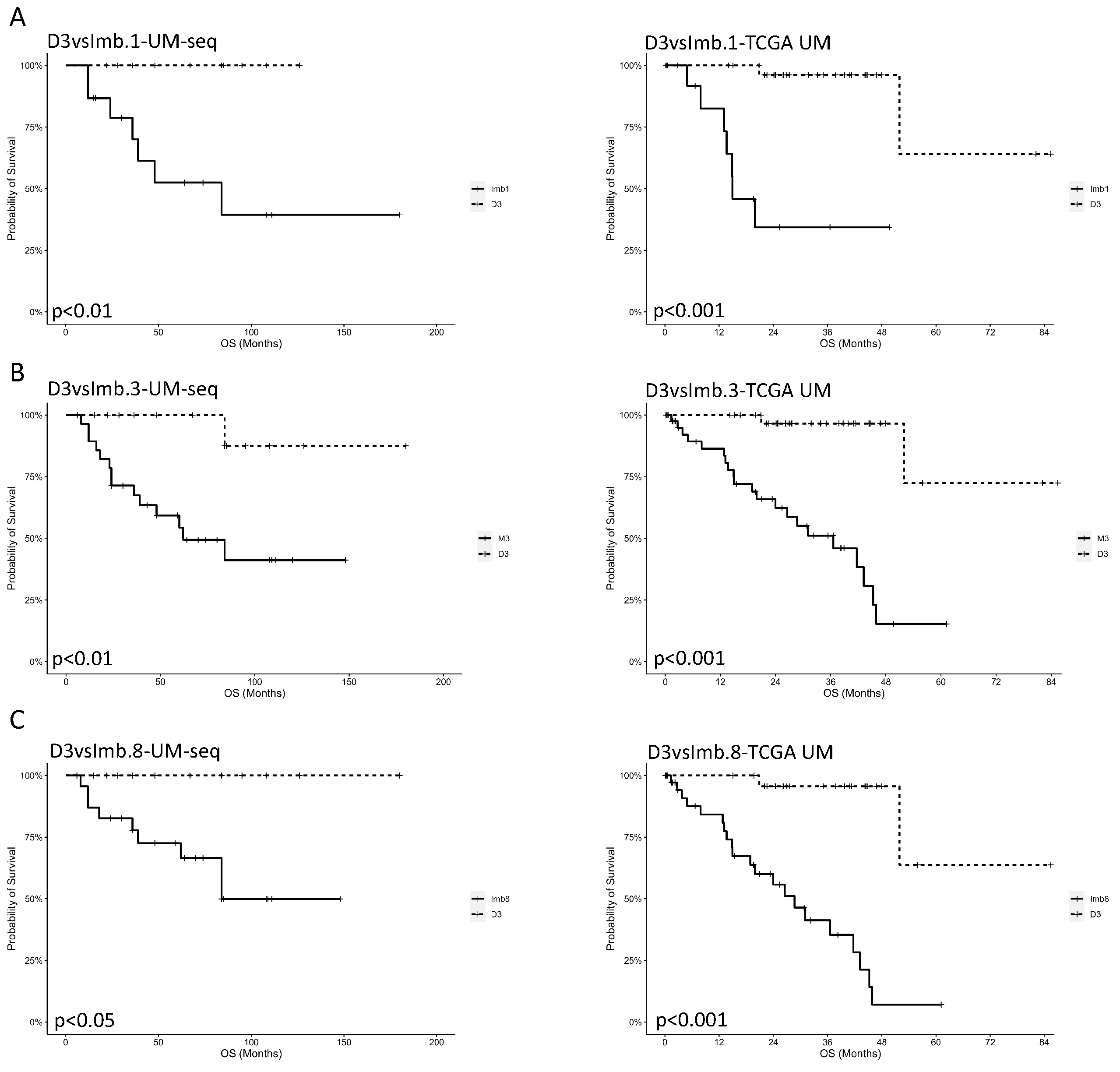
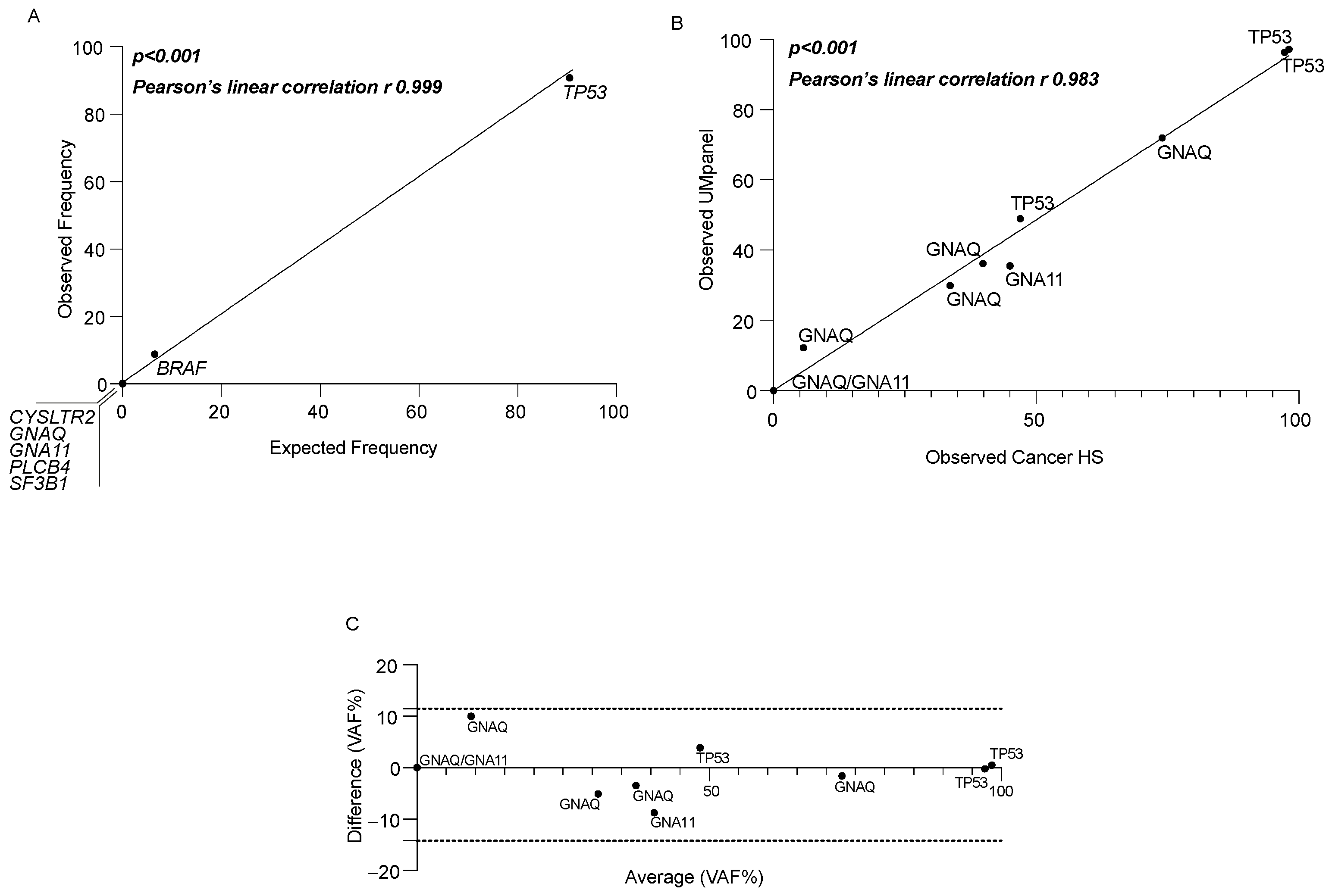
Background: Despite advances in uveal melanoma (UM) diagnosis and treatment, about 50% of patients develop distant metastases, thereby displaying poor overall survival. Molecular profiling has identified several genetic alterations that can stratify patients with UM into different risk categories. However, these genetic alterations are currently dispersed over multiple studies and several methodologies, emphasizing the need for a defined workflow that will allow standardized and reproducible molecular analyses. Methods: Following the findings published by “The Cancer Genome Atlas–UM” (TCGA-UM) study, we developed an NGS-based gene panel (called the UMpanel) that classifies mutation sets in four categories: initiating alterations (CYSLTR2, GNA11, GNAQ and PLCB4), prognostic alterations (BAP1, EIF1AX, SF3B1 and SRSF2), emergent biomarkers (CDKN2A, CENPE, FOXO1, HIF1A, RPL5 and TP53) and chromosomal abnormalities (imbalances in chromosomes 1, 3 and 8). Results: Employing commercial gene panels, reference mutated DNAs and Sanger sequencing, we performed a comparative analysis and found that our methodological approach successfully predicted survival with great specificity and sensitivity compared to the TCGA-UM cohort that was used as a validation group. Conclusions: Our results demonstrate that a reproducible NGS-based workflow translates into a reliable tool for the clinical stratification of patients with UM.
Keywords: molecular profiling; TCGA; uveal melanoma; NGS molecular profiling; TCGA; uveal melanoma; NGS